

















Article Contents
Article ID: CMT2622101008
Views: 43Revisiting Corporate Digital Responsibility in the Digital Era: Lessons from Management and Accounting Theory
 DOI:
DOI:
 PDF
PDF
⬇ Downloads: 2
1School of Management, Chengdu University of Information Technology, Chengdu, China
Received: 01 July, 2026
Accepted: 17 September, 2026
Revised: 14 September, 2026
Published: 28 September, 2026
Abstract:
Introduction: This article constructs a comprehensive system that combines Corporate Digital Responsibility (CDR) with environmental, social, and governance (ESG) goals, green innovation, and management accounting to address the current lack of unified and standardized digital responsible governance methods.
Methodology: This study belongs to conceptual research. This framework is formed through triangulation of stakeholder theory, agency theory, and management control theory, combined with the latest empirical research on digital transformation, green innovation, and ESG performance, as well as emerging literature in the fields of CDR, artificial intelligence ethics, and sustainability accounting.
Discovery: Responsible digitization should be based on CDR principles, while pursuing ESG goals and green innovation. Management accounting provides the information foundation for achieving this connection, making these goals quantifiable and feasible through continuous measurement and validation of balanced scorecards, carbon management accounting, and ESG. This framework distinguishes between experimentally validated relationships and speculative relationships, and proposes three hypotheses for further research.
Originality/Value: This article proposes using CDR as a clear governance hierarchy between digital capabilities and ESG outcomes, endowing three theoretical perspectives with clear division of labor, and mapping the CDR field to the ESG pillar at the tool level, linking it with management accounting tools, thereby expanding research in the field of CDR and sustainable development accounting.
Keywords: Corporate digital responsibility, Environmental Social and Governance (ESG), green innovation, digital transformation, management accounting, sustainability accounting.
1. INTRODUCTION
Algorithm screening of job seekers’ resumes, determination of credit prices, and management of insurance claims; Distributed ledgers track the location of global goods, and the data centers supporting these systems have consumed the energy equivalent to a small city. Digital technology has moved from the edge of business operations to the center. Therefore, a question that combines management and ethical significance arises: in the context of the increasing emphasis on computing to create value in the economy, are organizational leadership, monitoring, and control systems still applicable?
In practice, the gap between technological feasibility and ethical application is constantly widening. When retailers use customer data or manufacturers’ automated carbon emission reports, the responsibility for failure is dispersed and it is often difficult to determine which department is responsible for misclassification, data breaches, or biased recommendations. Management scholars have long been exploring who businesses truly serve (Donaldson & Preston, 1995); The accounting field has surpassed the historical cost category, but the value of data assets has not been reliably evaluated; Although ESG reports have become mainstream, their credibility remains questionable (Berg et al., 2022; Christensen et al., 2022). A system should be established to connect digital functions with accountability mechanisms for daily work, rather than just publishing sustainability reports.
There have been three types of literature exploring this issue, but each study has left some unresolved questions. Firstly, empirical studies linking digitalization with ESG performance have shown a positive correlation (Zhang & Li, 2025; Zhao et al., 2024; Wang & Esperança, 2023), but digitalization is often seen as a capability that can automatically bring sustainability benefits. However, these studies have not explained why the same ability can lead to algorithm bias, privacy breaches, and increased energy consumption, and have almost remained silent on the harm that only occurs in the digital field. Secondly, despite the emerging literature on Carbon Data Disclosure (CDD) (Lobschat et al., 2021; Mihale-Wilson et al., 2022; Mueller, 2022; Jones & Comfort, 2022; Trier et al., 2023; Wirtz et al., 2023) proposed principles of privacy, fairness, inclusivity, and accountability, but relatively little attention was paid to the organizational mechanisms required to implement these principles, such as budgets, indicators, controls, and safeguards. Finally, although mature sustainable accounting tools have been developed, such as the Sustainable Balanced Scorecard (SBSC), carbon accounting, and safeguard practices, these tools are rarely associated with CDR. Therefore, the specific research gap lies in the lack of normative rules and standardized operational processes at the organizational level.
This article explores the following two issues. RQ1: How to integrate CDR, ESG goals, and green innovation into a single governance system for digital transformation? RQ2: How will management accounting be applied to this system?
Therefore, this article draws the following four conclusions. Firstly, to our knowledge, this is the first framework that clarifies the governance hierarchy between carbon reduction as a digital capability and ESG outcomes, with green innovation as the conversion mechanism and management accounting as the operational infrastructure; This positioning is the main innovation of this article. Secondly, the framework combines the perspectives of stakeholders, agency, and management control, and clarifies the division of labor to explain why each perspective is indispensable and insufficient to be used alone. Thirdly, this article derives three propositions (P1-P3), consciously distinguishing between the content supported by existing evidence and the speculative part, thereby providing a verifiable research agenda. Fourthly, this article mapped the CDR field to the ESG pillar at the tool level, corresponding it to specific management accounting tools, providing practical and feasible entry points for managers and accountants.
The subsequent structure of the article is arranged as follows: the second part provides a theoretical basis, explaining the differences and complementary relationships between CDR, CSR, and ESG. The third part presents empirical results, identifies unexplainable issues, and proposes a comprehensive framework and related propositions. The fourth part introduces the management accounting tools provided by the system. The fifth part links the literature review with the research findings of this article. The sixth part lists the contributions, applications, shortcomings, and future research directions of this study.
2. THEORETICAL FOUNDATIONS
2.1. Stakeholder Theory Identifies the Concerned Parties
(Freeman’s, 2010) stakeholder theory suggests that managers should consider all groups influenced or capable of influencing the organization, such as employees, customers, suppliers, communities, shareholders, etc., rather than just focusing on shareholders. Although this theory is sometimes considered overly idealistic, neglecting these stakeholders can result in practical harm such as talent loss, brand damage, litigation, and regulatory tightening. Digitization not only increases the quantity of these costs, but also expands their scope. Data leakage will harm customers who expose their data and investors who suffer losses; Screening algorithms with systemic bias can expose businesses to legal liability and damage their reputation among candidates and the public; Data centers bring climate costs to those who will not engage in business with the company in the future. With the continuous development of enterprise digital systems, more and more people are starting to participate. (Mueller, 2022) further proposes that in the digital age, as decision-making power is increasingly delegated to algorithmic systems, the stakeholder category may need to include both human and technological entities. Regardless of how this viewpoint is extended, its fundamental principle remains consistent: responsibility begins with determining who will bear the consequences of digital behavior. Therefore, stakeholder theory answers the first question in this framework which should be considered, but this alone cannot provide a specific action path to implement this conclusion.
2.2. Principal-Agent Theory Explains the Demand for Credible Information
The first issue is information asymmetry: the principal hires an agent to manage the company, and the agent has a much higher level of understanding of the company’s daily operations than the principal (Jensen & Meckling, 1976). Accountants have started to address this issue to some extent. Digital operations have changed the nature of the problem, but have not completely solved it. They generate forward-looking non-financial data in almost real-time, such as carbon emissions, supply chain risks, customer sentiment, and algorithmic bias indicators; Although these data are often more decision relevant than last year’s profits, their standardization is lower and therefore more susceptible to manipulation. People often say that the measured content will be managed; Otherwise, the measurement would be meaningless. Recent research has confirmed this. (Zhang & Li, 2025) conducted research on Chinese listed industrial enterprises and found that digitization enhances ESG performance by promoting green innovation, transparency, and internal control; (Zhao et al., 2024) tracked similar broad effects through large-scale cross industry panel data, namely improved operational efficiency, reduced agency costs, and increased innovation. Both sets of data indicate that assuming the data obtained by these tools is accurate, digital tools can reduce information asymmetry between managers and external personnel. Therefore, agency theory suggests that the foundation of this system lies in precise measurement of responsible digitization. The blind spot is that the relationship between the principal and the agent does not cover all affected parties.
2.3. Management Control Theory Explains the Organisation of Behaviour
Management accounting is the application of strategy in practice. Its measurement and reward are not neutral; If performance indicators only show short-term financial returns, then investments that cannot immediately recoup costs including many sustainable development and responsibility initiatives will be reduced. The sustainable development path in this field provides a direct tool to address bias. Environmental management accounting tools help businesses reduce costs and minimize environmental damage (Schaltegger & Burritt, 2010), such as carbon footprint accounting, lifecycle cost analysis, and material flow analysis; SBSC (Sustainability and Business Strategy) coordinates environmental and social goals with strategic maps, making sustainability a part of the definition of success rather than an attachment to it (Figge et al., 2002; Hansen & Schaltegger, 2016). Control theory answers the third question in this framework – how to align behavior with the goals of digital responsibility, but it cannot clarify what these goals should be. These contents must be provided from external sources outside the control system.
2.4. Combining Lenses Through Optimised Division of Labour
These three theories are usually mentioned separately in previous research; Here, we will combine them to answer three questions that any feasible digital responsibility system must address: whose interests constitute responsibility? Stakeholder theory. Why does responsibility require specific data? Principal agent theory. How is responsibility reflected in daily life? Management Control Theory. Each of these theories has its own shortcomings when viewed individually. If there is no control mechanism, stakeholder theory will only remain empty talk; If the moral circle is not expanded in the agency theory, only the parties bound by the contract need to bear responsibility; And without normative guidance for control theory, its goals may not be achieved, as evidenced by financial crises and common cases of “green bleaching”. The combination of the three also reveals the practical logic of digital liability issues: damages are borne by stakeholders, hidden due to information asymmetry, and can be prevented through control design. This diversified theoretical foundation meets the demand of the sustainable accounting community for theoretical triangulation of single perspective explanations.
2.5. The Difference Among CDR, CSR and ESG
The second conceptual task is to clarify what content CDR adds to the vocabulary system that already includes CSR and ESG, as these three concepts are often mixed up but should not be confused. CSR is an earlier and broader value-oriented category that encompasses voluntary responsibilities of businesses in the economic, legal, ethical, and philanthropic fields (Carroll, 1991). ESG is an investment risk assessment system that has developed standardized indicators to measure a company’s environmental friendliness, social responsibility, and governance level. CDR is the youngest of these three concepts (Lobschat et al., 2021): it refers to the values and norms shared by organizations in creating, operating, evaluating, and adjusting digital technologies and data (Mueller, 2022; Jones & Comfort, 2022). Table 1 shows its specific content.
Table 1. Conceptual distinctions among CSR, ESG and CDR.
| Dimension | CSR | ESG | CDR |
| Primary object | Firm-wide societal obligations | Standardised assessment of ESG performance | Responsible creation, operation and use of digital technology and data |
| Core focus | Community, labour, philanthropy, environment | Measurable indicators, ratings, disclosure | Data privacy, algorithmic fairness, digital inclusion, footprint of digital infrastructure |
| Principal addressee | Society at large; communities | Investors, rating agencies, regulators | Users, data subjects, participants in the digital ecosystem |
| Time orientation | Ex post; largely voluntary | Ex post; evaluative | Design-oriented and preventive |
| Level of analysis | Firm–society relationship | Organisational performance | Socio-technical system |
| Typical instruments | Philanthropic programmes; codes of conduct | Ratings, benchmarks, sustainability reports | Governance-by-design; algorithmic review; responsible-data procedures |
| Representative references | (Carroll, 1991; Donaldson & Preston, 1995) | (Berg et al., 2022; Christensen et al., 2022) | (Mueller, 2022; Jones & Comfort, 2022; Trier et al., 2023; Wirtz et al., 2023) |
The three contents of Table 1 are explained as follows. Firstly, these three have synergy; CDR can be seen as a manifestation of the specific obligations of CSR arising from dataization and algorithmic decision-making in the digital age (Jones and Comfort, 2022). Secondly, CDR has not filled the gap left by ESG indicators; That is to say, algorithmic accountability and data ethics have not been included in the current rating system, but they belong to governance (G) issues; Digital inclusion is a social (S) issue; The footprint of digital infrastructure is an environmental (E) issue, but it is not fully reflected in most ESG data. Thirdly, this dependence is bidirectional; That is to say, CDR itself does not provide the basic conditions for generating ESG indicators, but rather the ESG measurement mechanism and its guarantee ecosystem make CDR visible to the outside world. Section 3 expands on the above content as a foundation.
3. FROM EMPIRICAL EVIDENCE TO AN INTEGRATED FRAMEWORK
3.1. What the Evidence Shows Now
As this paper belongs to theoretical research, it is necessary to clarify which connections are supported by data and which are not. At present, three research results have received relatively sufficient literature support, although most of these studies focus on Chinese listed companies. Firstly, digitalization is positively correlated with ESG performance (Zhang & Li, 2025; Zhao et al., 2024), and has been applied to small and medium-sized enterprises (Wang & Esperança, 2023). Secondly, digitalization is increasing the quantity and quality of green innovation (Wang & Zhong, 2024). Thirdly, green innovation has to some extent mediated the impact of digitalization on ESG outcomes (Zhang & Li, 2025). However, two additional points need to be noted: firstly, the measurement method is relatively fragile (digital strength is usually represented by text mining indicators, while ESG performance depends on third-party ratings provided by different suppliers, Berg et al., 2022); Secondly, the identification of causal relationships has not yet been fully realized.
3.2. What The Evidence Does Not Explain
Even from a literal perspective, these results do not provide sufficient justification. If digital capabilities can automatically bring sustainable development benefits, then companies with similar levels of digital investment should follow similar ESG development trajectories; But the fact is clearly not so. The recorded correlation coexists with the equally proven digital hazard. Residual differences indicate that certain factors, such as choice, direction, and observation, have not been taken into account in the empirical model between ability and outcome. The following section proposes two conceptual supplements (green innovation as a transformation mechanism; CDR as a governance level) and an infrastructure supplement (management accounting), and views them as propositions rather than outcomes.
3.3. Green Innovation as the Conversion Mechanism
Green innovation refers to the new era of activities that pursue economic and environmental coordination in products, processes, services, and business models. It will demonstrate how digital functions in the system contribute to improving the environment. This model focuses more on the organizational level rather than the technical level: sensor networks visualize waste, data analysis locates its source, distributed ledgers validate green claims but only when these capabilities are combined to create new products, processes, and models will environmental performance change. The above content indicates that the same set of digital tools can generate different ESG outcomes due to the different spaces provided by technology, and innovation can transform some of these spaces into tangible benefits. The intermediary evidence provided by (Zhang & Li, 2025), as well as the quantitative quality research results of (Wang & Zhong, 2024), are consistent with this report.
3.4. CDR as the Governance Layer
Enterprise capability answers what enterprises can do; Green innovation explains how to achieve benefits; But neither of them involves what the enterprise should do. This guidance function is provided by CDR. The record of ethical practices in artificial intelligence is disappointing: despite frequent references to transparency, fairness, and non-harm in guidelines, they are difficult to implement in practice (Jobin et al., 2019; Hagendorff, 2020). Service research reveals the reasons behind this: businesses repeatedly face CDR trade-offs between the commercial value of data usage and privacy and fairness risks (Wirtz et al., 2023), while the broader concept of digital responsibility extends this logic to the social, ethical, and ecological consequences of digitization (Trier et al., 2023). Therefore, CDR should not be seen as another form of reporting, but rather as a design philosophy that actively embeds responsibility into the system itself to prevent problems from occurring, which ESG indicators or green innovation cannot provide independently. CDR guides decision-making by selecting and shaping digital initiatives that align with ESG goals, and establishing review mechanisms to exclude projects whose benefits depend on externalizing digital harm.
3.5. Management Accounting as the Operating Foundation
Management still needs to follow regular management procedures. Section 4 points out that the three major categories of management accounting tools; SBSC, carbon management accounting, and ESG measurement and certification, should be used as the infrastructure for achieving CDR and ESG goals at the practical level, rather than just as ideal goals.
3.6. Integrated Framework and Its Concept
Fig. (1) shows the components of the framework. Digitization (premise) is associated with ESG performance (outcome) through two paths: one is the indirect path, namely green innovation; The other is the direct path, which involves transparency and governance effects. Carbon reduction (governance level) controls these two paths, while management accounting infrastructure (infrastructure level) provides measurement, target setting, control, and disclosure functions for all other parts. The solid arrow represents the relationship supported by the experiment; The dashed arrow represents the association relationship proposed in this article.
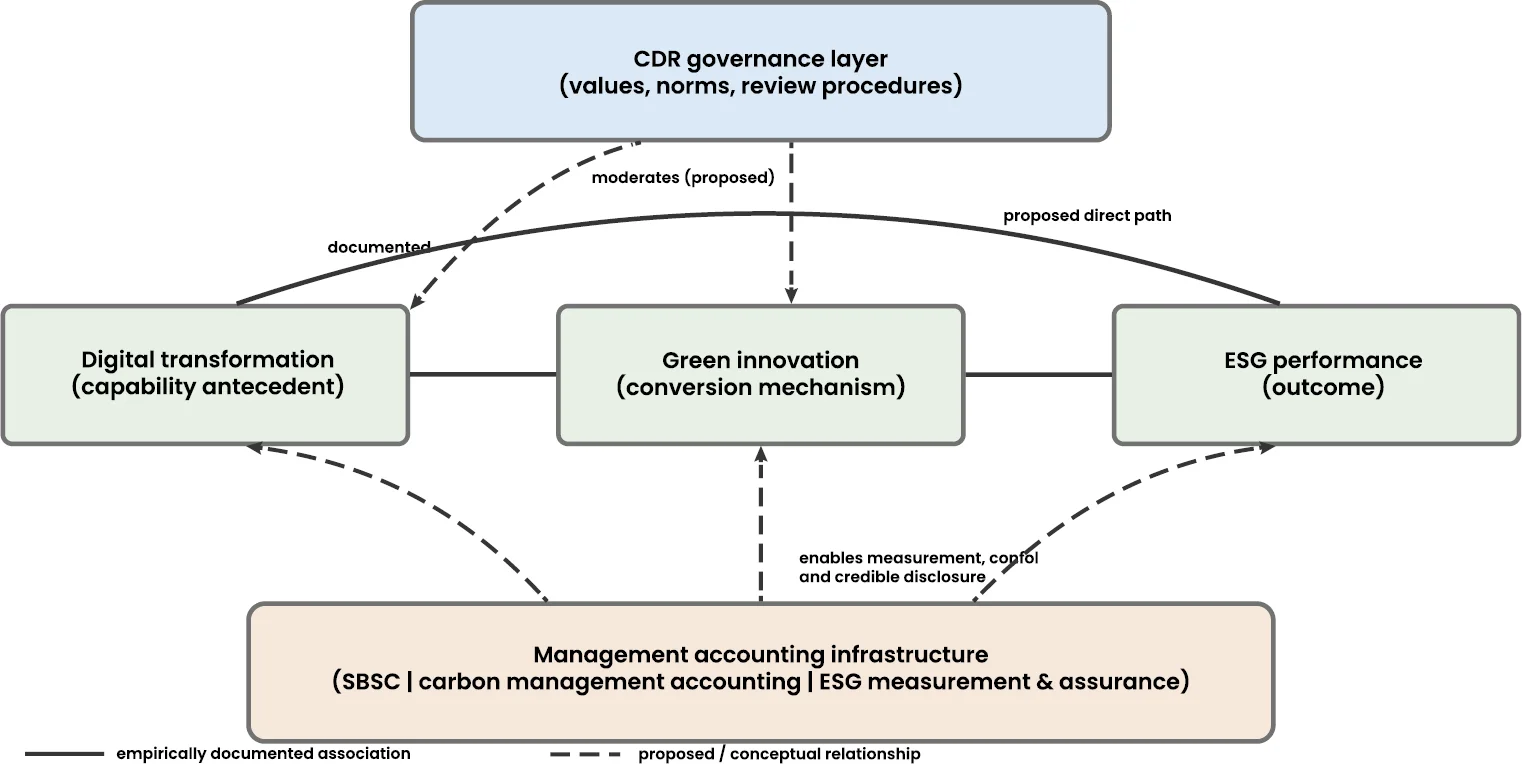
Fig. (1). Integrated framework linking digital transformation, CDR, green innovation, ESG performance and management accounting (solid arrows: empirically verified; dashed arrows: proposed).
The three arguments of this article are as follows. Each argument has its supporting reasons; The first one summarizes the existing evidence, while the second and third ones further expand upon it.
Digitization is positively correlated with ESG performance, with green innovation playing a partial mediating role in this relationship (P1). This argument integrates the content of Section 3.1: direct evidence comes from the research of (Zhang & Li, 2025, Zhao et al., 2024; and Wang & Esperança, 2023); The mediating role was proposed by (Zhang & Li, 2025) and confirmed by the association between digitalization and green innovation recorded by (Wang & Zhong, 2024). The theoretical bridge lies in the conversion logic in Section 3.3: digital capabilities enhance the upper limit that companies can achieve, while green innovation determines how much of this upper limit can be converted into ESG performance.
The higher the maturity of corporate CDR governance, the stronger the direct correlation between digitalization and ESG, as well as the indirect path formed through green innovation (P2). This is the most controversial claim of the framework, and it is precisely for this reason that it has been presented. The three reasons are as follows: from a regulatory perspective, mature CDR governance will choose digital projects whose returns do not depend on external damage, thereby biased investment portfolios towards results that meet ESG requirements; From a behavioral perspective, review procedures and training make responsible practices the norm rather than the exception; In the business environment, the costs borne by stakeholders due to bias and privacy breaches, such as litigation and talent loss, will offset the expected ESG benefits brought by digitization; Therefore, companies lacking CDR governance will receive weaker and unsustainable returns. (Jobin et al., 2019; Hagendorff, 2020; and Wirtz et al., 2023) have provided background support for the gap between ethical implementation of artificial intelligence and CDR computation; And direct verification requires a new CDR maturity measurement standard (Mueller, 2022; Trier et al., 2023).
Management accounting infrastructure; SBSC deployment, carbon management accounting, and ESG measurement and validation, helps to translate CDR commitments and digital investments into measurable ESG outcomes (P3). This is a theoretical reason, lacking supporting data. The management control theory holds that only when intentions are decomposed into goals, indicators, control measures, and incentive mechanisms, can they be transformed into actual behavior (Figge et al., 2002; Hansen & Schaltegger, 2016); The agency theory further states that the information generated must have credibility in order to effectively motivate behavior (Jensen & Meckling, 1976), therefore the verification process plays an important role in this process (Berg et al., 2022; Christensen et al., 2022). Section 4 elaborates on the operational mechanism of the tool.
4. MANAGEMENT ACCOUNTING TOOLS FOR RESPONSIBLE DIGITAL TRANSFORMATION
In this system, management accounting will adopt different approaches to establish specific accountability indicators for abstract concepts. Each of the following tool categories corresponds to different failure modes in responsible digitization: SBSC focuses on the issue of failing to translate principles into goals; Carbon management accounting focuses on the issue of failing to control digital footprints; ESG measurement and assurance focus on the issue of information disclosure being difficult to effectively persuade.
4.1. Sustainable Balanced Scorecard from Principles to Goals
Due to excessive focus on financial performance, managers have short sightedness issues, hence the introduction of the balanced scorecard (Kaplan & Norton, 1996). The balanced scorecard integrates environmental and social goals into the framework of four perspectives: finance, customers, internal processes, and learning and growth. It can be used as a fifth perspective, a supplementary indicator to the original four perspectives, or as an additional supporting scorecard (Figge et al., 2002). A systematic review found that this tool has been used to promote the integration of sustainable development in strategic implementation (Hansen & Schaltegger, 2016; Mio et al., 2022).
Its value for digital citizenship lies in translation. The CDR principle is essentially a declaration of intent; SBSC transforms it into quantifiable, time limited, and enterprise managed indicators. For example, companies can set carbon intensity targets for data centers from an environmental perspective; Set privacy events and digital inclusion indicators from the customer’s perspective; Set the coverage scope of algorithm review procedures and model documents from the perspective of internal processes; Set the completion rate of digital ethics training from a learning perspective. Therefore, this scorecard can be incorporated into the same KPI system along with ESG goals and digital responsibilities, becoming a regular management object rather than a special project. The chain of evidence for the results is transmitted through the control logic of P3: the content measured, rewarded, and evaluated by the scorecard is exactly the actions that the organization will actually take.
There are two aspects to note: the scorecard is only effective when its data can guide actual decision-making; Otherwise, complex dashboards that are not used for daily management will become known failure modes. Therefore, the assessment cycle and the weight of non-financial indicators in the incentive mechanism must be included in the tool design from the beginning, rather than being added afterwards.
4.2. Carbon Management Accounting that Makes Digital Footprints Clear and Visible
The reason why the environmental cost of digitization is relatively easy to overlook is precisely because it is dispersed at various levels. The data center consumes a large amount of electricity; Some computationally intensive applications, such as cryptocurrency mining, have attracted attention due to their emission issues; In addition, the production and scrapping of equipment also bring external costs, but these costs are rarely reflected in financial statements. Carbon management accounting helps to reveal damage and manage it (Schaltegger & Burritt, 2010; Schaltegger & Csutora, 2012).
In corporate practice, greenhouse gas agreements are used to report direct emissions (Scope 1), indirect emissions from purchased energy (Scope 2), and all other emissions in the value chain (Scope 3). The management accountant converts the emission inventory derived from this into a shadow carbon price and uses it as input for investment evaluation and product level cost increase, so that pricing reflects environmental costs (Schaltegger & Csutora, 2012). For highly digitized enterprises, the scope of accounting is twofold: it includes not only the emissions from IT infrastructure, but also the carbon offsets reduced through digital substitution, such as optimized logistics and remote work, and AI assisted energy management. Honesty in accounting is crucial: the emissions of most technology companies fall within Scope 3, with scattered data, frequent double counting, and no unified standards established yet; Research on the quality of carbon disclosure has found that the actual scope of reporting often exceeds the depth and balance of reporting (Pitrakkos & Maroun, 2020). A responsible carbon accounting system will acknowledge the aforementioned deficiencies and will not claim false accuracy. The correlation between the results is directly clear: the tool provides both the environmental dimension of CDR and the E-pillar in ESG, as well as emission data for SBSC targets and ESG disclosure.
4.3. ESG Measurement, Disclosure, and Assurance at the Credibility Level
High-quality disclosure can simultaneously achieve the following three objectives: reducing information asymmetry between the company and its stakeholders, reliably conveying management commitments, and indirectly generating data for internal improvement. Digitization can improve the quality of information disclosure through real-time data collection, automated verification, and communication with stakeholders (Liu et al., 2026).
Technology cannot guarantee the authenticity of objects. The differences in ESG ratings among these institutions stem from different measurement methods, rather than changes in scope or weight (Berg et al., 2022), and surprisingly, the higher the level of disclosure, the greater the dispersion of ratings (Christensen et al., 2022). In fact, quality and assurance are more important than quantity. This is precisely the field of management accountants, whose training in measurement systems, internal controls, and reporting directly corresponds to the issues faced by ESG and digital responsibility disclosure. It is currently unclear whether the profession will take on this role or transfer the responsibilities to a dedicated sustainability consultant; According to the viewpoint of this article, the required skills are more suitable for those who can combine ESG measurement with digital responsibility understanding.
4.4. Mapping Instruments to CDR and ESG Domains
Table 2 shows how each tool is connected to the CDR domain and ESG outcomes, presenting the working logic of P3.
Table 2. Mapping management-accounting instruments to CDR domains and ESG outcomes.
| Instrument | CDR Domain Served | ESG Pillar | Mechanism Linking Instrument to Outcomes | Key References |
| SBSC | All domains (steering) | E, S and G jointly | Converts CDR principles and ESG goals into targets, weights and rewards across four perspectives | (Figge et al., 2002; Hansen & Schaltegger, 2016; Mio et al., 2022) |
| Carbon management accounting | Environmental footprint of digital infrastructure | E | Makes digital emissions visible across Scopes 1–3; supports shadow pricing, investment appraisal and abatement choices | (Schaltegger & Burritt, 2010; Schaltegger & Csutora, 2012; Pitrakkos & Maroun, 2020) |
| ESG measurement, disclosure and assurance | Accountability to external stakeholders | G (with E and S) | Reduces information asymmetry; generates internal data for improvement | (Berg et al., 2022; Christensen et al., 2022; Liu et al., 2026) |
5. LINK THE LITERATURE WITH THE CONCLUSION
Table 3 connects the various clues in the literature reviewed with the conclusions drawn from them, presenting evidence supporting all claims.
Table 3. Matrix linking the reviewed literature to the study’s conclusions.
| Literature Strand | Key Insights | Conclusions Drawn Here | Representative References |
| Stakeholder theory | Ignoring stakeholders imposes tangible costs; corporate purpose extends beyond shareholders | Digital transformation widens the stakeholder field; responsibility must be defined for all affected parties | (Donaldson & Preston, 1995; Freeman, 2010) |
| Principal–agent theory | Information asymmetry enables agent opportunism; measurement disciplines it | Credible measurement of non-financial, real-time data is a precondition for responsible digitalisation | (Jensen & Meckling, 1976); Zhang & Li, 2025; Zhao et al., 2024) |
| CDR | Digital technologies create obligations that CSR and ESG only partially cover | CDR complements CSR and ESG rather than replacing them; framework’s governance layer | (Jones & Comfort, 2022; Mueller, 2022; Mihale-Wilson et al., 2022; Trier et al., 2023) |
| AI ethics and digital governance | Principles are widely accepted but weakly enforced; audit practice is emerging | Responsibility must be operationalised through controls, review procedures and assurance | (Jobin et al., 2019; Hagendorff, 2020; Hermann, 2022) |
| Digital transformation, green innovation and ESG | Digitalisation improves ESG performance via innovation, information and governance channels | Green innovation is the pivotal channel converting digital capability into environmental outcomes; governance conditions the conversion | (Wang & Esperança, 2023; Zhang & Li, 2025; Zhao et al., 2024; Wang & Zhong, 2024) |
| ESG reporting, ratings and assurance | Rating divergence stems mainly from measurement; more disclosure can widen disagreement | Credible ESG communication requires disclosure quality, independent assurance and honest treatment of measurement bounds | (Berg et al., 2022; Christensen et al., 2022; Pitrakkos & Maroun, 2020; Liu et al., 2026) |
| Management accounting and control | Performance-management systems can embed sustainability in strategy execution | Management accounting supplies the operational infrastructure that turns digital responsibility from intention into practice | (Figge et al., 2002; Schaltegger & Burritt, 2010; Hansen & Schaltegger, 2016; Mio et al., 2022) |
| Carbon and sustainability accounting | Carbon accounting supports decisions from compliance to strategy | The environmental footprint of digitalisation must be measured and managed, with acknowledged uncertainty | (Schaltegger & Csutora, 2012; Pitrakkos & Maroun, 2020) |
CONCLUSION
Summary
Firstly, good intentions are not sufficient to achieve digital citizenship; Technology alone cannot achieve this. Only by consciously integrating Customer Data Recording (CDR) principles, ESG goals, and green innovation can responsible digital transformation be achieved, and management accounting will make this integration measurable and actionable. Digital technology has expanded the scope that enterprises can achieve; And this framework clarifies what enterprises should do and how to internalize ‘what should be done’ as part of the organization’s daily operations.
How Each Component Responds to Research Questions
The research problem, namely the lack of a comprehensive system that connects digitization with proactive responsibility, has been decomposed into several components. Digitization is a prerequisite; It expands capabilities, and empirical research shows that higher ESG performance is correlated with this (Zhang & Li, 2025; Zhao et al., 2024), but improving abilities does not automatically lead to responsible behavior. Green innovation is a transformative model that refers to how digital capabilities can be utilized to achieve environmental benefits (Wang & Zhong, 2024; Zhang & Li, 2025). CDR is the level that guides the development of capabilities towards ethical and sustainable goals, and it addresses digital age issues that CSR and ESG frameworks only partially address (Jones & Comfort, 2022; Mueller, 2022; Trier et al., 2023). ESG performance is a result indicator. Management accounting solves operational problems by transforming normative commitments into goals, indicators, internal controls, and credible disclosure information, thereby turning responsibility into practical actions rather than empty talk (Kaplan & Norton, 1996; Schaltegger & Csutora, 2012; Hansen & Schaltegger, 2016).
THEORETICAL CONTRIBUTIONS
These three theories are as follows: in theory, the three major theories of stakeholders, agency, and management control have the following division of labor: the first one specifies who is affected by digital transformation; The second explanation is why reliable information is needed; The third item explains how to align behavior with digital responsibility goals. Each item is considered necessary, but looking at any one item alone is not enough to fully achieve the goal. From a conceptual perspective, Corporate Digital Responsibility (CDR), Corporate Social Responsibility (CSR), and Environmental, Social, and Governance (ESG) are different. They are not opposed to each other, but should work together. Firstly, CDR is positioned as a governance level for achieving digital capabilities and ESG outcomes, with green innovation serving as a conversion mechanism. In practice, it implements the framework by specifying management accounting tools and proposes three propositions to distinguish between existing evidence and speculation, thus forming a verifiable agenda.
PRACTICAL IMPLICATIONS
Managers should consider the carbon dioxide emissions throughout their entire lifecycle when selecting technologies; ESG goals should be integrated into the design phase of digital strategies, rather than added afterwards, and corresponding measurement capabilities should be established before stricter regulations are introduced. The training of accounting profession should expand traditional management models, incorporate data ethics and algorithm transparency into measurement and control, so that accountants can ensure the reliability of ESG information and algorithm information. Policymakers and standard setting agencies should focus on the credibility of disclosures and safeguards for algorithmic systems, rather than increasing the number of reports; Standardized measurement may be more effective than requiring more reports.
LIMITATIONS AND FUTURE DIRECTION
As a conceptual and literature-based study, this article does not provide new data, therefore the system and its claims need to be systematically validated. The priority path is as follows: firstly, it is necessary to empirically verify the maturity of CDR through questionnaire surveys or archival data, and then test the feasibility of P2; Secondly, the empirical basis is limited to Chinese listed companies, and it is not yet clear whether the mechanisms recorded can be extended to other institutional environments as well as small and medium-sized or private enterprises (Wang & Esperança, 2023); Thirdly, there is still a relative lack of research on the handling of intangible assets, platform dynamics, and algorithmic assets by SBSC; Fourthly, there are methodological issues with the measurement boundaries of Scope 3 carbon accounting, data asset valuation, and algorithmic system assurance, and accounting research happens to have the conditions to address these challenges; Finally, proxy based artificial intelligence systems have raised issues regarding the allocation of responsibilities between enterprises and their deployment techniques, which may require adjustments to the CDR framework. A company that can combine the above elements is one where digitalization can support long-term development, not just improve efficiency.
LIST OF ABBREVIATIONS
CDR | = | Corporate Digital Responsibility |
CSR | = | Corporate Social Responsibility |
ESG | = | Environmental, Social, and Governance |
AUTHORS’ CONTRIBUTIONS
Z.Z. and J.G. have contributed to the study conceptualization, methodology, data analysis, interpretation of results, and manuscript writing.
CONSENT FOR PUBLICATION
Not applicable.
AVAILABILITY OF DATA AND MATERIALS
The data will be made available on reasonable request by contacting the corresponding author [J.G.].
FUNDING
None.
CONFLICT OF INTEREST
The authors declare that there is no conflict of interest regarding the publication of this article.
ACKNOWLEDGEMENTS
Declared none.
DECLARATION OF AI
During the preparation of this manuscript, the author used ChatGPT for language editing and refinement purposes. Following the use of this tool, the author carefully reviewed and revised the content where necessary and accepts full responsibility for the final published version of the article.
REFERENCES
Berg, F., Kölbel, J. F., & Rigobon, R. (2022). Aggregate confusion: The divergence of ESG ratings. Review of Finance, 26(6), 1315–1344.
https://doi.org/10.1093/rof/rfac033
Carroll, A. B. (1991). The pyramid of corporate social responsibility: Toward the moral management of organizational stakeholders. Business Horizons, 34(4), 39–48.
https://doi.org/10.1016/0007-6813(91)90005-G
Christensen, D. M., Serafeim, G., & Sikochi, A. (2022). Why is corporate virtue in the eye of the beholder? The case of ESG ratings. The Accounting Review, 97(1), 147–175.
https://doi.org/10.2308/TAR-2019-0506
Donaldson, T., & Preston, L. E. (1995). The stakeholder theory of the corporation: Concepts, evidence, and implications. The Academy of Management Review, 20(1), 65–91.
https://doi.org/10.2307/258887
Figge, F., Hahn, T., Schaltegger, S., & Wagner, M. (2002). The sustainability balanced scorecard: Linking sustainability management to business strategy. Business Strategy and the Environment, 11(5), 269–284.
https://doi.org/10.1002/bse.339
Freeman, R. E. (2010). Strategic management: A stakeholder approach. Cambridge University Press.
https://doi.org/10.1017/CBO9781139192675
Hagendorff, T. (2020). The ethics of AI ethics: An evaluation of guidelines. Minds and Machines, 30, 99–120.
https://doi.org/10.1007/s11023-020-09517-8
Hansen, E. G., & Schaltegger, S. (2016). The sustainability balanced scorecard: A systematic review of architectures. Journal of Business Ethics, 133, 193–221.
https://doi.org/10.1007/s10551-014-2340-3
Hermann, E. (2022). Leveraging artificial intelligence in marketing for social good: An ethical perspective. Journal of Business Ethics, 179, 43–61.
https://doi.org/10.1007/s10551-021-04843-y
Jensen, M. C., & Meckling, W. H. (1976). Theory of the firm: Managerial behavior, agency costs and ownership structure. Journal of Financial Economics, 3(4), 305–360.
https://doi.org/10.1016/0304-405X(76)90026-X
Jobin, A., Ienca, M., & Vayena, E. (2019). The global landscape of AI ethics guidelines. Nature Machine Intelligence, 1, 389–399.
https://doi.org/10.1038/s42256-019-0088-2
Jones, P., & Comfort, D. (2022). Corporate digital responsibility: Approaches of the leading IT companies. In M. G. Wynn (Ed.), Handbook of research on digital transformation, industry use cases, and the impact of disruptive technologies (pp. 231–248). IGI Global Scientific Publishing.
https://doi.org/10.4018/978-1-7998-7712-7.ch013
Kaplan, R. S., & Norton, D. P. (1996). The balanced scorecard: Translating strategy into action. Harvard Business School Press. Available from: https://store.hbr.org/product/the-balanced-scorecard-translating-strategy-into-action/6513
Liu, J., Yuan, Y., & Zhu, Z. (2026). The role of artificial intelligence in enhancing ESG disclosure quality in accounting. Journal of Risk and Financial Management, 19(1), 58.
https://doi.org/10.3390/jrfm19010058
Lobschat, L., Mueller, B., Eggers, F., Brandimarte, L., Diefenbach, S., Kroschke, M., & Wirtz, J. (2021). Corporate digital responsibility. Journal of Business Research, 122, 875–888.
https://doi.org/10.1016/j.jbusres.2019.10.006
Mihale-Wilson, C., Hinz, O., van der Aalst, W. M. P., & Weinhardt, C. (2022). Corporate digital responsibility: Relevance and opportunities for business and information systems engineering. Business & Information Systems Engineering, 64, 127–132.
https://doi.org/10.1007/s12599-022-00746-y
Mio, C., Costantini, A., & Panfilo, S. (2022). Performance measurement tools for sustainable business: A systematic literature review on the sustainability balanced scorecard use. Corporate Social Responsibility and Environmental Management, 29(2), 367–384.
https://doi.org/10.1002/csr.2206
Mueller, B. (2022). Corporate digital responsibility. Business & Information Systems Engineering, 64, 689–700.
https://doi.org/10.1007/s12599-022-00760-0
Pitrakkos, P., & Maroun, W. (2020). Evaluating the quality of carbon disclosures. Sustainability Accounting, Management and Policy Journal, 11(3), 553–589.
https://doi.org/10.1108/SAMPJ-03-2018-0081
Schaltegger, S., & Burritt, R. L. (2010). Sustainability accounting for companies: Catchphrase or decision support for business leaders? Journal of World Business, 45(4), 375–384.
https://doi.org/10.1016/j.jwb.2009.08.002
Schaltegger, S., & Csutora, M. (2012). Carbon accounting for sustainability and management: Status quo and challenges. Journal of Cleaner Production, 36, 1–16.
https://doi.org/10.1016/j.jclepro.2012.06.024
Trier, M., Kundisch, D., Beverungen, D., Müller, O., Schryen, G., Mirbabaie, M., & Trang, S. (2023). Digital responsibility: A multilevel framework for responsible digitalization. Business & Information Systems Engineering, 65, 463–474.
https://doi.org/10.1007/s12599-023-00822-x
Wang, S., & Esperança, J. P. (2023). Can digital transformation improve market and ESG performance? Evidence from Chinese SMEs. Journal of Cleaner Production, 419, 137980.
https://doi.org/10.1016/j.jclepro.2023.137980
Wang, X., & Zhong, X. (2024). Digital transformation and green innovation: Firm-level evidence from China. Frontiers in Environmental Science, 12, 1389255.
https://doi.org/10.3389/fenvs.2024.1389255
Wirtz, J., Kunz, W. H., Hartley, N., & Tarbit, J. (2023). Corporate digital responsibility in service firms and their ecosystems. Journal of Service Research, 26(2), 173–190.
https://doi.org/10.1177/10946705221130467
Zhang, W., & Li, X. (2025). Digital transformation and corporate ESG performance: Evidence from China. Journal of Computational and Cognitive Engineering, 4(2), 195–207.
https://doi.org/10.47852/bonviewJCCE42023387
Zhao, F., Han, Z., & Wang, L. (2024). Digitization path to improve ESG performance: A study on organizational perspectives. PLOS ONE, 19(12), e0313686.
https://doi.org/10.1371/journal.pone.0313686
Licensed
© 2026 Copyright by the Authors.
Licensed as an open access article using a CC BY 4.0 license.
Article Contents Author Abdul Ghafoor Memon1, * 1Emaan Institute of Management Sciences, Karachi, Pakistan Article History: Received: 01 April, 2026
Article Contents Authors Zixuan Zhao1, Ju Guo1, * 1School of Management, Chengdu University of Information Technology, Chengdu, China Article History:
Article Contents Authors Sultan Ud Din Yousufzai1, Amtyaz Safi2, * Maher Khan1, Zia Ud Din1 1Department of Zoology, Govt. College
Article Contents Author Nasir Uddin Khan1, * 1Department of Emaan Institute of Management Sciences, Karachi, Pakistan Article History: Received:
Article Contents Authors Putri Syabillah1 , Dian Pratiwi1, * , Anung Barlianto Ariwibowo1 1Department of Informatics Engineering, Universitas Trisakti, Jakarta,
Article Contents Author Srigopal Mohanty1, * 1Siksha O Anusandhan University, Bhubaneswar, India Article History: Received: 01 July, 2026 Accepted: 03