




Editorial workflow
At Content Majestic Publisher (CMP), we believe that the path from a researcher’s idea to a published, globally accessible article should be transparent, efficient, and author-friendly. Every step in our editorial process is designed to ensure that the research we publish is original, scientifically rigorous, ethically conducted, and presented to the highest standard.
Our process has two major phases:
Pre-Publication Process: Manuscript Submission & QA → Initial Editorial Decision→ Peer Review Cycle → Revision Process → Final Editorial Decision → Acceptance
Post-Acceptance and Final Publication: Formal Acceptance → Final QA & Reference Check → DOI Generation → Copyediting & Typesetting → Author Proofing → Final Editorial Check → Publication (HTML, PDF, XML) → Indexing → Archiving (PORTICO)
Complete Process at a Glance
The flowchart below is the master reference for the editorial process. The top section shows Pre-Publication Processing and the bottom section shows Post-Acceptance Processing. Refer to this diagram as you read each phase below.
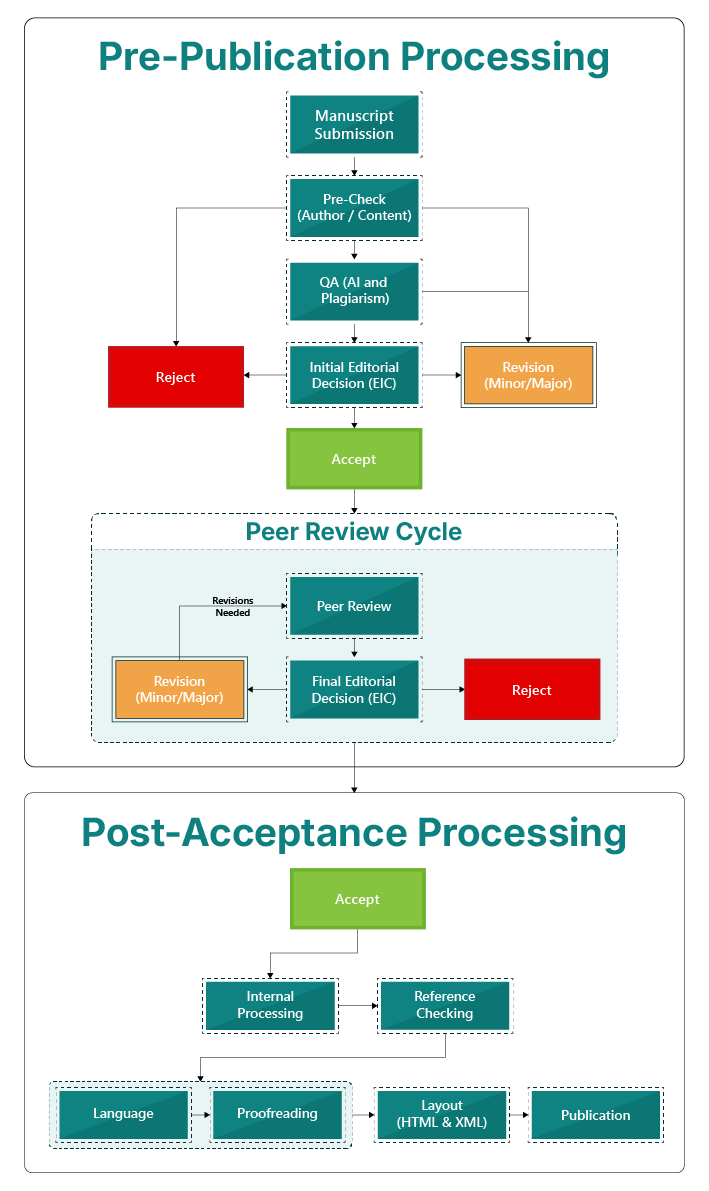
Complete Editorial Flowchart – Pre-Publication (top) and Post-Acceptance (bottom) Processing
Pre-Publication Process
The pre-publication process is the foundational stage of our editorial workflow, designed to evaluate the suitability, originality, and ethical integrity of all submissions. This rigorous phase ensures that only high-quality, ethically sound research advances to the peer-review cycle.
1. Manuscript Submission & QA
Authors submit their manuscripts through the OJS portal. The Journal Editor performs a 3-5 day administrative check to confirm the submission’s suitability before it is evaluated by the Editor-in-Chief (EIC).
Key checks performed at this stage include:
- Aims & Scope Alignment: Verification that the research topic falls within the journal’s specific scientific focus.
- Article Type Compliance: Ensuring the manuscript meets the specific criteria and guidelines for the declared article type.
- File Format Compliance: Ensuring the manuscript file is submitted in the correct format (Word .docx) and that all required supplementary files are included.
- Content & Quality Assurance: Conducting thorough content verification, including screening via Turnitin (or equivalent) for plagiarism and the identification of AI-generated content.
- Author Verification: Confirming the validity of author details, institutional affiliations, and the completeness of mandatory declarations (e.g., funding, data availability, and COI).
- Ethical Compliance & Mandatory Declarations: Verification of all required information, including IRB/ethics committee approval, informed consent, Conflict of Interest (COI) statements, funding sources, data availability, and AI use disclosure.
- Initial Action: If major issues are detected, the manuscript is returned to the author for revision. If the submission is fundamentally incomplete, out of scope, or contains significant ethical/integrity issues, it may be rejected. Otherwise, the submission is forwarded to the EIC for an initial editorial decision.
2. Initial Editorial Decision
After passing QA, the manuscript is assigned to the Editor-in-Chief (EIC) for an Initial Editorial Decision. This is a scholarly assessment of scope fit, scientific merit, originality, and peer-review readiness — it is not peer review itself.
EIC assessment criteria
- Does the research topic fall within the journal’s specific scientific focus?
- Does the study address a genuine research question with clear scientific significance?
- Is the work original, does it make a contribution beyond the existing literature?
- Is the methodology at a standard appropriate for external peer review?
- Is the manuscript of interest to the journal’s readership?
- Are there any ethical concerns requiring resolution before review proceeds?
Initial decision options
| Decision | Meaning |
| Send for peer review | Meets the standard for external review |
| Minor pre-review revision | Specific issues to fix before review |
| Major pre-review revision | Substantial gap in scope or methods |
| Desk reject | Below threshold; revision cannot resolve |
The EIC’s decision on desk rejections is final. Authors may submit to a different CMP journal if scope was the reason for rejection. For all other decisions, the final publication decision follows completion of peer review.
Note: Following successful EIC approval and before the manuscript is sent for peer review, the editorial office will ensure the manuscript is fully anonymized to support our double-blind peer-review model.
3. Peer Review Cycle
Following the initial editorial approval, the peer-review cycle proceeds according to the following core points:
- Double-blind peer review process is followed for all manuscripts to ensure fairness and impartiality. Authors do not know the identities of the reviewers, and reviewers do not know the identities of the authors throughout the review process.
- At least two independent external experts are selected based on strict criteria, including holding a PhD (or equivalent), possessing demonstrated subject-matter expertise, and maintaining complete institutional and professional independence from the authors. All prospective reviewers are also thoroughly screened for actual, potential, or perceived conflicts of interest.
- Reviewers are required to provide evidence-based, constructive feedback that identifies both strengths and specific areas for improvement, ensuring the process supports the authors in enhancing their research quality.
- Based on the reviewers’ feedback, the Editor-in-Chief (EIC) issues a final decision of Accept, Revision Required (Minor/Major), or Reject.
- In addition to reviewer feedback, the Editorial Office may communicate further quality or compliance requirements.
- Following the editorial decision, authors receive consolidated, specific decision letters that clearly explain the basis for the outcome, ensuring transparency at every stage of the peer-review journey.
For more detailed description of the peer-review process:
4. Revision Process
When revision is requested, authors must submit a revised manuscript through the OJS portal along with a detailed, point-by-point response to all reviewer and editorial comments within the specified timeframe.
Once resubmitted, the revised manuscript will be re-evaluated by the reviewers. These re-evaluation comments are then forwarded to the Editor-in-Chief (EIC) for a final editorial decision.
Following the EIC’s review, the final decision, Accept, Revise Again (if within the revision limits), or Reject will be formally communicated to the author.
A manuscript will normally undergo no more than two rounds of revision.
If no response is received within the permitted timeframe and no extension has been officially granted, then the Editorial Office will send reminder emails, followed by a final reminder specifying a firm submission deadline. If this final deadline is crossed, the submission will be considered withdrawn.
Any manuscript resubmitted after it has been administratively closed or withdrawn may be treated as a new submission.
If the manuscript is rejected after revision, the decision is final; however, authors may appeal via email to the Editorial Office within 30 days. Appeals are evaluated by the Editor-in-Chief (EIC) or an independent board member.
For further details on the appealing process:
Post-Acceptance and Final Publication
This phase ensures the seamless transition of an accepted manuscript into a high-quality, discoverable scholarly asset. It encompasses comprehensive quality assurance, rigorous reference verification, and professional formatting, culminating in the publication of the article in multiple accessible formats (HTML, PDF, and XML) with a unique DOI, followed by secure, long-term digital archiving.
- Once a manuscript is formally accepted, it is transferred to the production department.
- Following formal acceptance, a rigorous final QA check is conducted, including a comprehensive review mandatory declarations and all references to ensure accuracy, proper formatting, and compliance with journal standards.
- A Digital Object Identifier (DOI) is generated and assigned to the manuscript to ensure its permanent, unique identification and citability.
- Professional copyeditors perform a thorough review to ensure the manuscript meets the journal’s standards.
- The manuscript is professionally typeset according to the specific design requirements. The Journal Editor conducts a final check of the formatted files to ensure all figures, tables, and citations are correctly rendered.
- A composed proof is sent to the author for a final check; authors are requested to provide any necessary corrections within a defined turnaround time.
- The article is published in HTML, PDF, and XML versions to ensure broad accessibility and machine readability.
- Metadata is finalized and prepared for submission to academic databases and indexing services to ensure maximum discoverability.
- A digital record is generated and deposited in PORTICO to ensure long-term preservation and permanent archiving.
Timeline Summary
Stage | Target Time |
Pre-check and QA | 5 working days |
Initial editorial decision | 5 working days |
Peer-review | 4–6 weeks |
Author revision (minor) | 2 weeks |
Author revision (major) | 3-4 weeks |
Post-review/re-review decision | 1-2 weeks |
Production (copyediting + XML/HTML/PDF) | 1-2 weeks |
Proof finalization | 1-2 weeks |
Online publication | 5 days after approved proof |
Total (submission to publication) | 12-16 weeks (typical) |
Editorial Conduct and Ethical Compliance
Editorial decisions are made exclusively by the Editor-in-Chief (EIC) and designated academic editors, based solely on scholarly merit, peer-review feedback, ethical integrity, and alignment with journal scope. While the publisher and Editorial Office provide essential administrative and production support, they exercise no influence over editorial outcomes. To ensure complete impartiality, Editors, Guest Editors, and board members are strictly prohibited from handling their own submissions; any conflict of interest (actual, potential, or perceived) triggers an immediate reassignment of the manuscript to an independent editor in accordance with established publication ethics.
We are committed to upholding the highest standards of editorial excellence by adhering to the COPE Practices and internationally recognized best practices in scholarly publishing. Our editorial processes ensure transparency, editorial independence, rigorous peer review, ethical research conduct, conflict of interest management, data integrity, and the responsible handling of corrections and retractions. Guided by the recommendations of COPE, ICMJE, and the Principles of Transparency and Best Practice in Scholarly Publishing, we strive to maintain a fair, ethical, and trustworthy publishing environment.
Transparency and Website Information
- All journal policies, guidelines, editorial information, APC details, and contact information are clearly displayed and regularly updated on the journal website.
Last updated on July 16, 2026