










Article Contents
Article ID: CM2601105010
Views: 49Personalising Higher-Education Curricula with AI: A Systematic Review of AI-Driven Adaptive Learning Systems
 DOI:
 PDF
⬇ Downloads: 1
1Indus University, Karachi, Pakistan
Received: 25 August, 2026
Revised: 07 October, 2026
Accepted: 09 October, 2026
Published: 22 October, 2026
ABSTRACT:
Introduction: Artificial intelligence is increasingly used to adapt higher-education curricula through learner modelling, sequencing, feedback, assessment and recommendation.
Methodology: This systematic review aims to present a synthesis of evidence with an emphasis on techniques, mechanisms of adaptation, learning outcomes, barriers to implementing AI-driven curriculum personalisation, and evidence certainty. Records from 2020 to 2025 were identified using PRISMA 2020 in the following databases: Scopus, Web of Science, IEEE Xplore, ERIC, ACM Digital Library, ScienceDirect, SpringerLink and citation searching. A total of 32 records were retained after screening, comprising 17 primary empirical or primary technical evidence records and 15 contextual, review-level, theoretical or analytical records. Empirical evidence was appraised using domains informed by MMAT, while relevant qualitative aspects were assessed using CASP principles without numerical scoring. Outcome certainty was summarised using a GRADE-informed framework.
Results: Machine learning, deep learning, natural language processing, recommender systems, intelligent tutoring systems and generative AI supported adaptive sequencing, personalised feedback, difficulty adjustment, resource recommendation and targeted intervention. Evidence was strongest for engagement, satisfaction, responsiveness to feedback and short-term academic performance, and weakest for long-term retention, dropout reduction, fairness and institutional scalability.
Conclusion: Common challenges in implementation were privacy, algorithmic bias, explainability, faculty readiness, and digital infrastructure and access. The review therefore supports cautious, problem-focused adoption and emphasises longitudinal, controlled and equity-focused evaluation.
Keywords: Adaptive learning, artificial intelligence, curriculum personalisation, higher education, learning analytics, intelligent tutoring systems, generative AI.
INTRODUCTION
A variety of learners’ backgrounds in higher education now include prior knowledge, language profile, digital competence, career aspirations, study habits and academic preparedness. Fixed curricula are efficient for administration, but also hold the assumption that students will be able to follow the same content, pace and assessment sequence. This is a harder-to-justify assumption in large, hybrid, international and digitally mediated universities. The ability of digital platforms to distribute resources does not necessarily ensure equitable access, and online access alone does not constitute curriculum personalisation. The central issue is whether institutions can design pedagogically meaningful, ethically controlled and empirically based personalised curriculum experiences with the help of the evidence produced by learners [1–3].
One answer to this challenge is that AI systems can process data on learner interaction, assessment records, clickstream behaviour, language inputs, prior achievement indicators, and learner preferences to a scale beyond the capacity of manual monitoring by teachers. Machine-learning models can be used for learner classification, academic risk prediction, performance pattern identification and targeted intervention [4, 5]. Conversational feedback, automated explanation, open-response analysis and chatbot-mediated academic support are some areas where NLP can be used [6]. LMSs can be used to match learners with material, examples, activities, and academic selections [7, 8]. Intelligent Tutoring Systems and generative AI can scaffold, explain, prompt, and give formative feedback [9–12]. Other e-learning intelligence models have also been reported as having potential learning-performance benefits, the extent of which differs in implementations [13]. They present potential opportunities for curriculum personalisation, and challenges related to bias, explainability, privacy, academic integrity and human-automation balance.
AI-driven curriculum personalisation is different from traditional e-learning. In static e-learning, materials can be online, but they are basically the same for all learners [9]. An adaptive system, on the other hand, adapts the learning experience by adjusting at least one component based on learner evidence. Adaptation can be done at a resource level (through access to different readings, videos or examples); at a task level (by changing the difficulty of the tasks and/or providing feedback); at a pathway level (by changing the sequence of tasks); at an assessment level (through remediation, acceleration or adaptive testing); or at an institutional level (through targeted support). This distinction from operation makes it easier to avoid considering normal digitisation or administrative automation as personalisation of the curriculum.
There are a few previous reviews which have investigated the use of AI in education [14–16] and adaptive learning, recommender systems, learning analytics and generative AI, but with varying focus and expectations for evidence. Some integrate the school, professional and university environments; others focus on algorithmic taxonomies but fail to connect techniques with the functions of curriculum and measurable results in higher education. Also, there is a variety in the reporting of effects in primary studies and the equity analysis and assessment of long-term scalability [17–19]. The present review, therefore, concentrates specifically on adaptive learning in higher education as supported by AI, and explores the specific AI techniques that facilitate specific personalisation mechanisms, the results reported, the quality of the evidence, and the identified implementation challenges for adoption.
There have been several recent reviews on AI-enabled adaptive learning, recommender systems, generative AI & digital learning environments. The present review is different in that it synthesises elements of the AI technique, the personalisation mechanism at the curriculum level, the outcome domain, the evidence certainty, and the governance safeguards within a higher education-specific synthesis. Table 1 compares the present review with closely related work and clarifies that the present review does not provide another list of AI tools, but rather an evidence and governance perspective.
Table 1. Positioning of the present review against closely related studies.
| Prior Review | Main Focus | Limitation or Gap Addressed by the Present Review |
| (Kamal et al., 2024) [8] | Recommender systems for academic choices in higher education | Focuses specifically on academic recommendation, whereas the present review covers broader curriculum personalisation, including feedback, sequencing, assessment adaptation, learner profiling and governance. |
| (Gligorea et al., 2023) [9] | Adaptive learning using artificial intelligence in e-learning environments | Offers important technical and conceptual coverage, but does not systematically separate AI technique, curriculum-personalisation mechanism, outcome domain and implementation risk in higher education. |
| (Tlili et al., 2025) [19] | Broad AI-supported adaptive learning and educational transformation | Provides wide field-level coverage but gives less direct attention to higher-education curriculum functions, evidence certainty and governance safeguards. |
| Present Review | AI-driven curriculum personalisation in higher education | Separates empirical evidence from contextual reviews, maps AI techniques to curriculum-level mechanisms, grades evidence certainty and proposes a governance-aware evidence framework for responsible adoption. |
This comparison shows that the contribution of the present review is not merely the collection of recent AI-in-education studies, but the integration of evidence around curriculum function, empirical certainty and responsible implementation in higher education.
This study is guided by five research questions. RQ1 asks which artificial-intelligence techniques are used to support adaptive learning and curriculum personalisation in higher education. RQ2 examines the mechanisms of personalisation applied in these systems, including adaptive sequencing, personalised feedback, recommendation, assessment adaptation and learner profiling. RQ3 evaluates the reported learning outcomes, including achievement, engagement, satisfaction, retention and feedback responsiveness. RQ4 assesses the strength of the empirical evidence through quality appraisal, risk-of-bias judgement and effect-size extractability. RQ5 identifies the technical, ethical, pedagogical and institutional barriers that influence implementation. The contribution of the review is threefold: first, it separates primary empirical evidence from contextual and review-level evidence; second, it connects AI techniques to curriculum-level personalisation functions; and third, it proposes an evidence-and-governance framework for responsible AI adoption in higher education.
METHODOLOGY
The study adopted a systematic literature review design based on PRISMA 2020 guiding principles [20]. The protocol was structured around five research questions, where identification, screening, eligibility assessment, extraction, appraisal and synthesis were organised. This review is not prospectively registered, this information is reported here for transparency and is taken into account in the limitations. Due to the fact that the scope was limited to higher education, student autonomy, curriculum flexibility, assessment design, institutional governance and data-protection requirements are distinct from those in the K-12 environment. Hence, undergraduate and postgraduate, technical-university, college and equivalent tertiary contexts were prioritised.
Searches were conducted on Scopus, Web of Science, IEEE Xplore, ERIC, ACM Digital Library, ScienceDirect and SpringerLink, as well as Google Scholar verification and backwards and forward citation chasing. The search was limited to English-language scholarly publications published between 2020 and 2025. Three Concept blocks were merged: (A) AI, machine learning, deep learning, natural language processing/NLP, learning analytics, intelligent tutoring systems, recommender systems, chatbots, generative AI and large language models; (P) adaptive learning, personalised learning, adaptive curriculum, curriculum personalisation, learning pathways, adaptive assessment, personalised feedback; and (H) higher education, university, undergraduate, postgraduate, college, technical university and tertiary education. Table 2 details the syntax and limits of the fields in the database. The exact date each database was executed was not recorded in the source search log, so these dates are not reported as invented, but as not retained.
Table 2. Database-specific search strategy, limits and reproducibility information.
| Source | Database-Specific Search String/Field | Limits | Search Date/Role |
| Scopus | TITLE-ABS-KEY((“artificial intelligence” OR AI OR “machine learning” OR “deep learning” OR “natural language processing” OR NLP OR “learning analytics” OR “intelligent tutoring system” OR “recommender system” OR chatbot OR “generative AI” OR “large language model”) AND (“adaptive learning” OR “personalised learning” OR “personalised learning” OR “adaptive curriculum” OR “curriculum personalisation” OR “curriculum personalisation” OR “learning pathway” OR “adaptive assessment” OR “personalised feedback” OR “adaptive sequencing”) AND (“higher education” OR university OR undergraduate OR postgraduate OR college OR “technical university” OR “tertiary education”)) | 2020-2025; English; peer-reviewed article/conference records | Exact execution date not retained; core indexed search |
| Web of Science | TS=((“artificial intelligence” OR AI OR “machine learning” OR “deep learning” OR “natural language processing” OR NLP OR “learning analytics” OR “intelligent tutoring system” OR “recommender system” OR chatbot OR “generative AI” OR “large language model”) AND (“adaptive learning” OR “personalised learning” OR “personalised learning” OR “adaptive curriculum” OR “curriculum personalisation” OR “curriculum personalisation” OR “learning pathway” OR “adaptive assessment” OR “personalised feedback” OR “adaptive sequencing”) AND (“higher education” OR university OR undergraduate OR postgraduate OR college OR “technical university” OR “tertiary education”)) | 2020-2025; English; scholarly records | Exact execution date not retained; cross-disciplinary search |
| IEEE Xplore | (“All Metadata”:(“artificial intelligence” OR AI OR “machine learning” OR “deep learning” OR “natural language processing” OR NLP OR “learning analytics” OR “intelligent tutoring system” OR “recommender system” OR chatbot OR “generative AI” OR “large language model”)) AND (“All Metadata”:(“adaptive learning” OR “personalised learning” OR “personalised learning” OR “adaptive curriculum” OR “curriculum personalisation” OR “curriculum personalisation” OR “learning pathway” OR “adaptive assessment” OR “personalised feedback” OR “adaptive sequencing”)) AND (“All Metadata”:(“higher education” OR university OR undergraduate OR postgraduate OR college OR “technical university” OR “tertiary education”)) | 2020-2025; journals/full conference papers | Exact execution date not retained; technical implementation search |
| ERIC | (“artificial intelligence” OR AI OR “machine learning” OR “deep learning” OR “natural language processing” OR NLP OR “learning analytics” OR “intelligent tutoring system” OR “recommender system” OR chatbot OR “generative AI” OR “large language model”) AND (“adaptive learning” OR “personalised learning” OR “personalised learning” OR “adaptive curriculum” OR “curriculum personalisation” OR “curriculum personalisation” OR “learning pathway” OR “adaptive assessment” OR “personalised feedback” OR “adaptive sequencing”) AND (“higher education” OR university OR undergraduate OR postgraduate OR college OR “technical university” OR “tertiary education”) | 2020-2025; English; peer-reviewed where available; title/abstract/descriptor fields | Exact execution date not retained; education-focused search |
| ScienceDirect | (“artificial intelligence” OR AI OR “machine learning” OR “deep learning” OR “natural language processing” OR NLP OR “learning analytics” OR “intelligent tutoring system” OR “recommender system” OR chatbot OR “generative AI” OR “large language model”) AND (“adaptive learning” OR “personalised learning” OR “personalised learning” OR “adaptive curriculum” OR “curriculum personalisation” OR “curriculum personalisation” OR “learning pathway” OR “adaptive assessment” OR “personalised feedback” OR “adaptive sequencing”) AND (“higher education” OR university OR undergraduate OR postgraduate OR college OR “technical university” OR “tertiary education”) | 2020–2025; English; scholarly records; platform-supported title/abstract/keyword searching | Exact execution date not retained; supplementary publisher search |
| SpringerLink | (“artificial intelligence” OR AI OR “machine learning” OR “deep learning” OR “natural language processing” OR NLP OR “learning analytics” OR “intelligent tutoring system” OR “recommender system” OR chatbot OR “generative AI” OR “large language model”) AND (“adaptive learning” OR “personalised learning” OR “personalised learning” OR “adaptive curriculum” OR “curriculum personalisation” OR “curriculum personalisation” OR “learning pathway” OR “adaptive assessment” OR “personalised feedback” OR “adaptive sequencing”) AND (“higher education” OR university OR undergraduate OR postgraduate OR college OR “technical university” OR “tertiary education”) | 2020–2025; English; scholarly records; platform-supported search fields | Exact execution date not retained; supplementary publisher search |
| ACM Digital Library | (“artificial intelligence” OR AI OR “machine learning” OR “deep learning” OR “natural language processing” OR NLP OR “learning analytics” OR “intelligent tutoring system” OR “recommender system” OR chatbot OR “generative AI” OR “large language model”) AND (“adaptive learning” OR “personalised learning” OR “personalised learning” OR “adaptive curriculum” OR “curriculum personalisation” OR “curriculum personalisation” OR “learning pathway” OR “adaptive assessment” OR “personalised feedback” OR “adaptive sequencing”) AND (“higher education” OR university OR undergraduate OR postgraduate OR college OR “technical university” OR “tertiary education”) | 2020–2025; English; journal and conference literature; platform-supported metadata searching | Exact execution date not retained; supplementary computing search |
| Google Scholar/citation chasing | (“adaptive learning” OR “personalised learning” OR “personalised learning” OR “adaptive curriculum” OR “curriculum personalisation” OR “curriculum personalisation” OR “learning pathway” OR “adaptive assessment” OR “personalised feedback” OR “adaptive sequencing”) AND (“higher education” OR university OR undergraduate OR postgraduate OR college OR “technical university” OR “tertiary education”) AND (“artificial intelligence” OR “machine learning” OR “generative AI”) plus backward/forward citation checks | 2020-2025 for retained citations | Exact execution date not retained; verification and citation chasing |
The eligibility and screening process was conducted in a staged manner according to a predetermined procedure. Records were considered for inclusion if they were published between 2020 and 2025, concerned a higher-education or clearly transferable tertiary setting, described an AI-enabled personalisation or adaptive-learning intervention that modified at least one curriculum-related component, and contained empirical, technical, implementation or governance evidence relevant to the review questions. Records were excluded when they did not provide specific evidence of AI-based adaptation, described generic e-learning without adaptive AI features, applied AI only to administrative functions, lacked sufficient relevance to curriculum personalisation, or were unavailable as full text. Review-level, bibliometric, theoretical and conceptual sources were not used as evidence of learning effectiveness but could be retained for positioning purposes. Following the deletion of the duplicates and obviously ineligible reports, 469 titles and abstracts were screened, 157 reports were requested, 146 full texts were evaluated, and 32 reports were retained. Table 3 includes 17 primary empirical or primary technical evidence records and 15 contextual, review-level, theoretical or analytical records. Primary evidence was used to support claims concerning observed outcomes, implemented mechanisms and system behaviour, whereas contextual and review-level sources were used to support theoretical positioning, comparison and gap identification.
Table 3. Evidence matrix of 17 primary empirical/technical and 15 contextual/review-level records.
| Ref. | Year | Context | Design | AI Technique/Focus | Higher-education Relevance | Outcome Focus | Quality | Role in Synthesis |
| [2] | 2025 | Global | Bibliometric/analytical study | AI-driven adaptive learning and educational transformation | Broad education with strong adaptive-learning relevance | Sustainability, personalisation, access and transformation | Moderate | Contextual / review-level |
| [3] | 2021 | Higher education | Empirical study | Predictive learning analytics and emotionally adaptive learning | Higher education institutions | Student affect responses, adaptive support and predictive intervention | Moderate | Primary evidence: empirical |
| [5] | 2024 | Public student datasets | Comparative ML/DL modelling study | RF, SVM, XGBoost, neural networks, CNN and other ML models | Student outcome prediction datasets | Prediction accuracy and learner-performance modelling | High | Primary evidence: technical |
| [6] | 2022 | Global | Review | NLP for educational feedback analysis | Relevant to AI feedback and adaptive learning systems | Feedback analysis, NLP challenges and implementation barriers | Moderate | Contextual / review-level |
| [8] | 2024 | Higher education | Systematic review | Recommender systems for academic choices | Higher education | Academic recommendation, programme/course choice and personalisation | High | Contextual / review-level |
| [9] | 2023 | Global e-learning | Literature review | AI/ML in adaptive e-learning | E-learning and higher-education relevance | Engagement, retention, performance and adaptive pathways | Moderate | Contextual / review-level |
| [10] | 2024 | USA | Pilot implementation study | Hybrid rule-based and AI/ML intelligent assistant | Postgraduate learners | Engagement, content understanding and adaptive feedback | Moderate | Primary evidence: empirical |
| [11] | 2023 | Global | Bibliometric / content analysis | Generative AI in education | Educational settings including higher education | Assessment, personalised support and intelligent tutoring | High | Contextual / review-level |
| [12] | 2023 | Hong Kong | Survey empirical study | Generative AI tools such as ChatGPT | 399 undergraduate and postgraduate students | Perceptions, personalised support, privacy and ethical concerns | High | Primary evidence: empirical |
| [14] | 2024 | Computer science education | Meta-analysis | AI-supported computer science education | Higher/computer science education relevance | Learning achievement and AI-supported instruction | High | Contextual / review-level |
| [16] | 2024 | South Africa / global | Scoping review | Personalised adaptive learning platforms | Undergraduate higher education | Academic performance and engagement | High | Contextual / review-level |
| [17] | 2025 | Global | Systematic review | ML, DL, RL and multimodal AI | Digital adaptive learning | Personalisation, learner engagement and educational equity | High | Contextual / review-level |
| [18] | 2024 | Pakistan | Controlled experimental study | Deep learning-based personalised pathways | University courses | Grades, test scores, engagement and satisfaction | High | Primary evidence: empirical |
| [19] | 2025 | Global | Meta-analysis/research synthesis | AIEd interventions | Education studies with relevance to learning achievement | Achievement effects and evidence strength | High | Contextual / review-level |
| [21] | 2025 | Jordan | Empirical case study | Generative AI and NLP-supported graphic-design tools | Higher education graphic-design students | Creativity, engagement and learner perception | Moderate | Primary evidence: empirical |
| [22] | 2025 | Ghana | Mixed-method empirical study | AI-enhanced LMS and adaptive learning theory | Technical universities | Sustainable course delivery, content alignment and learning support | Moderate | Primary evidence: empirical |
| [23] | 2025 | Malaysia and Ghana | Survey / SEM | ChatGPT and NLP-based interaction | Undergraduate students | Motivation, autonomy, competence and continuous-use intention | Moderate | Primary evidence: empirical |
| [24] | 2024 | UAE and Saudi Arabia | SEM adoption study | Generative AI chatbots | Students and educators in higher education | Trust, perceived usefulness and adoption intention | Moderate | Primary evidence: empirical |
| [25] | 2025 | Ecuador and Spain | Applied empirical system study | Supervised learning-based adaptive learning system | Technical education | Problem-solving performance and adaptive task progression | High | Primary evidence: empirical |
| [26] | 2024 | Sweden and Egypt | Prototype-based empirical evaluation | Conversational AI learning bot | Higher-education users | Question answering, feedback support and interaction quality | Moderate | Primary evidence: empirical |
| [27] | 2025 | Higher education | Semester-based empirical study | AI optimisation algorithms for personalised teaching | University teaching and management | Learning outcomes, engagement, satisfaction and efficiency | Moderate | Primary evidence: empirical |
| [28] | 2024 | Multi-context education setting | Mixed-method empirical study | AI-driven adaptive learning systems | Students and educators, including higher education | Pre/post achievement, completion and engagement | Moderate | Primary evidence: empirical |
| [29] | 2024 | General education | Theory-building / qualitative model | Adaptive personalisation theory and AI-supported learning | Broad education with higher-education relevance | Motivation, engagement, retention and ethical safeguards | Low–Moderate | Contextual / review-level |
| [30] | 2022 | Kazakhstan and Russia | Case/survey empirical study | AIEd tools, chatbots, expert systems and intelligent agents | Second-year university students | Personalised pathways, real-time feedback and flexible learning | Moderate | Primary evidence: empirical |
| [31] | 2025 | Online education | Experimental / mixed-method study | ML/NLP adaptive online education technologies | Online learners with higher-education relevance | Knowledge retention, engagement, cognitive skills and adaptability | Moderate | Primary evidence: empirical |
| [32] | 2025 | Higher education | Data-driven curriculum innovation study | Predictive analytics, ML, NLP and recommender systems | College curriculum | Completion, retention, dropout reduction and academic performance | Moderate | Primary evidence: empirical |
| [33] | 2024 | Global e-learning | Systematic analysis | AI personalisation and adaptive assessment | E-learning and higher-education relevance | Performance, motivation, adaptive assessment, bias and ethics | High | Contextual / review-level |
| [34] | 2025 | Global e-learning | Systematic literature review | AI-enabled personalised learning and adaptive learning systems | Higher and tertiary education | Personalised learning pathways, learner engagement, academic performance, implementation challenges, privacy, scalability and educator readiness | Moderate | Contextual / review-level |
| [35] | 2023 | Global | Systematic review of empirical studies | AI in online and distance learning | Online and distance education | Adaptive/personalised learning and student behaviour prediction | High | Contextual / review-level |
| [36] | 2024 | Global | Review/case analysis | Generative AI in adaptive learning | Adaptive and personalised learning cases | Engagement, test scores, skill development and implementation barriers | Moderate | Contextual / review-level |
| [37] | 2024 | Higher education institutions | Quantitative adoption study | AI-enabled assessment and teaching tools | 250 faculty members in higher education | Faculty engagement, AI adoption, perceived risk and performance expectancy | Moderate | Primary evidence: empirical |
| [38] | 2025 | Global higher education | Systematic review of leading articles | AI-based personalised learning | SSCI Q1 higher-education literature | Equity, pedagogy, outcomes and interdisciplinary collaboration | High | Contextual / review-level |
Quality appraisal included the use of Design Appropriateness Domains informed by the Mixed Methods Appraisal Tool (MMAT) and Critical Appraisal Skills Programme (CASP) principles (if qualitative aspects were relevant). MMAT and CASP principles were not converted into numerical scores or combined into checklist totals. Rather, their principles guided a structured judgement, which spanned clarity of the research aim; appropriateness of design; sampling adequacy; description of the AI intervention; validity of outcome measures; adequacy of analysis; reporting transparency; ethical considerations; and coherence between evidence and conclusions. The ratings were as follows: High – generally acceptable evidence, no major concerns in the three principal design domains (measurement, analysis, and design); Moderate – generally credible evidence with one or two substantive limitations in the three principal design domains (measurement, analysis, and design); or Low-Moderate – several substantive limitations, including short follow-up, a dominant self-report, an incomplete description of the intervention, and small samples or indirect outcomes in the three principal design domains (measurement, analysis, and design). Primary outcome evidence did not include contextual/review level records.
A total of 469 records have been assessed during title-and-abstract screening against the predetermined eligibility criteria. Following this stage, 157 reports were sought for retrieval, and 146 full-text reports were assessed for eligibility. Disagreements between reviewers were resolved through discussion and consensus before final inclusion decisions were made. Inter-reviewer agreement was 93.8% (Cohen’s κ = 0.82) for title-and-abstract screening and 96.6% (Cohen’s κ = 0.88) for full-text screening.
The data extraction was done in a structured matrix including the author, the year of publication, the country of origin, the study design, the type of artificial intelligence technique, the higher education context, the personalisation mechanism, outcome measures, statistical indicators, implementation barriers, ethical issues and quality rating. Means, standard deviations, p-values, confidence intervals, regression or SEM coefficients, percentages and sample sizes were noted where reported. Only where published information was adequate, standardised effect sizes were computed. If neither dispersion nor group-level data were reported to calculate improvement percentages, the effect sizes were noted as “not calculable from reported data” instead of being estimated.
The synthesis combined thematic analysis with structured evidence comparison. Thematic coding organised the evidence into four categories: AI techniques, personalisation mechanisms, learning outcomes and implementation barriers. Direction of evidence and effect-size extractability were summarised by outcome domain. Evidence certainty was assessed using a GRADE-informed, non-formal framework that considered risk of bias, consistency across studies, directness to higher-education curriculum personalisation, precision, completeness of statistical reporting and implementation relevance. Confidence was lowered when outcomes relied predominantly on self-report, studies used small samples or short follow-up periods, findings were inconsistent, outcome measures were indirect, or statistical reporting was imprecise or incomplete.
The remaining corpus was divided into two major evidence strata: Seventeen records were delivered as providing primary empirical or primary technical evidence and could support claims about the outcomes observed, mechanisms or implemented system behaviour, depending on design quality. 15 records were contextual, review-level, theoretical/analytical sources used for positioning in the field, comparison and identification of gaps. In the primary stratum, technical modelling studies were differentiated from direct learning-effect studies, and prediction accuracy or system functionality were not assumed to be a form of educational benefit. This separation helps to avoid inflated claims of certainty of outcome based on review level or indirect technical evidence.
The literature was screened according to an operational definition of adaptive learning, personalised learning, intelligent tutoring, learning analytics and AI-supported feedback because these terms are used inconsistently across the literature. To qualify for inclusion, the learning process had to be adapted by an AI-enabled system using learner evidence, and at least one learner-facing or instructor-mediated component of the learning process had to be modified. Eligible adaptations included content, sequence, feedback, task difficulty, assessment, resource recommendation and targeted intervention. Systems that merely stored or distributed online resources, or automated administrative processes without adapting a curriculum-related learning component, were excluded.
Governance visibility was also coded. A study was deemed to be governance-aware if it mentioned at least one of consent, privacy, bias, explainability, human oversight, data retention, model validation or academic-integrity safeguards. Discussion sections were the venue for many records to mention either privacy or bias, while fewer records reported specific mitigation steps. This coding differentiated between the recognition and finding safeguards in place and their effectiveness.
A pooled meta-analysis was not performed due to the differences in design, length of intervention, discipline, comparison condition, outcome construct and reporting across the studies retained. Some reported achievement scores, others reported motivation or adoption scales, engagement logs, qualitative feedback or retention indicators. If these diverse results had been combined, it would have been statistically convenient but educationally misleading to get an average. The review thus reports direction of evidence, extractability of effect size by outcome domain and certainty.
The synthesis was controlled by reference roles. Primary empirical studies were used to support outcome-related claims, primary technical modelling studies were used to support claims in terms of learner profiling, prediction, recommendation or system functionality only, and review-level, bibliometric, theoretical and scoping studies were used to position and compare the findings with previous reviews and to identify gaps in the field. The evidence matrix and discussion were consistently applied to this source-role rule.
Fig. (1) summarises study identification and screening. A total of 612 database records and 28 citation-search records were found. Before title-and-abstract screening, 143 duplicate records and 28 indexing or platform-generated records were removed. The 28 records were identifiable from their bibliographic metadata as non-eligible publication records rather than potentially relevant scholarly studies; therefore, their removal did not require substantive title-and-abstract eligibility assessment. Following these pre-screening removals, 469 records proceeded to title-and-abstract screening, of which 312 were excluded, leaving 157 reports sought for retrieval. Eleven reports could not be retrieved, resulting in 146 full-text reports being assessed for eligibility. A total of 114 full-text reports were excluded: 29 were outside the higher-education setting, 34 did not involve AI-enabled personalisation, 27 were review or conceptual records that did not satisfy the relevant synthesis inclusion criteria, and 24 provided insufficient outcome evidence. Consequently, 32 records were retained for synthesis, comprising 17 primary empirical or primary technical evidence records and 15 contextual, review-level, theoretical or analytical records.
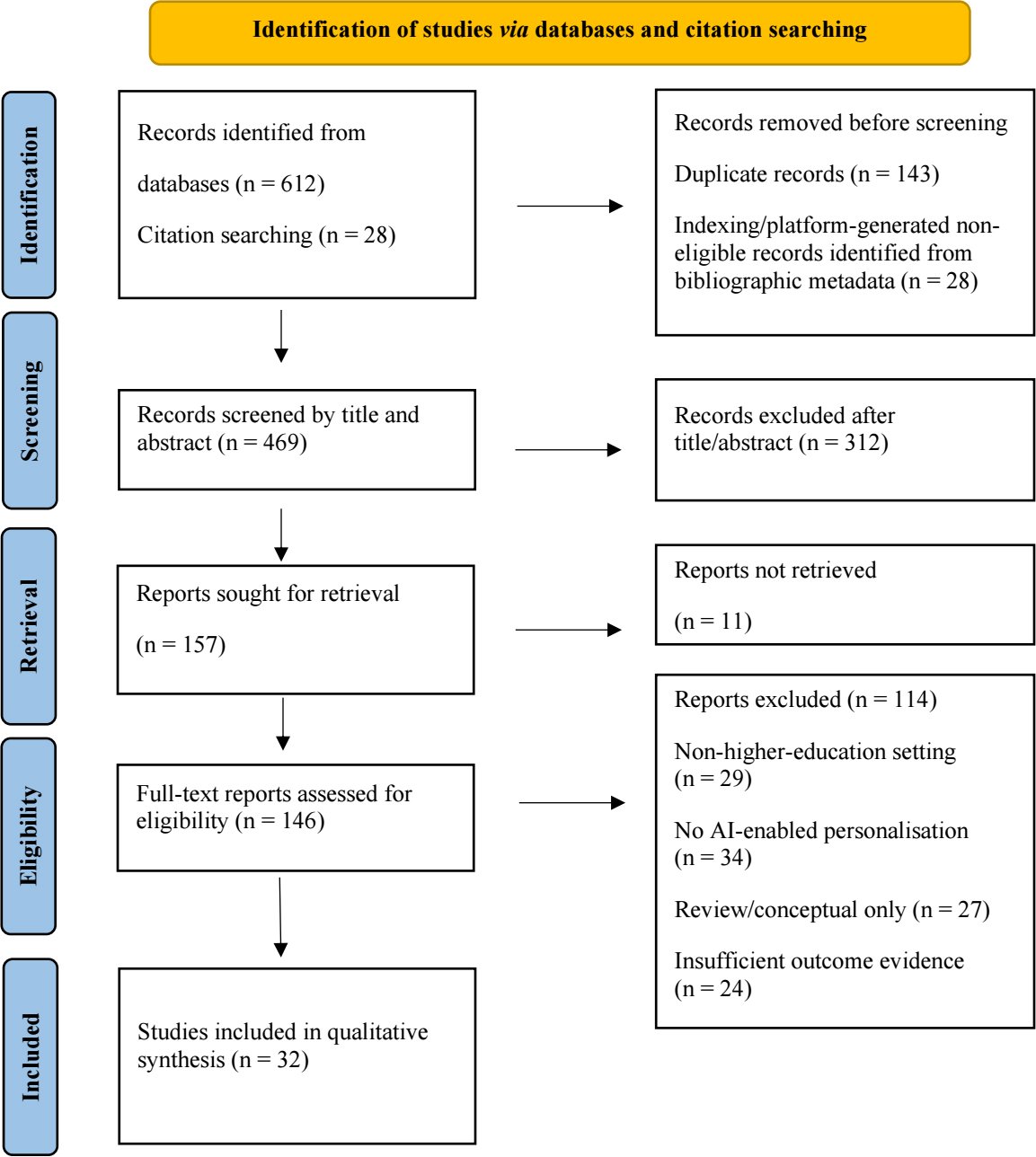
Fig. (1). PRISMA 2020 flow diagram for identification, screening and inclusion.
3. RESULTS AND THEMATIC SYNTHESIS
A total of 32 records were synthesised (Fig. 1), comprising 17 primary empirical or primary technical evidence records and 15 contextual, review-level, theoretical or analytical records. The 17 primary records were used to support claims concerning observed outcomes, mechanisms and system performance, whereas the 15 contextual records were used for field positioning, comparison and the identification of research gaps. This evidence classification is applied consistently across the Abstract, Table 3, Table 4, Discussion and Conclusion.
Table 4. Methodological quality and risk-of-bias synthesis for the reconciled evidence groups.
| Evidence Group | Studies | Risk of Bias | Outcome Evidence | Main Limitation | Certainty | References |
| Controlled / applied-system studies | 5 | Moderate to high | Performance, engagement, progression | Incomplete dispersion data or limited comparators in some studies | Moderate | [18, 25, 27, 31, 32] |
| Survey / SEM / empirical case studies | 6 | Moderate | Usefulness, motivation, trust, adoption and selected outcomes | Self-report and cross-sectional designs are common | Low-Moderate | [12, 21, 23, 24, 30, 37] |
| Prototype/pilot / mixed-method systems | 4 | Moderate | Feedback quality, usability, learning support | Small samples and short intervention periods | Low-Moderate | [10, 22, 26, 28] |
| Learning-analytics / technical modelling studies | 2 | Moderate to high | Risk prediction, learner profiling and model performance | Technical prediction is indirect evidence of learning effectiveness | Moderate | [3, 5] |
| Contextual / review-level / theoretical/analytical records | 15 | Not part of primary outcome appraisal | Scope, comparison and gap framing | Not counted as direct primary outcome evidence | Not graded as primary evidence | [2, 6, 8, 9, 11, 14, 16, 17, 19, 29, 33, 34, 35, 36, 38] |
Fig. (2) shows the year of publication for all 32 retained records, including the 17 primary evidence records. The focus on 2024 and 2025 is aligned with the fast growth of learning analytics and generative AI research in higher education following 2022. While earlier research was more concerned with predictive analytics, personalised pathways and basic adaptive-learning systems, recent research has been more focused on generative AI, AI-LMS integration, intelligent assistants, fairness, privacy and governance.
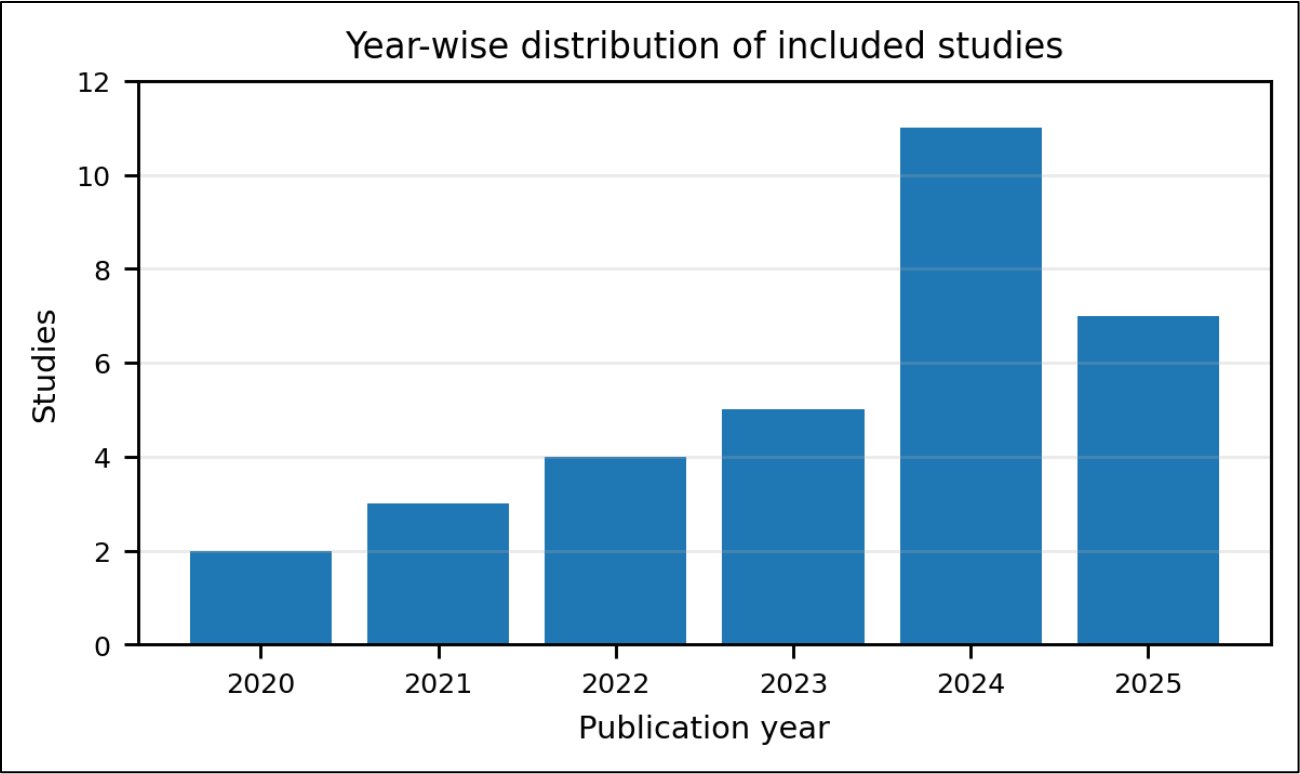
Fig. (2). Year-wise distribution of all 32 retained records.
Fig. (3) also presents the study contexts of all 32 (retained) records. The corpus covers areas of Asia, North America, Africa, the Middle East, Europe and cross-regional studies, and is unevenly represented. It is important, however, to note that repeated occurrences in this retained corpus should not be taken as evidence of widespread prevalence, as this corpus has been selected from China, the United States, Pakistan, Ghana and India. Transferability can be impacted by the geographical context, as infrastructure, institutional capacity, language resources, faculty preparedness and data-governance maturity may have an impact.
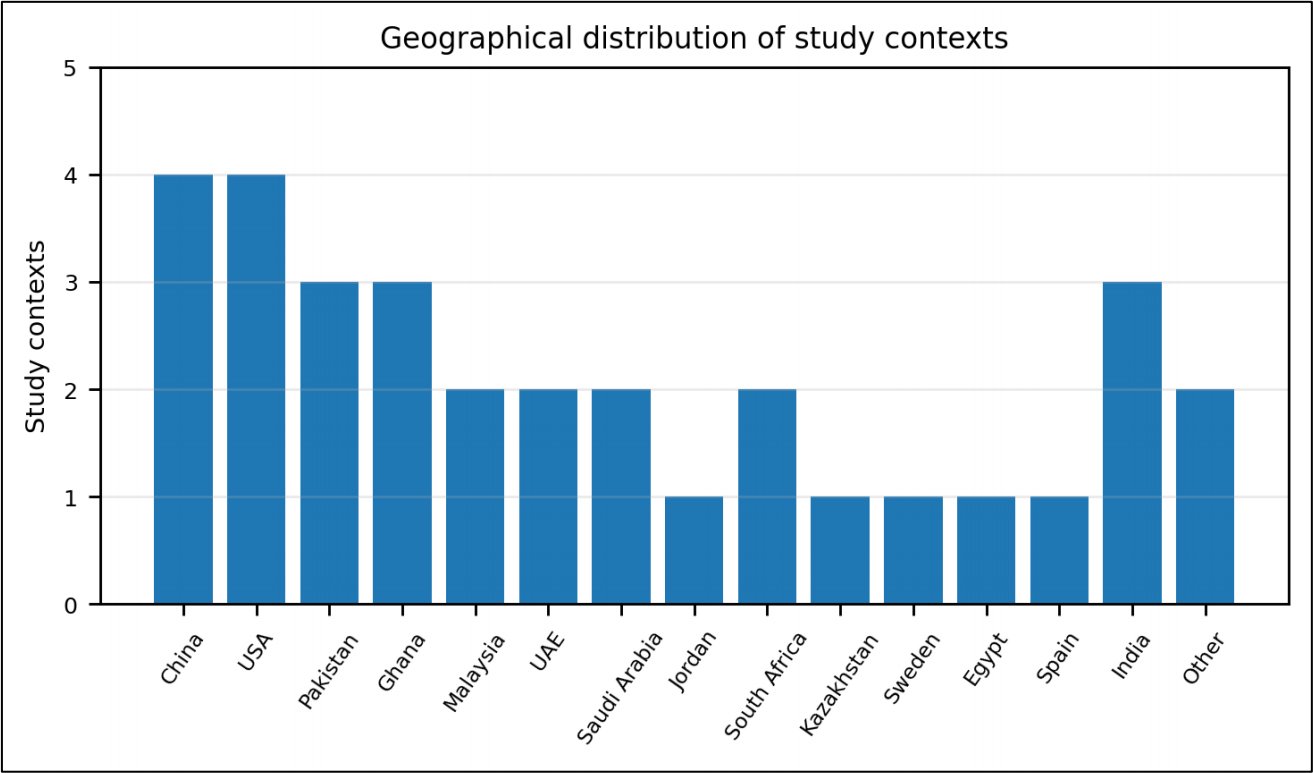
Fig. (3). Geographical distribution of contexts across all 32 retained records.
Fig. (2) shows an increase in retained publications from 2023 onward, with the largest concentration in 2024 and 2025. The counts sum to 32 records in the synthesis and therefore include both primary evidence and contextual/review-level sources.
Fig. (3) summarises the geographic contexts represented across the full 32-record corpus. The counts include primary and contextual records and should not be interpreted as the geographic distribution of the 17 primary studies alone.
A number of AI families were traced throughout the retained evidence. Dialogue-based support, explanation, question answering, writing assistance and personalised feedback were provided using natural language processing, conversational AI and generative AI [21–25]. Learner performance classification, problem modelling, risk assessment and targeted intervention were facilitated by supervised machine-learning approaches. Patterns were identified in learner records using deep-learning techniques to build personalised learning paths [26, 27]. The recommender systems were useful for academic choice, LMS-integrated recommender and personalised content delivery. Generative AI expanded these to include the generation of explanations and examples, prompts and formative responses, and added further concerns of accuracy, overreliance, academic integrity and governance.
There were varying levels of personalisation mechanisms. Some systems adjusted the order of content based on diagnostic evidence or performance evidence; others adjusted hints, explanations or corrective feedback. The difficulty levels of items and task type were adjusted, and resources were recommended by recommender systems, and targeted institutional support was triggered by predictive analytics. Not all the systems considered as personalised changed the curriculum. In this review, curriculum personalisation meant that evidence of learning needed to be used to alter the learning pathway, instructional support, the logic of the assessment or a directly related intervention.
The evidence on outcomes was largely favourable but inconsistent. Some pathway and curriculum systems with controlled or quasi-experimental studies showed improvements in academic performance with the use of AI [28– 32]. Generally, conversational AI and AI-personalised learning research yielded positive results in engagement or motivation [33– 37]. Survey or SEM designs were commonly used to assess satisfaction, perceived usefulness, autonomy, competence and trust. Evidence for long-term retention and for dropout reduction was much more modest than evidence for short-term engagement, responsiveness to feedback and academic performance.
A combined evidence synthesis was not appropriate, as explained in the structured evidence synthesis. Reported percentage change, p-values, SEM coefficients, pre-post differences, grades, engagement indicators, constructs of adoption or qualitative ratings, and many did not report means, standard deviations, and group sizes for comparable standardised effects. The synthesis reports direction of evidence and effect-size extractability not unsupported effect estimates or pooling non-comparable outcomes [38, 39].
Quality appraisal identified well-designed, controlled studies using quasi-experimental or well-specified data-driven evidence as the highest quality primary evidence. Where outcomes were self-reported or cross-sectional, the mixed-method and survey studies gave useful but less extensive information. Lower-rated evidence included short pilot studies, prototypes and studies with small samples. In each of the outcome domains, certainty was Moderate for engagement and satisfaction, Low-Moderate for academic performance and responsiveness to feedback, and Low for retention, dropouts and long-term scalability. These ratings refer to positive evidence but not to general effectiveness.
There were recurring problems of implementing the study across study types. Learner traces, assessment histories, and, for some systems, natural-language inputs may be needed as inputs for adaptive systems, raising privacy and data-governance issues. Algorithmic bias may perpetuate inequalities in training data; limited explainability can make it challenging for instructors to comprehend or deconstruct suggestions within the curriculum. Other common issues that arose repeatedly were faculty readiness, technical support, platform integration, connectivity and device access, especially in lower-resource settings.
The literature also highlights a tension between personalisation and learner autonomy. Reminders and feedback can help self-regulation, and personalised pathways can help, but over-automation can lead to depending too heavily on automation. This is especially important for generative AI, because students might not build these skills themselves, but outsource them. Human-in-the-loop designs, then, are better suited as a principle of governing the learning process than they are as full replacements for human decision-making regarding the curriculum.
The most obvious educational value was reported when AI was integrated into a specific pedagogical process as opposed to being a standalone tool. Systems that were linked to learning behaviour were more directly related to systems that were integrated into assessment, feedback, sequencing or structured LMS activities. In contrast, studies of the adoption of chatbots can provide evidence of acceptance, trust and motivation but are not enough to show curriculum-level change.
Learner data was used for diagnostic purposes, to determine prior knowledge and gaps; behavioural data, such as clicks, time on task, and submissions, were used to inform engagement and pacing; assessment data, such as the ability to infer mastery and adjust the difficulty; and open-ended or chatbot language data were used to inform feedback and modelling of the learner. All data types have restrictions. Assessment data are learning-related, but limited in scope; behavioural logs are subjectively interpreted; and language data are information-rich and sensitive. Valid interpretation is more crucial to effective personalisation than data volume.
Personalised feedback was one of the most frequently reported adaptations. The ability of chatbots, NLP tools and intelligent assistants to give quick explanations, corrective prompts and examples does not necessarily equate to pedagogical quality. Feedback generated using AI with teacher supervision or rubrics for the course was more convincing than that generated without teacher supervision or rubrics. The findings therefore support human oversight as a practical safeguard for AI-generated feedback.
Adaptive sequencing has broader curriculum-level implications than feedback because it alters the order in which curriculum content is delivered to the learner. Effective sequencing therefore requires credible models of prerequisite knowledge, learner readiness and learning objectives. Supervised learning, deep learning and recommender-system approaches may support pathway adaptation; however, opaque sequencing decisions can raise pedagogical and governance concerns. Learners and instructors should therefore be able to understand the basis on which activities are recommended, repeated or omitted.
Personalisation in assessment manifested in two primary ways: diagnostic assessment, the gaps identified and suggested remediation; dynamic assessment, the difficulty of the item or task varies as a function of performance. Both can facilitate mastery learning but also create comparability, validity and fairness issues. The evidence base did not present much detail about the validity of adaptive assessment, so more research into the validity of adaptive assessment and transparent scoring procedures is needed.
Generative AI provides a new level of personalisation, as it can generate content instead of simply choosing from and arranging resources. It can produce explanations, examples, prompts, quizzes, summaries and dialogue in large volumes, but probabilistic generation also has the danger of wrong or unsupported content. Student perception research reveals students’ interest in providing personalised support, along with concerns of accuracy, privacy, and dependency. The evidence thus suggests that generative AI should be viewed as an enablement tool rather than as a standalone tutor, as governance needs will be more intensive than the potential gains.
The geographic spread also suggests that the deployment of AI personalisation is an equity and capacity challenge. Emerging institutions could see advantages in scalable support, while resource-constrained institutions might experience challenges in infrastructure, faculty training, devices, language resources and reliable connectivity in the same setting. The term inclusive personalisation should thus be evaluated and not taken for granted, whether through multilingual, accessibility-aware and low-bandwidth evaluations.
The majority of research was on student tools, while there was less evidence of research on instructor workflow. This is a significant gap as the instructors remain responsible for making curriculum decisions, assessment integrity and learning support decisions. Future assessments should thus include assessments of the workload for teachers, interpretability, usability of the dashboard, and their confidence in following the recommendations of the AI tools, as well as student outcomes.
There is also an underestimation in the literature of potential adverse outcomes. Positive achievement, engagement and satisfaction measures are more prevalent, and measures for dependency, reduced learner autonomy, surface learning, anxiety, digital fatigue, peer interaction, and subgroup differences are less common. Evaluation should thus take into account the benefits and harms, including the ability to act autonomously, to engage in metacognition and social learning, as well as achievement assessment. Across the included studies, findings were predominantly positive for engagement, motivation, satisfaction, responsiveness to feedback and short-term academic performance. However, the certainty of evidence varied across outcome domains, and evidence remained limited for long-term retention, dropout reduction, fairness and institution-wide scalability. Heterogeneous outcome measures, limited availability of standardised effect sizes, short follow-up periods and the frequent use of self-reported or cross-sectional designs further constrain the strength and generalisability of these findings, as reflected in Tables 5 and 6.
Table 5. GRADE-informed structured evidence synthesis by outcome domain.
| Outcome Domain | Direction of Evidence | Effect-size Status | Certainty | Interpretation |
| Academic performance | Positive in most controlled or quasi-experimental studies | Cohen’s d rarely calculable; improvement percentages reported in several studies | Low-moderate | Limited reporting of means/SDs and short follow-up |
| Engagement and motivation | Consistently positive direction in chatbot, LMS and pathway studies | Not consistently standardised; survey scales vary | Moderate | Self-report and platform analytics not always triangulated |
| Satisfaction and perceived usefulness | Positive but context-dependent | Mostly survey/SEM coefficients, not standardised learning effect | Moderate | Influenced by digital literacy and novelty effects |
| Retention/dropout | Promising but sparsely measured | Completion/retention rates reported in few studies | Low | Few longitudinal institutional studies |
| Feedback responsiveness | Positive in intelligent assistant and chatbot studies | Qualitative ratings and usage logs dominate | Low-moderate | Hard to compare across systems |
| Equity, privacy and bias | Risks repeatedly reported | Not an outcome effect size | Moderate | Many studies identify risk without mitigation testing |
Table 6. AI techniques and curriculum-personalisation mechanisms.
| AI Technique | Typical Function | Personalisation Mechanism | Outcome Relevance | Implementation Concern |
| NLP/conversational AI | Dialogue, explanation and Q&A | Personalised feedback and support | Engagement and satisfaction | Hallucination, dependency and privacy |
| Supervised ML | Performance prediction and classification | Learner profiling, early alerts | Targeted support and assessment alignment | Bias from historical data |
| Deep learning | Pattern learning from learner records | Personalised pathways and sequencing | Achievement and engagement | Limited explainability |
| Recommender systems | Learning-resource matching | Content recommendation and pathway selection | Relevance and pacing | Filter bubbles and cold start |
| Intelligent tutoring systems | Scaffolded practice and hints | Adaptive difficulty, hints, mastery paths | Problem-solving and mastery | High development cost |
| Generative AI/LLMs | Content and feedback generation | Examples, prompts, summaries and practice tasks | Autonomy and rapid support | Accuracy, academic integrity and governance |
The literature in the context and review level reveals a fragmented field that is growing rapidly in width, from algorithms to generative AI, from adaptive assessment to LMS integration and student perceptions. The following 15 contextual records may help set the context for the primary evidence but may not count as direct evidence of effectiveness. This innovative synthesis links the field-level views with the functions of curriculum and evidence strength and the requirements of governance in higher education. The methodological quality and risk-of-bias profile of the evidence groups is summarised in Table 4. Outcome-domain certainty is presented in Table 5, while Table 6 maps the principal AI techniques to their curriculum-personalisation mechanisms, outcome relevance and implementation concerns. Outcome-domain certainty was assessed using a GRADE-informed approach in Table 5, rather than formal GRADE. The assessment considered risk of bias, consistency across studies, directness to higher-education curriculum personalisation, precision and completeness of statistical reporting. A domain was rated Moderate when the evidence was reasonably consistent and directly relevant but contained no more than one substantive limitation. A Low-Moderate rating was assigned when two or more substantive concerns were present, including predominant reliance on self-report, small samples, short follow-up periods, indirect outcomes or incomplete statistical reporting. A Low rating was assigned when evidence was sparse and multiple substantive limitations substantially reduced confidence in the observed direction of effect. These ratings represent structured GRADE-informed judgements rather than formal GRADE scores.
The framework links learner and context data to AI processing, personalisation mechanisms, educational outcomes and implementation implications. It shows that AI-driven curriculum personalisation should not be understood only as a technical process (Fig. 4). Instead, it should be treated as a socio-technical curriculum process supported by privacy protection, ethical oversight, bias mitigation, explainability, human supervision and institutional readiness.
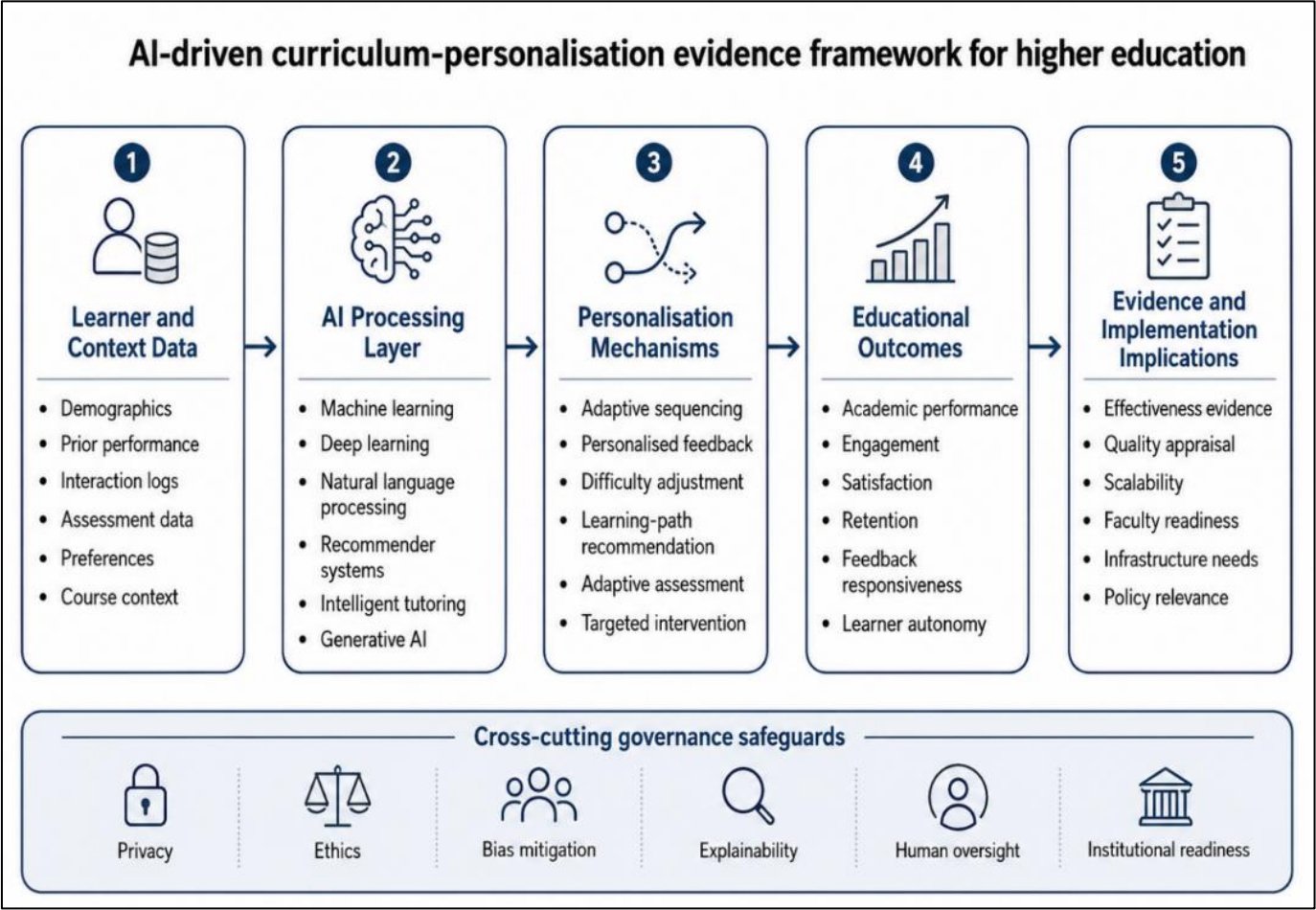
Fig. (4). AI-driven curriculum-personalisation evidence framework for higher education.
4. DISCUSSION
4.1. Evidence, Interpretation and Certainty
Based on the synthesis, AI-based curriculum personalisation in higher education shows promising but mixed evidence. Across the 17 primary empirical or technical records, the most consistently reported findings concerned engagement, satisfaction, responsiveness to feedback, adaptive sequencing and short-term academic performance. Evidence was considerably more limited for long-term retention, dropout reduction, fairness and institution-wide scalability. These conclusions are therefore intentionally restricted to the primary evidence base, while the 15 contextual, review-level, theoretical or analytical records are used only to position the findings within the wider literature and identify research gaps. A key contribution of the review is the distinction between AI techniques, personalisation mechanisms and outcome domains. Prediction, recommendation, conversational support, adaptive sequencing and generated feedback represent different functions with different pedagogical purposes and risks [11,12,14,15,16,17,18,35,36,37,38,39].
Positive findings should nevertheless be interpreted cautiously. Many of the included studies were conducted over short periods, relied on single-institution samples or self-reported measures, or provided incomplete statistical information. Some assessed adoption intentions or perceived usefulness rather than direct learning outcomes. The GRADE-informed synthesis therefore gives greater weight to controlled or clearly specified designs and lowers confidence where evidence is indirect, follow-up is short, samples are small or effect-size information is incomplete. The resulting certainty ratings should consequently be interpreted as evidence-informed judgements rather than proof of general effectiveness.
4.2. Transferability, Governance and Institutional Context
The evidence is not uniformly distributed across disciplines or geographical contexts. Technical and STEM settings are more strongly represented, whereas humanities, social sciences and multilingual learning environments receive comparatively less attention. Curriculum personalisation may therefore operate differently where learning depends on interpretation, critique or creativity rather than prerequisite mastery. Transferability is also influenced by infrastructure, language resources, institutional capacity and data-governance maturity.
Governance concerns should therefore be treated as an integral part of implementation rather than as a separate technical issue. Privacy, algorithmic bias, explainability, academic integrity, learner autonomy and faculty readiness recur across the evidence and support the socio-technical interpretation presented in Fig. (4). Institutions should ensure that learners understand how their data are used, that instructors can question or override automated recommendations and that safeguards are proportionate to the educational risk involved. Higher-stakes applications affecting progression, assessment or targeted intervention require greater validation, transparency and auditability than optional formative uses, ensuring that AI supports rather than replaces educational judgement.
4.3. Implementation Implications
Implementation should begin with a clearly defined curriculum problem rather than with the availability of a particular technology. Institutions should select the least complex AI function capable of addressing the identified need and embed it within explicit learning objectives, assessment processes and instructor workflows rather than adopting it primarily because of technological novelty.
Initial deployment is more defensible in low-stakes formative settings, where accuracy, student experience, faculty workload and unintended effects can be evaluated before higher-stakes use is considered. Institutional evaluation should examine curriculum alignment, learning outcomes, equity, interoperability with existing LMS and assessment systems, dashboard usability and faculty confidence in AI-supported recommendations. Vendor claims should not substitute for locally generated evidence because performance may vary according to student characteristics, curriculum structures and available institutional support. Fig. (4) should consequently be understood as an evaluation framework rather than as evidence that AI-based personalisation is universally effective.
4.4. Future Research and Limitations
Further research is needed to determine whether observed benefits persist beyond novelty effects and whether adaptive systems influence retention, progression or learning transfer over longer periods. Future studies should place greater emphasis on longitudinal and controlled designs, discipline-specific evaluation, fairness and subgroup analysis, and instructor as well as learner outcomes. Reports should clearly specify the AI technique, learner data, adaptation rule, intervention duration, comparison condition, outcome measures, missing-data treatment, statistical estimates, ethical approval and governance safeguards. More consistent reporting would improve reproducibility and make future quantitative synthesis more feasible.
The review included 32 records, of which 17 were classified as primary empirical or primary technical evidence and 15 as contextual, review-level, theoretical or analytical sources. A pooled meta-analysis was not undertaken because the retained studies differed substantially in design, intervention duration, discipline, comparison condition, outcome measures and statistical reporting, while several primary studies lacked the information required to calculate standardised effect sizes. Terminological inconsistency across studies also required judgement during screening. In addition, the review was not prospectively registered, and the source search log did not retain exact database execution dates or database-level retrieval counts, limiting full reproducibility.
CONCLUSION
Direct Synthesis Findings
This systematic review examined AI-based adaptive learning systems in the field of curriculum personalisation in higher education. Machine learning, deep learning, natural language processing, recommender systems, intelligent tutoring systems and generative AI were linked to adaptive sequencing, personalised feedback, adjustment of the difficulty level, recommendations for resources, learner profiling and targeted intervention across 17 primary empirical or primary technical evidence records. Engagement, satisfaction, and responsiveness to feedback, along with short-term academic performance, were the areas where the strongest evidence existed. Evidence was sparse regarding long-term retention, dropout reduction, fairness, disciplinary transferability and institutional scalability. In addition to the field positioning being informed by 15 contextual, review-level, theoretical or analytical records, these were not considered direct evidence of effectiveness.
Implementation Recommendations
Universities should define curriculum challenges before selecting AI functions, retain appropriate human oversight and evaluate outcomes before wider implementation. Responsible adoption should include proportionate attention to privacy, bias, explainability and institutional suitability. Further research should prioritise longitudinal, controlled, fairness-aware and discipline-specific evaluation.
LIST OF ABBREVIATIONS
CASP | = | Critical Appraisal Skills Programme |
MMAT | = | Mixed Methods Appraisal Tool |
AUTHOR’S CONTRIBUTION
R.A.B. contributed to the conceptualisation, methodology, literature screening, evidence synthesis, manuscript revision and approval of the final manuscript.
ETHICAL APPROVAL & INFORMED CONSENT
Ethical approval was not required for this systematic literature review because it was based exclusively on previously published studies and publicly available literature, without involving human participants, interventions, or the collection of personally identifiable information.
REPORTING GUIDELINES
The study was conducted in accordance with the PRISMA guidelines.
AVAILABILITY OF DATA AND MATERIALS
No new primary data were generated. The review was based on evidence from published scholarly sources. The study-level evidence matrix, quality-appraisal summary, database-specific search syntax and extraction fields are summarised in the manuscript. The original database execution dates and database-level retrieval counts were not preserved in the supplied search log and are therefore not presented as retrospectively reconstructed data.
FUNDING
This research received no external funding.
CONFLICT OF INTEREST
The author declares that they have no conflicts of interest.
ACKNOWLEDGEMENTS
The author acknowledges the use of scholarly databases and journal indexing platforms for identifying literature included in this systematic review. No individual or institution that could compromise double-anonymised review is identified in this version.
DECLARATION OF AI
ChatGPT was used as an AI-assisted tool to support language refinement and improve the clarity and readability of the manuscript. The author reviewed and verified the content and take full responsibility for the accuracy and integrity of the final manuscript.
REFERENCES
[1] C. Merino-Campos, “The impact of artificial intelligence on personalized learning in higher education: A systematic review,” Trends High. Educ., vol. 4, no. 2, Art. no. 17, 2025,
https://doi.org/10.3390/higheredu4020017
[2] W. Strielkowski, V. Grebennikova, A. Lisovskiy, G. Rakhimova, and T. Vasileva, “AI-driven adaptive learning for sustainable educational transformation,” Sustain. Develop., vol. 33, no. 2, pp. 1921–1947, 2025,
https://doi.org/10.1002/sd.3221
[3] P. Joseph-Richard, J. Uhomoibhi, and A. Jaffrey, “Predictive learning analytics and the creation of emotionally adaptive learning environments in higher education institutions: A study of students’ affect responses,” Int. J. Inf. Learn. Technol., vol. 38, no. 2, pp. 243–257, 2021,
https://doi.org/10.1108/IJILT-05-2020-0077
[4] G. Al-Tameemi, J. Xue, I. H. Ali, and S. Ajit, “A hybrid machine learning approach for predicting student performance using multi-class educational datasets,” Procedia Comput. Sci., vol. 238, pp. 888–895, 2024,
https://doi.org/10.1016/j.procs.2024.06.108
[5] H. Farhood, I. Joudah, A. Beheshti, and S. Muller, “Evaluating and enhancing artificial intelligence models for predicting student learning outcomes,” Informatics, vol. 11, no. 3, Art. no. 46, 2024,
https://doi.org/10.3390/informatics11030046
[6] T. Shaik, X. Tao, Y. Li, C. Dann, J. McDonald, P. Redmond, and L. Galligan, “A review of the trends and challenges in adopting natural language processing methods for education feedback analysis,” IEEE Access, vol. 10, pp. 56720–56739, 2022,
https://doi.org/10.1109/ACCESS.2022.3177752
[7] S. Amin, M. I. Uddin, W. K. Mashwani, A. A. Alarood, A. Alzahrani, and A. O. Alzahrani, “Developing a personalized e-learning and MOOC recommender system in IoT-enabled smart education,” IEEE Access, vol. 11, pp. 136437–136455, 2023,
https://doi.org/10.1109/ACCESS.2023.3336676
[8] N. Kamal, F. Sarker, A. Rahman, S. Hossain, and K. A. Mamun, “Recommender system in academic choices of higher education: A systematic review,” IEEE Access, vol. 12, pp. 35475–35501, 2024,
https://doi.org/10.1109/ACCESS.2024.3368058
[9] I. Gligorea, M. Cioca, R. Oancea, A. T. Gorski, H. Gorski, and P. Tudorache, “Adaptive learning using artificial intelligence in e-learning: A literature review,” Educ. Sci., vol. 13, no. 12, Art. no. 1216, 2023,
https://doi.org/10.3390/educsci13121216
[10] R. Sajja, Y. Sermet, M. Cikmaz, D. Cwiertny, and I. Demir, “Artificial intelligence-enabled intelligent assistant for personalized and adaptive learning in higher education,” Information, vol. 15, no. 10, Art. no. 596, 2024,
https://doi.org/10.3390/info15100596
[11] Z. Bahroun, C. Anane, V. Ahmed, and A. Zacca, “Transforming education: A comprehensive review of generative artificial intelligence in educational settings through bibliometric and content analysis,” Sustainability, vol. 15, no. 17, Art. no. 12983, 2023,
https://doi.org/10.3390/su151712983
[12] C. K. Y. Chan and W. Hu, “Students’ voices on generative AI: Perceptions, benefits, and challenges in higher education,” Int. J. Educ. Technol. High. Educ., vol. 20, no. 1, Art. no. 43, 2023,
https://doi.org/10.1186/s41239-023-00411-8
[13] G. Li, “E-learning intelligence model with artificial intelligence to improve learning performance of students,” J. Comput. Allied Intell., vol. 1, no. 1, pp. 14–26, 2023,
https://doi.org/10.69996/jcai.2023002
[14] A. Tlili, “Can artificial intelligence (AI) help in computer science education? A meta-analysis approach,” Span. J. Pedagogy, vol. 82, no. 289, pp. 469–490, 2024,
https://doi.org/10.22550/2174-0909.4172
[15] O. O. Ayeni, N. M. Al Hamad, O. N. Chisom, B. Osawaru, and O. E. Adewusi, “AI in education: A review of personalized learning and educational technology,” GSC Adv. Res. Rev., vol. 18, no. 2, pp. 261–271, 2024,
https://doi.org/10.30574/gscarr.2024.18.2.0062
[16] E. Du Plooy, D. Casteleijn, and D. Franzsen, “Personalized adaptive learning in higher education: A scoping review of key characteristics and impact on academic performance and engagement,” Heliyon, vol. 10, no. 21, Art. no. e39630, 2024,
https://doi.org/10.1016/j.heliyon.2024.e39630
[17] F. X. Kristianingsih, Hariyanto, and R. Maharani, “Artificial intelligence in adaptive education: A systematic review of techniques for personalized learning,” Discov. Educ., vol. 4, no. 1, Art. no. 458, 2025,
https://doi.org/10.1007/s44217-025-00908-6
[18] F. Naseer, M. N. Khan, M. Tahir, A. Addas, and S. H. Aejaz, “Integrating deep learning techniques for personalized learning pathways in higher education,” Heliyon, vol. 10, no. 11, Art. no. e32628, 2024,
https://doi.org/10.1016/j.heliyon.2024.e32628
[19] A. Tlili, K. Saqer, S. Salha, and R. Huang, “Investigating the effect of artificial intelligence in education (AIEd) on learning achievement: A meta-analysis and research synthesis,” Inf. Dev., vol. 41, no. 3, pp. 825–842, 2025,
https://doi.org/10.1177/02666669241304407
[20] M. J. Page, J. E. McKenzie, P. M. Bossuyt, I. Boutron, T. C. Hoffmann, C. D. Mulrow, L. Shamseer, J. M. Tetzlaff, E. A. Akl, S. E. Brennan, and R. Chou et. al., “The PRISMA 2020 statement: An updated guideline for reporting systematic reviews,” BMJ, vol. 372, 2021,
https://doi.org/10.1136/bmj.n71
[21] A. Alsswey, “Examining students’ perspectives on the use of artificial intelligence tools in higher education: A case study on AI tools of graphic design,” Acta Psychol., vol. 258, Art. no. 105190, 2025,
https://doi.org/10.1016/j.actpsy.2025.105190
[22] E. S. Adabor, E. Addy, N. Assyne, and E. Antwi-Boasiako, “Enhancing sustainable academic course delivery using AI in technical universities: An empirical analysis using adaptive learning theory,” Sustain. Futures, vol. 10, Art. no. 100828, 2025,
https://doi.org/10.1016/j.sftr.2025.100828
[23] N. Annamalai, B. Bervell, D. O. Mireku, and R. P. Andoh, “Artificial intelligence in higher education: Modelling students’ motivation for continuous use of ChatGPT based on a modified self-determination theory,” Computers and Education: Artificial Intelligence, vol. 8, Art. no. 100346, 2025,
https://doi.org/10.1016/j.caeai.2024.100346
[24] A. Saihi, M. Ben-Daya, M. Hariga, and R. As’ ad, “A structural equation modeling analysis of generative AI chatbots adoption among students and educators in higher education,” Comput. Educ. Artif. Intell., vol. 7, Art. no. 100274, 2024,
https://doi.org/10.1016/j.caeai.2024.100274
[25] R. Gutierrez, C. Villegas-Ch, A. M. Navarro, and S. Luján-Mora, “Optimizing problem-solving in technical education: An adaptive learning system based on artificial intelligence,” IEEE Access, vol. 13, pp. 61350–61367, 2025,
https://doi.org/10.1109/ACCESS.2025.3557281
[26] A. Elragal, A. I. Awad, I. Andersson, and J. Nilsson, “A conversational AI bot for efficient learning: A prototypical design,” IEEE Access, vol. 12, pp. 154877–154887, 2024,
https://doi.org/10.1109/ACCESS.2024.3476953
[27] X. Xu, “AI optimization algorithms enhance higher education management and personalized teaching through empirical analysis,” Sci. Rep., vol. 15, no. 1, Art. no. 10157, 2025,
https://doi.org/10.1038/s41598-025-94481-5
[28] H. E. Sari, B. Tumanggor, and D. Efron, “Improving educational outcomes through adaptive learning systems using AI,” Int. Trans. Artif. Intell., vol. 3, no. 1, pp. 21–31, 2024,
https://doi.org/10.33050/italic.v3i1.647
[29] R. Ejjami, “The adaptive personalization theory of learning: Revolutionizing education with AI,” J. Next-Gener. Res. 5.0, vol. 1, no. 1, 2024,
https://doi.org/10.70792/jngr5.0.v1i1.8
[30] O. Tapalova and N. Zhiyenbayeva, “Artificial intelligence in education: AIEd for personalised learning pathways,” Electron. J. e-Learn., vol. 20, no. 5, pp. 639–653, 2022,
https://doi.org/10.34190/ejel.20.5.2597
[31] V. Kumaresan, M. Jeyakarthic, P. Manjula Devi, P. Jona Innisai Rani, E. Mohan, and K. R. Surendra, “Personalized AI-driven online education technologies for adaptive learning and cognitive skill enhancement,” in Proc. IEEE Int. Conf. Signal Process., Comput. Control, 2025, pp. 1045–1050,
https://doi.org/10.1109/ISPCC66872.2025.11039410
[32] T. S. Chu and M. Ashraf, “Artificial intelligence in curriculum design: A data-driven approach to higher education innovation,” Knowledge, vol. 5, no. 3, Art. no. 14, 2025,
https://doi.org/10.3390/knowledge5030014
[33] C. Halkiopoulos and E. Gkintoni, “Leveraging AI in e-learning: Personalized learning and adaptive assessment through cognitive neuropsychology—A systematic analysis,” Electronics, vol. 13, no. 18, Art. no. 3762, 2024,
https://doi.org/10.3390/electronics13183762
[34] A. Fortuna, F. Prasetya, A. D. Samala, S. Rawas, C. Criollo-C, D. Kaya, M. Raihan, W. Andriani, D. Safitri, and R. A. Nabawi, “Artificial intelligence in personalized learning: A global systematic review of current advancements and shaping future opportunities,” Soc. Sci. Humanit. Open, vol. 12, Art. no. 102114, 2025, https://doi.org/10.1016/j.ssaho.2025.102114
[35] M. E. Dogan, T. Goru Dogan, and A. Bozkurt, “The use of artificial intelligence (AI) in online learning and distance education processes: A systematic review of empirical studies,” Appl. Sci, vol. 13, no. 5, Art. no. 3056, 2023,
https://doi.org/10.3390/app13053056
[36] M. Guettala, S. Bourekkache, O. Kazar, and S. Harous, “Generative artificial intelligence in education: Advancing adaptive and personalized learning,” Prag. J. Inform, vol. 13, no. 3, pp. 460–489, 2024,
https://doi.org/10.18267/j.aip.235
[37] H. U. Rahiman and R. Kodikal, “Revolutionizing education: Artificial intelligence empowered learning in higher education,” Cogent Educ., vol. 11, no. 1, Art. no. 2293431, 2024,
https://doi.org/10.1080/2331186X.2023.2293431
[38] J. Peng and Y. Li, “Frontiers of artificial intelligence for personalized learning in higher education: A systematic review of leading articles,” Appl. Sci., vol. 15, no. 18, Art. no. 10096, 2025, https://doi.org/10.3390/app151810096
[39] X. Weng, Q. Xia, M. Gu, K. Rajaram, and T. K. F. Chiu, “Assessment and learning outcomes for generative AI in higher education: A scoping review on current research status and trends,” Australas. J. Educ. Technol., vol. 40, no. 6, pp. 37–55, 2024,
https://doi.org/10.14742/ajet.9540
Licensed
© 2026 Copyright by the Authors.
Licensed as an open access article using a CC BY 4.0 license.
Article Contents Author Rashid Ali Baloch1, * 1Indus University, Karachi, Pakistan Article History: Received: 25 August, 2026 Revised: 07 October,
Article Contents Author Muhammad Jawwad1, * 1NED University of Engineering and Technology, Karachi, Pakistan Article History: Received: 01 September, 2026
Article Contents Author Joseph Kofi Mensah1, * , David Kwashie Garr2 , David Mensah Awadzie3 1Department of Business Administration, Accra
Article Contents Author Cao Minh Thanh1, Cao Thai Phuong Thanh1, Tran Son Hai2, * 1Faculty of Information Technology, Saigon University,
Article Contents Author Muhammad Qasim1, * 1Jinnah Sindh Medical University, Karachi, Pakistan Article History: Received: 01 June, 2026 Revised: 18
Article Contents Author Eva Troja1, * 1Microbiology Laboratory, Profarma Sh.a Pharmaceutical Company, Tirana, Albania Article History: Received: 16 May, 2026