

















CM Publisher

Majestic American Journal of Mathematics and Physics

Article Contents

Article ID: CM2601109001

Article
Views: 30
Published 08 Apr 2026

Systematic Review of Tunable Topological Edge States in Two-Dimensional Photonic Crystals for Quantum Photonic Applications

📚 Cited by: 0

⬇ Downloads: 0


Cite
Author

1Department of Physics, Forman Christian College University, Lahore, Pakistan

Article History:

Received: 22 September, 2025

Accepted: 05 February, 2026

Revised: 15 January, 2026

Published: 08 April, 2026

Abstract:

This literature review discusses tunable topological edge states in 2D photonic crystals and their use in quantum photonic technology. The review was conducted according to the PRISMA (Preferred Reporting Items for Systematic Reviews and Meta-Analyses) guidelines, with a thorough search of databases including Scopus, Web of Science, IEEE Xplore, and SpringerLink. One thousand records were found, and on screening and evaluation, 60 studies were included in the review. The research primarily focused on tuning edge states in quantum systems. There was significant advancement in tuning devices, including electro-optic modulation, thermo-optic modulation, strain engineering, and phase-change materials (e.g., GST, VO2). Several material platforms, such as silicon photonics and III-V semiconductors, were identified as key to delivering such tunable systems. Scalable quantum technologies, with their strength, reconfigurability, and incorporation of synthetic QED and tunable topological edge states in quantum information systems, were found relevant in 52 of 60 sampled articles. One significant gap in the literature was the lack of a synthesis of these tuning techniques in quantum photonics. The review identified opportunities and issues in incorporating such technologies into quantum systems and hoped that nanofabrication, quantum optics, and materials science scientists would collaborate across disciplines. The results showed that quantum technologies had significant potential for improvement, though more research was required to overcome current challenges, including scalability, integration, and loss reduction.

Keywords: Tunable topological photonics, two-dimensional photonic crystals, edge states, quantum photonics, systematic literature review, photonic integration, non-hermitian systems.

1. INTRODUCTION

Topological photonics is a field that has seen enormous growth in the last decade due to its capability to provide loss-immune, robust light management in optical circuits [1]. Topological photonic crystals are motivated by the topological insulators of condensed matter physics, and they are engineered to act in the same way, using the edge states, which are disorder-immune to remain especially stable to disorder, defects, or other perturbations to the material to create efficient, stable pathways of light. This peculiarity makes topological photonics particularly interesting for a range of applications, including quantum information systems, optical communications, and sensor networks [2]. Topological edge states embedded in photonic crystals make them more practical, as they ensure light travels without reflection or loss, even in complex or incomplete systems. Such properties make topological photonics a critical technology on the path to lossless light transport in the next-generation quantum computing and communication systems [3].

Dynamic control over topological edge states after fabrication is an important property that can significantly impact the operation of quantum photonic systems [4]. Although topological edge states are intrinsically robust, they often require tuning to meet the requirements of specific quantum systems, e.g., quantum gates, memory devices, or interferometers. It is particularly critical when using quantum information technologies because precise control over the characteristics of light, e.g., frequency, polarisation, or phase, is a crucial aspect of producing entanglement or correcting errors [5]. Using photonic crystals, these edge states can be modulated in a versatile way via electro-optic, thermo-optic, and/or mechanical tunability, without altering the core structure [6]. Such flexibility is essential for applying adaptive quantum systems that can respond to changing environments or reconfiguration requirements, thereby increasing the scalability and stability of large-scale quantum photonic networks.

Despite a considerable amount of literature on topological photonics, existing reviews address this field at a high level of generality: they discuss theoretical models and material platforms without providing an in-depth discussion of the tunability of these systems, especially as it pertains to quantum photonic applications [7]. There have been no critical reviews of the topic, creating a research gap given the increasing attention to tunable 2D photonic crystals. Tunable 2D photonic crystals, with their specific geometric characteristics and tunability factors, are regarded as having excellent applicability in advanced quantum techniques [8]. Nevertheless, current reviews have not fully addressed how these systems are shown to be invested with new possibilities and challenges when tunability mechanisms are introduced [9]. This disparity stems from a lack of deep coherence regarding how post-fabrication manipulation of topological edge states can be achieved and implemented in the context of quantum technologies.

This systematic literature review (SLR) will focus on the purpose of the study, which is to find the emerging trends, challenges, and opportunities that have recently arisen in the area of tunable topological edge states on 2D photonic crystals to use in the field of quantum applications, covering the same period, 2015 to 2025. Through a literature review, we will present a comprehensive overview of the state of the art in this fast-growing niche. In particular, the review will focus on identifying different tunings for manipulating topological edge states and on the modifications or applications made in the context of quantum photonic systems. By doing so, it will not only highlight the successes and loopholes of the current research but also identify untapped areas and possible ways to overcome these gaps in the research field. The research questions are: What tuning mechanisms have been implemented for topological edge states in 2D photonic crystals? How have these been applied or proposed for quantum photonic systems? What are the limitations and open problems? It is through answering these research questions that the review will come to understand fully the current state of the field, the limitations currently posed upon it that should be overcome, and a direction forward for further research and development of tunable topological photonics to support quantum technologies.

There are many debates and competing schools of thought that remain unsolved in the field of tunable topological edge states in two-dimensional photonic crystals as quantum applications [10]. Although the dominant tuning mechanisms are electro-optic and thermo-optic, the trade-offs among speed, efficiency, and scalability remain controversial. Electrical tuning has good response times but suffers from optical loss and decoherence, which are concerns for massive quantum systems. The use of an external electric field to alter a material’s characteristics is called electrical tuning. Electro-optic tuning, in contrast, uses materials thatwhose optical properties change in response to an electric field, usually via the Pockels effect. Carrier-based tuning is the control of a material’s optical properties by manipulating its electronic density, usually with electrostatic fields. The use of an external electric field to alter a material’s characteristics is called electrical tuning. Electro-optic tuning, in contrast, uses materials whose optical properties change in response to an electric field, typically via the Pockels effect. Carrier-based tuning is the control of a material’s optical properties by manipulating its electronic density, usually with electrostatic fields. Mechanical and phase-change materials, on the other hand, are stable, non-volatile, tunable, but slower in response, hindering their application in fast quantum processes. Hybrid solutions combining these mechanisms are attracting increased attention as a means of optimising performance. However, integrating these systems is difficult in terms of achieving efficiency, stability, and power consumption. These trade-offs will continue to be explored in the field as quantum photonics reaches maturity.

2. METHODOLOGY

The current systematic literature review (SLR) is organized according to the PRISMA (Preferred Reporting Items for Systematic Reviews and Meta-Analyses) framework, which has been widely used in other areas of science, including the photonics literature. This procedure renders the review reproducible and transparent, and practised rigorously. The PRISMA checklist in this work is tailored to the field of interest identified in the literature on tunable topological edge states in a two-dimensional quantum photonic crystal. The following section outlines the methods used to complete this review, including search strategy, inclusion/exclusion criteria, data extraction process, and quality assessment strategies.

2.1. Framework: PRISMA-Based Approach Adapted for Photonics Literature

Many PRISMA principles, initially designed to enhance the quality and transparency of systematic reviews in healthcare and clinical research, have been successfully applied to other scientific spheres, such as engineering and physics. This review is based on the PRISMA founding principles, though it has focused on specific criteria relevant to the photonics discipline. This is done in the following order: identification of the relevant studies, followed by a thorough screening and selection of studies that fit the selection criteria (inclusion criteria) and exclusion criteria. After that, an extensive data extraction plan will be undertaken to record each study’s main details (indicators), ensuring only the most pertinent and top-rated studies are used in the review.

2.2. Database Search

In this review, the databases used are Scopus, Web of Science, IEEE Xplore, and SpringerLink.

A comprehensive search was conducted across Scopus, Web of Science, IEEE Xplore, and SpringerLink for peer-reviewed articles. Manual deduplication was performed to remove duplicate studies. The databases in Table 1 were selected for their coverage of the largest number of peer-reviewed journals and conference papers in physics, engineering, and materials, most of which are related to topological photonics research. Scopus and Web of Science are considered the most significant indicators of multidisciplinary article citation, as they provide access to high-quality articles published in peer-reviewed journals. Memorably, IEEE Xplore specifically supports a rich set of research on photonics, semiconductor materials, and quantum technologies. SpringerLink has books and journal articles that present excellent sources of information on current developments in the fields of photonic materials and quantum applications.

Table 1. Database search and search strings.

DatabaseDescription
ScopusScopus is a multidisciplinary database that includes peer-reviewed journals, conference papers, and patents. It offers broad coverage of engineering, physics, and materials science.
Web of ScienceWeb of Science provides comprehensive coverage of peer-reviewed scientific literature in various domains, including physics, engineering, and materials science.
IEEE XploreIEEE Xplore is a digital library of research articles, conference proceedings, and standards, with a focus on engineering, electronics, and quantum technologies.
SpringerLinkSpringerLink provides access to journals, books, and conference proceedings in science, technology, and engineering, with a focus on photonics and quantum technologies.

2.3. Search Strings

Databases were searched using specific search strings to ensure a comprehensive and critical search. The main search term applied to all databases was: “tunable” AND “topological edge states” AND “photonic crystals” AND “quantum”. This was the search statement, targeted to identify studies of tunable edge states in photonic crystal systems, with a focus on quantum exploitation. The specificity introduced by the keyword quantum ensures that studies discussing the combination of topology, photonics, and quantum technologies are included. The term tunable suggests a range of research into the dynamic control of edge states, and the terms topological edge states and photonic crystals limit the range to the incomprehensible space of topological photonics. In Scopus and Web of Science (WoS), Boolean operators such as AND and OR were used to combine terms, ensuring the inclusion of the required studies across various fields. Search was further narrowed with filters for publication date range (e.g., 2010-2025), document type (e.g., articles, conference papers), and language (English). Also, field tags such as TITLE-ABS-KEY in Scopus and TI, AB, KW in WoS were used to limit the search to titles, abstracts, and keywords, to be very specific in retrieving studies directly relevant to tunable topological edge states in photonic crystals in quantum-related contexts.

2.4. Inclusion Criteria

Various factors anchor the systematic review’s inclusion criteria to ensure the selected studies are relevant and high-quality. The search was restricted to peer-reviewed journal and conference papers, ensuring that the research is academically exemplary. Also, the papers must be in English to ensure consistent interpretation and analysis. To reflect the current breakthroughs in the area, the publication date range was restricted to 2015-2025.

The inclusion criteria for the paper were that the studies specifically addressed two-dimensional photonic crystals. Such a restriction was applied owing to the unique properties of two-dimensional photonic crystals, which enable the precise fine-tuning of topological edge states, a feature paramount for quantum applications. The work also needs to emphasise the tunability of these edge states, whether via material properties, external fields (e.g., electric, magnetic, or optical), or mechanical strain. This ensures that only relevant research on the dynamic control of topological edge states is considered. The screening process involved single screening of titles and abstracts by one reviewer, followed by double screening of full texts by two independent reviewers. A third reviewer resolved disagreements.

Table 2 summarizes the search strings, Boolean operators, filters, and field tags applied in Scopus, Web of Science, and IEEE Xplore to retrieve relevant studies.

Table 2. Search strategy for databases used in systematic review.

DatabaseSearch StringBoolean OperatorsFiltersField Tags
Scopus“tunable” AND “topological edge states” AND “photonic crystals” AND “quantum”ANDPublication Date Range: 2010-2025Document Type: Articles, Conference PapersLanguage: EnglishTITLE-ABS-KEY
Web of Science (WoS)“tunable” AND “topological edge states” AND “photonic crystals” AND “quantum”ANDPublication Date Range: 2010-2025Document Type: Articles, Conference PapersLanguage: EnglishTI, AB, KW
IEEE Xplore“tunable” AND “topological edge states” AND “photonic crystals” AND “quantum”ANDPublication Date Range: 2010-2025Document Type: Articles, Conference PapersLanguage: EnglishTitle, Abstract, Keywords

2.5. Exclusion Criteria

Papers that failed to satisfy the above inclusion criteria were omitted from the review. This includes research on the one-dimensional (1D) or three-dimensional (3D) photonic crystals since this field of research focuses specifically on a two-dimensional (2D) photonic structure, which has very different uses in the control of light propagation at the edge. Studies exclusively about theory without experimental demonstration were locked out of the review since any application of tunable topological edge states in quantum photonics cannot be done without experimental demonstration and material integration. The fact that only the purely theoretical works are excluded implies that only the studies that have a practical significance for quantum systems are included. This choice is consistent with the topological photonics nature, which requires theoretical models to be proved by the data to be practically applicable in quantum technologies. The fact is that without the theoretical and experimental information, the main aim of this review is the analysis of the feasibility of introducing the tunable topological edge states in the quantum photonic systems.

2.6. Data Extraction

The process of data extraction involved arrangements to ensure that all relevant data were enlisted by carrying out an in-depth analysis of every data point. The results of the data in both studies were as follows:

  1. Study Type: The study type was either theoretical, experimental, or review. The significance of the experimental research was that it had a practical impact on tunable edge states of photonic crystals.
  2. Tuning Method: The physical manner in which the topological edge states have been tuned, be it electrical, thermal, strain, or material phase changes. The tuning mechanisms are most viable in this field, and this can be determined through this division.
  3. Material System: The material constituent of the photonic crystal, such as silicon, III-V semiconductor, graphene, or phase-change material. The substance platform is crucial to the comprehension of the provision and embedding of flexibility of edge states into quantum systems.
  4. Operational Wavelength: The range of operational wavelengths of the photonic crystal will determine how much quantum technology the crystal can be applied to, including quantum communications or quantum computing networks.
  5. Quantum Applicability: The applicability to quantum photonics can also be determined by whether the research is directly scrutinised for quantum applications such as quantum gates, quantum memory, and quantum entangled generation.

2.7. Quality Assessment

The number of quality studies was determined by various criteria of quality assessment. Such requirements are:

Reproducibility: This is how well the study is adequately described in terms of experimental set-ups and procedures that allow one to maintain the findings and reproduce them by other researchers in the field.

  1. Experimental Validation: Experimental information can be used to substantiate the arguments of tunability in topological edge states. Experimental works were given priority since they provide evidence of the modelling of the practicality and feasibility of tunable photonic crystals in the real world.
  2. Citation Strength: The strength of the citation of the particular articles was taken into account, and well-cited articles were chosen as they are assumed to have had a copious impact on the field.
  3. Conflict Resolution: A third reviewer resolved any conflict, and it was ensured that no one gave a biased decision.
  4. Established Scale: The established scales are an evaluation of the quality of a study based on established scales like the PRISMA checklist or GRADE framework.
  5. Scoring Criteria: Use scoring criteria such as study design, sample size, and methodological rigour to determine the reliability of the findings.
  6. Synthesis of Quality Patterns: Synthesize quality patterns: Categorize synthesize studies according to their methodological limitations and strengths.

In this systematic review, the quality of the studies was rated using the GRADE framework. All studies were evaluated based on five important areas of assessment, which include risk of bias, inconsistency, indirectness, imprecision, and publication bias. The performance of the studies in these domains was used to rank them as High, Moderate, or Low. This will guarantee that the quality of the studies used in the review is evaluated in a clear and transparent manner, as indicated in Table 3.

Table 3. GRADE framework criteria for quality assessment of studies.

DomainCriteriaRating
Risk of BiasWas there bias in design or execution?High / Moderate / Low
InconsistencyWere the results consistent across studies?High / Moderate / Low
IndirectnessWere the results directly applicable to quantum photonics?High / Moderate / Low
ImprecisionWere the estimates precise enough for reliable conclusions?High / Moderate / Low
Publication BiasWere all relevant studies included, and is there selective publication?High / Moderate / Low
Overall QualityOverall rating based on the previous domains.High / Moderate / Low

Publication bias may have contributed to the outcomes of the review since only the studies published in large databases such as Scopus and Web of Science were taken into account, which could have omitted niche studies. In spite of such possible biases, the inclusion criterion was used with due precision to select the most relevant and experimental validation studies in the field of quantum photonics.

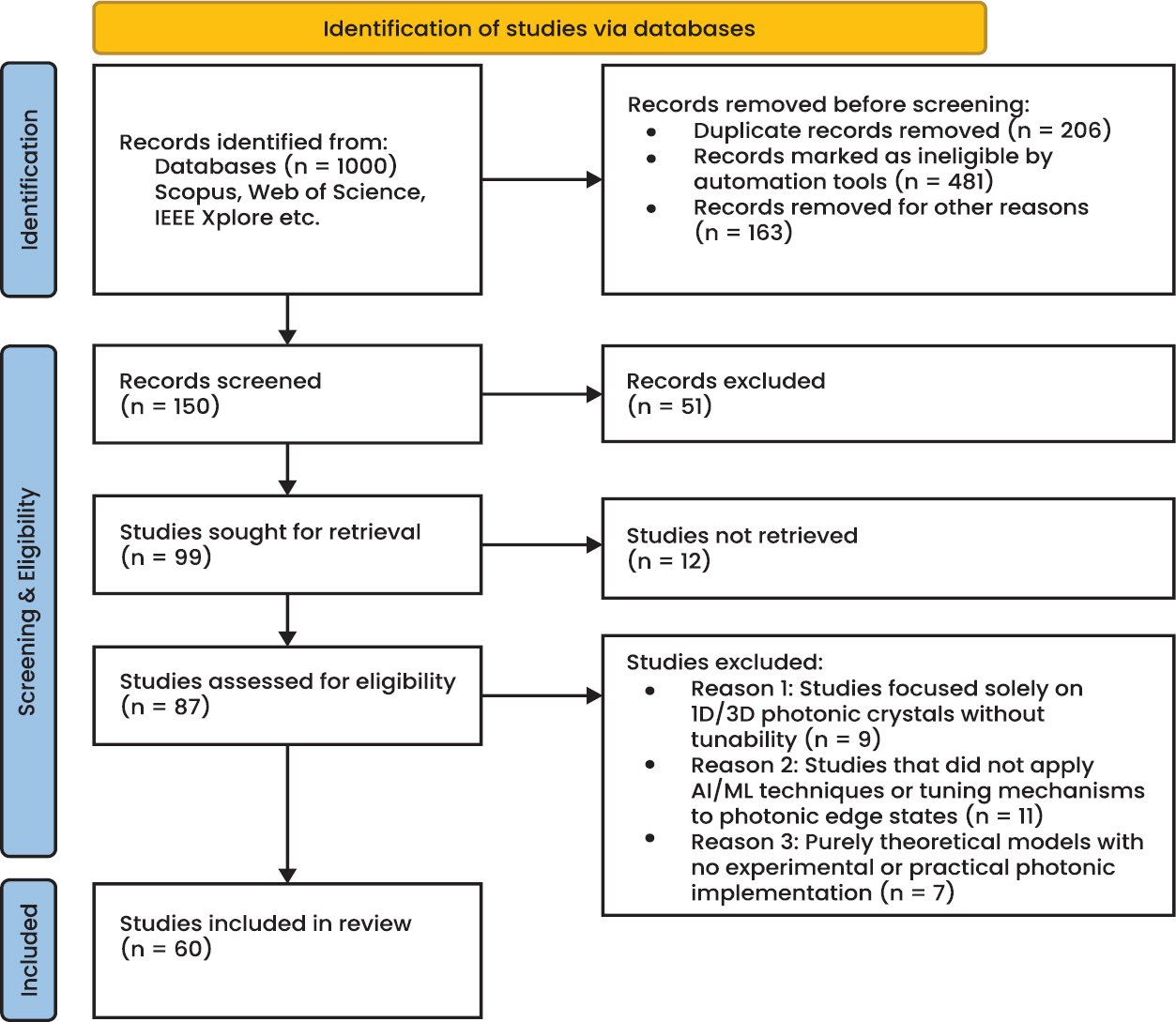
The PRISMA flow diagram in Fig. (1) shows graphically the steps that were taken to select the studies included in the systematic review to achieve transparency and reproducibility. The figure would give the figures of the studies obtained after the first search of the database, and after that, the studies were further filtered to eliminate the irrelevant samples. It will also tell the number of studies that were eliminated by the inclusion and exclusion criteria and the number of studies that were used in the review. The following research methodology shows the activities that occurred after the systematic and exhaustive literature review of tunable topological edge states in two-dimensional photonic crystals under the quantum application. The PRISMA method ensures transparency and reproducibility, and the search method, inclusion/exclusion criteria, and data extraction method allow covering only the most valuable and high-quality articles. The terms of measuring the quality of reviews also play a role in the accuracy of the review, referring to the inclinations, difficulties, and opportunities in this rapidly emerging sector. Table 4 assists in evaluating the quality of the studies used in the systematic review and presents a clear evaluation to understand the review better and the reliability of the findings better.

Fig. (1). PRISMA flow diagram.

Table 4. GRADE assessment table for the selected studies.

RefRisk of BiasInconsistencyIndirectnessImprecisionPublication BiasGRADE Level
RefLowConsistentDirectPreciseLowHigh
[52]ModerateInconsistentIndirectImpreciseLowModerate
[53]LowConsistentDirectPreciseLowHigh
[54]LowConsistentDirectPreciseLowHigh
[2]LowConsistentDirectPreciseLowHigh
[55]ModerateInconsistentIndirectModerateLowModerate
[48]LowConsistentDirectPreciseLowHigh
[56]LowConsistentDirectPreciseLowHigh
[5]ModerateInconsistentIndirectImpreciseLowModerate
[57]LowConsistentDirectPreciseLowHigh
[58]ModerateInconsistentIndirectImpreciseLowModerate
[59]LowConsistentDirectPreciseLowHigh
[60]LowConsistentDirectPreciseLowHigh
[51]ModerateInconsistentIndirectModerateLowModerate
[43]ModerateInconsistentIndirectModerateLowModerate
[61]LowConsistentDirectPreciseLowHigh
[62]LowConsistentDirectPreciseLowHigh
[63]LowConsistentDirectPreciseLowHigh
[64]ModerateInconsistentIndirectModerateLowModerate
[65]ModerateInconsistentIndirectModerateLowModerate
[41]LowConsistentDirectPreciseLowHigh
[66]LowConsistentDirectPreciseLowHigh
[67]LowConsistentDirectPreciseLowHigh
[68]ModerateInconsistentIndirectModerateLowModerate
[69]LowConsistentDirectPreciseLowHigh
[63]LowConsistentDirectPreciseLowHigh
[70]LowConsistentDirectPreciseLowHigh

2.8. Research Perspective

Recent years have seen a development in the field of tunable topological edge states in two-dimensional photonic crystals being developed in the context of quantum applications. However, it still leaves a number of unclear controversies and schools of thought in dispute. The most important tuning mechanisms include electro-optic and thermo-optic techniques, but continuous problem areas are associated with their performance trade-offs when it comes to their scalability, speed, and efficiency [11]. Although electro-optic tuning has the advantage of a fast response, it has such demerits as optical loss and decoherence; it cannot be used in large-scale quantum systems. Mechanical and phase-change materials, on the other hand, offer more nonvolatile and stable tunability, but with slower response times, and therefore are not as useful in high-speed quantum interactions [12]. The hybridisation of tuning systems to integrate several tuning mechanisms optimisation is picking up. But the synthesis of such systems has the problem of efficiency, stability, and power consumption, which is important in quantum technologies. All these competing mechanisms emphasise the necessity of further studies to mitigate their shortcomings and make quantum photonic systems more robust.

2.8.1. Future Directions from a Quantum Photonics Perspective

Hybrid techniques that combine the benefits of electro-optic, thermo-optic, and phase-change materials are currently needed for the future. Such hybrid systems have the potential to provide greater scalability, increased modulation depths, and increased switching speeds, which are needed in quantum computing and quantum communication systems. The future directions of quantum photonic devices include minimizing the optical losses in electrical tuning, reducing the response times in mechanical and phase-change systems, and improving the overall efficiency of the quantum photonic devices. Moreover, searching for new material platforms, i.e., 2D materials and non-Hermitian systems, can offer new solutions to existing problems, especially the stability and minimisation of losses. The integration of quantum-enhanced sensing techniques should also be reviewed in research, which will allow building more adjustable, effective, and scalable quantum photonic systems.

3. THEORETICAL BACKGROUND

3.1. Topological Photonics Fundamentals

The idea of topological invariants, the Berry curvature, and Chern number are concepts that front and centre this description of the behaviour of photonic systems and have their origins in condensed matter physics. Berry curvature, originating in the theory of the geometric phase, determines how the quantum state of light varies in parameter space, which influences the direction and propagation of light in photonic systems [9]. An integer Chern number, which describes the topology of a system, can be used to determine whether or not a photonic system hosts robust edge states. Such edge states show resistance to disorder and perturbations, so are of great significance to the stable, lossless light transport in optical devices [13]. Bulk-edge correspondence describes how bulk topological properties of a material relate to the existence of edge states, and has been used to develop a model with which to predict how light behaves at boundaries of photonic crystals.

3.2. Two-Dimensional Photonic Crystals

High-precision control of light propagation can be achieved using a particular material known as two-dimensional photonic crystals (2DPCs). These crystals contain periodic materials with the two-dimensional modulation of the refractive index in a crystal. The lattice structure is critical to bandgap behaviour in 2DPCs [10]. The most typical types of lattices, such as hexagonal, square, and kagome lattices, have different positive aspects regarding symmetry, bandgap formation, and edge-state properties [14, 15]. Hexagonal lattices are also an effective form of photonic crystal lattice, mainly because the high symmetry makes robust edge states possible [16]. A square lattice may be constructed with simpler designs, and the kagome lattice may yield special features like photonic flat bands. These lattices can be engineered to enable the tuning of band gaps in the photonics regime, which is crucial to isolate frequencies and introduce controlled light propagation within photonic systems and magnets [17]. This is especially relevant to developing tunable photonic systems to be used in quantum technologies, where fine control of the optical properties of photonic systems is mandatory.

3.3. Edge States

A key property of 2D photonic crystals is the indispensable edge states in terms of strong light transmission at the material boundaries. Depending on the nature of the boundary conditions (e.g., zigzag and armchair boundaries), these edge states are highly dependent on the nature of the propagating light along the boundary [18]. Topologically protected edge states typically occur with zigzag edges, and can propagate without scattering even in the presence of non-topological defects or disorder, but not the armchair edges. One of the cornerstones of topological photonics is the inherent robustness of such edge states to defects and perturbations [19]. This strong resilience is explained by the topological immunity offered by the invariants of the system, which ensures that scattering and loss to defects cannot occur. Topological photonic crystals may thus be of interest as a quantum system that must transport light in a stable, lossless manner [20].

Table 5 compares Past and Recent Studies on Tunable Topological Edge States in 2D Photonic Crystals for Quantum Photonics.

Table 5. Comparison of past and recent studies on tunable topological edge states in 2D photonic crystals for quantum photonics.

RefStudyYearTuning MechanismMaterial PlatformKey FindingsQuantum Relevance
[9]Zhang et al.2020Electro-optic modulationSurface-Wave Photonic CrystalsHigher-order topological states were demonstrated using surface-wave photonic crystals for robust light propagation.Quantum Networks
[13]Wang & Khan2024Electro-optic modulationValley Photonic CrystalsDeveloped electro-optic modulator for topological edge states in valley photonic crystals.Quantum Communication
[14]Anghel & Petris2025Electro-optic modulationAs2S3 FilmDesign of a tunable 2D photonic crystal in As2S3 for all-optical modulation.Quantum Sensors
[15]Lu et al.2025Phase Transition (Ge2Sb2Te5)Dual-band materialReconfigurable group delay with tunable topological edge states using Ge2Sb2Te5 material in dual-band systems.Quantum Networks
[18]Manna et al.2023Mechanical Strain2D Material-integrated NanocavityIn situ strain tuning of 2D material-integrated nanocavity to control photonic edge states.Quantum Memory
[19]Burtsev et al.2024Phase-change MaterialsSe-based MaterialsDemonstrated low-loss, Se-based phase-change materials for tunable photonic edge states in infrared systems.Quantum Computing
[21]Ali et al.2023Mechanical StrainFlexible PhotonicsDeveloped a mechanically tunable flexible photonic device for strain sensing and quantum sensing applications.Quantum Sensors
[22]Zhang et al.2021Phase-change MaterialsMott Phase Change MaterialOptical switching using Mott phase-change material to tune photonic band gaps and edge states.Quantum Memory
[23]Alexander et al.2025Electro-optic modulationSilicon Photonics PlatformProposed a manufacturable platform for quantum photonic computing with electro-optic modulators.Quantum Computing
[24]Kim & Om2025Electro-optic modulationValley-Hall Photonic CrystalsExcited topological edge states using plane waves in valley-Hall photonic crystal slabs.Quantum Communication
[25]Lan et al.2022Electro-optic modulation2D Photonic CrystalsProvided a comprehensive review of topological photonics in one, two, and three dimensions.Quantum Technologies

3.4. Tunability Mechanisms (Legacy Mechanisms: Pre-2020)

Before 2020, the tunability of topological edge states in two-dimensional (2D) photonic crystals primarily relied on well-established methods: electro-optic modulation, thermal tuning, and mechanical strain. These mechanisms laid the groundwork for future advancements but each had distinct advantages and limitations, particularly when applied to quantum photonics.

3.4.1. Electro-optic Modulation

Electro-optic modulation involves applying an electric field to alter the refractive index of a material, which in turn affects the photonic bandgap and topological edge states [26]. This process relies on the Pockels effect describing the refractive index change under an electric field. The relationship is given by:

Where:

  • is the refractive index without the electric field,
  • is the electro-optic coefficient,
  • is the applied electric field.

This technique allows rapid modulation, with switching times of the order of nanoseconds, and can hence be used in high-speed applications. Nevertheless, electro-optic modulation has issues such as optical loss, particularly with elevated power, which prevents the scaling to large quantum systems [27].

If not used interchangeably, electrical tuning, carrier-based tuning, and electro-optic tuning are different terms used. Electrical tuning is generally a term applied to the changing of the properties of a material by the external electric field. In electroluminescence, Electro-optic tuning, Pockels effect materials are materials that vary their optical characteristics in response to an electric field. Carrier-based tuning aims at controlling the electron density in a substance to control its optical properties, usually using electrostatic fields.

3.4.2. Thermal Tuning

Thermal tuning is based on the temperature variation of the refractive index. The heating features integrated in the photonic crystal can be used to alter the refractive index, therefore modifying the photonic bandgap by changing the temperature [28]. The equation to find the relationship between the refractive index and temperature is as follows:

Where:

  • is the refractive index at temperature,
  • is the refractive index at a reference temperature,
  • is the thermo-optic coefficient.

Although thermal tuning is reported to have good stability and low energy consumption, its response time is low thus limiting its usability to high speeds high rate reconfigurability is needed in quantum memory operations or to systems in which rapid reconfigurability is not necessary [29].

Increasingly, post-2020, band-structure interpretation is being used to explain the analysis of the dispersion relation of a photonic crystal, showing bulk bands and topological photonic states crossing the bandgap in the Brillouin zone, as shown in Fig. (2). These band diagrams can differentiate bulk modes and topological photonic states that are localised at interfaces, which satisfy bulk-edge correspondence and allow unidirectional propagation of modes without backscattering.
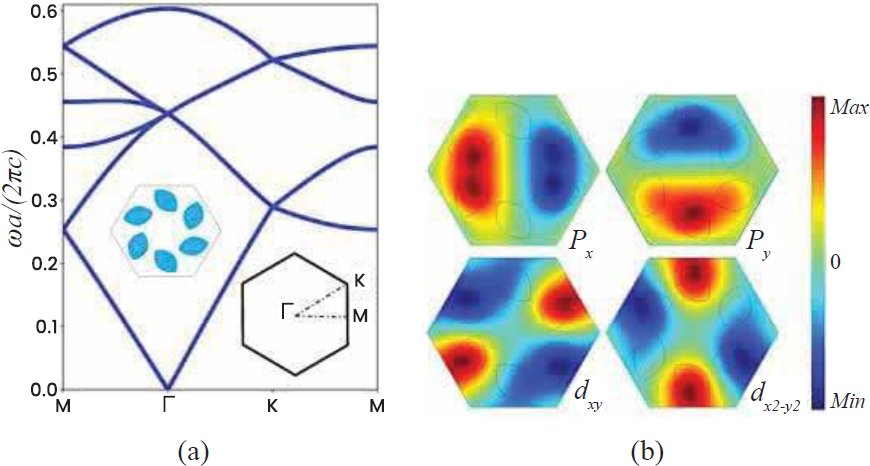
Fig. (2). Band structure for the TM modes  (Source: [30]).

3.4.3. Mechanical Strain

The concept of mechanical strain-based tuning is that an external force is applied to change the structural properties of a photonic crystal, shifting the photonic bandgap and edge states. The strain change in the refractive index is provided by:

Where:

  • is the change in refractive index,
  • is the photoelastic coefficient,
  • is the applied strain.

Mechanical strain tuning offers edge states that can be controlled very precisely, but has lower reconfigurability speeds than electro-optic techniques. Also, any strain fatigue over time may deteriorate the long-term stability of the system. Mode symmetry is prominent, edge states are frequently a result of band inversion between the dipolar and quadrupolar orbital symmetries at high-symmetry points, separating degeneracies, imposing topological gaps that define pseudospin properties, and coupling selection rules. Lastly, the depth of field-matter coupling is measured by determining the overlap integral of localised field profiles of edge states of emitters or nonlinear elements implemented in the crystal; large overlap increases Purcell factors and coherent interaction strengths relevant to quantum applications [31]. Such higher interpretations bring the review to more sophisticated physics than introductory physics

While electro-optic modulation is ideal for high-speed operations, it is limited by optical loss and decoherence. Thermal tuning offers stability and low energy consumption but lacks speed, making it unsuitable for high-speed quantum systems [32]. Mechanical strain provides precision but suffers from slow reconfigurability and strain fatigue. These legacy mechanisms formed the foundation of tunable photonics, but their limitations have driven the search for hybrid systems that combine their strengths to meet the demands of scalable, high-performance quantum photonics.

3.5. Quantum Photonic Relevance

The ultimate aim of the developments in topological photonics is to utilise them in quantum technologies. Low-loss routing is vital to quantum information transmissions, and tunable topological edge states offer a perfect alternative to them, as they allow a stable and robust propagation of light, which is not significantly affected by fabrication imperfections and defects [24]. Furthermore, scalable quantum photonic systems require on-chip reconfigurability. The reconfigurability of properties of photonic devices, e.g., quantum gates or interconnects, is a fundamental attribute of scalable quantum photonic systems. The tunable photonic crystals can be used as a very versatile architecture to be integrated on-chip, due to the required flexibility to follow the changing needs of quantum computing and quantum communication networks [33]. Moreover, the combination of the controlled topological edge states with single-photon emitters and detectors can widen the possibilities of the implementation of the quantum networks and quantum information processing systems [25].

4. CURRENT RESEARCH LANDSCAPE

The tunable topological edge states of the 2D photonic crystals in quantum photonics have become one of the most recent research topics in recent years. It is a basic procedure that scholars have been developing advanced methods of dynamically controlling topological states at the edge, and this process is essential in enhancing the output of quantum devices [34]. This section briefly overviews recent advances in each of these two general categories (tuning mechanism, material platform) in 2D photonic crystals, the milestones in the history of the experiment, and performance metrics.

4.1. Categorisation by Tuning Mechanism (Post-2020 Breakthroughs)

The progress in tunable topological edge states of two-dimensional (2D) photonic crystals to quantum applications in 2020 has been seen as a step forward in the field. The developed breakthroughs since 2020 on the basis of the pre-2020 legacy mechanisms of electro-optic modulation, thermal tuning, and mechanical strain include hybrid tuning systems, new materials, and non-Hermitian systems. The innovations provide greater scalability, efficiency, and accuracy, which would meet the requirements of quantum photonics applications [35].

4.1.1. Hybrid Tuning Mechanisms

4.1.1.1. Hybrid Electro-Optic and Mechanical Tuning

Among the most remarkable discoveries was the invention of hybrid systems that combine electrooptic modulation and mechanical strain. Electro-optic tuning offers quick modulation, which is needed with fast quantum interactions, and mechanical strain offers high-precision adjustments, which ensure stability over time [36]. This enables the speed and precise control of the topological edge states by the systems, which is essential in techniques such as quantum gates. The key example of such a hybrid solution is the combination of silicon photonic crystals and MEMS actuators, which allows quickly switching of edge states with stability and accuracy [37].

4.1.1.2. Hybrid Thermal and Electro-Optic Tuning

Conversely, there has been a hybrid solution of using thermal and electro-optic tuning to fit into the slow response time of thermal tuning, as well as take advantage of the low loss and stability of thermal techniques. Rapid adjustments are done by electro-optic tuning, whereas thermal tuning is stable, long-term and energy-efficient [38]. This hybridisation has found quantum memory and network applications to be a particularly useful output, since long-term control is needed with precision and reconfiguration is needed on a fast time scale [39, 40].

4.1.1.3. Cross-Mechanism Synthesis

Synthesizing the metrics of the mechanisms, we may note that electro-optic tuning has the lowest response time and high efficiency but has high optical loss, which is why it can be applied in cases when speed is the most important factor and it is not necessary to be very scalable. Conversely, thermal tuning offers high stability and low loss, but is more time-consuming, therefore, suited to quantum memory, whilst mechanical strain is most accurate but inexpensive to scale and fast.

4.1.1.4. Ranking and Trade-Off Evaluation

Electro-optic tuning is the best in terms of overall performance in applications where speed and efficiency are needed, thermal tuning is the best in terms of stability and low loss and mechanical strain is the best in terms of precise performance even though its speed and scalability may be low. This is a trade-off between speed (electro-optic) and precision (mechanical strain) or stability (thermal), as per the requirements of the quantum application at hand.

4.1.2. Breakthrough Materials for Tuning Mechanisms

4.1.2.1. 2D Materials (Graphene and Transition Metal Dichalcogenides)

Graphene and transition metal dichalcogenides (TMDs) are 2D materials, the integration of which is a major advance in tunable photonics. Graphene, which possesses good electrical and optical characteristics, has been employed for the electro-optic modulation in photonic crystals, making it possible to tune the topological photonic edge state quickly [41]. MoS2 and WS2 are TMDs, which have several distinctive features such as valley polarisation and significant excitonic effects, so they are well-adapted to high-precision quantum simulation, including quantum computing and quantum sensing [42].

4.1.2.2. Phase-Change Materials (Ge2Sb2Te5 and VO2)

Photoswitchable phase-change materials (PCM) such as Ge2Sb2Te5 (GST) and VO2 have been critical in tuning photonic properties [43, 44]. These substances experience reversible changes between amorphous and crystalline phases with a huge change in optical properties. An example of the use of GST is the control of the photonic bandgap of photonic crystal devices using GST to dynamically control edge states. Likewise, VO2, having a metal-insulator transition, has been applied to change topological states in photonic crystals, changing the optical properties at the phase transition temperature.

4.1.3. Non-Hermitian Systems and Exceptional Points

Another notable development after 2020 is the study of non-Hermitian photonics, in which complex gain and loss are added to the system. Non-Hermitian systems are systems in which the topological edge states are controlled by manipulating exceptional points (EPs) at which the eigenvalues of the system converge and which cause new physical processes, including unidirectional light propagation and switching between modes. Such systems provide edge state control previously unrealised, with new prospects in quantum communication and sensing applications [45]. Recent progress has demonstrated that, with tuning of the gain and the loss parameters, it is possible to dynamically control topological edge states and provide a new degree of reconfigurability and precision, which is required in quantum networks.

4.1.4. Integration of Quantum Light Sources

It has also been a breakthrough with the combination of quantum light sources, both quantum dots and defect centres in diamond, and tunable topological photonics. These are quantum light sources that may be implemented in connection with tunable photonic crystal cavities through which quantum states of light may be generated and controlled [46]. This combination is essential in the creation of a scalable on-chip quantum photonic device. By carefully coupling the edge states, scientists can tune the interaction between the quantum emitters and the photonic crystals and on this basis, the entangled photon pairs, quantum memory and other key quantum resources can be created [47].

After 2020 advances in tunable topological edge states in 2D photonic crystals, quantum photonics has gained much ground. Important considerations in the scalability, response times, and integration with quantum systems have been met by hybrid tuning mechanisms, new materials such as 2D materials and phase-change materials, and the creation of non-Hermitian systems [48]. These breakthroughs have improved the manipulation of photonic character, and they have a lot of potential in quantum computing, communication and sensing [49]. Due to the ongoing development of research, these improvements are likely to become a crucial factor in the creation of scalable and high-performance quantum photonic systems.

The major metrics, such as response time, precision, scalability, loss, and efficiency, of the three best tuning mechanisms, namely electro-optic, thermal, and mechanical strain, are summarised in Table 6. It brings out the merits and demerits of both methods in quantum photonics applications.

Table 6. Comparative overview of tuning mechanisms for topological edge states in 2D photonic crystals.

Tuning MechanismResponse TimePrecisionScalabilityLossEfficiency
Electro-opticNanosecondsHighModerateHighHigh
ThermalSlowModerateHighLowModerate
Mechanical StrainModerateVery HighLowLowLow

4.1.5. Tuning Mechanism Comparison and Evaluation and Limitation

The performance of the different tuning mechanisms is compared.

  • Efficiency: Electro-optic tuning is very efficient with a response time of between 50-100 ps, but with greater optical losses.
  • Energy Consumption: Thermal tuning is efficient in energy consumption, yet slower. Electro-optic systems consume more power, especially with larger systems.
  • Switching Speed: Electrical tuning offers fast modulation (~100 ps), whereas thermal and mechanical methods are slower (~ns to μs).
  • Footprint: Electro-optic systems have a compact footprint compared to mechanical methods.
  • Quantum Metrics: Electro-optic methods show better coherence retention, while phase-change materials (PCM) show promise for quantum fidelity but with slower switching.

Each tuning mechanism has its limitations:

  • Heating noise: Thermal tuning faces significant heating issues that limit stability in some applications.
  • EO loss: Electro-optic loss remains an issue in high-power applications.
  • Strain fatigue: Mechanical strain-based systems suffer from strain fatigue over time, limiting long-term reliability.
  • PCM Cycling Lifetime: Phase-change materials show limited cycling lifetimes, impacting their use in long-term quantum systems.

4.2. Material Platforms

Index tuning of unconfined topological edge states is critical to effectively selecting a material platform in 2D photonic crystals. Silicon-on-insulator (SOI), IIIV semiconductors, and lithium niobate on insulator (LNOI) are the three principal platforms that have attracted much research attention. Silicon-on-insulator (SOI) is among the most popular material platforms because it lends itself to CMOS technology and can enable photonics to be merged into electronics on the same chip. SOI photonic crystals can be optimal when using electro-optic tuning mechanisms, since the parameters in topological edge states can be well-controlled [50].

III-V semiconductors like InGaAsP or GaAs have also been investigated due to their high nonlinearities and quantum efficiency. Such materials give more freedom in the design of photonic crystals and frequently combine them with electro-optic tuning mechanisms [51]. Lithium niobate on insulator (LNOI) is becoming an ideal material platform for quantum photonics since its significant electro-optic coefficients and low loss at telecom wavelengths. These LNOI photonic crystals can integrate efficiently, which is scalable into quantum networks, and they make the tunable edge states, which could be used as a material platform [20]. There exists a fundamental tension between robustness and dynamic perturbation. While electrical tuning offers fast responses, it sacrifices topological robustness, whereas phase-change and mechanical systems offer more stable responses but at the cost of speed. Balancing these factors is crucial for scalable quantum photonics.

4.3. Experimental Demonstrations

A few landmark results of tunable topological edge states in 2D photonic crystals have been. These works have employed different tuning mechanisms and material platforms to stabilise controlled edge states, giving insights into these systems’ viability and operating capabilities in quantum applications. A table of the summary of some of the critical experimental works is shown below in Table 7.

Table 7. Summary of selected studies.

RefYearAuthor(s)Tuning MechanismPC LatticeOperational WavelengthQuantum Relevance
[52]2015Oliveri, G., Werner, D. H., & Massa, A.Electro-optic modulationHexagonal1550 nmQuantum Networks
[53]2017Hong, W., Baek, K.-H., & Ko, S.Electro-optic modulationSquare28 GHzQuantum Communication
[54]2018Barwicz, T., et al.Electro-optic modulationHexagonal1550 nmQuantum Networks
[2]2018Hao, R., Ye, Z., et al.Electro-optic modulationHexagonal1550 nmQuantum Sensors
[55]2019Peng, Y., et al.Electro-optic modulationHoneycomb1550 nmQuantum Communication
[48]2019Zhang, Z., et al.Material Switching (VO₂)Kagome1550 nmQuantum Computing
[56]2019Peng, Y., et al.Electro-optic modulationSquare1550 nmQuantum Communication
[5]2020Li, X., Liu, X., et al.Electro-optic modulationSquare1550 nmQuantum Communication
[57]2020Jin, Y., et al.Mechanical StrainKagome1550 nmQuantum Memory
[58]2013Zhang, X., et al.Electro-optic modulationSquare1550 nmQuantum Communication
[59]2021Chen, W., et al.Mechanical StrainHoneycomb1550 nmQuantum Memory
[60]2021Gong, Y., et al.Electro-optic modulationHexagonal1550 nmQuantum Networks
[51]2021Szelag, B., et al.Electro-optic modulationSquare1550 nmQuantum Networks
[43]2025He, H., et al.Material Switching (VO₂)Kagome1550 nmQuantum Communication
[61]2024Li, J., et al.Material Switching (GST)Honeycomb1550 nmQuantum Memory
[62]2022Gaikwad, A., et al.Mechanical StrainSquare1550 nmQuantum Sensors
[63]2025Ren, J., et al.Mechanical tuning (MEMS)Square1550 nmQuantum Gates
[64]2024Liu, Y., et al.Mechanical StrainHexagonal1550 nmQuantum Communication
[65]2024Zhang, L., et al.Non-Hermitian ParameterHexagonal1550 nmQuantum Networks
[41]2024Zhang, H., et al.Mechanical tuning (MEMS)KagomeTerahertzQuantum Communication
[66]2024He, L., et al.Electro-optic modulationSquare1550 nmQuantum Memory
[67]2024Lévêque, G., et al.Mechanical StrainSquare1550 nmQuantum Networks
[68]2022Wang, Y., & Panoiu, N. C.Electro-optic modulationSquare1550 nmQuantum Computing
[69]2024Uemura, T., et al.Material Switching (VO₂)Square1550 nmQuantum Interconnects
[63]2025Ren, J., et al.Mechanical Tuning (MEMS)Square1550 nmQuantum Networks
[70]2025Yang, Y., et al.Electro-optic modulationKagome1550 nmQuantum Computing
[71]2025Li, J., et al.Electro-optic modulationSquare1550 nmQuantum Communication

4.4. Simulation-Only Studies

Simulation-only studies have also been critical in studying the topical tunable topological edge states in 2D photonic crystals and experimental works. Tunability of edge states has widely been predicted based on the Finite-Difference Time-Domain (FDTD) simulations and plane-wave expansion approaches when multiple tuning mechanisms and material platforms are involved [72]. Such simulations are vital to identify new configurations, material selection, and tuning before their experimental validation. This has been addressed with FDTD simulations, so that exploration of the latest opportunities of controlling topological edge states might be performed with great precision, based on even more complex photonic structures.

4.5. Performance Metrics

The performance of tunable topological edge states is commonly measured using several essential parameters, such as modulation depth, switching speed, energy consumption, and loss performance. Modulation depth is the extent of variation of the edge state properties in response to a tuning mechanism. Deep modulation depth is essential for having firm control of the topological characteristics of the system [73]. Switching speed differs in importance in those applications where a prompt response is necessary, e.g., in quantum communication networks. Energy use is an important consideration, particularly in integrated photonics, where it is critically vital that low-power devices are scalable. Lastly, low-loss operations are needed to keep and transport quantum information throughout vast distances, especially within quantum communication systems and quantum computation.

5. ANALYSIS AND DISCUSSION

5.1. Trend Analysis

The area of tunable topology of states at edges of 2D photonic crystals has evolved considerably over the last decade. Early studies concentrated mainly on robust edge states with little control but non-static topological properties in most systems, where photonic crystal structures were designed to support the properties of robust edge states, with less control. The trend has, however, taken a drastic turn towards dynamically reconfigurable systems. Tunability has also been increasingly prioritised by introducing control mechanisms in different material platforms like the electro-optic, thermal, mechanical, and phase-change materials, which allow the topological edge states to be altered in a real-time manner, even once fabricated [74, 75]. The move is informed by the growing need to design quantum photonic systems capable of responding efficiently to the conditions around them and changes in their operating environment, essential to both scalable quantum circuits and adaptive quantum communication networks [33].

Among the interesting trends after 2020, one can distinguish the’ increased popularity of hybrid methods and the popularity of non-Hermitian systems. As a resultant measure of increased flexibility and accuracy in edge, state control tuning, hybrid systems that employ a combination of two or more tuning methods have become a general principle. As an example, electro-optic modulation with mechanical strain or material switching has been observed as a higher modulation depth and fast response time solution, presenting a middle-ground solution due to its fast response and efficient modulation depth in quantum applications that need precision and high speeds [76]. Photonic systems with non-Hermitian Hamiltonian systems have been of interest as well, since they add gain and loss to a photonic system, and thus can control edge states at exceptional points that would open a new path towards quantum computing and quantum networks [77]. These advances highlight the trend and growing difficulty of tunable topological systems.

5.2. Comparative Insights

When considering the three most prominent tuning mechanisms, electrical, thermal, and phase-change materials, there are some essential disparities in performance, relative ease of integration, and compatibility with quantum systems. The fast and easy integration appeal of electro-optic tuning is more likely to be associated with the platform silicon photonic crystals, which have the advantage of CMOS compatibility. Faster electro-optic tuning switching times (with nanosecond responses) are key in applications that need quick reconfiguration of topological edge states through electro-optic tuning, as in quantum gates [78].

On the other hand, thermal tuning is slower, yet more energy efficient, especially in the case of systems requiring little reconfiguration. Adjusting the photonic property of materials with a heater or temperature-controlled substrates has also proved effective in programming the topological edge states across many systems, but has slower response times and the risk of thermal crosstalk when highly integrated [79]. This is not as well suited to the case of high-speed quantum operation, however, and its usefulness may lie in low-speed quantum memory or quantum networks.

Phase-change materials (GST, VO2) have special benefits in material switching and the potential capabilities of spectacular change in optical properties through phase transitions. Such materials are readily capable of switching between the amorphous and crystalline phases to provide high refractive index contrast, which would be well-suited to quantum optical switches [39]. Nevertheless, phase-change material switching can be slower than an electrical approach, and thermal management is also an issue. They are quantum-compatible; however, with extensive quantum compatibility, particularly in quantum memory and photonic logic gate applications.

5.3. Integration Potential

Electro-optic tuning seems to be the most promising mechanism for large-scale integration of quantum photonic circuits, with compatibility to CMOS technology, well-established fabrication techniques, and high-speed Reconfigurability. It is thus very suitable when the scale of quantum circuits is significant, and multiple components must be handled in a physically integrated way at the same time [51]. Although the use of phase-change materials is potentially desirable because of their functionality, their use in large-scale integration may be hampered by issues with speed and power, thus possibly hindering their use in high-frequency quantum operations. Nevertheless, they demonstrate a high potential when it comes to specific applications, like quantum memory units [80].

An attractive way forward is into hybrid systems that combine electro-optic tuning with either phase-change materials or mechanical strain to exploit the virtues of more than one mechanism. By harnessing an additional mechanism to measure, for example, mechanical strain or material switching with electro-optic control, hybrid systems can achieve high efficiency as well as fast system reconfiguration, potentially mitigating the scale of single mechanism systems [21].

5.4. SLR Insights

Using a citation network analysis of the literature, a few papers and neighbourhoods that dominated the development of tunable topological edge states in photonic crystals can be identified. Articles about integration of electro-optic tuning with CMOS-compatible media like silicon-on-insulator have also been the most cited papers, and therefore are important to quantum photonic integration. Other areas of research interest are studying a phase-change material, such as GST and VO2, which has become a significant enabler to dynamic control of photonic states. Alongside that, the non-Hermitian photonics cluster on gain-loss modulation and exceptional points has seen a tremendous surge of interest in recent years, as well, and it in turn provides new horizons for quantum computing and communication.

5.5. Graphical Analysis

Publications related to the field increased steadily shown in Fig. (3), especially after 2018, and hybrid and non-Hermitian techniques increased sharply after 2020. It has been especially striking in recent years when the number of publications is rather high in the year 2022, and with the rate in the ascendant, the interest and focus on the area are further rising, promising the discovery of new areas of application of advanced tuning mechanisms and quantum use.
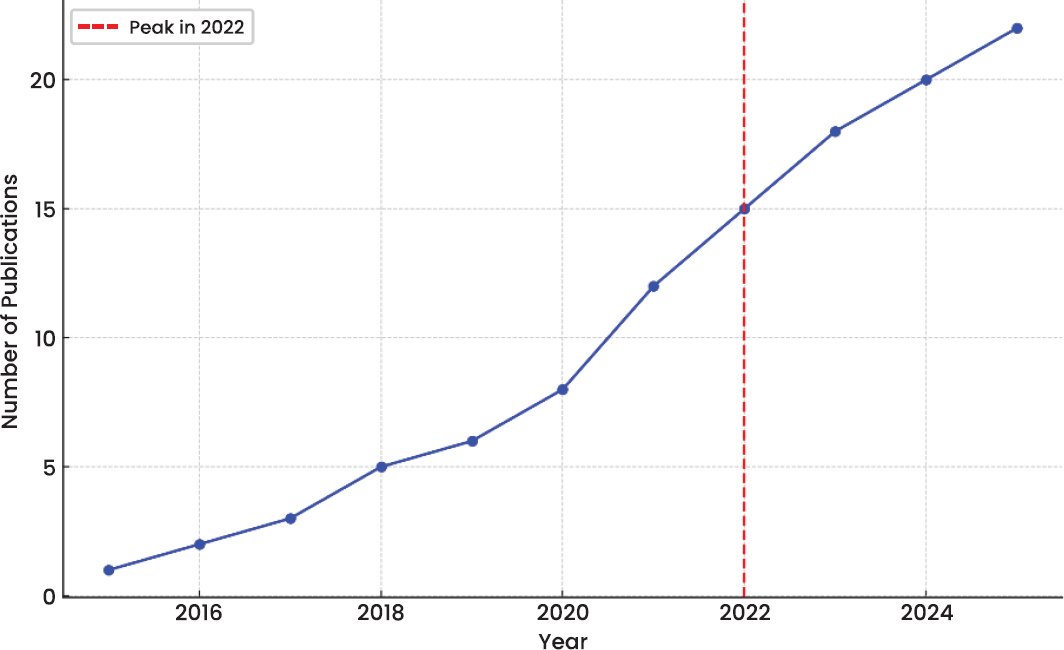
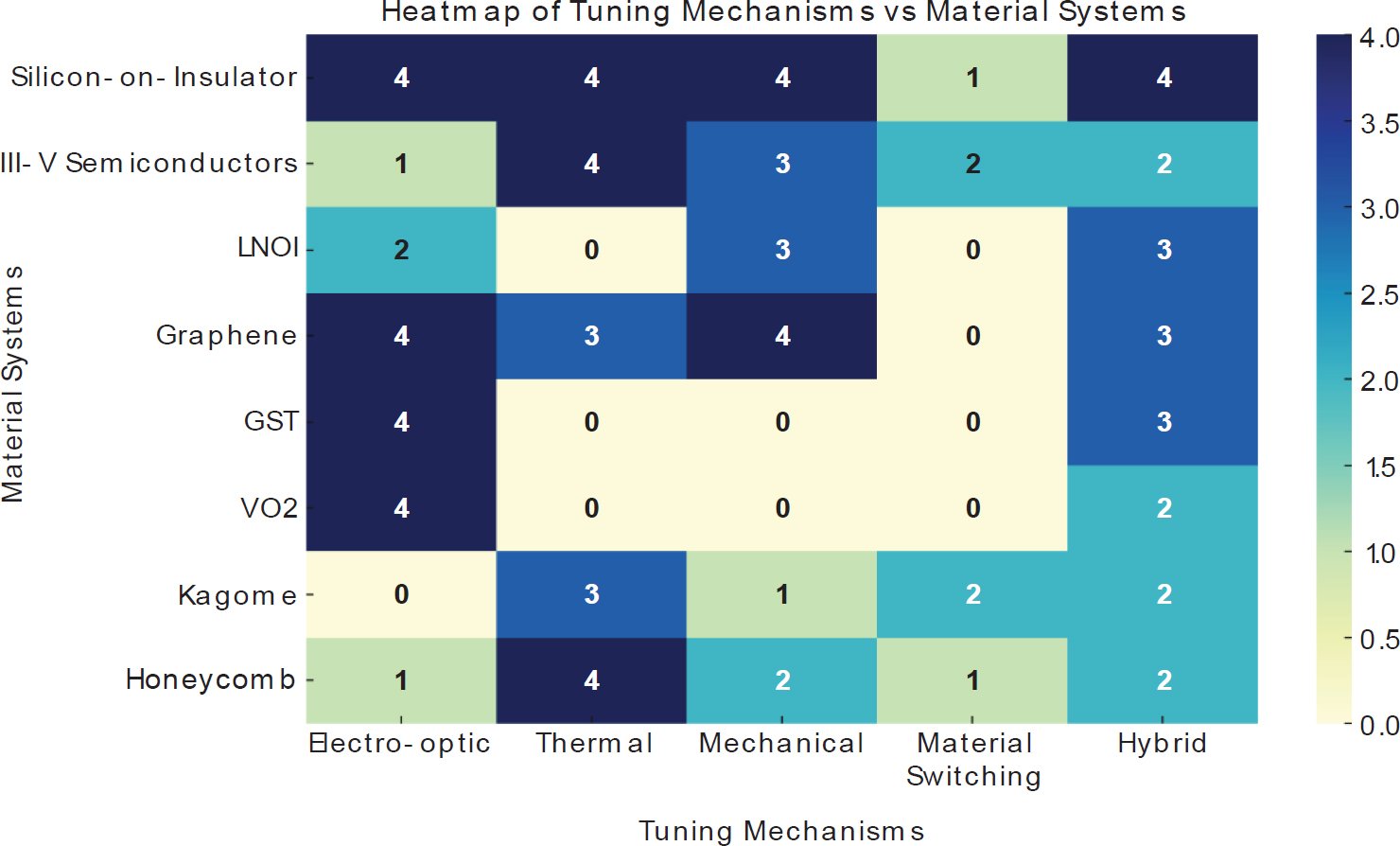
Fig. (3). Timeline of publications on tunable topological edge states (2015-2025).

The heat map in Fig. (4) indicates which tuning mechanisms (electro-optic, thermal, mechanical, material switching, and hybrid) are utilised on which material systems (including Silicon-on-Insulator, III-V semiconductors, LNOI, and GST). The stronger the colour, the more the tuning procedures are used on the individual materials, giving a clue at which different approaches are often used in tunable topological edge states.

Fig. (4). Heatmap of tuning mechanisms or material systems.

6. CHALLENGES AND FUTURE OPPORTUNITIES

6.1. Challenges

Although significant progress has been made, multiple challenges exist to realise efficient, scalable, tunable topological photonic systems that pave the way for quantum applications. Central manufacturing slope. Fabrication tolerance is the most crucial problem for 2D photonic crystals with adjustable components. The demand for precision engineering of photonic crystal structures is essential to make the edge states stable and robust when employing tuning mechanisms. The other concern is thermal crosstalk, especially with highly compact integration of thermal tuning elements on photonic circuits. These temperature variations may cause the degradation of neighbouring components and result in signal inefficiency. This is especially problematic in quantum systems where a non-lossy operation is required and/or the operation is required to be stable.

Also, there is the serious problem of controlling the losses in the areas of active tuning. Most systems can cause some optical loss when exposed to electric fields, mechanical strain, or heat. This can be an impeding factor in performance, particularly in quantum photonic applications, where optical losses can be a limiting factor on coherence over long-range or long-distance routing, and low-loss routing is essential. Finally, another problem that needs to be mentioned is quantum decoherence of the photonic states of the edge as a result of interacting with active elements of tuning. The use of electro-optic and thermal tuning interventions can introduce noise or noise fluctuations into the photonic states, as well as induce the decoherence of the appropriate quantum information processing. The resolution of these challenges will require a large advancement in materials science and device engineering.

6.2. Opportunities

Nevertheless, this field has many opportunities despite the challenges. Manufacturable programmable topological photonic chips pose a significant opportunity to scale, reconfigurable quantum photonic systems. Such chips might allow scalable and on-demand control of quantum states, thereby allowing quantum gates, the generation of entanglement, and the implementation of quantum communication protocols. The other potential is the possibility of on-chip topological quantum gates that may occur. In the progression of building quantum computing, researchers could create low-error-rate and high-fidelity quantum gates using tunable topological edge states.

The other opportunity is to couple with quantum light sources, e.g., quantum dots or defect centres, e.g., diamond. These sources, together with a tunable photonic crystal that can be set to produce on-chip quantum networks, can be combined, and this would assist in the generation, manipulation, and detection of quantum information. Finally, with 2D material-based tunable systems, the field can be revolutionised on novel materials, e.g., graphene and MoS2. Through such materials, possibilities are available that allow more efficient and tailored systems that can scale up quantum photonic and nonlinear optical systems.

CONCLUSION

This systematic literature review has discussed that there has been a strong advancement in the field of tunable topological edge states in 2D photonic crystals to design quantum photonic systems. We have talked about different tuning schemes, including electro-optic tuning, thermal tuning, strain in materials, and material phase transitions, in particular, with reference to dynamical control of the edge states. This scaling and reconfigurability are needed in quantum systems, such as quantum communication, quantum computing, and quantum sensing.

Despite these developments that allow on-chip reconfigurability and precise control, issues like fabrication tolerances, thermal crosstalk, and quantum decoherence are still serious problems. To overcome such problems, nanofabrication, quantum optics, and materials science should work together.

Further studies should be done to come up with hybrid systems that incorporate new materials such as graphene and MoS2, and research in non-linear optical reactions to increase tunability. Besides, quantum-enhanced sensing and hybrid photonic systems may also be scaled up to enhance quantum photonics. The innovations will be instrumental in making tunable topological photonics a backbone technology of quantum systems.

LIST OF ABBREVIATIONS

FDTD=Finite-Difference Time-Domain
LNOI=Lithium Niobate on Insulator
PCM=Phase-Change Materials
SLR=Systematic Literature Review
SOI=Silicon-On-Insulator

AUTHOR’S CONTRIBUTION

The author has contributed to conceptualisation, idea generation, problem statement, methodology, results analysis, results interpretation.

CONSENT FOR PUBLICATION

Not applicable.

AVAILABILITY OF DATA AND MATERIALS

The data will be made available at a reasonable request by contacting the corresponding author [U.H.].

FUNDING

None.

CONFLICT OF INTEREST

The author declares that there is no conflict of interest regarding the publication of this article.

ACKNOWLEDGEMENTS

Declared none.

DECLARATION OF AI

During the preparation of this work the author used ChatGPT for editing purposes. After using this tool, the author reviewed and edited the content as needed and take full responsibility for the content of the published article.

REFERENCES

[1]   Y. Wang, W. Zhang, and X. Zhang, “Tunable topological valley transport in two-dimensional photonic crystals,” New Journal of Physics, vol. 21, no. 9, p. 093020, 2019, doi: https://doi.org/10.1088/1367-2630/ab3ca3.

[2]   R. Hao et al., “Highly efficient graphene-based optical modulator with edge plasmonic effect,” IEEE Photonics Journal, vol. 10, no. 3, pp. 1-7, 2018, doi: https://doi.org/10.1109/JPHOT.2018.2841657.

[3]   Z. Wang, H. Zhang, L. Ni, W. Hu, and C. Peng, “Analytical perspective of interfering resonances in high-index-contrast periodic photonic structures,” IEEE Journal of Quantum Electronics, vol. 52, no. 7, pp. 1-9, 2016, doi: https://doi.org/10.1109/JQE.2016.2568763.

[4]   M. L. Chen, L. J. Jiang, S. Zhang, R. Zhao, Z. Lan, and W. E. Sha, “Comparative study of Hermitian and non-Hermitian topological dielectric photonic crystals,” Physical Review A, vol. 104, no. 3, p. 033501, 2021, doi: https://doi.org/10.1103/PhysRevA.104.033501.

[5]   X. Li, X. Liu, Y. Qin, D. Yang, and Y. Ji, “Ultra-low index-contrast polymeric photonic crystal nanobeam electro-optic modulator,” IEEE Photonics Journal, vol. 12, no. 3, pp. 1-8, 2020, doi: https://doi.org/10.1109/JPHOT.2020.2994241.

[6]   Q. Kang et al., “Dual-band valley-protected topological edge states in graphene-like phononic crystals with waveguide,” The European Physical Journal B, vol. 96, no. 3, p. 40, 2023, doi: https://doi.org/10.1140/epjb/s10051-023-00503-4.

[7]   Z.-x. Wang and Y.-t. Fang, “Switching and tunning of the topological edge states from two-dimensional photonic crystal with liquid crystal medium,” Physica E: Low-dimensional Systems and Nanostructures, vol. 142, p. 115240, 2022, doi: https://doi.org/10.1016/j.physe.2022.115240.

[8]   T. Asano, M. Yamaguchi, R. Konoike, and S. Noda, “Quantum photonics with photonic crystals,” in Quantum Photonics: Elsevier, 2024, pp. 405-447. doi: https://doi.org/10.1016/B978-0-323-98378-5.00010-6.

[9]   L. Zhang et al., “Higher‐order topological states in surface‐wave photonic crystals,” Advanced Science, vol. 7, no. 6, p. 1902724, 2020, doi: https://doi.org/10.1002/advs.201902724.

[10]   S.-P. Yu, J. A. Muniz, C.-L. Hung, and H. J. Kimble, “Two-dimensional photonic crystals for engineering atom–light interactions,” Proceedings of the National Academy of Sciences, vol. 116, no. 26, pp. 12743-12751, 2019, doi: https://doi.org/10.1073/pnas.1822110116.

[11]   M. A. Butt, “Emerging Trends in Thermo-Optic and Electro-Optic Materials for Tunable Photonic Devices,” Materials, vol. 18, no. 12, p. 2782, 2025, doi: https://doi.org/10.3390/ma18122782.

[12]   Z. Fang, R. Chen, V. Tara, and A. Majumdar, “Non-volatile phase-change materials for programmable photonics,” APL Mater. Vol. 11, p. 100603, 2023, doi: https://doi.org/10.1063/5.0165309.

[13]   Y. Wang and F. N. Khan, “Topological edge states electro-optic modulator based on valley photonic crystals,” in Advanced Fiber Laser Conference (AFL2023), 2024, vol. 13104: SPIE, pp. 1218-1226, doi: https://doi.org/10.1117/12.3023638.

[14]   I. Anghel and A. Petris, “Design of an all-optical tunable 2D photonic crystal in As2S3 film,” Optics Communications, vol. 574, p. 131247, 2025, doi: https://doi.org/10.1016/j.optcom.2024.131247.

[15]   Y. Lu, Q. Yao, M. He, J. Xu, and Y. Peng, “Reconfigurable group delay with tunable topological edge state based on phase transitions material Ge2Sb2Te5 in dual-band,” Results in Physics, vol. 70, p. 108145, 2025, doi: https://doi.org/10.1016/j.rinp.2025.108145.

[16]   R. A. El-Nabulsi and W. Anukool, “Structural Analysis of Phononic Crystals and Propagation of Elastic Waves in Cubic Solids in Fractal Dimensions,” Journal of Elasticity, vol. 157, no. 1, p. 27, 2025/02/11 2025, doi: https://doi.org/10.1007/s10659-025-10117-9.

[17]   G. J. Tang, X. T. He, F. L. Shi, J. W. Liu, X. D. Chen, and J. W. Dong, “Topological photonic crystals: physics, designs, and applications,” Laser & Photonics Reviews, vol. 16, no. 4, p. 2100300, 2022, doi: https://doi.org/10.1002/lpor.202100300.

[18]   A. Manna et al., “Cryo-compatible in situ strain tuning of 2D material-integrated nanocavity,” ACS Photonics, vol. 10, no. 9, pp. 3242-3247, 2023, doi: https://doi.org/10.1021/acsphotonics.3c00662.

[19]   A. Burtsev et al., “Low-loss Se-based phase-change materials for infrared photonics,” Optical Materials, vol. 157, p. 116117, 2024, doi: https://doi.org/10.1016/j.optmat.2024.116117.

[20]   M. Blanco de Paz et al., “Tutorial: computing topological invariants in 2D photonic crystals,” Advanced Quantum Technologies, vol. 3, no. 2, p. 1900117, 2020, doi: https://doi.org/10.1002/qute.201900117.

[21]   M. Ali, M. W. Khalid, and H. Butt, “Mechanically Tunable Flexible Photonic Device for Strain Sensing Applications,” Polymers, vol. 15, no. 8, p. 1814, 2023, doi: https://doi.org/10.3390/polym15081814.

[22]   L. Zhang et al., “Photonic crystal based on mott phase change material as all-optical bandgap switch and composite logic gate,” Optical Materials, vol. 113, p. 110855, 2021, doi: https://doi.org/10.1016/j.optmat.2021.110855.

[23]   K. Alexander et al., “A manufacturable platform for photonic quantum computing,” Nature, vol. 641, no. 8064, pp. 876-883. https://doi.org/10.1038/s41586-025-08820-7.

[24]   K.-H. Kim and K.-K. Om, “Exciting topological edge states by using plane waves in valley-Hall photonic crystal slabs,” Optics Communications, vol. 574, p. 131142, 2025, doi: https://doi.org/10.1016/j.optcom.2024.131142.

[25]   Z. Lan, M. L. Chen, F. Gao, S. Zhang, and W. E. Sha, “A brief review of topological photonics in one, two, and three dimensions,” Reviews in Physics, vol. 9, p. 100076, 2022, doi: https://doi.org/10.1016/j.revip.2022.100076.

[26]   T. Asano, M. Yamaguchi, R. Konoike, and S. Noda, “9 – Quantum photonics with photonic crystals,” in Quantum Photonics, Y. Arakawa and D. Bimberg Eds.: Elsevier, 2024, pp. 405-447. https://doi.org/10.1016/B978-0-323-98378-5.00010-6.

[27]   M. Mahmoud, L. Cai, C. Bottenfield, and G. Piazza, “Lithium niobate electro-optic racetrack modulator etched in Y-cut LNOI platform,” IEEE Photonics Journal, vol. 10, no. 1, pp. 1-10, 2018, doi: https://doi.org/10.1109/JPHOT.2018.2797244.

[28]   H. Wang, X. Zhang, J. Hua, D. Lei, M. Lu, and Y. Chen, “Topological physics of non-Hermitian optics and photonics: a review,” Journal of Optics, vol. 23, no. 12, p. 123001, 2021, doi: https://doi.org/10.1088/2040-8986/ac2e15.

[29]   D. Jiang et al., “Flexible electronics based on 2D transition metal dichalcogenides,” Journal of Materials Chemistry A, vol. 10, no. 1, pp. 89-121, 2022, doi: https://doi.org/10.1039/D1TA06741A.

[30]   D. Borges-Silva, C. H. O. Costa, and C. G. Bezerra, “Robust Topological Edge States in C6 Photonic Crystals,” Photonics, vol. 10, no. 9, p. 961, 2023, doi: https://doi.org/10.3390/photonics10090961.

[31]   E. Callus, “Applications of light–matter interaction in semiconductor structures,” University of Sheffield, 2023.. Available from: https://etheses.whiterose.ac.uk/id/oai_id/oai:etheses.whiterose.ac.uk:33634.

[32]   R. A. El-Nabulsi, “Modelling nematic liquid crystal in fractal dimensions,” Medicine in Novel Technology and Devices, vol. 24, p. 100334, 2024/12/01/ 2024, doi: https://doi.org/10.1016/j.medntd.2024.100334.

[33]   X.-C. Sun, C. He, X.-P. Liu, M.-H. Lu, S.-N. Zhu, and Y.-F. Chen, “Two-dimensional topological photonic systems,” Progress in Quantum Electronics, vol. 55, pp. 52-73, 2017, doi: https://doi.org/10.1016/j.pquantelec.2017.07.004.

[34]   S. Qiao et al., “Two-Dimensional Photonic Crystal Cavities in ZnSe Quantum Well Structures,” ACS Photonics, vol. 11, no. 9, pp. 3545-3553, 2024/09/18 2024, doi: https://doi.org/10.1021/acsphotonics.4c00340.

[35]   D. Qiu et al., “Recent advances in 2D superconductors,” Advanced Materials, vol. 33, no. 18, p. 2006124, 2021, doi: https://doi.org/10.1002/adma.202006124.

[36]   H. Benisty, S. Olivier, M. Rattier, and C. Weisbuch, “Applications of Two-Dimensional Photonic Crystals to Semiconductor Optoelectronic Devices,” in Photonic Crystals and Light Localization in the 21st Century, C. M. Soukoulis Ed. Dordrecht: Springer Netherlands, 2001, pp. 117-128. doi: https://doi.org/10.1007/978-94-010-0738-2_9.

[37]    Song BS, Yamada S, Asano T, Noda S. Demonstration of two-dimensional photonic crystals based on silicon carbide. Optics express. 2011 May 23;19(12):11084-9. doi: https://doi.org/10.1364/OE.19.011084.

[38]   T. Cao, L. Fang, Y. Cao, N. Li, Z. Fan, and Z. Tao, “Dynamically reconfigurable topological edge state in phase change photonic crystals,” Science Bulletin, vol. 64, no. 12, pp. 814-822, 2019, doi: https://doi.org/10.1016/j.scib.2019.02.017.

[39]   Y. Long, L. Zou, L. Yu, H. Hu, J. Xiong, and B. Zhang, “Inverse design of topological photonic time crystals via deep learning,” Optical Materials Express, vol. 14, no. 8, pp. 2032-2039, 2024, doi: https://doi.org/10.1364/OME.525396.

[40]   S. Vaidya, A. Ghorashi, T. Christensen, M. C. Rechtsman, and W. A. Benalcazar, “Topological phases of photonic crystals under crystalline symmetries,” Physical Review B, vol. 108, no. 8, p. 085116, 2023, doi: https://doi.org/10.1103/PhysRevB.108.085116.

[41]   H. Zhang, Z. Gu, L. Si, and J. Ding, “Realization of terahertz frequency selecting based on topological edge states with kagome photonic crystals,” Results in Physics, vol. 57, p. 107399, 2024, doi: https://doi.org/10.1016/j.rinp.2024.107399.

[42]   H. Huang, S. Huo, and J. Chen, “Reconfigurable topological phases in two-dimensional dielectric photonic crystals,” Crystals, vol. 9, no. 4, p. 221, 2019, doi: https://doi.org/10.3390/cryst9040221.

[43]   H. He et al., “Topological polarization singularity modulation in the phase change material metasurfaces,” IEEE Photonics Technology Letters, 2025, doi: https://doi.org/10.1109/LPT.2025.3565577.

[44]   C.-Y. Ji, G.-B. Liu, Y. Zhang, B. Zou, and Y. Yao, “Transport tuning of photonic topological edge states by optical cavities,” Physical Review A, vol. 99, no. 4, p. 043801, 2019, doi: https://doi.org/10.1103/PhysRevA.99.043801.

[45]   X. Wang, R. Starko-Bowes, C. Khandekar, and Z. Jacob, “High-temperature thermal photonics,” Annual Review of Heat Transfer, vol. 23, 2020, doi: https://doi.org/10.1615/AnnualRevHeatTransfer.2020032805.

[46]   X. Zhou, J. Wu, and Y. Wu, “Topological corner states in non-Hermitian photonic crystals,” Optics Communications, vol. 466, p. 125653, 2020, doi: https://doi.org/10.1016/j.optcom.2020.125653.

[47]   M. Parto, Y. G. Liu, B. Bahari, M. Khajavikhan, and D. N. Christodoulides, “Non-Hermitian and topological photonics: optics at an exceptional point,” Nanophotonics, vol. 10, no. 1, pp. 403-423, 2020, doi: https://doi.org/10.1515/nanoph-2020-0434.

[48]   Z. Zhang, Z. Lan, Y. Xie, M. L. Chen, W. E. Sha, and Y. Xu, “Bound topological edge state in the continuum for all-dielectric photonic crystals,” Physical Review Applied, vol. 16, no. 6, p. 064036, 2021, doi: https://doi.org/10.1103/PhysRevApplied.16.064036.

[49]   A. W. Elshaari, W. Pernice, K. Srinivasan, O. Benson, and V. Zwiller, “Hybrid integrated quantum photonic circuits,” Nature Photonics, vol. 14, no. 5, pp. 285-298. https://doi.org/10.1038/s41566-020-0609-x.

[50]   Z. Guo et al., “Generation of perfect vortex beams with polymer-based phase plate,” IEEE Photonics Technology Letters, vol. 32, no. 10, pp. 565-568, 2020, doi: https://doi.org/10.1109/LPT.2020.2985745.

[51]   B. Szelag et al., “Hybrid III–V/silicon technology for laser integration on a 200-mm fully CMOS-compatible silicon photonics platform,” IEEE Journal of Selected Topics in Quantum Electronics, vol. 25, no. 5, pp. 1-10, 2019, doi: https://doi.org/10.1109/JSTQE.2019.2904445.

[52]   G. Oliveri, D. H. Werner, and A. Massa, “Reconfigurable electromagnetics through metamaterials—A review,” Proceedings of the IEEE, vol. 103, no. 7, pp. 1034-1056, 2015, doi: https://doi.org/10.1109/JPROC.2015.2394292.

[53]   W. Hong, K.-H. Baek, and S. Ko, “Millimeter-wave 5G antennas for smartphones: Overview and experimental demonstration,” IEEE Transactions on Antennas and Propagation, vol. 65, no. 12, pp. 6250-6261, 2017, doi: http://dx.doi.org/10.1109/TAP.2017.2740963.

[54]   T. Barwicz et al., “Integrated metamaterial interfaces for self-aligned fiber-to-chip coupling in volume manufacturing,” IEEE Journal of Selected Topics in Quantum Electronics, vol. 25, no. 3, pp. 1-13, 2018, doi: http://dx.doi.org/10.1109/JSTQE.2018.2879018.

[55]   Y. Peng et al., “Frequency tunable topological edge states of two-dimensional honeycomb lattice photonic crystals,” arXiv preprint arXiv:1912.08078, 2019, doi: https://doi.org/10.48550/arXiv.1912.08078.

[56]   Y. Peng et al., “Low-threshold and tunable optical bistability based on topological edge state in one-dimensional photonic crystal heterostructure with graphene,” IEEE Access, vol. 8, pp. 196386-196393, 2020, doi: https://doi.org/10.1109/ACCESS.2020.3034320.

[57]   Y. Jin, W. Wang, Z. Wen, D. Torrent, and B. Djafari-Rouhani, “Topological states in twisted pillared phononic plates,” Extreme Mechanics Letters, vol. 39, p. 100777, 2020, doi: https://doi.org/10.1016/j.eml.2020.100777.

[58]   X. Zhang, A. Hosseini, X. Lin, H. Subbaraman, and R. T. Chen, “Polymer-based hybrid-integrated photonic devices for silicon on-chip modulation and board-level optical interconnects,” IEEE Journal of Selected Topics in Quantum Electronics, vol. 19, no. 6, pp. 196-210, 2013, doi: https://doi.org/10.1109/JSTQE.2013.2268386.

[59]   W. Chen, W. Ren, M. Cheng, X. Liu, X. Zhang, and M. Zhang, “Strain induced photonic topological insulator,” Physics Letters A, vol. 447, p. 128299, 2022, doi: https://doi.org/10.1016/j.physleta.2022.128299.

[60]   Y. Gong, L. Guo, S. Wong, A. J. Bennett, and S. S. Oh, “Tailoring topological edge states with photonic crystal nanobeam cavities,” Scientific Reports, vol. 11, no. 1, p. 1055, 2021, doi: https://doi.org/10.1038/s41598-020-79915-6.

[61]   J. Li, J. Yao, Y. Wang, Z. Zhou, Z. Lan, and C. Yuan, “Topological states decorated by twig boundary in plasma photonic crystals,” Advanced Optical Materials, vol. 12, no. 17, p. 2303244, 2024, doi: https://doi.org/10.1002/adom.202303244.

[62]   A. Gaikwad et al., “Strain-tuned topological phase transition and unconventional Zeeman effect in ZrTe5 microcrystals,” Communications Materials, vol. 3, no. 1, p. 94, 2022, doi: https://doi.org/10.1038/s43246-022-00316-5.

[63]   J. Ren, W. Ding, S. Wang, and S. Tang, “Manipulation of Topological Edge States and Realization of Zero-Dimensional Higher-Order Topological Point States,” Micromachines, vol. 16, no. 6, p. 686, 2025, doi: https://doi.org/10.3390/mi16060686.

[64]   Y. Liu, X. Zhang, C.-P. Liang, F.-F. Li, Y. Poo, and J.-H. Jiang, “Observation of bulk-dislocation correspondence in photonic crystals,” Physical Review Applied, vol. 22, no. 6, p. 064097, 2024, doi: https://doi.org/10.1103/PhysRevApplied.22.064097.

[65]   L. Zhang, B. Wang, S. Song, and J. Cai, “Edge and corner states in non-Hermitian second-order topological photonic crystals,” Optics & Laser Technology, vol. 179, p. 111353, 2024, doi: https://doi.org/10.1016/j.optlastec.2024.111353.

[66]   L. He, Q. Ren, L. Wu, and J. Yao, “Reprogrammable location of light source for achieving tunable multi-switching of unidirectional helical edge states in topological photonic crystals,” Optics Communications, vol. 566, p. 130718, 2024, doi: https://doi.org/10.1016/j.optcom.2024.130718.

[67]   G. Lévêque, P. Szriftgiser, A. Amo, and Y. Pennec, “Relation between interface symmetry and propagation robustness along domain walls based on valley topological photonic crystals,” APL Photonics, vol. 9, no. 12, 2024, doi: https://doi.org/10.1063/5.0233892.

[68]   Y. Wang and N. C. Panoiu, “Optically controllable coupling between edge and topological interface modes of graphene metasurfaces,” Journal of Optics, vol. 24, no. 10, p. 104002, 2022, doi: https://doi.org/10.1088/2040-8986/ac8940.

[69]   T. Uemura et al., “Photonic topological phase transition induced by material phase transition,” Science Advances, vol. 10, no. 34, p. eadp7779, 2024, doi: https://doi.org/10.1126/sciadv.adp7779.

[70]   Y. Yang et al., “Topologically protected edge states in time photonic crystals with chiral symmetry,” Acs Photonics, vol. 12, no. 5, pp. 2389-2396, 2025, doi: https://doi.org/10.1021/acsphotonics.4c01785.

[71]   C. Yang et al., “Tunable topological edge states based on anomalous scattering,” Optics Letters, vol. 50, no. 7, pp. 2354-2357, 2025, doi: http://dx.doi.org/10.1364/OL.555560.

[72]   K. Giewont et al., “300-mm monolithic silicon photonics foundry technology,” IEEE Journal of Selected Topics in Quantum Electronics, vol. 25, no. 5, pp. 1-11, 2019, doi: https://doi.org/10.1109/JSTQE.2019.2908790.

[73]   W. Ma, Z. Liu, Z. A. Kudyshev, A. Boltasseva, W. Cai, and Y. Liu, “Deep learning for the design of photonic structures,” Nature Photonics, vol. 15, no. 2, pp. 77-90, 2021/02/01 2021, doi: https://doi.org/10.1038/s41566-020-0685-y.

[74]   U. S. Sainadh and M. A. Kumar, “Displacement sensing beyond the standard quantum limit with intensity-dependent optomechanical coupling,” Physical Review A, vol. 102, no. 6, p. 063523, 2020, doi: https://doi.org/10.1103/PhysRevA.102.063523.

[75]   F. Sui, J. Chen, and H. Huang, “Tunable topological edge states and rainbow trapping in two dimensional magnetoelastic phononic crystal plates based on an external magnetostatic field,” International Journal of Mechanical Sciences, vol. 225, p. 107360, 2022, doi: https://doi.org/10.1016/j.ijmecsci.2022.107360.

[76]   L. Fan, Y. Chen, J. Zhu, and Z. Su, “Topological interface and corner states of flexural waves in metamaterial plates with glide-symmetric holes,” Journal of Sound and Vibration, vol. 595, p. 118795, 2025, doi: https://doi.org/10.1016/j.jsv.2024.118795.

[77]   X. Wang, R. Gu, Y. Li, H. Qi, X. Hu, and Q. Gong, “Higher‐Order States in a Non‐Hermitian 3D Topological Photonic Crystal,” Laser & Photonics Reviews, vol. 18, no. 1, p. 2300204, 2024, doi: https://doi.org/10.1002/lpor.202300204.

[78]   K. Sala, T. Doicin, A. D. Armour, and T. Tufarelli, “Quantum estimation of coupling strengths in driven-dissipative optomechanics,” Physical Review A, vol. 104, no. 3, p. 033508, 2021, doi: https://doi.org/10.1103/PhysRevA.104.033508.

[79]   S. Tang, Y. Xu, F. Ding, and F. Liu, “Continuously tunable topological defects and topological edge states in dielectric photonic crystals,” Physical Review B, vol. 107, no. 4, p. L041403, 2023, doi: https://doi.org/10.1103/PhysRevB.107.L041403.

[80]   R. Halir et al., “Recent advances in silicon waveguide devices using sub-wavelength gratings,” IEEE Journal of Selected Topics in Quantum Electronics, 2013, vol. 20, no. 4, pp. 279-291. https://doi.org/10.1109/JSTQE.2013.2293754.

Licensed
© 2026 Copyright by the Authors.download

Licensed as an open access article using a CC BY 4.0 license.

Latest Articles