

















Article Contents
Article ID: CMT2621101001
Views: 1247Effect of Safety-Oriented HR Practices, Safety Climate Practices and Project Leadership on Accident Prevention: Testing Perceived Vision 2030 Infrastructure Program as a Moderator
 DOI:
DOI:
 PDF
PDF
⬇ Downloads: 37
1Department of Business Administration, Imam Abdul Rahman Bin Faisal University, Dammam, Saudi Arabia
Received: 13 May, 2026
Accepted: 08 July, 2026
Revised: 01 July, 2026
Published: 14 July, 2026
ABSTRACT:
Introduction: This study explored the influence of Safety-Oriented HR Practices, Safety Climate Practices and Project Leadership on the Accident Prevention in large-scale infrastructure projects in Saudi Arabia and tested the moderating effect of the Perceived Vision 2030 Infrastructure Program. This study makes a few contributions by combining organisational and institutional lenses to elucidate safety outcomes. It also examined whether national infrastructural alignment enhances the translation of internal safety mechanisms into accident prevention.
Methods: A quantitative research design was used, and 300 construction professionals were surveyed. Partial Least Squares Structural Equation Modelling (PLS-SEM) was used to analyse the data.
Results & Discussion: The results suggest a positive association between Safety-Oriented HR Practices, Safety Climate Practices and Project Leadership, and accident prevention. However, the Perceived Vision 2030 Infrastructure Program only strengthens the relationship between Project Leadership and accident prevention, while its moderating effects on Safety-Oriented HR Practices and Safety Climate Practices remain insignificant. The direct impact of the Vision 2030 perception on accident prevention was also not supported.
Conclusion: This research offers practical implications for construction organisations and project stakeholders by emphasising the need to enhance internal safety systems in the context of national infrastructure initiatives.
Keywords: Safety climate, HR practices, project leadership, construction safety, accident prevention, Vision 2030 infrastructure program, Saudi Arabia.
1. INTRODUCTION
The construction industry is among the most hazardous industries in the world, and occupational risks and accident rates have not decreased despite recent improvements in safety. The cost of workplace injuries and accidents is still too high, with almost 3 million fatalities and approximately 400 million non-fatal injuries reported annually (Gaudiaut, 2026). The construction industry in Saudi Arabia incurs an estimated cost of $91,940 per accident, which is part of an estimated economic cost of $261.11 million annually that includes hospital bills, compensation, and loss of productivity (Umar & Umeokafor, 2021). This has been a major issue, especially in large-scale infrastructure programs, where complex risk environments, diverse workforces, and dynamic activities increase safety vulnerability.
Safety climate is a core driver of safety outcomes, as the literature highlights that management commitment, training, communication, and accountability are dimensions of safety climate associated with safer workplace behaviours and lower accident rates in the construction sector (Umar, 2020). Theoretically, Safety Climate Theory explains how employees form collective perceptions about their organisations in terms of safety priorities, policies, procedures, and management commitment, and how these perceptions affect safety-related attitudes and behaviours (Kines et al., 2011; Sawhney et al., 2011). It has been empirically demonstrated that positive perceptions of safety climate are associated with enhanced safety performance among construction workers, including migrant labour populations, where vulnerability may be particularly high (Zafar et al., 2024).
Simultaneously, leadership styles, particularly transformational leadership, are significant factors that influence how safety norms are communicated, exemplified, and embedded at construction sites. Transformational Leadership Theory refers to leadership practices that support and encourage employees through vision, intellectual stimulation, and personal consideration to achieve organisational objectives (Bass & Avolio, 1993, cited in Deng et al., 2023). Safety-specific transformational leadership was found to be especially useful for enhancing safety outcomes through employee empowerment, the development of a shared vision of safety, and increased motivation to comply (Senthamizh & Anandh, 2024). Another recent study supports the idea that transformational leadership improves safety behaviour through knowledge sharing and psychological safety (Ali et al., 2025). Thus, this research question explores whether the alignment of institutions with the Vision 2030 infrastructure program reinforces various organisational safety channels, such as human resource systems, climate practices, and project leadership.
Despite the fact that safety-oriented HR practices and safety climate practices have been identified as significant predictors of construction safety, past research has tended to analyse the two phenomena separately or within broad safety management models. There is a lack of empirical data on their relative impacts on Accident Prevention, especially within the context of complex infrastructures, where formal HRs and the safety perceptions of employees can be subjected to dissimilar mechanisms.
In addition, national institutions and policies have an important influence on organisational safety practices, as they provide regulatory, normative, and cultural pressure on firms and industries. Based on Institutional Theory, external forces are represented by programs and make companies adjust their practices to gain legitimacy, fulfil requirements, or even align with the overall targets of society (Kauppi, 2022). One such program is Vision 2030 in Saudi Arabia, where national transformation agendas are characterised by sound occupational safety and health regulations. Saudi Arabia has reported a 75% and 30% reduction in the number of fatalities and workplace injuries, respectively, owing to stringent regulatory measures, digital safety, and active safety policies (Abueish, 2025; Arab News, 2024). The National Institute for Occupational Safety and Health and compliance incentive programs are examples of how institutional forces can restructure organisational safety priorities (Government of Saudi Arabia, 2021). Despite such achievements, high-profile incidents still highlight the issue of safety in mega projects and reinforce the argument that additional efforts are required to examine the factors underlying organisations in the context of accident prevention (Pattisson, 2025).
Nonetheless, the available empirical studies did not investigate the interplay of these macro-level programs with organisational safety drivers, including a combination of Safety-Oriented HR Practices, Safety Climate Practices, and project leadership, to determine their effects on Accident Prevention. Therefore, the aim of the present research was to investigate the interaction between Safety-Oriented HR Practices, Safety Climate Practices and Project Leadership as predictors of Accident Prevention and Vision 2030 Infrastructure Program as a moderator. This study makes a theoretical contribution by combining safety climate, transformational leadership, and institutional theories to examine how internal factors within an organisation respond to external institutional programs that influence safety. This study is valuable because it articulates how organisational safety systems interrelate with a national infrastructure development environment to affect accident prevention in Saudi megaproject environments.
2. LITERATURE REVIEW
2.1. Key Constructs
(Zohar, 1980) introduced the term safety climate to explain the collective understanding of organisational safety priorities, policies, and practices by employees. The safety climate in construction settings indicates how employees perceive management dedication, safety anticipations, and the general focus on keeping safe activities (Lestari et al., 2020). Safety-Oriented HR Practices, together with safety climate, are formal organisational practices that enhance safety capability by engaging in activities such as training, competency development, performance assessment, and safety-related incentives. There is evidence that good HR safety practices enhance employee safety knowledge and promote safer work behaviour (Premarathna, 2020).
In this study, Safety-Oriented HR Practices and Climate Practices were conceptualised as separate organisational safety constructs. Safety-Oriented HR Practices are formal organisational strategies applied in the promotion of safety, such as employee training, competency development, communications, and systems that are concerned with safety and performance. Conversely, Climate Practices are employees’ collective perceptions of managerial commitment, safety priorities, and safety procedure execution in the workplace. Despite being complementary to each other in the organisation, the two constructs represent two distinct facets of safety management and are discussed separately in this study.
Project leadership, on the other hand, is a behavioural practice of organisational safety systems and climate expectations in routine project activities. Project leaders in construction projects organise multidisciplinary teams, engage stakeholders, and transform safety priorities into operational practices in multifaceted project settings (Whyte et al., 2022). Therefore, project leadership in the current study refers to the capacity of leaders to communicate safety priorities, reinforce safety compliance, and shape workers’safety-related behaviours to enhance accident prevention.
Moreover, Accident Prevention is employees’ evaluation of the effectiveness of organisational strategies, policies, and behavioural practices in minimising workplace hazards, injuries, and incidents before their occurrence. In this study, accident Prevention is a measure of the efficacy of safety activities and management in reducing on-site accidents in infrastructure development.
Finally, (Saudi Vision 2030, 2024) eases mega infrastructure projects, such as NEOM, The Red Sea Project, Qiddiya Entertainment City, King Salman Park, and Diriyah Gate, which, combined, should modernise infrastructure and achieve sustainable economic growth. As more infrastructure is developed as part of Vision 2030, organisations conducting such activities need to balance their operational practices with national safety standards, as well as institutional expectations and guidelines (Government of Saudi Arabia, 2021). In the current study, the Vision 2030 Infrastructure Program is theorised as a contextual institutional aspect of how employees perceive national infrastructure priorities, safety expectations, regulatory orientation, and organisational alignment with Vision 2030 initiatives.
2.2. Theoretical Framework
The theory of Safety Climate, first postulated by Dov Zohar, defines safety climate as the collective perceptions of employees regarding organisational safety policies, procedures, and practices that indicate management priorities towards safety performance (Anna, 2025). Recent empirical research in the construction setting found that a high perception of safety climate positively correlates with adherence to safety protocols and proactive safety behaviours of workers, which results in the enhancement of safety performance (Al-Bayati, 2021; Chen et al., 2021a; Shahin et al., 2026). Others have mentioned the psychological safety climate, which is where individual cognitive understanding of safety in the workplace occurs, as opposed to the organisational climate between groups or organisational levels (Golzad et al., 2023). However, the psychological safety climate emphasises individual interpretations and does not have a collective orientation on the organisation to explore Safety-Oriented HR Practices and Safety Climate Practices within complex infrastructure project environments. Thus, Safety Climate Theory offers an appropriate understanding of how climate practices impact employees’safety perceptions and accident prevention in construction projects.
Transformational Leadership (TFL) theory asserts that leaders should motivate followers by inspiring them with vision, intellectual stimulation, and individual consideration to go beyond standard expectations and embrace organisational goals (Bass & Avolio, 1993, cited in Deng et al., 2023). Empirical studies in construction settings support the claim that TFL enhances safety performance by strengthening workers’ safety commitment, promoting knowledge sharing, and increasing proactive safety behaviour (Ali et al., 2025; Senthamizh & Anandh, 2024). TFL is especially appropriate in project-based settings where the leader must manage multiple teams and enforce organisational goals in unstructured, ever-changing environments, compared to other leadership styles such as servant leadership. Therefore, TFL Theory serves as the conceptual base for Project Leadership by explaining how project leaders can reinforce safety priorities and motivate workers to adhere to safe practices that help prevent accidents.
At the macro level, Institutional Theory explains the mechanisms of external regulation, normative pressures, and cultural pressures that influence firms’ participation in practices that comply with societal expectations (Kauppi, 2022). Empirical research in the fields of infrastructure and construction has shown that the impact of government control and state development processes on organisational safety management systems and a more solid adherence to safety are significant (Olimat et al., 2025; Saad et al., 2026). Therefore, institutional Theory provides a theoretical view of the Perceived Vision 2030 Infrastructure Program as an institutional context that moderates the translation of internal processes (Safety-Oriented HR, Safety Climate Practices, and Project Leadership) into accident prevention results.
The three theories are combined in this study, as opposed to being independent explanatory lenses to explain accident prevention as a multilevel process. Safety Climate Theory describes the process by which Safety-Oriented HR Practices and Safety Climate Practices create formal expectations of safety via organisational systems (training, communication, and performance management). This is supplemented by Transformational Leadership Theory which describes how project leadership converts these formal safety expectations into operational behaviours through supervision, enforcement, and real-time decision-making on-site. Institutional Theory goes further to expand this mechanism by arguing that these relationships are influenced by the external institutional environment. In particular, the institutional setting of Vision 2030, as understood through perceived regulatory pressure and organisational commitment to national safety priorities, empowers or limits the degree to which leadership can successfully transform organisational safety systems into accident prevention results. Therefore, the prevention of accidents in large-scale infrastructure is not due to individual factors but the interplay of formal safety systems, leadership implementation, and institutional support.
2.3. Hypotheses Generation
(Mosly & Makki, 2020) conducted a systematic survey of 401 construction workers working on large projects in Saudi Arabia and studied 13 dimensions of the safety climate, such as education and training, communication, management commitment, involvement, and competence. The study established that safety commitment by top management, training, and communication are particular practices that determine the safety climate and most likely reinforce behaviour and results. Although it provided good evidence that HR-related practices, such as training and communication, are fundamental determinants of the safety climate in the construction environment, it did not connect them directly to the result of Accident Prevention, which is a gap that links practices to behavioural safety results.
Furthermore, mixed-method research was conducted among Micro, Small, and Medium Construction firms (440 surveyed respondents, with 11 interviews added) in Saudi Arabia (Alharbi et al., 2025). It was discovered that the communication gap, shortage of skilled workforce, absence of committed safety personnel, and poor knowledge of safety were major limitations to safety compliance. These limitations are of an HR nature and explain why safety behaviour is likely to decline in the absence of systematic HR practices. The major limitation of this study, however, is that its sample is biased toward smaller-scale firms, which cannot be generalised to the large-scale project conditions of Vision 2030 Institutional Pressure and Alignments. In addition, the causal direction between HR shortages and accident prevention was not empirically determined.
Supplementing these results with evidence from a different geographical and organisational setting, a smaller quantitative study by (Mustapha et al., 2024) of 77 construction workers in Ghana demonstrated that safety training and communication significantly impact productivity in terms of curtailing the risk of accidents and illness. The key barriers and resource gaps identified by the respondents as impediments to implementation were hierarchical barriers and a lack of resources. Moreover, organisational commitment was found to be necessary to support training and communication. Although not on a large scale, this study supports the idea that practical training and communication, which are key HR safety practices, are associated with better safety behaviours and outcomes, although it also highlights the need for organisational support to realise their full preventive potential.
Although safety climate is associated with safety behaviours and perceptions, (Chen et al., 2021b) indicated that its operationalisation is not yet consistent in construction because of disjointed and dynamic project settings, and its direct impact on safety outcomes is challenging to determine. This indicates that safety climate processes may not always be transformed into quantifiable accident prevention within a complicated project environment. In addition, (Shen et al., 2017) analysed the influence of safety climate and leadership on the safety behaviour of construction workers using structural equation modelling. Their findings showed that the relationship between safety climate and safety compliance, as well as safety participation, is significant; however, the association between safety climate and accident reduction is not consistent.
The literature is fragmented. Although HR-based safety practices are always associated with better safety perceptions and behaviours, their direct connection with accident prevention is not conclusive, especially in dynamic and complex project settings. This means that the performance of these practices can be dependent on contextual and operational variables instead of serving as independent predictors of accident prevention.
Accordingly, this study proposes the following hypothesis:
H1: Safety-Oriented HR Practices positively affect Accident Prevention.
H2: Safety Climate Practices positively affect Accident Prevention.
Empirical research places more emphasis on project leadership in influencing safety behaviour and reinforcing accident prevention in construction settings. (Zeng et al., 2026) investigated how transformational leadership affects new-generation construction workers using survey data from construction enterprises in Guangdong, China, and structural equation modelling (SEM). The researchers concluded that transformational leadership enhanced safety compliance and participation among workers. The strongest effect was demonstrated by inspirational motivation on safety compliance and participation, meaning that leaders who articulate a safety vision can internalise the safety norm and promote proactive involvement with safety practices. These behaviours are linked to better safety outcomes, such as the prevention of accidents. Nevertheless, the research primarily discusses behavioural outcomes and does not investigate the interaction of leadership and expanded organisational safety systems in complicated construction projects.
Additional support is provided by another quantitative study of 706 construction workers in Turkey on safety-specific transformational leadership (SSTL) (Ali et al., 2025). The study conducted a cross-sectional survey and concluded that SSTL can largely enhance the safety behaviour of workers and positively influence the sharing of knowledge about safety practices. The leadership-safety relationship was also enforced by knowledge sharing, which implied that leaders fostering open communication allow workers to share safety information and become more aware of risks. These findings imply that leadership creates a cooperative atmosphere related to better safety measures and accident prevention. However, the research was based on perceptual survey data in one national setting, which might not be generalisable to other institutional settings, such as large infrastructure programs.
To supplement these results, (Hamdan et al., 2023) surveyed 385 supervisors, engineers, and project managers working in large contracting firms in Malaysia to investigate the importance of safety leadership and competency in developing a safety culture. Based on SmartPLS analysis, this study discovered that safety leadership can substantially reinforce aspects of safety culture, such as communication, training, and adherence to safety procedures. An effective safety culture enhances safer working conditions and aids in preventing accidents on construction sites. However, the study was mainly limited to contractor-level culture and not project-level leadership dynamics that are common in large infrastructure programmes.
The literature collectively places leadership as one of the driving forces of safety in operation; its impacts are not equally strong in all contexts. It seems that the effectiveness of leadership can be influenced by the surrounding organisational and environmental conditions and not as an independent one. This underlines the necessity of considering leadership as a more general contextual and institutional unit. Thus, H3 is proposed:
H3: Project leadership positively affects Accident Prevention.
Construction safety literature reveals that external institutional forces, including government regulations, industry standards, and policy frameworks, affect the translation of internal safety practices and leadership into safety outcomes. A study of institutional pressures and safety climate on construction projects analysed survey data from 186 construction companies in China and performed PLS analysis to assess the effects of coercive, normative, and mimetic pressures (He et al., 2016). The results showed that external forces of rules and industry standards played a key role in improving management commitment to safety and employee engagement in safety activities. Such institutional pressures enhance workers’ perceptions of safety responsibility and organisational safety priorities, proving that external regulatory environments can impact the functioning of internal safety climate mechanisms in construction projects. Nevertheless, this research is ten years old, employs a small sample, and targets non-Saudi companies, which restricts its applicability.
Similarly, a study on regulatory reforms and safety culture in the construction industry concluded that institutional components such as government regulations, training needs, and the application of policies are essential in improving organisational safety culture (Saad et al., 2026). This study analysed survey data from 105 construction professionals and revealed that regulatory bodies and institutional sponsors significantly impact the development of safety culture compared to contractors or actors at the project level. This implies that macro-level institutional structures can positively affect the impact of organisational safety practices in terms of shaping expectations, setting standards, and shaping firms to embrace stronger safety systems. However, the study has limitations due to the small sample size, which restricts its generalisation. The second research article by (Liu et al., 2024), which focuses on the concept of safety governance in construction megaprojects, emphasises the role of both institutional and governance mechanisms in managing complex safety risks. This study developed a system dynamics model of safety management within megaprojects and realised that governance institutions, regulatory controls, and technological assistance can improve an organisation’s ability to prevent and react to safety failures. Such governance systems establish the general setting where project-level safety practices are located; hence, the degree to which organisational safety practices are functional in averting accidents.
(Elosta & Alzubi, 2024) examined the impact of perceived employer safety obligations on the connection between safety leadership and safety behaviour among 359 construction professionals. Their results concluded that strong employer safety obligations increased the positive effect of safety leadership on safety behaviour; that is, the greater the perceived emphasis of the organisation on safety obligations, the greater the effect of leadership on the enhancement of safety practices. This indicates that external or situational demands regarding safety (such as organisational policies or norms) may support effective leadership in leading to safer behaviours. Nevertheless, the prevention of accidents was not directly examined in this research, and the sample consisted only of Turkish professionals, which restricts the ability to generalise this study to the Saudi setting. Second research by (Hussain et al., 2026) investigated the regulatory competencies required to introduce Design for Safety (DfS) in construction by surveying 91 stakeholders, including regulators and designers. It was discovered that the implementation of safety requirements relied heavily on leadership and commitment, capacity building, technology integration, compliance, collaboration, and resource allocation. This demonstrates that leadership in regulatory and enforcement agencies has a significant influence on the implementation of safety practices, which impacts safety outcomes. One weakness is that the research did not directly examine project-level leadership or accident prevention, and its context in Malaysia could vary from that of other institutional settings. Nevertheless, it also helps to believe that the effects of leadership on safety may be mitigated through Vision the 2030 Institutional Pressure and Alignment.
Nevertheless, a few pioneering studies offer valuable information about how safety outcomes are generated through various organisational processes. (Clarke, 2013) summarised data from high-risk industries and discovered that safety leadership, especially transformational and supervisory leadership, is significantly more directly and strongly related to safety compliance and accident reduction than safety climate itself. The analysis indicates that although the safety climate reflects a mutual view of safety policies, its impact on actual safety outcomes is reinforced through behavioural compliance. However, leadership directly influences workers’ daily safety decisions and compliance behaviours at the workplace. In the same vein, (Zohar & Luria, 2010) constructed a multilevel framework of safety climate and showed that organisational safety mechanisms, such as safety policies rooted in HR, do not necessarily translate into safe behaviour unless they are put into practice through group-level supervisory leadership. Their results emphasise leadership as an important implementation layer that transforms formal safety procedures into manifest safety practices, where supervisory behaviour determines the extent to which safety policies are actually implemented in real working conditions. Collectively, these studies indicate that leadership has a more direct operational role in safety performance than HR-based systems, which offers a better background to comprehend why contextual/institutional forces are more inclined to enhance leadership-directed safety pathways. Overall, although institutional frameworks should affect organisational safety practices, these impacts might not be homogeneous among various mechanisms. In more complicated project settings, institutional pressures can be more directly converted into leadership behaviours than formal HR-based mechanisms. Thus, H4, H5, and H6 are proposed
H4: The Perceived Vision 2030 Infrastructure Program moderates the relationship between Safety-Oriented HR Practices and Accident Prevention.
H5: The Perceived Vision 2030 Infrastructure Program moderates the relationship between Safety Climate Practices and Accident Prevention.
H6: The Perceived Vision 2030 Infrastructure Program moderates the relationship between project leadership and Accident Prevention.
2.4. Conceptual Framework
Fig. (1) shows the conceptual framework of this study with the respective hypotheses. Safety-oriented HR Practices, Safety Climate Practices and Project Leadership were independent variables (IVs) that impacted the dependent variable (DV), which was Accident Prevention. All three pathways were moderated by a moderating variable (MV), the Perceived Vision 2030 Infrastructure Program (Fig. 1).
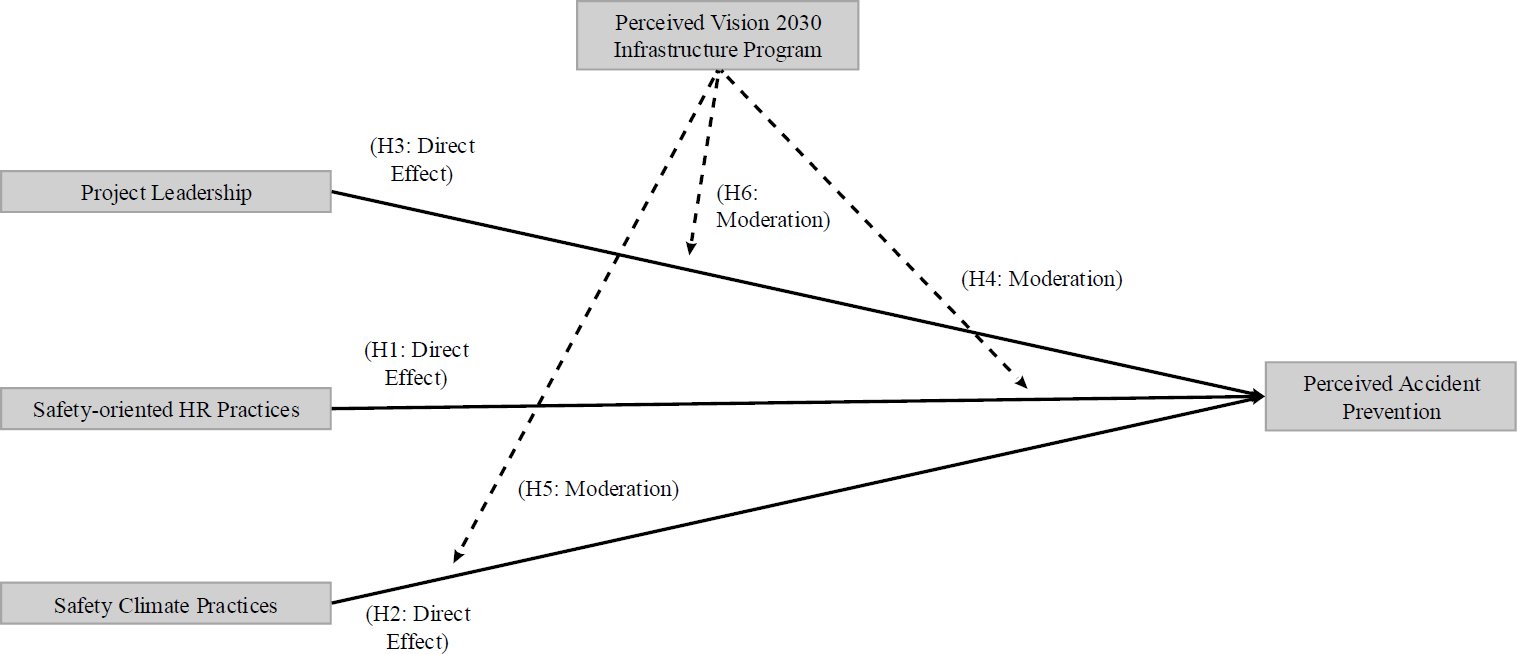
Fig. (1). Conceptual framework.
2.5. Literature Gap
Previous studies have largely investigated safety climate, HR practices, and leadership in association with safety behaviours, compliance, and safety culture in construction contexts (Ali et al., 2025; Mosly & Makki, 2020). Nevertheless, the relationship between these internal processes and Accident Prevention as a direct consequence has received relatively less focus, especially in large-scale and high-risk project contexts. Furthermore, although institutional theory posits that external regulatory and policy structures influence organisational practices, empirical data on the interaction between these macro-level factors and internal safety systems and leadership processes are scarce. Consequently, the question of whether national infrastructure programmes reinforce certain organisational safety processes, such as HR practices, climate practices, or project leadership, is not fully understood.
3. METHODS
This study employed a quantitative research design to investigate the connections between Safety-Oriented HR Practices, Safety Climate Practices, Project Leadership, and Accident Prevention, as well as the moderating effect of the Perceived Vision 2030 Infrastructure Program. Quantitative research enables the measurement of constructs with structured tools and offers statistical support for hypothesised relationships (Taherdoost, 2022). Despite the conceptual multilevel nature of the constructs (perceptions of individuals, organisational structures, and institutional environments), they are theoretically represented at the perceptual level, which is aligned with the extensive literature on PLS-SEM.
The population of interest included construction professionals involved in large-scale infrastructural development in Saudi Arabia, such as operational personnel, supervisors, engineers and project managers. Professional LinkedIn groups were used to recruit the sample: the survey link was shared through LinkedIn posts and sent to professional contacts, ensuring wide coverage of roles and types of projects. Purposive sampling was used, which (Hossan et al., 2023) described as a sampling method that involves the selection of participants who fit into a given set of inclusion criteria, such as experience in infrastructure projects and awareness of safety practices in this study. The rationale behind the use of purposive sampling is that the research aims to capture the opinions of informed people who are directly related to safety management, which increases construct validity. However, despite the presence of some frontline workers in the sample, the sample was biased towards supervisory, engineering, and managerial professionals.
Of the 500 responses collected, 300 valid responses were obtained after screening based on completeness and consistency. A priori G*Power analysis (linear multiple regression, fixed model, R2 deviation of zero) was conducted using an effect size of 0.15 (medium), alpha level of 0.05, statistical power of 0.80, and four predictors, which indicated a minimum required sample size of approximately 85–100 respondents. The standard guidelines for the G*Power application in behavioural research confirm that such parameters are appropriate for determining minimum sample requirements in regression-based models (Kang, 2021). Thus, the final sample size of 300 respondents is considered adequate.
A structured questionnaire was used to collect data, which included two primary parts: demographics and constructs (Appendix A). The constructs section with a Likert scale (1 = strongly disagree to 5 = strongly agree) encompassed Safety-Oriented HR Practices, Safety Climate Practices, Project Leadership, Perceived Vision 2030 Infrastructure Program, and Perceived Prevention of Accidents.
The questionnaire questions in this research were updated using validated and well-established measurement scales that are common in safety and leadership studies. The items of Safety-Oriented HR Practices and Safety Climate Practices were mainly based on Zohar’s original safety climate scale, which has been largely revised and tested in later construction safety research as a measure of management commitment and safety practice perceptions, as stated by (Seo et al., 2004). The transformational leadership items were based on the Multifactor Leadership Questionnaire (MLQ-5X), a well-validated tool created by Bass and Avolio to assess leadership behaviours in various dimensions, as stated by (Tejeda et al., 2001). In addition, the questionnaire was perfected based on expert advice and pilot testing to make it clear and relevant in context. Pilot testing was conducted with 30 participants. Items were also modified slightly to match the Saudi construction context and terms while retaining conceptual similarity with the original validated scales.
The Safety-Oriented HR Practices and Safety Climate Practices measurement items were formulated to reflect both the structural facet of HR-based safety systems (e.g. training, communication, and enforcement) and their contribution to the development of common safety perceptions among employees in accordance with the integrated conceptualisation of the construct.
Perceived Vision 2030 Infrastructure Program was operationalised as employees’ perceptions of regulatory expectations, policy guidance, and alignment of the organisation with national safety priorities under Vision 2030. The items represent the perceived institutional environment created by Vision 2030 infrastructure initiatives and the degree to which organisations comply with their safety practices.
The conceptualisation of Accident Prevention was in the form of the effectiveness of organisational and project-level safety systems in preventing accidents at the workplace as perceived by employees instead of individual safety behaviour. In this regard, the construct describes the perceptions that the respondents have on whether the safety management practices, leadership behaviours, and organisational controls in totality mitigate accident occurrence in the project. Thus, the construct indicates the perceived effectiveness of accident prevention at the project level and not the response of project members to safety protocols.
Procedural and statistical solutions were adopted to reduce the common method bias (CMB). Procedurally, anonymity and voluntary participation were stressed, and the questionnaire items were randomised to minimise response patterns. Statistically, Harman’s single-factor test was performed, according to (Kock, 2020), to determine whether a first factor explains most of the variance which should be less than 50%; in this study, the variance was not above this level. Non-response bias was also tested by comparing early and late respondents to enable consistency in the response across the periods of collection, and no such bias was observed. Moreover, the values of the full collinearity Variance Inflation Factor (VIF) were used to check for CMB, where all predictor constructs yielded values below 4.3, confirming no issue of common method bias (Table 1).
Table 1. Full collinearity VIF values.
| – | VIF |
| Perceived Vision 2030 Infrastructure Program -> Accident Prevention | 1.058 |
| Perceived Vision 2030 Infrastructure Program x Project Leadership -> Accident Prevention | 1.372 |
| Perceived Vision 2030 Infrastructure Program x Safety Climate Practices -> Accident Prevention | 1.252 |
| Perceived Vision 2030 Infrastructure Program x Safety-Oriented HR Practices -> Accident Prevention | 1.339 |
| Project Leadership -> Accident Prevention | 1.404 |
| Safety Climate Practices -> Accident Prevention | 1.258 |
| Safety-Oriented HR Practices -> Accident Prevention | 1.285 |
The data were analysed using partial least squares structural equation modelling (PLS-SEM), a variance-based method that can be applied to complex models containing latent variables. PLS-SEM is suitable for the present study because it can address small to medium sample sizes, non-normal data, and predictive modelling that has a moderation effect, as advocated by (Memon et al., 2021). Cronbach’s alpha (≥ 0.70) and composite reliability (≥ 0.70) were used to test measurement validity based on internal consistency, Average Variance Extracted (≥ 0.50) was used to test convergent validity, and ratios of HTMT (< 0.85) were used to test discriminant validity (Aburumman et al., 2022; Rasoolimanesh, 2022).
In this study, moderation was evaluated by including interaction terms between the Perceived Vision 2030 Infrastructure Program and the independent variables in the PLS-SEM model. Moreover, the evaluation of the structural models incorporated R2 to assess the variance explained in accident prevention and Q2 (through a blindfolding process) to evaluate the predictive relevance of the endogenous constructs, as mentioned by (Wijaya et al., 2022). Bootstrapping with 5,000 resamples was used to test the significance of the path and the moderation effect of Vision 2030 Institutional Pressure and Alignment.
Ethical considerations were strictly adhered throughout the study. Participation was voluntary, and the participants were aware of the purpose of the study, possible benefits, and their right to drop out. No personally identifiable data were gathered; thus, the information was confidential and anonymous. Prior to the administration of the questionnaire’s, informed consent was obtained, and ethical clearance was obtained from the relevant Institutional Review Board.
4. RESULTS
4.1. Descriptive Analysis
The demographic features of the 300 respondents are presented in Table 2. Most respondents were male (73.0%), 24.0% were female, and 3.0% did not disclose their gender. With regard to age, the majority of the respondents fell in the 25-34 years; and 35-44-years brackets (36.7% and 32.0%, respectively), which implies that the workforce in the infrastructure projects is relatively young and dynamic. In terms of educational qualifications, 44.0% had a bachelor’s degree, 22.0% had diplomas, and 17.7% had master’s degrees, implying that the majority of the respondents were holders of formal technical education. In relation to occupation, operational/frontline workers represented 29.7%, supervisory workers represented 28.0%, managers represented 27.0%, and senior management represented 15.3%. Lastly, regarding industry experience, the most common category was 6-10 years (36.7%), then 3-5 years (25.3%) and over 10 years (24.3%), which is indicative of a workforce with considerable industry exposure.
Table 2. Descriptive analysis results for 300 respondents.
| Demographic Variable | Category | Frequency (n) | Percentage (%) |
| Gender | Male | 219 | 73.0 |
| Female | 72 | 24.0 | |
| Prefer not to say | 9 | 3.0 | |
| Age Group | Below 25 | 36 | 12.0 |
| 25–34 | 110 | 36.7 | |
| 35–44 | 96 | 32.0 | |
| 45–54 | 42 | 14.0 | |
| 55 and above | 16 | 5.3 | |
| Educational Qualification | Secondary | 39 | 13.0 |
| Diploma | 66 | 22.0 | |
| Bachelor’s | 132 | 44.0 | |
| Master’s | 53 | 17.7 | |
| Doctorate | 10 | 3.3 | |
| Current Job Role | Operational / Frontline | 89 | 29.7 |
| Supervisory | 84 | 28.0 | |
| Managerial | 81 | 27.0 | |
| Senior Management | 46 | 15.3 | |
| Industry Experience | Less than 3 years | 41 | 13.7 |
| 3–5 years | 76 | 25.3 | |
| 6–10 years | 110 | 36.7 | |
| More than 10 years | 73 | 24.3 |
4.2. Measurement Model Analysis
The measurement model results are presented in Table 3, which shows construct reliability and validity. Each indicator value for the loading factor varied between 0.867-0.932 (≥ 0.70 threshold). Internal consistency was confirmed as Cronbach’s alpha values (0.936-0.957) and composite reliability (0.949-0.967) were above the standard threshold (≥ 0.70). Additionally, convergent validity was satisfactory as AVE values were between 0.788-0.853 significantly more than the ≥ 0.50 threshold. Overall, the reliability and validity of the constructs were adequate, signifying the appropriateness of their structural analysis.
Table 3. Measurement model.
| Latent Construct | Indicator | Factor Loading | Cronbach’s Alpha | Composite Reliability | Average Variance Extracted (AVE) |
| Accident Prevention | AP1 | 0.913 | 0.957 | 0.967 | 0.853 |
| AP2 | 0.932 | ||||
| AP3 | 0.921 | ||||
| AP4 | 0.930 | ||||
| AP5 | 0.923 | ||||
| Project Leadership | PL1 | 0.900 | 0.941 | 0.955 | 0.809 |
| PL2 | 0.894 | ||||
| PL3 | 0.894 | ||||
| PL4 | 0.901 | ||||
| PL5 | 0.907 | ||||
| Perceived Vision 2030 Infrastructure Program | PV20301 | 0.884 | 0.936 | 0.949 | 0.788 |
| PV20302 | 0.880 | ||||
| PV20303 | 0.888 | ||||
| PV20304 | 0.867 | ||||
| PV20305 | 0.918 | ||||
| Safety Climate Practices | SCP1 | 0.914 | 0.948 | 0.960 | 0.828 |
| SCP2 | 0.908 | ||||
| SCP3 | 0.911 | ||||
| SCP4 | 0.907 | ||||
| SCP5 | 0.911 | ||||
| Safety-Oriented HR Practices | SOHRP1 | 0.916 | 0.945 | 0.958 | 0.820 |
| SOHRP2 | 0.917 | ||||
| SOHRP3 | 0.895 | ||||
| SOHRP4 | 0.897 | ||||
| SOHRP5 | 0.903 |
Note: Factor Loadings ≥ 0.70; Cronbach’s alpha ≥ 0.70; CR ≥ 0.70; AVE ≥ 0.50 (Hair et al., 2021; Mia et al., 2022)
4.3. Discriminant Validity Analysis
Table 4 presents the results of discriminant validity for all constructs using the Heterotrait-Monotrait ratio (HTMT). HTMT is an evaluation of the presence of empirical differences between constructs. All the values in Table 3 are less than the 0.85 threshold. Thus, it is confirmed that each construct does not reflect the same concept with no overlapping of concepts and multicollinearity, showing discriminant validity at an adequate level.
Table 4. Discriminant validity using HTMT.
| – | Accident Prevention | Perceived Vision 2030 Infrastructure Program | Project Leadership | Safety Climate Practices | Safety-Oriented HR Practices |
| Perceived Vision 2030 Infrastructure Program | 0.083 | – | – | – | – |
| Project Leadership | 0.523 | 0.163 | – | – | – |
| Safety Climate Practices | 0.558 | 0.048 | 0.432 | – | – |
| Safety-Oriented HR Practices | 0.539 | 0.044 | 0.437 | 0.341 | – |
Note: HTMT threshold < 0.85 (Afthanorhan et al., 2021; Cheung et al., 2023)
4.4. Path Coefficient Analysis
The results of the structural model are provided in Table 5, comprising path coefficients, t-statistics, p-values, and effect sizes (f2), indicating the direct and moderating impacts of the study variables. The results show that Safety-Oriented HR Practices positively and significantly influence accident prevention (β= 0.301, t = 6.768, p < 0.001, f2 = 0.134), which proves H1 but shows a small practical effect. Similarly, Safety Climate Practices had a positive and significant impact on preventing accidents (β = 0.338, t = 8.131, p < 0.001, f2 = 0.172), which indicates that H2 is true. Safety Climate Practices had an f2 value of 0.172, thus reflecting a medium practical impact, which was the strongest predictor of the model. The positive impact of Project Leadership on accident prevention (β = 0.234, t = 4.397, p = 0.001, f2 = 0.074) was significant, but the practical impact was minimal. In terms of the moderating effects, the interaction of Perceived Vision 2030 Infrastructure Program and Project Leadership was positive and significant (β = 0.130, t = 2.084, p = 0.037, f2 = 0.023), which supports H6, but the effect was small. However, the moderating effect of moderating the relationship between Safety-Oriented HR Practices and accident prevention was not significant (β = 0.032, t = 0.653, p = 0.514, f2 = 0.001), thus H4 is rejected. Similarly, the relationship between the Vision 2030 Infrastructure Program and Safety Climate Practices was not significant (β = -0.040, t = 0.818, p = 0.413, f2 = 0.002), which rejects H5. Moreover, the direct impact of the Perceived Vision 2030 Infrastructure Program on accident prevention is insignificant (β= 0.028, t = 0.520, p = 0.603, f2 = 0.001), which means that the practical impact of the proposed model is negligible.
Table 5. Path coefficient.
| – | Path co-efficient | T-statistics | P-values | f-square |
| Perceived Vision 2030 Infrastructure Program -> Accident Prevention | 0.028 | 0.520 | 0.603 | 0.001 |
| Perceived Vision 2030 Infrastructure Program x Project Leadership -> Accident Prevention | 0.130** | 2.084 | 0.037 | 0.023 |
| Perceived Vision 2030 Infrastructure Program x Safety Climate Practices -> Accident Prevention | -0.040 | 0.818 | 0.413 | 0.002 |
| Perceived Vision 2030 Infrastructure Program x Safety-Oriented HR Practices -> Accident Prevention | 0.032 | 0.653 | 0.514 | 0.001 |
| Project Leadership -> Accident Prevention | 0.234*** | 4.397 | 0.001 | 0.074 |
| Safety Climate Practices -> Accident Prevention | 0.338*** | 8.131 | 0.001 | 0.172 |
| Safety-Oriented HR Practices -> Accident Prevention | 0.301*** | 6.768 | 0.001 | 0.134 |
Note: The number of asterisks indicates significant paths: * p < 0.1, ** p < 0.05, *** p < 0.01
4.5. Explanatory Power
The coefficient of determination (R2) and predictive relevance of the model (Q2) are presented in Table 6. The R2 of accident prevention was 0.473 (adjusted R2 = 0.460), showing moderate explanatory power. This implies that the predictors explain approximately 47% of accident prevention. Moreover, the Q2 of 0.444 in Table 6 indicates a large predictor relevance, implying the effectiveness of the model in predicting accident prevention. Overall, the model has moderate explanatory power and large predictive relevance.
Table 6. Explanatory power and predictive relevance.
| – | R-Square | R-Square Adjusted | Q-Square |
| Accident Prevention | 0.473 | 0.460 | 0.444 |
Note: R2 = 0.25 (weak), R2 = 0.5 (moderate), and R2 = 0.75(substantial); Q2 = 0.02 (small), Q2 = 0.15 (medium), and Q2 = 0.35 (large) (Wijaya et al., 2022)
5. DISCUSSION
The results of this study provide a more detailed insight into accident prevention in large-scale infrastructure projects in Saudi Arabia. The structural model shows that the internal safety-related mechanisms, especially Safety Climate Practices, Safety-Oriented HR Practices, and Project Leadership, are associated with enhanced accident prevention, and the perceived Vision 2030 Infrastructure Program does not show a direct effect and plays a minor moderating role. In general, the findings indicate that the issue of accident prevention is influenced less by the existence of general institutional efforts and more by the ways in which safety mechanisms are integrated, conveyed, and practiced in the context of projects.
Accident prevention was significantly positively associated with Safety-Oriented HR Practices (β = 0.301, p < 0.001), confirming H1. However, the effect size was not very large (f2 = 0.134) which means that HR-based safety mechanisms do have an impact on the prevention of accidents, but it is only one of the components of a broader safety mechanism. This finding is consistent with previous research highlighting the importance of training, communication, competence development, and employee involvement in construction safety management (Alharbi et al., 2025). HR practices can be used in the Saudi construction industry, where Vision 2030 projects require multinational manpower, subcontracting models, and operational complexities to set shared safety expectations among different workers. However, the small effect size indicates that formal practices, such as training and communication, might not help prevent accidents unless they are underpinned by effective supervision, worker engagement, and regular site-level implementation. Thus, the results support the perspective that HR practices can form the basis of safety performance; however, the impact of these practices is conditional on their ability to be translated into daily work behaviours.
According to the model, Safety Climate Practices had the most significant relationship with accident prevention (β = 0.338, p < 0.001), which is a medium effect size (f2 = 0.172), supporting H2. This result is consistent with Safety Climate Theory and past studies that propose that how workers perceive management commitment, safety priorities, and communication affects safety-related outcomes (Chen et al., 2021a; Shen et al., 2017). The more notable impact, in comparison with Safety-Oriented HR Practices, can be attributed to the more comprehensive nature of safety climate in that it does not just represent the presence of safety systems but also the perceived safety as an organisational priority by the employees. A positive safety climate can be used to provide coherence in safety expectations across organisational lines in Saudi Arabia for large infrastructure projects because there may be many contractors and teams working on the same project simultaneously. However, the effect size suggests that the safety climate is a significant factor but not a comprehensive explanation of accident prevention because safety perceptions still demand efficient practices in operations to affect the reality on the sites.
Accident prevention was also positively associated with Project Leadership (β = 0.234, p < 0.001), supporting H3, but the practical impact was less significant (f2 = 0.074). The results are consistent with earlier studies, indicating that safety-oriented leadership can enhance safety commitment, communication, and proactive behaviours in construction workers (Ali et al., 2025; Senthamizh & Anandh, 2024). The relatively smaller effect size compared with safety climate may be explained by the characteristics of project-based environments, in which leaders function within existing organisational systems, processes, and constraints rather than independently shaping safety outcomes. Project leaders in Saudi infrastructure projects coordinate various stakeholders, implement safety requirements, and react to site changes. However, their capacity to impact accident prevention can depend on the accessibility of supportive HR systems and safety climates. Hence, leadership seems to serve as a key implementation device, yet its effect is probably amplified if organisational safety structures already exist.
A more selective pattern was created through the moderating action of the perceived Vision 2030 Infrastructure Program. The moderation between Vision 2030 perceptions and Project Leadership was significant (β = 0.130, p = 0.037), although the effect size was extremely small (f2 = 0.023). This means that institutional alignment can enhance the role of leadership in accident prevention; however, the practical impact of this effect is weak. A potential reason for this is that national programs, such as Vision 2030, introduce new demands in terms of regulatory compliance, project responsibility, and safety performance. These tensions can be more directly manifested in leadership decisions because project leaders usually have the task of translating strategic demands into operational behaviour. This explanation aligns with Institutional Theory, which implies that external forces impact organisational practices by involving internal processes instead of inducing direct effects (He et al., 2016; Saad et al., 2026).
In contrast, the moderating effects of Vision 2030 perceptions on Safety-Oriented HR Practices (β = 0.032, p = 0.514, f² = 0.001) and Safety Climate Practices (β = -0.040, p = 0.413, f² = 0.002) were insignificant. These findings suggest that perceived congruence with Vision 2030 has no significant effect on the relationship between such organisational practices and accident prevention. One possible explanation is institutional decoupling, whereby organisations formally adopt safety policies to demonstrate compliance with Vision 2030 requirements, but implementation at the project level remains inconsistent. Under Institutional Theory, coercive pressures may encourage symbolic compliance rather than substantive behavioural change, reducing the observable impact of HR systems and safety climate on accident prevention.
This may be explained by the fact that HR practices and safety climate are internal organisational processes developed by management, resource distribution, and implementation in the workplace, instead of being influenced only by external perceptions. Although national initiatives can influence the development of stronger safety expectations, they might not directly affect how organisations carry out training, communication, or safety climate development. This result contributes to a more nuanced interpretation of institutional influence by suggesting that external pressures can influence certain organisational trajectories while exerting limited influence on others.
Similarly, the direct correlation between the Perceived Vision 2030 Infrastructure Program and accident prevention was not significant (β = 0.028, p = 0.603), and the effect size was insignificant (f2 = 0.001). This suggests that perceptions of the national infrastructure program are insufficient to explain the differences in the results of accident prevention. Rather than implying that Vision 2030 lacks relevance to safety, the findings indicate that institutional initiatives might need organisational translation mechanisms before affecting the outcomes at the project level. That is, national priorities can set expectations and direction, but their safety implications rely on the way organisations and project teams apply these expectations in leadership, systems, and workplace practices.
Considering the results, it can be concluded that the most commonly related factors in the context of preventing accidents in infrastructure projects in Saudi Arabia are related to the process of internal safety management, whereas the effects of the institutions seem to be more contingent and pathway-based. These findings indicate that the best safety performance is not just related to the presence of safety policies or external commitments but also to the way these factors are perceived and implemented in project settings. This gives a balanced perception of safety management because it appreciates the significance of both organisational practices and the institutional context without assuming that either factor alone suffices to explain the issue of accident prevention.
THEORETICAL CONTRIBUTION
This research adds to the theory of safety management by offering a more differentiated perspective on the relationship between organisational and institutional variables and preventing accidents in infrastructure projects. Instead of assuming that all safety mechanisms are equally effective, the results suggest that Safety Climate Practices, Safety-Oriented HR Practices, and Project Leadership are associated with accident prevention in different ways; thus, the relative impact of these practices should be considered. This study also offers a more tentative extension of the Institutional Theory, demonstrating that the perceived alignment of infrastructure with Vision 2030 does not necessarily result in the positive effect of preventing accidents or reinforcing all safety routes. The significant moderation with Project Leadership indicates that institutional factors may be activated by particular mechanisms of implementation and not by general organisational systems. Hence, the proposed study narrows down the existing theoretical explanations by showing that external initiatives can be selective in influencing safety procedures, whereas the central point in accident prevention lies in internal project-level practices.
LIMITATIONS AND FUTURE RESEARCH
Despite its contributions, this study has several limitations. First, the cross-sectional type does not allow researchers to build a causal relationship between constructs. Longitudinal research designs should be used in the future to investigate the effects of safety climate, leadership behaviour, and institutional programs on accident prevention over time. Second, the research is based on self-reported perceptual survey information, which can cause bias among respondents. Future research may include objective safety measures, such as accident history, near-miss reports, and safety audit scores. Further analysis of contextual factors, such as contractor management systems, safety monitoring systems based on technology, and workforce diversity, would also enhance the study. Comparative research on various national infrastructure programs may also enable the evaluation of whether the moderating role of institutional initiatives is not limited to Vision 2030.
The use of purposive non-probability sampling may limit the generalisability of the findings beyond the studied sample. In future research, probability-based sampling methods should be used to increase the representativeness and external validity among various construction populations. Furthermore, the sample obtained through professional networking sites such as LinkedIn is most likely to reflect supervisory, engineering, and managerial staff but not frontline workers and low-literary employees. Thus, the results reflect the perceptions of professional construction personnel and not the entire range of personnel at the site level. Moreover, some of the measurement items might also indicate perceptions of personal safety compliance and more general accident prevention efficacy. Although the construct was operationalised as a project-level safety outcome, measurement scales that better differentiate between organisational accident prevention effectiveness and individual safety behaviour should be used in future research.
CONCLUSION
This study highlights that the quality of internal safety mechanisms and their implementation in project environments influence the prevention of accidents in Saudi infrastructure projects. The results indicate that efficient safety management involves focusing on organisational practices but acknowledges that larger institutional efforts can affect safety outcomes in certain channels and not necessarily directly.
The results have practical implications for construction organisations and policymakers. First, project leaders should focus on developing leadership skills in firms by training leaders on safety communication, supervision, and proactive enforcement because effective leadership directly impacts the prevention of accidents. Second, organisations need to align internal safety programs with national programs, such as Vision 2030, including adherence to regulatory standards and the use of institutional direction to support safety culture. It is advisable to implement it in a stepwise manner: recognising major leadership gaps, aligning HR practices and program guidelines, tracking safety performance, and refining practices. Third, policymakers should improve safety in the industry by designing structured frameworks that promote leadership-based safety interventions in combination with incentives, compliance monitoring, and reporting systems. These plans focus on an integrated approach in which leadership, human resource practices, and institutional structures are interrelated, eventually leading to safer infrastructure project environments and eliminating the frequency of on-site accidents.
LIST OF ABBREVIATIONS
DfS | = | Design for Safety |
MLQ | = | Multifactor Leadership Questionnaire |
PLS-SEM | = | Partial Least Squares Structural Equation Modelling |
SSTL | = | Safety-Specific Transformational Leadership |
TFL | = | Transformational Leadership |
VIF | = | Variance Inflation Factor |
AUTHORS’ CONTRIBUTIONS
F.M. has contributed to the study conceptualization, methodology, data analysis, interpretation of the results, and manuscript writing. E.A.A.G. has contributed to the literature review, data collection, formal analysis, and manuscript editing. S.A.A. and J.O. have supervised the study, validated the findings, reviewed and revised the manuscript critically for important intellectual content, and approved the final version for publication. All authors read and approved the final manuscript.
ETHICAL APPROVAL & INFORMED CONSENT
Ethical considerations were strictly adhered throughout the study. Participation was voluntary, and the participants were aware of the purpose of the study, possible benefits, and their right to drop out. No personally identifiable data were gathered; thus, the information was confidential and anonymous. Prior to the administration of the questionnaire’s, informed consent was obtained, and ethical clearance was obtained from the relevant Institutional Review Board.
AVAILABILITY OF DATA AND MATERIALS
The data will be made available on reasonable request by contacting the corresponding author [F.M.].
FUNDING
None.
CONFLICT OF INTEREST
The authors declare that there is no conflict of interest regarding the publication of this article.
ACKNOWLEDGEMENTS
Declared none.
DECLARATION OF AI
The authors used ChatGPT solely to improve the language, grammar, and readability of this manuscript. The AI tool was not used to generate, interpret, or analyze research findings, nor to formulate scientific conclusions. Following its use, the authors carefully reviewed, revised, and validated the manuscript and assume full responsibility for the accuracy, integrity, and originality of its content.
APPENDIX A
Section A: Demographic
- What is your gender?
- Male
- Female
- Prefer not to say
- What is your age group?
- Below 25
- 25–34
- 35–44
- 45–54
- 55 and above
- What is your highest educational qualification?
- Secondary
- Diploma
- Bachelor’s
- Master’s
- Doctorate
- What best describes your current job role?
- Operational/Frontline
- Supervisory
- Managerial
- Senior Management
- How many years of total experience do you have in this industry?
- Less than 3 years
- 3–5 years
- 6–10 years
- More than 10 years
Section B: Main Questionnaire
Response Scale:
1 = Strongly Disagree, 2 = Disagree, 3 = Neutral, 4 = Agree, 5 = Strongly Agree
Variable | Question Statement | 1 | 2 | 3 | 4 | 5 |
Safety-Oriented HR Practices | The organisation provides adequate safety training to ensure employees understand safe working procedures. | ☐ | ☐ | ☐ | ☐ | ☐ |
Safety performance is considered when evaluating employee performance and work practices. | ☐ | ☐ | ☐ | ☐ | ☐ | |
The organisation communicates safety requirements clearly to employees and project teams. | ☐ | ☐ | ☐ | ☐ | ☐ | |
Employees receive continuous support and guidance to improve their safety-related skills and behaviours. | ☐ | ☐ | ☐ | ☐ | ☐ | |
The organisation has effective systems for identifying and correcting unsafe work behaviours. | ☐ | ☐ | ☐ | ☐ | ☐ | |
Safety Climate Practices | Management demonstrates a strong commitment to maintaining safety on construction projects. | ☐ | ☐ | ☐ | ☐ | ☐ |
Employees in this organisation believe that safety is prioritised alongside project performance. | ☐ | ☐ | ☐ | ☐ | ☐ | |
Safety communication between management, supervisors, and workers is effective. | ☐ | ☐ | ☐ | ☐ | ☐ | |
Workers are encouraged to report safety concerns without fear of negative consequences. | ☐ | ☐ | ☐ | ☐ | ☐ | |
Safety procedures and practices are consistently applied across project activities. | ☐ | ☐ | ☐ | ☐ | ☐ | |
Project Leadership | Project leaders actively promote safety as a priority during project execution. | ☐ | ☐ | ☐ | ☐ | ☐ |
Project leaders ensure that safety requirements are followed by employees and contractors. | ☐ | ☐ | ☐ | ☐ | ☐ | |
Project leaders motivate workers to participate in safety improvement activities. | ☐ | ☐ | ☐ | ☐ | ☐ | |
Project leaders respond effectively to safety risks and unsafe conditions at the workplace. | ☐ | ☐ | ☐ | ☐ | ☐ | |
Project leadership contributes to creating safer working conditions on construction sites. | ☐ | ☐ | ☐ | ☐ | ☐ | |
Perceived Vision 2030 Infrastructure Program | Vision 2030 infrastructure projects have increased attention toward improving construction safety standards. | ☐ | ☐ | ☐ | ☐ | ☐ |
Vision 2030 initiatives create expectations for organisations to strengthen safety management practices. | ☐ | ☐ | ☐ | ☐ | ☐ | |
My organisation aligns its safety practices with the safety expectations associated with Vision 2030 projects. | ☐ | ☐ | ☐ | ☐ | ☐ | |
Vision 2030 infrastructure development has encouraged greater organisational commitment toward construction safety. | ☐ | ☐ | ☐ | ☐ | ☐ | |
The regulatory and institutional environment surrounding Vision 2030 supports stronger safety practices in construction projects. | ☐ | ☐ | ☐ | ☐ | ☐ | |
Accident Prevention | Safety practices implemented in my organisation help prevent accidents at construction sites. | ☐ | ☐ | ☐ | ☐ | ☐ |
Employees in my organisation actively follow safety procedures to reduce accident risks. | ☐ | ☐ | ☐ | ☐ | ☐ | |
The organisation takes proactive actions to identify and prevent potential workplace accidents. | ☐ | ☐ | ☐ | ☐ | ☐ | |
Safety management practices have contributed to reducing accident occurrence on projects. | ☐ | ☐ | ☐ | ☐ | ☐ | |
Lessons learned from previous safety incidents are used to prevent similar accidents in the future. | ☐ | ☐ | ☐ | ☐ | ☐ |
REFERENCES
Abueish, T. (2025). Saudi Arabia cut workplace deaths by 75pct, created more health, safety jobs: Official. Al Arabiya English. Available from: https://english.alarabiya.net/News/saudi-arabia/2025/06/12/saudi-arabia-cut-workplace-deaths-by-75pct-created-more-health-safety-jobs-official (Accessed on: 14-07-2026).
Aburumman, O. J., Omar, K., Al Shbail, M., & Aldoghan, M. (2022). How to deal with the results of PLS-SEM? In International Conference on Business and Technology (pp. 1196-1206). Cham: Springer International Publishing.
https://doi.org/10.1007/978-3-031-08954-1_101
Afthanorhan, A., Ghazali, P. L., & Rashid, N. (2021). Discriminant validity: A comparison of CBSEM and consistent PLS using Fornell & Larcker and HTMT approaches. In Journal of Physics: Conference Series (Vol. 1874, No. 1, p. 012085). IOP Publishing.
https://doi.org/10.1088/1742-6596/1874/1/012085
Al-Bayati, A. J. (2021). Impact of construction safety culture and construction safety climate on safety behaviour and safety motivation. Safety, 7(2), 41.
https://doi.org/10.3390/safety7020041
Alharbi, M. A., Misnan, M. S., & Abidin, N. I. (2025). Challenges and opportunities in safety compliance for Saudi Arabian of MSMCs in construction. International Journal of Research and Innovation in Social Science, 8(12), 2143-2152.
https://doi.org/10.47772/IJRISS.2024.8120180
Ali, M., Iyiola, K., Alzubi, A., & Aljuhmani, H. Y. (2025). Using safety-specific transformational leadership to improve safety behaviour among construction workers: Exploring the role of knowledge sharing and psychological safety. Buildings, 15(18), 3340.
https://doi.org/10.3390/buildings15183340
Anna, J. (2025). A CULTURE THAT CARES: Connecting safety climate to safety management systems. Professional Safety, 70(10), 44-47. Available from: https://www.assp.org/docs/default-source/psj-articles/vpanna_1025.pdf?sfvrsn=eeb84a46_0 (Accessed on: 14-07-2026).
Arab News. (2024). Saudi Arabia sees 30% drop in work injuries. Available from: https://www.arabnews.pk/node/2505016/saudi-arabia (Accessed on: 14-07-2026).
Chen, H., Li, H., & Goh, Y. M. (2021a). A review of construction safety climate: Definitions, factors, relationship with safety behaviour and research agenda. Safety Science, 142, 105391.
https://doi.org/10.1016/j.ssci.2021.105391
Chen, W. T., Merrett, H. C., Huang, Y. H., Bria, T. A., & Lin, Y. H. (2021b). Exploring the relationship between safety climate and worker safety behaviour on building construction sites in Taiwan. Sustainability, 13(6), 3326.
https://doi.org/10.3390/su13063326
Cheung, G.W., Cooper-Thomas, H.D., Lau, R.S. & Wang, L.C. (2023). Reporting reliability, convergent and discriminant validity with structural equation modeling: A review and best-practice recommendations. Asia Pacific Journal of Management, 41, 745-783.
https://doi.org/10.1007/s10490-023-09871-y
Clarke, S. (2013). Safety leadership: A meta‐analytic review of transformational and transactional leadership styles as antecedents of safety behaviours. Journal of Occupational and Organisational Psychology, 86(1), 22-49.
https://doi.org/10.1111/j.2044-8325.2012.02064.x
Deng, C., Gulseren, D., Isola, C., Grocutt, K., & Turner, N. (2023). Transformational leadership effectiveness: An evidence-based primer. Human Resource Development International, 26(5), 627-641.
https://doi.org/10.1080/13678868.2022.2135938
Elosta, M., & Alzubi, A. (2024). The interplay between safety leadership and construction workers’ safety behaviour: Do perceived employer safety obligations matter? Buildings, 14(11), 3650.
https://doi.org/10.3390/buildings14113650
Gaudiaut, T. (2026). Infographic: A Global Snapshot of Workplace Safety. Statista Daily Data. Available from: https://www.statista.com/chart/29885/comparison-of-occupational-injuries-per-100000-workers-by-country/?srsltid=AfmBOorX1DNyiyiHQByfhSLdnGhL0S3MeRBJ2nTxF_LM-iicKMFWBEjp (Accessed on: 14-07-2026).
Golzad, H., Teimoory, A., Mousavi, S. J., Bayramova, A., & Edwards, D. J. (2023). Mental Health Causation in the Construction Industry: A Systematic Review Employing a Psychological Safety Climate Model. Buildings, 13(10), 2442.
https://doi.org/10.3390/buildings13102442
Government of Saudi Arabia (2021). The national policy on occupational safety and health. For the Kingdom of Saudi Arabia. Human Resources and Social Development. Available from: https://www.hrsd.gov.sa/sites/default/files/2023-02/E01042021.pdf (Accessed on: 14-07-2026).
Hair Jr, J. F., Hult, G. T. M., Ringle, C. M., Sarstedt, M., Danks, N. P., & Ray, S. (2021). An introduction to structural equation modeling. In Partial Least Squares Structural Equation Modeling (PLS-SEM) using R: A workbook (pp. 1-29). Cham: Springer International Publishing.
https://doi.org/10.1007/978-3-030-80519-7_1
Hamdan, H., Mahmood, R., Hashim, R. A., & Rosli, N. S. (2023). Building a safer future: The impact of safety leadership and safety competency in the construction industry. The Asian Journal of Professional & Business Studies, 4(2).
https://doi.org/10.61688/ajpbs.v4i2.124
He, Q., Dong, S., Rose, T., Li, H., Yin, Q., & Cao, D. (2016). Systematic impact of institutional pressures on safety climate in the construction industry. Accident Analysis & Prevention, 93, 230-239.
https://doi.org/10.1016/j.aap.2015.11.034
Hossan, D., Dato’Mansor, Z., & Jaharuddin, N. S. (2023). Research population and sampling in quantitative study. International Journal of Business and Technopreneurship (IJBT), 13(3), 209-222.
https://doi.org/10.58915/ijbt.v13i3.263
Hussain, A., Che Ibrahim, C. K. I., Belayutham, S., Manu, P., & Cheung, C. (2026). Exploring regulatory capabilities for design for safety in construction: The case of Malaysia. Built Environment Project and Asset Management, 16(2), 221-241.
https://doi.org/10.1108/BEPAM-03-2025-0077
Kang, H. (2021). Sample size determination and power analysis using the G* Power software. Journal of Educational Evaluation for Health Professions, 18.
https://doi.org/10.3352/jeehp.2021.18.17
Kauppi, K. (2022). Institutional theory. In Handbook of Theories for Purchasing, Supply Chain and Management Research (pp. 320-334). Edward Elgar Publishing. Available from: https://acris.aalto.fi/ws/portalfiles/portal/145111887/BIZ_Kauppi_Institutional_theory_Edward_Elgar_Book_chapter_pdfa2b.pdf (Accessed on: 14-07-2026).
Kines, P., Lappalainen, J., Mikkelsen, K. L., Olsen, E., Pousette, A., Tharaldsen, J., … & Törner, M. (2011). Nordic Safety Climate Questionnaire (NOSACQ-50): A new tool for diagnosing occupational safety climate. International Journal of Industrial Ergonomics, 41(6), 634-646.
https://doi.org/10.1016/j.ergon.2011.08.004
Kock, N. (2020). Harman’s single factor test in PLS-SEM: Checking for common method bias. Data Analysis Perspectives Journal, 2(2), 1-6. Available from: https://scriptwarp.com/dapj/2021_DAPJ_2_2/Kock_2021_DAPJ_2_2_HarmansCMBTest.pdf (Accessed on: 14-07-2026).
Lestari, F., Sunindijo, R. Y., Loosemore, M., Kusminanti, Y., & Widanarko, B. (2020). A safety climate framework for improving health and safety in the Indonesian construction industry. International Journal of Environmental Research and Public Health, 17(20), 7462.
https://doi.org/10.3390/ijerph17207462
Liu, K., Liu, Y., & Kou, Y. (2024). Study on construction safety management in megaprojects from the perspective of resilient governance. Safety Science, 173, 106442.
https://doi.org/10.1016/j.ssci.2024.106442
Memon, M. A., Ramayah, T., Cheah, J. H., Ting, H., Chuah, F., & Cham, T. H. (2021). PLS-SEM statistical programs: A review. Journal of Applied Structural Equation Modeling, 5(1), 1-14.
https://doi.org/10.47263/JASEM.5(1)06
Mia, M. M., Zayed, N. M., Islam, K. M. A., Nitsenko, V., Matusevych, T., & Mordous, I. (2022). The strategy of factors influencing learning satisfaction explored by first and second-order Structural Equation Modeling (SEM). Inventions, 7(3), 59.
https://doi.org/10.3390/inventions7030059
Mosly, I., & Makki, A. A. (2020). Safety climate perceptions in the construction industry of Saudi Arabia: The current situation. International Journal of Environmental Research and Public Health, 17(18), 6717.
https://doi.org/10.3390/ijerph17186717
Mustapha, Z., Akomah, B. B., Nkomo, W. M., Abilgah, T., & Thwala, W. D. (2025). Impact of Safety Training and Communication on Construction Project Productivity: Case Study of Cape Coast. Journal of Civil Engineering Frontiers (JoCEF), 6(1), 11-17.
https://doi.org/10.38094/jocef60197
Olimat, H., Alwashah, Z., Abudayyeh, O., & Liu, H. (2025). Data-Driven analysis of construction safety dynamics: Regulatory frameworks, evolutionary patterns, and technological innovations. Buildings, 15(10), 1680.
https://doi.org/10.3390/buildings15101680
Pattisson, P. (2025). First migrant worker dies building a World Cup stadium in Saudi Arabia. The Guardian. Available from: https://www.theguardian.com/global-development/2025/mar/21/muhammad-arshad-pakistan-first-migrant-worker-dies-khobar-building-world-cup-2034-stadium-saudi-arabia (Accessed on: 14-07-2026).
Premarathna, T. (2020). Professional qualification in human resource management research project report: Relationship between safety management and workplace accidents in ABC company, Sri Lanka.
https://doi.org/10.13140/RG.2.2.33447.15522/1
Rasoolimanesh, S. M. (2022). Discriminant validity assessment in PLS-SEM: A comprehensive composite-based approach. Data Analysis Perspectives Journal, 3(2), 1-8. Available from: https://scriptwarp.com/dapj/2022_DAPJ_3_2/Rasoolimanesh_2022_DAPJ_3_2_DiscriminantValidity.pdf (Accessed on: 14-07-2026).
Saad, M., Waqas, M., Tanoli, W. A., Ullah, A., Zubair, M. U., & Qureshi, H. J. (2026). Improving safety culture in Pakistan’s construction industry through regulatory reforms and training interventions. Buildings, 16(1), 80.
https://doi.org/10.3390/buildings16010080
Saudi Vision 2030. (2024). Saudi Vision 2030. Available from: https://www.vision2030.gov.sa/en (Accessed on: 14-07-2026).
Sawhney, G., Cigularov, K. P., Chen, P., Dejoy, D., Huang, Y. H. E., Kelloway, E. K., & Scharf, T. (2011). Safety climate theory, measurement, and development: Establishing a five-year research agenda. In Meeting of National Institute for Occupational Safety and Health and the American Psychological Association, Florida May.
https://doi.org/10.13140/RG.2.1.4514.5206
Sankar, S. S., & Anandh, K. S. (2024). Building safer workplaces: Unveiling the impact of safety leadership styles in the construction industry. Administrative Sciences, 14(9), 212.
https://doi.org/10.3390/admsci14090212
Seo, D. C., Torabi, M. R., Blair, E. H., & Ellis, N. T. (2004). A cross-validation of safety climate scale using confirmatory factor analytic approach. Journal of Safety Research, 35(4), 427-445.
https://doi.org/10.1016/j.jsr.2004.04.006
Shahin, F., Fisher, N., Wang, K. C., & Shohet, I. M. (2026). Safety climate in large construction enterprises. International Journal of Construction Management, 1-19.
https://doi.org/10.1080/15623599.2026.2628233
Shen, Y., Ju, C., Koh, T. Y., Rowlinson, S., & Bridge, A. J. (2017). The impact of transformational leadership on safety climate and individual safety behaviour on construction sites. International Journal of Environmental Research and Public Health, 14(1), 45.
https://doi.org/10.3390/ijerph14010045
Taherdoost, H. (2022). What are different research approaches? Comprehensive review of qualitative, quantitative, and mixed method research, their applications, types, and limitations. Journal of Management Science & Engineering Research, 5(1), 53-63.
https://doi.org/10.30564/jmser.v5i1.4538
Tejeda, M. J., Scandura, T. A., & Pillai, R. (2001). The MLQ revisited: Psychometric properties and recommendations. The Leadership Quarterly, 12(1), 31-52.
https://doi.org/10.1016/S1048-9843(01)00063-7
Umar, T. (2020). Safety climate factors in construction – a literature review. Policy and Practice in Health and Safety, 18(2), 80–99.
https://doi.org/10.1080/14773996.2020.1777799
Umar, T., & Umeokafor, N. (2021). A review of the costs of accident in GCC construction. Available from: https://gala.gre.ac.uk/id/eprint/37717/ (Accessed on: 14-07-2026).
Whyte, J., Naderpajouh, N., Clegg, S., Matous, P., Pollack, J., & Crawford, L. (2022). Project leadership: A research agenda for a changing world. Project Leadership and Society, 3, 100044.
https://doi.org/10.1016/j.plas.2022.100044
Wijaya, T. T., Jiang, P., Mailizar, M., & Habibi, A. (2022). Predicting factors influencing preservice teachers’ behaviour intention in the implementation of STEM education using partial least squares approach. Sustainability, 14(16), 9925.
https://doi.org/10.3390/su14169925
Zafar, K., Tamrin, S. B. M., Hamedon, T. R., & Ahsan, M. (2024). Relationship between safety climate and safety performance of migrant workers in Abu Dhabi’s construction industry. Malaysian Journal of Medicine and Health Sciences, 20(2).
https://doi.org/10.47836/mjmhs.20.2.21
Zeng, H., Jiang, X., Liang, Q., Li, M., & Tian, Y. (2026). Impact of Transformational Leadership on New-Generation Construction Workers’ Safety Behaviour: A Structural Equation Modeling Approach. Buildings, 16(2), 354.
https://doi.org/10.3390/buildings16020354
Zohar, D. (1980). Safety climate in industrial organisations: Theoretical and applied implications. Journal of Applied Psychology, 65(1), 96. https://psycnet.apa.org/doi/10.1037/0021-9010.65.1.96
Zohar, D., & Luria, G. (2010). Group leaders as gatekeepers: Testing safety climate variations across levels of analysis. Applied Psychology, 59(4), 647-673.
https://doi.org/10.1111/j.1464-0597.2010.00421.x
Licensed
© 2026 Copyright by the Authors.
Licensed as an open access article using a CC BY 4.0 license.
Article Contents Author Felicia Gabriela Beresescu1, * 1College of Business-Al Khobar, Al Yamamah University, Saudi Arabia Article History: Received: 21
Article Contents Authors Saman Ismail1, * Imran Iqbal2 1Faculty of Management Science, Department of Business Administration, Salim Habib University, Karachi,
Article Contents Author Michael Dolinsky1, * 1Faculty of Mathematics and Technologies of Programming, Francisk Skorina Gomel State University,
Article Contents Author Abdul Ghafoor Memon1, * 1Emaan Institute of Management Sciences, Karachi, Pakistan Article History: Received: 01 April, 2026
Article Contents Authors Zixuan Zhao1, Ju Guo1, * 1School of Management, Chengdu University of Information Technology, Chengdu, China Article History:
Article Contents Authors Sultan Ud Din Yousufzai1, Amtyaz Safi2, * , Maher Khan1, Zia Ud Din1 1Department of Zoology, Govt.