




Article Contents
Article ID: CM2602112013
Views: 701Green Authenticity Paradox: When Sustainability Claims Strengthen or Weaken Brand Credibility in Digital Marketing
 DOI:
DOI:
 PDF
PDF
⬇ Downloads: 16
1Department of Marketing, Ziauddin University, Karachi, Pakistan
2Department of Management Sciences, University of Turbat, Turbat, Pakistan
Received: 18 February, 2026
Accepted: 27 June, 2026
Revised: 22 May, 2026
Published: 06 July, 2026
Abstract:
Introduction: The study examined the impact of sustainability claim types and platform types on perceived brand credibility and consumer purchase intentions in the UK manufacturing sector.
Methods: We conducted an experiment in which three different ads were shown to 3 groups of 100 participants each, comprising no claim, vague claim, and verified claim. The data were collected in two phases: first, in the qualitative phase, focus groups were conducted with 6 participants. Following the experiment, in the quantitative phase, the survey was administered to participants using a structured 5-point Likert-scale questionnaire. Quantitative data were analysed using MANCOVA, one-way ANOVA, and independent-samples t-tests, and qualitative data were analysed using a thematic analysis approach.
Results: The study found that Perceived Brand Credibility (PBC) and Purchase Intention (PI) were significantly related with Consumer Scepticism (CS) and Perceived Green Authenticity (PGA), with both factors showing strong relationship. Platform Type did not have a substantial relationship with perceived brand credibility and purchase intention. Additionally, the claim type was found to be associated with PBC and PI significantly. Verified claims positively related with both PBC and PI, whereas vague claims had a insignificant relationship.
Conclusion: The findings imply the need for verifiable, transparent, sustainable communication to improve consumer engagement and trust. Manufacturers are required to adopt verifiable sustainability disclosures on social media and brand-owned websites.
Keywords: Verified sustainability claims, brand credibility, purchase intention, perceived green authenticity, consumer scepticism, platform type, UK manufacturing sector, digital marketing, sustainability communication, green branding.
1. INTRODUCTION
Sustainability has been essentially integrated into digital branding, and its influence on the perception of the consumer is so counter-intuitive. On the one hand, it establishes a feeling of authenticity and trust and, on the other hand, scepticism, which can have an adverse impact on brand credibility (Al-Haddad et al., 2022; Yang & Ha, 2021). This dilemma is very sharp especially in the domain of online markets where consumers are subjected to mediated brand messages that are understood differently. On the one hand, the concept of sustainability is becoming an imperative in the UK manufacturing industry due to regulatory, supply chain, and consumer pressures, but the industry is under intense pressure. Its economic significance is characterised by 2.6 million employees in the manufacturing sector, which led the economy, contributing PS220 billion to the economy (The Manufacturer, 2023). Green manufacturing is becoming increasingly significant, and about half of UK manufacturers focus on sustainability through such projects (Matt Mace, 2025). Additionally, the UK has made a pledge to the circular economy and to other measures, such as the Extended Producer Responsibility (EPR), to implement lifecycle responsibility (Gov. UK, 2022).
Nevertheless, despite this trend, UK manufacturers face a structural paradox: promoting sustainability messages on online platforms may lead to a positive brand reputation or result in claims of greenwashing (Hosain & Mamun, 2023; Haque et al., 2023). The first problem is that consumers lack clear indicators to verify claims in online advertisements, which creates additional uncertainty about the credibility and authenticity of brands (Pancic et al., 2023; Zayed et al., 2022). Moreover, the development of regulatory frameworks and third-party control mechanisms creates a certain reluctance among manufacturers to make confident, proven, substantiated claims due to the threat of noncompliance (Isac et al., 2024; Koh et al., 2022). There is quite a range of consumer scepticism, and highly sceptical consumers will interpret ambiguous sustainability statements negatively. By comparison, less sceptical consumers tend to trust statements posted on reliable platforms such as social media or brand-owned websites (Foroughi et al., 2024; Ngo et al., 2024). This puts UK manufacturers in a dilemma: either they are branded as dishonest, or they do not stand out as a special brand among other environmentally friendly brands. To address these issues, the present research employs an experimental design to investigate how consumers interpret various types of sustainability claims across different platforms, including social media and brand-owned websites. It is possible to test the causal relationship between these claims and consumer perceptions and behaviours.
The study highlights a main paradox in sustainability communication in the UK manufacturing sector, as verified sustainability claims are seen as a means to increase perceived brand credibility and consumers’ intention to purchase from companies that are communicating about sustainability. They can simultaneously lead to the reinforcement of consumer scepticism among the more cautious consumers suggested by (Nazish et al., 2024) as well. Rather, consumers’ skepticism demands a critical assessment of the motives, transparency and consistency of such claims before drawing a conclusion about their credibility. As suggested by (Gong et al., 2023) verified claims either strengthen authenticity and trust or arouse suspicion in consumers about a strategy for ‘greenwashing’ depending on their previous sceptical attitude and how they understand the intentions of the claim.
The variation in interpreting sustainability messaging itself is a serious problem, as what can be perceived as building trust may undermine it in the online market without any intention. The Green Authenticity Paradox refers to the condition whereby verified sustainability claims increase perceived credibility and authenticity for some consumers, while simultaneously triggering scepticism among highly vigilant consumers. Consumer scepticism therefore functions as a boundary condition that weakens the positive influence of sustainability claims on credibility outcomes. Therefore, the research problem examined in the work is the direct relationship between consumer scepticism and perceived green authenticity, and experimental variables of claim type and platform type with brand credibility and purchase intention. Also, the research yields a broader conceptualisation that includes perceived green authenticity and consumer scepticism as independent variables. These concepts have not been examined in depth in the UK manufacturing industry.
The study makes a significant contribution to empirical, theoretical, and policy research. In theory, it expands the knowledge on green authenticity and consumer scepticism as independent predictors of brand credibility and purchase intention to offer scientific evidence of the causal role of claim type and platform type in an experimental design. There is the little use of this methodology in the sustainability communication literature. Besides it, the research offers specific information on the situation in the UK manufacturing and identifies the effects of proven and unproven claims on consumer reactions. Policy-wise, the findings indicate that there should be clear and verifiable levels of sustainability reporting and responsible disclosure in online marketing. This plays an important role in boosting consumer confidence and brand responsibility. In addition, the paper puts special emphasis on the peculiarities of consumer perceptions of manufacturing-sector brands in which the epistemic trust and credibility heuristics are somewhat dissimilar to the B2C green marketing, providing a new theoretical approach to how manufacturers can foster trust online.
1.1. Research Questions
RQ1: What is the impact of each type of sustainability claim (no claim, vague claim and verified claim) on the perceived brand credibility and the consumers’ purchase intention in the UK manufacturing sector?
RQ2: What effects do platform type (social media vs brand-owned websites) have on perceived brand credibility and consumer purchase intent when sending sustainability-related advertising?
RQ3: How much does the perceived green authenticity and consumer scepticism affect perceived brand credibility and consumer purchase intention in the sustainability communication?
RQ4: Are there any interactions between sustainability claim types and platform types that can cause differential impacts on the perceived brand credibility and consumer purchase intention?
RQ5: What is the difference between different types of verified and vague sustainability claims for digital marketing and how do consumers make sense of them in deciding on their credibility judgements and purchase intentions?
2. LITERATURE REVIEW
2.1. Theoretical Framework
The theoretical underpinning for the study encompasses the viewpoints of Attribution Theory and Information Credibility Theory to interpret the consumers’ sustainability communication interpretation from the UK manufacturing sector. According to Attribution Theory, consumers’ motive inferences are based on the origin of the sustainability claims, which are either intrinsic motives or extrinsic motives indiated in (Chuah et al., 2022; Javed, 2022). This is conveyed in the form of Perceived Green Authenticity and Consumer Scepticism – consumer attributions towards ethics, transparency and authenticity of sustainability claims. Consumers’ perceptions of sustainability communication are strengthened when they feel that the communication is in line with the values of organisations creating more intrinsic attributions to increase perceptions of authenticity and credibility. On the other hand, any general or unsupported assertions raise doubts and the impression of greenwashing.
As a complement to this view, Information Credibility Theory is offered to elucidate the process of source credibility, how consumers determine the reliability and credibility of communication platforms, including social media and brand websites (Kim et al., 2021). Platform Type is thus a context cue that affects the acceptance and interpretation of the message. These theories found that consumer perceptions of the motives of the organisation behind their behaviour and perceived credibility of source influence their perceptions of the sustainability claims. The integrated framework, which accounts for the interaction between claim type, platform type, perceived green authenticity, and consumer scepticism, sheds light on their interactions and on how these factors jointly create a perceived brand credibility and purchase intention in digitally mediated manufacturing communication environments.
2.2. Sustainability Claim Types and Perceived Brand Credibility
(Sander et al., 2021) investigated the effects of claim types on brand credibility and found that environmental claims had a significant positive effect on perceived brand credibility. Although informative, their study was experimental and based on a small sample of Europe (n = 166). Perceptions were measured through self-reports, and therefore, the findings could not be generalised. Comparatively, a larger sample (n = 257) and a serial mediation model strengthened the study by (Javed et al., 2024b), which investigated social sustainability claims in the fast-fashion industry in China and showed that altruistic, socially oriented messages positively impact perceived brand credibility. Nevertheless, due to their cultural and industry specificity, cross-contextual application to Western manufacturing or digital platforms is limited, as suggested by (Azazz et al., 2024). Both studies confirm that sustainability claims increase brand credibility when perceived as genuine, but neither comprehensively examines the interaction between claim type and platform type in shaping brand credibility. Therefore, based on these emerging arguments from the current literature, hypothesis H1 of the study is formed;
H1: There is a statistically significant effect of claim types on perceived brand credibility in the UK manufacturing sector
2.3. Sustainability Claim Type and Purchase Intention
(Majeed et al., 2022) assessed the effectiveness of green marketing strategies, including eco-labelling and green branding, in creating green purchase intentions and found that these impacts are affected by the green brand image and environment or sustainability claims made by the brands. Their SEM method and a large-scale survey (n=450) enhance internal validity, but reliance on self-reported data and a cross-sectional research design limits causal inference. In the same vein, (Gong et al., 2023) explored the role of sustainable marketing in purchase intention in the Chinese electric vehicle market. They found that corporate social responsibility (CSR) is a significant factor influencing consumer purchase intention and behaviour. Their SEM analysis (n=393) is analytically rigorous, but the industry- and country-specific nature limits generalisability to high-involvement products only. In their comparison, both novels focus on cognitive mediators at the consumer level (Majeed et al., 2022), but (Gong et al., 2023) point to those at the organisational level. Both studies, however, do not isolate the type of sustainability claim this study addresses, as they do not experimentally test its specificity or its effect on purchase intention. Therefore, following hypothesis H2 of the study is developed;
H2: There is a statistically significant effect of claim types on consumer purchase intention in the context of UK manufacturing sector
2.4. Platform Type and Brand Credibility
Using the Information Adoption and Acceptance Models (IAM/IACM), (Chuang & Chen, 2023) examined the effects of information credibility and utility on green brand engagement and loyalty on social media brand pages. Their experiment on SEM with 416 people demonstrated that platform type has a strong effect on increasing engagement and loyalty and that credible information on the sustainability of products and services influences a platform (Facebook) more persuasively. The research is also limited to the social media and does not include the brand-owned digital context which constrains cross-platform analysis. In addition, even though brand credibility was operationalised as an assessor of the quality of the information on media, the media platforms, including social media platforms or brand-owned websites were not manipulated during the study, which provides ambiguity to the impact of the sustainability claims made on the social media platforms or brand-owned websites on perceived brand credibility. Such methodological shortcomings highlight the need to conduct the experiment of the relationship between the type of the platform and the predictor of the brand credibility, which results in the development of H3 of the study;
H3: There is a statistically significant difference between the perceived brand credibility impacted by platform types in the UK manufacturing sector context
2.5. Platform Type and Purchase Intention
To investigate the effects of platform types on green purchase intention based on environmental values and responsibility, (Nazish et al., 2024) employed PLS-SEM with data from 310 young consumers in the UK. They found that social media platforms played a persuasive role in consumer purchase intentions, indicating the importance of cognitive responses in the digital processing of marketing messages. Similarly, (Sun & Xing, 2022) examined information sharing about sustainability on social media in a Chinese Gen Z consumer context. They found that perceived green value and subjective norms mediate the effects of information sharing on purchase intention. The studies by (Nazish et al., 2024; and Sun & Xing, 2022) underscore the ability of social media to enhance green motives, but, due to their survey-based, self-reported designs, they do not allow for causal inferences and neglect comparisons with brand-owned digital platforms. Therefore, these literature arguments lead to the formulation of hypothesis H4 of the study;
H4: There is a statistically significant difference between the consumer purchase intentions impacted by platform types in the UK manufacturing sector context.
2.6. Perceived Green Authenticity, Brand Credibility and Purchase Intention
(Pittman et al., 2022) demonstrated that brand authenticity significantly impacts purchase intention, with authenticity being the most influential factor in social media communications compared to traditional brand websites. Similarly, (Kothari et al., 2025) found that credibility, authenticity, and sustainability also play a significant role in influencing both consumer purchase intention and brand credibility. Although they focus on authenticity as a significant motivator of persuasive green communication, these studies differ in their methodological approaches. (Pittman et al., 2022) have applied the experimental design. In contrast, (Kothariet al., 2025) have used a cross-sectional SEM design with 500 respondents as the study population, maximising generalisability but minimising causal inference. In accordance with the results of this research, the following hypotheses are developed:
H5: The impact of Perceived Green Authenticity (PGA) on purchase intention is statistically significant
H6: The impact of Perceived Green Authenticity (PGA) on Perceived Brand Credibility is statistically significant
2.7. Consumer Scepticism, Brand Credibility and Purchase Intention
(Dinana et al., 2025) investigated the impact of consumer scepticism towards sustainable claims on consumer purchase intention. Their results indicated that the more perceived scepticism of sustainable advertising, the less the relationships between sustainability claims, brand engagement and consumer purchase intention among the Egyptian FMCG consumers. Their research provides a good external validity based on a survey of 700 respondents but is limited by the fact that they used self-report measures of the levels of scepticism instead of experimentally induced levels. (Malhotra & Fatehpuria, 2025) on the other hand explored the consumer scepticism in relation to the product renting intentions and discovered that scepticism mediated the connection between the environmental consciousness and the product renting intent. Although the analysis is based on Structural Equation Modelling (SEM), the research study is limited to the rental market, and therefore, may not be generalised to the branded digital advertising situation, especially in the manufacturing sector. Both articles highlight the main importance of the scepticism in determining consumer response to sustainability signals, yet neither explored the role of scepticism in defeating persuasiveness of sustainability messages in online ads. Therefore, the following hypotheses are formulated.
H7: The impact of consumer scepticism on purchase intention is statistically significant.
H8: The impact of consumer scepticism on perceived brand credibility is statistically significant.
2.8. Research Gaps
Notwithstanding detailed investigation into sustainability claims and advertising, and their effects on consumer purchase intention and brand credibility, several research gaps persist in the existing literature, which this study aims to address. For instance, the existing literature, including (Javed et al., 2024b, Majeed et al., 2022, and Sander et al., 2021), has addressed consumer goods or fast fashion markets in non-UK-based backgrounds but has not considered the role of sustainability claims in industrial or manufacturing-based brands in advanced digital market platforms. Furthermore, previous research is primarily based on cross-sectional surveys, such as those by (Dinana et al., 2025; and Gong et al., 2023), which limit causal insight into the impact of various types of claims, such as vague vs. verified, on brand credibility and purchase intentions. The comparative effectiveness of sustainability communication between the use of a social media platform, as opposed to a brand-owned web platform is also not studied. In addition, the independent variables of perceived green authenticity and consumer scepticism have not been given enough empirical coverage. In order to address these gaps, the paper will integrate the experimental and qualitative information to examine the Green Authenticity Paradox within a context of digital marketing of UK manufacturing.
2.9. Conceptual Framework
As illustrated above in (Fig. 1), verifiable supply chain claim, platform time, perceived green authenticity and consumer skepticism are independent variables while perceived brand capability and purchase intention are dependent variables. The notions H1, H2 till H8 represent the hypotheses developed earlier.
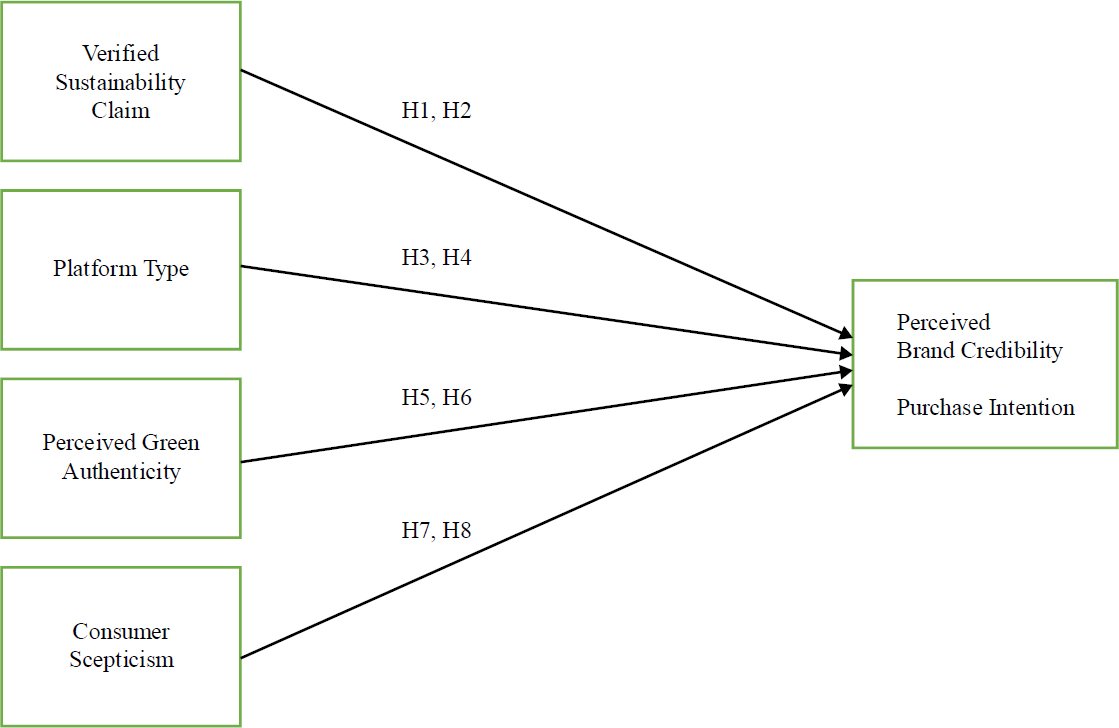
Fig. (1). Conceptual framework.
3. METHODOLOGY
3.1. Research Design
Following Research Onion for methodology and design, the current study is based on pragmatism philosophy, abductive approach, which is used to test the hypothesised relationships. Experiments (mono-quantitative) was used mainly, with a qualitative phase to gain deeper understandings. The method used was mixed methods. Time horizon was cross sectional. Controlled experiments, focus group methods were the techniques employed for data collection and purposive sampling was used. MANCOVA, ANOVA and t-tests were used for qualitative data analysis, as well as thematic analysis.
3.2. Quantitative Phase
The quantitative portion of this research adopted the experimental research design to test how the different kinds of sustainability claims (no claim, vague claim and verified claim) and platform (social media and brand-owned websites), Perceived Green Authenticity and Consumer Scepticism affect the perceived brand credibility and purchase intention. For the vague claim, participants were exposed to advertisements with statements such as ‘We are committed to sustainability’ or ‘Our products are environmentally friendly’. Such statements were broad and did not have any backing evidence or qualifications that could be interpreted in any way and thus could lead to scepticism. The attested assertions had quantifiable and clear certifications of sustainability, such as ‘Certified by [XYZ Eco-Label]’ or ‘100% recyclable materials, verified by [Third-Party Certification]’. These allegations were concrete evidences and meant to appeal to a greater degree of credibility and trust. In order to give a context, the participants were provided with a screenshot of the advertisement or a script of the message appearing on the platform. As a case in point, in the verified claim condition, the ad would incorporate a logo such as [XYZ Eco-Label] and a statement: ‘Our products meet the [XYZ] sustainability standard, verified by [Third-Party Certification]’. In the vague claim condition, the ad stated, ‘We care about the environment and are committed to sustainability. ’ The advertisements were shown in two channels, which included social and brand-owned sites. On each type of claim (no claim, vague claim and verified claim), the participants were shown the corresponding ad on one of these platforms to investigate the effect that the type of platform had on the perceived credibility and purchase intention. The experiment was aimed at establishing a realistic marketing situation so as to establish the effects of discrepancies in claim authenticity and platform type on consumer purchase intention and perceived brand credibility.
Claim type and platform type were operationalised as categorical independent variables following a controlled experimental design. Specifically, claim type was a between-subjects factor with three levels: (1) no claim, (2) vague claim and (3) verified claim. Platform type was operationalised using a between subjects 2-level experimental design with social media platform and brand-owned website being the two levels. The design was a fully between subject’s design with participants randomly allocated to one of the three claim conditions and then evenly distributed among the two platform conditions in each claim condition. This led to an even distribution of exposure into all experimental cells so that cells with a total of n = 50 were provided (six cells total). Random allocation helped to reduce selection bias and facilitate the inference of cause and effect of sustainability claim authenticity and communication platform on consumer responses. This factorial design allowed for systematic examination of the main effects and interaction effects in regard to perceived green authenticity, consumer skepticism, brand credibility and purchase intent.
In the current research, Perceived Green Authenticity (PGA) is considered as an exogenous evaluative orientation and Consumer Scepticism (CS) as an exogenous moderating variable, both of which have their origin in consumer cognition. In the UK manufacturing setting, sustainability communication is equated with existing perceptions of authenticity and scepticism in isolation which affect credibility notions and purchase intentions. Attribution Theory provides a justification for this view by arguing that consumers assign motives, sincerity and ethics to sustainability claims based on their pre-conceived assessment of them. (Shin & Ki, 2021). Furthermore, the design of the study revealed that they listened to different claims prior to making their authentic perception and sceptical responses as direct reaction to the claims. To this end, PGA and CS are not regarded as intermediate or moderating variables in the communication of sustainability, but as explanatory variables that can explain the outcomes of the consumption process.
A total of 600 people were contacted through LinkedIn and the official social media pages of the UK manufacturing firms. Among them, 320 responses were obtained, yielding a response rate of 53.33%. After filtering out invalid and missing data, 300 valid responses were used for the analysis. The purposive sampling method was used, as suggested by (Makwana et al., 2023), which allows for the inclusion of participants who are familiar with the concept of sustainability communication and digital marketing practices, which is aligned with the core aim of the study. The unit of analysis was individual consumers exposed to sustainability advertisements of manufacturing-sector brands. The target population comprised UK consumers familiar with sustainability communication and digital marketing platforms.
The sample size was calculated using the GPower software for an F-test, MANOVA: fixed effects, special, main effects and interactions, with medium effect size (f² = 0.15), α = 0.05, and statistical power (1−β) = 0.80, suggesting that the minimum sample size for this analysis is about 300, which was considered for the current investigation. It validates the adequacy for analysis, as argued by (Jhantasana, 2023), and also indicates that it is suitable for analysing causality using the said method. Non-response bias was assessed by analysing the significance of the difference between early (n1 = 30) and late (n2 = 30) respondents using independent-samples t-tests; no significant difference was found, indicating no selection bias. Further, the selection bias was reduced by selecting the participants who represented a variety of manufacturing sub-sectors and job positions.
In addition, the participants were randomly divided into three experimental groups (100 per group), which would reflect the conditions of claim types, that is, (1) no claim, (2) vague claim, and (3) verified claim. The subjects were presented with an advertisement stimulus tailored to the type of their assigned claim, which was alternately shown on a social media interface and brand-owned websites to simulate real-life exposure. After exposure to the advertisement, the study subjects completed a quantitative questionnaire that gauged consumer scepticism, perceived green authenticity, perceived brand credibility, and purchase intention using a 5-point Likert scale, as depicted in Appendix A.
Following this, a few study subjects participated in a focus group session, during which 6 participants were interviewed using semi-structured questions based on open-ended questions related to the study’s objectives. The session lasted approximately, during which participants were asked about the advertisement shown and their perceptions regarding the claim types, platform types, consumer scepticism, perceived green authenticity, and how these factors affect their purchase intention and perceived brand credibility. Moreover, a quantitative questionnaire that gauged consumer scepticism, perceived green authenticity, perceived brand credibility, and purchase intention. Data were filtered for completeness, outliers, and valid responses; 300 responses were obtained, with a response rate of about 60%.
To analyse the data, the study used MANCOVA, One-way ANOVA, and independent-samples t-tests to examine causal relationships between independent and dependent variables and to compare means across the three groups of claim types, as suggested by (Alassaf & Qamar, 2022) as well. This design allowed testing hypothesised effects under controlled conditions, providing strong empirical evidence on the effects of sustainability claim authenticity and communication platform on consumer perceptions and behavioural intentions.
3.3. Qualitative Phase
The qualitative stage used semi-structured questions to understand in detail how consumers understand sustainability claims and interpret authenticity in digital brand communication. The consumers, who are actively involved with sustainability-oriented and eco-brands in the UK manufacturing sector, participated in 6 participants. To ensure participants are relevant and have a clear understanding, professional sustainability forums, LinkedIn, and verified brand communities were used to reach them. A focus-group questionnaire comprising six semi-structured, open-ended questions was used to collect responses from 6 participants.
To reduce selection bias, participants were selected to represent diverse demographics by gender, age, and occupation, thereby reflecting different consumer groups in the UK. The focus group session was conducted online via Zoom, which is highly practical in terms of accessibility and the flexibility it offers participants across the UK. The focus group session lasted about 120 minutes, allowing us to collect detailed viewpoints from the participants regarding the research problem. Thematic analysis was applied using the (Braun & Clarke, 2021) framework, which comprised recording, transcribing, and analysing data to identify recurrent themes related to trust, authenticity, and credibility in sustainability communication.
4. RESULTS
4.1. Quantitative Findings
4.1.1. Demographic Profile Analysis
The statistical results in Table 1 depict the demographic profile of the research participants. It can be observed that among the total (n = 300) participants, 58.53% were male and 41.67% were female. On the other hand, in terms of age groups, 41.67% of the participants fall within the age category of 25-34 years, 33.33% within age category of 35-44 years and 25 % within age category of 45-54 years. Moreover, in terms of occupation, 25% of the study participants were students, 45% were employed, and 30% were self-employed. Lastly, with regards to the consumption pattern of the sustainable products by the participants, 25% consume it once a week, 33.3% once a month, and 41.7% yearly.
Table 1. Demographic profile.
| Demographic category | Frequency (n) | Percentage (%) | |
| Gender | Male | 175 | 58.33% |
| Female | 125 | 41.67% | |
| Age Range | 25-34 | 125 | 41.67% |
| 35-44 | 100 | 33.33% | |
| 45-54 | 75 | 25.00% | |
| Occupation | Student | 75 | 25.00% |
| Employed | 135 | 45.00% | |
| Self-Employed | 90 | 30.00% | |
| Consumption Patterns of Sustainable Products | Once a week | 75 | 25.00% |
| Once a Month | 100 | 33.33% | |
| Yearly | 125 | 41.67% | |
4.1.2. MANCOVA Analysis-Platform Type
The MANCOVA results depicted in Table 2 shows substantial multivariate relationship of Consumer Scepticism (Wilks’ λ = 0.965, p = 0.006) and Perceived Green Authenticity (Wilks’ λ = 0.881, p < 0.001) with the dependent variables, Perceived Brand Credibility and Purchase Intention. In addition, interactions amongst Platform Type were insignificant within both Consumer Scepticism (p = 0.895) as well as Perceived Green Authenticity (p = 0.673). Consumer Scepticism (CS) shows a statistically significant multivariate relationship (Wilk’s λ = 0.965, p = 0.006) as a result of which sceptical consumers have a systematic difference in their attitudes to assessing brand credibility and purchase intentions.
Table 2. MANCOVA results with platform types and covariates.
| Multivariate tests | ||||
| Effect | Wilks λ | F | Error df | P |
| Intercept | 0.432 | 193.091 | 294.000 | 0.000 |
| Consumer Scepticism | 0.965 | 5.258 | 294.000 | 0.006 |
| Perceived Green Authenticity | 0.881 | 19.805 | 294.000 | 0.001 |
| Platform Type * Consumer Scepticism | 0.999 | .111 | 294.000 | 0.895 |
| Platform Type * Perceived Green Authenticity | 0.997 | .396 | 294.000 | 0.673 |
The multivariate effect of Perceived Green Authenticity (PGA) is also highly significant (Wilk’s λ = 0.881, p = 0.001), indicating a substantial contribution to improvements in brand credibility perceptions and consumer purchase intentions. Platform Type interactions Platform Type x CS (Wilk’s λ = 0.999, p = 0.895) and Platform Type x PGA (Wilk’s λ = 0.997, p = 0.673), on the other hand, are not statistically significant which means that the presence of a sustainability message on social media or a brand-owned site does not change the relationship of consumer scepticism and perceived brand authenticity with brand credibility and purchase intention.
4.1.3. MANCOVA Analysis-Claim Type
The multivariate results, integrating claim type (Table 3), further strengthen the importance of message content in shaping consumer responses. Perceived Green Authenticity (Wilk’s λ = 0.890, p = 0.000) has a great multivariate impact that highlights the key role it plays in establishing a positive brand credibility and intentions to purchase. Similarly, Consumer Scepticism (CS) is also important (Wilk’s λ = 0.969, p = 0.010), indicating that sceptical attitudes strongly influence interpretations and actions regarding sustainability claims.
Table 3. MANCOVA results with claim types and covariates.
| Multivariate tests | ||||
| Effect | Wilks λ | F | Error df | P |
| Intercept | 0.426 | 196.566 | 292.000 | 0.000 |
| Perceived Green Authenticity | 0.890 | 17.956 | 292.000 | 0.000 |
| Consumer Scepticism | 0.969 | 4.704 | 292.000 | 0.010 |
| Claim Type * Consumer Scepticism | 0.881 | 9.531 | 584.000 | 0.000 |
| Claim Type * Perceived Green Authenticity | 0.889 | 8.823 | 584.000 | 0.000 |
Importantly, both the effects of interaction- Claim Type x CS (Wilk’s λ = 0.881, p = 0.000) and Claim Type x PGA (Wilk’s λ = 0.889, p = 0.000) have significant values. This means that consumer scepticism and brand perceived authenticity vary greatly depending on the outcome of the types of claims, which are, verified, no, and vague. These results substantiate the fact that the nature and quality of sustainability communication as well as the consumer predispositions are related with the trust and behavioural intention in the UK manufacturing environment.
In the next step, to further analyse and elaborate on differences, one-way ANOVA and Independent Samples T-test are applied.
4.1.4. One-way ANOVA
The effect of claim type on the purchase intention and perceived brand credibility is analysed using One-way ANOVA. (Lionello et al., 2021) indicated the use of one-way ANOVA when difference is needed to be evaluated amongst three or more groups.
As per the results depicted in Table 4, purchase intentions of consumers in the UK manufacturing sector significantly differ between the three claim groups (P = 0.00 < 0.05). The findings show that consumers exposed to different claim types exhibit varying levels of purchase intention, with verified claims significantly enhancing purchase intention compared to no claim and vague claims (multiple comparisons). This confirms that verified sustainability claims are more effective in driving consumer behaviour and willingness to purchase.
Table 4. One-way ANOVA.
| ANOVA | ||||||||||
| – | Sum of Squares | df | Mean Square | F | Sig. | |||||
| Purchase Intention | Between Groups | 9.85 | 2 | 4.923 | 13.021 | 0.000 | ||||
| Within Groups | 112.30 | 297 | 0.378 | – | ||||||
| Total | 122.15 | 299 | – | – | – | |||||
| Perceived Brand Credibility | Between Groups | 7.31 | 2 | 3.653 | 11.091 | 0.023 | ||||
| Within Groups | 177.53 | 297 | 0.598 | – | – | |||||
| Total | 178.84 | 299 | – | – | – | |||||
| Multiple Comparisons | ||||||||||
| Dependent variable | Mean difference (I-J) | Std. Error | Sig. | 95% Confidence Interval | ||||||
| Lower bound | Upper bound | |||||||||
| Purchase Intention | No Claim | Vague Claim | -0.170 | 0.087 | 0.155 | -0.38 | 0.04 | |||
| Verified Claim | -.440*** | 0.087 | 0.000 | -0.65 | -0.23 | |||||
| Vague Claim | No Claim | 0.170 | 0.087 | 0.155 | -0.04 | 0.38 | ||||
| Verified Claim | -.270*** | 0.087 | 0.006 | -0.48 | -0.06 | |||||
| Verified Claim | No Claim | .440*** | 0.087 | 0.000 | 0.23 | 0.65 | ||||
| Vague Claim | .270*** | 0.087 | 0.006 | 0.06 | 0.48 | |||||
Note: *** p < 0.01 (significant at the 1% level)
However, the results indicate that claim type have a significant effect on Perceived Brand Credibility (PBC) (P = 0.023 < 0.05). It means that, the nature of the claim would have an impact on the purchase intentions, as well as credibility of the brand. However, the effect size was weaker than for purchase intention.
4.1.5. Independent Sample T-test
An independent-samples T-test is applied to examine whether there is a statistically significant difference between the means of two groups, as suggested by (Makwana et al., 2023) as well. It has been assessed if purchase intention and perceived brand credibility vary based on the platform type, such as social media or brand-owned website (Table 5).
Table 5. Independent sample T-test.
| Independent Samples Test | ||||||||||
| – | Levene’s Test for Equality of Variances | t-test for Equality of Means | ||||||||
| F | Sig. | t | Df | Sig. (2-tailed) | Mean Difference | Std. Error Difference | 95% Confidence Interval of the Difference | |||
| Lower | Upper | |||||||||
| Purchase Intention | Equal variances assumed | 1.402 | 0.237 | 0.152 | 298 | 0.879 | -0.011 | 0.075 | -0.159 | 0.136 |
| Equal variances not assumed | – | – | 0.155 | 282.319 | 0.877 | -0.011 | 0.074 | -0.156 | 0.134 | |
| Perceived Brand Credibility | Equal variances assumed | 2.540 | 0.112 | 2.352 | 298 | 0.019 | -0.211 | 0.090 | -0.388 | -0.035 |
| Equal variances not assumed | – | – | 2.312 | 249.828 | 0.022 | -0.211 | 0.091 | -0.392 | -0.031 | |
An independent-samples t-test is used to compare the responses of participants who were exposed to two types of platforms, such as social media and brand-owned sites. The findings indicate that there is no significant difference in purchase intention (PI) by platform (p = 0.879). Thus, consumers’ purchase intentions are the same whether the sustainability claim is posted on a social media feed or on the company’s official website. It means that the platform itself does not provide high purchase motivation.
However, there is a significant difference in Perceived Brand Credibility (PBC) across platforms (p = 0.019). The large-mean difference shows that the PBC on the social media was lesser than on the same claims on the brand-owned websites. It is a symptom of the growing trust of the consumers in the corporate-controlled communicative context, in which assertions are less careless than in the less controlled social media realm.
4.2. Focus Group Analysis
4.2.1. Demographic Analysis
The demographics of the entire focus group (n = 6) participants in the discussions were depicted in Table 6. The proportion of male to female among those respondents was 66.7:33.3. Conversely, 16.67% were in the 30-39 years age group, 50% in the 40-49 years age group and 33.33% in the 50 years and above age group. Although occupationally speaking, the participants were equal in number that is, 33.33% each student, corporate employee, and self-employed population.
Table 6. Demographic analysis.
| Demographic Category | Frequency (n) | Percentage (%) | |
| Gender | Male | 4 | 66.67% |
| Female | 2 | 33.33% | |
| Age | 30-39 | 1 | 16.67% |
| 40-49 | 3 | 50.00% | |
| 50 and above | 2 | 33.33% | |
| Occupation | Student | 2 | 33.33% |
| Corporate Employee | 2 | 33.33% | |
| Self-Employed | 2 | 33.33% | |
4.3. Thematic Analysis
Theme 1: Authenticity as the Core of Sustainable Brand Credibility
This theme was also generated based on the consideration of the participants on what makes a brand seem truly sustainable (Table 7). It enabled the capturing of the connection under transparency, authenticity, and trust, which are main components of brand credibility.
Table 7. Themes table.
| Theme | Illustrative Responses | Codes | Keywords |
| Theme 1: Authenticity as the Core of Sustainable Brand Credibility | R1: “A brand is truly sustainable when it provides clear evidence — not just buzzwords like ‘eco-friendly’.” | Evidence-driven trust; Authentic sustainability; Transparency expectations | Authenticity, Transparency, Proof, Brand Credibility |
| R4: “If a company shows real actions like certifications, I’m more inclined to trust.” | |||
| Theme 2: Impact of Claim Type on Consumer Trust and Scepticism | R2: “Vague claims feel manipulative like greenwashing.” | Claim clarity; Greenwashing concern; Fact-based credibility | Claim Type, Scepticism, Verification, Greenwashing |
| R5: “I trust brands that back sustainability messages with facts.” | |||
| Theme 3: Platform Context and Perceived Credibility | R3: “Claims on social media feel less reliable than on the official website.” | Platform-based trust; Source credibility; Digital context influence | Social media, Brand Website, Credibility, Reliability |
| R6: “Social media ads feel like hype — websites are official.” | |||
| Theme 4: Verified Claims as a Driver of Purchase Intention | R2: “Verified logo gives confidence the brand isn’t just talking.” | Certification influence; Ethical reassurance; Purchase motivation | Verified Claims, Purchase Intention, Certification, Ethical Value |
| R5: “A certification makes me feel my purchase contributes to something meaningful.” | |||
| Theme 5: Overcoming Scepticism through Transparent Digital Communication | R6: “I only believe when progress updates are shown — not just achievements.” | Continuous transparency; Authentic reporting; Proof-based persuasion | Transparency, Communication, Scepticism Reduction, Digital Evidence |
| R4: “Factory videos or real impact stories make the brand credible.” |
In response to this question, R1 stated, “I believe a brand is truly sustainable when it provides clear evidence of what it’s doing — not just buzzwords like ‘eco-friendly’ or ‘green.’”
This proves that consumers require factful evidence, not rhetoric and this argument is enough to prove that authenticity is a product of verifiable commitment, not symbolic marketing as it has been emphasised by (Kim et al., 2021) as well. This uncertainties in the message spoils credibility that is consistent with (Sander et al., 2021), who established that environmental specificity results in better perceived honesty.
Similarly, R4 remarked, “If a company shows real actions, like certifications or transparent reports, I’m more inclined to trust its green claims.
This brings out the authenticity of authentic assertions. (Suhud et al., 2022) suggest that authenticity intervenes in the connection between sustainability claims and positive attitudes and purchase intentions. Hence, transparency is a source of credibility and buying intention due to provable sustainability statements.
Theme 2: The Impact of Claim Type on Consumer Trust and Scepticism
This was a theme that was created due to the debates on the place of claim types, no claim, vague claim, or verified claim, in respect of trust and scepticism.
In response, R2 stated, “When a brand makes vague claims like ‘we care for the planet’ without showing how, it feels manipulative like greenwashing.”
This highlights the negative reaction to ambiguity, which are also noted by (Carranza et al., 2023), who concluded that ambiguous claims reduce trust and purchase intention.
Meanwhile, R5 shared, “I trust brands that back their sustainability messages with facts, data, or certifications; anything less feels like marketing fluff.”
Authenticated claims minimise scepticism, and this does not contradict (Bladt et al., 2024) who claim that evidence-based communication is more effective in enhancing green value. Alternatively, brands with no or vague promises fail to deliver expectations of transparency. Validated messages, thus, build confidence and credibility, and the uncertain messages build doubt and lack credibility over the internet.
Theme 3: Platform Context and Its Influence on Perceived Credibility
The significance of this theme emerged because of the fact that the effects that the nature of platform i.e. social media and brand owned websites can have on the perceptions of credibility were taken into consideration.
R3 noted, “When I see a sustainability claim on social media, I take it lightly. But if it’s on the brand’s official website, I feel it’s more reliable.”
This proves that platform credibility is an intermediate of interpretation. (Mabkhot et al., 2022) have also discovered that credibility and participation are determined by the source of messages and usefulness of the information. The perception of social media as more prone to exaggeration than websites, which possess the infusion and permanence, is based on the interactivity.
Adding to this, R6 mentioned, “Social media ads feel like hype — they focus on visuals over facts. The website feels official and evidence-based.”
This disparity reveals that credibility of the platform is what defines authenticity ratings. There is also a similarity to (Kim et al., 2021), who state that the persuasive ability of social media is determined by the reliability of information. As such, platform type is the moderating factor on the translation of authenticity cues into credibility that prompts firms to contextualise sustainability.
Theme 4: Verified Claims as a Driver of Purchase Intention through Perceived Authenticity
This theme was the result of the argument produced by the respondents on the impact of verified sustainability claims on purchasing intentions, according to which the nature of the claim and its verifiability is combined with behaviour.
R2 expressed, “When I see a verified logo or certification, it gives me confidence that the brand isn’t just talking — it’s actually doing something.”
These examples of R2 that confirm claims are a type of a trust signal, and they enhance purchase intentions by reducing the uncertainty. (Mabkhot et al., 2022) claim that this relationship is mediated by authenticity, which transforms credibility of claims into behavioural intention.
Likewise, R5 stated, “If the claim is backed by a reliable certification body, I feel my purchase contributes to something meaningful.”
These arguments point to the matching of values and support the arguments regarding consumer motivation and are compatible with (Kothari et al., 2025) who discovered that the development of online trust through authenticity, sustainability, and credibility is mutually formed. R1, however, indicated that where evidence lacks, it is nothing but green marketing spin. Authenticated claims are, as such, mental shortcuts to authenticity, and unspecified claims are suspicions.
Theme 5: Overcoming Consumer Scepticism through Transparent Digital Communication
This theme can be explained based on the contemplations about how a brand can be viewed as less sceptical and more authentic on platforms.
R6 stated, “Most brands exaggerate their green claims. I only start believing when they show consistent updates about progress — not just achievements.”
This reaction of R6 highlights that this is a long-term openness, and not a single campaign. It is also mentioned that long-term communication and value compatibility reduce scepticism and promote mindful consumption (Suhud et al., 2022).
R4 added, “I don’t mind ads, but I need to see proof — like videos from the factory or real impact stories — to feel the brand is credible.”
This is pointing to the increasing demand of authenticity. R3 also observed that the central aspect of sharing the message, in particular, social media, is transparency, because consumers can sense that something may be too good to be true, as (Bladt et al., 2024) pointed out. Such observations mean that, when it comes to conquering scepticism, there is a necessity to open, be consistent and to make the stories checked. Bidirectional clear-cut digital communication may transform the sceptical target customers to be loyal customers.
5. DISCUSSION
H1: There is a statistically significant effect of claim types on perceived brand credibility in the UK manufacturing sector.
The findings support H1 in the MANCOVA analysis; however, the one-way ANOVA not supported it. It showed a direct significant effect of claim type on perceived brand credibility (PBC) and purchase intention (PI). Participants in the qualitative phase emphasised the importance of evidence-based claims for building trust in sustainability efforts. Ambiguous claims were seen as manipulative, which aligns with (Ngo et al., 2024), who found that ambiguous claims generate suspicion rather than credibility. These findings confirm those of (Koh et al., 2022), who also emphasised the role of evidence-based communication to improve brand credibility. This difference with (Kim et al., 2021), who proposed that credibility can be created solely through the message, can be explained by the UK manufacturing industry’s already high awareness of greenwashing, reinforced by the Green Claims Code (Javed et al., 2024a). This opinion is supported by Attribution Theory, which shows that verifiable claims are regarded as real behaviours and, as such, the brand’s credibility improves.
H2: There is a statistically significant effect of claim types on consumer purchase intention in the context of the UK manufacturing sector.
The findings are highly in favour of H2, because the type of claim played an important role in consumer purchase intention. Participants’ intention to purchase was higher among those exposed to verified claims than among those exposed to vague or no claims. This observation aligns with the qualitative data, as claims of sustainability were, in most cases, correlated with higher levels of trust, which, in turn, affected purchase intention. These findings are consistent with those of Hosain & Mamun, 2023), who found that consumers respond better to brands that offer realistic, sustainable value rather than empty rhetoric. This disparity in consumer behaviour is attributable to the fact that consumer regulation in the UK manufacturing industry is emerging as a key driver of green performance reporting (Edie, 2025; Hu & Zhu, 2022). According to the Attribution Theory, once claims are verified, consumers will attribute them to the brand’s actual sustainability actions, thereby enhancing their intention to purchase the brand.
H3: There is a statistically significant difference between the perceived brand credibility impacted by platform types in the UK manufacturing sector context.
The results partly support H3, as the independent-samples t-test indicates that platform type significantly affects perceived brand credibility (PBC) and nor purchase intention. In contrast, the MANCOVA indicates that platform type significantly affects PBC and PIVA. Although participants favoured brand-owned websites for sustainability messaging, the credibility gap was not as significant as expected. The qualitative findings indicated that participants were highly critical of sustainability claims across platforms, suggesting that platform type have an uncertain impact on trust. This aligns with (Gani et al., 2023), who found that platform type may affect trust formation, though the veracity of this assertion is more important. Attribution Theory proposes that the credibility of the statement, rather than the platform, is the predominant determinant of consumer trust, and this aligns with the finding that platform type is not an important credibility factor.
H4: There is a statistically significant difference between the consumer purchase intentions impacted by platform types in the UK manufacturing sector context.
The results do not confirm H4 because platform type is not significantly associated with consumer purchases. Despite a slight inclination among participants towards brand-owned websites when sending sustainability messages, this inclination did not lead to a significant difference in purchase intentions. It is the opposite of the conclusions of (Dinana et al., 2025), who maintained that platform type influences consumer trust and decision-making. The difference might be explained by the fact that the UK manufacturing industry is highly oriented towards consumers who attach greater importance to verified claims and third-party guarantees, rather than the platform where the sustainability claim is made. Attribution Theory holds that the credibility of the message will prevail over the medium through which it is conveyed, and hence consumers will tend to make their purchasing decisions based on the credibility of sustainability claims rather than the platform used.
H5: The impact of Perceived Green Authenticity (PGA) on purchase intention is statistically significant.
The results confirm H5 and prove that the perceived green authenticity (PGA) has a significant effect on consumer purchase intention. The value of authenticity was maintained throughout the respondents, who always linked credible claims of sustainability to a higher degree of trust and a higher tendency to purchase. It coincides with the results of the (Bladt et al., 2024) study where they emphasised that authenticity plays a major role in the process of formation of brand credibility and purchase intention. (Isac et al., 2024) also assume that the consumer literacy levels on the topic of sustainability in the UK manufacturing sector have increased, and consumers have become more demanding of authentic and transparent claims. The Attribution Theory indicates that the perceived green authenticity allows the consumer to internalise sustainability as a brand identity element which, on the other hand, increases credibility and purchase intention.
H6: The impact of Perceived Green Authenticity (PGA) on Perceived Brand Credibility is statistically significant.
The results confirm the hypothesis (H6), because the perceived green authenticity (PGA) was significantly affecting the perceived brand credibility (PBC). The more brands credibly and verifiably promoted their sustainability, the more credible they became to the participants. This is in line with (Pittman et al., 2022) who discovered that authenticity is one of the main drivers of brand credibility. Transparency and substantiated claims are necessary in generating trust as indicated in the results, which reveal that substantiated sustainability claims increased both PBC and purchase intention. The Attribution Theory says that when a consumer perceives the green authenticity, there are higher chances that they will consider the brand as being truly devoted to sustainability, which has a positive impact on both PBC and purchase intention.
H7: The impact of consumer scepticism on purchase intention is statistically significant.
These findings are in favour of H7, since consumer scepticism has a considerable influence on purchase intention. The sceptical consumers had a lower purchase intention that was positive particularly in the presence of sustainability claims that were seen as unverified or unclear. This result is consistent with the qualitative outcomes, which revealed that the respondents were concerned about the issue of greenwashing and insincerity in certain sustainability practices. Such findings are in line with (Chuah et al., 2022), who established that consumer scepticism undermines the sustainability message efficacy. This research clearly has a contribution to the UK manufacturing industry, where mistrust based on the historical corporate malpractice is still high. According to the Attribution Theory, sceptical customers project sustainability statements on to a marketing strategy of manipulation, and not a strategy of actual action, diminishing the credibility of the brand and the desire to buy it.
H8: The impact of consumer scepticism on perceived brand credibility is statistically significant.
The results prove H8, which ascertained that consumer scepticism has a significant impact on perceived brand credibility. The sustainability claims had more chances of being distrusted by sceptical consumers, and this would harm the brand. This can be linked to (Carranza et al., 2023), who claim that consumer scepticism is a type of filter that will allow the consumer to reject sustainability claims as true. Attribution Theory goes on to imply that under high scepticism, consumers put sustainability claims under the influence of persuasive marketing instead of actual corporate practices, and therefore, reduces the credibility of the brand.
CONCLUSION
This paper has a future-relevant contribution to sustainability communication through its purpose of discussing how the concept can be used to drive consumer trust and engagement in the UK manufacturing sector through the conglomeration of the Attribution Theory and perceived authenticity as well as consumer scepticism. The findings suggest that brand credibility and purchase intention grow significantly when the sustainability claims are credible, but they grow when they are vague or unsubstantiated. This is in line with findings that confirm the critical role played by claim type in determining consumer perceptions and behaviours and platform type in determining purchase intention. This means that visibility does not always imply that people are going to trust the brand, and the verisimilitude of the message is more efficient in creating perceptions of consumers.
Authentic claims, particularly the authentic ones, transform the consumer attributions, rendering scepticism less significant and heightening the purchasing willingness towards the long-term as opposed to the short-term marketing. Such results are in line with the Attribution Theory according to which consumers assess the claims related to sustainability as genuine and actual instead of considering them as marketing strategies. On the other hand, the vague statements or the lack of them were portrayed as a way of weakening the authenticity, raising the level of scepticism, and ultimately lowering the desire to buy.
Qualitative insights also confirm these findings, as they indicate that consumers judge sustainability claims using a motive-attribution framework, that is, in search of congruence between corporate will and ethical consistency. The article emphasises that clear and supported sustainability claims should be made to persuade the customers to develop the long-term confidence and curiosity. Finally, in this study, the importance of a balance between the clarity of messages and morality and honesty in the formation of a sustainable brand relationship is evident. The results can benefit theoretical and practical views because they place a strong focus on the idea that effective sustainability communication is not a mere reputational tactic, but a basic precursor to long-term consumer confidence and participation, particularly when it comes to industrial and manufacturing markets.
LIST OF ABBREVIATIONS
CS | = | Consumer Scepticism |
CSR | = | Corporate Social Responsibility |
EPR | = | Extended Producer Responsibility |
PBC | = | Perceived Brand Credibility |
PGA | = | Perceived Green Authenticity |
PI | = | Purchase Intentions |
AUTHORS’ CONTRIBUTIONS
M.A.H. and S.K. have contributed to the study concept and design, methodology, data analysis, interpretation of results, and manuscript writing.
ETHICAL APPROVAL & INFORMED CONSENT
All procedures were carried out in accordance with institutional research ethics committee guidelines and Declaration of Helsinki. Informed consent was obtained from all participants. To ensure participant protection, all data were fully anonymized at the point of collection, and no personal or identifiable data was recorded.
AVAILABILITY OF DATA AND MATERIALS
The data will be made available on reasonable request by contacting the corresponding author [S.K.].
FUNDING
None.
CONFLICT OF INTEREST
The authors declare that there is no conflict of interest regarding the publication of this article.
ACKNOWLEDGEMENTS
Declared none.
DECLARATION OF AI
During the preparation of this work the authors used ChatGPT for editing purposes. After using this tool, the authors reviewed and edited the content as needed and take full responsibility for the content of the published article.
APPENDICES A
Appendix 1: Survey Questionnaire
Demographic Profile
| Demographic Category | |
| Gender | Male |
| Female | |
| Age Range | 25-34 |
| 35-44 | |
| 45-54 | |
| Occupation | Student |
| Employed | |
| Self-Employed | |
| Consumption Patterns of Sustainable Products | Once a week |
| Once a Month | |
| Yearly | |
| Section / Variable | Item / Statement | SD (1) | D (2) | N (3) | A (4) | SA (5) |
Perceived Brand Credibility (Dependent Variable) | I consider this brand to be trustworthy. | ☐ | ☐ | ☐ | ☐ | ☐ |
| This brand delivers on the promises it makes in its sustainability claims. | ☐ | ☐ | ☐ | ☐ | ☐ | |
| I believe this brand is honest about its environmental practices. | ☐ | ☐ | ☐ | ☐ | ☐ | |
| This brand consistently provides transparent information about its sustainability effort | ☐ | ☐ | ☐ | ☐ | ☐ | |
| I believe this brand’s sustainability claims are backed by genuine actions. | ☐ | ☐ | ☐ | ☐ | ☐ | |
| This brand has a strong reputation for being environmentally responsible. | ☐ | ☐ | ☐ | ☐ | ☐ | |
| I trust that this brand is committed to reducing its environmental impact. | ☐ | ☐ | ☐ | ☐ | ☐ | |
| This brand is reliable in its environmental practices and initiatives. | ☐ | ☐ | ☐ | ☐ | ☐ | |
| I feel confident that this brand’s sustainability efforts are authentic | ☐ | ☐ | ☐ | ☐ | ☐ | |
| I would recommend this brand to others based on its sustainability practices | ☐ | ☐ | ☐ | ☐ | ☐ | |
Purchase Intention (Dependent Variable) | I would consider purchasing from this brand in the future. | ☐ | ☐ | ☐ | ☐ | ☐ |
| I am likely to choose this brand over others because of its sustainability practices. | ☐ | ☐ | ☐ | ☐ | ☐ | |
| I would recommend this brand to others due to its environmental commitment. | ☐ | ☐ | ☐ | ☐ | ☐ | |
| I am more likely to buy from this brand if I know it is committed to sustainability | ☐ | ☐ | ☐ | ☐ | ☐ | |
| I would be willing to pay a premium for this brand’s products because of its environmental practices. | ☐ | ☐ | ☐ | ☐ | ☐ | |
| I would choose this brand over its competitors due to its focus on sustainability | ☐ | ☐ | ☐ | ☐ | ☐ | |
| I am interested in purchasing from this brand because of its eco-friendly initiatives | ☐ | ☐ | ☐ | ☐ | ☐ | |
| I would actively seek out this brand in the future because of its commitment to sustainability. | ☐ | ☐ | ☐ | ☐ | ☐ | |
| I am likely to purchase from this brand based on its environmental responsibility. | ☐ | ☐ | ☐ | ☐ | ☐ | |
| I would support this brand by making a purchase because of its efforts to reduce environmental harm. | ☐ | ☐ | ☐ | ☐ | ☐ | |
Perceived Green Authenticity (Independent Variable) | The brand’s sustainability efforts feel genuine rather than opportunistic. | ☐ | ☐ | ☐ | ☐ | ☐ |
| I believe the brand truly cares about the environment. | ☐ | ☐ | ☐ | ☐ | ☐ | |
| The sustainability messages seem consistent with the brand’s overall values. | ☐ | ☐ | ☐ | ☐ | ☐ | |
| The brand’s sustainability claims reflect real, actionable steps towards environmental responsibility | ☐ | ☐ | ☐ | ☐ | ☐ | |
| I trust that the brand’s environmental initiatives are driven by a genuine commitment, not just marketing tactics. | ☐ | ☐ | ☐ | ☐ | ☐ | |
| The brand’s environmental practices align with its long-term business strategies, not just short-term goals | ☐ | ☐ | ☐ | ☐ | ☐ | |
| The brand’s sustainability efforts feel integrated into its operations, rather than being a separate initiative. | ☐ | ☐ | ☐ | ☐ | ☐ | |
| I believe the brand’s sustainability messages are based on real achievements rather than just promises | ☐ | ☐ | ☐ | ☐ | ☐ | |
| The brand consistently demonstrates its commitment to sustainability through its actions, not just words | ☐ | ☐ | ☐ | ☐ | ☐ | |
| I feel that the brand is transparent and honest about the impact of its sustainability practices | ☐ | ☐ | ☐ | ☐ | ☐ | |
| Consumer Scepticism (Independent Variable) | I am often doubtful about brands’ environmental or sustainability claims. | ☐ | ☐ | ☐ | ☐ | ☐ |
| Many brands exaggerate their green practices to attract customers. | ☐ | ☐ | ☐ | ☐ | ☐ | |
| I question whether sustainability claims in advertisements are completely true. | ☐ | ☐ | ☐ | ☐ | ☐ | |
| I am sceptical about the environmental claims made by most brands. | ☐ | ☐ | ☐ | ☐ | ☐ | |
| I often suspect that brands use sustainability claims to improve their image rather than make a real impact | ☐ | ☐ | ☐ | ☐ | ☐ | |
| I doubt the accuracy of sustainability claims made in advertising | ☐ | ☐ | ☐ | ☐ | ☐ | |
| I believe many brands make unverified or misleading claims about their environmental impact | ☐ | ☐ | ☐ | ☐ | ☐ | |
| I find it hard to trust sustainability claims unless they are verified by third-party organisations | ☐ | ☐ | ☐ | ☐ | ☐ | |
| I often feel that brands use greenwashing tactics to appeal to environmentally conscious consumers | ☐ | ☐ | ☐ | ☐ | ☐ | |
| I question the authenticity of sustainability efforts from brands that do not provide clear evidence of their action | ☐ | ☐ | ☐ | ☐ | ☐ |
Nominal variables:
Claim Type
- No Claim (0)
- Vague Claim (1)
- Verified Claim (2)
Platform Type
- Social media websites (0)
- Brand-owned Website (1)
Appendix 2: Focus Group Questionnaire
- What makes you believe a brand is genuinely sustainable, especially when you see its sustainability claims online?
- Can you recall a time when a brand’s green marketing claim (no claim, vague claim, or verified claim) made you trust or distrust it? What influenced your perception?
- When you come across sustainability messages on social media compared to a brand’s official website, which platform do you find more credible, and why?
- What factors make you question or doubt the truthfulness of sustainability claims made by brands online, particularly on social media?
- How do you respond when a brand provides a verified sustainability claim for instance, with third-party certification versus when it makes a vague or unverified claim? Does this affect your willingness to purchase?
- In your opinion, what steps can brands take on their social media pages or official websites to make their sustainability efforts appear more genuine and trustworthy?
REFERENCES
Al-Haddad, S., Sharabati, A. A. A., Al-Khasawneh, M., Maraqa, R., & Hashem, R. (2022). The influence of corporate social responsibility on consumer purchase intention: The mediating role of consumer engagement via social media. Sustainability, 14(11), 6771.
https://doi.org/10.3390/su14116771
Alassaf, M., & Qamar, A. M. (2022). Improving sentiment analysis of Arabic Tweets by One-way ANOVA. Journal of King Saud University-Computer and Information Sciences, 34(6), 2849-2859.
https://doi.org/10.1016/j.jksuci.2020.10.023
Azazz, A. M., Elshaer, I. A., Thani, A. A., Algezawy, M., Mahrous, A. A., Mansour, M. A., … & Fayyad, S. (2024). The influence of green demarketing on brand credibility, green authenticity, and greenwashing in the food industry. Sustainability, 16(21), 9215.
https://doi.org/10.3390/su16219215
Braun, V., & Clarke, V. (2021). One size fit all? What counts as quality practice in (reflexive) thematic analysis? Qualitative research in psychology, 18(3), 328-352.
https://doi.org/10.1080/14780887.2020.1769238
Bladt, D., van Capelleveen, G., & Yazan, D. M. (2024). The influence of greenwashing practices on brand attitude: A multidimensional consumer analysis in Germany. Business Strategy and the Environment, 33(2), 597-625.
https://doi.org/10.1002/bse.3496
Carranza, R., Zollo, L., Díaz, E., & Faraoni, M. (2023). Solving the luxury fashion and sustainable development “oxymoron”: A cross‐cultural analysis of green luxury consumption enablers and disablers. Business Strategy and the Environment, 32(4), 2399-2419.
https://doi.org/10.1002/bse.3255
Chuah, J. E., Ooi, S. K., & Yeap, J. A. (2022). Linking green scepticism to green purchase intention. Journal of Tourism, Hospitality and Environment Management, 7(29), 320-329.
https://doi.org/10.35631/JTHEM.729022
Chuang, H. M., & Chen, C. I. (2023). The role of two-way influences on sustaining green brand engagement and loyalty in social media. Sustainability, 15(2), 1291.
https://doi.org/10.3390/su15021291
Dinana, H., Fakhreddin, F., Marvi, R., & Massi, D. (2025). Sustainable advertising and brand engagement: the role of consumer minimalism and scepticism. International Journal of Advertising, 44(8), 1582-1618.
https://doi.org/10.1080/02650487.2025.2530914
Foroughi, B., Iranmanesh, M., Nilashi, M., Ghobakhloo, M., Asadi, S., & Khoshkam, M. (2024). Determinants of followers’ purchase intentions toward brands endorsed by social media influencers: Findings from PLS and fsQCA. Journal of Consumer Behaviour, 23(2), 888-914.
https://doi.org/10.1002/cb.2252
Gani, M. O., Roy, H., Rahman, M. S., Faroque, A. R., Gupta, V., & Prova, H. T. (2023). Effect of social media influence on consumer’s purchase intention of organic beauty products: the role of customer’s engagement and generativity. International Journal of Spa and Wellness, 6(1), 54-77.
https://doi.org/10.1080/24721735.2022.2096292
Gong, Y., Xiao, J., Tang, X., & Li, J. (2023). How sustainable marketing influences the customer engagement and sustainable purchase intention? The moderating role of corporate social responsibility. Frontiers in Psychology, 14, 1128686.
https://doi.org/10.3389/fpsyg.2023.1128686
Gov. UK (2022). Extended producer responsibility for packaging: who is affected and what to do. GOV.UK. Available from: https://www.gov.uk/guidance/extended-producer-responsibility-for-packaging-who-is-affected-and-what-to-do (Accessed on: 11 Jun, 2026).
Haque, I. U., Khan, S., & Mubarik, M. S. (2023). Effect of social media influencer on consumer purchase intention: A PLS-SEM study on branded luxury fashion clothing. Journal Of Mass Communication Department, Dept of Mass Communication, University of Karachi, 28(1), 303.
https://doi.org/10.46568/jmcd.v28i1.303
Hosain, M. S., & Mamun, A. M. A. (2023). The nexus between social media advertising and customers’ purchase intention with the mediating role of customers’ brand consciousness: evidence from three South Asian countries. Business Analyst Journal, 44(2), 84-105.
https://doi.org/10.1108/BAJ-06-2023-0053
Hu, S., & Zhu, Z. (2022). Effects of social media usage on consumers’ purchase intention in social commerce: a cross-cultural empirical analysis. Frontiers in Psychology, 13, 837752.
https://doi.org/10.3389/fpsyg.2022.837752
Isac, N., Javed, A., Radulescu, M., Cismasu, I. D. L., Yousaf, Z., & Serbu, R. S. (2024). Is greenwashing impacting on green brand trust and purchase intentions? Mediating role of environmental knowledge. Environment, Development and Sustainability, 27(9), 21329-21346.
https://doi.org/10.1007/s10668-023-04352-0
Javed, T., Mahmoud, A. B., Yang, J., & Zhao, X. (2024a). Green branding in fast fashion: examining the impact of social sustainability claims on Chinese consumer behaviour and brand perception. Corporate Communications: An International Journal, 29(6), 915-934.
https://doi.org/10.1108/CCIJ-12-2023-0169
Javed, U. (2022). Linking perceived greenwashing with brand credibility: Empirical evidence from Pakistan. International Journal of Business and Economic Affairs, 7(3), 1-10.
https://doi.org/10.24088/IJBEA-2022-73001
Javed, U., Rashid, M. A., Hussain, G., & Shafique, S. (2024b). Consumers’ perception of green brand attributes and its outcomes: a sustainable perspective. Journal of Environmental Planning and Management, 67(8), 1655-1677.
https://doi.org/10.1080/09640568.2023.2178882
Jhantasana, C. (2023). Should a rule of thumb be used to calculate PLS-SEM sample size. Asia Social Issues, 16(5), e254658-e254658.
https://doi.org/10.48048/asi.2023.254658
Kim, N. L., Shin, D. C., & Kim, G. (2021). Determinants of consumer attitudes and re-purchase intentions toward direct-to-consumer (DTC) brands. Fashion and Textiles, 8(1), 8.
https://doi.org/10.1186/s40691-020-00224-7
Koh, H. K., Burnasheva, R., & Suh, Y. G. (2022). Perceived ESG (environmental, social, governance) and consumers’ responses: The mediating role of brand credibility, Brand Image, and perceived quality. Sustainability, 14(8), 4515.
https://doi.org/10.3390/su14084515
Kothari, H., Choudhary, A., Jain, A., Singh, S., Prasad, K. D. V., & Vani, U. K. (2025). Impact of social media advertising on consumer behavior: Role of credibility, perceived authenticity, and sustainability. Frontiers in Communication, 10, 1595796.
https://doi.org/10.3389/fcomm.2025.1595796
Lionello, M., Aletta, F., Mitchell, A., & Kang, J. (2021). Introducing a method for intervals correction on multiple Likert scales: A case study on an urban soundscape data collection instrument. Frontiers in psychology, 11, 602831.
https://doi.org/10.3389/fpsyg.2020.602831
Matt Mace (2025). UK manufacturers plan to ramp up sustainability investments over next five years. Edie. Available from: https://www.edie.net/majority-of-uk-manufacturers-to-focus-on-sustainability-investments-in-the-next-five-years/ (Accessed on: 6 Oct, 2025).
Mabkhot, H., Isa, N. M., & Mabkhot, A. (2022). The influence of the credibility of social media influencers SMIs on the consumers’ purchase intentions: Evidence from Saudi Arabia. Sustainability, 14(19), 12323.
https://doi.org/10.3390/su141912323
Majeed, M. U., Aslam, S., Murtaza, S. A., Attila, S., & Molnár, E. (2022). Green marketing approaches and their impact on green purchase intentions: Mediating role of green brand image and consumer beliefs towards the environment. Sustainability, 14(18), 11703.
https://doi.org/10.3390/su141811703
Makwana, D., Engineer, P., Dabhi, A., & Chudasama, H. (2023). Sampling methods in research: A review. International Journal of Trend in Scientific Research and Development, 7(3), 762-768. Available from: http://www.ijtsrd.com/papers/ijtsrd57470.pdf
Malhotra, G., & Fatehpuria, N. (2025). Consumers’ intention to purchase renting products: role of consumer minimalism, environmental consciousness and consumer scepticism. Benchmarking: An International Journal, 32(2), 709-728.
https://doi.org/10.1108/BIJ-09-2023-0599
Nazish, M., Khan, M. N., & Khan, Z. (2024). Environmental sustainability in the digital age: unraveling the effect of social media on green purchase intention. Young Consumers, 25(6), 1015-1035.
https://doi.org/10.1108/YC-01-2024-1965
Ngo, T. T. A., Bui, C. T., Chau, H. K. L., & Tran, N. P. N. (2024). Electronic word-of-mouth (eWOM) on social networking sites (SNS): Roles of information credibility in shaping online purchase intention. Heliyon, 10(11).
https://doi.org/10.1016/j.heliyon.2024.e32168
Pancić, M., Serdarušić, H., & Ćućić, D. (2023). Green marketing and repurchase Intention: Stewardship of green advertisement, brand awareness, brand equity, green innovativeness, and brand innovativeness. Sustainability, 15(16), 12534.
https://doi.org/10.3390/su151612534
Pittman, M., Oeldorf-Hirsch, A., & Brannan, A. (2022). Green advertising on social media: Brand authenticity mediates the effect of different appeals on purchase intent and digital engagement. Journal of Current Issues & Research in Advertising, 43(1), 106-121.
https://doi.org/10.1080/10641734.2021.1964655
Sander, F., Föhl, U., Walter, N., & Demmer, V. (2021). Green or social? An analysis of environmental and social sustainability advertising and its impact on brand personality, credibility and attitude. Journal of Brand Management, 28(4), 429-445.
https://doi.org/10.1057/s41262-021-00236-8
Shin, S., & Ki, E. J. (2021). Attribution and attributional processes of organizations’ environmental messages. International Journal of Market Research, 63(5), 576-596.
https://doi.org/10.1177/1470785320934294
Suhud, U., Allan, M., Rahayu, S., & Prihandono, D. (2022). When brand image, perceived price, and perceived quality interplay in predicting purchase intention: Developing a rhombus model. Academic Journal of Interdisciplinary Studies, 11(1), 232-245.
https://doi.org/10.36941/ajis-2022-0021
Sun, Y., & Xing, J. (2022). The impact of social media information sharing on the green purchase intention among generation Z. Sustainability, 14(11), 6879.
https://doi.org/10.3390/su14116879
The Manufacturer (2023). UK Manufacturing Statistics. Available from: https://www.themanufacturer.com/uk-manufacturing-statistics/
Yang, Y., & Ha, L. (2021). Why people use TikTok (Douyin) and how their purchase intentions are affected by social media influencers in China: A uses and gratifications and parasocial relationship perspective. Journal of Interactive Advertising, 21(3), 297-305.
https://doi.org/10.1080/15252019.2021.1995544
Zayed, M. F., Gaber, H. R., & El Essawi, N. (2022). Examining the factors that affect consumers’ purchase intention of organic food products in a developing country. Sustainability, 14(10), 5868.
https://doi.org/10.3390/su14105868
Licensed
© 2026 Copyright by the Authors.
Licensed as an open access article using a CC BY 4.0 license.
Article Contents Authors Saman Ismail1, * Imran Iqbal2 1Faculty of Management Science, Department of Business Administration, Salim Habib University, Karachi,
Article Contents Author Michael Dolinsky1, * 1Faculty of Mathematics and Technologies of Programming, Francisk Skorina Gomel State University,
Article Contents Author Abdul Ghafoor Memon1, * 1Emaan Institute of Management Sciences, Karachi, Pakistan Article History: Received: 01 April, 2026
Article Contents Authors Zixuan Zhao1, Ju Guo1, * 1School of Management, Chengdu University of Information Technology, Chengdu, China Article History:
Article Contents Authors Sultan Ud Din Yousufzai1, Amtyaz Safi2, * , Maher Khan1, Zia Ud Din1 1Department of Zoology, Govt.
Article Contents Author Nasir Uddin Khan1, * 1Department of Emaan Institute of Management Sciences, Karachi, Pakistan Article History: Received: 16