















Article Contents
Article ID: CM2601107005
Views: 1000Competency-Based Curriculum Models for Higher Education: A Comparative Study Across Global Frameworks
 DOI:
DOI:
 PDF
PDF
⬇ Downloads: 22
1Bath Spa University, London, United Kingdom;
2BPP University, London, United Kingdom;
3Commecs Institute of Business and Emerging Sciences, Karachi, Pakistan
Received: 26 March, 2026
Accepted: 15 June, 2026
Revised: 30 April, 2026
Published: 16 June, 2026
ABSTRACT:
Introduction: This study aimed to critically assess three competency-based education frameworks, which are comprised of the OECD Learning Compass 2030, the ASEAN Qualifications Reference Framework (AQRF), and the African Continental Qualifications Framework (ACQF), and then propose an Integrated Competency Alignment Framework (ICAF) that functions as an Operational Competency Alignment Model (OCAM) accustomed for Asia and Africa.
Methodology: This study used a mixed-methods design, collecting data from education practitioners in Asia, Africa, and the Americas across 10 countries, with each participant completing a 32-item questionnaire to assess efficacy. Qualitative analysis was conducted through interviews with six practitioners. The data were analysed by examining the score attained for each framework in terms of: Strong: Framework is robust in this domain. Moderate: The framework has reasonable coverage but requires concrete operational work. Weak: There is a critical gap, and priority should be given to a unified framework.
Results: Compass 2030 did not perform well in transformative competencies or competency articulation, but was given an opportunity for digital readiness as a design priority. The AQRF demonstrated adequate capacity in the areas of structural alignment, assessment guidance, and quality assurance, and moderate results in the areas of localisation, scalability, and progression pathways. Likewise, the ACQF has been strong in terms of equity, teacher capacity, and quality assurance, and still has areas where it did not perform as well as it could in respect of digital readiness and in a few areas relating to operationalisation. In summary, the results indicate that there are no typical frameworks that have been developed to cover all the needs for competency-based education, which is why it is recommended to have an integrated framework approach.
Conclusion: The study results suggest that a more open evaluation of metrics and localisation processes, sound systems to develop teachers, and computer infrastructure should be used to adopt equitable, scalable, and integrated CBE reforms.
Keywords: Competency-based education, learning compass 2030, AQRF, ACQF, Asia, Africa, framework analysis, educational policy.
1. INTRODUCTION
Competency-Based Education (CBE) is becoming the primary tool for reasserting higher education in close alignment with rapidly evolving labour markets and societal demands. In contrast to a student-centred curriculum, CBE previews tangible learning outcomes and integrates knowledge across disciplines with transversal abilities, digital literacy, critical thinking, collaboration, and a lifelong-learning orientation to certify what graduates can practically accomplish in complex integrations [1, 2]. Outcome-Based Education (OBE) serves as the philosophical underpinning for articulating and linking learning goals with learning outcomes, as stated by [3], while Competency-Based Education (CBE) implements learning outcomes as a method of doing so: as a pathway by which students can progress through the course, by providing a continuous method for evaluating student performance, and by establishing a framework for crediting students based on the achievement of the learning outcomes highlighted in [4]. As indicated by [5], OBE is mainly concerned with stating programme learning outcomes, and CBE extends this by ensuring that learning competency is verified prior to progression. This difference clarifies that OBE is an enabler of outcome design, while CBE is an enabler within higher education systems for the implementation, assessment, and certification of outcomes. Jurisdictional qualification systems and international learning maps are redefining national agendas to focus on outcomes and learner agency, but practical convergence has not yet been achieved [6].
This issue is critical and complex; for instance, regional systems are often implemented using divergent descriptors of levels and competency taxonomies, which impairs cross-border portability, credit transfer, and employer recognition. Second, [7, 8] argue that universities frequently lack valid and reliable assessment architectures for complex cognitive and socio-emotional competencies, leading to the inflation of credentials with no valid evidence of workplace preparedness. Third, there is exacerbating technological disruption: demographic change and the spread of artificial intelligence [9, 10]. The rapid pace of change in core job tasks and skill requirements exceeds the capacity of curricula to keep up; employers and international agencies document large-scale skill changes and even chronic mismatches.
The chosen frameworks are examples of these issues and the possibility of synthesis. According to [11, 12], the ASEAN Qualifications Reference Framework (AQRF) offers standard referencing principles and practices to align national qualifications with learning outcomes and permit labour mobility in Southeast Asia. However, implementation and assessment practices among member states differ significantly [13]. Conversely, the African Continental Qualifications Framework (ACQF) is a validation of the African Union, approved in July 2023, which describes a continental approach to comparability and lifelong learning, support for digital and green transitions, and implementation capacity that varies across regions. Governance mechanisms are still being investigated and are in the phase of continuous development [14].
Although both the AQRF and ACQF seek to harmonise qualifications at the regional level, each face long-term structural and implementation issues. The AQRF is also voluntary, and most ASEAN member states have not yet referenced their national systems, which weakens comparability and recognition [15]. However, the ACQF faces certain problems, such as national policies and qualification frameworks, along with their underdeveloped quality-assurance systems or even non-existence. This is the case in most African countries. Other countries cannot easily recognise and value credentials or diplomas they report as having been issued, as [16] also notes. Moreover, both models lack standardised evaluation criteria, digital infrastructure, and the ability to conduct quality assurance. Thus, it is justified to adopt a new, comprehensive, Competency-Based Model that ensures clarity, operational efficiency, and regional flexibility.
This comparative investigation is timely, as regional tools are evolving in practice alongside a competitive instrument like the OECD Learning Compass 2030, which is redefining competency taxonomies in terms of agency and transformative abilities; scholarship that critically realigns these various levels is needed [17]. Furthermore, [18] show that employers anticipate significant skill disruption and that core capabilities will evolve by 2030, boosting the sense of urgency for interoperable, assessment-ready CBE models. Therefore, the present study focuses specifically on the following three interrelated research gaps: the limited empirically operationalised comparative scoring, which establishes a connection between the descriptions of the different qualification levels and the actual assessment context; the lack of clear evidence about the extent to which the integration is taken up in the operational governance of the continental referencing instruments by the practitioner; and the lack of feasible, integrated models to connect the normative competency taxonomies with the institutional constraints on assessment. Filling these gaps paves the way for the development of frameworks that are applied and measurable and informed by practical knowledge for formulating both scholarship and policy.
As both frameworks have different functions, the comparison made in this study is drawn on their ability to articulate and operationalise competency, not on their functions or the governance roles that they play within the institution. The comparison of the AQRF/ACQF with the OECD Learning Compass 2030 is only appropriate when considering the definition, structure, and operation of competencies across different contexts and can, therefore, be useful only as mechanisms for regional referencing and alignment.
Theoretically, the study combines qualifications frameworks scholarship with competency-epistemologies to generate a more fine-grained typology of higher-education competencies; practically, to develop a modular, interoperable CBE framework and assessment toolkit that may be adapted to the contexts of AQRF and ACQF; and to policy-makers and regulators by detailing governance, referencing, and quality-assurance processes to enhance portability, signalling by employers, and fair access. Altogether, these contributions are meant to move the discussion on descriptive comparison to actionable reform, which facilitates graduate employability and regional integration in the ASEAN. This study aims to critically examine the AQRF and ACQF with reference to the model Compass 2030 and propose an ICAF that is contextually adaptable, operationally viable, and scalable across Asia and Africa.
2. LITERATURE REVIEW
2.1. Theoretical Framework
The theoretical framework adopted for the study is outcome-based education (OBE) to conduct an analytical comparison of AQRF, ACQF, and Compass 2030. As indicated by [19], OBE highlights the importance of clearly defined learning outcomes in shaping curriculum design, teaching, and assessment, thereby providing a reference point for comparing competency structures used in regional frameworks. This perspective is then used by the study to ascertain whether the AQRF and ACQF have transformative competencies, contain quantifiable indicators, and are associated with desired graduate outcomes, as Compass 2030 illustrates by constructive alignment, as proposed by [20, 21, 22]. OBE also emphasises the necessity to develop context-based assessment plans, which point to the gaps in the operations of the current regional processes, as done by [23, 24]. By placing the AQRF, ACQF, and Compass 2030 across the OBE paradigm, this study establishes a line of analytical inference to identify strengths, weaknesses, and areas of misalignment. Therefore, [25], it allows us to formulate a way forward for designing an integrated, assessment-ready, Competency-Based Education (CBE) model that can ensure both regional comparability and practical operationalisation across Asia and Africa
2.2. Review of Studies and Frameworks
Competency-Based Education (CBE) in higher education necessitates the articulation of both normative educational objectives and technical functional patterns. Normative frameworks include Education for All (EFA) and Education for Sustainable Development (ESD), which offer guiding principles of equity, inclusivity, and lifelong learning. [15, 26] states that in EFA initiatives, accessibility and equity are the critical factors that drive curriculum development. Meanwhile, ESD also includes the notions of sustainability and responsible citizenship as its inherent purpose [2, 4, 7] claims that these normative frameworks are formulated to reflect aspirational goals but are vague in terms of quantifiable competencies, whereas [13, 23] also agree. Another suggestion made by [17] is that EFA and ESD do have an influence on policy but lack specifics on how competencies could be operationalised to assess and align credentials. As [12] explains, normative aspirations cannot exist separately, and some action must be taken to convert them into actionable, measurable indicators that can ensure graduates are ready.
In contrast, [27, 28] unveiled technical frameworks such as the ASEAN Qualifications Reference Framework (AQRF), African Continental Qualifications Framework (ACQF), and OECD Learning Compass 2030 which attempt to operationalise competencies by articulating learning outcomes or relating them to qualifications and by defining the assessment frameworks. However, current assessments of the frameworks are methodologically disjointed, and many focus on conceptual or policy analysis instead of empirical evidence of successful implementation [29, 30, 31]. However, [32] considers the AQRF a tool that facilitates regional harmonisation, while [33] believes that the assessment logic is not sufficiently standardised for the use of AQRF for its cross-border comparability. Likewise, the concept of the program Compass 2030 is often commended for its conceptual clarity, but practical studies such as [19, 34] about how it can be scaled up in contexts with different institutional capacities are still scarce. For the ACQF, many of the available resources are normative and developmental and are still preliminary in terms of operational effectiveness [11, 35]. [11] also opposes the overestimation of empirical evidence for the ACQF and highlights that comparative analyses are often based on concepts rather than systematic analyses. However, Compass 2030 offers a consistent framework for an operational model that combines transformative competencies, assessment progression, and recognition tracks, as observed by [13, 19, 36], which can be used to measure regional models.
A critical evaluative theme is made up of curriculum alignment and transformative competency. Higher-order skills, such as creativity, agency, and ethical responsibility, are incompletely addressed in the AQRF and ACQF but are not operationalised as proposed by [5, 17, 37]. [3] assert that competency descriptors, which are not context-sensitive in their assessments, are declarative. Similarly, according to [38], the ACQF does not provide specific recommendations on how to correlate competencies with observable outcomes, as noted by [6, 37]. Compass 2030 is constructively aligned, as its outcomes, pedagogy, and assessment are incorporated, underscoring the need for an operational viewpoint to engage in comparative evaluation.
Some of the most debated elements of competency-based approaches to assessment and operationalisation are the subfields of competence. Subfields of competence are among the most debated in competency-based assessment and operation approaches. While [8, 9] indicate that frameworks do not have measurable progression indicators, other studies, such as [13], indicate that the challenge is not only the design of the framework, but more importantly, the macro-level capacity for institutional implementation and assessor preparedness to implement the framework. [8, 9] also has its constraints with methodologically limited analysis that focuses on document analysis and policy interpretation without relying on the data collected in the process of assessing the policy via stakeholders’ validation. This implies that statements regarding the effectiveness of the AQRF and ACQF are sometimes not substantiated by empirical evidence suggested by Lee [29]. Although the concept of assessment progression is more structured in many of the models presented in Compass 2030, [6] warned that structurally sound competency-based assessments can experience reliability and consistency issues when applied to culturally and institutionally diverse settings. [6, 7] claim that technical operationalisation is critical to eliminate the gap between normative ambitions and empirical accountability; thus, the logic behind the purpose of the study to integrate the forces of technical clarity and values-oriented objectives is reasonable.
In transnational competency frameworks the problem of localisation and contextual adaptation is a constant conflict. [15] calls for setting a world-oriented competencies framework, but a few scholars claim that excessive standardisation could reduce the contextual relevance and institutional flexibility in the developing world. For example, while [13] focuses on the uneven capacities of countries to implement the AQRF, [12] argues that co-designed and locally adaptive models enhance implementation legitimacy. Conceptually, the literature on localisation lacks a comparative institutional perspective, and the contextual adaptation literature has a restricted focus on assessing its implications for implementation fidelity, assessment reliability, and case studies of stakeholders’ acceptance of contextual adaptation in different educational systems.
Cross-cutting issues include equity, inclusivity, and teacher capacity. EFA/ESD focus on normative access and inclusion requirements, as highlighted by [1, 15], whereas the AQRF and ACQF operationalisation of the equity principles is inconsistent, as indicated by [17, 19]. [38], identified another limitation that there is the insufficiency of teacher professional development limiting the implementation fidelity of competency-based curricula. The Compass 2030 strategy includes PD modules and monitoring that is continuous and provides credibility to the arguments of [13, 19], that implementation of the policy needs operational support.
2.3. Research Gaps
The literature indicates significant contextual and methodological gaps in the existing research on this topic, which this study specifically addresses. Most studies, such as [1, 10], also do not consider the alignment or lack thereof between planned competencies and real-life practices in assessment, which leads to a lack of understanding of the topic of functional comparability across regions. To address this gap, this study balanced the research design against the identified gaps by combining quantitative and qualitative approaches to measure the operationalisation of competency. The scoring framework and questionnaire directly evaluate measurable indicators, assessment formats, and progression descriptors among Compass 2030, AQRF, and ACQF, whereas interviews with professionals in the education sector provide insights into real-life. This design can be used to ensure that descriptive comparisons of level descriptors are related to functional assessment practices to bridge the gap between planned competencies and the operationalisation of a practical form.
Second, global normative models, including the OECD Learning Compass 2030, have not been incorporated into the analytical framework of regional scholarship. Current studies, such as [12, 38], depict global visions and regional qualifications as non-interactive systems rather than parallel systems, creating a gap in understanding how aspirational competencies relate to regional-specific curricular and assessment designs. Therefore, the OECD Learning Compass 2030 is included in the current research as a reference model in the comparative analysis between the AQRF and ACQF. This study identifies the relationship between aspirational competencies and curriculum and assessment designs unique to regions by analysing the alignment of transformative competencies, assessment metrics, and progression descriptors of a global normative framework with regional settings, as observed by [12, 38]. Lastly, [13] note the inadequate consideration of systems-level architecture principles and capability-centred approaches when creating CBE frameworks. Similarly, educational systems mostly require adaptive and equity-oriented architectural features that are seldom present in existing comparative studies. Thus, this study contributes to the analysis by incorporating the analytical perspectives of capability and systems resilience into the proposed structure.
3. METHODOLOGY
The proposed research design is a mixed-methods approach that integrates quantitative scoring with qualitative data to critically examine existing Competency-Based Education (CBE) frameworks and to introduce and develop a unified model. The quantitative part included a questionnaire, the Institutional Capacity Assessment Framework (ICAF-Q v1), with 32 items arranged in 10 categories that was offered to 150 teachers, curriculum developers, assessment experts, and policymakers at different locations. The rating was carried out using a Likert scale of 5 points (1 = very weak, 5 = very strong), and as a result, the AQRF, ACQF, and reference frameworks, such as the OECD Learning Compass 2030 and UNESCO EFA 2024, can be compared against each other systematically. The 32 items of the ICAF-Q v1 questionnaire used a 5-point Likert scale (1 = very weak, 5 = extreme), as suggested by [10]. Each domain score was summed by adding individual items, and the highest possible score depended on the number of items in the domain. Summing the domain totals provided the total framework scores.
The instrument consisted of 32 items, of which four were included in competency Domains (A and B) and three in Domains C-J. All items were measured on a five-point Likert scale, yielding maximum scores of 15–20 for each domain and a maximum composite score of 160. The items, scoring matrices, and reliability tables for the total scores and domain maximum values were compared with the structure of the questionnaire, and the numerical consistency of the scores was established by checking the steps of measuring a construct and using the statistical analysis procedures.
The Delphi validation process consisted of five experts in two rounds to finalise item relevance, item clarity, and item content validity. A pilot study was conducted on 30 respondents for reliability and comprehension. The items were slightly clarified through rephrasing of ambiguous items and recommendations from pilot testing before the final data collection based on the expert consensus.
This scoring system thus allows comparisons between the AQRF and ACQF and reference frameworks, such as Compass 2030, in terms of relative strengths, gaps, and areas to focus on improvements in the operationalisation of their competence areas. The thresholds integrated in the current study are heuristic in nature and are envisioned as ‘rules’ for the determination of steady categorisation and comparison of responses on each construct and do not act as fixed or universal cut-off points. This method is suitable for perceptual and Likert-based data, where variance in the interpretation of the data by the respondents and differences in context require flexible interpretive boundaries, as opposed to absolute and statistical determinism in evaluating the effectiveness of the frameworks and the relationship between variables.
The current study assesses the perceived operational effectiveness of the AQRF, ACQF, and OECD Learning Compass 2030 based on the perceptions of practitioners, such as teachers, instead of examining their formal structural or documentary properties. Practitioners of the frameworks bring their own experiences, interpretations, and applications to the context of education; thus, the focus is on how such experiences, interpretations, and applications are negotiated in actual educational and professional contexts. This design is justified as adequate, since implementation outcomes in competency-based systems are strongly based on how they are perceived by the users, the capability of implementing institutions and the constraints in the context, and this raises the need for perception-based evaluation to understand what works in practice and how this is adapted in different jurisdictions in the world.
However, this study does not assess the formal documentary or structural completeness of the AQRF, ACQF, or OECD Learning Compass 2030. Rather, it assesses practitioners’ perceptions of the operational utility, accessibility, and perceived readiness of the frameworks for applicability within diverse institutional settings.
The questionnaire of the study is provided in Table 1.
Table 1. ICF-Q v1 scoring.
| Item No. | Statements | Description |
| Domain A – Transformative Competencies | ||
| A1 | The framework explicitly defines transformative competencies (creativity, agency, responsibility). | It allows to evaluate how clearly the transformative competencies are defined by the framework, connects them to learning outcomes and integrates them within the pedagogy, curriculum and profiles of learners to provision development of capabilities aligned with future requirements. |
| A2 | The framework shows how transformative competencies map onto observable learning outcomes. | |
| A3 | The framework provides guidance for integrating transformative competencies into curriculum and pedagogy. | |
| A4 | The framework specifies intended learner profiles or future-ready attributes (e.g., agency, lifelong learning). | |
| Domain B – Operationalisability & Assessment Metrics (4 items; Max = 20) | ||
| Item No. | Statement | Assesses if the framework comprises measurable indicators, evaluation formats, rubrics, mastery descriptors, and examples which allow competencies to be operationalised steadily within institutions and classroom evaluation contexts. |
| B5 | The framework provides clear, measurable indicators for each competency. | |
| B6 | The framework includes assessment formats and rubrics (performance tasks, portfolios, etc.). | |
| B7 | Expected levels of achievement (progression or mastery descriptors) are clearly defined. | |
| B8 | The framework provides sample assessment items or exemplars. | |
| Domain C – Localisability & Contextual Adaptation (3 items; Max = 15) | ||
| Item No. | Statement | Scrutinises ways that the framework provisions cultural, linguistic, and contextual adaptation by offering localisation guidance, participating procedures, and tools allowing arrangement with community requirements and resource realities |
| C9 | The framework provides guidance for adapting competencies to local culture, language, and resources. | |
| C10 | The framework includes a toolkit or process for stakeholder localisation (teacher co-design, community validation). | |
| C11 | It addresses contextual and cultural relevance when adapting competencies. | |
| Domain D -Scalability & Feasibility (3 items; Max = 15) | ||
| Item No. | Statement | Evaluates if the framework is achievable in different and varied resource settings by specifying scalable pathways, staged adoption and implementation strategies, and monitoring processes that provisions sustainable implementation across education systems. |
| D12 | Minimum resource requirements and scalable pathways are clearly detailed. | |
| D13 | The framework contains guidance for phased implementation (pilot → scale). | |
| D14 | Monitoring and evaluation indicators for rollout are provided. | |
| Domain E – Alignment with Qualifications & Progression (3 items; Max = 15) | ||
| Item No. | Statement | Assesses the consistency amid levels of competencies and qualification by measuring enunciation pathways, progression routes, and recognition processes that provisions learner mobility within institutions and regions. |
| E15 | Competency levels are mapped to qualification or credential levels. | |
| E16 | Articulation is provided between school, vocational, and higher-education pathways. | |
| E17 | The framework supports cross-regional/institutional recognition of competencies. | |
| Domain F – Inclusivity, Equity & Accessibility (3 items; Max = 15) | ||
| Item No. | Statement | Evaluates if the framework operationalises equity by offering comprehensive principles, accommodations, and targeted strategies which guarantees substantial participation of learners with disabilities, language barriers, and disadvantaged socioeconomically. |
| F18 | Explicit equity principles are included (gender, disability, SES, etc.). | |
| F19 | The framework provides accommodations for learners with special educational needs. | |
| F20 | Strategies for including marginalised groups are clearly defined. | |
| Domain G – Teacher Capacity & Professional Development (3 items; Max = 15) | ||
| Item No. | Statement | Allows measurement of the degree to which teacher readiness is provisioned by means of professional-development modules, pedagogical examples, and fidelity-of-adoption and implementation process which are vital for reliable competency-based assessments. |
| G21 | Teacher professional-development requirements or modules are included. | |
| G22 | The framework provides sample teaching practices and coaching strategies. | |
| G23 | It includes guidance for assessing teacher implementation fidelity. | |
| Domain H – Validity, Reliability & Quality Assurance (3 items; Max = 15) | ||
| Item No. | Statement | Measures ways that the framework guarantees trustworthy evaluation by stipulating rationality and validity evidence, reliability processes, and quality-assurance systems like moderation or external review. |
| H24 | Validity evidence (construct, content, etc.) is described. | |
| H25 | Reliability procedures (inter-rater checks, rater training) are included. | |
| H26 | Clear QA processes (moderation, external review) are outlined. | |
| Domain I – Digital Readiness & Data Systems (3 items; Max = 15) | ||
| Item No. | Statement | Assesses how the framework supports digital-enabled competency tracking by outlining tools, data governance structures, and integration of technology into assessment and learning-analytics processes. |
| I27 | Digital tools for tracking competencies are provided or recommended. | |
| I28 | Data governance, privacy, and reporting structures are clearly specified. | |
| I29 | The framework provides guidance on integrating digital tools with curriculum delivery and assessment processes to support continuous competency monitoring. | |
| Domain J – Policy Coherence & Stakeholder Engagement (3 items; Max = 15) | ||
| Item No. | Statement | Evaluates policy alignment, governance structures, and stakeholder participation by examining mechanisms for coordination, engagement, and iterative revision to ensure sustainable system-wide adoption. |
| J30 | Mechanisms for policy alignment and governance are well defined. | |
| J31 | Stakeholder engagement plans (employers, HEIs, communities) are included. | |
| J32 | The framework includes pathways for iterative review and revision. | |
The qualitative part involved open-ended questions and follow-ups to put the quantitative scores into context, localise adaptation strategies, and identify implementation challenges. Participants with relevant CBE experience in different regions were targeted. Professional networks, regional education associations, and academic mailing lists were used to send invitations to ensure diversity in expertise. The study applied purposive sampling, and the final sample population reached was 150 people, for accessibility reasons at the participating institutions and the availability of practitioners in the competencies-based education in their respective roles. The approach used the standard sample size formula (z = 1.96, p = 0.5, and e = 0.05) as a reference point to achieve a sample size that was considered reasonable for a large population. However, it was also influenced by the limitations encountered during practical implementation and data collection, as suggested by [11]. Although the standard formula suggests approximately 384 respondents for large populations, the present study adopted 150 participants as an exploratory practitioner-based comparative evaluation owing to access constraints and the mixed-methods nature of the study. The selection bias was reduced by employing several outreach methods and professional networks, whereas the non-response bias was analysed by analysing significant differences between early (n1 = 30) and late (n2 = 30) respondents, as suggested by [3]. Table 2 shows the demographic profile of the survey participants.
Table 2. Demographic profile analysis.
| Demographic Category | Frequency (n) | Percentage (%) | |
| Gender | Male | 82 | 54.67% |
| Female | 68 | 45.33% | |
| Age | 20-29 | 35 | 23.33% |
| 30-39 | 44 | 29.38% | |
| 40-49 | 38 | 25.33% | |
| 50-59 | 33 | 22.00% | |
| Role in Education Department | Teacher | 27 | 18.00% |
| Curriculum Designer | 45 | 30.00% | |
| Policymaker and Administrator | 38 | 25.33% | |
| Assessment Specialist | 40 | 26.67% | |
| Region / Country | Africa | 45 | 30.00% |
| Asia | 52 | 34.67% | |
| Americas | 53 | 35.33% | |
The demographic results shown in Table 2 indicate that among (n the 150) participants, 54.67% were male and 45.33% were female. In addition, the maximum participants, 29.38% and 25.33%, lie in the age groups of 30-39 years and 40-49 years respectively. Moreover, among (n the 150) participants, 18% were teachers, 30% were curriculum designers, 25.33% were policymakers and administrators, and 25.67% were assessment specialists. Lastly, with respect to the region or country of the participants, 30% represented Africa, 34.67% were from Asia, and 35.3% represented America.
The quantitative data were analysed by summing the item scores to determine the per-domain and total structure scores. The interpretation rubric defines the domains as strong, moderate, or weak (≥70%), (50-69%), or weak (<50%) with critical gaps that characterise framework integration. Internal consistency was calculated based on Cronbach’s alpha per domain, with α ≥ 0.70 being an acceptable value, as suggested by [17]. Thematic analysis is carried out on the qualitative responses collected from 6 educational practitioners, 2 from each Aisa, African and the Americas region, to gain insights into contextual adaptation, localisation practices and feasibility on the ground which are triangulated with quantitative scores to improve validity recommended by [20, 33, 39]. Quantitative scores were used to determine areas of strength, gaps, and priority areas, and thematic analysis of practitioner interviews was used to identify factors relating to contexts, localisation practices, and operational issues. Triangulation guarantees that qualitative themes support and explain quantitative trends; thus, the integrated CBE model can be designed based on the coherent interpretation of framework effectiveness, as the authors of [20] recommend.
This approach resulted in the development of the Integrated Competency and Adaptability Framework (ICAF), which can be presented in tabular and graphic forms. The framework combines best practices, domain-specific results, and assessment-viable mechanisms, such as the AQRF, ACQF, and reference models. Content validity is enhanced through a Delphi panel consisting of CBE experts reviewing items, making refinements, and evaluating the integrated design which has been assessed using triangulation in the discussion. Pilot testing guarantees a high level of reliability, usability, and applicability to a wide range of educational contexts, producing an ICAF that is operationally robust, globally relevant, contextually adaptive, and useful for policymakers, institutions, and practitioners.
Ethical approval was obtained before initiating the data collection procedure, which involved voluntary participation with informed consent from all participants. Confidentiality and anonymity were guaranteed by coded responses and the safe administration of data. The participants were informed of their right to withdraw from the study at any stage without penalty, and the data were used only for academic research, as per institutional ethics guidelines.
4. RESULTS
4.1. Reliability Analysis
The reliability of the research instrument was checked using Cronbach’s alpha against the threshold criteria of alpha 0.7, as suggested by Kennedy [21].
As observed in Table 3, the results indicated that the Cronbach’s alpha value of all the constructs in the model of the study is found to be alpha > 0.7 which satisfies reliability conditions.
Table 3. Reliability.
| Reliability Statistics | ||
| Domain | Cronbach’s Alpha | N of Items |
| A | 0.933 | 4 |
| B | 0.938 | 4 |
| C | 0.921 | 3 |
| D | 0.911 | 3 |
| E | 0.919 | 3 |
| F | 0.905 | 3 |
| G | 0.913 | 3 |
| H | 0.903 | 3 |
| I | 0.923 | 3 |
| J | 0.919 | 3 |
4.2. Key Findings
The spider chart analysis provides a subtle comparison of Compass 2030 (blue line), AQRF (orange line), and ACQF (grey line) based on the 10 competency domains, as depicted in Fig. (1). The highest score was shown by Compass 2030, with an overall score of 104.31/160. Table 4 also shows that the domain-level assessment indicates good scores. Domains B (14.83) and A (14.80) showed the relative highest scores, suggesting significant clarity in the operationalisation of transformative competencies and assessment. Similarly, Domains F (11.21), G (11.31), H (11.1), and J (11.20) were high-scoring and were seen as areas of relative strength in equity, teacher capacity, quality assurance, and policy coherence. The modifications needed in Domains C (8.74), D (7.21), and E (8.31) were minimal, offering scope to further develop localisation, scalability, and qualifications alignment. Overall, comparatively low digital readiness was identified, with Domain I (5.51) standing out as the major design challenge. Overall, the findings showed that Compass 2030 has a good conceptual basis and bases for operation in several domains, but still needs to be further developed for a better implementation capacity in its digital, context-sensitive areas, as reiterated by Pistor and Colucci [31] and Sangwa and Mutabazi [34].
Table 4. Key results.
| ICAF Domain | Domain | Compass 2030 | AQRF | ACQF | Score Band |
| Strengths | Domain A | 14.800 | 9.100 | 9.340 | High Scores |
| Domain B | 14.830 | 11.230 | 9.327 | High Scores | |
| Domain F | 11.210 | 9.750 | 10.110 | High Scores | |
| Domain G | 11.310 | 10.120 | 11.250 | High Scores | |
| Domain H | 11.190 | 12.540 | 11.230 | High Scores | |
| Domain J | 11.200 | 9.750 | 9.850 | High Scores | |
| Slight Modifications Needed | Domain C | 8.740 | 6.540 | 7.520 | Moderate Scores |
| Domain D | 7.210 | 8.640 | 7.027 | Moderate Scores | |
| Domain E | 8.310 | 8.700 | 7.213 | Moderate Scores | |
| Design Priorities | Domain I | 5.510 | 5.770 | 4.747 | Low Scores |
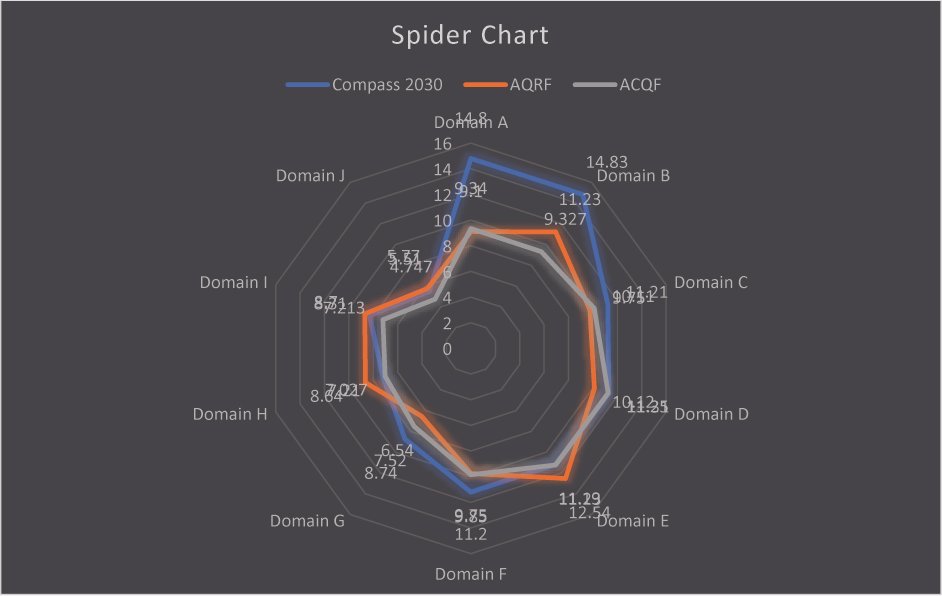
Fig. (1). Radar chart.
The orange, AQRF performed fairly well, with an overall score of 92.14 of 160, with some domains exhibiting higher scores than others. Some strengths were observed in competency articulation, assessment structures, institutional support, and governance mechanisms (Table 4, Fig 1), with high scores recorded in Transformative Competencies, Operationalisability and Assessment Metrics, Equity and Accessibility, Teacher Capacity, Validity and Quality Assurance, and Policy Coherence. However, Qualifications Alignment and Progression (8.70), Scalability and Feasibility (8.64), and Localisability and Contextual Adaptation (6.54) were deemed to be “at risk” areas for slight modifications, and Digital Readiness and Data Systems (5.77) were identified as the main design priority. The spider chart also highlights that, while there is strong structural and operational capacity in the AQRF, there are opportunities to enhance contextual adaptation and technology-based implementation. The results are in line with those of [34, 37, 2], who asserted that competency principles can be difficult to scale and implement in a digital context.
ACQF (grey line) had an overall score of 87.61/160 or strong performance in some competency domains but faced some areas of operational challenges. Articulation of competency, institutional support, quality assurance, and engagement of stakeholders were seen as strengths in performance, with high scores in Transformative Competencies (9.34), Equity and Accessibility (10.11), Teacher Capacity and Professional Development (11.25), Validity and Quality Assurance (11.23), and Policy Coherence (9.85) (Table 4; Fig. 1). Domains C (7.52), D (7.03) and E (7.21) were all deemed as slightly modified elements, highlighting the need to enhance contextual adaptation, scalability and progression routes. Digital Readiness and Data Systems (4.75) was identified as the key design priority, as there is a relatively low capacity for technology and data systems. The results show a framework with potential strengths but still areas for development, namely in relation to digital infrastructure and implementation mechanisms, which still do not completely fulfil the Compass 2030 and AQRF profiles for several domains. The study confirms the arguments provided by [8, 21] that competency-based frameworks need technological and operational enabling factors to be successfully implemented on a larger scale and sustainably.
In combination, the visualisation of the radar suggests that on the concept and competency level, Compass 2030 has the clearest conceptual and competency structure, while AQRF has comparatively good operational and governance strengths but needs to be further developed in terms of digital needs, and the ACQF has strengths in equity, teacher capacity, and quality assurance that need to be supplemented. The findings provide a basis for the proposed Integrated Competency Alignment Framework (ICAF) which aims to integrate the conceptual aspects of Compass 2030, the structure and governance aspects of AQRF, and the inclusively oriented aspects of ACQF in a framework which is operationally viable and culturally responsive to a variety of higher-education contexts.
4.3. Qualitative Insights
4.3.1. Demographic Profile of the Interviewes
The statistical results in Table 5 specify the demographic profiles of (n the six) interviewees. Among them, 66.67% were men and 33.33% were women. Moreover, 16.67% fell in the age bracket of 20-29, 33.33% in 30-39 years and 50% in 40-49 years. Among the six participants, 16.67% were teachers, 66.67% were curriculum designers, and 16.67% were policymakers. Each of the two participants represented Africa, Asia, and the Americas.
Table 5. Demographic profile.
| Demographic Category | Frequency (n) | Percentage (%) | |
| Gender | Male | 4 | 66.67% |
| Female | 2 | 33.33% | |
| Age | 20-29 | 1 | 16.67% |
| 30-39 | 2 | 33.33% | |
| 40-49 | 3 | 50.00% | |
| Role in Education Department | Teacher | 1 | 16.67% |
| Curriculum Designer | 4 | 66.67% | |
| Policymaker and Administrator | 1 | 16.67% | |
| Region / Country | Africa | 2 | 33.33% |
| Asia | 2 | 33.33% | |
| America | 2 | 33.33% | |
Theme 1: Integrating Transformative Competencies into Curriculum
This theme emerged from Domains A and B, indicating that practitioners perceive the definition and operationalisation of transformative competencies, such as creativity, agency, and responsibility, at different levels of frameworks.
In response to a question related to this theme, R1 states: “Compass 2030 provides explicit definitions of agency and responsibility and aligns them with intended learning outcomes; however, educators encounter challenges in operationalising these competencies into quantifiable classroom activities.”
This is an example of how a clear idea in the mind does not necessarily translate into effective classroom practice. Without instructions on how to design an assessment, practitioners may find that competencies are left abstract. According to [27], competency-based frameworks also need to have operational tools to translate theoretical constructs into observable results.
R3 adds: “The AQRF establishes structured qualification pathways; however, its articulation of transformative competencies remains ambiguous, and it offers limited guidance on integrating creativity effectively into assessment practices.”
This indicates that partial structural support is incapable of redressing inadequate conceptual articulation, which highlights the need to connect competency frameworks to real-world learning experiences, as argued by [36].
Theme 2: Contextual Adaptation and Localisation Challenges
This theme, which comes out of Domains C and J, describes the challenges encountered by professionals when they have to fit frameworks into various cultural, linguistic, and institutional environments.
R2 states: “AQRF looks comprehensive, but rural schools lack resources and trained personnel to contextualise competencies effectively, limiting real-world applicability.”
Practitioners emphasise that local adaptation is the only way that even a well-planned framework can result in the desired learning outcomes. According to [15], contextual relevance is key to equitable and sustainable Competency-Based Education.
R5 adds: “Although efforts at localisation are made, the framework provides insufficient guidance on assessing whether adaptations maintain the intended learning outcomes, resulting in inconsistent implementation across institutions.”
This presents the significance of systematic instruments and stakeholder involvement which also aligns with [1], as a way to sustain faithfulness and recommends that structures need to clearly incorporate mechanisms to monitor local adjustment.
R6 observes: “ACQF provides minimal support for local adaptation or stakeholder engagement, resulting in frameworks that are conceptually sound but operationally weak.”
Experience among practitioners reveals that effective localised training goes beyond policy, necessitating coordinated processes, training, and resources to make competencies relevant in contexts.
Theme 3: Digital Infrastructure and Assessment Readiness
This theme is based on Domains B and I, where the emphasis lies on the effect of technology and digital tools to facilitate competency assessment and tracking.
R4 states: “Most institutions operate without integrated digital platforms or e-portfolio systems, compelling teachers to develop ad-hoc workarounds that undermine assessment consistency and limit the reliability of learner-progress tracking.”
Practitioners underline that technological infrastructure is the key to operationalising competency frameworks, and the literature suggests a connection between digital readiness and the scalable implementation suggested by [19, 40].
R6 adds: “Even with available tools, teachers are rarely trained to interpret analytics for instructional decisions, limiting the impact of digital data on learning.”
This highlights the technology-teacher capacity relationship, as structural models need to match digital systems with teacher growth to be substantially adopted, aligned with [6].
R2 notes: “ACQF’s limited digital infrastructure constrains systematic monitoring of learner progression and weakens assessment reliability, resulting in competency statements that remain largely aspirational rather than operationally actionable.”
Practitioner wisdom explains that digital tools are not adequate, and their implementation requires both infrastructure and capacity building to facilitate the constant operationalisation of learning outcomes.
Theme 4: Equity, Inclusivity, and Recognition Across Pathways
This theme is a result of Domains E and F and concerns equitable participation, accessibility, and cross-institutional recognition of competencies.
R3 states: “Frameworks frequently under-theorise structural barriers such as gendered expectations and socioeconomic disadvantage which systematically limit marginalised learners’ opportunities to participate in assessments, thereby undermining the equity claims embedded in competency-based models.”
According to practitioners, specific strategies are required to instantiate equity and inclusion, which underlines the actions of [15], who suggested that frameworks should include mechanisms of equitable access.
R1 adds: “Recognition of competencies across school, vocational, and higher education remains fragmented, producing discontinuities in learner progression and constraining the development of coherent pathways for lifelong learning.”
This indicates the absence of cross-institutional articulation, implying that the frameworks should incorporate mechanisms of equivalency and transferability in order to achieve the maximum inclusivity which is revealed by [36], also in their work.
R5 observes: “Even frameworks with strong policy links sometimes fail to translate equity principles into classroom practices, leaving marginalised students underserved.”
In totality, these considerations reveal that conceptual equity should be accompanied by practical implementation schemes, professional assistance, and monitoring to have substantive inclusion.
Theme 5: Teacher Capacity and Quality Assurance
This theme is based on Domains G and H, as it concerns issues of professional development, monitoring, and competency assessment reliability.
R5 states: Teachers are mandated to operationalise increasingly complex competency frameworks despite insufficient professional development and limited access to validated exemplars, a condition that systematically compromises assessment fidelity and weakens implementation reliability.”
Practitioners point out that the effectiveness of frameworks depends solely on the educators deploying them, and literature that underscores the teacher capacity as a key to trustworthy Competency-Based Education [21], also supports it.
R6 adds: “Even when training exists, there is minimal evaluation of implementation fidelity, which risks inconsistent learner outcomes and misalignment with intended competencies.”
This means that quality assurance should be entrenched in teacher preparation so that competencies are meaningful and measurable.
R2 observes: “AQRF provides structured guidance, but without robust monitoring mechanisms, teacher application remains uneven.”
These findings highlight the fact that effective competency frameworks should incorporate teacher support, coaching, and assessment supervision to help make design into an effective educational practice, as suggested by [35].
4.4. Proposed Integrated CBE Framework
The proposed Integrated Competency Alignment Framework (ICAF) functions as an Operational Competency Alignment Model (OCAM), where normative competency visions, technical qualification structures, institutional operationalisation processes, and implementation evaluation with feedback converge (Fig. 2). The model suggests that the effectiveness of the competencies results from an iterative process involving curriculum design, assessment systems, localisation processes, teachers, governance coordination, and digital infrastructure. It applies the logic of alignment between competency articulation and capacity for implementation and the causal pathways of how the integration of institutional support and assessment affects competency outcomes. Moreover, feedback loops allow for continuous refinement based on the evaluation of stakeholders, implementation monitoring, and contextual adaptation, which further reinforces the sustainability and cross-regional applicability of the operations over the long term.
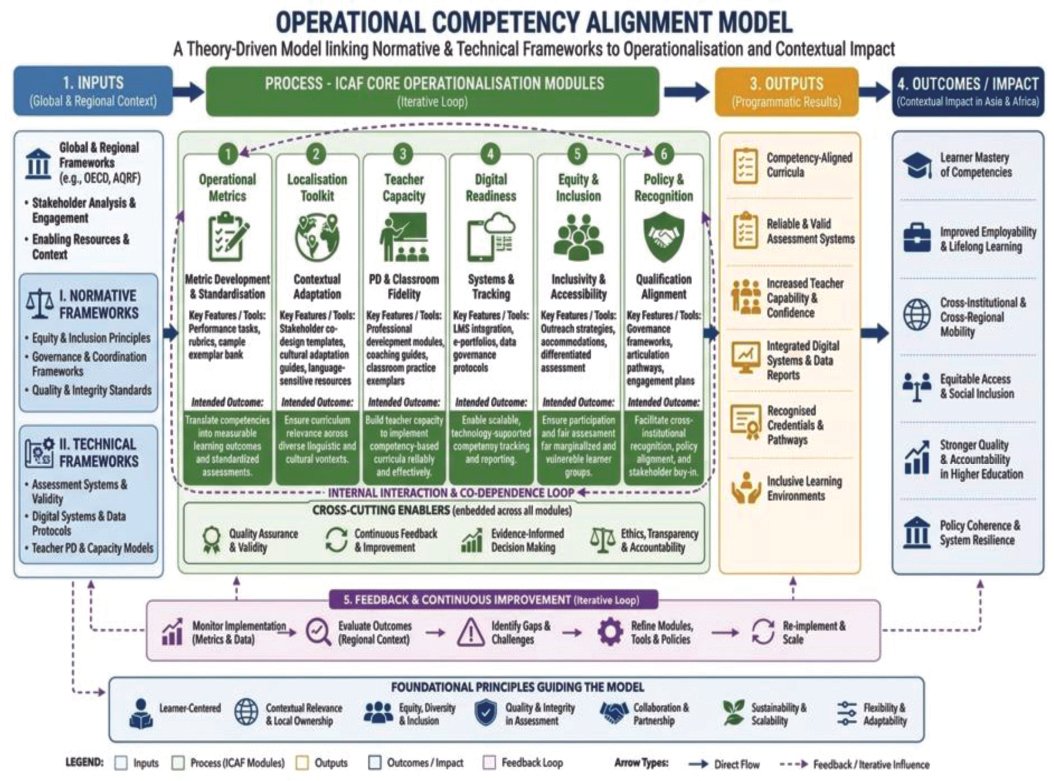
Fig. (2). Proposed integrated framework.
5. DISCUSSION
The comparative analysis of the OECD Compass 2030, ASEAN Qualifications Reference Framework (AQRF), and African Continental Qualifications Framework (ACQF) discovered noticeable deviations in conceptual clarity, operationalisation, and contextual readiness, as shown in Fig. (2). The comparison does not assume institutional equivalence between the OECD Learning Compass 2030, AQRF, and ACQF but rather the relative operational competency potential of the three framework types. The AQRF and ACQF are used as technical referencing tools, whereas Compass 2030 is a normative, forward-looking tool; the scoring instrument is identified in [6, 37]. Compass 2030 demonstrates strong conceptual operationalisability but comparatively limited implementation feasibility across heterogeneous institutional contexts. Therefore, it evaluates the degree of comparability in competency articulation, capacity to operate the framework, and readiness to implement it, and not the equivalence of institutions and governance across frameworks.
At one end, the comparative scores signify the relative strength of Compass 2030; an in-depth interpretation articulates that greater performance in transformative competencies signifies its normative design instead of applicability, a differentiation revealed by [20, 30]. Conceptually, the OECD Learning Compass 2030 is operational as it builds a coherent competency structure, aligns assessment tasks, and focuses on transformative learning. Empirically, this is moderately feasible, given the varying institutional contexts suggested in [41]. While respondents also felt that the framework was conceptually clear and operationally comprehensive, this might not be the case at the implementation level, as there might be differences in institutional readiness, governance coordination, assessment infrastructure, teacher preparedness, and contextual adaptability. While the OECD Learning Compass 2030 is a global normative roadmap to inform competency visioning and the direction of curriculum, the AQRF and ACQF are transnational credentialing and qualification referencing matrices for regional comparability and recognition. The articulation of observed differences as a function of the perceived purpose of operation indicates scope differences in institutional scope, rather than direct equivalence, emphasising the need for adaptability to be dependent on the scope of institutional governance, the scale of implementation, and the maturity of the implementation ecosystem regionally and between education systems.
Likewise, the moderate scoring of the AQRF tends to imitate its purpose as a base or reference tool instead of a pedagogical framework which reflects a misalignment between what the instrument measures and what the framework was expected and designed to do. The lower ACQF scores must be read carefully, as indicators of digital capacity tend to excessively penalise developing systems [7]. These patterns signify a limitation of the scoring approach itself, as aggregation grounded on the Likert scale leads to risks of over simplification of contextual, infrastructural, and political differences within regions which echoes the critiques of [23], associated with evaluative reductionism.
These findings are consistent with those of previous studies to a certain extent. For instance, [31] identify that transformative competencies should be defined in greater detail to reform higher education curricula, which is precisely the example of Compass 2030. Equally, [20] observes that regional frameworks tend to prioritise formal credential mapping rather than operationalisation, as it is in line with the weaknesses of both AQRF and ACQF. These gaps are bridged in the conceptual levels of the study by the integrated framework approach to Compass 2030 conceptual clarity which is converted to local actionable modules which are specific to Asia and Africa, including operational metrics, localisation toolkits, and teacher capacity modules. These arguments are consistent with the stance of [34], that Competency-Based Education must be able to bring up measurable outcomes and that such outcomes must be consistent with the local cultural and systemic circumstances to be effectively adopted.
The quantitative findings were also supported by qualitative insights. Operational metrics such as teacher preparedness and digital preparedness, especially in Africa and Southeast Asia, were mentioned as the major challenges for education professionals. Their reflections reinforce the idea of [21], that AQRF and ACQF frameworks, no matter the theoretical soundness, should have some elements of localisation, co-designing by the stakeholders, and professional development so that sustainable impact can be attained which is recommended by [27], also in their findings. The qualitative findings elaborated that practitioners appreciated the fact that Compass 2030 has been quite explicit in its competency definitions, but observed AQRF having a comparative focus on formal qualification alignment as a practical anchor where it was deemed that a hybrid approach would provide both conceptual depth and structural feasibility.
In spite of the fact that the results, in general, can be compared to previous literature, a more in-depth analysis demonstrate that said adherence is due, in part, to how the scoring tool advantageously positions conceptual clarity over systemic viability. As [31] also notes, it is necessary to describe transformative competencies in higher scores in Compass 2030 in more detail; therefore, it is possible to outline that it may overestimate the practicality of its superiority, and normative coherence does not ensure implementation. In the same manner, the noted shortcomings in the AQRF and ACQF resonate with the criticism of [35], but the scoring process can, in some ways, be seen to primarily discriminate against frameworks that aim to describe credential referencing as opposed to pedagogical operationalisation. In addition, the translation of Compass 2030 into regional modules is based on the assumption of linear adaptability, and local adaptation is shortened by the lack of political economy that cannot be best described by Likert-based scoring, which is also a methodological limitation. High perceived conceptual clarity of the OECD Learning Compass 2030 is not essentially translated into greater implementation feasibility within contexts supported by the arguments of [11]. This signifies that high competency rating and conceptual coherence are rated high by the respondents; however, the operationalisation relies on the availability of policy, assessment infrastructure, and institutional readiness in different regions, which may vary accordingly. Hence, good conceptual scoring does not necessarily translate to an ability to implement the concept in practice or make immediate application in current education systems.
In the case of Asia and Africa, the results indicate that it is not sufficient to adopt a regional or global system. The offered Integrated Competency Alignment Framework (ICAF) capitalises on the strengths of Compass 2030 and directly responds to the weaknesses of the AQRF and ACQF by focusing on culturally responsive evaluation, capacity building, digital preparedness, and equity. As suggested by [34, 35], the proposed ICAF competency-based framework attempts to balance global and local priorities by assigning more points to mission-critical areas such as transformative competencies and equity so that educational interventions can be considered global and local simultaneously. Although the ICAF approach uses the strengths of Compass 2030 to the advantage of the AQRF and ACQF weaknesses, it is partially limited in its performance by the assumptions of the scoring system. The prescription of greater importance to transformative competencies and equity, promoted by [30], poses the risk of reinforcing normative priorities, which might not align with the institutional capabilities of the locality. In addition, the key-metric induced framework may be unable to translate cultural subtlety or implementation constraints, which restrict the interpretative accuracy of the suggested framework despite its integrative desires.
CONCLUSION
This study critically illustrates how competency-based frameworks, although conceptually effective, cannot be operationalised alone to bring about higher education transformation. The comparative analysis showed that Compass 2030 provides unmatched clarity on transformative competencies, assessment design, and teacher capacity, but its applicability in various settings is minimal. On the other hand, the AQRF and ACQF offer structural and regional convergence but do not measure well, are not localisable, and do not include digital preparedness. The study results highlight that a combination of global and regional systems is insufficient to propel future-ready curricula. The suggested framework of the Competency-Based Education (ICAF) synthesises strengths and minimises weaknesses in a strategic manner, offering operational tools, localisation methods, and equity-related interventions specific to Asian and African environments. This method argues against the belief that it is possible to transplant frameworks without adapting them, promoting a hybrid context-sensitive model. Finally, ICAF provides a crucial roadmap to harmonise the soundness of concept and the viability of practice, so that Competency-Based Education is not only globally informed but also significant locally, covering the gap between policy, pedagogy, and practice.
LIMITATIONS AND FUTURE DIRECTIONS
The limitation of this study is that it uses the self-reported responses of the participants that might be biased judgement and may not address the complexity of framework implementation in various Asian and African settings. The comparative analysis mostly emphasises upper levels of domain scores, which may not be able to capture finer variations in institutional capacity or even local policy binding. Future studies should conduct detailed empirical research based on the proposed ICAF modules in terms of actual application, scalability, and results on students. Longitudinal research can be used to evaluate the maintenance of competency-based interventions, whereas cross-regional comparative research can be used to optimise localisation strategies and expand the applicability of the frameworks.
POLICY IMPLICATIONS
Based on the key results and spider/radar chart results, this study has substantial implications. For instance, policymakers are suggested to unite the high-performance areas A, B, F, G, H, and J through the institutionalisation of the lucid competency language of Compass 2030, an efficient assessment direction, and quality assurance tools. These areas are suggested to be the control of the national qualification reforms to ensure continuity and eliminate the fragmentation of the ministries, qualification bodies, and even teacher training systems. However, domains C, D, and E necessitate moderate recalibration; hence, policymakers emphasise contextual adaptation, feasibility planning, and aligning cross-pathways by insisting on local co-design operations, phase implementation plans, and regional harmonisation of recognition operations.
The most pressing policy measure is associated with Domain I, in which digital readiness is constantly at a critically low level in all three frameworks. Regulators need to establish minimal digital infrastructure requirements, specific funds, and mandatory digital assessment training for teachers. Together, these measures can allow the Asian and African education systems to address the structural flaws in the AQRF and ACQF, as well as exploit the strengths of Compass 2030 to realise a consistent, scalable ICAF. The proposed framework emphasises ethics, which requires fairness, transparency, and accountability during competency assessments in different regions. Policymakers should ensure that learner data remain secure, that digital-capacity differences do not strengthen inequities, and that localisation processes do not distort the desired outcomes and marginalise vulnerable groups. Informed consent, responsible analytics use, and anti-algorithm bias are also necessary to implement ethical practices that support the idea of competition-based reforms and do not undermine educational justice and learner dignity.
LIST OF ABBREVIATIONS
| ACQF | = | African Continental Qualifications Framework |
| AQRF | = | ASEAN Qualifications Reference Framework |
| CBE | = | Competency-Based Education |
| EFA | = | Education for All |
| ESD | = | Education for Sustainable Development |
| ICAF-Q v1 | = | Institutional Capacity Assessment Framework |
| OBE | = | Outcome-Based Education |
| OCAM | = | Operational Competency Alignment Model |
AUTHORS’ CONTRIBUTIONS
M.B. has contributed to conceptualization of study, development of idea, methodology. I.I. analysis of result and interpretation of result.
ETHICAL APPROVAL & INFORMED CONSENT
All procedures were conducted in accordance with institutional research ethics committee guidelines and Declaration of Helsinki. Informed consent is acquired from all participants to ensure anonymity no personal or identifiable data was recorded.
AVAILABILITY OF DATA AND MATERIALS
The data will be made available on reasonable request by contacting the corresponding author [M.B.].
FUNDING
None.
CONFLICT OF INTEREST
The authors declare that there is no conflict of interest regarding the publication of this article.
ACKNOWLEDGEMENTS
Declared none.
DECLARATION OF AI
Images were generated using ChatGpt to visualize data used in the paper. Authors take responsibility for the integrity of all content.
REFERENCES
[1] ACQF. II project – brief activity report 2023. ACQF; 2024. Available from: https://acqf.africa/news/acqf-ii-project-brief-activity-report-2023-and-plans-2024 (Accessed on: 9 June 2026).
[2] UNESCO. The Education For All (EFA) flagship: the right to education for persons with disabilities, towards inclusion. 2024. Available from: https://unesdoc.unesco.org/ark:/48223/pf0000137873 (Accessed on: 9 June 2026).
[3] Ali H. The influence of machine learning on consumer decision making patterns in Germany: the mediating role of AI recommendation systems for achieving sales and customer satisfaction. AJBMSS-Advance Journal of Business Management and Social Sciences. 2025;1(1).
https://doi.org/10.65080/c0nevs55.
[4] Lin HF, Lu HL, Lin MJ. The stability and acceptance of the system of competency-based curriculum design framework: perspectives of teachers. Curric J. 2025; 36(1): 91-109. https://doi.org/10.1002/curj.265.
[5] Buabeng I, Amo-Darko B. Curriculum reforms without foundation: the effects of inadequate preparation on Ghanaian teachers and the education system. Curric Perspect. 2025; 45: 133-147. http://doi.org/10.1007/s41297-025-00309-7.
[6] Hughson TA. The OECD and epistemic (de)colonisation: globalising visions for knowledge in the Learning Compass 2030. Compare. 2024; 54(1): 74-90.
http://doi.org/10.1080/03057925.2022.2078955.
[7] Bernotaite S, Karseth B. The OECD’s construction of future imaginaries for curriculum reform. Crit Stud Educ. 2025; 66(2): 159-177.
http://doi.org/10.1080/17508487.2024.2419875.
[8] Bolton H, Matsau L, Blom R. Flexible learning pathways: the national qualifications framework backbone. IIEP-UNESCO Research SDG4 Report. 2020. Available From: https://curated-library.iiep.unesco.org/library-record/flexible-learning-pathways-national-qualifications-framework-backbone (Accessed on: 9 June 2026).
[9] Taguma M, Makowiecki K, Gabriel F. OECD Learning Compass 2030: implications for mathematics curricula. In: Mathematics Curriculum Reforms Around the World. Cham: Springer; 2023. p. 479-509.
http://doi.org/10.1007/978-3-031-13548-4_32.
[10] Taguma M, Frid A. Curriculum frameworks and visualisations beyond national frameworks: alignment with OECD Learning Compass 2030. OECD; 2024. Available from: https://read.oecd-ilibrary.org/content/dam/oecd/en/publications/reports/2024/04/curriculum-frameworks-and-visualisations-beyond-national-frameworks_02ed384b/2a4bdce6-en.pdf (Accessed on: 9 June 2026).
[11] Díaz-Garzón Marco J, Fernández-Calle P, Ricós C. Models to estimate biological variation components and interpretation of serial results: strengths and limitations. Adv Lab Med. 2020; 1(3): 20200063.
http://doi.org/10.1515/almed-2020-0063.
[12] Okada A, Sherborne T, Panselinas G, Kolionis G. Fostering transversal skills through open schooling supported by CARE-KNOW-DO pedagogical model and UNESCO AI competencies framework. Int J Artif Intell Educ. 2025; 35(4); 1953-1998. http://doi.org/10.1007/s40593-025-00458-w.
[13] Höltl A, Berger T, Bates R, et al. The nexus of the UN Sustainable Development Goals and their link to quality of life: a case of urbanization in Ethiopia and India. In: Handbook of Quality of Life and Sustainability. Cham: Springer; 2020. p. 113-138. https://link.springer.com/chapter/10.1007/978-3-030-50540-0_7.
[14] Hughson TA, Wood BE. The OECD Learning Compass 2030 and the future of disciplinary learning: a Bernsteinian critique. J Educ Policy. 2022; 37(4): 634-654. http://doi.org/10.1080/02680939.2020.1865573.
[15] ACQF. African Continental Qualifications Framework. ACQF; 2025. Available from: https://acqf.africa/ (Accessed on: 9 June 2026).
[16] Isanbor PO. Philosophy of ‘education for all’ post-2015 agenda: a universal thrust for peace development. West Afr J Philos Stud. 2020;17. Available From: https://journals.ezenwaohaetorc.org/index.php/WAJOPS/article/view/1364.
[17] Baharuddin, Burhan. Urban and rural teacher perspectives on Indonesian educational reform: challenges and policy implications. Cogent Educ. 2025; 12(1): 2497142. http://doi.org/10.1080/2331186X.2025.2497142.
[18] Lurie H, Garrett R. Deconstructing competency-based education: an assessment of institutional activity, goals, and challenges in higher education. J Competency-Based Educ. 2017; 2(3): e01047. http://doi.org/10.1002/cbe2.1047.
[19] AUDA-NEPAD. New African Continental Qualifications Framework (ACQF) Thematic Briefs. NEPAD Home; 2021. Available from: https://www.nepad.org/skillsportalforyouth/publication/new-african-continental-qualifications-framework-acqf-thematic (Accessed on: 9 June 2026).
[20] Junaedi J, Zainuddin M, Walid M, Hasanah M, Barizi A. Enhancing transformative competencies through internalization of religious moderation: a vision for Islamic boarding school educational framework in 2030. Al-Ishlah J Pendidik. 2024; 16(2). http://doi.org/10.35445/alishlah.v16i2.5367.
[21] Kennedy I. Sample size determination in test-retest and Cronbach alpha reliability estimates. Br J Contemp Educ. 2022; 2(1): 17-29. http://doi.org/10.52589/BJCE-FY266HK9.
[22] Bateman A, Dyson C. Quality assurance arrangements related to national qualifications frameworks in ASEAN and their impact on higher education. 2018 Aug. Available from: https://asem-education.org/wp-content/uploads/2019/01/Report20SHARE20DAAD20August202018_Final.pdf.
[23] Green C, Mynhier L, Banfill J, et al. Preparing education for the crises of tomorrow: a framework for adaptability. Int Rev Educ. 2020; 66(5): 857-879.
http://doi.org/10.1007/s11159-020-09878-3.
[24] Dalka RP, Sachmpazidi D, Henderson C, Zwolak JP. Network analysis approach to Likert-style surveys. Phys Rev Phys Educ Res. 2022; 18(2): 020113. https://doi.org/10.1103/PhysRevPhysEducRes.18.020113.
[25] Izah SC, Sylva L, Hait M. Cronbach’s alpha: a cornerstone in ensuring reliability and validity in environmental health assessment. ES Energy Environ. 2023; 23: 1057.
http://doi.org/10.30919/esee1057.
[26] Katoue MG, Schwinghammer TL. Competency-based education in pharmacy: a review of its development, applications, and challenges. J Eval Clin Pract. 2020; 26(4): 1114-1123. http://doi.org/10.1111/jep.13362.
[27] Kawar LN, Dunbar GB, Aquino-Maneja EM, et al. Quantitative, qualitative, mixed methods, and triangulation research simplified. J Contin Educ Nurs. 2024; 55(7): 338-344. http://doi.org/10.3928/00220124-20240328-03.
[28] Laskar JH. Content-based learning to competency-based education: a paradigm shift. Educ Reforms J. 2024; 18(1): 99-110. Available from: https://www.researchgate.net/profile/Md-Rahman-1056/publication/370761642_The_Adaptive_Strategies_of_Bangladeshi_People_to_the_COVID-19_Pandemic_Challenges_and_Way_forward/links/664f10ef479366623a085c8e/The-Adaptive-Strategies-of-Bangladeshi-People-to-the-COVID-19-Pandemic-Challenges-and-Way-forward.pdf.
[29] Lee HA. Facilitating gainful labour migration in Southeast Asia remains an elusive task. Falcrum. 2025. Available from: https://fulcrum.sg/facilitating-gainful-labour-migration-in-southeast-asia-remains-an-elusive-task/ (Accessed on: 9 June 2026).
[30] Mohd Fahmi Z, Balasingam U, Laguador JM. ASEAN Qualification Reference Framework: harmonisation of ASEAN higher education area. In: ASEAN post-50. Singapore: Springer; 2019. p. 101-134. http://doi.org/10.1007/978-981-13-8043-3_6.
[31] Pistor P, Colucci E. Policy framework–towards a harmonised African continental higher education area. HAQAA Training Materials. 2022. Available from: https://www.hb.fh-muenster.de/opus4/frontdoor/deliver/index/docId/15184/file/02_HAQAA2_Policy-Framework_Modul-1.pdf.
[32] Pombo L, Marques MM. An app that changes mentalities about mobile learning—The EduPARK augmented reality activity. Computers. 2019; 8(2): 37. http://doi.org/10.3390/computers8020037.
[33] Mokwele MT, Chetty MY. An exploratory benchmarking review of professional bodies in NQF systems. SAQA Bulletin. 2022. Available From: https://www.saqa.org.za/wp-content/uploads/2023/02/Research-Report-Benchmarking-Professional-Bodies-in-NQF-systems.pdf.
[34] Sangwa S, Ekosse E, Mutabazi P. Degree equivalence as a non-tariff intellectual barrier: postcolonial knowledge governance, digital-equity costs, and innovation leakage in African recognition frameworks. 2025; 2(6): 388-401 https://doi.org/10.55677/ijhrsss/07-2025-Vol02I6.
[35] Sangwa S, Mutabazi P. Bridging the recognition gap: Rwanda’s foreign degree equivalency process in global perspective. 2025. https://zenodo.org/records/15874054.
[36] Setiawan A. Compliance of IQF towards AQRF: challenges and opportunities of the referencing to regional qualification framework. In: Proceedings of the International Conference on Innovation in Engineering and Vocational Education. 2015. http://doi.org/10.2991/icieve-15.2016.19.
[37] Shabani J. Recent developments in quality assurance in higher education in Africa. 2023. Available from: https://www.chea.org/sites/default/files/other-content/Quality-Assurance-in-Higher-Education-Across-the-World-Book.pdf#page=144.
[38] SV PK, Rajitha M. A study of green banking practices in domestic and international banking sectors. Adv Res Money Bank. 2023; 32. Available From: https://www.researchgate.net/profile/Lokesh-Y-R/publication/383498561_A_Study_on_Covid-19_and_the_Rise_in_Npa’s_In_Banks/links/66d0459af84dd1716c702787/A-Study-on-Covid-19-and-the-Rise-in-Npas-In-Banks.pdf#page=36.
[39] Xuan RP, Lindquist MH. Exploring sustainable development goals and curriculum adoption: a scoping review from 2020-2025. Societies. 2025; 15(8): 212.
http://doi.org/10.3390/soc15080212.
[40] Mishra P, McCaleb L, Oster N. Crafting a teaching compass for the generative AI age: nurturing educator agency, wellbeing, and competencies. OECD; 2024. Available from: https://www.oecd.org/content/dam/oecd/en/about/projects/edu/education-2040/global-forum/7th-global-forum/OECD%20Teaching%20Compass%20and%20Generative%20AI.pdf.
[41] Rhoney DH, Chen AM, Churchwell MD, et al. The need for competency-based education. Am J Pharm Educ. 2024; 88(6): 100706.
http://doi.org/10.1016/j.ajpe.2024.100706.
Licensed
© 2026 Copyright by the Authors.
Licensed as an open access article using a CC BY 4.0 license.
Article Contents Author Wahaj Anees1, * 1Department of Forensic Sciences, Institute of Basic Medical Sciences- Khyber Medical University, Peshawar, Pakistan
Article Contents Author Danish Rahman1, * Matias Garcia-Constantino1 1School of Computing, Ulster University, Belfast Campus, BT151AP, United Kingdom Article History:
Article Contents Authors Saqib Hussain Hadri1, Muhammad Hassnain1,* , Aqsa Arshed1, Shamaiza Kousar1, Aleeza Yasmeen1, Nuzhat Latif1, Kiran Ijaz1, Maryam
Article Contents Author Amal S. Al Saadi1, * 1Sohar University, Sohar, Oman Article History: Received: 13 June, 2026 Accepted: 09
Article Contents Author Olabode Adeyemi David1, * , Nduka Christiana1, Akazue Ruth Chioma1, Amos Mishael1 1Department of Animal Production,
Article Contents Author Muzmmil Memon1, * 1Department of Computer Science Management, Avila University, Kansas City, Missouri, United States Article History: