











Article Contents
Article ID: CM2601108002
Views: 535Impact of Time-Temperature Processing Conditions on Viability and Detection of Listeria monocytogenes and Yersinia enterocolitica in Pork Meatballs
 PDF
PDF
⬇ Downloads: 12
1Quality Control Laboratory, ICAR-National Research Centre on Pig, Rani, Guwahati 781131, Assam, India;
2Department of Chemistry, Assam Don Bosco University, Tapezia Gardens, Sonapur, Guwahati-782402, Assam, India
Received: 04 June, 2026
Accepted: 13 July, 2026
Revised: 08 July, 2026
Published: 25 July, 2026
Abstract:
Introduction: The prevalence of foodborne psychrotrophic pathogens in meat and meat products stored at refrigeration temperature continues to be a major global public health issue. Therefore, ensuring microbiological safety of food products is recognized as a crucial element of food quality assurance and public health protection.
Methodology: Ten crossbreed pigs (8 to 9 months old) were slaughtered under controlled conditions at the R&D Pig Slaughterhouse and Pork Processing Plant, ICAR-NRCP, Guwahati. The meat samples were trimmed, chilled at 4 ± 1°C for 24 h, minced and emulsified. Pork meatballs were inoculated with Listeria monocytogenes and Yersinia enterocolitica and subjected to different boiling time-temperature combinations, followed by enrichment in brain heart infusion (BHI) broth for 18 h at 37ºC. L. monocytogenes and Y. enterocolitica were cultured on PALCAM agar and Yersinia isolation agar respectively. Bacterial counts were expressed as colony forming units and the presence of both pathogens was confirmed using Polymerase Chain Reaction (PCR) amplification of hlyA1 and 16S rRNA genes, followed by gel electrophoresis.
Results: The variable time-temperature combinations reduced the viable count for both pathogens. Significant reduction in bacterial survival was observed at 68°C, while cooking temperatures at ≥70°C for 5-15 min resulted in near total loss of viable cells. The temperature of 72°C with shorter cooking duration showed less or no bacterial recovery. PCR amplification detected L. monocytogenes and Y. enterocolitica in uncooked inoculated samples as well as short duration cooked meatballs indicating presence of target genes. However, products cooked for less time showed presence of pathogens even after cooking. No significant difference was observed in thermal susceptibility between the two pathogens but increasing the cooking time and temperature significantly reduced pathogen recovery.
Conclusion: Thermal temperatures effectively reduced the survival of L. monocytogenes and Y. enterocolitica in pork meatballs with decreased bacterial survival with increasing cooking time and temperature. PCR detected genes specific for pathogenesis in some heat-treated samples that provided evidence for the persistent nature of bacterial DNA which emphasizes the importance of cooking time and temperature for improved microbial safety to reduce the risk of foodborne illnesses.
Keywords: Listeria monocytogenes, Yersinia enterocolitica, pork meatball, foodborne illness, PCR, psychrotrophic pathogens.
1. INTRODUCTION
The prevalence of microbial contamination in food leads to foodborne illnesses, caused by microbial contamination has become a global public health concern [1]. Studies show that annually, out of 600 million cases of foodborne diseases worldwide, 420,000 deaths were reported indicating increase in global morbidity, mortality and financial loss [2, 3]. This increased risk of disease is due to globalization of food production and distribution networks, shifting consumer preferences for less processed and ready-to-eat foods. Therefore, increasing microbial safety of food products is recognized as a crucial element of both food quality assurance and public health protection [4].
Animal derived food and food products, particularly meat and meat products are highly susceptible to microbial contamination, due to their optimal pH, high moisture content, and rich nutrient composition, all of which support growth and survival of pathogenic microorganisms [5]. Meat and meat products may become contaminated at different stages of the production chain, including slaughter, processing, transportation, storage and retail handling. They also provide a favorable environment for bacterial growth [6]. The factors contributing to contamination in meat and meat product include cross-contamination during manufacturing, poor storage conditions, and inadequate hygiene practices. Therefore, it is necessary to control microbial growth during storage of meat and meat related products to ensure food safety and consumer trust.
Two important zoonotic pathogens responsible for foodborne illness Listeria monocytogenes and Yersinia enterocolitica, are of significant health concern due to their widespread dispersion, environmental persistence and ability to adapt to harsh environmental conditions [7]. Both these pathogens can contaminate meat and meat-related products at different stages of storage, distribution and retail leading to outbreaks of foodborne illness globally. These psychrophilic pathogens are challenging to control chilled and ready-to-eat foods, as they can thrive and reproduce in refrigeration temperatures [8].
Listeria monocytogenes is a Gram-positive, facultative intracellular bacterium which is a causative agent for listeriosis, responsible for meningitis, encephalitis, septicemia and miscarriages in pregnant women [8]. Listeriosis is responsible for the highest rate of hospitalization leading to mortality, despite having a lower incidence rate compared to other foodborne illnesses. Its ability to adapt enables L. monocytogenes to survive under stressed environmental conditions such as low temperatures, high salt concentrations and acidic environments [9]. These adaptive characteristics facilitate their presence in food processing environments [10]. Vulnerable populations such as pregnant women, neonates, elderly individuals, and immunocompromised patients are particularly susceptible to severe clinical risks following L. monocytogenes infection [11].
Similarly, Yersinia enterocolitica is a Gram-negative enteric pathogen responsible for yersiniosis, a zoonotic illness characterized by mesenteric lymphadenitis, diarrhea, fever and stomachache [12]. The clinical manifestations of yersiniosis often resemble the symptoms of acute appendicitis, posing disease diagnosis as a challenge. Pigs are recognized as a primary reservoir for pathogenic Y. enterocolitica strains, and pork and pork products are often identified as major sources of human infections [12]. This bacterium persists throughout the food chain, increasing the risk of foodborne disease transmission due to its ability to grow at refrigeration temperatures and survive under a wide range of environmental conditions [13].
Thermal processing or cooking is a widely used and effective method to ensure microbiological safety of meat products. Processing meat at the appropriate temperatures for a sufficient time duration can significantly reduce or eliminate the risk of foodborne illnesses. Thermal treatments are effective depending on several factors including type of pathogen, properties of food matrix, heating technique and length of heat exposure. However, some pathogenic bacteria may survive thermal treatment if not cooked for appropriate time-temperature combinations [14]. Furthermore, even when meat products are cooked under adequate time-temperature combinations, psychrotrophic pathogens such as L. monocytogenes and Y. enterocolitica may still be detected due to post-processing contamination or inadequate chilled storage conditions [10].
To date, the gold standard for detection of foodborne pathogens is traditional culture-based methods, although these methods are labor-intensive and require several days to produce results. Moreover, Viable but Non-Culturable (VBNC) or sub-lethally wounded cells may evade identification, leading to an underestimation of microbial contamination and potential food safety risk [15].
Advanced molecular biology techniques such as Polymerase Chain Reaction (PCR), provide rapid, sensitive and specific detection of pathogens by targeting pathogen-specific genetic markers directly from food samples [16]. The PCR based detection techniques have become crucial for studies related to risk assessment, food safety surveillance and microbial risk assessment as a useful supplement to traditional culture-based microbiological methods.
Although thermal processing is considered as an effective method for controlling foodborne pathogens in meat and meat products, previous studies report many limitations. The effectiveness of pathogen inactivation largely depends on the type of microorganism, properties of food matrices, heating techniques and time-temperature combination, which often results in survival of bacteria if conditions are kept sub-optimal. Moreover, even when adequate processing temperature is maintained, psychrophilic bacteria such as L. monocytogenes and Y. enterocolitica can proliferate under chilled storage post-processing due to their ability to grow at refrigerated temperature. Although the culture-based methods are gold standard for validating thermal efficacy, they are labour-intensive, time-consuming and unable to detect viable but non-culturable cells (VBNC).
The present study addresses and provides a solution to the gaps in detection of pathogens in pork meatballs by examining the survival rates of Listeria monocytogenes and Yersinia enterocolitica under various thermal processing conditions using traditional culture-based methods and PCR. This combined approach will provide a comparative evaluation of the detection accuracy of these two methods while providing a comprehensive assessment of thermal inactivation. The findings of the study are aimed at improving understanding of pathogen inactivation during thermal processing, enhance the accuracy of microbial detection techniques and contribute to development of effective food safety measures for meat and meat products.
2. MATERIALS AND METHODS
2.1. Pork and Pork Fat
Ten crossbreed pigs aged 8 to 9 months, with uniform live-weight category were selected. The animals were slaughtered under controlled conditions at Research and Development Pig Slaughterhouse and Pork Processing Plant of the ICAR-National Research Centre on Pig, Rani, Guwahati (HACCP and ISO 9001:2015-certified; FSSAI License No. 10319001000189). Prior to slaughter, the pigs were electrically stunned following the slaughter guidelines of institutional and national welfare and hygiene regulations.
The slaughtering protocol was approved by the Institutional Animal Ethics committee (IAEC No. NRCP/IAEC/1658/2023-24/86 dated 25-04-2023). After animal slaughter, the Biceps femoris muscle from each carcass were excised within 1h. The muscle samples were aseptically trimmed and chilled for 24 h at 4 ± 1oC and thereafter subjected to mincing. The minced meat and fat were packaged in Low-Density Polyethylene (LDPE) bags and stored at -18 ± 1oC until further use.
2.2. Processing of Pork Products
To prepare the pork products, meat emulsions were prepared using a meat mincer (Model K20 Ras, Stutgart, Germany) with 20% pork fat. Each bag weighed approximately 1 kg meat obtained from the chilled carcass with 650 g (65%) lean pork, 200 g (20%) pork fat, 50 g (5%) condiments mix, 50 g (5%) refined wheat flour, 20 g (2%) spice mix and refined salt and 0.5 g (0.5%) each for cane sugar and sodium tripolyphosphate.
The condiment mix was prepared using onion and garlic paste in 3:1 ratio. Ground lean pork was mixed with salt, sugar, sodium nitrite and sodium tripolyphosphate for 2 min. The prepared condiments mix was added and mixed again for 2 min. Water or ice flakes were intentionally omitted to reduce the water activity of the meatballs. Ground pork fat was gradually added and mixed until the fat was uniformly dispersed throughout the emulsion (3 to 4 min). Spice mix and refined wheat flour were added and mixed (approximately 1 min) to obtain a fine homogenous emulsion.
2.3. Processing of Meatball Emulsion
The thermal inactivation study was performed on homogenized samples in triplicates, with each replicate, the meat emulsion was divided into two parts as un-inoculated control and inoculation with 105 CFU/g bacterial culture of Listeria monocytogenes incubated for 1hr. Pork emulsion balls were prepared from the inoculated and uninoculated controlled emulsion mix and vacuum packaged separately in LDPE bags each packet contained one product each.
Both products of control and inoculum were cooked at three different temperatures of 68ºC, 70ºC and 72ºC for a period of 5 min, 10 min, 15 min and 20 min to investigate the effect of pathogen survival at different time-temperature combinations. The core temperature of the meatballs was monitored using a calibrated digital probe thermometer, which was inserted into the center of the meatballs to ensure the desired temperature was achieved. At each given temperature, 6 different types of meatball samples were prepared; specifically, uninoculated meatball cooked at 68ºC for 20 min, meatballs inoculated with Listeria monocytogenes cooked at 68ºC for 5 min, 10 min, 15 min and 20 min respectively. Similar set of meatball products were prepared at 70ºC and 72ºC for every independent experimental batch. In each set, an uncooked meatball inoculated with Listeria monocytogenes was also added. Similarly, meatball samples inoculated with 105 CFU/g (5 log CFU/g) bacterial culture of Yersinia enterocolitica were also inoculated and processed.
2.4. Microbiological Analysis
All microbiological analyses of pork meatballs prepared from meat emulsion inoculated with Listeria monocytogenes and Yersinia enterocolitica were determined according to the procedures described in ICMSF, 1998 [17]. Culture media procured from HiMedia Laboratories Pvt. Ltd., Mumbai, were used for enumeration of different microorganisms. Quantitative microbial analysis was performed using serial dilutions for each sample performed in duplicates. 1 g of meatballs cooked at different time-temperature combinations were enriched in 9ml Brain Heart Infusion (BHI) broth (HiMedia, M210I) and incubated at 37ºC for 18 h. After incubation, the enriched broth was used for microbial culture. Plates were prepared and the counts were expressed as colony-forming units (CFU) per gram. The plates for psychrophilic counts were incubated at 4±1ºC for 48 h and colonies were counted. Yersinia enterocolitica was detected using Yersinia isolation agar (HiMedia, M564). The colonies with dark red centers and transparent boarders with approximately 0.5 mm diameter were counted. Listeria monocytogenes counts were also measured on PALCAM agar. Colonies judged to be borderline cases were also counted. Although enrichment culture was only applied for qualitative detection of viable bacteria below the direct detection limit, direct plate counting was used for quantitative microbiological enumeration in order to calculate log CFU/g and log reductions.
2.5. DNA Isolation
DNA was isolated from the cultured organisms. 100µl of broth was centrifuged at 14000 rpm for 15 min and the pellet was used for DNA extraction. The pellet of Yersinia enterocolitica and Listeria monocytogenes were transferred into 1.5ml microcentrifuge tubes, resuspended in 50µl of 1X TAE (Tris-Acetate-EDTA) and vortexed for cell lysis. The microcentrifuge tubes were sealed with parafilm and kept at 70ºC water bath for 15 minutes. After 15 minutes, immediately the tubes were placed at a -20ºC for 15 minutes. After freezing, the microcentrifuge tubes were centrifuged at 8000 rpm for 15 minutes and supernatant containing DNA of interest was extracted and stored at -20 ºC until further use.
2.6. PCR Amplification
PCR amplification of hlyA1 gene was performed on the extracted genomic DNA of Listeria monocytogenes using the hlyA1 primer sequence (F:5′-GAATGTAAACTTCGGCGCAATCAG-3′; R:5′-GCCGTCGATGATTTGAACTTCATC-3′) [18]. The PCR reaction mixture was prepared by mixing 12.5 μL DreamTaq PCR Master Mix (Thermo Scientific), 0.5 μL each forward and reverse primers, 2 μL of DNA template and 9.5 μL of Nuclease Free Water (NFW) to make the reaction volume up to 25 μL. The PCR reaction was performed under the following conditions: denaturation at 94ºC for 5 min, followed by 35 cycles of denaturation at 94ºC for 30 s, annealing at 52 ºC for 1 min, extension at 72ºC for 1 min and final extension at 72ºC for 5 min.
Similarly, amplification of 16S rRNA gene was performed for detection of Yersinia enterocolitica. The primers for 16S rRNA gene (F:5′-AATACCGCATAACGTCTTCG-3′; R:5′-CTTCTTCTGCGAGTAACGTC-3′) were selected for amplification [19]. The amplification system was same with Listeria monocytogenes. The PCR reaction conditions were: denaturing at 94ºC for 5 min and the cycle starts at 94ºC for 30 s, then annealing at 50ºC for 1 min, extending at 72ºC for 1 min for 35 cycles in total and then a final extension at 7 ºC for 5 min.
2.7. Statistical Analysis
Statistical analyses were performed using R software (version 4.5.1) and IBM SPSS Statistics (version 20.0). The Wilcoxon rank-sum test was used to compare viable bacterial counts of Yersinia enterocolitica and Listeria monocytogenes. The differences in bacterial recovery among the various time-temperature cooking combinations were evaluated using Kruskal-Wallis test. Effects of thermal treatments on bacterial recovery were further assessed using Firth’s penalized logistic regression implemented in R. The significance of regression model was evaluated using likelihood ratio test, and regression coefficients with their corresponding P-values were used to assess the influence of each variable on bacterial survival. The statistical significance was considered at p < 0.05.
3. RESULTS
Processing the meat at different time-temperature combinations led to reduction of the recovery of psychrotrophic pathogenic bacteria Listeria monocytogenes and Yersinia enterocolitica, as observed in this study. Listeria monocytogenes and Yersinia enterocolitica were considerably less detectable in inoculated meatball samples after thermal treatment. Uncooked inoculation samples showed amplification (388bp for L. monocytogenes and 330bp for Y. enterocolitica) under all cooking temperatures. Samples cooked at 68°C showed amplification for Listeria monocytogenes up to 15 min, but no discernible amplification was seen after 20 min of heating (Fig. 1a, Lane 5 and 6). Detectable amplification was observed after 5 min of heating at 72ºC (Fig. 1e, Lane 3), while a faint band indicating amplification was observed after 15 and 20 min at 70°C (Fig. 1c, Lane 5 and 6).
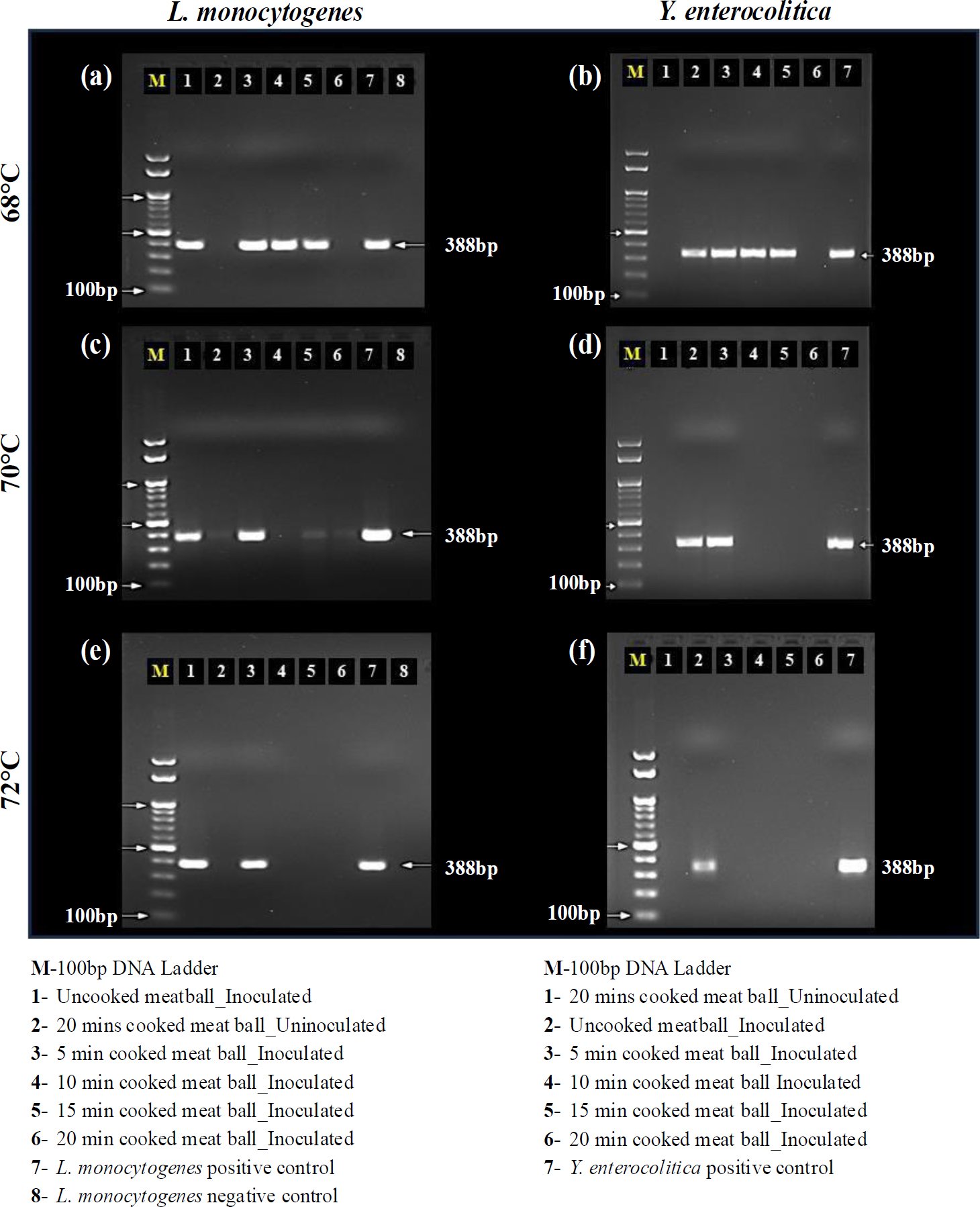
Fig. (1). Gel electrophoresis images showing the amplification of Listeria monocytogenes cooked at a) 68⁰C, c) 70⁰C, e) 72⁰C and Yersinia enterocolitica cooked at b) 68⁰C, d) 70⁰C, f) 72⁰C.
Yersinia enterocolitica, exhibited a similar amplification pattern with PCR amplifications in samples exposed to shorter cooking times. Amplification was observed at 68ºC for all inoculated meatballs treated at 5 to 15 min, while no amplification was observed at 20 min of thermal heating (Fig. 1b, Lane 6).
No amplification was detected after 5 min of thermal treatment at 70ºC (Fig. 1d, Lane 4-6) (Fig. 1b, d). Moreover, thermal temperature of 72ºC for 5, 10, 15 and 20 min resulted in complete elimination of detectable bacterial contamination (Fig. 1f, Lane 3-6), evident by absence of viable cells recovered by culture and no detectable PCR amplification.
Both microorganisms exhibited similar inactivation patterns, with substantial reductions observed at 68°C and near-complete elimination at ≥70°C after prolonged exposure (Fig. 2a & b). At 72°C, viable recovery was minimal, with only transient low-level detection at 5 min, after which no culturable cells were recovered. Percent reduction and log-reduction analyses further confirmed progressive thermal lethality, approaching complete inactivation under higher temperature-time combinations.
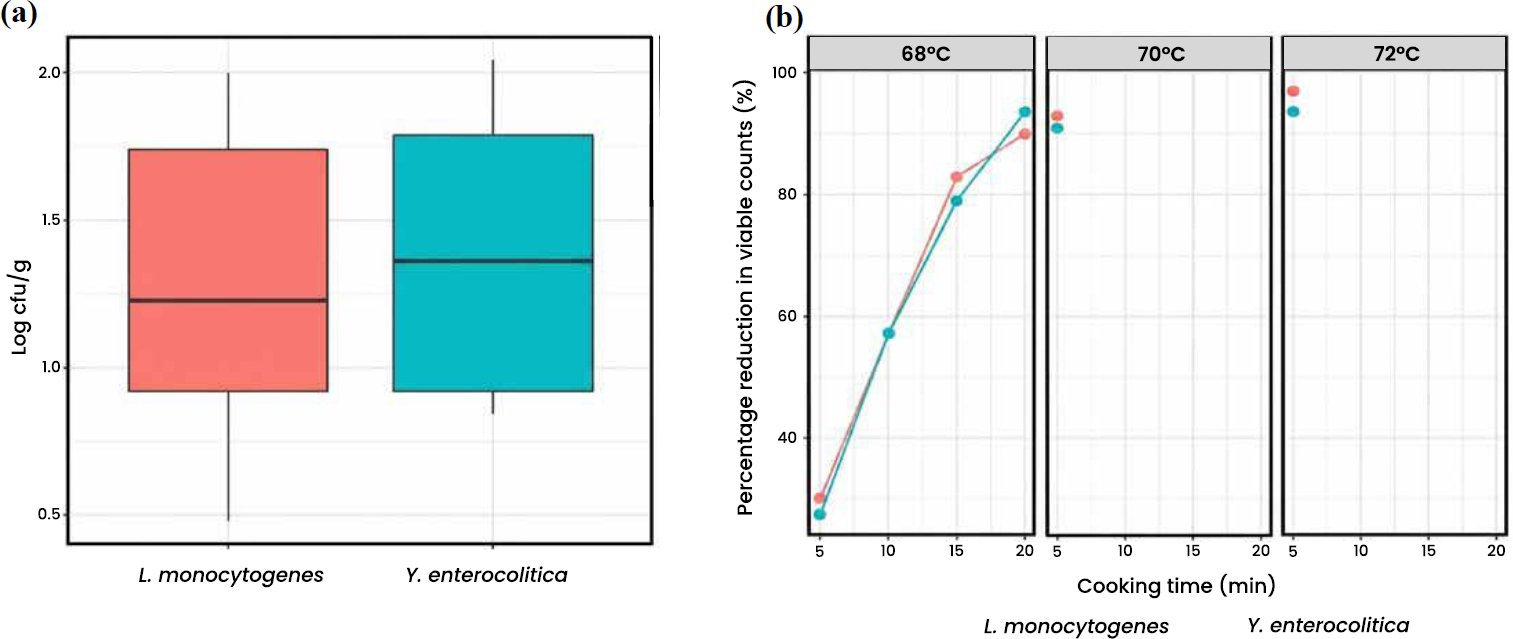
Fig. (2). (a) Box plot indicating the distribution of viable counts (log CFU/g) of Listeria monocytogenes and Yersinia enterocolitica post thermal treatment. (b) Percentage reduction in viable counts at different cooking time-temperature combinations, indicating increased bacterial inactivation with higher temperatures and longer exposure durations.
No significant differences were observed in the non-parametric comparison of viable bacterial counts between the two organisms in the study (Wilcoxon rank-sum test, W = 21.5, p = 0.748). The effect of temperature on viable bacterial counts was not statistically significant (Kruskal-Wallis test, χ² = 5.75, df = 2, p = 0.056), although a reduction in viable counts was observed with increasing temperatures. Moreover, thermal treatment alone did not significantly affect the viable bacterial counts (Kruskal–Wallis test, χ² = 6.71, df = 4, p = 0.152).
Binary bacterial culture detection outcomes were analyzed using Firth’s penalized logistic regression. The likelihood ratio test indicated that the overall model was statistically significant (Likelihood ratio = 15.40, p = 0.0015). The increasing temperature was associated with significantly lower odds of viable bacterial detection (β = -1.229, p = 0.0008), while the increase in cooking time independently reduced the odds of bacterial detection (β = -0.297, p = 0.0076).
No significant effect of both bacterial species Y. enterocolitica vs L. monocytogenes was observed (p = 1.000), supporting equivalent thermal susceptibility between the two pathogens. PCR based detection showed presence of bacterial DNA even in the conditions where culture recovery was absent, suggesting that amplified bacterial DNA persisted despite loss of bacterial viability.
4. DISCUSSION
The current study infers that survival and detection of Listeria monocytogenes and Yersinia enterocolitica inoculated meatballs decreased with increasing time and temperature. Moreover, the viable counts of both pathogens gradually decreased thereby demonstrating the bactericidal effect on heat treatment [20, 21]. The effectiveness of prolonged processing at higher temperature, was evident by the near total elimination of viable cells processed at 72°C for 20 min. The pattern of microbial reduction observed at temperature greater than 70ºC indicates that processing meat products at temperatures ≥70ºC were highly successful in inactivating both pathogens (Fig. 2a). These results support earlier studies, indicating that prevention of foodborne pathogens in meat products requires proper time-temperature thermal processing [22, 23] and is essential for achieving significant reductions in bacterial count of Listeria monocytogenes and Yersinia enterocolitica in meat products [22–28].
Under the experimental conditions, the lack of significant differences in thermal survival between the two organisms indicates similar heat susceptibility [28]. Furthermore, a logistic regression analysis clearly demonstrated that increasing the cooking temperature and time significantly reduced the likelihood of bacterial recovery, with temperature having a significant impact [1, 24]. Statistical modelling demonstrates that various time-temperature combination of cooking had a profound impact on microbial recovery, where the effect of temperature was found to be most significant [29]. For heat-treated samples, when cultures were not recovered, PCR based analysis aids by amplifying the gene of interest. The difference in culture based and PCR based analysis may be due to the preservation of DNA from dead, damaged or VBNC cells prior to heat exposure [30]. Therefore, culture-based techniques are more representative of microbial viability till date, even though PCR is still a sensitive detection tool [31, 32]. Overall, the study highlights how crucial adequate heat treatment for proper time period is necessary for enhanced microbiological safety of meatproducts, especially cooking at 72ºC for 10-20 minutes.
In this study, culture-based and PCR-based analysis were performed to determine presence of target pathogens after thermal-processing. The culture-based analysis determined presence of targeted pathogens, while PCR detection identified the pathogen specific DNA with higher sensitivity. In heat-treated bacterial samples, culture-based methods may not recover viable bacteria due to thermal inactivation of bacterial cells whereas PCR-based detection can still detect bacterial DNA [33]. This observation may be attributed to the persistence of amplifiable DNA from dead or damaged bacterial cells following heat treatment rather than definitive evidence of VBNC cells [34]. As PCR is a rapid and highly sensitive tool for detecting pathogen DNA, the combined use of both the methods helps in identifying more comprehensive assessment of bacterial survival on thermal processing [35].
CONCLUSION
The present study demonstrated that thermal processing significantly lowers the survival and detectability of Yersinia enterocolitica and Listeria monocytogenes in contaminated pork meatballs. As cooking temperature and time increased, viable bacterial counts gradually decreased, demonstrating the potent bactericidal action of heat treatment. There were no visible organism-specific differences observed in microbial recovery under the investigated circumstances and both infections showed similar thermal susceptibility. Cooking at 72ºC for 10-20 min was determined to be the most successful treatment among the assessed temperature-time combinations, leading to near-total elimination of cultured cells and a significant decrease in pathogen detectability. Statistical analyses further established that increasing temperature and cooking time significantly reduced the probability of survival of the pathogenic bacteria, with temperature exerting the greatest influence on microbial inactivation. In some heat-treated samples, PCR-based detection showed amplification of the pathogenic DNA even after the absence of bacteria during the culture recovery, suggesting the potential presence of VBNC cells or residual amplifiable DNA even after thermal exposure for less time period. Culture-based techniques provide a more genuine indication of real microbial viability followed by heat treatment, although PCR turned out to be a quick and sensitive molecular detection tool. Overall, the study summarizes how crucial proper thermal processing for adequate time period is for the microbiological safety of pork products and offer important scientific proof for creating efficient cooking and food safety protocols meant to reduce the risk of foodborne pathogens in meat products stored at chilled storage.
LIST OF ABBREVIATIONS
|
BHI |
= |
Brain Heart Infusion |
|
CFU |
= |
Colony-Forming Units |
|
LDPE |
= |
Low-Density Polyethylene |
|
NFW |
= |
Nuclease Free Water |
|
VBNC |
= |
Viable but Non-Culturable |
AUTHORS’ CONTRIBUTIONS
D.S. contributed to manuscript writing and interpretation of results. R.T. conceptualized the study and analyzed and interpreted the data. J.N.V. designed the study and D.B. collected and analyzed the data, and wrote the manuscript while S.O., H.D. and V.K.G. analyzed and interpreted the data.
ETHICAL APPROVAL & INFORMED CONSENT
The slaughtering protocol was approved by the Institutional Animal Ethics committee (IAEC No. NRCP/IAEC/1658/2023-24/86 dated 25-04-2023).
The animals were slaughtered under controlled conditions at Research and Development Pig Slaughterhouse and Pork Processing Plant of the ICAR-National Research Centre on Pig, Rani, Guwahati (HACCP and ISO 9001:2015-certified; FSSAI License No. 10319001000189). Prior to slaughter, the pigs were electrically stunned following the slaughter guidelines of institutional and national welfare and hygiene regulations.
Informed consent was not applicable as the study did not involve human participants.
AVAILABILITY OF DATA AND MATERIALS
The data supporting the findings of this study are available from the corresponding author upon request.
FUNDING
None.
CONFLICT OF INTEREST
The authors declare no competing interests related to the study.
ACKNOWLEDGEMENTS
Declared none.
DECLARATION OF AI
The authors used ChatGPT to improve manuscript grammar and refinement. The authors have carefully reviewed all content and take responsibility for integrity of the published work.
REFERENCES
[1] Singha S, Thomas R, Vishwakarma JN, Bharadwaj D, Gupta VK. Thermal Adaptation Alters Response to Thermal Stress and Expression of Virulent Genes (eae, stx1, stx2, and hlyA) in Pathogenic Escherichia coli Isolated from Pork. Curr Microbiol. 2023; 80(10): 330.
https://doi.org/10.1007/s00284-023-03446-2
[2] Havelaar AH, Kirk MD, Torgerson PR, Gibb HJ, Hald T, Lake RJ, Praet N, Bellinger DC, et al. World Health Organization global estimates and regional comparisons of the burden of foodborne disease in 2010. PLoS Med. 2015; 12(12): e1001923.
https://doi.org/10.1371/journal.pmed.1001923
[3] Lee H, Yoon Y. Etiological agents implicated in foodborne illness worldwide. Food Sci Anim Resour. 2021; 41(1): 1-7.
https://doi.org/10.5851/kosfa.2020.e75
[4] Nwakoby IP, Iheukwumere IH, Iheukwumere CM, Nwakoby NE, Idigo MA, Ike VE. Food safety and law: The role of microbiology in ensuring safe food products. IPS J Nutr Food Sci. 2025; 4(4): 601-7.
https://doi.org/10.54117/1q1mvb87
[5] Thomas R, Anjaneyulu ASR, Kondaiah N. Quality and shelf-life evaluation of emulsion and restructured buffalo meat nuggets at cold storage (4±1 ºC). Meat Sci. 2006; 72(3): 373-9.
https://doi.org/10.1016/j.meatsci.2005.03.022
[6] Rani ZT, Mhlongo LC, Hugo A. Microbial profiles of meat at different stages of the distribution chain from the abattoir to retail outlets. Int J Environ Res Public Health. 2023; 20(3): 1986.
https://doi.org/10.3390/ijerph20031986
[7] Thomsen E, Thompson S, Stow PR, Cukor M, Grogan G, Duhme-Klair A-K, Butler A. Yersinia ruckeri YRB periplasmic binding protein YiuA selectively recognizes a Fe (III)-mono-catecholate siderophore. Chem Commun. 2025; 61(90): 17653-6.
https://doi.org/10.1039/D5CC05103G
[8] Nissen H, Alvseike O, Bredholt S, Holck A, Nesbakken T. Comparison between the growth of Yersinia enterocolitica, Listeria monocytogenes, Escherichia coli O157:H7 and Salmonella spp. in ground beef packed by three commercially used packaging techniques. Int J Food Microbiol. 2000; 59(3): 211-20.
https://doi.org/10.1016/S0168-1605(00)00373-1
[9] Osek J, Lachtara B, Wieczorek K. (2022). Listeria monocytogenes-how this pathogen survives in food-production environments? Front Microbiol. 2022; 13: 866462.
https://doi.org/10.3389/fmicb.2022.866462
[10] Omar Alvi A, Yadav S, Yadav SK, Alam M. Physico-Chemical, Microbiological and Sensory Quality of Chicken and Beef Stored in Home Refrigerator. J Meat Sci. 2025; 20(2): 41-5.
https://doi.org/10.48165/jms.2025.20.02.5
[11] Rathod RK, Biswas AK, Mandal PK, Lalthanmawii J, Mandhale S. Applications of Hyperspectral Imaging in Meat Quality and Safety Evaluation. J Meat Sci. 2025; 20(1): 81-91.
https://doi.org/10.48165/jms.2025.20.01.9
[12] Drummond N, Murphy BP, Ringwood T, Prentice MB, Buckley JF, Fanning S. Yersinia enterocolitica: A brief review of the issues relating to the zoonotic pathogen, public health challenges, and the pork production chain. Foodborne Pathog Dis. 2012; 9(3): 179-89.
https://doi.org/10.1089/fpd.2011.0938
[13] Gupta V, Gulati P, Bhagat N, Dhar MS, Virdi JS. Detection of Yersinia enterocolitica in food: An overview. Eur J Clin Microbiol Infect Dis. 2015; 34(4): 641-650.
https://doi.org/10.1007/s10096-014-2276-7
[14] Li R, Kou X, Zhang L, Wang S. Inactivation kinetics of food-borne pathogens subjected to thermal treatments: A review. Int J Hyperther. 2018; 34(2): 177-88.
https://doi.org/10.1080/02656736.2017.1372643
[15] Wideman NE, Oliver JD, Crandall PG, Jarvis NA. Detection and potential virulence of viable but non-culturable (VBNC) Listeria monocytogenes: A review. Microorganisms. 2021; 9(1): 194.
https://doi.org/10.3390/microorganisms9010194
[16] Bhuvana KS, Mandal PK, Pal UK, Antony PX, Kasthuri S. Antimicrobial Efficacy of Garcinia Cambogia Fruit Extract Against Food Borne Bacterial Pathogens, In vitro and in Chicken Meat. J Meat Sci. 2020; 15(2): 61-6.
https://doi.org/10.5958/2581-6616.2020.00001.8
[17] ICMSF. Preventing abuse of foods after processing. In Micro-Organisms in Foods: Microbial Ecology of Food Commodities. Boston, MA: Springer US; 1998. pp. 577-597.
https://doi.org/10.1007/978-1-4615-5307-6
[18] Aznar R, Alarcón B. PCR detection of Listeria monocytogenes: A study of multiple factors affecting sensitivity. J Appl Microbiol. 2003; 95(5): 958-66.
https://doi.org/10.1046/j.1365-2672.2003.02066.x
[19] Sirghani K, Zeinali T, Jamshidi, A. Detection of Yersinia enterocolitica in retail chicken meat, Mashhad, Iran. J Pathog. 2018; 2018(1): 1286216.
https://doi.org/10.1155/2018/1286216
[20] Pegu SR, Sonowal J, Rajkhowa S, Das PJ, Sengar GS, Deb R, Choudhury M, Deka NJ, Paul S, Doley J, et al. Incidences of Helicobacter infection in pigs and tracing occupational hazard in pig farmers. Comp Immunol Microbiol Infect Dis. 2024; 106: 102128.
https://doi.org/10.1016/j.cimid.2024.102128
[21] Sokra I, Meta H, Somaly S. Microbial spoilage and pathogen control strategies in meat and meat products. J Agric Technol. 2026; 2(1): 228-243.
https://doi.org/10.5281/zenodo.18012788
[22] Thomas R, Singha S, Bharadwaj D, Kumar A, Gupta VK. In silico evaluation of phytochemicals present in Bambusa polymorpha and Citrus limon extracts against Salmonella enteric Typhimurium combined with in vitro antimicrobial and acidic stress responsive studies. J Food Saf. 2023; 43(5): e13074.
https://doi.org/10.1111/jfs.13074
[23] Food Safety and Standards Authority of India (FSSAI). Transforming the food safety and nutrition landscape in India 2016-2017. Food Safety and Standards Authority of India, New Delhi; FSSAI. 2017. pp 1-132. Available from: https://eatrightindia.gov.in/creativecatalogue/upload/books/PDF/500.pdf
[24] Juneja VK, Eblen BS, Marks HM. Modeling non-linear survival curves to calculate thermal inactivation of Salmonella in poultry of different fat levels. Int J Food Microbiol. 2002; 70(1-2): 37-51.
https://doi.org/10.1016/s0168-1605(01)00518-9
[25] Murphy RY, Osaili T, Duncan LK, Marcy JA. Thermal inactivation of Salmonella and Listeria monocytogenes in ground chicken thigh/leg meat and skin. Poult Sci. 2004; 83(7): 1218-25.
https://doi.org/10.1093/ps/83.7.1218
[26] Porto-Fett ACS, Hwang C-A, Call JE, Juneja VK, Ingham SC, Ingham BH, Luchansky JB. Viability of multi-strain mixtures of Listeria monocytogenes, Salmonella typhimurium, or Escherichia coli O157:H7 inoculated into the batter or onto the surface of a soudjouk-style fermented semi-dry sausage. Food Microbiol. 2008; 25(6): 793-801.
https://doi.org/10.1016/j.fm.2008.04.012
[27] Doyle MP, Erickson MC. Emerging microbiological food safety issues related to meat. Meat Sci. 2006; 74(1): 98-112.
https://doi.org/10.1016/j.meatsci.2006.04.009
[28] Wang W, Zhang Z, Wang C, Huang Q, Yan L, Bai T, Tang L, Kang J, Zhang J, Ji L, Cheng J. Molecular insights into heat-induced structural modifications of porcine myofibrillar proteins: Integrating multimodal thermal processing and molecular dynamics simulations. Food Qual Saf. 2026; 10: fyag014.
https://doi.org/10.1093/fqsafe/fyag014
[29] Kumar AV, Pal UK, Mandal PK, Kasthuri S, Antony PX. Antimicrobial Efficacy of Cardamom and Star Anise Powders on E. coli O157:H7 and other Microbial Quality Indicators in Minced Beef under Refrigeration Storage (5 ± 1 ºC). J Meat Sci. 2018; 13(1): 32-36.
https://doi.org/10.5958/2581-6616.2018.00004.X
[30] Latha C, Anu CJ, Ajaykumar VJ, Sunil B. Prevalence of Listeria monocytogenes, Yersinia enterocolitica, Staphylococcus aureus, and Salmonella enterica Typhimurium in meat and meat products using multiplex polymerase chain reaction. Vet World. 2017; 10(8): 927-31.
https://doi.org/10.14202/vetworld.2017.927-931
[31] Thomas R, Singha S, Saikia M, Kalita R, Baruah Z, Saharia N. Estimation of concentration of selected heavy metals in muscle, liver and bones of pigs. J Meat Sci. 2020; 15(1): 56-59.
https://doi.org/10.5958/2581-6616.2020.00022.5
[32] Knoerzer K, Sevenich R. From concept to commercialization: Unlocking the potential of high-pressure thermal processing. Food Eng Rev. 2025; 17(3): 627-44.
https://doi.org/10.1007/s12393-025-09414-9
[33] Chen J, Tang J, Liu J, Cai Z, Bai X. Development and evaluation of a multiplex PCR for simultaneous detection of five foodborne pathogens. J Appl Microbiol. 2012; 112(4): 823-30.
https://doi.org/10.1111/j.1365-2672.2012.05240.x
[34] Rodríguez-Lázaro D, Hernández M, Scortti M, Esteve T, Vázquez-Boland JA, Pla M. Quantitative detection of Listeria monocytogenes and Listeria innocua by real-time PCR: Assessment of hly, iap, and lin02483 targets and AmpliFluor technology. Appl Environ Microbiol. 2004; 70(3): 1366-1377.
https://doi.org/10.1128/AEM.70.3.1366-1377.2004
[35] Tarabees RZ, Hassanin ZH, El Rahman A, El Bagoury M. Polymerase Chain Reaction (PCR): An Alternative Rapid Method for Detection of Some Microbial Contamination of Meat Products. Alex J Vet Sci. 2015; 45: 91-8.
https://doi.org/10.5455/ajvs.177446
Licensed
© 2026 Copyright by the Authors.
Licensed as an open access article using a CC BY 4.0 license.
Article Contents Author Wahaj Anees1, * 1Department of Forensic Sciences, Institute of Basic Medical Sciences- Khyber Medical University, Peshawar, Pakistan
Article Contents Author Danish Rahman1, * Matias Garcia-Constantino1 1School of Computing, Ulster University, Belfast Campus, BT151AP, United Kingdom Article History:
Article Contents Authors Saqib Hussain Hadri1, Muhammad Hassnain1,* , Aqsa Arshed1, Shamaiza Kousar1, Aleeza Yasmeen1, Nuzhat Latif1, Kiran Ijaz1, Maryam
Article Contents Author Amal S. Al Saadi1, * 1Sohar University, Sohar, Oman Article History: Received: 13 June, 2026 Accepted: 09
Article Contents Author Olabode Adeyemi David1, * , Nduka Christiana1, Akazue Ruth Chioma1, Amos Mishael1 1Department of Animal Production,
Article Contents Author Muzmmil Memon1, * 1Department of Computer Science Management, Avila University, Kansas City, Missouri, United States Article History: