











Article Contents
Article ID: CM2602112012
Views: 634Usage of Social Media Platforms as a Mediating Variable in the Relationship Between e-WOM and Consumer Purchase Decisions: The Case of Retail Consumers of Saudi Arabia
 DOI:
DOI:
 PDF
PDF
⬇ Downloads: 20
1Department of Business Administration, Jubail Industrial College, Jubail, Kingdom of Saudi Arabia
2Department of Management Information System, Jubail Industrial College, Jubail, Kingdom of Saudi Arabia
Received: 18 January, 2026
Accepted: 27 June, 2026
Revised: 17 June, 2026
Published: 06 July, 2026
Abstract:
Introduction: This study explored how the dimensions of electronic word-of-mouth (eWOM), in terms of information quality, credibility, usefulness, and adoption, influence consumer purchase decisions, as well as examined the mediating role of social media platform usage among retail consumers in Saudi Arabia.
Methodology: A quantitative research design was used with a structured questionnaire on a five-point Likert scale. A total of 350 retail consumers were selected for data collection using purposive sampling. PLS-SEM was used to analyse the hypothesised relationships.
Results & Discussion: The findings indicated that information adoption had the greatest positive and significant relationship with consumer purchase decisions. Information quality, credibility, and usefulness with consumer purchase decisions also had positive associations. Moreover, social media platform usage significantly and partially mediated the relationship between all eWOM dimensions and consumer purchase decisions, validating its role as an active channel that reinforces the informational effect and transforms online content into authentic purchasing behaviour. Thus, retailers must design strategies to make the information adoption process more beneficial by providing credible, quality, and useful eWOM content on various social media channels. Social media eWOM can positively impact consumer decision-making and enhance retail marketing effectiveness if managed effectively.
Conclusion: This study expands the information adoption model coupled with the theory of reasoned action by emphasising the behavioural route between information processing, adoption, and decision-making. In practice, this study provides important insights that retail managers in Saudi Arabia can use to improve digital engagement, content quality, and credibility-building strategies on social media.
Keywords: eWOM, information adoption, social media platforms, purchase decision, Saudi Arabia.
1. INTRODUCTION
The changing economic environment of Saudi Arabia, as part of Vision 2030, has increased the pace of retail growth, redefining consumer behaviour patterns and decision-making strategies (AlBliwi et al., 2025; Rahman, 2022). Although it is well established that electronic word-of-mouth (eWOM) is becoming increasingly important for digital marketing, knowledge about how the multidimensional aspects of eWOM can be captured and ultimately influence consumers purchase decisions without a social media platform or system is still limited. Despite the rise in the reliance on online reviews and peer-generated content, the pathways through which information quality, credibility, usefulness, and adoption affect the final purchasing decision of consumers are fragmented in the existing literature, as stated by (Raghuwanshi et al., 2023). This gap is particularly wide in emerging economies such as the Kingdom of Saudi Arabia, where retail industry digitisation has been rapid and social media penetration is extremely high. However, there is no clear empirical evidence of the effectiveness and consistency of using social media as a channel for eWOM to impact consumer purchase decisions. Therefore, the core problem addressed in this study is the unclear influence of information quality, credibility, usefulness, and adoption on consumer purchase decisions through social media.
In addition, as reported by (Saudi Arabia Market Research, 2025; and Yahoo Finance, 2025) although the Saudi retail industry has been growing rapidly, there are long-standing problems connected to the ever-changing purchasing intentions and weak consumer confidence. Retail sales growth has also been volatile recently, according to reports by the General Authority for Statistics, since consumer confidence has fluctuated, as have inflationary pressures (Arab News, 2026). In addition, (Oliver, 2024) showed changes in conservative spending habits, especially among younger people, who are the main consumers. These tendencies are aggravated by information overload and distrust of marketing messages because consumers are becoming more reluctant to believe and use information about products on the market and are increasingly questioning the validity and usefulness of the information they receive. According to (PwC, 2024), more than 70% of Saudi consumers consult online reviews before purchasing products, but a substantial portion of them claim to struggle to distinguish trustworthy from misleading content. This confusion negatively impacts purchasing decisions and brand loyalty.
Emerging issues highlight the growing saliency of electronic word-of-mouth (eWOM), including its multidimensional aspects of information quality, credibility, usefulness, and adoption. The study of eWOM is accredited by (Berné et al., 2023 and Silaban et al., 2023), which have been deemed core influencing factors in consumer decision-making and emotional effects in digital environments. Furthermore, (Majeed et al., 2023) noted that the level of social media penetration in Saudi Arabia is more than 90% of the population, affirming the effective role of Social Media Platforms as intermediaries in influencing consumer exposure and interpretation of eWOM content. Accordingly, social media not only helps in better spread of eWOM but also helps in filtering, framing, and contextualising information which in turn affects consumer perception and penetration of eWOM, as also observed by (Arif 2025; and Cheng et al., 2021). However, the effectiveness of this mediation is highly dependent on the shared content that is perceived as credible, quality, and useful but is not consistently explained in the existing literature.
After studying eWOM extensively, some gaps remain concerning the key areas of study, which form the core of this study. First, the dimensions of eWOM have not been adequately studied in relation to each other as a joint system of dimensions and in mediating digital contexts, such as social media, as done by (Ismail et al., 2024; and Kaur & Singh, 2024). Second, the literature, such as (Sardar et al., 2021), either focuses on one or two aspects of eWOM or uses a more general model that cannot identify culturally nuanced behaviours and patterns of digital interaction specific to Saudi Arabia. Third, and perhaps most importantly, few empirical studies have examined social media as a mediating variable and its role between eWOM dimensions and purchase decisions.
This study explicitly considers these gaps by focusing on the direct relationship between the quality of information, credibility, usefulness, and adoption to impact consumer purchase decisions and the indirect relationship within the mediating role of social media usage among Saudi retail consumers. Theoretically, this research extends the empirical application and provides empirical insights into understanding consumer behaviour in the context of the rapidly changing Saudi Arabian digital retail environment.
1.1. Aim
This study seeks to explore the relationships among the dimensions of key eWOM: information quality, information credibility, information usefulness, and information adoption with consumer purchase decisions in the Saudi retail sector. This study also seeks to validate the mediating role of social media platforms in the aforementioned associations to enhance the knowledge of consumer decision-making behaviour in the context of Saudi Arabia.
2. LITERATURE REVIEW
2.1. Theoretical Framework
The theoretical basis of the current study is based on the Information Adoption Model (IAM), which is an extension of the Information Adoption Model integrated applied in integration with the Theory of Reasoned Action (TRA). As suggested by (Silaban et al., 2023), informational influence is divided into a dual-process perspective and forms the foundation of (IAM) employed to elucidate how individuals adopt and apply information in computer-mediated settings. According to (Bao & Zhu, 2025), IAM uses the aspects of the Technology Adoption Model and the Elaboration Likelihood Model, indicating that information is processed by people in central and peripheral routes based on the quality and credibility of the message.
The use of IAM in eWOM situations has been a common application because it highlights the role of information qualities such as quality, credibility, and usefulness in the adoption of information, as applied by (Ngo et al., 2024a). However, as (Fan & Ukaegbu, 2024) argued, IAM majorly deals with factors that involve messages and pay limited attention to the behaviour intentions of users, which are influenced by social and psychological factors. This weakness follows the implications of (Çelik & Aslan, 2025), who emphasised the necessity of embracing behavioural lenses in studies of digital communication.
To fill this gap, the combination of IAM and TRA led to the expansion of knowledge on the impact of eWOM on consumer behaviour. The TRA assumes that attitude and subjective norms determine behavioural intention, both of which play a significant role in an online setting where social influence is prominent, as indicated by (Rahaman et al., 2022; and Song et al., 2021). Through a synthesis of these views, the combination of IAM and TRA outlines how consumers appraise eWOM information and go ahead to make purchase decisions. In relation to the current study, the amalgamation of IAM and TRA provides an all-inclusive concept to consider the influence of information quality, credibility, usefulness, and adoption of eWOM dimensions on the purchasing decision-making process, with social media serving as the mediating variable. This presupposes that consumers are more likely to consider the information when eWOM seems credible and useful, which, in turn, has a positive effect on the purchase choices among Saudi retailers.
Furthermore, this study attempts to include social media not only as a medium of eWOM dissemination but also as a socio-digital environment that helps to amplify, interpret, and enhance the impact of eWOM on consumer decision-making. Such platforms are not merely passive dissemination mediums but also actively influence the perceptions, evaluations, and adoption of information presented by consumers, further influencing the impact of eWOM on purchase decisions in retail environments.
2.2. Hypotheses Development
2.2.1. Information Quality and Information Credibility of E-WOM and Consumer Purchase Decision
In terms of the Information Adoption Model (IAM), consumers’ evaluation of online information relies on its quality and credibility as a basis for determining whether it is to be adopted for decision-making purposes. In this perspective, (Nurhadi et al., 2023) opined that information quality is the degree of accuracy, relevance, completeness, and understandability of the eWOM information, while information credibility is the degree of trustworthiness and reliability of the eWOM information source and message. In addition, as per (Bao & Zhu 2025), the IAM proposes that consumers are more inclined to trust information that they believe to be high in quality and credible, and therefore more likely to influence their decisions. In line with this, the Theory of Reasoned Action (TRA) suggests that attitudinal beliefs developed from acceptable and pertinent information are related to positive attitudes and behavioural inclinations, as indicated by (Silaban et al., 2023). Therefore, it is logical to assume that information quality and credibility are important informational cues that impact the consumer evaluation process in digital retail settings.
To support this, (Erkan & Evans, 2018) revealed that purchase intentions are significantly influenced by information quality, which is represented as detailed, ready, and plentiful information, especially in the context of shopping websites, as opposed to social media. This implies that in online shopping platforms, structured informational environments facilitate central route processing, as proposed in the IAM, more than in the social media context. However, (Leong et al., 2021) proposed that information quality and credibility indirectly affect purchase intention via information usefulness and adoption. The emphasis on just one category of products and a small number of products, however, limits generalisability.
(Akın & Öztürk, 2025) present conflicting evidence as they discovered that information quality significantly increases eWOM engagement, but information credibility does not have a statistically significant impact. This contradicts the relationship between trust and behavioural intention as presumed by the TRA, which is interpreted as indicating that information may be more important than perceived credibility in shaping behavioural intentions. The methods of convenience sampling and cross-sectional design restrict causal generalisation and cast doubt on external validity.
Likewise, (Ngo et al., 2024b) established credibility as a reliable predictor of information usefulness and adoption, but not of information purchase intention. This subtle observation shows that credibility is indirect, which makes the assumptions of IAM linear. However, the study’s focus on Vietnamese consumers limits the transferability of its findings to the Middle Eastern context, where cultural and social norms differ considerably. Studies such as (Erkan & Evans, 2018; and Leong et al., 2021) have yielded mixed findings regarding the strength and intermediate mechanisms of these relationships, but this seems to be consistent with differences in platforms, cultural contexts, and consumers’ information-processing habits. IAM and TRA together suggest that consumers interpret information quality and credibility as evaluative signals when assessing the quality of information when making purchase-related judgments. Because Saudi consumers are digitally engaged and rely on online reviews, the informativeness of this characteristic is anticipated to show meaningful connections with their purchasing decisions. Thus, this study fills these gaps by claiming that
H1: Quality of eWOM information has a positive and statistically significant association with consumer purchase decisions in the retail industry of Saudi Arabia.
H2: E-WOM Information Credibility has a statistically significant and positive predictive relationship with consumer purchase decisions in the retail industry of Saudi Arabia.
2.2.2. Information Usefulness and Information Adoption of E-WOM and Consumer Purchase Decision
Information usefulness and information adoption are the two main processes that have been identified in the IAM that account for the impact of online information on consumer behaviour. Information usefulness is about what consumers think of eWOM for decision-making, as indicated by (Song et al., 2021). According to (Silaban et al., 2023), information adoption refers to how consumers receive and integrate information. However, as reflected in (Ngo et al., 2024b), the IAM assumes that if a consumer does not find information useful, they are not likely to take action and adopt it. TRA also posits that adopted information helps with the development of behavioural tendencies by influencing attitudes and assessments of available alternatives.
(Al-Haddad et al., 2022) discovered that information adoption has the most significant effect on purchase intention comparative to usefulness of information. This substantiates the IAM claim that adoption is the immediate predictor of behaviour. Nevertheless, the inconsistency of information quality and credibility in their model raises concerns regarding likely omitted variables and misspecification of the model. Furthermore, they rely on Facebook users within a national setting, and cross-sectional regression restricts relative inference and external validity.
In contrast, (Nugroho & Subekti, 2023) validated the mediating role of information usefulness by demonstrating its positive significant impact on information adoption and purchase intention. The integration of the TRA provides a more behaviourally oriented explanation, with a focus on attitudes to explain how usefulness leads to intention. This partially undermines the IAM notion that all quality-related attributes contribute to the greater usefulness of a product, meaning that consumers might be more sensitive to relevance than to objective accuracy. Purposive sampling and platform-specific data (YouTube) limit external validity methodologically.
(Veronita et al., 2025) found that information usefulness and adoption have direct and indirect effects on purchase intention within the TikTok environment. These findings are consistent with the existing linear effect-IAM pathway; however, they also found that brand image is another element that can strengthen eWOM and amplify or distort eWOM effects. However, platform-specific biases and an emphasis on a specific type of product restrict the evaluation of a wider audience. There are variations in the empirical evidence, but these studies (Al-Haddad et al., 2022; Veronita et al., 2025) framed information usefulness and information adoption as key factors of the information-processing model proposed by IAM. The differences between studies seem to stem from different contexts and platforms, as opposed to theoretical divergence. This is because information is more available to Saudi consumers in digital format during retail purchase evaluations; it is assumed that information that is perceived as useful and adopted will be linked to firm purchase decision tendencies. Consequently, the following hypotheses H3 and H4 are developed:
H3: E-WOM Information Usefulness has statistically significant and positive predictive relationship with Consumer Purchase Decision in the case of retail industry of Saudi Arabia
H4: E-WOM Information Adoption is positively and significantly related to Consumer Purchase Decision in the case of retail industry of Saudi Arabia
2.2.3. Mediating Role of Social Media Platforms Usage
Empirical evidence offers incompatible insights into this mediating mechanism. For instance, (Santy & Andriani, 2023) reported that eWOM alone does not significantly affect the purchase decision-making process on social media, but it becomes significant when applied together with content marketing. This undermines the direct-effect theorising of the IAM and indicates that the use of social media contributes to eWOM in a more dynamic way, depending on the contextual content. However, their use of regression analysis is limited, and they only studied one demographic group (Generation Z), making generalisation difficult and not explicitly accounting for mediation effects. (Conversely, Nurhadi et al., 2023) provide more arguments to support a mediating viewpoint and prove that brand awareness increases with social media quality but then affects eWOM and purchase decisions. This layered relationship is closer to the Theory of Reasoned Action (TRA), where the social environment and attitudes influence behavioural outcomes through social media. However, brands indirectly demonstrate mediation, with the role of social media as a mediator getting blurred and with theoretical ambivalence.
2.3. Conceptual Framework
Likewise, (Ellitan, 2022) highlights the synergistic importance of social media marketing and eWOM in influencing purchase decisions through brand awareness. Although this supports the amplification purpose of social media, the research takes a conceptual approach with few empirical rigors, thus undermining the causal interpretation. While the power of social media in shaping consumer behaviour has already been recognised in (Nurhadi et al., 2023; and Santy & Andriani, 2023), it did not consider the effect of social media as a mediating factor between the specific eWOM dimension and purchase behaviour. A common limitation of these studies is that they have primarily focused on social media as a way of communicating, as a marketing tool, or as a context, but not as an intervening mechanism linking information characteristics and behavioural outcomes. As social media can support information exposure, interaction, validation, and social influence, the relationship between eWOM dimensions and consumer buying decisions is enhanced. Therefore, this study proposes the fifth hypothesis, and the conceptual framework is depicted in Fig. (1).
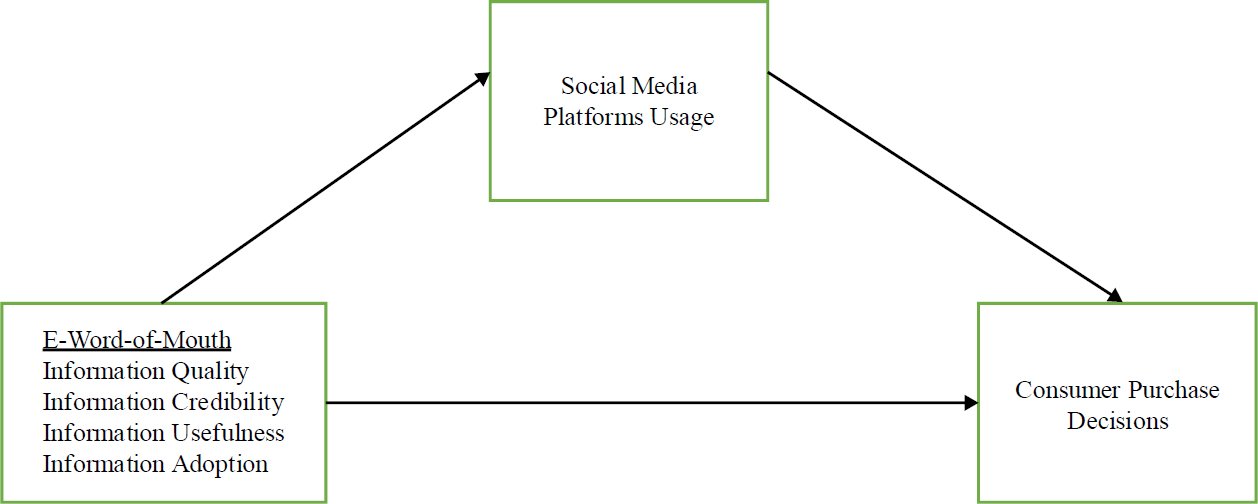
Fig. (1). Conceptual framework.
H5a: Social media platform usage positively and significantly mediates the relationship between e-WOM information quality and consumer purchase decisions in the retail industry in Saudi Arabia.
H5b: Social media platform usage positively and significantly mediates the relationship between e-WOM information credibility and consumer purchase decisions in the retail industry in Saudi Arabia.
H5c: Social media platform usage positively and significantly mediates the relationship between e-WOM information usefulness and consumer purchase decisions in the retail industry in Saudi Arabia.
H5d: Social media platform usage positively and significantly mediates the relationship between e-WOM information adoption and consumer purchase decisions in the retail industry in Saudi Arabia.
2.4. Ethical Considerations
Ethical issues were considered during the research process to guarantee the protection of the rights and privacy of the participants. The study was voluntary, and the participants were briefed on the academic nature of the study prior to completing the questionnaire. All participants provided informed consent in an electronic format prior to data collection. The respondents were assured that their identity and consent would be kept confidential and used only for research purposes. Moreover, the participants were allowed to withdraw from the survey at any moment without repercussions. All ethical research principles regarding privacy, confidentiality, informed participation, and responsible data handling were followed.
3. METHODOLOGY
The current research uses a quantitative research design because the study seeks to empirically investigate the relationships between eWOM dimensions, social media platform usage, and consumer purchase decisions. As suggested by (Dykema et al., 2022), a structured questionnaire on a five-point Likert scale (strongly disagree to strongly agree) was used to collect primary data (Appendix A). The tool is subdivided into major constructs: Consumer Purchase Decisions, Information Quality adapted from (Erkan & Evans, 2018), Information Credibility adapted from (Prendergast et al., 2010), Information Usefulness was adapted from (Erkan & Evans, 2018), Information Adoption from (Cheung et al., 2009), and Social Media Platform Usage from (Leong et al., 2021). This design can be effectively used to test the hypothesis and extend the empirical application.
This study takes a theoretical approach that adheres to the Information Adoption Model (IAM) which posits that people decide to use information on the web predominantly based on perceived quality, credibility, usefulness, and adoption before making a behavioural intention. Correspondingly, in (Erkan & Evans, 2018), a similar set of dimensions was selected as directly influencing the information-processing aspects of IAM, with other dimensions such as trust, attitude, and involvement being viewed as antecedents or consequences. Moreover, as identified by (Leong et al., 2021), social media platforms are included as a mediator because of their dual role in both disseminating and actively shaping eWOM interpretation. To guarantee theoretical parsimony and consistency with the existing IAM–TRA integration, the model has targeted information-centric determinants.
The segmented population is the retail consumers of Saudi Arabia using social media, such as Instagram, Pinterest, and Facebook. A purposive sampling method was employed to gather data, which, in this case, is appropriate since the respondents were chosen according to particular traits that are important in the study area, as (Thomas, 2022) point out. Only consumers who had previous experience interacting with eWOM content were used in this case, which guaranteed the relevance and reliability of the responses.
The necessary sample size was calculated using G*Power analysis, with multiple regression, medium effect size (f2 = 0.15), power of 0.95 and 6 predictors, which gave the minimum necessary sample size of about 146 respondents, as suggested by (Kang, 2021) as well. To enhance the statistical rigor, 800 questionnaires were sent through the Internet, and 420 respondents returned the questionnaires, representing a response rate of 52%. Following data screening, 70 responses were eliminated because of missing values and outliers, and a final sample of 350 valid responses was achieved.
To control for selection bias, respondents were selected based on various demographic profiles and platforms. To evaluate non-response bias, early (n1 = 60) and late (n2 = 60) respondents were compared, and no statistically significant differences were found, as in the study of (Guyot et al., 2023). As recommended by (Castillo et al., 2026), the common method bias (CMB) was assessed through full collinearity VIF against a 3.3 benchmark value, where no single value was found to be higher than 3.3, as shown in Table 1, indicating no issue of CMB.
Table 1. Full collinearity VIF.
| – | VIF |
| Information Adoption -> Consumer purchase decision | 1.321 |
| Information Adoption -> Social Media Platforms Usage | 1.296 |
| Information Credibility -> Consumer purchase decision | 2.283 |
| Information Credibility -> Social Media Platforms Usage | 1.958 |
| Information Quality -> Consumer purchase decision | 1.437 |
| Information Quality -> Social Media Platforms Usage | 1.295 |
| Information Usefulness -> Consumer purchase decision | 1.906 |
| Information Usefulness -> Social Media Platforms Usage | 1.824 |
| Social Media Platforms Usage -> Consumer purchase decision | 1.913 |
In addition, the reliability and validity of the measurement model were evaluated. According to (Mohd Dzin & Lay, 2021), reliability is the degree to which measurement items are consistent in measuring the intended construct and yield stable measurement results over observations. Reliability in PLS-SEM is frequently evaluated using Cronbach’s Alpha and Composite Reliability (CR). Higher values of these alpha and CR indicate greater consistency among the items within the measurement, as suggested by (Li & Lay, 2024). Validity is the degree of accuracy in measuring the concept measured by an instrument. Convergent validity was used to test the consistency of the indicators of the same construct by the Average Variance Extracted (AVE) and evaluate how much variance is shared between the indicators, as indicated in the findings of (Dash & Paul, 2021). If the AVE is above the recommended level, it indicates that the construct is valid enough to explain the variance of its indicators. In this case, consistency is defined as the coherence and uniformity of the answers to the items testing the same latent construct, such that the measure as a whole represents the same concept (Mohd Dzin & Lay, 2021). The measurement model is evaluated for consistency, reliability, and validity through Cronbach’s Alpha and Composite Reliability with a standard value of 0.7 and Average Variance Extracted (AVE), against a threshold of 0.5, as suggested by (Purwanto & Sudargini, 2021).
Partial Least Squares Structural Equation Modelling (PLS-SEM) was used to analyse the data, which is appropriate when the predictor has complex predictive models, as recommended by (Mohd Dzin & Lay, 2021) for discovering direct and indirect relationships. Structural model analysis was conducted to test the hypothesised relationships and determine the significance of the path coefficients. Partial Least Squares Structural Equation Modelling (PLS-SEM) was used instead of covariance-based SEM (CB-SEM) because the study does not seek confirmation of the theory. As recommended by (Sarstedt et al., 2021), PLS-SEM is more suitable for models involving multiple constructs, mediation paths, and exploratory relationships, especially where the data do not necessarily meet the multivariate normality requirements. Furthermore, PLS-SEM is more flexible in dealing with predictive research models in new contexts, such as Saudi digital consumer behaviour.
4. RESULTS
4.1. Demographic Profile
The states shown in Table 2 signify the demographic features of the study participants (N = 350). From these statistics, it can be observed that 57.14% of the participants were male and 42.86% were female. Among these participants, 34.29% were in the age brackets of 18-25 years, 22.86% were between 26-30 years, 17.14% were between 31-35 years and 14.29% were 40 years and above. In addition, 28.57% of the participants were high school graduates, 24.29% were college graduates, 31.43% were Masters, and 15.71% were Ph.D. In terms of monthly income of the study participants, most participants fell into the lower income categories, with 21.43% earning less than SAR 5,000 and 24.29% earning between SAR 5,000 and SAR 10,000. In contrast, 14.86% and 14.29% of participants reported monthly incomes of SAR 15,001–25,000 and SAR 35,000 or above, respectively. Regarding the occupation and profession of the participants, 25.71% of the study participants were students, 42.86% were employees in the corporate sector, and 17.14% were business owners or self-employed. Lastly, regarding social media usage for product search and reviews, 28.57% use Facebook, 15.71% use Pinterest, 24.29% use YouTube, and 31.43% depend on Instagram’s influencer E-WOM.
Table 2. Demographic profile analysis.
| Demographic Category | Frequency (n) | Percentage (%) | |
| Gender | Male | 200 | 57.14% |
| Female | 150 | 42.86% | |
| Age Range | 18 to 25 | 120 | 34.29% |
| 26-30 | 80 | 22.86% | |
| 31-35 | 60 | 17.14% | |
| 36-40 | 40 | 11.43% | |
| 40 and above | 50 | 14.29% | |
| Educational Qualification | Highschool graduate | 100 | 28.57% |
| College graduate | 85 | 24.29% | |
| Masters | 110 | 31.43% | |
| Ph.D. | 55 | 15.71% | |
| Monthly income | less than 5000 SAR | 75 | 21.43% |
| 5000 to 10,000 SAR | 85 | 24.29% | |
| 10,001 to 15,000 SAR | 55 | 15.71% | |
| 15,001 to 25,000 SAR | 52 | 14.86% | |
| 25,001 to 30,000 SAR | 33 | 9.43% | |
| 35,000 SAR and Above | 50 | 14.29% | |
| Occupation/Profession | Student | 90 | 25.71% |
| Unemployed | 50 | 14.29% | |
| Employee | 150 | 42.86% | |
| Business Owner | 60 | 17.14% | |
| Social Media Accounts | 100 | 28.57% | |
| 55 | 15.71% | ||
| YouTube | 85 | 24.29% | |
| 110 | 31.43% | ||
4.2. Measurement Model Assessment
In Table 3, the measurement model assessment is shown which reflects high factor loading which ranges between (0.821-0.935). In addition, the results reflect the establishment of internal consistency and reliability, as the Value of Cronbach’s alpha is found to be higher than alpha (α > 0.7). In addition, convergent validity was attained as the value of AVE was greater than 0.5 for all constructs of the measurement model.
Table 3. Measurement model evaluation.
| Latent Variables | Indicators | Factor Loadings | Cronbach’s Alpha | Composite Reliability (rho_a) | Average Variance Extracted (AVE) |
| Consumer Purchase Decisions | CPD1 | 0.862 | 0.862 | 0.864 | 0.784 |
| CPD2 | 0.917 | ||||
| CPD3 | 0.878 | ||||
| Information Adoption | IA1 | 0.897 | 0.892 | 0.893 | 0.823 |
| IA2 | 0.935 | ||||
| IA3 | 0.889 | ||||
| Information Credibility | IC1 | 0.899 | 0.890 | 0.893 | 0.819 |
| IC2 | 0.930 | ||||
| IC3 | 0.886 | ||||
| Information Quality | IQ1 | 0.821 | 0.832 | 0.842 | 0.749 |
| IQ2 | 0.914 | ||||
| IQ3 | 0.859 | ||||
| Information Usefulness | IU1 | 0.910 | 0.902 | 0.903 | 0.837 |
| IU2 | 0.932 | ||||
| IU3 | 0.902 | ||||
| Social Media Platforms Usage | SMP1 | 0.873 | 0.840 | 0.842 | 0.758 |
| SMP2 | 0.897 | ||||
| SMP3 | 0.840 |
4.3. Discriminant Validity
The discriminant validity which measures conceptual overlapping and separability among model constructs, was tested through the HTMT ratio, as per its standard threshold of 0.85 suggested by (Haji-Othman & Yusuff, 2022). The results in Table 4 indicate that all constructs have HTMT values below the standard threshold of 0.85 which ensures that discriminant validity is established and there is no issue of conceptual overlap.
Table 4. Discriminant validity.
| – | Consumer Purchase Decision | Information Adoption | Information Credibility | Information Quality | Information Usefulness |
| Information Adoption | 0.432 | – | – | – | – |
| Information Credibility | 0.507 | 0.491 | – | – | – |
| Information Quality | 0.420 | 0.343 | 0.521 | – | – |
| Information Usefulness | 0.512 | 0.463 | 0.523 | 0.453 | – |
| Social Media Platforms Usage | 0.319 | 0.267 | 0.421 | 0.571 | 0.581 |
4.4. Path Coefficient
The results of the path coefficient, as depicted in Table 5, offer robust support for the direct and mediation hypotheses. Information Adoption demonstrates a strong and significant positive predictive relationship with consumer purchase decisions (β= 0.741, p < 0.001), which supports H4. Other significant positive relationships were observed in Information Quality (β = 0.095, p = 0.015) and Information Credibility (β = 0.021, p < 0.021), validating H1 and H2. The relationship between Information Usefulness and consumer purchase decisions was found to be marginally significant (β = 0.100, p = 0.059), supporting H3 at the 10% level of significance. Moreover, the use of Social Media Platforms has a weak association with consumer purchase decisions (β = 0.013, p = 0.034), which supports H5.
Table 5. Path coefficient analysis.
| – | Path coefficients | T statistics | P values | f-square |
| Information Adoption -> Consumer purchase decision | 0.741*** | 3.152 | 0.000 | 1.341 |
| Information Adoption -> Social Media Platforms Usage | 0.115** | 2.100 | 0.036 | 0.019 |
| Information Credibility -> Consumer purchase decision | 0.021** | 2.765 | 0.021 | 0.001 |
| Information Credibility -> Social Media Platforms Usage | 0.412*** | 3.169 | 0.000 | 0.166 |
| Information Quality -> Consumer purchase decision | 0.095** | 2.439 | 0.015 | 0.020 |
| Information Quality -> Social Media Platforms Usage | 0.273*** | 5.356 | 0.000 | 0.110 |
| Information Usefulness -> Consumer purchase decision | 0.100* | 1.891 | 0.059 | 0.017 |
| Information Usefulness -> Social Media Platforms Usage | 0.207*** | 3.161 | 0.002 | 0.045 |
| Social Media Platforms Usage -> Consumer purchase decision | 0.013** | 2.121 | 0.034 | 0.000 |
| Specific Indirect Effects | ||||
| Information Adoption -> Social Media Platforms Usage -> Consumer purchase decision | 0.002** | 3.247 | 0.034 | – |
| Information Credibility -> Social Media Platforms Usage -> Consumer purchase decision | 0.005** | 2.267 | 0.018 | – |
| Information Quality -> Social Media Platforms Usage -> Consumer purchase decision | 0.004** | 2.268 | 0.025 | – |
| Information Usefulness -> Social Media Platforms Usage -> Consumer purchase decision | 0.003** | 2.271 | 0.027 | – |
Note: *: Significance at 10%; **: Significance at 5%; ***: Significance at 1%
In terms of mediation, all indirect relationships were positive and statistically significant, proving the partial mediating role of the use of Social Media Platforms. In particular, the adoption of Information (β = 0.002, p = 0.034), Information Credibility (β = 0.005, p = 0.018), Information Quality (β = 0.004, p = 0.025), and Information Usefulness (β = 0.003, p = 0.027) had a significant indirect role in purchase decisions which favours H5a, H5b, H5c, and H5d. This also implies partial mediation and supports the significance of social media in eWOM translation into consumer buying decisions. The effect sizes revealed from the t-test results showed that there were varying effect sizes among the constructs. Information Adoption has a significant impact on consumer purchase decisions (f² = 1.341), surpassing the threshold set by Cohen’s for a large effect, specified in (Gignac & Szodorai, 2016), making it the strongest predictor. The credibility of information on social media platforms had a medium effect (f² = 0.166), and information quality (f² = 0.110) and information usefulness (f² = 0.045) had small effects. However, for information credibility on consumer purchase decisions, the effect was f² = 0.001, and for social media platform usage on consumer purchase decisions, the effect was f² = 0.000 which represents a small effect.
4.5. Model Explanatory Power
The explanatory power examined through the R-squared shows the percentage of variance in the target variables predicted by their predictors. As per the results depicted in Table 6, it can be said that 69% variance in consumer purchase decisions is predicted by E-WOM dimensions which is strong explanatory power. However, 47.7% of the variance in social media usage is predicted by the e-WOM dimensions which depicts moderate explanatory power.
Table 6. Model explanatory power.
| – | R-square | R-square adjusted |
| Consumer purchase decision | 0.690 | 0.685 |
| Social Media Platforms Usage | 0.477 | 0.471 |
4.6. Predictive Relevance
The results in Table 7 regarding predictive relevance demonstrate that the models have a high level of performance. Q2 of Social Media Platforms (0.458) and Consumer Purchase Decision (0.680) were confirmed to be highly predictive. In addition, the low values of RMSE (0.743; 0.572) and MAE (0.537; 0.421) indicate adequate or moderate predictive accuracy. Overall, the model has a strong out-of-sample predictive success, specifically with consumer purchase decisions.
Table 7. Predictive relevance.
| – | Q²predict | RMSE | MAE |
| Social Media Platforms | 0.458 | 0.743 | 0.537 |
| Consumer purchase decision | 0.680 | 0.572 | 0.421 |
5. DISCUSSION
The results of the current research affirm hypothesis H1 that the quality of information in E-WOM plays an important role in shaping consumer purchase decisions, as previous research has indicated, but also indicates contextual peculiarities. In agreement with (Erkan & Evans, 2018), high-quality eWOM, determined by detailed, relevant, and structured information, can be used to improve the decision-making process because. Similarly, according to the Information Adoption Model (IAM), high-quality eWOM also helps consumers process information in the central route suggested by (Akın & Öztürk, 2025). Nevertheless, this study shows that the quality of information has a significant direct relationship with purchase decisions, unlike in the case of (Al-Haddad et al., 2022), where the quality of information did not have a significant direct association. This increased dependency on curated online content, stemming from the high prevalence of smartphone usage and social media among consumers, may explain the stronger link in the Saudi retail context, as there are likely to be higher levels of digital literacy among the individuals in this study. Detailed and structured eWOM information can be more relevant when people evaluate products during purchase decision-making processes, as proposed by (Erkan & Evans, 2018) under these conditions.
Higher uncertainty avoidance can result in increased effects on Saudi retail consumers because they culturally give importance to detailed and transparent information. Industrially, the nature of competition among retailers in Saudi Arabia pushes consumers to be more critical when comparing alternatives, thus increasing the importance of information quality, as supported by the findings of (Leong et al., 2021). Theoretically, these results are generally consistent with the IAM, which posits that information quality corresponds to purchase decision tendencies but does not work through other channels. In practice, Saudi retailers need to invest in the production of the right, comprehensive, and properly structured online content to enable consumer trust and informed buying decisions in an increasingly digital market.
The findings support H2 and show that the credibility of information provided in E-WOM is positively and significantly related to consumer purchase decisions, confirming the literature that was in place, but also showing some contextual differences. This result is consistent with that of (Ngo et al., 2024a), who pointed out that credibility is one of the primary factors of information adherence and ensuing behavioural consequences. However, this conflicts with (Akın & Öztürk, 2025), who found which credibility did not significantly affect eWOM engagement. This difference might be a consequence of the context in which Saudi consumers conduct their online business, where trust is a vital factor because of the fear of false information and online reviews.
Theoretically, the findings are also echoed in the Theory of Reasoned Action (TRA), in which believable information influences attitudes and subjective norms that ultimately determine behavioural intentions, as (Leong et al., 2021) also revealed. Conversely, research such as (Akın & Öztürk, 2025) in emerging economies like Indonesia shows that retail consumers are less sensitive to credibility, owing to varying degrees of digital scepticism. In online interactions, Saudi consumers also value trust and authenticity, which could reflect their general trust and authenticity values in social and cultural interactions.
These results suggest that Saudi retailers and policymakers should promote the transparency and authenticity of online reviews. Verification mechanisms and the development of trustworthy content can boost consumer confidence and improve the reputation of online retail settings.
The relationship between information usefulness and consumer purchase decisions was established to be positive and significant, supporting H3 and indicating congruency and variations with the existing literature. Although (Subekti & Nugroho, 2023) indicated a strong impact of usefulness on adoption and purchase intention, this study shows a direct relationship. This was also proposed by (Leong et al., 2021), who hypothesised that usefulness acts largely indirectly via information adoption; hence, the relatively less significant direct significance in this case.
This weak relationship suggests that the perceived sense of usefulness is not enough for Saudi consumers to make a purchase, even though it is considered one of the initial conditions for the evaluation process. In the IAM, this interpretation is valid and useful as part of the cognitive evaluation, which can be followed by information adoption before the acceptance of its message is reflected in some aspects of behaviour. In terms of IAM, (Nugroho & Subekti, 2023) suggested that usefulness is a middle cognitive assessment that does not necessarily translate into action, especially within complex digital settings. In addition, the wealth of online information in Saudi Arabia can decrease the ability to differentiate based on usefulness because most of the information presented is already viewed as sufficiently helpful. For Saudi retail practitioners, the findings imply that improving usefulness is not sufficient; it should be accompanied by credibility and engagement strategies to impact purchase decision-making in the retail industry.
In addition, the results indicate that consumer buying decisions are substantially related to information adoption, validating H4. This finding is in line with (Al-Haddad et al., 2022), who noted that information adoption is the strongest predictor of purchase intention. It also follows (Subekti & Nugroho, 2023), which strengthens the IAM’s basic assumption that adoption is the immediate precursor of behavioural outcomes.
The relatively strong association found in the Saudi context is related to high digital involvement and frequent exposure to peer generated content, in which the consumers seem to internalise and use online information in decision-making processes also highlighted by (Nugroho & Subekti, 2023) also. Adoption has a stronger influence than information quality or usefulness, which are measures of a more fundamental cognitive and behavioural commitment (Al-Haddad et al., 2022).
The results largely corroborate the IAM and confirm the sequential relationship between information evaluation, adoption, and behavioural tendencies toward purchase. This effect is further enhanced by cultural aspects, including collectivism and social influence, where consumers tend to accept information that conforms to group norms and experiences. Saudi retailers are required to employ strategies that encourage consumers to not only access information but also internalise and act on it. The increase in information adoption and eventual purchase decision can be greatly improved by making the information more interactive, personalised, and engaging to the user.
The mediating role of social media in the association between eWOM dimensions and consumer purchase decisions was affirmed, but with complex overtones validating H5. The results support the idea that social media is a strong mediator of the relationship of information quality, credibility, usefulness and adoption, which, to some extent, are consistent with (Nurhadi et al., 2023), who also focused on the role of social media as a mediator of brand awareness and the influence on the decision to purchase. In contrast to (Santy & Andriani, 2023), in this case, eWOM alone did not directly influence a purchase, which this study illustrates as showing that social media reinforces these relationships as an interactive and interpretative medium.
Similar to the integration of IAM and TRA, the findings are generally consistent in that the social media environment could enable information processing while reinforcing socially favoured behavioural tendencies. While IAM describes how the nature of information can lead to adoption, TRA describes the importance of social norms, which are enhanced by interactions with social media, as suggested by (Santy & Andriani, 2023). The large mediation values for all dimensions suggest that social media can serve as a tool for influencing how eWOM content is seen, interpreted, and attributed in relevance.
In practice, Saudi retailers can leverage social media platforms in various ways to facilitate user-generated content, interactions, and influencer engagement. Public institutions can also participate in programs to boost digital literacy and confidence in information environments. Public organisations can also facilitate digital literacy and control of online content to boost the level of trust. In general, the findings of this study highlight the importance of social media as a mediator in changing eWOM into consumer actions.
CONCLUSION
This study critically determines that eWOM is not a single construct but a multidimensional process whose success is determined by the information evaluation, internalisation, and transmission processes in social media networks. The results show that although the quality of information, its credibility, and its utility play a role in consumer decision-making, information adoption is the most dominant predictor which supports the main idea of the Information Adoption Model. Additionally, the mediating role of social media platforms demonstrates that digital spaces do not passively receive information; rather, they actively predispose it to be interpreted and have a behavioural effect, as the social influence assumption of the Theory of Reasoned Action assumes. These results suggest that the persuasive power of eWOM cannot be achieved without efficient mediation with the help of social media. Furthermore, the primary contribution of this study lies in empirically examining multidimensional eWOM simultaneously with the mediating role of social media platforms in the Saudi retail context. This research differs from previous studies that investigated one element of eWOM alone because it provides a broader framework detailing the interaction of multiple eWOM informational dimensions in the social media context to impact purchasing decisions. Therefore, this study contextually and theoretically advances the literature by clarifying the role of social media in digital consumer behaviour which is an active interpretative role.
LIMITATIONS AND FUTURE DIRECTIONS
Nevertheless, this study has certain limitations. First, purposive sampling limits its generalisability beyond the group of respondents chosen and other than the retail sector of Saudi Arabia. Second, the design was cross-sectional, limiting causal inferences. Third, self-reported data can cause response bias, although common method bias is controlled. Moreover, targeted social media channels can ignore new digital media that can impact consumer decision-making. In addition, the study has several limitations related to generalisability and platform-specific bias. Data were collected only from Saudi retail consumers using social media platforms such as Instagram, Facebook, and Pinterest, which may limit the applicability of the findings to consumers using other digital platforms or operating in different cultural contexts. Furthermore, the purposive sampling technique and cross-sectional design may restrict broader population representation and limit the ability to capture evolving consumer behaviour across diverse demographic and technological settings.
Longitudinal designs should be embraced in future research to study the dynamic variations in eWOM influence, and probabilistic sampling methods should be used to increase generalisability. It is also suggested that comparative cross-cultural studies should be conducted to investigate the impact of sociocultural variations on the effectiveness of eWOM. Moreover, subsequent models could incorporate other variables, such as trust, brand image, and the credibility of the influencer, to obtain a more detailed view of consumer decision-making within online retail spaces.
IMPLICATIONS
The results have major theoretical and practical implications for various actors. In theory, this study builds upon the Information Adoption Model by incorporating it with the Theory of Reasoned Action which shows how social media platforms serve as an important catalyst that converts eWOM into consumer behaviour. It also extends the empirical application of the multidimensional role of eWOM in a Middle Eastern background. As a practical suggestion, retail managers in Saudi Arabia should work on increasing information quality, credibility, and usefulness to promote information adoption among consumers. Social media tactics should focus on realistic user interaction and interactive communication to enhance the influence of purchase decisions. To policymakers, it is necessary to enforce laws against deceptive digital content and encourage digital literacy campaigns to gain consumer trust and to guarantee transparency. In general, this research can be used in practice to enhance the efficiency of marketing and consumer decision-making.
A number of limitations were identified in this study, which informed several directions for further investigation. Potential improvements included the integration of secure aggregation mechanisms and the incorporation of stronger formal privacy guarantees, such as adaptive differential privacy techniques. Extensions to support streaming data, concept drift handling, and fine-grained multi-class attack classification were also identified as important steps toward enhancing practical applicability. Moreover, the framework was identified as a candidate for evaluation in real multi-organizational deployment settings in order to further assess its robustness, scalability, and real-world utility.
LIST OF ABBREVIATIONS
AVE | = | Average Variance Extracted |
CMB | = | Common Method Bias |
CR | = | Composite Reliability |
eWOM | = | Electronic Word-of-Mouth |
IAM | = | Information Adoption Model |
PLS-SEM | = | Partial Least Squares Structural Equation Modelling |
TRA | = | Theory of Reasoned Action |
AUTHORS’ CONTRIBUTIONS
G.M.T. has contributed to the study conceptualization, methodology, data analysis, interpretation of results, and manuscript writing. I.K. has contributed to data collection, literature review, results validation, and manuscript revision. T.G.D.B. has contributed to supervision, critical review of the manuscript, project administration, and final approval of the submitted version.
ETHICAL APPROVAL & INFORMED CONSENT
Ethical issues were considered during the research process to guarantee the protection of the rights and privacy of the participants. The study was voluntary, and the participants were briefed on the academic nature of the study prior to completing the questionnaire. All participants provided informed consent in an electronic format prior to data collection. The respondents were assured that their identity and consent would be kept confidential and used only for research purposes. Moreover, the participants were allowed to withdraw from the survey at any moment without repercussions. All ethical research principles regarding privacy, confidentiality, informed participation, and responsible data handling were followed.
AVAILABILITY OF DATA AND MATERIALS
The data will be made available on reasonable request by contacting the corresponding author [G.M.T].
FUNDING
None.
CONFLICT OF INTEREST
The authors declare that there is no conflict of interest regarding the publication of this article.
ACKNOWLEDGEMENTS
Declared none.
DECLARATION OF AI
During the preparation of this manuscript, the authors used ChatGPT for language editing and refinement purposes. Following the use of this tool, the authors carefully reviewed and revised the content where necessary and accept full responsibility for the final published version of the article.
APPENDIX A
Questionnaire
Demographics
- Gender
- Male
- Female
- Age
- 18 to 25
- 26-30
- 31-35
- 36-40
- 40 and Above
- Monthly income
- less than 5000 SAR
- 5000 to 10,000 SAR
- 10,001 to 15,000 SAR
- 15,001 to 25,000 SAR
- 25,001 to 30,000 SAR
- 35,000 SAR and Above
- Educational Attainment
- Highschool graduate
- College graduate
- Masters
- PH.D
- Occupation/Profession
- Student
- Unemployed
- Employee
- Business Owner
- Social Media Accounts (you can choose more than 1)
- YouTube
Survey Questionnaire
| Information Quality. Adapted from (Erkan & Evans, 2018) | SD | D | N | A | SA |
| I think E-WOM have sufficient reasons supporting the opinion. | |||||
| I think E-WOM are objective | |||||
| I think E-WOM are understandable | |||||
| Information Credibility. Adapted from (Prendergast et al., 2010) | |||||
| I think E-WOM are convincing | |||||
| I think E-WOM are strong | |||||
| I think E-WOM are accurate | |||||
| Information Usefulness. (Erkan & Evans, 2018) | |||||
| I think E-WOM are generally helpful | |||||
| I think E-WOM are generally useful | |||||
| I think E-WOM are generally informative | |||||
| Information Adoption. (Cheung et al., 2009) | |||||
| E-WOM make easier for me to make consumption | |||||
| E-WOM enhance my effectiveness in making consumption decision | |||||
| E-WOM help me confidently apply the information when making purchase decisions | |||||
| Social Media Platforms | |||||
| Social media platforms provide me with useful information about products and services | |||||
| I frequently use social media platforms to explore product reviews before making a purchase | |||||
| Social media platforms make it easier for me to access others’ opinions about products | |||||
| Consumer Purchase Decisions. (Coyle & Thorson, 2001; and Erkan & Evans, 2016) | |||||
| It is very likely that I will buy the retail provides based on suggestions made in E-WOM | |||||
| I will purchase the products based on E-WOM next time when I want to consume it | |||||
| I will recommend the retail products to my friends |
REFERENCES
Akın, M. S., & Öztürk, A. (2025). What drives e-WOM engagement? Exploring the roles of information quality, credibility, and website quality. Business & Management Studies: An International Journal, 13(3), 1437-1453.
https://doi.org/10.15295/bmij.v13i3.2585
AlBliwi, S. A., Yusuf, N., & Almahdi, L. A. M. (2025). Service quality and consumer behavior in Saudi Arabia: Examining transactions and technological integration within the vision 2030 framework. European Journal of Sustainable Development, 14(2), 451-451.
https://doi.org/10.14207/ejsd.2025.v14n2p451
Al-Haddad, S., Sharabati, A. A., Harb, L., Husni, A., & Abdelfattah, M. (2022). E-WOM and consumers’ purchase intention: An empirical study on Facebook. Innovative Marketing, 18(3), 149-158.
https://doi.org/10.21511/im.18(3).2022.13
Arab News (2026). How does Saudi Arabia maintain price stability despite the war? Available from: https://www.arabnews.jp/en/business/article_167739/
Arif, C. (2025). Mediating role of electronic word of mouth 2.0 in the relationship between digital product quality and purchase intention. Journal of Entrepreneurial Economics, 2(2), 155-171.
https://doi.org/10.61511/jane.v2i2.2025.2312
Bao, Z., & Zhu, Y. (2025). Understanding online reviews adoption in social network communities: an extension of the information adoption model. Information Technology & People, 38(1), 48-69.
https://doi.org/10.1108/ITP-03-2022-0158
Berné Manero, M. D. C., Moretta Tartaglione, A., Russo, G., & Cavacece, Y. (2023). The impact of electronic word-of-mouth management in hotel ecosystem: insights about managers’ decision-making process. Journal of Intellectual Capital, 24(1), 227-256.
https://doi.org/10.1108/JIC-07-2021-0201
Castillo, A., Rescalvo-Martin, E., & Karatepe, O. M. (2026). How is common method bias addressed using partial least squares structural equation modelling in hospitality and tourism research? Tourism Review, 81(1), 204-228.
https://doi.org/10.1108/TR-07-2025-0762
Çelik, K., & Aslan, A. (2025). The impact of electronic word of mouth (eWOM) on visit intention within the framework of the information adoption model: A study on instagram users. International Journal of Marketing, Communication and New Media, 12(23), 108-130.
https://doi.org/10.54663/2182-9306.2024.v.12.n.108-130
Cheng, X., Gu, Y., Hua, Y., & Luo, X. R. (2021). The paradox of word-of-mouth in social commerce: exploring the juxtaposed impacts of source credibility and information quality on SWOM spreading. Information & Management, 58(7), 103505.
https://doi.org/10.1016/j.im.2021.103505
Cheung, M. Y., Luo, C., Sia, C. L., & Chen, H. (2009). Credibility of electronic word-of-mouth: Informational and normative determinants of on-line consumer recommendations. International Journal of Electronic Commerce, 13(4), 9-38.
https://doi.org/10.2753/JEC1086-4415130402
Dash, G., & Paul, J. (2021). CB-SEM vs PLS-SEM methods for research in social sciences and technology forecasting. Technological forecasting and social change, 173, 121092.
https://doi.org/10.1016/j.techfore.2021.121092
Dykema, J., Schaeffer, N. C., Garbarski, D., Assad, N., & Blixt, S. (2022). Towards a reconsideration of the use of agree-disagree questions in measuring subjective evaluations. Research in Social and Administrative Pharmacy, 18(2), 2335-2344.
https://doi.org/10.1016/j.sapharm.2021.06.014
Ellitan, L. (2022). The role of social media marketing, brand awareness and e-wom to increase purchase decision. EKOMA: Jurnal Ekonomi, Manajemen, Akuntansi, 2(1), 115-122.
https://doi.org/10.56799/ekoma.v2i1.882
Erkan, I., & Evans, C. (2018). Social media or shopping websites? The influence of eWOM on consumers’ online purchase intentions. Journal of marketing communications, 24(6), 617-632.
https://doi.org/10.1080/13527266.2016.1184706
Fan, M., & Ukaegbu, O. C. (2024). Information literacy and intention to adopt e-pharmacy: A study based on trust and the theory of reasoned action. BMC Health Services Research, 24(1), 912.
https://doi.org/10.1186/s12913-024-11301-8
Gignac, G. E., & Szodorai, E. T. (2016). Effect size guidelines for individual differences researchers. Personality and Individual Differences, 102, 74-78.
https://doi.org/10.1016/j.paid.2016.06.069
Guyot, M., Pelgrims, I., Aerts, R., Keune, H., Remmen, R., De Clercq, E. M., … & Vanwambeke, S. O. (2023). Non-response bias in the analysis of the association between mental health and the urban environment: A cross-sectional study in Brussels, Belgium. Archives of Public Health, 81(1), 129.
https://doi.org/10.1186/s13690-023-01118-y
Haji-Othman, Y., & Yusuff, M. S. S. (2022). Assessing reliability and validity of attitude construct using partial least squares structural equation modeling. Int J Acad Res Bus Soc Sci, 12(5), 378-385.
https://doi.org/10.6007/IJARBSS/v12-i5/13289
Ismail, I., Othman, A. A., & Majid, M. (2024). The triangulated influence of electronic word of mouth (eWOM) information on consumer purchase intention: A conceptual paper. Insight Journal (IJ), 11(1),
166-176.
https://doi.org/10.24191/ij.v0i0.24937
Kang, H. (2021). Sample size determination and power analysis using the G* Power software. Journal of Educational Evaluation for Health Professions, 18.
https://doi.org/10.3352/jeehp.2021.18.17
Kaur, K., & Singh, T. (2024). Understanding the drivers of eWOM review adoption: The impact of informational determinants and mediating role of perceived eWOM review credibility. Journal of Business Thought, 15, 29-45.
https://doi.org/10.18311/jbt/2024/41945
Leong, C. M., Loi, A. M. W., & Woon, S. (2021). The influence of social media eWOM information on purchase intention. Journal of Marketing Analytics, 10(2), 145.
https://doi.org/10.1057/s41270-021-00132-9
Li, W., & Lay, Y. F. (2024). Examining the reliability and validity of measuring scales related to informatization instructional leadership using PLS-SEM approach. Dinamika Jurnal Ilmiah Pendidikan Dasar, 16(1), 12-32.
https://doi.org/10.30595/dinamika.v16i1.19768
Majeed, A., Rahi, S., Sair, S. A., & Ngah, A. H. (2023). Influence of electronic word of mouth on purchase intention of mobile phones through information quality: Empirical evidence from Pakistan. International Journal of Business Information Systems, 43(2), 164-185.
https://doi.org/10.1504/IJBIS.2020.10034026
Mohd Dzin, N. H., & Lay, Y. F. (2021). Validity and reliability of adapted self-efficacy scales in Malaysian context using PLS-SEM approach. Education Sciences, 11(11), 676.
https://doi.org/10.3390/educsci11110676
Ngo, T. T. A., Bui, C. T., Chau, H. K. L., & Tran, N. P. N. (2024a). Electronic word-of-mouth (eWOM) on social networking sites (SNS): Roles of information credibility in shaping online purchase intention. Heliyon, 10(11), e32168.
https://doi.org/10.1016/j.heliyon.2024.e32168
Ngo, T. T. A., Vuong, B. L., Le, M. D., Nguyen, T. T., Tran, M. M., & Nguyen, Q. K. (2024b). The impact of eWOM information in social media on the online purchase intention of Generation Z. Cogent Business & Management, 11(1), 2316933.
https://doi.org/10.1080/23311975.2024.2316933
Nurhadi, M., Suryani, T., & Fauzi, A. A. (2023). The power of website and social media for strengthening brand image, E-WoM, and purchase decision. Journal of Economics, Business, & Accountancy Ventura, 25(3), 273.
https://doi.org/10.14414/jebav.v25i3.3093
Oliver. W (2024). The Evolving Spending Habits of Consumers in Saudi Arabia. Available from: https://www.oliverwyman.com/our-expertise/insights/2025/may/successfully-adapt-to-saudi-evolving-retail-consumer-trends.html
Prendergast, G., Ko, D., & Siu Yin, V. Y. (2010). Online word of mouth and consumer purchase intentions. International Journal of Advertising, 29(5), 687-708.
https://doi.org/10.2501/S0265048710201427
Purwanto, A., & Sudargini, Y. (2021). Partial least squares structural squation modeling (PLS-SEM) analysis for social and management research: A literature review. Journal of Industrial Engineering & Management Research, 2(4), 114-123.
https://doi.org/10.7777/jiemar.v2i4.168
PwC. (2024). Voice of the Consumer 2024 survey: Saudi Arabia findings. Available from: https://www.pwc.com/m1/en/publications/voice-of-the-consumer-2024-survey-saudi-arabia-findings.html
Raghuwanshi, S., Sharma, S., Khare, V., Singhal, A., Tripathi, M., & Banerjee, S. (2023). Modeling the nexus between perceived value, risk, negative marketing, and consumer trust with consumers’ social cross-platform buying behaviour in India using Smart-PLS. Journal of Law and Sustainable Development, 11(4), e488-e488.
https://doi.org/10.55908/sdgs.v11i4.488
Rahaman, M. A., Hassan, H. K., Asheq, A. A., & Islam, K. A. (2022). The interplay between eWOM information and purchase intention on social media: Through the lens of IAM and TAM theory. PloS one, 17(9), e0272926.
https://doi.org/10.1371/journal.pone.0272926
Rahman, M. N. (2022). Amalgamation of small firms given boost to the retail sector in Saudi Arabia. New Innovations in Economics, Business and Management, 4, 143-160.
https://doi.org/10.9734/bpi/niebm/v4/15253D
Santy, R. D., & Andriani, R. (2023). Purchase decision in terms of content marketing and e-WOM on social media. Journal of Eastern European and Central Asian Research, 10(6), 921-928.
https://doi.org/10.15549/jeecar.v10i6.1502
Sardar, A., Manzoor, A., Shaikh, K. A., & Ali, L. (2021). An empirical examination of the impact of eWom information on young consumers’ online purchase intention: Mediating role of eWom information adoption. Sage Open, 11(4), 21582440211052547.
https://doi.org/10.1177/21582440211052547
Sarstedt, M., Ringle, C. M., & Hair, J. F. (2021). Partial least squares structural equation modeling. In Handbook of market research (pp. 587-632). Cham: Springer International Publishing.
https://doi.org/10.1007/978-3-319-57413-4_15
Saudi Arabia Market Research (2025). The Rise of Saudi Retail Digital Trends in E-Commerce. Available from: https://saudimarketresearchconsulting.com/insights/articles/saudi-retail-digital-trends-small-town-stores-go-national
Silaban, P. H., Chen, W. K., Sormin, S., BP Panjaitan, Y. N., & Silalahi, A. D. K. (2023). How does electronic word of mouth on Instagram affect travel behaviour in Indonesia: A perspective of the information adoption model. Cogent Social Sciences, 9(1), 1-17, 2163525.
https://doi.org/10.1080/23311886.2022.2163525
Song, B. L., Liew, C. Y., Sia, J. Y., & Gopal, K. (2021). Electronic word-of-mouth in travel social networking sites and young consumers’ purchase intentions: an extended information adoption model. Young Consumers, 22(4), 521-538.
https://doi.org/10.1108/YC-03-2021-1288
Subekti, T. A., & Nugroho, S. S. (2023). Impact of information usefulness and adoption in social media on purchase intention: Evidence of Indonesia. Benefit Jurnal Manajemen dan Bisnis, 8(2), 179-196.
https://doi.org/10.23917/benefit.v8i2.2461
Thomas, F. B. (2022). The role of purposive sampling technique as a tool for informal choices in a social Sciences in research methods. Just Agriculture, 2(5), 1-8. Available from: https://www.scirp.org/reference/referencespapers?referenceid=3503967
Veronita, R., Ariyanti, M., & Hidayah, R. T. (2025). The effect of electronic word of mouth (E-WOM) on Tiktok application towards purchase intention mediated by the variables of information quality, information quantity, information credibility, and brand image on skintific products. International Journal of Science, Technology & Management, 6(4), 750-761.
https://doi.org/10.46729/ijstm.v6i4.1343
Yahoo Finance. (2025). Saudi Arabia Retail Market Analysis Report 2025-2030 | Expanding Digitalization, Increased Tourism Driving Luxury and Souvenir Sales, and a Shift Towards Digital Payments. Available from: https://finance.yahoo.com/news/saudi-arabia-retail-market-analysis-152500928.html
Licensed
© 2026 Copyright by the Authors.
Licensed as an open access article using a CC BY 4.0 license.
Article Contents Authors Saman Ismail1, * Imran Iqbal2 1Faculty of Management Science, Department of Business Administration, Salim Habib University, Karachi,
Article Contents Author Michael Dolinsky1, * 1Faculty of Mathematics and Technologies of Programming, Francisk Skorina Gomel State University,
Article Contents Author Abdul Ghafoor Memon1, * 1Emaan Institute of Management Sciences, Karachi, Pakistan Article History: Received: 01 April, 2026
Article Contents Authors Zixuan Zhao1, Ju Guo1, * 1School of Management, Chengdu University of Information Technology, Chengdu, China Article History:
Article Contents Authors Sultan Ud Din Yousufzai1, Amtyaz Safi2, * , Maher Khan1, Zia Ud Din1 1Department of Zoology, Govt.
Article Contents Author Nasir Uddin Khan1, * 1Department of Emaan Institute of Management Sciences, Karachi, Pakistan Article History: Received: 16