











Article Contents
Article ID: CM2621101023
Views: 1268Mediating Role of Organisational Culture in the Relationship Between People Dimensions and Employee Engagement in the Telecom Sector in Abu Dhabi
 DOI:
 XML
 PDF
Alvi, F. (2026). Mediating role of organisational culture in the relationship between people dimensions and employee engagement in the telecom sector in Abu Dhabi. Advance Journal of Business Management and Social Sciences, 2(1), 1–13, Article ID: CM2621101023. https://doi.org/10.65080/ajbmss.v2i1.CM2621101023
Alvi, F. 2026. “Mediating Role of Organisational Culture in the Relationship between People Dimensions and Employee Engagement in the Telecom Sector in Abu Dhabi.” Advance Journal of Business Management and Social Sciences 2 (1): 1–13, Article ID: CM2621101023. https://doi.org/10.65080/ajbmss.v2i1.CM2621101023
Alvi, F., 2026. Mediating role of organisational culture in the relationship between people dimensions and employee engagement in the telecom sector in Abu Dhabi. Advance Journal of Business Management and Social Sciences, 2(1), pp.1–13, Article ID: CM2621101023. Available at: https://doi.org/10.65080/ajbmss.v2i1.CM2621101023
Alvi F. Mediating role of organisational culture in the relationship between people dimensions and employee engagement in the telecom sector in Abu Dhabi. Adv J Buss Manag Soc Sci. 2026;2(1):1–13, Article ID: CM2621101023. doi:10.65080/ajbmss.v2i1.CM2621101023
1Department of Business Administration, Swiss Business School, Zurich, Switzerland
Received: 15 February, 2026
Revised: 01 May, 2026
Accepted: 15 May, 2026
Published: 23 May, 2026
ABSTRACT:
Introduction: The following research has examined the impact of people dimension on employee engagement in the Abu Dhabi’s telecom sector. It also explored the mediating role of organisational culture in the relationship between people dimensions and employee engagement.
Methods: The research employed a quantitative design, collecting data from 385 employees at the largest telecom operators in Abu Dhabi. The data were collected using a self-developed questionnaire with purposive sampling, resulting in 385 valid responses. Partial Least Squares-Structural Equation Modelling (PLS-SEM) was used as the analytical method to process the data.
Results & Discussion: The study revealed that Organisational Empowerment has a moderately positive relationship with Employee Engagement (β= 0.310, p < 0.001). Customer Centricity presented a negative relationship with engagement (β= -0.162, p = 0.035), but its indirect effect through organisational culture was positive and significant (β = 0.050, p = 0.017). However, its total effect on engagement was not significant (β = −0.111, p = 0.153), indicating an inconsistent mediation pattern. The effect of Managerial Support on engagement is weak but statistically insignificant (β = 0.126, p = 0.075), and its indirect effect through organisational culture was also non-significant (β = 0.018, p = 0.314).
Conclusion: This research provides valuable insights for telecom companies in Abu Dhabi, focusing on the significance of empowerment and positive organisational culture to increase employee engagement that ultimately drive improved performance and competitive advantage.
Keywords: Customer centricity, managerial support, empowerment, organisational culture, employee engagement, telecom sector, Abu Dhabi.
1. INTRODUCTION
The telecommunication sector is one of the fastest-growing and most competitive industries globally (PWC, 2023), and the UAE is no exception. As one of the most technologically advanced nations in the Middle East, the UAE’s telecom sector plays a vital role in driving the nation’s economy (Modor Intelligence, 2025). Dominated by major players like Etisalat and Du, the sector is valued at approximately $8.4 billion as of 2022, with a projected annual growth rate of 2% from 2022 to 2027 driven primarily by increasing demand for mobile services, digital technologies, and high-speed data solutions (Oxford Business Group, 2023). However, alongside technological advancements, people, dimensions, employee engagement, and organisational culture are essential to maintain the sector’s competitive edge. In such a dynamic and rapidly evolving industry, fostering a positive workplace culture and high levels of employee engagement are crucial for innovation, productivity, and long-term success.
Sustaining this growth in a competitive market alongside market dynamism requires telecommunication companies to prioritise optimised human capital development alongside technological development (Schwarzburg, 2024). Employee engagement represents the emotional organisational commitment of workers, which directly impacts workplace performance and productivity measurements (Yousif Ali & Hasaballah, 2020). Engaged employees tend to innovate further with their duties to create better customer relationships while driving higher profits for the company (Deepalakshmi et al., 2024). Organisations acknowledge the importance of employee engagement, yet most telecommunication operators struggle to sustain high engagement metrics. The Gallup State of the Global Workplace report-2021 shows that the Middle East and North Africa (MENA) region has just 15% of workers who maintain full engagement at work (Gallup, 2021). Employee engagement levels in the region stand at a critical low point, which particularly affects telecommunications industry operations because they heavily depend on innovation coupled with customer service.
The UAE telecom sector faces the challenge of maintaining high levels of employee engagement amid rapid technological advancements and fierce market competition. While the sector has experienced substantial growth, employee engagement remains relatively low, impacting productivity, innovation and service quality. Previous studies, such as (Saleem et al., 2020) have focused on the direct impact of workplace and supervisory factors on employee engagement including the mediating role of organisational culture, however, there is a further need to study how factors like customer centricity, empowerment, and managerial support can collectively influence employee engagement via organisational culture. In such a dynamic and competitive industry, a positive organisational culture is important to increase employee motivation and commitment (Setrojoyo et al., 2023). However, not much attention is provided to organisational culture with these dimensions to influence employee engagement, especially in the context of Abu Dhabi’s telecom sector. The study aims to investigate how organisational culture, as a mediator, interacts with People Dimensions (Customer Centricity, Managerial Support, and Empowerment) to influence employee engagement in the telecom sector of Abu Dhabi.
2. LITERATURE REVIEW
Employee engagement is a key driver of organisational performance, particularly in service sectors like telecommunications (Kadim, 2018). Employee engagement refers to the extent to which employees are emotionally connected, committed and involved in their work in the organisation (Yadav et al., 2022). It is an important factor driving key performance outcomes that involve enhanced productivity, increased creativity and improved customer satisfaction (Turner, 2020). In the telecommunications sector, where competition is stiff and technological advancements are rapid, workplace engagement is a major driving factor behind organisational excellence (Atiku et al., 2024).
Highly involved staff are more productive, creative, and innovative, and engagement is thus an integral ingredient in maintaining competitive advantage (Elidemir et al., 2020). (Ahmed & Shafiq, 2014) conducted a study to evaluate the impact of organisational culture on organisational performance in the telecom industry of Bahawalpur, Pakistan. The study demonstrated that dedicated employees are more likely to participate in knowledge-sharing activities, directly resulting in organisational success. In addition, dedicated employees enjoy higher customer loyalty, service quality, and efficiency (He et al., 2021). Achieving high levels of employee engagement is not solely dependent on individual factors; it is also significantly influenced by external elements such as organisational culture and leadership. It indicates the organisation environment including values, norms, and practices influencing employee work experiences. It includes how leadership styles and cultural elements foster or hinder employees’ emotional and cognitive commitment. Supportive culture and effective leadership develop conditions that increase engagement promoting trust, recognition and purpose (Parent & Lovelace, 2018). Hence, the understanding employee engagement requires considering both individual attributes and broader organisational dynamics affecting motivation and involvement.
2.1. Hypotheses Development
H1: Customer centricity positively affects employee engagement in the telecom sector of Abu Dhabi
Customer centricity is a business strategy that focuses on building favourable experiences and long-term value for customers by putting their needs, wants, and satisfaction at the centre of organisational decisions and activities (Gupta & Ramachandran, 2021). It means getting to know customers intensely, adapting products, services, and interactions to address their expectations, and building solid relationships to create loyalty and retention (Sparrow et al., 2015). In contrast to product-centric strategies, customer centricity centres on one-on-one interaction, ongoing feedback, and responsiveness to changing customer needs. This strategy propels sustainable growth by aligning the operations, culture, and strategies of the firm with delivering superior customer value repeatedly (Rajagopal, 2020).
Customer centricity functions as a resource and a demand through the Job Demands-Resources (JD-R) model because it enhances or hinders employee engagement based on the job demands versus resource equilibrium (Bakker & Demerouti, 2007). In the JD-R model, customer centricity is both a resource and a demand that affects employee engagement (Sparrow et al., 2015). As a resource, customer centricity motivates employees by giving those meaningful interactions, independence, and a sense of mission, potentially increasing motivation and engagement. Yet, when customer expectations are too high, it becomes a demand, inducing stress and burnout, and hence decreasing engagement. This balance is key between the requirements of the job (customer demands) and resources (caring leadership, training). A healthy environment encourages constructive employee engagement, while a lack of equilibrium results in disengagement and reduced performance (Gillet et al., 2024).
The study of (MacGillavry & Sinyan, 2016) investigated the impact of customer centricity on employee engagement in DHL Freight. The findings of the study suggested that there exists a significant relationship between customer centricity and employee engagement. It shows that customer centred approach leads to higher engagement of employees and they are motivated towards catering to the customer needs. However, the study of (Ghlichlee & Bayat, 2021) reflected that employee engagement has an impact on customer centric approaches when testing these variables in the retail banking sector.
H2: Managerial support positively affects employee engagement in the telecom sector of Abu Dhabi
Managerial support is the extent to which managers give advice, resources, encouragement, and help to workers to allow them to finish tasks and develop their careers. It involves emotional, informational, and instrumental support to promote a good working environment, employee motivation, and performance. Managerial support involves direct communication, positive feedback, appreciation of efforts, and facilitating access to tools and training. This assistance is important in enabling employees to overcome obstacles, attain organisational objectives, and sustain job satisfaction, thereby leading to general organisational effectiveness and employee welfare (Aldabbas et al., 2025).
According to the Social Exchange Theory positive manager-employee interactions establish a mutual connection that enhances employee perception of value and engagement. Managers providing support, respect, and fairness trigger valued resources for the employees, eliciting a sense of obligation to repay through higher commitment and involvement (Ahmad et al., 2023). Such exchange reinforces employees’ sense of value in the organisation, influencing their motivation and loyalty. This dynamic interaction fosters a positive work environment, ultimately resulting in enhanced performance and organisational success by aligning the interests of individuals and organisations through continuous, mutually rewarding interactions (Kilroy et al., 2023). Managerial support, consisting of guidance, encouragement, and recognition from managers, is crucial to increase employee engagement (Aldabbas et al., 2025). Managers who show emotional support while acknowledging employee work achieve better job satisfaction and employee motivation for improved engagement (Celestin et al., 2024).
H3: Empowerment positively affects employee engagement in the telecom sector of Abu Dhabi
Organisations implement empowerment by providing employees with the freedom to make decisions and the necessary tools and resources to take ownership of their work-related choices. Employee involvement enhances when organisations provide authority and autonomy while offering essential resources to their staff, who thus demonstrate higher levels of organisational engagement (Okochi & Ateke, 2020). Empowered employees are more likely to feel responsible for their work, showing greater enthusiasm and commitment. According to the Empowerment Theory, employees feel more motivated when their professional competence and work meaning receive enhancement through empowerment practices. Studies such as (Shkoler & Kimura, 2020) emphasise empowerment’s role in boosting engagement, particularly in jobs requiring decision-making autonomy. Meanwhile, (Lai et al., 2020) argued that empowered employees tend to show higher engagement levels, especially in industries like telecommunications where creativity is essential for competitiveness. However, some studies have found contradictory results, suggesting that excessive empowerment without proper support can lead to confusion, stress, and disengagement. Employees may feel overwhelmed by the added responsibility, especially if they lack the necessary resources or guidance, negatively impacting engagement (Dennerlein & Kirkman, 2022).
H4a: Organisational culture mediates the relationship between customer centricity and employee engagement in Abu Dhabi’s telecom sector
Organisational culture significantly shapes the relationship between Customer Centricity and Employee Engagement (Slabbert, 2018). A customer-centric culture aligns employees’ values and behaviours to provide excellent customer service (Banović-Ćurguz & Ilišević, 2018). When employees see their roles as integral to customer satisfaction, it boosts their emotional commitment to the organisation (Al-Kurdi et al., 2020). According to Schein’s Organisational Culture Theory, a strong, customer-focused culture helps employees feel more connected to the organisation’s goals, enhancing engagement (Schein, 2010). This positive culture acts as a mediator by reinforcing the connection between customer-centric practices and employee engagement, driving employees to deliver higher performance and customer satisfaction. However, the studies previously have not investigated the mediating effect of organisational culture between these variables, yet it can be justified using theoretical grounding.
H4b: Organisational culture mediates the relationship between managerial support and employee engagement in the Abu Dhabi telecom sector
Managerial Support is essential for employee engagement, but its effects are often shaped by the underlying organisational culture (Tyagi, 2021). When an organisation fosters a culture of support, trust, and respect, employees are more likely to feel valued by their managers, which enhances their overall engagement (Pougajendy et al., 2024). A positive organisational culture ensures that managerial support is aligned with the values and norms of the organisation, creating a conducive environment for motivation and commitment. As highlighted by (Kithae, 2023), when a supportive culture exists, it strengthens the effects of managerial support by ensuring that employees feel appreciated and encouraged, leading to higher engagement and productivity. However, the studies previously have not investigated the mediating effect of organisational culture between these variables, yet it can be justified using theoretical grounding.
H4c: Organisational culture mediates the relationship between empowerment and employee engagement in the telecom sector of Abu Dhabi
Empowerment gives employees the autonomy and resources to make decisions, directly influencing engagement (Afram et al., 2022). However, the effectiveness of empowerment is heavily influenced by the organisational culture in which it is implemented (Ljubica et al., 2022). A culture that encourages autonomy, values creativity, and promotes responsibility supports the empowerment process and enhances its effects on employee engagement. When the organisational culture aligns with empowerment practices, it ensures that employees are empowered and motivated to take ownership of their roles, resulting in increased organisational commitment and performance. However, the studies previously have not investigated the mediating effect of organisational culture between these variables, yet it can be justified using theoretical grounding.
Organisational Culture is the common set of values, norms, and practices that direct employees’ actions and interactions. It plays a major role in mediating the relationship between different organisational drivers (such as customer focus, managerial support, and empowerment) and employee engagement. Positive culture supports the effect of these drivers by synchronising employees’ attitudes with the organisational objectives (Kithae, 2023). Schein’s Organisational Culture Theory highlights that culture influences how employees think about their work and affects their attitudes and behaviour. If organisational culture is customer-centric, managerially supported, and empowering, it positively impacts employee engagement (Schein, 2010).
2.2. Conceptual Framework
Fig. (1) presents the conceptual model of the study that are representing the hypothesis developed above. The independent variables of the study as elaborated above are customer centricity, managerial support and empowerment while dependent variable is employee engagement. The mediating variable of the study is organisational culture. The framework is supported with the Job-Demand model and Schein’s organisational culture theory.
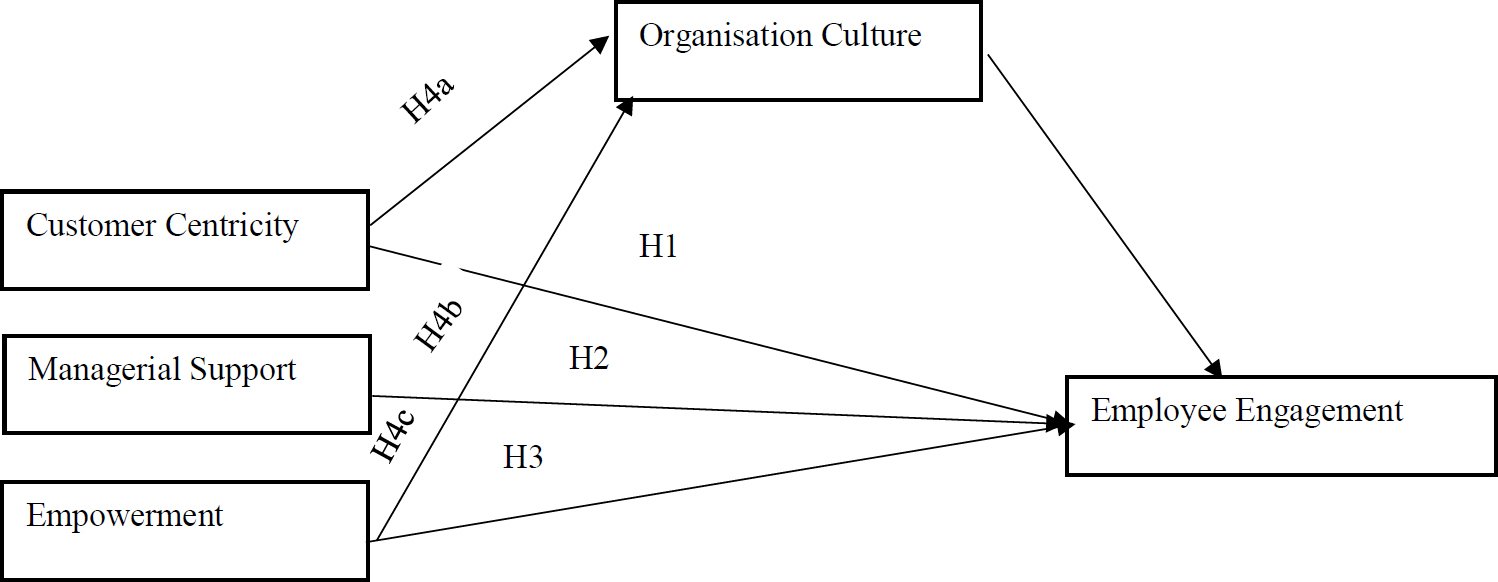
Fig. (1). Conceptual framework.
3. RESEARCH METHODOLOGY
The study has employed survey-based data collection to evaluate the influence of people dimension on employee engagement within the telecom industry of Abu Dhabi. The research targeted 675 employees working within the telecom sector, drawn from various departments such as technical support, customer service, operations, and management. Purposive sampling was applied to ensure a representation of employees across different roles and organisational levels. A total of 462 responses were collected, resulting in a response rate of 68.4%. After data cleaning, 77 responses were excluded due to missing or incomplete data, leaving 385 valid responses for analysis. Therefore, this sample size is sufficient to ensure reliable and valid results and provided statistical power for data analysis.
Data collection was carried out using a structured survey questionnaire (Appendix A). The questionnaire was designed to capture the study’s primary variables: people dimensions (independent variables), organisational culture (mediating variable), and employee engagement (dependent variable). The survey included 5-point Likert-scale closed ended questionnaire, allowing for a comprehensive assessment of the factors influencing employee engagement.
The data was analysed using Partial Least Squares- Structural Equation Modelling (PLS-SEM), which was chosen for its ability to test both direct and indirect relationships and mediating effects among the investigated variables. It involves two where the first stage involves measurement model evaluation using confirmatory factor analysis to confirm reliability and validity of the constructs and the second stage includes path analysis or structural model to test the hypothesis.
All research procedures followed appropriate ethical protocols to ensure research integrity. Informed consent was obtained from all participants, and the study’s objectives, tasks, and the option to withdraw without consequences were clearly explained. The confidentiality of responses was maintained, and all data were anonymised to protect participant privacy. Additionally, participants were assured that their personal information would remain undisclosed. Data security measures ensured that all data were securely stored, with access restricted to authorised personnel only. The study findings have been communicated in aggregate form to guarantee the anonymity of all participants.
As shown in Table 1, the demographic profile of the participants includes a diverse representation of employees across various roles and departments within the telecom sector of Abu Dhabi. The sample comprises 220 male (57.14%) and 165 female (42.86%) participants. In terms of age, most participants fall into the 25-44 age range, with 120 participants (31.17%) in the 25-34 age group and 135 participants (35.06%) in the 35-44 age group. The sample also includes a broad range of job positions, with Customer Relations employees making up 28.57% (110 participants), followed by Technical Services (25.97%, 100 participants), Operational Services (24.68%, 95 participants), and Administrative Management (20.78%, 80 participants).
Table 1. Demographic profile of the participants.
| Demographic Variable | Category | Frequency (n = 385) | Percentage (%) |
| Gender | Male | 220 | 57.14% |
| Female | 165 | 42.86% | |
| Age Group | 18-24 | 45 | 11.69% |
| 25-34 | 120 | 31.17% | |
| 35-44 | 135 | 35.06% | |
| 45-54 | 70 | 18.18% | |
| 55+ | 15 | 3.90% | |
| Job Position | Technical Services | 100 | 25.97% |
| Customer Relations | 110 | 28.57% | |
| Operational Services | 95 | 24.68% | |
| Administrative Management | 80 | 20.78% | |
| Length of Employment | Less than 1 year | 40 | 10.39% |
| 1-3 years | 130 | 33.77% | |
| 4-6 years | 120 | 31.17% | |
| 7-10 years | 60 | 15.58% | |
| More than 10 years | 35 | 9.09% | |
| Education Level | Secondary Education | 40 | 10.39% |
| Bachelor’s Degree | 160 | 41.56% | |
| Master’s Degree or Equivalent | 140 | 36.36% | |
| Doctoral Degree | 25 | 6.49% | |
| Other Qualifications | 20 | 5.19% |
Regarding length of employment, the largest group has been employed for 1-3 years (33.77%, 130 participants), with 120 participants (31.17%) employed for 4-6 years. The education level of the participants indicates that most hold Bachelor’s degree (41.56%, 160 participants), followed by Master’s degree or equivalent (36.36%, 140 participants). This diverse demographic representation ensures that the study captures various perspectives on employee engagement, people dimensions, and organisational culture in the telecom sector.
4. RESULTS AND ANALYSIS
4.1. Measurement Model Assessment
To evaluate the reliability and validity of the latent variables, the study employed measurement model which was assessed by examining each construct’s factor loadings, Cronbach’s Alpha, Composite Reliability (rho_a), and Average Variance Extracted (AVE). Factor loadings measure the strength of the relationship between the observed indicators and their respective latent variables. Cronbach’s Alpha and Composite Reliability assess the internal consistency and reliability of the constructs, while AVE evaluates the extent to which the construct explains the variance of its indicators. The results confirm that the measurement model demonstrates satisfactory psychometric properties, with all the factor loadings, reliability values, and AVE exceeding the acceptable thresholds (Baharum et al., 2023).
Table 2 displays the measurement model results from Measurement Model. The factor loadings for all indicators are above 0.80, indicating strong relationships between the indicators and their respective latent variables. Cronbach’s Alpha values for each construct exceed 0.80, suggesting high internal consistency and reliability (Hair et al., 2019). The Composite Reliability scores also support the constructs’ reliability, with values above 0.80. Additionally, the Average Variance Extracted (AVE) for each construct is above the threshold of 0.50, demonstrating good convergent validity, meaning that the constructs explain a substantial portion of the variance in the observed indicators.
Table 2. Measurement model.
| Latent Variables | Indicators | Factor Loadings | Cronbach’s Alpha | Composite Reliability | Average Variance Extracted (AVE) |
| Customer Centricity | CC1 | 0.880 | 0.851 | 0.853 | 0.771 |
| CC2 | 0.899 | ||||
| CC3 | 0.854 | ||||
| Empowerment | E1 | 0.892 | 0.894 | 0.905 | 0.825 |
| E2 | 0.928 | ||||
| E3 | 0.880 | ||||
| Employee Engagement | EE1 | 0.911 | 0.883 | 0.885 | 0.811 |
| EE2 | 0.933 | ||||
| EE3 | 0.880 | ||||
| Managerial Support | MS1 | 0.812 | 0.811 | 0.816 | 0.727 |
| MS2 | 0.903 | ||||
| MS3 | 0.841 | ||||
| Organisational Culture | OC1 | 0.907 | 0.901 | 0.901 | 0.835 |
| OC2 | 0.930 | ||||
| OC3 | 0.904 |
In summary, the measurement model in Fig. (2) has satisfactory psychometric properties. High factor loadings, Cronbach’s Alpha, composite reliability, and AVE values confirm that the constructs of the research are reliable and valid and can be used for analysis. Customer Centricity, Empowerment, Employee Engagement, Managerial Support, and Organisational Culture have high internal consistency and convergent validity.
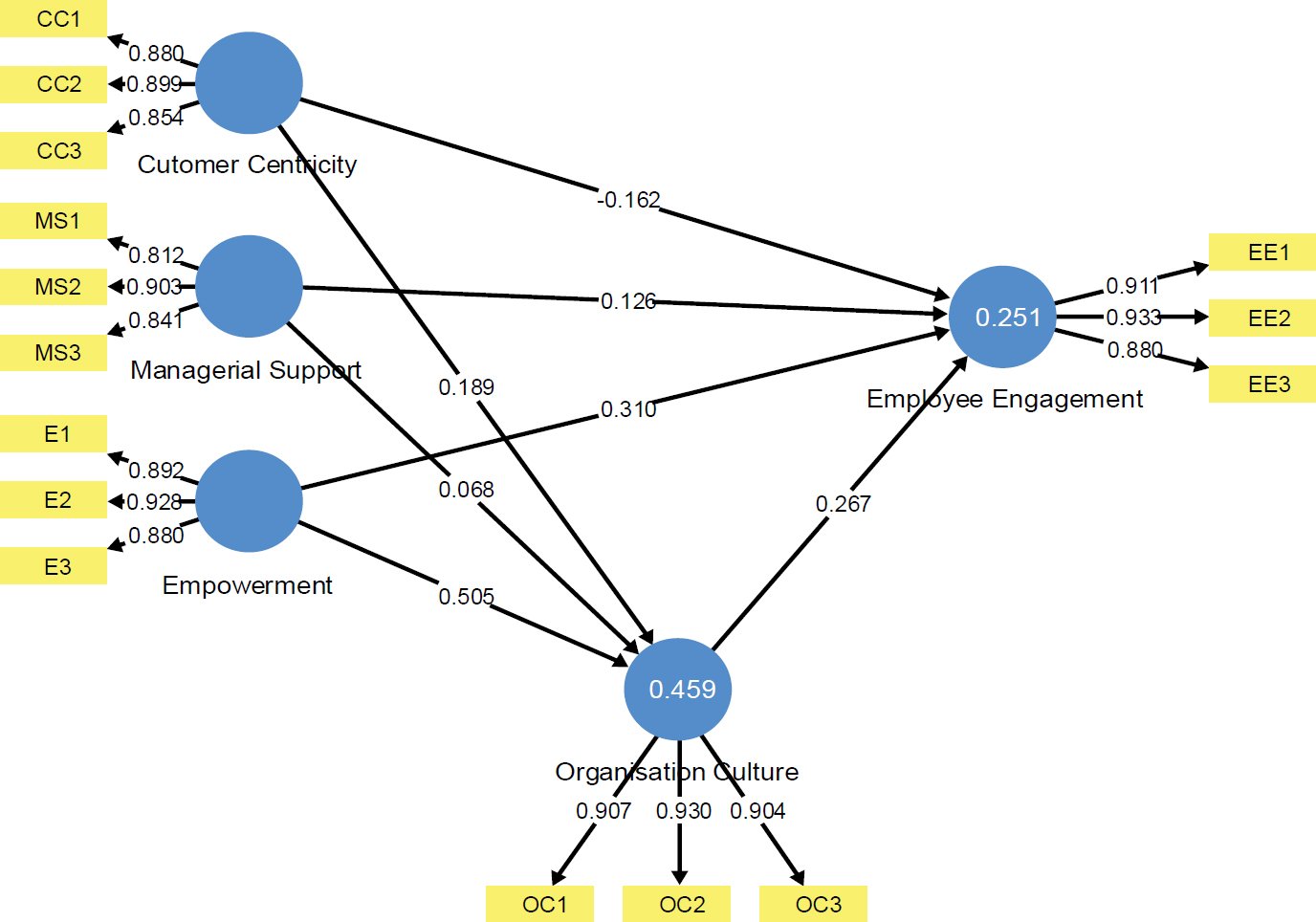
Fig. (2). Measurement model using CFA (showing factor loading, path coefficient, and R-squared).
The discriminant validity using HTMT ratio is shown in the Table 3 through the correlations among the latent variables. The values of HTMT are fairly low, meaning that each construct is unique, with Empowerment correlating highest with Organisational Culture (0.733) and Customer Centricity correlating lowest with Employee Engagement (0.276).
Table 3. Discriminant validity.
| – | Customer Centricity | Employee Engagement | Empowerment | Managerial Support |
| Employee Engagement | 0.276 | – | – | – |
| Empowerment | 0.718 | 0.495 | – | – |
| Managerial Support | 0.620 | 0.343 | 0.550 | – |
| Organisational culture | 0.614 | 0.477 | 0.733 | 0.467 |
4.2. Direct Effects
The direct effects table shows the direct relationships between the independent variables (People Dimensions) and the dependent variable (Employee Engagement), as well as the direct relationships between the mediator (Organisational Culture) and other variables.
The path analysis results (Table 4) reveal several important relationships between the latent variables in this study. Customer Centricity has a negative effect on Employee Engagement (β = -0.162, P = 0.035), suggesting that an increase in customer-centric practices may slightly reduce employee engagement. Although the effect is weak, it is statistically significant at the 5% level. However, Customer Centricity positively influences Organisational Culture (β = 0.189, P = 0.002), implying that a focus on customer satisfaction can foster a positive culture within the organisation. This relationship is moderate but significant. Empowerment has a much stronger positive effect on Employee Engagement (β = 0.310, p < 0.001), indicating that giving employees more autonomy and authority significantly enhance their engagement. Furthermore, Empowerment also has a very strong effect on Organisational Culture (β = 0.505, p < 0.001), suggesting that empowering employees helps to build a culture that values autonomy and creativity. In contrast, Managerial Support shows a marginally significant positive effect on Employee Engagement (β = 0.126, p = 0.075), with a weak relationship that is statistically insignificant. The effect of Managerial Support on Organisational Culture is not significant (β = 0.068, p = 0.235), indicating that managerial support does not play a significant role in shaping the culture. Finally, Organisational Culture has a positive and significant effect on Employee Engagement (β = 0.267, p = 0.002), demonstrating that a positive organisational culture strongly influences employee engagement.
Table 4. Direct effects.
| Path Coefficients | T Statistics | P Values | |
| Customer Centricity -> Employee Engagement | -0.162 ** | 2.112 | 0.035 |
| Customer Centricity -> Organisational culture | 0.189 *** | 3.080 | 0.002 |
| Empowerment -> Employee Engagement | 0.310 *** | 3.879 | <0.001 |
| Empowerment -> Organisational culture | 0.505 *** | 8.731 | <0.001 |
| Managerial Support -> Employee Engagement | 0.126 * | 1.783 | 0.075 |
| Managerial Support -> Organisational culture | 0.068 | 1.188 | 0.235 |
| Organisational culture -> Employee Engagement | 0.267 *** | 3.038 | 0.002 |
Note: ***: Significance at 1%, **: Significance at 5%, *: Significance at 10%
The mediation results further indicate that Customer Centricity had a significant negative direct effect on Employee Engagement (β = −0.162, p = 0.035), while its indirect effect through Organisational Culture was positive and significant (β = 0.050, p = 0.017). These opposite-sign effects indicate an inconsistent mediation pattern. However, the total effect was not statistically significant (β = −0.111, p = 0.153), indicating that the positive indirect effect did not translate into a significant overall effect on Employee Engagement.In terms of indirect effects for mediation analysis, Empowerment appears to have the strongest and most significant indirect effect on Employee Engagement through Organisational Culture, given its large effect on both variables as shown in Table 5. In contrast, Customer Centricity’s indirect effect on Employee Engagement is likely weak, as the direct effect of Customer Centricity on engagement is negative. Furthermore, the indirect effect of Managerial Support through Organisational Culture is negligible due to the non-significant relationships in both paths. Overall, Empowerment exerts the most significant and impactful effect on Employee Engagement and Organisational Culture, while Managerial Support and Customer Centricity have weaker and less significant effects, particularly when considering their indirect impacts.
Table 5. Indirect effects.
| Path Coefficients | T Statistics | P Values | |
| Customer Centricity -> Organisational culture -> Employee Engagement | 0.050** | 2.386 | 0.017 |
| Empowerment -> Organisational culture -> Employee Engagement | 0.135 *** | 2.782 | 0.005 |
| Managerial Support -> Organisational culture -> Employee Engagement | 0.018 | 1.008 | 0.314 |
Note: ***: Significance at 1%, **: Significance at 5%, *: Significance at 10%
The Total Effects (Table 6) shows that Employee Engagement results from the combined influence of People Dimensions together with Organisational Culture. The impact of Customer Centricity on Employee Engagement turns out to be negative yet unimportant (β = -0.111, p = 0.153) whereas its effects on Organisational Culture are both significant and positive (β = 0.189, p = 0.002). This shows that customer-oriented practises benefit organisational culture development. An organisation finds that empowerment generates the maximum positive influence on Employee Engagement (β = 0.445, p < 0.001) and Organisational Culture (β = 0.505, p < 0.001). These findings demonstrate that employee empowerment increases engagement levels and strengthens cultural values in the company. Employee Engagement receives substantially significant positive support from Managerial Support measures (β = 0.144, p = 0.044) but Organisational Culture shows no meaningful impact from this variable (β = 0.068, p = 0.235). The results indicate Organisational Culture has a strong positive relationship to Employee Engagement at the 0.002 significance level (β = 0.267). This finding demonstrates why organisations must establish positive organisational cultures to improve employee engagement. The study reveals Empowerment stands as the dominant force which increases employee engagement together with organisational culture though Customer Centricity and Managerial Support demonstrate reduced engagement effects. The analysis of mediation indicates partial mediation of Organisational Culture between People Dimensions and Employee Engagement. Empowerment has a strong impact on engagement both directly and indirectly through culture, whereas Customer Centricity has negative direct impact on employee engagement but organisational culture positively mediates the relationship. The insignificance of total effect indicates the complex dynamics of this variable which can be further better examined using different other variables or factors affecting it as well. Managerial Support’s mediation is small. This suggests direct actions and cultural building are crucial for improving engagement.
Table 6. Total effects.
| Path Coefficient | T Statistics | P Values | |
| Customer Centricity -> Employee Engagement | -0.111 | 1.430 | 0.153 |
| Customer Centricity -> Organisational culture | 0.189 *** | 3.080 | 0.002 |
| Empowerment -> Employee Engagement | 0.445 *** | 6.550 | <0.001 |
| Empowerment -> Organisational culture | 0.505 *** | 8.731 | <0.001 |
| Managerial Support -> Employee Engagement | 0.144** | 2.012 | 0.044 |
| Managerial Support -> Organisational culture | 0.068 | 1.188 | 0.235 |
| Organisational culture -> Employee Engagement | 0.267*** | 3.038 | 0.002 |
Note: ***: Significance at 1%, **: Significance at 5%, *: Significance at 10%
4.3. Model Explanatory Power
Table 7 shows the explanatory power of the model. Employee engagement shows R-Square of 0.251. It indicates that the people dimension variables such as customer centricity, empowerment and managerial support explains 25.1% variation in employee engagement. Furthermore, organisational culture has R-Square of 0.459 showing that customer centricity, empowerment and managerial support explain 45.9% of variation in the organisational culture.
Table 7. Explanatory power.
| R-Square | R-Square Adjusted | |
| Employee Engagement | 0.251 | 0.243 |
| Organisational culture | 0.459 | 0.455 |
5. DISCUSSION AND HYPOTHESIS ASSESSMENT
The main aim of this study was to explore the impact of people dimensions, customer centricity, empowerment, and managerial support, on employee engagement in the telecom industry of Abu Dhabi, and evaluate the role of Organisational Culture as a mediator in such relationships. The aim was not only to learn about the direct impacts of these variables on employee engagement, but also about how much organisational culture serves as a conduit strengthening or influencing these effects.
The results of the analysis provided several noteworthy findings. Empowerment proved to be the strongest predictor of Employee Engagement with clear direct and indirect effects through organisational culture. This supports that when employees are entrusted with autonomy, authority, and resources, they are more engaged and committed towards work. The strong positive effect of empowerment on organisational culture also indicates that empowering practices are building a culture that is appreciative of creativity and autonomy, leading to increased engagement. This is supported through (Lai et al., 2020; Okochi & Ateke, 2020; and Shkoler & Kimura, 2020), which highlights the pivotal role of empowerment in fostering engagement through higher responsibility and purposeful work.
On the contrary, Customer Centricity demonstrated a mixed relationship. Though it was positively and significantly associated with Organisational Culture, its direct association with Employee Engagement was negative. The positive indirect effect via culture partially balances this negative direct impact. This balanced finding aligns with the Job Demands-Resources (JD-R) model explanation presented by (Gillet et al., 2024), where customer-centric practices serve as both resources and demands encouraging employees when well managed but threatening to induce stress and disengagement when demands outstrip resources. It speaks to the fine line organisations need to walk to leverage customer centricity optimally without overexerting employees.
Managerial Support had a weak positive direct effect on Employee Engagement (β = 0.126, p = 0.075) but not significant at 5%; similarly, its effect on Organisational Culture was non-significant (β = 0.068, p = 0.235). The indirect effect through Organisational Culture was also non-significant (β = 0.018, p = 0.314), indicating that the mediating role of organisational culture was not supported. Nevertheless, the overall effect of managerial support on engagement was positive, showing that managerial behaviours directly have a positive effect on engagement but might do so largely through direct interpersonal relationships rather than influencing the broader culture. This is in line with the Social Exchange Theory approach (Kilroy et al., 2023) as well as the conclusions of (Aldabbas et al., 2025) emphasizing the critical role of immediate manager-employee support in generating motivation and commitment.
Organisational Culture itself had a significant positive effect on Employee Engagement, reinforcing its pivotal position as the driver of an environment in which people feel valued and engaged in the organisational agenda. The mediation results indicate that organisational culture significantly mediated the relationships of Customer Centricity and Empowerment with Employee Engagement, but not the relationship between Managerial Support and Employee Engagement. The result reinforces Schein’s Organisational Culture Theory (Schein, 2010) wherein culture is argued to facilitate employee attitude and behaviour. Table 8 represents the summary of the hypotheses based on the results obtained below.
Table 8. Summary of hypotheses.
| Developed and Tested Hypotheses | Status |
| H1: Customer Centricity positively affects Employee Engagement in the telecom sector of Abu Dhabi | Rejected |
| H2: Managerial Support positively affects Employee Engagement in the telecom sector of Abu Dhabi | Rejected |
| H3: Empowerment positively affects Employee Engagement in the telecom sector of Abu Dhabi | Accepted |
| H4a: Organisational Culture mediates the relationship between Customer Centricity and Employee Engagement in Abu Dhabi’s telecom sector. | Inconsistent Mediation |
| H4b: Organisational Culture mediates the relationship between managerial support and Employee Engagement in Abu Dhabi’s telecom sector. | No Significant Mediation |
| H4c: Organisational Culture mediates the relationship between empowerment and Employee Engagement in Abu Dhabi’s telecom sector. | Partial Mediation |
Implications of the findings are significant for Abu Dhabi telecom sector management. Empowerment needs to be a top-down priority as a strategic instrument for stimulating employee engagement and developing a robust organisational culture. Customer focus strategies need to be balanced with sufficient resources and support to avoid the negative impact on engagement. Managerial support is still crucial but supplemented by culture-construction initiatives to optimize its application. Organisations need to ensure a supportive culture that aligns people dimension practices with engagement objectives, hence achieving sustainable competitive advantage through committed and motivated employees. Furthermore, customer centricity has shown the complex dynamic indicating the implication that telecom sector employees must consider customer centric approaches carefully and ensure that their approach towards customers centric aspect is strong.
CONCLUSION
This research studied the impacts of People Dimensions Customer Centricity, Managerial Support, and Empowerment on Employee Engagement in the telecom industry in Abu Dhabi, with a focus on the mediating effect of Organisational Culture. The findings reveal that Empowerment is the strongest driver of employee engagement, having strong direct and indirect effects through organisational culture. Empowering workers through autonomy and resources creates a culture of creativity and accountability, which enhances engagement. In contrast, Customer Centricity had a negative direct impact on engagement but a positive effect on organisational culture, which may indicate that customer focus can build culture but that cause stress and disengagement, as would be predicted by the Job Demands-Resources model. Managerial Support had a weak positive but statistically non-significant direct effect on Employee Engagement at the 5% significance level, and its effect on Organisational Culture was non-significant. The indirect effect through Organisational Culture was also non-significant, providing no evidence of mediation for this pathway. These results underscore the necessity for balanced customer focus practices, firm empowerment strategies, and supportive managerial practices to facilitate ongoing employee commitment.
POLICY IMPLICATIONS
The policy implications of the research are important to managers in the telecom industry and HR practitioners working in Abu Dhabi and comparable markets. Having recognised Empowerment as a major driver of employee engagement, organisations are motivated to adopt policies that give employees more autonomy, decision-making powers, and resource access. These practices can promote motivation, creativity, and commitment, contributing to increased productivity and innovation. The research also emphasises the need for balancing Customer Centricity with supportive employee provisions so that burnout and disengagement are avoided, encouraging managers to develop customer-centric strategies that are sustainable and employee-friendly. In addition, while Managerial Support has a lesser influence on culture, its direct positive influence on engagement emphasises the worth of good, supportive leadership and communications. Overall, this study provides actionable recommendations for creating a positive organisational culture that supports people-focused initiatives, allowing telecom operators to sustain competitive edge through an energised, engaged, and resilient workforce.
LIMITATIONS & FUTURE DIRECTION
This research’s limitation implies different future directions. The study’s cross-sectional design restricts causal inferences, reflecting need for longitudinal studies in capturing changes in employee engagement over time. The focus on Abu Dhabi’s telecom sector restricts generalisability. Hence, future studies can explore different industries and geographic regions for broader applicability. Furthermore, relying on self-reported survey data may reveal bias, hence incorporating qualitative methods can enhance validity. Finally, evaluating other potential mediators or moderators like leadership styles, technological change or employee wellbeing can provide comprehensive understanding of factors shaping employee engagement. Furthermore, as study revealed the complex dynamic of the customer centricity, it is important to consider various other factors that can be involved in the relationship of customer centricity and employee engagement. The future researchers can consider different moderating or mediating variables that can intervene with this dynamic.
LIST OF ABBREVIATIONS
AVE | = | Average Variance Extracted |
EE | = | Employee Engagement |
JD-R | = | Job Demands-Resources |
OC | = | Organisational Culture |
PD | = | People Dimensions |
PLS-SEM | = | Partial Least Squares-Structural Equation Modelling |
AUTHOR’S CONTRIBUTION
The entire work including conceptualisation, methodology, analysis, software work, writing, and editing/proofreading before final submission was done by F.A.
ETHICAL APPROVAL & INFORMED CONSENT
All research procedures followed appropriate ethical protocols to ensure research integrity. Informed consent was obtained from all participants, and the study’s objectives, tasks, and the option to withdraw without consequences were clearly explained. The confidentiality of responses was maintained, and all data were anonymised to protect participant privacy. Additionally, participants were assured that their personal information would remain undisclosed. Data security measures ensured that all data were securely stored, with access restricted to authorised personnel only.
AVAILABILITY OF DATA AND MATERIALS
The data will be made available on reasonable request by contacting the corresponding author [F.A.].
FUNDING
None.
CONFLICT OF INTEREST
The author declares that there is no conflict of interest regarding the publication of this article.
ACKNOWLEDGEMENTS
Declared none.
DECLARATION OF AI
During the preparation of this work the author used ChatGPT for editing purposes. After using this tool, the author reviewed and edited the content as needed and take full responsibility for the content of the published article.
APPENDIX A: QUESTIONNAIRE
Section A: Demographics
- Gender
- Male
- Female
- Age
- 18-24
- 25-34
- 35-44
- 45-54
- 55+
- Job Position
- Technical Services
- Customer Relations
- Operational Services
- Administrative Management
- Length of Employment
- Less than 1 year
- 1-3 years
- 4-6 years
- 7-10 years
- More than 10 years
- Education Level
- Secondary Education
- Bachelor’s Degree
- Master’s Degree or Equivalent
- Doctoral Degree
- Other Qualifications
Section B: People Dimension
Rate the following statements based on the following scale
1= strongly disagree, 2= disagree, 3= neutral, 4= agree and 5= strongly agree
| Customer Centricity | 1 | 2 | 3 | 4 | 5 |
| The organisation prioritizes customers’ needs in all decision-making processes. | |||||
| Employees are encouraged to understand and address customer concerns effectively. | |||||
| Customer satisfaction is considered a key measure of organisational success. | |||||
| Managerial Support | 1 | 2 | 3 | 4 | 5 |
| My manager provides timely guidance and assistance when I face work challenges. | |||||
| I feel supported by management in my professional development and growth. | |||||
| Management recognises and appreciates employees’ contributions regularly. | |||||
| Empowerment | 1 | 2 | 3 | 4 | 5 |
| I have the authority to make decisions relevant to my job responsibilities. | |||||
| The organisation encourages employees to take initiative and be innovative. | |||||
| I feel confident in my ability to influence work outcomes. |
Section C: Employee Engagement
| 1 | 2 | 3 | 4 | 5 | |
| I am enthusiastic about my work and committed to the organisation’s goals. | |||||
| I feel motivated to put in extra effort beyond my job requirements. | |||||
| I actively participate in activities that improve the workplace environment. |
Section D: Organisational culture
| 1 | 2 | 3 | 4 | 5 | |
| The organisation fosters a culture of collaboration and mutual respect. | |||||
| Innovation and creativity are valued and encouraged in this organisation. | |||||
| Communication within the organisation is open and transparent. |
REFERENCES
Afram, J., Manresa, A., & Mas Machuca, M. (2022). The impact of employee empowerment on organisational performance: The mediating role of employee engagement and organisational citizenship behaviour. Intangible Capital, 18(1), 96–119.
https://doi.org/10.3926/ic.1781
Ahmad, R., Nawaz, M. R., Ishaq, M. I., Khan, M. M., & Ashraf, H. A. (2023). Social exchange theory: Systematic review and future directions. Frontiers in Psychology, 13, 1015921.
https://doi.org/10.3389/fpsyg.2022.1015921
Ahmed, M., & Shafiq, S. (2014). The Impact of Organizational Culture on Organizational Performance: A Case Study of Telecom Sector. Global Journal of Management and Business Research: A Administration and Management, 14(3). Available from: https://www.researchgate.net/publication/323799766_The_Impact_of_Organizational_Culture_on_Organizational_PerformanceA_Case_Study_on_Telecom_Sector
Al Kurdi, B., Alshurideh, M., & Alnaser, A. (2020). The impact of employee satisfaction on customer satisfaction: Theoretical and empirical underpinning. Management Science Letters, 10(15), 3561–3570.
https://doi.org/10.5267/j.msl.2020.6.038
Aldabbas, H., Pinnington, A., Lahrech, A., & Blaique, L. (2025). Extrinsic rewards for employee creativity? The role of perceived organisational support, work engagement and intrinsic motivation. International Journal of Innovation Science, 17(2), 237–260.
https://doi.org/10.1108/IJIS-08-2022-0165
Atiku, S. O., Itembu-Naunyango, K. A., & Oladejo, O. M. (2024). Inclusive Leadership and Employee Engagement as Critical Drivers of Sustainability in Telecommunication Companies. Administrative Sciences, 14(6), 126.
https://doi.org/10.3390/admsci14060126
Baharum, H., Ismail, A., Awang, Z., McKenna, L., Ibrahim, R., Mohamed, Z., & Hassan, N. H. (2023). The study adapted instruments based on Confirmatory Factor Analysis (CFA) to validate measurement models of latent constructs. International Journal of Environmental Research and Public Health, 20(4), 2860.
https://doi.org/10.3390/ijerph20042860
Bakker, A. B., & Demerouti, E. (2007). The Job Demands‐Resources model: State of the art. Journal of Managerial Psychology, 22(3), 309–328.
https://doi.org/10.1108/02683940710733115
Banović-Ćurguz, N., & Ilišević, D. (2018). Customer-centric culture as enabler of digital transformation. 2018 41st International Convention on Information and Communication Technology, Electronics and Microelectronics (MIPRO), 0400–0404.
https://doi.org/10.23919/mipro.2018.8400076
Celestin, M., Vasuki, M., Sujatha, S., & Kumar, A. D. (2024). Enhancing Employee Satisfaction and Engagement to Boost Productivity: The Role of Leadership, Culture, and Recognition Programs. International Journal of Computational Research and Development, 9(2), 67–74.
https://doi.org/10.5281/zenodo.13871930
Deepalakshmi, N., Tiwari, D., Baruah, R., Seth, A., & Bisht, R. (2024). Employee Engagement And Organizational Performance: A Human Resource Perspective. Educational Administration: Theory and Practice, 30(4), 5941–5948.
https://doi.org/10.53555/kuey.v30i4.2323
Dennerlein, T., & Kirkman, B. L. (2022). The hidden dark side of empowering leadership: The moderating role of hindrance stressors in explaining when empowering employees can promote moral disengagement and unethical pro-organizational behavior. Journal of Applied Psychology, 107(12), 2220.
https://doi.org/10.1037/apl0001013
Elidemir, S. N., Ozturen, A., & Bayighomog, S. W. (2020). Innovative Behaviors, Employee Creativity, and Sustainable Competitive Advantage: A Moderated Mediation. Sustainability, 12(8), 3295.
https://doi.org/10.3390/su12083295
Gallup. (2021). State of the Global Workplace: 2021 Report. Available from: https://www.scirp.org/reference/referencespapers?referenceid=3552998
Ghlichlee, B., & Bayat, F. (2021). Frontline employees’ engagement and business performance: The mediating role of customer-oriented behaviors. Management Research Review, 44(2), 290–317.
https://doi.org/10.1108/MRR-11-2019-0482
Gillet, N., Morin, A. J. S., & Blais, A.-R. (2024). A Multilevel Person-Centered Perspective on the Role of Job Demands and Resources for Employees’ Job Engagement and Burnout Profiles. Group & Organization Management, 49(3), 621–672.
https://doi.org/10.1177/10596011221100893
Gupta, S., & Ramachandran, D. (2021). Emerging market retail: Transitioning from a product-centric to a customer-centric approach. Journal of Retailing, 97(4), 597–620.
https://doi.org/10.1016/j.jretai.2021.01.008
Hair, J. F., Risher, J. J., Sarstedt, M., & Ringle, C. M. (2019). When to use and how to report the results of PLS-SEM. European Business Review, 31(1), 2–24.
https://doi.org/10.1108/EBR-11-2018-0203
He, J., Morrison, A. M., & Zhang, H. (2021). How high-performance HR practices and LMX affect employee engagement and creativity in hospitality. Journal of Hospitality & Tourism Research, 45(8), 1360–1382.
https://doi.org/10.1177/1096348021996800
Kadim, N. H. (2018). Determinant factors of service oriented organizational citizenship behavior among employees in a telecommunication company [Universiti Utara Malaysia]. Available from: https://etd.uum.edu.my/id/eprint/7388
Kilroy, J., Dundon, T., & Townsend, K. (2023). Embedding reciprocity in human resource management: A social exchange theory of the role of frontline managers. Human Resource Management Journal, 33(2), 511–531.
https://doi.org/10.1111/1748-8583.12468
Kithae, P. P. (2023). Interplay between Technology and Culture in Driving Change for Employee Satisfaction. Organizational Culture-Cultural Change and Technology.
https://doi.org/10.5772/intechopen.112905
Lai, F.-Y., Tang, H.-C., Lu, S.-C., Lee, Y.-C., & Lin, C.-C. (2020). Transformational leadership and job performance: The mediating role of work engagement. Sage Open, 10(1), 2158244019899085.
https://doi.org/10.1177/2158244019899085
Ljubica, J., Littrell, R. F., Warner-Søderholm, G., & Minelgaite, I. (2022). Empower me or not? Influence of societal culture. Cross Cultural & Strategic Management, 29(1), 114–146.
https://doi.org/10.1108/CCSM-05-2021-0091
MacGillavry, K., & Sinyan, P. (2016). Focusing on the Critical Link Between Employee Engagement and Customer Centricity at DHL Freight. Global Business and Organizational Excellence, 35(4), 6–16.
https://doi.org/10.1002/joe.21680
Modor Intelligence. (2025). Telecom Industry in UAE Size-Industry Report on Share, Growth Trends & Forecasts Analysis .(2025-2030). Available from: https://www.mordorintelligence.com/industry-reports/analysis-of-the-telecom-sector-in-the-united-arab-emirates-industry
Okochi, K., & Ateke, B. W. (2020). Employee empowerment: A strategy for optimizing employee performance. Nigerian Journal of Business and Social Review, 11(2), 125–137. Available from: https://www.researchgate.net/publication/368449588_Employee_Empowerment_A_Strategy_for_Optimizing_Employee_Performance
Oxford Business Group. (2023). The Report: Abu Dhabi 2023. Available from: https://oxfordbusinessgroup.com/reports/uae-abu-dhabi/2023-report/
Parent, J. D., & Lovelace, K. J. (2018). Employee engagement, positive organizational culture and individual adaptability. On the Horizon, 26(3), 206–214.
https://doi.org/10.1108/OTH-01-2018-0003
Pougajendy, S., Mathiazhagan, A., & Karunamurthy, A. (2024). The Role of Organizational Culture in Driving Employee Engagement: Insights and Implications. Quing: International Journal of Multidisciplinary Scientific Research and Development, 3(3), 26–32.
https://doi.org/10.54368/qijmsrd.3.3.0009
PWC. (2023). The Leadership Agenda. Available from: https://www.pwc.com/gx/en/issues/c-suite-insights/the-leadership-agenda.html
Rajagopal, A. (2020). Transforming entrepreneurial business design: Converging leadership and customer-centric approach. Journal of Transnational Management, 25(2), 128–153.
https://doi.org/10.1080/15475778.2020.1734418
Saleem, Z., Shenbei, Z., & Hanif, A. M. (2020). Workplace violence and employee engagement: The mediating role of work environment and organizational culture. SAGE Open, 10(2).
https://doi.org/10.1177/2158244020935885
Schein, E. H. (2010). Organizational culture and leadership (Vol. 2). John Wiley & Sons. Available from: https://www.scirp.org/reference/referencespapers?referenceid=2404590
Schwarzburg, D. (2024). Five Strategies To Drive Innovation In A Fast-Paced Market. Forbes. Available from: https://www.forbes.com/councils/forbesbusinesscouncil/2024/12/04/five-strategies-to-drive-innovation-in-a-fast-paced-market/
Setrojoyo, S. M., Rony, Z. T., Sutrisno, S., Naim, S., Manap, A., & Sakti, B. P. (2023). The effect of intrinsic motivation, organizational culture on employee performance with organizational commitment as an intervening variable. International Journal of Professional Business Review: Int. J. Prof. Bus. Rev., 8(7), 52.
https://doi.org/10.26668/businessreview/2023.v8i7.2436
Shkoler, O., & Kimura, T. (2020). How does work motivation impact employees’ investment at work and their job engagement? A moderated-moderation perspective through an international lens. Frontiers in Psychology, 11, 487698.
https://doi.org/10.3389/fpsyg.2020.00038
Slabbert, H. (2018). The Influence of Employee Engagement on Customer Experience in a Customer Centric Climate and Culture. University of Johannesburg (South Africa). Available from: https://hdl.handle.net/10210/292386
Sparrow, P., Hird, M., & Cooper, C. L. (2015). Customer Centricity and People Management. In Do We Need HR? Palgrave Macmillan.
https://doi.org/10.1057/9781137313775_3
Turner, P. (2020). Employee Engagement in Contemporary Organizations Maintaining High Productivity and Sustained Competitiveness. Palgrave Macmillan.
https://link.springer.com/content/pdf/10.1007/978-3-030-36387-1.pdf
Tyagi, N. (2021). Aligning organizational culture to enhance managerial effectiveness of academic leaders: An interface for employee engagement and retention. International Journal of Educational Management, 35(7), 1387–1404.
https://doi.org/10.1108/IJEM-10-2020-0447
Yadav, A., Pandita, D., & Singh, S. (2022). Work-life integration, job contentment, employee engagement and its impact on organizational effectiveness: A systematic literature review. Industrial and Commercial Training, 54(3), 509–527.
https://doi.org/10.1108/ICT-12-2021-0083
Yousif Ali, M. S., & Hasaballah, A. H. A. (2020). Assessing the effect of organizational cultural values and employee’s engagement on performance excellence. International Journal of Management, 11(4), 108-126. Available from: https://ssrn.com/abstract=3600700
Licensed
© 2026 Copyright by the Authors.
Licensed as an open access article using a CC BY 4.0 license.
Article Contents Author Sumaira Sharif1, * 1Department of Mathematics, University of Central Punjab, Lahore, Pakistan Article History: Received: 25 September,
Article Contents Author Atta Ullah1, * , Chan Yen San1 1Department of Chemical & Energy Engineering, Faculty of Engineering and
Article Contents Author Abdulrahman Mawlood Abdulghani1, * , Bilal Omar Akram1 1Department of Communication Technology and Network, Faculty of Computer
Article Contents Author Ananya Mishra1, * 1GIFT Engineering and Management College, GIFT Autonomous, Bhubaneswar, India Article History: Received: 13 June,
Article Contents Author Snehal Bansod1, * 1Department of Oral and Maxillofacial Surgery, Maitri Educational Society, Chhattisgarh, India Article History: Received:
Article Contents Author Shallu Kadiyan1, Anupreet Kaur Sobti1 , Ritu Pradhan1 , Vasudha Bansal1, * 1Department of Foods and Nutrition,