
















Article Contents
Article ID: CMT2622101006
Views: 255Association of Regulatory Compliance Behaviour with HR Compliance Training and Quality Assurance Enforcement in the Saudi Pharmaceutical Sector: Testing Vision 2030-Driven Healthcare Innovation Capability as a Moderator
 DOI:
DOI:
 PDF
PDF
⬇ Downloads: 6
1Department of Business Administration, Emaan Institute of Management and Sciences, Karachi, Pakistan
Received: 11 May, 2026
Accepted: 09 August, 2026
Revised: 03 August, 2026
Published: 27 August, 2026
ABSTRACT:
Introduction: This study explored the association between HR compliance training and quality assurance enforcement with regulatory compliance behaviour among the Saudi pharmaceutical industry and how Vision 2030-driven healthcare innovation capabilities moderate this association.
Methodology: Data were gathered using a structured questionnaire completed by 400 HR compliance officers and quality assurance managers. Partial least squares structural equation modelling (PLS-SEM) was used to test the hypothesised relationships. The findings indicate that regulatory compliance behaviour is associated with HR compliance training (β = 0.380, p = 0.001), but quality assurance enforcement does not show a significant association with regulatory compliance behaviour (β = 0.074, p= 0.313). Vision 2030-driven healthcare innovation capability had a marginally significant moderating impact only on the association between HR compliance training and compliance behaviour (β = 0.121, p = 0.050), but not on quality assurance enforcement and HR compliance training (β = 0.004, p = 0.942).
Results: The results showed that capability-building mechanisms might be a relatively more effective predictor of compliance behaviour than structural enforcement mechanisms, but the effect sizes were relatively small.
Conclusion: The findings of this research have practical implications for informing the design of training and maximising compliance outcomes by capitalising on digital innovation.
Keywords: HR compliance training, quality assurance enforcement, regulatory compliance behaviour, pharmaceutical industry, vision 2030-driven healthcare innovation capability, Saudi Arabia.
1. INTRODUCTION
Regulatory compliance in the pharmaceutical sector of any country is not inadvertent; instead, it is the outcome of cautious and intentional continuous development, institutionalisation, and regulatory and legal evolution. In 2023, the global pharmaceutical regulatory compliance cost manufacturers $50 billion, which grew by 7.17% annually, but the non-compliance fines amounted to 1.1 billion in the last five years (Jessica, 2025). In September 2025 alone, the FDA issued 80 warning letters for pharmaceutical noncompliance, with the average cost of each pharmaceutical violation estimated at $14.8 million by 2026 (Anbil et al., 2026; Cuffari, 2025). These patterns show that it is not just spending that can achieve compliance; behaviour and organisational factors within organisations are equally important in achieving compliance. The following regulatory frameworks are necessary to avoid negative consequences and guarantee the reliability of products, as well as to retain public confidence in healthcare products and services (Anbil et al., 2026).
In this landscape, the Saudi pharmaceutical industry has gained strategic significance. Vision 2030 of Saudi Arabia, chaired by His Royal Highness Prince Mohammed bin Salman, is intended to transform the society and economy of the country, with the healthcare sector being of special interest. The current state of healthcare in Saudi Arabia is 26th globally, with health and social development expenditures exceeding $66.6 billion in 2023 (Global Health Exhibition, 2024). The Saudi Food and Drug Authority (SFDA) has achieved the WHO medicine and vaccine regulation level 4, which is an indicator of improved institutional capacity (WHO, 2023). Although this has been accomplished, compliance issues remain. The Research, Development, and Innovation Authority (RDIA) announced four national research priorities in 2022, with Health and Wellness ranking as a top priority, paving the way for a target of 2.5% annual R&D investment, equivalent to 2.5% of GDP by 2040 (Science & Innovation Network, 2022). Such aspirations subject pharmaceutical companies to considerable strain to ensure that employees perform in accordance with the expectations of regulatory agencies.
Human resource compliance training has emerged as a first-line organisational instrument for developing this alignment. Pharmaceutical workers are bound by complicated and constantly evolving laws and regulations that govern drug development, production, and sales, and they need to be trained regularly to define what is expected and to ensure that all operations comply with the rules (Zubair, 2024). Empirical evidence from the pharmaceutical industry indicates that structured training programs have a dramatic impact on the levels of compliance with current Good Manufacturing Practices (cGMP), especially where training program design and delivery are consistent with operational needs (Muhammad et al., 2025).
In addition to training, quality assurance enforcement (QAE) has become increasingly important. In Saudi Arabia, regulatory inspections conducted by the Saudi Food and Drug (Authority, 2026) revealed 1,713 observations made in pharmaceutical factories in 2023. This inspection was characterised by several non-conformities and facility suspensions, thereby indicating that there are still existing gaps in compliance, despite the fact that formal systems exist to this effect. Additional enforcement measures reflect that 24 pharmaceutical firms have been fined in 2024 due to offences such as the lack of reporting drug movements and supply disruptions, which shows a lack of compliance with operational compliance and reporting systems (Saudi Gazette, 2024). Moreover, according to recent information obtained during the GMP inspection, quality management systems, documentation, and production processes are the most widespread deficiencies, and QAE is significant for ensuring compliance (SFDA, 2025). This implies that QAE does not necessarily translate to behavioural compliance at the employee level, provided that it does not have enforcement mechanisms that make internalisation and engagement possible.
These findings have also been confirmed in academic studies. A recent study that examined Good Clinical Practice inspections by the Saudi Food and Drug Authority revealed that regulatory compatibility is highly reliant on systematic monitoring, documentation, and following standardised procedures, highlighting the need for internal quality systems in pharmaceutical governance (Arab et al., 2025). However, the same body of research proposes that compliance failures often result from gaps in implementation, not the absence of formal frameworks in the organisation. Theoretically, these dynamics can be understood from the Resource-Based View, which states that organisational capabilities, such as training and quality systems, determine successful performance outcomes, and Dynamic Capabilities Theory, which focuses on the role of adaptability in utilising these capabilities in changing regulatory environments. Despite increasing interest in compliance systems, previous studies have mostly focused on training and quality assurance separately, and little interest has been directed towards the combined effects of training and quality assurance on regulatory compliance behaviour in new pharmaceutical markets such as Saudi Arabia.
Consequently, this study examines how HR compliance training and quality assurance enforcement influence regulatory compliance behaviour in the Saudi pharmaceutical industry and how Saudi Vision 2030-driven healthcare innovation capability moderates it. Theoretically, it combines capability-based and adaptive perspectives to offer a single explanation for compliance behaviour. In a practical sense, it offers a contextual background for regulators and drug firms to develop superior systems that adhere to regulations in an expanding, multifaceted, and innovation-driven world.
2. LITERATURE REVIEW
2.1. Key Constructs
It is important to provide an understanding of key constructs to readers for a better comprehension of the current subject matter. HR Compliance Training (HRCT) is formal and mandatory training that aims to educate employees about policies, legal regulations, and industry rules regarding workplace behaviour (Colman, 2026). It informs employees of their responsibilities and the consequences of not adhering to them and reduces legal and operational risks. This study considers HRCT as a capability-building process that enhances employees’ regulatory knowledge, awareness, and skills to behave in accordance with the pharmaceutical standards.
Moreover, quality assurance enforcement (QAE) can be traced back to the term quality assurance, which has a more general meaning, as it is based on monitoring, standardisation, and compliance with set procedures to guarantee constant and credible results. In regulated industries, quality control is necessary to ensure that processes are professional and align with regulatory requirements (Klein et al., 2023). This is carried over to enforcement in this analysis, not only to formal systems but also to the discipline, consistency, and accountability that are manifested in day-to-day operations that generate compliant behaviour. Finally, regulatory compliance behaviour (RCB) is defined as the degree to which employees comply with laws, regulations, and organisational policies during their work practice. It involves adhering to legal and ethical norms to prevent breaches and guarantee organisational legitimacy (Julian & Abbas, 2020). In this study, RCB refers to the regular and observable compliance of employees with pharmaceutical regulatory requirements in routine work and decision-making.
In this study, Vision 2030-Driven Healthcare Innovation Capability (VHI) is defined as employees’ attitudes towards the level of innovation-oriented resources and practices adopted by the organisation based on the Saudi Vision 2030 initiatives. These encompass digital compliance tools, technology-based monitoring systems, innovation-enabling compliance practices, and organisational initiatives to enhance compliance effectiveness through modernisation. Employees’ perceptions are a suitable instrument for measuring an organisation’s innovation capacity in the context of compliance because they are directly involved in organisational initiatives. As such, VHI is not only a technological capability but also a perceived capability of an organisation.
2.2. Theoretical Framework
This study is based on the theoretical basis of the resource-based view (RBV) and Dynamic Capabilities Theory (DCT). These theories were chosen because they offer a logical basis for understanding how an organisation’s capabilities relate to its regulatory compliance behaviour in a highly regulated setting, such as the pharmaceutical industry.
RBV (Barney, 2001) suggests that organisations can achieve better results by using their internal resources and capacities that are valuable to them. From the perspective of this study, HRCT and QAE are capabilities within the organisation that can help improve employee awareness of regulatory needs and ensure the consistency of related processes. Recent studies conducted in the pharmaceutical industry have shown that an internal control environment and integrity-based capabilities significantly affect compliance outcomes and reduce non-compliance in operations (Altamuro et al., 2022). Compliance behaviour is thus seen as a product of capability development and an organisation’s resource deployment.
In addition to RBV, Dynamic Capabilities Theory (DCT) addresses how organisations can change, integrate, and reconfigure their resources to meet the demands of changing environmental and regulatory conditions (Teece, 2022). Pharmaceuticals are regulated in an ever-changing landscape that is technologically advanced and has higher quality expectations. Pharmaceutical research shows that adaptive regulatory systems and continuous innovation play crucial roles in managing compliance and regulatory complexities (Bao et al., 2024). Thus, it is important for organisations to have the capability to innovate, continuously enhance compliance systems, and adjust to changing regulations. In this study, the VHI is a dynamic capability because it measures the strength of pharmaceutical companies’ use of digital tools, integrated compliance systems, automation, and innovation programs to enhance regulatory compliance processes. In capability perception research, employees’ perceptions are conceptualised as observable manifestations of underlying organisational capabilities.
Integrating the RBV and DCT is essential because they account for different but complementary mechanisms of regulatory compliance behaviour. RBV accounts for how internal organisational resources, such as HR compliance training and quality assurance enforcement, enable the capability base needed for compliance. However, RBV is based on the assumption that valuable resources remain effective over time and offers only a limited explanation of how organisations adapt these resources in a changing regulatory environment. DCT extends RBV by providing insight into the importance of the ongoing process of innovating, digitalising, and learning in organisations to continuously reconfigure and strengthen internal capabilities. Thus, RBV accounts for why compliance capabilities are important, while DCT accounts for when and how these capabilities become more effective in the rapidly changing regulatory landscape created by Saudi Vision 2030. Thus, their combined use provides a more complete explanation than either theory alone.
Table 1 presents a mapping of the theoretical framework adopted in this study. These theories are not independent of each other: RBV explains the building of capability in terms of HRCT, and DCT explains how the capability to innovate (VHI) allows or hampers the effectiveness of these processes. The combination of these provided an organised understanding of regulatory compliance behaviour, with capability building as the starting point, compliance maintained by behavioural internalisation, compliance reinforced by enforcement, and the adaptation and effectiveness of compliance determined by innovation.
Table 1. Theoretical framework mapping.
| Construct | Theory | Mechanism |
| HR Compliance Training (HRCT) | RBV | Capability development and regulatory knowledge enhancement |
| Quality Assurance Enforcement (QAE) | RBV | Standardization, monitoring, and process control |
| Vision 2030-Driven Healthcare Innovation Capability (VHI) | DCT | Adaptation, digital integration, and enhancement of compliance capabilities |
| Regulatory Compliance Behaviour (RCB) | RBV + DCT Outcome | Behavioural manifestation of organisational capabilities |
2.3. Hypotheses Generation
The new empirical data support the positive contribution of HR compliance training to the creation of regulatory compliance behaviour. A study conducted by Bar-Ilan University evaluated the effectiveness of compliance training in multinational corporations using data from 93 compliance officers (Manor, 2025). This research particularly targeted structured e-training programs throughout different stages, including their design, implementation, and evaluation. The results showed strong positive relationships between well-designed compliance training practices and perceived compliance effectiveness, implying that well-structured compliance training improves employees’ comprehension of and compliance with regulations. Nevertheless, the research was restricted to multinational companies and based on the perceptions of managers, but not on employee behaviour.
Another study by (Muhammad et al., 2025) focused on the effects of training elements on compliance behaviour in the Pakistani pharmaceutical market. This study used a quantitative survey of 412 employees to examine the effects of training needs assessment, training design, and trainer competency on cGMP compliance behaviour. The results show that every training element exerts a significant positive direct impact on compliance behaviour and indirectly increases compliance through perceived training utility. This implies that properly designed and applicable training initiatives enhance employees’ capacity and desire to comply with regulations. Nonetheless, the research was confined to the Pakistani pharmaceutical setting and examined the indirect effect by using the perceived utility of training, which is not the same as the direct correlation in this study’s context. Compliance management system studies indicate that training is a basic component that influences employees’ compliance. Using compliance officers as an example, (Kuiper, 2025) interviewed them about compliance programs in organisations and found that training allows them to address risks and reduce violations more effectively, but the effectiveness of the training depends on the quality of implementation and the situation within organisations.
However, critical opinions indicate that compliance training alone may be ineffective. Training does not always lead to tangible changes in behaviour because of a lack of engagement or organisational culture, and most workers see training as an operating need instead of a behavioural template (Jacobs, 2023). Moreover, other factors, including organisational culture, communication, and enforcement mechanisms, are essential in determining the outcomes of compliance beyond training interventions (Kuiper, 2025). Previous research agrees that HR compliance training enhances knowledge and behaviour; however, there is some disagreement on whether training is enough to maintain long-term behaviour compliance. While most studies find a positive direct effect, others state that the real question is whether the training leads to routine compliance behaviour, which depends on the quality of implementation and engagement and organisational culture. This disparity suggests that the impact of HR compliance training is context-specific and warrants an analysis of its effects in Saudi Arabia’s pharmaceutical industry. Thus, H1 is proposed:
H1: HR compliance training positively and significantly affects regulatory compliance behaviour in the Saudi pharmaceutical sector.
In partnership with the FDA, the Center for Drug Evaluation and Research (CDER), (Fellows et al., 2022) conducted a benchmarking study to assess quality management practices in global drug manufacturing facilities worldwide. Their results showed that the qualities of a top-quality culture associated with compliance outcomes were communication of quality as a shared responsibility by management, formal quality improvement goals, and explicit performance goals, all of which can be traced back to ICH Q10 quality system standards. However, the sample was mostly US-biased and could not be generalised to the GCC and Saudi pharmaceutical settings. In addition, (Chen et al., 2023) empirically examined the relationship between company characteristics and risk management strategies and the outcome of good manufacturing practice (GMP) inspections by applying a 2SLS regression to the actual inspection results. They discovered that enterprise ownership and capital structure play significant roles in compliance performance and that enforcement instruments, such as inspections, warnings, and penalties, can be effective in inducing compliance behaviour among pharmaceutical employees. One of the main limitations, however, is that all data were retrieved from Chinese pharmaceutical companies, which limits their cross-cultural applicability to the Middle Eastern context.
Moreover, (Adola et al., 2026) conducted a cross-sectional study on the implementation of the QA system in Ethiopian pharmaceutical manufacturing companies using WHO GMP-based evaluation tools in six licenced manufacturing companies. The study found that the lack of QA systems was directly related to the reduced performance of GMP compliance, whereas a stronger QA structure enhanced compliance. However, this is constrained by the fact that the study was conducted in a low-resource African regulatory environment and may not be generalisable to more developed systems, such as Saudi Arabia.
However, compliance behaviour is not confined to the QA discipline alone. As seen in the Quality Management Maturity Initiative of the FDA, organisational learning and quality culture are independent contributors to compliance outcomes, thus making leadership commitment and employee engagement separate contributors (Anbil et al., 2026). Furthermore, (Bernasconi et al., 2025) studied the continuous improvement mindset within the pharmaceutical sector and noted that regulatory audit frequency should be well strategized because inspection alone cannot initiate continuous improvement unless quality management practices are in place; regulatory pressure and quality assurance measures should be considered interacting but independent variables.
Together, past studies provide inconsistent data on the efficacy of enforcement-based measures in motivating compliant behaviour. While some research indicates that inspections and punishments are vital, others indicate that enforcement in itself might not influence significant behavioural change without other supportive organisational systems. The literature thus offers mixed conclusions on whether deterrence-based enforcement or capability-building mechanisms are more important drivers of compliance. This study attempts to clarify this incongruence, which is one of the empirical gaps it fills. Thus, H2 is proposed.
H2: Quality Assurance Enforcement significantly and positively impacts regulatory compliance behaviour in the Saudi pharmaceutical sector.
The moderating effect of innovation is supported by the empirical evidence. In research within the pharmaceutical industry, the moderating influence of innovative climate on HR practices in the pharmaceutical industry was investigated with the help of the data of some employees in pharmaceutical companies of varying ranks in Pakistan (Waheed et al., 2024). The study found that innovation-related factors, such as learning, resource availability, and the work environment, significantly enhanced the relationship between HR practices and performance outcomes, showing a clear moderating effect. However, this study dealt with innovation capability, not regulatory compliance behaviour, which limits its direct applicability to compliance contexts.
Similarly, (Gillani et al., 2025) conducted an experimental study on pharmacy and medical students to examine the effects of educational interventions on behaviour. The study found that structured learning interventions had a significant effect on pharmaceutical practices and behavioural responses, indicating innovation in training delivery and improved behavioural outcomes of the participants. However, the participants were students rather than industry workers, which limits the generalisability of the findings to organisational settings. In addition, industry-wide research by (Conrad et al., 2019) interviewed compliance executives from 10 pharmaceutical companies. Digital innovation tools have increased compliance monitoring, improved reporting accuracy, and enhanced retraining effectiveness, indicating that innovation supplements the effects of compliance systems. Nonetheless, the analysis was grounded in the perception of managers and not in quantitative data from employees, which restricts behavioural inference.
Recent studies have shown that digital innovation is effective in enhancing quality assurance systems in pharmaceutical settings. (Khaliq et al., 2025) conducted a survey on the automation and digitalisation of quality control laboratories. They discovered that digital tools enhanced accuracy, real-time monitoring, and error detection, thereby implementing QA processes that enhanced compliance reliability. This helps moderate the role of innovation in the influence of the QA discipline on compliance being so intense. However, this study is conceptual and does not include primary empirical data. Likewise, (Ullagaddi, 2024) conducted a digital transformation study and discovered that incorporating technology into organisational systems boosts efficiency and control systems, which improves compliance performance. However, its general cross-industry approach limits its direct pharmaceutical applicability.
In summary, existing research has shown that innovation improves organisational processes, but evidence of its moderating effect on regulatory compliance behaviour is still indirect and limited. Existing studies primarily concentrate on organisational performance, digital transformation, and educational outcomes, but not on employee compliance behaviour. Consequently, it is uncertain whether innovation capability is simply a consequence of good organisational systems or whether it also has a positive effect on compliance training and quality assurance enforcement. The lack of a resolution is what makes it a compelling rationale for investigating the moderating effect of Vision 2030-driven health care innovation capability. Therefore, H3 and H4 are proposed as follows:
H3: Vision 2030-driven healthcare innovation capability positively and significantly moderates the relationship between HR compliance training and regulatory compliance behaviour in Saudi Arabia’s pharmaceutical sector.
H4: Vision 2030-driven healthcare innovation capability positively and significantly moderates the relationship between quality assurance enforcement and regulatory compliance behaviour in the Saudi pharmaceutical sector.
2.4. Literature Gap
Although the importance of pharmaceutical compliance is on the rise, the literature is still insufficient in explaining how regulatory compliance behaviour can be developed due to the combined effect of organisational training, enforcement systems and innovation facilitation. Most publications likely examine HR compliance training and quality assurance systems without considering how the two constructs relate to each other within the same behavioural paradigm (Adola et al., 2026; Muhammad et al., 2025). Moreover, the data are mainly based on non-Saudi regulatory environments, where the institutional environment and enforcement have other settings and thus cannot be mapped onto the Saudi pharmaceutical industry (Chen et al., 2023). Despite innovation becoming a facilitating ability, its role in the formation of compliance relations is poorly theorised and empirically insufficiently studied in the context of transformation-oriented settings (Khaliq et al., 2025; Waheed et al., 2024). Finally, although there is an increasing amount of research on compliance by managers that suggests managerial analytical insights, the research has not been combined with the interpretation and translation of these mechanisms by different actors to produce overt compliance behaviour in a regulated pharmaceutical context.
2.5. Conceptual Framework
Fig. (1) shows the conceptual framework of this study, in which HRCT and QAE are presented as independent variables that impact the dependent variable, RCB. Moreover, Vision 2030-driven healthcare innovation capability is presented as a moderator that impacts the relationship between independent and dependent variables.
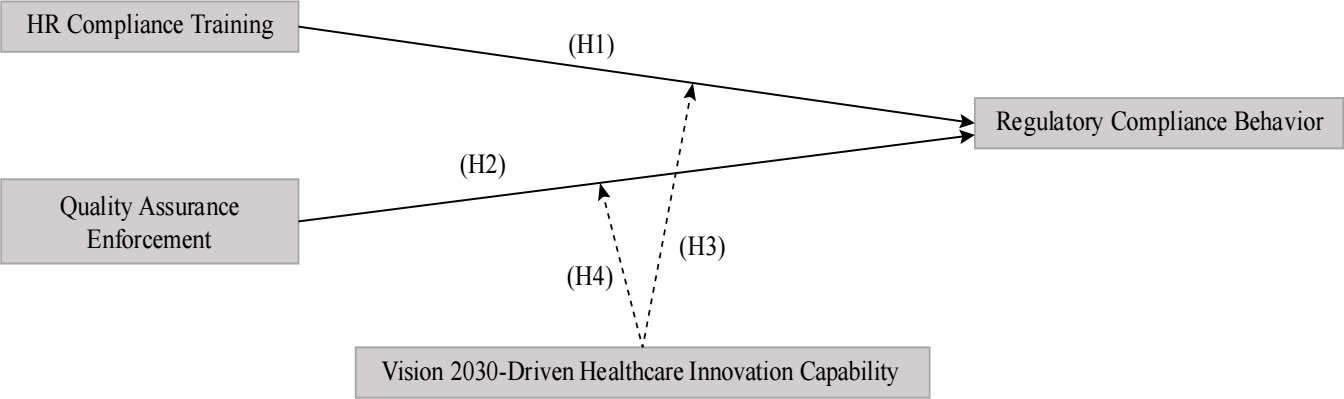
Fig. (1). Conceptual framework.
3. METHODOLOGY
This study adopted a quantitative research design, systematic collection, and statistical analysis of numerical data to test the hypothesised relationships among the variables. Quantitative designs are especially appropriate for cause-and-effect and theory-testing studies through structured measurements and inferential analyses (Ghanad, 2023). In this study, a quantitative approach is appropriate because it allows for the empirical testing of the relationship between HR compliance training, quality assurance enforcement, regulatory compliance behaviour, and the moderating effect of Vision 2030-drived healthcare innovation capability using statistical modelling.
The data were gathered via a structured online questionnaire created in Google Forms and rated on a five-point Likert scale from strongly disagree to strongly agree. The online survey is justified by the fact that it is effective in accessing geographically spread professionals, and it is economical and can guarantee standardisation of data collection. Additionally, online questionnaires allow for anonymity, which is important in the context of gathering responses about compliance practices and organisations, and reducing social desirability bias. The survey instrument consisted of two sections (Appendix A). The first part obtained demographic data such as the role, experience, and organisational characteristics of respondents. The second section involved measurement items for all the study constructs, namely HR compliance training, quality assurance enforcement, regulatory compliance behaviour, and Vision 2030-driven healthcare innovation capabilities.
The measurement instrument used was relatively short, with three indicators for each of the constructs. This process follows the PLS-SEM recommendations, which focus on indicator reliability and construct validity rather than the length of the scale. The constructs were derived from relevant literature. In particular, HR Compliance Training (HRCT) was based on (Colman, 2026), Quality Assurance Enforcement (QAE) on (Klein et al., 2023), Regulatory Compliance Behaviour (RCB) on (Julian & Abbas, 2020) and Vision 2030 Driven Healthcare Innovation Capability (VHI) on (Bao, et al., 2024). Based on these conceptual foundations, the questionnaire items were contextualised according to the Saudi pharmaceutical industry.
This study used a purposive sampling technique. Purposive sampling is a non-probability sampling method in which individuals are chosen based on some attributes regarding the research objective (Campbell et al., 2020). This methodology is appropriate because the work is centred on people with firsthand information and experience in compliance-related operations. The sample consisted of employees working in pharmaceutical organisations who were directly involved in compliance-related activities and knowledgeable about regulatory compliance systems. These comprised human resources, quality assurance, and regulatory compliance department staff members in operational, supervisory, managerial, and senior management positions. These roles have a direct responsibility for designing, implementing, and monitoring compliance systems in organisations.
Professional networking websites, especially LinkedIn, were used to recruit participants. Relevant groups that focused on pharmaceuticals and compliance were invited with a brief description of the study and survey link. Invitations were presented to potential respondents through group posts and direct messages, and participation was voluntary. This process ensured that a focused and informed group of respondents was reached. As respondents were recruited through LinkedIn, employees with greater professional engagement and digital literacy may have been overrepresented.
Initially, 433 responses were gathered. Data screening was performed to eliminate incomplete and inconsistent data; 400 valid responses were analysed. The sufficiency of such a sample size was verified using the G*Power analysis program, which, according to (Rahman, 2023), is applied in research studies to estimate the sufficient sample size and analyse power. This discussion indicates that a sample size of approximately 109 respondents would be suitable for observing medium effect sizes (f2 = 0.15) with a statistical power of 0.95 and a significance level of 0.05 with multiple predictors. Thus, 400 was the final sample size, which met the recommended level and guaranteed strong statistical power.
Partial least squares structural equation modelling (PLS-SEM) was used for data analysis. PLS-SEM is a structural modelling method which is an algorithmic account of variance used to analyse more complex associations among latent variables (Hair & Alamer, 2022). It is particularly suitable for predictive research, exploratory models, and research involving moderation effects. This method is suitable for this study because of its capability to deal with complex models, non-normal data distributions, and relatively large numbers of indicators.
Common method bias (CMB) was also considered by applying the full collinearity assessment approach recommended for PLS-SEM because all variables were measured from a single respondent source (self-administered questionnaire). This method assesses the level of collinearity between latent constructs, which can indicate common method variance (CMV). All the variance inflation factor (VIF) values were less than the recommended level of 3.3, indicating that common method bias was not likely to have been a significant issue in the current study (Table 2). Thus, the results provide reasonable assurance that the relationships observed are not significantly affected by the common method variance. In addition, non-response bias was assessed by comparing those who responded early to the survey with those who responded late. No statistically significant differences were found between the two groups; hence, there was no significant threat of non-response bias in the results.
Table 2. Collinearity VIF values.
| – | VIF |
| HR Compliance Training -> Regulatory Compliance Behaviour | 1.746 |
| Quality Assurance Enforcement -> Regulatory Compliance Behaviour | 2.118 |
| Vision 2030 Healthcare Innovation -> Regulatory Compliance Behaviour | 2.321 |
| Vision 2030 Healthcare Innovation x HR Compliance Training -> Regulatory Compliance Behaviour | 1.907 |
| Vision 2030 Healthcare Innovation x Quality Assurance Enforcement -> Regulatory Compliance Behaviour | 1.887 |
Note: Threshold for VIF values <3.3
The study was conducted in accordance with applicable ethical guidelines. The participants were given an informed consent statement and the purpose of the study, voluntary participation, and the fact that they could leave the study at any time was explained. No personal data were gathered, and anonymity and confidentiality were maintained. The data were kept in a safe place and not misused.
4. RESULTS
4.1. Descriptive Analysis
The respondents were predominantly men (62%), as indicated in Table 3, which indicates that men dominate compliance-related jobs. The majority of respondents were aged 25-34 (42%), 35-44 (31%) which is indicative of a relatively young and middle-aged workforce. The percentage of those with a Bachelor’s degree (45.5%) is large, implying that they are sufficiently educated for the study. The majority of the respondents were in managerial positions (39%), which is a strength in terms of data reliability, since they are the decision-makers. In addition, 60% have over six years of experience, implying that the responses are informed by considerable industry exposure and hands-on experience with compliance systems.
Table 3. Demographic profile of respondents (N = 400).
| Variable | Category | Frequency | Percentage (%) |
| Gender | Male | 248 | 62.0% |
| Female | 138 | 34.5% | |
| Prefer not to say | 14 | 3.5% | |
| Age Group | Below 25 | 36 | 9.0% |
| 25–34 | 168 | 42.0% | |
| 35–44 | 124 | 31.0% | |
| 45–54 | 52 | 13.0% | |
| 55 and above | 20 | 5.0% | |
| Education | Secondary | 28 | 7.0% |
| Diploma | 64 | 16.0% | |
| Bachelor’s | 182 | 45.5% | |
| Master’s | 104 | 26.0% | |
| Doctorate | 22 | 5.5% | |
| Job Role | Operational/Frontline | 72 | 18.0% |
| Supervisory | 96 | 24.0% | |
| Managerial | 156 | 39.0% | |
| Senior Management | 76 | 19.0% | |
| Experience | Less than 3 years | 58 | 14.5% |
| 3–5 years | 102 | 25.5% | |
| 6–10 years | 128 | 32.0% | |
| More than 10 years | 112 | 28.0% |
4.2. Measurement Model Analysis
Table 4 reveals that the measurement model is reliable and valid. The factor loadings were greater than 0.70, indicating the reliability of the indicators. Cronbach’s alpha and composite reliability were over 0.80, indicating high internal consistency among the constructs. The AVE was above 0.50, indicating convergent validity. It is important to note that Quality Assurance Enforcement demonstrates the largest AVE (0.832) which means that it has a good representation of constructs. Overall, the measurement model met the recommended thresholds, indicating that the constructs were measured correctly and could be analysed in terms of structure.
Table 4. Measurement model.
| Latent Constructs | Indicator | Factor Loading | Cronbach’s Alpha | Composite Reliability | Average Variance Extracted (AVE) |
| HR Compliance Training | HRCT1 | 0.872 | 0.853 | 0.853 | 0.773 |
| HRCT2 | 0.901 | ||||
| HRCT3 | 0.864 | ||||
| Quality Assurance Enforcement | QAE1 | 0.913 | 0.899 | 0.903 | 0.832 |
| QAE2 | 0.927 | ||||
| QAE3 | 0.895 | ||||
| Regulatory Compliance Behaviour | RCB1 | 0.783 | 0.812 | 0.832 | 0.726 |
| RCB2 | 0.898 | ||||
| RCB3 | 0.872 | ||||
| Vision 2030-Driven Healthcare Innovation Capability | VHI1 | 0.888 | 0.881 | 0.881 | 0.808 |
| VHI2 | 0.922 | ||||
| VHI3 | 0.887 |
Note: Thresholds; Factor Loadings ≥ 0.70; CR ≥ 0.70; AVE ≥ 0.50 (Hair et al., 2022)
4.3. Discriminant Validity Analysis
Table 5 confirms the existence of discriminant validity because all HTMT values are lower than the 0.85 threshold value. This implies that each construct is empirically distinct. Even though some relationships are relatively higher, such as that between Vision 2030-driven healthcare innovation capability and Quality Assurance Enforcement (0.733), they are still within the acceptable range. This implies that the constructs are conceptually related but test different phenomena, which guarantees the strength of the structural models.
Table 5. Discriminant validity.
| – | HR Compliance Training | Quality Assurance Enforcement | Regulatory Compliance Behaviour |
| Quality Assurance Enforcement | 0.616 | – | – |
| Regulatory Compliance Behaviour | 0.631 | 0.470 | – |
| Vision 2030-Driven Healthcare Innovation Capability | 0.719 | 0.733 | 0.557 |
Note: HTMT values < 0.85 (Rasoolimanesh, 2022)
4.4. Path Coefficient
Table 6 provides the results of the structural model examining the hypothesised relationships among the study variables. HR Compliance Training has a positive effect on Regulatory Compliance Behaviour (β = 0.380, p = 0.001), indicating that the better the training, the higher the compliance behaviour, which supports H1. Nonetheless, Quality assurance enforcement exhibits a negligible impact (β = 0.074, p = 0.313), indicating that formal QA mechanisms alone may not have a direct effect on compliance behaviour, not supporting H2. Vision 2030-Driven Healthcare Innovation Capability had a direct effect (β = 0.254, p = 0.001) that was important; hence, it was an enabling factor.
Table 6. Path coefficient.
| – | Path Coefficients | T Statistics | P Values | F-Square |
| HR Compliance Training -> Regulatory Compliance Behaviour | 0.380*** | 6.581 | 0.001 | 0.125 |
| Quality Assurance Enforcement -> Regulatory Compliance Behaviour | 0.074 | 1.009 | 0.313 | 0.004 |
| Vision 2030-Driven Healthcare Innovation Capability -> Regulatory Compliance Behaviour | 0.254*** | 3.438 | 0.001 | 0.042 |
| Vision 2030-Driven Healthcare Innovation Capability x HR Compliance Training -> Regulatory Compliance Behaviour | 0.121* | 1.964 | 0.050 | 0.015 |
| Vision 2030-Driven Healthcare Innovation Capability x Quality Assurance Enforcement -> Regulatory Compliance Behaviour | 0.004 | 0.072 | 0.942 | 0.001 |
Note: β represents the standardised path coefficients estimated using the PLS-SEM. * p < 0.05; ** p < 0.01; *** p < 0.001
Regarding moderation, the relationship between HR Compliance Training and compliance behaviour was marginally moderated by Vision 2030-Driven Healthcare Innovation Capability (β = 0.121, p = 0.050). It offers only marginal statistical evidence for H3, as the p-value is equal to the conventional significance threshold (0.050). Therefore, this interaction must be interpreted with caution and as indicative, not conclusive evidence. In addition, having a small effect size (f2 = 0.015), the practical significance of this moderating effect is quite limited and should be interpreted with caution. Nevertheless, its moderating impact on quality assurance enforcement is insignificant (β = 0.004, p = 0.942) and does not support H4. The effect sizes (f2) are mostly small, that is, the relationships are not very strong in explaining the variance. This indicates a low practical effect; that is, the predictors determine compliance behaviour but not in a strong manner. Overall, the results indicate that behavioural and capability-based (training and innovation) factors are stronger than structural enforcement mechanisms on their own.
4.5. Explanatory Power and Predictive Relevance
According to Table 7, the model explains 33.9% (R2 = 0.339) of the variance in regulatory compliance behaviour, which is a moderate explanatory power. Stability of the model is verified by adjusted R2 (0.330). Q2 = 0.300 indicates a moderate to high degree of predictive relevance, meaning that the model is a good out-of-sample predictor. In summary, the model has reasonable explanatory power and relevant predictive validity in terms of explaining compliance behaviour.
Table 7. Explanatory power and predictive relevance of the model.
| – | R-Square | R-Square Adjusted | Q-Square |
| Regulatory Compliance Behaviour | 0.339 | 0.330 | 0.300 |
Note: R2 = 0.25 (weak), 0.5 (moderate), and 0.75 (substantial); Q2 = 0.02 (small), 0.15 (medium), and 0.35 (large) (Aburumman et al., 2022)
5. DISCUSSION
The results of this study provide a subtle understanding of the effects of various organisational processes on regulatory compliance behaviour in the pharmaceutical industry. The association between HRCT and RCB was positive and strong (β= 0.380, p = 0.001), which is in favour of H1. This implies that employees can internalise expectations and convert them to their day-to-day work practices when they are trained systematically on regulatory requirements. This finding is aligned with the literature (Manor, 2025; Muhammad et al., 2025), which highlights the notion that properly organised training may enhance the level of knowledge and application of compliance standards. In practical terms, this suggests that training is not a formal requirement but a behavioural driver. However, the comparatively small-moderate effect size (f2= 0.125) suggests that training by itself might not be a guaranteed factor to ensure compliance, which is why, arguably, other factors like engagement and organisational culture play a role in determining whether or not training is converted into actual behaviour (Jacobs, 2023). This should be further explored in future research with mediators of motivation, organisational culture, or the usefulness of perceived training.
In contrast, an insignificant association was found between QAE and RCB (β = 0.074, p = 0.313), which did not support H2. Although QA systems are historically considered one of the core components of compliance, the results show that their presence does not always guarantee behavioural compliance. This aligns with the literature arguments that structural enforcement is not the only cause of compliance but also behavioural and cultural aspects (Anbil et al., 2026; Bernasconi et al., 2025). A possible reason is that QA systems can be more systemic or process-based rather than individually action-oriented. Moreover, this finding suggests that enforcement mechanisms are procedural rather than behaviourally internalised by employees, which restricts their immediate influence on compliance. This lack of support for H2 does not invalidate the existing theory, but it does indicate that enforcement-based mechanisms might not necessarily map onto behavioural compliance without the internalisation of norms.
The negligible influence of quality assurance enforcement does not imply that QA systems are ineffective. Instead, it shows that formal implementation structures do not necessarily translate into behavioural compliance at the employee’s level. Although QA systems provide structure, monitoring, and control of procedures, the degree to which the controls are internalised by employees determines the degree to which they affect actual behaviour. This observation is consistent with the differences between enforcement and internal compliance mechanisms. The findings indicate that formal QA systems should have capability-building and behavioural reinforcement mechanisms to successfully impact compliance behaviour, but should not be standalone drivers.
This finding is also relevant to the Saudi pharmaceutical industry. The Saudi Food and Drug Authority (SFDA) is an external regulator that has imposed regulations and inspection audits on many pharmaceutical companies, affecting their regulatory compliance systems. This means that compliance checks can be viewed as an external process rather than an accepted internal norm of action. In this case, enforcement could result in compliance at the time of audits and inspections but not in daily operations. This phenomenon can be likened to superficial or symbolic compliance (as described in organisational studies), whereby employees follow formal rules when they are observed but do not incorporate compliance expectations into their work routine. Thus, the lack of a significant relationship might be attributed to the differences between procedural and behavioural compliance in highly regulated contexts.
Another possible reason could be the characteristics of compliance implementation in Saudi pharmaceutical organisations: to align with SFDA regulations and Vision 2030 changes, many companies have enhanced their quality assurance systems by adopting common documentation protocols, audit timetables, and inspection procedures. These programs enhance compliance with procedures but can also foster a checkbox culture where staff complete compliance documentation and audit requirements but lack an embedded culture of compliance in their day-to-day decisions. Workers might do things right when the inspector comes, but revert to previous habits when the level of external oversight wanes. In addition, measurable indicators of quality assurance, including the number of audits completed, accuracy of documentation, rate of closing out corrective actions, and percentage of inspections being ready, are often used instead of behavioural indicators of employees’ day-to-day adherence to regulatory principles. Thus, the formal enforcement system can successfully ensure organisational compliance at the institutional level while having only a minor impact on individual regulatory compliance behaviour. This difference between procedural and behavioural compliance offers a likely explanation for the statistically insignificant relationship found in this study.
This finding also supports the Resource-Based View (RBV) and Dynamic Capabilities Theory (DCT) used in this research. RBV assumes that the value of organisational resources depends on whether employees can use them, while Dynamic Capabilities Theory focuses on the adjustment of organisational routines. While formal enforcement mechanisms offer structural control, they may not foster the knowledge, motivation, and behavioural commitment required for long-term compliance. Thus, enforcement should be supported by capability-building programs, behavioural feedback, coaching, and ongoing learning if organisations want to move from procedural compliance to consistent employee behaviour.
The large direct effect of Vision 2030-Driven Healthcare Innovation Capability on RCB justifies the fact that innovation is an organisational capability that facilitates RCB (β= 0.254, p = 0.001). This suggests that compliance outcomes can be improved with the assistance of digitalisation, advanced monitoring devices, and integrated healthcare technologies that enhance transparency, efficiency, and control. This is consistent with current studies (Khaliq et al., 2025; Ullagaddi, 2024), according to which innovation improves the functioning of organisations and reduces the differences in compliance. Nevertheless, the effect size is quite small and demonstrates that innovation does not prevail over compliance behaviour but is complementary to other processes. Therefore, based on the current findings, innovation must be considered an enabling infrastructure and not a solution.
The moderating effect of Vision 2030-Driven Healthcare Innovation Capability on HRCT and RCB was marginally significant (β = 0.121, p = 0.050), providing limited empirical support for H3. Hence, it provides weak evidence that Vision 2030-driven healthcare innovation capabilities reinforce the link between HRCT and RCB. The p-value is exactly 0.050, and the size of the interaction effect is small (β = 0.121; f² = 0.015), which suggests a possible enabling effect of innovation rather than a robust moderating effect. This suggests that digitally enabled training platforms, e-learning systems, and real-time compliance tools support the delivery and utilisation of training. This observation is consistent with previous studies (Gillani et al., 2025; Waheed et al., 2024), which indicate that innovation enhances HR-related performance. However, the small effect size of moderation (f2 = 0.015) indicates that this effect is not strong and could be the result of training effectiveness being dependent on other factors: content relevance, employee engagement, and organisational support. This demonstrates that although digital tools might be effective in the delivery of training, they can only achieve so much without high-quality content, user engagement, and organisational support structures. To understand this interaction, future research should consider more specific aspects of innovation, including the quality of digital learning and system usability.
Conversely, the moderating role of Vision 2030-Driven Healthcare Innovation Capability on the QAE–RCB relationship was not significant (β = 0.004, p = 0.942); thus, H4 cannot be supported. One explanation could be that the QAE itself has no direct effect on behaviour, and thus the effect of innovation on it is difficult to facilitate. In addition, QA systems might have already been formalised and standardised, meaning that there can be little innovation to make a greater behavioural impact. This result is opposite to certain conceptual arguments (Khaliq et al., 2025) suggesting that innovation increases QA performance and that there is a mismatch between system-level gains and behavioural results at the employee level. Future studies should focus on whether innovation indirectly affects QA outcomes by improving processes rather than directly changing behaviours.
Overall, the results suggest that capability-building mechanisms (training) and adaptive enablers (innovation) have a greater effect on compliance behaviour than structural enforcement mechanisms (QA discipline). Simultaneously, the effect sizes were relatively small and indicated that compliance behaviour is complex and affects other factors that cannot be reflected in this model. This underscores the necessity of more inclusive models that constitute behavioural, cultural, and organisational variables for a better understanding of compliance under intricate regulatory conditions.
While some of the relationships were statistically significant, the effect sizes (f² = 0.125 for HR compliance training, f² = 0.042 for Vision 2030-driven healthcare innovation capability, and f² = 0.015 for the moderating effect) were relatively small, indicating that regulatory compliance behaviour is not a function of a single intervention. From a managerial perspective, pharmaceutical organisations should not rely on a significant increase in compliance behaviour from implementing further training programs or digital compliance technologies. The results suggest that compliance management should be considered a holistic system of the organisation and not a single training or enforcement department.
Moreover, the sampling technique employed in this study should be considered when interpreting these findings. Although in this study, the recruitment of the respondents was from different levels of the organisation, such as operational, supervisory, managerial, and senior management positions, the sample still holds potential bias toward managerial perceptions of compliance systems because there was a relatively larger proportion of managerial and senior management respondents. This could be one of the reasons why enforcement mechanisms (QAE) seem inconsequential, since managers can assess compliance based on system implementation and not on daily behavioural compliance. Thus, the results should be treated with caution, with other possible outcomes being presented in the case that frontline workers are considered.
THEORETICAL CONTRIBUTION
This study explains how capability development (RBV) and capability reconfiguration (DCT) jointly influence regulatory compliance behaviour under national digital transformation. RBV focuses on how internal compliance resources are developed, whereas DCT focuses on how adaptive processes enable internal compliance resources to become more effective in an innovation-driven regulatory environment. This complementary theoretical logic builds on current compliance research to demonstrate that compliance capability is resource-dependent and dynamically enhanced.
This study makes a nuanced theoretical contribution by integrating capability-based, behavioural, and adaptive perspectives into a single explanatory framework. First, by combining RBV and DCT, this study provides additional support for compliance scholarship beyond the traditional focus on structural control. The results indicate that HRCT is a capability-building resource, as it is linked to influencing employee behaviour, whereas Vision 2030-Driven Healthcare Innovation Capability is an enabling dynamic capability linked with a small yet significant strengthening of this association. This validates the theoretical assumption that compliance does not depend only on static organisational resources but also on their dynamic use in changing the regulatory environment. Second, this study contributes to the existing body of research on institutional innovation by empirically separating the direct and moderating impacts of national transformation programs Vision 2030. Although innovation has a positive correlation with compliance behaviour, it does not greatly moderate behavioural change, suggesting that innovation can be an enabling infrastructure rather than a transformer of behaviour.
Although this study does not claim to make a theoretical breakthrough, it provides a contextual and configurational contribution by illustrating the joint work of various theoretical mechanisms in a specific regulatory context. This emphasises that the configuration of capabilities, enforcement structures, and innovation context determines compliance behaviour, as opposed to a dominant theoretical explanation. Moreover, the cross-sectional design does not allow for the determination of temporal precedence; therefore, the results can be discussed as indicative patterns but not as causal effects. Overall, this research contributes to the understanding of the current debate between deterrent-based and capability-based policies by showing that the non-significant impact of enforcement mechanisms is possible and may not be enough to change compliance behaviour at the employee level.
CONCLUSION
This study demonstrates that capability-based and innovation-enabled mechanisms appear to be more influential in forming regulatory compliance in the Saudi pharmaceutical sector than formal systems. The results indicate that compliance is preconditioned by the way organisations convert knowledge and technological improvements into everyday practice. These insights emphasise the need to enhance people-centred and adaptive strategies to maintain a high level of regulatory compliance in dynamic healthcare settings. Nonetheless, considering the small effect size and moderate explanatory power, the current model is limited in its ability to explain compliance behaviour.
LIMITATIONS AND FUTURE DIRECTION
This study had several limitations. First, the cross-sectional design interferes with the development of a causal relationship; longitudinal studies should be employed in future studies to establish long-term changes. The second limitation is the possible managerial perspective bias in the study. The sample was limited to HR compliance officers and quality assurance managers who were directly involved in developing, implementing, and monitoring HR compliance systems. Consequently, the view on compliance is likely to be more from a system-management perspective than a frontline perspective because the respondents may not be employees directly in contact with compliance monitoring and enforcement systems. This managerial orientation may partly account for the slight impact seen in the case of Quality Assurance Enforcement, as managers could have a different view of enforcement effectiveness than employees who face enforcement during their daily work.
Finally, the study is confined to the Saudi pharmaceutical sector, which limits generalisation; thus, cross-country comparative studies should be conducted. Finally, the model does not consider aspects such as organisational culture and leadership, which should be considered by future researchers to present a more specific portrayal of compliance behaviour.
POLICY AND PRACTICAL IMPLICATION
These results imply that regulators and pharmaceutical companies in Saudi Arabia should implement specific measures. To begin with, the SFDA and other agencies should specify minimum training hours per year, role-specific regulatory modules (e.g. manufacturing, documentation, and pharmacovigilance), and post-training assessment score requirements to value learning into behavioural preparedness. Moreover, pharmaceutical organisations should restructure compliance training to applied learning systems, as opposed to theoretical learning. It can be operationalised in three steps: (1) a scenario-based simulation of actual GMC violations, (2) connecting the training completion records with the individual compliance performance indicators, and (3) quarterly refresher micro-training can be introduced in connection with recent FDA/SFDA warning letters.
Additionally, companies should combine QA systems and behavioural accountability systems by directly relating QA audit reports to the departmental performance dashboard and tracking corrective actions at the individual level. Furthermore, real-time compliance dashboards, AI monitoring systems, and mobile reporting solutions can be implemented to enable organisations to obtain real-time feedback on non-conformities and allow frontline personnel to report them in real time. Lastly, HR and QA departments must create compliance behaviour review committees that meet monthly to ensure that training outcomes are aligned with QA results to have behavioural reinforcement and not just system-related improvements.
Lastly, due to the relatively modest magnitude of effect sizes, managers and regulators should view the results as proof that no single compliance intervention is sufficient to significantly change employee behaviour. HR compliance training, quality assurance systems, and digital innovation should be part of a holistic compliance approach and not stand-alone programmes. Therefore, for organisations that want to achieve Vision 2030 goals, investment priorities should be balanced between technological modernisation and behavioural capability building, employee engagement, leadership commitment and ongoing organisational learning. This multidimensional approach is likely to be more effective in creating lasting gains in regulatory compliance than relying on enforcement or technology-based solutions.
LIST OF ABBREVIATIONS
CDER | = | Center for Drug Evaluation and Research |
cGMP | = | current Good Manufacturing Practices |
CMB | = | Common Method Bias |
CMV | = | Common Method Variance |
DCT | = | Dynamic Capabilities Theory |
HRCT | = | Hr Compliance Training |
QAE | = | Quality Assurance Enforcement |
RBV | = | Resource-Based View |
RCB | = | Regulatory Compliance Behaviour |
RDIA | = | Research, Development, and Innovation Authority |
SFDA | = | Saudi Food and Drug Authority |
VIF | = | Variance Inflation Factor |
AUTHOR’S CONTRIBUTION
S.R.B. has contributed to the study conceptualization, methodology, data analysis, interpretation of results, and manuscript writing.
ETHICAL APPROVAL & INFORMED CONSENT
The study was conducted in accordance with applicable ethical guidelines. The participants were given an informed consent statement and the purpose of the study, voluntary participation, and the fact that they could leave the study at any time was explained. No personal data were gathered, and anonymity and confidentiality were maintained. The data were kept in a safe place and not misused.
AVAILABILITY OF DATA AND MATERIALS
The data will be made available on reasonable request by contacting the corresponding author [S.R.B.].
FUNDING
None.
CONFLICT OF INTEREST
The author declares that there is no conflict of interest regarding the publication of this article.
ACKNOWLEDGEMENTS
Declared none.
DECLARATION OF AI
During the preparation of this manuscript, the author used ChatGPT for language editing and refinement purposes. Following the use of this tool, the author carefully reviewed and revised the content where necessary and accept full responsibility for the final published version of the article.
APPENDIX A
Section A: Demographic
- What is your gender?
- Male
- Female
- Prefer not to say
- What is your age group?
- Below 25
- 25–34
- 35–44
- 45–54
- 55 and above
- What is your highest educational qualification?
- Secondary
- Diploma
- Bachelor’s
- Master’s
- Doctorate
- What best describes your current job role?
- Operational/Frontline
- Supervisory
- Managerial
- Senior Management
- How many years of total experience do you have in this industry?
- Less than 3 years
- 3–5 years
- 6–10 years
- More than 10 years
Section B: Main Questionnaire
| Variable | Question Statement | Strongly Disagree (1) | Disagree (2) | Neutral (3) | Agree (4) | Strongly Agree (5) |
| HR Compliance Training | 1. My organisation regularly provides formal training programs related to regulatory compliance requirements. | ☐ | ☐ | ☐ | ☐ | ☐ |
| Employees receive compliance-related training whenever important regulatory updates occur. | ☐ | ☐ | ☐ | ☐ | ☐ | |
| 3. Compliance training is systematically incorporated into employee development activities within my organisation. | ☐ | ☐ | ☐ | ☐ | ☐ | |
| Quality Assurance Enforcement | 1. Quality assurance practices are effectively integrated into daily work processes to meet compliance. | ☐ | ☐ | ☐ | ☐ | ☐ |
| 2. The company maintains a strong culture of quality assurance and compliance within department. | ☐ | ☐ | ☐ | ☐ | ☐ | |
| 3. Quality Assurance Enforcement helps minimise risks and ensure regulatory compliance in role. | ☐ | ☐ | ☐ | ☐ | ☐ | |
| Vision 2030-driven healthcare innovation capability | 1. My organisation utilizes digital technologies and innovative systems to support regulatory compliance activities. | ☐ | ☐ | ☐ | ☐ | ☐ |
| 2. My organisation continuously upgrades compliance-related processes through technology and innovation initiatives aligned with Vision 2030. | ☐ | ☐ | ☐ | ☐ | ☐ | |
| 3. Innovation-driven compliance tools and systems improve the effectiveness of regulatory compliance activities in my organisation. | ☐ | ☐ | ☐ | ☐ | ☐ | |
| Regulatory Compliance Behaviour | 1. Employees consistently follow regulatory compliance protocols in their work. | ☐ | ☐ | ☐ | ☐ | ☐ |
| 2. Employees actively participate in initiatives to enhance compliance within the organisation. | ☐ | ☐ | ☐ | ☐ | ☐ | |
| 3. Employees committed to ensuring that all regulatory requirements are met in their daily tasks. | ☐ | ☐ | ☐ | ☐ | ☐ |
REFERENCES
Aburumman, O. J., Omar, K., Al Shbail, M., & Aldoghan, M. (2022). How to deal with the results of PLS-SEM?. In International Conference on Business and Technology (pp. 1196-1206). Cham: Springer International Publishing.
https://doi.org/10.1007/978-3-031-08954-1_101
Adola, T. B., Assefa, D., Ejeta, F., Gashe, F., Paulos, G., & Borga, D. K. (2026). Assessment of current good manufacturing practice (cGMP) compliance in pharmaceutical manufacturers in Ethiopia: Cross-sectional descriptive study. PloS One, 21(3), e0343881. https://doi.org/10.1371/journal.pone.0343881
Altamuro, J. L. M., Gray, J. V., & Zhang, H. (2022). Corporate integrity culture and compliance: A study of the pharmaceutical industry. Contemporary Accounting Research, 39(1), 428-458.
https://doi.org/10.1111/1911-3846.12727
Anbil, P., Deshpande, P. & Khot, P. (2026). Quality and Compliance in the Pharmaceutical Industry: Navigating a Transformed Landscape. Pharmaceutical Commerce. 21(1). Available from: https://www.pharmaceuticalcommerce.com/view/quality-and-compliance-in-the-pharmaceutical-industry (Accessed on: 03-08-2026).
Arab, O. O., Aldayan, M., Almowaizri, K., Alghamdi, A., Alghamdi, J., & Alharf, A. (2025). Descriptive Analysis of Good Clinical Practice Inspection Findings from the Saudi Food and Drug Authority. Therapeutic Innovation & Regulatory Science, 59, 295–303.
https://doi.org/10.1007/s43441-024-00731-5
Bao, Y., Buhay, N. & Zheng, Q. (2024). A Dynamic Model for GMP Compliance and Regulatory Science. Journal of Pharmaceutical Innovation, 19. 25.
https://doi.org/10.1007/s12247-024-09825-x
Barney, J. B. (2001). Resource-based theories of competitive advantage: A ten-year retrospective on the resource-based view. Journal of Management, 27(6), 643-650.
https://doi.org/10.1177/014920630102700602
Bernasconi, M., Friedli, T., & von Dzengelevski, O. (2025). The impact of current good manufacturing practices inspections on continuous improvement mindset in the pharmaceutical industry. Journal of Pharmaceutical Innovation, 20, 282.
https://doi.org/10.1007/s12247-025-10200-7
Campbell, S., Greenwood, M., Prior, S., Shearer, T., Walkem, K., Young, S., … & Walker, K. (2020). Purposive sampling: complex or simple? Research case examples. Journal of Research in Nursing, 25(8), 652-661.
https://doi.org/10.1177/1744987120927206
Chen, H., Qin, L., Jiang, C., Qin, M., Sun, Y., & Luo, J. (2023). Characteristics, risk management and GMP standards of pharmaceutical companies in China. Frontiers in Public Health, 11, 1103555.
https://doi.org/10.3389/fpubh.2023.1103555
Colman, H. (2026). HR Compliance Training: A Practical Guide for 2026. iSpring LMS. Available from: https://www.ispring.com/knowledge-hub/hr-compliance-training (Accessed on: 03-08-2026).
Conrad, J., Silver, P., & Elsner, N. (2019). Maintaining value in pharmaceutical compliance. Deloitte Insights. Available from: https://www.deloitte.com/us/en/insights/industry/life-sciences/pharmaceutical-compliance-technology.html (Accessed on: 03-08-2026).
Cuffari, B. (2025). Market Report 2025: Pharmaceutical Manufacturing. News-Medical Life Sciences. Available from: https://www.news-medical.net/life-sciences/Market-Report-2025-Pharmaceutical-Manufacturing.aspx
Fellows, M., Friedli, T., Li, Y., Maguire, J., Rakala, N., Ritz, M., Bernasconi, M., Seiss, M., Stiber, N., Swatek, M., & Viehmann, A. (2022). Benchmarking the quality practices of global pharmaceutical manufacturing to advance supply chain resilience. The AAPS Journal, 24(6), 111.
https://doi.org/10.1208/s12248-022-00761-7
Ghanad, A. (2023). An overview of quantitative research methods. International Journal of Multidisciplinary Research and Analysis, 6(08), 3794-3803.
https://doi.org/10.47191/ijmra/v6-i8-52
Gillani, A. H., Arshad, H., Yang, C., Arshed, M., Atif, N., Bashir, K., Abbas Malik, H. M., & Fang, Y. (2025). Assessing the effects of online educational intervention on pharmaceutical promotions: a pre-post study among medical and pharmacy students in Pakistan. Frontiers in Pharmacology, 16, 1616631.
https://doi.org/10.3389/fphar.2025.1616631
Global Health Exhibition (2024). How Saudi’s Vision 2030 is going to Transform the Healthcare Industry. Available from: https://www.globalhealthsaudi.com/en/news/healthcare-insights/how_saudis_vision_2030_is_going_to_transform_the_healthcare.html (Accessed on: 03-08-2026).
Hair, J., & Alamer, A. (2022). Partial Least Squares Structural Equation Modeling (PLS-SEM) in second language and education research: Guidelines using an applied example. Research Methods in Applied Linguistics, 1(3), 100027.
https://doi.org/10.1016/j.rmal.2022.100027
Jacobs, A. (2023). Why compliance training fails. SSRN.
https://dx.doi.org/10.2139/ssrn.5268898
Jessica, R. (2025). Navigating the complex world of pharma regulatory compliance: Finding the sweet spot between safety & innovation. Available from: https://gmppros.com/pharma-regulatory-compliance/ (Accessed on: 03-08-2026).
Julian, C., & Abbas, A. (2020). Regulatory Compliance in HR: A Strategic Workforce Planning Approach. ResearchGate.
https://doi.org/10.13140/RG.2.2.19928.76806
Khaliq, S. A., Kashif, M., Shaik, M. J., & Hussain, I. (2025). A narrative review on automation and digitalization in quality control laboratories of pharmaceuticals. International Journal of Pharmacy & Integrated Health Sciences, 6(2), 89-98.
https://doi.org/10.56536/ijpihs.v6i2.262
Klein, T. A., Seelbach, C. L., & Brannan, G. D. (2023). Quality Assurance. PubMed; StatPearls Publishing. https://www.ncbi.nlm.nih.gov/books/NBK557503/ (Accessed on: 03-08-2026).
Kuiper, M. E. (2025). There is no quick fix: Compliance officers’ views on organisational behavioural change. Journal of Business Ethics, 206, 461-486.
https://doi.org/10.1007/s10551-025-06183-7
Manor, K. (2025). Is a compliance training program effective? A comparison analysis of compliance officers’ perceptions and recommended practices in multinational corporations regarding compliance etraining program effectiveness. Journal of Legal, Ethical & Regulatory Isses, 28 (2).
https://doi.org/10.13140/RG.2.2.35961.38245
Muhammad, F., Iqbal, N., Asim, M., & Ali, M. A. (2025). Impact of training program components on perceived training utility and cGMP compliance behaviour: An evidence from pharmaceutical industry (Pakistan). Journal of Asian Development Studies, 14(4), 209-224.
https://doi.org/10.62345/jads.2025.14.04.1661
Rahman, M. M. (2023). Sample size determination for survey research and non-probability sampling techniques: A review and set of recommendations. Journal of Entrepreneurship, Business and Economics, 11(1), 42-62. Available from: https://scientificia.com/index.php/JEBE/article/view/201/190 (Accessed on: 03-08-2026).
Rasoolimanesh, S. M. (2022). Discriminant validity assessment in PLS-SEM: A comprehensive composite-based approach. Data Analysis Perspectives Journal, 3(2), 1-8. https://www.researchgate.net/profile/S-Mostafa-Rasoolimanesh/publication/356961783_Discriminant_validity_assessment_in_PLS-SEM_A_comprehensive_composite-based_approach/links/61b465e31d88475981dfde95/Discriminant-validity-assessment-in-PLS-SEM-A-comprehensive-composite-based-approach.pdf (Accessed on: 03-08-2026).
Saudi Food and Drug Authority (2026). SFDA conducts field visits to 197 pharmaceutical, medical device factories in 2023. Available from: https://www.sfda.gov.sa/en/news/878322 (Accessed on: 03-08-2026).
Saudi Gazette (2024). SFDA slaps fines of SR678400 on 24 pharmaceutical firms for violations. Available from: https://saudigazette.com.sa/article/645811/SAUDI-ARABIA/SFDA-slaps-fines-of-SR678400-on-24-pharmaceutical-firms-for-violations (Accessed on: 03-08-2026).
Science & Innovation Network (2022). UK Science & Innovation Network Country Snapshot Kingdom of Saudi Arabia. Available from: https://assets.publishing.service.gov.uk/media/6391ae8fd3bf7f1bd42de7be/KSA_Snapshot-2022.pdf (Accessed on: 03-08-2026).
SFDA (2025). SFDA GMP inspection deficiency data trend 2025. Available from: https://www.sfda.gov.sa/sites/default/files/2026-03/DF2025.pdf (Accessed on: 03-08-2026).
Teece, D. J. (2022). The evolution of the dynamic capabilities framework. In Artificiality and Sustainability in Entrepreneurship: Exploring the unforeseen, and paving the way to a sustainable future. FGF Studies in Small Business and Entrepreneurship. (pp. 113-129). Cham: Springer International Publishing.
https://doi.org/10.1007/978-3-031-11371-0_6
Ullagaddi, P. (2024). Leveraging digital transformation for enhanced risk mitigation and compliance in pharma manufacturing. Journal of Advances in Medical and Pharmaceutical Sciences, 26(6), 75-86.
https://doi.org/10.9734/jamps/2024/v26i6697
Waheed, A., Waheed, S., Hussain, S., & Majeed, A. (2024). The HR revolution: Redefining performance paradigms in Pakistan’s pharma landscape through moderating role of innovative climate. PloS One, 19(5), e0301777.
https://doi.org/10.1371/journal.pone.0301777
WHO (2023). Saudi Arabia regulatory system becomes third to reach WHO Maturity Level 4. Available from: https://www.who.int/news/item/30-10-2023-saudi-arabia-regulatory-system-becomes-third-to-reach-who-maturity-level-4 (Accessed on: 03-08-2026).
Zubair, M. (2024). Navigating the complex landscape of regulatory compliance in the pharmaceutical industry. Trends in Telemedicine & E-health, 5(2).
http://dx.doi.org/10.31031/TTEH.2024.05.000607
Licensed
© 2026 Copyright by the Authors.
Licensed as an open access article using a CC BY 4.0 license.
Article Contents Author Felicia Gabriela Beresescu1, * 1College of Business-Al Khobar, Al Yamamah University, Saudi Arabia Article History: Received: 21
Article Contents Authors Saman Ismail1, * Imran Iqbal2 1Faculty of Management Science, Department of Business Administration, Salim Habib University, Karachi,
Article Contents Author Michael Dolinsky1, * 1Faculty of Mathematics and Technologies of Programming, Francisk Skorina Gomel State University,
Article Contents Author Abdul Ghafoor Memon1, * 1Emaan Institute of Management Sciences, Karachi, Pakistan Article History: Received: 01 April, 2026
Article Contents Authors Zixuan Zhao1, Ju Guo1, * 1School of Management, Chengdu University of Information Technology, Chengdu, China Article History:
Article Contents Authors Sultan Ud Din Yousufzai1, Amtyaz Safi2, * , Maher Khan1, Zia Ud Din1 1Department of Zoology, Govt.