






Article Contents
Article ID: CMT2622101005
Views: 673The Impact of Training and Development on the Perceived Organisational Performance of Saudi Tourism Companies
 DOI:
DOI:
 PDF
PDF
⬇ Downloads: 27
1Department of Business Administration, Emaan Institute of Management and Sciences, Karachi, Pakistan
Received: 16 May, 2026
Accepted: 28 July, 2026
Revised: 21 July, 2026
Published: 12 August, 2026
ABSTRACT:
Introduction: This study aimed to examine the predictive relationship between Training and Development (T&D) and Perceived Organisational Performance, while also assessing the moderating role of the Vision 2030 Program in the relationship within the Saudi Arabian tourism sector.
Methods: A quantitative cross-sectional study design was followed, using a structured Likert-scale questionnaire for data collection. The study was conducted on employees in the tourism industry in Saudi Arabia which consists of more than one million employees. Participants were recruited using purposive sampling, and 450 employees were sampled for the study. The number of samples in the study was above the lowest sample size determined by G*Power analysis, which is suitable for PLS-SEM analysis. Partial Least Squares Structural Equation Modelling (PLS-SEM) was used to analyse the data.
Results: The results indicate that T&D has a statistically significant and positive effect on the perceived organisational performance. The Perceived Vision 2030 Program also showed a significant direct association with organisational performance. Importantly, the moderation analysis revealed that positive perceptions of Vision 2030 strengthened the relationship between T&D and organisational performance, suggesting that institutional alignment enhances the effectiveness of internal HR practices in the healthcare sector.
Conclusion: This study contributes theoretically by contextualising Human Capital and Institutional theoretical perspectives to elucidate organisational performance within a national transformative framework. Practically, it provides insights for policymakers and managers to align employee development initiatives with national strategies, enhance workforce capabilities, and strengthen organisational competitiveness.
Keywords: Training and development, organisational performance, vision 2030, tourism sector, Saudi Arabia.
1. INTRODUCTION
The tourism industry is one of the fastest-developing sectors of the economy worldwide, with major contributions to the gross domestic product (GDP), creation of employment opportunities, and exchange of cultures (Khaksar & Amir, 2023; Thommandru et al., 2023). This has resulted in the Kingdom of Saudi Arabia positioning tourism as its core sector in the socio-economic transformation in recent years, as stipulated in the Vision 2030 program, as reported by (Filippi & Mazzetto, 2024; and Shesha & Yusuf, 2021). Within this national plan, the role of tourism in the economy has grown rapidly, with projections of 100 million annual visitors, approximately 10% of GDP, and 1.6 million jobs. The sector is expected to meet its targets at an earlier pace by 2026, with the growth in the number of annual visitors to the country up to 100 million and 1.1 million tourism jobs generated by early 2026 (Arab News, 2026; Ministry of Finance, 2025).
Regardless of this increased growth and high level of investment, (Alkaf et al., 2021) revealed that tourism remains a highly competitive service-based industry in which human capital quality directly impacts organisational performance. According to (Aman-Ullah et al., 2022; and Candra et al., 2023), tourism firms such as hotels, travel agencies, and resorts must be highly competitive in terms of providing high-quality service, operational efficiency, and customer satisfaction. Strategic investments in infrastructure and mega-projects, such as the Red Sea Project and Diriyah Gate, have helped Saudi Arabia boost the sector’s global presence. Although the problem of human resources still remains, especially in terms of skills among employees, customer handling skills, and performance consistency, which are key influencing factors of satisfactory service delivery in the tourism sector, as reflected in the arguments of (Omarova, 2026; and Tai et al., 2021).
(De Bruin et al., 2021; and Silva et al., 2025) argue that despite most organisations’ heavy investment in employee training and development programmes, tourism businesses face common organisational-level problems. Organisations face problems in sustaining service quality and a lack of skills among frontline workers, as well as poor productivity, despite increasing employee development investments (Rashid et al., 2025). This poses a practical and theoretical issue for tourism organisations in Saudi Arabia, because it is underexplored how this issue can be addressed through effective Training and Development which tends to affect employee productivity and overall organisational performance, as suggested by (Elsafty & Oraby, 2022). These are major concerns when service provision relies on employees’ skills, and they directly influence customer satisfaction and organisation performance, as is typical in the tourism industry. It is also evident from studies focused on the hospitality sector, such as (Birdir & Sahilli, 2024; and Dewangga & Sumerta, 2024), which have proven a strong relationship between training quality and service performance outcomes.
Training and Development (T&D) is considered an important aspect of human resource management literature as a strategic mechanism that improves employee knowledge, skills, and motivation, which, in turn, can promote organisational performance. According to (Niati et al., 2021; and Tumi et al., 2022), systematic training programs are positively correlated with perceived organisational performance, job satisfaction, and quality of services across different types of service industries. Nonetheless, the available literature, such as (Alregab, 2023; and Bilderback, 2024), provides little information on the nature of these relations, particularly in the Saudi tourism context and within the conditions of a national strategic framework such as Vision 2030.
Specifically, the moderating effect of the Vision 2030 Programmes on the association between T&D and Perceived Organisational Performance still needs to be filled in. The impact of training in broader contexts in the hospitality industry has been studied by non-local researchers, although few have critically considered the interactions between strategic national programs, such as Vision 2030 and its ambitious tourism and human capital goals, and internal organisational practices (Bindawas, 2025). This indicates a gap in research on the perception of the national vision initiatives in enhancing or reducing the effectiveness of training on organisational outcomes.
The rationale and motivation behind the study are based on the growing importance of human capital in the context of the Saudi tourism transformation plan and the lack of knowledge about the impact of national policy initiatives on the efficiency of organisations’ HR practices. It is important to assess whether the capability-building investment of tourism organisations is always associated with perceived organisational performance and whether employees’ perceptions of Vision 2030 contribute to strengthening this link, as the institutional environment is changing rapidly.
The main research question in this study is whether T&D is consistently related to the perceived organisational performance in a fast-changing tourism environment and the effect of employee perceptions of Vision 2030 on this relationship. Despite the significance of workforce development investments by tourism organisations, there remains a lack of clarity regarding the conditions for their success in achieving positive organisational outcomes. This is especially relevant in Saudi Arabia, where tourism companies are likely to adapt their HR practices to be more in sync with larger national transformation goals (Ngcobo, 2022). In light of this, this study, on one hand, examined the relationship between Training and Development and perceived organisational performance and on the other hand, to find out the moderating role of Perceived Vision 2030 Program.
Despite earlier studies that recorded a positive relationship between T&D and organisational performance, such as (Elsafty & Oraby, 2022; and Syeda et al., 2023), few researchers have paid attention to the role of national transformation frameworks in conditioning this relationship. Thus, this study does not aim to recreate a connection between HRM and performance but instead investigates the relationship in the unique institutional environment of Saudi Vision 2030. This study examines how employees’ perceptions of the national macro-level policy framework affect the outcomes of tourism organisations’ micro-level HR practices, thereby gaining a more contextual understanding of organisational performance and providing suggestions for tourism organisations interested in making their HR practices more contextually effective.
Moreover, this study contributes to the literature by expanding the knowledge of the relationship between T&D and organisational performance in the institutional context of the tourism sector in the Kingdom of Saudi Arabia. The study does not introduce a new theoretical integration; however, it sets the established human capital and institutional perspectives in context by introducing the influence of employees’ perceptions of a program of national transformation on the link between organisational training practices and perceived organisational performance. This contributes to the call for conducting HRM research with context sensitivity for policy-driven circumstances and extends existing empirical evidence beyond the manufacturing and banking sectors, which were the focus of earlier studies. The findings contribute to the HRM and organisational performance literature by highlighting the need for the institutional context to account for the variation in the perceived outcomes of the organisation. The objectives of this study were as follows:
- To examine the predictive relationship between T&D and Perceived Organisational Performance in Saudi Arabia’s tourism sector.
- To examine the moderating role of the Perceived Vision 2030 Program in the relationship between T&D and Perceived Organisational Performance.
2. LITERATURE REVIEW
2.1. Theoretical Framework
This study applies a combination of Institutional Theory and the Human Capital Theory to elucidate the mechanisms between the constructs of Training and Development, Perceived Vision 2030 Programmes, and Perceived Organisational Performance. Institutional Theory further argues that organisations are motivated not only by their internal efficiency goals but also by external pressures, norms, and concerns about legitimacy (Alshareef et al., 2025). According to (Syeda et al., 2023), organisations are coerced by national policies and strategic frameworks to embark on practices consistent with larger socio-economic objectives. Within the framework of Saudi Arabian Vision 2030, organisations can participate in strategic training programmes to meet institutional expectations. There is some evidence that institutional policies can reinforce organisational interest in workforce development, as echoed in (Rashid et al., 2025) arguments. In addition, (Galeazzo et al., 2024) argue that normative and mimetic pressures which arise as a result of national transformation agendas, may influence the perception of program value, which, in turn, influences organisational behaviour.
This is in line with the Human Capital Theory, which holds that investing in employee knowledge, skills, and abilities pays off in terms of increased productivity and performance outputs, as suggested by (Elsafty & Oraby, 2022). (Aman-Ullah et al., 2022) state that training is a strategic investment that supports personal competencies that eventually result in organisational gains. (Urbancová et al., 2021) also show that the implementation of well-designed training programs positively influences service quality and performance in service-intensive sectors. Moreover, human capital improvements, as per (Garavan et al., 2021), mediate the relationship between HR practices and organisational results. Thus, T&D, as an internal strategic resource, has a direct relationship with perceived organisational performance. Human Capital Theory further contends that once employees feel that training is relevant and valuable, their engagement and performance are enhanced, forming the theoretical premise for studying individual perception as an outcome measure (Obeng-Tuaah, 2025). A combination of these theories justifies the role of institutional pressures, such as Vision 2030 and internal strategic investments, Training and Development, in influencing organisational performance in the Saudi tourism industry. Although Human Capital Theory is used to explain how Training and Development accumulate knowledge, skills, and competencies in employees, Institutional Theory clarifies the circumstances under which capabilities are transferred into perceived organisational performance. In particular, Institutional Theory points to the fact that external pressures, norms, and legitimacy expectations, including Vision 2030, influence the way employees perceive it and the internalisation of training results to understand whether the improved capabilities are accepted and appreciated in an organisational setting. Such bridging creates a complementary process between micro-level HR practices and macro-level institutional forces.
2.2. Hypotheses Development
Training and development are conceptually distinct activities, but they are frequently considered in amalgamation in the literature, such as (Garavan et al., 2021; and Zubair, 2025) on HRM. According to (Igudia, 2022), training involves a systematic process or series of planned activities intended to develop and enhance employees’ existing skills, knowledge, and abilities to perform their current jobs more effectively. However, (Aman-Ullah et al., 2022) specified that development has a wider and longer-term perspective, which involves future growth of employees’ career progression and skills and ability improvement beyond the scope of their current work requirements. Nonetheless, both practices have the same goal: enhancing human capital and organisational results. As reflected in prior HRM studies, such as (Elsafty & Oraby, 2022; and Rashid et al., 2025), the training and development construct is treated as a single construct in the present study, representing the investments made in training and development within the organisation to enhance their capabilities to learn.
It is widely recognised that Training and Development (T&D) is a primary determinant of organisational performance. As postulated by the Human Capital Theory, investment in the knowledge and skills of employees boosts productivity and competitive advantage, as (Garavan et al., 2021) revealed. Furthermore, (Upadhyay, 2018) argues that well-planned T&D programmes enhance competencies, job satisfaction, and a culture of cooperation among employees and are positively related to organisational performance. This is consistent with the findings of (Igudia, 2022) for manufacturing companies in Nigeria, where the quality of training was strongly associated with the quality of performance. Nevertheless, although both studies validate the Human Capital Theory, they are based on cross-sectional surveys, which overly depend on self-reported data and restrict the ability to draw conclusions, which is a methodological weakness in indicating the longitudinal impacts of T&D on performance.
In contrast, (Zubair, 2025) proved that on-the-job training demonstrated a weak relationship with organisational performance, but online training was important in terms of innovativeness. This contradiction indicates that the relevance and mode of training play important roles in achieving Human Capital benefits, which (Upadhyay, 2018) does not focus on specifically. In a similar vein, (Hasan & Chowdhury, 2023) underline the importance of applying and reinforcing skills in practice, which means that the effectiveness of T&D depends on implementation and organisational support. They add depth to the knowledge, but their qualitative research approach does not allow generalisation, which is why multi-method research is essential in this field of study.
In contrast, (Ngcobo, 2022) demonstrates that T&D does not address structural skill shortages and demographic limitations in South Africa’s footwear industry, implying that Human Capital Theory is a contingent aspect of the environment. This is weaker than the strong effects of performance reported by (Igudia, 2022; and Upadhyay, 2018), which implies that sectoral characteristics and contextual factors have a critical influence on the effect of T&D, which was missed in previous literature. While (Igudia, 2022; Upadhyay, 2018; and Zubair, 2025) report strong positive relationships between T&D and organisational performance, (Ngcobo, 2022) suggests that structural and contextual constraints can negatively impact these relationships. The results of these studies suggest that the T&D–performance relationship does not apply in all situations. In addition, all these studies took place outside the context of the tourism industry; therefore, the results cannot be validly generalised to the tourism industry in the Kingdom of Saudi Arabia to test the positive relationship between T&D and the tourism industry’s perceived organisational performance. The current study is based on these theoretical and empirical findings; thus, it proposes the following hypothesis:
H1: Training and Development has a positive predictive relationship with Perceived Organisational Performance in the Saudi Arabian Tourism Sector.
National strategic initiatives produce institutional pressure that influences organisational behaviour, which is in line with Institutional Theory, which postulates that organisations adopt practices to align themselves with coercive, normative, and mimetic pressures, as suggested by (Aburub & Khanfar, 2025). (Bin Othayman et al., 2022) analyse how Saudi Vision 2030 influences HR practices in organisations and propose that the more organisations view the program as a strategic initiative, the more they are inclined to introduce instituted T&D programs. Similarly, (Mekdad et al., 2024) state that firms that align internal HR practices with Vision 2030 show greater employee engagement and performance, supporting the idea that external institutional factors affect organisational performance. The two studies hold similar ground in their ability to identify the motivational impact of the national strategic programmes but are constrained by a cross-sectional survey design, which could exaggerate the perceived alignment without longitudinal effects.
(Mohammad et al., 2024), on the other hand, suggest that the impact of the Vision 2030 initiatives depends on how they are interpreted by managers; companies that had merely made superficial compliance demonstrated no significant improvements in performance despite investing in training. This differs from the findings of (Elsafty & Oraby, 2022), who state that the perception of institutional programs, and not the presence of policy, is what makes it effective, a detail that aligns with the focus of the Institutional Theory on legitimacy and perception. In addition, (Mohammad et al., 2024) observed that, in most cases, institutional pressures lead to ceremonial adoption rather than substantive change. (Bin Othayman et al., 2022) observed that when internal policies are effectively integrated, strategic national programs moderate the impact of HR practices on organizational performance. These comparisons indicate that the moderating influence of Vision 2030 is likely based on organisational commitment and employee perception.
Research on this subject is methodologically limited to self-reported survey instruments, which do not permit causal inference (Urbancová et al., 2021). Qualitative interviews (Obeng-Tuaah, 2025) present gaps in perceptions but do not provide generalisability. While (Bin Othayman et al., 2022; and Mekdad et al., 2024) indicate a link between Vision 2030 alignment and the effectiveness of HR practices and organisational outcomes, (Mohammad et al., 2024) note that these benefits are contingent upon how Vision 2030 is perceived and internalised. Likewise, (Elsafty & Oraby, 2022) recognise the significance of strategic alignment; however, they do not examine the conditional nature of strategic alignment in terms of its effect on HRM outcomes. To date, existing research has mainly concentrated on the direct effect of Vision 2030 and organisational alignment, while overlooking the potential of Vision 2030 as a boundary condition. Furthermore, no empirical research has investigated the effect of changing employees’ perception of Vision 2030 on strengthening the relationship between Training and Development and perceived organisational performance in Saudi Arabia’s tourism sector. Thus, the following hypothesis (H2) is proposed: The conceptual framework of this study is shown in Fig. (1).
H2: The Perceived Vision 2030 Program positively moderates the relationship between training and development and perceived organisational performance in the Saudi Arabian tourism sector.
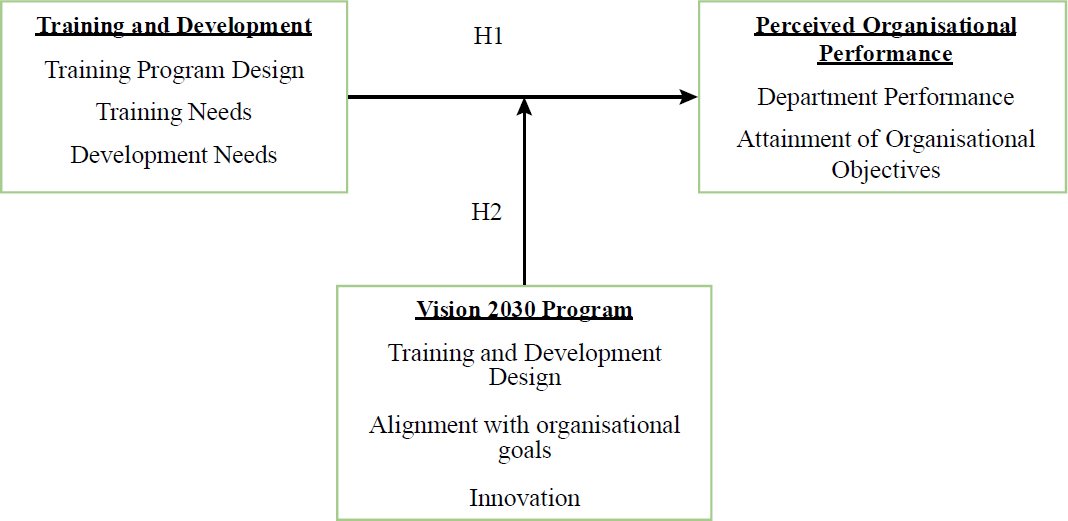
Fig. (1). Conceptual framework.
3. METHODS
This study adopted a quantitative research design. As recommended by (Alabi & Jelili, 2023), data were collected using a structured questionnaire with a five-point Likert scale ranging from strongly disagree (1) to strongly agree (5). This is considered the most effective way to ensure uniformity and simplicity in responding to questions in behavioural research. The questionnaire was categorised into three major constructs: Training and Development, Perceived Organisational Performance, and Perceived Vision 2030 Programme, whose measurement items were modified based on previously validated research to facilitate content validity (Appendix A).
All constructs were operationalised as reflective measures, and multiple-item scales were used that were drawn from existing literature. Three items from (Jamil, 2006) which related to training needs assessment, employee involvement in training identification, and matching training programs to employees’ needs, were used to measure T&D. Examples of such items include training programs planned based on the needs and requirements of employees and employees’ involvement in planning the training requirements. Perceived Organisational performance was assessed using three items adapted from (Mdhlalose, 2020) that addressed employees’ perceptions of the outcomes of training that occurred in the organisation. The items were as follows: My organisation’s performance has improved as a result of the training and development provided; the training programmes have directly contributed to achieving organisational objectives; and my organisation’s training and development have been of high value to me.
Based on the key themes that appeared throughout the previous literature on institutional policies, national transformation frameworks, and strategic government interventions affecting organisational practices, the Perceived Vision 2030 Program construct was developed for this study. The first set of items was given to a panel of academic and industry experts for content validity, and minor wording changes were implemented. In addition, a pilot study was conducted with 75 respondents, with all constructs having a Cronbach’s alpha greater than 0.70, indicating acceptable internal consistency, as shown in Table 1. The proposed measures were conducted with the reliability and validity of the constructs using Cronbach’s alpha, composite reliability, AVE, and discriminant validity analysis.
Table 1. Pilot testing.
| Construct | Cronbach’s Alpha | No of Items |
| Training and Development | 0.767 | 3 |
| Perceived Organisational Performance | 0.718 | 3 |
| Vision 2030 Program | 0.875 | 3 |
Data were obtained from employees and professionals in Saudi Arabian tourism companies, including hotels, travel agencies, and other service providers. Participants were approached through social media (Instagram, Twitter, and Facebook), which allowed us to reach a geographically dispersed sample. The purposive sampling method was used because it allowed the recruitment of respondents with the necessary knowledge and experience related to organisational practices, which is essential when conducting theory-testing studies, as suggested by (Obilor, 2023). This approach is particularly appropriate when the target group is specific and expertise-based.
This study quantifies perceived organisational performance, which is the subjective evaluation of employees regarding the effectiveness of organisational performance, rather than objective financial or operational performance. These perceptual indicators are used to describe how employees perceive the quality of services, efficiency, and general organisational operations, which are of key importance in service-heavy industries such as tourism, where frontline experiences determine the measures of performance. Although perceptual data do not necessarily reflect financial measures, previous studies have indicated that employees’ perceptions are directly correlated with organisational facts and reflect a valuable understanding of performance dynamics.
Aligned with (Kang, 2021), G*Power analysis was used to calculate the required sample size, with three predictors, an assumed significance level (α = 0.05) of 0.80, and a medium effect size (f2 = 0.15), which led to a minimum sample size of approximately 77 respondents. Nevertheless, to promote better generalisability and strength, 825 questionnaires were sent, and 475 participants returned them (response rate = 57.57). Ultimately, the sample size was reduced to 450 valid responses after screening the data using data screening processes for missing values and outliers.
To handle selection bias, selection was based on different roles and organisations in the tourism industry. As suggested by (Obilor, 2023), the assessment of non-response bias was done between the early respondents (n1 = 30) and the late respondents (n2 = 30), and no significant differences were detected. Aligned with (Castillo et al., 2026), the Harman Single-Factor test was used to evaluate Common Method Bias (CMB). All items were placed in an unrotated factor analysis. There was no individual factor that explained above the 50% variance threshold; therefore, this means that CMB is not a major issue that should be a concern.
The data were analysed using Partial Least Squares Structural Equation Modelling (PLS-SEM), which is used in research work and complex models oriented on prediction (Purwanto & Sudargini, 2021). The diagnostic tests involved measuring the reliability of the measurement model with Cronbach’s alpha and composite reliability, and convergent validity with Average Variance Extracted (AVE). This was followed by a structural model (path) analysis, which was conducted to test the hypothesised relationships and moderating effects, allowing the researcher to analyse the causal relationships between the study variables.
4. RESULTS
4.1. Demographics Profile Analysis
The demographic characteristics of the participants are shown in Table 2. Among the total (n = 450) participants, 58.89% were male and 32.67% were female, while 8.44% did not respond. In addition, with regards to the age of the participants, 33.33% were below 25 years, 24.44% were 25-34 years, 16.67% were 35-44 years, and 13.33% were 45-54 years. With respect to the educational qualifications of the participants, most of the participants, that is, 26.22% and 26.67%, held secondary education and bachelor’s degrees, respectively, while 24.44% were master’s degree holders. Regarding the job role of the participants, 38.89% served in supervisory and 27.33% in managerial positions. Finally, regarding the types of tourism organisations employees work in, 24.44% work at hotels, 33.33% work in travel agencies, and 30.67% work in resorts.
Table 2. Demographic profile.
| Demographic Category | Frequency (n) | Percentage (%) | |
| Gender | Male | 265 | 58.89% |
| Female | 147 | 32.67% | |
| Prefer not to say | 38 | 8.44% | |
| Age Range | Below 25 | 150 | 33.33% |
| 25–34 | 110 | 24.44% | |
| 35–44 | 75 | 16.67% | |
| 45–54 | 60 | 13.33% | |
| 55 and above | 55 | 12.22% | |
| Educational Qualification | Secondary | 118 | 26.22% |
| Diploma | 92 | 20.44% | |
| Bachelor’s | 120 | 26.67% | |
| Master’s | 110 | 24.44% | |
| Doctorate | 10 | 2.22% | |
| Current Job Role | Operational/Frontline | 90 | 20.00% |
| Supervisory | 175 | 38.89% | |
| Managerial | 123 | 27.33% | |
| Senior Management | 62 | 13.78% | |
| Type of Tourism Organisation | Hotel | 110 | 24.44% |
| Travel Agency | 150 | 33.33% | |
| Resorts | 138 | 30.67% | |
| Transportation Providers | 52 | 11.56% | |
4.2. Descriptive Statistics
The descriptive statistics results (Table 3) revealed favourable perceptions of all the constructs included in the study. The mean scores of respondents were moderate for the Vision 2030 program, with a mean score of 3.65 (SD = 0.86), followed by a mean score of 3.59 (SD = 0.81) for perceived Organisational performance and 3.55 (SD = 0.89) for Training and Development. The relative standard deviations indicate a relatively low amount of variability in respondents’ assessment of the measured Likert scale items.
Table 3. Descriptive statistics.
| – | N | Mean | Std. Deviation |
| Training And Development | 450 | 3.5489 | 0.88693 |
| Perceived Organisational Performance | 450 | 3.5926 | 0.81190 |
| Vision2030Program | 450 | 3.6496 | 0.85641 |
4.3. Measurement Model Assessment
The measurement model assessment was performed using Cronbach’s Alpha, Composite Reliability, with a threshold value of 0.7, and convergent validity was measured with AVE, according to its standard value of 0.5. The results are shown in Table 4.
Table 4. Measurement model assessment.
| Latent Variables | Indicators | Factor Loadings | Cronbach’s Alpha | Composite Reliability | Average Variance Extracted |
| Perceived Organisational Performance | POP1 | 0.786 | 0.821 | 0.845 | 0.736 |
| POP2 | 0.903 | ||||
| POP3 | 0.881 | ||||
| Training and Development | TD1 | 0.873 | 0.854 | 0.854 | 0.774 |
| TD2 | 0.903 | ||||
| TD3 | 0.863 | ||||
| Perceived Vision 2030 Program | PVP1 | 0.890 | 0.884 | 0.884 | 0.812 |
| PVP2 | 0.924 | ||||
| PVP3 | 0.889 |
According to the results shown in Table 4, the items of all constructs showed high factor loadings, ranging from 0.786 to 0.924. In addition, reliability and consistency were established for all constructs, as the alpha value was (α > 0.7). Furthermore, convergent validity was established because the AVE was higher than 0.5. The measurement model assessment of the study is shown in Fig. (2).
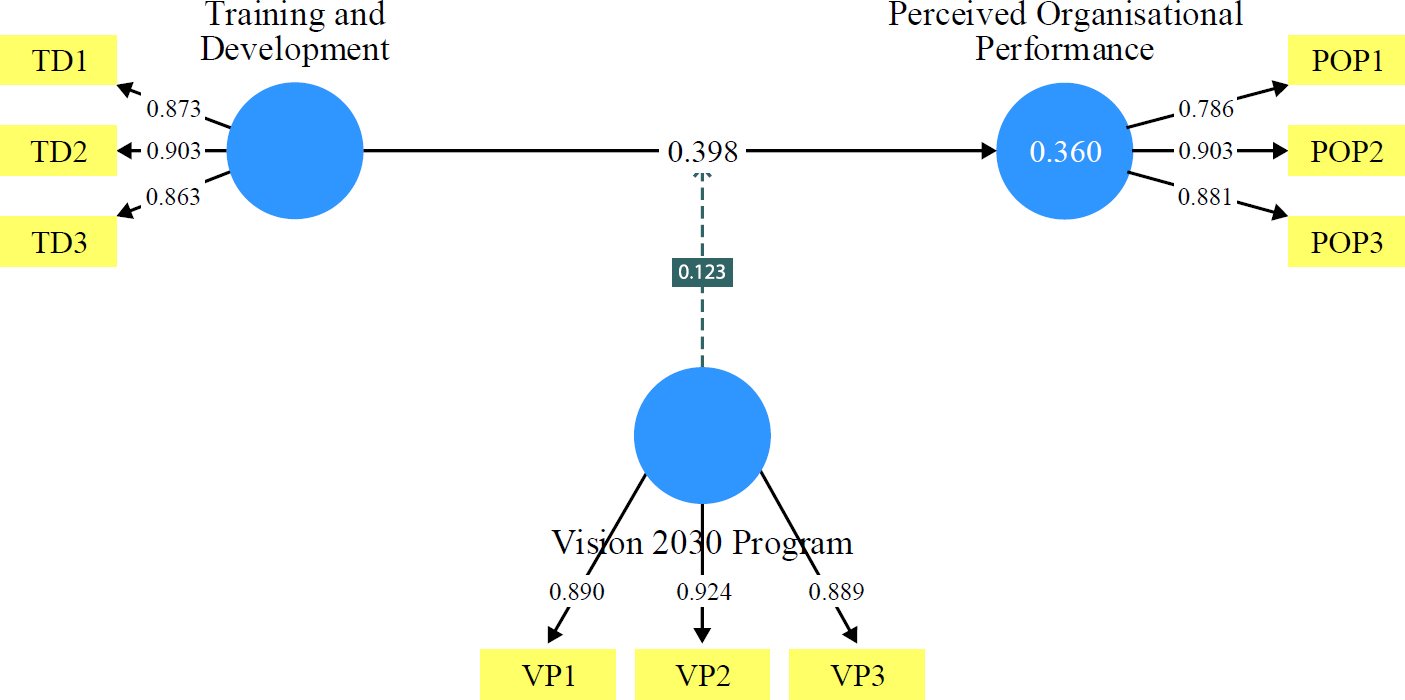
Fig. (2). Measurement model.
4.4. Discriminant Validity
The results of discriminant validity, presented in Table 5, which measures conceptual overlapping and variable distinctiveness, were analysed using the HTMT ratio against the standard threshold of 0.85, as suggested by (Rasoolimanesh, 2022). As shown in Table 5, the HTMT value for all constructs is lower than 0.85, indicating that there is no conceptual overlap among the variables and that the variables are distinct and separable from each other.
Table 5. Discriminant validity.
| – | Perceived Organisational Performance | Training and Development |
| Training and Development | 0.483 | – |
| Vision 2030 Program | 0.426 | 0.531 |
4.5. Multicollinearity Diagnostics
The Variance Inflation Factor (VIF), as shown in Table 6, is applied to measure collinearity and the CMB issue, and the results were compared with the threshold of 3.3, as suggested by (Tsagris & Pandis, 2021). The findings indicate no collinearity issues, as the VIF values are between 1.313 and 1.819, which is considerably below the 3.3 threshold. Moreover, aligned with (Kock, 2015), VIF values below 3.3 indicate the absence of common method bias using the full-collinearity approach.
Table 6. Multicollinearity diagnostics.
| – | VIF |
| Training and Development -> Perceived Organisational Performance | 1.688 |
| Vision 2030 Program -> Perceived Organisational Performance | 1.819 |
| Vision 2030 Program x Training and Development -> Perceived Organisational Performance | 1.313 |
4.6. Correlation Analysis
The Pearson correlation results (Table 7) reveal statistically significant positive relationships between all study variables. There is a moderate positive relationship between T&D and Perceived Organisational Performance (r = 0.543 p < 0.001), indicating that as the training practices increase, the perception of organisation performance also increases. Likewise, perceived Organisational performance (r = 0.506, p < 0.001) was positively related to the Vision 2030 Program variables, meaning that higher levels of perceived Vision 2030 initiatives were linked to higher levels of perceived organisational performance. The highest correlation score (0.629) is seen with T&D and Vision 2030 Program, with the level of significance being less than 0.001, indicating that there is high alignment between organisations’ training activities and their employees’ perception of national transformation initiatives. The overall results support the hypothesised relationships to some extent.
Table 7. Correlation analysis.
| Correlations | |||
| – | Training And Development | Perceived Organisational Performance | Vision 2030 Program |
| Training And Development | 1 | 0.543*** | 0.629*** |
| Perceived Organisational Performance | 0.543*** | 1 | 0.506*** |
| Vision 2030 Program | 0.629*** | 0.506*** | 1 |
Note: ***: significant at 1%
4.7. Path Coefficients Analysis
The path coefficient findings in Table 8 show that Training and Development (T&D) has a positive and statistically significant relationship with perceived Organisational performance (β = 0.398, p < 0.001), which supports H1 and confirms that the increased skills and competencies of employees lead to a significant contribution to organisational performance. Similarly, Vision 2030 has a high level of direct predictive association with organisational performance (β = 0.329, p < 0.001), implying that alignment with national strategic initiatives is positively related to organisational performance perceptions. Notably, the interaction term (Vision 2030 x T&D) is also positive and significant (β = 0.123, p = 0.015), which supports H2. This means that the efficiency of T&D in improving performance is reinforced when employees have positive attitudes towards Vision 2030 programs. In other words, institutional support enhances the effect of internal capability building and the supportive functions of external strategic alignment and internal investment in human capital. Finally, the results of the F-square show different effect sizes of the predictors on perceived organisational performance. For instance, the results show that T&D has a moderate effect size (f² = 0.147), indicating a modest predictive relevance. In addition, Vision 2030 demonstrated a small effect size (f² = 0.093), indicating modest contribution. The interaction term shows a weak effect size (f² = 0.026), implying that while the contribution is significant, its practical impact is limited.
Table 8. Path coefficient analysis.
| – | Path coefficients | T-statistics | P-values | f-square |
| Training and Development -> Perceived Organisational Performance | 0.398*** | 7.508 | 0.001 | 0.147 |
| Vision 2030 Program -> Perceived Organisational Performance | 0.329*** | 5.511 | 0.001 | 0.093 |
| Vision 2030 Program x Training and Development -> Perceived Organisational Performance | 0.123** | 2.437 | 0.015 | 0.026 |
Note: **: Significant at 5%; ***: Significant at 1%
4.8. Model Explanatory Power
The R-square results are shown in Table 9, which indicates that 36% of the variance in Perceived Organisational Performance can be predicted by Training and Development in Saudi tourism organisations. This can be regarded as having low to modest explanatory power.
Table 9. Explanatory power.
| – | R-Square | R-Square Adjusted |
| Perceived Organisational Performance | 0.360 | 0.356 |
4.9. Predictive Relevance
The results of the predictive relevance in Table 10 indicate that the predictive out-of-sample relevance of this model is moderate. The Q2 value of 0.333 exceeds zero, proving that there is an acceptable predictive relevance of perceived organisational performance. Furthermore, the values of RMSE (0.821) and MAE (0.614) are relatively small, implying that the error in prediction is not large, which indicates that the model is accurate. Together, these results show that the model is acceptable for predicting organisational performance in Saudi Arabia’s tourism sector.
Table 10. Predictive relevance.
| – | Q²predict | RMSE | MAE |
| Perceived Organisational Performance | 0.333 | 0.821 | 0.614 |
5. DISCUSSION
The results of the current research indicate that Training and Development (T&D) possesses a statistically significant and positive predictive relationship with the perceived organisational performance, which validates H1. This is consistent with (Igudia, 2022; and Upadhyay, 2018), who also found a strong positive connection between organised training practices and organisational performance. This convergence is explained by the Human Capital Theory, which states that investments in the competencies of employees are positively related to the enhancement of organisational functioning. This relationship seems to be quite robust in the case of the Saudi Arabian tourism industry because of the service-oriented nature of the industry, where employees’ competency directly determines customer experience and service perceptions.
However, the level of this relationship brings a little contradicts the study by (Zubair, 2025), who found a limited relationship between on-the-job training and organisational performance. This difference can be explained by sectoral variations, as tourism is more dependent on the human interpersonal and adaptable skills of service than on routine-based banking. In the same vein, the authors have highlighted the significance of continuous reinforcement, but the current results indicate that the current training framework within Saudi tourism companies might already have elements that involve practical and ongoing learning that enhances its predictive value.
The current findings are also not similar to those provided by (Ngcobo, 2022), who emphasised the limitations, including the lack of skills and demographics of the working population. This difference can be explained by Saudi Arabia’s high institutional investment in workforce development, which minimises structural barriers. Group work orientations and service norms also support the culturally based positive association between T&D and performance. In the retail industry, these results indicate that strategic investment in employee development is bound to have a positive relationship with improved service quality and organisational competitiveness.
These findings have important implications for both theory and practice. Theoretically, the findings reinforce the relevance of Human Capital Theory, as they indicate that investments in employee knowledge, skills, and competencies are still positively related to perceived organisational performance in a service-driven and policy-constrained setting. The results also indicate that the scope of application of Human Capital Theory is not limited to conventional work environments but has also been relevant in the context of the rapidly evolving tourism industry in Saudi Arabia. The results have practical implications in that, from the perspective of the tourism organisation, training and development must be considered a strategic organisational capability and not a human resource activity that occurs on an ad-hoc basis. Further investigations are required to systematically identify the need for employee training, design learning programmes for job-specific roles, and ongoing assessment of training results to ensure that they meet the organisationally defined goals. This will likely lead to increased workforce competence, more consistent service levels, better customer experiences, and better organisational competitiveness, making tourism organisations more sustainable in the changing Saudi economic landscape.
The results also revealed that the Perceived Vision 2030 Programme significantly and positively moderated the association between Training and Development and Perceived Organisational, confirming H2. This confirms and builds on the previous research by (Hasan & Chowdhury, 2023; and Garavan et al., 2021), who found positive relationships between alignment with Vision 2030 and organisational outcomes. Nevertheless, as opposed to these studies, the current results show that Vision 2030 is not directly related to performance only, but also reinforces the predictive relationship between internal HR practices and organisational results.
This moderating role can be explained by Institutional Theory, which proposes that organisations act in response to external forces and norms to ensure that they remain legitimate, as suggested by (Mohammad et al., 2024). According to (Mekdad et al., 2024), Vision 2030, in the present instance, is a normative and coercive institutional framework which informs organisational priorities. Hence, it can be said that as employees feel the purpose of these national initiatives, the relationship between T&D and organisational performance becomes closer, meaning that external institutional alignment enhances internal capability of the organisation.
In contrast, (Aburub & Khanfar, 2025) noted a weak relationship between superficial compliance and Vision the 2030. The findings of this study enhance this view by focusing on the fact that it is the perception of alignment, not the formal adoption, that reinforces organisational outcomes. This difference can be attributed to the fact that the tourism sector is more visible in the framework of Vision 2030, which creates more awareness among employees and increases their engagement. It is also possible that, culturally, national identity and support for government initiatives in Saudi Arabia reinforce this relationship. For the retail industry, this implies that harmony between organisational practices and national strategies, as well as ensuring that employees hold positive perceptions, can lead to increased effectiveness of internal development processes.
Vision 2030 enhances the relationship between T&D and perceived organisational performance, as employees use it as a meaning-making frame. Congruence with national transformation initiatives categorises employees’ identities and organisational commitment, enhancing the internalisation of training content. Employees interested in T&D are more likely to be motivated and engaged, and the predictive relationship between skill development and performance results can be increased, as indicated by (Upadhyay, 2018). This process transcends generic institutional pressure and directly connects policy images with HR effectiveness.
The results have substantial theoretical and practical implications for the field. From a theoretical perspective, they argue that the explanatory power of Institutional Theory goes beyond organisational conformity, as they claim that the perceived consequences of institutional initiatives are an important contextual condition that links HR practices to perceived organisational performance. This implies that beyond the process of “capability enhancement”, people’s interpretation of the institutional environment is also an important factor in determining the effectiveness of “training and development”. In practice, tourism organisations need to incorporate employee development programmes into their Vision 2030 agenda, consistently communicating, committing, and enacting an organisation’s policy that embeds the importance of national transformation. Vision 2030 should be integrated into organisational learning and development initiatives and strategies to boost employee engagement, improve the value of training and learning, and ensure that the development of the workforce in the tourism sector maximises organisational benefits in Saudi Arabia.
CONCLUSION
This study enhances the argument that organisational performance based on service-intensive industries, such as tourism, cannot be wholly explained by internal practices but needs to be analysed in relation to larger institutional contexts. The results indicate that T&D is positively related to organisational performance; however, its ability to predict is dependent on the degree to which organisations and employees resonate with national strategic guidelines, such as Vision 2030. This brings out a more integrative approach in which human capital development and institutional alignment occur together, and not separately. Thus, this research is relevant to the gap between micro-level HR practices and macro-level policy impacts to provide a fine-tuning perspective on the dynamics of performance in emerging economies, especially in Saudi Arabia’s rapidly changing tourism industry.
LIMITATIONS AND FUTURE DIRECTION
Nonetheless, this study has some limitations. The cross-sectional design limits the possibility of drawing conclusions about temporal relationships, whereas the use of self-reported data can create a perceptual bias, even with statistical controls. In addition, purposive sampling, while suitable, can constrain generalisation outside the sphere of tourism. Future studies should focus on a longitudinal design to measure changes over time and use multi-source data to strengthen these findings. The findings should be further confirmed by expanding the research study into other sectors, including the retail or hospitality sub-industries. Furthermore, moderating or mediating variables, such as organisational culture or leadership, can be integrated into future research to present a more detailed picture of performance results. Moreover, this study recognises that purposive sampling can restrict the representativeness of the data on the general tourism workforce in Saudi Arabia. Despite the selection of participants according to relevance and experience, the sample did not adequately represent the variety of positions, organisational types, and geographical differences in the sector. Hence, future studies should apply a probability-based sampling technique within different regions and organisational types to widen the generalisability and scope of the findings.
IMPLICATIONS
This study is important from both empirical and practical perspectives. Based on empirical evidence, it provides findings from the Saudi tourism sector, indicating that the relationship between T&D and perceived organisational performance depends on employees’ perceptions of national transformation projects. The findings corroborate and extend prior work on HRM by showing how perceptions of policies at the macro level can be a significant contextual determinant within organisations that have implications for outcomes. The implications for policymaking, with respect to Vision 2030, are two-fold: employee awareness and engagement with national programs need to be further strengthened to improve organisational alignment. Any training program needs to be aligned with the Vision 2030 goals of the tourism organisation and the country and with the goals of the people in the tourism industry. Training programs should also be aligned with organisational development goals. Training programs should also be linked to country and organisation development goals and the role of people in the tourism industry. Any training program should be linked to internal communication in respect of its relation to the role of the people in the tourism industry. This alignment can enhance the impact of workforce development initiatives and contribute to the competitiveness of organisations in service-based businesses.
LIST OF ABBREVIATIONS
AVE | = | Average Variance Extracted |
CMB | = | Common Method Biases |
GDP | = | Gross Domestic Product |
PLS-SEM | = | Partial Least Squares Structural Equation Modelling |
T&D | = | Training and Development |
AUTHOR’S CONTRIBUTION
E.R. has contributed to the study conceptualization, methodology, data analysis, interpretation of results, and manuscript writing.
ETHICAL APPROVAL & INFORMED CONSENT
Formal ethical approval was not required for this study in accordance with the policies of the relevant institution. The research was conducted in accordance with established ethical principles, ensuring participant confidentiality, anonymity, and data protection. All participants were provided with detailed information about the purpose, procedures, and voluntary nature of the study and gave informed consent prior to their participation. Participants were informed of their right to withdraw at any stage without any consequences.
AVAILABILITY OF DATA AND MATERIALS
The data will be made available on reasonable request by contacting the corresponding author [E.R.].
FUNDING
None.
CONFLICT OF INTEREST
The author declares that there is no conflict of interest regarding the publication of this article.
ACKNOWLEDGEMENTS
Declared none.
DECLARATION OF AI
Artificial intelligence (AI) tools were used solely to support language refinement and improve the clarity and presentation of the manuscript. All research design, data collection, analysis, interpretation, and final content remained the responsibility of the researcher.
APPENDIX A
Demographic Questions:
- What is your gender?
- Male
- Female
- Prefer not to say
- What is your age group?
- Below 25
- 25–34
- 35–44
- 45–54
- 55 and above
- What is your highest educational qualification?
- Secondary
- Diploma
- Bachelor’s
- Master’s
- Doctorate
- What best describes your current job?
- Operational/Frontline
- Supervisory
- Managerial
- Senior Management
- How many years of total experience do you have in this industry?
- Less than 3 years
- 3–5 years
- 6–10 years
- More than 10 years
| Variable | Question Statement | Strongly Disagree (1) | Disagree (2) | Neutral (3) | Agree (4) | Strongly Agree (5) |
| Training and Development. Adapted from (Jamil, 2006) | Training programs are designed after considering employees’ needs and requirements. | ☐ | ☐ | ☐ | ☐ | ☐ |
| Employees in the organisation participate in determining the training they need. | ☐ | ☐ | ☐ | ☐ | ☐ | |
| There is a process for assessing the organisation immediate training and individual development needs. | ☐ | ☐ | ☐ | ☐ | ☐ | |
| Perceived organisational Performance. Adopted from (Mdhlalose, 2020) | Training and Development has an impact on the overall performance of the staff within the department. | ☐ | ☐ | ☐ | ☐ | ☐ |
| My organisation’s performance has improved because of the training and development provided. | ☐ | ☐ | ☐ | ☐ | ☐ | |
| The training programs directly contribute to achieving organisational objectives. | ☐ | ☐ | ☐ | ☐ | ☐ | |
| Perceived Vision 2030 Program | Vision 2030 initiatives have influenced the training and development programs in my organisation. | ☐ | ☐ | ☐ | ☐ | ☐ |
| The alignment of Vision 2030 goals with organisational performance has enhanced the impact of training programs. | ☐ | ☐ | ☐ | ☐ | ☐ | |
| Vision the 2030s focus on innovation and development has contributed to improved organisational performance. | ☐ | ☐ | ☐ | ☐ | ☐ |
REFERENCES
Aburub, A., & Khanfar, F. (2025). Cultural dimensions of human resource practices in Saudi Arabia: Navigating identity, diversity, and social change in STC. Journal of Cultural Analysis and Social Change, 10(2), 2958-2972.
https://doi.org/10.64753/jcasc.v10i2.2039
Alabi, A. T., & Jelili, M. O. (2023). Clarifying likert scale misconception for improved application in urban studies. Quality & Quantity, 57(2), 1337-1350.
https://doi.org/10.1007/s11135-022-01415-8
Alkaf, A., Yusliza, M. Y., Saputra, J., Muhammad, Z., & Bon, A. T. (2021). A review of work effectiveness and efficiency, service quality and organisational performance literature: A mini-review approach. In Proceedings of the 11th Annual International Conference on Industrial Engineering and Operations Management Singapore, 5127-5141.
https://doi.org/10.46254/AN11.20210873
Alregab, H. (2023). The role of corporate governance in attracting foreign investment: An empirical investigation of Saudi‐listed firms in light of vision 2030. International Journal of Finance & Economics, 28(1), 284-294.
https://doi.org/10.1002/ijfe.2420
Alshareef, M. N. (2025). Artificial intelligence-enhanced environmental, social, and governance disclosure quality and financial performance nexus in Saudi listed companies under vision 2030. Sustainability, 17(16), 7421.
https://doi.org/10.3390/su17167421
Aman-Ullah, A., Mehmood, W., Amin, S., & Abbas, Y. A. (2022). Human capital and organisational performance: A moderation study through innovative leadership. Journal of Innovation & Knowledge, 7(4), 100261.
https://doi.org/10.1016/j.jik.2022.100261
Arab News (2026) Saudi tourism employment surpasses 1m as hospitality sector expands. Arab News. Available from: https://www.arabnews.com/node/2628650/business-economy (Accessed on: 21 July 2026).
Bilderback, S. (2024). Integrating training for organizational sustainability: The application of Sustainable Development Goals globally. European Journal of Training and Development, 48(7-8), 730-748.
https://doi.org/10.1108/EJTD-01-2023-0005
Bin Othayman, M., Mulyata, J., Meshari, A., & Debrah, Y. (2022). The challenges confronting the training needs assessment in Saudi Arabian higher education. International Journal of Engineering Business Management, 14, 18479790211049706.
https://doi.org/10.1177/18479790211049706
Bindawas, A. M. (2025). Promoting sustainable tourism through employee skills: Contextualizing quality education and the human resource management perspective (SDG-4). Sustainability, 17(2), 748.
https://doi.org/10.3390/su17020748
Birdir, K., & Sahilli Birdir, S. (2024). Staff shortages in hospitality and tourism industries: How technology influences? Worldwide Hospitality and Tourism Themes, 16(5), 551-554.
https://doi.org/10.1108/WHATT-09-2024-0229
Candra, P., Mahaputra, M. R., & Mahaputra, M. R. (2023). Service Quality and Customer Satisfaction Have an Impact on Increasing Hotel Room Occupancy Ratio: Literature Review Study. Greenation International Journal of Tourism and Management, 1(4), 400-412.
https://doi.org/10.38035/gijtm.v1i4.127
Castillo, A., Rescalvo-Martin, E., & Karatepe, O. M. (2026). How is common method bias addressed using partial least squares structural equation modeling in hospitality and tourism research? Tourism Review,81(1), 204-228.
https://doi.org/10.1108/TR-07-2025-0762
De Bruin, L., Roberts-Lombard, M., & De Meyer-Heydenrych, C. (2021). Internal marketing, service quality and perceived customer satisfaction: An Islamic banking perspective. Journal of Islamic Marketing, 12(1), 199-224.
https://doi.org/10.1108/JIMA-09-2019-0185
Dewangga, I. K. K., & Sumerta, K. E. (2024). Enhancing Waiter Teamwork: Supervisory Strategies at Bhira Restaurant, Quest San Hotel Denpasar, Bali. Bali Journal of Hospitality, Tourism and Culture Research, 2(1), 22-33.
https://doi.org/10.5281/zenodo.14602766
Elsafty, A., & Oraby, M. (2022). The impact of training on employee retention: An empirical research on the private sector in Egypt. International Journal of Business and Management,17(5), 58-74.
https://doi.org/10.5539/ijbm.v17n5p58
Filippi, L. D., & Mazzetto, S. (2024). Comparing AlUla and the red sea Saudi Arabia’s Giga projects on tourism towards a sustainable change in destination development. Sustainability, 16(5), 2117.
https://doi.org/10.3390/su16052117
Galeazzo, A., Miandar, T., & Carraro, M. (2024). SDGs in corporate responsibility reporting: A longitudinal investigation of institutional determinants and financial performance. Journal of Management and Governance, 28(1), 113-136.
https://doi.org/10.1007/s10997-023-09671-y
Garavan, T., McCarthy, A., Lai, Y., Murphy, K., Sheehan, M., & Carbery, R. (2021). Training and organisational performance: A meta‐analysis of temporal, institutional and organisational context moderators. Human Resource Management Journal, 31(1), 93-119.
https://doi.org/10.1111/1748-8583.12284
Hasan, M. M., & Chowdhury, S. A. (2023). Assessing the influence of training and skill development initiatives on employee performance: A case study of private banks in Dhaka, Bangladesh. Malaysian Business Management Journal, 2(2), 74-79. http://doi.org/10.26480/mbmj.02.2023.74.79
Igudia, P. O. (2022). Employee training and development, and organisational performance: A study of small-scale manufacturing firms in Nigeria. American Journal of Economics and Business Management, 5(5), 38-54. Available from: https://globalresearchnetwork.us/index.php/ajebm/article/view/1055
Jamil, R. (2006): Training needs analysis: Practices of top companies in Malaysia. Available from: https://www.academia.edu/35912577/Training_Needs_Analysis_Practices_of_Top_Companies_in_Malaysia (Accessed on: 21-07-2026).
Kang, H. (2021). Sample size determination and power analysis using the G* Power software. Journal of Educational Evaluation for Health Professions, 18, 17.
https://doi.org/10.3352/jeehp.2021.18.17
Khaksar, M. R., & Amir, E. (2023). The contribution of tourism to the economic growth of a country. International Journal of Current Science Research and Review, 6(7), 4917-4921.
https://doi.org/10.47191/ijcsrr/V6-i7-107
Kock, N. (2015). Common method bias in PLS-SEM: A full collinearity assessment approach. International Journal of e-Collaboration (IJeC), 11(4), 1-10.
https://doi.org/10.4018/ijec.2015100101
Mdhlalose, D. (2020). An evaluation of the impact of training and development on organisational performance: A case study of the Gauteng provincial department of economic development. Journal of Human Resource and Sustainability Studies, 8(1), 48-74.
https://doi.org/10.4236/jhrss.2020.81004
Mekdad, D. K., Jayasuria, J. G., & Hossin, A. A. (2024). Impact of training and development on employee performance: Insights for sustainable capacity building of employees in telecommunication organisations in Qatar. In Innovation and Technological Advances for Sustainability (pp. 578-593). CRC Press. http://dx.doi.org/10.1201/9781003496724-58
Ministry of Finance (2025). Budget Statement 2026. Available from: https://www.mof.gov.sa/en/budget/2026/BudgetStatementDocs/Eng_2026.pdf (Accessed on: 21-07-2026).
Mohammad, T., Kassem, B., & Mohammad, S. (2024). Employee wellbeing and quality of life of Saudi Arabian workers. In Employee Wellbeing in the Global South: A Critical Overview (pp. 121-144). Cham: Springer Nature Switzerland.
https://doi.org/10.1007/978-3-031-63249-5_6
Ngcobo, S. D. (2022). The role of training and development on organisational performance in the footwear industry in South Africa. Technium Social Sciences Journal, 35, 418-432.
https://doi.org/10.47577/tssj.v35i1.6058
Niati, D. R., Siregar, Z. M. E., & Prayoga, Y. (2021). The effect of training on work performance and career development: The role of motivation as intervening variable. Budapest International Research and Critics Institute (BIRCI-Journal): Humanities and Social Sciences, 4(2), 2385-2393.
https://doi.org/10.33258/birci.v4i2.1940
Obeng-Tuaah, M. (2025). Employees training and development to enhance organisational performance. International Journal of Multidisciplinary Studies and Innovative Research, 13(1), 1-15. Available from: https://scholarindexing.com/uploads/files/hpwrq_eg0l537nf.pdf (Accessed on: 21-07-2026).
Obilor, E. I. (2023). Convenience and purposive sampling techniques: Are they the same? International Journal of Innovative Social & Science Education Research, 11(1), 1-7. Available from: https://www.researchgate.net/profile/Esezi-Obilor/publication/398681103_Convenience_and_Purposive_Sampling_Techniques_Are_they_the_Same/links/693fe9e8a1fd01798907e406/Convenience-and-Purposive-Sampling-Techniques-Are-they-the-Same.pdf (Accessed on: 21-07-2026).
Omarova, A. (2026). Human Resource Practices and Their Impact on Front-Office Service Quality in Almaty Hotels. In ACE-International Conference “Actual Economy: Local Solutions for Global Challenges”, 166. Available from: https://conferaces.com/index.php/journal/article/view/834
Purwanto, A., & Sudargini, Y. (2021). Partial least squares structural squation modeling (PLS-SEM) analysis for social and management research: A literature review. Journal of Industrial Engineering & Management Research, 2(4), 114-123. Available from: https://www.jiemar.org/index.php/jiemar/article/view/168/130
Rashid, A., Rasheed, R., & Altay, N. (2025). Greening manufacturing: The role of institutional pressure and collaboration in operational performance. Journal of Manufacturing Technology Management, 36(2), 455-478.
https://doi.org/10.1108/JMTM-04-2024-0194
Rasoolimanesh, S. M. (2022). Discriminant validity assessment in PLS-SEM: A comprehensive composite-based approach. Data Analysis Perspectives Journal, 3(2), 1-8. Available from: https://scriptwarp.com/dapj/2022_DAPJ_3_2/Rasoolimanesh_2022_DAPJ_3_2_DiscriminantValidity.pdf (Accessed on: 21-07-2026).
Shesha, L. S., & Yusuf, N. (2021). The socio-economic potential of the emerging film industry in Saudi Arabia. European Journal of Sustainable Development, 10(1), 239.
https://doi.org/10.14207/ejsd.2021.v10n1p239
Silva, M. J., Ribeiro, L. M. R. P., & Costa, C. (2025). Tourism operation and distribution in Portugal: Human capital challenges in a crisis context. In Building Human Capital in Tourism and Hospitality: Perspectives from theory and practice. (pp. 157-176.
https://doi.org/10.1079/9781800624979.0009
Syeda, S. T., Kee, D. M. H., Alyafi-AlZahri, R., Alsanie, G., & BinSaeed, R. (2023). Corporate Sustainability and Vision 2030: Exploring ARAMCO’s role in promoting social responsibility for sustainability. Journal of Law and Sustainable Development, 11(12), e1408.
https://doi.org/10.55908/sdgs.v11i12.1408
Tai, Y. F., Wang, Y. C., & Luo, C. C. (2021). Technology-or human-related service innovation? Enhancing customer satisfaction, delight, and loyalty in the hospitality industry. Service Business, 15(4), 667-694.
https://doi.org/10.1007/s11628-021-00461-w
Thommandru, A., Espinoza-Maguiña, M., Ramirez-Asis, E., Ray, S., Naved, M., & Guzman-Avalos, M. (2023). Role of tourism and hospitality business in economic development. Materials Today: Proceedings, 80, 2901-2904.
https://doi.org/10.1016/j.matpr.2021.07.059
Tsagris, M., & Pandis, N. (2021). Multicollinearity. American Journal of Orthodontics and Dentofacial Orthopedics, 159(5), 695-696.
https://doi.org/10.1016/j.ajodo.2021.02.005
Tumi, N. S., Hasan, A. N., & Khalid, J. (2022). Impact of compensation, job enrichment and enlargement, and training on employee motivation. Business Perspectives and Research, 10(1), 121-139.
https://doi.org/10.1177/2278533721995353
Upadhyay, R. (2018). The Relationship between Employee Training and development and organisational performance: An empirical Study. Psychology and Education, 55(1), 74-82.
https://doi.org/10.48047/pne.2018.55.1.04
Urbancová, H., Vrabcová, P., Hudáková, M., & Petrů, G. J. (2021). Effective training evaluation: The role of factors influencing the evaluation of effectiveness of employee training and development. Sustainability, 13(5), 2721.
https://doi.org/10.3390/su13052721
Zubair, K. J. (2025). Impact Of Employee Training and Development on Organisational Performance: A Case Study of Guaranty Trust Bank Zaria Branch. Path of Science, 11(8), 1051-1057.
https://doi.org/10.22178/pos.121-47
Licensed
© 2026 Copyright by the Authors.
Licensed as an open access article using a CC BY 4.0 license.
Article Contents Author Felicia Gabriela Beresescu1, * 1College of Business-Al Khobar, Al Yamamah University, Saudi Arabia Article History: Received: 21
Article Contents Authors Saman Ismail1, * Imran Iqbal2 1Faculty of Management Science, Department of Business Administration, Salim Habib University, Karachi,
Article Contents Author Michael Dolinsky1, * 1Faculty of Mathematics and Technologies of Programming, Francisk Skorina Gomel State University,
Article Contents Author Abdul Ghafoor Memon1, * 1Emaan Institute of Management Sciences, Karachi, Pakistan Article History: Received: 01 April, 2026
Article Contents Authors Zixuan Zhao1, Ju Guo1, * 1School of Management, Chengdu University of Information Technology, Chengdu, China Article History:
Article Contents Authors Sultan Ud Din Yousufzai1, Amtyaz Safi2, * , Maher Khan1, Zia Ud Din1 1Department of Zoology, Govt.