









Article Contents
Article ID: CM2602112014
Views: 14Ethical Advertising Disclosure, AI-Content Transparency, and Consumer Trust: The Mediating Role of Perceived Authenticity in Perceptions of AI-Generated FMCG Marketing in France
 DOI:
 PDF
⬇ Downloads: 0
1Department of Management, Emaan Institute of Management and Sciences (EIMS), Karachi, Pakistan
Received: 27 September, 2026
Revised: 07 October, 2026
Accepted: 12 October, 2026
Published: 23 October, 2026
ABSTRACT:
Introduction: This research examines the relationships among Ethical Advertising Disclosure (EAD), AI-content Transparency (AIT), and Consumer Trust (CT) in overall perceptions of AI-created FMCG marketing in France, with Perceived Authenticity (PA) as a mediating variable.
Methodology: The study used a quantitative, explanatory cross-sectional design to collect data from 362 consumers aged 18-40 using a five-point Likert scale questionnaire delivered online and analysed using PLS-SEM.
Results: Positive associations were observed between EAD and PA, EAD and CT, AIT and PA, AIT and CT, and PA and CT. Significant direct and indirect paths were consistent with complementary partial mediation, indicating that disclosure signals were associated with trust through authenticity judgements as well as direct statistical pathways. The EAD→PA coefficient was larger than the AIT→PA coefficient, whereas the AIT→CT coefficient was larger than the EAD→CT coefficient; the differences are descriptive since there was no formal test of coefficient differences. The results are consistent with signalling theory because they distinguish disclosure of commercial intent from transparency of AI involvement and identify authenticity as one interpretive pathway.
Conclusion: The results suggest transparent sponsorship disclosure, clear communication of AI use, and brand-aligned AI-assisted marketing behaviours as potentially valuable methods of supporting credibility and consumer trust for FMCG managers.
Keywords: Ethical advertising disclosure, AI-content transparency, perceived authenticity, consumer trust, FMCG marketing, France, PLS-SEM.
1. INTRODUCTION
1.1. Overview
AI is changing marketing practice by enabling companies to design customised, scalable, and rapidly adapted promotional content. Additionally, AI is utilised in digital marketing and e-commerce, leveraging its potential to generate ads, recommendations, and promotional materials that can improve communication and interactions with customers (Saleh & Zeebaree, 2025). Consumer perceptions of the source, authenticity and motives behind marketing messages are also affected. This creates a dual hurdle for the companies that do business in digitally oriented markets: getting the efficiency boost of AI, and keeping communication channels open that consumers deem as clear and reliable. The issues are particularly relevant in France, where businesses are beginning to implement AI in their customer interactions marketing workflows (Ejjami, 2024). The value of AI-assisted marketing therefore depends not only on technical capabilities but also on how clearly brands communicate their use. Cross-national research including 1,561 adults in France found that psychological need fulfilment was associated with AI positivity and negativity across European populations, reinforcing the importance of contextual interpretation of AI attitudes (Bergdahl et al., 2023). Recent advertising research distinguishes generative-AI disclosures that communicate how content was produced from conventional disclosures that primarily reveal persuasive intent, reinforcing the conceptual separation between AIT and EAD in the present model (Dineva & Acar, 2026).
Ethical Advertising Disclosure (EAD) and AI-content Transparency (AIT) are similar but conceptually different forms of openness. EAD concerns consumers’ ability to identify promotional, sponsored, or commercial intent, whereas AIT concerns firms’ disclosure that AI was involved in creating or delivering marketing content. Perceived authenticity can be reinforced by transparent brand communication so that it lessens the uncertainty about the manner and rationale of creating a message (Yang & Battocchio, 2021). Recent research also indicates that AI disclosure may influence credibility and consumer judgement, but the direction of the relationship depends on how consumers make sense of the disclosure (Baek et al., 2026). Perceived Authenticity (PA) is therefore relevant because consumers assess the authenticity of a brand; they consider sincerity, genuineness, and consistency in determining whether they can trust the brand. In the French FMCG setting, examining these relationships may help explain how trust relates to different forms of transparency.
1.2. Problem Statement
The increasing use of AI in marketing poses a trust challenge to FMCG brands because consumers may not easily determine promotional intent or how AI was used to create a message. Limited disclosure may be associated with uncertainty about authorship, persuasion, and potential manipulation, which may correspond with greater scepticism towards the communication (Saleh & Zeebaree, 2025). Whether consumers receive credible information that enables them to understand the message and the brand’s intentions is a central question. Low levels of transparency can undermine perceived authenticity in situations where consumers doubt whether communication is based on authentic brand values or on autopilot persuasion. The commercial value of this concern is that trust facilitates long-term relationships with consumers, and perceived deception can undermine credibility and brand image (Ejjami, 2024). FMCG companies thus require evidence on whether advertising disclosure and AI-content transparency have a direct or indirect relationship with trust via authenticity or both.
1.3. Research Gap
The field of AI marketing research has grown significantly but there are still key conceptual, contextual, and methodological gaps. Previous research has tried to analyse disclosure, authenticity, credibility, or trust separately, and the nature of interactions among disclosure cues is also not well understood in previous research. More recently, however, there is no consistent pattern of beneficial responses to AI disclosure: AI disclosure can help to build trust and transparency in some contexts, but can also lead to mistrust when consumers think poorly of AI participation (Kirkby et al., 2023). Likewise, (Baek et al., 2026) reveal that AI disclosure is linked to advertising evaluations via the credibility-related judgements, suggesting that transparency is not necessarily advantageous. Research has been mainly focused on digital advertising in general, and a smaller number of studies have been conducted regarding online FMCG consumers in France (Ejjami, 2024). In addition, perceived authenticity is often considered an outcome of disclosure indicators instead of a statistical pathway connecting disclosure indicators and trust (Majerova et al., 2025). This study fills these gaps by distinguishing between EAD and AIT and exploring PA as a mediator in a single signalling-based model. A recent systematic review further identifies trust, security, personalisation, convenience, and effectiveness as recurring dimensions of the AI-consumer relationship, supporting closer examination of trust-related mechanisms in brand contexts (Ribeiro et al., 2025).
1.4. Purpose Statement
The paper examines the link between ethical advertising disclosure and the transparency of AI-generated content and consumers’ trust in the general perception of AI content in FMCG marketing, with perceived authenticity as a mediator. It also examines the effectiveness of the signalling theory in explaining consumer behaviour with regard to two transparency signals: commercial intent disclosure and AI involvement disclosure. The study distinguishes these signals and examines whether their associations with trust are direct, indirect through authenticity, or both.
2. LITERATURE REVIEW
2.1. Theoretical Foundations: Signalling Theory and Persuasion Knowledge
Signalling theory originated in economics to explain how observable cues reduce information asymmetry between parties with unequal information (Spence, 1978). In marketing, the theory has been extended to explain how firms communicate less observable qualities such as reliability, integrity, and credibility (Bafera & Kleinert, 2023). This theory applies to AI-assisted advertising because, in many cases, consumers cannot independently determine who produced a message, why it was produced, or how much AI was used. EAD may signal openness to persuasive intent, whereas AIT may signal openness to content provenance and technological participation. When perceived as credible, disclosure cues can reduce information asymmetry and strengthen perceptions of brand transparency, although their effects may vary with consumers’ existing perceptions of brand credibility (Sansome et al., 2026). Signalling theory thus explains how observable disclosure signals can convey information about less observable attributes of the firm and its disclosure.
Persuasion Knowledge Theory provides a complementary explanation of how consumers respond when persuasive intent becomes salient. Instead of believing that disclosure is automatically more likely to raise the level of trust, this view suggests that consumers apply their awareness of persuasive techniques to judge the intentions of advertisers and determine whether to question or oppose the message. (Van Reijmersdal et al., 2016) found that sponsored-content disclosures can activate recognition of persuasive intent and resistance strategies. (Wojdynski & Evans, 2016) also demonstrated that disclosure position and wording affect recognition of native advertising, whereas (Hwang & Jeong, 2016) found that disclosure of sponsorship affects responses to sponsored communication. In the current context, EAD can make persuasive intent more salient, whereas AIT can prompt consumers to consider the technology used to create the message. Experimental evidence also indicates that AI disclosure labels can shape advertising and brand attitudes through inferences of manipulative intent, supporting the relevance of persuasion knowledge in AI-mediated advertising (Wortel et al., 2024).
These perspectives are complementary rather than contradictory. Signalling theory describes why EAD and AIT can lessen information asymmetry by observable signals about commercial intent and technological authorship, and persuasion knowledge describes how consumers process those signals when persuasive intent is activated. The primary framework is signalling theory, while Persuasion Knowledge Theory helps explain why disclosure may also prompt critical evaluation; together, they clarify relationships between disclosure signals and trust. (Kirkby et al., 2023) found that disclosed AI authorship is not necessarily associated with lower authenticity when the communication remains credible. (Baek et al., 2026) likewise show that AI disclosure can reshape credibility-based advertising evaluations. Together, these perceptions provide a more detailed theoretical basis for the proposed relationships.
2.2. Ethical Advertising Disclosure
Ethical advertising disclosure concerns the clarity of sponsorship, promotional, and commercial intent. This paper uses the term EAD to focus on the ethical aspect of disclosure, which implies being clear and transparent, fair, and non-deceptive in relation to sponsorship and commercial motive, rather than advertising ethics in its broader context. Transparency can reduce confusion because consumers can more effectively identify the type of message and evaluate brand behaviour. (Hwang & Jeong, 2016) proved that a sponsorship disclosure changes the response to sponsored communication, and (Van Reijmersdal et al., 2016) found that a disclosure can activate persuasion knowledge and resistance strategies. These results indicate that disclosure may not always help to increase persuasion; its value varies depending on whether the openness is viewed as an indication of truthfulness or as a signal of manipulation. Newer discoveries associate credibility and perceived authenticity with greater consumer response during online advertising (Kothari et al., 2025). This difference is especially important when it comes to AI-based marketing since consumers can consider both the commercial purpose and the technology used to generate a message. The national focus on the clear identification of commercial content in digital influence also aligns with the disclosure-specific meaning in France (Aade & Goanta, 2025). The ARPP’s 2024 Responsible Influence Observatory documented continuing improvement in the transparent identification of commercial collaborations in France (ARPP, 2024). EAD is therefore interpreted here as an ethically framed advertising-disclosure construct rather than a general measure of advertising ethics.
2.3. AI-Content Transparency
AI-content transparency refers to the extent to which firms clearly explain how artificial intelligence is used to create, modify, or deliver marketing content. In contrast to traditional disclosure of sponsorship, AIT deals with the uncertainty regarding the content provenance and technological authorship. (Kirkby et al., 2023) discovered that reporting the use of an AI-generated brand voice did not always diminish brand authenticity, which implies that consumers might not reject AI intervention when reported in a transparent manner. Nevertheless, AI disclosure may also be associated with increased scrutiny when consumers perceive machine-generated content as less credible or less human in its intentionality (Baek et al., 2026; Pierre, 2025) also shows that brand transparency regarding AI may influence brand assessments, and consumer perceptions of AI are a critical boundary condition. These ambivalent results reveal that AIT cannot be presupposed to have a similar positive reaction. Its connection with consumer judgements rests on whether disclosure is taken as a sign of credible openness, a sign of technological competence, or a reason for scepticism. Recent experimental evidence shows that AI disclosures can influence trust through both conceptual AI knowledge and attitudinal persuasion knowledge, indicating that transparency may generate different trust responses depending on how the disclosure is interpreted (Koning & Voorveld, 2025).
2.4. Perceived Authenticity and Consumer Trust
Consumer trust and perceived authenticity are related but distinct consumer judgements. PA concerns whether brand communication is perceived as authentic, genuine, credible, and consistent with brand identity, whereas CT reflects consumers’ willingness to rely on the brand’s honesty and reliability. (Morhart et al., 2015) conceptualised brand authenticity as a multidimensional construct with credibility, integrity, continuity, and symbolism. Authenticity may be strengthened through open communication because transparency provides customers with the information that less responsible brands find difficult to counterfeit (Yang & Battocchio, 2021). Authenticity has also been noted as a significant interpretive route that consumers use to perceive machine-generated content based on recent research on AI (Majerova et al., 2025). Trust is consequently anticipated to be greater where the disclosure cues are linked with enhanced perceptions of genuine communication. At the same time, transparency may also be directly associated with trust, as it reduces uncertainty, and partial, but not full, mediation is theoretically feasible.
2.5. Development of the Hypotheses
The hypothesis is that ethical advertising disclosure is positively related to perceived authenticity since transparent disclosure can make the persuasive intent more apparent than having consumers guess the presence of an underlying commercial objective. Clear sponsorship and promotion disclosure can lead to less scepticism, as consumers may see such disclosure as a sign that the brand is telling the truth (Kothari et al., 2025). From a signalling theory perspective, EAD is an observable signal that can lessen information asymmetry about the motives of advertisers. (Zafar et al., 2025) also associated disclosure with perceived ethicality and trust in digitally manipulated advertising. Disclosure can enhance more honest and responsible communication by assisting consumers to realise the commerciality of a message without feeling that there is some hidden agenda. Thus, the following hypothesis is proposed:
H1: Ethical advertising disclosure is positively associated with perceived authenticity.
It is assumed that EAD is positively related to consumer trust since the disclosure of commercial practices can be a sign of honesty and procedural fairness. As (Sands et al., 2026) note, the responses to AI-generated advertisements could be partly contingent on the way consumers view the behaviour and motives of the advertiser. When the promotional purpose is clearly disclosed, consumers might not be as likely to suspect hidden persuasion and might form an opinion about the brand based on fuller information. Signalling theory suggests that EAD can decrease the ambiguity about the source intent and enable trust in marketing communication (Bafera & Kleinert, 2023). This direct route is conceptually distinct from the authenticity pathway because consumers may value openness even when authenticity judgements are only moderately related. Thus, the following hypothesis is proposed:
H2: Ethical advertising disclosure is positively associated with consumer trust.
AI-content transparency is hypothesised to be positively associated with perceived authenticity when disclosure minimises uncertainty about the production of marketing content. Customers who realise that AI was used to create content may be less likely to encounter the technological source later and interpret its earlier omission as concealment. (Kirkby et al., 2023) discovered that disclosing AI authorship does not always hurt brand authenticity, which means that transparent AI utilisation may still be in line with authentic brand communication. (Majerova et al., 2025) also link perceptions of AI-generated content to authenticity and credibility judgements. From a signalling-theory perspective, AIT can be conceptualised as a visible signal concerning content provenance and the firm’s willingness to disclose its production process. When that cue is perceived as credible, it may support perceptions of honesty rather than ambiguity. Thus, the following hypothesis is proposed:
H3: AI-content transparency is positively associated with perceived authenticity.
AIT is also expected to be positively associated with consumer trust because explicit information about AI involvement may reduce uncertainty about the origin and production of marketing content. (Pierre, 2025) shows that brand transparency concerning AI is associated with consumer evaluations, indicating that openness about technology becomes part of how consumers assess a firm’s conduct. Nevertheless, disclosure can also lead to a more critical assessment if AI is perceived negatively; i.e., the anticipated association depends on transparency being perceived as responsible communication rather than as a warning. (Baek et al., 2026) identify credibility as central to consumer reactions to AI disclosure. Signalling theory thus predicts a positive relationship when AIT provides transparent and plausible information associated with lower perceived concealment. Thus, the following hypothesis is proposed:
H4: AI-content transparency is positively associated with consumer trust.
Perceived authenticity is hypothesised to be positively associated with consumer trust, as genuine communication may indicate consistency between what a brand communicates and how it behaves. Customers are more likely to trust brands whose messages seem genuine, authoritative, and consistent with an existing identity. As (Yang & Battocchio, 2021) discovered, authenticity can be enhanced through open communication and, consequently, build trust-related responses. (Majerova et al., 2025) also identify authenticity as an important evaluation in consumer reactions to AI-generated content. From a signalling-theory perspective, PA reflects the consumer’s interpretation that the available cues are credible rather than opportunistic. Such an interpretation may be associated with less uncertainty about brand motives and a greater likelihood of trust. Thus, the following hypothesis is proposed:
H5: Perceived authenticity is positively associated with consumer trust.
PA is hypothesised to mediate the association between EAD and CT because commercial disclosure may be associated with perceptions of authentic, responsible communication. According to (Sands et al., 2026), judgements of advertiser motives and behaviours inform consumer reactions to AI advertising. When EAD signals openness, consumers may perceive the brand as more genuine, which may be associated with greater trust. This statistical pathway is consistent with signalling theory because disclosure is observable, whereas authenticity represents the consumer’s interpretation of the less observable quality signalled by that disclosure. The model would thus anticipate EAD to relate to CT directly and indirectly via PA instead of considering authenticity to be the sole channel. Thus, the following hypothesis is proposed:
H6: Perceived authenticity mediates the association between ethical advertising disclosure and consumer trust.
PA is also hypothesised to mediate the association between AIT and CT because disclosure of AI involvement may be associated with perceptions of technologically assisted marketing as transparent and authentic. (Majerova et al., 2025) demonstrate that authenticity and trust are the key aspects of consumer assessments of AI-generated content. (Kirkby et al., 2023) also show that disclosed AI authorship need not reduce authenticity when communication remains credible. In signalling theory, AIT may be associated with less uncertainty regarding the provenance of the content, and PA reflects the belief of the consumer that such transparency indicates honest brand behaviour. Trust may therefore be higher when AI disclosure is associated with greater authenticity, while a direct transparency-to-trust path may remain. Thus, the following hypothesis is proposed:
H7: Perceived authenticity mediates the association between AI-content transparency and consumer trust.
2.6. Research Model
Fig. (1) summarises the hypothesised associations among EAD, AIT, PA, and CT.
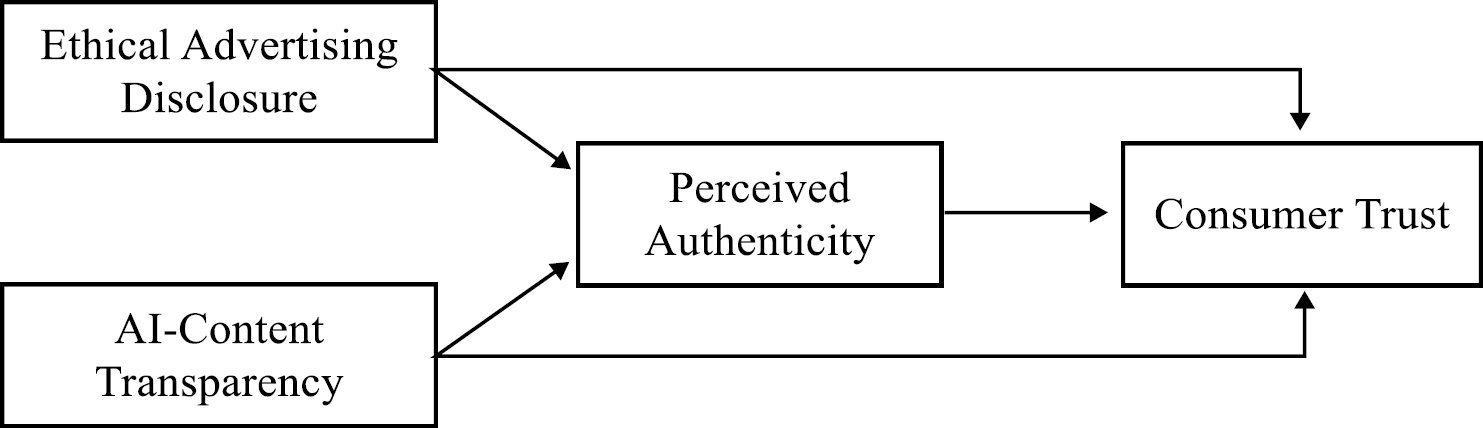
Fig. (1). Research model.
3. METHODOLOGY
3.1. Sample and Population
The target group included adults between the ages of 18 and 40 who lived in France and were exposed to digital FMCG marketing and could rate the levels of advertising transparency, AI-content disclosure, authenticity, and trust. The age group was selected because young and middle-aged adults are highly active online and are likely to be frequently exposed to promotional content. The study focused on general perceptions of AI-generated FMCG marketing rather than purchase behaviour as an outcome. Based on this, frequency of online FMCG purchasing was taken as a descriptive characteristic, but not as an exclusion criterion. This treatment explains why 16 respondents reported never purchasing FMCG products online while remaining eligible to participate. The sample therefore includes consumers with varying levels of online purchasing activity rather than only frequent online buyers.
The 24-item questionnaire was planned using a 15:1 heuristic of respondent to item (Kline, 2005), whereby the target sample size was 360 respondents who would be usable Appendix A. This heuristic is a preliminary planning guideline and not a formal statistical power test. The sensitivity analysis indicates that N = 362 provided approximately 80% power at α = 0.05 to detect an effect of approximately f² = 0.03 with up to three predictors (Cohen, 1988), which is smaller than the smallest observed direct-path f² of 0.061. The original dataset was reduced to 362 usable responses, and 16 indicators were left after cleaning the measurement model. Table 1 summarises the age, gender, education, monthly income, frequency of online purchase of FMCG, category of the preferred FMCG and the preferred online platform of the participants.
Table 1. Demographic profile (n = 362).
| Demographic Category | Frequency | Percent | |
| Age | 18-24 years | 144 | 39.8 |
| 25-30 years | 128 | 35.4 | |
| 31-35 years | 56 | 15.5 | |
| 36-40 years | 34 | 9.4 | |
| Gender | Male | 178 | 49.2 |
| Female | 178 | 49.2 | |
| Other | 6 | 1.7 | |
| Education Level | High School | 37 | 10.2 |
| Bachelor’s Degree | 177 | 48.9 | |
| Master’s Degree | 120 | 33.1 | |
| Doctorate | 20 | 5.5 | |
| Other | 8 | 2.2 | |
| Monthly Income | Less than €1000 | 62 | 17.1 |
| €1000-€2000 | 112 | 30.9 | |
| €2001-€3000 | 99 | 27.3 | |
| €3001-€4000 | 58 | 16.0 | |
| More than €4000 | 31 | 8.6 | |
| Frequency of FMCG Online Purchase | Never | 16 | 4.4 |
| Rarely | 49 | 13.5 | |
| Sometimes | 99 | 27.3 | |
| Often | 142 | 39.2 | |
| Very Often | 56 | 15.5 | |
| Preferred FMCG Category | Food & Beverages | 148 | 40.9 |
| Personal Care | 84 | 23.2 | |
| Household Products | 66 | 18.2 | |
| Health & Wellness | 40 | 11.0 | |
| Other | 24 | 6.6 | |
| Preferred Online Platform | Amazon | 144 | 39.8 |
| Cdiscount | 67 | 18.5 | |
| Carrefour | 70 | 19.3 | |
| Leclerc | 63 | 17.4 | |
| Other | 18 | 5.0 | |
3.2. Measures
3.2.1. Ethical Advertising Disclosure
Ethical advertising disclosure is the degree to which marketing communication clearly and fairly identifies promotional, sponsorship, or commercial intent (Hwang & Jeong, 2016). In this study, the construct is operationalised as the disclosure-related ethical dimension of advertising, focused on clarity, transparency, fairness, and non-deception. Accordingly, the EAD label denotes the ethical framing of advertising disclosure rather than a broad measure of advertising ethics; empirically, it is limited to clarity, fairness, transparency, and non-deception in sponsorship, promotional, and commercial-intent disclosure. The initial questionnaire comprised six items based on (Boerman et al., 2012; Van Reijmersdal et al., 2016; Wojdynski & Evans, 2016; and Hwang & Jeong, 2016). Table 2 identifies EAD4-EAD6 as the retained indicators. All items were measured on a five-point Likert scale. A representative item was: “The advertisement clearly informs me when the content is sponsored or promotional.”
Table 2. Measurement model.
| Construct | Items | Loadings | P | Alpha | CR | AVE |
| AI-Content Transparency | AIT4 | 0.836 | < 0.001 | 0.835 | 0.901 | 0.751 |
| AIT5 | 0.883 | < 0.001 | ||||
| AIT6 | 0.881 | < 0.001 | ||||
| Consumer Trust | CT1 | 0.881 | < 0.001 | 0.926 | 0.944 | 0.772 |
| CT3 | 0.875 | < 0.001 | ||||
| CT4 | 0.823 | < 0.001 | ||||
| CT5 | 0.907 | < 0.001 | ||||
| CT6 | 0.905 | < 0.001 | ||||
| Ethical Advertising Disclosure | EAD4 | 0.873 | < 0.001 | 0.874 | 0.923 | 0.799 |
| EAD5 | 0.913 | < 0.001 | ||||
| EAD6 | 0.895 | < 0.001 | ||||
| Perceived Authenticity | PA1 | 0.859 | < 0.001 | 0.907 | 0.931 | 0.728 |
| PA2 | 0.841 | < 0.001 | ||||
| PA3 | 0.851 | < 0.001 | ||||
| PA4 | 0.875 | < 0.001 | ||||
| PA5 | 0.841 | < 0.001 |
3.2.2. AI-Content Transparency
AI-content transparency refers to the extent to which companies disclose the use of artificial intelligence in creating, editing, or delivering marketing content. This disclosure may help consumers understand the role of AI in brand communication (Kirkby et al., 2023). The initial AIT measure contained six items adapted from (Yao, 2025; and Kirkby et al., 2023). All the items were rated using a five-point Likert scale. A representative item was: “The brand clearly tells me when AI has been used to create the marketing content.”
3.2.3. Perceived Authenticity
Perceived authenticity refers to the extent to which consumers perceive brand communication as authentic, sincere, credible, and consistent with the brand’s identity and values (Yang & Battocchio, 2021). The original PA measure contained six items adapted from (Morhart et al., 2015; Kirkby et al., 2023; and Yang & Battocchio, 2021). All the items were rated on a five-point Likert scale. A representative item was: “The marketing content feels genuine.”
3.2.4. Consumer Trust
Consumer trust refers to consumers’ willingness to rely on a brand when its marketing communication is perceived as honest, reliable, and responsible. The initial CT measure contained six items adapted from (Soh et al., 2009; Munuera-Alemán, 2003; and Kang & Hustvedt, 2014), rated on a five-point Likert scale. The final measurement model retained general trust indicators relating to honesty, reliability, and confidence. The AIT conceptual content was not replicated in a disclosure-specific trust indicator, which further enhanced the difference between the dependent variable and the AI-transparency predictor.
3.3. Data Collection
Data were collected using a self-administered questionnaire created in Google Forms. The initial English questionnaire was also translated into French. For verification, a back-translation procedure was conducted. An independent translator who had not seen the original questionnaire performed the reverse translation, which was then compared with the original English version. Both English and French versions were made available to eligible participants residing in France, who could select their preferred language at the beginning of the questionnaire. Both versions retained the same constructs and the five-point response format. General statements regarding the perceptions of AI-assisted or AI-generated marketing and brand communications of FMCG were rated by respondents; no particular advertising stimulus was used, and the respondents were not asked to remember a particular brand. The recruitment strategy was an open-link purposive method, whereby adults between the ages of 18 and 40, who identified themselves as living in France, were targeted. Residence was self-reported, and no IP-address or geolocation verification was recorded. The retained fieldwork records do not specify the digital platforms or the date of collection. Because the open link was not distributed through a recorded invitation list, the number approached, and the denominator required to calculate a conventional response rate could not be reconstructed. No incentives were provided to respondents. Nationality and international-resident status were not collected; therefore, the proportion of international residents in the sample could not be determined. These language and recruitment characteristics are considered when interpreting the results because they may introduce self-selection, coverage, and measurement biases.
3.4. Data Analysis
PLS-SEM was used because the model contains several latent constructs, direct paths, and mediation relationships that can be estimated simultaneously as defined by (Hair et al., 2011). It is also applicable to prediction-oriented survey models and is not as reliant on multivariate normality as covariance-based options (Hair et al., 2013). The analysis was done in two steps. The measurement model was initially evaluated based on indicator loadings, Cronbach’s alpha, composite reliability, average variance extracted, the Fornell-Larcker criterion, and HTMT. Second, path coefficients, t-statistics, p-values, R², VIF, f², and indirect effects were used to evaluate the structural model. Common-Method Bias (CMB) was considered as a methodological issue since all constructs were measured using a single self-report questionnaire. Inner VIFs were used to gauge the collinearity of the predictors in the structural model and were interpreted using the 5.0 guideline by (Hair et al., 2017). For the common-method-bias diagnostic, full-collinearity VIFs were used. (Kock, 2015) proposes 3.3 as a conservative threshold for this procedure. The full-collinearity VIFs were 3.181 for AIT, 2.678 for CT, 3.065 for EAD, and 2.188 for PA; these values indicate no severe CMB concern under the 3.3 criterion. Harman’s single-factor test was also used to assess CMB, and no single factor explained more than 50% of the variance, complementing the full-collinearity VIF assessment. These procedures establish the measurement and diagnostic basis for interpreting the hypothesised structural relationships.
4. RESULTS
4.1. Measurement Model
Table 2 presents the measurement-model results obtained using the PLS algorithm. The initial measurement specification contained 24 indicators, and indicator purification was completed before structural-model interpretation. Indicator screening involved the use of the recommended outer-loading criterion of 0.70 as well as construct reliability, AVE, and discriminant-validity diagnostics. Available records indicate that EAD1-EAD3, AIT1-AIT3, and PA6 were removed during staged statistical screening that considered outer-loading adequacy, construct reliability, AVE, discriminant validity, and content coverage. Since the original item-level diagnostics are not available, it is not possible to assign the particular criterion failed by each individual item retrospectively; they were not removed based solely on HTMT. CT2 was removed for a separate conceptual reason because its wording explicitly incorporated AI disclosure and therefore overlapped with AIT. The retained model demonstrates acceptable reliability, convergent validity, and discriminant validity for the remaining indicators, but full preservation of construct-content validity cannot be established definitively, particularly because three of the six original indicators were removed from both EAD and AIT. The final PLS measurement model retained AIT4-AIT6, EAD4-EAD6, PA1-PA5, and CT1, CT3-CT6. All retained loadings exceeded the recommended 0.70 indicator-reliability standard. Cronbach’s alpha and composite reliability were above 0.70, and all AVE values were above 0.50 (Hair et al., 2017), which is an indication of sufficient internal consistency and convergent validity. Fig. (2) shows the retained measurement model and its outer loadings.
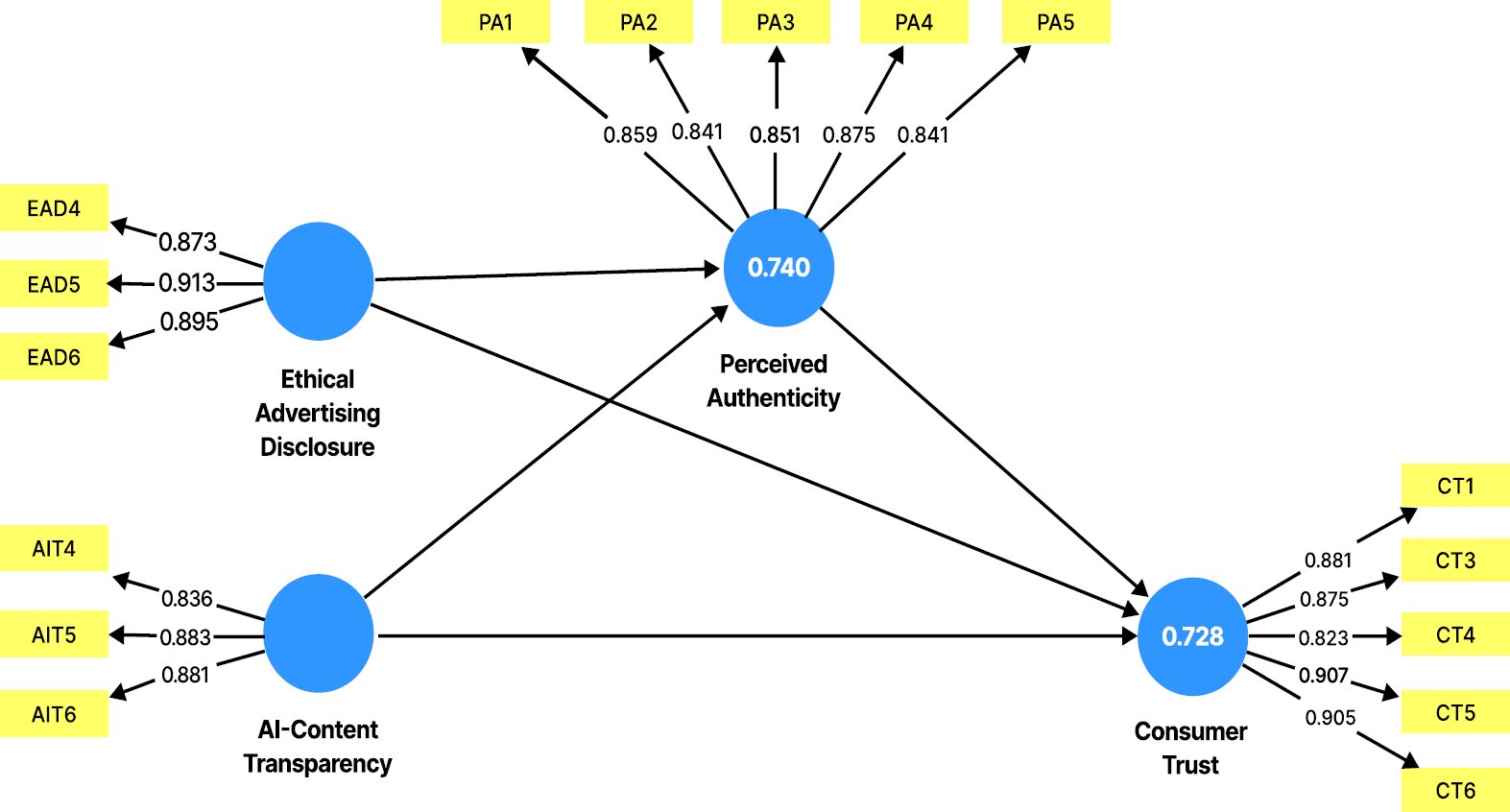
Fig. (2). PLS algorithm.
4.2. Discriminant Validity
4.2.1. Fornell-Larcker Criterion (FLC)
Table 3 presents the Fornell-Larcker criterion results used to assess discriminant validity.
Table 3. Fornell-Larcker Criterion (FLC).
| – | AIT | CT | EAD | PA |
| AIT | 0.867 | |||
| CT | 0.791 | 0.879 | ||
| EAD | 0.691 | 0.746 | 0.894 | |
| PA | 0.778 | 0.799 | 0.801 | 0.853 |
Note: CT = Consumer Trust; PA = Perceived Authenticity; AIT = AI-Content Transparency; EAD = Ethical Advertising Disclosure
The square root of AVE of each construct, as indicated on the diagonal, was greater than the correlation of the construct with the remaining constructs as indicated in Table 3. This pattern indicates that each latent construct shared more variance with its own indicators than with the other constructs, satisfying the Fornell-Larcker criterion (Fornell & Larcker, 1981). The criterion is met, though some of the correlations are relatively high, especially those with PA. The outcome provides evidence in this sample that EAD, AIT, PA, and CT are empirically distinguishable rather than interchangeable.
4.2.2. Heterotrait-Monotrait (HTMT) Ratio
Table 4 presents the HTMT ratio results used to assess discriminant validity.
Table 4. Heterotrait-Monotrait (HTMT) ratio.
| – | AIT | CT | EAD | PA |
| AIT | – | – | – | – |
| CT | 0.742 | – | – | – |
| EAD | 0.681 | 0.716 | – | – |
| PA | 0.754 | 0.781 | 0.733 | – |
Abbreviations: CT = Consumer Trust; PA = Perceived Authenticity; AIT = AI-Content Transparency; EAD = Ethical Advertising Disclosure
(Henseler et al., 2015) recommend HTMT as a sensitive test of discriminant validity. A value of less than 0.85 indicates a more conservative estimate of discriminant validity, and a value less than 0.90 is generally regarded as an acceptable estimate of conceptually related constructs (Henseler et al., 2016). Table 4 indicates that HTMT values ranged from 0.681 to 0.781, with all values below both 0.85 and 0.90. These values reflect the final purified measurement model applied to the existing sample. The results are consistent with discriminant validity among AIT, CT, EAD, and PA in the final measurement model.
4.3. Explanatory Power
Table 5 presents the explanatory power of the endogenous constructs.
Table 5. Explanatory power.
| – | R² |
| Consumer Trust | 0.728 |
| Perceived Authenticity | 0.740 |
R² indicates the proportion of variance in an endogenous construct explained by the model. According to (Hair et al., 2013), values of 0.25, 0.50, and 0.75 are weak, moderate, and substantial reference points. The model accounts for 74.0% of the variance in PA and 72.8% of the variance in CT, placing both constructs near the substantial reference range. The R² values in Table 5 match those displayed in Fig. (2) (PA = 0.740; CT = 0.728). These values describe the model’s in-sample explanatory power and should not be interpreted as evidence of causal prediction.
4.4. Structural Model
Table 6 presents the PLS path-analysis results used to test the hypotheses.
Table 6. Hypothesis testing using PLS-SEM.
| – | Estimate | S. D. | T-Stats | P | VIF | F² | Decision |
| H1: EAD -> PA | 0.508 | 0.047 | 10.828 | < 0.001 | 1.914 | 0.518 | Supported |
| H2: EAD -> CT | 0.219 | 0.101 | 2.173 | 0.030 | 2.906 | 0.061 | Supported |
| H3: AIT -> PA | 0.426 | 0.053 | 8.070 | < 0.001 | 1.914 | 0.365 | Supported |
| H4: AIT -> CT | 0.392 | 0.052 | 7.530 | < 0.001 | 3.840 | 0.097 | Supported |
| H5: PA -> CT | 0.318 | 0.082 | 3.885 | < 0.001 | 2.612 | 0.217 | Supported |
| H6: EAD -> PA -> CT | 0.162 | 0.047 | 3.445 | 0.001 | – | – | Supported |
| H7: AIT -> PA -> CT | 0.136 | 0.038 | 3.528 | < 0.001 | – | – | Supported |
Table 6 shows that all seven hypotheses were supported. EAD was positively associated with PA (β = 0.508, p < 0.001, f² = 0.518) and CT (β = 0.219, p = 0.030, f² = 0.061). AIT was positively associated with PA (β = 0.426, p < 0.001, f² = 0.365) and CT (β = 0.392, p < 0.001, f² = 0.097), while PA was positively associated with CT (β = 0.318, p < 0.001, f² = 0.217). Using Cohen’s (1988) conventional f² benchmarks of 0.02, 0.15, and 0.35, alongside PLS-SEM guidance from (Hair et al., 2017), EAD→PA and AIT→PA showed large effects, PA→CT showed a medium effect, and EAD→CT and AIT→CT showed small effects. Inner VIF values ranged from 1.914 to 3.840; all were below the conventional 5.0 threshold for structural-model collinearity (Hair et al., 2017). Bootstrapped 95% confidence intervals were [0.416, 0.600] for EAD→PA, [0.021, 0.417] for EAD→CT, [0.322, 0.530] for AIT→PA, [0.290, 0.494] for AIT→CT, [0.157, 0.479] for PA→CT, [0.070, 0.254] for EAD→PA→CT, and [0.062, 0.210] for AIT→PA→CT. The indirect paths through PA were significant for EAD (β = 0.162, p = 0.001) and AIT (β = 0.136, p < 0.001). VAF was 42.5% for EAD→PA→CT and 25.8% for AIT→PA→CT. Because the corresponding direct and indirect paths remained significant and positive, both patterns are consistent with complementary partial mediation. Fig. (3) displays the bootstrapped structural paths reported in Table 6.
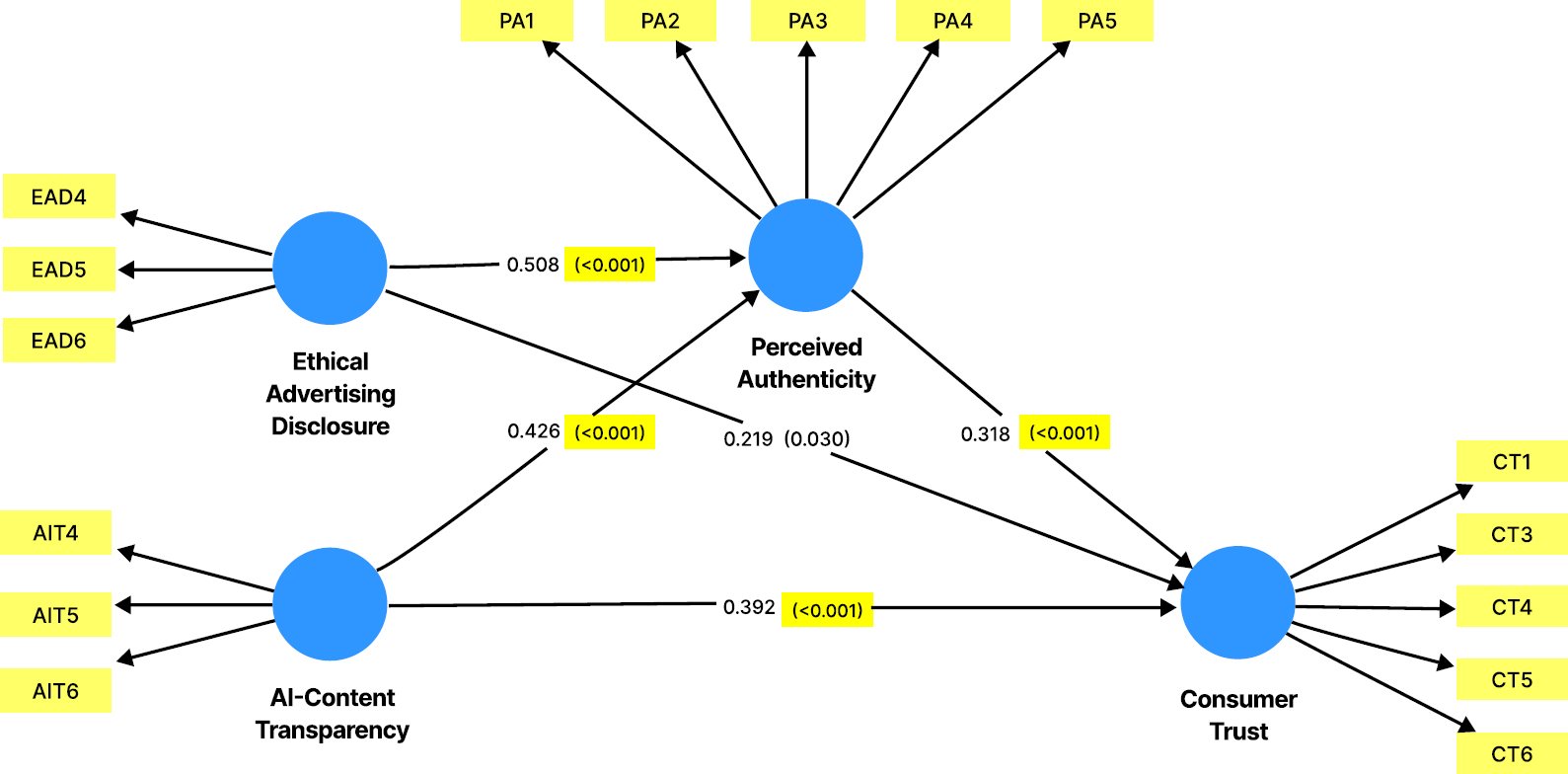
Fig. (3). PLS bootstrapping.
5. DISCUSSION
EAD demonstrated the highest coefficient with PA (β = 0.508) and the lowest coefficient with CT (β = 0.219), indicating that disclosure of commercial intent is more related to perceived genuineness than to wider brand trust in this sample. This pattern is consistent with signalling theory because an explicit sponsorship or promotional cue may reduce uncertainty about advertisers’ intentions and be interpreted as an indication of candour. (Van Reijmersdal et al., 2016) demonstrate that persuasive intent is more cognitively available with disclosure, and (Wojdynski & Evans, 2016) provide evidence that the design of disclosure influences advertising recognition. The present associations are consistent with the possibility that recognition has constructive consequences when disclosure is interpreted as accountable communication. The results suggest that the large f² value for EAD→PA suggests that disclosure may be more important for perceived sincerity and authenticity than for merely complying with disclosure requirements.
The AIT→CT coefficient (β = 0.392) was larger than the EAD→CT coefficient (β = 0.219), while AIT was also positively associated with PA (β = 0.426). This comparison is descriptive since no formal test of the difference between the coefficients was performed. This trend implies that consumers could interpret the disclosure of AI as a bit of information regarding the origin of the message and brand credibility. Uncertainty in perceptions of AI-supported marketing is not only about the intent to persuade, but also the presence of automated systems without the knowledge of consumers. (Kirkby et al., 2023) discovered that brand authenticity was not always lower when the use of AI was disclosed, which is consistent with the view that AI use may remain acceptable when it is explicitly disclosed. (Baek et al., 2026) also demonstrate that AI disclosure is linked to credibility-related advertising appraisals, meaning that disclosure is not always helpful. The larger AIT→CT coefficient may indicate the salience of technological transparency, but the current design does not establish that the AIT→CT and EAD→CT coefficients differ statistically.
The path coefficient from PA to CT was positive (β = 0.318) and the f² value of the path was medium (f² = 0.217), which means that there is a positive relationship between perceived authenticity and consumer trust. This result aligns with the one provided by (Yang & Battocchio, 2021): when a brand communicates explicitly, it is able to trigger greater levels of authenticity and, in turn, more trust-based reactions. (Morhart et al., 2015) also similarly conceptualise authenticity as a judgement based on credibility and integrity and not superficial message appeal. This statistical guidance applies to the general attitude towards using AI in marketing, since although they might not be against technology, they could also want messages that are aligned with their brand beliefs and values. Authenticity is another focus point of (Majerova et al., 2025) research on reactions to AI content. This connection implies that authenticity could be a key benchmark in consumers’ judgments of AI-driven marketing communications.
The mediation results indicate the statistical relationships between the two disclosure cues and trust. The direct path coefficient for EAD was 0.219, and the indirect effect on EAD through PA was 0.162, yielding an implied total effect of ~0.381, and a VAF of 42.5%. For AIT, the direct path coefficient was 0.392 and the indirect effect was 0.136, producing an implied total effect of approximately 0.528; the VAF was 25.8%. Because both direct and indirect paths were significant and positive, the results are consistent with complementary partial mediation in both relationships. The larger mediated proportion for EAD is theoretically consistent with the close association between ethical disclosure and sincerity judgements, whereas AIT also conveys information about technological openness. These patterns are associative and are not necessarily represented as causal processes.
It is more informative to managers that not all of the hypotheses were accepted but that the relative size of the effects was informative. It can be observed that EAD had a large f² for PA, and a small direct f² for CT, indicating that transparent disclosure of sponsorship and advertising might be of particular relevance if consumers assess communication as being truthful and reliable. AIT was positively correlated with PA and the coefficient AIT→CT (β = 0.392) was higher than the coefficient EAD→CT (β = 0.219). This comparison is descriptive because no formal test of the difference between the coefficients was conducted. The pattern may reflect a distinct trust-related consideration associated with technological transparency. PA was moderately related to CT, which implies that authenticity needs to be considered a substantive trust-related consideration and not a cosmetic communication objective. (Kothari et al., 2025) also relate credibility and authenticity to the reaction of consumers in digital advertising. The two forms of disclosure can then be considered by the managers, who can accept the fact that the current coefficients do not represent causal effects. This warning aligns with responsible-AI research that identifies negative consumer response to AI claims and potential lack of trust as the consequence of lack of transparency and agency (Öztürkcan & Bozdağ, 2025).
The findings also extend the use of signalling theory, suggesting differences in the effects of transparency signalling. The previously-proposed conventional arguments for credible disclosure suggest that the uncertainty being disclosed is likely to be one of the factors, with the type of uncertainty being disclosed also being important. EAD is correlated to uncertainty about the purpose of the commercialisation, while AIT is correlated to uncertainty about the technological authorship and uncertainty about content production. (Pierre, 2025) also shows that openness about AI may be linked to brand evaluations, and consumers’ attitudes towards AI could also be linked to how they interpret the information. This might be one reason why the findings of previous studies vary in their responses to transparency even though it has a moral component. The model is consistent with two statistical paths: a direct path to trust and an indirect path via perceived authenticity. In today’s context of AI marketing, signalling theory can be applied both when disclosure does and does not exist, and when consumers interpret the disclosure or not.
The French FMCG environment is a relevant context given that the fast-moving FMCG products require high frequency but not high involvement communication in saturated digital environments. Simple and credible disclosure cues become more important in the real world where consumers might not necessarily scrutinise each marketing assertion. The ideas of transparency and ethical practices with AI must be highlighted as a potential influence in marketing and customer communications within the context of France, as per (Ejjami, 2024). Clear commercial-intent disclosure is also a real issue in terms of practical enforcement as demonstrated by French enforcement which found anomalies in almost half of the more than 300 influencers inspected in 2022-2023, among which disclosure issues (DGCCRF, 2024). A European cross-country survey that included French participants also identified substantial national variation in AI awareness, attitudes, and trust, reinforcing the need to interpret France-based responses within their national context (Scantamburlo et al., 2025). The current findings should be interpreted within this context that there exist positive associations among commercial disclosure, AI-content transparency, and consumer trust. However, the cross-sectional and perception-based design implies that the coefficients may not be causal effects of a particular disclosure label. The results instead describe associations within the reported sample and provide a basis for future experiments on disclosure formats, wording, placement, and intensity.
CONCLUSION
This study examined how EAD and AIT are associated with CT in general perceptions of AI-generated FMCG marketing in France, with PA as a mediating statistical pathway. The study employed a quantitative cross-sectional design with 362 participants between the ages of 18 and 40 and evaluated the proposed model with PLS-SEM. Measurement-model purification revealed an acceptable level of reliability, convergent validity, and discriminant validity for the measurement model, with the removal of eight indicators that failed to meet the final criteria for measurement or had conceptual overlap. All hypothesised direct and indirect paths were statistically significant. EAD had the largest coefficient with PA, while the AIT→CT coefficient was larger than the EAD→CT coefficient; this comparison is descriptive and does not constitute a formal coefficient-difference test. Authenticity judgments are also important when consumers assess marketing involving AI, as PA was also found to be positive.
Complementary partial mediation with PA was revealed in both cases of EAD and AIT in the mediation analysis. Trust had both authenticities mediated and direct statistical relationships with disclosure signals. It is not just a simple statement of the obvious that transparency is good; it is something more that is here. The association of perceived sincerity was stronger with ethical advertising disclosure, and AI-content transparency was more directly associated with trust. The findings therefore suggest a potential differentiated transparency approach, as FMCG brands have been shown to be transparent with a persuasive motive and an AI engagement without competing with the brand’s identity and values.
THEORETICAL IMPLICATIONS
The findings extend the application of signalling theory by distinguishing two forms of signalling within the same AI-mediated marketing context. EAD is an indicator of openness to persuasive intent and AIT is an indicator of openness to technological authorship and content production. The larger EAD→PA coefficient is aligned with the closer relationship between commercial disclosure and authenticity judgements whereas the larger AIT→CT coefficient is aligned with the closer direct relationship between technological transparency and trust. These comparisons of coefficients are descriptive since no formal test of difference was done. This pattern is consistent with previous research on transparent brand communication, where transparency is typically treated as a broader communication characteristic (Yang & Battocchio, 2021). If disclosure signals are partially mediated by the use of complementary partial mediation, then another theoretical implication can be drawn: PA serves as an important interpretive pathway that is not the sole statistical pathway between disclosure signals and trust. This offers a more accurate implementation of signalling theory, as it considers the availability of a signal and the interpretation that is given to it. Modeling the disclosures of EAD and AIT separately is also consistent with the growing notion that AI disclosures convey production provenance, not just persuasive intent, which helps to explain the theoretical rationale.The difference between EAD and AIT is also in line with the emerging understanding that an AI disclosure conveys production provenance, not simply persuasive intent, which reinforces the theoretical rationale.
The results also help to clarify existing conflicting evidence about disclosure of AI. (Kirkby et al., 2023) suggest that the AI authorship disclosed may not always decrease authenticity, whereas (Baek et al., 2026) demonstrate that the disclosure may trigger credibility issues. These findings can coexist when disclosure is treated as a signal whose meaning depends on consumer interpretation. The existing results indicate that the perceived clarity of AIT is positively linked with authenticity and trust, yet the design does not presuppose that all types of AI labels can elicit a similar reaction. The theoretical implication is therefore the distinction between two forms of transparency and the identification of authenticity as a partial statistical pathway linking disclosure signals with trust in the French FMCG context.
RECOMMENDATIONS
The findings indicate that the managers of FMCGs can design disclosure practices to suit the type of uncertainty they want to mitigate. The use of sponsorship, promotional and paid-partnership disclosures must be clear and visible enough to the consumer so that they can identify the commercial intent without having to look down to find the qualifying information. Since EAD demonstrated the highest coefficient with PA, these disclosures may warrant further testing in direct language and used uniformly across the digital platforms. Companies can also set up explicit guidelines on how to label AI-written or AI-enhanced ads, pictures, videos and promotion copy. The AIT→CT coefficient was higher than the EAD→CT coefficient, and descriptively, technological transparency could be a unique consideration of trust by consumers.
Authenticity is an issue that should be viewed in relation to disclosure and not as a natural outcome of transparency. The AI-powered communication must not go against the set brand values, tone, product claims, and expectations of the consumer. Human oversight may be particularly important before publication when AI devices are employed in producing convincing arguments or lifelike imagery. A frequent review can assist in detecting misdirecting messages, over-the-top claims, or conflicting messages which might undermine the perceived credibility. The medium association between PA and CT also implies that brands ought to evaluate consumer reactions to authenticity, rather than to recognition of disclosure labels. Combining clear AI usage and coherent brand behaviour can be more efficient in facilitating trust than disclosure wording.
The training of employees can include ethical advertising, responsible use of AI, standards of disclosure, and the line between commercial and technological transparency. Marketing teams must be aware that EAD and AIT are related yet different consumer-info needs, so disclosure by either type should not be considered a substitute of the other. Companies can also test disclosure wording, visibility, and placement to target consumers prior to extensive campaigns. This is applicable because previously, it was found that disclosure reactions vary by consumers’ perceptions of AI involvement. An organised method of transparent disclosure, human verification, and authenticity checks, as well as consumer testing, could aid FMCG companies in safeguarding their credibility and the use of AI to enhance the efficiency of marketing approaches.
LIMITATIONS AND FUTURE DIRECTION
This study has a number of limitations that should be considered for further study. This sample was obtained by an open-link purposive approach, which does not guarantee statistical generalisation and may lead to the presence of self-selection and coverage bias among the consumers of this study, who are aged 18-40 and reside in France. Platform-specific dissemination logs were not kept and a precise date range for fieldwork was not recorded. The sample did not include nationality nor the status of international residency, so it would not be possible to establish whether the sample was predominantly made up of international residents. The study focused on perceived advertising effects from AI-generated FMCG marketing instead of an experimental advertising stimulus and suggests that future studies should directly vary disclosure wording, placement, and AI involvement. Because of the cross-sectional nature, it is difficult to make strong causal inferences and the study cannot determine whether changes in trust occur over time as consumers become more familiar with AI-generated content. In addition, all constructs were measured by self-report in one questionnaire. Measurement purification removed three of the six original indicators from both EAD and AIT. Future studies should use longitudinal, experimental, or mixed-method designs, include broader age groups and countries, and examine whether product type, AI attitudes, brand familiarity, or disclosure format changes the observed associations. Future studies should incorporate appropriate procedural and statistical controls for common-method bias and report software-generated bootstrap confidence intervals where available.
LIST OF ABBREVIATIONS
AIT | = | AI-content Transparency |
CMB | = | Common-Method Bias |
CT | = | Consumer Trust |
EAD | = | Ethical Advertising Disclosure |
FLC | = | Fornell-Larcker Criterion |
PA | = | Perceived Authenticity |
AUTHOR’S CONTRIBUTION
R.H.K. has contributed to the study conceptualization, methodology, data analysis, interpretation of results, and manuscript writing.
ETHICAL APPROVAL & INFORMED CONSENT
This study was conducted in compliance with internationally accepted ethical principles for conducting research. Participation was voluntary, and the purpose of the study was explained to the respondents. Anonymity and confidentiality were assured, and no personally identifiable information was gathered. Before participation, informed consent was obtained from all respondents. The study was independent and did not require a formal institutional ethics committee review, as it was an anonymous, minimal-risk questionnaire.
AVAILABILITY OF DATA AND MATERIALS
The data will be made available on reasonable request by contacting the corresponding author [R.H.K.].
FUNDING
None.
CONFLICT OF INTEREST
The author declares that there is no conflict of interest regarding the publication of this article.
ACKNOWLEDGEMENTS
Declared none.
DECLARATION OF AI
During the preparation of this manuscript, the author used ChatGPT for language editing and refinement purposes. Following the use of this tool, the author carefully reviewed and revised the content where necessary and accepts full responsibility for the final published version of the article.
APPENDICES
Appendix A: Questionnaire
Instruction: Please answer the following questions based on your general perceptions of FMCG marketing encountered online. No particular advertisement or brand needs to be recalled.
For Sections B–E, please use the following scale:
- = Strongly disagree
- = Disagree
- = Neither agree nor disagree
- = Agree
- = Strongly agree
Section A. Screening and Demographic Information
A1. What is your age?
- 18–24 years
- 25–30 years
- 31–35 years
- 36–40 years
- Outside this age range
A2. Do you currently reside in France?
- Yes
- No
A3. Which questionnaire language do you prefer?
- English
- French
A4. What is your gender?
- Male
- Female
- Other
- Prefer not to say
A5. What is your highest level of education?
- High School
- Bachelor’s Degree
- Master’s Degree
- Doctorate
- Other
A6. What is your approximate monthly income?
- Less than €1,000
- €1,000–€2,000
- €2,001–€3,000
- €3,001–€4,000
- More than €4,000
- Prefer not to say
A7. How often do you purchase FMCG products online?
- Never
- Rarely
- Sometimes
- Often
- Very often
A8. Which FMCG category do you purchase or encounter most frequently?
- Food and beverages
- Personal care
- Household products
- Health and wellness
- Other
A9. Which online platform do you most frequently use for FMCG products?
- Amazon
- Cdiscount
- Carrefour
- Leclerc
- Other
Section B. Ethical Advertising Disclosure
- I can easily recognise when FMCG marketing content has a commercial purpose.
- Brands clearly indicate when their online marketing content is promotional.
- Paid or sponsored relationships are openly identified in FMCG marketing communications.
- The advertisement clearly informs me when the content is sponsored or promotional.
- FMCG brands are transparent about the commercial purpose of their marketing messages.
- Disclosure of sponsorship or promotional intent is sufficiently clear to prevent consumers from being misled.
Section C. AI-Content Transparency
- I can recognise when artificial intelligence has been involved in producing FMCG marketing content.
- Brands clearly disclose when AI contributes to the creation of their marketing materials.
- Information about the use of AI in FMCG marketing is communicated openly to consumers.
- The brand clearly tells me when AI has been used to create the marketing content.
- Brands provide clear information about the role of AI in producing or editing their marketing communications.
- I am adequately informed when AI-generated or AI-assisted content is used in FMCG marketing.
Section D. Perceived Authenticity
- The marketing content feels genuine.
- The brand communicates in a sincere manner.
- The marketing message appears consistent with the brand’s identity.
- The communication appears credible rather than artificial or misleading.
- The brand’s marketing communication reflects its stated values.
- The marketing content appears honest and authentic to me.
Section E. Consumer Trust
- I consider the brand to be honest in its marketing communication.
- I am more willing to trust a brand when it openly tells consumers that AI has been used in its marketing content.
- I consider the brand reliable.
- I have confidence in the information communicated by the brand.
- I believe the brand communicates with consumers responsibly.
- Overall, I feel that the brand can be trusted.
REFERENCES
Aade, L., & Goanta, C. (2025). Ban-it-harderism in European consumer law: The case of the French influencer law. Journal of Consumer Policy, 48(4), 523–538.
https://doi.org/10.1007/s10603-025-09600-6
Autorité de Régulation Professionnelle de la Publicité. (ARPP) (2024). Observatoire de l’Influence Responsable 2024. Available from: https://www.arpp.org/actualite/observatoire-influence-responsable-arpp-2024/ (Accessed on: 07-10-2026).
Baek, T. H., Kim, J., & Kim, J. H. (2026). Effect of disclosing AI-generated content on prosocial advertising evaluation. International Journal of Advertising, 45(1), 171–192.
https://doi.org/10.1080/02650487.2024.2401319
Bafera, J., & Kleinert, S. (2023). Signaling theory in entrepreneurship research: A systematic review and research agenda. Entrepreneurship Theory and Practice, 47(6), 2419–2464.
https://doi.org/10.1177/10422587221138489
Bergdahl, J., Latikka, R., Celuch, M., Savolainen, I., Soares Mantere, E., Savela, N., & Oksanen, A. (2023). Self-determination and attitudes toward artificial intelligence: Cross-national and longitudinal perspectives. Telematics and Informatics, 82, 102013.
https://doi.org/10.1016/j.tele.2023.102013
Boerman, S. C., van Reijmersdal, E. A., & Neijens, P. C. (2012). Sponsorship disclosure: Effects of duration on persuasion knowledge and brand responses. Journal of Communication, 62(6), 1047–1064.
https://doi.org/10.1111/j.1460-2466.2012.01677.x
Cohen, J. (1988). Statistical power analysis for the behavioral sciences (2nd ed.). Lawrence Erlbaum Associates. Available from: https://www.routledge.com/Statistical-Power-Analysis-for-the-Beat/Academic-Press/p/book/9780805802832 (Accesssed on: 07-10-2026).
Dineva, D., & Acar, O. A. (2026). Generative AI disclosure in advertising: From intent- to production-based disclosure. Journal of Advertising, 1-19.
https://doi.org/10.1080/00913367.2026.2731565
Direction générale de la concurrence, de la consommation et de la répression des fraudes. (2024). Influenceurs : bilan des contrôles 2022 et 2023 de la DGCCRF. Available from: https://www.economie.gouv.fr/actualites/influenceurs-bilan-des-controles-2022-et-2023-de-la-dgccrf (Accessed on: 07-10-2026).
Ejjami, R. (2024). Leveraging AI to enhance marketing and customer engagement strategies in the French market. International Journal for Multidisciplinary Research, 6(3), 1-29.
https://doi.org/10.36948/ijfmr.2024.v06i03.23147
Fornell, C., & Larcker, D. F. (1981). Structural equation models with unobservable variables and measurement error: Algebra and statistics. Journal of Marketing Research, 18(3), 382–388.
https://doi.org/10.1177/002224378101800313
Hair, J. F., Matthews, L. M., Matthews, R. L., & Sarstedt, M. (2017). PLS-SEM or CB-SEM: Updated guidelines on which method to use. International Journal of Multivariate Data Analysis, 1(2), 107–123.
https://doi.org/10.1504/IJMDA.2017.087624
Hair, J. F., Ringle, C. M., & Sarstedt, M. (2011). PLS-SEM: Indeed a silver bullet. Journal of Marketing Theory and Practice, 19(2), 139–152.
https://doi.org/10.2753/MTP1069-6679190202
Hair, J. F., Ringle, C. M., & Sarstedt, M. (2013). Partial least squares structural equation modeling: Rigorous applications, better results and higher acceptance. Long Range Planning, 46(1–2), 1–12.
https://doi.org/10.1016/j.lrp.2013.01.001
Henseler, J., Hubona, G., & Ray, P. A. (2016). Using PLS path modeling in new technology research: Updated guidelines. Industrial Management & Data Systems, 116(1), 2–20.
https://doi.org/10.1108/IMDS-09-2015-0382
Henseler, J., Ringle, C. M., & Sarstedt, M. (2015). A new criterion for assessing discriminant validity in variance-based structural equation modeling. Journal of the Academy of Marketing Science, 43(1), 115–135.
https://doi.org/10.1007/s11747-014-0403-8
Hwang, Y., & Jeong, S.-H. (2016). “This is a sponsored blog post, but all opinions are my own”: The effects of sponsorship disclosure on responses to sponsored blog posts. Computers in Human Behavior, 62, 528–535.
https://doi.org/10.1016/j.chb.2016.04.026
Kang, J., & Hustvedt, G. (2014). Building trust between consumers and corporations: The role of consumer perceptions of transparency and social responsibility. Journal of Business Ethics, 125(2), 253–265.
https://doi.org/10.1007/s10551-013-1916-7
Kirkby, A., Baumgarth, C., & Henseler, J. (2023). To disclose or not disclose, is no longer the question – effect of AI-disclosed brand voice on brand authenticity and attitude. Journal of Product & Brand Management, 32(7), 1108–1122.
https://doi.org/10.1108/JPBM-02-2022-3864
Kline, R. B. (2005). Principles and practice of structural equation modeling (2nd ed.). Guilford Press. Available from: https://search.worldcat.org/title/Principles-and-practice-of-structural-equation-modeling/oclc/263437349 (Accessed on: 07-10-2026).
Kock, N. (2015). Common method bias in PLS-SEM: A full collinearity assessment approach. International Journal of e-Collaboration, 11(4), 1–10.
https://doi.org/10.4018/ijec.2015100101
Koning, B., & Voorveld, H. A. M. (2025). Disclaimer! This content is AI-generated: How AI-disclosures influence trust in advertisements and organizations. Journal of Interactive Advertising, 25(3), 240–253.
https://doi.org/10.1080/15252019.2025.2554149
Kothari, H., Choudhary, A., Jain, A., Singh, S., Prasad, K. D. V., & Vani, U. K. (2025). Impact of social media advertising on consumer behavior: Role of credibility, perceived authenticity, and sustainability. Frontiers in Communication, 10, 1595796.
https://doi.org/10.3389/fcomm.2025.1595796
Majerova, J., Nadanyiova, M., & Patik, L. (2025). One step forward, two steps back: AI-generated content vs. perceived trust, authenticity and credibility. Intellectual Economics, 19(2), 150–170.
https://doi.org/10.13165/IE-25-19-2-06
Morhart, F., Malär, L., Guèvremont, A., Girardin, F., & Grohmann, B. (2015). Brand authenticity: An integrative framework and measurement scale. Journal of Consumer Psychology, 25(2), 200–218.
https://doi.org/10.1016/j.jcps.2014.11.006
Munuera-Alemán, J. L., Delgado-Ballester, E., & Yagüe-Guillén, M. J. (2003). Development and validation of a brand trust scale. International Journal of Market Research, 45(1), 1–18.
https://doi.org/10.1177/147078530304500103
Öztürkcan, S., & Bozdağ, A. A. (2025). Responsible AI in marketing: AI booing and AI washing cycle of AI mistrust. International Journal of Market Research, 67(6), 696–722.
https://doi.org/10.1177/14707853251379285
Pierre, L. (2025). Exploring how brand use of artificial intelligence influences consumer perceptions and behavioral intentions through general AI attitudes and brand transparency. Journal of Current Issues & Research in Advertising, 1-25.
https://doi.org/10.1080/10641734.2025.2596011
Ribeiro, A., López Rivero, A. J., & Abrantes, J. L. (2025). The impact of artificial intelligence on consumer behavior towards brands: A systematic review. Electronic Commerce Research, 26, 4483-4524.
https://doi.org/10.1007/s10660-025-10063-7
Saleh, R. A., & Zeebaree, S. R. (2025). Artificial intelligence in e-commerce and digital marketing: A systematic review of opportunities, challenges, and ethical implications. Asian Journal of Research in Computer Science, 18(3), 395–410.
https://doi.org/10.9734/ajrcos/2025/v18i3601
Sands, S., Demsar, V., Ferraro, C., Wilson, S., Wheeler, M., & Campbell, C. (2026). Easing AI-advertising aversion: How leadership for the greater good buffers negative response to AI-generated ads. International Journal of Advertising, 45(1), 27–47.
https://doi.org/10.1080/02650487.2025.2457080
Sansome, K., Conduit, J., & Wilkie, D. (2026). Acknowledging brand shortcomings: The interplay between negative disclosures, brand transparency, brand credibility, and word-of-mouth. Journal of Brand Management, 33(2), 154–176.
https://doi.org/10.1057/s41262-025-00412-0
Scantamburlo, T., Cortés, A., Foffano, F., Barrué, C., Distefano, V., Pham, L., & Fabris, A. (2025). Artificial intelligence across Europe: A study on awareness, attitude and trust. IEEE Transactions on Artificial Intelligence, 6(2), 477–490.
https://doi.org/10.1109/TAI.2024.3461633
Soh, H., Reid, L. N., & King, K. W. (2009). Measuring trust in advertising. Journal of Advertising, 38(2), 83–104.
https://doi.org/10.2753/JOA0091-3367380206
Spence, M. (1978). Job market signaling. In P. Diamond & M. Rothschild (Eds.), Uncertainty in economics (pp. 281–306). Academic Press.
https://doi.org/10.1016/B978-0-12-214850-7.50025-5
Van Reijmersdal, E. A., Fransen, M. L., van Noort, G., Opree, S. J., Vandeberg, L., Reusch, S., van Lieshout, F., & Boerman, S. C. (2016). Effects of disclosing sponsored content in blogs: How the use of resistance strategies mediates effects on persuasion. American Behavioral Scientist, 60(12), 1458–1474.
https://doi.org/10.1177/0002764216660141
Wojdynski, B. W., & Evans, N. J. (2016). Going native: Effects of disclosure position and language on the recognition and evaluation of online native advertising. Journal of Advertising, 45(2), 157–168.
https://doi.org/10.1080/00913367.2015.1115380
Wortel, C., Vanwesenbeeck, I., & Tomas, F. (2024). Made with artificial intelligence: The effect of artificial intelligence disclosures in Instagram advertisements on consumer attitudes. Emerging Media, 2(3), 547–570.
https://doi.org/10.1177/27523543241292096
Yang, J., & Battocchio, A. F. (2021). Effects of transparent brand communication on perceived brand authenticity and consumer responses. Journal of Product & Brand Management, 30(8), 1176–1193.
https://doi.org/10.1108/JPBM-03-2020-2803
Yao, Y. (2025). Transparent technology: Evaluating the impact of AI-generated ad disclosure on consumer trust, authenticity, and purchase intention. In 2025 Global Marketing Conference at Hong Kong Proceedings (p. 289). Available from: https://db.koreascholar.com/Article/Detail/442446 (Accessed on: 07-10-2026).
Zafar, G., Kasheer, M., Hameed, R. M., Ullah, I., Khan, W. A., Shakeel, R., Nisar, H., & Niazi, S. (2025). Impact of deep-fake advertising disclosure on purchase intention with mediating roles of perceived reality, trust, perceived ethicality, and irritation. International Journal of Social Sciences Bulletin, 3(4), 578–603.
https://doi.org/10.5281/zenodo.15266445
Licensed
© 2026 Copyright by the Authors.
Licensed as an open access article using a CC BY 4.0 license.
Article Contents Author Jiyad Shaikh1, * 1NED University of Engineering and Technology, Karachi, Pakistan Article History: Received: 23 July, 2026
Article Contents Author Saad Ahmad Khan1, * Imran Iqbal2 1Department of Marketing and Supply Chain Management, Iqra University, Karachi, Pakistan
Article Contents Author Raza Hussain Khoso1, * 1Department of Management, Emaan Institute of Management and Sciences (EIMS), Karachi, Pakistan Article
Article Contents Author Rashid Ali Baloch1, * 1Indus University, Karachi, Pakistan Article History: Received: 25 August, 2026 Revised: 07 October,
Article Contents Author Muhammad Jawwad1, * 1NED University of Engineering and Technology, Karachi, Pakistan Article History: Received: 01 September, 2026
Article Contents Author Joseph Kofi Mensah1, * , David Kwashie Garr2 , David Mensah Awadzie3 1Department of Business Administration, Accra