















Article Contents
Article ID: CM2602112016
Views: 24Supply Chain Digitalization and Supply Chain Resilience in Manufacturing SMES in Italy
 DOI:
 PDF
⬇ Downloads: 0
1NED University of Engineering and Technology, Karachi, Pakistan
Received: 23 July, 2026
Revised: 07 October, 2026
Accepted: 15 October, 2026
Published: 23 October, 2026
ABSTRACT:
Introduction: Digitalization offers manufacturing SMEs several supply-chain management capabilities that may enhance resilience. This study explores the relationship between IoT adoption, data analytics capability, and cloud integration and supply chain visibility and supply chain resilience, with supply chain visibility as a mediator and top management support as a moderator.
Methodology: A quantitative cross-sectional survey was conducted with 344 employees from Italian manufacturing SMEs. The data were analyzed by PLS-SEM with 5,000 bootstrap resamples.
Results: IoT adoption, data analytics capability, and cloud integration were positively associated with supply chain visibility, which in turn was positively associated with supply chain resilience. All three relationships were partially mediated by visibility, and the highest mediation was found for analytics. Top management support did not significantly moderate the visibility–resilience relationship.
Conclusion: Results suggest that digital capabilities should be treated as separate information functions instead of being seen as a homogeneous tool. The study offers a comprehensive picture of digital capability, visibility, and resilience within Italian manufacturing SMEs.
Keywords: Supply chain digitalization, IoT adoption, data analytics capability, cloud integration, supply chain visibility, supply chain resilience, Italian manufacturing SMEs.
1. INTRODUCTION
While manufacturing SMEs in Italy are the backbone of the national economy, they are also under increasing pressure from various global factors, including disruptions in the supply chain, energy price increases, and rapidly progressing digitalization (Giorgetti & Zirulia, 2024). The pandemic and the following geopolitical tensions have highlighted the fragility of these firms, as Italian manufacturing SMEs have experienced longer delivery time and have been negatively affected by material shortages (Bettiol et al., 2023; Pencarelli et al., 2022). At the same time, the Italian Industry 4.0 programme has been characterized as having limited and selective adoption of technology and low levels of organizational change “that do not fulfill the promises of the project” (Da Roit & Iannuzzi, 2023). In this context, the question of how digital capabilities can contribute to the resilience of the supply chain of Italian manufacturing SMEs is both relevant and timely.
Dynamic Capability Theory (DCT) and Information Processing Theory (IPT) provide the theoretical lens for this investigation. DCT refers to the combination and re-combination of competencies to meet different environments, and IPT focuses on building information-processing capacity within the organization to cope with uncertainty. Together, they indicate that digital capabilities (IoT adoption, data analytics capability, and cloud integration) can improve supply chain visibility, which in turn contributes to resilience.
Recent research has contributed to the understanding of digitalization and resilience. Previous research has covered the general aspects of supply chain digitization (Al Tera et al., 2024; Zhao et al., 2023), the supply chain analytics capability (Jiang et al., 2025), and Industry 4.0 technologies (Huang et al., 2023). The Italian evidence has considered e-commerce and resilience (Onjewu et al., 2022) and proactive approaches to resilience in SMEs (Carissimi et al., 2023). Three limitations still remain, though. First, there is limited study that considered IoT adoption, data analytics capability, cloud integration as three separate antecedents of visibility. Second, Italian SME evidence is not yet integrated but is diffused in various digital technologies. Third, results on top management support as a moderator are mixed, with some studies revealing it as a strengthener (Ali Shah et al., 2026) and others showing insignificant moderation (Xu & Zhao, 2022). Furthermore, studies on the implementation of digitization in Italian SMEs show that the main constraint is not financial incentives but cultural aspects, and that the involvement of middle-line and top management is crucial to counterbalance the internal resistance (Kassem et al., 2024). The literature also revealed that firm-specific and owner-managerial factors are important when Italian manufacturing medium-sized companies make decisions about using digital channels (Martinelli & Tunisini, 2024).
The research context is set in Italy, where the manufacturing sector is largely represented by SMEs, which are characterized by specific resource limitations and structural issues when implementing digital technologies (Giorgetti & Zirulia, 2024). The conversion of digital investments into resilience capabilities is not guaranteed and, compared to large companies, Italian manufacturing SMEs do not always have access to specialized human resources and internal know-how in the field of digitization.
The aim of this study is thus to investigate the relationship between IoT adoption, data analytics capability, cloud integration, and supply chain visibility, followed by the mediating role of supply chain visibility in the Italian manufacturing SME context, taking into account the role of top management support as a moderator (Fig. 1). In theory, it offers a more nuanced interpretation of DCT and IPT, seeing the three digital capabilities as distinct, with the underlying idea of visibility as a shared information processing mechanism, as opposed to viewing digitization as a monolithic entity. In practice, it offers understanding about how resource-limited SMEs can direct digital investments to particular aspects of the supply chain, noting that different capabilities can have different pathways to resilience.
2. LITERATURE REVIEW
2.1. Construct Conceptualization
IoT adoption is the use and implementation of interconnected devices and sensors that can collect, communicate, and exchange information over digital networks (Vass et al., 2018; Shahzad et al., 2023) highlighted its application in manufacturing SMEs. For this study, IoT adoption is defined as the perceived degree of adoption of IoT-enabled technologies for monitoring, data collection, tracking, and process integration in supply-chain and operational activities of manufacturing SMEs in Italy. Furthermore, data analytics capability is the capacity of an organization to obtain, integrate, process, analyze, and interpret data for decision-making through technological and organizational resources (Gupta & George, 2016; Wong & Ngai, 2023) also highlight analytical, data consolidation, and visualization techniques. Here, it refers to perception about Italian manufacturing SMEs’ ability to integrate and analyze supply-chain data, identify patterns, visualize information, and generate forecasts. It is not the same as visibility, which is about access to information, and not necessarily about analyzing it.
Cloud integration refers to the integration of cloud-based systems with organizational processes and external supply-chain partners to enable information and process integration (Shee et al., 2018; Yao et al., 2007). This study views it as a process of connecting the cloud systems with the internal supply-chain functions and key suppliers and customers, and not necessarily the adoption of the cloud in itself. Moreover, supply chain visibility is the availability of information, in a timely and accurate manner, regarding the supply and demand situations in the supply chain (Barratt & Oke, 2007; Williams et al., 2013). In this study, it is perception of Italian manufacturing SMEs’ access to information on customer demand, supplier information, inventory level, orders, delivery, and product and material movement. Resilience of the supply chain is defined as the capability to respond, adapt, absorb, and recover from supply-chain disruptions (Ambulkar et al., 2015; Chowdhury & Quaddus, 2017). This research views it as perceived SMEs’ capability to continue operations, minimize the impact, adjust, rebuild, and design new arrangements.
Finally, top management support involves commitment, provision of resources, and encouragement of technological and organizational initiatives from senior management (Yao et al., 2007). Here, it serves as perceived strategic recognition, support, investment, and encouragement from management to initiatives that enhance supply-chain visibility and information capabilities, which is likely to enhance the visibility–resilience connection.
2.2. Theoretical Framework
The study is based on Dynamic Capability Theory (DCT) and Information Processing Theory (IPT) to provide an understanding of the relationship between digital technologies and supply chain information capabilities and supply chain resilience in manufacturing SMEs. The Dynamic Capability Theory, coined by (Teece et al., 1997), states that dynamic capabilities are an organization’s capability to integrate, build, and reconfigure internal and external capabilities to adjust to changing environments. For manufacturing SMEs, DCT offers a lens to view how IoT adoption, data analytics capability, and cloud integration are organizational capabilities that can support them in developing and adjusting supply chain processes. The capabilities are thus deemed relevant to achieving supply chain visibility and resilience in altered operational scenarios.
According to (Galbraith, 1974), Information Processing Theory suggests that organizations need to have the correct information-processing capacity to handle uncertainty and coordinate their activities. IPT is applicable to this study because the visibility of the supply chain indicates timely and accurate information on demand, suppliers, inventories, orders, and flow of materials. Increased visibility can help organizations understand changing supply chain conditions and react when supply chain disruptions occur. DCT and IPT offer complementary explanations. DCT focuses on the organizational capabilities enabled by digital technologies, while IPT explains the importance of information availability for managing uncertainty. Together, they offer a logical foundation to explore the relationship between digital capabilities and visibility, and, in turn, supply chain resilience.
2.3. Hypothesis Formation
The hypotheses are grounded in DCT and IPT and attempt to capture the way digital capabilities can improve the information processing aspects of the supply chain, and consequently supply chain resilience. IoT adoption, data analytics capability, and cloud integration are supported by DCT, and IPT underscores the need for visibility in supply chain uncertainty.
IoT enables the creation of constant information from connected devices and operational processes, which can then be used as a means for monitoring movement and conditions throughout the supply chain activities. According to (Vass et al., 2018), IoT capability is connected to the integration of the supply chain, and (Shah et al., 2025) show the relevance of the adoption of Industrial IoT in manufacturing SMEs. Likewise, data analytics skill is not just about having data, but about how to process and interpret the data. (Gupta & George, 2016) view analytics as a capability of the organization, while (Wong & Ngai, 2023) relate analytics capability to operational performance and sensing. Cloud integration, in turn, can enable information connectivity across organizational and inter-organizational processes. (Yao et al., 2007; and Shee et al., 2018) point to the importance of electronically supported and cloud-based integration to supply chain processes. There is also empirical evidence that digitalization is correlated with increased visibility, but (Huang et al., 2023) warn that the adoption of technology does not always lead to capabilities within the supply chain. The expected relationships are therefore not an assumption of the automatic generation of information vis-à-vis digital technologies, but the contribution of those technologies to information visibility. Therefore, H1a-H1c are proposed:
H1a: IoT adoption is positively associated with supply chain visibility.
H1b: Data analytics capability is positively associated with supply chain visibility.
H1c: Cloud integration is positively associated with supply chain visibility.
Supply chain visibility is especially relevant to resilience as resilience requires firms to learn about changing conditions and coordinate appropriate responses. According to IPT, timely and accurate information can improve an organization’s ability to deal with uncertainty, and DCT implies that it can facilitate the adjustment and reconfiguration of supply chain activities. According to (Williams et al., 2013), although visibility is an important foundation for supply chain responsiveness, it is also found that the degree of responsiveness depends on integration within the supply chain. This qualification draws attention to the fact that visibility alone is not enough, but it is an information capability that could be used in response to disruptions.
There is more recent evidence supporting this relationship. (Zhao et al., 2023) find supply chain visibility to be one of the mechanisms through which supply chain digitization is related to supply chain resilience, and (Al Tera et al., 2024) show that supply chain visibility exists as a mediator between digitization and outcomes of the supply chain. Additionally, (Jiang et al., 2025) demonstrate that visibility is a component of how the relationship between analytics capability and resilience unfolds. (Onjewu et al., 2022) assessed the relationship between e-commerce and resilience of small manufacturing companies in the Italian context, but this is only one way of digitalization. Following this, the degree of visibility is likely to be positively associated with resilience, but not assuming that visibility would be the only factor in determining the resilience of firms to disruptions. Therefore, H2 is proposed:
H2: Supply chain visibility is positively associated with supply chain resilience.
The above arguments also point to the possibility that visibility could be an intermediate mechanism through which digital capabilities have relevance to resilience. DCT provides the capability-based explanation: IoT adoption, data analytics capability, and cloud integration can provide firms with resources for sensing, processing, and coordinating supply chain information. IPT adds to this perspective by providing a description of how the information available as a result of IPT can have significance in a context of uncertainty.
There is existing evidence to support the examination of this mechanism, but they suggested that it should not be assumed to be the same across technologies. (Al Tera et al., 2024) showed that the link between supply chain digitalization and supply chain performance is mediated by supply chain visibility, which indicates that digitalization might work through an information-based mechanism. (Zhao et al., 2023) also find that there is a mediating link between digitalization and resilience in the form of visibility. Specifically, (Jiang et al., 2025) demonstrate that visibility acts as a mediator between analytics capability and resilience, with varying degrees of impact on each type of resilience: reactive and proactive. (Huang et al., 2023) also suggest that visibility is a component of the link between IT advancement and resilience, and their less robust findings regarding Industry 4.0 adoption suggest that technological adoption does not automatically result in capabilities. This finding leads to a differential analysis of IoT, analytics, and cloud integration in terms of visibility and not as a monolithic entity of digitalization. Therefore, H3a-H3c are proposed:
H3a: Supply chain visibility mediates the relationship between IoT adoption and supply chain resilience.
H3b: Supply chain visibility mediates the relationship between data analytics capability and supply chain resilience.
H3c: Supply chain visibility mediates the relationship between cloud integration and supply chain resilience.
The level of supply chain visibility that can be converted to supply chain resilience can be dependent on top management support. Management commitment can have a profound impact on the DCT in terms of its support for resources, strategic focus, and organizational adoption of digital and information capabilities. (Shee et al., 2018) label top management as being relevant to cloud-enabled process integration, and (Fornasiero & Tolio, 2025) underline governance and interoperability in a resilient digital supply-chain ecosystem. However, the literature suggests an inconsistent moderation effect. While (Ali Shah et al., 2026) reveal that the strength of top management support deepens the connections between digital technology adoption and resilience, (Xu & Zhao, 2022) showed that top management commitment has no significant moderating effect on some relationships in supply chain performance. The lack of consistency makes the proposed moderation of empirical relevance and not of theoretical predetermination, at least for the case of SMEs in the Italian manufacturing sector. Therefore, H4 is proposed:
H4: Top management support moderates the relationship between supply chain visibility and supply chain resilience, such that higher top management support strengthens this relationship.
2.4. Conceptual Framework
Fig. (1) shows the illustrative representation of the hypothesized relationships.
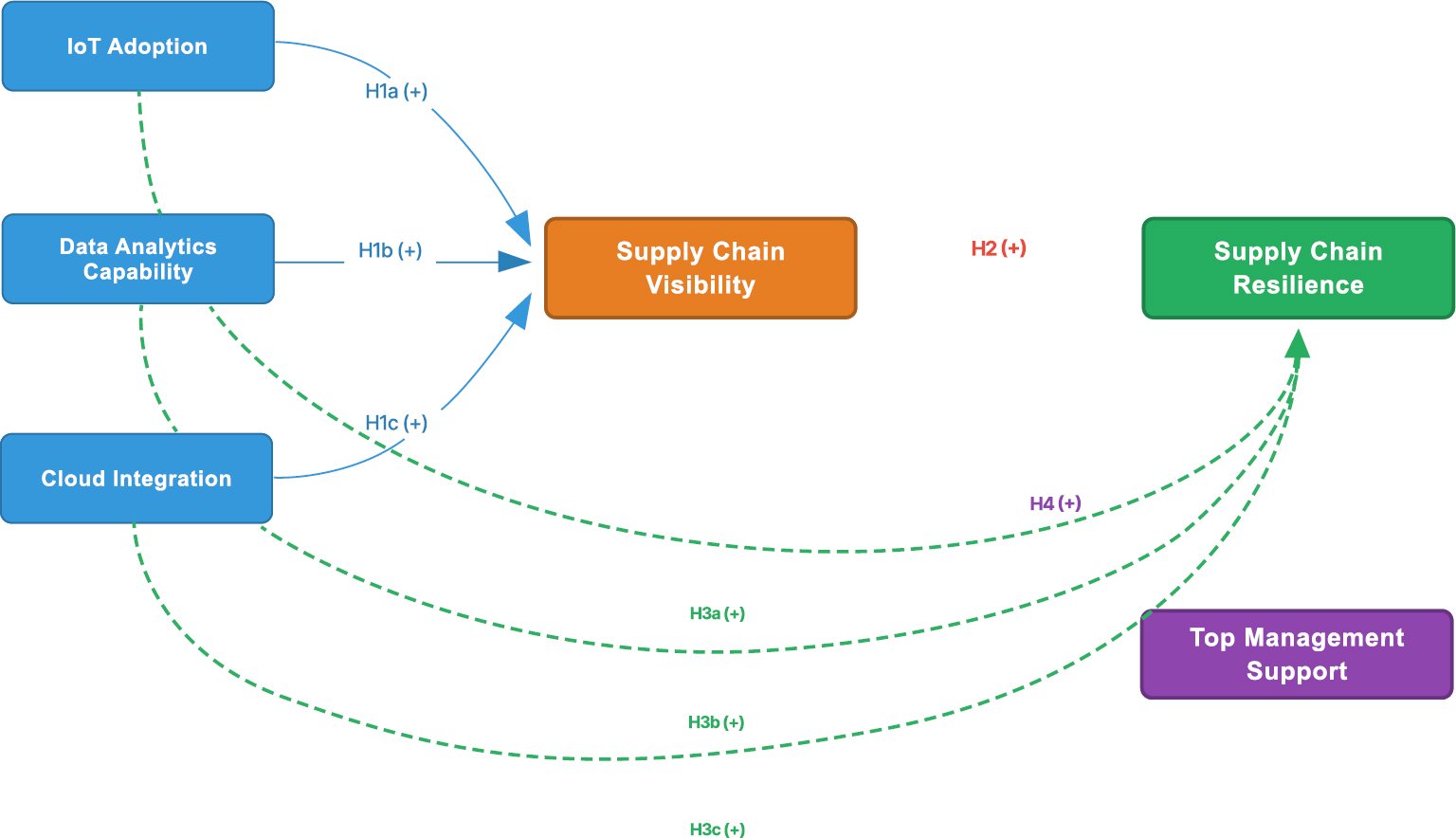
Fig. (1). Conceptual framework.
2.5. Literature Synthesis and Gap
The literature suggests that there are information-related mechanisms through which digital capabilities can support supply chain resilience, yet there are several limitations. Previous research has studied the general problem of digitalization in the supply chain e.g., (Al Tera et al., 2024; Zhao et al., 2023), looked at data analytics specifically e.g., (Jiang et al., 2025), or examined Industry 4.0 technologies specifically e.g., (Huang et al., 2023); however, it is less clear whether IoT adoption, data analytics capability, and cloud integration function as separate antecedents of visibility. Additionally, the results regarding top management support are also mixed, as (Ali Shah et al., 2026) find that top management support strengthens the relationship, while (Xu & Zhao, 2022) report insignificant moderation. Context also remains important. While several Italian studies have investigated e-commerce and resilience of small manufacturers (Onjewu et al., 2022), proactive resilience in Italian manufacturing SMEs (Carissimi et al., 2023), and digital resources among Italian firms (Pellegrino & Gaudenzi, 2026), none focus specifically on the combination of the three digital capabilities, supply chain visibility as a common mediating mechanism, and top management support as a moderator. The present study thus investigates the relationships together in the case of Italian manufacturing SMEs.
3. METHODOLOGY
3.1. Research Design and Sampling
This study was based on a quantitative and cross-sectional approach to investigate the relationship of IoT adoption, data analytics capability, and cloud integration with supply chain visibility, and supply chain visibility association with supply chain resilience of Italian manufacturing SMEs, with a specific focus on the role of top management support as a moderator. The study also investigated the mediating role of supply chain visibility. The quantitative approach allowed the proposed relationships to be examined statistically with the use of the structured questionnaire data. Data were collected at one point in time with the individual employee as the unit of analysis. The respondents were chosen from roles that have first-hand knowledge of the organization’s supply chain and operational activities.
The study targeted manufacturing employees across the supply chain, procurement, logistics, operations, production, warehousing, planning, and managerial roles in SMEs in Italy. Respondents had to meet certain organizational and occupational requirements; thus, purposive sampling was used. Participants were screened before they started the main questionnaire to ensure that they were currently working for a manufacturing organization in Italy with less than 250 employees (Appendix A). Those not meeting either criterion were excluded. The demographic and professional description of the 344 respondents is shown in Table 1. There was a relatively equal distribution of gender, and the majority held a bachelor’s or master’s degree (63.1%). Production was the largest job role (17.7%), and food and beverages were the largest industry group (16.6%). The majority of the respondents worked in an organization that had 50-249 employees (67.4%) and had 1-10 years of experience (51.7%).
Table 1. Demographic profile of 344 respondents.
| Variable | Response Option | Frequency | Percentage (%) |
| Age | 18–25 | 52 | 15.1 |
| 26–35 | 91 | 26.5 | |
| 36–45 | 83 | 24.1 | |
| 46–55 | 67 | 19.5 | |
| 56 or above | 51 | 14.8 | |
| Total | 344 | 100.0 | |
| Gender | Male | 154 | 44.8 |
| Female | 164 | 47.6 | |
| Prefer not to say | 15 | 4.4 | |
| Other | 11 | 3.2 | |
| Total | 344 | 100.0 | |
| Highest education level | Secondary or below | 31 | 9.0 |
| Diploma | 46 | 13.4 | |
| Bachelor’s | 105 | 30.5 | |
| Master’s | 112 | 32.6 | |
| Doctorate | 38 | 11.0 | |
| Other | 12 | 3.5 | |
| Total | 344 | 100.0 | |
| Current job role | Supply chain | 49 | 14.2 |
| Procurement | 37 | 10.8 | |
| Logistics | 51 | 14.8 | |
| Operations | 46 | 13.4 | |
| Production | 61 | 17.7 | |
| Warehousing | 31 | 9.0 | |
| Planning | 28 | 8.1 | |
| Senior management | 24 | 7.0 | |
| Other | 17 | 5.0 | |
| Total | 344 | 100.0 | |
| Manufacturing industry | Automotive | 53 | 15.4 |
| Machinery & equipment | 48 | 14.0 | |
| Food & beverage | 57 | 16.6 | |
| Pharmaceuticals | 35 | 10.2 | |
| Chemicals | 29 | 8.4 | |
| Textiles & apparel | 51 | 14.8 | |
| Electronics & electrical | 42 | 12.2 | |
| Other | 29 | 8.4 | |
| Total | 344 | 100.0 | |
| Years of professional experience | Less than 1 year | 24 | 7.0 |
| 1–5 years | 91 | 26.5 | |
| 6–10 years | 87 | 25.3 | |
| 11–15 years | 76 | 22.1 | |
| More than 15 years | 66 | 19.2 | |
| Total | 344 | 100.0 | |
| Number of employees in organization | 1–9 | 38 | 11.0 |
| 10–49 | 74 | 21.5 | |
| 50–149 | 109 | 31.7 | |
| 150–249 | 123 | 35.8 | |
| Total | 344 | 100.0 |
Recruitment was carried out on LinkedIn professional networks, Italian manufacturing and supply chain communities, procurement and logistics communities, and professional networks of operations and manufacturing practitioners. Invitations were also sent through contacts in manufacturing organizations. The invitation included a short description of the research, the eligibility criteria, voluntary participation information, and the link to the questionnaire. The survey was kept open throughout the collection period and yielded 344 valid responses.
To further check the suitability of the sample, G*Power 3.1 was used. Using the linear multiple regression: fixed model, R² increase procedure, six predictors, a statistical power of 0.80, an α level of 0.05, and a maximum number of predictors in the structural model was used for the calculation. A minimum sample requirement of 85 respondents was achieved. The 344 usable observations therefore exceeded the minimum requirement. The invitation was openly disseminated via multiple electronic means, and the number of recipients or those who saw it could not be determined. Therefore, a traditional response rate calculation was not possible. Due to the purposive approach, the results also cannot be used as statistically representative of the entirety of Italian manufacturing SMEs.
3.2. Instrument Development and Pilot Testing
The questionnaire was created based on existing construct conceptualizations and existing empirical measures. The items were not presented as direct adaptations from one existing instrument but were researcher-worded and inspired by previous literature. (Vass et al., 2018; and Shahzad et al., 2023) guided the adoption of IoT, while (Gupta & George, 2016; and Wong & Ngai, 2023) guided the data analytics capability, and (Shee et al., 2018; and Yao et al., 2007) guided the cloud integration. The sources for supply chain visibility were (Williams et al., 2013; and Barratt & Oke, 2007), and for supply chain resilience, (Ambulkar et al., 2015; and Chowdhury & Quaddus, 2017; Yao et al., 2007) inspired the top management support, while some related work was based on (Chen et al., 2015; and Lai et al., 2018).
There were 32 measurement items: 5 IoT adoption, 5 data analytics capability, 5 cloud integration, 6 supply chain visibility, 6 supply chain resilience, and 5 top management support (Appendix A). All the responses were obtained on a 5-point Likert scale ranging from 1 = strongly disagree to 5 = strongly agree. This format allowed for adequate differentiation of responses and has been applied to similar research on supply chains and analytics (Dennehy et al., 2021; Zhang et al., 2023). A pilot test was carried out prior to the main survey with 35 participants whose characteristics matched those of the target population. Feedback emphasized clarity, wording, comprehensibility, and interpretation of the items. Before administering the final questionnaire, necessary wording refinements were made, and pilot responses were not included in the final data set.
3.3. Data Analysis and Data Quality Assessment
SmartPLS software was used to analyze the data by means of Partial Least Squares Structural Equation Modelling (PLS-SEM). It is a variance-based structural equation modelling technique that allows for the estimation of relationships between latent constructs, the assessment of measurement and structural models and mediation and moderation effects for predictive research (Hair et al., 2011). Thus, this approach is suitable as the proposed model has several latent constructs and multiple relationships in the model, including direct, mediation, and moderation relationships. Indicator loadings, internal consistency reliability, convergent validity, and discriminant validity were used to evaluate the measurement model first. Path coefficients, significance level, effect size, and explained variance were then used to assess the structural model. Within the structural model, mediation effects of supply chain visibility and the moderating effect of top management support were explored. Significance and confidence intervals of the hypothesized relationships were obtained using bootstrapping with 5,000 resamples. Also, the direct paths from the three digital capabilities to resilience were also estimated to assess whether resilience was associated with these capabilities beyond the indirect visibility pathway.
The non-response bias in data quality assessment is examined by comparing 50 early responses and 50 late responses. No significant differences were observed between the two groups on the study variables, thus indicating that systematic non-response bias was unlikely to have an impact on the results. Furthermore, procedural and statistical methods were used to assess potential Common Method Bias (CMB). The respondents were told that they would be anonymous, that their answers would remain confidential, and that the information that they provided would be gathered for academic purposes only. Statistically, the first factor was found to contain 34% of the total variance, which is below the 50% criterion generally used in the application of Harman’s first factor test. The full-collinearity VIF values were also checked, and all of them were less than 3.3, which means that there is no severe CMB problem (Kock, 2017). The highest VIF was 2.192 for the SCV → SCR relationship (Table 2).
Table 2. VIF values.
| – | VIF |
| CI -> SCR | 1.395 |
| CI -> SCV | 1.210 |
| DAC -> SCR | 1.395 |
| DAC -> SCV | 1.187 |
| IOTA -> SCR | 1.454 |
| IOTA -> SCV | 1.172 |
| SCV -> SCR | 2.192 |
| TMS -> SCR | 1.276 |
| TMS x SCV -> SCR | 1.022 |
Note: VIF Threshold < 3.3 (Kock, 2017).
4. RESULTS
4.1. Measurement Model
Table 3 shows the measurement model results for the studied constructs. All factor loadings exceed 0.70, ranging from 0.772 to 0.887. Cronbach’s alpha and composite reliability values are >0.70, and AVE values are between 0.669 and 0.752. Hence, the constructs have sufficient indicator reliability, internal consistency, and convergent validity.
Table 3. Measurement model.
| Constructs | Indicators | Factor Loadings | Cronbach’s Alpha | Composite Reliability | Average Variance Extracted (AVE) |
| Cloud Integration | CI1 | 0.879 | 0.906 | 0.907 | 0.727 |
| CI2 | 0.851 | ||||
| CI3 | 0.828 | ||||
| CI4 | 0.847 | ||||
| CI5 | 0.857 | ||||
| Data Analytics Capability | DAC1 | 0.819 | 0.917 | 0.921 | 0.752 |
| DAC2 | 0.870 | ||||
| DAC3 | 0.872 | ||||
| DAC4 | 0.887 | ||||
| DAC5 | 0.886 | ||||
| IoT Adoption | IOTA1 | 0.867 | 0.906 | 0.907 | 0.726 |
| IOTA2 | 0.819 | ||||
| IOTA3 | 0.852 | ||||
| IOTA4 | 0.849 | ||||
| IOTA5 | 0.873 | ||||
| Supply Chain Resilience | SCR1 | 0.793 | 0.907 | 0.908 | 0.682 |
| SCR2 | 0.831 | ||||
| SCR3 | 0.854 | ||||
| SCR4 | 0.833 | ||||
| SCR5 | 0.821 | ||||
| SCR6 | 0.824 | ||||
| Supply Chain Visibility | SCV1 | 0.818 | 0.901 | 0.903 | 0.669 |
| SCV2 | 0.839 | ||||
| SCV3 | 0.831 | ||||
| SCV4 | 0.864 | ||||
| SCV5 | 0.780 | ||||
| SCV6 | 0.772 | ||||
| Top Management Support | TMS1 | 0.873 | 0.899 | 0.906 | 0.711 |
| TMS2 | 0.866 | ||||
| TMS3 | 0.838 | ||||
| TMS4 | 0.815 | ||||
| TMS5 | 0.824 |
Note: Factor loadings > 0.70, Composite reliability and Cronbach’s alpha > 0.70, AVE > 0.5 (Hair et al., 2011).
4.2. Discriminant Validity
The HTMT ratios used for checking the discriminant validity are reported in Table 4. The values are all within the range of 0.118 to 0.837, which is below the recommended limit of 0.85. Although SCV-SCR was close to the threshold of 0.85 (0.837), it still falls under the suggested threshold. It suggests that the constructs are empirically different from each other, which means that the measurement model has satisfactory discriminant validity.
Table 4. HTMT ratio.
| – | CI | DAC | IOTA | SCR | SCV |
| DAC | 0.377 | – | – | – | – |
| IOTA | 0.360 | 0.324 | – | – | – |
| SCR | 0.677 | 0.545 | 0.618 | – | – |
| SCV | 0.571 | 0.556 | 0.595 | 0.837 | |
| TMS | 0.275 | 0.350 | 0.118 | 0.472 | 0.454 |
Note: HTMT Threshold < 0.85
4.3. Model Fit
Table 5 presents the model fit results for the saturated and estimated models. SRMR values are 0.041 and 0.054, which are below the acceptable value of 0.08. NFI values of 0.905 and 0.902 were considered as acceptable. The d_ULS and d_G are reported for completeness and are not indicative of notable fit concerns.
Table 5. Model fit summary.
| – | Saturated Model | Estimated Model |
| SRMR | 0.041 | 0.054 |
| d_ULS | 0.879 | 1.541 |
| d_G | 0.383 | 0.400 |
| NFI | 0.905 | 0.902 |
4.4. Path Coefficient
Table 6 shows the direct effects between the variables of the study. CI, DAC, and IOTA each have significant positive associations with SCV (β = 0.301, 0.299, and 0.349; p < 0.001), supporting H1a–H1c. SCV is also positively related to SCR (β = 0.389, p < 0.001), confirming H2. The direct effects of CI, DAC, and IOTA on SCR are significant (β = 0.272, 0.093, and 0.221), although DAC has a small effect size (f² = 0.021). The relationship between TMS and SCR is positive (β = 0.146, p < 0.001), while the interaction between TMS and SCV is not significant (β = 0.031, p = 0.235), which does not support H4.
Table 6. Direct effects.
| – | Path Coefficient | STDEV | T Statistics | P Values | CI 95% | F-Square |
| CI -> SCR | 0.272 | 0.037 | 7.310 | <0.001 | [0.199, 0.343] | 0.175 |
| CI -> SCV | 0.301 | 0.043 | 6.985 | <0.001 | [0.214, 0.383] | 0.148 |
| DAC -> SCR | 0.093 | 0.038 | 2.485 | 0.013 | [0.018, 0.165] | 0.021 |
| DAC -> SCV | 0.299 | 0.041 | 7.237 | <0.001 | [0.217, 0.379] | 0.149 |
| IOTA -> SCR | 0.221 | 0.037 | 5.904 | <0.001 | [0.148, 0.295] | 0.111 |
| IOTA -> SCV | 0.349 | 0.040 | 8.658 | <0.001 | [0.269, 0.427] | 0.206 |
| SCV -> SCR | 0.389 | 0.049 | 8.009 | <0.001 | [0.295, 0.485] | 0.229 |
| TMS -> SCR | 0.146 | 0.036 | 4.063 | <0.001 | [0.077, 0.216] | 0.056 |
| TMS x SCV -> SCR | 0.031 | 0.026 | 1.189 | 0.235 | [-0.020, 0.080] | 0.003 |
Note: f2 = 0.02 (small), 0.15 (medium), and 0.35 (large) (Hair & Alamer, 2022).
Indirect effects (through SCV) are shown in Table 7. All three indirect effects are positive and significant (p < .001), consistent with H3a, H3b, and H3c. The VAF values are 38.1% for IOTA, 30.1% for CI, and 55.7% for DAC. Since the corresponding direct effects remain significant, SCV provides partial mediation in all three relationships.
Table 7. Mediation/ indirect effects.
| – | Path Coefficient | STDEV | T Statistics | P Values | CI 95% | VAF |
| IOTA -> SCV -> SCR | 0.136 | 0.022 | 6.136 | <0.001 | [0.094, 0.181] | 38.1% |
| CI -> SCV -> SCR | 0.117 | 0.022 | 5.419 | <0.001 | [0.076, 0.161] | 30.1% |
| DAC -> SCV -> SCR | 0.117 | 0.023 | 5.096 | <0.001 | [0.074, 0.164] | 55.7% |
Note: VAF = Indirect Effect / Total Effect x 100
4.5. Simple Slope Analysis
Table 8 shows the conditional effects of SCV on SCR as well as the indirect effects at varying levels of TMS. The SCV–SCR association increases from 0.358 at low TMS to 0.420 at high TMS. There are also indirect effects that rise in proportion with TMS. But since the interaction effect in Table 6 is not significant, these conditional differences do not show a significant moderation effect.
Table 8. Conditional direct and indirect effects.
| – | SCV -> SCR | CI -> SCV -> SCR | DAC -> SCV -> SCR | IOTA -> SCV -> SCR |
| TMS at +1 SD | 0.420 | 0.126 | 0.126 | 0.146 |
| TMS at -1 SD | 0.358 | 0.108 | 0.107 | 0.125 |
| TMS at Mean | 0.389 | 0.117 | 0.117 | 0.136 |
4.6. Explanatory power and Predictive Relevance
The explanatory and predictive relevance of the endogenous constructs are shown in Table 9. The model explains 69.8% of the variance in SCR (adjusted R² = 0.693) and 49.5% in SCV (adjusted R² = 0.490). The Q2predict values are >0 and positive (0.610 and 0.483), showing that these models are predictive. The RMSE and MAE also indicate the model’s prediction errors on SCR and SCV.
Table 9. R2 and Q2.
| – | R-Square | R-Square Adjusted | Q²Predict | RMSE | MAE |
| SCR | 0.698 | 0.693 | 0.610 | 0.628 | 0.494 |
| SCV | 0.495 | 0.490 | 0.483 | 0.723 | 0.575 |
5. DISCUSSION
The results offer a nuanced perspective on the connection between the digital capabilities of SMEs in the Italian manufacturing sector. The findings do not necessarily mean that digitalization is a single capability, but rather that there is heterogeneity in its relevance depending on IoT adoption, data analytics capability, and cloud integration, and that supply chain visibility is a critical linking capability. This is generally aligned with Dynamic Capability Theory (DCT) and Information Processing Theory (IPT): a digital capability can be a means to create and process information within the supply chain, and visibility is an information-processing condition that can be linked to resilience.
All three digital capabilities were positively associated with supply chain visibility, with IoT adoption having the highest association (β = 0.349, f² = 0.206), followed by cloud integration (β = 0.301, f² = 0.148) and data analytics capability (β = 0.299, f² = 0.149). The ordering may have a theoretical significance. IoT is closely related to the physical observation of products, materials, equipment, and processes and therefore has a more direct informational relationship with visibility. Cloud integration and analytics, however, are about how information is linked and processed once it is available. The results, thus, complement the studies of (Vass et al., 2018; and Shahzad et al., 2023), and extend the overall picture of digitalization evidenced in (Al Tera et al., 2024). Notably, the equivalent variables for analytics and cloud integration show that visibility may not rely on one technological path. For Italian SMEs, the various digital capabilities can thus offer partial substitutes but more or less distinct ways of enhancing the availability of information in the supply chain.
The relationship between visibility and resilience was relatively stronger (β = 0.389, f² = 0.229), which is the main argument of IPT, where the information processing capacity is more relevant under uncertainty conditions. This finding is in line with the result reported by (Williams et al., 2013), yet adds to their qualification that visibility cannot act alone in the organizational situation. The findings are consistent with (Zhao et al., 2023; and Jiang et al., 2025), who both suggested that visibility is a key mechanism between digital capabilities and resilience. The current results, however, provide a more holistic interpretation, as visibility is explored as a shared phenomenon across three different digital capabilities instead of a wider digitalization index.
These relationships are also set against the backdrop of the additional direct-effect analysis. The direct pathways from each of the three digital capabilities to supply chain resilience were not hypothesized, but examined to determine if other digital capabilities beyond the visibility pathway were related to resilience. The findings show that these direct relationships were not consistent, and that the relationship between digital skills and resilience does not depend only on technology use. Together, this evidence suggests that the link between individual capabilities and resilience should be analyzed at the pathway level rather than assuming that all digital capabilities have similar direct impacts on resilience.
The mediation results, considered alongside the additional non-hypothesized direct-effect tests, strengthen this interpretation. All three digital capability–resilience relationships were partially mediated by SCV, with some mediation being stronger than others. Data Analytics Capability had the highest VAF (55.7%) while IoT adoption (38.1%) and cloud integration (30.1%) had lower scores. This distinction is relevant, as the direct link between analytics and resilience was rather weak (β = 0.093, f² = 0.021), yet was still statistically significant and had a meaningful indirect link via visibility (β = 0.117). Therefore, it seems that analytics capability is more reliant on the information-visibility pathway than IoT or cloud integration for its association with resilience. This finding is in line with (Jiang et al., 2025), who also finds that visibility is a link between analytics capability and resilience. In contrast, the direct link between cloud integration and resilience (β = 0.272, f² = 0.175) indicates that cloud-enabled connectivity might be of relevance to something other than visibility. These differences taken together suggest that digitalization should not be understood as a uniform organizational resource.
The additional direct-effect results further distinguish the three capabilities; a direct association was found between IoT adoption and resilience, while the direct association between data analytics and resilience was relatively low and between cloud integration and resilience was the highest of the three. Given that these paths were not postulated as hypotheses, they are more likely to be interpreted as supplementary evidence than as evidence of additional hypothesized relationships. However, they do explain the varying levels of power in mediation across the digital capabilities.
There is a second equally important qualification; the role of top management support was not significant. TMS was also directly positively associated with resilience (β = 0.146, f² = 0.056), but the interaction between TMS and visibility was not significant (β = 0.031, p = 0.235, f² = 0.003). The conditional estimates increased from low to high TMS, but the nonsignificant interaction indicates that this difference does not constitute statistically significant moderation. This is in contrast to (Ali Shah et al., 2026), which showed that TMS strengthens the relationship between digital technology and resilience, and is consistent with the context-dependent moderation reported by (Xu & Zhao, 2022). The difference could reflect that managerial support is associated with resilience more broadly, but not necessarily with the strength of the link between visibility and resilience. In other words, management commitment might support the organizational context of digitalization and the informational value of visibility might be relatively stable, regardless of the level of managerial support.
The results combined show a picture of digitalization in Italian manufacturing SMEs as a capability that is diverse rather than uniform. The results indicate that IoT seems especially relevant to the visibility of supply-chain activities, cloud integration exhibits a relatively more direct connection with resilience, and analytics has a relatively closer connection with resilience via the visibility pathway. These patterns were derived from the hypothesized relationships and additional direct-effects tests, and therefore, produce a more nuanced understanding of the relationship between individual digital capabilities and resilience.
This indicates that the usefulness of various digital capabilities to organizations could be related to the function within which it is integrated within supply-chain activities. The strong explanatory power for resilience (R² = 0.698) also suggests that these relationships are significant within the context of the study; however, the relationships cannot be interpreted as evidence that digital capabilities are a direct cause of resilience. The negligible TMS moderation suggests that the visibility–resilience link is not systematic in this sample and is not moderated by managerial support. Altogether, the results depict an Italian manufacturing SME landscape where digital capabilities, information visibility, and resilience are deeply connected but not necessarily in the same way.
THEORETICAL CONTRIBUTION
This study provides a more differentiated application of DCT and IPT to supply chain digitalization. DCT distinguishes between IoT adoption, data analytics capability, and cloud integration as organizational capabilities, rather than a single technological resource as digitalization. IPT, in turn, positions supply chain visibility as the information-processing condition connecting these capabilities with resilience. The results also suggest that this relationship is not equal for all capabilities, as seen in the higher mediation results for analytics. The lack of significance for the moderation of top management support also implies that a positive managerial support should not be assumed to automatically change the visibility–resilience relationship. The study, combined, represents a context-specific application of the two perspectives, both direct and information-mediated.
PRACTICAL IMPLICATIONS
Digital investment for Italian manufacturing SMEs should be linked to the function of the supply chain that they should support. Where continuous tracking and operational monitoring are important, IoT investments can be prioritized, and investments in analytics must be accompanied by processes that consolidate and make supply-chain information accessible across functions. The integration of the cloud should be evaluated more through the lens of connectivity between internal operations and external supply-chain partners than on cloud adoption alone. Managers might also consider assessing digital programs based on their contribution to information continuity in disruption. Since managerial support did not strengthen the visibility–resilience link, allocating additional management attention alone may be insufficient; organizational processes surrounding information use and cross-functional coordination also warrant consideration.
CONCLUSION
The study concludes that supply chain visibility is linked to IoT adoption, data analytics capability, and cloud integration, and that supply chain visibility is a significant linkage to resilience in the case of Italian manufacturing SMEs. The differentiated mediation patterns suggest that digital capabilities don’t follow the same paths, while the non-significant moderation suggests that managerial support does not always enhance visibility-related resilience. The study, overall, offers an integrated empirical account of the co-existence of different digital capabilities and supply-chain information conditions in shaping resilience.
LIMITATIONS AND FUTURE DIRECTIONS
There are a number of limitations that give directions for further research. The cross-sectional design prevents the evaluation of change over time of digital capabilities and digital resilience, and longitudinal studies could explore whether the relationships are sustained as digital initiatives grow. The purposive sampling and the focus on Italian manufacturing SMEs also restrict the statistical generalization. The patterns found could be investigated further in comparative studies between European countries or between firms, or manufacturing sectors, to see if they are context-dependent. Future research might also separate reactive and proactive resilience, as there is evidence that digital capabilities may not be similarly associated with both types of resilience. Lastly, qualitative or mixed-method research could explore how SMEs transform the digital information into disruption-driven decisions and why top management support does not necessarily shape this process.
LIST OF ABBREVIATIONS
CMB | = | Common Method Bias |
DCT | = | Dynamic Capability Theory |
IPT | = | Information Processing Theory |
PLS-SEM | = | Partial Least Squares Structural Equation Modelling |
AUTHOR’S CONTRIBUTION
J.S. has contributed to the study conceptualization, methodology, data analysis, interpretation of results, and manuscript writing.
ETHICAL APPROVAL & INFORMED CONSENT
This study was conducted in compliance with internationally accepted ethical principles for conducting research. An informed-consent statement describing the study and their rights as participants was first presented to each participant. There was no forced participation, and the respondents were free to withdraw at any time without penalty. No personally identifying information was collected, and all responses were kept anonymous and confidential. The participants were also told that the data that they provided would only be used for academic research and no other purpose.
AVAILABILITY OF DATA AND MATERIALS
The data will be made available on reasonable request by contacting the corresponding author [J.S.].
FUNDING
None.
CONFLICT OF INTEREST
The author declares that there is no conflict of interest regarding the publication of this article.
ACKNOWLEDGEMENTS
Declared none.
DECLARATION OF AI
During the preparation of this manuscript, the author used ChatGPT for language editing and refinement purposes. Following the use of this tool, the author carefully reviewed and revised the content where necessary and accept full responsibility for the final published version of the article.
APPENDIX
Section A: Screening Question
Code | Screening Question | Response Options |
S1 | Are you currently working for a manufacturing company located in Italy? | Yes / No |
S2 | Does your organization have fewer than 250 employees? | Yes / No / Not sure |
Section B: Demographic
Code | Variable | Response Options |
D1 | Age | 18–25 / 26–35 / 36–45 / 46–55 / 56 or above |
D2 | Gender | Male / Female / Prefer not to say / Other |
D3 | Highest education level | Secondary or below / Diploma / Bachelor’s / Master’s / Doctorate / Other |
D4 | Current job role | Supply chain / Procurement / Logistics / Operations / Production / Warehousing / Planning / Senior management / Other |
D5 | Manufacturing industry | Automotive / Machinery & equipment / Food & beverage / Pharmaceuticals / Chemicals / Textiles & apparel / Electronics & electrical / Other |
D6 | Years of professional experience | Less than 1 year / 1–5 / 6–10 / 11–15 / More than 15 years |
D7 | Number of employees in organization | 1–9 / 10–49 / 50–149 / 150–249 |
Section C: Main Questionnaire
For all main questionnaire items:
1 = Strongly Disagree
2 = Disagree
3 = Neither Agree nor Disagree
4 = Agree
5 = Strongly Agree
Construct | Code | Questionnaire Item |
IoT Adoption | IOTA1 | Our organization uses connected sensors or devices to monitor supply chain or production activities. |
IOTA2 | Our organization uses IoT technologies to collect operational information from physical assets or processes. | |
IOTA3 | Our organization has implemented IoT technologies in supply chain operations. | |
IOTA4 | Our organization uses IoT technologies to monitor the condition or status of products, equipment, or materials. | |
IOTA5 | IoT technologies are integrated into our routine supply chain operations. | |
Data Analytics Capability | DAC1 | Our organization uses advanced analytical techniques to support supply chain decision-making. |
DAC2 | Our organization can combine data from multiple sources for supply chain analysis. | |
DAC3 | Our organization uses data visualization tools to help managers understand complex supply chain information. | |
DAC4 | Our organization can use analytics to identify patterns and relationships in supply chain data. | |
DAC5 | Our organization can use analytics to generate forecasts or predictions for supply chain decisions. | |
Cloud Integration | CI1 | Our cloud-based systems are integrated with the information systems used in our supply chain operations. |
CI2 | Our cloud-based systems connect our internal supply chain functions. | |
CI3 | Our cloud-based systems connect our organization with key suppliers. | |
CI4 | Our cloud-based systems connect our organization with key customers. | |
CI5 | Our cloud-based systems integrate previously separate supply chain applications and processes. | |
Supply Chain Visibility | SCV1 | Our organization has timely information about changes in customer demand. |
SCV2 | Our organization has accurate information about customer demand and forecasts. | |
SCV3 | Our organization has timely information about suppliers’ inventory and capacity. | |
SCV4 | Our organization has timely information about supplier orders and delivery status. | |
SCV5 | Our organization has visibility of inventory levels across the supply chain. | |
SCV6 | Our organization can track the movement and status of products or materials across the supply chain. | |
Supply Chain Resilience | SCR1 | Our supply chain can respond quickly when unexpected disruptions occur. |
SCR2 | Our supply chain can continue essential operations during disruptions. | |
SCR3 | Our supply chain can adapt its operations when disruption conditions change. | |
SCR4 | Our supply chain can reduce the impact of disruptions on its operations. | |
SCR5 | Our supply chain can recover its operations within a reasonable time after a disruption. | |
SCR6 | Our supply chain can develop alternative ways of operating when normal arrangements are disrupted. | |
Top Management Support | TMS1 | Top management considers supply chain visibility strategically important for our organization. |
TMS2 | Top management actively supports initiatives to improve supply chain visibility. | |
TMS3 | Top management provides the resources needed to improve our supply chain information capabilities. | |
TMS4 | Top management is willing to invest in technologies that support our supply chain. | |
TMS5 | Top management encourages managers to use supply chain information when making decisions. |
REFERENCES
Al Tera, A., Alzubi, A., & Iyiola, K. (2024). Supply chain digitalization and performance: A moderated mediation of supply chain visibility and supply chain survivability. Heliyon, 10(4), e25584.
https://doi.org/10.1016/j.heliyon.2024.e25584
Ali Shah B., S. R., Khurshid, A., Sajid, A., & Hanif, M. S. (2026). Rebooting resilience: Examining the role of digital technology and top management support in supply chain performance. Future Business Journal, 12(1), 55.
https://doi.org/10.1186/s43093-026-00762-4
Ambulkar, S., Blackhurst, J., & Grawe, S. (2015). Firm’s resilience to supply chain disruptions: Scale development and empirical examination. Journal of Operations Management, 33-34(1), 111–122.
https://doi.org/10.1016/j.jom.2014.11.002
Barratt, M., & Oke, A. (2007). Antecedents of supply chain visibility in retail supply chains: A resource-based theory perspective. Journal of Operations Management, 25(6), 1217–1233.
https://doi.org/10.1016/j.jom.2007.01.003
Bettiol, M., Capestro, M., Di Maria, E., & Micelli, S. (2023). Ambidextrous strategies in turbulent times: The experience of manufacturing SMEs during the COVID-19 pandemic. International Journal of Physical Distribution & Logistics Management, 53(2), 248–272.
https://doi.org/10.1108/IJPDLM-10-2021-0422
Carissimi, M. C., Creazza, A., Prataviera, L. B., & Colicchia, C. (2023). Supply chain resilience for small and medium enterprises: A protection motivation perspective for Italian firms. Summer School Francesco Turco Proceedings, 1–7. Available from: https://re.public.polimi.it/handle/11311/1263001 (Accessed on: 07-10-2026).
Chen, D., Heyer, S., Ibbotson, S., Salonitis, K., Steingrímsson, J. G., & Thiede, S. (2015). Direct digital manufacturing: Definition, evolution, and sustainability implications. Journal of Cleaner Production, 107, 615–625.
https://doi.org/10.1016/j.jclepro.2015.05.009
Chowdhury, M. M. H., & Quaddus, M. (2017). Supply chain resilience: Conceptualization and scale development using dynamic capability theory. International Journal of Production Economics, 188, 185–204.
https://doi.org/10.1016/j.ijpe.2017.03.020
Da Roit, B., & Iannuzzi, F. E. (2023). One of many roads to Industry 4.0? Technology, policy, organisational adaptation and worker experience in “Third Italy” SMEs. New Technology, Work and Employment, 38(2), 252–271.
https://doi.org/10.1111/ntwe.12241
Dennehy, D., Oredo, J., Spanaki, K., Despoudi, S., & Fitzgibbon, M. (2021). Supply chain resilience in mindful humanitarian aid organizations: The role of big data analytics. International Journal of Operations & Production Management, 41(9), 1417–1441.
https://doi.org/10.1108/IJOPM-12-2020-0871
Fornasiero, R., & Tolio, T. A. (2025). Digital supply chains for ecosystem resilience: A framework for the Italian case. Operations Management Research, 18(1), 210–225.
https://doi.org/10.1007/s12063-024-00511-2
Galbraith, J. R. (1974). Organization design: An information processing view. Interfaces, 4(3), 28–36.
https://doi.org/10.1287/inte.4.3.28
Giorgetti, M. L., & Zirulia, L. (2024). Digital transition and the European industrial policy. Milano University Press.
https://doi.org/10.54103/milanoup.180
Gupta, M., & George, J. F. (2016). Toward the development of a big data analytics capability. Information & Management, 53(8), 1049–1064.
https://doi.org/10.1016/j.im.2016.07.004
Hair, J. F., Ringle, C. M., & Sarstedt, M. (2011). PLS-SEM: Indeed a silver bullet. Journal of Marketing Theory and Practice, 19(2), 139–152.
https://doi.org/10.2753/MTP1069-6679190202
Hair, J., & Alamer, A. (2022). Partial least squares structural equation modeling (PLS-SEM) in second language and education research: Guidelines using an applied example. Research Methods in Applied Linguistics, 1(3), 100027.
https://doi.org/10.1016/j.rmal.2022.100027
Huang, K., Wang, K., Lee, P. K., & Yeung, A. C. (2023). The impact of Industry 4.0 on supply chain capability and supply chain resilience: A dynamic resource-based view. International Journal of Production Economics, 262, 108913.
https://doi.org/10.1016/j.ijpe.2023.108913
Jiang, W., Feng, T., & Wong, C. Y. (2025). How big data analytics capabilities drive supply chain resilience: The mediating roles of supply chain visibility and flexibility. International Journal of Physical Distribution & Logistics Management, 55(5), 505–539.
https://doi.org/10.1108/IJPDLM-07-2024-0252
Kassem, B., Rossini, M., Frecassetti, S., Costa, F., & Portioli Staudacher, A. (2024). An implementation model for socio-technical digital tools. Journal of Manufacturing Technology Management, 35(5), 941–961.
https://doi.org/10.1108/JMTM-06-2023-0230
Kock, N. (2017). Common method bias: A full collinearity assessment method for PLS-SEM. In Partial least squares path modeling: Basic concepts, methodological issues and applications (pp. 245–257). Springer International Publishing.
https://doi.org/10.1007/978-3-319-64069-3_11
Lai, Y., Sun, H., & Ren, J. (2018). Understanding the determinants of big data analytics (BDA) adoption in logistics and supply chain management: An empirical investigation. The International Journal of Logistics Management, 29(2), 676–703.
https://doi.org/10.1108/IJLM-06-2017-0153
Martinelli, E. M., & Tunisini, A. (2024). Digitalization in Italian SMEs: The transformation of marketing channels. Italian Journal of Marketing, 2024(4), 445–474.
https://doi.org/10.1007/s43039-024-00099-2
Onjewu, A. K. E., Hussain, S., & Haddoud, M. Y. (2022). The interplay of e-commerce, resilience and exports in the context of COVID-19. Information Systems Frontiers, 24(4), 1209–1221.
https://doi.org/10.1007/s10796-022-10342-w
Pellegrino, R., & Gaudenzi, B. (2026). Supply chain resilience as a viable way to cope with disruptions: An empirical analysis of Italian firms. Review of Managerial Science, 20(5), 1459–1489.
https://doi.org/10.1007/s11846-025-00911-z
Pencarelli, T., Cesaroni, F. M., & Demartini, P. (2022). Italian SMEs and new scenarios in the current geopolitical turmoil. Piccola Impresa/Small Business, (1).
https://doi.org/10.14596/pisb.3436
Shah, S., Madni, S. H. H., Hashim, S. Z. M., Faheem, M., & Shahzad, H. M. F. (2025). Bridging the gap: Empowering manufacturing and production small medium enterprises through industrial Internet of Things adoption model. IET Collaborative Intelligent Manufacturing, 7(1), e70021.
https://doi.org/10.1049/cim2.70021
Shahzad, A., bin Zakaria, M. S. A., Kotzab, H., Makki, M. A. M., Hussain, A., & Fischer, J. (2023). Adoption of fourth industrial revolution 4.0 among Malaysian small and medium enterprises (SMEs). Humanities and Social Sciences Communications, 10(1), 693.
https://doi.org/10.1057/s41599-023-02076-0
Shee, H., Miah, S. J., Fairfield, L., & Pujawan, N. (2018). The impact of cloud-enabled process integration on supply chain performance and firm sustainability: The moderating role of top management. Supply Chain Management: An International Journal, 23(6), 500–517.
https://doi.org/10.1108/SCM-09-2017-0309
Teece, D. J., Pisano, G., & Shuen, A. (1997). Dynamic capabilities and strategic management. Strategic Management Journal, 18(7), 509–533.
https://doi.org/10.1002/(SICI)1097-0266(199708)18:7%3C509::AID-SMJ882%3E3.0.CO;2-Z
Vass, T. D., Shee, H., & Miah, S. J. (2018). The effect of “Internet of Things” on supply chain integration and performance: An organisational capability perspective. Australasian Journal of Information Systems, 22, 11.
https://doi.org/10.3127/ajis.v22i0.1734
Williams, B. D., Roh, J., Tokar, T., & Swink, M. (2013). Leveraging supply chain visibility for responsiveness: The moderating role of internal integration. Journal of Operations Management, 31(7–8), 543–554.
https://doi.org/10.1016/j.jom.2013.09.003
Wong, D. T. W., & Ngai, E. W. T. (2023). The effects of analytics capability and sensing capability on operations performance: The moderating role of data-driven culture. Annals of Operations Research, 350, 781-816.
https://doi.org/10.1007/s10479-023-05241-5
Xu, H., & Zhao, C. (2022). Supply chain management practices influence supply chain performance with mediation role of innovation and moderation role of top management support. Frontiers in Public Health, 10, 813828.
https://doi.org/10.3389/fpubh.2022.813828
Yao, Y., Palmer, J., & Dresner, M. (2007). An interorganizational perspective on the use of electronically enabled supply chains. Decision Support Systems, 43(3), 884–896.
https://doi.org/10.1016/j.dss.2007.01.002
Zhang, X., He, X., Du, X., Zhang, A., & Dong, Y. (2023). Supply chain practices, dynamic capabilities, and performance: The moderating role of big data analytics. Journal of Organizational and End User Computing, 35(3), 1–26.
https://doi.org/10.4018/JOEUC.325214
Zhao, N., Hong, J., & Lau, K. H. (2023). Impact of supply chain digitalization on supply chain resilience and performance: A multi-mediation model. International Journal of Production Economics, 259, Article 108817.
https://doi.org/10.1016/j.ijpe.2023.108817
Licensed
© 2026 Copyright by the Authors.
Licensed as an open access article using a CC BY 4.0 license.
Article Contents Author Jiyad Shaikh1, * 1NED University of Engineering and Technology, Karachi, Pakistan Article History: Received: 23 July, 2026
Article Contents Author Saad Ahmad Khan1, * Imran Iqbal2 1Department of Marketing and Supply Chain Management, Iqra University, Karachi, Pakistan
Article Contents Author Raza Hussain Khoso1, * 1Department of Management, Emaan Institute of Management and Sciences (EIMS), Karachi, Pakistan Article
Article Contents Author Rashid Ali Baloch1, * 1Indus University, Karachi, Pakistan Article History: Received: 25 August, 2026 Revised: 07 October,
Article Contents Author Muhammad Jawwad1, * 1NED University of Engineering and Technology, Karachi, Pakistan Article History: Received: 01 September, 2026
Article Contents Author Joseph Kofi Mensah1, * , David Kwashie Garr2 , David Mensah Awadzie3 1Department of Business Administration, Accra