


















Article Contents
Article ID: CM2610110005
Views: 13Adipokines and Inflammatory Biomarkers Linking Obesity and Periodontitis: A Critical Review
 PDF
PDF
⬇ Downloads: 3
1George Emil Palade University of Medicine, Pharmacy, Science and Technology, Targu Mures, Romania
Received: 21 September, 2026
Accepted: 03 October, 2026
Revised: 01 October, 2026
Published: 12 October, 2026
ABSTRACT:
Background: Obesity and periodontitis change the inflammatory and adipokine profiles. The interpretation depends on the biomarker, specimen, and comparison used. This study was designed to evaluate clinical associations involving resistin, adiponectin, interleukin-6, and tumour necrosis factor-α. It also sought to assess treatment responses and implications for periodontal care.
Methods: In this critical review, clinical publications through July 2025 and molecular studies without date restriction were analysed. Observational studies, treatment reports, and randomised trials were analysed. Molecular studies were not date-restricted. Studies were analysed by study type, biomarkers, and biological specimens. The interpretation of observational associations, within-group changes, and the effects of treatment were performed separately.
Results: Obesity with poor periodontal health was associated with higher local pro-inflammatory cytokines, higher circulating resistin and leptin, and decreased adiponectin levels. The local and circulating profiles varied. Seven treatment reports described improvements in periodontal measures, but circulating adipokine levels did not consistently change. One randomised trial demonstrated lower high-sensitivity C-reactive protein levels after an intensive treatment package containing azithromycin; another found no significant between-group change in salivary resistin levels. Molecular findings remain exploratory.
Conclusions: The evidence reviewed indicates that there are relationships between adiposity, periodontitis, and host biomarkers. However, the studies reviewed offer no support for a universal biomarker pattern, use of biomarkers in practice, or prevention of cardiometabolic events. Practitioners should evaluate periodontal outcomes while the use of biomarkers demands standardisation and clinical relevance.
Keywords: Periodontitis, obesity, adipokines, inflammatory biomarkers, periodontal therapy, clinical interpretation.
1. INTRODUCTION
Periodontitis is an inflammatory condition caused by biofilm and which causes damage to the tissues supporting the teeth. Treatment focuses on inflammation control and retention of teeth [1]. Obesity provides an additional inflammatory context: macrophage accumulation and inflammatory activity in adipose tissue offer a biological rationale for studying its relationship with periodontal disease [2]. However, a circulating biomarker does not identify the tissue from which its signal originated.
This review addresses a complementary clinical question: what do reported biomarker associations and treatment responses mean for assessing and managing individual periodontal patients? Previous systematic reviews [3, 4] have examined systemic outcomes and cytokine changes after periodontal treatment in individuals with obesity, providing a broader synthesis than the focused evidence considered here.
Adipokines mediate adipose biology, whereas inflammatory cytokines are defined by their immune-signaling functions; these categories overlap. Human resistin, for example, is expressed by monocytes and macrophages and responds to inflammatory stimulation [5]. This review focuses on resistin, adiponectin, interleukin-6 (IL-6), and tumour necrosis factor-α (TNF-α), selected because they are frequently measured in obesity–periodontitis research and represent both inflammatory cytokines and adipokines. Leptin, C-reactive protein (CRP), and other measured host markers are considered where they clarify the clinical findings (Fig. 1). These four biomarkers were selected because (1) they are frequently measured in obesity–periodontitis research, (2) they represent both inflammatory cytokines (namely IL-6 and TNF-α) as well as adipokines (resistin, adiponectin), and (3) they have been proposed as candidate mediators of the obesity–periodontal relationship. Leptin and CRP are considered where they inform the clinical interpretation, but are not primary synthesis targets.
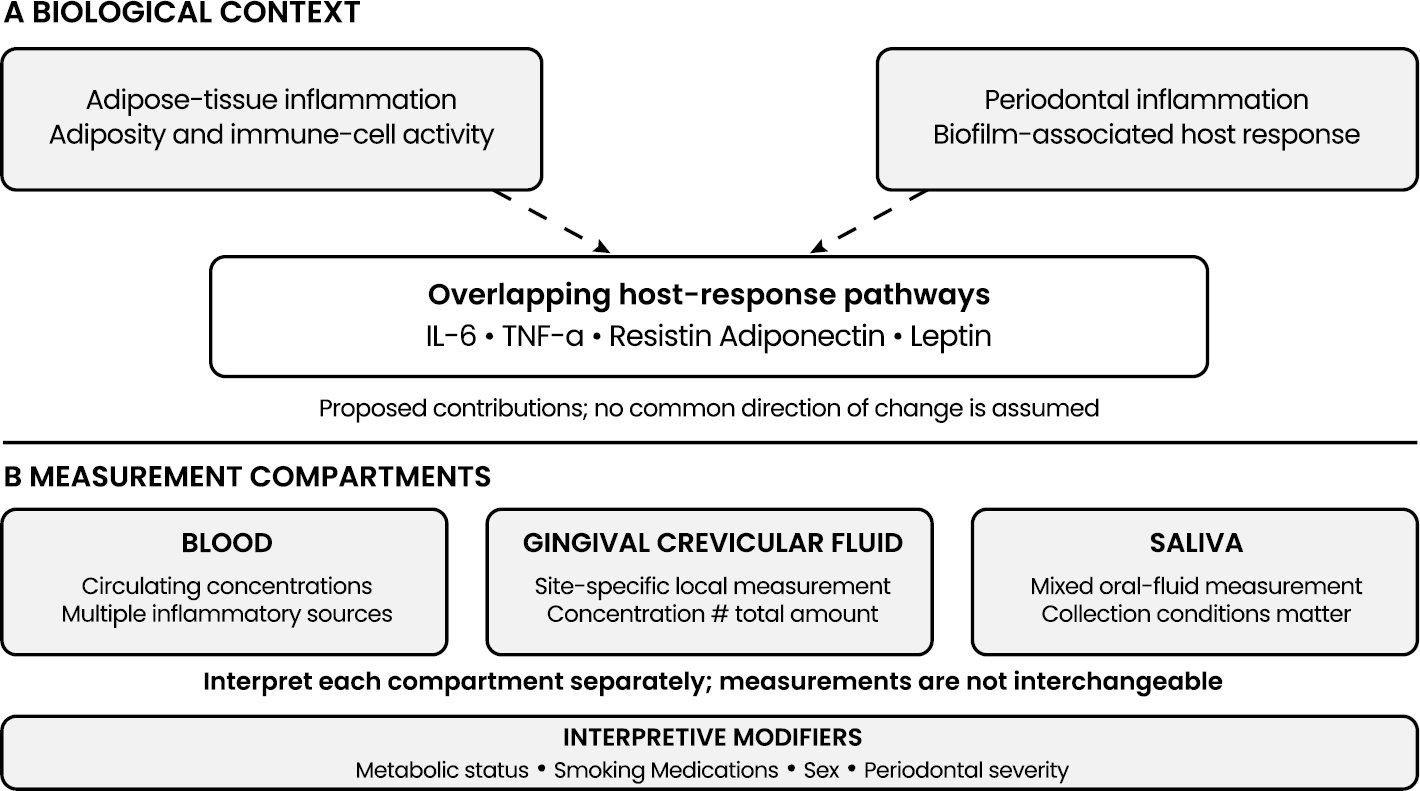
Fig. (1). Biological compartments and how inflammatory biomarkers are interpreted in obesity and periodontitis. The dashed arrows show contributions to overlapping host-response mechanisms; they do not specify the origin of each mediator or prove causality. Blood-based specimens (serum or plasma), gingival crevicular fluid (GCF), and saliva represent different measurements and should be interpreted separately. The lower strip identifies the factors relevant to the interpretation. No common direction of change, validated panel, or uniform treatment response is implied. IL-6, interleukin-6; TNF-α, tumour necrosis factor-α.
The main purpose was to critically examine the associations between adiposity, periodontal status, and the four principal biomarkers. The secondary objective was to assess changes after periodontal treatment and determine what they support regarding diagnosis, treatment monitoring, and clinical decision-making. We addressed the observational associations and treatment effects separately because they answer different questions. Molecular studies are considered as supporting biological evidence, not as substitutes for clinical validation.
Although observational research has linked adiposity and periodontal status with altered biomarker levels, group-level associations do not determine individual diagnostic cut-offs (Table 1).
Table 1. Selected observational reports of adiposity, periodontal status, and host biomarkers.
| Study / Source Available | Population and Clinical Comparison | Biomarker and Periodontal Findings | Interpretation |
Jia et al., 2023 [6] Full text | 112 adults: 36 with normal weight, 38 overweight, and 38 with obesity; cross-sectional. | Greater periodontal severity in the obese group (mean clinical attachment loss: obesity 3.2 mm, normal weight 1.8 mm; p < 0.001); higher IL-6 and TNF-α in GCF and higher serum resistin and leptin, with lower serum adiponectin. | Periodontal health and severity differed across groups; the comparison did not isolate either exposure. |
Nilsen et al., 2023 [7] Full text | 52 adults with obesity: 38 with and 14 without MetS; cross-sectional study. | Periodontal examination, CRP, and metabolic data; no significant MetS–periodontitis association in this sample. | A comparison of obesity, not a test of treatment-related adipokine changes. |
Rangé et al., 2013 [8] Full text | 32 adults with severe obesity and periodontitis: 16 with mild/moderate and 16 with severe disease. | Circulating orosomucoid, CRP, IL-6, adiponectin, and leptin levels were measured, and periodontal severity was associated with orosomucoid levels. | No normal-weight or periodontal health comparator; marker-specific association. |
Alkan and Guzeldemir-Akcakanat, 2021 [9] Indexed abstract | 71 women: 25 with obesity and periodontitis; 31 with obesity and periodontal health; and 15 lean and periodontally healthy. | Serum, saliva, and GCF IL-1β, TNF-α, leptin, resistin, and adiponectin levels differed by compartment. | No lean periodontitis group was included. However, the accessible abstract does not establish a transferable assay threshold. |
Abbreviations: CRP, C-reactive protein; GCF, gingival crevicular fluid; IL, interleukin; MetS, metabolic syndrome; TNF-α, tumour necrosis factor-α.
2. MATERIALS AND METHODS
This critical narrative review covered selected clinical and molecular studies related to adiposity, periodontitis, and host inflammatory biomarkers. The literature pertaining to clinical studies was limited to papers available up to July 31, 2025. Primary research articles were collected using focused search strategies in PubMed (last updated on July 31, 2025) and on publisher’s article webpages, utilising different sets of keywords (obesity, periodontitis, adipokines, IL-6, TNF-alpha, resistin, adiponectin, biomarkers) and author/DOI searches. Study inclusion was determined by relevance and not exhaustivity, focusing on those studies that (1) tested one or more of the four main biomarkers; (2) studied both adiposity and periodontitis conditions; and (3) presented primary data.
Clinical evidence included patients with documented obesity or metabolic syndrome and periodontal disease. Evidence for biomarkers also includes host inflammatory mediators or adipokines. Experimental studies involving treatment included longitudinal measurements pre- and post-periodontal treatment. Microbial and patient data were not considered as evidence for predicting host protein response. Molecular work was excluded from our analysis; however, experimental and review work provided background information.
We collected information on the study design, population, sample size, biomarkers, specimens, assay methods, treatment components, comparators, follow-up, and outcomes. Full texts were examined when they were accessible. The evidence was organised into observational studies, non-randomised periodontal treatment studies, randomised controlled trials, and molecular investigations.
We organised the findings according to study design, biomarker, specimen type, comparison group, and follow-up duration. Baseline associations, within-group changes, and between-group treatment effects were analysed separately. Circulating, gingival crevicular fluid, and salivary measurements were distinguished, as were the biomarker concentrations and total amounts. Critical appraisal addressed comparator suitability, confounding, baseline balance, missing data, specimen collection, assay reporting, treatment content, and clinical applicability.
Statistically significant and non-significant findings were retained. A significant within-group change was not considered to indicate a between-group treatment effect, and nonsignificance was not considered proof of equivalence. No meta-analysis was conducted, and neither a formal assessment of risk of bias nor certainty grading was performed.
3. CLINICAL EVIDENCE
Observational studies have linked adiposity and periodontal severity to changes in host biomarkers. However, the association varies by comparison. In 112 adults, Jia et al. [6] found more severe periodontal disease and higher IL-6 and TNF-α levels in gingival crevicular fluid (GCF) among obese participants. Compared with the normal-weight participants, serum resistin and leptin levels were higher, and adiponectin levels were lower [6]. These findings link clinical periodontal measurements with both a local inflammatory profile and a circulating adipokine profile. Because not all participants had periodontitis and disease severity differed across weight groups, the results do not isolate an obesity effect within otherwise identical periodontal disease.
Not all metabolic comparisons produced the same associations. For example, Nilsen et al. [7] examined 52 adults with obesity and observed that metabolic syndrome was not significantly associated with periodontitis [7], in contrast to the obesity-periodontitis association reported by Jia et al. [6]. In contrast, Rangé et al. [8] found that circulating orosomucoid levels were associated with periodontal disease severity in 32 adults with severe obesity and periodontitis [8]. This result concerns an acute-phase marker within a defined clinical population; it does not establish that every adipokine reflects the disease severity.
Alkan and Guzeldemir-Akcakanat [9] compared 71 women across obesity–periodontal phenotypes and reported different adipokine patterns in serum, saliva, and GCF [9]. Their findings reinforce the importance of specifying the specimen rather than assuming a common systemic and oral fluid signature. Table 1 summarizes the populations, measured outcomes, and clinically relevant findings.
The practical message is that clinicians should document adiposity and periodontal status when interpreting a biomarker. These group-level associations do not define individual diagnostic thresholds.
Non-randomized reports demonstrate that patients with obesity can show periodontal improvement after nonsurgical periodontal therapy (NSPT). Altay et al. [10] treated 46 patients with generalized chronic periodontitis, including 22 with obesity and dyslipidemia. Both weight groups improved clinically, and at three months the obese group showed reductions in serum IL-6 and TNF-α [10]. Al-Zahrani and Alghamdi [11] studied 40 women and reported reduced gingival inflammation and serum CRP at two months. CRP reduction did not differ significantly between the normal-weight and obese groups [11]. These are favorable clinical observations, but both studies compared treated weight groups rather than treatment against no treatment.
Gonçalves et al. [12] reported periodontal improvement in 48 patients (24 with obesity and 24 without) after SRP, without significant changes in serum leptin or adiponectin levels. At six months, probing depth decreased more in patients without obesity [12]. A separate one-year report in 40 patients showed that serum mediators did not change significantly, although selected GCF measurements changed according to weight group and sampling site [13]. The clinical and biochemical outcomes therefore provide different information: a measurable periodontal benefit does not necessarily produce a corresponding change in circulating adipokine levels.
Tahir et al. [14] analysed 48 of the 54 recruited participants: 18 with obesity and 30 with normal weight. Plaque and gingival bleeding measures improved after treatment, but serum resistin did not significantly decrease. Six participants were excluded from the obesity group, which constrains the interpretation of the complete-case comparison [14]. The actual instrumentation and chlorhexidine regimen are listed in Table 2.
Table 2. Periodontal treatment reports: intervention components, comparators, host biomarkers, and clinical findings.
| Study / Population / Follow-up | Periodontal Intervention | Comparator | Measured Host Biomarkers | Clinical and Biomarker Findings |
| A. Nonrandomized treatment reports | ||||
| Altay et al., 2013 [10] 46 patients: 22 with obesity and dyslipidaemia and 24 without obesity. 3 months. Publisher abstract. | NSPT in both groups. The accessible abstract does not specify an instrumentation schedule or adjunctive regimen. | Patients without obesity and no untreated group. | Serum hsCRP, leptin, IL-6, and TNF-α levels; metabolic measurements. | Clinical periodontal measures improved in both groups. In the obese group, serum IL-6 and TNF-α levels declined. Resistin and adiponectin levels were not assessed as outcomes. |
| Al-Zahrani and Alghamdi, 2012 [11] 40 women: 20 obese and 20 normal weight. 2 months. Publisher abstract. | Conventional nonsurgical periodontal therapy was performed in both groups. The visit schedule and adjunct details were not available in the consulted abstracts. | Treated normal-weight women; no untreated group was included. | Serum CRP. | Gingival inflammation and CRP levels decreased. CRP reduction was not significantly different among the weight groups. IL-6, TNF-α, and resistin were not the outcomes. |
| Gonçalves et al., 2015a [12] The study included 48 patients, of whom 24 had obesity and 24 did not. 3 and 6 months. Publisher abstract. | SRP in both groups; the abstract does not specify adjuncts or the visit schedule. | The treated patients did not have obesity. | Serum leptin and adiponectin levels were measured using ELISA. | Periodontal measures improved; probing depth reduction was greater without obesity at six months. Serum leptin and adiponectin levels did not change significantly. |
| Gonçalves et al., 2015b [13] Forty patients: 20 with obesity and 20 without obesity. 3, 6, and 12 months. Publisher abstract | SRP in both groups; detailed delivery and adjunct specifications were not available in the abstract. | Patients without obesity; GCF site-specific comparisons | Resistin, adiponectin, leptin, TNF-α, and IL-6 in serum and GCF; ELISA. | No significant serum changes. Selected GCF responses varied by weight group and sampling site; local changes were not uniformly decreased. |
| Md Tahir et al., 2020 [14] A total of 54 participants were recruited, and 48 were analysed: 18 with obesity and 30 with normal weight. 12 weeks. Full text. | Oral hygiene instruction; full-mouth scaling, with root-surface debridement of sites with PPD ≥5 mm, using ultrasonic and hand instruments; pocket irrigation with 0.12% chlorhexidine. Mouthrinse: 15 mL of 0.12% chlorhexidine, three times a day for 14 days. | Normal-weight participants received the same treatments. | Serum resistin; ELISA. Microbial qPCR outcomes were measured separately. | Plaque and gingival bleeding improved; however, serum resistin did not significantly decrease. Six exclusions occurred in the obesity group. |
| B. Randomized treatment trials | ||||
| Akram et al., 2017 [15] 66 randomized; 62 were analysed, and 31 were per arm. 6 and 12 weeks and resistin at 12 weeks. Full text. | Single-appointment SRP under local anaesthesia with ultrasonic and hand instruments; oral hygiene instruction; 0.12% chlorhexidine mouthrinse three times daily for two weeks; professional prophylaxis and reinforcement at follow-up. No systemic antibiotics. | No periodontal treatment or oral hygiene instruction during follow-up; treatment provided after the trial. | Salivary resistin; ELISA. | Plaque outcomes favoured the intervention. Resistin decreased within the treated group, but the change was not significantly different between the arms (p = 0.418). Baseline resistin was imbalanced. |
| Montero et al., 2020 [16] 63 randomized patients with MetS and severe periodontitis were enrolled. 6-month primary endpoint. Publisher/indexed abstract. | Intensive subgingival instrumentation (SRP) plus systemic azithromycin, 500 mg daily for three days. | Supragingival professional mechanical plaque removal plus placebo group. | Primary: serum hsCRP. IL-1β and TNF-α were among the secondary inflammatory outcomes. | Adjusted hsCRP was 1.2 mg/L lower at six months (95% CI, 0.4–2.0; p = 0.004). This effect concerns the complete treatment package; resistin was not an outcome. |
Abbreviations: CI, confidence interval; CRP, C-reactive protein; ELISA, enzyme-linked immunosorbent assay; GCF, gingival crevicular fluid; hsCRP, high-sensitivity C-reactive protein; IL, interleukin; MetS, metabolic syndrome; NSPT, nonsurgical periodontal therapy; PPD, probing pocket depth; qPCR, quantitative polymerase chain reaction; SRP, scaling and root planing; TNF-α, tumour necrosis factor-α. “Not available in the abstract” describes the source consulted and is not a claim that the full publication omitted the information. Treatment protocols are reported as studied, not recommended regimens. The two Gonçalves reports may contain overlapping participants. Sample sizes are not summed, and non-significant results do not establish equivalence.The IL-6–TNF-α relationship, as reflected in observational studies and treatment outcomes, remains an active area of research. One observational study reported elevated IL-6 and TNF-α levels in the GCF of the obesity group, while circulating concentrations declined after specific treatment regimens [6, 10]. Their clinical value is currently explanatory rather than decisional.
Clinicians should directly assess periodontal outcomes rather than infer them from serum biomarker changes. Their before-and-after design also leaves time, behavioural change, regression to the mean, and concurrent systemic management as possible contributors to laboratory changes. A treated non-obese group informs response by adiposity but does not replace an untreated or randomised alternative-treatment comparator.
Akram et al. [15] randomized 66 adults with obesity and periodontitis; 62 were analyzed. The intervention combined SRP, oral-hygiene instruction, and chlorhexidine, whereas the control arm received no treatment during follow-up. Plaque outcomes favored treatment, while change in salivary resistin showed no significant association with the improvement of periodontal variables. Although resistin decreased within the treated group, the change did not differ significantly between groups (p = 0.418), and baseline concentrations differed [15]. This trial provides a clinical example of why a favorable paired comparison does not establish a biomarker treatment effect.
Montero et al. [16] randomised 63 patients with MetS and severe periodontitis to subgingival instrumentation plus azithromycin or supragingival plaque removal plus placebo. At six months, the adjusted serum high-sensitivity C-reactive protein (hsCRP) level was 1.2 mg/L lower after intensive treatment (95% confidence interval, 0.4–2.0 mg/L; p = 0.004) [16]. This is evidence of a controlled biomarker benefit for the complete treatment package. It does not separate the contributions of instrumentation and antibiotic treatment, nor does it establish a reduction in future cardiovascular or diabetes complications.
Table 2 distinguishes treatment components, comparators, specimens, and findings. Chlorhexidine-containing protocols and a regimen containing systemic azithromycin should not be presented as interchangeable with mechanical instrumentation alone. Similarly, the outcome of a MetS trial cannot be automatically generalised to every patient with obesity classified according to body mass index (BMI).
Resistin illustrates a distinction between association and responsiveness. Higher circulating resistin is associated with obesity, but neither the serum treatment study nor the randomized salivary comparison established a consistent treatment-related benefit [6, 14, 15]. Adiponectin provides a different pattern: lower circulating concentrations are associated with obesity, yet serum concentrations did not consistently increase after SRP [6, 12, 13]. Leptin similarly appeared more closely related to adiposity than to short-term treatment response in the selected studies [6, 12].
CRP is relevant as a circulating inflammatory outcome rather than an adipokine or a periodontal-specific diagnostic marker. The controlled hs-CRP finding supports the possibility that a defined periodontal treatment package can reduce systemic laboratory measures [16]. This finding should not be generalised to a uniform response across all biomarkers. These distinctions are consistent with the mediator- and specimen-dependent findings of an earlier systematic synthesis [4].
4. MOLECULAR EVIDENCE: FROM DISCOVERY TO CANDIDATE BIOMARKERS
Molecular studies provide complementary evidence on shared pathways but require distinct interpretation. Cai et al. [17] integrated separate public obesity and periodontitis expression datasets [17]. The findings generate hypotheses about convergent pathways but do not represent a newly recruited combined-disease cohort or a measured periodontal treatment effect on circulating proteins. Expression results from different datasets are not equivalent to an integrated clinical test measured in the same participants.
Foratori-Junior et al. [18] investigated label-free salivary proteomics in 40 women classified by obesity and periodontal status during pregnancy and after delivery [18]. Their findings add a protein discovery layer to the defined physiological setting. Follow-up across pregnancy and the postpartum period cannot be interpreted as follow-up after periodontal therapy, and the results require validation before being extrapolated to other adult populations.
In 292 men, Wilkins et al. [19] found that the association between central adiposity and periodontal progression depended on interleukin-1 inflammatory genetic variation [19]. This longitudinal finding supports investigating host susceptibility but does not establish a biomarker-guided treatment strategy. Chen et al. [20] reported no significant global genetic correlation between obesity and periodontitis, and their nominal BMI–periodontitis causal estimate was not robust across additional analyses [20].
Molecular studies in Table 3 identify candidates and hypotheses. Stronger clinical integration would require reproducible links between molecular measurements and a defined periodontal phenotype or outcome in independently characterised participants. Combining separate genetic, expression, and protein studies does not establish a chain or validate a multi-omics panel.
Table 3. Molecular evidence and its implications for biomarker development.
| Study | Evidence Layer / Material | Contribution | Clinical-Validation Boundary |
| Cai et al., 2023 [17] | Transcriptomic integration of separate public obesity and periodontitis datasets | Shared immune-related expression signatures and candidate genes. | It is not a same-participant multi-omics panel or treatment-related protein measurement. |
| Foratori-Junior et al., 2022 [18] | Label-free salivary proteomic analysis in 40 women during pregnancy and after delivery | Protein patterns associated with adiposity and periodontal phenotypes. | Physiological follow-up, not a periodontal treatment comparison; external clinical validation needed. |
| Wilkins et al., 2017 [19] | Longitudinal genetic–exposure analysis in 292 men. | Host genetic variation may modify the central adiposity–periodontal progression association. | Not a validated diagnostic, monitoring, or treatment selection test. |
| Chen et al., 2025 [20] | Genome-wide summary data analyses of obesity, periodontitis, and tooth loss. | Shared local signals and investigation of possible causal relationships. | No robust evidence of a BMI–periodontitis causal effect; tooth loss is a distinct endpoint. |
Abbreviations: BMI, body mass index. Molecular discovery, genetic susceptibility, protein concentration, and clinical utility are all different evidence layers. However, none of these reports established a validated integrated biomarker-guided treatment strategy.
5. BIOLOGICAL AND ANALYTICAL INTERPRETATION
Adipose tissue and periodontal inflammation may share host response pathways; however, circulating biomarkers do not distinguish their separate contributions [2]. Human resistin illustrates the importance of cellular context because inflammatory activation of monocytes and macrophages contributes to its expression [5]. Adiponectin has demonstrated anti-inflammatory activity in experimental endothelial cells [21]. These findings explain the biological interest in the markers but do not establish that treatment-related changes mediate systemic clinical benefits.
The combination of altered circulating adipokines and local cytokines is compatible with interacting metabolic and periodontal inflammatory environments. This is not specific to a single causal pathway. To establish mediation, a study would need a treatment-to-biomarker effect, an appropriate temporal relationship with a subsequent clinical outcome, and an analysis addressing alternative explanations. A correlation with probing depth or an isolated laboratory change does not meet these requirements.
Blood-based measurements, site-specific GCF, and saliva represent distinct biological environments. Their responses can diverge, as shown in clinical reports [6, 9, 13]. Serum and plasma should be explicitly identified rather than described only as “blood” in an assay report. For GCF, the concentration and total recovered amount are different outcomes; a change in fluid volume may change the concentration without a corresponding change in the amount of mediator.
Relevant sampling details included the selected periodontal sites, duration of collection, recovered volume, contamination criteria, and whether the sites were pooled. A sample from a deep inflamed pocket is not interchangeable with a mixture of healthy and diseased sites. For blood and saliva, collection time, fasting status where relevant, stimulated or unstimulated saliva, processing delay, storage, and freeze–thaw exposure should be documented consistently across visits. These are reporting requirements for interpretable measurements, not assumptions about procedures used in every reviewed study.
Several studies have used enzyme-linked immunosorbent assays (ELISA) [12–15]. Comparability across studies requires additional details, including the platform, calibration range, quantification limits, units, dilution procedures, handling of out-of-range values, and within- and between-run precision. However, not all reviewed abstracts provided this level of detail. Platform, calibration range, quantification limits, units, dilution procedures, handling of out-of-range values, and within- and between-run precision are all relevant. Repeated or blinded laboratory measurements help assess analytical reliability but do not correct an unsuitable clinical comparator.
Transcriptomics measures ribonucleic acid (RNA) expression, discovery proteomics may report normalised relative abundance, and microbial quantitative polymerase chain reaction (qPCR) measures specified microbial targets [14, 17, 18]. These outputs should not be considered equivalent to the targeted host protein concentrations. A reliable assay must validate its clinical use; utility requires showing that the results improve decisions or outcomes. Table 4 summarises the current clinical interpretation of the principal markers.
Table 4. Marker-specific clinical synthesis of the selected association and treatment evidence.
| Marker | Clinical Association in the Selected Evidence | Periodontal-Treatment Findings | Current Clinical Interpretation |
| IL-6 | Higher GCF concentrations in obese individuals in an observational comparison [6]. | Serum reductions in selected settings without a uniform response across reports [10, 13]. | An inflammatory signal of research interest: no validated decision threshold established here. |
| TNF-α | Higher GCF concentrations are associated with obesity and worse periodontal findings [6]. | Serum reduction was reported in one non-randomised study, and local and circulating responses differ [10, 13]. | Specify the specimen and clinical comparison; not a universal marker of treatment success. |
| Resistin | Higher serum concentrations in the obesity group; oral fluid patterns depend on the compartment [6, 9] | No significant serum reduction was observed in one treatment study, and no significant randomised salivary change was observed [14, 15]. | However, this association does not establish responsiveness or a basis for treatment escalation. |
| Adiponectin | Lower serum concentrations in the obesity group and compartment-dependent patterns [6, 9]. | No consistent increase in serum levels was observed after SRP [12, 13]. | An unchanged serum result does not indicate periodontal improvement. |
| Leptin | Higher circulating concentrations are associated with adiposity [6, 12]. | Serum concentrations did not significantly change in the selected SRP reports [12, 13]. | Interpret adiposity and metabolic context, not as a standalone periodontal endpoint. |
| CRP / hsCRP | A circulating inflammatory measure was also assessed alongside periodontal and metabolic findings [7, 8]. | Controlled six-month hsCRP benefits from an intensive treatment package in MetS [16]. | Evidence for a specified laboratory outcome, not periodontal specificity, or proven prevention of systemic events. |
Abbreviations: CRP, C-reactive protein; GCF, gingival crevicular fluid; hsCRP, high-sensitivity C-reactive protein; IL-6, interleukin-6; MetS, metabolic syndrome; SRP, scaling and root planing; TNF-α, tumour necrosis factor-α. This is a narrative clinical synthesis, not an exhaustive evidence map, formal certainty assessment, or validated decision rule. “No significant change” does not demonstrate equivalence. The table does not supply clinical cutoffs.
6. DISCUSSION
Clinical associations involving IL-6, TNF-α, resistin, and adiponectin are marker- and compartment-dependent. The reviewed studies support a pattern in which greater adiposity and worse periodontal findings coexist with higher local inflammatory cytokine levels and an altered circulating adipokine profile. In particular, the reported pattern of higher GCF IL-6 and TNF-α levels, higher serum resistin levels, and lower serum adiponectin levels is consistent with a more inflammatory phenotype in the obese group [6]. This is a group-level association, not a universal four-marker signature or proof that periodontal inflammation causes systemic disease.
Additional observations refine this answer. Compartment-dependent findings in women with different obesity–periodontal phenotypes suggest that an oral fluid result cannot replace a circulating result [9]. The association of orosomucoid with periodontal severity, alongside the non-significant ETS–periodontitis comparison in another cohort, shows that the answer also depends on the clinical population and the marker selected [7, 8]. Collectively, the evidence supports biological and clinical heterogeneity rather than a single concentration pattern applicable to all patients with obesity.
Periodontal treatment was followed by improvements in clinical measures in the selected reports, including settings in which serum adipokine levels did not change [10–15]. This is clinically important because the failure of a serum marker to normalise should not be interpreted as the failure of otherwise successful periodontal treatment. Conversely, lower levels of circulating inflammatory markers do not demonstrate attachment recovery or resolution of residual periodontal pockets. Report clinical and laboratory outcomes alongside each other, without using one to substitute the other.
The two randomised trials reviewed provided selective rather than uniformly positive or negative biomarker findings. The MetS trial supports a six-month hsCRP benefit of the tested treatment package [16]. This study on saliva resistin did not show a biomarker effect between groups [15]. These findings supplement the available systematic reviews [3, 4] by determining the exact intervention, sample, and comparison used for each finding. These findings do not prove that all periodontal treatments cause the same systemic reaction.
In diagnosis, group-level associations warrant research into biomarkers but do not set criteria that can replace physical examination. For prognosis, the selected papers do not demonstrate that;
The four main proteins can predict future periodontal disease progression beyond clinical information already available. For monitoring, an interpretable serial change would need to exceed analytical and biological variability and correspond to a clinically meaningful outcome. The reviewed reports did not establish these requirements as a complete testing strategy [6–16].
Therefore, management must still be guided by periodontal examination and radiography, risk factors, oral hygiene, subgingival instrumentation when indicated, and supportive periodontal care [1]. In a patient whose plaque, bleeding, and pocket measurements improve while the serum adipokine remains unchanged, the clinical response should guide the periodontal reassessment; an isolated biomarker result does not establish a need to intensify treatment. In the reverse situation, a favourable laboratory result should not override persistent clinical signs of disease.
Obesity and metabolic disturbances have separate evaluations and treatments. The evidence from the available biomarkers can help in discussing the inflammatory burden among experts but should not be regarded as proof of the ability of periodontal therapy to prevent cardiovascular disease or diabetic complications. Likewise, hsCRP reduction in a regimen containing azithromycin is not an indication to prescribe antibiotics solely to modify biomarkers [1, 16, 22–24]. These conclusions concern the markers and populations reviewed here, not every possible periodontal biomarker application.
FUTURE DIRECTIONS
Future studies should specify the intended use: explaining the biology of association, diagnosis, prognosis, monitoring of treatment, or choice of treatment. Association studies need to have clear adiposity–periodontal phenotypes with proper adjustment for confounders. In the treatment studies, the analyte, sample type, primary time point, and effect need to be specified, with emphasis on between-group effect estimation as against paired analyses. The study reporting needs to include estimates of effect and uncertainty, and not just statistical significance.
Quantitative synthesis needs to discriminate between associations, uncontrolled differences, and randomisation effects. Combining data requires comparable samples, analytes, units, times, and treatment comparisons. Normalising effect sizes cannot remedy a difference in the biological measure itself. Molecular targets demand independent validation, ideally with coordinated measures at the appropriate molecular levels within the same subjects. Fig. (2) presents a graphic overview of the distinctions in study designs and the proposed path from discovery to proving clinical utility.
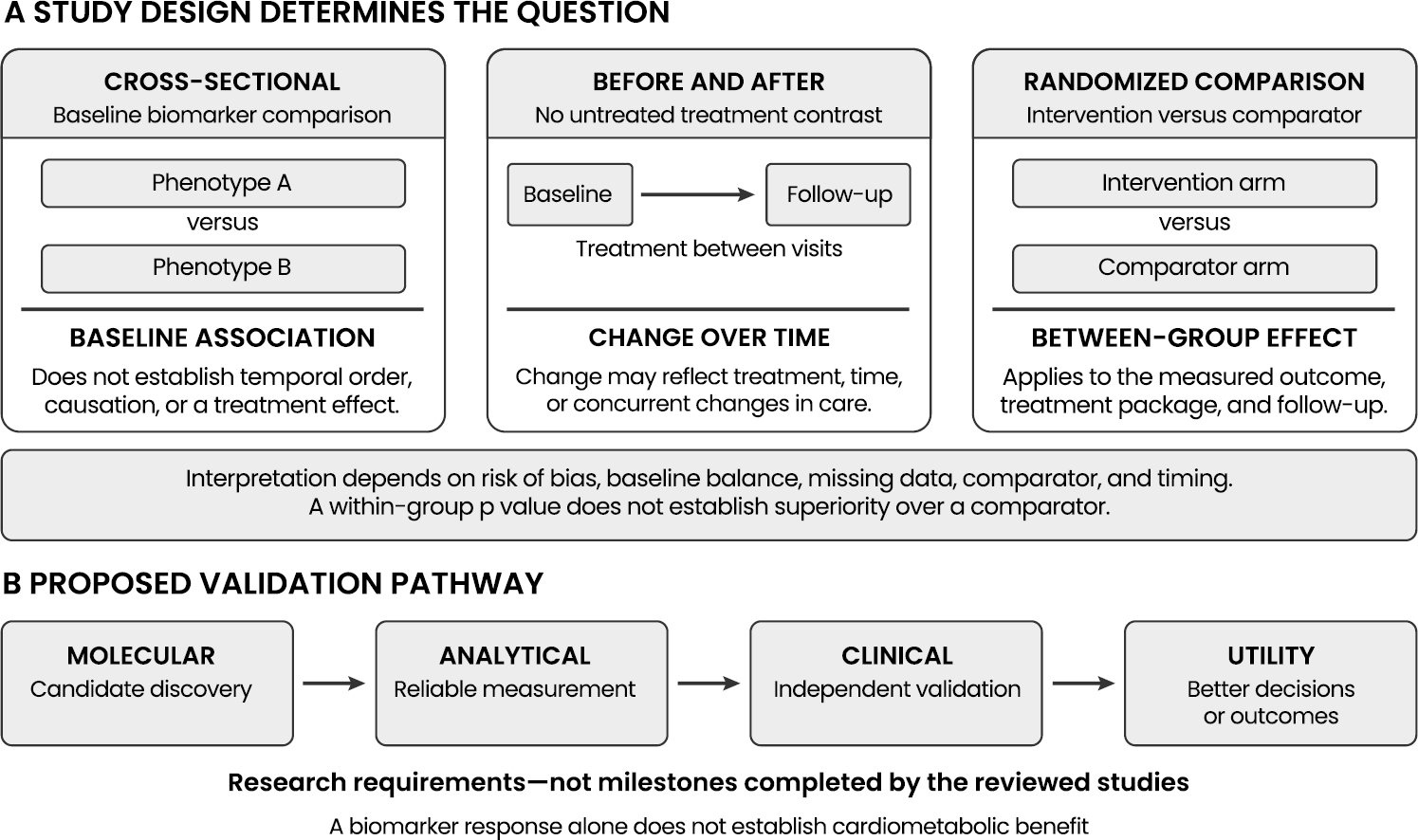
Fig. (2). Study design, inference, and the proposed pathway to clinical utility. Cross-sectional comparisons address baseline associations, before-and-after studies without a control group describe longitudinal change, and randomised between-group comparisons estimate an intervention effect under the tested conditions. Interpretation depends on the risk of bias, baseline balance, missing data, comparator, and outcome timing. The lower pathway describes research requirements, not milestones completed by the reviewed studies. A biomarker effect alone does not establish better clinical decisions or prevention of cardiometabolic events.
CONCLUSION
The evidence from the reviewed literature indicates the link between adiposity and periodontal inflammation based on changes in local cytokines and circulating adipokines, including IL-6, TNF-α, resistin, and adiponectin. These associations vary by population and specimen and do not define a universal biomarker signature. Periodontal treatment can improve clinical outcomes without a parallel circulating adipokine response; controlled biomarker benefits are specific to the tested intervention and outcome. The evidence does not establish routine biomarker-guided periodontal management or prevention of cardiometabolic events. Candidate tests require standardised assays, independent clinical validation, and demonstrated added value beyond conventional periodontal assessment. Future research should prioritise prespecified analytes, appropriate comparators, and independent validation of molecular candidates.
LIST OF ABBREVIATIONS
BMI | = | Body Mass Index |
CI | = | Confidence Interval |
CRP | = | C-Reactive Protein |
DOI | = | Digital Object Identifier |
ELISA | = | Enzyme-Linked Immunosorbent Assay |
GCF | = | Gingival Crevicular Fluid |
GRADE | = | Grading of Recommendations Assessment, Development and Evaluation |
hsCRP | = | High-Sensitivity C-Reactive Protein |
IL | = | Interleukin |
MetS | = | Metabolic Syndrome |
NSPT | = | Nonsurgical Periodontal Therapy |
PPD | = | Probing Pocket Depth |
qPCR | = | quantitative Polymerase Chain Reaction |
RNA | = | Ribonucleic Acid |
RoB 2 | = | Revised Cochrane Risk-of-Bias Tool for Randomised Trials |
ROBINS-I | = | Risk Of Bias In Non-randomised Studies of Interventions |
SRP | Scaling and Root Planing | |
TNF-α | Tumour Necrosis Factor-α |
AUTHOR’S CONTRIBUTION
F.G.B. conceptualized the study, conducted the analysis and interpretation and wrote the manuscript.
CONSENT FOR PUBLICATION
Not applicable.
AVAILABILITY OF DATA AND MATERIALS
This review did not generate any new participant-level or meta-analysis data sets.
FUNDING
This work received funding from the George Emil Palade University of Medicine, Pharmacy, Science and Technology of Targu Mures, Romania, Research Grant No. 511/2/17.01.2022.
CONFLICT OF INTEREST
The author declares no conflict of interest.
ACKNOWLEDGEMENTS
Declared none.
DECLARATION OF AI
The author declare that AI-assisted tools were used solely for language improvement and grammatical editing. The author reviewed and verified all content and took full responsibility for the accuracy, originality, and integrity of the manuscript.
REFERENCES
[1] Sanz M, Herrera D, Kebschull M, et al. Treatment of stage I-III periodontitis-The EFP S3 level clinical practice guideline. J Clin Periodontol. 2020;47(Suppl 22):4-60.
https://doi.org/10.1111/jcpe.13290 PMID: 32383274
[2] Weisberg SP, McCann D, Desai M, Rosenbaum M, Leibel RL, Ferrante AW Jr. Obesity is associated with macrophage accumulation in adipose tissue. J Clin Invest. 2003;112: 1796-1808.
https://doi.org/10.1172/JCI200319246 PMID: 14679176
[3] Callegaro de Menezes C, da Silva Barbirato D, Fogacci MF, Marañón-Vásquez GA, Carneiro JRI, Maia LC, de Barros MCM. Systemic benefits of periodontal therapy in patients with obesity and periodontitis: a systematic review. Braz Oral Res. 2024;38: e031.
https://doi.org/10.1590/1807-3107bor-2024.vol38.0031 PMID: 38597549
[4] Zhang Y, Jia R, Zhang Y, Sun X, Mei Y, Zou R, Niu L, Dong S. Effect of non-surgical periodontal treatment on cytokines/adipocytokines levels among periodontitis patients with or without obesity: a systematic review and meta-analysis. BMC Oral Health. 2023;23: 717.
https://doi.org/10.1186/s12903-023-03383-3 PMID: 37798684
[5] Lehrke M, Reilly MP, Millington SC, Iqbal N, Rader DJ, Lazar MA. An inflammatory cascade leading to hyperresistinemia in humans. PLoS Med. 2004;1: e45.
https://doi.org/10.1371/journal.pmed.0010045 PMID: 15578112
[6] Jia R, Zhang Y, Wang Z, Hu B, Wang Z, Qiao H. Association between lipid metabolism and periodontitis in obese patients: a cross-sectional study. BMC Endocr Disord. 2023;23: 119.
https://doi.org/10.1186/s12902-023-01366-7 PMID: 37231396
[7] Nilsen A, Thorsnes A, Lie SA, Methlie P, Bunaes DF, Reinholtsen KK, Leknes KN. Periodontitis in obese adults with and without metabolic syndrome: a cross-sectional study. BMC Oral Health. 2023;23: 439.
https://doi.org/10.1186/s12903-023-03133-5 PMID: 37393272
[8] Rangé H, Poitou C, Boillot A, et al. Orosomucoid, a new biomarker in the association between obesity and periodontitis. PLoS One. 2013;8: e57645.
https://doi.org/10.1371/journal.pone.0057645 PMID: 23526947
[9] Alkan B, Guzeldemir-Akcakanat E. Evaluation of adipokine levels in obese women with periodontitis: a cohort study. Am J Dent. 2021;34: 267-272. Available from: https://pubmed.ncbi.nlm.nih.gov/34689450/
[10] Altay U, Gürgan CA, Ağbaht K. Changes in inflammatory and metabolic parameters after periodontal treatment in patients with and without obesity. J Periodontol. 2013;84: 13-23.
https://doi.org/10.1902/jop.2012.110646 PMID: 22348694
[11] Al-Zahrani MS, Alghamdi HS. Effect of periodontal treatment on serum C-reactive protein level in obese and normal-weight women affected with chronic periodontitis. Saudi Med J. 2012;33: 309-314.
https://doi.org/10.15537/1658-3175.5512 PMID: 22426913
[12] Gonçalves TED, Feres M, Zimmermann GS, Faveri M, Figueiredo LC, Braga PG, Duarte PM. Effects of scaling and root planing on clinical response and serum levels of adipocytokines in patients with obesity and chronic periodontitis. J Periodontol. 2015;86: 53-61.
https://doi.org/10.1902/jop.2014.140266 PMID: 25119561
[13] Gonçalves TED, Zimmermann GS, Figueiredo LC, et al. Local and serum levels of adipokines in patients with obesity after periodontal therapy: one-year follow-up. J Clin Periodontol. 2015;42: 431-439.
https://doi.org/10.1111/jcpe.12396 PMID: 25858047
[14] Md Tahir K, Ab Malek AH, Vaithilingam RD, et al. Impact of non-surgical periodontal therapy on serum resistin and periodontal pathogen in periodontitis patients with obesity. BMC Oral Health. 2020; 20:52.
https://doi.org/10.1186/s12903-020-1039-3 PMID: 32059714
[15] Akram Z, Baharuddin NA, Vaithilingam RD, et al. Effect of nonsurgical periodontal treatment on clinical periodontal variables and salivary resistin levels in obese Asians. J Oral Sci. 2017; 59:93-102.
https://doi.org/10.2334/josnusd.16-0127 PMID: 28049964
[16] Montero E, López M, Vidal H, et al. Impact of periodontal therapy on systemic markers of inflammation in patients with metabolic syndrome: a randomized clinical trial. Diabetes Obes Metab. 2020;22: 2120-2132.
https://doi.org/10.1111/dom.14131 PMID: 32613714
[17] Cai Y, Zuo X, Zuo Y, et al. Transcriptomic analysis reveals shared gene signatures and molecular mechanisms between obesity and periodontitis. Front Immunol. 2023;14: 1101854.
https://doi.org/10.3389/fimmu.2023.1101854 PMID: 37063877
[18] Foratori-Junior GA, Ventura TMO, Grizzo LT, Carpenter GH, Buzalaf MAR, Sales-Peres SHC. Label-free quantitative proteomic analysis reveals inflammatory pattern associated with obesity and periodontitis in pregnant women. Metabolites. 2022; 12:1091.
https://doi.org/10.3390/metabo12111091 PMID: 36355174
[19] Wilkins LM, Kaye EK, Wang HY, Rogus J, Doucette-Stamm L, Kornman K, Garcia RI. Influence of obesity on periodontitis progression is conditional on interleukin-1 inflammatory genetic variation. J Periodontol. 2017;88: 59-68.
https://doi.org/10.1902/jop.2016.160408 PMID: 27541081
[20] Chen L, Qu Y, Cui H, et al. Genomic correlation, shared loci, and causal association between obesity, periodontitis and tooth loss. Sci Rep. 2025;15: 5155.
https://doi.org/10.1038/s41598-025-89782-8 PMID: 39934647
[21] Ouchi N, Kihara S, Arita Y, et al. Novel modulator for endothelial adhesion molecules: adipocyte-derived plasma protein adiponectin. Circulation. 1999;100: 2473-2476.
https://doi.org/10.1161/01.CIR.100.25.2473 PMID: 10604883
[22] Ion, R.M.; Májai, E.; Croitoru, M.D.; Rusti, O.A.; Beresescu, G.; Fülöp, I.; Neagoe, R.M. Redox Homeostasis and Antioxidant Response After Bariatric Surgery in Severe Obesity: Insights from a Controlled Clinical Cohort. Medicina. 2025; 61: 1884.
https://doi.org/10.3390/medicina61101884 PMID: 41155870
[23] Beresescu, F.G.; Ion, R.M.; Crisan, A.-S.; Bors, A. Microbial Shifts After Sleeve Gastrectomy: The Gut-Oral Axis, Periodontal Outcomes, and Competing Oral Risks. Biomedicines. 2026; 14: 838.
https://doi.org/10.3390/biomedicines14040838 PMID: 42072380
[24] Ion, R.-M.; Hutanu, A.; Sala, D.T.; Muresan, M.G.; Fodor, S.R.; Voidazan, S.; Beresescu, G.; Neagoe, R.M. Short-Term Changes in TNF-Alpha, IL-6 and Adiponectin Following Bariatric Surgery in Caucasian Obese Adults: An Observational Case-Control Study. Medicina. 2024; 60: 1789.
https://doi.org/10.3390/medicina60111789 PMID: 39596974
Licensed
© 2026 Copyright by the Authors.
Licensed as an open access article using a CC BY 4.0 license.
Article Contents Author Felicia Gabriela Beresescu1, * 1College of Business-Al Khobar, Al Yamamah University, Saudi Arabia Article History: Received: 21
Article Contents Authors Saman Ismail1, * Imran Iqbal2 1Faculty of Management Science, Department of Business Administration, Salim Habib University, Karachi,
Article Contents Author Michael Dolinsky1, * 1Faculty of Mathematics and Technologies of Programming, Francisk Skorina Gomel State University,
Article Contents Author Abdul Ghafoor Memon1, * 1Emaan Institute of Management Sciences, Karachi, Pakistan Article History: Received: 01 April, 2026
Article Contents Authors Zixuan Zhao1, Ju Guo1, * 1School of Management, Chengdu University of Information Technology, Chengdu, China Article History:
Article Contents Authors Sultan Ud Din Yousufzai1, Amtyaz Safi2, * , Maher Khan1, Zia Ud Din1 1Department of Zoology, Govt.