

Article Contents
Article ID: CM2622101027
Views: 1237Examining The Influence of Leadership Micro-Behaviours on Employee Well-Being in Hybrid Work Environments: Mediating Effect of Perceived Organisational Support
 DOI:
DOI:
 PDF
PDF
⬇ Downloads: 28
1Department of Management Sciences, Balochistan University of Information Technology, Engineering and Management Sciences, Quetta, Pakistan
Received: 20 May, 2026
Accepted: 28 July, 2026
Revised: 02 July, 2026
Published: 11 August, 2026
ABSTRACT:
Introduction: This study aimed to examine the relationship between leadership micro-behaviours, including task-oriented, relationship-oriented, and change-oriented behaviour, and employee well-being in the UK hospitality industry and to explore the mediating role of perceived organisational support in these relationships.
Methods: A quantitative research design was adopted, and data were gathered through a structured five-point Likert-scale questionnaire from 300 employees serving different entry-to middle-level positions in hospitality organisations in the UK. Structural equation modelling Partial Least Squares Structural Equation Modelling (PLS-SEM) was used as an evaluative technique.
Results & Discussion: The findings revealed that change-oriented behaviour had a positive direct relationship with employee well-being, whereas relationship-oriented behaviour showed a marginally significant but positive predictive relationship with employee well-being. Task-oriented behaviour had a negative relationship with employee well-being. Organisational support had a positive predictive power on employee wellbeing. The mediation analysis revealed that perceived organisational support statistically and significantly mediated the relationship between change-oriented behaviour and well-being and had a significant negative indirect role in mediating the relationship between task-oriented behaviour and well-being, showing selective mediation. Relationship-oriented behaviour did not display any indirect effect under the mediation of perceived organisational support.
Conclusion: The results contribute to the existing body of leadership and well-being literature by merging Social Exchange Theory and Conservation of Resources Theory and providing a practical impact on UK hospitality management to focus on supportive, change-oriented leadership practices.
Keywords: Leadership micro-behaviours, task-oriented, relationship-oriented, change-oriented behaviour, employee well-being, perceived organisational support.
1. INTRODUCTION
The UK hospitality industry is an important vehicle of the national economy, where more than 3.5 million individuals are employed, and the industry contributes greatly to service export and internal tourism (UK Hospitality, 2023). Nevertheless, employee well-being within this sector has been put under continuous and increasing pressure, specifically as companies are switching to hybrid work models in reaction to the alterations in the post-pandemic labour market and modified employee expectations (Payne, 2024; Krzak, 2025). Recent developments have created a dark picture of well-being issues in the UK hospitality sector.
Surveys show that 76% of hospitality employees have reported mental health problems at some point in their careers, representing a substantial rise of up to 56% in 2018. Poor work-life balance (60%) and mental health-related issues (44%) were identified as the key sources of distress (Institute of Hospitality, 2024). As (Joe, 2024; and Randstad, 2024) have shown, staffing issues and burnout have been rampant, with 57% of respondents indicating that under-resourcing is a leading cause of poor well-being and burnout. As reported by (Edward, 2024), such issues have driven turnover, absenteeism, and employee instability, compromising the quality and performance of operations in pubs, hotels, and restaurants across the country.
This situation is further complicated by the fast and uneven implementation of hybrid work practices in the hospitality industry. Although the statistics indicate that 65% of hospitality businesses have implemented hybrid or remote work policies and 55% of employees claim that hybrid work-life balance is better than traditional work settings (Ishaq et al., 2025; Mansour & Zayed, 2024). Hence, the industry continues to struggle with issues of implementation, such as technological obstacles, disproportionate policy enforcement, and uncertainty about the role of managers in a hybrid workplace. Such ambivalent results point to the urgent necessity of comprehending how behavioural leadership concepts can be applied to employee welfare in cases when teams are distributed both physically and virtually.
Micro-behaviours of leadership, such as task-oriented behaviours, result in a more work-focused culture rather than a participative approach which is the main stressor for employees and reduces well-being, as suggested by (Giousmpasoglou, 2024; Salisbury, 2025; and Zientara et al., 2024). However, relationship-oriented behaviours develop trust and psychological safety, and change-oriented behaviours help employees deal with uncertainty and technological changes inherent to hybrid models, as also revealed by (Herttalampi et al., 2023). Moreover, (Jabbar et al., 2020) elucidate that by regularly performing these behaviours, leaders are more likely to make employees feel that the organisation is supportive and caring, thereby enhancing Perceived Organisational Support (POS) which is a well-established mediator of well-being outcomes.
Leadership micro-behaviours can be described as particular, noticeable, and discrete leadership behaviours that involve the actions that a leader engages with in daily interactions and that have a cumulative impact on employee results, as argued by (Poetz & Volmer, 2024). Also in this research, task-oriented, relationship-oriented and change-oriented behaviours were inducted due to the fact that they are operationalised and concrete actions within the larger leadership styles that allow measuring the influence of leaders at behavioural micro-level suggested by (Ishaq et al., 2025; Mansour & Zayed, 2024) also.
As indicated by (Zientara et al., 2024), unlike classical constructs of leadership that are frequently conceived as general dispositions or world-system orientations, micro-behaviours capture situational, moment-to-moment behaviour, such as providing well-structured advice, interpersonal support, or promoting flexibility and creativity, and not in general leadership philosophy. Such granularity enables more actionable findings on how employees perceive leaders’ actions and their relationship with perceived organisational support and well-being. The measurement of these three behaviours offers representative but parsimonious coverage of leadership behaviours. Simultaneously, it is micro-level, hence it accommodates the novelty gap and guarantees the relevance of the theory to areas beyond classical theories of leadership.
In the current study, leadership micro-behaviours refer to specific, observable, and recurring actions by which larger orientations of leadership are applied in daily interactions between the leader and the employees. Nonetheless, according to (Giousmpasoglou, 2024), task-oriented, relationship-oriented, and change-oriented behaviours are well-known dimensions of leadership. These orientations are not abstract; employees go through one or more specific episodes of behaviour, manifested through goal clarification, performance feedback, interpersonal recognition, active listening, encouragement of new ideas, and support for adaptation. Thus, at the micro-level, (Poetz & Volmer, 2024) revealed that these behaviours do not lie in the dimensions of leadership, but in their daily enactment and the interpretation given to them by employees. This view aligns with the Social Exchange Theory, which focuses on employee perception and the subsequent employee reactions in a pattern of repeated interpersonal encounters at work, and the Conservation of Resources Theory, which posits that targeted behaviours from a leader can add or remove valued resources, as suggested by (Mansour & Zayed, 2024). Therefore, this study is not focused on redefining the different dimensions of traditional leadership as new constructs; rather, it is concerned with how their micro-level behavioural manifestations are associated with perceived organisational support and employee well-being in a hybrid hospitality work context.
Although there is increasing research on employees’ general well-being, little is known about the role of particular leadership micro-behaviours in relation to well-being through POS within the UK hospitality industry for employees working remotely or in hybrid conditions. Research gaps still exist in sector-specific leadership processes and hybrid work outcomes. Thus, the proposed research explores the relationship between task, relationship, and change-oriented leadership behaviours and employee well-being under perceived organisational support within the UK hospitality industry in the context of employees working under hybrid conditions. This study makes a theoretical contribution to the area of leadership and organisational support literature and a practical contribution by helping hospitality firms to develop leadership interventions that encourage well-being and sustainable performance in this changing work environment.
2. LITERATURE REVIEW
2.1. Theoretical Framework
This study combines the Social Exchange Theory (SET) and Conservation of Resources Theory (COR) by developing contending arguments to comprehend the linkage between leadership micro-behaviours and employee well-being. The leadership influences are described by SET as norms of reciprocity, where the employees perceive the leader’s behaviours as indicators of organisational intention and respond to the perceived support with positive psychological conditions, namely, well-being, as hypothesised by (Poetz & Volmer, 2024; and Wang et al., 2022). In this sense, relationship-oriented and change-oriented leadership behaviours are likely to trigger reciprocal interactions, leading to well-being improvement as proposed by (Jabbar et al., 2020; and Li & Lin, 2021) also.
However, COR theory is a competing explanation, as it focuses on the dynamics of resources and the threat of their depletion. COR implies that leadership behaviours can indicate support while simultaneously putting strain on job demands, keeping an eye on, or pressuring employees, which undermines their emotional and cognitive resources, as demonstrated by (Ahmad et al., 2020; & Wang et al., 2021). Leaders’ behaviours, especially task-oriented behaviours, can lead to an increased workload and performance under microscopy, mobilising loops of resource loss that compromise well-being regardless of perceived organisational support.
Notably, this framework acknowledges that the work of SET and COR is not isolated but based on tension. (Liu et al., 2023; and Xerri et al., 2023) also indicate that leadership behaviours trigger both reciprocating support perceptions and at the same time strain resources, yielding both positive and negative well-being effects. The theorised way of tipping the scale toward resource gain is through the addition of meaning, adaptability, and future-oriented resources which are change-oriented behaviours, and the activation of resource depletion through intensification of demand which is task-oriented behaviour. Relationship-oriented behaviours have the potential to engage employees, but their success might be contextually and industry-specific, as reported by (Sulistiyani et al., 2022). This combined viewpoint is capable of making theoretically distinct predictions and explaining the variability in well-being results across the micro-behaviour of leadership.
Although both Social Exchange Theory and COR theory conceptualise leadership and employee well-being as dynamic processes that change as a result of repeated social interaction and resource exchange over time, the current research design is a cross-sectional research design and does not purport temporal or predictive precedence of any construct under study. Rather, the suggested framework relies on these theories to create a theoretically informed logical series of leadership micro-behaviours, perceived organisational, and employee well-being, which is empirically verified in terms of statistical relationships but not causal ones. Mediation analysis is then seen as analytical or statistical mediation, suggesting trends of interrelationships that are reflective of the underlying theoretical presumptions of SET and COR, and not indicative of predictive processes occurring over time.
In the current study, COR and SET are deliberately amalgamated to offer discriminating predations analytically associated with leadership micro-behaviours and employee well-being. COR was applied to capture the possible resource-depleting outcomes of task-oriented behaviours of leaders, which, while enhancing POS, tends to simultaneously raise cognitive load, pressure of monitoring, and emotional strain of employees, consequently adversely impacting well-being, as stressed by (Liu et al., 2023; and Xerri et al., 2023). However, the SET was integrated into the study to illustrate reciprocity-driven associations, specifically for relationship- and change-oriented behaviours. Employees interpret leadership actions as signals of organisational intent, which produces psychological states and increases employee well-being, as suggested by (Jabbar et al., 2020; Poetz & Volmer, 2024; and Alvi, 2025). Hence, the implementation of both theories enabled the current study to formulate differentiated anticipations; under COR, specific structured or controlling behaviours are expected to suppress employee well-being. Within SET, adaptive and supportive behaviours are expected to endorse well-being. This dual theory approach also improves the theoretical depth and illustrates patterns dependent on context which were observed in employees in the UK hospitality sector.
2.2. Hypotheses Development
2.2.1. Task-Oriented Behavior (TOB) and Employee Well-Being
Task-oriented behaviour can be defined as leadership behaviour that is aimed at defining roles, organising tasks, establishing goals, and controlling performance, and has re-emerged as a predictable indicator of employee well-being. The well-being-strengthening role of task-oriented leadership is strongly supported by recent evidence provided by (Döring et al., 2025) in a powerful way. The authors show, based on a multi-source, time-lagged design in the Danish public sector, that task-oriented behaviour is positively correlated with eudaimonic and social aspects of well-being, which refutes the long-standing belief that task-oriented behaviours are the key determinants of reduced employee health and well-being. From the perspective of Social Exchange Theory (SET), task clarification and performance guidance can be viewed as organisational investments that motivate employees to respond to this investment with positive psychological states.
In contrast, (Herttalampi et al., 2023) provide a more detailed perspective, stating that leaders’ task-related demands can serve as both resources and stressors. Their multilevel analysis demonstrates that the lack of job planning and participative decision-making of leaders requires the core components of task-oriented behaviour, and not employee focus, to be linked with the higher incidence of burnout by employees and the reduced well-being. This contradicts the Conservation of Resources (COR) theory, which postulates that structured planning and decision authority are available to the followers of resource abundance to cushion strain. Methodologically, there is a lack of transferability to hospitality due to sampling of the public sector and lack of hybrid working settings.
Prior research, such as (Döring et al., 2025; and Herttalampi et al., 2023), offers mixed evidence associated with the well-being implications of task-oriented leadership. Task behaviours could be beneficial for monitoring, performance pressure, and managerial control; however, they should also help clarify task roles and decrease ambiguity. The current research suggests that ambiguity is more dominant in the UK’s hospitality industry. Hospitality workers work in settings where customer-contact demands are high, they have to perform emotional labour, and there are staffing constraints and fluctuating workloads, as suggested by (Liu et al., 2023). As indicated by (Giousmpasoglou, 2024), employees value flexibility and autonomy in managing work responsibilities in hybrid work settings. This can make leadership behaviours that focus on task monitoring, adherence, and performance goals appear to be resource-absorbing instead of resource-enhancing. Following the Conservation of Resources Theory, this expected potential loss of psychological resources in the case of role ambiguity is likely to be outweighed by the gains in task-oriented behaviour, resulting in a negative correlation between task-oriented behaviour and employee well-being. These arguments led to the formulation of the first hypothesis of the study.
H1: There is a statistically significant and negative relationship between task-oriented behaviour and employee well-being in the context of the UK hospitality industry.
2.2.2. Relationship Oriented Behavior (ROB) and Employee Well-Being-Theory
Relationship-oriented behaviour involves leadership behaviours that support, mentor, and emotionally involve employees, and these behaviours are based on trust, respect, and interpersonal relationships (Alvi, 2025; Briker et al., 2021). Despite the lack of empirical research on the UK hospitality industry, there is theoretical evidence that it is highly correlated with employee well-being. According to Social Exchange Theory (SET), employees pay employers back (with better commitment and psychological performance) when they are treated well by leaders (Choi, 2021a; Salisbury, 2025). When leaders show concern, fairness, and active support, it indicates that the organisation is invested in, and employees may experience more satisfaction, engagement, and stress.
From this perspective, the Conservation of Resources (COR) Theory states that well-being increases when employees obtain or maintain valuable resources, as revealed by (Teetzen et al., 2022). Relationship-oriented behaviours are social and emotional assets that can guide employees and provide emotional support and a sense of belonging. According to (Hauff et al., 2022), these sources cushion against burnout and facilitate resiliency, especially in services that are in high demand, such as in the hospitality environment. As the two theories differ, SET places more emphasis on the motivational aspects of reciprocity and perception, whereas COR appeals to accumulating resources and stress reduction as the means of achieving a sense of well-being. A combination of these views implies that the relationship-based leadership approach contributes to cognitive-emotional satisfaction as well as the availability of resources, which functions as a favourable condition for employee well-being. Consequently, the theoretical evidence justifies the formulation of the following hypothesis:
H2: There is a statistically significant and positive association between relationship-oriented behaviour and employee well-being in the context of the UK hospitality industry.
2.2.3. Change Oriented Behavior (COB) and Employee Well-Being
Change-oriented behaviour focuses on leadership behaviour that boosts flexibility, creativity, and initiative to adapt to changing work needs, which are becoming essential to employee welfare. (Bashira et al., 2021) demonstrate how change-oriented leadership is appropriate in improving employee performance as well their well-being. This is aligned with the postulations made by the Conservation of Resources (COR) theory, that change-oriented leaders assist employees in developing cognitive and emotional resources, such as clarity in uncertain situations and confidence in coping with change, which cushion stress and serve as shields against well-being in a changing world, as suggested by (Briker et al., 2021; & Salas‐Vallina et al., 2021).
However, in a similar manner, (Jang, 2021) showed that authentic leadership leads to the establishment of change-oriented organisational citizenship behaviour, especially when employees feel called. Although the outcome variable is discretionary behaviour, that is of significance, such as autonomy, meaningfulness, and intrinsic motivation, are fundamental aspects of Eudaimonic well-being. Nonetheless, the focus on calling implies that leadership in change orientation does not necessarily maximise well-being, especially for employees who are not inherently motivated or geared towards organisational change processes.
Relatively, (Bashira et al., 2021) suggested a more universal advantage of change-oriented leadership, and (Jang, 2021) emphasised individual differences as boundary conditions. In the context of Social Exchange Theory (SET), employees tend to pay leaders back with favourable psychological states when they support change through perceptions that they are making legitimate investments in the organisation. In methodological terms, neither study investigated hospitality contexts, which is why the investigation of change-oriented leadership and employee well-being in the sector requires specific research.
H3: There is a statistically significant and positive relationship between change-oriented behaviour and employee well-being in the UK hospitality industry.
2.2.4. Mediating Effect of Perceived Organisational Support
As indicated by (Ilyas et al., 2023) Perceived Organisational Support (POS) is a concept that indicates how employees believe that their organisation cares about them and what value it attaches to their contributions. In this perspective, (Asif et al., 2023) argues that despite the scarcity of direct empirical research in the UK hospitality sector, theoretical considerations have proposed that POS has become a very important mediating factor between management micro-behaviours, on the one hand, and worker well-being, on the other. According to Social Exchange Theory (SET), employees tend to comprehend supporting leadership behaviour, that is, task-oriented, relationship-oriented, and change-oriented, as an indicator of organisational investment, as reflected in the arguments of (Pham et al., 2024; and Wang et al., 2020). These attitudes, in turn, are responded to with positive attitudes, which contribute to an improved psychological and emotional state.
Similarly, the Conservation of Resources (COR) theory posits that well-being is a result of the acquisition and maintenance of treasured resources (Choi et al., 2021b). To further elucidate this point, (Le et al., 2023) argue that the resources offered by leadership micro-behaviours include clarity, emotional support, and adaptability direction, which, when perceived as organisational support, alleviate stress and lower burnout in stressful workplaces, such as the hospitality sector.
In comparison to the two views, SET focuses on mutual social responsibilities, whereas COR focuses on resource acquisition and stress reduction, which is how POS affects well-being. In this combination, they offer a powerful theoretical justification for POS as a mediator; that is, leaders’ micro-behaviours promote the perception of support of employees in the organisation, leading to well-being. Accordingly, these arguments lead to the formulation of the following hypothesis (H4): The conceptual framework of the study is shown in Fig. (1).
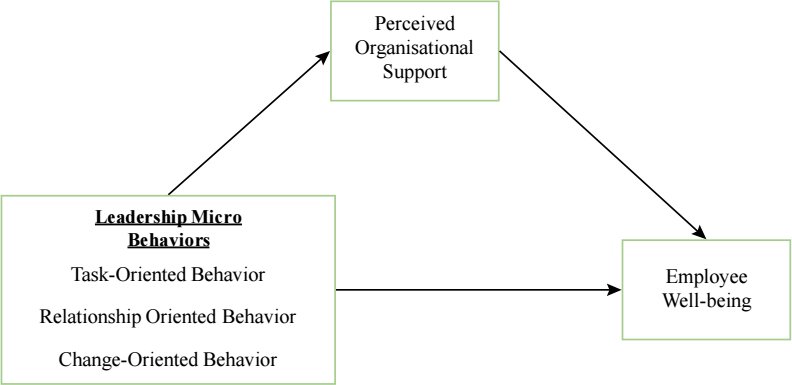
Fig. (1). Conceptual framework.
H4: Perceived Organisational Support conditionally significantly mediates the relationship between leadership micro-behaviours and employee well-being in the hospitality industry of the UK.
H4a: Perceived Organisational Support statistically significantly mediates the relationship between task-oriented behaviours and employee well-being in hospitality industry of the of the UK conditionally
H4b: Perceived Organisational Support statistically significantly mediates the relationship between relationship-oriented behaviours and employee well-being in hospitality industry of the of the UK conditionally
H4c: Perceived Organisational Support statistically significantly mediates the relationship between change-oriented behaviours and employee well-being in hospitality industry of the of the UK
2.3. Conceptual Framework
This framework proposes that leadership micro behaviours including task-oriented, relationship-oriented, and change-oriented actions shape employee well-being through two pathways. The indirect path runs through perceived organisational support: these leadership behaviours build employees’ sense of being supported by the organisation, which then improves their well-being. The direct path shows leadership behaviours also affecting well-being on their own, independent of that support perception. Together, this makes perceived organisational support a partial mediator rather than the full explanation of the leadership–well-being relationship.
3. METHODOLOGY
The research design of this study is a primary quantitative research design, which aligns with the objective of the study, which is to determine the relationships between micro-behaviours of leadership, perceived organisational support, and employee well-being. The collection of data was done with the help of a structured questionnaire with standardised measurement scales, all of which are evaluated on a five-point Likert scale (strongly disagree), (strongly agree). The questionnaire was subdivided into five constructs: perceived Organisational support, employee well-being, task-oriented behaviour (TOB), Relationship-Oriented Behaviour (ROB), and Change-Oriented Behaviour (COB) (Appendix A).
Data were collected from employees in hospitality organisations in the UK, including officers, executive officers, and senior executive officers. A purposive sampling method was used to select participants, which is a suitable method if the respondents have particular qualities that can be used to achieve the research goals, as suggested by (Ahmed, 2024). The given approach was appropriate, as only representatives of hospitality were involved in leadership interactions and were able to respond meaningfully to the variables of the study. As recommended by (Adhikari, 2021), G*Power was used to calculate the minimum required sample size with an assumed medium effect size (f2 = 0.15), power of 0.95, and five predictors which showed that the minimum sample size was 204 responses; therefore, the final sample of 300 was more than the recommended minimum.
Originally, 750 questionnaires were issued, 412 of which were returned, resulting in a response rate of 54.9%. After eliminating 112 questionnaires because of missing values and outliers, the final dataset was reduced to 300 valid responses. Participants were contacted through official email addresses obtained from the websites of UK hospitality companies. Invitations were distributed through various organisations and job levels to minimise selection bias. Non-response bias was evaluated by comparing the early respondents (n1 = 30) and the late respondents (n2 = 30), and no significant differences were found which means that there is minimal bias, as recommended by (Oscarsson & Arkhede, 2020). In addition, the issue of Common Method Variance (CMV) was taken into account because self-reported questionnaires were used in the form of cross-sectional. Therefore, a statistical approach was performed using the single-factor test developed by Harman which proved that one single factor could not explain the greater part of the variance which means that CMV is not likely to influence the results of the given study. Furthermore, full collinearity VIF was also conducted, as shown in, to examine the issue of common method bias. As shown in Table 1, none of the VIF values surpasses the threshold of 3.3 which rules out the issue of CMB in the model.
Table 1. Full collinearity VIF.
| – | VIF |
| Change Oriented Behaviour -> Employee Well-being | 2.025 |
| Change Oriented Behaviour -> Perceived Organisational Support | 1.619 |
| Perceived Organisational Support -> Employee Well-being | 1.771 |
| Relationship Oriented Behaviour -> Employee Well-being | 1.326 |
| Relationship Oriented Behaviour -> Perceived Organisational Support | 1.318 |
| Task Oriented Behaviour -> Employee Well-being | 1.859 |
| Task Oriented Behaviour -> Perceived Organisational Support | 1.782 |
Partial Least Squares Structural Equation Modelling (PLS-SEM) was used to analyse the data. The first step involved confirmatory factor analysis (CFA) to examine the measurement reliability and validity, where Cronbach’s alpha, composite reliability, and average variance extracted (AVE) were analysed, in line with (Baharum et al., 2023). Path analysis was then performed based on PLS-SEM, which was important for testing the hypothesised relationships and mediation effects specific to complex models and predictive studies. The results were interpreted at 5% and 10% confidence intervals for significance and marginal significance, respectively.
The study reports the significance of relationships at the 10% threshold as exploratory and theory-extending. Studies analysing the multifaceted associations in context-specific service settings usually comprise understated behavioural effects that tend to not emerge robustly at severer thresholds such as 5%. (Oscarsson & Arkhede, 2020) recognises that marginal differences tend to provide theoretically substantial insights when examining the extensions of developed frameworks in novel empirical settings. Therefore, the results, significant at 10%, are interpreted as vigilant predictive patterns instead of empirical support.
4. RESULTS
4.1. Demographics Profile Analysis
The results in Table 2 specify the demographic profiles of the study participants. Among the 300 respondents surveyed, 57% were male and 43% were female. Of these participants, 27.33% were 26-35 years of age, 27% were 36-45 years and 24% were 46-55 years of age. Among the surveyed employees, 25% served as officers, 37.3% as executive officers, and 37.67% as senior executive officers. In addition, 21.67% of them represented hotels and resorts, 38.33% worked in restaurants and cafes, and 40% worked in resorts. Lastly, most of the participants, that is, 35% and 28.33%, worked in partially hybrid and mostly remote environments, respectively.
Table 2. Demographic profile.
| Demographic Category | Frequency (n) | Percentage (%) | |
| Gender | Male | 171 | 57.00% |
| Female | 129 | 43.00% | |
| Age Range | 26-35 | 82 | 27.33% |
| 36-45 | 81 | 27.00% | |
| 46-55 | 72 | 24.00% | |
| 56+ | 65 | 21.67% | |
| Current Job Role | Officer | 75 | 25.00% |
| Executive Officer | 112 | 37.33% | |
| Senior Executive Officer | 113 | 37.67% | |
| Type of Hospitality Organisation | Hotels | 65 | 21.67% |
| Restaurant/Café | 115 | 38.33% | |
| Resorts | 120 | 40.00% | |
| Hybrid Work Arrangement | Fully On-site | 110 | 36.67% |
| Balanced Hybrid (2–3 remote days | 105 | 35.00% | |
| Mostly Remote | 85 | 28.33% | |
4.2. Measurement Model-Confirmatory Factor Analysis (CFA)
The measurement model of the is assessed for internal consistency and reliability using confirmatory factor analysis approach which is comprised of Cronbach’s Alpha, Composite Reliability and Average Variance Extracted (AVE). The results are presented in Table 3.
Table 3. Measurement model.
| Latent Variables | Indicators | Factor Loadings | Cronbach’s Alpha | Composite Reliability (rho_a) | Average Variance Extracted (AVE) |
| Change-Oriented Behavior | COB1 | 0.887 | 0.884 | 0.886 | 0.812 |
| COB2 | 0.928 | ||||
| COB3 | 0.888 | ||||
| Employee Well-being | EWB1 | 0.905 | 0.894 | 0.899 | 0.824 |
| EWB2 | 0.930 | ||||
| EWB3 | 0.889 | ||||
| Perceived Organisational Support | POS1 | 0.906 | 0.901 | 0.901 | 0.835 |
| POS2 | 0.934 | ||||
| POS3 | 0.901 | ||||
| Relationship Oriented Behavior | ROB1 | 0.843 | 0.818 | 0.831 | 0.733 |
| ROB2 | 0.910 | ||||
| ROB3 | 0.814 | ||||
| Task-Oriented Behavior | TOB1 | 0.878 | 0.837 | 0.842 | 0.754 |
| TOB2 | 0.888 | ||||
| TOB3 | 0.840 |
4.3. Discriminant Validity
The discriminant validity test allows for the measurement of separability and distinctiveness among the variables of the model using the HTMT ratio, as suggested by (Afthanorhan et al., 2021). The results of the discriminant validity are presented in Table 4.
Table 4. Discriminant validity.
| – | Change Oriented Behaviour | Employee Well-Being | Perceived Organisational Support | Relationship Oriented Behaviour |
| Employee Well-being | 0.471 | – | – | – |
| Perceived Organisational Support | 0.706 | 0.454 | – | – |
| Relationship Oriented Behaviour | 0.460 | 0.305 | 0.406 | – |
| Task Oriented Behaviour | 0.704 | 0.235 | 0.608 | 0.577 |
The HTMT ratio values among all the constructs are far lower than 0.85 which shows that all the constructs in the measurement model are separated and distinguished from each other with no conceptual overlap (Table 4).
4.4. Model Fitness
The model had an adequate overall fit (Table 5). The SRMR value is 0.055 which is less than the recommended value of 0.08; hence, there is a good fit between the proposed model and the observed data. The values of the saturated and estimated models were identical, indicating model stability. In addition, the NFI value is in the middle range of good model fit, and the relatively low values of d_ULS and d_G show the limited discrepancy between the empirical and model-implied correlation matrices.
Table 5. Model fitness.
| – | Saturated Model | Estimated Model |
| SRMR | 0.055 | 0.055 |
| d_ULS | 0.368 | 0.368 |
| d_G | 0.261 | 0.261 |
| Chi-square | 489.686 | 489.686 |
| NFI | 0.836 | 0.836 |
4.5. Path Coefficients
The direct effects show that there are significant disparities between the impact of leadership micro-behaviours on employee well-being and perceived organisational support (POS) (Table 6). The effect of change-oriented behaviour on employee well-being (β = 0.317, p < 0.001) and POS (β = 0.479, p < 0.001) was strong and positive, implying that change orientation which endorses and encourages innovation, flexibility, and direction, positively enhances employees’ perceptions related to organisational support. In practice, this implies that matching the level of perceived encouragement toward adaptation, innovation, and problem solving in the future is likely to be partly responsible for employees’ psychological confidence and connectedness with the organisation, especially in a business environment that is constantly changing and uncertain regarding its services.
Table 6. Path coefficients.
| – | Path Coefficients | T Statistics | P Values | F-Square |
| Change Oriented Behaviour -> Employee Well-being | 0.317*** | 3.569 | 0.001 | 0.066 |
| Change Oriented Behaviour -> Perceived Organisational Support | 0.479*** | 7.402 | 0.001 | 0.251 |
| Perceived Organisational Support -> Employee Well-being | 0.266*** | 2.714 | 0.007 | 0.052 |
| Relationship Oriented Behaviour -> Employee Well-being | 0.144* | 1.792 | 0.073 | 0.021 |
| Relationship Oriented Behaviour -> Perceived Organisational Support | 0.065 | 1.054 | 0.292 | 0.006 |
| Task Oriented Behaviour -> Employee Well-being | -0.197** | 2.283 | 0.022 | 0.028 |
| Task Oriented Behaviour -> Perceived Organisational Support | 0.208*** | 2.942 | 0.003 | 0.043 |
| Specific Indirect Effects | ||||
| Relationship Oriented Behaviour -> Perceived Organisational Support -> Employee Well-being | 0.017 | 0.893 | 0.372 | – |
| Task Oriented Behaviour -> Perceived Organisational Support -> Employee Well-being | -0.055** | 2.175 | 0.030 | – |
| Change Oriented Behaviour -> Perceived Organisational Support -> Employee Well-being | 0.127** | 2.424 | 0.015 | – |
Note: *: Significance at 10%; **: Significance at 5%; ***: Significance at 1%.
Relationship-oriented behaviour has a marginal direct relationship with employee well-being (β = 0.144, p = 0.073) at 10%; however, the relationship with POS is insignificant (β = 0.065, p = 0.292). This indicates that relational support may not be effective enough to guide organisational support perceptions. From a practical perspective, positive interpersonal interactions could be beneficial without a corresponding feeling that the organisation is helpful. To ultimately build Organisational evaluations, employees need to see Organisational resources, policies, and growth possibilities prior to linking positive relationships with leaders to greater Organisational evaluations.
In contrast, task-oriented behaviour has a substantial negative relationship with employee well-being (β = -0.197, p = 0.022), implying that excessive task control and monitoring can negatively influence well-being. Nonetheless, the association of task-oriented behaviour with POS is statistically significant and positive (β = 0.208 and p = 0.003), which implies that systematic guidance remains organisational assistance. In terms of practice, structured supervision and performance monitoring could be an opportunity for employees to see that there is a commitment to being efficient at work, but it also reduces the freedom of the employee and creates more pressure on them, which could lead to a drop in well-being.
POS plays a critical role in mediating the association between change-oriented behaviour and employee well-being (β = 0.127, p = 0.015) validating H4c.The study result suggest that the positive well-being measures of employees are more likely to be obtained when there are also systems and practices in the organisation that support perceptions of leadership support for Organisational change. This is partial mediation because both direct and indirect associations are significant. The indirect effect of task-oriented behaviour on well-being through POS is also significant and negative (β = -0.055, p = 0.030), but the effect of task-oriented behaviour is also significant, which proves that there is partial mediation; POS partially mediates the relationship between task-oriented behaviour and employee well-being, validating H4a.
Second, organisational support does not fully compensate for the negative implications of task-oriented behaviour, pointing towards the need for different types of support when there is a perceived high level of control or performance pressure. However, relationship-oriented behaviour had no mediation through POS (β = 0.017, p = 0.372), rejecting H4b. Consequently, it can be said that POS has a mediating role but is selective in converting leadership micro-behaviours into employee well-being outcomes. This suggests that other complementary Organisational actions are needed to enhance employee well-being in addition to relational employee–leader relationships.
According to Cohen’s (1988) criteria (0.02 = small, 0.15 = medium, 0.35 = large), most associations depict small effect sizes. Change-oriented behaviour had the largest perceived organisational support (f² = 0.251) and a modest effect on employee well-being (f² = 0.066). The effects of perceived organisational support (f² = 0.052), task-oriented behaviour (f² = 0.028; 0.043), and relationship-oriented behaviour (f² = 0.021; 0.006) were small but meaningful in practice and contributed to understanding the link between employee well-being and perceived organisational support.
Furthermore, for a detailed mediating analysis, the Variance Accounted For (VAF) approach was applied, as shown in Table 7.
Table 7. Variance accounted for.
| Relationship | Indirect Effect (β) | Total Effect (β) | VAF (%) | Mediation Type |
| Change-Oriented Behaviour → POS → Employee Well-being | 0.127 | 0.445 | 28.54 | Partial Mediation |
| Relationship-Oriented Behaviour → POS → Employee Well-being | 0.017 | 0.161 | 10.56 | No Meaningful Mediation |
| Task-Oriented Behaviour → POS → Employee Well-being | -0.055 | -0.252 | 21.83 | Partial Mediation |
Based on the VAF results (Table 7), perceived organisational support partially mediates the relationship between change-oriented behaviour and employee well-being, accounting for 28.54% of the total variance. In turn, the effect of task-oriented behaviour on employee well-being is partially explained by perceived organisational support (21.83%). The VAF for the mediation effect of relationship-oriented behaviour is relatively small at 10.56%, suggesting that the perceived organisational support does not significantly mediate between relationship-oriented behaviours and employee well-being. The findings indicate that perceived organisation support is a significant explanatory mechanism for change-oriented and task-oriented behaviours, but its explanatory power in predicting the consequences of relationship-oriented behaviours on employees’ well-being is rather weak.
4.6. Explanatory Power
The analysis of explanatory power allows us to examine the ability of independent variables to predict the percentage of variation in the target variables. The results of the explanatory power are presented in Table 8.
Table 8. Explanatory power.
| – | R-Square | R-Square Adjusted |
| Employee Well-being | 0.240 | 0.230 |
| Perceived Organisational Support | 0.435 | 0.430 |
As the results in Table 8 show, the independent constructs of leadership micro-behaviours can predict 24% variation in employee well-being and 43.5% variation in perceived organisational support in the UK hospitality context.
4.7. Predictive Relevance
The values of Q² predicted for Employee Well-being (Q2 = 0.211) and POS (Q2 = 0.402), as presented in Table 9, are positive which provides the model with high out-of-sample predictive relevance. Furthermore, the results of the RMSE and MAE values imply reasonable prediction errors, indicating the satisfactory predictive ability of the model for the endogenous constructs analysed.
Table 9. Predictive relevance q-squared.
| – | Qpredict2 | RMSE | MAE |
| Employee Well-being | 0.211 | 0.865 | 0.624 |
| Perceived Organisational Support | 0.402 | 0.742 | 0.535 |
5. DISCUSSION
The results of this research led to the acceptance of H1, which is the statistically significant negative relationship between task-oriented behaviour and the well-being of employees in the UK hospitality sector. This outcome is partly opposite to previous studies, where the functional value of task-oriented leadership has been regularly stressed. For example, the study conducted by (Orikyiriza et al., 2022) showed a strong positive correlation between task-oriented leadership and employee performance in a community development environment in Uganda, emphasising the importance of structuring tasks, exercising authority, and providing feedback to improve efficiency and performance. Nevertheless, the current research implies that task-oriented behaviour can enhance performance. However, they can also abolish the well-being of employees in hospitality settings where there is excessive control and monitoring in terms of micro-management which leads to employee burnout and adversely impacts well-being, as revealed by (Poetz & Volmer, 2024).
This is due to divergent contexts and industrial differences. UK hospitality is high in emotional labour, customer-facing stressors, and labour shortages, and inadequate monitoring of tasks and strict performance controls can increase stress and lower psychological well-being. In contrast to the resource-constrained and collectivist environment of (Orikyiriza et al., 2022), UK hospitality staff might perceive severe task restrictions as micromanagement but not support. Task-oriented leadership through the lens of the Conservation of Resources (COR) can also be viewed as potentially leading to the waste of resources, however, without the intention to do so, because it causes pressure and cognitive load that damages well-being, as reflected in the analysis of (Jabbar et al., 2020). Thus, the theoretical implication of this pattern of relationship is more supportive of COR Theory than SET. This is due to the fact that the task control, which is a characteristic of a structured and strict observation cause mental and psychological stress among employees. The most important implication is the non-existence of a positive correlation between task-oriented behaviour and well-being compared with the direct correlation. Therefore, the implication is that where too much control over tasks is imposed as opposed to sufficient task autonomy, flexibility, and social support, the role of task control affects the well-being of workers in the hospitality industry in the UK adversely rather than in a supportive manner.
While task-oriented behaviours are frequently linked to role clarity and operational efficiency, the connection with poorly experienced employee well-being, as shown in this study, could mean that the experience of employees in the hospitality industry, particularly the hybrid industry, may differ. The UK hospitality industry is known for its transient customer needs, lack of staff, unpredictable work hours, and high emotional labour. In this context, emphasis on task monitoring, adherence to procedures, and targets for work performance can be seen as creating a burden rather than support.
This can result in a decrease in employee autonomy and flexibility, which are especially important for hybrid work. Thus, task-oriented behaviour can be seen as a way to deplete resources, as supported by the Conservation of Resources (COR) theory. This does not mean that task-centred behaviour is “adverse” but taking this to mean that it is related to employee well-being and requires a balance of task direction and employee autonomy, as well as supportive work practices.
The obtained outcomes support H2 and suggest that relationship-oriented behaviour has a marginal and positive association with employee well-being in the UK hospitality sector. This observation is consistent with the findings of theoretical expectations and previous empirical research on the significance of interpersonal leadership behaviours. The current research builds on the findings of employee welfare within the UK hospitality sector, where the sensitivity of emotional demands and interpersonal service engagement are particularly relevant.
This relatively marginal effect can be attributed to industry-related strains. The intensity of workload, customer volatility, and complexities of hybrid schedules are some of the issues that UK hospitality employees are likely to experience, and such factors could restrict the degree to which relational behaviours would counterbalance structural stressors. However, in terms of Social Exchange Theory (SET), (Wang et al., 2021) revealed that relationship-oriented leaders create an impression of caring, respect, and fairness and motivate employees to respond by increasing their psychological well-being. This process is especially applicable to the hospitality sector, where leader-employee communication on a daily basis has a powerful effect on morale. Cultural influences could also be a factor, whereby UK employees value autonomy and professional boundaries, which blunt the effects of relational closeness. Hence, the findings of the current study also showed that relationship-oriented leadership is positively related to well-being and should be supplemented with supportive frameworks and modular leadership styles.
The results confirm H3, which states that change-oriented behaviour has a statistically significant and positive relationship with employee well-being in the UK hospitality industry. This finding is in line with existing studies that suggest the psychological advantages of leadership that boost flexibility and creativity. Also, (Alvi, 2025; Bashira et al., 2021) discovered that change-oriented leadership improves the performance of the employees by engaging them, which is a construct that is directly related to well-being, in terms of increased energy, purpose, and emotional vitality. In comparable terms, (Jang, 2021) established that authentic leadership promotes change-oriented behaviours through the establishment of meaningfulness and intrinsic motivation, both of which are fundamental components of eudaimonic well-being.
Nevertheless, the current results build on these studies by showing a direct well-being outcome, not through the proxy variables of engagement or organisational citizenship behaviour. This disparity is due to industry-related forces in UK hospitality, where increased technological adoption, variable demand, and post-pandemic reorganisation have increased uncertainty (Pham et al., 2024). These leaders of change attitudes help employees cope by providing vision, reassurance, and learning opportunities. From the Conservation of Resources (COR) theory standpoint, these behaviours provide essential psychological and cognitive resources that cushion stress and guard well-being.
The findings support the hypothesis that change leadership is positively associated with employee welfare in the UK hospitality setting. However, this is contrary to the implications of mutualistic relationships, which state that the quality of the exchange outcome is conditional on the various orientations of the leader. This finding merely signals a potential apprehension of the behaviours of leaders associated with change orientation that facilitates the adaptation of employees to the inherent changes and trends emerging in the industry. In this regard, change-oriented leadership, as also stated by (Choi et al., 2021a), facilitates adaptation among employees by enhancing their perceptions of their ability to cope with changing circumstances.
The results show strong evidence and acceptance of H4, which says that the relationship of task-oriented behaviours and change-oriented behaviours with employee well-being in the UK hospitality sector is significantly mediated by the perceived organisational support (POS) confirming H4a and H4c, but no mediation is found for relationship between relationship-oriented behaviour and employee well-being rejecting H4b. In line with the Social Exchange Theory (SET), the mediation outcomes suggest that employees translate leadership behaviours as a signal of organisational intentions, which is linked to the perception of organisational support and, subsequently, employee well-being.
The favourable indirect relationship observed between change-oriented behaviour and the positive relationships found by (Bashira et al., 2021) is consistent, as change-oriented leadership practices, which promote change of mindset and engagement, relate to the positive development of the psychological state through determined associations. Similarly, (Jang, 2021) indirectly supports this path by showing that leadership behaviours that allow meaningfulness and purpose improve employee-oriented outcomes, which supports the importance of supportive perceptions in converting leadership behaviours into benefits related to well-being.
The mediation pattern of task behaviour was analysed, and a suppressive effect was found, which has adequate theoretical implications. Task behaviour has a positive relationship with POS but a negative relationship with overall employee well-being, indicating a suppressive impact. In other words, clarity or guidance is perceived as a contributor of POS, but, on the other hand, it also brings a certain aspect of strain that is associated with strict monitoring of employees, lack of participation and merely a follower of tasks. Conservation of Resources Theory expounds on the implication as well as the fact that gains and losses in resources can coexist at the same time. High demands placed by organisations in service situations may also coincide with the creation of more POS-related resources and employee stress, both psychological and bodily, in addition to lower well-being, which echoes the arguments of (Briker et al., 2021; and Le et al., 2023).
Importantly, the fact that there is no substantial mediation impact of relationship-based behaviour is an indicator that interpersonal warmth is insufficient to influence perceptions of organisational support in hospitality organisations in the UK. Cultural and operational specificities in the hospitality sector make UK employees focus more on structural rather than relational gestures. In general, these results highlight perceived organisational support as a highly important explanatory variable and the requirement of balanced leadership micro-behaviours which transform interpersonal behaviours into significant organisational support systems.
As the results indicate an insignificant relationship between relationship-oriented behaviour and perceived organisational support, it is evident that positive relationship behaviours between leaders and employees do not necessarily signal employee perceptions of organisational support in the hybrid hospitality context. The presumption in leadership studies, such as (Poetz & Volmer, 2024), is that supportive interpersonal behaviour tends to increase perceptions of organizational-level caring; nonetheless, this link can become more fragile in organisations if employees perceive the caring behaviours of their leaders as more than those of the organisation. Enhanced good practice and equality in the UK hospitality industry are often hindered by structural issues such as scarce staffing levels, variable hours, heavy workloads, and lack of career development. In such situations, perceptions of support are likely to be influenced more by tangible organisational support measures than by the leader’s interpersonal behaviours.
Therefore, relationship-oriented behaviours can be perceived as personal attributes of supervisors and not investments in the organisation. In addition, hybrid working arrangements decrease the interaction between people and make it less noticeable in the broader work environment, thus impacting interpersonal interaction that may be a factor in the overall organisational assessment. This finding, therefore, suggests that relational leadership can have positive consequences for direct employee relations but is not necessarily sufficient to increase perceived organisational support if there is no evidence of relational leadership policies, resources, and practices that can be seen as a direct consequence of the leader and perceived as “our” by employees.
CONCLUSION
This study contributes to the literature on leadership in the hospitality sector in the UK by demonstrating that leadership micro-behaviours have differentiated and even antagonistic influences on employees’ well-being. The results highlight that not every supportive leadership behaviour contributes equally to well-being, whereas change-oriented behaviour proves to be an essential well-being driver, but task-oriented behaviour may potentially harm it when viewed as highly dominating.
Notably, perceived organisational support was found to be a statistically significant mediating factor, but conditional on leadership behaviours, particularly task-oriented and change-oriented, being converted into employee well-being outcomes, negatively and positively, respectively. The combination of Social Exchange Theory and COR theory allows this research to emphasise the importance of balancing structure, adaptability, and actual support. To UK hospitality organisations that have faced enduring change, the findings underline leadership development, which focuses on flexibility and valuable assistance to maintain employee well-being.
LIMITATIONS AND FUTURE DIRECTIONS
Despite its contribution to future research openings and theory, this study is not without limitations. First, the design was cross-sectional, which limits inferences concerning dynamic changes in leadership behaviours and well-being over time. Second, the chosen focus on UK hospitality restricts cross-cultural generalisability because leadership interpretations can differ in national and institutional settings. Future studies should use longitudinal or diary designs to ensure that the processes of resource gain and loss over time are captured and that the processes of hospitality are compared with other service sectors. In addition, the use of objective well-being indicators and multilevel leadership data would reinforce predictive inference and further theoretical improvement in future research.
POLICY IMPLICATIONS
The results indicate that UK hospitality organisations can leverage the development of micro-leadership behaviours, which is expected to have a positive impact on perceived organisational support to enhance employee well-being. Change-oriented behaviours seem to be the most effective, and task-oriented behaviours can be carefully calibrated to prevent unwanted strain. Relationship-based behaviours require structural support to act in a complementary manner to have a meaningful impact on well-being. Such observations suggest that interventions in leadership practices in organisations must be situation-specific, pilot-tested, and constantly reviewed, and not generalised throughout the sector. These should be considered important by policymakers and HR practitioners due to the non-random sample of the study, self-reported data, and the context of a single country that prevents the generalisation of the study but offers information on how to conduct evidence-based organisational practice.
LIST OF ABBREVIATIONS
| AVE | = | Average Variance Extracted |
| CFA | = | Confirmatory Factor Analysis |
| CMV | = | Common Method Variance |
| COB | = | Change Oriented Behavior |
| COR | = | Conservation of Resources Theory |
| PLS-SEM | = | Partial Least Squares Structural Equation Modelling |
| POS | = | Perceived Organisational Support |
| ROB | = | Relationship Oriented Behavior |
| SET | = | Social Exchange Theory |
| TOB | = | Task-Oriented Behavior |
| VAF | = | Variance Accounted For |
AUTHOR’S CONTRIBUTION
A.J. has contributed to the study conceptualization, methodology, data analysis, interpretation of results, and manuscript writing.
ETHICAL APPROVAL & INFORMED CONSENT
The research was conducted in accordance with established ethical principles, ensuring participant confidentiality, anonymity, and data protection. All participants were provided with detailed information about the purpose, procedures, and voluntary nature of the study and gave informed consent prior to their participation. Participants were informed of their right to withdraw at any stage without any consequences.
AVAILABILITY OF DATA AND MATERIALS
The data will be made available on reasonable request by contacting the corresponding author [A.J.]
FUNDING
None.
CONFLICT OF INTEREST
The author declares that there is no conflict of interest regarding the publication of this article.
ACKNOWLEDGEMENTS
Declared none.
DECLARATION OF AI
During the preparation of this manuscript, the author used ChatGPT for language editing and refinement purposes. Following the use of this tool, the author carefully reviewed and revised the content where necessary and accepts full responsibility for the final published version of the article.
APPENDIX A
Demographics Questionnaires
| Demographic Variable | Response Options (Tick One) |
| Gender | ☐ Male ☐ Female |
| Age Group | ☐ 26–35 ☐ 36–45 ☐ 46–55 ☐ 56+ |
| Current Job Position | ☐ Officer ☐ Executive Officer ☐ Senior Executive Officer |
| Type of Hospitality Organisation | ☐ Hotel ☐ Restaurant/Café ☐ Resorts |
| Hybrid Work Arrangement | ☐ Fully On-site ☐ Balanced Hybrid (2–3 remote days) ☐ Mostly Remote |
Survey Questionnaire
Please indicate the extent to which you agree with each statement by ticking (✓) one option.
Scale:
1 = Strongly Disagree 2 = Disagree 3 = Neutral 4 = Agree 5 = Strongly Agree
| Task-Oriented Behavior (TOB) | – | – | – | – | – | |
| Item Code | Statement | 1 | 2 | 3 | 4 | 5 |
| TOB1 | My leader clearly defines my job responsibilities and performance expectations. | ☐ | ☐ | ☐ | ☐ | ☐ |
| TOB2 | My leader provides clear instructions on how tasks should be completed. | ☐ | ☐ | ☐ | ☐ | ☐ |
| TOB3 | My leader monitors work progress and provides timely task-related feedback. | ☐ | ☐ | ☐ | ☐ | ☐ |
| Relationship-Oriented Behavior (ROB) | – | – | – | – | – | |
| Item Code | Statement | 1 | 2 | 3 | 4 | 5 |
| ROB1 | My leader shows genuine concern for my personal well-being. | ☐ | ☐ | ☐ | ☐ | ☐ |
| ROB2 | My leader listens to my concerns and values my opinions. | ☐ | ☐ | ☐ | ☐ | ☐ |
| ROB3 | My leader treats team members with respect and fairness. | ☐ | ☐ | ☐ | ☐ | ☐ |
| Change-Oriented Behavior (COB) | – | – | – | – | – | |
| Item Code | Statement | 1 | 2 | 3 | 4 | 5 |
| COB1 | My leader encourages new ideas to improve work processes. | ☐ | ☐ | ☐ | ☐ | ☐ |
| COB2 | My leader supports employees during Organisational or work-related changes. | ☐ | ☐ | ☐ | ☐ | ☐ |
| COB3 | My leader helps me adapt to changes related to hybrid or flexible work. | ☐ | ☐ | ☐ | ☐ | ☐ |
| Perceived Organisational Support (POS) | – | – | – | – | – | |
| Item Code | Statement | 1 | 2 | 3 | 4 | 5 |
| POS1 | My Organisation values my contributions to its success. | ☐ | ☐ | ☐ | ☐ | ☐ |
| POS2 | My Organisation cares about my well-being. | ☐ | ☐ | ☐ | ☐ | ☐ |
| POS3 | My Organisation would support me if I faced work-related difficulties. | ☐ | ☐ | ☐ | ☐ | ☐ |
| Employee Well-Being | – | – | – | – | – | |
| Item Code | Statement | 1 | 2 | 3 | 4 | 5 |
| EWB1 | I feel mentally well while performing my job. | ☐ | ☐ | ☐ | ☐ | ☐ |
| EWB2 | I am satisfied with my overall well-being at work. | ☐ | ☐ | ☐ | ☐ | ☐ |
| EWB3 | I feel emotionally balanced and positive in my work role. | ☐ | ☐ | ☐ | ☐ | ☐ |
REFERENCES
Adhikari, G. P. (2021). Calculating the sample size in quantitative studies. Scholars’ Journal, 4(1), 14-29.
https://doi.org/10.3126/scholars.v4i1.42458
Afthanorhan, A., Ghazali, P. L., & Rashid, N. (2021). Discriminant validity: A comparison of CBSEM and consistent PLS using Fornell and Larcker and HTMT approaches. In Journal of Physics: Conference Series (Vol. 1874, No. 1, Article 012085). IOP Publishing. https://doi.org/10.1088/1742-6596/1874/1/012085
Ahmad, S., Sohal, A. S., & Cox, J. W. (2020). Leading well is not enough: A new insight from the ethical leadership, workplace bullying and employee well-being relationships. European Business Review, 32(2), 159–180.
https://doi.org/10.1108/EBR-08-2018-0149
Ahmed, S. K. (2024). How to choose a sampling technique and determine sample size for research: A simplified guide for researchers. Oral Oncology Reports, 12, 100662. https://doi.org/10.1016/j.oor.2024.100662
Alvi, F. (2025). Moderating Effect of Leadership Styles on the Relationship Between Employee Engagement and Performance Excellence in the Telecom Sector of Abu Dhabi. Advance Journal of Business Management & Social Science, 1(2).
https://doi.org/10.65080/ajbmss.v1i2.32
Asif, M., Li, M., Hussain, A., Jameel, A., & Hu, W. (2023). Impact of perceived supervisor support and leader-member exchange on employees’ intention to leave in public sector museums: A parallel mediation approach. Frontiers in Psychology, 14, 1131896.
https://doi.org/10.3389/fpsyg.2023.1131896
Baharum, H., Ismail, A., Awang, Z., McKenna, L., Ibrahim, R., Mohamed, Z., & Hassan, N. H. (2023). The study adapted instruments based on confirmatory factor analysis (CFA) to validate measurement models of latent constructs. International Journal of Environmental Research and Public Health, 20, 2860.
https://doi.org/10.3390/ijerph20042860
Bashira, M., Saleem, S., Qurah-Tul–Ain., Bari, M. W., & Tufail, S. (2021). The impact of change-oriented leadership on employees’ performance: Mediating role of employees’ engagement. International Journal of Innovation, Creativity and Change, 15(8), 558-580.
https://www.ijicc.net/images/Vol_15/Iss_8/15840_Bari_2021_E_R1.pdf
Briker, R., Walter, F., & Cole, M. S. (2021). Hurry up! The role of supervisors’ time urgency and self-perceived status for autocratic leadership and subordinates’ well-being. Personnel Psychology, 74(1), 55–76.
https://doi.org/10.1111/peps.12400
Choi, H. J. (2021a). Effect of chief executive officer’s sustainable leadership styles on Organisation members’ psychological well-being and Organisational citizenship behavior. Sustainability, 13(24), 13676.
https://doi.org/10.3390/su132413676
Choi, W. S., Kang, S. W., & Choi, S. B. (2021b). Innovative behaviour in the workplace: An empirical study of moderated mediation model of self-efficacy, perceived Organisational support, and leader–member exchange. Behavioral Sciences, 11(12), 182.
https://doi.org/10.3390/bs11120182
Döring, M., Pihl-Thingvad, S., & Vogel, R. (2025). Time to rediscover task-oriented leadership? A multi-source, time-lagged study on leadership and well-being in public service jobs. Public Management Review, 27(6), 1675-1700.
https://doi.org/10.1080/14719037.2024.2411631
Edward. W. (2024). Survey finds hospitality workers report “surge” in mental health issues. PublicSector Catering. Available from: https://www.publicsectorcatering.co.uk/news/survey-finds-hospitality-workers-report-surge-mental-health-issues (Accessed on: 02-07-2026).
Giousmpasoglou, C. (2024). Working conditions in the hospitality industry: The case for a fair and decent work agenda. Sustainability, 16(19), 8428.
https://doi.org/10.3390/su16198428
Hauff, S., Felfe, J., & Klug, K. (2022). High-performance work practices, employee well-being, and supportive leadership: Spillover mechanisms and boundary conditions between HRM and leadership behavior. The International Journal of Human Resource Management, 33(10), 2109–2137.
https://doi.org/10.1080/09585192.2020.1841819
Herttalampi, M., Wiese, B., & Feldt, T. (2023). Leaders’ intensified job demands: Their multi-level associations with leader-follower relationships and follower well-being. Work & Stress, 37(1), 78-99.
https://doi.org/10.1080/02678373.2022.2080776
Ilyas, S., Abid, G., & Ashfaq, F. (2023). The impact of perceived organisational support on professional commitment: A moderation of burnout and mediation of well-being. International Journal of Sociology and Social Policy, 43(7-8), 710–726.
https://doi.org/10.1108/IJSSP-06-2022-0170
Institute of Hospitality (2024). Mental health issues on the rise reports hospitality action survey. (2024). Available from: https://www.instituteofhospitality.org/hospitality-action-survey/ (Accessed on: 02-07-2026).
Ishaq, M. I., Sarwar, H., Franzoni, S., & Palermo, O. (2025). The nexus of human resource management, corporate social responsibility and sustainable performance in upscale hotels: a mixed-method study. International Journal of Emerging Markets, 20(13), 1-29.
https://doi.org/10.1108/IJOEM-04-2022-0714
Jabbar, U. B., Saleem, F., Malik, M. I., Qureshi, S. S., & Thursamy, R. (2020). Abusive leadership and employee commitment nexus: Conservation of resources theory perspective. Cogent Business & Management, 7(1), 1857993.
https://doi.org/10.1080/23311975.2020.1857993
Jang, E. (2021). Sustainable workplace: impact of authentic leadership on change-oriented Organisational citizenship behavior and the moderating role of perceived employees’ calling. Sustainability, 13(15), 8542.
https://doi.org/10.3390/su13158542
Joe. G (2024). Hospitality workers report surge in mental health and well-being issues. Available from: https://www.conference-news.co.uk/news/hospitality-workers-report-surge-in-mental-health-and-well-being-issues/ (Accessed on: 02-07-2026).
Krzak, R. (2025). Supporting mental health in UK hospitality: Challenges and solutions. Gecko Hospitality. Available from: https://www.geckohospitality.co.uk/supporting-mental-health-in-uk-hospitality-challenges-and-solutions/ (Accessed on: 02-07-2026).
Le, H., Gopalan, N., Lee, J., Kirige, I., Haque, A., Yadav, V., & Lambropoulos, V. (2023). Impact of work and non-work support on employee well-being: The moderating role of perceived organisational support. Sustainability, 15(22), 15808.
https://doi.org/10.3390/su152215808
Li, X., & Lin, C. (2021). The influence of high-commitment work system on work well-being: The mediating role of psychological empowerment and the moderating role of leader trust. Personnel Review, 50(4), 1128–1147.
https://doi.org/10.1108/PR-01-2020-0034
Liu, H., Song, Z., Xu, Y., Xu, X. A., & Li, J. (2023). Exploring explanatory mechanisms of adjustment-specific resources underlying the relationship between leader–member exchange and work engagement: A lens of conservation of resources theory. Sustainability, 15(2), 1561. https://doi.org/10.3390/su15021561
Mansour, E., & Zayed, A. (2024). The role of work-life balance in enhancing career development: An empirical study on private universities in Egypt. MSA-Management Sciences Journal, 3(1), 1–40. Available at: https://pdfs.semanticscholar.org/6a3d/dede88c9d1ae6cda85f4c79fcf579737496b.pdf
Orikyiriza, E., Moses, A., & Alex, K. (2022). Task-Oriented Leadership and Employee Performance: A Case Study of Buhoma Mukono Community Development Association (BMCDA) in Kanungu, Uganda. Science Journal of Business and Management, 10(3), 151-160.
https://doi.org/10.11648/j.sjbm.20221003.13
Oscarsson, H., & Arkhede, S. (2020). Effects of conditional incentives on response rate, non-response bias and measurement error in a high response-rate context. International Journal of Public Opinion Research. 32(2), 354-368.
https://doi.org/10.1093/ijpor/edz015
Payne, L. (2024). Hospitality Workers Report Surge in Mental Health and Well-being Issues. Hotel Magazine. Available from: https://thehotelmagazine.co.uk/hospitality-workers-report-surge-in-mental-health-and-well-being-issues/ (Accessed on: 02-07-2026).
Pham, L. N. T., Nguyen, D. T., Vo, A. H. K., & Nguyen, L. D. (2024). Well-being of migrant workers in Taiwan during COVID-19 pandemic: The role of perceived organisational support, employee resilience and ethical leadership. International Journal of Manpower, 45(6), 1132–1149.
https://doi.org/10.1108/IJM-04-2023-0179
Poetz, L., & Volmer, J. (2024). Exploring the dynamic relationship of transformational leadership behavior and leader well-being: A three-wave cross-lagged panel study. Occupational Health Science, 8(1), 71-101.
https://doi.org/10.1007/s41542-023-00165-9
Randstad, (2024). Employee Wellness in High-Pressure Environments. Available from: https://www.randstad.co.uk/market-insights/employee-engagement/employee-wellness-high-pressure-environments/ (Accessed on: 02-07-2026).
Salas-Vallina, A., Alegre, J., & López-Cabrales, Á. (2021). The challenge of increasing employees’ well-being and performance: How human resource management practices and engaging leadership work together toward reaching this goal. Human Resource Management, 60(3), 333–347.
https://doi.org/10.1002/hrm.22021
Salisbury, K. (2025). Impact of Leadership Style, Employee Motivation, and Organisational Culture on Employee Productivity in the Technology UK. Advance Journal of Business Management & Social Science, 1(2).
https://doi.org/10.65080/ajbmss.v1i2.28
Sulistiyani, E., Hidayat, Y. A., Setiawan, A., & Suwardi, S. (2022). Perceived Organisational support, employee work engagement and work life balance: Social exchange theory perspective. Jurnal Riset Ekonomi Dan Bisnis, 15(2), 133–143.
https://doi.org/10.26623/jreb.v15i2.5336
Teetzen, F., Bürkner, P. C., Gregersen, S., & Vincent-Höper, S. (2022). The mediating effects of work characteristics on the relationship between transformational leadership and employee well-being: A meta-analytic investigation. International Journal of Environmental Research and Public Health, 19(5), 3133.
https://doi.org/10.3390/ijerph19053133
UK Hospitality (2023). Economic contribution of hospitality. Available from: https://www.ukhospitality.org.uk/insight/economic-contribution-of-hospitality/ (Accessed on: 02-07-2026).
Wang, H., Chen, X., Wang, H., & Xie, M. (2022). Employee innovative behaviour and workplace well-being: Leader support for innovation and coworker ostracism as mediators. Frontiers in Psychology, 13, 1014195.
https://doi.org/10.3389/fpsyg.2022.1014195
Wang, W., Kang, S. W., & Choi, S. B. (2021). Effects of employee well-being and self-efficacy on the relationship between coaching leadership and knowledge sharing intention: A study of UK and US employees. International Journal of Environmental Research and Public Health, 18(20), 10638.
https://doi.org/10.3390/ijerph182010638
Wang, X., Guchait, P., & Paşamehmetoğlu, A. (2020). Why should errors be tolerated? Perceived Organisational support, Organisation-based self-esteem and psychological well-being. International Journal of Contemporary Hospitality Management, 32(5), 1987-2006.
https://doi.org/10.1108/IJCHM-10-2019-0869
Xerri, M. J., Cozens, R., & Brunetto, Y. (2023). Catching emotions: The moderating role of emotional contagion between leader-member exchange, psychological capital and employee well-being. Personnel Review, 52(7), 1823–1841.
https://doi.org/10.1108/PR-11-2021-0785
Zientara, P., Adamska-Mieruszewska, J., & Bąk, M. (2024). Advancing understanding of unionization in the hospitality industry: The role of attitudes toward unions and social justice. Journal of Sustainable Tourism, 32(12), 2623–2643. https://doi.org/10.1080/09669582.2024.2306545
Licensed
© 2026 Copyright by the Authors.
Licensed as an open access article using a CC BY 4.0 license.
Article Contents Author Felicia Gabriela Beresescu1, * 1College of Business-Al Khobar, Al Yamamah University, Saudi Arabia Article History:
Article Contents Authors Saman Ismail1, * Imran Iqbal2 1Faculty of Management Science, Department of Business Administration, Salim Habib University, Karachi,
Article Contents Author Michael Dolinsky1, * 1Faculty of Mathematics and Technologies of Programming, Francisk Skorina Gomel State University,
Article Contents Author Abdul Ghafoor Memon1, * 1Emaan Institute of Management Sciences, Karachi, Pakistan Article History: Received: 01 April, 2026
Article Contents Authors Zixuan Zhao1, Ju Guo1, * 1School of Management, Chengdu University of Information Technology, Chengdu, China Article History:
Article Contents Authors Sultan Ud Din Yousufzai1, Amtyaz Safi2, * , Maher Khan1, Zia Ud Din1 1Department of Zoology, Govt.