















Article Contents
Article ID: CM2622101025
Views: 903The Effect of Web 4.0 Technologies Integration on Customer Satisfaction in the E-Commerce Industry: The Moderating Role of Data Privacy Concern
 DOI:
DOI:
 PDF
PDF
⬇ Downloads: 24
- Beenish Nawaz Awan1, *
- ,
- Imran Iqbal2
1Department of Business Management, SIRM College, University of Salford, Salford, UK
2Department of Business Administration, Commecs Institute of Business and Emerging Sciences-CIBES, Karachi, Pakistan
Received: 25 April, 2026
Accepted: 01 July, 2026
Revised: 04 June, 2026
Published: 22 July, 2026
ABSTRACT:
Introduction: This study aimed to analyse the integration of Web 4.0 technology in customer satisfaction in the e-commerce sector, considering three technology aspects: artificial intelligence (AI) personalisation, immersive shopping experience, and intelligent service automation.
Method: A quantitative cross-sectional survey was used to gather data from 300 participants, which was analysed using PLS SEM in SmartPLS. Factor loadings, Cronbach’s alpha, composite reliability, and average variance extracted (AVE) were used to determine the quality of the reflective measurement, and structural modelling was performed using bootstrapping and two-stage moderation analysis of the interaction effects. This approach is suitable for prediction-oriented models that contain latent constructs and moderation.
Results: Immersive shopping experience had the greatest predictive value for satisfaction, followed by intelligent service automation and AI-driven personalisation. Data privacy concerns had a direct positive relationship with satisfaction. In contrast, the moderation evidence was limited, with only personalisation by privacy interaction reaching significance; the remaining interaction terms were not significant.
Conclusion: Managers should prioritise immersive shopping features and intelligent service automation to improve customer satisfaction while maintaining transparent privacy governance, particularly in data-driven personalisation. Privacy must be handled as a designed and trusted problem, and not as an obstacle to all Web 4.0 investments.
Keywords: Web 4.0, e-commerce customer satisfaction, Ai-driven personalization, immersive shopping experience, data privacy concern.
1. INTRODUCTION
Web 4.0 is a more connected, intelligent, and immersive digital world where artificial intelligence, predictive analytics, automation, and extended reality are integrated into online systems to form more adaptive user experiences. Web 4.0 is operationally defined in this study as the combination of three capabilities of data-driven and interactive platforms in e-commerce environments: AI-driven personalisation, immersive shopping experience, and intelligent service automation. Thus, this study investigates how AI-based personalisation, immersive shopping experience, and automation of smart intelligent services influence customer satisfaction, and data privacy concerns as a predictor and a limitation (Guo & Zhang, 2024). The United Kingdom was chosen as a study area because it depicts a developed e-commerce situation with a high level of online shopping and an established data protection framework within the UK GDPR and the Data Protection Act 2018, making it a suitable location to assess more advanced digital commerce capabilities and privacy-based customer reviews.
Web 4.0 in this study is operationally defined as the integration of smart, adaptive, interactive, and automated digital features in e-commerce platforms. It is not considered an established and well-developed independent theory but rather a practical umbrella concept of three measurable customer-facing capabilities: AI-driven personalisation, immersive shopping experience, and intelligent service automation. AI-based personalisation can be understood as personalised product suggestions, custom content, and shopping assistance. Immersive shopping experiences are interactive and visually rich shopping capabilities, such as augmented reality, virtual exploration of products, and 3D presentation of products. Intelligent service automation involves the use of AI chatbots, virtual assistants, and automated customer service systems.
Customer satisfaction is a key outcome because it can be considered the overall rating of the customer, whether shopping experiences online are to the standard or above expectations. The aspects of satisfaction in digital retail include product and price, as well as service quality, interface quality, trust, and the emotional quality of the interaction. (Kim & Yum, 2024) assert that the quality of the e-services has a tremendous positive effect on customer satisfaction and the confidence that customers have in the e-commerce marketplace platforms. (Pires et al., 2024) recognised customer experience, satisfaction, trust, privacy, and service quality as interconnected constructs in e-commerce systems. Meanwhile, greater technological integration provokes issues of data extraction, algorithmic profiling, and surveillance. Individualised suggestions, chatbot dialogues, and virtual interfaces necessitate the constant gathering of data, which can create privacy risks and lower the level of security for users. (Saeed, 2023) discovered that credit cards, information security, and trustworthiness are issues that influence users’ perceptions of the security and trustworthiness of e-commerce applications. (Morić et al., 2024) suggested that strong data protection and open privacy policies are the keys to maintaining confidence in Internet marketplaces.
Data privacy issues in this study were formulated as a moderator; that is, it was assumed that it would not translate the effect but would change the magnitude of the correlation between the capabilities of the technology and customer satisfaction. Thus, the model examined the direct impacts of AI-powered personalisation, immersive shopping, and intelligent service automation on satisfaction, and the interaction impacts between privacy concerns and each technology capacity. These established capability constructs in e-commerce were operationalised with reflective survey items, as Web 4.0 was not a new entity but a shorthand term to describe these bundles of established capabilities. Therefore, this study analyzes how AI-driven personalisation, immersive shopping experiences, intelligent service automation, and privacy issues directly impact customer satisfaction. It also establishes the correlations between data privacy issues and the intensity of the correlations of each technology capability with customer satisfaction.
2. LITERATURE REVIEW
2.1. Theoretical Framework
2.1.1. Stimulus Organism Response (SOR) Theory
This study is based on SOR theory as an interpretive theory but not as a full-fledged mediation theory. Technological stimuli are seen as personalisation, according to AI, high immersion in the shopping experience, and the intelligent automation of the services offered, and customer satisfaction is seen as the evaluative response. Nevertheless, organism-level variables, including trust, enjoyment, perceived usefulness, perceived control, and perceived risk, were not measured directly. Thus, the empirical model can be viewed as a direct stimulus-response model rather than a complete test of the entire SOR process. In e-commerce studies, the features of technological platforms might act as stimuli, and trust, enjoyment, perceived usefulness, perceived control, or perceived risk might act as organism states, and satisfaction might act as the response (Ltifi, 2023; Hipólito et al., 2025). The entire SOR process was not tested in this study. Rather, it implements a partial SOR logic by considering AI-based personalisation, immersive shopping experience, and automated customer service as technological stimuli, and customer satisfaction as an evaluative response. Thus, the empirical model is a direct stimulus-response system, as opposed to a full SOR model. The lack of measured variables of the organisms is acknowledged as a conceptual limitation of this study.
(Guo & Zhang, 2024) also demonstrated that immersive AR shopping features impact users via perceived usefulness and ease of use, which is consistent with the organism stage of the model. SOR in this study was applied as a background interpretive lens, as opposed to a completely tested causal process model. This study considers AI-based personalisation, interactive shopping experiences, and the automation of smart services as external stimuli, and customer satisfaction as the evaluative response. Because perceived control, enjoyment, or perceived usefulness of the organism states were not directly measured, the model specified direct effects of the stimuli on satisfaction and not an intermediate psychological process.
The technological stimuli considered in the current research model are AI-driven personalisation, immersive shopping experiences, and intelligent service automation. These stimuli are projected to enhance customer assessments as they have the capacity to enhance relevance, convenience, responsiveness, and richness of experience. (Pires et al., 2024) recognised customer experience as a decisive concept in e-commerce systems and closely associated it with the concepts of satisfaction, trust, and privacy. (Kim & Yum, 2024) also discovered that the quality of service reinforces customer satisfaction and confidence with marketplace platforms.
2.1.2. Privacy Calculus Theory
The second theory is the Privacy Calculus theory. In this theory, the author believes that people would balance the perceived benefits and risks to privacy when they decide whether to share information or remain involved in digital systems. Web 4.0 functions employed in e-commerce are largely based on personal information, such as browsing history, location, preferences, interaction patterns, and payment behaviour. Although such data enhance the quality of recommendations and the efficiency of services, they can also raise concerns about surveillance, manipulation, and misuse. According to (Zhao et al., 2025), customers are becoming more concerned about how personalised recommendation systems are likely to control their behaviour, despite their liking for convenience. (Saeed, 2023) discovered that trust in e-commerce applications is influenced by security and privacy. (Morić et al., 2024) demonstrated that more robust privacy protection frameworks should be established to regain safety and trust in online shopping. Privacy Calculus makes up most of the theoretical framework of the current model, as it explains why a single digital attribute leads to positive or negative appraisals in case the consumer considers the advantages of convenience, relevance, and benefits of the services to the dangers of surveillance, abuse, and loss of control. This trade-off rationale is particularly applicable to e-commerce, as personalisation, immersive interfaces, and automated services are based on constant data gathering and processing (Asawawibul et al., 2025; Sardjono et al., 2023). The issue of data privacy is considered here as a direct predictor of customer satisfaction as well as a moderator of the three technology relationships of satisfaction.
2.2. Hypotheses Development
2.2.1. AI-Driven Personalization and Customer Satisfaction
One of the most apparent aspects of Web 4.0 in e-commerce is AI-driven personalisation. It is a process that uses algorithms to process customer data and provide customised recommendations, search results, content, and promotional messages. The idea behind this is that relevance increases with higher relevance, lowering the search effort and increasing the quality of the decision, thus leading to higher satisfaction. (Yin et al., 2025) discovered that AI-based personalised recommendation systems enhance user experience by enhancing the perceived relevance and appeal of digital content. (Hassan et al., 2025) also revealed that personalized recommendations are important aspects in the context of AI-based e-commerce and are capable of enhancing the chain of trust, satisfaction, and loyalty. (Zhao et al., 2025) also established that personalised recommendations affect consumer responses in terms of the psychological perceptions of autonomy, competence, and relatedness.
It is unlikely that the positive impact of personalisation applies to all users. Customised systems are based on the use of personal information, such as browsing history, previous purchases, preferences, and behavioural footprints (Venkatakrishnan et al., 2023; Qing et al., 2023). This creates the risk that highly personalised recommendations will be perceived as obtrusive rather than useful by users. (Saeed, 2023) demonstrated that information security and trustworthiness concerns influence the way users analyse e-commerce applications. According to (Morić et al., 2024), to maintain trust in a digital marketplace, it is necessary to protect data openly. (Li et al., 2025) also directly supported a moderation logic by demonstrating that privacy concerns diminish the positive impact of interactive-commerce features on trust. Regarding the SOR theory, AI personalisation is a motivator that can enhance internal reviews and bring positive reactions, such as satisfaction (Jabeen et al., 2024). In terms of Privacy Calculus, convenience gain is balanced with the danger of data exposure. Based on this, the following hypothesis is formulated:
H1: AI-based personalisation positively affects customer satisfaction in e-commerce.
2.2.2. Immersive Shopping Experience and Customer Satisfaction
An immersive shopping experience is the application of AR, VR, and other interactive technologies that enable customers to see, explore, and simulate products in more vivid forms. In Web 4.0, immersion enhances the information and experience of online purchasing by decreasing ambiguity and making online communication more active. (Guo & Zhang, 2024) established that AR shopping experiences positively influence the level of perceived usefulness and ease of use, which facilitates user reactions in digital commerce environments. (Ilieva et al., 2022) also indicated that perceptual attractiveness and communicative suitability in high-technology e-commerce settings enhance interaction and value generation.
The immersion satisfaction effect is consistent with broader research on customer experience. (Pires et al., 2024) revealed that customer experience is the key construct that is related to service quality, trust, privacy, and satisfaction in e-commerce. (Valdez-Juárez et al., 2021) also discovered that the level of satisfaction is greatly influenced by the security of the website and the experience of the buyer. These studies suggest that digital experiences lead to satisfaction when they alleviate uncertainty and provide a feeling of competence and control. This can be achieved through immersive features that allow customers to examine the product size, fit, appearance, or usage situation before they buy (Mutambik et al., 2023; Farhat et al., 2025). AR-based previewing systems, virtual try-on applications, and interactive product displays can improve satisfaction by reducing uncertainty in making choices. However, immersive systems are also data-intensive. They can demand access to cameras, biometrics, positioning, device tracking, or behavioural tracking. (Li et al., 2025) discovered that privacy issues dilute the impact of interactive and immersive-commerce scenes to trust on the positive side. (Morić et al., 2024; and Saeed, 2023) indicate that privacy and security issues are primary in customers’ assessment of digital shopping settings. Based on this, the following hypothesis is formulated:
H2: Customer satisfaction in e-commerce is positively affected by shopping immersion.
2.2.3. Intelligent Service Automation and Customer Satisfaction
Intelligent service automation can be characterised as the application of AI-powered chatbots, virtual assistants, and automated support systems, which provide real-time support and customised services within the customer experience. These tools enhance the continuity, speed, and availability of services in Web 4.0 e-commerce, which are key predictors of satisfaction. As revealed by (Ltifi, 2023), the cues that can be found in chatbots determine the trust and responses of a user in digital commerce through the SOR process. (Hassan et al., 2025) note that chatbots and AI recommendation systems can be applied to help customers during their shopping process and attain a high level of satisfaction. (Kim & Yum, 2024) also confirmed that service quality is a strong positive predictor of customer satisfaction and trust in e-commerce marketplace platforms.
The issue of automation is also important, as customers of e-commerce are becoming more demanding in receiving prompt service. Slow speed, poor service, and weak support decrease trust in online transactions. Smart chatbots are capable of completing common questions, order tracking, product search descriptions, and scale product searches (Bangun et al., 2025; Zaker et al., 2026). According to (Pires et al., 2024), service quality, trust, and satisfaction are components of the same system in the e-commerce experience, which is why the idea that the automation process could influence the level of satisfaction related to the perception of service improvement was justified. (Peña-Garcia et al., 2024) also showed that the interrelations between trust and mechanisms directly impact customer experience in online marketplaces. However, conversational, transactional, and behavioural data are often collected by automated service systems. Users may also be concerned that chatbot communications are being tracked, archived, or repurposed in a manner that they do not fully comprehend (Pereira et al., 2025; Saeed, 2023) discovered that privacy and security issues influence trust in the use of e-commerce applications. In contrast, (Morić et al., 2024) highlight the importance of the open regulation of personal data. Based on this, the following hypothesis is formulated:
H3: Customer satisfaction in e-commerce is positively affected by intelligent service automation.
2.2.4. Data Privacy and Its Moderation
The existing literature generally indicates that concerns about privacy might decrease trust, comfort, and satisfaction in an online context due to increased awareness among customers regarding the collection of data, profiling, monitoring, and potential abuse of personal information. However, privacy calculus theory presupposes that customers do not consider privacy risks as independent variables (Morić et al., 2024). As an alternative, they reflect perceived risks with perceived benefits, such as convenience, personalisation, quality of service, and usefulness of the platform. This risk-benefit argument is particularly applicable to e-commerce, where customers might still be content with highly digital services despite knowing about privacy risks.
This prospect is also in line with the privacy paradox, in which consumers are worried about data privacy. However, they still use and positively rate digital platforms when they have a positive attitude, trust signals, transparency, or institutional safeguards (Hipólito et al., 2025; Li et al., 2025). Regulatory trust and privacy-conscious customers would be more assured in the UK context that formal data governance requirements bind platforms, as the UK GDPR and Data Protection Act 2018 could enhance regulatory trust. Thus, the correlation between data privacy and satisfaction cannot be assumed to be either negative or positive. As this is a mixed theoretical rationale, this study has a non-directional direct hypothesis.
The boundary condition is also considered a data privacy concern. Rather than thinking that privacy concerns have a uniform and negative effect on the entire range of technology-satisfaction relationships, this study proposes that privacy concerns may influence the strength or direction of customer ratings in a technology-specific way. Based on this, the following hypotheses were formulated:
H4: Data privacy concerns significantly affect customer satisfaction.
H4a: Data privacy concern moderates the association between AI and satisfaction.
H4b: Data privacy concern moderates the association between immersion and satisfaction.
H4c: Data privacy concerns moderate the association between automation and satisfaction.
2.3. Conceptual Framework
The endogenous construct of customer satisfaction is specified in the conceptual framework. Customer satisfaction is modelled as a direct result of AI-driven personalisation, immersive shopping experiences, intelligent service automation, and concerns about data privacy. In addition, the terms of interaction between data privacy issues and each capability were defined to test the moderation hypotheses.Fig. (1) illustrates the conceptual framework.
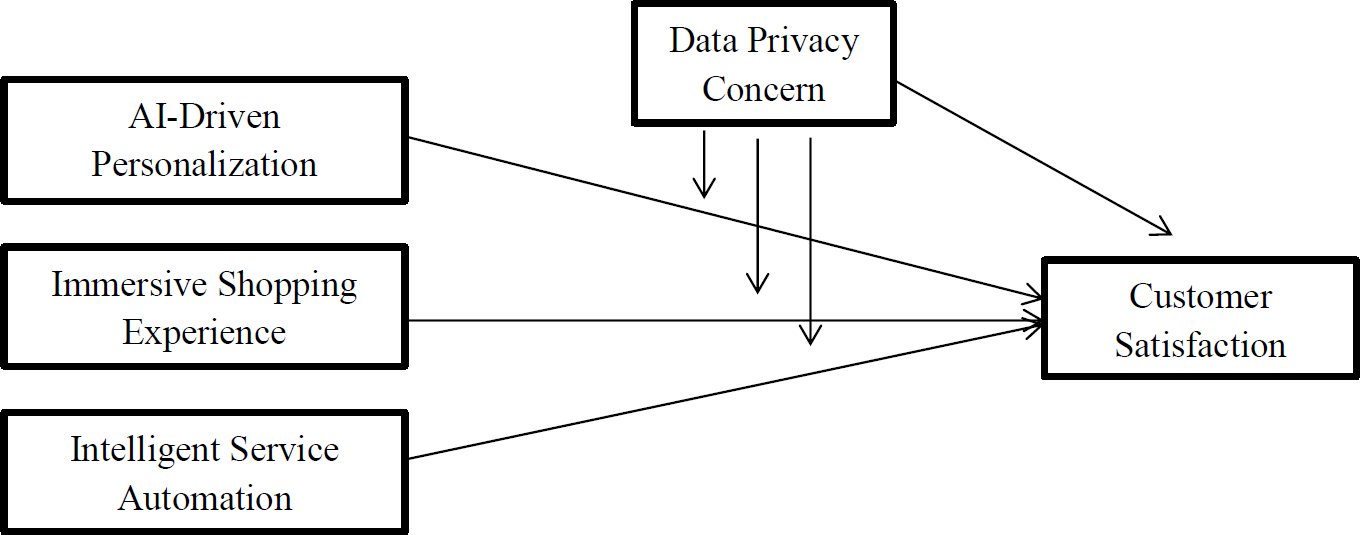
Fig. (1). Conceptual framework.
3. METHODOLOGY
This study adopted a quantitative, cross-sectional research design to determine the effects of the integration of Web 4.0 technologies on customer satisfaction in the e-commerce industry and data privacy concerns that have been proposed as a moderating variable. The use of a survey method was appropriate because the proposed model has latent constructs, which are customer perceptions and attitudes, and which are best quantified in structured questions in a questionnaire. The population of interest was online customers who had recently used e-commerce websites that incorporated smart and interactive digital capabilities such as personalised shopping suggestions, 3D product presentation, and customer-service robots, and the research used a target sample of 300 customers. Since convenience sampling and not probability sampling were used, the results of the study were only applicable within the sampled consumers, as opposed to the whole population of consumers in the UK e-commerce sector. The eligibility criteria were that the respondents must be adults, must have made at least one online purchase in the past three months, and must have used an e-commerce site that offered at least one of the features under study (personalised recommendations, immersive product interaction, or automated customer support). The sample of the research was UK online shoppers, as the United Kingdom is an established e-commerce environment with a high level of online retail penetration and a robust data protection system in the UK GDPR and the Data Protection Act 2018. This backdrop is appropriate for exploring the hypothesis that innovative e-commerce functionalities and privacy issues have a combined effect on customer satisfaction. A self-administered questionnaire was used to collect data through Google Forms on a five-point Likert scale, where 1 = strongly disagree and 5 = strongly agree. The additions to the questionnaire included AI-based personalisation, immersive experience of shopping, automation of the services, the issue of data privacy, and customer satisfaction, along with three demographic questions about gender, age group, and the number of times the respondent shops online per month. All measurement items were listed in Appendix A.
Partial least squares structural equation modelling was employed on SmartPLS because this technique is appropriate for research oriented towards prediction, intricate path models, and models that incorporate moderating effects. Recent methodological literature mentions that PLS-SEM is commonly used to estimate the intricate relationship between constructs and indicator variables and can be applied in cases when researchers adhere to the guidelines and recent methodological progress (Hair et al., 2024; Richter et al., 2022) also elaborated that the superior functions of PLS SEM can be useful to researchers both on their own or used together with other complementary methods. (Kabongo & Mbonigaba, 2024) demonstrated that a two-stage approach to the application of PLS-SEM is effective in moderation models. Data analysis was performed in two phases: evaluation of the measurement model and evaluation of the structural model. Internal consistency reliability was evaluated in the first stage using Cronbach’s alpha and composite reliability, but convergent validity was evaluated using the average variance extracted. The loadings of the indicators were examined to ensure that each item adequately explained its intended construct. The Heterotrait-Monotrait ratio was used to determine discriminant validity. The second phase was the analysis of the structural model, in which collinearity, path coefficients, coefficient of determination, effect sizes, and predictive relevance were evaluated.
The hypothesised relationships were tested with a large number of resamples using bootstrapping to test significance. This procedure is consistent with recent PLS-SEM recommendations, which advise against confusing the quality of measurement with structural path evaluation during model evaluation (Hair et al., 2024; Richter et al., 2022). To verify the moderating position of data privacy concerns, this study estimated the interaction impact between data privacy concerns and each of the three Web 4.0 constructs. Moderation analysis followed the application of recent PLS-SEM to study the hypothesis using SmartPLS with a two-stage approach, which is suitable when the interactions between the latent variables are central to the research model (Kabongo & Mbonigaba, 2024). Because all variables were measured on the same respondents at a given time, common method bias was measured before the structural model analysis. The Harman single-factor test showed that the first factor could explain 44.73% of the variance, which is less than the typical 50% mark, and indicates that the common method bias is not severe in this preliminary check. Moreover, construct-level VIF values were between 2.067 and 2.673, under the conservative 3.3, and suggest that collinearity does not create bias in the estimates of the structure or indicate problematic common method variance. These two diagnostics are mentioned here because they relate to the determination of the quality of data before structural testing.
4. RESULTS
4.1. Demographics Profile Analysis
Table 1 comprises of 300 people (including 176 females and 124 males), which implies that females are more represented in the sample. The age of the respondents was skewed toward middle adulthood, with the majority in the 45 to 54 (36.7%) and 35 to 44 (22.7%) age groups. The younger respondents were fewer in number, with only 18 to 24 (19.0%) and 25 to 34 (18.7%) years of age, while those 55 and above were marginal (3.0 percent). Shopping frequency is rather active: the highest percentage of 9 to 11 times per month (36.0%) comes first, followed by 6 to 8 times per month (24.7%). The lower frequency groups were less numerous. Owing to the convenience sampling method, the results can provide a valuable contextual understanding of the surveyed respondents. However, they cannot be considered statistically representative of the entire population of e-commerce users in the UK.
Table 1. Demographics analysis.
| Demographic Category | Group | Frequency (n) | Percentage (%) |
| Gender | Male | 124 | 41.3 |
| Female | 176 | 58.7 | |
| Age | 18 to 24 | 57 | 19.0 |
| 25-34 | 56 | 18.7 | |
| 35-44 | 68 | 22.7 | |
| 45-54 | 110 | 36.7 | |
| 55 and above | 9 | 3.0 | |
| Frequency of online shopping per month | 1 to 2 times | 54 | 18.0 |
| 3 to 5 times | 52 | 17.3 | |
| 6 to 8 times | 74 | 24.7 | |
| 9 to 11 times | 108 | 36.0 | |
| 12 times or more | 12 | 4.0 | |
| Total | – | 300 | 100 |
4.2. Measurement Model Analysis
Table 2 indicates the high quality of measurement of all constructs. The loading values of the indicators were between 0.786 and 0.918, which were higher than the normative values of reflective models, implying that the items did measure what they were intended to measure. The scale has a high internal consistency, with Cronbach’s alpha ranging between 0.860 and 0.917, and composite reliability ranging between 0.905 and 0.942, which demonstrates that the scale is stable and reliable. In addition, it has convergent validity, as the values of AVE are between 0.706 and 0.801, which is greater than the standard value of 0.50, and all constructs include more variance from their indicators than error. The AVE of Customer Satisfaction, Data Privacy Concern, and Immersive Shopping Experience was high (0.801, 0.775, 0.801), which is also indicative of a high level of coherent measurement. In general, the measurement model can facilitate valid inferences in further structural testing.
Table 2. Measurement model.
| Latent Variables | Indicators | Factor Loadings | Cronbach’s Alpha | Composite Reliability | Average Variance Extracted (AVE) |
| AI-Driven Personalization | AIP1 | 0.865 | 0.870 | 0.911 | 0.719 |
| AIP2 | 0.872 | ||||
| AIP3 | 0.825 | ||||
| 0.828 | |||||
| Customer Satisfaction | CS1 | 0.873 | 0.917 | 0.942 | 0.801 |
| CS2 | 0.912 | ||||
| CS3 | 0.918 | ||||
| CS4 | 0.878 | ||||
| Data Privacy Concern | DPC1 | 0.907 | 0.902 | 0.932 | 0.775 |
| DPC2 | 0.894 | ||||
| DPC3 | 0.911 | ||||
| DPC4 | 0.806 | ||||
| Immersive Shopping Experience | ISE1 | 0.897 | 0.917 | 0.941 | 0.801 |
| ISE2 | 0.884 | ||||
| ISE3 | 0.913 | ||||
| ISE4 | 0.886 | ||||
| Intelligent service automation | ISA1 | 0.819 | 0.860 | 0.905 | 0.706 |
| ISA2 | 0.884 | ||||
| ISA3 | 0.867 | ||||
| ISA4 | 0.786 |
4.3. Heterotrait-Monotrait Ratio (HTMT) Analysis
Table 3 presents the HTMT ratios as a discriminant validity criterion. HTMT values less than the typical value (0.90) indicate that the constructs are empirically different, even though the concepts are related. Immersive Shopping Experience and Customer Satisfaction have the highest HTMT value (0.821), which is less than 0.90. The HTMT results support the discriminant validity of the measurement model.
Table 3. Heterotrait-monotrait ratio (HTMT).
| – | AI-Driven Personalization | Customer Satisfaction | Data Privacy Concern | Immersive Shopping Experience |
| Customer Satisfaction | 0.656 | – | – | – |
| Data Privacy Concern | 0.657 | 0.733 | – | – |
| Immersive Shopping Experience | 0.720 | 0.821 | 0.769 | – |
| Intelligent Service Automation | 0.736 | 0.706 | 0.676 | 0.748 |
4.4. Path Coefficient Analysis
As shown in Table 4, immersive shopping experience is the most significant predictor of customer satisfaction (β = 0.450, p = 0.001), which supports the argument that experiential richness and interactive product evaluation are the drivers of e-commerce customer satisfaction. The positive effect on Intelligent Service Automation is also significant (β = 0.144, p = 0.005), which is in line with the evidence of the effect of responsive digital service on the satisfaction of perceived service quality. AI-driven personalisation also had a statistically significant but very small positive effect on customer satisfaction (β = 0.076, p = 0.022). Nevertheless, this result should be interpreted cautiously because the effect size is practically negligible (f² = 0.008) in terms of incremental value once immersive shopping experience and intelligent service automation are considered. Data privacy concerns are statistically significant and positively associated with customer satisfaction (β = 0.198, p = 0.001), but this does not necessarily imply a “causal enhancement” effect. Rather, it is likely to be a function of trust mechanisms in the context of the UK digital environment and regulatory assurance as offered in the UK legal regime, which are robust and reduce perceived risks. Overall, the moderating effects were weak. Only the interaction with personalisation was statistically significant (β = 0.049, p = 0.046), whereas the remaining interaction effects were not statistically significant.
Table 4. Path analysis.
| – | Path Coefficients (β) | T-statistics | P values |
| AI-Driven personalization -> Customer Satisfaction | 0.076** | 2.301 | 0.022 |
| Data Privacy Concern -> Customer Satisfaction | 0.198*** | 3.712 | 0.001 |
| Data Privacy Concern x AI-Driven Personalization -> Customer Satisfaction | 0.049** | 2.130 | 0.046 |
| Data Privacy Concern x Immersive Shopping Experience -> Customer Satisfaction | 0.044 | 0.604 | 0.546 |
| Data Privacy Concern X Intelligent Service Automation -> Customer Satisfaction | -0.088 | 1.409 | 0.159 |
| Immersive Shopping Experience -> Customer Satisfaction | 0.450*** | 6.962 | 0.001 |
| Intelligent Service Automation -> Customer Satisfaction | 0.144*** | 2.789 | 0.005 |
Note: *: Significance at 10%; **: Significance at 5%; ***: Significance at 1%
4.5. Model Explanatory Power Analysis
Table 5 shows that Customer Satisfaction has good explanatory power, as indicated by the R-squared of 0.631 and the adjusted R-squared of 0.622. This implies that the model accounts for a large proportion of 63% of the variation in satisfaction, which is significant in behavioural studies with survey-based latent constructs. The insignificant change between R-squared and adjusted R-squared indicates less overfitting and predictive stability. This finding confirms the applicability of PLS-SEM to prediction-oriented models involving more than two constructs and terms of interaction. The model provides a solid explanation of the formation of satisfaction in Web 4.0 facilitated e-commerce situations.
Table 5. Explanatory power.
| – | R-Square | R-Square Adjusted |
| Customer Satisfaction | 0.631 | 0.622 |
4.6. Effect-sizes f-squared Analysis
Table 6 presents the f-squared effect sizes to estimate practical importance, as opposed to statistical significance. The only exhibited medium effect (f-squared = 0.206) proves the meaning of incremental explanatory power of satisfaction in Immersive Shopping Experience. There were slight effects on intelligent service automation (0.026) and data privacy concerns (0.046). AI-driven personalisation had a practically negligible effect (f² = 0.008); therefore, its managerial effect should not be exaggerated.
Table 6. Fsquared effect sizes.
| Structural Path | F-square |
| AI-Driven personalization -> Customer Satisfaction | 0.008 |
| Data Privacy Concern -> Customer Satisfaction | 0.046 |
| Data Privacy Concern x AI-Driven Personalization -> Customer Satisfaction | 0.000 |
| Data Privacy Concern x Immersive Shopping Experience -> Customer Satisfaction | 0.002 |
| Data Privacy Concern x Intelligent service automation -> Customer Satisfaction | 0.011 |
| Immersive Shopping Experience -> Customer Satisfaction | 0.206 |
| Intelligent service automation -> Customer Satisfaction | 0.026 |
4.7. Predictive Relevance Analysis
The Q²predict value for Customer Satisfaction is provided in Table 7. The Q2 value of 0.610 indicates that it has an adequate predictive significance in the current data, and acceptable prediction errors are indicated by RMSE = 0.632 and MAE = 0.480. However, due to the comparatively high level of this value in behavioural survey research, it must be interpreted with caution. This suggests predictive utility with the sampled respondents. However, it cannot be extrapolated as an indicator that the model will have the same predictive utility when applied to all e-commerce groups or contexts of all platform users.
Table 7. Predictive relevance (Q² predict).
| Q²predict | RMSE | MAE | |
| Customer Satisfaction | 0.610 | 0.632 | 0.480 |
5. DISCUSSION
The structural model is a logical depiction of the influence of Web 4.0 capabilities on customer satisfaction and describes a significant variance in customer satisfaction. Hypotheses are used to organise the discussion to align theory, estimates, and interpretation. The model has good explanatory power (R² = 0.631; Adjusted R² = 0.622), which shows that the model’s proposed predictors explain 63% of the variance in student satisfaction. Furthermore, the good out-of-sample predictive ability is indicated by Q²predict = 0.610. Prediction error indicators (RMSE = 0.632; MAE = 0.480) convey that there is a moderate difference between the observed and predicted values, meaning that the model is good at the statistical level, but deviations in predictive precision could occur at different levels of the user context. Thus, the results must be understood in the context of the specific results and cannot be assumed to be generally applicable. The effect-size findings further indicated that Immersive Shopping Experience had the greatest incremental explanatory contribution (f² = 0.206), while AI-driven personalisation had a practically negligible contribution (f² = 0.008). These tests minimise the chances of over-interpreting tiny coefficients and explain the factors that were important in practice. This degree of accountability is aligned with the prediction-oriented PLS SEM used in multifaceted behavioural models, especially in cases where several correlated technology constructs are being modelled simultaneously (Hair et al., 2024; Richter et al., 2022).
Immersive Shopping Experience is the strongest predictor of customer satisfaction (β = 0.450, p = 0.001). This is consistent with studies that indicate that immersive AR-based experiences enhance the level of perceived usefulness and ease of use, hence enhancing the level of evaluation in online shopping (Guo & Zhang, 2024). Customer experience logic, whereby interactive design and enhanced product knowledge lessen uncertainty and increase confidence to attain more satisfaction, also suits the strength of this path (Pires et al., 2024; Mutambik et al., 2023). The immersive shopping experience in SOR terms is understood as a direct influence on satisfaction without the use of modelling psychological states as constructs, such as perceived control and competence, which were not quantified in the model (Mofokeng, 2021). Immersive features provide the most immediate satisfaction benefits because they can decrease the level of ambiguity in decision-making and enhance the quality of perceived shopping.
The relationship between Intelligent Service Automation and satisfaction was also positive and significant (β = 0.144, p = 0.005), which proves that responsive support mechanisms affect the perceived quality of service and enhance satisfaction in marketplace environments (Kim & Yum, 2024). This agrees with the fact that chatbot hints and automated interactions influence user confidence and judgments via the SOR sequence, especially in cases where the system is regarded as useful and efficient (Ltifi, 2023; Jantapoon, 2025). This is also consistent with broader marketplace research, implying that trust-associated mechanisms and the quality of the interaction are important to customer experience outcomes (Peña-García et al., 2024). Practically, automation can be realised by shortening waiting times, continuous presence, and accelerated problem-solving, which can increase satisfaction despite equal products and prices. Satisfaction increases as a result of the benefits of service performance through automation, but at a smaller scale compared to immersion.
Although AI-driven personalisation significantly influenced customer satisfaction (β = 0.076, p = 0.022), its practical contribution was negligible (f² = 0.008), suggesting that personalisation has become an expected platform feature, rather than a major differentiator. (Yin et al., 2025) show that AI recommendations can improve perceived relevance in e-commerce. However, (Zhao et al., 2025) indicated that customer responses also depend on perceived autonomy and comfort with recommendation systems. Therefore, personalisation remains useful, but its role is secondary to immersive shopping and service automation in explaining customer satisfaction.
The relationship between data privacy concerns and customer satisfaction was positive (β = 0.198, p = 0.001), although data privacy concerns had a small effect size (f² = 0.046). This result is best interpreted through privacy calculus and the privacy paradox because concerned users may still evaluate platforms positively when perceived benefits, transparency, trust signals, and regulatory safeguards reduce perceived risk. (Saeed, 2023) showed that privacy and security shape trust in E-commerce applications. (Morić et al., 2024) also emphasised the role of strong data protection in online marketplaces. In the UK context, the GDPR and the Data Protection Act 2018 may strengthen institutional confidence; therefore, the positive association should not be read as evidence that privacy concerns directly improve satisfaction. The results indicate that privacy concerns can coexist with satisfaction when customers perceive adequate platform and regulatory protection.
The analysis of the moderation results shows a selective boundary effect of data privacy concerns. Only AI-driven personalisation moderates the relationship between privacy concerns and customer satisfaction, with no significant moderating effects found for immersive shopping experiences or intelligent service automation. This indicates that privacy sensitivity is activated mostly when it comes to personal data usage and algorithm-based recommendations. Conversely, immersive technologies and service automation are seen as functional and experiential improvements, where perceived utility outweighs concerns with privacy, thus dampening moderation effects in these pathways. The interaction was large and positive, as opposed to negative. Thus, the results are not in line with the presumption that privacy issues consistently undermine the value of Web 4.0-oriented technologies. Privacy issues influenced the assessments of customers in a selective and not uniformly undermining fashion to all the Web 4.0 technology impacts (Zhao et al., 2025). This finding suggests that privacy is particularly crucial when customers consider personalisation, as personalised recommendations can highlight how data collection, profiling, and behaviour inferences are more apparent. To shop and automate services, customers might emphasise usefulness, convenience, product evaluation, or service responsiveness, which might be the reason privacy concerns did not significantly moderate those relationships.
THEORETICAL IMPLICATIONS
This study contributes to the body of knowledge on Web 4.0-based e-commerce capabilities in the UK by elucidating the relationship between the traits of customer satisfaction and the chosen Web 4.0-based e-commerce capabilities. Instead of realising Web 4.0 as a well-developed theoretical framework, the research operationalises it using three customer-facing capabilities that can be measured: AI-powered personalisation, immersive shopping experience, and intelligent service automation. This study also narrows the application of SOR theory because it demonstrates that the current model uses partial SOR logic. Technological capabilities have been considered stimuli and customer satisfaction as the response, but there was no measurement of such organism variables as trust, perceived control, enjoyment, and perceived usefulness. Thus, the present study can be perceived as a direct stimulus-response test, as opposed to a complete test of the SOR process.
MANAGERIAL IMPLICATIONS
For e-commerce managers, the results imply that an immersive shopping experience must be prioritised because it creates the greatest customer satisfaction effect and the greatest effect size in practice. Interactive product visualisation, augmented reality previews, virtual try-ons, and more detailed product exploration can offer more visible benefits of satisfaction than personalisation. Another area where intelligent service automation is helpful is in the case of chatbots, virtual assistants, and automated support, which enhance the speed, convenience, and availability of services. In comparison, personalisation by AI should not receive too much emphasis as a significant independent factor in satisfaction because of the insignificance of its effect size. Instead of merely increasing algorithmic targeting, managers must emphasise enhancing the transparency, quality, and control of personalisation by users.
LIMITATIONS AND FUTURE RESEARCH
This study has several limitations. First, convenience sampling was employed, which limits the generalisability of the results to all consumers of e-commerce in the UK. Second, the cross-sectional survey design restricts the ability to causally interpret the results. Third, the measures of all constructs were self-reported survey ratings, which can have common method bias despite the diagnostic checks performed. Fourth, the research partially applied the SOR theory because no measurement of the organism variables was performed. Further studies should incorporate constructs such as trust, perceived control, enjoyment, perceived usefulness, perceived risk, and perceived transparency to experiment with a comprehensive SOR process. The high Q2predict value in independent samples should also be proven in future studies, and the UK context should be compared with other regulatory environments in future studies.
CONCLUSION
This study explored the connection between AI-driven personalisation, immersive shopping experiences, service automation, data privacy issues, and customer satisfaction in UK e-commerce. The results indicate that the most predictive difference in customer satisfaction was the immersive shopping experience, followed by intelligent service automation. AI-based personalisation was statistically significant, but its effect was practically negligible, suggesting that personalisation may function more as an expected feature than as a driver of high satisfaction. Data privacy concerns were positively and directly related to satisfaction. This counterintuitive finding must be viewed with care in terms of privacy calculus, privacy paradox, and the regulatory environment of the UK, instead of being an indicator that privacy concerns usually enhance satisfaction. The selectivity of the moderation results was also biased. The only significant interaction was between data privacy concerns and AI-driven personalisation, and the positive direction of the interaction signified that privacy concerns did not have a consistent and significant impact on technology effects. In general, this research is a small and contextually enlightened work as it compares three proven e-commerce capabilities based on a Web 4.0-style approach. Nevertheless, the results must be interpreted in the context of the convenience sample, cross-sectional research, self-reporting, lack of measurement of the organism variables, and additional validation in various markets and e-commerce settings.
LIST OF ABBREVIATIONS
| AI | = | Artificial Intelligence |
| AVE | = | Average Variance Extracted |
| HTMT | = | Heterotrait-Monotrait Ratio |
| SOR | = | Stimulus Organism Response |
AUTHORS’ CONTRIBUTIONS
B.N.A. has contributed to the study conceptualization, methodology, data analysis, interpretation of results, and manuscript writing. I.I. has contributed to manuscript writing, critical revision of the content, and approved the final version of the manuscript.
ETHICAL APPROVAL & INFORMED CONSENT
This study was conducted in accordance with established ethical research principles. Ethical approval was obtained from the relevant institutional research ethics committee before data collection commenced. The study ensured that all research procedures involving human participants complied with ethical standards regarding privacy, confidentiality, and voluntary participation. Before participating in the survey, all respondents were provided with clear information regarding the purpose of the study, the nature of their involvement, and their rights as participants. Informed consent was obtained from each participant, confirming their voluntary agreement to participate. Participants were informed that they could withdraw from the study at any stage without providing any reason or facing any negative consequences.
AVAILABILITY OF DATA AND MATERIALS
The data will be made available on reasonable request by contacting the corresponding author [B.N.A.].
FUNDING
None.
CONFLICT OF INTEREST
The authors declare that there is no conflict of interest regarding the publication of this article.
ACKNOWLEDGEMENTS
Declared none.
DECLARATION OF AI
The authors confirm that the manuscript is original, has not been submitted elsewhere for publication, and that any AI-assisted tools used were limited to language editing and did not contribute to the study’s intellectual content, analysis, or conclusions. The authors take full responsibility for the content of the manuscript.
APPENDIX A
Questionnaire
Part I: Demographics
1. Gender
- Male
- Female
2. Age group
- 18 to 24 years
- 25 to 34 years
- 35 to 44 years
- 45 to 54 years
- 55 years and above
3. Frequency of online shopping per month
- 1 to 2 times
- 3 to 5 times
- 6 to 8 times
- 9 to 11 times
- 12 times or more
Part II: Likert Scale
- Strongly disagree
- Disagree
- Neutral
- Agree
- Strongly agree
AI-Driven Personalization
The platform suggests the products that are relevant to my interests.
The platform knows well what I want to buy.
Recommendations are personalized, and hence, one will easily get the relevant products.
The personalized content of the platform can be helpful in my shopping process.
Immersive Shopping Experience
The platform has interactive features that make the shopping more interactive.
The platform has visual technologies that assist me in learning more about products.
The shopping experience is more realistic due to the sense of immersion.
The features of immersion enhance my confidence in online shopping.
Intelligent Service Automation
The service on the site works well through the use of robots that can quickly address my concerns.
Chatbots or virtual assistants give useful information.
Smart support systems facilitate the process of shopping.
Automated service features can help me solve my normal shopping problems.
Data Privacy Concerns
I am worried about the way the site gathers my personal information.
My shopping data can also be utilized without my complete approval.
I am unsure of the level of security with which the platform stores my personal data.
I fear that digitally advanced features will interfere with my privacy.
Customer Satisfaction
I am content with my experience in shopping on this platform.
As an online shopping service, the platform is as expected.
I am satisfied with the level of my interactions here.
My general attitude towards this platform is positive.
REFERENCES
Asawawibul, S., Na-Nan, K., Pinkajay, K., Jaturat, N., Kittichotsatsawat, Y., & Hu, B. (2025). The influence of cost on customer satisfaction in e-commerce logistics: Mediating roles of service quality, technology usage, transportation time, and production condition. Journal of Open Innovation: Technology, Market, and Complexity, 11(1), 100482.
https://doi.org/10.1016/j.joitmc.2025.100482.
Bangun, C. S. B., Riskhandini, D. P., & Lyraa, N. (2025). Blockchain governance models for enhancing e-commerce user satisfaction. Blockchain Frontier Technology, 4(2), 72–83.
https://doi.org/10.34306/bfront.v4i2.682.
Farhat, R., Yang, Q., Ahmed, M. A. O., & Hasan, G. (2025). E-commerce for a sustainable future: Integrating trust, product quality perception, and online-shopping satisfaction. Sustainability, 17(4), 1431.
https://doi.org/10.3390/su17041431.
Guo, C., & Zhang, X. (2024). The impact of AR online shopping experience on customer purchase intention: An empirical study based on the TAM model. PloS one, 19(8), e0309468.
https://doi.org/10.1371/journal.pone.0309468.
Hair, J. F., Sarstedt, M., Ringle, C. M., Sharma, P. N., & Liengaard, B. D. (2024). Going beyond the untold facts in PLS–SEM and moving forward. European Journal of Marketing, 58(13), 81-106.
https://doi.org/10.1108/EJM-08-2023-0645.
Hassan, N., Abdelraouf, M., & El-Shihy, D. (2025). The moderating role of personalized recommendations in the trust–satisfaction–loyalty relationship: An empirical study of AI-driven e-commerce. Future Business Journal, 11(1), 66.
https://doi.org/10.1186/s43093-025-00476-z.
Hipólito, F., Dias, Á., & Pereira, L. (2025). Influence of consumer trust, return policy, and risk perception on satisfaction with the online shopping experience. Systems, 13(3), 158.
https://doi.org/10.3390/systems13030158.
Ilieva, G., Yankova, T., Klisarova, S., & Dzhabarova, Y. (2022). Customer Satisfaction in e-Commerce during the COVID-19 Pandemic. Systems, 10(6), 213.
https://doi.org/10.3390/systems10060213.
Jabeen, R., Khan, K. U., Zain, F., Atlas, F., & Khan, F. (2024). Investigating the impact of social media advertising and risk factors on customer online buying behavior: A trust-based perspective. Future Business Journal, 10(1), 123.
https://doi.org/10.1186/s43093-024-00411-8.
Jantapoon, K. (2025). The impact of smart warehousing and last-mile delivery on e-commerce supply chain performance: An empirical study using machine learning-enhanced SEM analysis. International Journal of Analysis and Applications, 23, 101.
https://doi.org/10.28924/2291-8639-23-2025-101.
Kabongo, W. N. S., & Mbonigaba, J. (2024). Effectiveness of public health spending: Investigating the moderating role of governance using partial least squares structural equation modelling (PLS-SEM). Health Research Policy and Systems, 22(1), 80.
https://doi.org/10.1186/s12961-024-01159-x.
Kim, J., & Yum, K. (2024). Enhancing continuous usage intention in e-commerce marketplace platforms: The effects of service quality, customer satisfaction, and trust. Applied Sciences, 14(17), 7617.
https://doi.org/10.3390/app14177617.
Li, W., Cujilema, S., Hu, L., & Xie, G. (2025). How social scene characteristics affect customers’ purchase intention: The role of trust and privacy concerns in live streaming commerce. Journal of Theoretical and Applied Electronic Commerce Research, 20(2), 85.
https://doi.org/10.3390/jtaer20020085.
Ltifi, M. (2023). Trust in the chatbot: A semi-human relationship. Future Business Journal, 9(1), 109.
https://doi.org/10.1186/s43093-023-00288-z.
Mofokeng, T. E. (2021). The impact of online shopping attributes on customer satisfaction and loyalty: Moderating effects of e-commerce experience. Cogent Business & Management, 8(1), 1968206.
https://doi.org/10.1080/23311975.2021.1968206.
Morić, Z., Dakic, V., Djekic, D., & Regvart, D. (2024). Protection of personal data in the context of e-commerce. Journal of Cybersecurity and Privacy, 4(3), 731-761.
https://doi.org/10.3390/jcp4030034.
Mutambik, I., Lee, J., Almuqrin, A., Zhang, J. Z., Baihan, M., & Alkhanifer, A. (2023). Privacy concerns in social commerce: The impact of gender. Sustainability, 15(17), 12771.
https://doi.org/10.3390/su151712771.
Peña-García, N., Losada-Otálora, M., Auza, D. P., & Cruz, M. P. (2024). Reviews, trust, and customer experience in online marketplaces: the case of Mercado Libre Colombia. Frontiers in Communication, 9, 1460321.
https://doi.org/10.3389/fcomm.2024.1460321.
Pereira, M. D. S., de Castro, B. S., Cordeiro, B. A., de Castro, B. S., Peixoto, M. G. M., da Silva, E. C. M., & Gonçalves, M. C. (2025). Factors of customer loyalty and retention in the digital environment. Journal of Theoretical and Applied Electronic Commerce Research, 20(2), 71.
https://doi.org/10.3390/jtaer20020071.
Pires, P. B., Prisco, M., Delgado, C., & Santos, J. D. (2024). A conceptual approach to understanding the customer experience in e-commerce: An empirical study. Journal of Theoretical and Applied Electronic Commerce Research, 19(3), 1943-1983.
https://doi.org/10.3390/jtaer19030096.
Qing, W., Amin, M. B., Gazi, M. A. I., Khan, W., Al Masud, A., & Alam, M. N. (2023). Mediation effect of technology adaptation capabilities between the relationship of service quality attributes and customer satisfaction: An investigation on young customers’ perceptions toward e-commerce in China. IEEE Access, 11, 123904–123923.
https://doi.org/10.1109/ACCESS.2023.3328775.
Richter, N. F., Hauff, S., Ringle, C. M., & Gudergan, S. P. (2022). The use of partial least squares structural equation modeling and complementary methods in international management research. Management International Review, 62(4), 449–470.
https://doi.org/10.1007/s11575-022-00475-0.
Saeed, S. (2023). A customer-centric view of E-commerce security and privacy. Applied Sciences, 13(2), 1020.
https://doi.org/10.3390/app13021020.
Sardjono, W., Martasari, G. W., & Gui, A. (2023). Impact of industrial technology 4.0 on improving service quality and customer experience on E-Commerce platforms. In E3S Web of Conferences (Vol. 426, p. 01007). EDP Sciences.
https://doi.org/10.1051/e3sconf/202342601007.
Valdez-Juárez, L. E., Gallardo-Vázquez, D., & Ramos-Escobar, E. A. (2021). Online buyers and open innovation: Security, experience, and satisfaction. Journal of Open Innovation: Technology, Market, and Complexity, 7(1), 37.
https://doi.org/10.3390/joitmc7010037.
Venkatakrishnan, J., Alagiriswamy, R., & Parayitam, S. (2023). Web design and trust as moderators in the relationship between e-service quality, customer satisfaction and customer loyalty. The TQM Journal, 35(8), 2455-2484.
https://doi.org/10.1108/TQM-10-2022-0298.
Yin, J., Qiu, X., & Wang, Y. (2025). The impact of AI-personalized recommendations on clicking intentions: Evidence from Chinese e-commerce. Journal of Theoretical and Applied Electronic Commerce Research, 20(1), 21.
https://doi.org/10.3390/jtaer20010021.
Zaker, R. A., Najeeb, S. H., Tawfiq, A. Z., Hussein, M. M., & Alshaher, A. A. (2026). The role of website quality on the enhancement of E-Loyalty: The moderating role of customer knowledge management. F1000Research, 15, 259.
https://doi.org/10.12688/f1000research.175562.1.
Zhao, L., Fu, B., & Bai, S. (2025). Understanding the influence of personalized recommendation on purchase intentions from a self-determination perspective: Contingent upon product categories. Journal of Theoretical and Applied Electronic Commerce Research, 20(1), 32.
https://doi.org/10.3390/jtaer20010032.
Licensed
© 2026 Copyright by the Authors.
Licensed as an open access article using a CC BY 4.0 license.
Article Contents Author Wahaj Anees1, * 1Department of Forensic Sciences, Institute of Basic Medical Sciences- Khyber Medical University, Peshawar, Pakistan
Article Contents Author Danish Rahman1, * Matias Garcia-Constantino1 1School of Computing, Ulster University, Belfast Campus, BT151AP, United Kingdom Article History:
Article Contents Authors Saqib Hussain Hadri1, Muhammad Hassnain1,* , Aqsa Arshed1, Shamaiza Kousar1, Aleeza Yasmeen1, Nuzhat Latif1, Kiran Ijaz1, Maryam
Article Contents Author Amal S. Al Saadi1, * 1Sohar University, Sohar, Oman Article History: Received: 13 June, 2026 Accepted: 09
Article Contents Author Olabode Adeyemi David1, * , Nduka Christiana1, Akazue Ruth Chioma1, Amos Mishael1 1Department of Animal Production,
Article Contents Author Muzmmil Memon1, * 1Department of Computer Science Management, Avila University, Kansas City, Missouri, United States Article History: