
















Article Contents
Article ID: CMT2601113001
Views: 28Dose-Dependent Neurobehavioral and Neurochemical Effects of Oral Donepezil in Male Albino Rats
 PDF
⬇ Downloads: 0
1Department of Biochemistry, Federal Urdu University, Karachi, Pakistan
Received: 23 July, 2026
Revised: 12 September, 2026
Accepted: 17 September, 2026
Published: 24 October, 2026
ABSTRACT:
Introduction: Donepezil is widely used for the symptomatic treatment of Alzheimer’s disease, and is considered as reversible, centrally acting as acetylcholine esterase (AChE) inhibitor. Several studies show that donepezil affects mood-related behaviors, monoaminergic transmission and cerebral oxidative status, in biphasic ways along with its recognized precognitive effect.
Materials and Methods: The neurobehavioral and neurochemical studies were examined in male albino rats on administration of oral donepezil treatment in the dose of 5, 10 and 20 mg/kg which were compared with vehicle-treated control rats. Forced Swimming Test (FST) used for evaluation of Depression-like symptoms, spatial Long-Term Memory (LTM) was evaluated by performing Morris Water Maze (MWM), and estimation of brain Superoxide Dismutase (SOD) activity, Malondialdehyde (MDA) content and dopamine and serotonin concentrations have also been performed.
Results and Discussion: The effects of donepezil on immobility time and escape latency were all biphasic with the moderate dose (10 mg/kg) having the greatest antidepressant-like and memory enhancing effect, while the 20 mg/kg dose gave a less pronounced response compared to 10 mg/kg, which is consistent with an inverted U-shaped dose response relationship. SOD activity showed a gradual increase with dose 10 mg/kg while MDA gradually decreased with dose 5 and 10 mg/kg whereas 20 mg/kg is slightly decrease in dose dependent manner following 10 mg/kg, indicating an antioxidant effect, The dopamine and serotonin levels were similarly increased at 10 mg/kg dose, but decreased at 20 mg/kg dose.
Conclusion: The findings corroborate a biphasic, neurobehavioral and neurochemical effects signature to donepezil that may be used to identify a therapeutic window for safe and effective treatment.
Keywords: Donepezil, depression, memory, oxidative stress, dopamine, serotonin
1. INTRODUCTION
Progressive loss of cholinergic neurons has been found in Alzheimer’s Disease (AD) and related dementias from the basal forebrain which leads to a marked loss of acetylcholine in the cortex and hippocampus and is responsible for many of the cognitive deficits seen in these patients [1]. Prior studies proposed that donepezil, a reversible acetylcholinesterase (AChE) inhibitor, is one of the most commonly used drugs in mild to severe symptomatic AD. Due to the inhibitory action of donepezil on the enzymatic degradation of acetylcholine, acetylcholine has increased activity in the synapse which are also thought to include nicotinic receptor upregulation and the reduction of glutamate receptor-mediated excitotoxicity [2]. Shiekh and Ammar [3] elaborated that clinically donepezil exhibited the dose-dependent effect with measurable improvement in cognition and global function at the standard dosing (mg/kg/day) and higher doses in more advanced disease [3].
Previous literature reported that donepezil has, however, not been limited to its precognitive activity [4]. Since acetylcholine has high affinity and binding to the monoaminergic systems which are known to regulate mood (dopamine, serotonin and noradrenaline) the classics, cholinesterase inhibitors are candidates for mood modulation, with seemingly contradictory results. The pro-depressant effect of high-dose cholinergic stimulation has been well-established, while several recent studies have reported that AchE inhibitors, such as donepezil, have antidepressant-like properties at low doses [4]. Notably, low and medium doses of donepezil decreased immobility time in the rats Forced Swim Test (FST), while a higher dose tended to induce depressive-like behavior, showing a U-shaped dose-response relationship between cholinergic modulation of despair-like behavior [4]. A similar finding has been reported in rats, in a chronic mild stress model, where sub-clinical doses of donepezil were found to have antidepressant, anxiolytic and precognitive effects [5]. Such observations suggest that there is a biphasic effect of cholinergic augmentation, depending on how much acetylcholine is raised in the synapses of the brain.
A researcher reported that Morris Water Maze (MWM) is the most widely used behavioral assessment test of learning and memory in rodents and is still one of the most common readouts for pharmacology studies investigating the hippocampal-dependent cognition [6]. In the medial prefrontal cortex and hippocampus, donepezil increases extracellular acetylcholine, which in turn has been shown to cause enhanced dopaminergic release in these regions, as well as to affect the monoamine tone (elevated, in the case of cholinergic augmentation). Cholinergic augmentation is expected to increase escape latency in the MWM, but also to change monoamine tone, which is increased after cholinergic augmentation. At the same time, oxidative stress is becoming a recognized mechanism in the pathogenesis of neurodegenerative diseases and excessive levels of ROS, including lipid peroxidation markers, Malondialdehyde (MDA) are associated with cognitive impairment as well as the development of depressive pathology. In cognitive impairment rodent models, donepezil has been demonstrated to increase brain SOD activity and decrease MDA content in addition to increasing water-maze performance indicating that some of the neurobehavioral effects of donepezil may be an antioxidant effect, which does not occur with cholinergic action alone [7].
Previous literature shows little understanding about behavioral despair, spatial long-term memory, oxidative status and monoamine levels at the same time in the same group of healthy rats, but with very different doses of donepezil. It is crucial to consider such an integrated evaluation as donepezil is often used orally in clinical practice and the decision on dose in practice involves the trade-off between the precognitive effect and possible adverse effects of a widening or reversal of benefit at higher doses [8]. The present study was, therefore, planned to determine the effects of oral administration of donepezil (5, 10 and 20 mg/kg) on neurobehavioral parameters including depressive-like behavior, long-term memory and oxidative stress markers with neurochemicals contents in male albino rats. Study will predict a dose-dependent and possibly non-monotonic enhancement of these behavior and biochemical parameters with donepezil.
2. MATERIALS AND METHODS
2.1. Animals and Experimental Groups
Twenty-four male albino rats of weighing 150-200 gm, were locally bred, were fed ad libitum with standard rat chow feed and provided water and kept under standard laboratory conditions (12-hour light/dark cycle, controlled temperature and humidity). All experiments were performed using the institutional guidelines for the care and use of laboratory animals. The animals were randomly divided into four groups (six animals in each group): a vehicle (water)-treated control group and three donepezil-treated groups receiving 5 mg/kg, 10 mg/kg and 20 mg/kg daily through the treatment period of 28 days respectively. Doses were selected on the basis of literature review [9].
2.2. Behavioral Assessment
2.2.1. Forced Swimming Test (FST)
Forced swimming test described by Porsolt et al., [10] and standardized for rats was used as an assessment of depressive-like behavior [11]. Animals were briefly pretested in a cylinder mentioned by Sajid et al., [12] with no opportunity to escape from the water, for 15 min a day. After twenty hours a test swim was performed for 5 min in which the total time spent without active escape-oriented movement was measured.
2.2.2. Morris Water Maze Test
The Morris water maze test was used to assess spatial Long-Term Memory (LTM): a round pool of opaque water with a hidden, submerged escape platform in a fixed quadrant [6]. Extra maze visual cues were provided during repeated training acquisition trials, and the delayed probe/retention trial either involved removal of the platform or a change in platform position, with latency to find the platform/quadrant measured as an index of long-term memory, a shorter latency represents good long-term memory consolidation and retrieval [13].
2.2.3. Biochemical and Neurochemical Estimation
After behavioral testing, all animals were sacrificed and whole brain was quickly dissected and homogenized for biochemical analysis. The endogenous antioxidant capacity measured by the level of the enzyme Superoxide Dismutase (SOD) and the level of Malondialdehyde (MDA) that reflects occurrence of lipid peroxidation and oxidative damage were estimated in the brain homogenates by standard spectrophotometric assays as described by [12].
Standard chromatographic quantification methods were used to measure the levels of brain Dopamine (DA) and serotonin (5-HT) while using standard curve of DA and 5-HT by HPLC. Following the protocol by Haider et al., [14].
All the chemicals and reagents have been purchased from Merck, Darmstadt, Germany and Sigma-Aldrich, St. Louis, MO, USA.
2.3. Statistical Analysis
Data are presented as mean ± SEM (Standard Error of the Mean) for all the groups. Individual differences were compared by one way analysis of variance (ANOVA) and an appropriate post-hoc multiple comparison test. Immobility was slightly reduced in 5 mg/kg dose, significantly reduced in 10 mg/kg dose and 20 mg/kg dose slightly increased again by 10 mg/kg whereas remain lessen as compared to control 5 mg/kg dose.
3. RESULTS
3.1. Forced Swim Test (FST)
Fig. (1) shows the effect on 28 days oral administration of donepezil on depression-like symptoms in rats. Data was analyzed through one way ANOVA shows significant effect (F = 5.640, df = 3,20, ** ++p < 0.01). The graph shows a non-significant effect at 5mg/kg as compared to control, while the 10 mg/kg dose significantly reduced depression-like response and minimizing immobility time. However, 20 mg/kg dose of Donepezil shows non-significant effect as compared to 10mg/kg which showing a biphasic U-shaped or bi-phasic response in forced swim/tail suspension test.
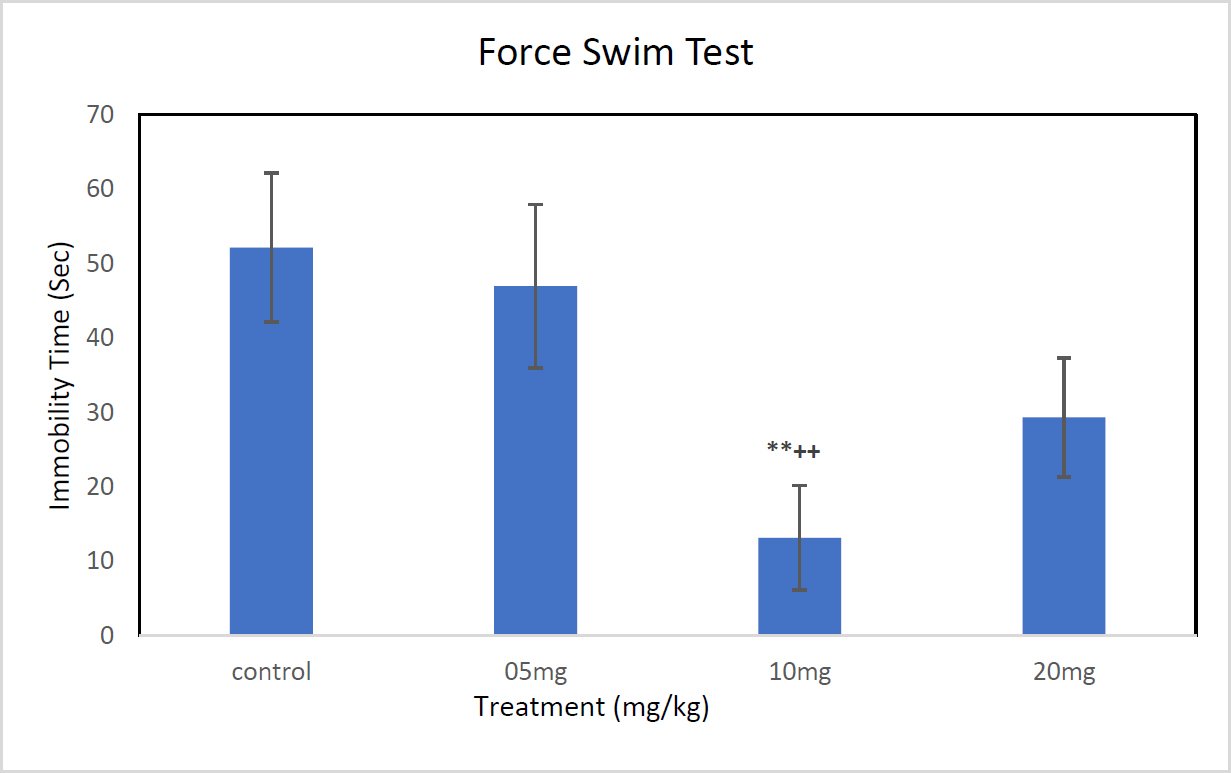
Fig. (1). The effect of orally administered donepezil (5, 10 and 20 mg/kg) on immobility time (s) in FST compared to vehicle treated control group, ** ++ p < 0.01 vs 5 mg/kg group.
3.2. Morris Water Maze Test
The results demonstrated that rats received 5 mg/kg dose of donepezil exhibited significant reduction in escape latency compared to control group but 10 mg/kg showed more pronounced effect and on cognitive enhancement. When the dose increased to 20 mg/kg it also showed a significant reduction in latency but not more than 10mg/kg hence bi-phasic response observed. These results elucidate a biphasic (inverted U-shaped) dose-response effect. Fig. (2) shows the effect on 28 days of oral administration of donepezil on memory in rats. Data was analyzed through one way ANOVA shows significant effect (F = 23.002, df = 3,20, ** p < 0.01).
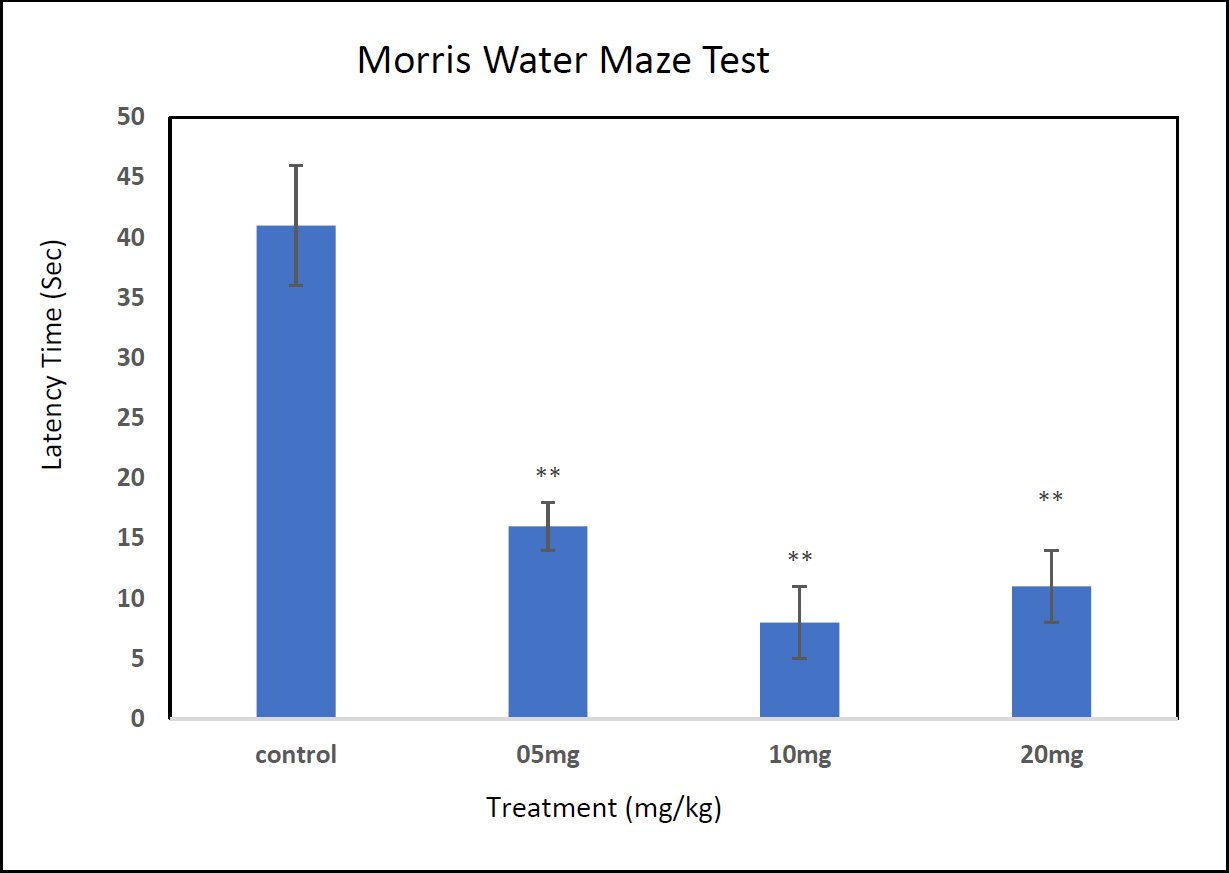
Fig. (2). Effect of oral administration of donepezil (5, 10 and 20 mg/kg) on latency time (s) in MWM compared to vehicle treated control group, ** p < 0.01.
3.3. Biochemical and Neurochemical Estimation
3.3.1. Estimation of MDA
Results demonstrate the 28 days oral administration of 5, 10 and 20 mg/kg donepezil on an oxidative stress marker MDA in rats compared to control. It was found that 5 mg/kg did not produce much inhibition of MDA concentration in µmol/gm compared to 10 mg/kg which showed a significant reduction on MDA level. However, 20 mg/kg showed almost the similar effect as 10 mg/kg as shown in Fig. (3).
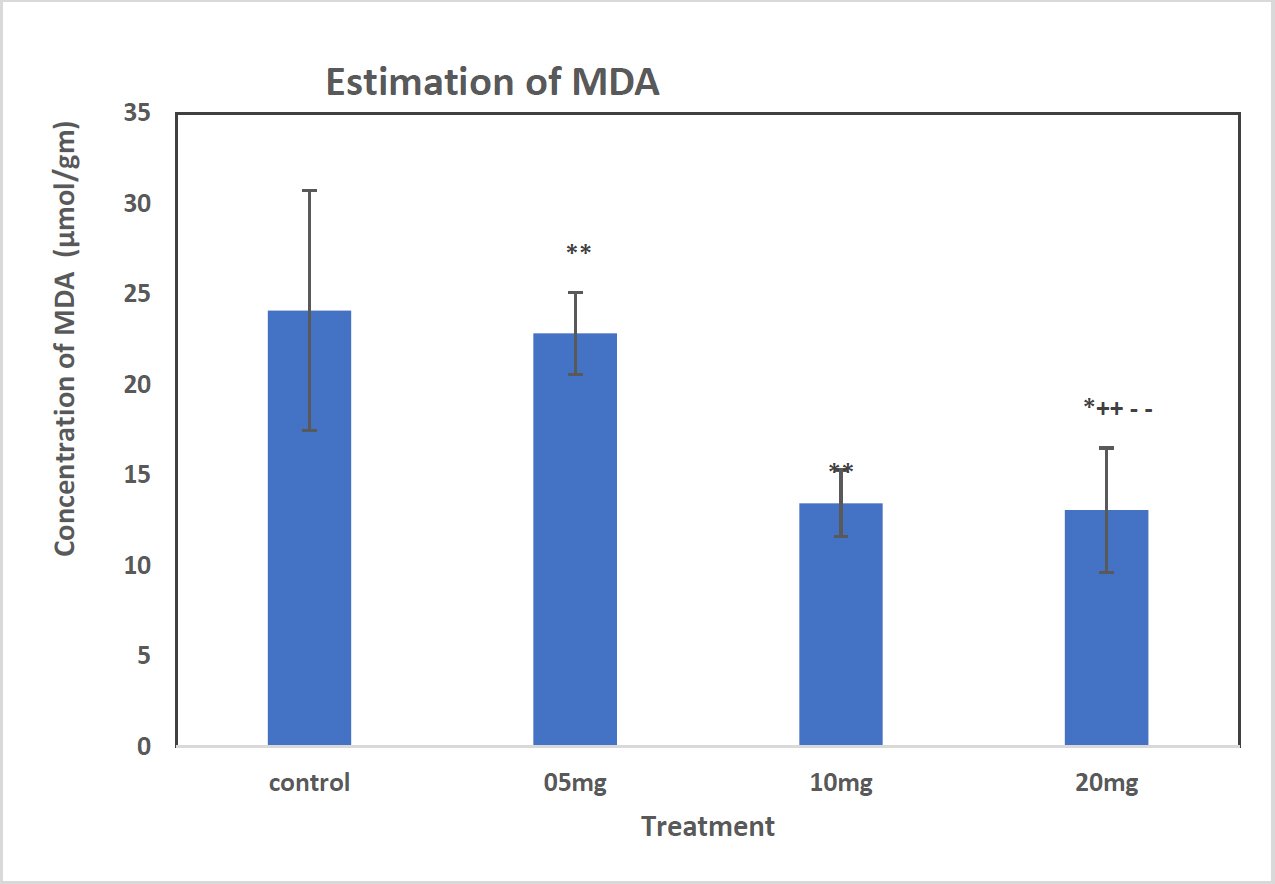
Fig. (3). Effect of oral administration of donepezil (5, 10 and 20 mg/kg) on lipid peroxidation by evaluating MDA marker compared to vehicle treated control group, ** p < 0.01, *p < 0.0.05 vs control, ++p < 0.01 vs 05mg/kg, —p < 0.01 vs 10mg/kg.
Data was analyzed through one way ANOVA shows significant effect (F = 62.698, df = 3,20, **p < 0.01, *p < 0.05, ++p < 0.01, – –p < 0.01). The graph demonstrates
3.3.2. Estimation of Superoxide Dismutase (SOD)
The results show that 28 days oral administration of donepezil on an oxidative enzymatic marker superoxide dismutase in rats. Data was analyzed through one way ANOVA. The graph demonstrates a non-significant effect of SOD expression in u/g at 5mg/kg and 10 mg/kg compared to control but significantly increased at dose 10 mg/kg (F= 4.229, df = 3,20, ** p < 0.01) which again explains the bi-phasic response (Fig. 4).
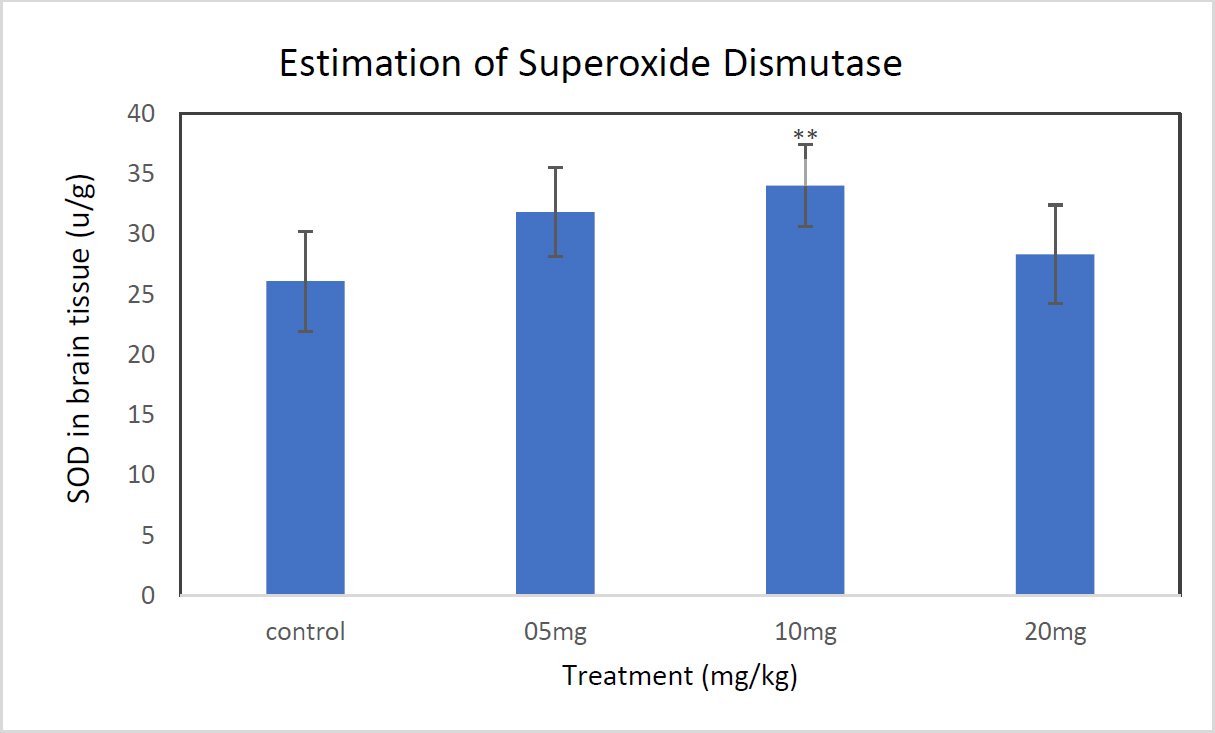
Fig. (4). Effect of oral donepezil (05, 10 and 20 mg/kg) doses on superoxide dismutase enzymatic marker compared to vehicle treated control group, ** p < 0.01.
3.3.3. Estimation of Dopamine
The results of 5 mg/kg, 10 mg/kg and 20 mg/kg of donepezil on dopamine level ng/g in brain tissues for 28 days, oral administration of showed pronounced expression of dopamine at 10 mg/kg (F = 7.507, df = 3,20, **p < 0.01, ++p < 0.01). Data was analyzed through one way ANOVA. The graph demonstrates a non-significant effect of dopamine ng/g at dose 5 mg/kg and 10 mg/kg as compared to control which also shows bi-phasic response (Fig. 5).
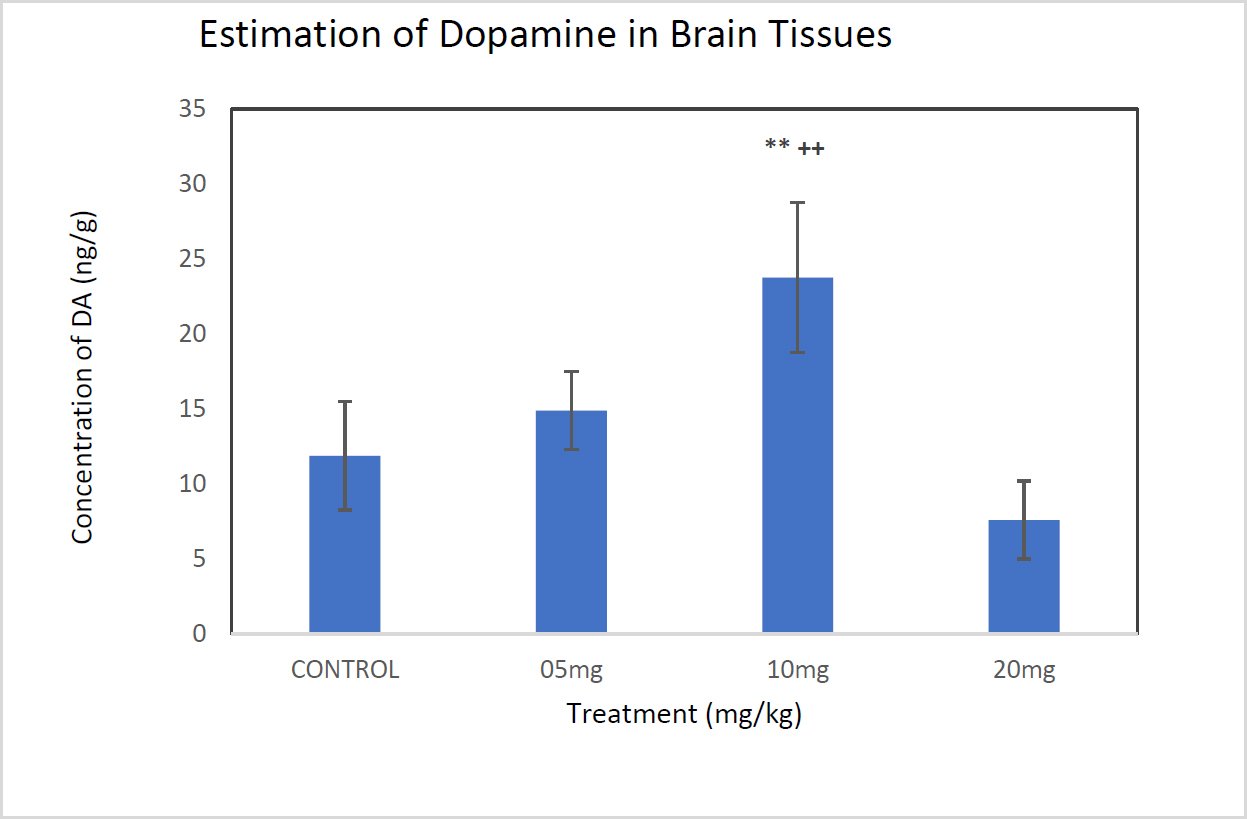
Fig. (5). Effect of oral administration of donepezil (5, 10 and 20 mg/kg) doses on biogenic amine dopamine in brain tissue compared to vehicle treated control group, ** p < 0.01 vs control and ++p < 0.01vs 5 mg/kg.
3.3.4. Estimation of 5-HT
The results of 28 days, oral administration of donepezil on serotonin (5-HT) level in brain tissue for indicate a significant rise in 5-HT level in the rat brain tissues. Data was analyzed through one way ANOVA. The graph explains that non-significant effect of serotonin on dose 5 mg/kg compared to control whereas serotonin level significantly increased at dose 10 mg/kg (F = 19.385, df = 3,20, ** ++ p < 0.01, – –p < 0.01). At 20 mg/kg 5-HT level was decreased dopamine as compared to 10 mg/kg, hence a bi-phasic response observed (Fig. 6).
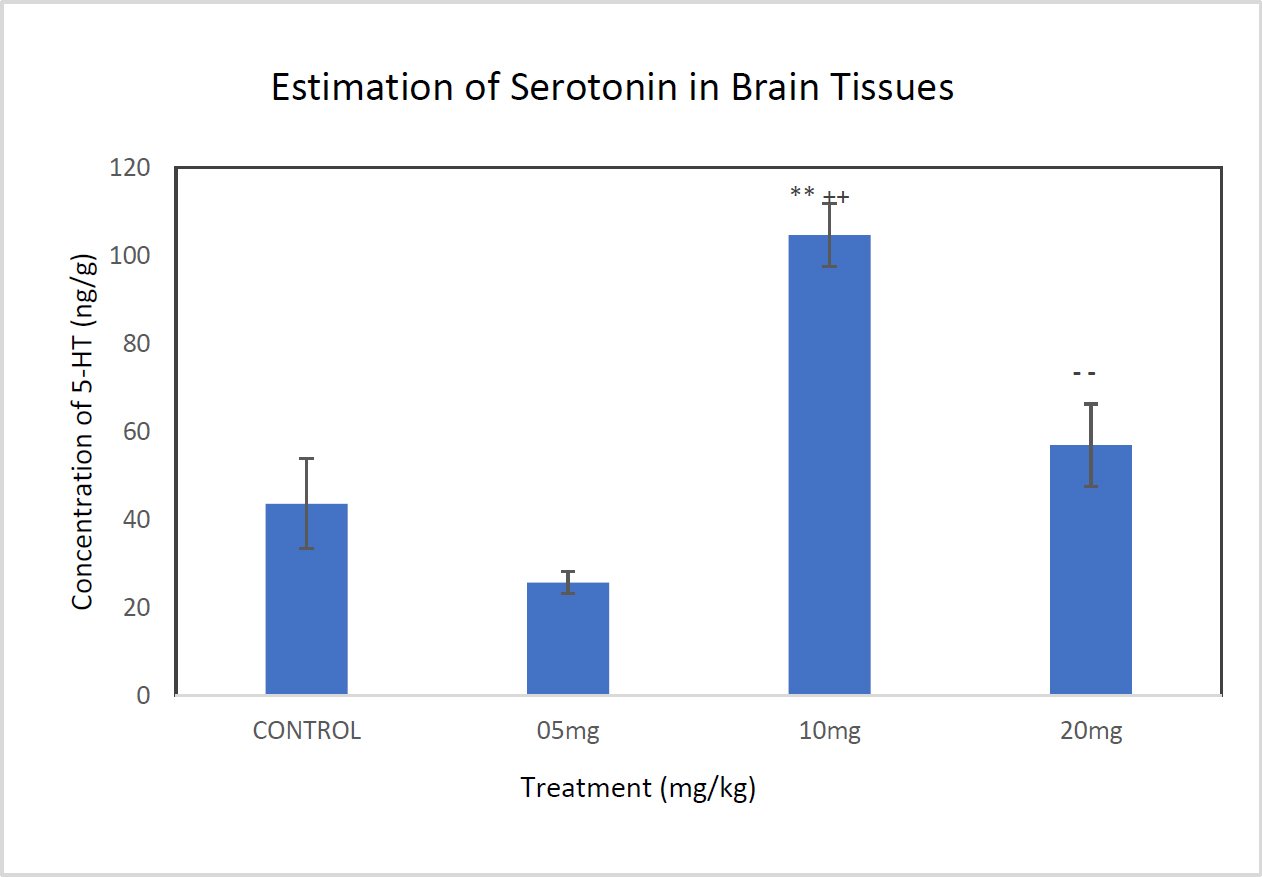
Fig. (6). Effect of oral administration of donepezil (5, 10 and 20 mg/kg) on biogenic amine 5-HT ng/g in brain tissue compared to vehicle treated control group, **p < 0.01 vs control ++p < 0.01 vs 05 mg/kg, and – p < 0.01 vs 10 mg/kg.
4. DISCUSSION
The results of the present study indicate that oral donepezil has clear biphasic effects in the behavioral despair, spatial long-term memory, oxidative stress and monoaminergic role in male albino rats, while oral dose of 10 mg/kg shows consistent favorable behavioral and neurochemical effects, compared to the lower and higher doses (5 and 20 mg/kg respectively) examined.
Current study about biphasic effect shows decreases in immobility time seen at 10 mg/kg, and conversely, the partial reversal seen at 20 mg/kg echoes with past studies that of donepezil in the forced swim test, which showed a low to moderate doses decreasing immobility (antidepressant-like effect) and high doses increasing immobility (depression-like effect) [4]. Prior studies showed that cholinesterase inhibitors, such as donepezil and rivastigmine, have been described with a similar biphasic effect in rodents stressed for prolonged periods, with sub-maximal doses of these drugs yielding procognitive, antidepressant and anxiolytic effects [5]. These observations are extended in present study that the oral route of administration, and a formal dose comparison of the same cohort of unstressed animals, indicating that the inverted-u relationship between cholinergic augmentation and mood-related behavior is not limited to a specific stress paradigm, species or route of dosing.
The present behavioral response are corroborated with the neurochemicals study showed a decrease in brain serotonin concentration at a low dose, followed by a significant increase at 10 mg/kg, and then by a significantly decrease again at 20 mg/kg, is more complex than has been reported in most other micro dialysis studies of acute cholinesterase blockade in rats, which have either shown a lack of effect or a decline of serotonin [15]. The discrepancy may be due to the duration of the dose (acute micro dialysis as compared to repeated oral dose in the present study), the region of the brain examined, or even a true biphasic effect of donepezil on serotonergic tone which can only be seen across a larger dose range. As serotonin is significantly elevated at 10 mg/kg and there is a close functional relationship between serotonergic transmission and behavioral despair, the prominent increase in serotonin could be mechanistically responsible for the simultaneous decrease in the immobility time of FST showing antidepressant effect that was found at the same dose [4].
The significant increase was observed in MWM production level in all treated groups especially at 10 mg/kg, is in line with prior studies that the precognitive properties of donepezil, for which inhibition of acetylcholinesterase and subsequent increase in synaptic. Previous literature stated that AChE in the hippocampus and cortex are key mechanisms regions which are critical for the pathogenesis of both spatial learning and spatial memory consolidation [10, 11]. Researchers in past studies elaborated that the stimulatory effect of oral administration of donepezil in the medial prefrontal cortex and hippocampus has also been shown to lead to increased extracellular release of dopamine in freely moving rats, which was interpreted as a mechanism of action originating from crosstalk between cholinergic and dopaminergic circuits [15]. Despite this, the present dopamine data with significant rise at 10 mg/kg and significant decrease at 20 mg/kg point to such a mechanism, as well as to the fact that this dopaminergic enhancement also shows a bell-shaped, rather than linear, dose response partly likely explaining the parallel behavior data, as the dopaminergic and serotonergic systems are known to modulate despair-like behavior and memory consolidation, respectively [16].
The significantly increasing SOD activity and significantly decreasing MDA content in a dose-dependent manner observed in present study is in line with previous studies reporting enhancing antioxidant properties of donepezil, that is not merely related to its cholinergic activity, such as the increase in SOD, and the reduction in the lipid peroxidation and pro-inflammatory cytokine levels after cognitive impairment models [7, 17].
Overall, the fact that 10 mg/kg is associated with the maximum antidepressant-like effect, as well as memory-enhancing, antioxidant and monoamine-elevating effects, and that certain of these effects are reduced or reversed (at 20 mg/kg) is consistent with the concept that cholinergic signaling, like multiple other neurotransmitter systems, has an inverted u relationship in which an intermediate level of receptor activation is most beneficial, with insufficient or excessive stimulation being comparatively less beneficial or even counterproductive [4]. From a translational standpoint, these results are consistent with clinical practice, where the benefit is seen at standard doses (5-10 mg/kg/day) of donepezil and without a simple linear extension of benefit at higher doses [10, 11] and further highlight the need to take note of non-monotonic dose-response relationships when evaluating donepezil (or other cholinesterase inhibitors) for its other uses beyond improved cognition such as mood disorders. However, direct translation of rat doses to human clinical doses requires allometric scaling; therefore, the present findings suggest a therapeutic window in rats but do not directly define human dosing.
LIMITATIONS AND FUTURE DIRECTION
There are limitations in this study that may need to be noted when interpreting the results of this study. The behavioral and biochemical effects were collected in one group of otherwise normal rats (no lesions or stresses) and it will be important to determine if similar dose-response would be found in models of induced cognitive dysfunction or depression-like states. This nicotinic and muscarinic receptor-subtype selectivity, however, was not directly examined here nor were the downstream effects of the monoamines via these receptors and both remains an interesting question for further investigation. Future studies should also incorporate appropriate standard drugs as comparator groups to further validate and contextualize the neurobehavioral, neurochemical, and antioxidant effects of donepezil.
CONCLUSION
Oral donepezil produced clear, dose-dependent improvements in depression-like behaviour, long-term spatial memory, brain antioxidant status and monoamine concentrations in male albino rats, with 10 mg/kg dose consistently identified as the point of maximal benefit and the 20 mg/kg dose showing partial attenuation of several of these effects. These findings support a non-monotonic, inverted U-shaped dose-response relationship for the neurobehavioural and neurochemical actions of donepezil and highlight the importance of careful dose selection when this and related cholinesterase inhibitors are considered for therapeutic indications beyond cognitive enhancement.
LIST OF ABBREVIATIONS
AD | = | Alzheimer’s Disease |
FST | = | Forced Swimming Test |
MWM | = | Morris Water Maze |
SOD | = | Superoxide Dismutase |
AUTHORS’ CONTRIBUTIONS
H.K. has contributed to the study conception and design and manuscript writing. A.F. has contributed to data analysis, interpretation of results, and manuscript writing. M.S. was responsible for data collection, analysis, and interpretation. P.A.H. has contributed to data analysis and interpretation. M.A. and Y.M. have contributed to data collection. All authors reviewed and approved the final version of the manuscript.
ETHICAL APPROVAL AND INFORMED CONSENT
Ethical approval for this study was granted by the Institutional Animal Ethics Committee of the Federal Urdu University of Arts, Science and Technology (FUUAST Ref no 04328/2023). All experimental procedures were conducted in strict accordance with the Guide for the Care and Use of Laboratory Animals and 3Rs principles. The study design and reporting adhere strictly to the ARRIVE guidelines. Informed consent was not applicable, as no human participants were involved.
AVAILABILITY OF DATA AND MATERIAL
The data will be made available on reasonable request by contacting the corresponding author [H.K.].
FUNDING
None.
CONFLICT OF INTEREST
The authors declare no conflict of interest regarding the publication of this paper.
ACKNOWLEDGEMENTS
Declared none.
DECLARATION OF AI
During the preparation of this manuscript, the author used ChatGPT for language editing and refinement purposes. Following the use of this tool, the author carefully reviewed and revised the content where necessary and accept full responsibility for the final published version of the article.
REFERENCES
[1] Chen ZR, Huang JB, Yang SL, Hong FF. Role of cholinergic signaling in Alzheimer’s disease. Molecules. 2022;27(6):1816.
https://doi.org/10.3390/molecules27061816
[2] Kumar A, Gupta V, Sharma S. Donepezil. In: StatPearls . Treasure Island (FL): StatPearls [Internet] Publishing; 2023. Available from: https://www.ncbi.nlm.nih.gov/books/NBK513257/
[3] Sheikh M, Ammar M. Efficacy of 5 and 10 mg donepezil in improving cognitive function in patients with dementia: a systematic review and meta-analysis. Front Neurosci. 2024; 18:1398952.
https://doi.org/10.3389/fnins.2024.1398952
[4] Fitzgerald PJ, Hale PJ, Ghimire A, Watson BO. The cholinesterase inhibitor donepezil has antidepressant-like properties in the mouse forced swim test. Transl Psychiatry. 2020; 10:255.
https://doi.org/10.1038/s41398-020-00928-w
[5] Papp M, Gruca P, Lason-Tyburkiewicz M, Willner P. Antidepressant, anxiolytic and procognitive effects of rivastigmine and donepezil in the chronic mild stress model in rats. Psychopharmacology. 2016;233(7):1235–1243.
https://doi.org/10.1007/s00213-016-4206-0
[6] Morris R. Developments of a water-maze procedure for studying spatial learning in the rat. J Neurosci Methods. 1984;11(1):47–60.
https://doi.org/10.1016/0165-0270(84)90007-4
[7] Rao YL, Ganaraja B, Marathe A, Manjrekar PA, Joy T, Ullal S, Pai MM, Murlimanju BV. Comparison of malondialdehyde levels and superoxide dismutase activity in resveratrol and resveratrol/donepezil combination treatment groups in Alzheimer’s disease induced rat model. 3 Biotech. 2021; 11:329.
https://doi.org/10.1007/s13205-021-02879-5
[8] Birks JS, Harvey RJ. Donepezil for dementia due to Alzheimer’s disease. Cochrane Database Syst Rev. 2018;6(6):CD001190.
https://doi.org/10.1002/14651858.CD001190.pub3
[9] Berk C, Sabbagh M. Broader considerations of higher doses of donepezil in the treatment of mild, moderate, and severe Alzheimer’s disease. Int J Alzheimers Dis. 2012; 2012:707468.
https://doi.org/10.1155/2012/707468
[10] Porsolt RD, Le Pichon M, Jalfre M. Depression: a new animal model sensitive to antidepressant treatments. Nature. 1977;266(5604):730–732.
https://doi.org/10.1038/266730a0
[11] Slattery DA, Cryan JF. Using the rat forced swim test to assess antidepressant-like activity in rodents. Nat Protoc. 2012;7(6):1009–1014.
https://doi.org/10.1038/nprot.2012.044
[12] Sajid I, Anis L, Ahmed S. Chronic exposure to immobilized stress induces memory impairment and produces other behavioral deficits in male rats. Pak J Biochem Mol Biol. 2022;53(3):156–161. Available from: https://www.pjbmb.com/index.php/pjbmb/article/view/70
[13] Sajid I, Ahmad S, Emad S, Batool Z, Khaliq S, Anis L, et al. Enhanced physical endurance and improved memory performance following taurine administration in rats. Pak J Pharm Sci. 2017;30(5 Suppl):1957–1963. Available from: https://pubmed.ncbi.nlm.nih.gov/29105628/
[14] Haider S, Naqvi F, Batool Z, Tabassum S, Perveen T, Saleem S, Haleem DJ. Decreased hippocampal 5-HT and DA levels following sub-chronic exposure to noise stress: impairment in both spatial and recognition memory in male rats. Sci Pharm. 2012;80(4):1001–1012.
https://doi.org/10.3797/scipharm.1207-15
[15] Liang YQ, Tang XC. Comparative studies of huperzine A, donepezil, and rivastigmine on brain acetylcholine, dopamine, norepinephrine, and 5-hydroxytryptamine levels in freely-moving rats. Acta Pharmacol Sin. 2006;27(9):1127–1136.
https://doi.org/10.1111/j.1745-7254.2006.00411.x
[16] Chowdhury R, Guitart-Masip M, Bunzeck N, Dolan RJ, Düzel E. Dopamine modulates episodic memory persistence in old age. J Neurosci. 2012;32(41):14193–14204.
https://doi.org/10.1523/JNEUROSCI.1278-12.2012
[17] Wang T, Lv P, Jin W, Zhang H, Lang J, Fan M. Protective effect of donepezil hydrochloride on cerebral ischemia/reperfusion injury in mice. Mol Med Rep. 2014;9(2):509–514.
https://doi.org/10.3892/mmr.2013.1823
Licensed
© 2026 Copyright by the Authors.
Licensed as an open access article using a CC BY 4.0 license.
Article Contents Author Hafsah Khan1, * , Ayesha Farooq1 , Muhammad Sohail1 , Palwasha Abrar Hussain1 ,
Article Contents Author Ajay Mahesh Gaur1, * 1University of Colorado Denver, Denver, USA Article History: Received: 30 July, 2026 Revised:
Article Contents Author Jiyad Shaikh1, * 1NED University of Engineering and Technology, Karachi, Pakistan Article History: Received: 23 July, 2026
Article Contents Author Saad Ahmad Khan1, * Imran Iqbal2 1Department of Marketing and Supply Chain Management, Iqra University, Karachi, Pakistan
Article Contents Author Raza Hussain Khoso1, * 1Henry W. Bloch School of Management, University of Missouri-Kansas City, Kansas City USA
Article Contents Author Rashid Ali Baloch1, * 1Indus University, Karachi, Pakistan Article History: Received: 25 August, 2026 Revised: 07 October,