






Article Contents
Article ID: CMT2621101003
Views: 777Teaching Service Quality in Saudi Higher Education: The Role of Employee Engagement, Innovation Strategy, and Vision 2030
 DOI:
DOI:
 PDF
PDF
⬇ Downloads: 31
1Department of Business Administration, Imam Abdul Rahman Bin Faisal University, Dammam, Saudi Arabia
Received: 14 May, 2026
Accepted: 27 June, 2026
Revised: 19 June, 2026
Published: 15 July, 2026
ABSTRACT:
Introduction: In this study, the authors discuss the association between employee engagement practices and innovation strategies with the quality of teaching services in Saudi Arabian higher education and evaluate the moderating role of Vision 2030 Human Capital Development initiatives.
Methodology: The study followed a quantitative design, with 350 academic staff participating in the research. Partial Least Squares Structural Equation Modelling (PLS-SEM) was used to analyse the data.
Results & Discussion: The results indicate that the practice of employee engagement is positively and significantly associated with the quality of teaching services, but with a small effect. Conversely, the innovation strategy did not show any significant direct association. Vision 2030 Human Capital Development also demonstrates a direct, positive, and significant moderating impact on the quality of teaching services. The moderation analysis shows that Vision 2030 human capital development plays a significant role in strengthening the relationship between employee engagement practices and teaching service quality. Likewise, it has a significant moderating effect on the association between innovation strategy and teaching service quality.
Conclusion: These results suggest that engagement practices and innovation strategy effectiveness increase with alignment to Vision 2030 human capital development programs. Therefore, Human capital development (operationalised in the Vision 2030 context) acts as a contextual institutional factor and enhancer of organisational practices.
Keywords: Employee engagement practices, innovation strategy, teaching service quality, vision 2030, human capital development, higher education.
1. INTRODUCTION
The increased digitalisation of education and hybrid learning formats has escalated the pressure on higher education to innovate teaching practices and enhance service delivery in education. Consequently, the university-wide strategic focus has shifted towards innovation in pedagogy, curriculum design, and online classroom environments as a way to achieve sustainable competitiveness.
An increasing number of researchers have noted that creative pedagogical approaches increase the effectiveness of learning, interest, and performance of students at contemporary institutions of higher learning (Khadijah et al., 2025). In addition to innovation, staff engagement in academic work has become an essential organisational variable affecting the quality of teaching and institutional performance (Gede & Huluka, 2024; Nalini et al., 2026). Engaged faculty members are more committed, motivated, and willing to embrace new pedagogical practices in instructional activities. Engagement practices that include professional development, empowerment, and supportive organisational climates are thus receiving more attention in higher education institutions. These practices help enhance the satisfaction of academic staff, staff retention, and general teaching performance in universities in competitive international settings (Ghamooshi et al., 2023; Verma & Kaur, 2024).
Nevertheless, the challenge of aligning employee engagement programs and innovation strategies continues to be a major issue in most institutions of higher learning across the globe. Effective interaction in universities is a difficult task since academic staff are likely to be overwhelmed with workloads, administration, and the need to keep research prolific and preserve teaching quality. These issues are especially noticeable in countries that are developing mass educational transformation and economic diversification programs.
Saudi Arabia is a notable example of such change, with its national development program, Vision 2030. Vision 2030 focuses on building a knowledge-based economy by enhancing institutions of higher learning and workforce capacity (Alhazmy, 2025). The Human Capability Development Program (HCDP), initiated as part of (Saudi Vision 2030, 2021), aims to empower the population with skills that will enable their economic competitiveness in the future. According to a recent report, the rate of Saudi graduates joining the labour market within six months rose to 44.43% in 2024 from 13.3% in 2016 (Saudi Gazette, 2025). The level of youth employment among Saudis aged between fifteen and twenty-four years also increased to 36.2, which is the positive effect of human capital development activities (Saudi Gazette, 2024). Moreover, Vision 2030 reforms are centred on continuous learning and skill development as critical elements of national workforce transformation. (ETS, 2025) published the results of the 2025 Human Progress Report and found that over 90% of Saudis surveyed trust that lifelong learning and skill building are the keys to career success. These reform initiatives can also be seen in Saudi higher education, which has shown some form of measurable improvement in academic rankings worldwide. For instance, 12 universities in Saudi Arabia were listed as among the top one thousand universities in the Shanghai world ranking (SPA, 2024). These results demonstrate the growing concern regarding the quality of education, research, and innovation in Saudi institutions of higher learning.
Nevertheless, despite these promising efforts made under Vision 2030, a number of challenges impede the full achievement of the educational targets. Saudi culture is deeply ingrained in traditional teaching and curricula, and implementing new methods without facing resistance is challenging (Alhazmy, 2025). Therefore, effective organisational practices and national policies regarding human capital should be combined to achieve sustainability in education quality.
The research problem in this study is based on the fact that there is little knowledge about the effect of joint organisational practices and national policy initiatives on teaching service quality in higher institutions of learning. Although earlier research has analysed employee engagement and innovation strategy independently, there is scant research on the combined impact of the two in the context of Saudi Arabia’s Vision 2030 reforms.
Thus, this study aims to assess the influence of employee engagement practices, innovation strategy, and teaching service quality in Saudi Arabian higher education institutions, as well as to examine the moderating effect of Vision 2030 Human Capital Development. Moreover, the research questions were formulated to investigate whether the practices of employee engagement and the innovation strategy have a significant impact on teaching service quality and whether Vision 2030 human capital development reinforces these relations. The study hypotheses were formulated logically based on these questions to test the direct and moderating relationships as proposed in the conceptual framework.
Theoretically, this study combines Social Exchange Theory, Resource-Based View, and Human Capital Theory to explain how an organisation and policy affect the quality of teaching services. This integration expands the multi-theoretical perspectives on the interaction of engagement practices, innovation capabilities, and human capital development within the higher education system. Empirically, this study offers quantitative results of Saudi post-secondary education institutions by applying PLS-SEM to estimate the interdependence of engagement practices, innovation strategy, and teaching service quality.
2. LITERATURE REVIEW
2.1. Key Constructs
Employee engagement practices are organisational programs aimed at boosting employees’ psychological involvement, commitment, and participation in their work roles. (Kahn, 2017) defines employee engagement as the process of mobilising the physical, cognitive, and emotional energies of employees into work performance. Engagement practices are a more recent literature that describes structured activities such as training, empowerment, recognition, and participatory decision-making, through which the motivation of employees and organisational commitment are promoted (Omolola, 2023). These practices are especially relevant in the context of higher education because they can affect faculty motivation, teaching performance, and readiness to embrace new methods. This study views employee engagement practices as an institutional process of promoting faculty involvement and commitment, which can lead to higher-quality teaching service provision.
Although both employee engagement practices and Vision 2030 human capital development are associated with elements such as training and development, they differ in scope, purpose, and level of operation. Employee engagement practices refer to institution-wide programs that aim to increase faculty motivation, involvement, and commitment through empowerment, recognition, and participative decision-making processes. In contrast, Vision 2030 human capital development is a macro-level policy framework intended to enhance the workforce capability of different sectors by making massive investments in education, skills development, and institutional capacity building. Therefore, engagement practices emphasise the expansion of psychological and behavioural participation in organisations, whereas human capital development is based on more extensive structural and policy-related initiatives to empower national talent and competencies. The distinction between these two constructs guarantees that they are conceptually and analytically independent, although they have some developmental similarities.
Innovation strategy is defined as the conscious way through which an organisation creates and deploys new ideas, processes, or technologies to improve performance and competitiveness. The concept of innovation introduced by Schumpeter assumes new combinations in production and organisation processes (Ziemnowicz, 2020). Modern studies describe innovation strategy as a codified plan that determines how new methods of teaching, digital technologies, and pedagogical advancements are introduced into institutions (Sumathi, 2022). Curriculum redesign, digital learning integration, and interactive teaching practices are some of the innovative strategies applied in the context of higher education. In this study, innovation strategy is considered an institutional capacity that can help improve the quality of teaching services by successfully utilising innovative teaching strategies.
Teaching quality refers to the quality and effectiveness of teaching performance, which is perceived by different stakeholders, including students. (Parasuraman et al. cited in Alemu, 2023) created the SERVQUAL model, according to which teaching service quality is the difference between expectations and perceived performance. In higher education, teaching service quality refers to reliability, responsiveness, instructional effectiveness, and overall learning experience. In this study, this construct is the outcome variable: the association between engagement practices and innovation strategies and perceived teaching effectiveness in the university setting. Additionally, this construct is evaluated through the lens of faculty members and indicates their assessment of instructional performance, responsiveness, and teaching practices in general.
Although students are widely regarded as the main assessors of service quality in the education sector, this study determines teaching service quality through the lens of the faculty, since the relationship between organisational practices and the teaching process is the focus of this study. Faculty members have direct involvement in the design and delivery of teaching; therefore, they are appropriate respondents to evaluate the extent to which engagement practices and innovation strategies affect the quality of instruction.
The literature exhibits conflicting views on the correlation between innovation strategies and teaching outcomes. Some scholars state that digital transformation and pedagogical innovation directly enhance educational quality and student learning experiences (Abdurashidova et al., 2023; Arrieta & Avolio, 2020; Paanos-Castro et al., 2024). However, other studies indicate that innovation alone might not positively affect the quality of services unless organisations integrate supportive organisational structures, faculty preparedness, and training systems (Mohiuddin et al., 2023; Paños-Castro et al., 2024). Conversely, employee engagement practices have been found to have a comparatively more positive association with faculty performance and service delivery outcomes. (Chatiza et al., 2021; Chen et al., 2025; Pan et al., 2025) These opposite results suggest that the effectiveness of innovation could be contingent on the contextual and institutional circumstances, which is why Vision 2030 human capital development should be considered a moderating variable in the current research.
Another significant relationship found in the literature is between organisational practices and macro-level policy initiatives. The literature on engagement practices or innovation strategies primarily studies them separately, with little focus on how national human capital policies can reinforce or undermine these relationships (Abdurashidova et al., 2023; Ghamooshi et al., 2023). Thus, this study builds on previous studies by suggesting that the development of human capital, as embodied in Vision 2030, is a contextual enforcer that predisposes the effectiveness of institutional practices to enhance the quality of teaching services (Abubakar et al., 2024; Al-Mekhlafi et al., 2024; Mohiuddin et al., 2023).
2.2. Theoretical Framework
This study is based on three theoretical perspectives: Social Exchange Theory, Resource-Based View, and Human Capital Theory.
The first theoretical basis is the Social Exchange Theory (SET), which was initially developed by George C. Homans and elaborated by Blau (Cook et al., 2013). The theory describes social relationships as the process of exchanging gains and responsibilities between individuals and organisations. In organisations, employees are likely to have favourable attitudes and behaviours towards the organisation when they feel that they are supported by the organisation through recognition, empowerment, or professional development (Ajobi et al., 2025; Tan et al., 2025). Engagement practices adopted by universities in higher education institutions can therefore motivate faculty to participate in teaching processes more effectively. Using SET, (Sultana et al., 2024) discovered a positive correlation between psychological capital and innovative work behaviour among university teaching staff, in which employee engagement was also observed to support this association. These results indicate that mutual organizational behaviour may contribute to participation and beneficial work results in educational settings.
The second theory is the Resource-Based View (RBV) proposed by Jay Barney. According to RBV, organisations attain a sustainable advantage when they make efficient use of valuable and strategic resources, including knowledge, capabilities, and expertise (Sugiarno & Novita, 2022). Faculty knowledge, teaching skills, and new instructional methods in institutions of higher education are valuable, intangible resources that can improve the quality of education. In this light, innovation strategies, including new teaching techniques, e-learning tools, and curricular restructuring, can be interpreted as the capabilities of the institution that makes use of the resources. A recent investigation based on resource-based theory revealed that knowledge management and innovation practices are organisational capabilities that play a significant role in performance and learning outcomes across organisations (Cui, 2025). Therefore, RBV was a suitable theoretical framework for analysing the impact of innovation strategies on teaching service quality in higher education institutions.
The third theoretical view is the Human Capital Theory (HCT), which was created by Theodore Shultz and further advanced by Gary Becker. HCT asserts that investments in education, skills, and training make people more productive and effective in institutions (Fix, 2021). Faculty members are one of the most important human capitals in a college or university, and their professional development can be improved to boost teaching potential and organisational performance. (Ali et al., 2024) discussed the importance of human capital and intellectual capital in university performance and emphasised the significance of faculty knowledge and competencies in enhancing institutional performance. Likewise, recent studies of higher-education policy show that human capital investment via education and training is one of the main sources of institutional growth and knowledge creation (Ma, 2025). Vision 2030 in the Saudi context focuses on the development of human capital development initiatives to enhance skills, innovation, and quality education to further fortify the relationship between organisational practices and teaching outcomes.
To go beyond the parallel application of the theories, this study conceptually unites Social Exchange Theory, Resource-Based View, and Human Capital Theory with the underlying mechanism of perceived policy alignment. Perceived policy alignment refers to the degree to which faculty members perceive national-level initiatives, including the programs of Vision the 2030s human capital development, as being in line with and conducive to their practices and professional roles within the institution. According to the Social Exchange Theory, in cases where faculty members feel that the institutional practices of engagement coincide with the national policy priorities, they tend to pay back by dedicating more effort and better teaching results.
According to the Resource-Based View, this alignment helps to use innovation-related resources more effectively, as faculty are more open to using and implementing new teaching methods when they feel strategic coherence. According to the Human Capital Theory, investment in skills and development in the country can be converted into better teaching results only after people internalise them as useful and applicable. Therefore, Vision 2030 is not just an external moderator; it also functions by shaping faculty perceptions, which consequently impacts the way in which engagement practices and innovation strategies influence teaching service quality. It should be noted that the conceptual mechanism of perceived policy alignment was not empirically tested in the current study but was introduced to explain the interaction between macro-level policy and micro-level behaviour.
2.3. Hypotheses Formation
In a study by (Pan et al., 2025), the researchers investigated the effect of professional development practices on the teaching performance of Chinese university faculty. This study sampled 550 educators from 23 universities to investigate these associations using structural equation modelling. The results showed that teaching performance is greatly enhanced through professional development, suggesting that institutional engagement practices support faculty effectiveness and classroom outcomes. Nevertheless, the research concentrated more on development practices and did not reflect the wider engagement practices of empowerment or reward systems.
A different study by (Chen et al., 2025) at Sichuan University focused on the effects of performance management practices, such as training and development, monitoring, rewards, and talent management, on faculty job performance in higher education. A total of 647 academic staff were sampled, and the results showed that performance management practices have a great effect on job performance; thus, it is important to ensure that organisational practices are effective in enhancing academic performance.
However, the focus of the study was on overall job performance and not specifically on teaching service quality in the context of university teaching.
Similarly, (Ahmed et al., 2024) tested how training and digital enablement practices can influence the competence of employees in institutions of higher learning. The participants in the research were 541 employees from different universities, and they applied SmartPLS to determine the association between training practices, competence, and organisational outcomes. The results showed that training practices are important for improving employee competence, which leads to better performance and organisational effectiveness in academic settings. Nonetheless, this research failed to clearly connect engagement practices with teaching service quality as an independent variable in higher education.
(Chatiza et al., 2021) conducted a mixed-method case study of a public university in Zimbabwe with 87 academic and administrative staff to assess how employee engagement influences service delivery. The results showed a strong positive correlation between engagement and service delivery, and that the drivers of disengagement are poor remuneration, no recognition, poor communication, and low empowerment. These findings imply that organisational engagement practices are key factors that determine the quality of services, since insufficient mechanisms of institutional support negatively affect the motivation and performance of employees in service delivery. Nevertheless, the research had limitations, including a single-institution approach and a COVID-19 environment, which restricted the scope of generalisation and the necessity of more extensive and context-focused studies of higher education systems.
Despite the heavy empirical evidence on the relationship between employee engagement practices and performance outcomes, there is little research on its effects on the quality of teaching services. Furthermore, these relationships have never been investigated in terms of Saudi Arabian higher education, especially within the context of the Vision 2030 transformation agenda. Thus, the following hypothesis is proposed:
H1: Teaching service quality in Saudi Arabian higher education is positively and significantly impacted by employee engagement.
Recent literature shows that digital transformation, pedagogical innovation, and faculty development are innovation strategies that help improve the quality of teaching and provision of educational services in higher education. (Abdurashidova et al., 2023) conducted a study investigated the effects of digitalisation and innovation strategies on the quality of higher education in universities. This research used a mixed methodology to gather data from 300 participants (faculty, students, and administrators) and assess the practices of innovation and education quality. The results showed that 83% of the respondents believed that digital technologies and innovation strategies positively impacted the quality of education and teaching in universities. Nevertheless, the research was based on perceptual data and did not isolate the individual dimensions of teaching service quality or test the relationships between these dimensions and causality using sophisticated quantitative methods.
(Paños-Castro et al., 2024) examined the strategies of digital transformation and teaching innovation in a Spanish university. The research design was a case study that concentrated on institutional practices, faculty training, and digital innovation efforts implemented following the COVID-19 transition. The findings showed that digital innovation and faculty training had a powerful impact on teaching practice, use of resources, and overall teaching quality in the university. However, the research was confined to one institutional setting, so the impact on generalisation was limited to other higher educational establishments and policy environments.
In addition, (Arrieta & Avolio, 2020) investigated the impact of factors on the quality of higher education services in Peruvian universities, especially curriculum design and teaching processes. The study, based on the data of students and graduates, discovered that the perceived teaching quality and the level of effectiveness of the instruction delivery methods are the determinants of service quality. These results suggest that curriculum changes and improved teaching practices, which are viewed as innovation strategies, have a direct impact on the enhancement of the quality of teaching services in institutions of higher education. Nevertheless, the research had limitations due to its qualitative nature and small sample size, which limited the scope of generalisation and the quantitative validation of the relationships between innovation and quality.
Although earlier research tends to understand innovation strategy as a factor that shapes performance outcomes indirectly, such as through organisational capabilities, faculty competence, or engagement, the direct impact of innovation strategy on teaching service quality remains to be studied. When applied to the sphere of higher education, digital learning integration, curriculum redesign, and pedagogical developments can have a direct effect on teaching practice and student learning experience. Exploring this direct relationship provides baseline insight into whether innovation initiatives can lead to service quality independently, especially in a rapidly changing educational environment, such as Saudi Arabia under Vision 2030. Thus, the following hypothesis is proposed:
H2: Innovation strategy positively and significantly impacts teaching service quality in Saudi Arabian higher education.
Recent literature has highlighted that human capital development programs, such as training, skill development, and institutional support, are a major aspect of enhancing organisational results in higher education. (Al-Mekhlafi et al., 2024) conducted a study that sought to investigate the moderating effect of training and development of human capital on the relationship between organisations in Saudi institutions. Data from 318 respondents were analysed using PLS-SEM to examine the relationship between governance practices, human capital development, and organisational outcomes. The results show that human capital development is an important moderator of connections in organisational practices and performance, reinforcing the efficacy of institutional strategies. Nevertheless, the research focused on nonprofit organisations and did not include the higher education setting or teaching service quality.
(Abubakar et al., 2024) conducted another study that intended to explore the major factors in human capital development in line with the objectives of Saudi Vision 2030. The sample included 203 participants from the public sector, and PLS-SEM was used to examine the links between training, institutional support, and the development of workforce capability. The findings revealed that training, institutional support, and integration of technology play a significant role in enhancing the development of human capital and organisational effectiveness. These results imply that the influence of organisational practices can be enhanced by human capital programmes, which enhance the adaptability and capabilities of employees. However, the moderating effects in the context of higher education teaching or service quality were not directly tested in this study. Likewise, (Mohiuddin et al., 2023) conducted a study that aimed to investigate higher education reform initiatives as part of Vision 2030 and their outcomes on institutional development. The analysis discusses practice and policy reform in higher education and the importance of the fact that innovation, training, and human capital programs could contribute to the enhancement of institutional performance. The evidence indicates that the Vision 2030 initiatives enable universities to gain abilities to advance teaching, innovation, and the general level of education. Nevertheless, it was conceptual rather than empirical, as it did not test the moderating relationships between the development of human capital and organisational practices.
Although much evidence is accumulating in favour of the significance of human capital development in reinforcing organisational performance, few studies have investigated its moderating effect in higher education. Moreover, Vision 2030 human capital development can be viewed as a moderator through the prism of perceived policy alignment. In particular, the effectiveness of engagement practices and innovation strategies is likely to increase when faculty members feel a good fit between national human capital initiatives and institutional practices. However, poor alignment can reduce the transfer of policy efforts into better teaching performance. Hence, a positive moderating effect is hypothetically postulated, but its practical implementation may differ across different settings. Thus, the following hypotheses are proposed:
H3: Vision 2030 Human Capital Development has a positive and significant moderating impact on the relationship between employee engagement practices and teaching service quality in Saudi Arabian higher education.
H4: Vision 2030 Human Capital Development has a positive and significant moderating impact on the relationship between innovation strategy and teaching service quality in Saudi Arabian higher education.
2.4. Conceptual Framework
Fig. (1) displays the hypothesised relationships between the study variables and provides a graphical representation of the hypothesised effects and moderating relationships to be tested in this study. The independent variables in this conceptual framework are employee engagement practices and innovation strategy, which affect teaching service quality as the dependent variable. Vision 2030 human capital development was incorporated as a moderating variable that is expected to influence the strength of these relationships. The model is a contextualised test of established relationships within a national reform setting, as it represents a synthesis of organisational practices and national policy initiatives to explain differences in the quality of teaching services (Fig. 1). Social Exchange Theory, Resource-Based View, and Human Capital Theory form the basis of the model, wherein their combined understanding facilitates comprehension of the relationship between institutional and policy-level factors that can impact educational outcomes in higher education.
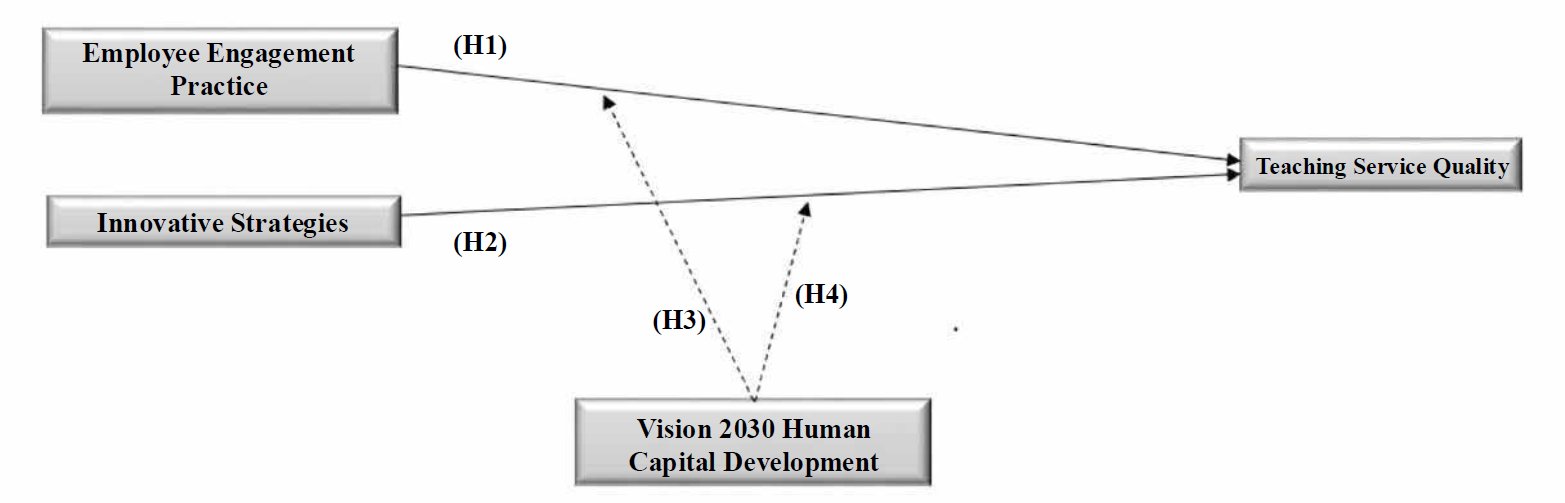
Fig. (1). Conceptual framework.
2.5. Literature Gap
The existing literature supports the idea that pedagogical and digital learning innovation positively affects learning outcomes and organisational performance (Bhuttah et al., 2024; Khadijah et al., 2025), whereas engagement practices have a positive impact on faculty motivation and teaching performance (Gede & Huluka, 2024; Verma & Kaur, 2024). Nonetheless, these studies mostly look at these constructs as independent, and little attention has been paid to their joint impact on service quality as a particular service-oriented outcome in teaching. Moreover, the engagement literature focuses on individual psychological engagement rather than engagement practices by an organisation (Ghamooshi et al., 2023). This restricts the understanding of how institutional mechanisms can be translated into better teaching quality. Similarly, in the literature on innovation strategies, these strategies are viewed independently, rather than linking them with a bigger framework of service quality in higher education institutions (Abdurashidova et al., 2023).
Moreover, there are reports of substantial improvements, including rising university rankings and greater graduate employability (Saudi Gazette, 2025; SPA, 2024), which indicate the greater significance of human capital growth in determining the outcomes of educational quality. Vision 2030 has also facilitated an increased focus on continuous learning, skills improvement, and institutional performance enhancement, especially through Vision 2030 (especially the Human Capability Development Program) (Alhazmy, 2025). Nevertheless, empirical studies that verify the moderating effect of human capital development on the relationships among engagement practices, innovation strategy, and the quality of teaching services are scarce. As Saudi higher education is undergoing policy-based changes, it is critical to study these interactions.
3. METHODOLOGY
The current research project used a quantitative research design to examine the connections among employee engagement practices, innovation strategy, and teaching service quality, with the moderating effect of Vision 2030 human capital development. Quantitative research is a method that allows for the systematic testing of hypothesised relationships based on numerical data and statistical procedures (Thomas & Zubkov, 2023). This is an explanatory study aimed at determining relationships between constructs, as opposed to determining causal consequences, which is consistent with prediction-oriented modelling strategies typical of organisational and educational research.
The study adopted purposive sampling as it is suitable when the research seeks individuals with specialised knowledge or familiarity with the context of the research goals (Obilor, 2023). The target population was the academic staff working in higher education institutes in Saudi Arabia. The faculty members were chosen because of their direct engagement with the teaching process, implementation of the curriculum, and incorporation of innovative teaching methods. The study included universities that fell within the scope of the transformation agenda of Vision 2030. This was to ensure that the respondents were exposed to relevant organizational practices and national-level initiatives. Specific inclusion criteria were used to select the participants as a purposive sample. The respondents had to be full-time academic employees with at least one year of teaching experience. In this manner, the participants, equipped with adequate knowledge and experience on the practices and innovation strategies related to institutional engagement, were included.
Data were collected through an online survey using closed-ended Likert-scale questions delivered through Google Forms. It is a free, popular, and fast distribution system that enables the efficient delivery of information and the automatic assembly of data (Kumar, 2021). Close-ended questions provide structured response options, resulting in measurable data that can be statistically analysed to enhance reliability and comparability across respondents to supplement quantitative research principles (Misner & Carr, 2023).
Participants were recruited through academic networks, university mailing lists, and professional networks, including LinkedIn. Invitations were emailed to approximately 600 faculty members at several universities in Saudi Arabia. A total of 420 responses were obtained, of which 350 were used after screening for completeness, consistency, and elimination of outliers. This is a reasonable size that is deemed sufficient to facilitate structural equation modelling and offer adequate statistical power to test the hypothesis. To further support the sufficiency of the sample size, G*Power analysis was used. This study followed the recommendation of (Kang, 2021), who stated that a minimum sample size of over 100 respondents is needed to identify medium effect sizes with a statistical power of 0.80 and a significance level of 0.05. The 350 final samples met the threshold, thus improving the strength and credibility of the analysis.
Although the population of academic staff in the context of the higher education sector in Saudi Arabia is quite large, the research was conducted among faculty members who met the purposive inclusion criteria and had sufficient familiarity with institutional engagement practices, innovation initiatives, and Vision 2030 reforms. Thus, the sampling frame was deliberately limited to respondents who could provide informed and contextually specific answers. The sample size of 600 questionnaires was deemed sufficient because PLS-SEM studies focus on sample sufficiency and statistical power, not population representativeness. Additionally, the sample size was larger than the minimum suggested in the methodological literature and G*Power analysis to identify a medium-sized effect with a reasonable level of statistical confidence.
The questionnaire had two major sections (Appendix A). The initial section captured demographics such as gender, age, academic rank, years of experience, and educational background. The significance of these variables is that they can impact teaching practice, level of engagement, and innovation readiness. The second section measured the study constructs: employee engagement, innovative strategy, Vision 2030 human capital development, and teaching service quality. All measurement items were evaluated on a five-point Likert scale (strongly disagree to strongly agree). Importantly, although the conceptual description of the study discusses perceived policy alignment as an explanatory construct, it is not operationalised as a measurable construct in the empirical model.
The questionnaire was generated from organisational behaviour, innovation management, and higher education research. The items on employee engagement practices were modified based on the research, which identified empowerment, professional development, and institutional support. Digital learning integration, curriculum redesign, and adoption of innovative teaching methods were some of the dimensions reflected in the innovation strategy items. Similarly, teaching service quality items were informed by SERVQUAL-related educational research, while Vision 2030 human capital development items were designed to capture faculty perceptions of national workforce development and institutional support initiatives. Some minor changes in wording were made to make it contextually relevant to Saudi Arabian higher education institutions.
The data obtained were processed using Partial Least Squares Structural Equation Modelling (PLS-SEM) via SmartPLS software. PLS-SEM was employed because the study aimed to examine complex predictive relationships, including direct and moderating effects, among latent constructs (Hair et al., 2021). PLS-SEM is more suitable for exploratory and prediction-oriented research models than covariance-based SEM, especially when the focus is on explaining the variance, as opposed to testing and confirming a theory. In addition, the technique is appropriate for analysing reflective constructs and models with interaction effects. The method also enables the measurement reliability, construct validity, and structural relationships to be simultaneously evaluated, which makes it very suitable for the aims of the present study.
The analysis was conducted in two steps: measurement model assessment and structural model assessment. Composite reliability and Cronbach’s alpha were checked using the recommended threshold values (P > 0.70). Convergent validity was evaluated using the Average Variance Extracted (AVE), with a value above 0.50 signifying satisfactory validity. The Heterotrait-Monotrait ratio (HTMT) was used to evaluate discriminant validity, as it is regarded as one of the most effective measures of construct distinctiveness (Afthanorhan et al., 2021).
Harman’s Single-factor test was done to control the possible Common Method Bias (CMB). The first factor explained less than half of the total variance, which means that common method bias will not significantly affect the findings (Howard et al., 2024). Moreover, the full collinearity Variance Inflation Factor (VIF) values were used to check CMB and found values below 5 for all of the constructs, which confirmed that the structural model estimation did not have a CMB issue. According to (Jeng, 2023), VIF values less than 5 are ideal for assessing CMB. Non-response bias was evaluated through early and late response evaluations, and there were no significant differences.
This study was conducted in accordance with high ethical standards to promote responsible research. The survey was completely voluntary, and the respondents were made fully aware of the aim and scope of the study before they filled out the questionnaire. Electronic informed consent was obtained, and the participants were free to withdraw at any point without repercussions. There were complete confidentiality and anonymity, and no personally identifiable information was collected. All data were kept safe and with great caution and were used only to conduct academic research as per the ethical codes.
4. RESULTS
4.1. Descriptive Analysis
Table 1 presents the demographic data of the 350 respondents. The findings revealed a moderate gender imbalance in the sample, with more males (60%) than females (40%). Most of the participants were aged between 25 and 44, implying that they have a fairly young and middle-aged academic workforce. Regarding qualifications, most of them had a doctoral degree (51.4%), followed by a master’s degree (42.9%), and only a small proportion had post-doctoral qualifications (5.7%). The largest occupational group is assistant professors (40.0%), followed by lecturers (25.7%), Associate Professors (22.9%), and professors (11.4%). The distribution of experience indicates that a majority of the respondents have experience of 3-10 years, and their responses are informed in relation to service quality and practice in the teaching institution.
Table 1. Descriptive analysis of 350 respondents.
| Variable | Category | Frequency (n) | Percentage (%) |
| Gender | Male | 210 | 60.0 |
| Female | 140 | 40.0 | |
| Age | Below 25 | 35 | 10.0 |
| 25–34 | 120 | 34.3 | |
| 35–44 | 110 | 31.4 | |
| 45–54 | 60 | 17.1 | |
| 55+ | 25 | 7.2 | |
| Qualification | Master’s | 150 | 42.9 |
| Doctorate | 180 | 51.4 | |
| Post-doctoral | 20 | 5.70 | |
| Position | Lecturer | 90 | 25.7 |
| Assistant Professor | 140 | 40.0 | |
| Associate Professor | 80 | 22.9 | |
| Professor | 40 | 11.4 | |
| Experience | <3 years | 60 | 17.1 |
| 3–5 years | 95 | 27.1 | |
| 6–10 years | 110 | 31.4 | |
| >10 years | 85 | 24.3 |
Note: Post-doctoral refers to respondents who completed postdoctoral research training after obtaining their doctorate.
4.2. Measurement Model Analysis
Table 2 affirms the high reliability and validity of the measurement models. The factor loadings were all greater than the recommended value of 0.70, with a value between 0.825 and 0.932, indicating a high level of reliability of the indicators. Cronbach’s alpha values for all constructs (0.832-0.902) indicate high internal consistency. Construct reliability is also supported by composite reliability values (0.900-0.939). In addition, the AVE values are between 0.749 and 0.837, which is above the minimum value of 0.50, showing a high level of convergent validity. These findings affirm that the employee engagement practices, innovation strategies, quality of teaching services, and human capital development of Vision 2030 are measured with high reliability and can be analysed in structural models.
Table 2. Measurement model.
| Latent Construct | Indicators | Factor Loading | Cronbach’s Alpha | Composite Reliability | Average Variance Extracted (AVE) |
| Employee Engagement Practices | EEP1 | 0.877 | 0.84 | 0.904 | 0.758 |
| EEP2 | 0.892 | ||||
| EEP3 | 0.841 | ||||
| Innovative Strategies | IS1 | 0.825 | 0.832 | 0.900 | 0.749 |
| IS2 | 0.914 | ||||
| IS3 | 0.855 | ||||
| Teaching Service Quality | TSQ1 | 0.907 | 0.902 | 0.939 | 0.837 |
| TSQ2 | 0.932 | ||||
| TSQ3 | 0.905 | ||||
| Vision 2030 Human Capital Development | VH1 | 0.894 | 0.89 | 0.932 | 0.819 |
| VH2 | 0.931 | ||||
| VH3 | 0.890 |
Note: Thresholds; Factor Loadings ≥ 0.70; CR ≥ 0.70; AVE ≥ 0.50 (Hair et al., 2021)
4.3. Discriminant Validity Analysis
Table 3 shows the results of the HTMT-based discriminant validity, which establishes that all constructs are empirically different. The HTMT values among the constructs were lower than the conservative level of 0.85, suggesting satisfactory discriminant validity. For example, employee engagement practices and Vision 2030 human capital development demonstrate moderate relationships, but they are still different constructs. Likewise, innovation strategies and teaching service quality show low-to-moderate correlations, which validates the conceptual segregation. Altogether, these findings prove that every construct is a measure of a distinct dimension of the model, and the subsequent analysis of the structure can be considered valid.
Table 3. Discriminant validity.
| – | Employee Engagement Practices | Innovative Strategies | Teaching Service Quality |
| Innovative Strategies | 0.602 | – | – |
| Teaching service quality | 0.612 | 0.453 | – |
| Vision 2030 human capital development | 0.713 | 0.521 | 0.724 |
Note: HTMT values < 0.85 (Cheung et al., 2023)
4.4. Path Coefficient Analysis
Table 4 presents the structural relationships between the study variables. Employee engagement practices are significantly associated with teaching service quality (β = 0.184, t = 2.755, p = 0.006), confirming H1. Nonetheless, its effect size was low (f2 = 0.033), indicating a modest practical association. There is a positive but insignificant relationship between innovation strategies and teaching service quality (β = 0.076, t = 1.343, p = 0.179), resulting in the rejection of H2. This demonstrates that in the current study sample, using innovation separately is not directly linked to improving teaching service quality. Moreover, although not hypothesised in this study for the direct effect, the positive association of Vision 2030 human capital development on teaching service quality was significant (β = 0.487, t = 7.348, p = 0.001) with a medium effect size (f2 = 0.229).
Table 4. Path coefficient.
| Path | Coefficient | T-statistics | P-values | f-square |
| Employee Engagement Practices → Teaching service quality | 0.184** | 2.755 | 0.006 | 0.033 |
| Innovative Strategies → Teaching service quality | 0.076 | 1.343 | 0.179 | 0.007 |
| Vision 2030 human capital development → Teaching service quality | 0.487*** | 7.348 | 0.001 | 0.229 |
| Vision 2030 × Employee Engagement Practices → Teaching service quality | 0.268*** | 4.215 | 0.001 | 0.182 |
| Vision 2030 × Innovative Strategies → Teaching service quality | 0.221*** | 2.987 | 0.003 | 0.156 |
Note: Asterisks show significant paths: ** for p < 0.05 (5%), and *** for p < 0.01 (1%)
Moderation analysis indicates that Vision 2030 human capital development plays a significant role in enhancing the relationship between employee engagement practices and teaching service quality (β = 0.268, t = 4.215, p = 0.001), supporting H3. Similarly, it has a significant moderating effect on the relationship between innovation strategy and teaching service quality (β = 0.221, t = 2.987, p = 0.003), supporting H4. These results suggest that innovation strategies and engagement practices are more effective when aligned with Vision 2030 human capital development initiatives. Therefore, Vision 2030 is not only a directly associated factor but also a contextual factor in organizational practices.
4.5. Explanatory Power and Predictive Relevance
Table 5 presents the explanatory power of the model. R2 values of 0.25, 0.5, and 0.75 are considered weak, moderate, and substantial, respectively (Wijaya et al., 2022). As per Table 5, the R2 of 0.455 suggests that teaching service quality can be explained by employee engagement practices, innovation strategies, and Vision 2030 human capital development by 45.5%, depicting a moderate level of explanatory power. The adjusted R2 of 0.447 confirms model stability when predictors are considered. Moreover, Q2 values of 0.02, 0.15, and 0.35 are small, medium, and large, respectively. The Q2 value of 0.418 in Table 5 shows large predictive relevance, that is, the model has excellent out-of-sample predictive accuracy. In general, these findings indicate that the specified theoretical framework offers a decent and marginally effective explanation of the teaching service quality in Saudi higher education establishments.
Table 5. Explanatory power of the model.
| – | R-Square | R-Square Adjusted | Q-Square |
| Teaching service quality | 0.455 | 0.447 | 0.418 |
5. DISCUSSION
The results of the present study offer valuable information about the association between organisational practices and national policy frameworks with teaching service quality in Saudi Arabian higher education. The outcomes partially confirm the proposed model, indicating a difference in the relationship between employee engagement practices, innovation strategies, and Vision 2030 human capital development. This finding suggests that innovation strategy may operate indirectly rather than being a directly associated factor.
H1: Employee Engagement and Teaching Service Quality.
The findings demonstrated a positive and statistically significant link between employee engagement practices and teaching service quality, which supports H1; however, the effect size was small (β = 0.184, t = 2.755, p = 0.006). This observation implies that institutional programs such as training, professional growth, empowerment, and favourable work conditions help improve teaching effectiveness. In higher education settings, this suggests that in situations where faculty members feel organisational support, they tend to display dedication and hard work in the teaching profession, which can enhance student learning experiences. This result is consistent with previous research, which notes that engagement practices are valuable in enhancing service outcomes and faculty performance (Chatiza et al., 2021; Chen et al., 2025; Pan et al., 2025). Nevertheless, the small effect size suggests that engagement practices alone might not be effective in significantly increasing the quality of teaching services. This suggests that although such practices are required, they must be supplemented with other institutional mechanisms to create more effective improvements in teaching outcomes.
H2: Innovation Strategy and Teaching Service Quality.
Conversely, the innovation strategy was not found to be significantly associated with the quality of teaching service (β = 0.076, t = 1.343, p = 0.179), which means the rejection of H2. Although the relationship is positive, it is rather weak and insignificant, which means that the existence of innovation initiatives in the form of digital tools, curriculum redesign, or new teaching methods might not directly correlate with the quality of teaching services. This finding is contrary to most of the available literature, which tends to show a positive relationship between innovation and the quality of education (Abdurashidova et al., 2023; Arrieta & Avolio, 2020).
A potential explanation is the specifics of the academic environment in Saudi universities, where conservative teaching standards and organizational frameworks could slow the practice-based adoption of new methods. The findings suggest that faculty members may also require more institutional support, technological preparedness, and pedagogical training. Another explanation is related to the operationalisation of the innovation strategy in this study. The construct mainly focused on institutional innovation initiatives and not on the effectiveness or successful implementation of initiatives in the classroom. Consequently, the results indicate a discrepancy between policy implementation and effective instructional change. Moreover, the significant moderation findings suggest that innovation initiatives may be more strongly associated with teaching service quality when supported by broader capability development environments. This suggests that innovation strategy can be linked to teaching service quality indirectly, via faculty competence or engagement or institutional alignment.
Moreover, innovation strategies applied in higher education may require time, resources, and adequate implementation before producing significant results. In other instances, when new technologies or methods of teaching are introduced without proper training or institutional backing, this could bring further complexity instead of enhancing teaching effectiveness. Moreover, faculty resistance to change or dependence on traditional teaching methods might limit the efficacy of the innovation strategy. Another possible explanation is that innovation can act indirectly and does not have a direct relationship with the quality of teaching services. This indicates that the relationship between innovation initiatives and teaching outcomes may be mediated by factors such as faculty competence, engagement, or institutional support. Consequently, future studies should investigate these possible mediating pathways to understand how innovation strategies can be translated into a higher quality of education. Consequently, the results imply that innovation strategies are not effective in isolation but should be well adopted into institutional practices to bring about a realistic change in teaching quality.
H3: Vision 2030 human capital development as a moderator between Employee Engagement and Teaching Service Quality.
The results provide a more refined insight into Vision 2030 human capital development, as they indicate that it can serve as a powerful direct associated factor and a powerful moderating factor. The direct effect of its direct effect on teaching service quality (β = 0.487, t = 7.348, p = 0.001) is significant; thus, it plays a central role as a macro-level determinant of educational outcomes. More importantly, it has a statistically significant moderating relationship with employee engagement practices and teaching service quality (β = 0.268, t = 4.215, p = 0.001), supporting H3. This suggests that Vision 2030 is not just a background enabling factor but a contextual force that links organisational practices to teaching outcomes.
Critically, the moderation of employee engagement practices suggests that although engagement shows a direct positive association (β = 0.184, p = 0.006), its relationship becomes stronger under conditions of high human capital development. This implies that organisational practices are more legitimised and effective when integrated into a consistent national structure. In line with previous studies (Chen et al., 2025; Pan et al., 2025), engagement improves faculty performance; however, this study goes further to demonstrate that its efficacy is contingent and not omnipresent. From the perspective of Social Exchange Theory, the findings suggest that reciprocal behaviour is reinforced when multilevel support is provided.
H4: Vision 2030 human capital development as a moderator between Innovation Strategy and Teaching Service Quality.
Another key insight is connected to the innovation strategy. Although its direct association is quite small (β = 0.076, p = 0.179), the moderating effect (β = 0.221, p = 0.003) is significant. This finding empirically demonstrates policy-practice alignment. The significant moderation effects imply that engagement and innovation become more effective when faculty members see that institutional practices are aligned with national initiatives. This provides a sophisticated understanding of the conflicting results in earlier studies (Al-Mekhlafi et al., 2024; Mohiuddin et al., 2023), where the consistency of implementation and alignment is crucial.
The results also suggest that employee engagement and innovation cannot be viewed as administrative activities that are handled separately in universities. Rather, educational institutions should integrate faculty support systems that include professional development, mentoring, recognition programs, and innovation-oriented teaching support. In terms of management, university management should concentrate more on building skills in the long term and not just on the adoption of technology. Digital infrastructure investment alone may not enhance teaching quality unless supplemented by ongoing faculty education, pedagogical mentoring, and institutional support for innovation adoption. There should also be more transparent monitoring mechanisms that will help policymakers determine whether the innovation initiatives yield measurable results in terms of the effectiveness of the teaching process and the learning outcomes of students. This is particularly relevant for Saudi Arabia, which has a reform-oriented environment with increasingly intersecting national priorities and institutional strategies.
The Saudi setting is particularly interesting because universities are embedded in a tightly cohesive national transformation agenda. In contrast to most higher education environments, in which institutional initiatives are formulated in isolation, Saudi universities have become more compelled to match organisational goals with Vision 2030 objectives. This may be the reason why the outcome of institutional practices appears to be strongly tied to broader human capital development contexts.
THEORETICAL CONTRIBUTION
This research adds to the literature on higher education and organisational literature by offering a contextualised test of established relationships within a national reform setting to teaching service quality that integrates both national policy factors and institutional practices. The study shows that the three theories (Social Exchange Theory, Resource-Based View, and Human Capital Theory) are not only complementary but also contextually dependent in a policy-influenced setting. The results add to the Social Exchange Theory by proposing that the efficiency of employee engagement practices is enhanced when underpinned by more general human capital programs, showing that the perceived organisational support can be external to institutional levels. With respect to the Resource-Based View, this study provides a subtle explanation in that innovation strategies do not always translate to direct performance but require enabling conditions to be effective. This underscores the relevance of contextual factors in utilising organisational capabilities. Additionally, this study supports the Human Capital Theory through the significant role of national-level investments, while also indicating that such investments can shape the effectiveness of organisational practices. This study does not present generalisable assertions but offers context-specific considerations and highlights the contingency of these relationships in Saudi higher education.
LIMITATIONS AND FUTURE DIRECTION
This study has several limitations that must be considered when interpreting the findings. First, the cross-sectional design does not provide the opportunity to draw conclusions regarding causality; therefore, further studies should use longitudinal methods to reveal long-term changes. Second, this study focused on a few variables, and other variables, such as leadership, organisational culture, or mediating variables, can be incorporated in future studies for a more in-depth understanding. Third, the use of quantitative data limits contextual interpretations; hence, qualitative or mixed studies are suggested to investigate the underlying mechanisms.
Moreover, since purposive sampling was used, the results of this study should be interpreted with caution regarding generalisability. The findings are specific to the context of Saudi Arabian institutions of higher learning and may not be entirely applicable to other systems and areas of education. Although teaching service quality is normally considered in light of students, the current study deliberately considered faculty perceptions because the main aim was to examine how organisational practices affect teaching-related processes in universities. Faculty members are directly engaged in teaching, curriculum implementation, and adoption of innovations; therefore, they are the right respondents to assess institutional practices and teaching conditions. However, the use of student reviews might provide a more impartial assessment of the quality of services. Consequently, future studies should adopt a multi-stakeholder approach by incorporating both faculty and student voices to enhance the strength of the results. Moreover, all data were self-reported, which increases common method bias, despite efforts to reduce it.
Finally, despite the fact that the study presents perceived policy alignment as a theoretical tool connecting macro-level policy to individual behaviour, the latter was not measured empirically. Future studies should operationalise and test this construct to better understand its mediating or moderating role.
CONCLUSION
This study demonstrates that both institutional practices and general policy contexts are vital for comprehending teaching service quality. Although employee engagement has positive effects, it has a weak effect size, whereas the direct effect of innovation strategies is insignificant. However, both constructs showed positive and significant associations with teaching service quality when there were supportive human capital programs. These results indicate that organisational initiatives can be effective based on how much they are aligned with national development frameworks, which provides a more comprehensive approach to enhancing teaching outcomes in higher education.
PRACTICAL AND POLICY IMPLICATION
The results indicate that policymakers in higher education in Saudi Arabia should focus on the systematic alignment of Vision 2030 human capital programs with university practices. An example is the creation of standardised faculty development models that are directly connected to the Human Capability Development Program, which will help achieve consistency in implementation across different universities. Institutions should operationalise employee engagement practices by integrating formal training activities, mentoring activities, and performance-based incentives that are specifically linked to teaching quality indicators, such as student feedback and student learning outcomes. On the institutional level, higher education must go beyond the facade of innovation and offer specific university training on digital pedagogy, curriculum redesign, and the use of technology to make proper use of it. This can be facilitated by establishing teaching innovation labs and ongoing professional development workshops. In addition, higher education institutions must develop an internal surveillance infrastructure to measure the long-term effectiveness of engagement and innovation practices in terms of teaching service quality. In general, policy instructions and institutional implementation require collaborative action to convert strategic initiatives into quantifiable teaching changes.
LIST OF ABBREVIATIONS
AVE | = | Average Variance Extracted |
HCT | = | Human Capital Theory |
HCDP | = | Human Capability Development Program |
HTMT | = | Heterotrait-Monotrait ratio |
PLS-SEM | = | Partial Least Squares Structural Equation Modelling |
RBV | = | Resource-Based View |
SET | = | Social Exchange Theory |
VIF | = | Variance Inflation Factor |
AUTHORS’ CONTRIBUTIONS
B.A has contributed to the study conceptualization, methodology, data analysis, interpretation of the results, and manuscript writing. S.A has contributed to the literature review, data collection, formal analysis, and manuscript editing. B.M and F.A have supervised the study, validated the findings, reviewed and revised the manuscript critically for important intellectual content, and approved the final version for publication. All authors read and approved the final manuscript.
ETHICAL APPROVAL & INFORMED CONSENT
This study was conducted in accordance with high ethical standards to promote responsible research. The survey was completely voluntary, and the respondents were made fully aware of the aim and scope of the study before they filled out the questionnaire. Electronic informed consent was obtained, and the participants were free to withdraw at any point without repercussions. There were complete confidentiality and anonymity, and no personally identifiable information was collected. All data were kept safe and with great caution and were used only to conduct academic research as per the ethical codes.
AVAILABILITY OF DATA AND MATERIALS
The data will be made available on reasonable request by contacting the corresponding author [B.A.].
FUNDING
None.
CONFLICT OF INTEREST
The authors declare that there is no conflict of interest regarding the publication of this article.
ACKNOWLEDGEMENTS
Declared none.
DECLARATION OF AI
The authors used ChatGPT solely to improve the language, grammar, and readability of this manuscript. The AI tool was not used to generate, interpret, or analyze research findings, nor to formulate scientific conclusions. Following its use, the authors carefully reviewed, revised, and validated the manuscript and assume full responsibility for the accuracy, integrity, and originality of its content.
APPENDIX A
Study Title: Employee Engagement Practices and Innovation Strategy on Teaching Service Quality: Moderating Role of Vision 2030 Human Capital Development
Research Team: [Student names]
Introduction
Thank you for considering participation in this research study. We, a group of students, are conducting a study on the relationship between employee engagement practices, innovation strategy, and teaching service quality, with a particular focus on the moderating role of Vision 2030 human capital development. Your participation is valuable and will significantly contribute to the completion of this research.
Purpose of the Study
The aim of this study is to explore how employee engagement practices and innovation strategies influence teaching service quality, and how Vision 2030 human capital development initiatives act as a moderator in this relationship. By participating, you will help us understand the role of engagement and innovation in improving service quality in teaching, as well as how the Vision 2030 reforms in human capital development are shaping these practices within educational institutions. Your responses will provide valuable insights into the effectiveness of these strategies and the impact of Vision 2030 on education quality.
What will I be asked to do?
You will be asked to complete a questionnaire that will take approximately 5-15 minutes to complete. The questions will focus on your experiences and views regarding employee engagement practices, innovation strategies in teaching, and the impact of Vision 2030 human capital development on teaching service quality. Your participation will help us collect essential data to support our research findings.
Confidentiality
Your responses will be kept strictly confidential. The information you provide will only be used for research purposes. No personally identifiable information will be collected, and your participation will remain anonymous.
Voluntary Participation
Participation in this study is entirely voluntary. You can choose not to participate, or withdraw from the study at any time without any consequences. If you decide to withdraw, your responses will be excluded from the final analysis.
Potential Risks
There are no anticipated risks involved in participating in this study. The questions are non-invasive and do not require sensitive personal information. If you feel uncomfortable at any point, you are free to skip any questions or withdraw.
Thank you for taking the time to consider participating in this study. Your involvement is greatly appreciated.
Section 1: Demographics
- What is your gender?
- Male
- Female
- Prefer not to say
2.What is your age group?
- Below 25
- 25–34
- 35–44
- 45–54
- 55 and above
3.What is your highest educational qualification?
- Bachelor’s
- Master’s
- Doctorate
- Post-doctoral qualification
4. What is your current academic position?
- Lecturer
- Assistant Professor
- Associate Professor
- Professor
5. How many years of total experience do you have in this industry?
- Less than 3 years
- 3–5 years
- 6–10 years
- More than 10 years
Section 2: Questionnaire
| Variable | Question Statement | Strongly Disagree (1) | Disagree (2) | Neutral (3) | Agree (4) | Strongly Agree (5) |
| Employee Engagement Practices | My institution provides strong engagement practices for faculty development. | ☐ | ☐ | ☐ | ☐ | ☐ |
| Training and empowerment opportunities enhance my teaching effectiveness. | ☐ | ☐ | ☐ | ☐ | ☐ | |
| Engagement practices increase my commitment to teaching responsibilities. | ☐ | ☐ | ☐ | ☐ | ☐ | |
| Innovation Strategy | Innovation is actively promoted within my institution to enhance teaching quality. | ☐ | ☐ | ☐ | ☐ | ☐ |
| Encouraged to integrate innovative methods and technology in teaching. | ☐ | ☐ | ☐ | ☐ | ☐ | |
| Innovation in teaching practices contributes to improved service quality for students. | ☐ | ☐ | ☐ | ☐ | ☐ | |
| Vision 2030 Human Capital Development | Vision 2030’s human capital development strategy has improved the quality of education at my institution. | ☐ | ☐ | ☐ | ☐ | ☐ |
| Vision 2030’s human capital development initiatives support the growth and development of teaching staff. | ☐ | ☐ | ☐ | ☐ | ☐ | |
| The human capital development focus of Vision 2030 has motivated me to improve my teaching performance. | ☐ | ☐ | ☐ | ☐ | ☐ | |
| Teaching Service Quality | I provide clear, organized, and effective instruction during my teaching activities. | ☐ | ☐ | ☐ | ☐ | ☐ |
| I use appropriate teaching methods and resources to support students’ learning needs. | ☐ | ☐ | ☐ | ☐ | ☐ | |
| I provide timely support and constructive feedback to facilitate students’ learning progress. | ☐ | ☐ | ☐ | ☐ | ☐ |
REFERENCES
Alhazmy, E. A. (2025). Education reform and vision 2030 in Saudi Arabia: challenges and pathways. Discover Education, 5, 40.
https://doi.org/10.1007/s44217-025-01005-4
Abdurashidova, M., Balbaa, M. E., Nematov, S., Mukhiddinov, Z. & Nasriddinov, I. (2023). The impact of innovation and digitalization on the quality of higher education: A study of selected universities in Uzbekistan. Journal of Intelligent Systems, 32(1), 20230070.
https://doi.org/10.1515/jisys-2023-0070
Abubakar, A. A., Al-Mamary, Y. H., Singh, H. P., Singh, A., Alam, F., & Agrawal, V. (2024). Exploring factors influencing sustainable human capital development: Insights from Saudi Arabia.Heliyon,10(16).
https://doi.org/10.1016/j.heliyon.2024.e35676
Afthanorhan, A., Ghazali, P. L., & Rashid, N. (2021). Discriminant validity: A comparison of CBSEM and consistent PLS using Fornell & Larcker and HTMT approaches. In Journal of Physics: Conference Series (Vol. 1874, No. 1, p. 012085). IOP Publishing.
https://doi.org/10.1088/1742-6596/1874/1/012085
Ahmed, U., Shakur, M. M. A., Hashim, S., & Ahmed, R. (2024). The impact of training and digital enablement on employee competence and brand relationship quality in higher education institutions. International Journal of Academic Research in Business and Social Sciences, 14(7), 1566–1575.
https://doi.org/10.6007/IJARBSS/v14-i7/21969
Ajobi, A. O., Ismail, I. A. B., Ismail, S. B., & Owunna, R. (2025). Enhancing employee performance through training: A theoretical exploration of social exchange theory.Quantum Journal of Social Sciences and Humanities, 6(3), 489-501.
https://doi.org/10.55197/qjssh.v6i3.706
Alemu, A. (2023). Assessing service quality in tertiary Education using adapted SERVQUAL scale. Cogent Education, 10(2), 2259733.
https://doi.org/10.1080/2331186X.2023.2259733
Ali, Q. B., Zin, M. L. M., & bin Ismail, S. A. (2024). The role of human capital, structural capital, and relational capital in higher education institutions performance. Journal of Management Info, 11(2), 185-196.
https://doi.org/10.31580/jmi.v11i2.2874
Al-Mekhlafi, A. W. A. G. S., Al-Mekhlafi, H. A. G., Al-Kahtani, S. M., & Abdelmahmod, M. K. A. (2024). The moderating role of human capital training and development in the relationship between smart administrative governance, smart technical governance, and sustainable development in Saudi non-profit institutions. Discover Sustainability, 5(1), 274.
https://doi.org/10.1007/s43621-024-00493-y
Arrieta, M. D. C., & Avolio, B. (2020). Factors of higher education quality service: The case of a Peruvian university. Quality Assurance in Education, 28(4), 219-238.
https://doi.org/10.1108/QAE-03-2020-0037
Bhuttah, T. M., Xusheng, Q., Abid, M. N., & Sharma, S. (2024). Enhancing student critical thinking and learning outcomes through innovative pedagogical approaches in higher education: the mediating role of inclusive leadership. Scientific reports,14(1), 24362.
https://doi.org/10.1038/s41598-024-75379-0
Chatiza, K., Mubvundu, M., & Chisango, S. (2021). Employee engagement and service delivery in tertiary institutions: Case of a public university in Zimbabwe. Journal of African Interdisciplinary Studies. 5(11), 79–102. Available from: https://cedred.or.ke/jais/images/november2021/PDF_Chatiza_et_al_Employee_Engagement_and_Service_Delivery_in_Tertiary_Institutions.pdf (Accessed on: 19 June, 2026).
Chen, H., Swatdikun, T., Prempanichnukul, V., & Hao, W. (2025). Performance management and job performance: The intervening role of job engagement at Sichuan University of science and engineering, China. Social Sciences & Humanities Open, 12, 102026.
https://doi.org/10.1016/j.ssaho.2025.102026
Cheung, G.W., Cooper-Thomas, H.D., Lau, R.S. & Wang, L.C. (2023). Reporting reliability, convergent and discriminant validity with structural equation modeling: A review and best-practice recommendations. Asia Pacific Journal of Management, 41, 745–783.
https://doi.org/10.1007/s10490-023-09871-y
Cook, K. S., Cheshire, C., Rice, E. R., & Nakagawa, S. (2013). Social exchange theory. In Handbook of social psychology (pp. 61-88). Dordrecht: Springer Netherlands.
https://doi.org/10.1007/978-94-007-6772-0_3
Cui, J. (2025). The explore of knowledge management dynamic capabilities, AI-driven knowledge sharing, knowledge-based organisational support, and organisational learning on job performance: Evidence from Chinese technological companies. arXiv preprint arXiv:2501.02468.
https://doi.org/10.48550/arXiv.2501.02468
ETS. (2025). More than 90% of Saudi respondents say that continuous learning is essential for success today, according to new report from ETS and HCI. Available from: https://www.ets.org/newsroom/ets-hci-launch-hpr-saudiedition.html (Accessed on: 19 June, 2026).
Fix, B. (2021). The rise of human capital theory. Real-World Economics Review, (95), 29-41. Available from: https://www.paecon.net/PAEReview/issue95/Fix95.pdf (Accessed on: 19 June, 2026).
Gede, D. U., & Huluka, A. T. (2024). Effects of employee engagement on organisational performance: case of public universities in Ethiopia. Future Business Journal, 10(1), 32.
https://doi.org/10.1186/s43093-024-00315-7
Ghamooshi, Z., Pourkarimi, J., & Ehtesham, Z. (2023). Multiple Prediction of Job Satisfaction Using Professional Development Components of Faculty Members of Universities and Higher Education Institutions. Higher Education Letter,16(64), 7-32.
https://doi.org/10.22034/HEL.2024.709928
Hair Jr, J. F., Hult, G. T. M., Ringle, C. M., Sarstedt, M., Danks, N. P., & Ray, S. (2021). An introduction to structural equation modeling. In Partial least squares structural equation modeling (PLS-SEM) Using R: A workbook (pp. 1-29). Cham: Springer International Publishing.
https://doi.org/10.1007/978-3-030-80519-7_1
Howard, M. C., Boudreaux, M., & Oglesby, M. (2024). Can Harman’s single-factor test reliably distinguish between research designs? Not in published management studies. European Journal of Work and Organisational Psychology, 33(6), 790-804.
https://doi.org/10.1080/1359432X.2024.2393462
Jeng, C. C. (2023). Why a variance inflation factor of 10 is not an ideal cutoff for multicollinearity diagnostics. Journal of Education Studies, 57(2), 67-93.
https://doi.org/10.53106/199044282023105702004
Kahn, W. A. (2017). Psychological conditions of personal engagement and disengagement at work. Academy of Management Journal, 33(4), 692-724.
https://doi.org/10.5465/256287
Kang, H. (2021). Sample size determination and power analysis using the G*power software. Journal of Educational Evaluation for Health Professions, 18, 17.
https://doi.org/10.3352/jeehp.2021.18.17
Khadijah, I., Nurhamidah, N., Mulyani, L., Amanah, S. N., & Sukmanawati, N. (2025). Improving learning outcomes through innovative pedagogical approaches in modern education. Journal of English Language and Education, 10(1), 423-433.
https://doi.org/10.31004/jele.v10i1.661
Kumar, M. (2021). Top-notch benefits of Google Forms survey data collection. Medium. Available from: https://marketing-insightsdna.medium.com/top-notch-benefits-of-google-forms-survey-data-collection-f27c7f08c6a6 (Accessed on: 19 June, 2026).
Ma, Z. (2025). A systematic literature review of human capital and education policy 2014-2024.Higher Education Research, 10(6) 231-246.
https://doi.org/10.11648/j.her.20251006.12
Misner, J., & Carr, G. (2023). Survey research. Messages that Matter: Public Speaking in the Information Age-Third Edition. Available from: https://nic.pressbooks.pub/messagesthatmatter/chapter/survey-research/ (Accessed on: 16 June, 2026).
Mohiuddin, K., Nasr, O. A., Miladi, M. N., Fatima, H., Shahwar, S., & Naveed, Q. N. (2023). Potentialities and priorities for higher educational development in Saudi Arabia for the next decade: Critical reflections of the vision 2030 framework. Heliyon, 9(5), e16368.
https://doi.org/10.1016/j.heliyon.2023.e16368
Nalini, M., Karthikeyani, V., Sajitha, V. M., Murugan, R., Rajasekaran, R., Adarsh, R., … & Sivasubramanian, K. (2026). Reviewing employee engagement in higher education institutions and its Impact on teacher’s performance, efficiency, and effectiveness. In Empowering Business Through Technology: Innovations Shaping Our Future (pp. 315-321). Cham: Springer Nature Switzerland.
https://doi.org/10.1007/978-3-032-02056-7_25
Obilor, E. I. (2023). Convenience and purposive sampling techniques: Are they the same. International Journal of Innovative Social & Science Education Research, 11(1), 1-7. Available from: https://www.researchgate.net/profile/Esezi-Obilor/publication/398681103_Convenience_and_Purposive_Sampling_Techniques_Are_they_the_Same/links/693fe9e8a1fd01798907e406/Convenience-and-Purposive-Sampling-Techniques-Are-they-the-Same.pdf
Omolola, F. F. (2023). The Influence of Employee Participation, Employee Empowerment and Employee Decision-Making on Employee Engagement in Nem Insurance Plc (Doctoral Dissertation, Department of Employment Relations and Human Resource Management, Faculty of Management Sciences, University of Lagos). Available from: https://www.academia.edu/download/125274546/THE_INFLUENCE_OF_EMPLOYEE_PARTICIPATION_EE_AND_ED_ON_EMPLOYEE_ENGAGEMENT_IN_NEM_INSURANCE_PLC.pdf
Pan, L., & Abd Rani, N. S. (2025). The impact of professional development, employee engagement on teaching performance among university teachers in Shanghai city, China. Uniglobal Journal of Social Sciences and Humanities,4(1), 57–65.
https://doi.org/10.53797/ujssh.v4i1.7.2025
Paños-Castro, J., Korres, O., Iriondo, I., & Petchamé, J. (2024). Digital transformation and teaching innovation in higher education: A case study. Education Sciences,14(8), 820.
https://doi.org/10.3390/educsci14080820
Saheli, J. (2025). Innovative teaching Strategies for Better Student Engagement and Tips of Implementation. Pen and Prosperity, 2(3), 145-155.
https://doi.org/10.70798/PP/020300018
Saudi Gazette (2025). Saudi graduates see record job market entry in 2024. Available from: https://saudigazette.com.sa/article/653373/SAUDI-ARABIA/Saudi-Human-Capability-Program-boosts-youth-employment-startup-growth-in-2024 (Accessed on: 19 June, 2026).
Saudi Vision 2030 (2021). Human Capability Development Program. Vision2030.gov.sa. Available from: https://www.vision2030.gov.sa/en/explore/programs/human-capability-development-program (Accessed on: 19 June, 2026).
SPA (2024). Minister hails Saudi Arabia’s higher education milestone. Arab News PK. Available from: https://www.arabnews.pk/node/2567703/saudi-arabia (Accessed on: 19 June, 2026).
Sugiarno, Y., & Novita, D. (2022). Resources-Based View (RBV) as a strategy of company competitive advantage: A literature review. In International conference on economics business management and accounting (ICOEMA)(Vol. 1, pp. 656-666). Available from: https://www.researchgate.net/publication/370765611_Proceeding_International_Conference_on_Economic_Business_Management_and_Accounting_ICOEMA-2022_Program_Studi_Doktor_Ilmu_Ekonomi_Resources-Based_View_RBV_as_A_Strategy_of_Company_Competitive_Advantage
Sultana, N., Ahmad, A., Awi, N. A., & Usman, M. (2024). Mediating effect of employee engagement on psychological capital and employee innovative work behaviour among teaching staff of Pakistan public sector HEIs. Journal of International Crisis & Risk Communication Research (JICRCR), 7, 996.
https://doi.org/10.63278/jicrcr.vi.996
Sumathi, D. (2022). Innovative teaching strategies. Psycho-Technological Approaches in Heutagogy, 25. Available from: https://files.eric.ed.gov/fulltext/ED619929.pdf (Accessed on: 19 June, 2026).
Tan, J. X., Chong, C. W., & Cham, T. H. (2025). A social exchange perspective in sustaining employee engagement: Do benevolent leaders really matter? Cogent Business & Management, 12(1).
https://doi.org/10.1080/23311975.2025.2493310
Thomas, D., & Zubkov, P. (2023). Quantitative research designs. In book Quantitative Research for Practical Theology, 103-114. Available from: https://www.researchgate.net/profile/Darrin-Thomas/publication/370630979_Quantitative_Research_Designs/links/645a8b0c2edb8e5f094afcfe/Quantitative-Research-Designs.pdf (Accessed on: 19 June, 2026).
Verma, S., & Kaur, G. (2024). Faculty retention dynamics: Investigating the role of HR climate, trust, and organisational commitment in higher education context. Sage Open, 14(1), 21582440241233372.
https://doi.org/10.1177/21582440241233372
Wijaya, T. T., Jiang, P., Mailizar, M., & Habibi, A. (2022). Predicting factors influencing preservice teachers’ behaviour intention in the implementation of STEM education using partial least squares approach. Sustainability, 14(16), 9925.
https://doi.org/10.3390/su14169925
Ziemnowicz, C. (2020). Joseph A. Schumpeter and innovation. In Encyclopedia of creativity, invention, innovation and entrepreneurship (pp. 1517-1522). Cham: Springer International Publishing.
https://doi.org/10.1007/978-3-319-15347-6_476
Licensed
© 2026 Copyright by the Authors.
Licensed as an open access article using a CC BY 4.0 license.
Article Contents Author Felicia Gabriela Beresescu1, * 1College of Business-Al Khobar, Al Yamamah University, Saudi Arabia Article History: Received: 21
Article Contents Authors Saman Ismail1, * Imran Iqbal2 1Faculty of Management Science, Department of Business Administration, Salim Habib University, Karachi,
Article Contents Author Michael Dolinsky1, * 1Faculty of Mathematics and Technologies of Programming, Francisk Skorina Gomel State University,
Article Contents Author Abdul Ghafoor Memon1, * 1Emaan Institute of Management Sciences, Karachi, Pakistan Article History: Received: 01 April, 2026
Article Contents Authors Zixuan Zhao1, Ju Guo1, * 1School of Management, Chengdu University of Information Technology, Chengdu, China Article History:
Article Contents Authors Sultan Ud Din Yousufzai1, Amtyaz Safi2, * , Maher Khan1, Zia Ud Din1 1Department of Zoology, Govt.