






Article Contents
Article ID: CM2602112008
Views: 1092Re-Establishing Jordan’s Brand Trust in the Tourism Sector Using Experiential Marketing: A Post-Gaza Conflict Scenario
 DOI:
DOI:
 PDF
PDF
⬇ Downloads: 16
Abu-Alhaija, A.S. (2026). Re-establishing jordan’s brand trust in the tourism sector using experiential marketing: A post-gaza conflict scenario. Majestic Global Trends in Marketing & Supply Chain Management, 2, 1–18, Article ID: CM2602112008. https://doi.org/10.65080/mgtmscm.v2.CM2602112008
Abu-Alhaija, Ahmad Saif. 2026. “Re-establishing jordan’s brand trust in the tourism sector using experiential marketing: A post-gaza conflict scenario.“ Majestic Global Trends in Marketing & Supply Chain Management, 2:1–18, Article ID: CM2602112008. https://doi.org/10.65080/mgtmscm.v2.CM2602112008
Abu-Alhaija, A.S., (2026). Re-establishing jordan’s brand trust in the tourism sector using experiential marketing: A post-gaza conflict scenario. Majestic Global Trends in Marketing & Supply Chain Management, 2, 1–18, Article ID: CM2602112008. https://doi.org/10.65080/mgtmscm.v2.CM2602112008
Abu-Alhaija AS. Re-establishing jordan’s brand trust in the tourism sector using experiential marketing: A post-gaza conflict scenario. Maj Glob Trends Mark Supply Chain Manag. 2026 Apr 6; 2, 1–18, Article ID: CM2602112008. doi: 10.65080/mgtmscm.v2.CM2602112008
1College of Business Studies, Arab Open University- KSA, Dammam, Saudi Arabia
Received: 14 October, 2025
Accepted: 12 February, 2026
Revised: 01 January, 2026
Published: 06 April, 2026
ABSTRACT:
Introduction: Geopolitical conflict is increasingly becoming a significant obstacle for the recovery of tourism destinations, as it hinges on whether they can regain brand trust among risk-averse travellers. Nonetheless, there has been a lack of empirical studies on the role of experiential marketing in recovering brand trust based through the perceived safety during the post-conflict tourism situations.
Methods: Quantitative data were collected from both domestic and international tourists and tourism service providers, and qualitative data were obtained through semi-structured interviews with major stakeholders, including tourism officials, marketing professionals, and hospitality managers. Quantitative and qualitative data analysis were conducted using structural equation modelling (PLS-SEM) and thematic analysis, respectively, following the methods of Braun and Clarke.
Results: The findings of path coefficient analysis indicates that brand trust is highly predicted by the perceived safety (β = 0.748, p = 0.001). Feel positively has a substantial positive impact on trust (β = 0.085, p = 0.05), and a weak direct impact act positively (β = 0.094, p = 0.10). The dimensions of sense and think positively do not have direct effect on trust but they have a significant indirect influence which shows full mediation.
Conclusion: The research has contributed to the literature on experiential marketing and brand trust in conflict tourism using a comprehensive safety-based framework. In practice, it provides evidence-based advice to policymakers and tourism practitioners on planning experiential strategies that enhance tourism recovery, destination resilience, and the re-establishment of international tourist confidence, and facilitates sustainable, long-term sectoral competitiveness in Jordan.
Keywords: Experiential marketing, brand trust, perceived safety, tourism sector, geopolitical conflict, destination resilience.
1. INTRODUCTION
Tourism is among the most dynamic economic sectors in Jordan, making a substantial contribution to local development and cultural exchange and creating employment opportunities (Allan, 2025). However, after the Gaza conflict, tourism businesses in Jordan are struggling to regain travellers’ confidence in Jordan as a safe travel destination and to maintain tourist inflows (Papagianni et al., 2024). Brand trust has become a key element in restoring the country’s tourism attractiveness, as tourists are more willing to travel to new places perceived as safe and that provide emotional satisfaction (Bader et al., 2024; Jawabreh, 2021). In this context, the experiential marketing strategies tends to provide Jordan with the effective means of reconciling with prospective visitors based on sensory, emotional, cognitive, behavioural, and relational marketing, and restore the trust with redefining the image of the country as a safe and rewarding place to visit which is suggested by also (Aldweik, 2024; Saleh et al., 2023).
Against this background, Jordan emerges as a country where tourism is an extremely important economic catalyst, accounting for approximately 14.6% of GDP and providing employment for half a million people (Weldali, 2023). In 2023, the Kingdom received almost 6.3 million tourists, an increase of 25.8% over the past year, and earned close to JD 5.26 billion in receipts (The Jordan Times, 2023). However, the eruption of the Gaza conflict towards the end of 2023 unleashed drastic consequences for Jordan’s tourism industry. Global travel to Jordan plummeted, and places like Petra saw tourist numbers drop by more than 60% compared to pre-war levels (The National, 2025). Hotels in Petra, Wadi Rum, and other key attractions have registered cancellation rates of more than 70% which has seen dozens of hotels close down leading to large scale layoffs (Arab News, 2025). The European and North American markets, which were once significant contributors, also plummeted to the ground as tourists were more hesitant to visit the region according to (Akamavi et al., 2023; and Papagianni et al., 2024) because of security threats and negative publicity.
Although the situation is stable in Jordan on its territory, and there are no signs of a direct armed conflict, the instability in the region due to the Gaza conflict has resulted in the large-scale spillover effects, such as the international media coverage, travel advisories, and the perception of increased geopolitical risks (Efendi et al., 2023). According to (Chen & Wu, 2022), tourists tend to extend the regional conflict in the destinations they visit to the rest of the places whether the area is safe or not. This has seen the Jordan tourism brand being degraded and confidence has been more of a psychological and symbolic defeat than economic. This is because negative imagery, uncertainty, and fear erode the belief of tourists in the emotional perspective and their cognitive judgments of the destination reliability as reported by (Bader et al., 2024). Even in cases when there is no damage to infrastructure, security systems, and visitor services, whenever such symbolic damage is done, trust is undermined. Perception gaps, reassurance mechanisms, and trust signalling are required to rebuild tourism performance in a post-conflict-adjacent environment, instead of placing the emphasis on financial recovery indicators, or visitor numbers as an indicator of modern destination branding research.
The issues facing the tourism industry in Jordan in the post Gaza conflict situation are multi-dimensional. Besides direct financial losses, the major issue is the lack of brand trust in the tourism industry, where the Jordanian reputation as a safe, secure, and rewarding location in terms of emotions and other benefits was destroyed, as (Al-Riffai, 2024; and Arabeyyat & Aldweik, 2024) are not isolated. Conversely, the Ministry of Tourism and Antiquities also showed recovery in fractions in early 2025 when revenue in the sector hits JD 5.13 billion and the number of arrivals increased by 19 percent, an increase compared to the performance of 2024, but still below the 2023 performance (Petra, 2025). This is an indication that the international image and brand confidence in the Jordan tourism industry may require more than the economic recovery; new and effective experiential marketing strategies are necessary to reconnect with the tourists.
The importance of the study is that it is an effort to remedy those ills by looking into how experiential marketing variables including sense positively, feel positively, think positively, and act positively can be implemented strategically to rebuild brand trust on tourism sector of Jordan especially in the post-Gaza conflict context. The current paper will provide evidence-based insights into the ways of improving the reputation Jordan as a reliable and trustworthy destination by examining the effects of these dimensions on consumer perceptions and trust in the brand during the post-conflict situations.
Also, the perceived safety is believed to mediate between the experiential marketing and brand trust with reference to the post-Gaza-conflict destinations like Jordan. Besides this, perceived safety is also a key variable that has a mediating role in the relationship between experiential marketing and brand trust of tourists to conflicted destinations like Jordan. In this light, (Awais-E-Yazdan et al., 2025) stated that perceived safety is a central factor in tourist destination selection intention and emotional affection to the destination. Emotions and real engagement of experience marketing promote the sense of safety and, consequently, establish loyalty and trust in the destination brand (Bader et al., 2024; Saleh et al., 2023).
The works of the present research article are threefold. Regarding the contributions in terms of theory, the paper adds to the body of knowledge in integrating the techniques of experiential marketing method with the model of brand trust, specifically in the post-conflict tourism situation in Jordan. The empirical findings of the research article offer some new scientific knowledge in the tourism industry in Jordan, which captures the causal correlations between four dimensions of experiential marketing and brand trust. Moreover, the paper identifies the mediating impact of the perception of safety in this relationship whereby cognitive, emotional, sensory, and behavioural experiences are more likely to increase the sensation of safety among the tourists which may ultimately boost their confidence in Jordan as a safe tourist destination.
1.1. Research Objectives
- To examine the effects of experiential marketing dimensions (sense, feel, think, act, and relate positively) on brand trust in Jordan’s tourism sector in the post-Gaza conflict context.
- To assess the mediating role of perceived safety in the relationship between experiential marketing and brand trust.
1.2. Research Questions
- How do experiential marketing dimensions influence brand trust in Jordan’s tourism sector following the Gaza conflict?
- To what extent does perceived safety mediate the relationship between experiential marketing and brand trust?
2. LITERATURE REVIEW
2.1. Theoretical Framework
The study applies Signalling Theory, which, as per (Alazaizeh et al., 2024; and Jain et al., 2025), posits that in circumstances of uncertainty, potential customers or actors rely on credible signals to form specific judgments about an event or brand. In the context of tourism, experiential marketing can be used to signal sensory, emotional, cognitive, behavioural, and relational experiences against the perceived risks among tourists in the post-Gaza conflict context. Simultaneously, as noted by (Novitaningtyas et al., 2025; and Senathirajah et al., 2024), the Trust-Commitment Theory provides an integrative contribution by stating that trust is a pillar of relationships between the brand and its customers. Using this as a destination branding and rebuilding brand trust in Jordan, it needs to provide tourists with positive, consistent experiences that build credibility and commitment. Collectively, the theories offer a conceptual framework for analysing experiential marketing as a promotional strategy and a trust-building technique. The current study has its theoretical foundation at this school of thought with an aim of comprehending how the experimental marketing methods can be utilized to restore brand trust and competitive positioning in the Jordan tourism industry after the Gaza conflict. The necessity to introduce a hybrid theoretical framework, such as Signalling Theory and Trust-Commitment Theory, is high, as they represent the two opposite methods of creating trust. The Signalling Theory describes the process of cues associated with experiential marketing which signal safety, reliability and credibility in the presence of uncertainty and the Trust-Commitment Theory describes how positive experience cues evolve over time resulting in long term trust and relational commitment. Both theories provide a comprehensive account of how trust can be restored in the situation of post-conflict tourism. Even though Signalling Theory and Trust-Commitment Theory are applied to explain how experiential marketing signals are used to build trust in stable market conditions, they are not theoretically developed concerning post-conflict tourism contexts with increased uncertainty and risk perception. This paper builds on these theories by conceptualising perceived safety as a conditioning process and by reformulating the credibility and efficacy of experiential cues, thereby redefining the emergence of trust and commitment under conditions of geopolitical instability and destination vulnerability, such as the post-Gaza conflict situation in Jordan.
2.2. Sense Positively Effect on Brand Trust
The experiential marketing sensory dimension, conceptualised as Sense positively, has consistently been found in both service and consumer sectors as a brand communication tool that builds believability and minimises uncertainty. Tourism. According to (Efendi et al., 2023; and Mirando et al., 2023), sensory stimuli are vital in developing destination perceptions and the initial trust formation. Applying the same reasoning, (Xu et al., 2022) show that within the integrated resort sector, visual appeal, sound, and ambience have a direct and considerable effect on brand trust, and an indirect positive effect on behavioural intentions. Their results make sensory experience an aspect of establishing a certain level of trust and not a hedonic one.
Furthermore, in the luxury retail setting, (Shahid et al., 2022) state that sensory marketing enhances the brand experience and emotional connection, which, in turn, leads to loyalty. Their findings, unlike those of (Xu et al., 2022), imply that the outcomes linked to trust are indirect, mediated by affect, and dependent on contextual moderators, including store image. Combined, these studies suggest that sensory involvement leads to positive brand assessments; however, the path to trust differs across industries and depends on intervening psychological processes. As explained by the Trust-Commitment Theory (Arabeyyat & Aldweik, 2024), sensory cues are relational cues that reduce perceived risk and build trust, which, in turn, leads to commitment through repeated positive experiences. Nevertheless, generalisation is limited by the methodological and contextual constraints. (Xu et al., 2022) focus on Korean resort tourists, which limits cross-cultural applicability, whereas (Shahid et al., 2022) focus on retail, not destination environments, which limits cross-cultural applicability to tourism. Both are based on self-reported survey designs, which are susceptible to perceptual bias. These patterns highlight gaps in post-conflict tourism. Grounded on the above literature arguments, the first hypothesis H1 of the study is formulated as;
H1: Sense positively has a significant positive effect on brand trust in Jordan’s tourism sector.
2.3. Feel Positively Effect on Brand Trust
Emotional engagement is apprehended as “Feel positively” is a foundation of experiential marketing in forming brand trust among consumers, which is supported by (Ellitan, 2023) as well. In this perspective, a study by (Chen & Wu, 2022) emphasised a sugar heritage destination in Taiwan and found that tourists’ emotions played a central role in influencing satisfaction and brand image, which, in turn, mediated loyalty. The results show that emotional resonance not only affects the immediate satisfaction but also increases the credibility and appeal of destinations. However, (Nivetha & Vijayalakshmi, 2025) found in the cosmetic sector that experiential marketing significantly contributed to brand trust and brand commitment, although the correlation between trust and commitment was not significant. Although (Chen & Wu, 2022) focus on emotional experiences as indirect antecedents of loyalty via mediators, (Nivetha & Vijayalakshmi, 2025) offer robust evidence of a direct relationship between emotional engagement and trust formation.
As argued by (Hariyanti et al., 2023; and Khoirunnisa & Astini, 2021) in Signalling Theory, emotional experiences can be considered credible signals that reduce perceived risk and uncertainty, especially when a brand’s reliability is doubted, as in the case of post-conflict tourism. Emotions of comfort, happiness, or cultural alignment make consumers believe the brand aligns with their values and thus develop trust. However, these studies also have major methodological limitations. For instance, (Chen & Wu’.s, 2022) reliance on a single heritage site limits external validity. In contrast, (Nivetha & Vijayalakshmi’.s, 2025) focus on cosmetics consumers in Chennai raises concerns about the transferability of the results to the tourism context. Further, in both studies, self-reported surveys raise concerns about social desirability bias. However, based on strong evidence emerging from the literature, the following second hypothesis, H2, of the study is formulated as;
H2: Positive feelings have a significant positive effect on brand trust in Jordan’s tourism sector.
2.4. Think Positively and Brand Trust
Cognitive engagement, conceptualised as “Think positively”, is an important constituent of brand trust, as it shapes consumers’ perceptions of a brand’s credibility and reliability. In the Indonesian airline industry, cognitive engagement, as a concept, has been found to affect brand trust in service and tourism environments. In experience and social media marketing, (Lasputra et al., 2023) found that positive brand thinking increased, influenced trust, and indirectly influenced repurchase intentions in the airline industry. Cognition was identified as a mediating mechanism 2023. Similarly, (Hammad & Abd El Maksoud, 2025) found that storytelling and virtual tours in Egyptian tourism elicited positive cognitive appraisals, thereby enhancing engagement and trust. The synthesis of these results indicates that, although industries vary in context, cognitive experiences are consistently used as cues that alleviate uncertainty and build trust. However, these mechanisms are not widely explored in earlier studies on post-conflict tourism, and thus there is a gap in research on how cognitive experiential marketing can restore brand trust through perceived safety.
Cognitive experiences result in trust, as argued by (Khan et al., 2020; and Subawa et al., 2020). Through the Trust-Commitment Theory, such experiences minimise uncertainty and promote evaluative commitment, which is indispensable in risk-prone sectors such as tourism. Positive perceptions of a destination’s safety, authenticity, and innovativeness make tourists more willing to visit or revisit. Nevertheless, there are methodological issues in the studies; for instance, (Lasputra et al., 2023) surveyed 166 customers of carriers, which is insufficient to be representative, whereas (Hammad & Abd El Maksoud, 2025) used self-reported surveys with a high risk of desirability bias and applied generalizable recommendations without any long-term follow-up. These limitations notwithstanding, both articles conclude that cognition plays a central role in the creation of trust. These arguments lead to the formulation of the third hypothesis (H3) of the study.
H3: Thinking positively has a significant positive effect on brand trust in Jordan’s tourism sector.
2.5. Act Positively Effect on Brand Trust
The positive action that users make to interact with a brand, thereby enhancing trust and commitment is the behavioural engagement, which is conceptualised as positive action. (Suprayogi et al., 2023) emphasized that active customer engagement in coffee shops leads to higher brand image and satisfaction, which is the basis of trust and loyalty. These findings show that service experience behaviour could be applied as body cues of brand credibility. The generalization of this to industries in general, (Fatoki & Fatoki, 2021) postulated that experiential marketing can affect consumer behaviour in the tourism, retail, and other sectors as it promotes more pleasant, faster purchasing decisions by increasing confidence in the brand. They also indicated that the generational differences are also present with the younger consumers being more receptive to interactive and participatory experience compared to their older counterparts. It is in the combination of these findings that a set of implied syntheses can be made, which, at different contexts, there is always the presence of active engagement as an active process confirming trust and enhancing commitment. According to the Trust-Commitment Theory, (Allan et al., 2025) also discovered that frequent and visible contact with the brand represents confidence, which creates a long-term commitment of a relationship. Nonetheless, the methodology is also limited. (Suprayogi et al., 2023) conducted a literature-based analysis instead of primary data, and (Fatoki & Fatoki, 2021) provided an unproven conceptual review, thus the effect of behavioural engagement in post-conflict tourism is poorly researched. These are the emerging arguments that result in the formulation of H4 of the study.
H4: Act positively has a significant positive effect on brand trust in Jordan’s tourism sector.
2.6. Perceived Safety as Mediator Between the Relationship Between Experiential Marketing and Brand Trust in Jordan’s Tourism Sector
The current literature highlights the mediating role of perceived safety in shaping tourists’ trust and behavioural responses in the context of experiential marketing. In this perspective, (Wu et al., 2023) found that safety attachment through experience co-creation enhances experiential trust and tourists’ intentions, and underline the psychological connection between perceived safety and destination loyalty. Likewise, (Awais-E-Yazdan et al., 2025) showed that perceived safety plays a major role in tourists’ behavioural intentions and destination image, underscoring its critical role in the recovery of sustainable tourism. Nevertheless, the two studies have a contextual limitation: (Wu et al., 2023) examined U.S. outbound tourists during COVID-19, and the sample of (Awais-E-Yazdan et al., 2025) is small and purposive in Thailand, limiting generalisability to the post-conflict situation in Jordan. Perceived safety, as viewed through the lens of Signalling Theory, is an important factor in reliability and stability for potential tourists and therefore builds brand credibility. Based on this theoretical and empirical synthesis, it is hypothesised that:
H5: Perceived safety mediates the relationship between experiential marketing and brand trust within Jordan’s tourism sector.
H5a: Perceived safety mediates the relationship between the experiential marketing sense dimension and brand trust in Jordan’s tourism sector.
H5b: Perceived safety mediates the relationship between the feel dimension of experiential marketing and brand trust within Jordan’s tourism sector.
H5c: Perceived safety mediates the relationship between the think dimension of experiential marketing and brand trust within Jordan’s tourism sector.
H5d: Perceived safety mediates the relationship between the experiential marketing act dimension and brand trust in Jordan’s tourism sector.
2.7. Research Gaps
2.7.1. Context: Post-Conflict Tourism
Whereas experiential marketing has been studied in other sectors, its application in tourism to post-conflict destinations has received little research attention. Most research, such as (Chen & Wu, 2022; and Hammad & Abd El Maksoud, 2025), focuses on the stable setting, leaving the areas where an external shock undermines brand trust. The Gaza conflict has led to spillovers that have diminished tourist confidence in Jordan, even though the nation is safe domestically. Previous Jordan-oriented tourism research seldom examines the reestablishment of trust under a perceived risk via the dimensions of experiential marketing. This gap highlights the need to study tourism in a post-conflict context as a distinct setting, where destination brand trust is symbolic and psychological rather than economic, and where recovery strategies need to be grounded in Jordan’s unique geopolitical conditions.
2.7.2. Theory: Experiential Marketing Trust
Even though experiential marketing has been associated with brand trust in the context of retail, cosmetics, and hospitality (Nivetha & Vijayalakshmi, 2025; Shahid et al., 2022; Suprayogi et al., 2023), the processes of individual dimensions, Sense, Feel, Think, Act, and Relate have not been explored in the tourism context. The literature fails to properly combine Signalling Theory, which describes how sensory and cognitive cues reduce uncertainty, and Trust-Commitment Theory, which elucidates how positive experiences foster relational dedication. Previous research does not explicitly link these theories to the development of a hypothesis or the design of a model. This research contributes to the literature by elucidating how each dimension of experience indicates trustworthiness and reinforces dedication in post-conflict Jordan.
2.7.3. Method: Mixed-Method Mediation Testing
Although there is limited empirical research on the relationship between experiential marketing and brand trust in post-conflict destinations, perceived safety is not a mediating variable. Although previous studies focus on satisfaction, engagement, or loyalty (Xu et al., 2022; Hammad & Abd El Maksoud, 2025), the impact of safety perceptions on restoring tourists’ trust has not been adequately studied. Even the Jordan-based studies conducted have not utilised a mixed-methods design to ensure both quantitative validation and a qualitative understanding of stakeholders. This study can test mediation hypotheses by combining survey data and interviews, but it provides context-specific evidence. Therefore, it fills gaps in methodology, bridges experiential aspects, perceived safety, and brand trust in post-Gaza tourism within the industry in Jordan, and provides both theoretical and practical outcomes. (Fig. 1) presents the framework based on the study’s gaps and hypothesised associations.
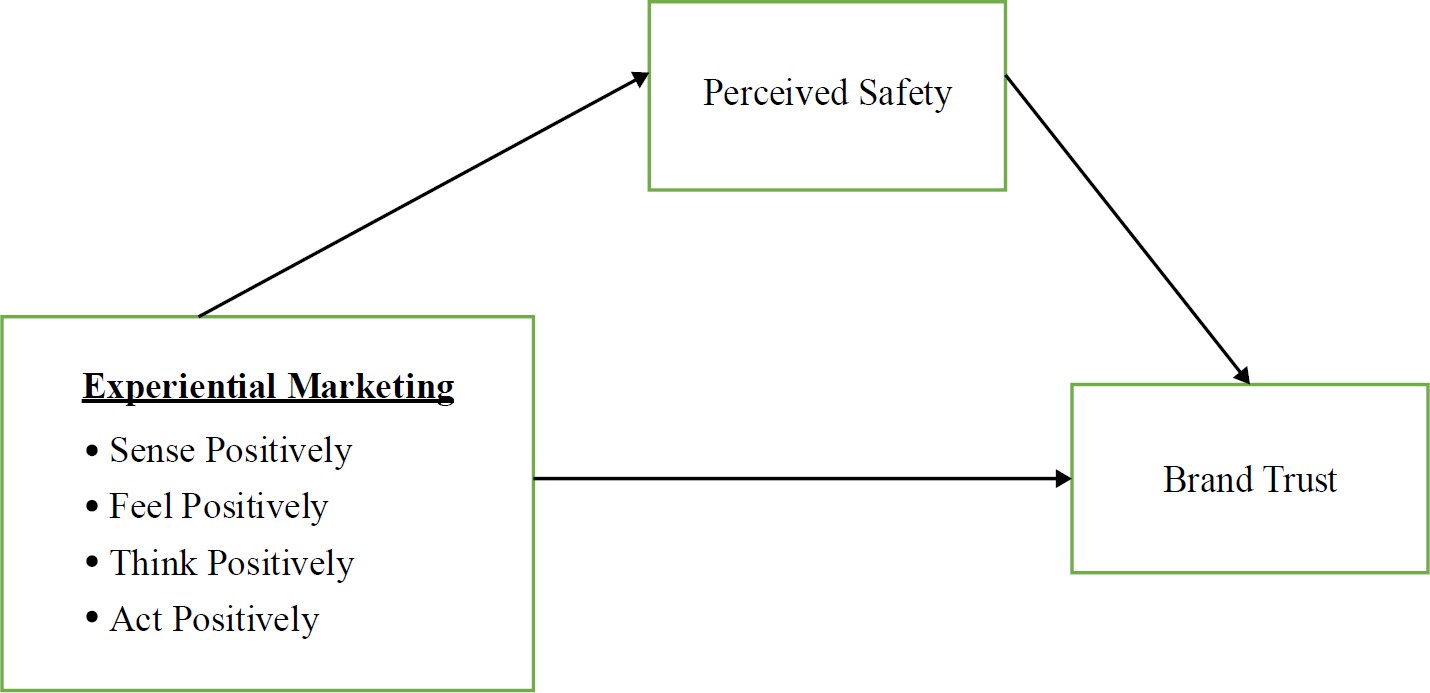
Fig. (1). Conceptual framework.
3. METHODOLOGY
This research employed an explanatory mixed-methods design to examine how experiential marketing strategies can restore Jordan’s brand trust in the tourism industry following the Gaza war. The design combined a sequential alignment of quantitative and qualitative methods, which enabled both statistical analysis and richer contextual understanding. A mixed-method approach considering explanatory design was chosen to offer both quantitative and qualitative evidence regarding the relationships between the various dimensions of experiential marketing, the perceived safety, and the brand trust, and to offer qualitative information about the stakeholder perspectives to gain a deeper insight into the mechanism of restoring the brand trust in the post-conflict tourism settings.
In the quantitative stage, a focused questionnaire survey (Appendix A) was distributed to 700 participants, including domestic and foreign visitors, recent visitors to Jordan within the last 12 months, and service providers in the tourism sector. 420 responses (60%) were collected and, after imputation for missing values, 395 valid replies were left for analysis. In the case of the survey, it targeted the domestic and foreign tourists who had visited Jordan in the last 12 months by applying a purposive sampling approach. This guaranteed that the participants were experienced providers of tourism services in the post-Gaza conflict era. The purposive sampling method enabled the researchers to concentrate on respondents who were the most relevant to the research objectives and still provide diversity in terms of age, nationality, and purpose of travel. The 395 respondents were selected to develop a sufficient statistical power of the PLS-SEM analysis, given the complexity of the model, as it included five dimensions of experiential marketing and a mediating variable. The minimum sample size of 146 participants was suggested by applying G*Power 3.1 to linear multiple regression (a = 0.05, power = 0.95, 6 predictors). The sample received is larger than this, which helps to assume strong estimation of the path coefficients, reliability, and validity, and depiction of domestic and foreign tourists after the Gaza conflict.
The survey employed a five-point Likert scale to assess perceptions of experiential marketing dimensions and how these affected brand trust and loyalty. Quantitative data were analysed using SmartPLS, which facilitated the examination of the measurement and structural models via Partial Least Squares Structural Equation Modelling (PLS-SEM) for testing assumed relationships. The demographic profile of respondents is presented in Table 1.
Table 1. Demographic respondents for questionnaire survey.
| Variable | Category | Frequency (n) | Percentage (%) |
| Gender | Male | 210 | 53.2 |
| Female | 185 | 46.8 | |
| Age Group | 18–25 years | 75 | 19 |
| 26–35 years | 120 | 30.4 | |
| 36–45 years | 100 | 25.3 | |
| 46–55 years | 60 | 15.2 | |
| 56 years and above | 40 | 10.1 | |
| Nationality | Domestic visitors | 160 | 40.5 |
| Foreign visitors | 145 | 36.7 | |
| Service providers | 90 | 22.8 | |
| Education Level | High school or below | 60 | 15.2 |
| Undergraduate degree | 175 | 44.3 | |
| Postgraduate degree | 120 | 30.4 | |
| Other | 40 | 10.1 | |
| Occupation | Student | 55 | 13.9 |
| Employed in tourism | 90 | 22.8 | |
| Self-employed | 60 | 15.2 | |
| Government employee | 80 | 20.3 | |
| Private sector employee | 70 | 17.7 | |
| Other | 40 | 10.1 | |
| Purpose of Visit | Leisure | 185 | 46.8 |
| Business | 75 | 19 | |
| Cultural/Religious | 85 | 21.5 | |
| Other | 50 | 12.7 |
A number of steps were implemented to limit possible biases within this research. Common method bias (CMB) was managed using the Harman single-factor test. Harman’s single-factor test ascertained that there was no one factor that explained the majority of variance since the first variance generated was lower than 50% and therefore CMB was not an issue. In order to minimise selection bias, the sample was taken from various subgroups of the tourism industry, both domestic and foreign tourists, and various service providers to ensure representativeness. Non-response bias was assessed by testing for differences between early and late responders by independent t-tests. It has been indicated that all variables, such as act positively (p-value > 0.05), brand trust (p-value > 0.05), feel positively (p-value > 0.05), perceived safety (p-value > 0.05), sense positively (p-value > 0.05), and think positively (p-value >0.05). Hence, it indicated that there is no response bias issue for this research.
Qualitative phase supplemented the quantitative results via semi-structured interviews of the most important stakeholders using an interview questionnaire (Appendix B), i.e., tourism officials, marketing experts, and hospitality managers. 15 persons were approached, and 12 participated in interviews. The thematic saturation of the qualitative sample of 12 semi-structured interviews was established, which is a saturation of the qualitative sample, when no new information was obtained, but rather information was redundant. Tourism officials, marketing professionals, and service providers were chosen in terms of their availability and direct role in regaining brand trust. This was an adequate sample size that offered deep, contextually sensitive information to supplement quantitative results, which brought in-depth and believability to the interpretation of the effects of experiential marketing in post-Gaza Jordanian tourism. In the case of the interviews, convenience sampling was utilised to sample the tourism stakeholders, such as service providers, marketing professionals, and officials. Participants were selected on the basis of accessibility and availability that enables them to collect data in time and provide rich and context-specific insights that minimise potential biases posed by -also. This convenience-based approach was used to guarantee a practical interaction with the key informants who could describe organisational practices and issues in regaining brand trust to supplement quantitative results. Demographic profiles of the respondents are presented in Table 2. The qualitative data were inspected through thematic analysis in accordance with (Braun & Clarke’s, 2006) six-step process, familiarisation, coding, theme generation, reviewing, defining, and reporting, to extract crucial patterns and stories concerning experiential marketing and restoring brand trust.
Table 2. Demographic respondents for interviews.
| Participant ID | Category | Profession / Role | Gender | Years of Experience | Interview Duration (minutes) |
| P1 | Tourism Official | Director, Tourism Promotion Department | Male | 15 | 55 |
| P2 | Tourism Official | Policy Officer, Ministry of Tourism | Female | 10 | 50 |
| P3 | Marketing Expert | Destination Branding Consultant | Male | 12 | 45 |
| P4 | Marketing Expert | Digital Marketing Specialist (Tourism Agency) | Female | 8 | 40 |
| P5 | Hospitality Manager | Hotel General Manager (5-star) | Male | 18 | 60 |
| P6 | Hospitality Manager | Resort Operations Manager | Female | 14 | 50 |
| P7 | Tourism Official | Regional Tourism Development Officer | Male | 11 | 45 |
| P8 | Marketing Expert | Travel and Events Marketing Manager | Male | 9 | 48 |
| P9 | Hospitality Manager | Boutique Hotel Owner | Female | 13 | 55 |
| P10 | Tourism Official | Head of Cultural Heritage Tourism Unit | Male | 16 | 52 |
| P11 | Marketing Expert | Tourism Market Analyst | Female | 10 | 47 |
| P12 | Hospitality Manager | Guest Experience Supervisor | Female | 6 | 42 |
Ethical aspects were taken into account when carrying out the data collection. All of the participants were inducted using informed consent before data was collected, with the respondents being fully aware of the purpose of the study. Voluntary participation and the right to withdraw at any point were also provided to all the participants. Anonymity and confidentiality were guaranteed, and no personal data was taken; approval from the research review committee of the institute was also obtained. Data was safely recorded, stored, and used only for this research purpose in reference to the general data protection rules.
4. RESULTS
4.1. Measurement Model Using Confirmatory Factor Analysis (CFA)
Table 3 below shows the measurement model using CFA, which involves assessing the validity and reliability of the instrument using factor loadings (FL), Cronbach’s alpha (CA), Composite Reliability (CR), and Average Variance Extracted (AVE). FL indicates the validity of the instruments, where (Hair et al., 2020) indicate that the value must be higher than 0.6. Table 1 shows that all items have FL values above 0.6, hence indicating that no variables are to be dropped. (Brown & Moore, 2012) indicated that CA and CR must be greater than 0.7 to indicate reliability. All variables below have a value higher than 0.7, and hence they are reliable. (Hair et al., 2020) reflect that AVE values must be higher than 0.5 to reflect convergent validity. AVE values for all variables are higher than 0.5, showing that convergent validity is ensured.
Table 3. Measurement model using CFA.
| Latent Constructs | Indicators | FL | CA | CR | AVE |
| Act Positively | AP1 | 0.905 | 0.899 | 0.900 | 0.832 |
| AP2 | 0.932 | ||||
| AP3 | 0.899 | ||||
| Brand Trust | BT1 | 0.861 | 0.860 | 0.861 | 0.782 |
| BT2 | 0.907 | ||||
| BT3 | 0.883 | ||||
| Feel Positively | FP1 | 0.822 | 0.812 | 0.817 | 0.727 |
| FP2 | 0.900 | ||||
| FP3 | 0.833 | ||||
| Perceived Safety | PS1 | 0.900 | 0.893 | 0.894 | 0.824 |
| PS2 | 0.938 | ||||
| PS3 | 0.885 | ||||
| Sense Positively | SP1 | 0.878 | 0.852 | 0.856 | 0.772 |
| SP2 | 0.906 | ||||
| SP3 | 0.850 | ||||
| Think Positively | TP1 | 0.892 | 0.881 | 0.881 | 0.808 |
| TP2 | 0.921 | ||||
| TP3 | 0.883 |
Table 4 shows the discriminant validity of the variables, indicating that the items of one variable are distinctly unrelated to other variables. (Hair et al., 2020) recommend the HTMT ratio to be below 0.85 to ensure discriminant validity. Consequently, Table 2 indicates that the values of HTMT for all the constructs are below the threshold of 0.85, which indicates that all constructs of the study are separated and different from each other, with no conceptual overlapping.
Table 4. Discriminant validity.
| – | Act Positively | Brand Trust | Feel positively | Perceived Safety | Sense Positively |
| Brand Trust | 0.527 | – | – | – | – |
| Feel Positively | 0.472 | 0.421 | – | – | – |
| Perceived Safety | 0.486 | 0.657 | 0.352 | – | – |
| Sense Positively | 0.617 | 0.323 | 0.626 | 0.281 | – |
| Think Positively | 0.733 | 0.513 | 0.557 | 0.497 | 0.720 |
4.2. Path Analysis
Table 5 below shows the path analysis indicating the testing of the hypotheses of the study. It shows that in the case of acting positively, the path to brand trust was marginally significant (β = 0.094, p = 0.057), which shows a feeble but evocative effect at the 90% confidence level. Feel positively is also significantly and positively related to brand trust (β = 0.085, p = 0.021). Sense positively has an insignificant impact on the brand trust (β = -0.016, p = 0.710). While thinking positively has a statistically insignificant impact on the brand trust (β = 0.025, p = 0.622). Perceived safety has a positive and significant impact on the brand trust (β = 0.748, p = 0.000). Furthermore, the specific indirect effect shows that perceived safety has a negative and significant mediating impact on the relationship between sense positively and brand trust (β = -0.119, p = 0.029). It shows the partial mediation since both direct and indirect effect has a significant impact. Furthermore, perceived safety has a significant mediating impact on the relationship between thinking positively and brand trust (B 0.226, p = 0.000). It shows the full mediation since direct and indirect impacts have different impacts. Furthermore, perceived safety has a significant mediating impact on the relationship between acting positively and brand trust (β = 0.302, p = 0.002). It shows partial mediation since the direct and indirect impact has a significant impact. Furthermore, perceived safety shows a marginally significant mediating impact in the path between feeling positively and brand trust (β = 0.099, p = 0.058), which signifies an uncertain mediation at the 90% confidence level. It reflects partial mediation since both direct and indirect impact has an insignificant impact. Therefore, the results indicate acceptance of H2, H3, H4, H5a, H5b, H5c, and H5d.
Table 5. Path analysis.
| – | Path Coefficient | T Statistics | P Values |
| Act Positively -> Brand Trust | 0.094* | 1.902 | 0.057 |
| Act Positively -> Perceived Safety | 0.273*** | 3.138 | 0.002 |
| Feel Positively -> Brand Trust | 0.085** | 2.314 | 0.021 |
| Feel Positively -> Perceived Safety | 0.132* | 1.897 | 0.058 |
| Perceived Safety -> Brand Trust | 0.748*** | 23.012 | 0.000 |
| Sense Positively -> Brand Trust | -0.016 | 0.372 | 0.710 |
| Sense Positively -> Perceived Safety | -0.159** | 2.195 | 0.028 |
| Think Positively -> Brand Trust | 0.025 | 0.493 | 0.622 |
| Think Positively -> Perceived Safety | 0.302*** | 3.782 | 0.000 |
| Indirect Effect | |||
| Act Positively -> Brand Trust | 0.205*** | 3.148 | 0.002 |
| Feel Positively -> Brand Trust | 0.099* | 1.896 | 0.058 |
| Sense Positively -> Brand Trust | -0.119** | 2.185 | 0.029 |
| Think Positively -> Brand Trust | 0.226*** | 3.673 | 0.000 |
| Specific Indirect Effect | |||
| Sense Positively -> Perceived Safety -> Brand Trust | -0.119** | 2.185 | 0.029 |
| Think Positively -> Perceived Safety -> Brand Trust | 0.226*** | 3.673 | 0.000 |
| Act Positively -> Perceived Safety -> Brand Trust | 0.205*** | 3.148 | 0.002 |
| Feel Positively -> Perceived Safety -> Brand Trust | 0.099* | 1.896 | 0.058 |
Note: * indicates significance at 10%, ** indicates significance at 5%, *** indicates significance at 1%.
4.3. Model Explanatory Power
Table 6 shows the model’s explanatory power. It shows that brand trust has an R-squared of 0.696, showing that 69.6% of the variance in brand trust can be explained through experiential marketing and perceived safety. Furthermore, perceived safety has an R-square of 0.253, showing that 25.3% of the variance in perceived safety is explained through experiential marketing factors.
Table 6. Model explanatory power.
| – | R-Square | R-Square Adjusted |
| Brand Trust | 0.696 | 0.692 |
| Perceived Safety | 0.253 | 0.246 |
4.4. Qualitative Analysis
Using Braun and Clarke’s approach, the results of thematic analysis have been tabulated in Table 7, comprising three core themes.
Theme 1: Experiential Positivity as the Foundation for Brand Trust
This theme was established through ongoing patterns that were found in responses regarding how tourists build perceptions and regain confidence in Jordan following the Gaza conflict. Through ongoing references during the coding process, regular references appeared around good feelings, behaviours, and thoughts such as hospitality, optimism, and proactive behaviour, which all influenced visitors’ trust in Jordan’s tourism brand. Stakeholders consistently connected these experiential factors to credibility and emotional reassurance, marking convergence with the quantitative variables feel positively, act positively, and think positively.
Brand trust was noted by tourism officials and hospitality managers not to be established by promotions but by the aggregate emotional and behavioural experiences encountered by tourists. Respondent 3, a hotel administrator, said,
“Tourists retain the memory of how we made them feel above all else — that’s what restores confidence.”
Likewise, a marketing official (Respondent 8) said,
“Our campaigns have to emphasize optimism and resilience, to shift the way people think about Jordan.”
The responses show that experiential positivity leads to brand trust as it exhibits how emotional and behavioural engagement is a mechanism that minimises uncertainty and perceived risk in a post-conflict setting. It aligns with (Alazaizeh et al., 2024), who also unveiled that the proactive service behaviours and optimism serve as psychological anchors, and the fear of regional instability. This further elucidates the quantitative results as it is clear that, not only do the impacts of “Feel positively” and “Act positively” correlate with the trust, but take place through cognitive and behavioural pathways, which sheds light on the mechanism by which experiential marketing dimensions restore the confidence of tourists and provide the perception that there is stability in the tourism sector of Jordan. For instance, Respondent 6 noted,
“Actions need to match our optimism — guests pick up on when our service is reflecting our words.”
This evidence supports the notion that affect and behaviour consistency increases credibility, aligning with the quantitative findings of meaningful relationships between acting positively and feeling positively and brand trust. Overall, the theme highlights that experiential positivity, which is achieved by extended warm hospitality, optimistic communication, and persistent service, is the emotive bedrock on which Jordan’s tourism brand can restore and maintain trust in the post-conflict period.
Theme 2: Perceived Safety as the Core Mediator in Rebuilding Trust
This theme was established by the repeated focus by participants on tourists’ perceptions of safety and security as the central factor linking marketing strategies to trust in Jordan’s tourism brand. In the thematic coding, “safety,” “reassurance,” and “confidence” repeatedly emerged from interviews, implying that perceived safety not only drives travel choice but also facilitates how experiential marketing strategies build up into brand trust. Respondents characterised perceived safety as a psychological and emotional condition, influenced by communication, behaviour, and authenticity of experience as opposed to mere factual safety statistics.
A number of tourism authorities and marketing professionals emphasised the necessity of re-establishing safety perceptions through emotional reassurance as well as tangible safety measures. Respondent 10, a senior tourism officer, said,
“Safety isn’t merely avoiding risk — it’s tourists feeling confident enough to roam freely.”
Likewise, Respondent 5, a marketing expert, noted,
“Films of tourists patronizing local markets or hiking trails depict actual safety more effectively than any report.”
These responses emphasize that perceived safety functions as a central mediator, which makes the process of how the dimensions of experiential marketing are converted into brand trust. The qualitative data indicate that safety is not only the lack of risk but is mentally and emotionally formed as a result of personal experience and observable signs of the tourists, which expands the quantitative result of high mediation. The effect of the emotional and mental activity is also reinforced by perceived safety, which, as per Akamavi et al. (2023), transforms positive emotions and action behaviour into long-term trust. It is a mental bridge, where optimism and involvement are projected as a consistent hope of the destination. This explanatory account explains why the concepts of Feel positively, think positively, and Act positively have a direct and indirect effect on brand trust, and that the safety concept enhances the effects. The qualitative findings give the quantitative results depth by determining the underlying processes that explain the relationship between experiential marketing and perceived safety, in that these processes will be used to rebuild confidence and implement the post-conflict tourism recovery strategy of Jordan.
Theme 3: Authentic Collaboration and Cultural Integrity as Emerging Drivers
This theme emerged as a result of indicating factors that impact brand trust, indicating that authenticity and collaborative involvement are essential for rebuilding and maintaining Jordan’s brand trust in the post-conflict era. Throughout the coding process, repeated mentions were made of “demonstrating the true Jordan,” “collaboration,” and “genuine representation.” These repeated concepts spoke to stakeholders’ perception that authentic cultural representation and cooperation throughout the tourism value chain, government institutions, private sector operators, and local communities are necessary to rebuild trust and visitor confidence.
Table 7. Thematic tables.
| Themes | Codes | Sub-Codes | Keywords / Key Phrases |
| Theme 1: Experiential Positivity as the Foundation for Brand Trust | Emotional engagement | Positive emotions, hospitality, warmth, and a welcoming environment | “Tourists remember how we made them feel,” “emotional connection,” “warm hospitality,” “positive experiences.” |
| Behavioural positivity | Service consistency, staff courtesy, and proactive communication | “Actions must match our optimism,” “service reflects our words,” “consistent quality.” | |
| Cognitive positivity | Optimistic messaging, resilience narratives, brand storytelling | “Highlight optimism,” “positive image of Jordan,” “resilient destination.” | |
| Emotional reassurance | Comfort, empathy, personal touch | “Made to feel safe and cared for,” “friendly interactions,” “genuine concern.” | |
| Theme 2: Perceived Safety as the Core Mediator in Rebuilding Trust | Emotional safety | Feeling secure, emotional comfort, reassurance | “Feeling safe enough to explore,” “confidence in environment,” “calm atmosphere.” |
| Visual and experiential proof | Influencer content, visitor testimonials, storytelling through visuals | “Videos of tourists enjoying markets,” “show real experiences,” “visual reassurance.” | |
| Safety perception management | Transparency, communication, crisis response | “Rebuilding confidence,” “clear communication,” “trust through visibility.” | |
| Psychological reassurance | Perceived stability, reduced fear, safe engagement | “Safety beyond numbers,” “emotional trust,” “sense of control.” | |
| Theme 3: Authentic Collaboration and Cultural Integrity as Emerging Drivers | Authenticity of experience | Genuine culture, local representation, unfiltered portrayal | “Show the real Jordan,” “true cultural identity,” “real connections with locals.” |
| Cultural integrity | Preserving heritage, honest marketing, and ethical storytelling | “Authentic traditions,” “truthful marketing,” “cultural pride” | |
| Cross-sector collaboration | Partnership among tourism actors, shared strategy, public-private cooperation. | “Joint effort,” “collaborative branding,” “unified message” | |
| Brand coherence | Consistent service standards, coordinated messaging | “Shared vision,” “consistent experience,” “alignment across sectors” |
Repeatedly, participants highlighted that the tourists are looking for real, transparent experiences, not ones that are produced and overly commercialised. Respondent 2, a marketing professional, described,
“Authenticity reassures visitors — when what they see online matches what they experience, trust grows.”
Similarly, a hotel manager (Respondent 9) responded,
“The aroma of spices, the native cuisine, and plain chats with Jordanians make authentic connections.”
The reply shows that genuine cooperation and cultural wholeness serve as emerging forces of brand trust by guaranteeing consistency between the anticipations and actual encounters of tourists. The qualitative evidence demonstrates that cultural authenticity reinforces emotional and confirms cognitive appraisals, which offer a mechanism for converting the dimensions of experience marketing into trust. This further expounds quantitative results, showing how the relationship between Relate positively and other dimensions works to illustrate that social and cultural connectedness enhances confidence in the destination. Authentic cultural experiences address this gap between perception and reality, thereby intensifying the impacts of emotional, cognitive, and behavioural involvement on brand trust, which points to a context-specific channel of revitalising the Jordan tourism image and strengthening the credibility and robustness of the post-conflict brand.
Respondent 12, a tourism representative, stated,
“No one sector can reconstruct Jordan’s image by itself — it’s a collective effort by ministries, marketers, and local companies.”
This account shows that unification in strategy and communication can elevate brand consistency and decrease contradictory messages that could otherwise erode trust. In summary, authenticity and cooperation come forward as the essential, interdependent drivers in the reconstruction of Jordan’s tourism brand. Experiential positivity and perceived safety represent the psychological essence of trust, but these new qualitative dimensions assert that sustainable trust relies on honest cultural representation and shared responsibility among all actors in the tourism industry.
5. DISCUSSION
The primary results of this study reveal that experiential marketing dimensions, namely, act positively and feel positively, are key drivers in restoring brand trust in Jordan’s tourism industry after the Gaza conflict. These results support the theoretical framework based on Signalling Theory and the Trust-Commitment Theory. As per (Alazaizeh et al., 2024; and Jain et al., 2025), trustworthy signals serve to decrease uncertainty in risk situations, while the Trust-Commitment Theory by (Morgan & Hunt, 1994) underlines that trust is the cornerstone of long-lasting relationships between consumers and brands. The crucial function of affective (feel positively) and behavioural (act positively) experiences is consistent with (Chen & Wu, 2022; and Suprayogi et al., 2023), who established that emotional connection and active customer interaction substantially build trust and loyalty. Also, the result that perceived safety mediates the effect of experiential marketing on trust is consistent with (Wu et al., 2023; and Awais-E-Yazdan et al., 2025), who emphasise perceived safety as the decisive factor of tourists’ trust and destination image, particularly in recovery situations.
The research contributes to the theory by enhancing Signalling Theory to a post-conflict tourism environment in terms of showing that experiential signals can be effective based on the perceptions of contextual risk and not a supposed general applicability. Having balanced the surprising insignificance of sensory and cognitive dimensions with the powerful influence of emotional and behavioural engagement and perceived safety, the results explain that signals of trust act in a hierarchical manner in the conditions of instability. Quantitative findings form structural connections, whereas qualitative findings characterise how tourists sift through signals cognitively for safety and emotional reassurance. In practice, it means that destination managers ought to emphasise the observable safety behaviours, successful service experience, which have an emotive touch, and participatory experiences, rather than aesthetic or informational messages, in isolation, as argued by (Arabeyyat & Aldweik, 2024; and Bader et al., 2024). Contextually, Jordan’s closeness to the conflict in the region redefines the way the signals are received, and it is necessary to adapt to the marketing methods. Taken together, the combined results provide a consistent structure of post-conflict tourism recovery and the restoration of brand trust.
The results are also in contradiction to the expectation, showing that both the senses and thinking have a statistically insignificant influence in the context of brand trust in post-conflict tourism in Jordan. Although previous research, (Lasputra et al., 2023; Xu et al., 2022), has indicated that sensory and cognitive cognitions are the most appropriate stimuli in forming initial perceptions of a destination, the current findings indicate that these stimuli do not suffice to restore trust in the situation of increased geopolitical anxiety. The given surprising result refines the Signalling Theory because it shows that sensory and informational signals become less helpful in post-conflict tourism unless supported with emotional reassurance and observable behaviour involvement. The weak or ambiguous nature of sensory appeal and cognitive stimulation may act as weak signals in situations when perceived safety is weak, which explains why they have a limited effect. Combining the two insights of the qualitative approach enlightens that trustworthiness is less perceived by the tourists based on the aesthetics or the rational message, but rather through the emotionally charged and action experience that prominently displays stability. These innovations that signalling theory implies place the effectiveness of signals in post-conflict environments and emphasise the conditional character of experiential signals in restoring trust.
Thematic analysis also brought forth factors that were beyond the quantitative measures. Experiential positivity, symbolic safety cues, and hospitality that is community-driven were some themes that were identified as vital qualitative findings. These aspects resonate with (Pine & Gilmore’s, 1999) Experience Economy, which states that live and emotionally stimulating experiences can redefine how people perceive a brand and make them loyal. For example, tourists’ reports of warm local interactions and visible safety practices illustrate how safety is made a psychological and experience-based construct, congruent with Signalling Theory.
The quantitative results indicated that perception of positivity has a significant influence of brand trust with acting positively being the other influential factor with perceived safety as the mediating variable. These variables were put through qualitative findings that have not only proved to be true but have also pointed towards a number of additional variables such as cultural integrity, cross-sector collaboration, and brand coherence that are discussed in Fig. (2). Cultural integrity, cross-sector collaboration, and brand coherence are the newly born variables that are closely supported by Trust-Commitment Theory and Signalling Theory. Cultural integrity serves as a trust indicator, which signifies authenticity and trustworthiness to the local values, which reduces uncertainty and increases destination credibility. Cross-sector collaboration is a relational process in Trust-Commitment Theory which develops the shared responsibility and consistent service provision which consolidates the confidence of tourists. According to Signalling Theory, brand consistency ensures that the overall system of the marketing communications, experiences, and stakeholder behaviour comes together to convey confidence and reliability (Xu et al., 2022). These factors combined together expand the theoretical model through reconnecting the experiential marketing with the general trust recovery.
Quantitative combined with qualitative results are enhanced via triangulation to ensure the joint impact of experiential marketing on brand trust. The quantitative data confirmed that emotional and behavioural episodes are the strongest predictors of trust, and the qualitative data showed the reasons why, as tourists perceive empathy, authenticity, and security as the signs of credibility. This is aligned with (Fatoki & Fatoki, 2021) who emphasize the role of brand trust being founded upon functional dependability in addition to affective bonding. The perceived safety mediation also enhances the trust recovery framework that states that the restoration of confidence after crisis must be done under both rational assurance and affective engagement (Awais-E-Yazdan et al., 2025).
Besides, the results add to Signalling Theory as they indicate that not every signal of experience is universal. Quantitative results show that sensory and cognitive dimensions do not give statistically significant findings on brand trust, and emotional and behavioural dimensions are highly predictive of the trust mediated by perceived safety. Qualitative findings also explain this trend in that tourists view qualitative cues as a source of psychological reassurance, evident behaviour, and not always aesthetics and information. Similarly, Trust-Commitment Theory is reduced to indicate that post-exogenous shock trust-building is not only a sequential process, but also a conditional process in which perceived safety precedes relational commitment. The integration of the results implies that confidence in post-conflict tourism is built upon the signals of an emotional nature as well as behaviourally manifested that reformulate the meaning of safety as a need rather than an outcome of the experience.
These findings are important implications in the Jordanian case. The tourism recovery in Jordan depends on regaining the reputation of the country as a safe and friendly destination. Signals of trustworthiness and emotional warmth can be created with the use of experiential marketing, such as resilience storytelling, true local experience, and observable safety communication. By incorporating sensorial involvement, emotional and behavioural participation, Jordan will be able to regain brand confidence and rebrand the world image as a safe, multicultural, and trustworthy destination during the post-Gaza conflict era. According to the described aspects, we introduce a revised framework (Fig. 2) that will indicate the results of the current research.
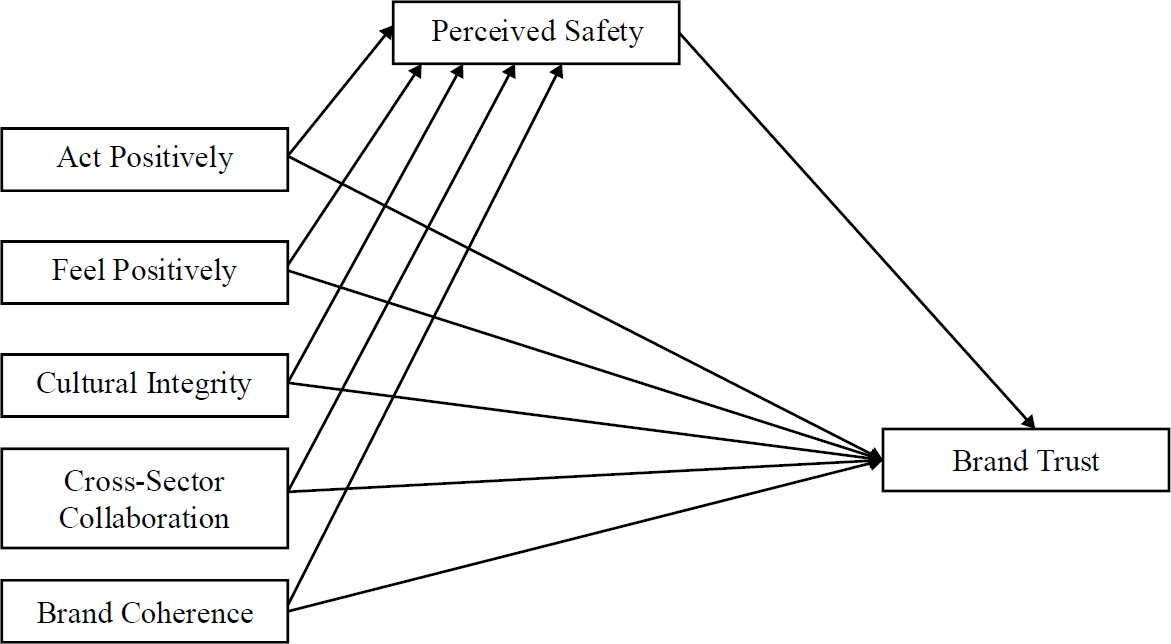
Fig. (2). Revised framework.
POLICY IMPLICATIONS
The results indicate that the policy of experiential marketing in the post-conflict tourism recovery in Jordan should be varied across the governance levels, and not be uniform. On the national level, the Ministry of Tourism and Antiquities must emphasise emotionally reassuring stories and behavioural salience in the official recovery plans, as emotional and action-oriented experiences were empirically demonstrated to be the drivers of brand trust. This can be operationalised by the Jordan Tourism Board curating verified safety storytelling campaigns, which include real-life tourist activity and community interaction experiences, and strengthen the impression of perceived safety without making it seem like security is a massive exaggeration. Managers of these sites, such as Petra and Wadi Rum, should receive specific funding to introduce small-scale culturally authentic experiences to enable visitors to be engaged with local heritage, which fits the evidence on behavioural engagement presented in the study. This should include the local municipalities and tourism SMEs in subsidised training programmes on empathy-based service delivery and visible safety practices. These implications of the policy are situational and do not override structural security measures; they actually supplement them by turning the safety to the experiences that are psychologically plausible.
MANAGERIAL IMPLICATIONS
To the tourism and hospitality managers, the results suggest that the recovery of trust needs a role-specific experiential strategy, as opposed to generic service enhancement. Emotional reassurance, empathy, and proactive engagement should be the priority of staff training in the hotel and resort industry because emotional reassurance is the driving force, and positive feelings are the influential power of brand trust. Tour operators and guides, especially those working in heritage sites like Petra and Jerash, ought to create participative experiences that are guided tours, cultural performances, and storytelling where the tourists can take an active part, so that they can create a trust that can be developed through participation. Restaurants and other local craft providers as SME operators should be geared towards genuine social engagements and open safety procedures that promote a sense of security on a micro-service basis. The study has also shown that credibility is developed by behavioural evidence instead of promotional messages, and this is why marketing managers should selectively share verified visitor experiences along with real-time service interactions using digital platforms. The implication is confined within the post-conflict context of Jordan and must be modified in a careful manner in other regions. Generally, the results put experiential marketing in a perspective of a credibility-enhancing management tool that complements, but does not replace, operational safety and service quality systems.
CONCLUSION
The findings of the study depict that experiential marketing plays a substantial role in reconstructing the brand trust across the post-conflict era in the case of the tourism sector of Jordan. While addressing the research objective, the results depict that experiential marketing dimensions such as emotional (“feel positively”) and behavioural (“act positively”) hold a significant impact on the brand trust. While associated with the second objective, perceived safety is validated as a significant mediator that elucidates the ways that experiential marketing transforms into trust under conditions of regional instability. The third objective is addressed by means of qualitative insights, which can clarify reasons behind the insignificant impact of sensory aspects, such as sense positively and thinking positively on brand trust, which stresses the significance of emotional reassurance, observable safety practices, as well as authentic engagement. Postulated in the Signalling Theory and Trust-Commitment Theory, these findings enhance current knowledge by explaining the brand trust dependent on contexts. Though restricted to Jordan and cross-sectional data, the study still provides valuable implications for tourism recovery strategies in the post-conflict era.
LIMITATIONS & FUTURE DIRECTION
The study holds substantial limitations, such as its dependence on a non-probability sampling technique, which limits generalisation of the findings beyond the post-Gaza conflict era of Jordan, and also leads to self-selection bias. The cross-sectional design also restricts causal inference, while self-reported measures are subjected to perceptual bias. Moreover, the small qualitative sample, though adequate for saturation, lacks representational breadth. Therefore, future researchers are suggested to apply cross-sectional and longitudinal designs, amalgamate probability sampling, and test alternative mediating factors such as media exposure to further extend the theoretical models and authenticate context-sensitive mechanisms of trust.
Third, while the qualitative interviews were deep and rich in information, they engaged relatively few stakeholders and thus may not represent the diversity of views in the tourism industry fully. Future research needs to take a cross-country comparative method to investigate how experiential marketing builds trust in brands in various cultural and geopolitical settings. Further, future studies can also integrate this revised research framework to evaluate how cultural integrity, cross-sector collaboration, and brand coherence can impact brand trust, while how perceived safety can mediate the relationship between evolved variables and brand trust. Longitudinal studies can analyse how trust develops over time as perceptions of safety stabilise. Furthermore, future studies can integrate technology variables like virtual reality and digital narrative to evaluate the extent to which new experiential tools build destination trust and facilitate tourism recovery efforts.
LIST OF ABBREVIATIONS
AVE | = | Average Variance Extracted |
CA | = | Cronbach’s Alpha |
CFA | = | Confirmatory Factor Analysis |
CMB | = | Common Method Bias |
CR | = | Composite Reliability |
FL | = | Factor Loadings |
AUTHOR’S CONTRIBUTION
The author has contributed to conceptualisation, idea generation, problem statement, methodology, results analysis, results interpretation.
ETHICAL APPROVAL/INFORMED CONSENT
Ethical aspects were taken into account when carrying out the data collection. All of the participants were inducted using informed consent before data was collected, with the respondents being fully aware of the purpose of the study. Voluntary participation and the right to withdraw at any point were also provided to all the participants. Anonymity and confidentiality were guaranteed, and no personal data was taken; approval from the research review committee of the institute was also obtained. Data was safely recorded, stored, and used only for this research purpose in reference to the general data protection rules.
AVAILABILITY OF DATA AND MATERIALS
The data will be made available at a reasonable request by contacting the corresponding author [A.S.A.A.].
FUNDING
None.
CONFLICT OF INTEREST
The author declares that there is no conflict of interest regarding the publication of this article.
ACKNOWLEDGEMENTS
Declared none.
DECLARATION OF AI
During the preparation of this work the author used ChatGPT for editing purposes. After using this tool, the author reviewed and edited the content as needed and take full responsibility for the content of the published article.
APPENDICES
Appendix A: Questionnaire Survey
Section A: Demographic Profiles
- Gender
- Male
- Female
- Age group
- 18–25 years
- 26–35 years
- 36–45 years
- 46–55 years
- 56 years and above
- Respondent type / Stakeholder
- Domestic visitor (tourist)
- Foreign visitor (tourist)
- Service provider (e.g., hotel, tour operator, guide, agency)
- Education level
- High school or below
- Undergraduate degree
- Postgraduate degree
- Other
- Occupation
- Student
- Employed in tourism sector
- Self-employed
- Government employee
- Private sector employee
- Other
- Purpose of visit
- Leisure
- Business
- Cultural/Religious
- Other
Section B: Experiential Marketing Dimensions
- Sense Positively
- The destination’s visual appearance (scenery, design, signage) made a positive impression on me.
- The sounds and ambient atmosphere at the destination enhanced my experience.
- The smells and tactile aspects (textures, cleanliness) at places I visited improved my perception of the destination.
- Feel Positively
- I felt emotionally connected (comforted/pleasant) during my visit.
- The destination evoked positive emotions (joy, relaxation, excitement).
- Staff and service encounters made me feel cared for and valued.
- Think Positively
- The information and storytelling about the destination increased my understanding and appreciation.
- I found the destination’s marketing and communications to be informative and credible.
- Innovative offerings (virtual tours, interactive exhibits) improved my perception of the destination.
- Act Positively
- I actively participated in local activities or experiences offered at the destination.
- Interactive experiences made me more likely to recommend the destination.
- I engaged in repeat or prolonged activities because they were enjoyable.
Section C: Perceived Safety
- I perceived the destination as safe to visit during the current period.
- I believe the destination’s authorities and service providers take adequate safety measures.
- Safety-related information provided before or during the visit increased my confidence.
Section D: Brand Trust
- I consider this destination to be a trustworthy brand.
- The destination keeps its promises regarding services and visitor experience.
- I believe the destination acts with integrity in how it manages tourism.
Appendix B: Interview Questions
- How has the Gaza conflict influenced international tourists’ trust and perception of Jordan as a safe and reliable travel destination?
- What role do you believe experiential marketing can play in rebuilding Jordan’s tourism brand and restoring visitor confidence?
- Which types of experiences (e.g., cultural, adventure, religious, or eco-tourism) best represent Jordan’s identity and could be used to strengthen its brand trust?
- How can local communities and businesses contribute to creating authentic and memorable tourist experiences that enhance brand credibility?
- What challenges might arise in implementing experiential marketing strategies during the post-conflict recovery phase?
- How can digital platforms, storytelling, and social media campaigns support Jordan’s image rebuilding efforts?
- What key strategies would you recommend for restoring long-term brand trust and resilience in Jordan’s tourism sector?
REFERENCES
Akamavi, R. K., Ibrahim, F., & Swaray, R. (2023). Tourism and troubles: Effects of security threats on the global travel and tourism industry performance. Journal of Travel Research, 62(8), 1755-1800.
https://doi.org/10.1177/00472875221138792
Alazaizeh, M. M., Jamaliah, M. M., Alzghoul, Y. A., & Mgonja, J. T. (2024). Tour guide and tourist loyalty toward cultural heritage sites: a signaling theory perspective. Tourism Planning & Development, 21(3), 255-275.
https://doi.org/10.1080/21568316.2022.2095663
Aldweik, R. (2024). Jordan-centric cross-border tourism projects with Egypt and Saudi Arabia. London Journal of Research In Management & Business, 24(5), 43-64. Available from: https://journalspress.uk/index.php/LJRMB/article/view/1019/3897
Allan, M. (2025). Tourism experiences, motivations, and travel lifestyles preferences for domestic tourists: A case of Jordan. Geo Journal of Tourism and Geosites, 58(1), 52-60.
https://doi.org/10.30892/gtg.58105-1390
Al-Riffai, P. (2024). The economic and social costs of the war in Gaza. Atlantic Council. Available from: https://eurasia.ro/wp-content/uploads/2024/11/The-Economic-and-Social-Costs-of-the-war-in-Gaza.pdf
Arab News (2025). Petra tourist numbers plunge 75% due to Iran-Israel war. Arab News. Available from: https://www.arabnews.com/node/2607266/amp (Accessed: 17 September 2025).
Arabeyyat, A. R., & Aldweik, R. (2024). A comprehensive exploration of the Jordan tourism board’s 2023 strategic planning, news, and social media. Emirati Journal of Business, Economics, & Social Studies, 3(1), pp. 32-41. Available from: https://www.scribd.com/document/718640026/270224070224779
Awais-E-Yazdan, M., Popescu, V., Birau, R., & Bărbăcioru, I. C. (2025). Enhancing tourist’s perceived safety and their behavioural intention in thailand: a pathway to sustainable tourism and sustainable economic growth. Sustainability, 17(10), 4297.
https://doi.org/10.3390/su17104297
Bader, M., Mustafa, M., Al Rousan, R., & Ibrahim, H. M. (2024). Crisis management as a driver of sustainable tourism in Jordan: Evaluating performance of Jordanian tourism public policies during crisis-before and after COVID-19. Geo Journal of Tourism and Geosites, 53(2), 743-751.
https://doi.org/10.30892/gtg.53238-1250
Braun, V., & Clarke, V. (2006). Using thematic analysis in psychology. Qualitative research in psychology, 3(2), 77-101.
https://doi.org/10.1191/1478088706qp063oa
Brown, T. A., & Moore, M. T. (2012). Confirmatory factor analysis. Handbook of Structural Equation Modeling, 361, 379. ISNN: 02215-2013.
https://doi.org/10.2466/03.CP.4.10
Chen, A. H., & Wu, R. Y. (2022). Mediating effect of brand image and satisfaction on loyalty through experiential marketing: A case study of a sugar heritage destination. Sustainability, 14(12), 7122.
https://doi.org/10.3390/su14127122
Efendi, B., Setiawan, Z., Saksono, L., Ekasari, S., & Munizu, M. (2023) Analysis of the influence of brand association, experiental marketing and brand trust on consumer loyalty for national digital game products. 12(1).
https://doi.org/10.35870/jemsi.v9i6.1710
Ellitan, L. (2023). The role of experiential marketing, social media marketing and brand trust in increasing repurchase intention. International Journal of Research, 10(9).
https://doi.org/10.5281/zenodo.8351040
Elsawy, M.M., Abu-Alhaija, A.S. (2025). Artificial intelligence and human team dynamics: addressing challenges through strategic HRM. In: Alareeni, B., Hamdan, A. (eds) Digital Disruption and Business Innovation: Navigating the New Technological Era. ICBT 2024. Lecture Notes in Networks and Systems, vol 1573. Springer, Cham, pp. 23-33.
https://doi.org/10.1007/978-3-032-00444-4_3
Fatoki, O. P., & Fatoki, T. H. (2021). Experiential marketing: Effects on brand, customer and market experience, and industrial applications with perspectives from Nigeria. Marketing–from Information to Decision Journal (In Press Article), 3(1): pp.58-66.
https://doi.org/10.2478/midj-2020-0005
Hair Jr, J. F., Howard, M. C., & Nitzl, C. (2020). Assessing measurement model quality in PLS-SEM using confirmatory composite analysis. Journal of Business Research, 109, 101-110.
https://doi.org/10.1016/j.jbusres.2019.11.069
Hammad, A. A., & Abd El Maksoud, R. M. (2025). Leveraging Experiential Marketing for Boosting Tourists’ Engagement in the Egyptian Tourist Destination. The International Journal of Tourism and Hospitality Studies, 8(2), 48-70.
https://doi.org/10.21608/ijthsx.2025.369532.1150
Hariyanti, T., Pradana, E. W., Wardani, D. S., & Fitriasari, N. (2023). The experiential marketing to increase brand trust and loyalty of non-insurance patients in the outpatient unit of the army hospital in Malang East Java, Indonesia. International Journal of Professional Business Review, 8(5), 120.
https://doi.org/10.26668/businessreview/2023.v8i5.2158
Jain, S., Mishra, S., & Shukla, Y. S. (2025). A green pathway to luxury tourists’ subjective well-being: applying eudaimonic identity and signalling theories. Journal of Hospitality and Tourism Insights, 8(9): pp. 3201-3220.
https://doi.org/10.1108/jhti-11-2024-1173
Jawabreh, O. A. (2021). Tourists and local community of the case study aqaba special economic zone authority (ASEZA). Geo Journal of Tourism and Geosites, 35(2), 490-498.
https://doi.org/10.30892/gtg.35229-676
Khan, I., Hollebeek, L. D., Fatma, M., Islam, J. U., & Rahman, Z. (2020). Brand engagement and experience in online services. Journal of Services Marketing, 34(2), 163-175.
https://doi.org/10.1108/JSM-03-2019-0106
Khoirunnisa, A., & Astini, R. (2021). The effects of experiential marketing and social media marketing on repurchase intention with brand trust as variable mediation for wearing Klamby hijab fashion products. European Journal of Business and Management Research, 6(6), 35-41.
https://doi.org/10.24018/ejbmr.2021.6.6.1145
Lasputra, G. P., Pujangkoro, S. A., & Sembiring, B. K. F. (2023). The Effects of Social Media Marketing and Experiential Marketing on Repurchase Intention with Brand Trust on Full-Service Airline. In 7th Global Conference on Business, Management, and Entrepreneurship (GCBME 2022) (pp. 700-709). Atlantis Press.
https://doi.org/10.2991/978-94-6463-234-7_73
Mirando, U. J., & Wanninayake, W. M. C. B. (2023). The Mediating Effect of Brand Trust on the Relationship between Experiential Marketing and Brand Loyalty: With Special Reference to Retail Industry of Sri Lanka. Sri Lanka Journal of Management Studies, 5(1): pp. 35-50.
https://doi.org/10.4038/sljms.v5i1.105
Morgan, R. M., & Hunt, S. D. (1994). The commitment-trust theory of relationship marketing. Journal of Marketing, 58(3), 20-38.
https://doi.org/10.1177/002224299405800302
Nivetha, M. A., & Vijayalakshmi, R. (2025). Effects of implementing experimental marketing on building brand commitment and brand Trust. Journal of Marketing & Social Research: https://jmsr-online. com, 2(03), Available from: https://www.researchgate.net/profile/Nivetha-Ar/publication/392239683_Effects_Of_Implementing_Experimental_Marketing_on_Building_Brand_Commitment_and_Brand_Trust/links/683a8e246b5a287c30485fcd/Effects-Of-Implementing-Experimental-Marketing-on-Building-Brand-Commitment-and-Brand-Trust.pdf?origin=publication_detail&_tp=eyJjb250ZXh0Ijp7ImZpcnN0UGFnZSI6InB1YmxpY2F0aW9uIiwicGFnZSI6InB1YmxpY2F0aW9uRG93bmxvYWQiLCJwcmV2aW91c1BhZ2UiOiJwdWJsaWNhdGlvbiJ9fQ&__cf_chl_tk=CH1kE6wD09N0wQEDGRfzkXaI7H6SINBJ07m0Rqq.Yk4-1758109953-1.0.1.1-M2BiVsNKEEaGL3eSFtEr65dbXK2OAaDPC6y7H53K0c0
Novitaningtyas, I., Saefudin, S., Deliana, D., & Susilo, G. F. A. (2025). Examining the factors that influence tourist repurchase intention on the virtual hotel operator website: integrating Technology Acceptance Model (TAM) and Trust-Commitment Theory (TCS). In Proceeding of International Conference on Digital, Social, and Science (Vol. 2, No. 01, pp. 1445-1457).
https://doi.org/10.62201/4bv41f11
Papagianni, E., Evgenidis, A., Tsagkanos, A., & Megalooikonomou, V. (2024). Tourism demand in the face of geopolitical risk: Insights from a cross-country analysis. Journal of Travel Research, 63(8), 2094-2119.
https://doi.org/10.1177/00472875231206539
Petra, J. N. A. (2025). Tourism revenue increases to JD1.7 billion in first four months of 2025, Petra. Available from: https://petra.gov.jo/Include/InnerPage.jsp?ID=71542&lang=en&name=en_news (Accessed: 17 September 2025).
Pine, B. J., & Gilmore, J. H. (1999). The experience economy: Work is theatre & every business a stage. Available from: https://cir.nii.ac.jp/crid/1971993809685094468
Saleh, M. H., Jawabreh, O., Emad Al Dein, A., & Ali, B. J. (2023). The Competitiveness of Jordanian Tourism Activity in Enhancement Economic Growth. Applied Mathematics & Information Sciences (AMIS), 17(1), 161-174.
https://doi.org/10.18576/amis/170117
Senathirajah, A. R. B. S., bin S Senathirajah, A. R., Alainati, S., Haque, R., Ahmed, S., Khalil, M. I., & Chowdhury, B. (2024). Antecedents and consequence of trust-commitment towards artificial based customer experience. UCJC Business and Society Review (formerly known as Universia Business Review), 21(80).
https://doi.org/10.3232/UBR.2024.V21.N1.16
Shahid, S., Paul, J., Gilal, F. G., & Ansari, S. (2022). The role of sensory marketing and brand experience in building emotional attachment and brand loyalty in luxury retail stores. Psychology & Marketing, 39(7), 1398-1412.
https://doi.org/10.1002/mar.21661
Subawa, N. S., Widhiasthini, N. W., & Suastika, N. P. M. W. S. (2020). The effect of experiential marketing, social media marketing, and brand trust on repurchase intention in Ovo applications. International Research Journal of Management, IT and Social Sciences, 7(3), 11-21.
https://doi.org/10.21744/irjmis.v7n3.881
Suprayogi, B. M., Kusumawati, A., & Mawardi, M. K. (2023). The effect of experiential marketing, brand image on customer satisfaction and customer loyalty: coffee-shop context. In Brawijaya International Conference on Business, Administration, Taxation, and Tourism (BICBATT 2022) (pp. 28-40). Atlantis Press.
https://doi.org/10.2991/978-94-6463-240-8_5
The Jordan Times, (2023). Jordan has welcomed over 3 million tourists since beginning of 2023 — Soboul. Available from: https://jordantimes.com/news/local/jordan-has-welcomed-over-3-million-tourists-beginning-2023-%E2%80%94-shboul
The National, (2025). Visitor numbers to ancient city of Petra slump during Gaza war, The National. Available from: https://www.thenationalnews.com/news/mena/2025/08/04/jordan-has-slump-in-visitors-to-petra-during-gaza-war/ (Accessed: 17 September 2025).
Weldali. M. (2023). Jordan’s tourism sector contributes 14.6% to GDP in 2023 despite challenges. The Jordan Times. Available from: https://jordantimes.com/news/local/jordans-tourism-sector-contributes-146-gdp-2023-despite-challenges
Wu, H. C., Chang, Y. Y., & Wu, T. P. (2023). Structural relationships between safety attachment, experiential co-creation and future experiential intentions in the tourism industry. Journal of Global Scholars of Marketing Science, 33(1), 45-69.
https://doi.org/10.1080/21639159.2021.2001351
Xu, W., Jung, H., & Han, J. (2022). The influences of experiential marketing factors on brand trust, brand attachment, and behavioral intention: Focused on integrated resort tourists. Sustainability, 14(20), 13000.
https://doi.org/10.3390/su142013000
Licensed
© 2026 Copyright by the Authors.
Licensed as an open access article using a CC BY 4.0 license.
Article Contents Author Felicia Gabriela Beresescu1, * 1College of Business-Al Khobar, Al Yamamah University, Saudi Arabia Article History: Received: 21
Article Contents Authors Saman Ismail1, * Imran Iqbal2 1Faculty of Management Science, Department of Business Administration, Salim Habib University, Karachi,
Article Contents Author Michael Dolinsky1, * 1Faculty of Mathematics and Technologies of Programming, Francisk Skorina Gomel State University,
Article Contents Author Abdul Ghafoor Memon1, * 1Emaan Institute of Management Sciences, Karachi, Pakistan Article History: Received: 01 April, 2026
Article Contents Authors Zixuan Zhao1, Ju Guo1, * 1School of Management, Chengdu University of Information Technology, Chengdu, China Article History:
Article Contents Authors Sultan Ud Din Yousufzai1, Amtyaz Safi2, * , Maher Khan1, Zia Ud Din1 1Department of Zoology, Govt.