











Article Contents
Article ID: CM2602112010
Views: 674AI-Powered Personalisation in Charity Marketing: Transforming Donor Engagement and Lifetime Value Through Data-Driven Campaigns
 DOI:
DOI:
 PDF
PDF
⬇ Downloads: 8
1Jubail Industrial College, Jubail Industrial City, Jubail, Kingdom of Saudi Arabia
Received: 03 December, 2025
Accepted: 06 May, 2026
Revised: 24 March, 2026
Published: 04 June, 2026
ABSTRACT:
Introduction: Charities are becoming more adaptive to advanced digital technologies to capture donors’ interest, though traditional marketing methods are not always able to maximise long-term donor value. This research aimed to analyse AI-powered personalisation in charity marketing, transforming donor engagement and lifetime value through data-driven campaigns in the UK charity sector.
Methods: The research adopted a primary quantitative design, with data collected via a structured survey questionnaire from a sample of 380 participants. The data were analysed using SmartPLS and structured equation modelling (SEM).
Results: AI-Powered Personalisation had a significant direct impact on Data-Driven Campaigns, Donor Engagement, and Donor Lifetime Value. AI-Powered Personalisation through Data-Driven Campaigns positively affects Donor Engagement and Donor Lifetime Value. The role of AI-based personalisation in improving the effectiveness of personalised strategies is partially mediated by data-driven campaigns, which enhance AI-based personalisation’s impact on donor engagement and lifetime value.
Conclusion: The paper contributes to the literature on donor relationship management by integrating Relationship Marketing Theory and Customer Lifetime Value (CLV) Theory into the concept of AI-based personalisation strategies. Moreover, the results indicate that UK charity regulators should develop ethical guidelines for AI adoption, promote transparency in donors’ work, and assist small-scale charities in adopting responsible AI-based engagement strategies.
Keywords: AI-powered personalisation, charity marketing, donor engagement, donor lifetime value (DLV), data-driven campaigns, charity, non-profit sector.
1. INTRODUCTION
The charity sector of the United Kingdom comprises of 168,000 registered charities (Government of UK, 2024) that compete for limited funding resources and attention of donors (Hibabox, 2023). Conventional charity marketing in the United Kingdom usually depends on mass marketing campaigns and generic messaging, which become a failure to imitate and target donors having varying behaviours (CAF, 2024). This absence of personalisation of marketing campaigns through data-driven approaches leads to fatigue among donors, a decline in engagement rates, and reduced retention of donors. (Cherniavska et al., 2023) depict that charities in the UK lose almost 50% of new donors in the first year. At one end, the UK firms operating in the finance and retail sectors progressively use AI-driven personalisation to enhance customer experience, retention, and loyalty; the charity sector, on the other hand, substantially lags behind in the implementation of these technologies (Williams, 2025).
As a prominent solution to this problem, AI-based personalisation allows for hyper-targeted, data-driven engagement that can strengthen donor relationships and optimise donor lifetime value (DLV) (Onufriyenko, 2025). The report of (Zoe Amar Digital, 2024) indicates that average rates of donations can be increased by 27% (in terms of frequency of giving) and 32% (in terms of value of a single donation) when the charity has adopted AI-powered personalisation techniques instead of generic campaigns. The major UK charities, such as Cancer Research UK and British Heart Foundation, are placing bets on predictive analytics and machine learning algorithms to divide the donor databases, automate personalised messaging, and identify the churn (Singh et al., 2022). This strategic interpretation is consistent with evidence that customer-facing automation systems can strengthen engagement, retention, and decision-making when they are treated as organisational capabilities rather than isolated technology tools (Patel & Patyrykin, 2025).
In addition, the main challenge facing the non-profit industry of UK is not necessarily technological adoption but the strategic value of using AI-powered personalisation to support donor engagement and DLV without compromising trust (Sellen & Mönks, 2024). As a result, the non-profit sector of the UK fails to meet the regulatory requirements or breaks the structural integrity of organisations (Khastgir & Shalini, 2024). Personalisation has not been fully utilised by many UK charities. They are based on antiquated mail merges and CRM segmentation or introduced by exploiting AI tools without a thorough analysis of their effects on donor retention and loyalty, satisfaction, and long-term value (Evans, 2025). This fragmentary strategy has led to an unsustainable donor experience, low retention rates (which were never higher than 45% among one-time donors as reported in the Blackbaud Benchmark (Report, 2024). It led to an added problem of developing a disconnect amid sophisticated digital campaigns and genuine, relationship-based donor engagement, the basis on which charities are formed (NCVO, 2021). For donor-facing organisations, this trust boundary is important because opaque or socially insensitive uses of personal data may generate reputational backlash and public sanction in digital environments, a risk reflected in wider debates on AI philanthropy, ethical vigilance, donor transparency, and cancel culture (Jasper et al., 2024; Khastgir & Shalini, 2024; Sellen & Mönks, 2024; Santos, 2025; Patyrykin, 2025).
In addition, while present studies (Gooyabadi et al., 2023; and Jasper et al., 2024) signified AI personalisation as major driver of donor engagement and DLV, they usually neglected the mediating role of data-driven campaigns which holds tendency to translate personalisation in marketing campaigns to quantifiable donor retention and engagement. Deprived of a detailed empirical analysis of this mediating mechanism the comprehension of ways that AI-enabled charity marketing initiatives impact donor relationships and life-time value in the long term, cannot be understood. Therefore, this study addresses this gap by superficially focussing on analysis of mediating effect of data-driven campaigns on the relationship between AI-powered personalisation, donor engagement and lifetime value.
Nevertheless, the question of whether the existing literature on AI personalisation in the charity sector reflects the characteristics of the specific interactions between AI and nonprofits remains unaddressed in existing research (Gooyabadi et al., 2023; and Jasper et al., 2024), which explains the necessity to conduct the study on the topic to explore the impacts of ethical, trust-related, and donor-based approaches on long-term involvement and lifetime value in charities in the United Kingdom. This study, thus, by introducing Relationship Marketing Theory and Customer Lifetime Value Theory contributes to further literature by offering an expression of how AI-powered personalisation, when mediated through data-driven campaigns, can promote trust, long-term relationships between donors, and long-term donation behaviour. Contextualising the concept of AI personalisation in these ethical and relational dimensions, this research provides a new perspective on technology-based fundraising and proves that it is possible to create digital strategies that would increase donor interaction and lifetime value without affecting trust or mission integrity.
The following research objectives have been drawn for the current research;
To investigate the cause-and-effect relationship between AI-powered personalisation in charity marketing and donor engagement in the case of the UK non-profit sector.
To analyse the impact of AI-powered personalisation in charity marketing on donor lifetime value (DLV) in the context of the UK non-profit sector.
To investigate the mediating effect of data-driven campaigns on the relation of AI-powered personalisation in charity marketing with donor engagement and DLV.
Hence, the study is anticipated to make major contributions such as, the current study enhances academic knowledge on AI applications in non-profit marketing which is mainly remained explored in the context of commercial business enterprises and non-profitable area remains unexplored. The study provides evidence-based insights on ways that UK charities can amalgamate AI-enabled data analytics to formulate personalised donor journeys, thus, enhancing donor acquisition, retention as well as re-engagement. Lastly, in terms of policy and sector level contribution, the findings provision the development of frameworks and guidelines for ethical utilisation of digital and data-driven marketing campaigns in the UK charity sector which will guarantee compliance with UK GDPR.
2. LITERATURE REVIEW
2.1. Theoretical Framework
The theoretical framework of the current study is based on two relevant theories, which are comprised of Relationship Marketing Theory and Customer Lifetime Value (CLV) Theory (Firmansyah et al., 2024; Kumar, 2024). The Relationship Marketing Theory places massive emphasis on building partnering relationships through longer-term, trust-based relationships as the key basis of loyalty and maximisation of stakeholder value (Yau et al., 2021). This paradigm is of major concern to charities in the UK because sustainability is achieved when the charity cultivates a continuing donor relationship as opposed to a single transaction (Mariani et al., 2022). In contrast to the transactional strategies, where short-term benefits are of the essence, relationship marketing emphasises on personalised engagement, credibility, and mutual trust that should be maintained between the stakeholders (Pfajfar et al., 2022). In the context of this study, this perspective plays a crucial role in sustaining donor commitment among charities, which keeps the donations recurrent and creates more emotional impetus. Eventually, it leads to both donor engagement in the long-term, repeated donations and life-time value creation. Within the AI-based personalisation, this theory provides the reasonableness to UK charity organisations to consider prioritising the desire to create a significant, data-driven connection with the donors to develop a sense of long-term attachment, not just related to the current donations (Rather et al., 2021).
Besides, CLV Theory offers a quantitative perspective to consider the monetary value of individual donors with time, allowing charities operating in the UK to determine the effectiveness of the personalisation approach that employs AI in boosting donor lifetime value as one of the most significant performance indicators of non-profit sustainability (Solow et al., 2023). Incorporating these theories, the research critically reviews not only the effects of increased engagement with the help of AI-powered personalisation but also whether AI tools can help develop sustainable donor relationships and create lifetime value.
2.2. Literature Review and Hypotheses Development
2.2.1. AI-Powered Personalisation and Donor Engagement
Donor engagement through AI-powered and digital technologies has received massive attention in the literature related to charity marketing through data-driven campaigns. In this perspective, a recent study has been carried out by (Cheng & Wang, 2025) in the context of the United States’ charity sector. Adopting a primary quantitative research design, the data were gathered using a structured survey questionnaire from a sample of 591 chatbot users of charity marketing. Applying inferential statistics such as regression analysis, the author unveiled that AI-powered personalisation, leading to targeting functional and emotional values, derives donors’ trust, which, according to (Jasper et al., 2024; and Sellen & Mönks, 2024), leads to increased engagement with charity organisations and eventually sustained donation behaviour.
Although the empirical evidence presented by (Cheng & Wang, 2025) on the loyalty of donors caused by AI-powered personalisation promoting donor engagement and trust, the emphasis on chatbots does not take into consideration the larger ecosystem of AI tools that affect donor behaviour. This is compounded by the fact that (Cheng & Wang, 2025) utilise a U.S.-centred sample, which holds limited transferability since the UK context. Furthermore, placing emphasis on emotional targeting, (Jasper et al., 2024) consider one of the valid aspects of donor engagement, which is emotional targeting; the researchers did not build a connection between emotional targeting attained through AI-powered personalised marketing and long-term donor value, thus leaving an apparent theoretical gap between emotional appeals and Donor Lifetime Value (DLV). Likewise, (Sellen & Mönks, 2024) focus on transparency adheres with Relationship Marketing Theory, but their use of qualitative methods leads to provide insufficient empirical evidence on how AI-powered personalisation leads to donor engagement and DLV. Hence, it can be said that these studies hold strengths in the identification of the key engagement drivers but do not incorporate the ideation of DLV and Relationship Marketing Theory, which can be critical in explaining the role of AI-personalisation in fostering trust, extending to the maintenance of long-term donor relationships and DLV in the UK charity context.
Moreover, a similar study was carried out by (Sammer et al., 2024) to analyse the effects of the AI-FEED web-based platform on user and donor engagement to address challenges related to food crisis and nutrition insecurity in the US. Collecting data through semi-structured interviews from various food charity service users and donors, convincing results were drawn that the food charity module is helpful for charities to develop educational content and envisage client needs by means of AI-driven tools. The study effectively depicted ways that AI-FEED eases customised content and anticipates needs of clients. Though it depends on qualitative methods restricts generalisation of the results across broader charity sector contexts. On the other hand, the narrow emphasis on charities in the food sector and lack of longitudinal dataset limit comprehension of donor engagement outcomes over the long-term period. These methodological limitations make the findings context-specific and less applicable to wider charity organisation contexts.
Although researchers, including (Cheng & Wang, 2025; Jasper et al., 2024; and Sellen & Monks, 2024), revealed that such factors as emotional targeting, trust, and transparency are the most important drivers of donor engagement, they are rather descriptive and context-related. The focus of (Cheng & Wang, 2025) on chatbots in the U.S. limits generalisation beyond the charity sector in the U.S. and in the wider AI tools framework. In similar vein, (Sammer et al., 2024) emphasise the customisation of the content based on AI, but they are limited to the food charity sector and have qualitative data, which does not allow making long-term conclusions. A conceptual mechanism can be based on the Relationship Marketing Theory (RMT) and the Customer Lifetime Value (CLV) Theory by assuming that RMT describes how AI personalisation enhances trust and commitment to relationship, resulting in long-term engagement, whereas CLV Theory views engagement as the source of long-term donor value. Collectively, the two frameworks explain how AI-enabled personalisation can be helpful to systematically improve donor interactions, develop persistent relational loyalty, and eventually increase the lifetime value, which bridges the empirical evidence gaps in the context of the UK charity. These arguments lead to the formulation of the first hypothesis, H1, of the study.
H1: There is a statistically significant impact of AI-powered personalisation in charity marketing on donor engagement in the UK non-profit sector.
2.2.2. AI-Powered Personalisation and Donor Lifetime Value
According to (Alsolbi et al., 2023), the personalisation strategies in charity marketing allow for personalising and enriching the relationships of the donors, generating relevant, individualised experiences which, according to Relationship Marketing Theory, must be critical in expanding donor lifetime value (DLV). (Day et al., 2025) observe that donor-focused messages are very important in enhancing retention levels, which is a significant factor causing DLV in charities. Likewise, (Lv & Huang, 2024) revealed that customised interaction yields an increase in the number of repeat donations, which directly improves DLV. Nonetheless, (Shukla & Tripathi, 2025) have found out that impersonal mass appeals are dangerous to donor attrition and they, therefore, restrict lifetime donations. (Gooyabadi et al., 2023) pointed out that predictive personalisation increases lifetime value, at least in the commercial setting, which means that it has potential in the charity setting, but there is little empirical evidence on this. The perspectives create an urgent need to seek to better understand whether the use of an AI to personalise an approach to DLV is realistically adding value to the process. In contrast, (Khastgir & Shalini, 2024) argued that excessive reliance on data to implement data-driven AI-powered personalisation can lead to the spread of misinformation, echo chambers, and the corrosion of trust amid donors and charity organisations. This is because, excessive reliance on data-analytics leads to risk of cybersecurity risks, leak of confidential information and data breaches which tends to compromise trust of donors on charity organisations.
In spite of emphasising the role of individual relationships in the growth of DLV, (Alsolbi et al., 2023) do not discuss how this can be applied to the real-life scenario of donation behaviour among various stakeholders, such as donors. The implication is that such approaches are only effective for donors who are already engaged. (Day et al., 2025) implicated donor-centred messages in retention but do not assess decreasing returns that can present the issue of message fatigue when considered aggravated over time. Although (Lv & Huang, 2024) conclude that customised interaction enhances repeat donations, they do not state whether it is more cost-effective, which indicates that customised methods would be more effective with charities that have large donor bases than small ones.
Though (Alsolbi et al., 2023) emphasise personalisation as the factor promoting enriched donor relationships, the research is only conceptual and does not focus on behavioural validation, which restricts its practical application. According to (Day et al., 2025), AI-powered personalisation campaigns help to attain donor retention, which fits in the short-term orientation of trust under the light of RMT, but fail to make conclusive arguments and evidence on the sustainability of this relationship in the long run. Likewise, (Lv & Huang, 2024) demonstrate that customised marketing campaigns also increase the donations made by repeat donors; however, the lack of attention to cost-effective data-driven campaigns as a mediating factor limits their application in the context of the charities subjected to scarce financial resources, an essential component in DLV optimisation. Moreover, (Gooyabadi et al., 2023) developed these insights of predictive personalisation in the context of commercial business enterprises and neglect the charity sector. Together, these studies support the idea that AI personalisation can empower donor engagement and DLV, but the fragmentary nature, theoretical boundedness, and situational constriction of these studies raise a fundamental concern of whether AI-powered personalisation campaigns can actually lead to a higher level of donor lifetime value in the charity sector.
Despite the fact that the previous studies provide evidence of the significance of individualised engagement in the motivational process of the donor lifetime value (DLV), the existing literature has several significant limitations. The concept of personalised relationships as developed by (Alsolbi et al., 2023) lacks empirical validation, which reduces its practical applicability. In contrast, (Day et al., 2025) emphasise the use of donor-centred messages to retain donors but fail to address such aspects as the fatigue of the messages that can weaken donor engagement in the long term. (Lv & Huang, 2024) show that tailored interactions have higher repeat donations but do not consider cost-efficiency, which is a crucial aspect of resource-limited charities. On the other hand, (Gooyabadi et al., 2023) discuss predictive personalisation in business, ignoring the need to offer charity and the concern of trust that is especially relevant to charitable activities. Based on the Relationship Marketing Theory, the AI personalisation enhances trust and commitment of relationships, whereas the CLV Theory considers the long-term engagement as the driver of the long-term donor value suggested by (Ali & Shabn, 2024) as well. Combined, these views demonstrate a serious gap, such as, though AI-based personalisation has its potential, empirical results on its impact on improving the effectiveness of the DLV among the UK charities with ethical, trust, and cost aspects are still limited. These arguments lead to the formulation of the second hypothesis, H2 of the current study:
H2: There is a statistically significant impact of AI-powered personalisation in charity marketing on donor lifetime value in the UK non-profit sector.
2.2.3. Mediating Effect of Data-Driven Technologies on AI-Powered Personalisation, Donor Engagement and Lifetime Value
Formulation of strategy based on evidence using data-driven technologies has now become a prominent approach to enhance donor engagement and create lifetime value. In this similar vein, the study carried out by (Onuche, 2025) examined ways that adopting data-driven approaches enabled with AI technologies impacts engagement strategies, resource allocation, transparency, and boosts trust within stakeholders. Applying secondary data collection methods and analysing it, the research unveiled that data-driven technologies such as predictive analytics enhance operational efficiency of charity organisations in terms of errors in donor’s fund allocation by 30%. This signifies that the advanced technologies of data governance enhance transparency in charity organisations, which eventually boosts the trust of the donors and thus results in increased donor engagement and lifetime value. For charity marketing, this accountability dimension is critical because claims linked to data-driven campaigns should be supported by traceable evidence rather than symbolic visibility alone; this concern parallels ESG literature on greenwashing, indirect impacts, and symbolic compliance (Onuche, 2025; Faruq et al., 2024; Santos, 2025; Sellen & Mönks, 2024; Patyrykin & Vasyukova, 2025).
(Werke & Bogale, 2024) unveiled that data-driven segmentation substantially strengthens the identification of donors for charity organisations, which improves engagement precision. Also, (Faruq et al., 2024) revealed that AI-enabled governance of data enhances the pertinence of charity messages, which boosts the trust of donors. Similar arguments were proposed by (Khan et al., 2025), unveiling that the predictive analytics mediate amid personalisation efforts and behaviour of donors during charity marketing, which amplifies the rates of donations. Similarly, (Santos, 2025) argued that the amalgamation of real-time data into data-driven AI-powered charity marketing campaigns leads to personalisation of donors’ touchpoints, such as developing an emotional connection with the noble cause, which impacts donor satisfaction and results in long-term engagement with the charity organisation and lifetime value.
Data-driven technologies have become a strategy to optimise the donor engagement and lifetime value. In this perspective, (Onuche, 2025) shows that operational efficiency is made to be enhanced by using AI-powered predictive analytics, which result in a 30% decline in errors during fund allocation, and how sound data governance leads to transparency and trust of donors. On the other hand, (Werke & Bogale, 2024) underline that donor targeting based on data enhances the accuracy of the engagement, whereas (Faruq et al., 2024) demonstrate that data managed by AI makes charity messages more relevant, which subsequent increases the level of trust. This is further elaborated by (Santos, 2025) who shows how real-time data helps to personalise the touchpoints of the donors, enhancing emotional appeal and long-term commitment. Combining Relationship Marketing Theory and CLV Theory, these works propose that AI-based, data-driven strategies are not only more effective at improving immediate interactions with donors but are also the base of long-term engagement and higher donor lifetime value, although empirical evidence in the context of the UK charity sector is rather scarce.
Also, (Onuche, 2025) provides a convincing source of insightful opinions about how AI can improve data strategies to increase donor confidence and efficiency in operations, however, the use of secondary data provides the research with limited causal validity and the context of a business. The point is that it might not equally applicable to all the charities in the UK. (Werke & Bogale, 2024) demonstrate that data-driven segmentation increases the precision of targeting donors, though they do not look at whether that contributes to the existence of long-term relations with donors. (Santos, 2025) associates real-time data incorporation and emotional donor association but there was no quantitative support which is why it is hard to determine the intensity of the engagement and life-time value creation. Such shortcomings demonstrate the necessity of research in specific contexts with empirical basis. Therefore, this literature finding leads to the formulation of the third hypothesis, H3, of the current study:
H3: There is a statistically significant mediating effect of data-driven technologies on the relationship of AI-powered personalisation with donor engagement and lifetime value.
2.3. Research Gaps
The review of existing literature on the AI-powered personalisation in charity marketing to impact donor engagement and lifetime value has encountered several gaps, which drive motivation to carry out this study. At first, there is a lack of empirical evidence on the relationship across these specified variables in the case of the UK non-profit sector, as recent studies carried out by (Cheng & Wang, 2025; and Sammer et al., 2024) in the case of USA, which limits generalisation of the findings on the UK non-profit or charity sector. On the other hand, a study carried out by (Onuche, 2025) lacks empirical evidence on the relationship amid how data-driven campaigns enabled with AI in the marketing practices of charity organisations drive donor engagement and life-time value. In addition, a theoretical gap persists in the integration of Relationship Marketing Theory and CLV Theory in designing AI-driven donor engagement strategies in the charity industry (Kumar, 2024). Although the two theories share the fact that they focus on the role of trust, personalisation, and long-term relational value, their use in the context of AI-enabled, data-mediated fundraising has received little research (Madanchian, 2024). This study aims to fill this gap by critically evaluating the role that AI-personalisation through data-driven campaigns plays in improving the lifetime value and donor engagement in non-profit organisations in the UK through the lens of Relationship Marketing Theory and CLV Theory.
Therefore, this study is an attempt to bridge this gap and make novel contributions to the existing conceptual framework by providing quantitative evidence on how AI-powered personalisation in charity marketing can derive donor engagement and lifetime and mediation effects of data-driven campaigns on the relationship of these variables in the case of the UK non-profit sector. Hence, the conceptual framework of the current study is shown in Fig. (1).
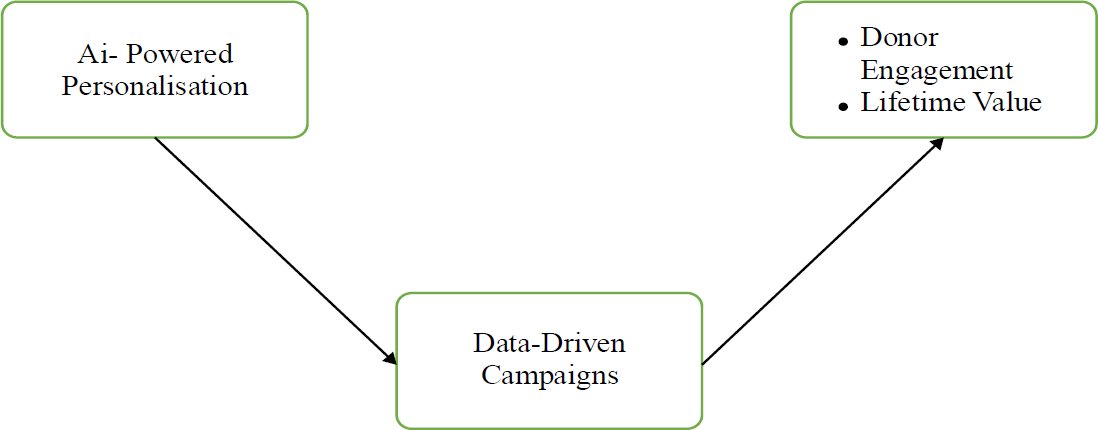
Fig. (1). Conceptual framework.
3. RESEARCH METHODS
3.1. Data Collection Methods
The current research has applied a primary data collection method using a structured survey questionnaire where items are measured on a 5-point LIKERT scaling system. As per (Doubleday et al., 2022), LIKERT scaling system allows to measure rate the intensity of the participant’s response towards items from 1 being strongly disagree to 5 being strongly agree, which has also been adopted in this study. The participants of the study are marketing managers, Information Technology (IT) managers, donor relationship managers, and brand managers of charity organisations. The participants are approached using informed consent and a debrief form on professional networking platforms like LinkedIn, and official social media pages of renowned charities operating in the UK, such as British Red Cross, Oxfam, British Heart Foundation, WWF-UK, and Marie Curie. After contact was made with the participants on these platforms, they were shared with informed and consented, and a debrief form containing details of the study. Upon consent, a survey questionnaire link, created on Google Forms (Appendix A), was shared on their direct messages or inbox.
Since data was gathered through structured self-report survey adapted from previous studies validated instruments, this is an effective way of collecting data at large scale, but it raises issues of perception or social desirability bias. In order to reduce this, future research is suggested to cross-verify the survey data with real donation data, system-generated engagement data or longitudinal observation. The measurement items are critically modified and pretested to be clear, relevant and match the constructs of AI-powered personalisation, data-driven campaigns, donor engagement, and donor lifetime value.
In addition, the cross-sectional design only provides a picture of the relationship between AI-powered personalisation, data-driven campaigns, donor engagement, and donor lifetime value but does not allow causal inference. The effects occurring over time are dynamic or reciprocal and are impossible to capture. Consequently, the longitudinal designs should be used in future studies to monitor the patterns of donor behaviour and involvement so that causal and temporal variations can be drawn. The awareness of this weakness will prompt a cautious approach to the interpretation of the results and will prompt further research into how the aspect of AI-based personalisation would have a long-term effect on relationships with donors in the UK charity sector.
3.2. Sample Size and Sampling Technique
A total sample size of 380 participants was finalised as it provides an adequate statistical power. Aligned with (Ledolter & Kardon, 2020) using G*power software, the estimation of sample size integrated an unanticipated medium effect size, significance level (α = 0.05), and the desired power of 0.80. The study sampled 380 participants of 25 UK-charities chosen purposely to represent the whole non-profit population in terms of size, causes, and geographical coverage. IT experts and marketing managers were contacted to reflect both organisational and technical insights on AI-based personalisation. This stratified sampling remained helpful to guarantee that they are not restricted to one kind of charity but can be generalised to broader charitable organisations in the UK. The description of the sampling also makes it more transparent and replicable in future researches.
An aggregate of 650 respondents was approached, and 390 respondents provided informed consent and filled questionnaire, with a response rate of 60%; however, after applying the data cleaning process, 10 responses were omitted due to invalid or missing values and outliers, leaving 380 responses finally considered for analysis. Moreover, to mitigate the issue of selection bias, a purposive sampling technique was employed across several UK charities to guarantee diverse representation of roles and departments, while clear inclusion criteria necessitated participants to have experience with the donor-engagement procedure. In addition, the non-response bias is addressed by using the method of (Compton et al., 2019), the study performed an independent sample t-test to liken statistically significant variances among early respondents (n1 = 30) and late respondents (n2 = 30), which allowed to confirm that there was no statistically significant difference between the non-respondents and late respondents. This indicated that it ruled out the problem of non-response bias in the dataset. Common method bias was tested using Harman’s single-factor test and no bias was found since the total variance explained was less than 50%.
3.3. Data Analysis Approaches
The data analysis process is carried out using SEM-PLS on SmartPLS. In the first step, reliability and validity are tested using Cronbach’s Alpha and Composite Reliability as suggested by (Subhaktiyasa, 2024). Besides, Average Variance Extracted (AVE) is applied to measure convergent validity of the constructs. In the next step, discriminant validity and reliability are tested using Heterotrait-Monotrait Ratio (HTMT), which, according to (Fauzi, 2022), allows for analysing if each construct is different and separate from each construct and there is no issue of multicollinearity. In the last step, path coefficients are analysed to examine causality among independent, dependent variables and the mediating effect using. As indicated by (Baharum et al., 2023), significance of causality and mediating effect is analysed using p-values at 0.05 alpha with a 95% confidence interval, which has also been adopted in the current study.
4. RESULTS
4.1. Demographic Analysis
The demographic profile of study participants is depicted in Table 1. As per the statistics, it can be observed that male participation remains higher (55.73%) out of (n = 380). While female representation is 30.9%. On the other hand, (33.33%) of the total participants falls within the age bracket of 35-44, where (27.86%) are 45-54 years of age, with the least representation (17.45%) of the participants falling within the age category of 25-34. Moreover, in terms of relevancy of the participants with the research, it can be observed that (24.74%) of the participants are donor managers, (21.88%) are marketing managers, and (25.52%) are IT managers, among them (46.755) holds 6 to 15 years of industry experience, which articulates that the data is collected from relevant and experienced industry personnel.
Table 1. Demographic profile.
| Demographic Category | Frequency (n) | Percentage (%) | |
| Gender | Male | 172 | 55.73% |
| Female | 119 | 30.99% | |
| Prefer not to say | 89 | 23.18% | |
| Age Range | 25-34 | 67 | 17.45% |
| 35-44 | 130 | 33.85% | |
| 45-54 | 107 | 27.86% | |
| 55+ | 76 | 19.79% | |
| Job Title/Position | Donor Managers | 95 | 24.74% |
| Marketing Manager | 84 | 21.88% | |
| IT Managers | 98 | 25.52% | |
| Brand Manager | 103 | 26.82% | |
| Department | Public Relations | 172 | 44.79% |
| Corporate Communications and Marketing | 133 | 34.64% | |
| IT | 75 | 19.53% | |
| Industry Experience | 1-5 years | 66 | 12.98% |
| 6-10 years | 80 | 25.97% | |
| 11-15 years | 132 | 20.78% | |
| 15+ years | 102 | 18.18% | |
4.2. Measurement Model Using Confirmatory Factor Analysis (CFA)
The results in Table 2 and Fig. (2) depict the outcomes of the CFA which depicts robust measurement practices within all variables of the study. The results show high factor loadings which ranges between (0.785-0.930). On the other hand, in terms of reliability, it can be observed that the value of Cronbach’s Alpha and Composite reliability higher than 0.7 complying the condition (α > 0.7) which confirms internal consistency and reliability of the constructs. Further, satisfactory convergent validity is also attained, since, values of AVE in case of all constructs is found to be above standard of 0.5.
Table 2. Measurement model using CFA.
| Latent Variables | Indicators | Factor Loadings | Cronbach’s Alpha | Composite Reliability | Average Variance Extracted (AVE) |
| AI-Powered Personalisation | APP1 | 0.879 | 0.852 | 0.853 | 0.772 |
| APP2 | 0.902 | ||||
| APP3 | 0.855 | ||||
| Data Driven Campaigns | DDC1 | 0.785 | 0.815 | 0.833 | 0.730 |
| DDC2 | 0.902 | ||||
| DDC3 | 0.872 | ||||
| Donor Engagement | DE1 | 0.898 | 0.885 | 0.892 | 0.812 |
| DE2 | 0.930 | ||||
| DE3 | 0.874 | ||||
| Donor Lifetime Value | DLV1 | 0.912 | 0.901 | 0.903 | 0.835 |
| DLV2 | 0.926 | ||||
| DLV3 | 0.903 |
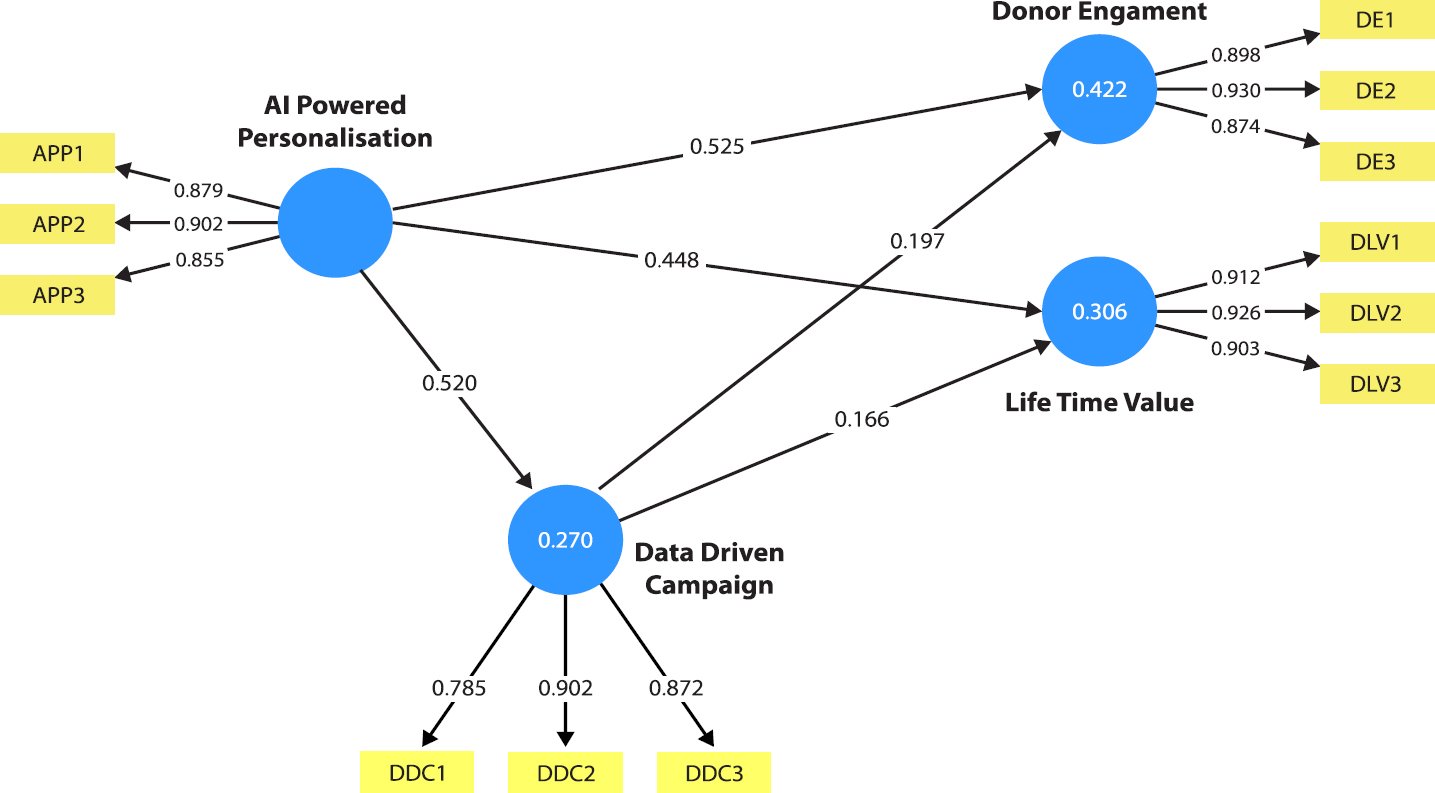
Fig. (2). Measurement model using CFA (showing factor loading, path coefficient and R-squared).
4.3. Discriminant Validity
The test of Discriminant validity allows to examination how separate and distinct each construct is forming other elements or constructs of the model framework. It allows to avoid overlapping between the variables which also ensures validity of the model through Heterotrait-Monotrait Ratio (HTMT) ratio against threshold of 0.85 (Roemer et al., 2021; Yusoff et al., 2020). The results of the HTMT matrix are depicted in Table 3, which articulates strong discriminant validity among the constructs of the model framework has been attained. This is because, in the case of all constructs in the model, the HTM ratio is found to be lower than 0.85 which confirms variable distinctiveness and no conceptual overlapping.
Table 3. Discriminant validity and reliability.
| – | AI Powered Personalisation | Data Driven Campaign | Donor Engagement |
| Data-Driven Campaign | 0.617 | – | – |
| Donor Engagement | 0.718 | 0.547 | – |
| Life Time Value | 0.608 | 0.465 | 0.731 |
4.4. Path Analysis
Table 4 shows that the relationships are significant and strong throughout the model. AI-Powered Personalisation has significant direct impacts with Data-Driven Campaigns (β = 0.520; p = 0.000), Donor Engagement (β = 0.525; p = 0.001), and Donor Lifetime Value (β = 0.448; p = 0.000), proving it is the key factor to improving engagement and lifetime value. The findings suggest that AI-Powered Personalisation is a core driver, which influences campaign planning, advances donor engagement, and promotes value-creation. Its impact implies that charities focusing on personalised, AI-controlled communication have a tangible effect on the quality of engagement, maximise campaign success, and improve long-term relationships with donors, which is why it has a strategic importance, rather than just statistical one.
Table 4. Path analysis.
| – | Path Coefficients | T Statistics | P-Values | f-Square |
| AI Powered Personalisation -> Data Driven Campaign | 0.52*** | 12.342 | 0.000 | 0.371 |
| AI Powered Personalisation -> Donor Engagement | 0.52*** | 10.531 | 0.000 | 0.348 |
| AI Powered Personalisation -> Life Time Value | 0.448*** | 7.992 | 0.000 | 0.211 |
| Data Driven Campaign -> Donor Engagement | 0.197*** | 3.503 | 0.000 | 0.049 |
| Data Driven Campaign -> Life Time Value | 0.166*** | 2.566 | 0.010 | 0.029 |
| Indirect Effects | ||||
| AI Powered Personalisation -> Data Driven Campaign -> Donor Engagement | 0.102*** | 3.189 | 0.001 | |
| AI Powered Personalisation -> Data Driven Campaign -> Life Time Value | 0.086*** | 2.347 | 0.019 | |
Note: *** indicates significance at 1%, ** indicates significance at 5%, * indicates significance at 10%
Data-Driven Campaigns also have a positive and significant impact on Donor Engagement (β = 0.197; p = 0.000) and Donor Lifetime Value (β = 0.166; p = 0.010), with less stable points, which is why it is necessary to indicate Data-Driven Moreover, AI-Powered Personalisation through Data-Driven Campaigns positively affects Donor Engagement (β = 0.102; p = 0.001) and Donor Lifetime Value (β = 0.086; p = 0.019) and supports the importance of data-driven approaches to transforming personalisation into performance improvements. In terms of donor activity and lifetime value, the data-driven campaigns have a beneficial impact, but rather moderate, which indicates that it is also necessary to mix campaigns with strategy-based personalisation. The mediation analysis highlights the fact that AI-Powered Personalisation is better implemented into performance improvements when organised in data-driven strategies, which supports the importance of focused, evidence-based interventions.
In addition, Table 4 denotes that partial mediation exists in the links between AI-Powered Personalisation as well as Donor Engagement and Donor Lifetime Value, using Data-Driven Campaigns. These effects cannot be considered minor since the direct impact of AI-Powered Personalisation on Donor Engagement (p = 0.001) and Lifetime Value (p = 0.001) is significant and has the most considerable coefficient of (β = 0.525) and (β = 0.448), respectively. The fact that Data-Driven Campaigns mediates the efforts of AI-Powered Personalisation in creating better engagement with donors and lifetime value. It implies that although personalisation is increased further by structured campaigns, AI-based approaches have a significant direct impact, which confirms to their strategic significance. In terms of effect size, the results of f² depicts that AI-powered personalisation applies a substantial effect on data-driven campaigns (f² = 0.371) as well as donor engagement (f² = 0.348), and a moderate effect on donor lifetime value (f² = 0.211). On the other hand, data-driven campaigns validate merely small effect sizes on donor engagement (f² = 0.049) and donor lifetime value (f² = 0.029), which signifies a complementary instead of dominant role.
4.5. Model Explanatory Power
The model explanatory power is explained through R-square values which allows to analyse the percentage of variance in dependent variable is explained by predictors or independent variables (Purwanto & Sudargini, 2021). The statistical results depicted in Table 5 indicate that 0.27, that is 27% of variance, is explained by AI-Powered personalisation. In addition, in donor engagement, 0.422, that is 42.2% variance, is explained by AI-Powered personalisation, and 33.6% variance is explained by Life-time donor value.
Table 5. R-square and model fit.
| – | R-Square | R-Square Adjusted |
| Data Driven Campaign | 0.270 | 0.269 |
| Donor Engagement | 0.422 | 0.419 |
| Life Time Value | 0.306 | 0.302 |
5. DISCUSSION AND HYPOTHESIS ASSESSMENT
5.1. Impact of AI-Powered Personalisation in Charity Marketing on Donor Engagement in the UK Non-Profit Sector
H1 is supported, with a significant relationship with AI-powered personalisation resulting in donor engagement and reaffirming the claim that personalisation is closely related with the charity sector in the UK. Likewise, a study of (Alsolbi et al., 2023) within the retailing context determined that AI-supported personalisation enhances customer contact by making communication messages more relevant and emotionally appealing, indicating uniformity across industries of the ability of AI to promote engagement. In contrast, (Shukla & Tripathi, 2025) argued on personalisation initiatives in UK charities, which showed merely incremental benefits in donor engagement, also pointing at the outdated CRM systems as the main factors contributing to lesser donor engagement, as such, indicating technology development as a principal factor.
Similarly, the findings also align with the claim made by (Gooyabadi et al., 2023) that the increased proximity of targeted donor communications powered with AI increases engagement, and there is a counter-intuitive negative effect beyond a certain level of personalisation due to its invasiveness and advanced abilities of modern AI systems to contextualise messages. The similar results presented can likely be considered as an indicator of digital maturity because big, UK charities that have implemented modern AI platforms are more exact and swifter in developing personalised marketing campaigns to target donors and improve donor engagement. Such relationships with UK charities mean that investing in AI systems can undertake a personalised approach to their services dynamically and with ethics should be in focus, where content would be relevant and not violating privacy limits.
The results are relevant to the current understanding of nonprofit marketing as they show that AI-driven personalisation has the potential to enhance relational relationships and provoke long-term allegiance to donors, which corresponds to the Relationship Marketing Theory. The extent of personalisation to engagement is affected by the organisational factors of digital maturity, CRM sophistication, resource allocation, and effectiveness is mediated by environmental factors, including donor expectations and data privacy norms unveiled in the analysis of (Sellen & Mönks, 2024) as well. The findings also highlight that AI-based engagement tactics should be morally applied, with personalisation versus privacy to ensure customer trust. Charities can use AI tools to optimise communication relevance and responsiveness managerially, but need to incorporate the governance structures and training programmes to maintain impact. Hence, the findings underline the fact that the successful donor engagement strategies in UK nonprofit environment are constituted by the technological capability, the organisational preparedness, and ethical considerations.
5.2. AI-Powered Personalisation in Charity Marketing on Donor Lifetime Value in the UK Non-Profit Sector
The results confirm H2, showing that the personalisation using AI had a significant positive relationship with the donor lifetime value (DLV), as the notion is capable of developing long-term relationships with the donor and increasing donor lifetime value. These findings align with results claimed by (Day et al., 2025) that personalised marketing campaigns have been shown to raise donor lifetime value significantly, through satisfaction and repeat purchases, resulting in the same being useful in prolonging the giving of donors. Contrarily, (Jasper et al., 2024) did not support the results of the current study, revealing that the DLV gains were rather limited among UK charities. Moreover, the limited impact could be linked to the unreliable use of or outdated personalisation tactics and lack of coordination between marketing and donor databases, with the ability to differentiate through technology and data variables as the key factors.
In addition, the findings of this study are supported by (Sellen & Mönks, 2024), who reported that long-term results of emotionally resonant, donor-centric marketing communications were that they increased long-term giving. However, as the charities failed to follow them with consistent stewardship, their influence dropped; this might be the cause of the stagnation of DLV even in the wake of personalisation efforts by some charities (Rather et al., 2021). Hence, the findings of the current study could be attributed to the development of AI tools that provide opportunities to maintain timely and relevant touchpoints. This also aligns with the principle of long-term and trust-based engagement with Relationship Marketing Theory, as well as the focus on donor value maximisation on the basis of individual retention strategies in the framework of the CLV Theory (Pfajfar et al., 2022). The implication is that AI-driven personalisation can play a differentiated role in enhancing DLV of UK charities and that when. To prevent donor disengagement, guaranteeing donor retention and developing lifetime value, charities need to make sure that personalisation attempts are supported with rigorous data driven practices powered with AI and ongoing development of strong relationships, and need to strike a healthy balance between innovation and ethical, transparent fundraising approaches that offer long-term sustainability to their fundraising efforts.
5.3. Mediating Effect of Data-Driven Technologies on the Relationship Of AI-Powered Personalisation with Donor Engagement and Lifetime Value
The results of H3 reveal research findings indicating that data-driven campaigns partially mediate the predictive association of AI-powered personalisation with donor engagement and donor lifetime value and, therefore, highlight that the technologies of data play a mediating role but do not fully explain the connection. In similar vein, the (Khastgir & Shalini, 2024) study indicated a significant improvement of the personalisation effect on donor retention using predictive analytics, which reveals that data-driven tools can enhance engagement strategies because of their greater precision and responsiveness. As a contrast, (Singh et al., 2022) led to the revelation that charities who extensively relied on the traditional segmentation but without the real-time data experienced negligible long-term gains in terms of donation by a charity, indicating how traditionalization of an approach can inhibit the benefit of personalisation, which is why introduction of more modern integration of AI and report data in this experiment as compared to any traditional segmentation employed strong results.
Similar to the idea promoted by the Relationship Marketing Theory, (Day et al., 2025) also discovered that data-driven transparency positively affected the level of donor trust. Nevertheless, (Khastgir & Shalini, 2024) also reminded about the danger of excessive data, which can lead to deconstructing donors into their transactional aspects and losing its emotional component and, therefore, disengagement in the long-run, which the findings of this study did not indicate, possibly due to the higher individualisation of outreach done by advanced AI systems without the need to worry about relationship quality. Such disparities in the findings imply that the maturity of technologies and responsible data applications play a pivotal role in determining the course of events. In the case of UK charities, the implications are significant; for instance, the use of AI-personalisation in combination with well-developed data-driven approaches can bring massive improvements in engagement and donor lifetime value. However, organisations need to make sure that data use complements, not replaces, genuine, true-to-trust relationships on which fundraising success is built in the long term.
These results build on the insight into AI-based strategies on nonprofit marketing by demonstrating how data-based campaigns serve as a partial conduit through which AI-powered personalisation increases the engagement of donors and lifetime value as per the Relationship Marketing Theory and CLV Theory. It is also aligned with the arguments of (Cheng & Wang, 2025) arguing that the effectiveness of AI-driven insights in being translated into engagement is determined by organisational factors, including the ability to unite real-time analytics and the complexity of data governance. This is mediated by environmental factors such as expectations of donors and digital literacy. Thus, the findings imply that the charities should invest in AI-powered systems of data and human resources on the managerial level to make the personalisation strategies responsive, accurate, and ethical. The findings also indicate that personalisation performance is enhanced with the help of data-driven campaigns, though, the success rate of these campaigns relies on the organisational preparedness and the alignment of AI tools with the donor-centred practise.
CONCLUSION
This research has investigated how AI-based personalisation can enhance donor engagement and lifetime value in the UK non-profit sector and has pointed out the mediating factor of information-led campaigns. The findings proved the heterogeneous causal indication that AI-powered personalisation produces a significant and direct positive impact on the engagement of donors in proving the potential of this market to modify the interactions between the charity marketers and the donors by communicating to them with relevance, in a timely manner, regarding societal needs.
In the same vein, AI-personalisation has had profound positive impacts in elevating the donor value in terms of lifetime and demonstrated its ability to DLV and realise maximum collective donations over a long period. Moreover, the results of data-driven campaigns were revealed to provide partial mediation to the relationships between AI-powered personalisation and donor engagement, as well as lifetime value, showing that although, when operating alone, AI-personalisation results in positive outcomes, it becomes even more effective as a combination of advanced data strategies increases accuracy and responsiveness of engagement activities. The findings overall support how charities in the UK have the potential to be transformed through AI and data analytics tools, with empirical evidence that funding data-driven personalisation strategies supported by AI will make a significant difference both in the short-term engagement of donors and donor value in the long term. This research contributes to the literature on nonprofit marketing since it empirically shows that the use of AI-controlled personalisation, which is mediated by data-driven campaigns, increases donor engagement and lifetime value. It contributes to the knowledge of technology-based approaches to fundraising, incorporating the Relationship Marketing and the CLV concepts, and offers a model usable by the nonprofits to strategically introduce AI tools to the nonprofit, closing the gap between digital innovation and long-term donor relations management.
LIMITATIONS OF THE STUDY AND FUTURE DIRECTIONS
There are several limitations encountered in the current study, which are comprised of exclusive emphasis on charities in the UK, which limits the generalisation of the results and findings produced by the current study to other countries’ charity organisations with diverse rates of technological adoption and donor cultures. On the other hand, the cross-sectional research design averts the development of cause-and-effect associations in the long term amid AI-personalisation, data-driven campaigns, and donor outcomes. In addition, dependence on self-reported data tends to introduce social desirability or response biases that possibly inflate relationships among the variables.
Future studies, therefore, are required to explore longitudinal designs to evaluate ways that AI-powered personalisation and data strategies influence engagement of donors and lifetime value creation over the period. In addition, comparative studies across diverse countries and their non-profit sector tend to generate in-depth insights related to contextual factors that formulate the effectiveness of AI-driven fundraising, donor engagement, and value creation in the long term. In addition, the amalgamation of qualitative approaches tends to unveil detailed donor perceptions of AI-personalisation, at the same time, analysing developing technologies such as predictive donor behaviour and lifetime value creation models through machine learning technologies tends to further improve comprehension of ways that digital transformation in charity organisations can improve donor relationship, engagement and lifetime value in charity organisations.
POLICY IMPLICATIONS
The results suggest that managers of charities in the UK should focus on ethically and transparently applying AI-supported personalisation and data-driven campaigns. This has to be done with clearly set guidelines that will make the donors feel safe and long-term involvement as they will know how their data is gathered, stored and utilised. The managers are suggested to prefer AI systems that dynamically personalise communications without violating the boundaries of privacy and without engaging in invasive behaviours. Staff training programmes and funding to smaller and medium charities can be used to encourage the fair use of these technologies. Moreover, the predictive analytics in the campaign planning can contribute to the effectiveness of targeting the donors, enhancing satisfaction and life-time value. Longitudinal studies can be conducted in future to understand the long-term impacts of AI personalisation on donor loyalty. Comparative studies on different regional contexts might uncover contextual variations in the behaviour of donors, and can serve to shape more versatile AI-based strategies. Together, these can help charities maximise the lifetime value of their donors, and be ethical and responsible in their data use.
ABBREVIATION
CLV | = | Customer Lifetime Value |
AUTHOR’S CONTRIBUTION
I.K. has contributed to conceptualization, idea generation, problem statement, methodology, results analysis, results interpretation.
ETHICAL APPROVAL & INFORMED CONSENT
The participants are approached using informed consent and a debrief form on professional networking platforms like LinkedIn, and official social media pages of renowned charities operating in the UK, such as British Red Cross, Oxfam, British Heart Foundation, WWF-UK, and Marie Curie. After contact was made with the participants on these platforms, they were shared with informed and consented, and a debrief form containing details of the study
AVAILABILITY OF DATA AND MATERIAL
The data will be made available on reasonable request by contacting the corresponding author [I.K.].
FUNDING
None.
CONFLICT OF INTEREST
The authors declare that there is no conflict of interest regarding the publication of this article.
ACKNOWLEDGEMENTS
Declared none.
DECLARATION OF AI
During the preparation of this work the author used ChatGPT for editing purposes. After using this tool, the author reviewed and edited the content as needed and take full responsibility for the content of the published article.
APPENDIX A
| Item | Response Options |
| Age | [ ] 25–34 [ ] 35–44 [ ] 45–54 [ ] 55+ |
| Gender | [ ] Male [ ] Female [ ] Non-binary [ ] Prefer not to say |
| Job Position | [ ] Donor managers [ ] Marketing Manager [ ] IT Mangers [ ] Brand Manager. |
| Department | [ ] Public Relations, [ ] Corporate Communications, and Marketing [ ] IT |
| Industry Experience | [ ] 1-5 years [ ] 6-10 years [ ] 4–6 years [ ] 11-15 years[ ] 15+ years |
The Likert scale options are:
1 = Strongly Disagree, 2 = Disagree, 3 = Neutral, 4 = Agree, 5 = Strongly Agree.
| Section | Statements | 1 | 2 | 3 | 4 | 5 |
| AI-Powered Personalisation | Our charity uses AI to tailor communication specifically to individual donor preferences. | |||||
| AI tools in our campaigns provide insights that help personalise donor experiences. | ||||||
| The use of AI has improved the relevance of our messages to different donor segments. | ||||||
| Data-Driven Campaigns | Data analytics guides our decisions on when and how to approach donors. | |||||
| Our campaigns use real-time data to adjust strategies for donor engagement. | ||||||
| Data-driven processes increase the transparency of how donor funds are utilised. | ||||||
| Donor Engagement | Donors respond more positively to personalised communications. | |||||
| Personalised approaches encourage donors to engage with our charity more frequently. | ||||||
| The level of donor interaction has increased since adopting AI-based personalisation. | ||||||
| Donor Lifetime Value | Personalised communication has led to higher repeat donations from our donors. | |||||
| AI-powered strategies have extended the duration of donors’ relationships with our charity. | ||||||
| The average donation per donor has increased since introducing data-driven personalisation strategies. |
REFERENCES
Ali, N., & Shabn, O. S. (2024). Customer lifetime value (CLV) insights for strategic marketing success and its impact on organizational financial performance. Cogent Business & Management, 11(1), 2361321.
https://doi.org/10.1080/23311975.2024.2361321.
Alsolbi, I., Agarwal, R., Unhelkar, B., Al-Jabri, T., Samarawickrama, M., Tafavogh, S., & Prasad, M. (2023). A conceptual design of an AI-enabled decision support system for analysing donor behaviour in nonprofit organisations. Information, 14(10), 578.
https://doi.org/10.3390/info14100578.
Baharum, H., Ismail, A., Awang, Z., McKenna, L., Ibrahim, R., Mohamed, Z., & Hassan, N. H. (2023). Validating an instrument for measuring newly graduated nurses’ adaptation. International Journal of Environmental Research and Public Health, 20(4), 2860.
https://doi.org/10.3390/ijerph20042860.
Blackbaud. (2024). The status of UK fundraising: Benchmark report. Blackbaud. Available from: https://www.blackbaud.co.uk/industry-insights/resources/the-status-of-uk-fundraising-2024-benchmark-report.
CAF. (2024). UK giving report 2024. CAF Online. https://www.cafonline.org/docs/default-source/uk-giving-reports/uk_giving_report_2024.pdf.
Cheng, Y., & Wang, Y. (2025). Leveraging artificial intelligence–powered chatbots for nonprofit organizations: Examining the antecedents and outcomes of chatbot trust and social media engagement. Journal of Philanthropy, 30(1), e70013.
https://doi.org/10.1002/nvsm.70013.
Cherniavska, O., Belov, A., Shmygol, N., Järvis, M., & Tsalko, T. (2023). Artificial intelligence tools for university fundraising 5.0: A comprehensive analysis. In Proceedings of the 2023 IEEE 5th International Conference on Modern Electrical and Energy Systems (MEES) (pp. 1–6).
https://doi.org/10.1109/MEES61502.2023.10402529.
Compton, J., Glass, N., & Fowler, T. (2019). Evidence of selection bias and non-response bias in patient satisfaction surveys. The Iowa Orthopaedic Journal, 39(1), 195–201. Available from: https://pubmed.ncbi.nlm.nih.gov/31413694/.
Day, S. W., Jean-Denis, H., & Karanja, E. (2025). Extending the resource-based view of social entrepreneurship: The role of artificial intelligence in scaling impact. Journal of Risk and Financial Management, 18(7), 341.
https://doi.org/10.3390/jrfm18070341.
Doubleday, K. F., Crews, K. A., Eisenhart, A. C., & Young, K. R. (2022). Post-survey Likert constructions: An adaptive method for generalizing perceptions of environmental variability. GeoJournal, 87(1), 261-275.
https://doi.org/10.1007/s10708-020-10251-y.
Evans, S. (2025). Bringing charities, a new level of audience insights with Dotdigital. Giant Digital. Available from: https://www.giantdigital.co.uk/about/our-journal/giant-partners-dot-digital-bring-charities-new-level/.
Faruq, O., Haque, S., Sufian, M. A., Al-Samad, K., Hossain, M. A., Talukder, T., & Shayed, A. U. (2024). AI-driven strategies for enhancing non-profit organizational impact. AIJMR: Advanced International Journal of Multidisciplinary Research, 2(5), 1-15.
https://doi.org/10.62127/aijmr.2024.v02i05.1088.
Fauzi, M. A. (2022). Partial least squares structural equation modelling (PLS-SEM) in knowledge management studies: Knowledge sharing in virtual communities. Knowledge Management & E-Learning, 14(1), 103–124.
https://doi.org/10.34105/j.kmel.2022.14.007.
Firmansyah, E. B., Machado, M. R., & Moreira, J. L. R. (2024). How can artificial intelligence (AI) be used to manage customer lifetime value (CLV): A systematic literature review. International Journal of Information Management Data Insights, 4(2), 100279.
https://doi.org/10.1016/j.jjimei.2024.100279.
Gooyabadi, A. A., GorjianKhanzad, Z., & Lee, N. (2023). Nonprofit digital transformation: Choice or mandate? In Nonprofit digital transformation demystified: A practical guide (pp. 51–65). Springer.
https://doi.org/10.1007/978-3-031-47182-7.
Government of UK. (2024). The future for charities can’t be guaranteed if today’s challenges are not met. Available from: https://www.gov.uk/government/speeches/the-future-for-charities-cant-be-guaranteed-if-todays-challenges-are-not-met.
Hibabox. (2023). Contactless donation for mosques and charities. Hibabox. https://hibabox.com/blog/how-to-start-a-charity-a-comprehensive-guide.
Jasper, U., Jha, S., & Germann, S. (2024). Shaping the ethical and inclusive AI revolution: Five roles for philanthropies. In The Routledge handbook of artificial intelligence and philanthropy (pp. 471–485). Routledge.
https://doi.org/10.4324/9781003468615-33.
Khan, N., Hasan, M.R., Hasan, M., Mirza, J.B., Hassan, A., Paul, R., Khan, N., Nikit, N.A. (2025). The role of AI in digital marketing analytics: Enhancing customer segmentation and personalization in IT service-based businesses. AIJMR: Advanced International Journal of Multidisciplinary Research, 3(1), 1-23.
https://doi.org/10.62127/aijmr.2025.v03i01.1124.
Khastgir, P., & Shalini, S. (2024). Applying diverse AI tools to transform philanthropic operations: Insights from the for-profit sector. In The Routledge handbook of artificial intelligence and philanthropy (pp. 76–93). Routledge.
https://doi.org/10.4324/9781003468615-7.
Kumar, V. (2024). Customer valuation theory. In Valuing customer engagement: Strategies to measure and maximize profitability (pp. 15–35). Springer.
https://doi.org/10.1007/978-3-031-43296-5_2.
Ledolter, J., & Kardon, R. H. (2020). Focus on data: Statistical design of experiments and sample size selection using power analysis. Investigative Ophthalmology & Visual Science, 61(8), 11.
https://doi.org/10.1167/iovs.61.8.11.
Lv, L., & Huang, M. (2024). Can personalized recommendations in charity advertising boost donations? The role of perceived autonomy. Journal of Advertising, 53(1), 36–53.
https://doi.org/10.1080/00913367.2022.2109082.
Madanchian, M. (2024). The impact of artificial intelligence marketing on e-commerce sales. Systems, 12(10), 429.
https://doi.org/10.3390/systems12100429.
Mariani, M. M., Perez‐Vega, R., & Wirtz, J. (2022). AI in marketing, consumer research and psychology: A systematic literature review and research agenda. Psychology & Marketing, 39(4), 755–776.
https://doi.org/10.1002/mar.21619.
NCVO. (2021). Where do voluntary organisations get their income from? NCVO Available from: https://www.ncvo.org.uk/news-and-insights/news-index/uk-civil-society-almanac-2024/financials/where-do-voluntary-organisations-get-their-income-from/.
Onuche, J. (2025). Enhancing non-profit efficiency and impact through data-driven strategies: Addressing challenges and leveraging emerging technologies–A literature review. Texila International Journal of Management, 11(1), 1-12.
https://doi.org/10.21522/TIJMG.2015.11.01.Art024.
Onufriyenko, A. (2025). Orgs boosted donations with donor analytics. NonProfit PRO. https://www.nonprofitpro.com/article/study-shows-donations-increase-with-ai-powered-donor-data-analytics/.
Patel, S., & Patyrykin, K. (2025). Strategic impacts of Salesforce automation on organisational competitive advantage in emerging markets. Journal of Posthumanism, 5(12), 357–372.
https://doi.org/10.63332/joph.v5i12.3782.
Patyrykin, K. (2025). Cancel culture problem. Lex Localis – Journal of Local Self-Government, 23(S6), 8376–8386.
https://doi.org/10.52152/4bd84a80.
Patyrykin, K., & Vasyukova, L. (2025). Environmental accountability or symbolic compliance? A critical review of ESG ratings, greenwashing, and indirect emissions in the global insurance sector. International Journal of Energy Economics and Policy, 15(6), 917–925.
https://doi.org/10.32479/ijeep.22770.
Pfajfar, G., Shoham, A., Małecka, A., & Zalaznik, M. (2022). Value of corporate social responsibility for multiple stakeholders and social impact: A relationship marketing perspective. Journal of Business Research, 143, 46–61.
https://doi.org/10.1016/j.jbusres.2022.01.051.
Purwanto, A., & Sudargini, Y. (2021). Partial least squares structural squation modeling (PLS-SEM) analysis for social and management research: a literature review. Journal of Industrial Engineering & Management Research, 2(4), 114-123.
https://doi.org/10.7777/jiemar.v2i4.168.
Rather, R. A., Tehseen, S., Itoo, M. H., & Parrey, S. H. (2021). Customer brand identification, affective commitment, customer satisfaction, and brand trust as antecedents of customer behavioral intention of loyalty: An empirical study in the hospitality sector. In Consumer behaviour in hospitality and tourism (pp. 44-65). Routledge.
https://doi.org/10.1080/21639159.2019.1577694.
Roemer, E., Schuberth, F., & Henseler, J. (2021). HTMT2—An improved criterion for assessing discriminant validity in structural equation modeling. Industrial Management & Data Systems, 121(12), 2637–2650.
https://doi.org/10.1108/IMDS-02-2021-0082.
Sammer, M., Seong, K., Olvera, N., Gronseth, S. L., Anderson-Fletcher, E., Jiao, J., & Kakadiaris, I. A. (2024). AI-FEED: Prototyping an AI-powered platform for the food charity ecosystem. International Journal of Computational Intelligence Systems, 17(1), 259.
https://doi.org/10.1007/s44196-024-00656-9.
Santos, J. (2025). Emerging paradigms in non-profit governance. In New trends for the governance of non-profit organizations (pp. 1–86). IGI Global.
https://doi.org/10.4018/979-8-3693-3723-3.ch001.
Sellen, C., & Mönks, J. (2024). AI disruptions in philanthropy: A multi-scale model of ethical vigilance. In The Routledge handbook of artificial intelligence and philanthropy (pp. 520–538). Routledge.
https://doi.org/10.4324/9781003468615-36.
Shukla, D., & Tripathi, R. (2025). Artificial intelligence for social good in-service marketing. In Tracking tourism patterns and improving travel experiences with innovative technologies (pp. 169–190). IGI Global.
https://doi.org/10.4018/979-8-3693-9636-0.ch008.
Singh, C., Zhao, L., Lin, W., & Ye, Z. (2022). Can machine learning as a RegTech compliance tool lighten the regulatory burden for charitable organisations in the United Kingdom? Journal of Financial Crime, 29(1), 45–61.
https://doi.org/10.1108/JFC-06-2021-0131.
Solow, D., Webb, N., & Symes, R. (2023). A novel approach to legacy donations with long-term benefits supported by numerical illustrations. Journal of Philanthropy and Marketing, 28(3), e1803.
https://doi.org/10.1002/nvsm.1803.
Subhaktiyasa, P. G. (2024). PLS-SEM for multivariate analysis: A practical guide to educational research using SmartPLS. EduLine: Journal of Education and Learning Innovation, 4(3), 353-365.
https://doi.org/10.35877/454RI.eduline2861.
Werke, S. Z., & Bogale, A. T. (2024). Nonprofit marketing: A systematic review. Journal of Nonprofit & Public Sector Marketing, 36(5), 603–640.
https://doi.org/10.1080/10495142.2023.2290531.
Williams, S. (2025). UK charities missing out on AI as demand and barriers increase. ChannelLife. https://channellife.co.uk/story/uk-charities-missing-out-on-ai-as-demand-barriers-increase.
Yau, K. L. A., Saad, N. M., & Chong, Y. W. (2021). Artificial intelligence marketing for enhancing customer relationships. Applied Sciences, 11(18), 8562.
https://doi.org/10.3390/app11188562.
Yusoff, A. S. M., Peng, F. S., Razak, F. Z. A., & Mustafa, W. A. (2020, April). Discriminant validity assessment of religious teacher acceptance: The use of HTMT criterion. In Journal of Physics: Conference Series (Vol. 1529, No. 4, p. 042045). IOP Publishing.
https://doi.org/10.1088/1742-6596/1529/4/042045.
Zoe Amar Digital. (2024). Charity digital skills report 2024. Available from: https://charitydigitalskills.co.uk/wp-content/uploads/2024/07/Charity-Digital-Skills-Report-2024.pdf.
Licensed
© 2026 Copyright by the Authors.
Licensed as an open access article using a CC BY 4.0 license.
Article Contents Authors Saman Ismail1, * Imran Iqbal2 1Faculty of Management Science, Department of Business Administration, Salim Habib University, Karachi,
Article Contents Author Michael Dolinsky1, * 1Faculty of Mathematics and Technologies of Programming, Francisk Skorina Gomel State University,
Article Contents Author Abdul Ghafoor Memon1, * 1Emaan Institute of Management Sciences, Karachi, Pakistan Article History: Received: 01 April, 2026
Article Contents Authors Zixuan Zhao1, Ju Guo1, * 1School of Management, Chengdu University of Information Technology, Chengdu, China Article History:
Article Contents Authors Sultan Ud Din Yousufzai1, Amtyaz Safi2, * , Maher Khan1, Zia Ud Din1 1Department of Zoology, Govt.
Article Contents Author Nasir Uddin Khan1, * 1Department of Emaan Institute of Management Sciences, Karachi, Pakistan Article History: Received: 16