


















Article Contents
Article ID: CMT2621101004
Views: 883Perceived Talent Management and Perceived Total Quality Management on Patient-Centred Service Quality: Vision 2030 Healthcare Reform as a Moderator
 DOI:
DOI:
 PDF
PDF
⬇ Downloads: 45
1Department of Business Administration, Imam Abdul Rahman Bin Faisal University, Dammam, Saudi Arabia
Received: 27 March, 2026
Accepted: 27 June, 2026
Revised: 16 June, 2026
Published: 15 July, 2026
ABSTRACT:
Introduction: This study examined the associations among perceived Talent Management (TM), perceived Total Quality Management (TQM), and patient-centred service quality, and explored the moderating effect of Vision 2030 Healthcare Reform in the Saudi Arabian healthcare sector.
Methods: A quantitative research design was employed, with a structured questionnaire using a 5-point Likert scale to collect data. Purposive sampling was used to collect data from (n= 350) nurses working in emergency, intensive care, and outpatient units in selected Saudi hospitals. The data were analysed using (PLS-SEM).
Results: This study revealed that perceived Talent Management Practices and perceived Total Quality Management were significantly related to perceived patient-centred service quality. Perceived patient-centred service quality outcomes were also found to be significantly and positively associated with perceived Vision 2030 Healthcare Reform. In addition, the moderation results showed that the perceived Vision 2030 Healthcare Reform initiatives play a significant role in enhancing the relationships between talent management, perceived total quality management, and perceived patient-centred service quality.
Conclusion: This study highlights the significance of human capital development, quality management systems, and national healthcare reform efforts in achieving the sustainability of patient-centred excellence. To enhance the sense of institutional accountability and responsiveness to services, policymakers and hospital administrators must incorporate talent strategies and continuous improvement frameworks into the performance requirements of Vision 2030.
Originality Value: This study provides novel empirical evidence by positioning the concept of perceived healthcare reform as a contextual governance mechanism, which allows the study to consider healthcare organisational capabilities as sturdier determinants of perceived healthcare outcomes in the context of patient-centred healthcare reform in Saudi Arabia.
Keywords: Perceived talent management, perceived total quality management, patient-centred service quality, Vision 2030, healthcare reform.
1. INTRODUCTION
The healthcare industry in Saudi Arabia has experienced a significant transformation over the last few years because of a combination of demographic changes, an increase in disease burden, and the Vision 2030 healthcare strategic reforms (Mani & Goniewicz, 2024). (Saggaf et al., 2025; Alharbi et al., 2025) unveiled that service delivery has progressively shifted towards patient-centred care due to substantial developments in the healthcare sector, such as expanding healthcare infrastructure, integrating digital health, implementing privatisation policies, and adopting performance-based governance. (Alasiri & Mohammed, 2022) signifies that enhancing the capacity of healthcare workers along with strengthening quality management systems are important determinants to uphold service delivery, specifically where there are increasing non-communicable diseases with ageing population that lasts to place extra burden on healthcare systems.
However, following the reforms, the Saudi health sector still faces substantial structural challenges. (Rahman & Al-Borie, 2021) claim that the impact of skilled labour shortage, high staff turnover, uneven distribution of skilled labour and quality assurance bottlenecks persist and limit the effectiveness of healthcare services. Moreover, due to the increasing number of patients and the high prevalence of chronic diseases, patient experiences remain unpredictable within healthcare institutions, and they have different levels of satisfaction in healthcare institutions (Aljehani & Nawees, 2025). These challenges highlight the gap between policy goals and the organisational level of preparedness to achieve consistent patient-centred care outcomes.
The results from previous studies, such as (Chen et al., 2020; Nkala et al., 2021), show that perceived talent management and perceived Total Quality Management (TQM) enhance the adaptability of the organisation as well as responsiveness to altering external policies and environmental conditions. For example, (Chen et al., 2020; Nkala et al., 2021) argue that workforce talent strategies can improve clinical governance given improved staff competence, turnover, and adaptability. Likewise, (Salahat et al., 2023) claimed that TQM helps create structured decision-making, process standardisation, and continuous improvement processes that together bolster service reliability and patient-centred care delivery.
While there is a massive literature available discussing about different aspects of healthcare transformation such as (Aljehani & Nawees, 2025; Rahman & Al-Borie, 2021) the majority of it has been addressing the subject as three different organisational or policy aspects that are separate from each other, namely Talent Management, Perceived Total Quality Management (TQM), and healthcare reforms. There is little empirical evidence addressing the relationship between these capabilities in the context of Health Care Systems, especially under the governance conditions imposed by Saudi Vision 2030. Past literature, such as (Dzimbiri & Molefi, 2021), is descriptive of the reform attempts but does not examine the moderating effect of the reform activities on the relationship between organisational capabilities and patient-centred outcomes. Since then, there has been a lack of focus on integrated capability frameworks that help describe how the effectiveness of internal organisational capabilities in the delivery of healthcare services is conditioned by institutional reforms.
In terms of theory, this study makes a significant contribution to the literature on capability-based models of performance in the field of Resource-Based View (RBV) and perceived Total Quality Management (TQM) within the healthcare sector of Saudi Arabia. In practice, it provides empirical evidence on the nature of interaction between organisational capabilities, during ongoing healthcare transformation, through the context of Saudi Arabia. In addition, novelty of the study is also its conceptualisation of the process of healthcare reform as a governance-enabling mechanism, thereby not referring to the process of reform as a policy initiative alone, but also as a process that shapes how the capabilities of healthcare organisations come together in a synergistic manner to affect the perceived quality of patients’ services in changing healthcare systems. This study makes three main contributions to the literature. First, it aligns human capital strategies with the Vision 2030 healthcare governance reforms.
- Support evidence-based quality improvement policies through integrated talent and total TQM
- The moderating role of Vision 2030 Healthcare Reform on the relationship between talent management, TQM, and patient-centred service quality was tested using sector-specific data.
2. LITERATURE REVIEW
2.1. Theoretical Framework
This study combines the Resource-Based View (RBV) and institutional theory to explain how organisational capabilities in the healthcare sector can lead to patient-centred service quality, as outlined in the Saudi Vision 2030 healthcare reform. The integrated framework describes the interactions among human capital resources, organisational quality routines, and institutional reform pressures, and their effects on healthcare service outcomes.
According to (Zvarimwa & Zimuto, 2022), the RBV holds that an organisation’s performance is reliant on valuable, rare, inimitable, and irreplaceable resources (VRIN). In healthcare organisations, strategic human capital is created through Perceived Talent Management practices, such as recruitment, development, and retention, thereby enhancing clinical and service processes. Healthcare perceived talent management boosts professional skills and collaborative proficiencies that contribute to delivering patient-centred care. Similarly, (Kosiol et al., 2023) claimed that specialised healthcare knowledge and skills are inimitable organisational resources that enhance the service capacity. Perceived Talent Management is viewed from an RBV perspective as a way of creating a strategic workforce that helps hospitals excel in their services.
Competing theories, such as institutional theory and the RBV, better explain the institutional context for Saudi healthcare transformation under Saudi Vision 2030. For instance, (Aldhobaib, 2025) states that the organisational theory of institutions states that organisations respond to external pressures on them in terms of regulatory, normative, and cultural pressures which means that the results of reform, such as changes in the governance structure, digitalisation, and localisation of the workforce, lead to the homogenisation of the behaviour of the organisations. In contrast, RBV suggests that institutional pressures have little effect on performance differences because the effects are due to the presence of valuable, rare, and inimitable capabilities, which vary from firm to firm, as suggested by (Kero & Bogale, 2023). This forms a boundary condition; policy compliance is not enough to ensure better quality of the services provided if the capabilities within the organisation are not put in place.
However, the assumptions of the Institutional Theory and the RBV are not completely compatible. (Adubasim et al., 2025; Cha et al., 2024) also suggested that under similar regulatory pressures, organisations evolve towards uniformity regarding structure and practice as hypothesised in Institutional Theory. According to (Jinjing & Karia, 2024), the RBV assumes that performance disparities exist due to different strategic capacities and resource, configuration, and positioning among organisations. This presents a theoretical dilemma in the Saudi context due to the need for healthcare to be compliant with the Vision 2030 reforms but not necessarily achieve better patient-centred outcomes. The governance structures that can be adopted to reform a hospital can be in place at the formal level, but there are variations in staff competence, managerial readiness, and quality systems in hospital operations. Thus, it is important to combine and consider both views to determine the reasons for the variation in the ability of some healthcare organisations to implement changes in services in response to reform pressures.
Furthermore, it can be argued that the apparent tension between the RBV and institutional theory disappears once it is realised that they address different aspects of organisational performance. As stated by (Rahman & Al-Borie, 2021), the RBV theory explains the variation in the managerial potential of healthcare organisations to produce high-quality services from the perspective of patients’ perceived benefits, as seen in internal attributes such as Perceived Talent Management and Perceived Total Quality Management. Nonetheless, how these capabilities operate is the result of the conditions created by external reform pressures, which is explained by the Institutional Theory suggested in (Saggaf et al., 2025). Based on the present study, Vision 2030 Healthcare Reform is not directly considered a source of organisational advantage but a boundary condition. Organisations in the healthcare industry are subject to the same governance and regulatory challenges as others but have differing capacities to make the most of their in-house resources. Institutional reforms can enhance or hinder the expression of organisational capabilities, while RBV provides a perspective on how organisational performance can vary across hospitals in the same reform setting.
2.2. Hypotheses Development
2.2.1. Perceived Talent Management and Perceived Patient-Centred Service Quality
Empirical literature has shown that Perceived Talent Management is a strategic factor in service quality in healthcare systems. In this perspective, (Irtaimeh et al., 2016) also investigated this relationship based on the survey data concerning the Jordanian healthcare industry, and 135 valid responses at the Princess Rahma Hospital reported a statistically significant positive effect (P < 0.05) of the strategies of Perceived Talent Management in improving the quality of the provided service and satisfaction of beneficiaries. Although their study results helped explain the performance-enhancing nature of talent strategies, the cross-sectional design and single-hospital setting limit generalisability and causal inference. (Aljehani & Nawees, 2025; Friedel et al., 2023; and Nilsen et al., 2020) also address the role of service differentiation as a result of human capital capabilities within the RBV. However, moderating processes and longitudinal impacts were not tested in this study. The review (2019-2024) suggests that nursing talent management, with a focus on leadership development, digitalisation, and mentoring, contributes to better patient care quality and workforce sustainability. The review-based design is considered comprehensive but lacks primary empirical validation and may be prone to selection bias. In contrast, (Alharbi et al., 2025; Salahat et al., 2023) argue that strategic talent pools have a direct effect on service innovation, consistent with the RBV claim that rare competencies are performance drivers. However, they have much conceptual and non-healthcare-based work.
Other empirical evidence provides complementary information. For instance, (Pereira et al., 2023; Saggaf et al., 2025) concluded that talent retention significantly enhanced hospital service responsiveness in Gulf environments, although the measurements were based on perceptual scales only. Relating the findings to Perceived Total Quality Management, competence of employees is the key to the ongoing improvement process, as suggested by (Rave et al., 2022; Alasiri & Mohammed, 2022), while also emphasising regularly organised workforce participation in quality systems. Nevertheless, integrating Perceived Talent Management into quality frameworks is not a common practice in most healthcare studies, which treat it as an HR activity. The combined arguments help confirm a positive relationship between Perceived Talent Management and service outcomes but demonstrate a lack of integrated, theory-driven empirical research in Saudi Arabia.
Furthermore, previous research has been conducted by (Chen et al., 2020; Nkala et al., 2021). indicates that Perceived Talent Management positively impacts healthcare performance by boosting the capability, engagement, and responsiveness of employees in delivering services to patients. Nevertheless, (Rahman & Al-Borie, 2021) provide contradictory evidence regarding the strength and significance of the link in some healthcare environments, as staffing is poorly managed, human resource practices are poorly designed to fit into operational systems, and there is limited retention. Thus, organisational preparedness, staff stability, leadership backing, and the extent of HR practice integration within healthcare systems are among the factors that impact the effectiveness of talent management. In the context of the healthcare sector in Saudi Arabia, these discrepancies are also driven by the implementation of Saudi Vision 2030, which is still in its early stages, with its transformative efforts progressing towards the introduction of rapid reforms, localisation of the Saudi workforce, and digitalisation. There are conflicting views in the current study regarding the positive outcomes obtained from Perceived Talent Management in healthcare environments. In the context of a resource-based view, Perceived Talent Management is about building rare and valuable human capital competencies that impact an organisation’s performance. However, from an institutional and process perspective, the approach of talent strategies alone is not adequate to enhance service results without the help of operational integration, leadership buy-in, and quality governance systems. These two views imply that the ties between Perceived Talent Management and the experience of service quality from the patient’s perspective are not necessarily uniform for all healthcare systems. Thus, based on these perspectives, H1 of the study is formulated as follows:
H1: Perceived Talent Management has a statistically significant relationship with Perceived Patient-Centred Service Quality in the healthcare sector of Saudi Arabia.
2.2.2. Perceived Total Quality Management and Perceived Patient-Centred Service Quality
(Haroun et al., 2022; Rahman & Al-Borie, 2021) define TQM as a multidimensional philosophy encompassing customer focus, employee involvement, and continuous improvement, and argue that all three dimensions can improve patient experiences and outcomes. Their findings are consistent with the classical theory of TQM, which assumes that a systemic quality culture spurs excellence in service. Nevertheless, their narrative assessment is largely quantitative, which limits empirical accuracy and does not provide empirical evidence that TQM has a direct effect on perceived service quality and patient satisfaction and that satisfaction moderates’ behavioural intentions. Although their structural modelling enhances causal inference, they are based on perceptual survey data, which invokes the issue of common method variance and inflated correlations. Likewise, (Zafar et al., 2025) indicated that patient care and service quality improved following TQM implementation, supporting the argument that continuous improvement is at the core of TQM theory. In contrast, (Almutairi et al., 2024; Essa, 2025) indicate that barriers to implementation in Saudi public hospitals include poor organisational culture and moderate levels of workforce satisfaction, suggesting that TQM’s effectiveness is context-dependent and not universal. This is partly contrary to the more positive results of (Zaid et al., 2020), who noted diversity in institutional contexts. (Shehadeh & Bin Ahmad, 2025) also make it more complicated as they show that strategic management is a moderating factor in the TQM-service quality relation, which means that TQM itself, without strategic alignment, can be ineffective.
The prevailing theme in studies is that leadership commitment and workforce empowerment are quality enablers, but there are conflicting arguments over whether TQM has a direct impact or operates through moderators such as employee commitment. Most studies used a cross-sectional survey design, which does not allow for longitudinal insight or objective measurement of outcomes. A theoretical perspective on TQM is that of continuous quality improvement; however, through the prism of the RBV, quality systems are seen as strategic capabilities that need to be integrated into the organisational context.
The overall evidence is generally positive, but there is no consistent evidence regarding the relationship between Perceived Total Quality Management (TQM) and the service quality perceived by patients. Previous studies, such as (Grossu-Leibovica & Kalkis, 2023; Tessema et al., 2024), indicate that TQM can be used to enhance the performance of the healthcare sector by implementing continuous improvement, actively involving employees, leading with continuous commitment by the leaders, and optimising processes, which, in turn, would improve the quality of services provided to patients. Though, counterintuitive results provided by (Atalıç & Çiçek, 2021; Zafar et al., 2025) suggests that TQM can be superficial, have limited support from leadership or organisational readiness and have weak and/or insignificant effects. This suggests that the impact of TQM is strongly dependent on organisational culture, leadership commitment, and employee participation and readiness of the institution, especially in the health sector, where there is a rapidly changing landscape. However, in Saudi Arabia, inconsistent factors are also affected by the continuous healthcare transformation taking place in the Kingdom under the Saudi Vision 2030, including the digitalisation of hospitals, governance reform, and restructuring of the healthcare workforce. Conflicting views on the success of TQM in healthcare systems exist in the literature. According to (Pereira et al., 2023), the traditional theory of TQM suggests that service quality outcomes are generally improved through the introduction of standardisation, a continuous improvement approach, and the participation of the workforce. The other views that are mainly contingency-oriented claim that the success of TQM is highly contingent on cultural aspects, managerial competencies, institutional readiness, and employee motivation. Formal quality routines can be in place and symbolic, that is, not routinely used in clinical practice in rapidly changing healthcare systems. Consequently, TQM and perceived patient-centred service quality can be seen as being very different in different institutional and governance settings. Hence, there is a gap in the empirical evidence, as there is no strong, Saudi-specific, theory-based relationship testing in the literature. Based on the emerging arguments from the above literature, the following hypothesis (H2) is developed.
H2: Perceived Total Quality Management has a statistically significant association with Perceived Patient-Centred Service Quality in the healthcare sector of Saudi Arabia.
2.2.3. Moderating Effect of Perceived Vision 2030 Healthcare Reform
The transformation in healthcare under the Perceived Saudi Vision 2030 has been a broadly researched structural reform agenda that is projected to boost efficiency, accountability, privatisation, digitalisation, and workforce development in the national health system, as suggested by (Akdere et al., 2020). (Alharbi, 2021; Alfahad et al., 2024) indicate that the restructuring of governance through reforms strengthens the ability of an institution to operate through indirect impacts on the quality of services delivered. Similarly, (Rahman & Al-Borie, 2021) state that digital health programs and e-governance systems improve the accessibility and responsiveness of services, but such studies are cross-sectional, which limits the ability to infer over time.
In comparison, (Alanezy et al., 2025; Dzimbiri & Molefi, 2021) show that policies of workforce localisation and competency development contribute to higher employee engagement and commitment to the organisation, suggesting that the reform initiatives strengthen the alignment of human capital. Although these results align with the RBV, which postulates that the institutional framework enhances the value extraction of strategic resources, the methodological rigor of the studies differs. The majority of them depend on perceptual survey tools or case-based assessments and do not allow objective analysis of patient-centred service outcomes, as indicated by the findings of (Pereira et al., 2023; Salahat et al., 2023).
According to (Al-Arabiya, 2023), perceived to adopt institutional changes for continuous improvement, including governance changes, performance measurement systems, integration among departments, and electronic monitoring systems (Graham et al., 2024).
These processes build quality–performance linkages by incorporating structured operational practices into healthcare organisations. In contrast, existing empirical research such as (Aljehani & Nawees, 2025; Ali & Dzandu, 2023) however, generally focuses on the relationships between talent management, TQM or healthcare reform separately without putting them in a single structure. This raises the conceptual ambiguity of how the implementation of reform policies in healthcare organisations contributes to the strengthening of their capacities or its efficacy depending on their readiness and managerial capacities. This can generate conceptual confusion regarding the effect that reform policies have when they lead to the strengthening of the capacity of the organisations or whether their effectiveness depends on institutional readiness, capabilities of managers, and the operational implementation of reform policies in the organisations themselves. Additionally, there is a lack of a clear structural conditioning mechanism in the perceived Vision 2030 healthcare reform, leaving the understanding of the impact of institutional reforms on the relationship between the capacities of healthcare organisations and the quality of services provided to be limited. Therefore, a moderation-based analysis is needed in the context of Saudi healthcare. These emerging arguments from the literature, following H3 of the study is developed. On the other hand, the identification of gaps in the existing body of knowledge and the formulated research objectives, following the conceptual framework of the study, are illustrated in Fig. (1).
H3: Perceived Vision 2030 Healthcare Reform statistically and significantly moderates the relationship of Perceived Talent Management and Perceived Total Quality Management with Perceived Patient-Centred Service Quality in the Saudi Arabian context.
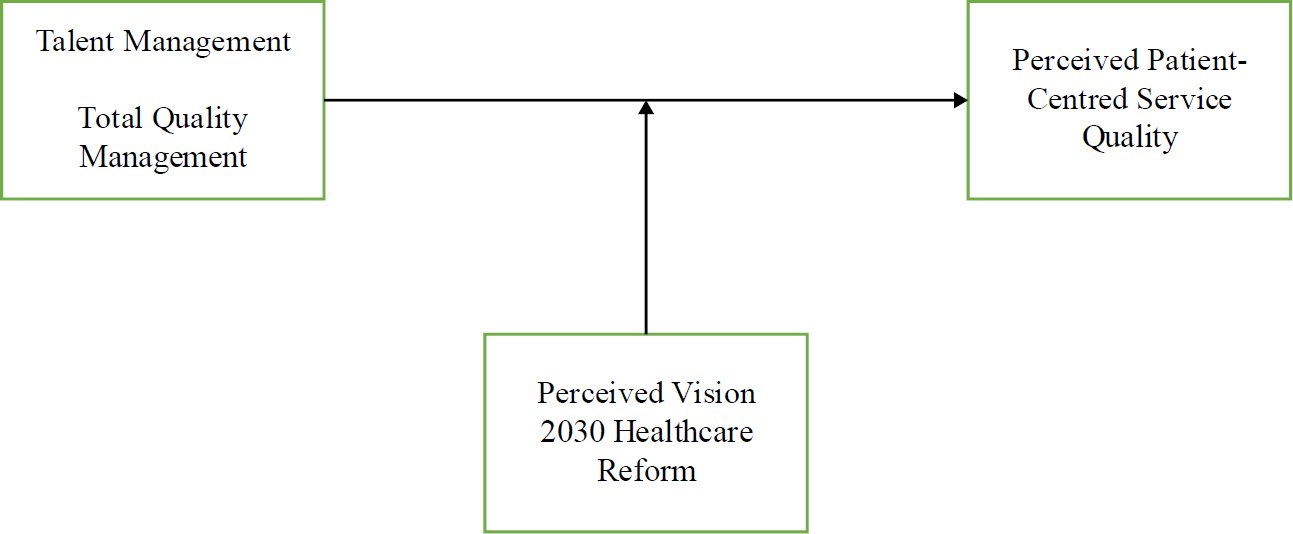
Fig. (1). Conceptual framework.
3. METHODS
In this study, a primary quantitative research design was employed, with data collected using a structured Likert-scale questionnaire. Terms were rated on a five-point scale, with 1 (strongly disagree) as the lowest and 5 (strongly agree) as the highest, as suggested by (Tanujaya et al., 2022). The instrument was segmented into four constructs: Talent Management, Perceived Total Quality Management, Perceived Patient-Centred Service Quality, and Perceived Vision 2030 Healthcare Reform, as depicted in the Appendix A.
3.1. Population
The study population included registered nurses in public and private hospitals in Saudi Arabia. The Saudi Commission for Health Specialties reported that the number than nurses working in Saudi Arabia is more than 230,000, working in various hospitals and health facilities. Nurses in emergency, intensive, and outpatient services were selected because they come into direct contact with service delivery of the patient and have direct operational experience of healthcare reform and quality systems in hospitals. They are specially selected for their role in the hospital’s patient services.
3.2. Sample Size
For the target population, 350 nurses were selected using a purposive sampling technique. This method allows for the selection of respondents with specific knowledge and experience relevant to the study’s variables. Since the proposed study aims to consider reform implementation and quality practices, purposive sampling was used to ensure the inclusion of participants who are actively involved in patient care processes, as used by (Obilor, 2023; Tajik et al., 2025) in their studies. The G*Power formula for calculating the sample size when multiple regression is used was used: N = (Za + Zb)2 x (1 – R2)) / R2. The lowest possible sample size was 129, assuming an effect size (f2 = 0.15), power of 0.95, and four predictors. Nonetheless, 600 questionnaires were distributed to increase the statistical power and external validity. The response rate was 63.3%, with 380 questionnaires returned. However, 30 questionnaires were eliminated due to missing values and multivariate outliers identified by the Mahalanobis distance, resulting in a final sample of 350.
Although respondents were from various hospitals, the current study collected data at the individual level, as the primary objective was to assess individual perceptions of talent management, Perceived Total Quality Management, and reform implementation, rather than to compare hospital-level performance. Therefore, this study is not capable of aggregating data at the organisational level. Therefore, future studies should consider applying multilevel modelling to account for cross-level effects and address hospital-level variations in the implementation of the reform and quality outcomes.
3.3. Addressing Bias
Selection bias was reduced as the respondents were selected to represent various hospital units and both the public and private sectors. As recommended by (AboAlsamh, 2025), the risk of non-response bias was addressed by conducting an independent-samples t-test on the early (n1 = 30) and late respondents (n2 = 30), and all results were found to be statistically equal. Common Method Bias (CMB) was treated statistically. Anonymity was guaranteed as items were well randomised in the questionnaire, and clear instructions were used to minimise social desirability and evaluation apprehension effects. Both Harman’s single-factor test and the full collinearity assessment indicated that the variance explained by a single factor was below 50%, as suggested by (Howard et al., 2024). The integrated methods suggest that the resulting relationships observed in the model are unlikely to be significantly distorted by the CMB.
3.4. Ethical Considerations
This study was approved by the Institutional Research Ethics Committee of the university prior to data collection. This study adhered to internationally recognised research ethics when dealing with human subjects. The administration officials of the involved hospitals also granted the researcher permission to administer the survey questionnaires. Respondent participation was voluntary, and informed consent was obtained from all the participants. The questionnaire included an effective statement of the research aim, confidentiality, and the right to withdraw from the research at any time, without repercussions. The collection of personal identifiers was not carried out, and the anonymity and confidentiality of the respondents’ professional and personal information were maintained throughout the research process.
3.5. Data Analysis
The data were analysed using Partial Least Squares Structural Equation Modelling (PLS-SEM). Reliability was evaluated using a measurement model assessment with Cronbach’s alpha and composite reliability, and convergent validity was assessed using Average Variance Extracted (AVE), as suggested by others. This was followed by testing the hypothesised causal and moderating relationships through path analysis in PLS-SEM. The study was conducted with a prediction-oriented purpose, and the requirement of examining direct relations among constructs in combination with the moderating relations among these constructs also led to the selection of PLS-SEM. While the sample size (n = 350) is adequate for CB-SEM, covariance-based techniques are more suitable for confirming a theory and analysing stringent model fits within the multivariate normality assumption. In contrast, PLS-SEM is suggested for models with a number of predictive steps and variance maximisation, particularly when it has moderation effects, as mentioned by (Dash & Paul, 2021). It is also robust in the presence of data distributions other than the normal distribution. In addition, PLS-SEM is less dependent on non-normality and is appropriate for the exploratory integration of various theoretical approaches in intricate moderation frameworks (Al Issa & Abdelsalam, 2021). Hence, PLS-SEM is more suitable for estimating the direct and moderating effects in the proposed framework.
4. RESULTS
4.1. Demographics Analysis
Table 1 shows the demographic profiles of the study participants from the total sample (n = 350). The statistics show that, across the total sample, 45.71% were male, 50% were female, and 4.29% preferred not to disclose their gender. Among these participants, 18.57% were under 25 years old, 21.43% were 25-34 years old, 24.29% were 35-44 years old, 17.14% were 45-54 years old, and 18.57% were 55 years old or older. Furthermore, in the total sample, the largest proportion of participants held bachelor’s degrees (31.43%), followed closely by master’s degrees (30%). Moreover, with regard to the current job role, 42.86% of the nurses serve as operational/frontline workers, 35.71% serve in supervisory positions, and only 5.71% serve in senior management roles. In terms of industry experience, most participants had 6–10 years (36.86%) and more than 10 years (28.86%) of experience. Among the total participants, 38.57% worked in public government hospitals, 32.86% in private hospitals, and 28.57% in military specialised hospitals. Finally, regarding the regional context, 31.43% and 38.57% of the total population were served by hospitals in the central and western regions of Saudi Arabia, respectively.
Table 1. Demographics profile analysis.
| Demographic Category | Frequency (n) | Percentage (%) | |
| Gender | Male | 160 | 45.71% |
| Female | 175 | 50.00% | |
| Prefer not to say | 15 | 4.29% | |
| Age Range | Below 25 | 65 | 18.57% |
| 25–34 | 75 | 21.43% | |
| 35–44 | 85 | 24.29% | |
| 45–54 | 60 | 17.14% | |
| 55 and above | 65 | 18.57% | |
| Educational Qualification | Secondary | 60 | 17.14% |
| Diploma | 75 | 21.43% | |
| Bachelor’s | 110 | 31.43% | |
| Master’s | 105 | 30.00% | |
| Current Job Role | Operational/Frontline | 150 | 42.86% |
| Supervisory | 125 | 35.71% | |
| Managerial | 55 | 15.71% | |
| Senior Management | 20 | 5.71% | |
| Industry Experience | Less than 3 years | 55 | 15.71% |
| 3–5 years | 65 | 18.57% | |
| 6–10 years | 129 | 36.86% | |
| More than 10 years | 101 | 28.86% | |
| Hospital Type | Public government hospital | 135 | 38.57% |
| Private hospital | 115 | 32.86% | |
| Military / Specialised government hospital | 100 | 28.57% | |
| Geographic Region | Central | 110 | 31.43% |
| Eastern | 135 | 38.57% | |
| Western | 105 | 30.00% | |
4.2. Measurement Model Assessment
The measurement model of the study is tested for internal consistency reliability and convergent validity using approaches that include Cronbach’s Alpha, Composite Reliability with threshold values of 0.7, and Average Variance Extracted (AVE) with a threshold value of 0.5, as suggested by (Baharum et al., 2023; Baistaman, 2020).
The results of the measurement model assessment, as shown in Table 2, indicate high factor loadings, ranging from 0.639 to 0.929. Furthermore, the results also depict that internal consistency and reliability have been attained since Cronbach’s Alpha and Composite Reliability values in the case of all constructs of the study are found to be (α > 0.7). Finally, convergent validity was established as the AVEs exceeded the threshold of 0.5. The measurement model used in this study is shown in Fig. (2).
Table 2. Measurement model assessment.
| Latent Variables | Indicators | Factor Loadings | Cronbach’s Alpha | Composite Reliability | Average Variance Extracted (AVE) |
| Perceived Patient-Centred Service Quality | PCSQ1 | 0.914 | 0.902 | 0.905 | 0.837 |
| PCSQ2 | 0.929 | ||||
| PCSQ3 | 0.901 | ||||
| Talent Management | TMP1 | 0.877 | 0.840 | 0.843 | 0.758 |
| TMP2 | 0.892 | ||||
| TMP3 | 0.841 | ||||
| Perceived Total Quality Management | TQM1 | 0.826 | 0.832 | 0.845 | 0.749 |
| TQM2 | 0.914 | ||||
| TQM3 | 0.855 | ||||
| Perceived Vision 2030 Healthcare Reform | V2HR1 | 0.639 | 0.896 | 0.896 | 0.592 |
| V2HR2 | 0.743 | ||||
| V2HR3 | 0.750 | ||||
| V2HR4 | 0.908 | ||||
| V2HR5 | 0.763 | ||||
| V2HR6 | 0.788 |
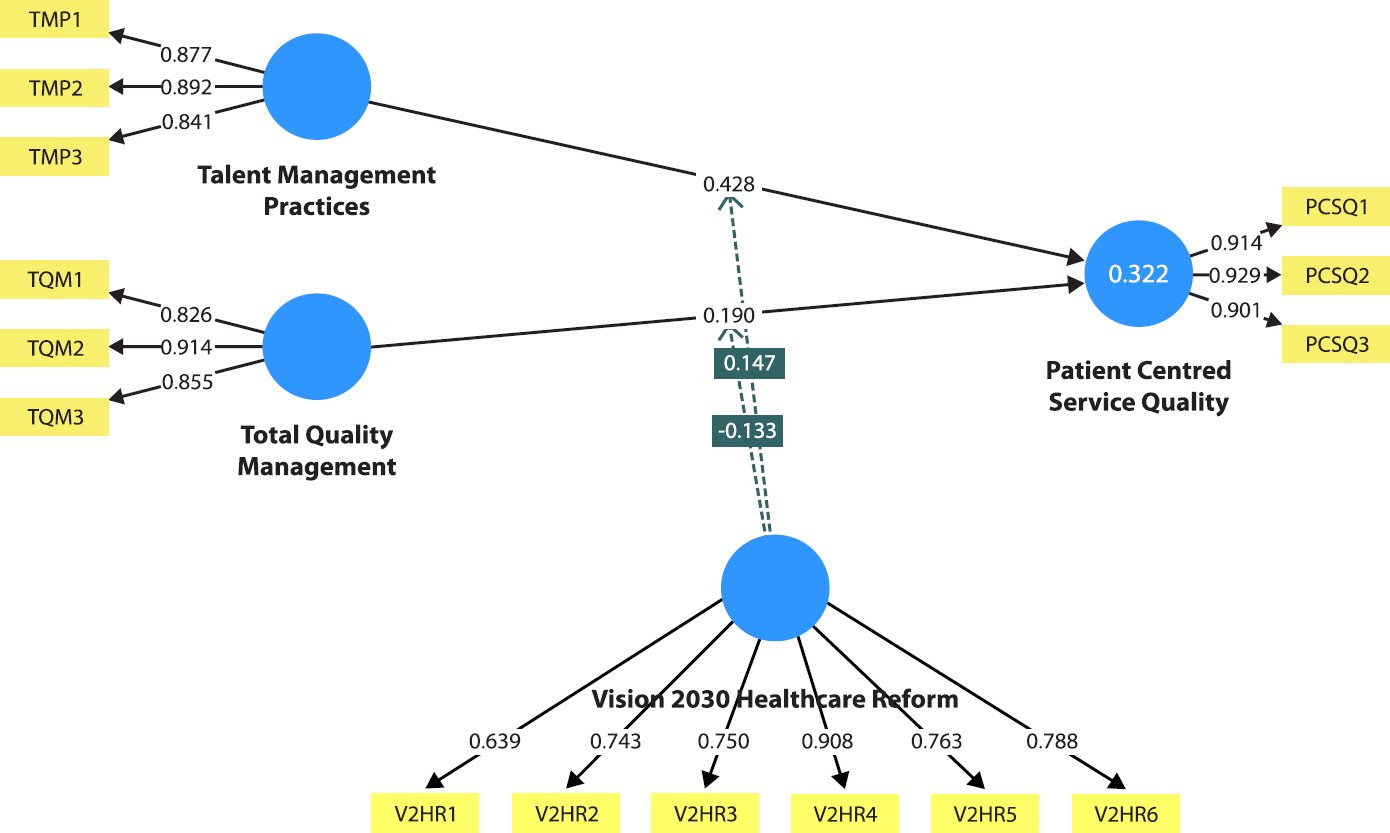
Fig. (2). Measurement model of the study.
4.3. Discriminant Validity
Discriminant validity, which examines the conceptual overlap and distinctiveness among the model’s constructs, was assessed using the HTMT ratio, with a threshold of 0.85, as indicated by (Rasoolimanesh, 2022).
The results in Table 3 show that all inter-construct HTMT ratios are below the threshold, indicating sufficient discriminant validity. In particular, Perceived Talent Management Practices reported low HTMT values with Perceived Patient-Centred Service Quality (0.612) and Perceived Total Quality Management (0.602), indicating that there is no conceptual overlap or separability between the constructs. Similarly, Perceived Total Quality Management also shows a low HTMT value with Perceived Patient-Centred Service Quality (0.453), indicating separability among these constructs. The conceptual distinctiveness of Perceived Vision 2030 Healthcare Reform is also supported by low HTMT values for all constructs (0.069-0.128). The results generally show that construct separability is achieved with no conceptual overlap.
Table 3. Discriminant validity.
| – | Perceived Patient-centred Service Quality | Perceived Talent Management Practices | Perceived Total Quality Management |
| Perceived Talent Management Practices | 0.612 | – | – |
| Perceived Total Quality Management | 0.453 | 0.602 | – |
| Perceived Vision 2030 Healthcare Reform | 0.069 | 0.128 | 0.124 |
4.4. Test of Normality-Shapiro-Wilk
The normality test results in Table 4 suggest that the data are not normally distributed. Both the Kolmogorov–Smirnov and Shapiro–Wilk tests revealed that the results were statistically significant for all measurement items (p < 0.001), and the null hypothesis of normality was rejected. The Shapiro–Wilk statistics ranged from 0.805 to 0.885 and the Kolmogorov–Smirnov statistics ranged from 0.253 to 0.329, which further validated the data characteristics as non-normal, as recommended in the study by (Sathyanarayana, 2026). The results confirmed the appropriateness of Partial Least Squares Structural Equation Modelling (PLS-SEM) for this study because it does not assume strict multivariate normality and is suitable for research with predictions in complex structural relationships and moderating effects, as suggested by (Sovey et al., 2022).
Table 4. Normality test.
| Tests of Normality | ||||||
| – | Kolmogorov-Smirnova | Shapiro-Wilk | ||||
| Statistic | df | Sig. | Statistic | df | Sig. | |
| TMP1 | 0.288 | 350 | 0.000 | 0.854 | 350 | 0.000 |
| TMP2 | 0.270 | 350 | 0.000 | 0.873 | 350 | 0.000 |
| TMP3 | 0.300 | 350 | 0.000 | 0.839 | 350 | 0.000 |
| TQM1 | 0.271 | 350 | 0.000 | 0.869 | 350 | 0.000 |
| TQM2 | 0.262 | 350 | 0.000 | 0.879 | 350 | 0.000 |
| TQM3 | 0.253 | 350 | 0.000 | 0.885 | 350 | 0.000 |
| V2HR1 | 0.265 | 350 | 0.000 | 0.866 | 350 | 0.000 |
| V2HR2 | 0.288 | 350 | 0.000 | 0.855 | 350 | 0.000 |
| V2HR3 | 0.274 | 350 | 0.000 | 0.863 | 350 | 0.000 |
| PCSQ1 | 0.293 | 350 | 0.000 | 0.831 | 350 | 0.000 |
| PCSQ2 | 0.329 | 350 | 0.000 | 0.805 | 350 | 0.000 |
| PCSQ3 | 0.302 | 350 | 0.000 | 0.834 | 350 | 0.000 |
4.5. Variance Inflation Factor
The variance inflation factor (VIF) allows for the assessment of multicollinearity. The threshold value of the VIF is generally ≤ 3.5.
The VIF results, as shown in Table 5, indicate values within the acceptable limit of ≤ 3.5, suggesting no multicollinearity issues.
Table 5. Variance inflation factor.
| VIF | |
| Perceived Talent Management Practices -> Perceived Patient-centred service quality | 1.811 |
| Perceived Talent Management Practices -> Perceived Vision 2030 Healthcare Reform | 1.347 |
| Perceived Total Quality Management -> Perceived Patient-centred service quality | 1.405 |
| Perceived Total Quality Management ->Perceived Vision 2030 Healthcare Reform | 1.347 |
| Perceived Vision 2030 Healthcare Reform -> Perceived Patient-centred service quality | 1.691 |
4.6. Path Coefficient Analysis
The results of the path coefficients, shown in Table 6, indicate that both organisational capability variables have statistically significant relationships with perceived patient-centred service quality. The results in Table 6 indicate that the Perceived Talent Management Practices have a positive relationship with perceived patient-centred service quality (β = 0.428, p < 0.000). Similarly, Perceived Total Quality Management demonstrated a statistically significant positive association with the perceived patient-centred quality of service (β = 0.190, p < 0.003). Moreover, Perceived Vision 2030 Healthcare Reform had a positive, statistically significant relationship with perceived patient-centred service quality (β = 0.141, p < 0.041), indicating that healthcare personnel who perceive reform initiatives as effectively implemented would report greater perceived patient-centred service delivery.
Table 6. Path coefficient.
| – | Path coefficients | T-statistics | P-values | F-square |
| Perceived Talent Management Practices -> Patient-centred service quality | 0.428 | 7.148 | 0.000 | 0.195 |
| Perceived Total Quality Management -> Patient-centred service quality | 0.190 | 2.937 | 0.003 | 0.037 |
| Vision 2030 Healthcare Reform -> Patient-centred service quality | 0.141 | 2.051 | 0.041 | 0.002 |
| Vision 2030 Healthcare Reform x Perceived Talent Management Practices -> Patient-centred service quality | 0.147 | 2.119 | 0.022 | 0.018 |
| Vision 2030 Healthcare Reform x Perceived Total Quality Management -> Patient-centred service quality | 0.133 | 2.825 | 0.003 | 0.013 |
Note: *: Significance at 10%; **: Significance at 5%; ***: Significance at 1%
The moderating analysis also demonstrates that the Perceived Vision 2030 Healthcare Reform moderates the association between organisational capabilities and perceived service outcomes. Moreover, the relationship between Perceived Vision 2030 Healthcare Reform and Perceived Talent Management Practices was positive and statistically significant (β = 0.147, p < 0.022), indicating that stronger perceptions of the reform’s implementation strengthen the association between Perceived Talent Management and perceived patient-centred service quality. Similarly, the association between Perceived Vision 2030 Healthcare Reform and Perceived Total Quality Management was statistically significant and positive (β = 0.133, p < 0.003), indicating that reform-based institutional support enhances the value of quality management practices for patient-centred service quality. Lastly, in terms of effect size, the results of the F-square show different effect sizes of predictors when predicting Patient-Centred Service Quality. Perceived Talent Management had a moderate effect (f² = 0.195), which signified a moderate effect size. Perceived Total Quality Management also showed a small effect (f² = 0.037), whereas perceived Vision 2030 reform showed a negligible effect size (f² = 0.002). Interaction effects were also small but pertinent, which validates the limited but meaningful moderating effect in the structural model.
From a practical perspective, talent management, with its higher effect size, has a large influence on the perception of the quality of service provided in the healthcare sector in Saudi Arabia, compared to procedural quality systems. This indicates that there is a need for hospital management to emphasise leadership development, digital competency training, strategies for retaining staff and strategies to engage their workforces to boost their responsiveness to services. The interaction between TQM and reform is relatively weak but statistically significant, showing that there is still a reinforcement between structured governance and reform-enabling institutional settings and organisational performance. Hence, aligning quality monitoring systems and workforce strategies to Vision 2030 performance indicators to maximise healthcare outcomes from the patient perspective is a critical priority for healthcare managers.
4.7. Model Explanatory Power
The results shown in Table 7 indicate the moderate explanatory power of the measurement model. It can be observed that 32.2% of the variation in Perceived Patient-centred service quality can be predicted by TQM, Perceived Talent Management practices, and perceived Vision 2030 health reforms.
Table 7. Model explanatory power.
| – | R-square | R-square Adjusted |
| Perceived Patient-centred service quality | 0.322 | 0.312 |
4.8. Predictive Relevance Using Q-squared
As shown in Table 8, the Q² predictive value for perceived patient-centred service quality was 0.296, which was greater than zero, indicating that the model had sufficient predictive relevance. In addition, the RMSE (0.850) and MAE (0.627) values indicate satisfactory prediction accuracy, which supports the structural model’s out-of-sample predictive capability for the dependent construct.
Table 8. Q-squared-Predictive relevance.
| – | Q²predict | RMSE | MAE |
| Perceived Patient-centred service quality | 0.296 | 0.850 | 0.627 |
5. DISCUSSION
The results validate H1, as Perceived Talent Management Practices show a statistically significant relationship with Perceived Patient-Centred Service Quality in Saudi healthcare. This aligns with (Irtaimeh et al., 2016), who found a strong positive relationship between talent strategies and service quality in Jordan. Similarly, (Mat, 2025) highlighted the use of leadership, mentorship, and digital competencies in nursing as essential processes for improving the quality of patient care. Nevertheless, compared with (Rahman & Al-Borie,. 2021), who implied that HR practices must be moderated by other factors, including employee engagement, to shape service outcomes, the current research shows a direct association in Saudi Arabia.
This disparity can be justified by the centralised healthcare governance and systematic workforce changes in Saudi Arabia as part of Vision 2030, which better incorporates talent development into hospital performance outcomes (Rahman & Al-Borie,. 2021). Comparatively, the centralised administrative structures characterising healthcare institutions in Saudi Arabia may be connected to robust compliance with competency frameworks across organisational settings, leading to higher visibility of Perceived Talent Management activities in patient-centred practices, as disclosed by (Essa, 2025). The strategic value of skilled healthcare professionals could be further enhanced in the industrial sector due to the rapid digital transformation and nationalisation of the workforce (Saudisation) policies. From the RBV, (Alharbi et al., 2025) also highlighted that human capital signifies a strategic organisational resource, and its efficient usage leads to improved service delivery in healthcare organisations. Perceived Talent Management aligns institutional capabilities with patient expectations, thereby improving its applicability in Saudi healthcare settings.
The increasing digitisation of healthcare services in Saudi Arabia, including smart hospital management, predictive analytics, digital engagement platforms for patients, and AI-driven data-driven quality monitoring, further underscores the importance of digitally knowledgeable healthcare practitioners who can thrive in technologically advanced healthcare settings. (Kosiol et al., 2023) claim that such skills involve tacit knowledge that is difficult to copy and require both clinical expertise and digital competence in the healthcare sector. However, (Atalıç & Çiçek, 2021) propose that the ability to work in a team and in a patient-centred manner is institutionalised over time in the process of talent development in the health sector. In Vision 2030, the critical role of digitally competent healthcare workers is growing due to the growing digital health systems and electronic governance, as highlighted by (Alfahad et al., 2024). As a result, Perceived Talent Management builds valuable and scarce human capital assets that enhance organisational flexibility and enable a focus on delivering patient-centred services.
The findings suggest that perceived Total Quality Management (TQM) and Perceived Patient-Centred Service Quality are significantly associated, thereby justifying the acceptance of H2. This result supports (Zaid et al., 2020), who found that TQM significantly impacts patients’ perceived service quality and satisfaction in Palestinian healthcare organisations. The conceptual focus of (Haroun et al., 2022) is that customer focus, continuous improvement, and integrated systems improve patients’ experiences, and the current study empirically tests these arguments in Saudi hospitals. In the current study, TQM signifies organisational process capability, while patient-centred service quality imitates perceived service outcomes confronted by patients across healthcare delivery settings.
The application of TQM in Saudi public healthcare organisations may confront limitations related to relatively low levels of job satisfaction and developing organisational culture conditions, as informed by (Almutairi et al., 2024). Other studies, such as (Alanezy et al., 2025), argue that these restrictions could be an outcome of transitional resistance to organisational restructuring, reform fatigue, pressure on the workforce when adapting to change, and managerial readiness, which may arise as part of the process of implementing the reforms in Vision 2030, as posited by (Alanezy et al., 2025). Therefore, the impact of TQM can differ depending on the level of adaptation, employees’ attitudes towards the organisation, and institutional support provided throughout the health care organisation. However, (Ali & Dzandu,. 2023) suggest that the observed relationship between TQM and perceived patient-centred service quality is also influenced by the growing “pressure” on the organisation to pursue standardised quality indicators and accreditation processes, not just by the maturity of the organisation itself.
These findings are theoretically extended to organisational capability theory, as these phenomena are not only institutional pressures that come from the outside of the organisation but are part of the context from which the organisational capability produces service outcomes. In this context, TQM is considered not only an operational quality system but also a capability for governance, which is supported by a digital monitoring system and the generation of accountability mechanisms and performance appraisals, as mentioned by (Al-Saggaf et al., 2025) as a governance-driven performance evaluation system. This contradicts the conventional RBV assumption of the independence of capabilities from the institutional setting. However, the study reveals that organisational capacity is enhanced when it merges with reform-oriented governance mechanisms. Thus, this study helps develop a new paradigm that sees the effectiveness of capabilities within health institutions as dependent on the context in which they are situated rather than generalisable.
The moderating analysis that supports H3 shows that the Perceived Vision 2030 healthcare reform has a significant positive moderating effect on the relationship between organisational capabilities and the perceived quality of patient-centred services. In particular, the interaction effects of perceived Vision 2030 reform and both Perceived Talent Management and Perceived Total Quality Management are positive, suggesting that reform initiatives improve the degree to which internal capabilities are converted to the enhanced image of service delivery at the patient level, as revealed in the findings of (Nilsen et al., 2020).
If hospitals see Vision 2030 reform as stronger and beneficial in terms of driving operational excellence of healthcare organisations, they can place more emphasis on performance monitoring systems, digital governance systems, accreditation systems, and outcome-based managerial evaluations to add organizational accountability. Structures of governance designed for reform can enhance the operationalisation of TQM routines and Perceived Talent Management processes through improved compliance, intra-departmental coordination, and data-driven decision-making, as suggested by (Haroun et al., 2022). Consequently, healthcare professionals feel more aligned with the goals of patient-centred care, which can enhance the impact of quality management and staff skills on patient outcomes in Saudi healthcare facilities.
The results are also applicable to international healthcare settings. In line with (Rahman & Al-Borie,. 2021), similar reform-oriented healthcare modernisation programmes have been noted in the NHS’s digital transformation in the United Kingdom and Asian healthcare systems which focus on smart governance, performance-based accountability, and integration service delivery models. Although more decentralised reform settings found in (Graham et al., 2024) lack strong central coordination and governance of the workforce, the Saudi healthcare transformation offers a greater level of central governance coordination via Vision 2030, which may allow for more direct coupling between the capability of the workforce, quality systems, and institutional reform agendas. This means that the performance of organisational capabilities might vary strongly by national governance arrangements, the state of healthcare reforms, and the capacity of institutions to implement them.
There is a competing explanation that centralisation led to unequal results based on the level of autonomy granted in the organisations and their capacity to implement the policies and performance systems, as proposed by (Pereira et al., 2023). Therefore, centralisation does not necessarily result in better performance but works in conjunction with institutional readiness and managerial skills. Theoretically, these results offer a way to advance institutional logic to demonstrate that reforms work as contingent mechanisms or are not necessarily enabling structures; they go beyond the merely confirmatory way of understanding the effectiveness of reform.
Although the evidence for health reforms has been ‘moderating’, it is important to note that this does not necessarily mean that such reforms will be carried out equally across all hospitals. In some healthcare environments, quality management systems and employee initiatives are less effective due to reform fatigue, symbolic compliance with accreditation standards, bureaucratic overload, implementation capacity issues, and resistance to digital transformation. Excessive administrative oversight can also distract the focus from interacting with the patient and focusing more on compliance. Therefore, the effectiveness of reforms under Vision 2030 is contingent on the readiness of the institutions, managerial adaptability, acceptance of the workforce, and capacity to integrate technology into the healthcare organisation, and as such, cannot be considered as universally enabling mechanisms.
Healthcare organisations have been symbolically implementing reform-oriented quality systems for compliance without completely integrating them into operational practice. Institutional decoupling can occur when there is a gap between governance and performance, in the sense that a formal accreditation framework exists, but the corresponding performance is inadequate to ensure that patients’ outcomes are centred. Likewise, hospitals with heavy workloads tend to focus more on the formality of work than on realising meaningful service innovations. Therefore, the effectiveness of reform governance relies on the level of operational self-integration of quality systems into daily clinic and managerial processes.
According to the RBV theory, the perceived Vision 2030 reform improves the strategic utilisation of valuable organizational resources, especially human capital, which is nurtured through Perceived Talent Management practices (Pereira et al., 2023). Simultaneously, according to the Perceived Total Quality Management theory, the institutionalisation of continuous improvement routines and performance monitoring in healthcare organisations is attained by reform-driven mechanisms of governance (Cha et al., 2024). The moderating findings thus indicate that reform is their institutional facilitator, reinforcing the performance of organisational capabilities rather than substituting for them. Therefore, the results show that the integration of governance mechanisms, capability building, development of healthcare workers, systems of digital transformation, and quality management routines become strategically effective for healthcare reforms. This strengthens the policy orientation of the need for regulatory change, as well as for institutional readiness, management adaptability, and support of technologically mediated governance infrastructures for long-term healthcare performance in favour of patients.
Potential differences between various healthcare organisations, such as public, private, and military, also shape the perception and implementation of changes in hospitals towards implementing Vision 2030. Aas highlighted by (Zafar et al., 2025) also, the public hospital in Saudi Arabia perceive reform more as administrative restructuring, finding localised staffing arrangements, or accountability measures, while private hospitals feel reform more as market competitiveness or privatisation pressure, and efficiency expectations. Likewise, there can be individual operational autonomy and governance systems in specialised and military healthcare institutions that influence responsiveness to reforms. The present study did not compare effectiveness across different institutional types of ownership, but such variance across organisations shapes the effectiveness of organisational abilities and implementation of reform. Therefore, future research should investigate the ownership type of hospitals as a comparative or moderating institutional factor.
CONCLUSION
This study contributes to the literature by demonstrating that patient-centred service quality in Saudi Arabia’s healthcare sector cannot be conceptualised on an isolated managerial basis but rather through a capability-oriented, reform-based approach. In terms of practical contributions, the results show that the concepts of Perceived Talent Management and Perceived Total Quality Management can be seen as strategic organisational facilitators, with predictive relevance that is heavily reinforced in the structural context of Vision 2030 Healthcare Reform. Workforce capabilities and quality systems can be more institutionally coherent when incorporated into a nationally coordinated governance transformation rather than operating independently of each other. Subsequently, to establish sustainable patient-centred excellence in Saudi healthcare, the harmonisation of the human capital approach with quality governance and macro-level reform architecture is needed. The theoretical contribution demonstrates that adding the dimensions of Perceived Talent Management and TQM, together with perceived Vision 2030 reform, can amplify institutional and capability views to account for contingent effects in healthcare transformation. This study offers practical advice to Saudi healthcare stakeholders to ensure that workforce planning and systems for quality and service delivery are aligned with reform-based governance to achieve positive patient-centred results.
LIMITATIONS AND FUTURE DIRECTION
The present study also has several methodological shortcomings that must be critically addressed. First, because the research is cross-sectional, it is not possible to draw causal or temporal inferences from the results regarding the relationship between Talent Management, TQM, healthcare reform, and perceived patient-centred service quality. Second, having assessed data from the nurse perspective only, there is likely to be perceptual bias and Common Method Bias (CMB). Although Harman’s single-factor test and full collinearity evaluations showed no major statistical problems, practical remedies comprising the anonymity of respondents and confidentiality assurance were also employed to minimise response bias as well as social desirability bias. However, observers are still subject to the influence of perceptual measures on the strength of observed relationships. Another limitation of the current study is the unit of analysis used. Talent Management (TM) and Total Quality Management (TQM) have both been conceptualised as organisational capabilities, and the author measured the perception of these practices in the present study, not objective organisational (hospital) level capabilities. This means that the results reflect perceived talent management and TQM implementation and do not necessarily portray real organisational skills. This perceptual approach may not account for fully inter-hospital variation and has some limitations for cross-level inferences. Future studies should use aggregated organisational data and multilevel research designs. Future research with longitudinal and multi-source designs is needed, along with objective healthcare performance data and patient feedback, and comparative cross-country studies with enhanced causal inference, methodological strength, and external validity.
IMPLICATIONS
The results have specific policy implications for policymakers and hospital administrators involved in transforming healthcare in Saudi Arabia. For policymakers, the findings indicate that Vision 2030 programmes should be tailored to align workforce capability building with institutional quality systems by incorporating Perceived Talent Management indicators into national healthcare performance systems. Theoretically, this study develops an integrated perspective of capability, in which Perceived Talent Management accumulates human capital, TQM instils operational practices, and reform governance aligns these capabilities to produce better service quality outcomes. Integrating Perceived Talent Management and indicators of quality performance in national accreditation frameworks and their connection to performance-based funding should be a focus for healthcare regulators in Saudi healthcare organisations to build accountability for healthcare institutions. Vision 2030 quality KPIs should be included on departmental dashboards, clinical audit systems, and workforce evaluations to ensure measurable alignment between the Vision 2030 goals and the way health services are delivered. In addition, cross-functional governance committees should be established in healthcare organisations to oversee workforce capability, patient safety indicators, digital health use, and the ongoing enhancement of quality improvement practices to strengthen the delivery of patient-centred services and institutional performance in the context of health system reforms.
LIST OF ABBREVIATIONS
AVE | = | Average Variance Extracted |
CMB | = | Common Method Bias |
PLS-SEM | = | Partial Least Squares Structural Equation Modelling |
RBV | = | Resource Based View |
TM | = | Talent Management |
TQM | = | Total Quality Management |
VIF | = | Variance Inflation Factor |
VRIN | = | Valuable, Rare, Inimitable, and Irreplaceable Resources |
AUTHORS’ CONTRIBUTIONS
Q.F.A.A. has contributed to the study conceptualization, methodology, data analysis, interpretation of the results, and manuscript writing. E.A.A.A. has contributed to the literature review, data collection, formal analysis, and manuscript editing. H.M.A.A. and H.J.A. have supervised the study, validated the findings, reviewed and revised the manuscript critically for important intellectual content, and approved the final version for publication. All authors read and approved the final manuscript.
ETHICAL APPROVAL & INFORMED CONSENT
This study was approved by the Institutional Research Ethics Committee of the university prior to data collection. This study adhered to internationally recognised research ethics when dealing with human subjects. The administration officials of the involved hospitals also granted the researcher permission to administer the survey questionnaires. Respondent participation was voluntary, and informed consent was obtained from all the participants. The questionnaire included an effective statement of the research aim, confidentiality, and the right to withdraw from the research at any time, without repercussions. The collection of personal identifiers was not carried out, and the anonymity and confidentiality of the respondents’ professional and personal information were maintained throughout the research process.
AVAILABILITY OF DATA AND MATERIALS
The data will be made available on reasonable request by contacting the corresponding author [Q.F.A.A.].
FUNDING
None.
CONFLICT OF INTEREST
The authors declare that there is no conflict of interest regarding the publication of this article.
ACKNOWLEDGEMENTS
Declared none.
DECLARATION OF AI
The authors used ChatGPT solely to improve the language, grammar, and readability of this manuscript. The AI tool was not used to generate, interpret, or analyze research findings, nor to formulate scientific conclusions. Following its use, the authors carefully reviewed, revised, and validated the manuscript and assume full responsibility for the accuracy, integrity, and originality of its content.
APPENDIX A
Demographic Factors
- What is your gender?
- Male
- Female
- Prefer not to say
- What is your age group?
- Below 25
- 25–34
- 35–44
- 45–54
- 55 and above
- What is your highest educational qualification?
- Secondary
- Diploma
- Bachelor’s
- Master’s
- Doctorate
- What best describes your current job role?
- Operational/Frontline
- Supervisory
- Managerial
- Senior Management
- How many years of total experience do you have in this industry?
- Less than 3 years
- 3–5 years
- 6–10 years
- More than 10 years
- Which hospital type you work in?
- Public government hospital
- Private hospital
- Military / Specialised government hospital
- Region, where the hospital is located?
- Central
- Eastern
- Western
Survey Questionnaire
| Variable | Question Statement | SD (1) | D (2) | N (3) | A (4) | SA (5) |
| Perceived Talent Management Practices | 1. Perceived Talent Management practices help identify and develop employees who contribute to high-quality patient care. | ☐ | ☐ | ☐ | ☐ | ☐ |
| 2. The organisation’s focus on Perceived Talent Management has enhanced patient-centred care delivery. | ☐ | ☐ | ☐ | ☐ | ☐ | |
| 3. Perceived Talent Management strategies align with the goal of improving patient outcomes. | ☐ | ☐ | ☐ | ☐ | ☐ | |
| Perceived Total Quality Management (TQM) | 1. TQM practices are effective in improving the overall quality of patient care. | ☐ | ☐ | ☐ | ☐ | ☐ |
| 2. The organisation’s commitment to TQM enhances patient satisfaction. | ☐ | ☐ | ☐ | ☐ | ☐ | |
| 3. TQM practices are integrated into daily work processes to improve patient care. | ☐ | ☐ | ☐ | ☐ | ☐ | |
| Vision 2030 Healthcare Reform | 1. Vision 2030 healthcare reforms have strengthened patient-centred care practices within my organisation. | ☐ | ☐ | ☐ | ☐ | ☐ |
| 2. Vision 2030 reforms have improved quality management systems in healthcare institutions. | ☐ | ☐ | ☐ | ☐ | ☐ | |
| 3. Vision 2030 initiatives have promoted digital technologies and innovation in healthcare delivery. | ☐ | ☐ | ☐ | ☐ | ☐ | |
| 4. Vision 2030 reforms have enhanced accountability and governance in healthcare services | ☐ | ☐ | ☐ | ☐ | ☐ | |
| 5. Vision 2030 policies have improved training and professional development opportunities for healthcare staff | ☐ | ☐ | ☐ | ☐ | ☐ | |
| 6. Vision 2030 reforms have encouraged greater efficiency and performance monitoring in healthcare organisations | ☐ | ☐ | ☐ | ☐ | ☐ | |
| Patient-Centered Service Quality | 1. Prioritise patient needs when making care-related decisions. | ☐ | ☐ | ☐ | ☐ | ☐ |
| 2. Deliver care consistently to enhances the patient experience. | ☐ | ☐ | ☐ | ☐ | ☐ | |
| 3. Focus on patient-centred care contributed to improved patient satisfaction. | ☐ | ☐ | ☐ | ☐ | ☐ |
REFERENCES
AboAlsamh, H. (2025). The dark side of international talent management: Exploring the negative effect of talent repatriation on multinational enterprises’ performance with the meditating role of reverse culture shock. AJBMSS-Advance Journal of Business Management and Social Sciences, 1(1), 1-11.
https://doi.org/10.65080/942npc70
Adubasim, E. I., Humphrey Uche Amanze, P. D., & Francis, U. O. (2025). Talent management practices and survival of healthcare facilities in Nigeria. International Journal of Business Environment & Intelligence, 4(1), 44-61. Available from: https://arcnjournals.com/wp-content/uploads/2025/07/42721590414.pdf
Akdere, M., Top, M., & Tekingündüz, S. (2020). Examining patient perceptions of service quality in Turkish hospitals: The SERVPERF model. Total Quality Management & Business Excellence, 31(3-4), 342-352.
https://doi.org/10.1080/14783363.2018.1427501
Al Issa, H-E., & Abdelsalam, M. K. (2021). Antecedents to leadership: A CB-SEM and PLS-SEM validation. International Journal of Sustainable Development and Planning, 16(8), 1403-1414.
https://doi.org/10.18280/ijsdp.160801
Alanezy, F. M., Alharbi, A. S. D., Alenezi, Y. M., Al-harbi, A. H., Alotaibi, S. H., Al-Harbi, S. M., … & Almutairi, W. M. S. (2025). Paramedics at the core of emergency healthcare transformation in Saudi Arabia: A systematic review. The Review of Diabetic Studies, 21(S2), 58-66. Available from: https://diabeticstudies.org/index.php/RDS/article/view/880
Al-Arabiya. (2023). Saudi Arabia. The development of the health care sector returns the compass of investments to the inside. Available from: https://drsartawi.com/en/saudi-arabia-the-development-of-the-health-care-sector-returns-the-compass-of-investments-to-the-inside/
Alasiri, A. A., & Mohammed, V. (2022). Healthcare transformation in Saudi Arabia: An overview since the launch of vision 2030. Health services insights, 15, 1-7.
https://doi.org/10.1177/11786329221121214
Aldhobaib, M. A. (2025). The new era of the kingdom of Saudi Arabia: Key highlights and future research agenda on organisational strategy. Businesses, 5(1), 5.
https://doi.org/10.3390/businesses5010005
Alfahad, A. H., Alabbas, Y. S., ALabbas, H. S. M., Abukhashbah, T. H., Alabdali, A. A., Alfatieh, Q. M. H., … & Alhazmi, K. M. A. (2024). Evaluating the impact of Saudi vision 2030 on healthcare investment: A comprehensive review of progress and future directions. Journal of Ecohumanism, 3(8), 870-880.
https://doi.org/10.62754/joe.v3i8.4774
Alharbi, A., Aljuaid, M., Alamri, F. A., Alosaimi, S. N., & Aldeijy, S. (2025). Health sector transformation in Saudi Arabia-The modern healthcare model: A qualitative study among healthcare leaders. Journal of Taibah University Medical Sciences, 20(5), 643-653.
https://doi.org/10.1016/j.jtumed.2025.08.006
Ali, N., & Dzandu, M. D. (2023). A paradigm shift for medical health care to focus on a service-value approach to achieve greater patient satisfaction. Journal of Health Organisation and Management, 37(2), 133-157.
https://doi.org/10.1108/jhom-06-2022-0180
Aljehani, N. M., & Al Nawees, F. E. (2025). The current state, challenges, and future directions of artificial intelligence in healthcare in Saudi Arabia: Systematic review. Frontiers in Artificial Intelligence, 8, 1-9.
https://doi.org/10.3389/frai.2025.1518440
Almutairi, B. H. H., Alsaif, W. A. A., Almutairi, M. M. F., Alotaibi, A. O. M., Alqahtani, M. A. M., Aldlafea, A. M. W., … & Alaqeeli, A. M. (2024). The role of implementing total quality management in improving the performance of public hospitals in the Kingdom of Saudi Arabia. Journal of International Crisis and Risk Communication Research, 7(S10), 223. Available from: https://jicrcr.com/index.php/jicrcr/article/view/293/152
Al-Saggaf, L., Al-Hadrami, A. H., & Aoun, M. (2025). Healthcare sector in Saudi Arabia: initiatives and challenges. In Achieving sustainable business through AI, technology education and computer science: Volume 1: Computer science, business sustainability, and competitive advantage (pp. 203-214). Cham: Springer Nature Switzerland.
https://doi.org/10.1007/978-3-031-70855-8_18
Atalıç, H., & Çiçek, H. (2021). Total quality management practices in health care organisations: Perception of health care providers. European Journal of Public Health Studies, 4(2), 76-97.
https://doi.org/10.46827/ejphs.v4i2.100
Baharum, H., Ismail, A., Awang, Z., McKenna, L., Ibrahim, R., Mohamed, Z., & Hassan, N. H. (2023). Validating an instrument for measuring newly graduated nurses’ adaptation. International Journal of Environmental Research and Public Health, 20(4), 2860.
https://doi.org/10.3390/ijerph20042860
Baistaman, J., Awang, Z., Afthanorhan, A. and Rahim, M. M. A., (2020). Developing and validating the measurement model for the financial literacy construct using confirmatory factor analysis. Humanities and Social Science Reviews, 8(2), 413-422.
https://doi.org/10.18510/HSSR.2020.8247
Cha, J., Jang, J., & Lee, K-H. (2024). Tapping into patient engagement in organisational performance improvement: A social resource-based view and the role of patient and family engagement. International Journal of Health Planning and Management.
https://doi.org/10.22541/au.172450869.98376046/v1
Chen, M. H., Chen, B. H., Shih, H. M., & Wu, M. H. (2020). Evaluation research on the implementation of talent quality management system in medical institutions. Journal of Economics and Management, 16, 51-67. Available from: https://www.researchgate.net/profile/Bryan-Chen-4/publication/343230519_Evaluation_Research_on_the_Implementation_of_Talent_Quality_Management_System_in_Medical_Institutions/links/5f1e9728a6fdcc9626b6864f/Evaluation-Research-on-the-Implementation-of-Talent-Quality-Management-System-in-Medical-Institutions.pdf
Dash, G., & Paul, J. (2021). CB-SEM vs PLS-SEM methods for research in social sciences and technology forecasting. Technological Forecasting and Social Change, 173, 121092.
https://doi.org/10.1016/j.techfore.2021.121092
Dzimbiri, G. L., & Molefi, A. (2021). The impact of talent management on job satisfaction of registered nurses in Malawian public hospitals. SA Journal of Human Resource Management, 19, a1513.
https://doi.org/10.4102/sajhrm.v19i0.1513
Essa, G. T. K. (2025). Internal auditing and organizational culture as pillars of it governance: Evidence from the Saudi Arabian healthcare sector using PLS-SEM. Available from: https://sci-cult.net/index.php/cult/article/view/1755/1226
Friedel, A. L., Siegel, S., Kirstein, C. F., Gerigk, M., Bingel, U., Diehl, A., … & Kreitschmann-Andermahr, I. (2023). Measuring patient experience and patient satisfaction—how are we doing it and why does it matter? A comparison of European and US American approaches. Healthcare 11 (6), 797.
https://doi.org/10.3390/healthcare11060797
Graham, B. E., Zaharie, M., & Osoian, C. (2024). Inclusive talent management philosophy, perceived talent practices and employees’ outcomes. European Journal of Training and Development, 48(5-6), 576-591.
https://doi.org/10.1108/EJTD-12-2022-0138
Grossu-Leibovica, D., & Kalkis, H. (2023). Total quality management tools and techniques for improving service quality and client satisfaction in the healthcare environment: A qualitative systematic review. SHS Web of Conferences, 131, 02009.
https://doi.org/10.1051/shsconf/202213102009
Haroun, A., Ayaad, O., Al-Ruzzieh, M. A., & Ayyad, M. (2022). The role of perceived total quality management in improving patient experiences and outcomes. British Journal of Healthcare Management, 28(10), 1-8.
https://doi.org/10.12968/bjhc.2021.0082
Howard, M. C., Boudreaux, M., & Oglesby, M. (2024). Can Harman’s single-factor test reliably distinguish between research designs? Not in published management studies. European Journal of Work and Organisational Psychology, 33(6), 790-804.
https://doi.org/10.1080/1359432X.2024.2393462
Irtaimeh, H. J., Al-Azzam, Z. F., & Khaddam, A. A. (2016). Exploring the impact of talent management strategies and service quality on beneficiaries’ satisfaction in Jordan healthcare sector: Provider point of view. Journal of Entrepreneurship and Organization Management, 5(3), 1000197. Available from: https://www.hilarispublisher.com/open-access/exploring-the-impact-of-talent-management-strategies-and-service-quality-on-beneficiaries-satisfaction-in-jordan-healthcare-sector-2169-026X-1000197.pdf
Jinjing, M., & Karia, N. (2024). The impact of talent management on public hospital performance based on knowledge management. Global Business and Management Research: An International Journal, 16(4s), 1089-1102. Available from: https://www.gbmrjournal.com/pdf/v16n4s/V16N4s-68.pdf
Kero, C. A., & Bogale, A. T. (2023). A systematic review of resource-based view and dynamic capabilities of firms and future research avenues. International Journal of Sustainable Development & Planning, 18(10), 3137-3154.
https://doi.org/10.18280/ijsdp.181016
Kosiol, J., Fraser, L., Fitzgerald, A., & Radford, K. (2023). Resource-based view: A new strategic perspective for public health service managers. Asia Pacific Journal of Health Management, 18(1), i35.
https://doi.org/10.24083/apjhm.v18i1.2053
Mani, Z. A., & Goniewicz, K. (2024). Transforming healthcare in Saudi Arabia: a comprehensive evaluation of vision 2030’s impact. Sustainability, 16(8), 3277.
https://doi.org/10.3390/su16083277
Mat, S. T. B. (2025). Empowering care: The evolution of talent management in nursing. MEHES Journal, 3(1), 61-70.
https://doi.org/10.5281/zenodo.15105126
Nilsen, P., Seing, I., Ericsson, C., Birken, S. A., & Schildmeijer, K. (2020). Characteristics of successful changes in health care organisations: an interview study with physicians, registered nurses and assistant nurses. BMC Health Services Research, 20(1), 147.
https://doi.org/10.1186/s12913-020-4999-8
Nkala, B., Mudimu, C., & Mbengwa, A. M. (2021). Human resources for health talent management contribution: A case for health systems strengthening in the public health sector. World Journal of Advanced Research and Reviews, 9(2), 192-201.
https://doi.org/10.30574/wjarr.2021.9.2.0062
Obilor, E. I. (2023). Convenience and purposive sampling techniques: Are they the same. International Journal of Innovative Social & Science Education Research, 11(1), 1-7. Available from: https://www.researchgate.net/profile/Esezi-Obilor/publication/398681103_Convenience_and_Purposive_Sampling_Techniques_Are_they_the_Same/links/693fe9e8a1fd01798907e406/Convenience-and-Purposive-Sampling-Techniques-Are-they-the-Same.pdf
Pereira, L., Jerónimo, C., Salgado, A., Dias, Á., Costa, R. L. D., & Gonçalves, R. (2023). Patient centricity as strategy to improve quality of service in healthcare management. International Journal of Healthcare Technology and Management, 20(1), 1-15.
https://doi.org/10.1504/IJHTM.2023.130319
Rahman, R., & Al-Borie, H. M. (2021). Strengthening the Saudi Arabian healthcare system: Role of vision 2030. International Journal of Healthcare Management, 14(4), 1483-1491.
https://doi.org/10.1080/20479700.2020.1788334
Rasoolimanesh, S. M. (2022). Discriminant validity assessment in PLS-SEM: A comprehensive composite-based approach. Data Analysis Perspectives Journal, 3(2), 1-8. Available from: https://scriptwarp.com/dapj/2022_DAPJ_3_2/Rasoolimanesh_2022_DAPJ_3_2_DiscriminantValidity.pdf
Rave, J. I. P., Sánchez Figueroa, G. A., & González Echavarría, F. (2022). A scale for measuring healthcare service quality incorporating patient-centred care and using a psychometric analytics framework. Journal of Health Organisation and Management, 36(6), 816-838.
https://doi.org/10.1108/jhom-10-2021-0387
Salahat, M., Ajouz, M., Hammash, A., Shehadeh, M., Tunsi, W., Jamjoom, Y., Kanan, M., & Al-Sartawi, A. (2023). The nexus of leadership styles and total quality management: Enhancing healthcare sector implications through individual readiness to change within decisions sciences framework. Operational Research in Engineering Sciences: Theory and Applications, 6(4), 54-74. Available from: https://oresta.org/menu-script/index.php/oresta/article/view/663/213
Sathyanarayana, S. (2026). Assessing normality in quantitative analysis: Diagnostics, consequences and remedies. Asian Journal of Probability and Statistics, 28(1), 31-57.
https://doi.org/10.9734/ajpas/2026/v28i1853
Shehadeh S., K. J., & Bin Ahmad, M. F. (2025). The impact of total quality management on healthcare service quality in Jordan and UAE: The moderating role of strategic management. Lex Localis: Journal of Local Self-Government, 23(S6), 1569-1586.
https://doi.org/10.52152/802003
Sovey, S., Osman, K., & Mohd-Matore, M. E. E. (2022). Exploratory and confirmatory factor analysis for disposition levels of computational thinking instrument among secondary school students. European Journal of Educational Research, 11(2), 639-652.
https://doi.org/10.12973/eu-jer.11.2.639
Tajik, O., Golzar, J., & Noor, S. (2025). Purposive sampling. International Journal of Education & Language Studies, 1-9.
https://doi.org/10.22034/ijels.2025.490681.1029
Tanujaya, B., Prahmana, R. C. I., & Mumu, J. (2022). Likert scale in social sciences research: Problems and difficulties. FWU Journal of Social Sciences, 16(4), 89-101. http://doi.org/10.51709/19951272/Winter2022/7
Tessema, D. H., Nuhu, J. A., Obeng, H. A., & Assefa, H. K. (2024). The relationship between total quality management, patient satisfaction, service quality, and trust in the healthcare sector: The case of Ethiopian public hospitals. International Anatolian Journal of Social Sciences, 8(1), 164-176.
https://doi.org/10.47525/ulasbid.1402805
Zafar, N., Hanif, M., Parveen, S., Mushtaq, F., Bano, S., Awaiz, A. D., & Abid, N. (2025). Total quality management in healthcare setting and impact on patient outcomes and healthcare services standard. Insights-Journal of Health and Rehabilitation. 3(2), 208-216.
https://doi.org/10.71000/tzmxnz80
Zaid, A. A., Arqawi, S. M., Mwais, R. M. A., Al Shobaki, M. J., & Abu-Naser, S. S. (2020). The impact of total quality management and perceived service quality on patient satisfaction and behavior intention in Palestinian healthcare organisations. Technology Reports of Kansai University, 62(03), 221-232. Available from: https://www.researchgate.net/profile/Ahmed-Zaid-2/publication/341043587_The_Impact_of_Total_Quality_Management_and_Perceived_Service_Quality_on_Patient_Satisfaction_and_Behavior_Intention_in_Palestinian_Healthcare_Organisations/links/5eaaac3592851cb26766e00a/The-Impact-of-Total-Quality-Management-and-Perceived-Service-Quality-on-Patient-Satisfaction-and-Behavior-Intention-in-Palestinian-Healthcare-Organisations.pdf
Zvarimwa, C., & Zimuto, J. (2022). Valuable, rare, inimitable, non-substitutable and exploitable (VRINE) resources on competitive advantage. EPH-International Journal of Business & Management Sciences, 8(1), 9-22. Available from: https://pdfs.semanticscholar.org/2b91/554139f444f27ea553804e855d86764e73f6.pdf
Licensed
© 2026 Copyright by the Authors.
Licensed as an open access article using a CC BY 4.0 license.
Article Contents Authors Saman Ismail1, * Imran Iqbal2 1Faculty of Management Science, Department of Business Administration, Salim Habib University, Karachi,
Article Contents Author Michael Dolinsky1, * 1Faculty of Mathematics and Technologies of Programming, Francisk Skorina Gomel State University,
Article Contents Author Abdul Ghafoor Memon1, * 1Emaan Institute of Management Sciences, Karachi, Pakistan Article History: Received: 01 April, 2026
Article Contents Authors Zixuan Zhao1, Ju Guo1, * 1School of Management, Chengdu University of Information Technology, Chengdu, China Article History:
Article Contents Authors Sultan Ud Din Yousufzai1, Amtyaz Safi2, * , Maher Khan1, Zia Ud Din1 1Department of Zoology, Govt.
Article Contents Author Nasir Uddin Khan1, * 1Department of Emaan Institute of Management Sciences, Karachi, Pakistan Article History: Received: 16