
















Article Contents
Article ID: CM2601103002
Views: 834A Systematic Review of the Effect of Temperature and Catalyst Concentration on the Decomposition Rate of Hydrogen Peroxide (H₂O₂)
 DOI:
DOI:
 PDF
PDF
⬇ Downloads: 26
1Institute of Biopharmaceutical and Health Engineering, Shenzhen International Graduate School, Tsinghua University, Shenzhen 518055, China;
2Key Laboratory of Bioactive Proteins and Peptides, Green Biomanufacturing of Guangdong Higher Education Institutes Shenzhen International Graduate School, Tsinghua University, Shenzhen 518055, China
Received: 26 May, 2026
Accepted: 22 June, 2026
Revised: 22 June, 2026
Published: 18 July, 2026
ABSTRACT:
Introduction: One of the common oxidants that are used in the industrial process, chemical environmental cleanup, medical oxygen production, and propulsion uses hydrogen peroxide (H₂O₂). The systematic literature review forms the synthesis of recent primary experimental data related to the effects of temperature and catalyst concentration/loading on the kinetics of the decomposition process of hydrogen peroxide.
Methodology: A systematic review of 15 peer reviewed articles published from 2017 till 2025 were reviewed, including batch reactors, continuous-flow and fixed-bed systems, microreactors, and propulsion relevant catalytic chambers, and using heterogeneous catalysts, enzymatic systems, and thermally driven reactions.
Results: The findings suggest that temperature and H₂O₂ concentration are the dominant kinetic drivers, which under most reported conditions control the reaction rate, conversion efficiency, and stability of all the systems analysed. Although Arrhenius-like behaviour was generally found, optimum temperature ranges were discovered due to catalyst deactivation, mass-transfer, and safety limits at high temperatures. The amount of hydrogen peroxide showed a nonlinear effect; a number of experiments found a change of kinetic regimes and higher exothermicity in higher amounts. The type and loading of the catalyst had a highly modulating impact on the performance and longevity but failed to surpass the underlying thermal and concentration impacts. The temperature, concentration, and reactor design interaction effects were crucial, which demonstrates that the kinetic parameters were very system-dependent.
Conclusion: The novelty of this review lies in its cross-domain, safety-oriented synthesis of kinetic behaviour across medical, environmental, and propulsion contexts. The review identifies the need to use integrated statistically sound experimental designs and provides knowledge that is relevant to the process optimisation, scale-up, and safe use of hydrogen peroxide-based technologies.
Keywords: Hydrogen peroxide decomposition, temperature effect, catalyst concentration, reaction kinetics, catalytic reactors, catalyst concentration.
1. INTRODUCTION
Hydrogen peroxide (H₂O₂) is a strategically valuable oxidant used in various industrial processes, including pulp and paper ordering, textile production, chemical production, health-care disinfection, semiconductor manufacturing and management, and advanced clarification of aqueous samples. The global quality of H₂O₂ remains high, with market forecasts of about 6.11 million tonnes in 2025, and it is expected to grow to between 7.40 million tonnes in 2030 [1]. The growing use of this oxidant underscores the need to exercise operational control to better understand its stability and decomposition mechanisms. Uncontrolled decompositions might negatively affect the efficiency of oxidants, leading to dangerous oxygen evolution, heat discharge, and inconsistent process yields and safety consequences [2]. Mechanistically, H₂O₂ breaks down into water and oxygen (2H₂O₂ → 2H₂O + O₂); the rate, however, is susceptible to temperature, type of catalyst, and, most importantly in scalable design, concentration/loading of the catalyst plus the initial concentration of H₂O₂.
Kinetically, temperature affects decomposition via Arrhenius (k = Ae^(-Ea/RT)) and the catalyst concentration. The active number in heterogeneous catalysts or in units in biocatalysis typically changes the apparent rate constant and can occasionally change the order of reaction. As shown by Anekwe [3], the effects of temperature and concentration are not additive. They might interact through mass-transfer restrictions, catalyst deactivation, and changes in the pathways of the dominant reactions. As an example, Qiu et al. [4] state that in a microfluidic in-situ kinetics experiment, the rate constant of decomposition of H₂O₂ and its activation energy were measured as a function of temperature and initial mass fraction of H2O, which means that kinetic parameters are susceptible to operating conditions and can be used to make high-resolution kinetic inferences. Equally, Danyliuk et al. [5] highlight that Decomposition behaviour in continuous-flow fixed-bed experiments of cobalt ferrite experiments showed, at the lowest level, a 3-80 mM H₂O₂ continuous-flow system showed single-order-like behaviour at low concentrations. However, there is evidence that the apparent order exceeds about 10 mM, and therefore the low-order assumptions of single- or first-order decomposition provide no understanding of what occurs at higher concentrations [5].
Despite these developments, there is still a significant research gap in the study of both academic and process design. Researches are limited to investigating the dependence on temperature or catalyst concentration effects in isolation, or to changing multiple factors in varying manners without a systematic factorial framework and is not large enough to replicate sets to effectively quantify the impact of interactions and uncertainty ranges. Indicatively, a fixed-bed catalase study by Grubecki [6] uses optimal derivation to develop an optimisation-focused framework to assess feed-temperature effects, but is focused on optimisation assuming or embedded forms of kinetic activity rather than a more holistic factorial quantification of the joint effects of temperature and catalyst concentration. The extractions of kinetics are of high quality, as presented by Qiu et al. [4], yet, in the microfluidic environment, a direct translation might not be viable for standard batch-scale catalyst-dosing regimens, in which the most common control variable is catalyst concentration (e.g., g L⁻¹). Danyliuk et al. [5] explicitly chart concentration effects at 3- 80 mm packed bed, but catalyst concentration is not a variable (as in fixed-bed), but a peripheral part. This leaves a desire for a more integrated, statistically justifiable experimental design that can both vary temperature and catalyst concentration and, in some cases, include a variety of initial H₂O₂ concentrations. A large sample size must be used with sufficient replicates per condition to allow sufficient estimation of kinetic parameters, interaction effects, and the operating envelopes that are practical to use.
Previous reviews have largely focused on catalyst development, reactor performance, or application-specific aspects of hydrogen peroxide decomposition. In contrast, the present review integrates evidence across enzymatic, heterogeneous catalytic, medical, environmental, and propulsion systems to evaluate the combined influence of temperature, hydrogen peroxide concentration, and catalyst concentration on decomposition kinetics. The review further emphasizes interaction effects, reactor-specific kinetic behaviour, and safety-oriented operating envelopes, areas that have received limited attention in earlier reviews.
In this paper, the author aims to discuss the joint effect of temperature and catalyst concentration on the rate of hydrogen peroxide decomposition and, hence, to synthesise and critically evaluate reported kinetic behaviours for informing prediction and safely operating the processes. Rather than proposing new kinetic models, this review contributes a cross-domain, safety-oriented synthesis of reported kinetic behaviour across medical, environmental, and propulsion applications. The goal is to inform safe operating envelopes reported in the literature to drive catalyst dosing and temperature settings, ensuring the desired decomposition rates without exceeding safety limits.
2. METHODS
2.1. Research Method
This research employs a Systematic Literature Review (SLR) to examine the relationships between temperature and concentration and the kinetics of hydrogen peroxide decomposition. The SLR helps synthesise various experimental evidence across different reactor types and catalyst systems in a rigorous way and minimises bias by using well-defined protocols, making it robust, reproducible, and aligned [7]. This review does not derive or validate a unified kinetic model, but synthesises reported experimental findings.
2.2. Search Strategy
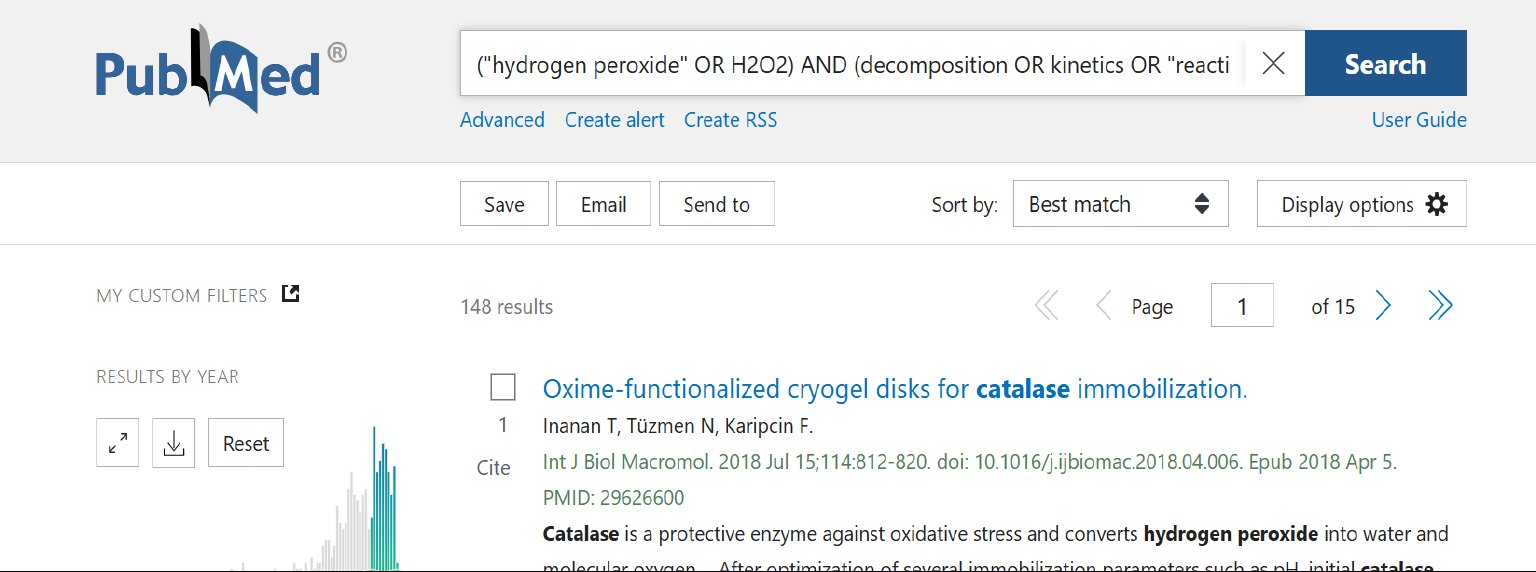
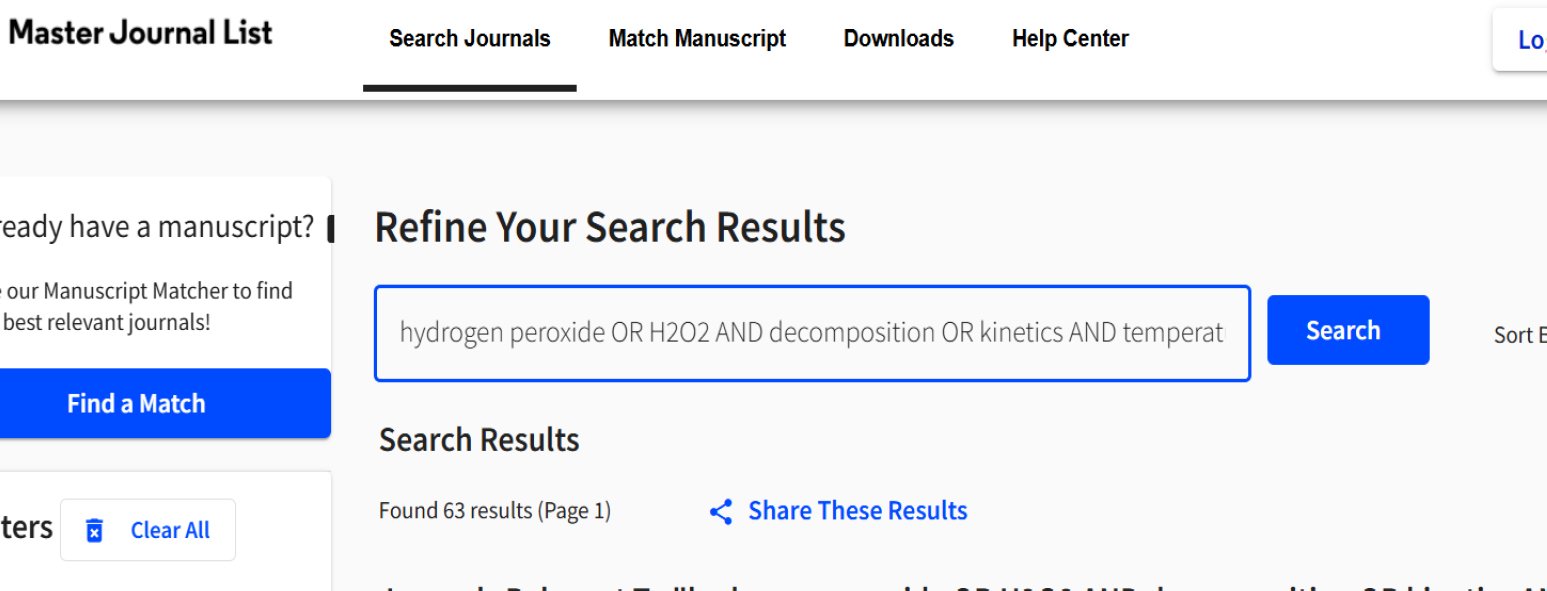
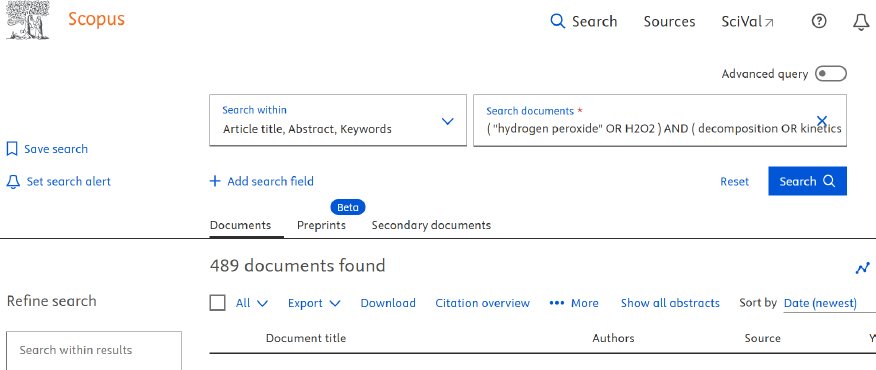
An extensive, multi-step search policy was used to identify the leading experimental research on the kinetics of hydrogen peroxide decomposition. PubMed, Scopus, and Web of Science were chosen as three large scientific databases. The Boolean search terms were designed to achieve precision and scope that capture the essence of the topic, while allowing terminological flexibility across subject areas. Title, abstract, and keyword searches were carried out. The search strings specific to the database were as was: on PubMed: (‘hydrogen peroxide’ OR H₂O₂) AND (decomposition OR kinetics OR ‘reaction rate’) AND (temperature) AND (concentration) AND (catalyst OR catalase); on Web of Science: hydrogen peroxide OR H₂O₂) AND (decomposition OR kinetics AND temperature) AND (concentration) (Appendix A).
2.3. Selection Criteria
2.3.1. Inclusion Criteria
Limitations were set so that studies required original, experiment-based laboratory data when the study was a direct investigation of the kinetics of hydrogen peroxide decomposition as a primary product of the reaction. Applicable articles specifically examined temperature and/or hydrogen peroxide level and/or catalyst concentration or loading as an independent variable. They provided quantitative markers of the kinetics, e.g., reaction rates, rate constants, reaction order, Arrhenius parameters, and concentration-time profiles. Such studies that used approved experimental reactor designs, such as batch reactors, continuous-flow systems, fixed-bed catalytic reactors or microreactors, were included. In the case of both heterogeneous catalytic (e.g., metal oxides and noble metals) and enzymatic systems (e.g., catalase), as long as the original kinetic analysis was provided. The review was limited to peer-reviewed journal articles published in the English language within the year range of 2017-2025 to achieve the objective of methodological rigour and reliability.
2.3.2. Exclusion Criteria
Only studies that were not review articles, meta-analyses, conceptual papers, editorials, or commentary pieces were included in the studies; likewise, studies that did not have original experimental data were excluded. Student papers with no direct kinetic analysis and studies with inadequate methodological transparency or published in non-peer-reviewed materials were also excluded to retain a strong and consistent evidence base.
2.4. Data Extraction
A systematic data-extraction protocol was implemented using a predetermined template to ensure consistency and transparency across included studies. The extracted information included bibliographic details, the experimental configuration, and the operating conditions. The critical ones were catalyst type and loading, initial peroxide concentration, and the temperature range and controls. The systematic results of quantitative kinetics were used to determine reaction rate constants, reaction orders, activation energies, and concentration-time profiles. Reported effects of temperature and concentration interaction and reported experimental constraints were further modelled, where possible, to facilitate strong comparative analysis and critical appraisal.
2.5. Data Analysis
Synthesis of the extracted data was carried out using narrative and comparative analytical methods, which apply to research on quantitative chemical kinetics. The studies were divided by their experimental layout and catalyst type, allowing comparison of each study across different temperature sensitivities, concentration dependencies, and apparent reaction orders. Where possible, Arrhenius parameters and rate constants were normalised to a standard set of units to facilitate interpretation. Trends in non-adherence to first-order kinetics at larger concentrations of hydrogen peroxide or high temperatures were recognised and examined. Special emphasis was placed on studies reporting the effect of the interaction between temperature and catalyst concentration, as this is one of the main methodological gaps in the literature. The synthesis highlighted similarities and differences among the studies by showing overall consistent trends in kinetics, while also critically evaluating differences due to reactor design, mass-transfer constraints or catalyst deactivation.
2.6. Ethical Consideration
Since this research was based solely on published secondary data, there was no need to seek formal ethical approval. To avoid bias and ensure reproducibility, moral standards were observed through transparent reporting, proper citation, and online screening and data extraction.
3. RESULTS
3.1. Data Screening
To promote transparency, rigour and reproducibility PRISMA 2020 framework was followed to select the study (Fig. 1). A total of three databases were searched during identification: 489 records from Scopus, 148 from PubMed and 63 from Web of Science were identified. The temporal limit (2017 to 2025) was set beforehand to span modern catalyst systems, intensified reactor designs, and safety standards in hydrogen peroxide handling in 2016 or later, and accordingly, date filters were used at the search phase on the database. The rest of the screening took place in this predefined corpus. Before the screening, 382), duplicated records were removed. At the title/abstract phase, 198 records were removed that did not focus on H₂O₂ decomposition kinetics or had not undertaken a kinetic analysis. Further, 90 records that were not peer-reviewed, commentaries, editorials, reviews, books, conference papers, did not have specific kinetic methodology (determination of rates, controlled conditions, and quantitative parameters), and data papers were excluded. The remaining 30 articles were evaluated in regard to inclusion and exclusion criteria. 12 articles were filtered out during the eligibility process as the studies did not explicitly study the effects of temperature and/or concentration of H₂O₂ (concentration or loading of the catalyst) on the decomposition rates, or had insufficient kinetic data available to compare it to the literature. 3 articles were removed due to no full-text access. A total of 15 studies were finally used in the final synthesis since they fulfilled all the requirements and formed good primary experimental evidence.
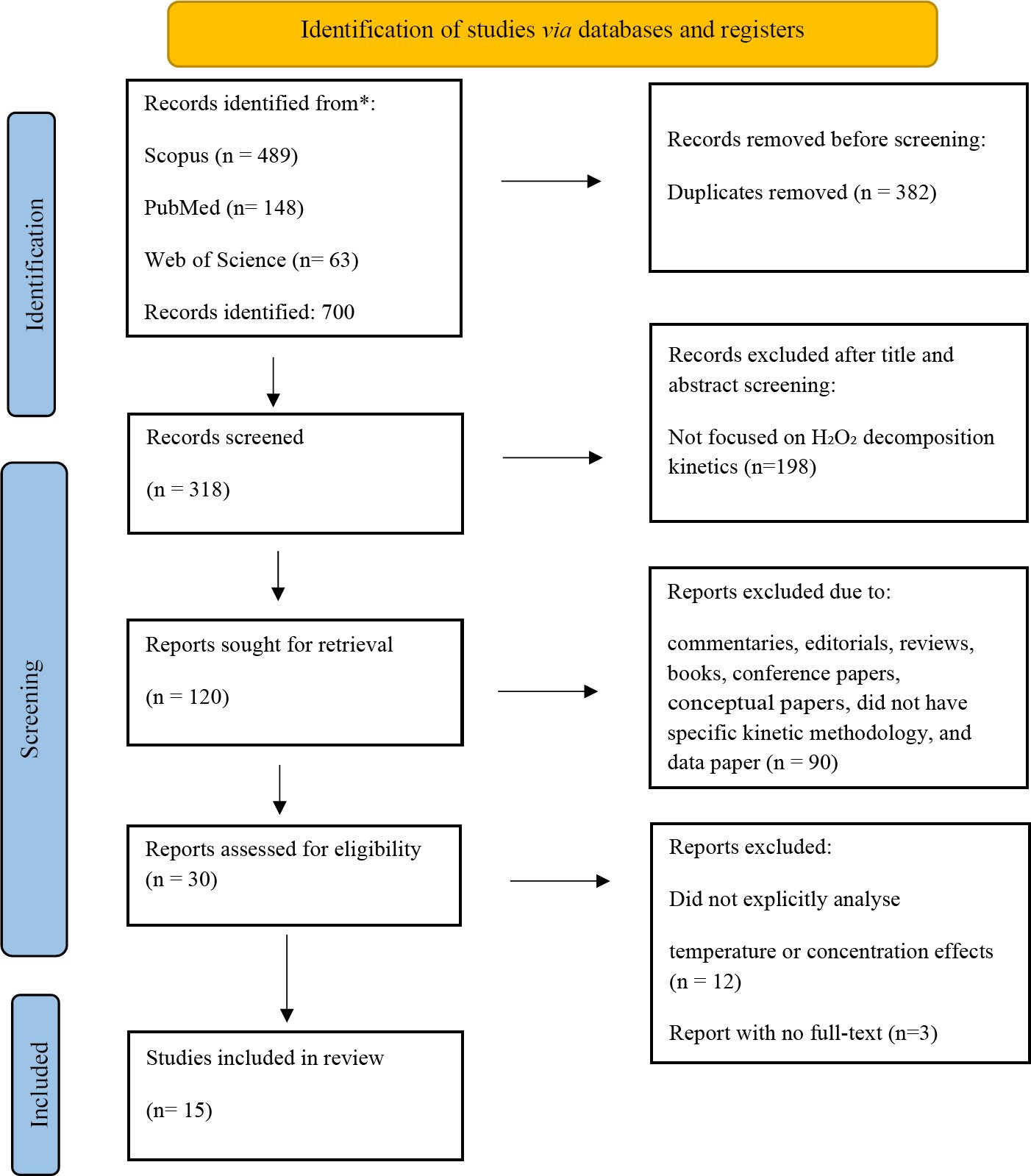
Fig. (1). PRISMA flowchart.
3.2. Quality Assessment
The quality of methodology of the studies followed in this review was evaluated with the help of a reproducibility and reporting quality framework designed to be used with laboratory-based studies in the field of chemical kinetics and catalysis research. Without a validated appraisal tool specifically tailored to work with physicochemical reaction systems, the given framework was focused on the issues of experimental reproducibility, strict control of critical variables and kinetic identifiability more than it was considered that human-intervention validity. This emphasis was considered correct, as the chosen trials comprised deterministic control of the factors of the experiment, so temperature, concentration of hydrogen-peroxide, catalyst concentration, etc. so characteristic of chemical-kinetics research but not clinical or health-science studies. The appraisal examined standards required of trustworthy kinetic interpretation, such as unambiguity of the aims of experiment, control of reaction conditions, suitability of the configuration of the reactor, and clear reporting of quantitative kinetic or performance values. Other criterion involved replication of experiments, catalyst stability or deactivation behaviour, and simplicity in evaluating analytical and instrumental techniques. Kinetic modelling and mechanistic reasoning were considered as signs of increased causal inference. All criteria were evaluated on a descriptive basis of fully met, partly met or not met but not weighted. In general, the review suggests that the degree of methodological rigour and generalizability between the studies is high, thus, leading to high qualitative comparison and synthesis levels (Appendix B).
3.3. Study Characteristics
These studies comprise a heterogeneous but methodologically consistent corpus of primary experimental studies on the decomposition of hydrogen peroxide (H₂O₂) under a wide variety of reactor configurations, catalyst systems, temperature regimes and concentration domains. The date of publication is 2017 to 2025, which covers both the fundamental kinetic investigations and the latest developments of catalysts, including characterisations of reactors and studies related to applications. As to the experimental configuration, there are batch reactors (Chen et al. [8]; Elbasuney et al. [9]; Yu & Lyu [10]), continuous-flow and fixed-bed reactors (Danyliuk et al. [5]; Grubecki [6]; Li et al. [11]), microreactors and propulsion-related catalytic chambers (Carlotti & Maggi [12]). This diversity allows it to be compared to basic kinetic behaviour and more process-oriented performance indicators, including conversion efficiency, temperature increase and catalyst longevity.
These catalyst types are represented by a wide array of catalysts such as metal oxide (MnO2, MnOX, Cu based catalysts, Co-based catalysts), cobalt and zirconium inorganic complexes, metal-organic frameworks, carbonaceous materials, as well as enzymatic systems based on free or immobilised catalase (Grubecki [6]; Trawczyńska [13]; Li et al. [11]). Characterisation and preparation of catalysts are well known; numerous studies have explicitly correlated structure or composition (such as oxidation state, dispersion, Ti³⁺ content) with decomposition activity (Gorokhovsky et al. [14]; Maksimchuk et al. [15]). Reaction temperature and H₂O₂ concentration are observed as the most common aspects of experiments across the dataset, exemplified at one extreme by low-strength solutions (1.5 wt%) suitable for medical oxygen production (Hassanein & Abdelaziz [16]) and on the other end by high-test hydrogen peroxide (>80 wt%) to consider just propulsion systems (Carlotti & Maggi [12]). Quantitative kinetic results, such as rate constants, activation energies, reaction orders, and conversion efficiencies, are reported, thus facilitating cross-study synthesis (Table 1). Taken together, all these features create a strong and heterogeneous body of evidence that is sufficient to uncover systematic features in the temperature-, concentration-, and catalyst-dependent behaviour of H₂O₂ decomposition. To facilitate cross-study comparison, Table 2 summarises the principal kinetic parameters reported in the included studies, including catalyst concentration, temperature range, hydrogen peroxide concentration, activation energy, and key kinetic observations.
Table 1. Findings table.
| Authors | Year | Aim of the Study | Methodology | Solution / Catalyst | Findings of the Study (Quantifiable) | Outcome |
| Carlotti & Maggi [12] | 2022 | To develop, characterise, and evaluate MnOx-based catalysts for high-test hydrogen peroxide (HTP) decomposition in propulsion-relevant conditions | Laboratory-scale endurance tests using single MnOx/Al₂O₃ pellets; mass-loss–based reaction rate estimation; thermocouple temperature monitoring; fixed-bed decomposition chamber testing | MnOx supported on Al₂O₃ pellets prepared via impregnation (baseline, 1-step, 3-step); H₂O₂ ≈83.5% | 3-step impregnation achieved 4.8 wt% catalyst loading (vs ~1.9% baseline). Achieved ~88% temperature efficiency at steady state. Catalysts showed limited degradation after 36 s of cumulative firing. The reaction rate derived from mass loss showed rapid decomposition with a short induction time for high-activity pellets. | MnOx/Al₂O₃ catalysts demonstrated high efficiency and durability, confirming suitability for sustained H₂O₂ decomposition under high-temperature, high-concentration conditions. |
| Danyliuk et al. [5] | 2025 | To investigate the kinetics of H₂O₂ decomposition in a continuous-flow reactor and relate it to bacterial inactivation | Continuous-flow fixed-bed reactor; UV-Vis determination of residual H₂O₂; logarithmic kinetic plots; regression modelling | Granular cobalt ferrite (CoFe₂O₄); catalyst bed mass ≈180 g; H₂O₂ 3–80 mM | At 3–15 mM H₂O₂, decomposition followed first-order kinetics (linear ln[C] vs time). At >23 mM, kinetic plots became nonlinear, indicating reaction order >1. Only 10–15% H₂O₂ decomposition occurred at ~30 min contact time due to flow limitations. | Demonstrated strong concentration-dependent kinetic regime shift, highlighting that reaction order increases at higher H₂O₂ concentrations. |
| Elbasuney et al. [9] | 2024 | To compare the catalytic activity and durability of green-synthesised nano-catalysts for H₂O₂ decomposition | Batch reactor tests; liquid temperature profile (LTP); lifetime mass loss (LTML); repeated catalyst cycling | Silver nanoparticles (~18 nm) and MnO₂ nanoparticles (~20 nm); H₂O₂ 85% | Silver nanoparticles reached the LTP peak within ~20 s but were oxidised, losing activity within ~20 s. MnO₂ reached peak temperature in ~40 s but maintained activity across multiple cycles with minimal mass loss. | MnO₂ exhibited superior durability and sustained decomposition, whereas silver showed a high initial rate but poor lifetime. |
| Chen et al. [8] | 2019 | To evaluate ZIF-67 as a catalyst for rapid H₂O₂ decomposition and determine kinetic parameters | Batch kinetic experiments; UV-Vis colorimetric analysis; Arrhenius modelling at 30–60 °C | ZIF-67 (Co-based MOF); catalyst concentrations 10–300 µg mL⁻¹; H₂O₂ 20 mM | Decomposition followed first-order kinetics. Rate constants increased with catalyst loading: k = 2.82×10⁻², 7.85×10⁻², 4.30×10⁻¹ min⁻¹. Temperature-dependent k values reached 3.47 min⁻¹ at 60 °C. Calculated activation energy = 37 kJ mol⁻¹. | Confirmed strong temperature and catalyst-concentration dependence, with ZIF-67 showing faster kinetics than conventional cobalt salts. |
| Grubecki [6] | 2020 | To determine the optimal feed temperature for hydrogen peroxide decomposition in a fixed-bed enzymatic reactor | Fixed-bed plug-flow bioreactor; immobilised commercial catalase (Terminox Ultra); analytical optimisation model validated experimentally | Catalase immobilised on non-porous glass beads; H₂O₂ ≤ 2×10⁻² kmol m⁻³ | Reaction activation energy ER = 12.6 ± 0.3 kJ mol⁻¹; enzyme deactivation energy ED = 49.7 ± 1.2 kJ mol⁻¹. Optimal feed temperature (OFT) varied with flow rate and diffusional resistance. At Q = 20×10⁻⁸ m³ s⁻¹, maximum conversion αₘ = 0.949 at T ≈ 305 K; increasing pellet diameter (5×10⁻⁴ → 10×10⁻⁴ m) raised OFT from 304.6 K to 309.9 K while reducing conversion to 0.780. | Demonstrated that temperature–concentration–diffusion coupling governs optimal reactor performance; improper temperature selection significantly reduces conversion. |
| Gorokhovsky et al. [14] | 2023 | To investigate how the synthesis conditions of potassium polytitanates affect H₂O₂ decomposition kinetics | Batch kinetic experiments; FT-IR, XPS, DSC/TGA; temperature-controlled aqueous dispersions | Potassium polytitanates (PPT) synthesised in KOH–KNO₃ molten salts | Catalytic activity increased with Ti³⁺ content: 0 → 4.0 → 21.9 at.% Ti³⁺ for PPT(30-30-40), PPT(30-50-20), PPT(30-70-0). Specific surface areas 71.3–79.6 m²/g⁻¹. Efficient decomposition occurred below 40–45 °C, avoiding violent exothermic runaway. Higher KNO₃ reduction conditions produced stable, controlled decomposition rates. | Identified Ti³⁺ concentration and surface hydroxylation as key drivers of H₂O₂ decomposition efficiency at low temperatures. |
| Huh et al. [17] | 2025 | To evaluate the effect of preheating temperature on H₂O₂ decomposition efficiency in a monopropellant thruster | Experimental firing tests in a catalyst chamber; pressure–temperature diagnostics; resistive preheating | Mn-oxide catalyst on alumina pellets; 50 wt% H₂O₂ | Characteristic velocity efficiency increased from 64 % at 28 °C to a maximum of 89 % at 106 °C, then declined at higher temperatures. Chamber preheating range 28–237 °C. Excessive preheating led to additional pressure losses downstream, despite higher initial decomposition rates. | Demonstrated existence of an optimal temperature window where thermal and catalytic decomposition are balanced for maximum efficiency. |
| Hassanein & Abdelaziz [16] | 2025 | To optimise low-strength H₂O₂ decomposition for stable, medical-grade oxygen generation | Batch reactor; 3×3 full-factorial design; continuous O₂ flow and purity monitoring | MnO₂ powder (0.1–0.5 g); H₂O₂ concentrations 1.5, 2.87, 6 wt% | At 1.5 wt% H₂O₂, stable O₂ generation was achieved with flow rates of 68–134 mL h⁻¹, oxygen purity ≥95.6 %, and temperature rise <4 °C. Higher H₂O₂ concentrations increased the rate but reduced stability. Increasing MnO₂ mass accelerated decomposition only up to surface saturation. | Confirmed H₂O₂ concentration as the dominant kinetic variable for controlled, low-temperature decomposition. |
| Maksimchuk et al. [15] | 2023 | Resolve the mechanism of H₂O₂ decomposition over Zr(IV)-substituted Lindqvist tungstate and validate via experiment–DFT alignment. | Mechanistic/kinetic study integrating experimental Arrhenius analysis with DFT pathways + kinetic simulations. | Mechanistic proposal involving Zr-trioxane intermediate leading to singlet oxygen (heterolytic) or superoxide radicals (homolytic). | Experimental Arrhenius activation energy (Ea) for H₂O₂ decomposition with {ZrW5}²⁻ = 11.5 kcal·mol⁻¹. Computed RDS energy barriers (ZPE-corrected) 13.9, 10.1, 8.8 kcal·mol⁻¹ (mechanisms 1,2,4) and weighted average 9.2 kcal·mol⁻¹ (close to experiment). Also reports comparative computed barriers: Zr 9.2, Ti 14.7, Nb 18.6 kcal·mol⁻¹, consistent with the experimental values of 11.5, 14.6, and 16.7 kcal·mol⁻¹. | Provides a validated mechanistic explanation and quantified activation energetics, demonstrating how catalyst identity (Zr vs Ti vs Nb) shifts decomposition energetics and pathways. |
| Li et al. [11] | 2024 | Improve H₂O₂ decomposition performance by immobilising catalase on a PAES-C polymer carrier and testing in continuous-flow mode. | Enzyme immobilisation optimisation (temperature/time/dosage) + continuous-flow decomposition performance testing. | Immobilised catalase (PAES-C carrier) for continuous H₂O₂ decomposition with better stability/recyclability than free enzyme. | Immobilised enzyme activity 188.75 U·g⁻¹ at 30 °C, pH 7; adsorption capacity 4.685 mg protein per unit mass carrier. Continuous-flow H₂O₂ decomposition achieved 90% conversion at 8 mL·min⁻¹ for one h, with 0.2 g catalyst/bed. Reusability: after 22 cycles, activity ≈ was 45% of the initial; the first 10 cycles showed no significant decrease. | Demonstrates temperature-linked activity (30 °C optimum reported) plus flow/bed-mass conditions delivering high conversion and quantifiable reusability—useful for catalyst loading + operational comparisons. |
| Remissa et al. [18] | 2025 | Evaluate thermal decomposition of H₂O₂ (green propellant context) over low-cost Cu catalysts on different supports, emphasising temperature effects. | Lab thermal decomposition using 30% (w/w) H₂O₂ microdroplet with Cu catalysts (1 wt% Cu) supported on γ-alumina, graphite, MNC clay; monitoring via differential pressure and first-order kinetic plotting. | Low-cost catalytic system: Cu/support (support-dependent dispersion) to accelerate decomposition; compares supports under two temperature conditions. | First-order form used: ln([H₂O₂]t/[H₂O₂]0)=Kt. Apparent kinetic constant K extracted from slopes. At 36 °C, slopes ( | The results confirm that higher temperature significantly increases the H₂O₂ decomposition rate and that Cu catalyst performance is strongly support-dependent, demonstrating the importance of temperature control and support selection for efficient, low-cost, green-propellant decomposition systems. |
| Shang et al. [19] | 2017 | Provide a kinetic study of H₂O₂ decomposition at high temperatures and concentrations in capillary microreactors, including catalyst loading effects. | Continuous-flow capillary microreactor kinetics; uses PFA capillary; sets H₂O₂: catalyst molar ratio = 440:6 and operates at 10 bar to avoid water evaporation; measures conversion vs temperature/residence time. | Microreactor approach to quantify decomposition under harsh “process window” conditions relevant to intensified oxidation chemistry; kinetic framework includes temperature and residence time. | Conversion increased with temperature; at 378 K, ~50% H₂O₂ decomposed at 20 20-minute theoretical residence time in a PFA capillary. The experimental conditions explicitly state 10 bar pressure control and a 440:6 molar ratio baseline. | Establishes a quantified baseline for temperature–residence-time dependence at elevated conditions; forms a comparator study for your review of “temperature + concentration + catalyst loading” synthesis. |
| Yu & Lyu [10] | 2024 | To identify and quantify an overlooked pathway of H₂O₂ decomposition over carbonaceous materials and assess the controlling variables | Batch experiments with carbon strips (charcoal, graphite, carbon felt); GC–MS and in-situ FTIR for gaseous products; UV–Vis for H₂O₂; pH/temperature monitoring | Carbonaceous cathodes reacting with H₂O₂ (5.6–34 wt%) at ambient conditions. | Spontaneous reaction produced CO₂ and CO (not only O₂/H₂O). At 34% H₂O₂, CO₂ dominated; at 5.6–11%, CO dominated. With charcoal at pH 10, H₂O₂ decreased from 2.73 to 1.24 mol L⁻¹ in 60 min (>50% loss). The temperature rose by up to 9 °C at high pH. Charcoal mass loss confirmed carbon consumption. | Demonstrates that H₂O₂ concentration, pH, and carbon surface strongly accelerate decomposition via a chemical oxidation pathway, limiting achievable H₂O₂ accumulation. |
| Yoon et al. [20] | 2022 | To develop a recyclable MOF-based catalyst for oxygen evolution from H₂O₂ under mild conditions | Cation-exchange encapsulation of Co(III) complex in InBTB MOF; KMnO₄ titration for H₂O₂; UV-Vis/IR/XPS; recycling tests | trans-[Co(en)₂Cl₂]@InBTB MOF catalyst | Encapsulation amount 5.55 mmol per 10 mg MOF. Catalytic H₂O₂ decomposition at 40 °C showed sustained activity with no Co leaching. Oxygen evolution activity was retained over ≥7 reuse cycles with minimal loss. | Confirms stable heterogeneous catalysis of H₂O₂ with high recyclability, highlighting MOF confinement benefits for controlled decomposition. |
| Trawczyńska [13] | 2020 | To introduce a new method for the simultaneous determination of reaction and deactivation kinetics of catalase-driven H₂O₂ decomposition | Batch enzymatic assays; integrated kinetic modelling; pH (3–10) and temperature (10–45 °C) variation | Bovine liver catalase (free enzyme) | Determined activation energy for decomposition, Er = 14 kJ mol⁻¹, and deactivation, Ed = 56.8 kJ mol⁻¹. At pH 7, deactivation constant kₑ = 7.85 dm³ mol⁻¹ min⁻¹. Maximum rate constant observed at pH 6–8; rate decreased sharply outside this range. Deactivation constant increased monotonically with temperature (10–45 °C). | Provides quantitative temperature–pH dependence of catalase kinetics, enabling accurate modelling of enzymatic H₂O₂ decomposition and stability limits. |
| Study | Catalyst | Temperature Range | Catalyst Loading | H₂O₂ Concentration | Activation Energy (Ea) | Key Kinetic Observation |
| Chen et al. [8] | ZIF-67 | 30–60°C | 10–300 µg mL−1 | 20 mM | 37 kJ mol−1 | First-order kinetics |
| Grubecki [6] | Immobilised catalase | Around 305 K optimum | Fixed-bed | ≤2×10⁻² kmol m−3 | 12.6 kJ mol−1 | High conversion near optimum temperature |
| Trawczyńska [13] | Free catalase | 10–45°C | Not reported | Variable | 14 kJ mol−1 | Temperature-dependent deactivation |
| Maksimchuk et al. [15] | Zr-substituted tungstate | Variable | Not reported | Variable | 11.5 kcal mol−1 | Mechanistic pathway control |
| Huh et al. [17] | Mn-oxide catalyst | 28–237°C | Pellet catalyst | 50 wt% | Not reported | Maximum efficiency at 106°C |
| Remissa et al. [18] | Cu catalysts | 0–36°C | 1 wt% Cu | 30 wt% | Not reported | Strong temperature dependence |
3.4. Effect of Temperature on Hydrogen Peroxide Decomposition Kinetics
Across the studies examined, temperature has been established as the major kinetic driving force of hydrogen peroxide decomposition, with the majority of cases exhibiting Arrhenius behaviour, though modulated by catalyst chemistry, reactor design, and concentration regime. Enzyme and heterogeneous catalytic systems have been reported to exhibit escalating decomposition rates with increasing temperature, thus validating the importance of temperature dependence in the breakdown kinetics of H₂O₂ [6, 8, 15]. Quantitative kinetic measurements indicate that the temperature sensitivity varies widely across systems; enzymatic measurements indicate low activation energies for the decomposition reaction (12–14 kJ mol⁻¹), corresponding to high catalytic efficiency at moderate temperatures [6, 13]. Conversely, heterogeneous catalysts exhibit elevated apparent activation energies, with 37 kJ mol⁻¹ in the case of ZIF -67 [8] and a mechanistic potential of 11.5 kcal mol⁻¹ (about 48 kJ mol 1) in the case of Zr-substituted tungstates [15]. These irregularities emphasise that temperature and rate depend on catalyst chemistry rather than temperature being a universal accelerator.
A range of literature also defines optimal temperature ranges, beyond which performance either stagnates or declines. In enzymatic fixed-bed reactors, Grubecki [6] (Table 3) showed that the optimal feed temperature varied with both flow rate and diffusional resistance, with the highest conversion (α ≈ 0.95) near 305 K, though higher temperatures increased enzyme deactivation. The same stability limitations were observed with free catalase, where the deactivation constants increased monotonically from 10 to 45°C, although higher PMs were obtained in this case [13]. The results highlight that a trade-off between kinetic acceleration and catalyst life controls the temperature optimisation of enzymatic systems. In heterogeneous catalysts and propulsion systems, temperature optima also occur, but via different mechanisms. Carlotti & Maggi [12] and Huh et al. [17] obtained significant efficiency gains on preheating, decomposition or characteristic velocity efficiency maximum around 100 and 110°C, and a decrease in performance over high temperatures because of pressure losses, inefficiency in heat dissipation or catalyst stress (Fig. 2). Remissa et al. [18] also demonstrated that apparent first-order rate constants at 36°C were an order of magnitude greater than those at 0°C, although also pointing out that overheating can enhance support-dependent instability.
Table 3. Activation energies and frequency factors in Arrhenius equation for reaction and enzyme; Source: Grubecki (2020) [6].
| Reaction of HPD | |
| Activation energy (kJ·mol⁻¹) |  |
| Frequency factor (s⁻¹) |  |
| Parallel deactivation of TUC | |
| Activation energy (kJ·mol⁻¹) |  |
| Frequency factor (m³·kmol⁻¹·s⁻¹) |  |
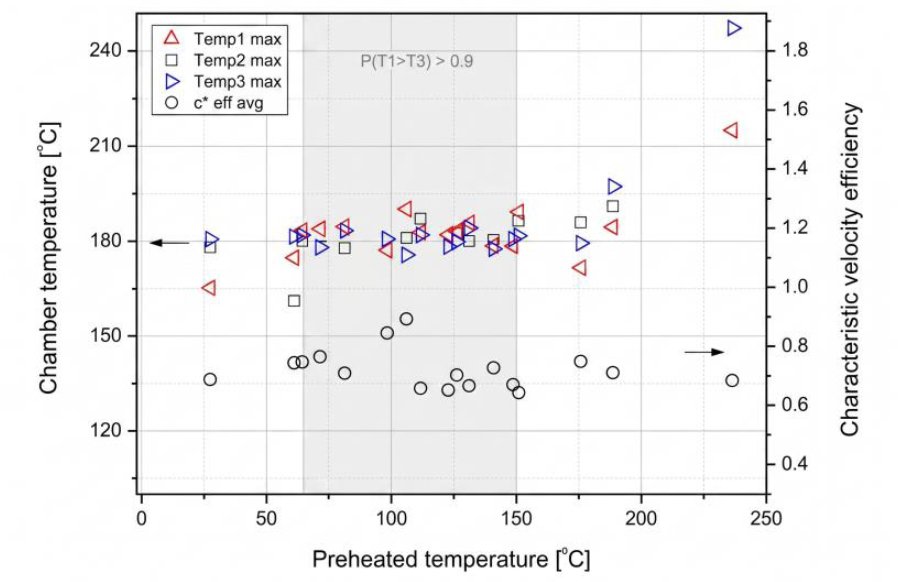
Fig. (2). Maximum chamber temperature and average c*efficiency of the thruster with respect to preheated temperature, with the highlighted area where the probability of upstream temperature (Temp1) being greater than downstream temperature (Temp3) exceeds 90 %; Source: Huh et al. [17].
Temperature-induced limitations are therefore a recurring theme. Elbasuney et al. [9] states that high temperature exacerbates catalyst deactivation, Yu & Lyu [10] further found that it threatens thermal runaway at high H₂O₂ levels. This poses reactor-specific limitations, including boiling, mass transfer, or pressure in microreactors and fixed-bed reactors [5, 19]. Taken together, the data show that although higher temperature increases the intrinsic rate of reaction, the ultimate system-specific thermal optima control the efficiency of kinetic performance rather than a temperature-dependent uniform increase.
3.5. Influence of Hydrogen Peroxide Concentration on Decomposition Behaviour
Across the literature reviewed, the level of hydrogen peroxide use is shown to have a non-linear, system-specific impact on decomposition behaviour, including reaction order, thermal stability, and operational stability. Other studies provide direct evidence of a kinetic regime transition with increasing concentration, which disproves the general expectation of a first-order decomposition. Danyliuk et al. [5] found that decomposition in a continuous-flow fixed-bed reactor obeyed first-order kinetics at low concentrations (3- 15 mM). Still, this non-linear behaviour occurs above molecular concentrations of around 23 mM, indicating an apparent increase in reaction order (Fig. 3). As in concentrated and high-temperature systems, the rate accelerations were not solely due to concentration scaling [19].
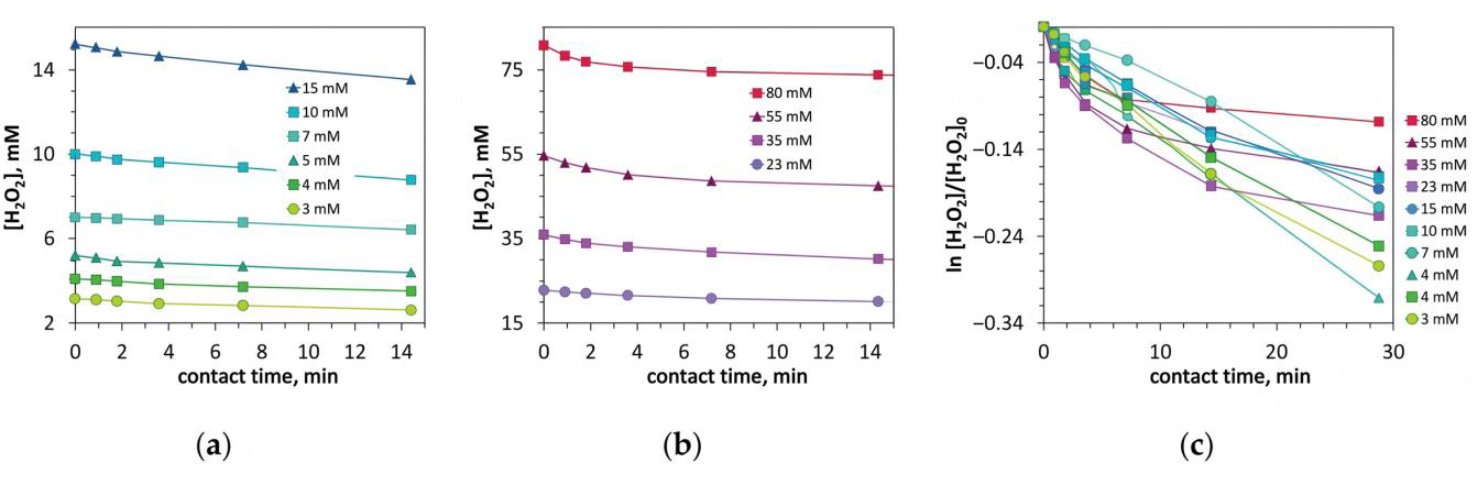
Fig. (3). The kinetics of H₂O₂ decomposition in the flow reactor at different initial concentrations of (a, b) The changes in H₂O₂ concentration over time. (c) The changes in H₂O₂ concentration are plotted on a logarithmic scale. Source: Danyliuk et al. [5]
Concentration is an essential factor closely related to stability and safety. High H₂O₂ concentration (>80 wt%) studies consistently report enhanced heat release and rapid oxygen evolution, which, on the one hand, lead to high propulsion efficiency but, on the other hand, impose severe restrictions on thermal control and catalyst life [9, 12]. Yu & Lyu [10] also note a previously under-considered risk pathway, in which at 34 wt% H₂O₂, carbonaceous surfaces facilitate spontaneous chemical oxidation to give CO2 and CO, with a high amount of heat loss, facilitating decomposition faster than can be catalysed (Fig. 4). These discoveries can be shown to demonstrate that high concentration does not only elevate rate, but can actually dramatically reshape the reaction pathways.
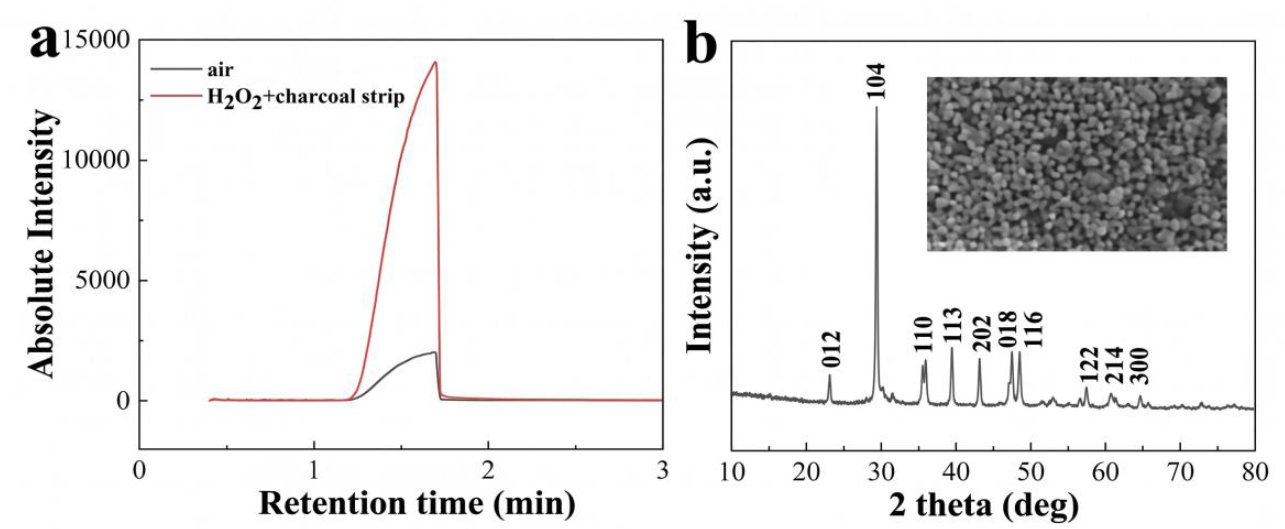
Fig. (4). Mass 44 spectrometry (a), XRD pattern (b) and SEM image (inset of b) of the white precipitate (CaCO3) from the reaction between charcoal and H₂O₂. Source: Yu & Lyu [10].
On the other hand, research on low-strength H₂O₂ shows that low concentration facilitates stable operation. It was found that at 1.5 wt% H₂O₂, a portion of the decomposition produced medical-grade oxygen, accompanied by a slight temperature rise (<4 °C) compared with higher concentrations, resulting in a faster reaction but lower stability [16]. Concentration-dependent moderation was also observed in enzymatic and flow systems, with decreasing inlet concentrations allowing longer residence times and greater net conversion, without thermal runaway [6, 11]. Comparisons across batch, flow, and microreactor studies have shown that the effects of concentration are more potent in systems that lack sufficient heat removal or residence time, i.e., in fixed beds and microchannels [5, 19]. In general, the evidence confirms that hydrogen peroxide concentration effectively controls the decomposition rate and kinetic regime, as well as stability, and enables reactor operation, underscoring its importance as a design variable to consider alongside temperature and catalyst choice.
3.6. Role of Catalyst Type and Catalyst Concentration/Loading Behaviour
A cumulative analysis of the examined studies suggests that the type and loading of catalysts are definitive factors in determining the kinetics of hydrogen peroxide decomposition, balancing innate activity and durability. There is great diversity in the performance of metal oxides, Metal-Organic Frameworks (MOFs), polyoxometalates, carbonaceous materials, and enzymatic catalysts, so it is essential to have catalyst chemistry and structure that defines the reaction pathways. Among metal oxide catalysts, manganese-based systems are active and durable. Elbasuney et al. [9] found that both MnO2 nanoparticles and silver nanoparticles exhibited continuous decomposition over multiple cycles, with short initial activity but were oxidatively poisoned within several seconds. Equivalent durability benefits were indicated in MnOx/Al₂O₃ pellets in propulsion-relevant experiments, where a deeper impregnation depth (4.8 wt%) enhanced temperature efficiency (~88%) and reduced degradation [12] (Fig. 5). The impact of support-dependent dispersion can be further illustrated by copper-based catalysts, with Remissa et al. [18] finding order-of-magnitude variations in the apparent rate constants of Cu catalysts supported on alumina, graphite, and clay under the same loading conditions.
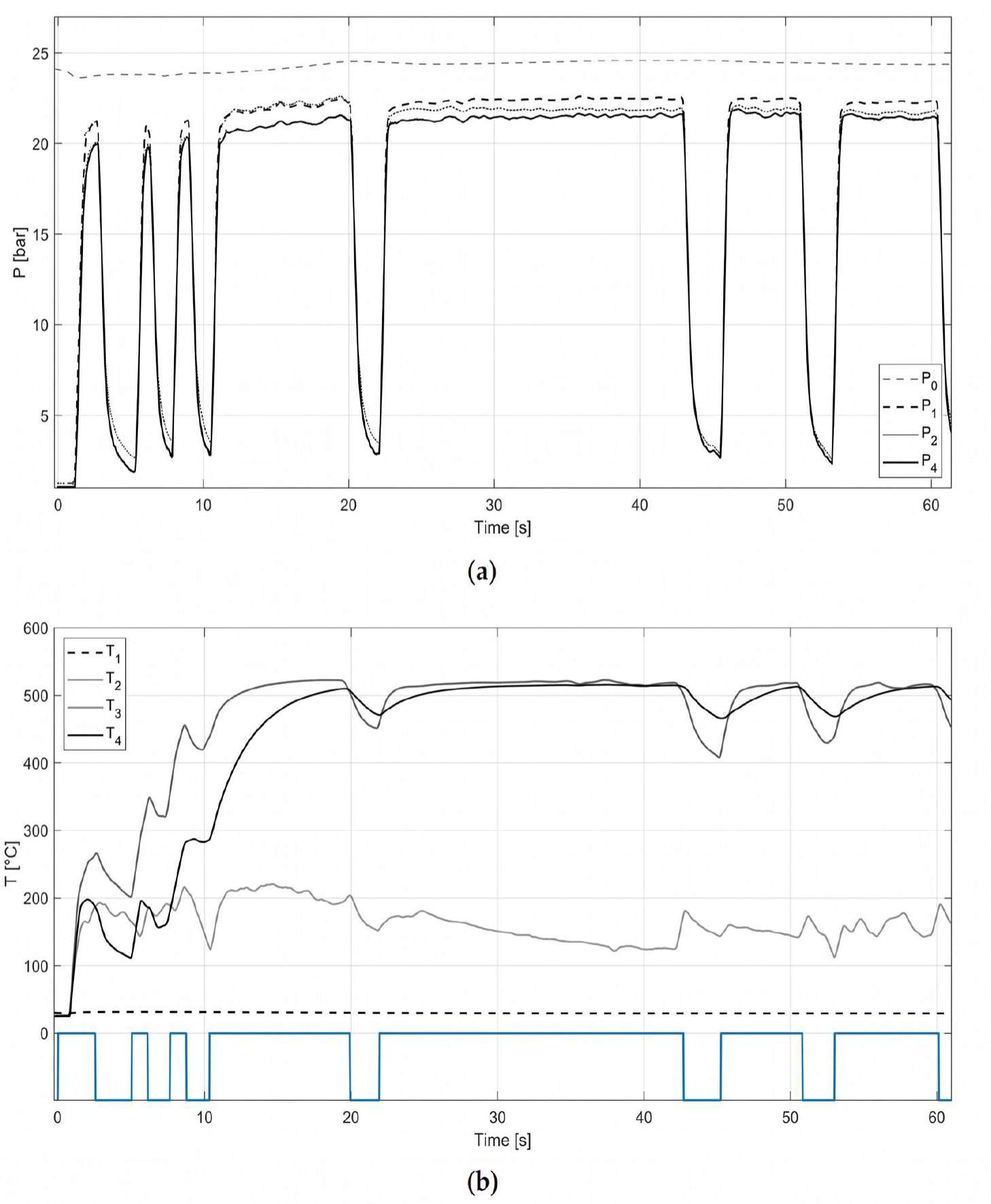
Fig. (5). Pressure and temperature distributions during pulsed and continuous tests. The light blue line indicates the opening of the HTP valve. Source: Carlotti & Maggi [12]. (a) Transient pressure variations over time showing cyclic drops and recoveries across multiple pressure signals. (b) Corresponding temperature response and control profile over time under stepwise operating conditions.
There is also an advanced catalyst architecture that provides a mechanistic understanding of the relationship between structure and activity. Chen et al. [8] underscores that ZIF-67 MOFs showed a higher rate of cube formation than traditional cobalt salts, which could be explained by increased access to active sites and a favourable cobalt coordination environment that promoted catalysis. The polyoxometalate systems take the finding one step further, revealing that Zr (IV) replacement reduces the activation barriers relative to Ti or Nb analogues and semi-quantitatively correlates the oxidation state and metal identity with catalytic efficiency. The significance of electronic structure was also established by Gorokhovsky et al. [14], who found that Ti³⁺ concentration and surface hydroxylation were the primary factors driving activity in potassium polytitanates. The effects of catalyst concentration are discussed in a variety of works, most of which report a positive relationship between mass and the apparent rate constant at the beginning of testing, extending to the mass extension. At concentrations of 300 µg mL⁻¹, Chen et al. [8] found monotonic rises in rate constant with ZIF 67 concentration (Fig. 6). In contrast, Hassanein & Abdelaziz [16] found that the rate of acceleration with MnO₂ mass levelled off at higher concentrations due to surface saturation. These observations suggest a decrease in returns at an optimum catalyst concentration.
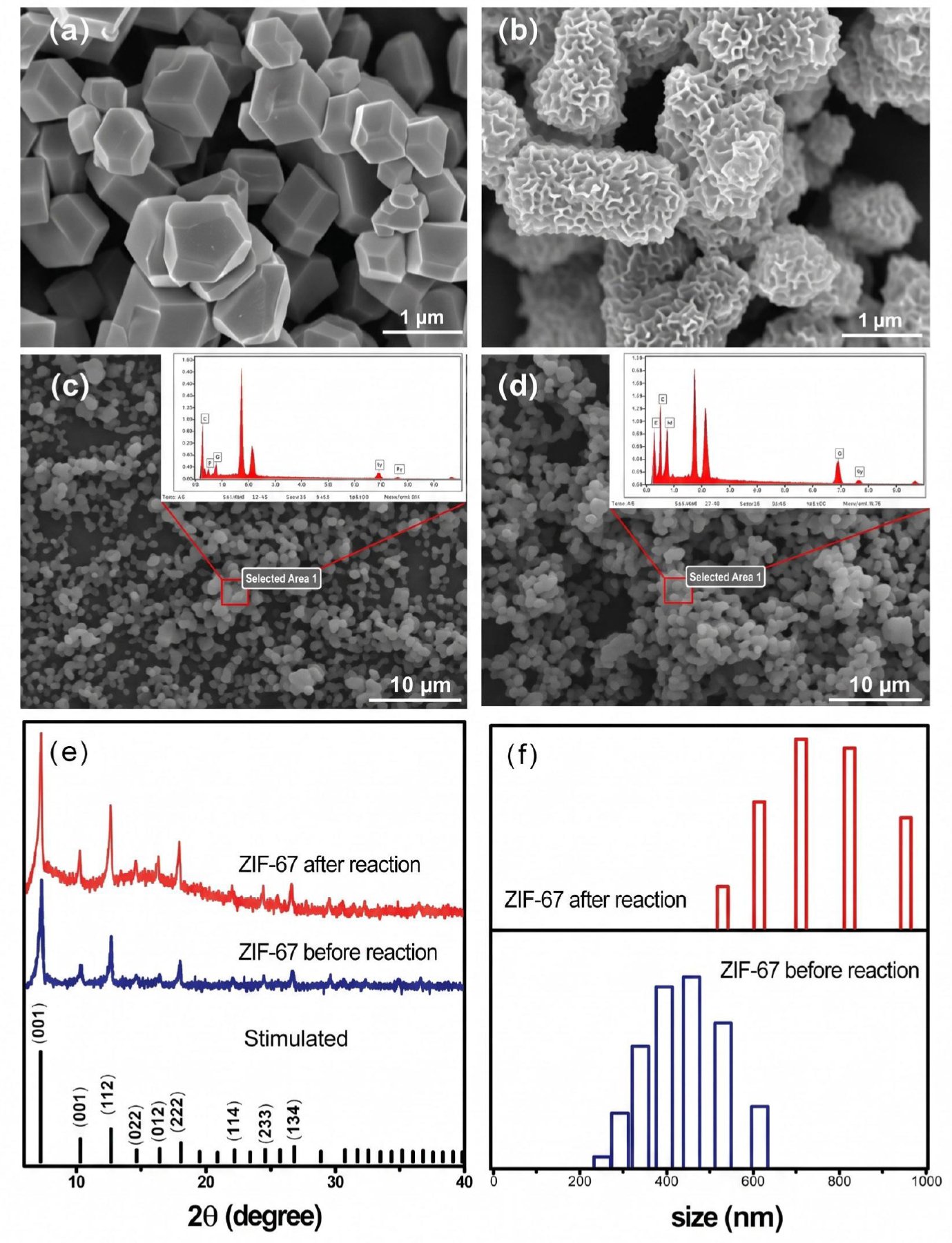
Fig. (6). SEM images of ZIF-67 NPs. (a) before and (b) after decomposing hydrogen peroxide reaction; EDAX analysis of ZIF-67 NPs (c) before and (d) after reaction; (e) XRD pattern of ZIF-67 NPs; (f) DLS analysis of ZIF-67 NPs. Source: Chen et al. [8].
Systems also vary in terms of catalyst stability and reusability. Li et al. [11] procured that enzymatic catalysts that are immobilised have better stability over the long term as PAES-C-immobilised catalase shows approximately 45% activity stability after 22 cycles and undergoes little loss within the first 10 cycles. On the contrary, Yu & Lyu [10] states that unsupported nanoparticles and carbonaceous substances are more likely to be deactivated or consumed. Therefore, it can be affirmed that the best catalyst selection and loading involve a compromise in which one must balance intrinsic activity and lifespan, especially in continuous, high-temperature operation.
3.7. Interaction Effects Between Temperature, Concentration, and Reactor Design
Results are synthesised within reactor classes to preserve system-specific transport, thermal, and kinetic characteristics. Cross-reactor comparisons are employed solely to identify qualitative patterns, such as temperature sensitivity, concentration-driven regime shifts, and catalyst deactivation tendencies and do not imply direct quantitative equivalence of kinetic parameters across reactor types (Table 4).
Table 4. Reactor-stratified framework for interpreting H₂O₂ decomposition kinetics.
| Reactor Class | Dominant Transport Characteristics | Primary Kinetic Controls | Typical Limitations | Interpretation Boundary |
| Microreactors | High heat and mass transfer; short residence time | Temperature, residence time | Pressure control, limited contact time | Apparent kinetics dominated by transport intensification |
| Fixed-bed / Continuous-flow | Axial gradients; internal diffusion | Concentration, hydrodynamics | Flow limitation, diffusion resistance | Apparent kinetics reflect coupled reaction–transport |
| Batch reactors | Poor heat removal; gas accumulation | Concentration, thermal stability | Runaway risk, mass transfer | Kinetics strongly system-dependent |
| Enzymatic reactors | Mild conditions; diffusion-limited | Temperature (optimum), enzyme stability | Thermal deactivation | Apparent kinetics valid only near optimum |
| Propulsion catalyst chambers | Non-isothermal; high flux | Temperature, reactor geometry | Pressure loss, catalyst stress | System-level performance, not intrinsic kinetics |
3.7.1. Microreactor Systems
The technology of microreactor studies demonstrates that augmented heat and mass transfer alleviate the effects of high temperature along with high hydrogen peroxide concentration. Shang et al. [19] described that hydrogen peroxide was quickly broken down in capillary microreactors with large operating temperatures and concentrations. Still, overall conversion was limited by residence time and pressure management, instead of intrinsic reaction rates. The given observations emphasise the fact that thermal acceleration does not provide any guarantee of complete decomposition in cases when the residence times are not adequate. Highly efficient heat dissipation of microreactors allows them to work in situations that could have caused boiling or runaway in bigger reaction differences (Shang et al., [19]; Qiu et al., [4]). However, the corresponding kinetics in these systems is an exaggeration of the transport phenomenon as opposed to universally valid intrinsic rate constants.
3.7.2. Fixed-Bed and Continuous-Flow Reactors
The relationship between temperature and concentration in fixed-bed and continuous-flow modes is stricter in hydrodynamics/internal diffusion. Danyliuk et al. [5] observed that the decomposition of hydrogen peroxide obeyed first-order kinetics at lower concentrations, but obeyed other higher orders or mixed order kinetics at higher concentrations that exceeded about 23 mM. In spite of temperature and concentration increases, the overall conversion declined due to the limitations of the flow and the decline of the contact time. As shown by these findings, with fixed-bed systems, apparent kinetic parameters are determined by coupled chemical and transport constraints, and not at all by the intrinsic reaction rates.
3.7.3. Batch and Enzymatic Reactor Systems
Reactor-dependent effects of interaction are also demonstrated through batch and enzymatic reactor studies. Batch systems are noted, in particular, to be affected by temperature gradients, mass accumulation, and resistance due to mass transfer at high concentrations (Grubecki, [6]; Hassanein & Abdelaziz, [16]). In an enzymatic system, a rise in temperature only enhances decomposition up to the optimal point, after which enzyme deactivation takes centre stage. Such results suggest that the exothermicity induced by concentration and acceleration caused by temperature has to be balanced against the stability considerations that were involved in the reactor design.
3.7.4. Propulsion-Relevant Catalyst Chambers
A very extreme case of interaction effects is propulsion-oriented catalyst chambers. As demonstrated in the studies conducted by Huh et al. [17] and Carlotti & Maggi [12], preheating results in more effective decomposition within a favourable range of temperature, and, in any case, a higher-pressure loss and catalyst overloading reduce the overall performance. Apparent kinetics in such non-isothermal systems are manifestations of the behaviour of systems at the system level, which depends on thermal management and reactor geometry, and is independent of intrinsic catalytic activity.
3.7.5. Mechanistic Implications Across Reactor Types
Mechanistic studies also give increased insight into the reasons why interaction effects vary in different reactor classes. Maksimchuk et al. [15] demonstrated that the identity of catalysts is the one that can either lead to a heterolytic or a homolytic reaction, and Yu & Lyu [10] confirmed that non-catalytic oxidation on carbonaceous materials of the surface can be significant at high concentrations. These mechanisms are either turned on or off based on receptor-specific temperature and concentration.
4. DISCUSSION
4.1. Interpretation of the Findings
Temperature is consistently identified as the most critical factor in determining hydrogen peroxide decomposition kinetics in the literature reviewed, and most observed systems exhibit Arrhenius behaviour. As shown in both enzymatic and heterogeneous catalytic studies, increases in temperature accelerate decomposition by decreasing the effective activation barrier, in agreement with the classical theory of chemical kinetics. In enzymatic systems, the reported apparent activation energies are relatively low when catalase is used to decompose [6, 13]. These values are consistent with external enzymatic kinetic measurements by Miłek [21], which report lower activation energies for catalase due to well-optimised active-site designs that enable rapid turnover of peroxide. On the contrary, heterogeneous catalytic systems exhibit larger and more unreliable activation energies. An experimentally determined activation energy barrier to ZIF-67 was reported by Chen et al. [8]. In contrast, Maksimchuk et al. [15] experimentally determined barriers to Zr-substituted polyoxometalates, which are quantitatively similar to those calculated by DFT. These values are consistent with Wu et al. [22], who demonstrate that surface-mediated H₂O₂ decomposition generally exhibits activation energies that depend on both metal identity and oxidation state. Reported activation energies reflect apparent system-level kinetics influenced by heat transfer, mass transport, and catalyst deactivation, and should not be interpreted as intrinsic barriers unless obtained under isothermal, kinetically controlled conditions. Nonideal Arrhenius behaviour at higher temperatures is usually due to mass-transfer considerations and/or the restructuring or deactivation of a catalyst, as opposed to the Zeldovich kinetic anomalies. More importantly, multiple studies determine temperature optima rather than monotonic increases in rates. As shown by Grubecki [6], once the peak of enzymatic conversion was reached and further conversion was no longer possible, enzyme deactivation prevailed. On the same note, propulsion-oriented systems were most efficient at mid-temperature preheating, and performance worsened at higher temperatures due to pressure losses and the stress imposed by catalysts [12, 17]. This point is supported by Scott [23], claiming that optimal temperatures represent the balance between the kinetic acceleration and the catalyst life or the limitations of the reactor. Therefore, temperature is a domineering, but limited, kinetic driving force.
It was observed that hydrogen peroxide concentration has a non-linear effect on decomposition behaviour, often causing changes in the kinetic regime. Danyliuk et al. [5] showed that in flow systems, decomposition was first-order but deviated at concentrations above approximately 23 mM, confirming its progression to higher-order or mixed-order kinetic phases. Certain types of non-linearity related to concentration have also been documented by Villota et al. [24], in which an increase in peroxide concentration leads to amplification of radical-radical interactions and secondary reactions. Batch studies are more complex, as demonstrated by Hassanein & Abdelaziz [16]. Decomposition remained stable and manageable, and when concentrations were increased, the reaction became faster at the expense of thermal stability. This corresponds to the safety-oriented literature by Ma et al. [25], which shows that high peroxide concentrations enhance exothermicity and oxygen evolution, thereby increasing the likelihood of runaway reactions. Yu & Lyu [10] also provide this insight by revealing that the oxidative decomposition pathways catalysed by carbonaceous surfaces yield CO and CO2, which fundamentally modify reaction chemistry. External research supports the idea that rate laws are not able to fully describe the effects of the concentration. Antonov et al. [26] emphasise the contributions of localised heating, bubble-beam mass-transfer resistance, and radical chain propagation, especially in localised or diffusively mixed reactors. This does not only mean that it is the concentration that determines the rate of the reaction, but also that it is the concentration of the reagent and the reaction that determine the predominance of its mechanism, the safety envelope, and conditions of feasible operation of the reactor physicochemical system. It is only natural that kinetic behaviour becomes progressively systems-dependent as the peroxide strength is raised.
The effects of catalyst chemistry and loading were found to affect decomposition kinetics with significant, consistent secondary effects after temperature and consistent effects after concentration. Catalysts dominate mechanism, whereas temperature and concentration more often dominate rate magnitude Metal oxide catalysts and especially manganese-based metal oxide catalyst were observed by Elbasuney et al. [9] and Carlotti & Maggi [12] to have excellent durability and stability, which is also consistent with the research of Yang et al. [27], who claimed that MnO₂ is a powerful redox catalyst and does not degrade in the presence of oxygen. A strong reliance on support was observed in copper-based systems, where rate constants are apparently dispersion- and metal-support interaction-dependent [18]. This finding is supported by Xia & Sautet [28] who examined the dynamic of copper surface oxidation.
Recent innovations on catalyst architecture are through metal-organic frameworks (MOFs) and polyoxometalates, which give them mechanistic advantages. ZIF -67 is particularly more effective in combination with cobalt salts due to the increased accessibility of an active site [8]. Likewise, the presence of Zr substituted polyoxometalates diminishes the activation barriers by stabilising the important intermediates [15]. These findings are in line with recent catalyst design guidelines highlighted by Qin et al. [29], which focus on oxidation-state handling and control of the electronic structure. The loading effects of catalysts also decreased at higher loadings, as reported by Hassanein & Abdelaziz [16] and Chen et al. [8]. Walker et al. [30] demonstrate that, in addition to surface saturation, further increases in catalyst concentration result in minimal rate increases because surface-mass-transfer or reactant accessibility constraints limit the rate. Notably, in most cases, high-activity catalysts have inferior longevity, further demonstrating that activity is an inadequate performance criterion in real operating scenarios.
The results show that kinetic parameters are not universal and depend on interactions among temperature, concentration, and reactor configuration. Shang et al. [19] demonstrated that increased heat transfer enables stable, high-temperature, high-concentration operation to support external intensification in the process. Brown [31] recommends using microstructured reactors to enhance external exothermic reactions. Compared to fixed-bed and batch systems, they are more susceptible to gas build-up, temperature gradients and residence-time constraints. These interactions are also explained by mechanistic insight. Maksimchuk et al. [15] established that catalyst identity can determine which pathway (heterolytic or radical) is predominant, and Yu & Lyu [10] discussed and proved that non-catalytic surface oxidation can be the dominant pathway at high concentrations. Zhou et al. [32] reported that radical-mediated pathways become more significant at higher temperatures and concentrations with less heat removal. This means that apparent kinetics describe the interactions of the system at the system level, not just the intrinsic reaction rates.
The aggregate interpretation of the results is that efficient and safe hydrogen peroxide decomposition can only be achieved through integrated optimisation and not univariate tuning of the variables. In the case of medical oxygen production, low concentrations at moderate temperatures are stable [16]. The notion is further consistent with Ashammakhi et al. [33] in the biomedical engineering literature. The environmental and wastewater domains are under the advantage of having the capacity to utilise strong catalysts with the operation under stabilised thermal conditions to prevent catalyst degradation [9]. In the propulsion and energy system, increases in temperature and concentration cannot be avoided, although efficiency is determined by accurate thermal control and reactor design [12, 17]. Alvur et al. [34] note that working outside optimal temperature ranges results in waste and material breakage. Altogether, it can be stated that the decomposition of hydrogen peroxide is a situation-driven process that requires application-specific kinetic representation and a safety-driven process design.
4.2. Strengths and Limitations
The ability to experimentally control temperature and hydrogen peroxide concentration is the primary strength of the reviewed body of evidence, as it represents the most critical kinetic drivers identified across various studies. Most of the studies have used accurate heat regulation such as water bath, preheating conditions, pressurised conditions and clearly reported the ranges of concentration thus allowing reproducible kinetic interpretation [6, 8, 16]. The literature also shows that there is a wide range of catalyst systems and reactor configurations in existence such as metal oxides, metal-organic frameworks, polyoxometalates, and carbonaceous materials, and enzymatic catalysts. They were tested in batch, fixed-sum, continuous-flow, microreactor, and propulsion relevant reactor design schemes [12, 15, 19]. It is important to note that the majority of studies also provided quantitative kinetic or performance type data, including the rate constants, the orders of the reaction, the activation energy, conversion efficiencies, and temperature increments, among others, which help to synthesise the cross-studies [5, 8, 13]. In recent years, methodological sophistication has also advanced, with more frequent use of continuous-flow systems that better model industrial conditions and mechanistic validation, which combines experimental kinetics with calculations using density-functional theory to increase causal interpretation [11, 15]. In combination, these characteristics suggest that the research is well aligned with best practices in chemical kinetics and catalysis, thereby enhancing the credibility of the overall evidence base.
However, the discipline has a number of methodological flaws that hamper interpretation. The most important of them is the lack of full-factorial experimental designs, which would make it possible to manipulate the temperature, hydrogen peroxide concentration, and catalyst concentration simultaneously and prevent the statistical quantification of interaction effects [9, 18]. Other problems are a lack of consistency in reporting the uncertainty in the experiments, error propagation, and replication; most of the studies supply little information on the repeatability or variance [10, 12]. Short-period testing, which is used to measure peak performance in works related to high-temperature and propulsion research, provides little information on the long-term stability or deactivation of catalysts [17]. In addition, the majority of experiments have been performed in controlled laboratory conditions and under ideally controlled conditions, which make it difficult to handle the problem of scale-up, as well as translation into practise, especially in regards to heat removal, mass transfer, and safety considerations [5, 19]. The durability of catalysts on a long-term basis was not systematically assessed across the full range of catalyst classes, and there are gaps in life-cycle knowledge. These limitations suggest the possibility of over-generalising these kinetic parameters beyond their experimental conditions. The reactor design, concentration regime, and catalyst preparation vary, making cross-studies difficult to compare even when comparable rate laws are reported. Although a subset of records could not be retrieved in full, these exclusions are unlikely to bias conclusions, as eligibility required detailed kinetic reporting, reactor description, and quantitative parameterisation that were absent from unavailable records. Therefore, integrated, statistically robust experimental and long-term validity studies should be given priority in future research in the scope of enhancing translational relevance. By filling these gaps, faith in kinetic modelling will be reinforced, and a safer and application-specific implementation of hydrogen peroxide decomposition systems will be realised. Table 5 highlights that although the included studies consistently report strong temperature and concentration effects, methodological limitations relating to scale-up, long-term catalyst stability, and interaction analysis remain common across the literature.
Table 5. Summary of key findings and methodological limitations.
| Study | Major Finding | Main Limitation |
| Chen et al. [8] | Catalyst loading increases decomposition rate | Batch-scale only |
| Danyliuk et al. [5] | Kinetic regime shift above 23 mM | Flow limitations |
| Grubecki [6] | Temperature optimum identified | Enzymatic system only |
| Huh et al. [17] | Optimal preheating window | Short-duration tests |
| Hassanein & Abdelaziz [16] | Stable oxygen generation at low concentrations | Small laboratory scale |
| Shang et al. [19] | High-temperature operation in microreactors | Limited scale-up relevance |
| Li et al. [11] | Good catalyst reusability | Limited long-term operation |
4.3. Practical Implications
The results of the current review have several practical implications for the design, operation, and security management of hydrogen-peroxide-based systems in industrial, medical, and energy-related practice. To begin with, the stable reliance of temperature and hydrogen-peroxide concentration as key kinetic drivers, while operating in the reactors, signifies the importance of accurate thermal and concentration regulation of the reactors. Instead of forcing the temperature or concentration past the equilibrium point to rapidly decompose the sample, operators should aim for system-specific optimal operating ranges that balance reaction efficiency and catalyst deactivation, pressure loss and thermal runaway risk. Second, the findings prove the applicability of catalyst selection and loading to be application-specific. In time-continuous or long-term operations, including medical oxygen production or wastewater purification, stable catalysts (e.g., MnO2 or immobilised catalase) with low levels of H₂O₂ are more easily controllable and safe. On the contrary, propulsion, and energy systems can utilise higher concentrations and temperatures but must use supporting catalysts that are robust and manage heat so that the efficiency is not lost and materials do not fail. Third, the potent role of the reactor design implies that micro-reactors and intensified flow regimens are highly beneficial to high-temperature operations or high-concentration ones because of the improved heat and mass transfer. Lastly, the evidence warns against the immediate application of laboratory-proven kinetic parameters at the industrial scale without considering interactions among temperature, concentration, and hydrodynamics. All these implications, combined, will contribute to the creation of integrated, safety-conscious process designs with greater emphasis on controlled decomposition than on maximum reaction rate, thereby providing higher reliability, scalability, and operating safety.
This review advances the existing literature in several ways. First, it synthesises evidence across multiple application domains rather than focusing on a single catalyst family or reactor type. Second, it compares temperature effects, hydrogen peroxide concentration effects, and catalyst concentration effects within a common analytical framework. Third, the review highlights interaction effects among temperature, concentration, catalyst characteristics, and reactor design, demonstrating that apparent kinetic behaviour is strongly system-dependent. Finally, the review adopts a safety-oriented perspective by linking kinetic behaviour with thermal stability, catalyst durability, and operational risk, thereby providing guidance for practical process optimisation and scale-up.
CONCLUSION
This systematic literature review evaluated the effects of temperature and catalyst concentration/loading on the decomposition kinetics of hydrogen peroxide. This is done by synthesising evidence from recent primary experimental studies involving enzymatic, heterogeneous catalytic, and reactor-intensified systems. The results prove that temperature and the concentration of hydrogen peroxide are the most common kinetic drivers, and they are in control of the reaction rate, conversion efficiency, and stability in a variety of exploration settings under most reported conditions. Although the specific type of catalyst, structure and loading can play a significant role in performance; this does not override the underlying thermal and concentration relationships that the decomposition process can inherently exhibit. The analysis also indicates that the hydrogen peroxide decomposition is not a process which can be described using general kinetic parameters. Instead, nonlinear behaviour, shift in kinetic regimes and limits to operation are due to system-specific interactions of temperature, concentration, catalyst chemistry and reactor design. Ideal operating regimes not due to monotonic rate increments but due to the catalyst deactivation, mass-transfer and most importantly safety restrictions in high temperatures and concentrations were also observed in both enzymatic and heterogeneous systems. Future studies should focus on integrated factorial experimental designs that simultaneously vary temperature, hydrogen peroxide concentration, and catalyst concentration to assess interactions with greater statistical power. Increased focus is also needed on the long-term stability of catalysts, the reporting of uncertainties, and scale-related reactor configurations, mainly those used in industrial and propulsion applications. This synthesis informs how reported kinetic parameters are interpreted and applied in system-specific contexts.
LIST OF ABBREVIATIONS
H₂O₂ | = | Hydrogen Peroxide |
MOFs | = | Metal-Organic Frameworks |
OFT | = | Optimal Feed Temperature |
PPT | = | Potassium Polytitanates |
SLR | = | Systematic Literature Review |
AUTHOR’S CONTRIBUTION
H.M.Z has contributed to conceptualization of study, development of idea, methodology, analysis of result and interpretation of result.
ETHICAL APPROVAL & INFORMED CONSENT
This research was based solely on published secondary data; there was no need to seek formal ethical approval. To avoid bias and ensure reproducibility, moral standards were observed through transparent reporting, proper citation, and online screening and data extraction.
REPORTING GUIDELINES
PRISMA guidelines have been followed in this study.
AVAILABILITY OF DATA AND MATERIAL
The datasets used during the current study are available from the corresponding author upon reasonable request. [H.M.Z.].
FUNDING
None.
CONFLICT OF INTEREST
The author declares that there are no conflicts of interest.
ACKNOWLEDGEMENTS
Declared none.
DECLARATION OF AI
During the preparation of this manuscript, the authors used ChatGPT for language assistance. Subsequently the content was reviewed, edited, and verified by the author, who took full responsibility for the final content of the publication.
APPENDICES
APPENDIX A: DATABASE SEARCH
Database core Results
| Database | Search String | Results |
| Pubmed | (“hydrogen peroxide” OR H₂O₂) AND (decomposition OR kinetics OR “reaction rate”) AND (temperature OR “thermal effect”) AND (concentration OR dosage) AND (catalyst OR catalase) | 148 |
| Scopus | (“hydrogen peroxide” OR H₂O₂) AND (decomposition OR kinetics OR “reaction rate”) AND (temperature) AND (concentration) AND (catalyst OR “catalyst concentration”) | 489 |
| Web of Science | hydrogen peroxide OR H₂O₂ AND decomposition OR kinetics AND temperature AND concentration AND catalyst OR catalase | 63 |
Appendix B: Quality Assessment
| Kinetic Quality Criterion | Carlotti & Maggi [12] | Danyliuk et al. [5] | Elbasuney et al. [9] | Chen et al. [8] | Grubecki [6] | Gorokhovsky et al. [14] | Huh et al. [17] | Hassanein & Abdelaziz [16] | Maksimchuk et al. [15] | Li et al. [11] | Remissa et al. [18] | Shang et al. [19] | Yu & Lyu [10] | Yoon et al. [20] | Trawczyńska [13] |
| Clear experimental aim / kinetic objective | ✔ | ✔ | ✔ | ✔ | ✔ | ✔ | ✔ | ✔ | ✔ | ✔ | ✔ | ✔ | ✔ | ✔ | ✔ |
| Temperature range defined and controlled | ✔ | ✔ | ✔ | ✔ | ✔ | ✔ | ✔ | ✔ | ✔ | ✔ | ✔ | ✔ | ✔ | ✔ | ✔ |
| H₂O₂ concentration (range) explicitly reported | ✔ | ✔ | ✔ | ✔ | ✔ | ✔ | ✔ | ✔ | ✔ | ✔ | ✔ | ✔ | ✔ | ✔ | ✔ |
| Catalyst type and loading/concentration explicitly reported | ✔ | ✔ | ✔ | ✔ | ✔ | ✔ | ✔ | ✔ | ✔ | ✔ | ✔ | ✔ | ✔ | ✔ | ✔ |
| Catalyst/material characterisation sufficient for kinetic interpretation | ✔ | ✔ | ✔ | ✔ | ◐ | ✔ | ✔ | ◐ | ✔ | ✔ | ✔ | ✔ | ✔ | ✔ | ◐ |
| Reactor design appropriate for kinetic inference | ✔ | ✔ | ✔ | ✔ | ✔ | ✔ | ✔ | ✔ | ✔ | ✔ | ✔ | ✔ | ✔ | ✔ | ✔ |
| Rate determination / measurement method justified | ✔ | ✔ | ✔ | ✔ | ✔ | ✔ | ✔ | ✔ | ✔ | ✔ | ✔ | ✔ | ✔ | ✔ | ✔ |
| Calibration/ reference checks reported | ◐ | ✔ | ◐ | ✔ | ◐ | ◐ | ◐ | ✔ | ✔ | ◐ | ◐ | ✔ | ◐ | ✔ | ◐ |
| pH controlled or clearly reported | ◐ | ✔ | ◐ | ◐ | ✔ | ◐ | ◐ | ✔ | ◐ | ✔ | ◐ | ◐ | ✔ | ◐ | ✔ |
| Impurities/ stabilisers/ additives acknowledged | ◐ | ◐ | ◐ | ✖ | ✖ | ◐ | ✖ | ✔ | ✖ | ✖ | ✖ | ✖ | ✔ | ✖ | ✖ |
| Replication / repeat testing reported | ◐ | ✔ | ✔ | ✔ | ✔ | ✔ | ✔ | ✔ | ◐ | ✔ | ◐ | ✔ | ✔ | ✔ | ✔ |
| Error/uncertainty analysis reported | ◐ | ◐ | ◐ | ◐ | ✔ | ◐ | ◐ | ✔ | ◐ | ◐ | ◐ | ✔ | ◐ | ◐ | ✔ |
| Appropriate kinetic model used (order/Arrhenius/fit) | ✔ | ✔ | ✔ | ✔ | ✔ | ✔ | ✔ | ✔ | ✔ | ✔ | ✔ | ✔ | ✔ | ✔ | ✔ |
| Regression/ statistical treatment described | ◐ | ✔ | ◐ | ✔ | ✔ | ◐ | ◐ | ✔ | ✔ | ✔ | ◐ | ✔ | ✔ | ◐ | ✔ |
| Catalyst stability / deactivation assessed | ✔ | ◐ | ✔ | ◐ | ✔ | ✔ | ◐ | ✔ | ✔ | ✔ | ◐ | ◐ | ✔ | ✔ | ✔ |
| Reporting transparency (units/conditions consistent) | ✔ | ✔ | ✔ | ✔ | ✔ | ✔ | ✔ | ✔ | ✔ | ✔ | ✔ | ✔ | ✔ | ✔ | ✔ |
| Overall reproducibility potential (methods sufficient) | ✔ | ✔ | ✔ | ✔ | ✔ | ✔ | ✔ | ✔ | ✔ | ✔ | ✔ | ✔ | ✔ | ✔ | ✔ |
References
[1] Mordor Intelligence. Hydrogen Peroxide Market Size and Share; Mordor Intelligence, 2025. Available at: https://www.mordorintelligence.com/industry-reports/hydrogen-peroxide-market (Accessed June 18, 2026).
[2] Wang, Z.; Liu, S.; Liu, Y.; Wei, X.; Liang, N.; Sang, Z.; Jiang, J.; Li, B. Challenges and prospects of catalyst design and environmental applications for on-site hydrogen peroxide production via diverse (photo)electrochemical reaction pathways. Small 2025, 21 (10), 2410612.
https://doi.org/10.1002/smll.202410612
[3] Anekwe, I. M. S.; Isa, Y. M. Unlocking catalytic longevity: a critical review of catalyst deactivation pathways and regeneration technologies. Energy Adv. 2025, 4 (9), 1075–1113.
https://doi.org/10.1039/D5YA00015G
[4] Qiu, J.; Tang, W.; Bao, B.; Zhao, S. Microfluidic-based in situ determination for reaction kinetics of hydrogen peroxide decomposition. Chem. Eng. J. 2021, 424, 130486.
https://doi.org/10.1016/j.cej.2021.130486
[5] Danyliuk, N.; Husak, V.; Boichuk, V.; Ziółkowska, D.; Danyliuk, I.; Shyichuk, A. Kinetics of H₂O₂ decomposition and bacteria inactivation in a continuous-flow reactor with a fixed bed of cobalt ferrite catalyst. Appl. Sci. 2025, 15 (15), 8195.
https://doi.org/10.3390/app15158195
[6] Grubecki, I. Analytical determination of the optimal feed temperature for hydrogen peroxide decomposition process occurring in bioreactor with a fixed-bed of commercial catalase. Catalysts 2021, 11 (1), 35.
https://doi.org/10.3390/catal11010035
[7] Azarian, M.; Yu, H.; Shiferaw, A. T.; Stevik, T. K. Do we perform systematic literature review right? A scientific mapping and methodological assessment. Logistics 2023, 7 (4), 89.
https://doi.org/10.3390/logistics7040089
[8] Chen, W.; Chen, F.; Zhang, G.; Kong, S.; Cai, W.; Wang, J.; Du, L.; Wu, C. Fast decomposition of hydrogen peroxide by zeolitic imidazolate framework-67 crystals. Mater. Lett. 2019, 239, 94–97. https://doi.org/10.1016/j.matlet.2018.12.064
[9] Elbasuney, S.; Attwa, M.; Deif, A.; ElGamal, M.; Fayoud, A.; Abdelkhalek, S. M.; Gobara, M. Green synthesis and catalytic activity assessment of bespoke nano-catalyst for eco-friendly green propellant systems based on hydrogen peroxide. Braz. J. Chem. Eng. 2024, 41 (4), 1151–1164.
https://doi.org/10.1007/s43153-023-00380-5
[10] Yu, J.; Lyu, C. The overlooked reaction of H₂O₂ decomposition over carbonaceous cathodes. Sep. Purif. Technol. 2024, 349, 127809.
https://doi.org/10.1016/j.seppur.2024.127809
[11] Li, Y.; Zhang, Y.; Zhang, W.; Wu, H.; Zhang, S. Enhanced hydrogen peroxide decomposition in a continuous-flow reactor over immobilised catalase with PAES-C. Polymers 2024, 16 (13), 1762.
https://doi.org/10.3390/polym16131762
[12] Carlotti, S.; Maggi, F. Hydrogen peroxide decomposition: testing and characterisation of MnOx-based catalysts. In Proceedings of the European Conference for Aeronautics and Space Sciences (EUCASS); 2022.
https://doi.org/10.13009/EUCASS2022-6184
[13] Trawczyńska, I. New method of determining kinetic parameters for decomposition of hydrogen peroxide by catalase. Catalysts 2020, 10 (3), 323.
https://doi.org/10.3390/catal10030323
[14] Gorokhovsky, A.; Morozova, N.; Yurkov, G.; Grapenko, O.; Kozinkin, A.; Kozakov, A.; Nikolskiy, A.; Tretyachenko, E.; Semenov, A.; Solodilov. V. Catalytic decomposition of H₂O₂ in the aqueous dispersions of the potassium polytitanates produced in different conditions of molten salt synthesis. Molecules 2023, 28 (13), 4945.
https://doi.org/10.3390/molecules28134945
[15] Maksimchuk, N. V.; Puiggali-Jou, J.; Zalomaeva, O. V.; Larionov, K. P.; Evtushok, V. Y.; Soshnikov, I. E.; Solé-Daura, A.; Kholdeeva, O. A.; Poblet, M.; Carbó, J. J. Resolving the mechanism for H₂O₂ decomposition over Zr(IV)-substituted Lindqvist tungstate: evidence of singlet oxygen intermediacy. ACS Catal. 2023, 13 (15), 10324–10339.
https://doi.org/10.1021/acscatal.3c02416
[16] Hassanein, A.; Abdelaziz, O. Catalytic decomposition of low-strength hydrogen peroxide for stable, low-flow, medical-grade oxygen generation. Chem. Eng. J. Adv. 2025, 24, 100955.
https://doi.org/10.1016/j.ceja.2025.100955
[17] Huh, J.; Mahroof, A.; Elawad, M.; Abulhassan, A.; Albraiki, R. Performance of hydrogen peroxide decomposition in a preheated monopropellant thruster catalyst chamber. Aerosp. Sci. Technol. 2025, 165, 110484.
https://doi.org/10.1016/j.ast.2025.110484
[18] Remissa, I.; Nosseir, A. E.; Tiwari, A.; Bachar, A.; Mabrouk, A.; Amrousse, R. Lab-scale thermal decomposition of hydrogen peroxide as green propellant over low-cost catalysts based on copper deposited on different supports. Aerospace 2025, 12 (5), 440.
https://doi.org/10.3390/aerospace12050440
[19] Shang, M.; Noël, T.; Su, Y.; Hessel, V. Kinetic study of hydrogen peroxide decomposition at high temperatures and concentrations in two capillary microreactors. AIChE J. 2017, 63 (2), 689–697.
https://doi.org/10.1002/aic.15385
[20] Yoon, S.; Choi, I. H.; Kim, Y.; Huh, S. Catalytic oxygen evolution from hydrogen peroxide by trans-[Co(en)₂Cl₂]@InBTB metal-organic framework catalytic system. RSC Adv. 2022, 12 (23), 14450–14455.
https://doi.org/10.1039/D2RA02208G
[21] Miłek, J. Estimation of the kinetic parameters for H₂O₂ enzymatic decomposition and for catalase deactivation. Braz. J. Chem. Eng. 2018, 35 (3), 995–1004.
https://doi.org/10.1590/0104-6632.20180353S20160617
[22] Wu, Y.; Huang, D.; Li, D.; Qian, X.; Niu, J. From ambiguity to application: deciphering non-radical pathways in heterogeneous persulfate activation. Adv. Mater. 2026, 38 (3), e16166.
https://doi.org/10.1002/adma.202516166
[23] Scott, S. L. A matter of life(time) and death. ACS Catal. 2018, 8 (9), 8597–8599.
https://doi.org/10.1021/acscatal.8b03199
[24] Villota, N.; Duoandicoechea, U.; Echevarria, B.; de Luis, A. M. Impact of hydrogen peroxide concentration on diclofenac degradation by UV/H₂O₂: kinetic modeling for water treatment applications. Separations 2025, 12 (5), 125.
https://doi.org/10.3390/separations12050125
[25] Ma, Z.; Xu, F.; Wang, Y.; Wang, J.; Jiang, L.; Tan, L.; Wu, Z.; Xu, S. Experimental thermal explosion risk assessment of high-concentration hydrogen peroxide. Case Stud. Therm. Eng. 2025, 75, 107246.
https://doi.org/10.1016/j.csite.2025.107246
[26] Antonov, D. V.; Gaidukova, O. S.; Dorokhov, V. V.; Misyura, S.; Morozov, V. S.; Schlegel, N. E.; Strizhak, P. A. Heat and mass transfer at the ignition of single and double gas hydrate powder flow in a reactor. Int. J. Heat Mass Transfer 2023, 209, 124121.
https://doi.org/10.1016/j.ijheatmasstransfer.2023.124121
[27] Yang, J. N.; Zhan, J.; Zhou, H.; Yang, H. H.; Zhang, S. Y.; Yi, X.; Shan, J.; Liu, Y. Enhanced oxidative ability, recyclability, water tolerance, and aromatic resistance of α-MnO₂ catalyst for room-temperature formaldehyde oxidation via simple oxalic acid treatment. Environ. Res. 2023, 217, 114938. https://doi.org/10.1016/j.envres.2022.114938
[28] Xia, Y.; Sautet, P. Plasma oxidation of copper: molecular dynamics study with neural network potentials. ACS Nano 2022, 16 (12), 20680–20692.
https://doi.org/10.1021/acsnano.2c07712
[29] Qin, N.; Yu, S.; Ji, Z.; Wang, Y.; Li, Y.; Gu, S.; Gan, Q.; Wang, Z.; Li, Z.; Luo, G.; Zhang, K.; Lu, Z. Oxidation state as a descriptor in oxygen reduction electrocatalysis. CCS Chem. 2022, 4 (11), 3587–3598.
https://doi.org/10.31635/ccschem.022.202101531
[30] Walker, T. W.; Motagamwala, A. H.; Dumesic, J. A.; Huber, G. W. Fundamental catalytic challenges to design improved biomass conversion technologies. J. Catal. 2019, 369, 518–525.
https://doi.org/10.1016/j.jcat.2018.11.028
[31] Brown, R. C. Process intensification through directly coupled autothermal operation of chemical reactors. Joule 2020, 4 (11), 2268–2289.
https://doi.org/10.1016/j.joule.2020.09.006
[32] Zhou, Y.; Guo, W.; Li, Y.; Gao, M.; Li, X.; Liu, W.; Chen, Z.; Zhang, X.; Zhou, Y.; Xing, M. Insights into free radical and non-radical routes regulation for water cleanup. Nat. Commun. 2025, 16 (1), 7753.
https://doi.org/10.1038/s41467-025-63235-2
[33] Ashammakhi, N.; Darabi, M. A.; Kehr, N. S.; Erdem, A.; Hu, S. K.; Dokmeci, M. R.; Nasr, A. S.; Khademhosseini, A. Advances in controlled oxygen-generating biomaterials for tissue engineering and regenerative therapy. Biomacromolecules 2020, 21 (1), 56–72.
https://doi.org/10.1021/acs.biomac.9b00546
[34] Alvur, E.; Cuce, P. M.; Cuce, E.; Bouabidi, A.; Soudagar, M. E. Thermal bridging in windows: a critical review on mitigation strategies for enhanced building energy efficiency. In Sustainable and Clean Buildings; 2025, pp 176–193.
https://doi.org/10.37256/scb.1120266066
Licensed
© 2026 Copyright by the Authors.
Licensed as an open access article using a CC BY 4.0 license.
Article Contents Author Wahaj Anees1, * 1Department of Forensic Sciences, Institute of Basic Medical Sciences- Khyber Medical University, Peshawar, Pakistan
Article Contents Author Danish Rahman1, * Matias Garcia-Constantino1 1School of Computing, Ulster University, Belfast Campus, BT151AP, United Kingdom Article History:
Article Contents Authors Saqib Hussain Hadri1, Muhammad Hassnain1,* , Aqsa Arshed1, Shamaiza Kousar1, Aleeza Yasmeen1, Nuzhat Latif1, Kiran Ijaz1, Maryam
Article Contents Author Amal S. Al Saadi1, * 1Sohar University, Sohar, Oman Article History: Received: 13 June, 2026 Accepted: 09
Article Contents Author Olabode Adeyemi David1, * , Nduka Christiana1, Akazue Ruth Chioma1, Amos Mishael1 1Department of Animal Production,
Article Contents Author Muzmmil Memon1, * 1Department of Computer Science Management, Avila University, Kansas City, Missouri, United States Article History: