



Article Contents
Article ID: CM2621101020
Views: 1968Understanding The Relationship of Greenwashing and Consumer Behavior: Case Study of the Airline Sector in the US
 DOI:
DOI:
 PDF
PDF
⬇ Downloads: 15
1Jubail Industrial College, Al Jubail, Saudi Arabia
Received: 11 November, 2025
Accepted: 13 February, 2026
Revised: 20 January, 2026
Published: 02 April, 2026
Abstract:
Introduction: The aim of this study was to examine how greenwashing practices, environmental initiatives, and consumer awareness mediate the relationship between perceived authenticity and consumer behavior in the U.S. airline sector.
Method: A quantitative design was employed, with data collected from 385 U.S. airline consumers, including students, travel vloggers, business professionals, and corporate employees. Responses were gathered using a structured Likert-scale survey and analyzed through Partial Least Squares Structural Equation Modelling (PLS-SEM) using SmartPLS.
Results: Results indicated that consumer awareness (β = 0.413; p < 0.001), greenwashing practices (β = 0.194; p < 0.001), and perceived authenticity (β = 0.177; p < 0.001) significantly influenced consumer behavior. However, environmental initiatives had an insignificant direct effect (β = 0.063; p < 0.218). Mediation analysis revealed that environmental initiatives exerted a significant indirect effect (β = 0.139; p < 0.005), indicating full mediation.
Conclusion: The findings suggested that environmental programs influence consumer behavior more strongly when perceived as authentic, whereas exaggerated or ambiguous claims diminish their impact on airline passengers.
Keywords: Greenwashing, green consumerism, environmentalism, perceived genuineness, green, consumer sensitivity, sustainability, credibility, airline business, U.S. airline business, corporate socio-responsibility.
1. INTRODUCTION
Within the past few years, environmental concerns have gained massive relevance, affected consumer expectations and forced airlines to pursue a more visibly sustainable approach, as also reflected by (Bläse et al., 2024). In perspective, (Leal et al., 2023) argued that the airline industry in the United States is often known as the second-largest source of emissions into the air. The airline industry, one of the most emission-intensive industries in the United States, is increasingly viewing the question of its environmental influence. In response, airlines have been increasingly relying on green marketing to enhance their ecological image and address the demands of the sustainability-conscious consumers stressed by (Avirutha, 2025). This change of strategy is indicative of regulatory pressures and the increasing demand among passengers to have environmentally friendly ways of traveling.
This intensified attention to sustainability, however, has also resulted in a boom of greenwashing in which companies inflate or falsify their environmental performance, which usually results in ethical and practical issues suggested by (Mosteller & Deale, 2024) as well. This concern is especially severe in the U.S. airline industry since the air industry’s environmental communication is often faster than the real performance (Neureiter & Matthes, 2023). An example of this is that airlines usually discuss carbon-offset initiatives or fuel-efficient technologies. Still, as unveiled by (Hartmann et al., 2023), their customers often tend to perceive such messages ambiguously, unverifiably, or exaggeratedly, reducing trust and a negative attitude towards the brand. The lack of regulatory transparency is another factor that increases this credibility gap, as it becomes hard to assess the validity of the sustainability statements by passengers stressed by (Sim & Kim, 2024).
Consumer trust is lost in the U.S. airline branding due to the discrepancy between the announced environmental work and the practice of actual sustainability. Consequently, consumers can fail to recognize the validity of the initiatives and the misleading messages, which impacts their decision-making and attitude toward the industry (Guix et al., 2022; Rosario, 2024). Managing these behavioral reactions is critical, especially as sustainability is not a branding choice, but a business requirement among airlines. Further, although previous investigations, such as (Korba et al., 2023; and Patino-Artaza & Suau-Sanchez, 2025), have been conducted on greenwashing in the general business population, there is little research done specifically on the response of U.S. airline clients to environmental claims. Also, the mediating position of greenwashing behavior, consumer awareness, and ecological initiatives between perceived authenticity and consumer behavior is a crucial element of consumer judgment screening, which is under-researched in aviation.
Therefore, this study is significant as it contributes to central theoretical, empirical, policymaking, and regulatory contributions. In terms of theory, this research contributes to the existing knowledge on green marketing and perceived authenticity in behavioral frameworks of greenwashing effects. The empirical contributions of the study are also substantial, as it offers sector-specific evidence regarding the direct effect of greenwashing, environmental initiatives, and consumer awareness, anchoring on consumer behavior in the U.S. airline market, as well as the mediating role in the relationship between perceived authenticity and consumer behavior. Lastly, the research provides practical implications to the regulators and policymakers by providing more stringent measures in environmental communication to ascertain transparency, accountability, and consumer protection.
2. LITERATURE REVIEW
2.1. Hypotheses Development
Greenwashing refers to deceiving individuals about the business’s environmental track record through false and baseless statements. This issue has become a significant concern, and nowadays it is felt by all industries, particularly those where businesses are growing more environmentally conscious (Hesse & Rünz, 2022). Greenwashing may appear in various ways, such as deceiving marketing campaigns, vague wording, and selective disclosures of environmental data (Baxter et al., 2024; He et al., 2023). The analysis of its foundation principles of greenwashing is the foundation on which the extensive influence of the strategy on consumer behavior is discerned, particularly when an industry has a considerable environmental footprint.
In this study, the greenwashing is construed as the perceived greenwashing by consumers and not as the factual deceptive practices that have been proven to be so. Building on signaling theory, the environmental claims of firms even in the case of vague or symbolic ones serve as positive signals in the context of high information asymmetry, including the US airline industry, where buyers lack the knowledge to evaluate the technical sustainability performance unveiled by (Baxter et al., 2024; He et al., 2023; Galhoz, 2023) also. Consequently, consumers view such assertions as indications of environmental commitments as opposed to fraud, on which they react favorably at the behavioral level. The attribution theory implies that negative reactions appear only when it is obvious that claims are deceiving, as revealed by (Hesse & Runz, 2022). As such, positive impact implies low consumer awareness and acceptance of low green marketing statements, as opposed to condoning deceptive behavior.
H1: There is a statistically significant impact of greenwashing practices on consumer behavior in the airline sector of the USA
The high carbon emissions level, reliance on fossil fuels, the above-mentioned complexity of operations, and high strategic reliance on multiple stakeholders provide the airline industry with its own challenges to meet sustainability (He et al., 2023). Airlines are fond of in-flight carbon offset schemes, fuel efficiency technologies, or other green schemes; however, it is still doubted whether they contribute much to sustainability (Abadie et al., 2024). It leads to the difference between consumer expectations and airline realities, a real environment where greenwashing can occur (Alizadeh et al., 2024). Having the context provided through the assessment of corporate sustainability arguments, understanding the specific environmental issues within the airline industry makes this industry an experimental field (He et al., 2023).
Hence, based on above literature arguments, it can be said that despite of ensuring ecological initiatives for instance, fuel-efficient technologies, and carbon-offset scheme, the actual outcomes airlines related to sustainability remain uncertain which also created a perceptual gap amid consumer anticipations and operational reality as stressed by (Abadie et al., 2024; He et al., 2023) as well. From the signaling theory perspective, these initiatives act as signals planned to impact consumers’ judgments. However, when consumers question the credibility of such signals, their attitudes and behavior shift accordingly towards particular airlines. Consequently, environmental initiatives are anticipated to impact consumer behavior, which leads to the formation of the second hypothesis of the study:
H2: There is a statistically significant impact of environmental initiatives on consumer behavior in the airline sector of the USA
Several variables, such as trust, perceived authenticity, and accessibility of transparent information, in response to environmental claims, determine consumer behavior. Greenwashing companies usually generate suspicion, reduce brand names, and generate adverse buying choices, which is argued by (Mr. & O’Connell, 2024; Papagiannakis et al., 2024). Cost-effective environmental policies, on the other hand, can establish consumer confidence and build long-term relationships (Oates, 2020). Analyzing the perception of consumers towards and their reactions to environmental messaging with reference to greenwashing unravels bigger implications of environmental messaging about awareness and consumption behavior (Kwon et al., 2024).
(Oates, 2020) asserted that if the perceived authenticity of the passengers is translated well into favorable outcomes, the passengers may have a positive perception of the airline, especially when their environmental claims are genuine. This implies that any suspicion about the authenticity of greenwashing behavior from consumers in the airline industry may influence consumer behavior. The arguments emerging from the findings of (Mr. & O’Connell, 2024; Papagiannakis et al., 2024) signified that a crucial role is played by consumer awareness in formulating responses to ecological claims, as postulated by the Theory of Planned Behavior, where informed attitudes derive accountable as well as responsible decision-making articulated by (Papagiannakis et al., 2024) as well. When consumers possess detailed awareness of ecological impacts, they are better positioned to critically assess the airlines’ sustainability messages, reducing vulnerability to misleading claims, as (Mr. & O’Connell, 2024) argued. The authors also discussed the context of consumers, where they authenticate the claims made by the companies regarding the environmental initiatives. Moreover, higher consumer awareness enhances trust in authentic initiatives while augmenting consumer behavior, as (Kwon et al., 2024; and Oates, 2020) explain. Therefore, consumer awareness is anticipated to substantially impact behavioral outcomes regarding choosing sustainable airlines regarding perceived authenticity. These arguments lead to the formulation of the third and fourth hypotheses of the study, where greenwashing practices, environmental initiatives, and consumer behavior are modelled as mediating variables rather than dimensions. The reason behind treating them as distinct independent variables is associated with the fact that each construct represents a discrete concept and this treatment of the variables has helped to preserve the theoretical rigor of the construct.
H3: There is a statistically significant impact of consumer awareness on consumer behavior in the airline sector of the USA
H4: There is a statistically significant mediating effect of green washing practices, environmental initiatives, and consumer awareness on perceived authenticity and consumer behavior in the airline sector of the USA.
H4a: There is a statistically significant mediating effect of green washing practices on perceived authenticity and consumer behavior in the airline sector of the USA.
H4b: There is a statistically significant mediating effect of environmental initiatives between perceived authenticity and consumer behavior in the airline sector of the USA.
H4c: There is a statistically significant mediating effect of consumer awareness between perceived authenticity and consumer behavior in the airline sector of the USA.
2.2. Research Gap
However, although the body of research about greenwashing and its consequences has grown, gaps in this research still exist, especially regarding the airline sector. However, most studies of greenwashing focus on greenwashing in general consumer goods, with little work on high-impact sectors such as aviation (Sanguinetti & Amenta, 2022). One additional aspect is that very little empirical research looks into how greenwashing particularly impacts consumer trust and decision-making in the U.S. airline industry (Bakır, 2023). Additionally, previous studies identified challenges of greenwashing, but limited studies of actionable strategies, which are exceptionally functional to address airlines’ challenges regarding the environment and operations. Filling these gaps, this study will address greenwashing in the airline sector, investigate consumers’ responses to greenwashing disclosures, and provide industry-specific measures to increase transparency and accountability.
2.3. Conceptual Framework
The current study develops effect-based instead of correlational hypotheses as it is based on an explanatory research design which is driven by theory and targeted at investigating the directional associateship among constructs. Previous studies on greenwashing, consumer awareness, and authenticity reflect that these factors dynamically impact consumer behavioral responses instead of just co-varying with them. Consequently, the study applies Partial Least Squares Structural Equation Modelling (PLS-SEM), which is mainly appropriate for testing and analyzing predictive and causal paths across the multifaceted models. Steady with this methodological approach, the hypotheses are formulated and a conceptual framework is drawn, (Fig. 1), to evaluate the magnitude as well as direction of effects, which guarantees coherence among the theoretical framework of the study, hypothesis formation, and analytical strategy.
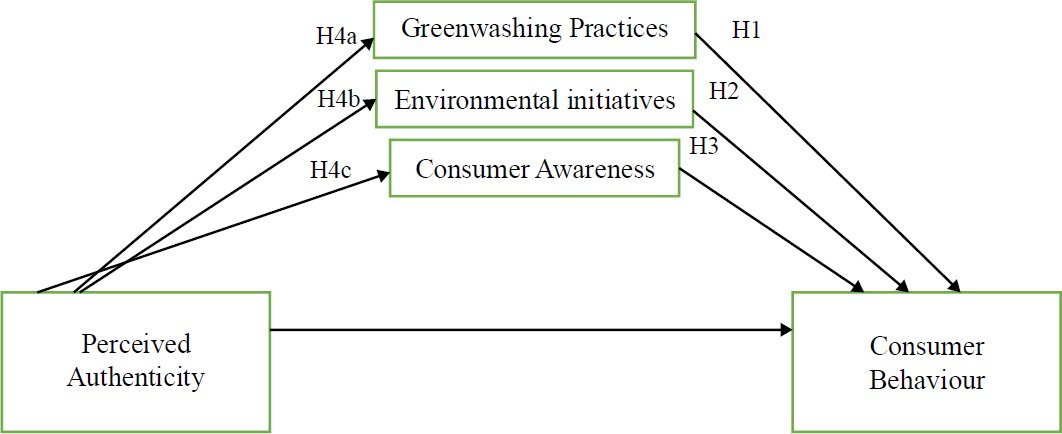
Fig. (1). Conceptual framework
3. METHODOLOGY
This research uses a quantitative design, utilizing structured surveys to investigate the relationship between greenwashing practices and consumer behavior in the U.S. airline sector. The research utilizes a cross-sectional design to obtain data at one point in time to present a snapshot of consumer attitudes and behavior, which is also suggested by (Ghanad, 2023). This research design is helpful in achieving the study’s objectives to identify a cause-and-effect relationship among variables. Eventually, based on the significance or insignificance of the result, hypotheses can be tested.
Following the quantitative research design, the data is collected using primary data collection techniques and a structured questionnaire containing closed-ended questions. The questionnaire is divided into 5 sections: Greenwashing practices (Liu, 2024), Environmental initiatives (Taufique et al., 2016), Consumer Awareness (Han et al., 2020), Consumer behavior (Çabuk et al., 2019), and Perceived authenticity. The items under every construct are measured using a 5-point LIKERT scaling questionnaire from (1) strongly disagree to (5) strongly agree, which is suggested by (Velte, 2023) as well as an effective tool to collect quantifiable data regarding particular research problems, as depicted in Appendix 1. It is significant to specify that the greenwashing scale captures perceptions of consumers of airlines’ environmental communication and promotional claims, instead of objectively confirmed or deliberate environmental deception. An online questionnaire is distributed through email and social media platforms to gather data from as many people as possible. Since the survey instrument includes validated scales from other literature, it maintains content validity and reliability (Montgomery et al., 2024). With a pilot sample of (n = 50) participants, the questionnaire is pre-tested before full-scale data collection to identify and rectify problems related to clarity, length, and design. It used Cronbach’s Alpha, which provides a reliability score above 0.7.
The study aimed at a target population of U.S. consumers who travelled with airlines in the past 3 years, thus giving the data relevance to the current market dynamics. The sample size, considering the research, is deemed to be 385 participants from the U.S. airlines, such as customers and employees. The sample size of the study is computed using the Z-probability formula, which is also suggested by (Ghanad, 2023).
n = (Z^2 * p * (1 – p)) / e^2
Where:
- n = required sample size
- Z = Z-value corresponding to the confidence level
- p = estimated proportion of the population
- e = margin of error
- Z = 1.96 (for a 95% confidence level)
- p = 0.5 (assuming maximum variability)
- e = 0.05
- Substituting the values:
- n = (1.96^2 * 0.5 * (1 – 0.5)) / (0.05^2)
- n = (3.8416 * 0.25) / 0.0025
- n = 0.9604 / 0.0025
- n = 384.16 rounded to 385.
Even though the sample included respondents from varying professional and occupational groups, including students, travel vloggers, and business travelers, the observed impacts are probably motivated by the common exposure to the concept of airline sustainability communication as opposed to occupation-specific interpretations. In the US airline industry, mass marketing is the means of conveying environmental claims so that the informational environments of consumers are rather homogenous. According to the previous study, such as (Guix et al., 2022), individual differences have a weak effect on behavioral response when sustainability information is standardized and of low transparency. The positive effect of greenwashing practices, therefore, can be generalized to a consumer-level heuristic processing mechanism as opposed to fragmented patterns of perception. It helps to justify the strength of findings even in the case of demographic heterogeneity.
In the case of collecting primary data, the problem of selection and non-response bias also arises, which requires mitigation as stated by (Gupta & Singh, 2024). Therefore, to mitigate the issue of selection bias, the respondents were approached at different social media platforms and official tourism-related social media pages of online travel agents (OTA) like Booking.com. Participants with other occupational and ethnic backgrounds and distinct personal characteristics, such as age groups and gender, were approached. This technique allowed us to induct participants from diverse backgrounds, providing a variety of responses. Further, to mitigate the issue of standard method variance (CMV), the technique was applied to examine the occurrence of a significant difference between early (n1 = 30) and late (n2 =30) respondents, where an insignificant difference specified no non-response bias. The sampling was based on a stratified sampling procedure to minimize the sampling bias and provide a proportional representation of the central demographic groups suggested by (Duckett, 2021). The respondents were randomly selected in each of the strata according to age, gender, income level, and geographic region of the US. It allowed for guaranteeing that the diversity of air travelers is accurately represented by the sample throughout the United States, so that the external validity and generalizability are more effective, which is also the major focus of (de Mello, 2024). There is also reduced over-representation of any group; the results of greenwashing perceptions and consumer behavior are not influenced by the imbalance in the demographics.
Structural Equation Modelling (SEM) driven by SMARTPLS software is utilized to analyze the data that is collected. For the ability to model complex relationships and test hypothesized paths within the conceptual framework, this tool was chosen. First, the data go through preliminary analysis, such as descriptive statistics, to give an overview of the sample characteristics and identify missing or unnatural data (Purwanto, 2021). Subsequently, PLS-SEM is conducted to assess direct effects and mediation effects between variables, which was applied in SEM.
In the first step of PLS-SEM, the measurement model in terms of reliability and validity was measured using CFA, which was comprised of Cronbach’s Alpha and Composite Reliability, considering threshold values of 0.7. Further convergent validity was tested using the Average Variance Extracted Method, considering a 0.5 threshold value, which is suggested by Cheung, et al., 2024) as well. Besides, discriminant validity in terms of variables’ separability and conceptual overlapping was examined using the HTMT ratio against 0.85 as the threshold value guided by (Duckett, 2021).
In the last step, path coefficients were analyzed to gauge the direct and indirect relationships between variables in terms of mediation effects. Path coefficients were analyzed for significance in the bootstrapping technique of SmartPLS software, which led to detailed insights related to the strength and direction of associations. Furthermore, non-normal data is a common feature of survey responses, and SMARTPLS allows for this characteristic. The methodology uses rigorous data collection methods coupled with advanced analytical techniques to generate reliable and action-oriented findings that help to illuminate the phenomena of greenwashing and consumer behavior within the airline sector.
Major ethical considerations have also been followed in the study for data collection, which include confidentiality, anonymity, informed consent and withdrawal rights. Informed consent was obtained from the participants using a debrief form and an informed consent form. Identifiable information was not collected from the participants to ensure anonymity and confidentiality. All participants were given withdrawal rights to leave the study at any point in time. Also, aligned with data protection regulations, all the data was stored in access control devices that could be accessed by the author only. Lastly, approval was also obtained from the internal review board (IRB).
4. RESULTS
4.1. Demographic Profile
The statistical results in Table 1 depict the demographic profile of the participants. As per results, it can be observed that, among (n = 385) respondents, (55.32%) are male and (46.68%) are female participants. Among these participants, (18.70%) lies in the age bracket of 18-25 years, (33.25%) 26-35 years, (28.05%) 36-45 years and (20%) 46-55 years. Whereas, with regards to occupation of the participants, (25.97%) were students, (21.30%) were Travel Vloggers, (25.75%) were Corporate Employees, and (27.01%) were Businessmen. Moreover, with regards to travelling frequency with airlines, (19.48%) travel once a month, (32.21%) twice a year, (25.97%) once a year and (22.08%) rarely.
Table 1. Demographic profile analysis.
| Demographic Category | Frequency (n) | Percentage (%) | |
| Gender | Male | 213 | 55.32% |
| Female | 172 | 44.68% | |
| Age Range | 18-25 | 72 | 18.70% |
| 26-35 | 128 | 33.25% | |
| 36-45 | 108 | 28.05% | |
| 46-55 | 77 | 20.00% | |
| Occupation | Students | 100 | 25.97% |
| Travel Vlogger | 82 | 21.30% | |
| Corporate Employee | 99 | 25.75% | |
| Businessmen | 104 | 27.01% | |
| Travelling Frequency | Once a Month | 75 | 19.48% |
| Twice a Year | 124 | 32.21% | |
| Once a year | 100 | 25.97% | |
| Rarely | 85 | 22.08% | |
4.2. Measurement Model Using CFA
The measurement model has been assessed using CFA approaches, where Cronbach’s alpha, composite, and average variance extracted (AVE) were used to test the reliability and validity as well. The results are depicted in Table 2.
Table 2. Measurement model CFA.
| Latent Variables | Indicators | Factor Loadings | Cronbach’s Alpha | Composite Reliability (rho _ a) | Average Variance Extracted (AVE) |
| Consumer Awareness | CA1 | 0.891 | 0.881 | 0.883 | 0.808 |
| CA2 | 0.926 | ||||
| CA3 | 0.879 | ||||
| Consumer Behavior | CB1 | 0.927 | 0.899 | 0.899 | 0.831 |
| CB2 | 0.904 | ||||
| CB3 | 0.863 | ||||
| Environmental Initiatives | EI1 | 0.805 | 0.812 | 0.816 | 0.727 |
| EI2 | 0.897 | ||||
| EI3 | 0.854 | ||||
| Greenwashing Practices | GP1 | 0.880 | 0.852 | 0.854 | 0.772 |
| GP2 | 0.898 | ||||
| GP3 | 0.857 | ||||
| Perceived Authenticity | PA1 | 0.914 | 0.893 | 0.912 | 0.823 |
| PA2 | 0.933 | ||||
| PA3 | 0.874 |
As per the results depicted in Table 2, it can be observed that all constructs surpassed the suggested thresholds of 0.7 for reliability and 0.5 for AVE, which validated robust internal consistency and convergent validity. Factor loadings on all the items showed a range of 0.805 to 0.933, which means that every indicator is reflecting its latent construct. In particular, the robust reliability was demonstrated by Consumer Awareness, Consumer Behavior, Environmental Initiatives, Greenwashing Practices and Perceived Authenticity with the Cronbach alpha ranging between 0.812 and 0.899 and composite reliability between 0.816 and 0.912. The satisfactory convergent validity across constructs was additionally determined with the help of the AVE values that differed between 0.727 and 0.831. In general, the CFA findings support the reliability and validity of the measurement model used and form an effective foundation on which additional structural investigation can be conducted to determine the correlation between greenwashing and consumer behavior within the U.S airline industry.
4.3. Discriminant Validity
Discriminant validity was evaluated with the help of the Heterotrait-Monotrait Ratio (HTMT). The results are depicted in Table 3.
Table 3. Discriminant validity.
| Variable | Consumer Awareness | Consumer Behavior | Environmental Initiatives | Greenwashing Practices |
| Consumer behavior | 0.733 | – | – | – |
| Environmental initiatives | 0.557 | 0.472 | – | – |
| Greenwashing practices | 0.720 | 0.617 | 0.626 | – |
| Perceived authenticity | 0.497 | 0.486 | 0.352 | 0.281 |
As shown in Table 3, all the HTMT values are found to be less than the conservative value of 0.85. This indicates that constructs in a model are distinct and can be conceptually distinguished from one another. The value of the highest HTMT was seen between Consumer Awareness and Consumer Behavior (0.733) and between Consumer Awareness and Greenwashing Practices (0.720), which fell within acceptable limits, meaning that there was no conceptual overlap. In general, the findings confirm that Consumer Awareness, Consumer Behavior, Environmental Initiatives, Greenwashing Practices, and Perceived Authenticity and the terms of the interaction are empirically differentiated to prove the model’s sufficiency and assure that the further structural analysis does not counter issues related to multicollinearity or conceptual redundancy.
4.4. Path Coefficient Analysis
The path analysis results in Table 4 indicates Consumer Awareness has a strong and statistically significant positive impact on Consumer Behavior (β = 0.413; p < 0.000), whereas Greenwashing Practices (β = 0.194; p < 0.001) and Perceived Authenticity (β = 0.177; p < 0.001) also have significant positive effects which proves that awareness and authenticity and perceptions of green marketing practices contribute to consumer behavioral responses. The greenwashing practices have a positive influence on consumer behavior, which can be theoretically explained by taking into account the information environment and consumer cognition of the U.S. airline industry. Greenwashing in this study is the perceived environmental communication that is not objectively proved to be deceptive. With high information asymmetry and high verification costs, as is the case with aviation sustainability, (Bakır, 2023) argues that even weak or symbolic claims to green can be interpreted as a positive signal, as explained by the signaling theory. As also reported by (Kaupa, 2022), most of the U.S. consumers do not possess the technical knowledge to analyze the data on emissions or the effectiveness of offsets and thus take green claims as an indication of effort and not as a gimmick. Also, according to the attribution theory, skepticism is only created when deception is identified. Therefore, the result is low consumer awareness and acceptance of low green marketing, and not acceptance of deceptive behavior.
Table 4. Path coefficient analysis.
| – | Path Coefficients | T-Statistics | P Values |
| Consumer awareness -> Consumer behavior | 0.413*** | 6.683 | 0.000 |
| Environmental initiatives -> Consumer behavior | 0.063 | 1.232 | 0.218 |
| Greenwashing practices -> Consumer behavior | 0.194*** | 3.380 | 0.001 |
| Perceived authenticity -> Consumer behavior | 0.177*** | 3.214 | 0.001 |
| Specific Indirect Effects | |||
| Perceived authenticity -> Consumer awareness -> Consumer behavior | 0.013 | 0.197 | 0.844 |
| Perceived authenticity -> Environmental initiatives -> Consumer behavior | 0.139*** | 2.832 | 0.005 |
| Perceived authenticity -> Greenwashing practices -> Consumer behavior | 0.111 | 1.595 | 0.111 |
Note: *: Significance at 10%; **: Significance at 5%; ***: Significance at 1%
On the other hand, the direct effect of Environmental Initiatives is insignificant (β = 0.063; p < 0.218), implying that they are not predictors of consumer behavior on their own. In terms of mediation, the mediating effect of environmental initiatives was statistically significant through indirect effects (β = 0.139; p < 0.005), showing full mediation since the direct path is insignificant. The rest of the mediating variables, that is, consumer awareness and greenwashing practices, were found to have an insignificant indirect effect between perceived authenticity and consumer behavior, indicating no mediation.
4.5. Model Explanatory Power
The model’s explanatory power is measured by R-square and Adjusted R-squared values, which allow for the analysis of the predictive or explanatory power of predicting variance in the dependent variable by independent variables. The results are depicted in Table 5.
Table 5. Model explanatory power.
| Variable | R-Square | R-Square Adjusted |
| Consumer behavior | 0.510 | 0.502 |
As per results depicted in Table 5, it can be observed that, 0.510, that is 51% variation in consumer behavior, is predicted by greenwashing practices, environmental initiatives, and consumer awareness in the airline sector of the USA.
5. DISCUSSION
The results of this research are helpful in understanding the interaction of greenwashing practice, environmental programs, consumer consciousness, and perceived authenticity to determine consumer behavior in the U.S. airline industry. The findings of the study indicate that H1, which is based on the positive and significant impact of the greenwashing practices on consumer behavior, is substantiated. This observation indicates that consumers in the American airline industry are more sensitive to environmental proclamations, although these claims are not necessarily always fully authentic. Despite the fact that greenwashing has been extensively theorized as a way to undermine trust, the positive outcome, that was witnessed in this study is a possibility that could be explained by the structural characteristics of the airline market in the US. Airlines are in a high degree of consolidation, with little bargaining power by consumers, and sustainability information, however concealed, has served as a heuristic shortcut as opposed to a highly scrutinized assertion. Previously existing studies, such as (Baxter et al., 2024), indicate that when the environmental literacy of consumers is low or when they are overwhelmed by the information, they can have a positive reaction even towards the weak or exaggerated sustainability cues. Carbon-offset programs and long-term promises of being net-zero by 2050 that are actively advertised by major airlines in the U.S. airline setting also often appear to be viewed by consumers as real signs of environmental responsibility despite continued criticism of their practical relevance (Kaupa, 2022). According to a signaling theory perspective, those claims can serve as symbolic green signals to modify consumer decisions in situations of information asymmetry, where the passengers do not have the technical expertise or the interest to check the sustainability performance. Therefore, the fact that what is considered greenwashing in the measurement sense can be viewed by the consumers as genuine green marketing and not deception. In line with this position, (Guix et al., 2022) note that the lack of environmental knowledge and the lack of regulatory transparency promote the acceptance of low sustainability assertions. The beneficial behavioral attitude, therefore, represents consumer ignorance or resignation, rather than approval of the deceptive behaviors. The outcome parallels the results of (de Mello, 2024), who hypothesized that repeated exposure to greenwashing may lead to consumer behavior that is counterintuitive, skeptical, and also has an impact on evaluating green responsibility. Nevertheless, contrary to the research in European and Asian environments, where greenwashing frequently results in consumer rejection and mistrust, such as (Velte, 2023; and Vangeli et al., 2023), consumers in the U.S. are found to give less consideration to greenwashing practices. Such a discrepancy can be explained by the cultural and industrial factors, especially the nature of the U.S. airline industry, which is highly competitive and marketing-focused, and sustainability messages are likely to be accepted as a part of brand differentiation, but not as blatant deception.
H2, which was examined to confirm the effect of environmental initiatives on consumer behavior, is rejected. This finding contradicts some previous studies, including (Bakır, 2023; and Sorsa & Bona-Sánchez, 2024), which identified environmental initiatives as powerful predictors of consumers with environmentally friendly airline preferences, in particular in those markets with sustainable aviation visible as a consumer issue. These findings can also be related to the theory of planned behavior, which postulates that environmental initiatives are required strengthen positive attitudes and intentions towards sustainable airlines. However, the insignificant impact highlights that consumers tend to doubt the credibility or effectiveness of these initiatives, which decreases their impact on perceived behavioral control and subjective norms, which eventually deteriorate pro-ecological purchase intentions. The insignificant impact could be explained, however, in the U.S. context by the skepticism of consumers and a low level of disclosed sustainability, which is suggested by (Sinisalo, 2020) as well. Several American airlines advertise carbon offset and biofuel investment, which seem distant or unreachable to the general consumer. The capital-intensive and regulation-heavy nature of the airline industry is also a limiting factor to visible environmental improvement in the context, curtailing consumer interaction and behavioral modification regardless of their awareness of such activity, as reflected by (Sim & Kim, 2024) as well.
H3, which states that there is a significant impact of consumer awareness on consumer behavior, is accepted. This result confirms the previous studies by (Rosario, 2024; and Sanguinetti & Amenta, 2022) that stated the importance of environmental consciousness in determining responsible travel behavior. Nevertheless, the U.S. findings demonstrate a subtle sphere of consciousness because consumers are morally concerned with environmental problems but tend to make their airline choices based on convenience, prices, and reliability of services rather than ecology. This is an indication of the lack of breadth of green alternatives in the U.S. aviation market, as opposed to the regions such as Scandinavia, highlighted by (Purwanto, 2021), where sustainability is more of a policy and consumer-culture imprint.
H4, related to the mediating effect of consumer awareness, environmental initiative, and greenwashing behavior between perceived authenticity and consumer behavior, provides inconsistent findings, where only H4b is accepted. There is full mediation of environmental initiative between perceived authenticity and consumer behavior. This implies that environmental programs have greater effects on consumer behavior when observed as authentic, and exaggerated or ambiguous assertions have a lesser effect on the passengers of the U.S. airline industry. The result aligns with the ideas presented by (Olk, 2021; and Papagiannakis et al., 2024), who concluded that authenticity is a credibility filter that affects consumers in their perception of corporate environmental claims. Nonetheless, the relationships between the greenwashing practices and consumer awareness are not mitigated by the aspect of authenticity, meaning that consumers in the U.S. already have existing perceptions of these constructs regardless of the perceived authenticity.
The discovery of the full mediation signifies that the Environmental Initiatives is a suppressor variable with indirect effects being the opposite of the direct relationship between Perceived Authenticity and Consumer Behavior. In theory, this implies that in cases where consumers believe airline efforts to be authentic, authenticity has a direct positive effect on positive behavioral outcomes, but that in cases where these efforts are considered discrete cues, they can indeed have a counterproductive effect of generating skepticism or attributional questioning. According to (Elshaer et al., 2025), sustainability activities create consumer distrust when they seem to be implemented as strategies instead of as value-based efforts. In the airline industry of the US, where carbon-footprint printing and zero-emission policies and promises have consistently been criticized, these initiatives can undermine the lasting impact of perceived authenticity by reminding consumers of the controversies in the industry, and thus acting as a suppressor. This counter trend conforms to Attribution Theory, which, according to (He et al., 2023), suggests that consumers discount positive information when motives are perceived as self-interested. As a result, the full mediation demonstrates that Environmental Initiatives make the process in which the authenticity influences consumer behavioral responses more difficult instead of smoothing them.
CONCLUSION
The study finds that the consumer behavior in the U.S. airline industry is determined by perception and awareness, rather than the mere existence of environmental initiatives. However, greenwashing practices are found to significantly impact consumer behavior in the U.S. airline industry. Effective environmental programs are not adequate to provoke behavioral change until they are communicated in a transparent and genuine manner. The most powerful driver is consumer awareness, but its influence is limited by the industrial reality, including the lack of sustainable travel alternatives. The mediating effect of authenticity underlines the trust, rather than information, as the determinant of behavioral consequences. Also, authentic, verifiable environmental commitment as opposed to performative marketing tends to determine competitive advantage in a more environmentally conscious airline market in terms of positive consumer behavior and consumer purchase intention eventually.
The study depicts that Greenwashing Practices, Consumer Awareness, and Perceived Authenticity substantially form consumer behavior in the U.S. airline sector; at the same time, Environmental Initiatives alone are inadequate to drive consumer behavior. Results indicate that perceived authenticity plays a critical role as a mediator of consumer response and behavior, and that trust and credibility, and not just sustainability messages, are the driving force of consumer behavior. The findings underline the relevance of clear and verifiable environmental policies, provide a theoretical basis and practical solutions to airlines, and policy recommendations to regulators to increase consumer confidence.
LIMITATIONS AND FUTURE DIRECTIONS
This study is limited by its focus on the U.S. airline sector; hence, its results are not generalized to other industries and regions with varying regulatory and cultural conditions. Causal inference is also hampered by the cross-sectional design, and self-reported data could be influenced by the social desirability bias. Future studies ought to use a longitudinal or experimental design to investigate changes in behaviors over time with the aim of confirming causal mechanisms. Regional airline comparative analyses might identify contextual differences, whereas qualitative research could enhance knowledge on the effect of authenticity and consumer trust on responses to corporate environmental communication and initiatives.
POLICY IMPLICATIONS
The implications produced by the findings are essential to regulators and industry practitioners. Regulators need to make sure that environmental claims are clear and provable to reduce greenwashing and increase consumer confidence. Accountability in the U.S. airline industry can be enhanced by having clear disclosure standards and external audits on these standards. For the practitioners and regulators of the U.S. aviation sector, the findings reveal that sustainability communication should be based on authenticity and credibility. Airlines are to no longer pursue merely the symbolic measures but to incorporate the real environmental performance into the actual business and branding messages. Long-term positive consumer behavior can be achieved through investment in open communication, quantifiable results of sustainability, and educating customers on the value of sustainable practices, positioning brands above their competitors, and aligning industry trends with the changing expectations of customers towards sustainability.
LIST OF ABBREVIATIONS
| AVE | = | Average Variance Extracted |
| OTA | = | Online Travel Agent |
| SMV | = | Standard Method Variance |
| SEM | = | Structural Equation Modelling |
AUTHOR’S CONTRIBUTION
G.M.T. contributed to the design and implementation of the study, contributed to the analysis of the results and the writing of the manuscript.
ETHICAL APPROVAL & INFORMED CONSENT
Major ethical considerations have also been followed in the study for data collection, which include confidentiality, anonymity, informed consent and withdrawal rights. Informed consent was obtained from the participants using a debrief form and an informed consent form. Identifiable information was not collected from the participants to ensure anonymity and confidentiality. All participants were given withdrawal rights to leave the study at any point in time. Also, aligned with data protection regulations, all the data was stored in access control devices that could be accessed by the author only. Lastly, approval was also obtained from the internal review board (IRB).
AVAILABILITY OF DATA AND MATERIALS
The data will be made available on reasonable request by contacting the corresponding author [G.M.T].
FUNDING
None.
CONFLICT OF INTEREST
The author declares no conflicts of interest.
ACKNOWLEDGEMENTS
Declared none.
APPENDICES
Appendix 1: Questionnaire
| Sr.No | Variables | Strongly Agree | Agree | Neutral | Disagree | Strongly Disagree |
| Greenwashing practices Adapted from (Liu, 2024) | 1 | 2 | 3 | 4 | 5 | |
| 1 | How far do you agree that you have loss trust on airlines due to their greenwashing activities? | |||||
| 2 | How far do you agree that the airlines use social media marketing for greenwashing? | |||||
| 3 | There is not a trace of how the airlines set up the environmental initiatives. | |||||
| Environmental initiatives. Adapted from (Taufique et al., 2016) | 1 | 2 | 3 | 4 | 5 | |
| 4 | When there is a choice, I always choose the airlines that contributes to the least amount of pollution. | |||||
| 5 | I strongly support that more environmental protection works are needed by US airlines. | |||||
| 6 | I perceive airlines’ brand positively when they have environmental initiatives. | |||||
| Consumer Awareness. Adapted from: (Han et al., 2020) | 1 | 2 | 3 | 4 | 5 | |
| 7 | I know greenwashing in the airline industry exists. | |||||
| 8 | I choose airlines that I am aware of environmental issues and that this airline does business in a manner that is consistent with protecting the environment | |||||
| 9 | Before booking my flight, I read up on airline environmental claims. | |||||
| Consumer behavior Adapted from (Çabuk et al., 2019) | 1 | 2 | 3 | 4 | 5 | |
| 10 | I intend to buy tickets from eco-friendly airlines next time because of them positive contribution to the environment. | 5 | ||||
| 11 | I chose to buy tickets from green airlines because of their environmental benefits. | |||||
| 12 | My decision to recommend an airline to somebody else is affected by environmental claims. | |||||
| Perceived authenticity | 1 | 2 | 3 | 4 | 5 | |
| 13 | Airlines are believable on the environment. | |||||
| 14 | Before I use them, I ensure airlines’ environmental claims are verified. | |||||
| 15 | When it comes to airline choice my trust is impacted by an airline’s authentic sustainability claims. |
REFERENCES
Abadie, A., Chowdhury, S., Mangla, S. K., & Malik, S. (2024). Impact of carbon offset perceptions on greenwashing: Revealing intentions and strategies through an experimental approach. Industrial Marketing Management, 117, 304-320. https://doi.org/10.1016/j.indmarman.2024.01.001.
Alizadeh, L., Liscio, M. C., & Sospiro, P. (2024). The phenomenon of greenwashing in the fashion industry: A conceptual framework. Sustainable Chemistry and Pharmacy, 37, 101416. https://doi.org/10.1016/j.scp.2023.101416.
Avirutha, A., & Sittisook, B. (2025). Consumer Awareness of Green Aviation and Its Influence on Airline Choice Behavior. Ramkhamhaeng International Journal of Science and Technology, 8(2), 23-31. https://ph02.tci-thaijo.org/index.php/RIST/article/view/260831/172688.
Bakir, M. (2023). The influence of environmental knowledge on green purchase intention in the air travel industry: The mediating role of green attitude. International Journal of Sustainable Aviation, 9(4), 371-388. https://doi.org/10.1504/IJSA.2023.10054766.
Baxter, K., Ghandour., R. & Histon,. W., (2024). Greenwashing and brand perception-a consumer sentiment analysis on organisations accused of greenwashing. International Journal of Internet Marketing and Advertising, 21(1-2), pp. 149-179. https://doi.org/10.1504/IJIMA.2023.10060121.
Bläse, R., Filser, M., Kraus, S., Puumalainen, K., & Moog, P. (2024). Non‐sustainable buying behavior: How the fear of missing out drives purchase intentions in the fast fashion industry. Business Strategy and The Environment, 33(2), 626-641. https://doi.org/10.1002/bse.3509.
Çabuk, S., Güreş, N., İnan, H., & Arslan, S. (2019). A survey on the attitudes of passengers towards Green Airlines.Yaşar Üniversitesi E-Dergisi, 14(55), 237-250. https://dergipark.org.tr/tr/pub/ppad/issue/90272/1504357.
Cheung, G. W., Cooper-Thomas, H. D., Lau, R. S., & Wang, L. C. (2024). Reporting reliability, convergent and discriminant validity with structural equation modeling: A review and best-practice recommendations. Asia Pacific Journal of Management, 41(2), 745-783. https://doi.org/10.1007/s10490-023-09871-y.
de Mello, (2024). Voluntary carbon offset programs in aviation: A systematic literature review. Transport Policy. https://doi.org/10.1016/j.tranpol.2023.12.023.
Duckett, L. J. (2021). Quantitative research excellence: Study design and reliable and valid measurement of variables. Journal of Human Lactation, 37(3), 456-463. https://doi.org/10.1177/08903344211019285.
Elshaer, I. A., Azazz, A. M., Fayyad, S., Aljoghaiman, A., Fathy, E. A., & Fouad, A. M. (2025). From asymmetry to satisfaction: The dynamic role of perceived value and trust to boost customer satisfaction in the tourism industry. Tourism and Hospitality, 6(2), 68. https://doi.org/10.3390/tourhosp6020068.
Galhoz, I., Ramos, R. F., & Biscaia, R. (2024). Airline environmental sustainability actions and CSR impact on customer behavior. Research in Transportation Business & Management, 53, 101111. https://doi.org/10.1016/j.rtbm.2024.101111.
Ghanad, A. (2023). An overview of quantitative research methods. International Journal of Multidisciplinary Research and Analysis, 6(08), 3794-3803. https://doi.org/10.47191/ijmra/v6-i8-52.
Guix, M., Ollé, C. & Font, X., (2022). Trustworthy or misleading communication of voluntary carbon offsets in the aviation industry. Tourism Management, 88, 104430. https://doi.org/10.1016/j.tourman.2021.104430.
Han, H., Al-Ansi, A., Chi, X., Baek, H., & Lee, K. S. (2020). Impact of environmental CSR, service quality, emotional attachment, and price perception on word-of-mouth for full-service airlines. Sustainability, 12(10), 3974. https://doi.org/10.3390/su12103974.
Hartmann, P., Marcos, A., Castro, J., & Apaolaza, V. (2023). Perspectives: Advertising and climate change–Part of the problem or part of the solution? International Journal of Advertising, 42(2), 430-457. https://doi.org/10.1080/02650487.2022.2140963.
He, M., Blye, C. J., & Halpenny, E. (2023). Impacts of environmental communication on pro-environmental intentions and behaviours: a systematic review on nature-based tourism context. Journal of Sustainable Tourism, 31(8), 1921-1943. https://doi.org/10.1080/09669582.2022.2095392.
Hesse, A., & Rünz, S. (2022). ‘Fly Responsibly’: a case study on consumer perceptions of a green demarketing campaign. Journal of Marketing Communications, 28(3), 232-252. https://doi.org/10.1080/13527266.2020.1842483.
Kaupa, C. (2022). Peddling False Solutions to Worried Consumers: The Promotion of Greenhouse Gas” Offsetting” as a Misleading Commercial Practice. J. Eur. Consumer & Mkt. L., 11, 139. http://dx.doi.org/10.2139/ssrn.4157810.
Korba, P., Sekelová, I., Koščáková, M., & Behúnová, A. (2023). Passengers’ knowledge and attitudes toward green initiatives in aviation. Sustainability, 15(7), 6187. https://doi.org/10.3390/su15076187.
Gupta, K., & Singh, N. (2024). A Systematic Review of Literature on Greenwashing Contemporary Studies in Economic and Financial Analysis, in: Sustainability Development through Green Economics, 114, 75-90. DOI: https://doi.org/10.1108/S1569-375920240000114005.
Kwon, K., Lee, J., Wang, C., & Diwanji, V. S. (2024). From green advertising to greenwashing: Content analysis of global corporations’ green advertising on social media. International Journal of Advertising, 43(1), 97-124. https://doi.org/10.1080/02650487.2023.2208489.
Leal, W., Ng, A. W., Sharifi, A., Janová, J., Özuyar, P. G., Hemani, C., … & Rampasso, I. (2023). Global tourism, climate change and energy sustainability: assessing carbon reduction mitigating measures from the aviation industry. Sustainability Science, 18(2), 983-996. https://doi.org/10.1007/s11625-022-01207-x.
Liu, G. (2024). Deceptive Sustainability: Analysing the Impact of Greenwashing on Consumer Behavior in Social Media Marketing–Case study of the Fast Fashion Industry of China. Pakistan Journal of Life & Social Sciences, 22(2). https://doi.org/10.57239/PJLSS-2024-22.2.00933.
Montgomery, A. W., Lyon, T. P., & Barg, J. (2024). No end in sight? A greenwash review and research agenda. Organization & Environment, 37(2), 221-256. https://doi.org/10.1177/10860266231168905.
Mosteller, M. & Deale, C., (2024). The Google Flights Emissions Calculation: Is It Green or Greenwashing? Journal of Hospitality & Tourism Cases, p. 21649987241282673. https://doi.org/10.1177/21649987241282673.
Mr, T. H. H., & O’Connell, J. F. (2024). Examining Air Travellers’ Willingness to Pay for Non-voluntary Environment-related Fees: The Case of SAF Surcharge and Carbon Taxes. Highlights of Sustainability, 3(31), 61. https://doi.org/10.54175/hsustain3010005.
Neureiter, A., & Matthes, J. (2023). Comparing the effects of greenwashing claims in environmental airline advertising: perceived greenwashing, brand evaluation, and flight shame. International Journal of Advertising, 42(3), 461-487. https://doi.org/10.1080/02650487.2022.2076510.
Oates, C. J. (2020). Sustainability marketing: Products, fairtrade, and greenwashing. The SAGE Handbook of Marketing Ethics, 226-238. https://doi.org/10.4135/9781529739725.n16.
Olk, S. (2021). The effect of self-congruence on perceived green claims’ authenticity and perceived greenwashing: the case of EasyJet’s CO2 promise. Journal of Nonprofit & Public Sector Marketing, 33(2), 114-131. https://doi.org/10.1080/10495142.2020.1798859.
Papagiannakis, G. E., Vlachos, P. A., Koritos, C. D., & Kassinis, G. I. (2024). Are publicly traded tourism and hospitality providers greenwashing? Tourism Management, 103, 104893. https://doi.org/10.1016/j.tourman.2024.104893.
Patino-Artaza, H., & Suau-Sanchez, P. (2025). What drives passengers toward sustainable aviation? A segmentation study of travel behavior and environmental concern in Spain.Case Studies on Transport Policy, 101539. https://doi.org/10.1016/j.cstp.2025.101539.
Purwanto, A., (2021). Education research quantitative analysis for little respondents: comparing of Lisrel, Tetrad, GSCA, Amos, SmartPLS, WarpPLS, and SPSS. Jurnal Studi Guru Dan Pembelajaran, 2(4). https://doi.org/10.30605/jsgp.4.2.2021.1326.
Rosario, M. (2024). Assessing the efficacy of EU greenwashing directive: A study of European airlines’ voluntary carbon offset programs. Journal of the Air Transport Research Society, 3, 100028. https://doi.org/10.1016/j.jatrs.2024.100028.
Sanguinetti, A., & Amenta, N. (2022). Nudging consumers toward greener air travel by adding carbon to the equation in online flight search. Transportation Research Record, 2676(2), 788-799. https://doi.org/10.1177/03611981211046924.
Sim, M., & Kim, H. (2025). Measurement validation of a consumer-driven environmental, social, and governance (ESG) index for the airline industry. Journal of Sustainable Tourism, 33(3), 474-499. https://doi.org/10.1080/09669582.2024.2351179.
Sinisalo, C., (2020). Effect of greenwashing on brand image and buying behavior in fast fashion: a consumer perspective. Haaga-Helia. Available from: https://www.theseus.fi/bitstream/handle/10024/347178/Sinisalo_Camilla.pdf?sequence=2.
Sorsa, K. & Bona-Sánchez, C., (2024). Corporate Social Responsibility Trends in the Airline Industry: A Bibliometric Analysis. Sustainability, 16(7), p. 2709. https://doi.org/10.3390/su16072709.
Taufique, K. M. R., Siwar, C., Chamhuri, N., & Sarah, F. H. (2016). Integrating general environmental knowledge and eco-label knowledge in understanding ecologically conscious consumer behavior. Procedia Economics and Finance, 37, 39-45. https://doi.org/10.1016/S2212-5671(16)30090-9.
Vangeli, A., Małecka, A., Mitręga, M., & Pfajfar, G. (2023). From greenwashing to green B2B marketing: A systematic literature review. Industrial Marketing Management, 115, 281-299. https://doi.org/10.1016/j.indmarman.2023.10.002.
Velte, P. (2023). Determinants and consequences of corporate social responsibility decoupling—Status quo and limitations of recent empirical quantitative research. Corporate Social Responsibility and Environmental Management, 30(6), 2695-2717. 2695-2717. https://doi.org/10.1002/csr.2538.
Licensed
© 2026 Copyright by the Authors.
Licensed as an open access article using a CC BY 4.0 license.
Article Contents Author Felicia Gabriela Beresescu1, * 1College of Business-Al Khobar, Al Yamamah University, Saudi Arabia Article History: Received: 21
Article Contents Authors Saman Ismail1, * Imran Iqbal2 1Faculty of Management Science, Department of Business Administration, Salim Habib University, Karachi,
Article Contents Author Michael Dolinsky1, * 1Faculty of Mathematics and Technologies of Programming, Francisk Skorina Gomel State University,
Article Contents Author Abdul Ghafoor Memon1, * 1Emaan Institute of Management Sciences, Karachi, Pakistan Article History: Received: 01 April, 2026
Article Contents Authors Zixuan Zhao1, Ju Guo1, * 1School of Management, Chengdu University of Information Technology, Chengdu, China Article History:
Article Contents Authors Sultan Ud Din Yousufzai1, Amtyaz Safi2, * , Maher Khan1, Zia Ud Din1 1Department of Zoology, Govt.