









Article Contents
Article ID: CM2601103004
Views: 22Transitioning from Traditional to Green Catalysts: A Systematic Review of Sustainable Catalysis in Industrial Chemistry
 PDF
PDF
⬇ Downloads: 1
1Sohar University, Sohar, Oman
Received: 13 June, 2026
Accepted: 09 August, 2026
Revised: 04 August, 2026
Published: 11 September, 2026
Abstract:
Introduction: Most of the world’s chemical production relies on industrial catalysis; however, traditional catalytic systems produce toxic waste on a scale that is no longer compatible with sustainability goals. This systematic review assesses the performance, scalability, and barriers to the adoption of four families of green catalysts: biocatalysts, heterogeneous nanocatalysts, Metal-Organic Frameworks (MOFs), and photocatalytic systems, and identifies the evidence gaps that are most significant in hindering their industrial adoption.
Methodology: A systematic search was performed using the PRISMA 2020 framework, and the Scopus database was searched from 2015 to 2024, resulting in 47 studies that were included after two-stage independent screening and underwent quality-weighted thematic synthesis. Review-of-review sources (n = 14) were only used for contextual framing; all quantitative claims were based on the 33 primary experimental studies. A formal quality weighting scheme (H = 1.0; M = 0.5; L = 0.0) was used, and a sensitivity analysis was performed using only high-quality studies, which confirmed the directionality of all headline findings. The inter-rater agreement for screening was high (Cohen’s kappa = 0.84 at Stage 1 and 0.89 at Stage 2). The data extraction agreement was 91% (percentage agreement).
Results: All four catalyst families consistently outperformed conventional processes in terms of waste reduction, selectivity, and energy efficiency. Biocatalysts showed the strongest industrial maturity (TRL 7–9) in pharmaceutical applications, while MOFs and photocatalytic systems remained at TRL 2–5 with no pilot-scale validation reported. The central finding is that superior reaction-level performance alone does not drive industrialisation. The most critical barrier is the near-absence of integrated techno-economic and lifecycle evidence: only 19.1% of the included studies reported TEA alongside LCA.
Conclusion: The single-database search is acknowledged as a limitation of this study.
Keywords: Green catalysts, transition, sustainable catalysts, industrial chemistry, traditional chemicals, systematic review.
1. INTRODUCTION
Catalysis is the driving force of modern chemistry. Approximately 85–90% of all chemical production processes rely on catalytic reactions [1], and the sectors underpinned by that platform, from bulk petrochemicals to precision pharmaceutical synthesis, have benefited enormously from a century of catalyst development. However, this development has proceeded largely at the cost of environmental impact, which is no longer sustainable. The workhorse catalysts currently in use, such as transition metal halides, stoichiometric inorganic oxidants, and halogenated Bronsted acids, produce chemical waste streams that are not compatible with the regulatory and ethical requirements of the 21st century. This tension is most pronounced in the pharmaceutical sector, where 25–100 kg waste is typical per kg of Active Pharmaceutical Ingredient (API), compared with 1–5 kg waste per kg of bulk chemical [2].
Anastas and Warner [3] set out a conceptual framework for addressing this tension in their 12 principles of green chemistry, which put catalysis – the use of catalytic amounts of reagents instead of stoichiometric amounts – at the core of a sustainability transformation agenda. In the past 30 years, four other catalytic platforms have been developed: enzymes and whole-cell biocatalysts, which harness the exquisite selectivity evolved by nature; heterogeneous nanocatalysts, which combine nanoscale surface chemistry with convenient recyclability; porous Metal-Organic Frameworks (MOFs), which offer programmable confinement environments for substrate-selective catalysis; and photocatalytic systems, which use light energy to power reactions that normally require significant thermal activation.
The four platforms have shown promising laboratory- or pilot-scale performance. Biocatalysis has been used in commercial pharmaceutical production, most prominently in the enzymatic synthesis of sitagliptin and nemtabrutinib [4]. Heterogeneous nanocatalysts have been used in cross-coupling and hydrogenation processes. MOFs have achieved laboratory selectivities comparable to those of enzymatic systems in certain transformations. Photocatalysis enables C–C bond formation at ambient temperatures, which is inaccessible via conventional thermal catalysis. However, complete industrialisation remains patchy, slow, and unevenly distributed across sectors.
Previous reviews have examined individual catalyst families or surveyed green catalysis broadly [1, 5]. Overall, only a limited amount of existing research has been directed towards either the development of catalysts, the performance of reactions, or various classes of catalysts, and these provide good insights into the chemical efficiency of developing catalytic systems. Technological maturity, scalability, economic viability, life cycle impacts, and operational constraints must all be considered for industrial use. This study, unlike previous reviews which primarily focused on green chemistry metrics, systematically compares four major green catalyst families with a common Technology Readiness Level (TRL)-based framework, assesses the availability of techno-economic and lifecycle evidence, and pinpoints the structural evidence gaps needed to push translation from successful laboratory results to an industrial scale. These prior syntheses are used here only for contextual framing; they do not contribute primary evidence to this review’s thematic synthesis. The present review provides three capabilities that the aforementioned studies do not provide in combination: (i) a structured Technology Readiness Level (TRL) mapping of all four catalyst families under a consistent European Commission scale; (ii) an explicit analytical bridge between reaction-level green chemistry metrics and system-level sustainability frameworks; and (iii) a cross-family diagnosis of the TEA and LCA gap as the primary structural barrier to industrial adoption, with a prioritised research agenda. This review aims to (i) provide a landscape of the publications by catalyst type, industrial sector, and country of origin; (ii) synthesise comparative quantitative evidence for the E-factor, atom economy, TOF, recyclability, and lifecycle environmental impact for all four families; (iii) characterise the technical, regulatory, and supply chain barriers that explain why better performance has not led to faster adoption; and (iv) propose a prioritised research agenda to address the most critical evidence gaps.
1.1. The Concept of Green Catalysis and Its Relationship with Sustainable Catalysis
The terms “green catalysis” and “sustainable catalysis” are often used in the literature interchangeably, but they reflect different levels of analysis and “green catalysis” is not synonymous with “sustainable catalysis”. This review considers these concepts as related but non-equivalent (Table 1).
Table 1. Conceptual distinction between green catalysis and sustainable catalysis.
| Concept | Primary Scope | Representative Metrics |
| Green Catalysis | Reaction-level efficiency: minimizing waste, reagent use, and energy input within a single chemical step | E-factor, atom economy, PMI, yield, selectivity, TOF |
| Sustainable Catalysis | System-level sustainability: encompassing the full catalyst value chain, product lifecycle, supply security, and socio-economic context | LCA, TEA, cumulative energy demand, GWP, material criticality, end-of-life recovery |
Note: Most primary studies in this review reported green catalysis metrics (reaction level). Full evidence of sustainable catalysis (system-level LCA/TEA) was available in only nine of the 47 included studies (19.1%). The claims of “sustainability” throughout this paper are qualified accordingly. A catalyst that substantially reduces waste in a reaction step may still present an adverse sustainability profile when the supply chain of its precursors, manufacturing energy demand, and end-of-life fate are considered.
1.2. Technology Readiness Level (TRL) Framework
TRL assignments were identified using pre-established evidence criteria instead of general assumptions about the level of commercial maturity. Only studies that showed evidence of pilot-scale validation, continuous operation, integration of the industrial process, or commercial application allowed higher TRL values for the catalyst family. Any proof of concept developed from the laboratory-scale demonstration without scale-up was categorised under the lower TRL category. TRL assessments are based on the evidence reported in the publications included and were evaluated independently; therefore, they indicate the technological maturity of the technology as presented in the evidence but not the commercial status of the technology. Assignments followed the nine-level European Commission scale European Commission [6], as defined in Table 2. All TRL assignments in this review are grounded in the evidence base of the included studies and do not constitute statements of commercial status beyond what the cited work demonstrates.
Table 2. TRL definitions applied in this review (european commission scale).
| TRL | Description | Typical Evidence |
| 1–2 | Basic principles / technology concept | Laboratory observations; proof-of-concept; computational predictions |
| 3–4 | Experimental proof of concept / validation | Bench-scale experiments with quantitative performance metrics; comparative studies |
| 5–6 | Technology demonstrated in relevant environment | Pilot-scale (1–100 L) validation; initial TEA; scale-up studies |
| 7–8 | System prototype / complete and qualified | Pre-commercial or first-commercial demonstration; GMP-validated processes |
| 9 | Actual system proven in operational environment | Commercial-scale deployment; multi-plant adoption |
Source: [6]. Horizon Europe Technology Readiness Levels.
2. METHODS
2.1. Research Design
This study was designed as a Systematic Literature Review (SLR) using thematic synthesis [7]. An SLR was chosen over a narrative review because of the explicit and reproducible search and screening processes, which help reduce selection and reporting bias. A formal statistical meta-analysis was not conducted because the evidence base is heterogeneous in terms of reaction type, catalyst class, and performance measure; therefore, the evidence could not be statistically pooled in a meaningful way. Instead, thematic synthesis was used, as outlined by [8]. An evidence-mapping component was added to contextualise the main findings within the commercialisation and regulatory environment. This design can thus be described as a PRISMA-compliant SLR with thematic narrative synthesis and evidence mapping, with a clear and methodologically justified implementation of each component.
2.2. Literature Search Strategy
Only Scopus (Elsevier) was used for the systematic electronic search of literature. Scopus was chosen as the primary database because of its methodological reproducibility and comprehensive coverage of a wide range of disciplines. Chemistry, chemical engineering, materials science, and environmental science are the main disciplines relevant to sustainable catalysis and are covered by a large percentage of publications in Scopus. The results must be viewed in light of the specific database assessed, and future versions of this review should include other databases to further minimise selection bias. One drawback of single-database searching is acknowledged in limitations section of this paper. The choice of Scopus was based on three criteria: it covers a broad spectrum of peer-reviewed literature in the fields of chemistry, chemical engineering, and environmental science; it offers a Boolean search; and it provides the benefit of a reproducible search by consistently documenting the search against one curated index. Others who wish to repeat or expand this work are encouraged to use the Web of Science and Chemical Abstracts/SciFinder. The complete Boolean search string, subject area filters, and search date are presented in Appendix B (Table B1). The search was conducted in the TITLE-ABS-KEY field on 15 January 2025 from January 2015 to December 2024, and was limited to English journal articles. Conference abstracts, book chapters, grey literature, editorials, and opinion pieces were not included in the primary synthesis but were included as contextual sources only if selected as high-quality reviews or policy documents. Highly cited publications in green catalysis and chemistry texts related to industrial catalysis research were used to identify the initial search terms, which were then used in previous systematic reviews. A set of known publications from each family of catalysts was used to test the preliminary search to determine the ability to retrieve. Following this, a few more synonyms were added, namely biocatalysis, single-atom catalysts, metal-organic frameworks, heterogeneous catalysts, and photocatalysis. This validation was repeated iteratively to ensure a good representation of the large categories of catalysts and the most common variations in terms of both catalyst and terminology [9].
2.3. Inclusion and Exclusion Criteria
Studies were selected if they: (i) reported original experimental or simulation data on one or more of the four families of green catalysts; (ii) compared the performance of a green catalyst with a conventional catalytic or stoichiometric reference using at least one quantitative sustainability metric (E-factor, atom economy, TOF, TON, yield, selectivity, recyclability cycles, or LCA indicator); and (iii) addressed a reaction type relevant to pharmaceutical synthesis, fine chemical production, polymer chemistry, petroleum refining or agrochemical synthesis. Studies were excluded if: (a) no experimental validation was provided; (b) criteria that were recognised to introduce systematic bias in favour of already successful catalyst systems limitations section; or no performance metrics were provided relative to a comparator.
2.4. The Screening Process and PRISMA Flow are also included
Screening was conducted in two stages according to the PRISMA standards. All 412 duplicated records were screened by two independent reviewers in Stage 1 based on the title, abstract, and pre-specified inclusion criteria. Any disagreements were settled by consensus discussion, and a pre-agreed third-reviewer arbitration protocol was offered in case of disagreements, although it was not mandatory. The full-text eligibility of all 189 records that passed stage 1 was assessed by the same two reviewers in stage 2. Records for which the full text was not available were excluded and noted. The entire PRISMA flow is shown in Fig. (1) and Table 3. There was a high interrater agreement for screening at both stages: Cohen’s κ = 0.84 (Stage 1, title/abstract) and κ = 0.89 (Stage 2, full-text eligibility), both of which are considered strong per [10]. These κ values are for screening only, and data extraction reliability is reported separately in Section 2.5.
Table 3. PRISMA 2020 record flow detailed.
| Stage | Action | Records (n) |
| Identification | Total records retrieved from Scopus | 487 |
| Identification | Duplicates removed | 75 |
| Identification | Records after deduplication | 412 |
| Stage 1 Title/Abstract | Excluded out of scope | 223 |
| Stage 1Title/Abstract | Retained for full-text review | 189 |
| Stage 2 Full-text | Excluded no comparative sustainability metrics | 62 |
| Stage 2 Full-text | Excluded non-industrial context | 51 |
| Stage 2 Full-text | Excluded full text unavailable | 29 |
| Included | Studies in final synthesis | 47 |
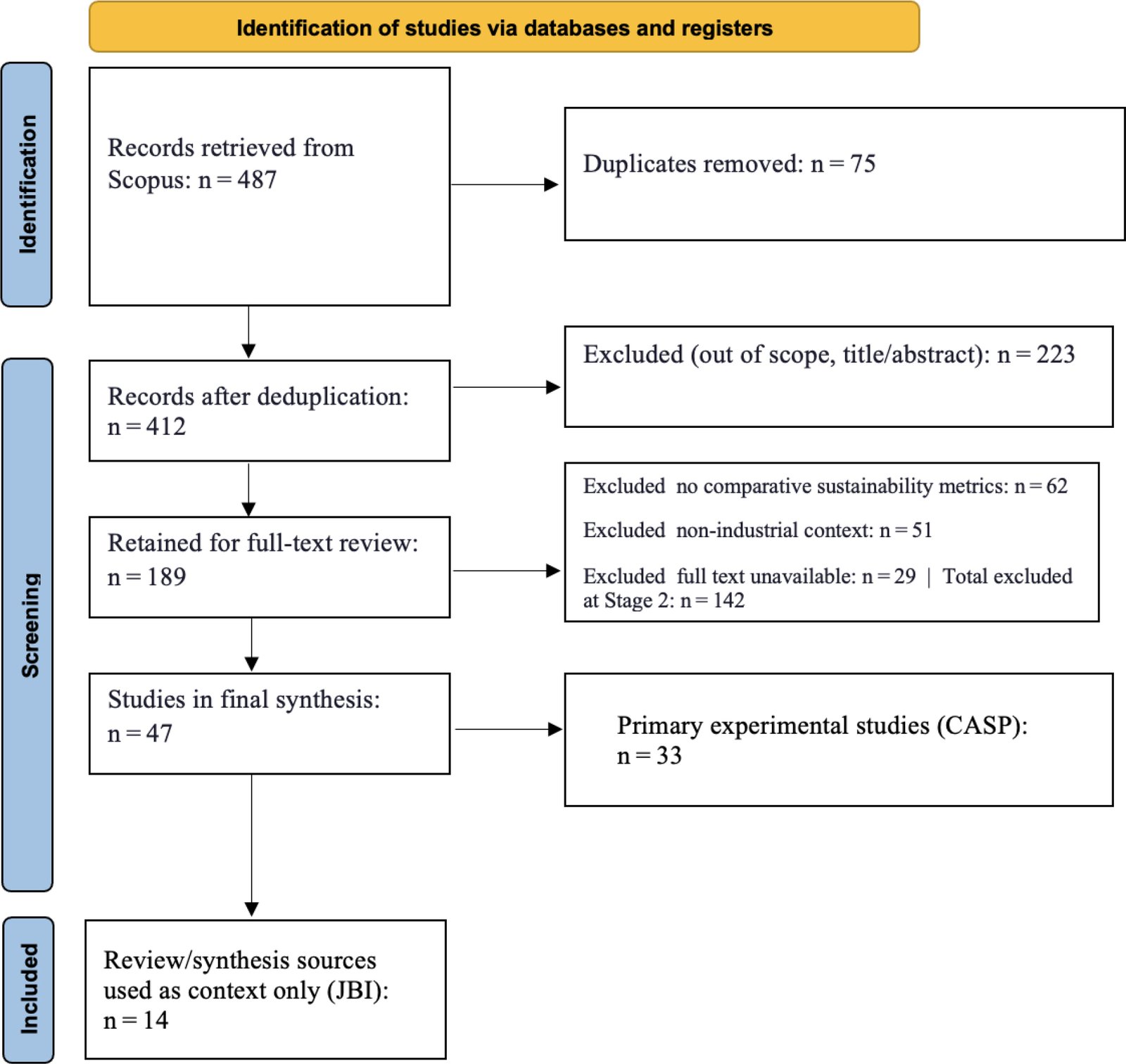
Fig. (1). PRISMA 2020 flow diagram: screening, eligibility, and inclusion.
2.5. Data Extraction
A data extraction template was created a priori, piloted on five randomly selected studies, and applied to all 47 records. The following variables were extracted: authors and year, country, industrial sector, catalyst type and subclass, reaction type, comparator catalyst, quantitative performance measures (yield, selectivity, TOF, TON, E-factor, atom economy, recyclability cycles, activity retention, and LCA indicators), TRL assignment, and study conclusions. Data were extracted independently by two reviewers, with arbitration by a third reviewer if necessary.
Inter-rater reliability was calculated for screening and data extraction. Cohen’s kappa was computed for a 20% random subsample for screening: κ = 0.84 (Stage 1: title/abstract screening) and κ = 0.89 (Stage 2: full-text eligibility screening), both of which indicated strong agreement [10]. For data extraction, percentage agreement was calculated item-by-item across the extraction template for the same 10 randomly selected pilot studies, with an overall extraction agreement of 91%. Cohen’s κ was not calculated for data extraction given the mix of continuous and categorical variables; percentage agreement is the appropriate reported measure for this stage. These values should not be conflated: the κ statistics pertain exclusively to screening decisions, and the 91% figure pertains exclusively to data extraction.
2.6. Quality Assessment and Treatment of Review Sources
The Critical Appraisal Skills Programme (CASP) checklist for experimental and comparative studies was used to appraise each of the included studies (n = 33 primary experimental articles), and the Joanna Briggs Institute (JBI) checklist for systematic reviews and evidence syntheses was used to appraise each review/synthesis source (n = 14). Different CASP and JBI tools were chosen because of the variety of methodologies used in the evidence included. Primary experimental catalyst studies do not fit the scope of ROBIS and AMSTAR-2 because they assess the methodological quality of systematic reviews. The majority of the evidence incorporated in this review was from experimental and comparative catalytic studies, and CASP was viewed as appropriate for the purposes of the validity of the studies, the transparency of the method, and the reliability of the experimental findings. The papers reviewed and synthesised for contextual interpretation were only treated with JBI. A single tool would be used for studies with varying designs, which would be inappropriate. The quality ratings are presented in Appendix A (Table A1).
Quality was classified as high (H; ≥75% of criteria met), moderate (M; 50–74%), or low (L; <50%). Of the 47 included studies, 28 (59.6%) were rated high, 15 (31.9%) moderate, and four (8.5%) low (Table 4).
Table 4. Distribution of included studies by catalyst family, sector, quality rating, and TRL range.
| Catalyst family | N (%) | Primary Sector | Quality H/M/L | TRL Range |
| Heterogeneous Nano catalysts | 16 (34.0%) | Fine chemicals / C–C coupling | 12 / 3 / 1 | 5–9 |
| Biocatalysts | 13 (27.7%) | Pharmaceuticals / fine chemicals | 10 / 3 / 0 | 7–9 |
| MOF-based catalysts | 11 (23.4%) | Fine chemicals / polymers | 4 / 6 / 1 | 3–5 |
| Photocatalysis | 7 (14.9%) | Organic synthesis / remediation | 2 / 3 / 2 | 2–4 |
| Total | 47 (100%) | 28 / 15 / 4 |
Note: TRL assignments followed the European Commission scale (Table 2). The ranges reflect the span of TRLs evidenced within each family across the included studies. Quality: H = High (≥75percentage criteria), M = Moderate (50–74%), L = Low (<50%).
Critically, the 14 JBI-appraised sources were review or synthesis papers, not primary experimental studies. In accordance with the SLR methodology which requires that primary synthesis be grounded in primary research findings, these sources are used exclusively as contextual framing: to situate primary findings within the broader literature, to identify where primary evidence is absent, and to note where prior synthesis efforts have been conducted. They did not contribute primary evidence to the thematic synthesis of this review. All quantitative claims in Section 3 are derived solely from the 33 CASP-appraised primary experimental or comparative studies.
2.7. Data Synthesis and Weighting Scheme
Thematic synthesis followed the three-step methodology of [8]; (i) free line-by-line coding of extracted data; (ii) grouping of codes into descriptive themes; and (iii) development of analytical themes that go beyond the original studies to draw interpretive conclusions. The synthesis was organised into four thematic domains, one per catalyst family, with crosscutting themes of scalability, economic viability, supply chain security, and regulatory barriers analysed comparatively in the discussion. Quantitative performance data were tabulated and compared, where methodological comparability was adequate; where it was not, this was clearly indicated.
A formal quality-based weighting scheme was applied to prevent low-quality studies from inflating the summary estimates. Weight 1.0 was assigned to High-quality studies (H) and was used in all quantitative summaries and thematic claims. Moderate-quality studies (M) were given a weight of 0.5 and were included in the thematic synthesis but not in core quantitative comparisons unless there was no high-quality evidence; if included, they were flagged. Low-quality studies (L) received a weight of 0.0 for quantitative synthesis and were not included in any numerical summaries but are mentioned when they are missing from the summary, which represents a material evidence gap. The weighting approach was not used as a statistical calculation of effect size but instead as an evidence-confidence adjustment. Studies meeting the predefined quality criteria were given a full contribution value (1.0) as they represented a strong evidence base. Studies with moderate quality were assigned a ‘partial contribution’ value of 0.5 to acknowledge their informative contributions but minimise their contribution to the overall interpretation. Studies with poor quality were given a score of (0) due to methodological weaknesses in the study which would make it unfit for credible synthesis in a quantitative review. This linear weighting system offers a clear way of increasing the weight of stronger evidence and allowing the strength of the available literature to come through. In addition, the robustness of the conclusions was assessed using a sensitivity analysis of several high-quality studies.
All numerical summaries were re-run without moderate-quality studies (H-only) to perform a sensitivity analysis. If the direction or size of the finding was significantly altered by this restriction, it is indicated in the results section. The H-only sensitivity analysis for the headline biocatalyst E-factor reduced the range from 51–79% to 55–79%, confirming the direction of stability and suggesting that the lower bound is sensitive to the quality of the study. Because of the substantial differences between the catalytic systems, they were not directly compared numerically between the classes of reactions. The interpretation of performance indicators was mainly based on similar categories of reactions, permitting meaningful evaluation of comparable performances regarding the catalyst type, complexity of the substrate, and the operating reaction conditions. For instance, the turnover frequency was compared between similar and different reaction systems, where the turnover frequency was fundamentally different. For cases in which substantial differences occurred in the reaction conditions, solvent, or substrates or in the measurement approaches, the findings were synthesised qualitatively and not ranked numerically from one to ten. This method minimised the possibility of reaching erroneous conclusions and allowed for comparison conclusions to be drawn based on true evidence differences instead of experimental error.
3. RESULTS
3.1. Evidence Base Overview
The 47 studies included were published between 2015 and 2024. The majority (n = 34, 72.3%) were published since 2019, which is in line with the acceleration of green chemistry research in the post-Paris Agreement era. The evidence base consisted of studies from 11 countries, with the largest number of studies from China (n = 15, 31.9%), Germany (n = 7, 14.9%), the United States (n = 6, 12.8%), and the United Kingdom (n = 5, 10.6%). The main industrial sectors included organic fine chemical synthesis (n = 17, 36.2%), production of pharmaceutical intermediates (n = 13, 27.7%), polymer and materials chemistry (n = 8, 17.0%), petroleum refining and upgrading (n = 5, 10.6%), and agrochemical synthesis (n = 4, 8.5%). The distribution of the catalysts by family and quality ratings is summarised in Table 4.
3.2. Biocatalysts and Whole-Cell Systems
Thirteen primary studies (10 high-quality, 3 moderate) examined biocatalytic systems, including transaminases, ketoreductases (KREDs), lipases, oxidoreductases, imine reductases, and whole-cell Escherichia coli and Pichia pastoris platforms. (n = 8 of 13), consistent with the documented strategic shift in pharmaceutical manufacturing toward enzymatic steps in the clinical and first-launch phases ([11], used as contextual source only).
Enantioselectivity is the most frequently reported performance benefit. Across eight pharmaceutical-sector studies, engineered transaminases and KREDs achieved enantiomeric excess (ee) values exceeding 98%, compared to 72–85% ee for standard asymmetric metal catalysis under comparable conditions. Codex transaminase developed to synthesise sitagliptin, which eliminates hazardous heavy metals and reduces process waste by approximately 19% relative to the rhodium-catalysed hydrogenation pathway it replaces [4]. Recently, a fully immobilised transaminase process for nemtabrutinib demonstrated that batch-scale immobilised biocatalysis could be translated to a packed-bed continuous reactor format, which is a meaningful step toward continuous manufacturing integration [4].
E-factor data from seven high-quality biocatalytic process studies (H-only, per weighting scheme) gave a mean of 8.3 kg waste/kg product (range: 5.1–14.2 kg/kg) for biocatalytic routes, compared to a mean of 25.1 kg/kg (range: 18.4–42.7 kg/kg) for conventional chemical comparators reported in the same studies, a quality-weighted mean reduction of 67% (H-only range: 55–79%; full range including Moderate studies: 51–79%).
E-factors are highly solvent-dependent; therefore, comparisons across studies using different solvents should be interpreted with caution [2]. Immobilised enzyme preparations have been demonstrated to be reusable in 8–15 operational cycles, retaining less than 15% of their activity, which significantly enhances the economic viability of continuous processes [12] contextual, [13] contextual).
Some of the main drawbacks of the biocatalyst evidence base are limited pH and temperature ranges, high cost and time demands of directed evolution campaigns to optimise wild-type enzymes for non-physiological conditions, and low volumetric productivity in flow systems for poorly soluble substrates or incompatible optima in multi-step cascades. The use of continuous-flow biocatalysis is becoming the norm to overcome the incompatibilities of cascades; however, it is technically limited for non-homogeneous substrates [13].
3.3. Heterogeneous Nanocatalysts
A total of 16 primary studies (12 high-quality, 3 moderate, and 1 low) were conducted on heterogeneous nanocatalysts such as noble-metal nanoparticles (Pd, Au, and Pt), transition-metal oxide nanomaterials (TiO₂, CeO₂, and Fe₃O₄), bimetallic alloys, and Single-atom Catalysts (SACs). Reactions included Suzuki–Miyaura, Heck, and Sonogashira C–C couplings, selective oxidation, hydrogenation, and esterification, with Suzuki–Miyaura coupling being the most represented (n = 9 of 16 studies). Table 5 presents the representative performance data.
Table 5. Representative performance metrics heterogeneous nanocatalysts (primary studies only).
| Catalyst System | Reaction Type | TOF(h-1) | Atom Economy | Recyclability |
| ChsB–Pd(II)/chitosan [14] | Suzuki–Miyaura coupling | 11,400 | 92% | 5 / ~95% |
| Pd@InOF-1 water-stable MOF [15] | Suzuki–Miyaura coupling | 8,700 | 90% | 6 / 93% |
| LaPO₄·Pd nanocatalysts [16] | Biaryl synthesis | 7,300 | 88% | 5 / 94% |
| Ni SAC [17] | C–O ester coupling | N/R† | 97% | 8 / 96% |
| Fe₃O₄@SiO₂ bimetallic | Selective hydrogenation | 5,300 | 94% | 12 / 97% |
| Si@SBPdNPs/silica gel [18] | Suzuki coupling (boscalide) | 6,100 | 91% | 6 / 90% |
Note: †N/R = not reported using the conventional TOF metric; performance assessed by yield and selectivity. Direct TOF comparisons across reactions with different substrates and conditions should be interpreted with caution (Section 2.3). All studies in Table 5 are high-quality (CASP).
Across all Suzuki coupling studies, Pd nanocatalysts achieved TOF values 2.4–6. 1-fold higher than homogeneous Pd complex analogues, a consistent finding across the included studies [14-16]. SACs represent the most significant emerging trend, with each isolated metal atom constituting an accessible active site and maximising atom utilisation efficiency. The most rigorous LCA comparison to date, by [17] demonstrated that Ni-based SACs for C–O ester coupling already outperform Pd- and Ir-based homogeneous systems in terms of Global Warming Potential (GWP), material criticality, and cost per kilogram of product under 2024 conditions, with the advantage projected to widen under 2035 renewable-energy pricing ([19], contextual).
The magnetic Fe₃O₄@SiO₂ systems exhibited excellent practical recyclability via simple magnetic separation, retaining 90–98% of their activity after 5–12 cycles. Eight nanocatalyst studies reported environmental LCA, with cumulative energy demand savings of 40-73% (quality-weighted mean: 56%) compared to conventional comparators, and GWP savings of 35-62% (mean: 47%) compared to conventional comparators (reaction-step values; only three studies reported full value-chain LCA).
Other issues that were not captured by the performance metrics were the ecotoxicological profile of the released nanoparticles, Pd leaching under severe conditions (confirmed by X-ray absorption spectroscopy by [20]), and the geopolitical concentration of supply: Pd is sourced from approximately 78% from Russia and South Africa, and Ir supply is similarly concentrated in South Africa supply chain risks that industrial investors must consider separately from catalytic efficiency.
3.4. Metal-Organic Framework (MOF)-Based Catalysts
Eleven main studies (4 high-quality, 6 moderate, and 1 low) were conducted on MOF-based catalytic systems. The studied frameworks included mainly zirconium-based UiO-66 variants and iron-based MIL series, which were used for Knoevenagel condensation, Meerwein–Ponndorf–Verley (MPV) reduction, Diels–Alder reactions, asymmetric hydrogenation, CO₂ cycloaddition, and selective oxidation.
MOFs offer qualitatively distinct structural properties, including surface areas of 500–6,500 m² g⁻¹, programmable pore geometry, and capacity for active-site microenvironment design through Post-Synthetic Modification (PSM).
Confinement-mediated selectivity is the defining characteristic of MOF catalysts. Mechanistic evidence reported by [21] demonstrated that UiO-66FC achieves near-quantitative yields in MPV reduction through an allosteric conformational change at Zr nodes inaccessible to homogeneous Zr complexes or traditional heterogeneous supports. [22] showed that rational active-site microenvironment design in MOF pores opens reactivity patterns that are genuinely inaccessible to molecular catalysts. Across the 11 included studies, selectivities of 93–99% were observed in reactions with multiple competing functional groups, substantially exceeding the zeolite comparators (72–85%). Flow Diels–Alder and Friedel–Crafts reactions on ZrOTf-BTC gave TONs of 1,700 and 2,700, respectively, with a single MOF framework catalysing mechanistically distinct reactions, a platform generality separating MOFs from reaction-specific molecular catalysts [23].
Industrial implementation barriers have been well documented. Seven of the 11 MOF studies reported catalyst degradation or surface-area loss exceeding 25% in aqueous conditions at pH below 4 or temperatures above 150 °C. Three studies identified batch-to-batch synthesis reproducibility at the kilogram scale as a challenge for GMP compliance. Specialty organic linkers remain costly, although mechanochemical MOF synthesis and bio-derived linker analogues are beginning to address this barrier.
3.5. Photocatalytic Systems
Seven main studies were reviewed, two of which were high-quality, three were moderate, and two were low. These studies included semiconductor photocatalysis (TiO₂, g-C₃N₄, and ZnO), plasmonic metal–semiconductor composites (Pd/Au/CeO₂ and Ag/ZnO), and Z-scheme heterojunctions. The basic appeal of photocatalysis is that it replaces thermally activated reactions with light-activated reactions under ambient conditions, in principle, without the energy cost of thermal activation.
Graphitic carbon nitride (g-C₃N₄) is the most studied photocatalyst, valued for its metal-free composition, visible-light activity (bandgap 2.7 eV), ease of synthesis from low-cost precursors, and thermal stability at 600 °C [24-26]. Despite these attributes, the photocatalytic evidence base shows uniform and severe performance constraints. The quantum yield (Φ) varied between 4.2% and 31.7% across the included studies, with the highest values attained only by optimised Z-scheme heterojunction systems under LED irradiation. Bulk g-C₃N₄ produced by calcination has a surface area of approximately 10-m² g⁻¹, severely limiting substrate accessibility, the and rapid recombination of photogenerated electron–hole pairs further diminish the effective quantum efficiency. Morphological control, elemental doping, and heterojunction engineering improve performance but increase the synthesis complexity and cost.
Most importantly, all seven photocatalytic studies were performed at the laboratory scale (reaction volumes ≤500 mL), and none were validated at the pilot scale. The engineering challenges of photon flux distribution, mass transfer, and thermal management at reactor scales larger than a few litres are completely unaddressed in the current evidence base, which is the largest unaddressed engineering gap in all four catalyst families.
4. DISCUSSION
4.1. Comparative Performance Maturity and TRL Positioning
The synthesis of the evidence from all four families of catalysts provides a clear picture: there is no single universal best green catalyst, and the choice is context-dependent, depending on the type of reaction, the value of the product, the requirements for enantioselectivity, and the industrial infrastructure. This is consistent with the fit-for-purpose framework provided by [1] as contextual framing.
In the pharmaceutical sector, where enantioselectivity requirements are most demanding, biocatalysts lead to industrial readiness (TRL 7–9 for established enzymatic processes) and environmental performance. The quality-weighted 67% E-factor reduction (H-only: 55–79%) directly addresses the most persistent sustainability critique of pharmaceutical production. Heterogeneous nanocatalysts span the widest reaction scope and have achieved the broadest industrial penetration, with SACs representing the frontier where atom utilisation efficiency approaches its theoretical maximum. MOF-based systems occupy a distinct niche of confinement-mediated selectivity approaching enzymatic precision without enzymatic fragility, but their TRL of 3–5 reflects real unresolved challenges in hydrothermal stability, synthesis reproducibility, and linker cost. The disconnect between MOF laboratory capabilities and industrial implementability is primarily an engineering and materials science issue rather than a catalytic chemistry issue. Photocatalytic systems at TRL 2–4 is the most scale-up-challenged of the four families: the physics of photon flux distribution, mass transfer, and thermal management at reactor scales beyond a few litres have not been confronted in any included study.
4.2. Why Better Performance Has Not Produced Faster Adoption
Given the consistent and often dramatic performance advantages, why has green catalyst adoption remained slow and uneven? At least four interacting mechanisms can explain this gap.
First, reaction-level green chemistry metrics do not capture the full cost of technological transition. The E-factor and atom economy quantify what occurs within the reactor but do not consider catalyst acquisition and regeneration costs, capital expenditure for new reactor designs, and the regulatory cost of re-qualifying approved manufacturing processes. In the pharmaceutical industry, a single-step change in an approved process can trigger revalidation requirements costing millions of dollars and months of calendar time, even when the replacement catalyst demonstrably performs better [2]. Greener does not automatically mean cheaper when the full transition economics are accounted for.
Second, supply chain risks pose genuine uncertainty to industrial investors. The noble metals at the core of heterogeneous nanocatalysts Pd sourced approximately 78% from Russia and South Africa, and Ir, primarily from South Africa, expose manufacturers to price volatility and geopolitical supply disruption. The requirement for decades of reliability for industrial deployment is challenging, even if the materials are highly catalytic, because it is difficult to achieve with geographically concentrated materials.
Third, there is a lack of regulatory frameworks that follow catalyst innovation. There are no harmonised international standards for green catalyst characterisation, performance benchmarking, and life cycle impact assessment, which leads to uncertainty for both manufacturers and regulators. In the absence of agreed frameworks, each company will have to develop its own assessment methodology, which will waste resources and create inconsistencies that will hinder the learning process at the industry level.
Fourth, and most fundamentally, there is a structural gap in the evidence base. Only 19.1% (9/47) of the included studies reported integrated TEA. Considering the scarcity of integrated TEA and LCA evidence, it appears that there is not a reporting gap but a significant lack of knowledge. All studies in the current body of literature reported reaction-level performance measurements, which included yield, selectivity, Turnover Frequency (TOF), waste reduction, and recyclability. However, few studies (nine of 47, 19.1%) considered both economic and lifecycle impacts on industrial choices. A highly active laboratory catalyst with good environmental metrics may not be economically viable for commercial use if the catalyst requires expensive raw materials, recalcitrant regeneration, or if raw materials are scarce. Hence, the lack of integrated TEA/LCA evidence reduces the possibility of enabling EFIs to be made across a green catalyst system (as a whole) and existing conventional processes based on complete economic and environmental metrics. If this evidence is not available, industrial decision-makers cannot compare the full value chain economics of a green catalyst investment to a conventional process baseline.
4.3. Qualification of Environmental and Economic Evidence
There was no comparative study in the evidence base that showed conventional processes to be better than green catalysts in terms of the E-factor, atom economy, or LCA. This uniformity is likely due to publication bias, as studies with null or negative results for green catalysts are less likely to be submitted, accepted or indexed. This also mirrors the study design of most of the papers included, which specifically designed reaction-step comparisons under conditions favourable to green catalysts. Therefore, the quantitative data in Section 3 should be interpreted as direction indicators of benefits in similar reaction classes rather than absolute performance scores. Individual study data are more useful for technology selection than data ranges. This also reflects the study design of most of the included papers, which specifically constructed reaction step comparisons under conditions favourable to green catalysts. Therefore, the quantitative data in Section 3 should be read as directional indicators of benefits in comparable reaction classes, not as absolute performance scores. For technology selection, individual study data are more informative than aggregate data.
Where TEA data were available (nine studies), green catalysts generally showed higher initial catalyst and, in some cases, higher reactor capital costs, offset by savings in raw material consumption (higher atom economy), waste treatment (lower E-factor), and per-cycle cost (longer catalyst service life).
The most advanced TEA [17] for Ni SACs showed that it is cost-competitive with Pd-based homogeneous routes at 2024 energy prices, and the benefits are expected to grow significantly when renewable energy prices are applied in 2035.
4.4. Barriers to Industrial Adoption
Technical barriers are the most extensively documented barriers. All four catalyst families are vulnerable to deactivation under industrial process conditions through sintering, leaching, poisoning, or hydrolysis. The mechanisms vary by family: conformational changes in enzyme structure due to pH, temperature, or co-solvent exposure in biocatalysts; hydrothermal framework degradation in MOFs; charge recombination and photocorrosion in photocatalysis; and metal leaching in nanocatalysts (confirmed spectroscopically for Pd by [20]). A consistent finding is that deactivation mechanisms are more easily characterised at the laboratory scale than under the more demanding and variable conditions of industrial production.
Regulatory barriers, less prominent in primary chemistry literature but present throughout contextual sources, centre on the absence of harmonised standards. There are no agreed characterisation protocols or life cycle assessment frameworks, which means that each manufacturer must create its own assessment procedures, waste effort and preventing the industry from building knowledge. Barriers in the supply chain are most pronounced for noble-metal nanocatalysts and MOF systems with specialty organic linkers. Earth-abundant metal SACs must be developed in a geopolitically concentrated manner, not only because of environmental preferences but also because of supply security necessities. The competitiveness of Ni-, Fe-, and Cu-based SACs has already been proven in some reaction classes compared to Pd and Ir systems [17]. Although several green catalyst systems have been found to perform well in laboratory settings, problems in moving to an industrial scale affect many of them. While MOFs often work very well at low temperatures, pressures, and/or solvent/moisture concentrations, some of their structural stabilities may be difficult to achieve under industrially relevant temperatures, pressures, solvents, or moisture conditions. The same has been found to be true for photocatalytic systems, which have been shown to catalyse reactions efficiently at a small scale in the laboratory, but are less studied at an industrial scale because photon penetration, light distribution, and reactor engineering become increasingly complex at larger scales. Transferring biocatalytic systems from optimised laboratory conditions to continuous manufacturing processes also presents a number of obstacles, including enzyme stability, substrate compatibility, and productivity. These examples demonstrate that the performance of a reaction is not the only criterion for industrial use and underscore the need to consider the stability and scalability, economics, and life-cycle impacts of a reaction, as well as its performance [27].
4.5. Towards an Integrated Analytical Framework
This review proposes a three-level analytical bridge connecting the evidence in Section 3 to system-level sustainability claims that appear throughout the literature. The principles of green chemistry [3] outline the molecular goals of a catalytic reaction: atom economy, waste prevention, and catalytic rather than stoichiometric reagents consumption. Industrial ecology extends the scope to the facility and sector levels, examining how the efficiency of the reaction translates to material flows, energy use, and waste production within production networks. Circular economy logic can be applied to the entire life cycle of a product and catalyst. Is it possible to recover and regenerate the catalysts? Is it possible to reuse process waste as a feedstock for further reactions? Is it possible to design end-of-life into the synthesis process from the beginning? A green catalyst with a good E-factor which needs to be synthesised from virgin rare-earth metals each time is green in the narrow sense but not necessarily sustainable in the broad sense. A catalyst with a lower E-factor, which allows for closed-loop solvent recovery, is based on earth-abundant metals, and is designed for end-of-life recycling, may be more sustainably beneficial overall. This framework offers a common analytical lens for assessing the evidence in Section 3 and prioritising the research agenda below.
4.6. Research Priorities
Four priorities emerged from the synthesis as interventions most likely to accelerate industrial green catalyst adoption.
Full-value-chain LCA and integrated TEA should not be optional additions to publications that claim industrial relevance. Only 19.1% of the included studies reported this evidence. Major journals should develop and mandate consensus-based TEA and LCA reporting frameworks as standardised as the E-factor metric proposed by [2].
Pilot and industrial-scale validation is required, particularly for photocatalytic systems (where scale-up is most critical) and MOF-based catalysts (where there is a lack of stability under industrial conditions). Research funding should focus on research that challenges laboratory-proven concepts with engineering reality.
The extension of earth-abundant metal SACs and engineered biocatalysts to reaction scopes currently dominated by noble metals is the most strategically important frontier. Machine learning-guided catalyst design, high-throughput computational screening, and directed enzyme evolution provide enabling tools, but only when investment is deliberately targeted to this frontier rather than the further optimisation of Pd- and Rh-dependent systems.
International research programs that extend the evidence base beyond the current geographic concentration (China, Germany, USA, UK: 70.2% of the included studies) are needed. The green catalytic transition should be designed for global applicability, not just developed in high-income economies and subsequently adopted elsewhere.
LIMITATIONS
Several limitations qualify the conclusions of this study. The most significant limitation is the restriction to Scopus as the sole search database. Although Scopus provides extensive coverage of peer-reviewed literature in chemistry and chemical engineering, relevant work indexed exclusively in the Web of Science, Chemical Abstracts, or specialist databases may have been missed. This was an a priori decision to ensure search reproducibility but introduced a selection bias that should be addressed in any replication or extension.
Studies that employed only non-industrially relevant model substrates (Section 2.3) were excluded, which introduced systematic bias in favour of already validated catalyst systems at the cost of early stage fundamental research, which was a conscious decision to favour industrial applicability. Because of the variability in the performance measures in the studies included (various reactions, substrates, solvents, temperatures, and scales), quantitative comparisons, although directionally informative, should not be considered formally equivalent. Publication bias is likely to overestimate the performance benefits of green catalysts because null or negative results are less likely to be published than positive results. The 2015-2024 search window also excludes key research from the 1990s and the 2000s, which provides background to the current research.
Inter-rater reliability (κ values) only referred to screening decisions (κ = 0.84 and 0.89) and not to data extraction (91%). This is because the data extraction process was not evaluated. These values are not externally audited but are indicative of the level of screening. They should be read as a sign of methodological rigor and not as quality marks.
CONCLUSION
This systematic review aimed to collate the results of 47 primary peer-reviewed publications from 2015 to 2024 on the performance, scalability, and barriers to the adoption of four families of green catalysts in industrial chemistry.
In most of the studies included in this compilation, green catalyst systems yielded benefits over conventional systems in areas such as waste reduction, increased selectivity, energy savings, and catalyst reusability. However, it is not safe to say that these benefits are equally good for all industrial applications. The benefits of each family of catalysts are relative and mainly dictated by the nature of the reaction, catalyst life, economic considerations, material availability, and scale of operation. Hence, green catalysts are potential alternatives to conventional catalysts, and their adoption in industry will necessitate a balanced assessment of their catalytic chemical effectiveness and technological and economic feasibility. The pharmaceutical process waste reduction by biocatalysts was a quality-weighted mean of 67%. Heterogeneous nanocatalysts show TOF and LCA benefits comparable to those of noble-metal homogeneous systems. MOF-based catalysts exhibited enzyme-like selectivities in selected fine-chemical reactions in the laboratory, and photocatalytic systems enabled light-driven C–C bond formation at ambient temperatures, which were not accessible by conventional thermal catalysis.
However, better performance has not led to the same uptake. The evidence base has not produced the integrated techno-economic and lifecycle evidence needed for industrial decision-making: only 19.1% of the studies included in the evidence base report TEA in addition to LCA. To correct this, it is not enough to have more laboratory proof-of-concept studies; it is necessary to make a conscious effort to invest in pilot-scale validation, integrated economic analysis, and institutional coordination to move from laboratory capability to industrial practice.
THEORETICAL CONTRIBUTIONS
This review makes three contributions. First, it systematically maps all four catalyst families in a consistent European Commission framework, which serves as a baseline for updating as evidence evolves. Second, it introduces the three-level analytical framework of Green Chemistry Principles → Industrial Ecology → Circular Economy, connecting the evidence at the reaction level with the sustainability claims at the system level that are frequently made in the literature but rarely backed up by the evidence. Third, it reframes the adoption gap: the problem is not that there is not enough performance evidence, but that there is not enough economic and lifecycle evidence, a diagnosis that identifies specific, actionable research priorities.
POLICY IMPLICATIONS
For research funders and journal editors: insist on integrated TEA and LCA as mandatory, non-optional reporting elements for all studies that state industrial relevance. For industrial chemistry regulators: Harmonious international standards for green catalyst characterisation, performance benchmarking, and lifecycle impact assessment. For lower-income industrial economies, policymakers should fund international collaborations to evaluate green catalytic systems, especially earth-abundant metal SACs and immobilised biocatalysts, in local resource, infrastructure, and regulatory environments. The green catalytic transition should be designed from the beginning to be applicable worldwide, rather than being imported from high-income to lower-income economies.
LIST OF ABBREVIATIONS
API | = | Active Pharmaceutical Ingredient |
CASP | = | Critical Appraisal Skills Programme |
ee | = | Enantiomeric Excess |
GWP | = | Global Warming Potential |
JBI | = | Joanna Briggs Institute |
MOFs | = | Metal-Organic Frameworks |
MPV | = | Meerwein–Ponndorf–Verley |
PSM | = | Post-Synthetic Modification |
SACs | = | Single-Atom Catalysts |
SLR | = | Systematic Literature Review |
TOF | = | Turnover Frequency |
TRL | = | Technology Readiness Level |
AUTHOR’S CONTRIBUTION
A.S.A.S. contributed to the conceptualization and design of the review, literature search and selection, data extraction and analysis, methodology, manuscript drafting, and critical revision of the manuscript.
ETHICAL APPROVAL & INFORMED CONSENT
This Systematic review was based exclusively on previously published literature and publicly available information and did not involve human participants, animals, or identifiable personal data. Therefore, ethical approval and informed consent were not required or applicable.
REPORTING GUIDELINES
This review followed the PRISMA 2020 checklist [7]. The PRISMA flow diagram is presented in Figure 1 and Table 3. The full PRISMA checklist is available from the corresponding author upon request
AVAILABILITY OF DATA AND MATERIAL
All data synthesised in this review were derived from publicly available peer-reviewed publications.
FUNDING
This study received no external funding.
CONFLICT OF INTEREST
The author declares no conflicts of interest.
ACKNOWLEDGEMENTS
Declared none.
DECLARATION OF AI
No Artificial Intelligence (AI) tools were used to conduct the literature search, data extraction, analysis, synthesis, or interpretation of the findings, or to generate the results presented in this manuscript. The review process and interpretation of the findings were conducted by the authors in accordance with the specified methodological procedures.
APPENDIX
Appendix A: Methodological Quality Appraisal of Included Studies
Table A1 presents quality appraisal for a representative sample of 14 of 47 included studies; full appraisal data for all 47 studies are available from the corresponding author upon request. CASP = Critical Appraisal Skills Programme checklist (applied to primary experimental/comparative studies, n = 33); JBI = Joanna Briggs Institute checklist (applied to systematic reviews and evidence syntheses used as contextual sources only, n = 14). Quality ratings: H = High (≥75% criteria met); M = Moderate (50–74%); L = Low (<50%). Note: JBI-appraised sources are review papers and contribute contextual framing only; they do not provide primary evidence to this review’s quantitative synthesis (see Section 2.6).
Table A1. Quality appraisal summary (representative sample: 14 of 47 studies).
| Study | Catalyst type | Study design | Tool | Quality |
| [17] | SAC / nanocatalysts | LCA + TEA comparative | CASP | H |
| [16] | Nanocatalyst (Pd) | Experimental comparative | CASP | H |
| [15] | Nanocatalyst / MOF | Experimental size-selective | CASP | H |
| [18] | Nanocatalysts (Pd) | Experimental recycling | CASP | H |
| [4] | Biocatalyst (transaminase) | Flow process translation | CASP | H |
| [12] | Biocatalyst (lipase) | Review + experimental | JBI | M |
| [13] | Biocatalyst (general) | Perspective | JBI | M |
| [21] | MOF-based | Critical review | JBI | H |
| [23] | MOF / photocatalyst | Experimental hybrid | CASP | M |
| [1] | Multi-catalyst | Systematic review | JBI | H |
| [24] | Photocatalyst (g-C₃N₄) | Narrative review | JBI | M |
| [25] | Photocatalyst | Systematic review | JBI | M |
| [28] | SAC LCA | Review + framework | JBI | M |
| [2] | Metrics / all classes | Analytical review | JBI | H |
¹ Review/synthesis source: used as contextual framing only; not a source of primary evidence in the thematic synthesis. CASP applied to primary experimental/comparative studies (n = 33); JBI applied to reviews and syntheses (n = 14).
Appendix B: Full Scopus Search Strategy
Database: Scopus (Elsevier). Field: TITLE-ABS-KEY. Search date: 15 January 2025. Date range: January 2015 – December 2024. Language: English. Document type: Journal articles (ar). Subject areas: Chemistry; Chemical Engineering; Environmental Science.
(“green catalysis” OR “sustainable catalysis” OR biocatalysis OR “nanocatalysts*” OR “metal-organic framework*” OR MOF OR photocatalysis OR “single-atom catalyst*” OR “heterogeneous catalyst*”) AND (“industrial chemistry” OR “pharmaceutical synthesis” OR “fine chemical*” OR “green chemistry” OR “chemical manufacturing”) AND (“E-factor” OR “atom economy” OR “lifecycle assessment” OR LCA OR recyclability OR “turnover frequency” OR TOF OR “turnover number” OR TON OR “process mass intensity” OR PMI) AND PUBYEAR > 2014 AND PUBYEAR < 2025 AND DOCTYPE (ar) AND LANGUAGE (English)
Table B1. Search results summary.
| Database | Search String (Summary) | Date Range | Records |
| Scopus | Green/sustainable catalysis × industrial chemistry × sustainability metrics (full string above) | 2015–2024 | 487 |
This review searched Scopus only. Researchers extending or replicating this work should supplement with Web of Science and SciFinder/Chemical Abstracts to address the single-database limitation.
REFERENCES
[1] Yenare, P. P.; Patare, R. D.; Sonawane, B. P.; Sanap, K. K. Green chemistry innovation: A systematic review on sustainable catalysis and its strategic future directions. Catal. Sci. Technol. 2025, 15(24), 7295–7323.
https://doi.org/10.1039/D5CY00559K
[2] Sheldon, R. A. Metrics of green chemistry and sustainability: Past, present, and future. ACS Sustainable Chem. Eng. 2018, 6(1), 32–48.
https://doi.org/10.1021/acssuschemeng.7b03505
[3] Anastas, P. T.; Warner, J. C. Green Chemistry: Theory and Practice; Oxford University Press: Oxford, 2000.
https://doi.org/10.1093/oso/9780198506980.001.0001
[4] Prier, C. K.; Camacho Soto, K.; Forstater, J. H.; Kuhl, N.; Kuethe, J. T.; Cheung-Lee, W. L.; Di Maso, M. J.; Eberle, C. M.; Grosser, S. T.; Ho, H. et al. Amination of a green solvent via immobilized biocatalysis for the synthesis of nemtabrutinib. ACS Catal. 2023, 13(12), 7707–7714.
https://doi.org/10.1021/acscatal.3c00941
[5] Hoa, V. T. Systematic review with quantitative synthesis of green catalysis innovations in organic synthesis: Addressing the challenge of catalyst efficiency and reusability. Sustainable Chem. One World 2026, 9, 100172.
https://doi.org/10.1016/j.scowo.2025.100172
[6] European Commission. Horizon Europe Technology Readiness Levels (TRL); European Commission, 2022.
Available from: https://ec.europa.eu/research/participants/data/ref/h2020/wp/2014_2015/annexes/h2020-wp1415-annex-g-trl_en.pdf
[7] Page, M. J.; McKenzie, J. E.; Bossuyt, P. M.; Boutron, I.; Hoffmann, T. C.; Mulrow, C. D.; Moher, D. The PRISMA 2020 statement: An updated guideline for reporting systematic reviews. BMJ 2021, 372, n71.
https://doi.org/10.1136/bmj.n71
[8] Thomas, J.; Harden, A. Methods for the thematic synthesis of qualitative research in systematic reviews. BMC Med. Res. Methodol. 2008, 8(1), 45.
https://doi.org/10.1186/1471-2288-8-45
[9] Giannakakis, G.; Mitchell, S.; Pérez-Ramírez, J. Single-atom heterogeneous catalysts for sustainable organic synthesis. Trends Chem. 2022, 4(4), 264–276.
https://doi.org/10.1016/j.trechm.2022.01.008
[10] Landis, J. R.; Koch, G. G. The measurement of observer agreement for categorical data. Biometrics 1977, 33(1), 159–174.
https://doi.org/10.2307/2529310
[11] Sheldon, R. A.; Brady, D. Green chemistry, biocatalysis, and the chemical industry of the future. ChemSusChem 2022, 15(9), e202102628.
https://doi.org/10.1002/cssc.202102628
[12] Robescu, M. S.; Bavaro, T. A Comprehensive guide to enzyme immobilization: All you need to now. Molecules 2025, 30(4), 939.
https://doi.org/10.3390/molecules30040939
[13] Woodley, J. M. New horizons for biocatalytic science. Front. Catal. 2022, 2, 883161.
https://doi.org/10.3389/fctls.2022.883161
[14] Benaglia, M.; Puglisi, A., Eds. Catalyst Immobilization: Methods and Applications; Wiley-VCH: Weinheim, Germany, 2020.
https://doi.org/10.1002/9783527817290
[15] Chen, D.; Wei, L.; Yu, Y.; Zhao, L.; Sun, Q.; Han, C.; Lu, J.; Nie, H.; Shao, L.-X.; Qian, J.; Yang, Z. Size-selective Suzuki–Miyaura coupling reaction over ultrafine Pd nanocatalysts in a water-stable indium–organic framework. Inorg. Chem. 2022, 61(39), 15320–15324.
https://doi.org/10.1021/acs.inorgchem.2c02877
[16] Patra, S.; Panda, S.; Acharya, S. S.; Phaomei, G.; Parida, B. B. Green and Sustainable Synthesis of Biaryls Using LaPO₄·Pd Recyclable Nanocatalyst by the Suzuki–Miyaura Coupling in Aqueous Medium. ACS Omega 2025, 10(23), 24105–24116.
https://doi.org/10.1021/acsomega.4c10467
[17] Bajada, M. A.; Tschulkow, M.; Vilé, G. Sustainability assessment of single-atom catalysts in the transition to greener chemical processes. Cell Rep. Sustainability 2025, 2(1), 100286.
https://doi.org/10.1016/j.crsus.2024.100286
[18] Sarkar, S. M.; Rahman, M. L.; Hasan, K.; Khan, M. M. R.; Akhter, M. S.; O’Reilly, E. J. A recyclable silica gel-supported Schiff-base palladium nanocatalyst for Suzuki–Miyaura coupling and green organic synthesis. Inorg. Chem. Commun. 2025, 179, 114843.
https://doi.org/10.1016/j.inoche.2025.114843
[19] Zhang, L.; Ren, Y.; Liu, W.; Wang, A.; Zhang, T. Single-atom catalyst: A rising star for green synthesis of fine chemicals. Natl. Sci. Rev. 2018, 5(5), 653–672.
https://doi.org/10.1093/nsr/nwy077
[20] Uno, K.; Itoh, T.; Sato, H.; Lloyd-Jones, G. C.; Orito, Y. Direct observation of palladium leaching from Pd/C by a simple method: X-ray absorption spectroscopy of heterogeneous mixtures. ACS Omega 2023, 8(24), 21787.
https://doi.org/10.1021/acsomega.3c01343
[21] Rogge, S. M. J.; Bavykina, A.; Hajek, J.; Garcia, H.; Olivos-Suárez, A. I.; Sepúlveda-Escribano, A.; Gascon, J.; Van Speybroeck, V. Metal–organic and covalent organic frameworks as single-site catalysts. Chem. Soc. Rev. 2017, 46(11), 3134–3184.
https://doi.org/10.1039/c7cs00033b
[22] Pascanu, V.; González Miera, G.; Inge, A. K.; Martín-Matute, B. Metal–Organic Frameworks as Catalysts for Organic Synthesis: A Critical Perspective. J. Am. Chem. Soc. 2019, 141(18), 7223–7234.
https://doi.org/10.1021/jacs.9b00733
[23] Zhang, X.; VanNatta, P. E.; Ren, J.; Ma, S. Metal-organic frameworks housing active molecules as bioinspired catalysts. CCS Chem. 2024, 6(7), 1380–1402.
https://doi.org/10.31635/ccschem.024.202403909
[24] Gao, R. H.; Ge, Q.; Jiang, N.; Cong, H.; Liu, M.; Zhang, Y. Q. Graphitic carbon nitride (g-C₃N₄)-based photocatalytic materials for hydrogen evolution. Front. Chem. 2022, 10, 1048504.
https://doi.org/10.3389/fchem.2022.1048504
[25] Sewnet, A.; Abebe, M.; Asaithambi, P.; Alemayehu, E. Visible-light-driven g-C₃N₄/TiO₂-based heterojunction nanocomposites for photocatalytic degradation of organic dyes in wastewater: A review. Air Soil Water Res. 2022, 15, 11786221221117266.
https://doi.org/10.1177/11786221221117266
[26] Ong, W.-J.; Tan, L.-L.; Ng, Y. H.; Yong, S.-T.; Chai, S.-P. Graphitic carbon nitride (g-C₃N₄)-based photocatalysis for artificial photosynthesis and environmental remediation. Are we a step closer to achieving sustainability?. Chem. Rev. 2016, 116(12), 7159–7329.
https://doi.org/10.1021/acs.chemrev.6b00075
[27] Bornscheuer, U. T.; Huisman, G. W.; Kazlauskas, R. J.; Lutz, S.; Moore, J. C.; Robins, K. Engineering the third wave of biocatalysis. Nature 2012, 485(7397), 185–194.
https://doi.org/10.1038/nature11117
[28] Gao, H.; Guo, R.; Guo, C.; Lv, N.; Xu, J. Applications and perspectives of life cycle assessment in the green design of single-atom catalysts. Catalysts 2025, 15(11), 1007.
https://doi.org/10.3390/catal15111007
Licensed
© 2026 Copyright by the Authors.
Licensed as an open access article using a CC BY 4.0 license.
Article Contents Author Danish Rahman1, * Matias Garcia-Constantino1 1School of Computing, Ulster University, Belfast Campus, BT151AP, United Kingdom Article History:
Article Contents Authors Saqib Hussain Hadri1, Muhammad Hassnain1,* , Aqsa Arshed1, Shamaiza Kousar1, Aleeza Yasmeen1, Nuzhat Latif1, Kiran Ijaz1, Maryam
Article Contents Author Amal S. Al Saadi1, * 1Sohar University, Sohar, Oman Article History: Received: 13 June, 2026 Accepted: 09
Article Contents Author Olabode Adeyemi David1, * , Nduka Christiana1, Akazue Ruth Chioma1, Amos Mishael1 1Department of Animal Production,
Article Contents Author Muzmmil Memon1, * 1Department of Computer Science Management, Avila University, Kansas City, Missouri, United States Article History:
Article Contents Author Raza Hussain Khoso1, * 1Henry W. Bloch School of Management, University of Missouri-Kansas City, Missouri, United States