







Article Contents
Article ID: CMT2622101007
Views: 75Effect of Diversity and Inclusion-oriented HR Practices and Strategic Leadership on Perceived Team/Club Performance: Testing Perceived Organisational Alignment with Vision 2030 Sports Objectives as a Moderator
 DOI:
DOI:
 PDF
PDF
⬇ Downloads: 3
1Henry W. Bloch School of Management, University of Missouri-Kansas City, Missouri, United States
Received: 16 May, 2026
Accepted: 13 August, 2026
Revised: 07 August, 2026
Published: 08 September, 2026
Abstract:
Introduction: This study examined Diversity and Inclusion (D&I)-oriented HR practices and the impact of strategic leadership on perceived team/club performance, and tested the moderating effect of perceived organisational alignment with Vision 2030 sports objectives. Based on a combination of the Resource-Based View (RBV) and Contingency Theory (CT), this study initially theorises alignment as a situational moderator but also considers its direct institutional effect.
Methodology: This study employed a quantitative research design, and data were gathered using a structured survey questionnaire from 300 employees in sports organisations. Partial Least Square Structural Equation Modelling (PLS-SEM) was used to analyse the hypotheses and examine the direct and moderating effects.
Results: The findings reveal that D&I-oriented HR practices are positively associated with perceived performance but with a modest effect, whereas strategic leadership does not exhibit a significant direct effect. Conversely, perceived organisational alignment with Vision 2030 sports objectives was the most powerful predictor of perceived performance, demonstrating the predominance of institutional factors. Although the interaction terms were statistically significant, their small effect sizes implied that they did not have any significant moderating effect. Therefore, perceived organisational alignment with Vision 2030 sports objectives is statistically significant but practically negligible as a moderator and works more as a direct predictor than as a substantive boundary condition.
Conclusion: This study refines the RBV-CT perspective by presenting evidence of a state-led sports transformation situation that indicates that perceived institutional alignment can act as a performance driver rather than a pure moderating boundary condition.
Keywords: Diversity and inclusion-oriented HR practices, strategic leadership, perceived team/club performance, Resource-Based View (RBV), Contingency Theory (CT), vision 2030 sports.
1. INTRODUCTION
The global sports industry has undergone a radical transformation in the last couple of years, driven by increased commercialisation and professionalisation and the strategic importance of human capital in building competitive advantage. Against this changing environment, organisations are becoming more aware of how diversity and inclusion (D&I)-oriented human resource practices and strategic leadership can improve team effectiveness and performance (Brovina & Sallaku, 2025; Doh et al., 2025). Nevertheless, although these factors are increasingly being considered, little is known about how they are perceived in the context of national transformation, including Vision 2030 in Saudi Arabia.
The case of the Kingdom of Saudi Arabia offers an interesting background for this study. The Vision 2030 (Saudi Vision 2030, 2025) is having a significant impact on the sports sector, transforming it into a key driver of economic diversification and competitiveness on the international stage. The Kingdom has put considerable effort into the development of sports infrastructure, international events and grassroots participation programs to ensure that sport becomes a major contributor to national development. This program has encouraged participation in sport activities as in 2025, almost 59.1% of the adult population and 19% of the child population are engaged in sport activities on a weekly basis (Saudi Vision 2030, 2025). Furthermore, the projected value of the industry in 2030 will be above $22 billion, which shows its significant economic importance (El-Shaeri, 2026). The changes underlined the importance of good organizational behavior and leadership in sports teams and clubs in Saudi Arabia.
Regardless of the unprecedented investment as part of Saudi Vision 2030, numerous sports organisations still face organisational issues concerning workforce management, leadership competency, and connecting national policy goals to daily organisational activities (Alshahrani & Alqahtani, 2025; Alardani, 2023). Although infrastructure development and international sporting events have been the focus of much attention, relatively less focus has been given to understanding whether internal organisational practices can help sports organisations deliver sustainable performance outcomes (Saiyed et al., 2025). Specifically, there is scant empirical research on whether D&I-oriented HR practices and strategic leadership continue to be significant predictors of perceived team performance when organisations are present in a highly centralised national transformation agenda. As a result, it is not clear whether organisational performance is largely based on internal managerial competencies or congruency with the perception of wider Vision 2030 institutional sports goals.
Theoretically, the Resource-Based View (RBV) assumes that internal resources, including D&I-oriented human resource practices and leadership, are essential strategic resources that enhance performance (Arbelo et al., 2024). Simultaneously, Contingency Theory explains that the success of such resources depends on their alignment with external environments (Csaszar & Ostler, 2020). Additionally, empirical studies have shown that D&I and leadership have a positive impact on performance; however, the majority of the studies have been undertaken in a corporate environment rather than a sport setting and have not included an analysis of the impact of national-level strategic frameworks (Clare et al., 2025; Singh et al., 2024).
In addition, perceptions of team/club performance has not been given adequate attention particularly in sports organisations that operate in a rapidly changing environment (Martínez-Moreno et al., 2021). Furthermore, while there is a growing body of research on the relationship between D&I practices, leadership, and performance on a general level (e.g., uncertainty of the external environment, governance structures, and institutional pressure), the external environment context has been operationalised broadly.
Therefore, the aim of this study was to investigate the relationship between D&I oriented HR Practices, perceived team/club performance and the moderating effect of perceived organisational alignment with the Vision 2030 sports objectives.
Thus, this study aimed to examine how D&I-oriented HR practices and strategic leadership affect perceived team/club performance and explore the moderating role of perceived organisational alignment with the Vision 2030 sports objectives. This research has a theoretical contribution in that it draws on an established RBV–CT framework integration in the context of sports and national change. In an empirical manner, this research uses PLS-SEM to offer strong, context-dependent evidence in the field of sports in Saudi Arabia to allow for the analysis of intricate relationships and modulating influences among the constructs. In addition, it provides useful information to policymakers and practitioners on how to improve team performance through strategic alignment and inclusivity in HR practices.
2. LITERATURE REVIEW
2.1. Key Constructs
The idea of diversity and inclusion (D&I) within companies dates back to the initial theoretical representations of workforce diversity as any form of distinction between individuals that can be identified, including demographic and cognitive diversity (gender, ethnicity, age, and experience) (Kreitz, 2008, cited in Chaudhry et al., 2021). (Barak, 2000) defined inclusion as how much employees feel included in the organisation’s processes and decision-making. According to recent research, D&I HR practices are formalised policies, programs and managerial practices that involve the recruitment, development and retention of diverse talent and the facilitation of fairness, belongingness and participation (Away & Boudabbous, 2025; Zhao et al., 2025a). Recent research posits that D&I practices can be explained as a strategic HR mechanism that enhances innovation, quality of decision-making and organisational performance by utilising different perspectives (Saha et al., 2024; Shaha & Bhadauria, 2023). Such practices include inclusive recruitment, diversity training, equitable policies, and communication systems that minimise bias and encourage engagement. In this study, D&I-oriented HR practices are defined as employees’ perceptions of the effectiveness with which their organisation can apply and communicate diversity policies, promote different views, and foster a sense of inclusion within the team. This construct measures how much such practices lead to the effectiveness of the team, clarity of communication, and how diversity is used to enhance team performance in sports teams and clubs.
The idea of leadership has shifted from trait-based views to strategic orientations. The early schools of thought on leadership were concerned with influence and direction, and the current perspectives explain strategic leadership as the ability to envision the future, adapt to changing situations, and empower others to achieve change in an organisation (Tipurić, 2022). Strategic leadership is a blend of long-term vision and day-to-day decision-making processes; whereby organisational resources are matched with environmental needs. Recent literature has pointed out that strategic leadership is a key tool in defining the performance of organisations through the generation of vision, innovation, and improved collaboration (Ashkevari & Ghasemi, 2023). It is also directly connected to diversity management because leaders have a duty to establish inclusive cultures and use diverse talents to their advantage (Atta & Zaman, 2024). In this study, strategic leadership is analysed based on how employees view leadership in terms of its capability to inspire, support, and strategically direct teams to meet performance objectives. This construct is operationalised by perceptions of the role of leadership in enhancing team performance, motivating contributions, and supporting the achievement of team goals, especially in the dynamic environment of sports organisations.
Traditionally, organisational performance has been defined in objective terms, such as productivity, profitability, or efficiency. Nevertheless, researchers have also noted that subjective performance should be considered essential because it is an important indicator of efficacy, as employees’ perceptions are key factors (Arthachinda & Charoensukmongkol, 2024; Tran et al., 2021). Perceived performance is used to show individual assessments of both team performance and organisational performance with regard to attaining the objectives and performance relative to expectations and includes variables such as goal attainment, contribution to organisational success, and continuous improvement. It is influenced by internal factors such as leadership, team cohesion, and human resource (HR) practices (Anwar & Abdullah, 2021; Holle, 2021; Iqbal & Hussain, 2022). Moreover, the literature suggests that diversity and leadership are significant factors affecting the perception of performance because they enhance collaboration, creativity, and the quality of decisions (Turi et al., 2022). In the context of this study, the perceived team/club performance of the team or club is the subjective assessment of employees on how well their team or club is performing, making it successful in its objectives, and how it does it through strategic endeavours. This study captured this through indicators such as meeting performance targets, individual contributions to team success, and the perceived effects of diversity and leadership on performance outcomes within sports teams or clubs.
One of the national transformation strategies in Saudi Arabia, aimed at diversifying the economy and enhancing the quality of life, is Vision 2030, which is geared towards diversification and development of the national economy. In addition to different industries, it seeks to establish a global standard of sports infrastructure, increase community outreach, empower women in sports, and transform the Kingdom into a global sports destination by hosting international events and making investments (Saudi Vision 2030, 2025). Sports is also one of the sectors of the economy that is looked at in the vision to bring in tourism, employment, and competitiveness in the world. Within the context of this study, perceived organisational alignment with Vision 2030 sports objectives refers to employees’ perceptions of how well their organisation’s policies, leadership, and operational practices are aligned with the objectives of Saudi Vision 2030 for sports. As such, the construct is perceived by the organisation and not as an objective institutional feature.
2.2. Theoretical Framework
(Barney’s, 2001) resource-based View (RBV) assumes that the path to sustained competitive advantage is based on resources that are valuable, rare, inimitable, and non-substitutable. Modern studies still underline that the difference in firm performance is due to heterogeneous tangible and intangible resources, especially human capital and capabilities (Arbelo et al., 2024). In this study, D&I-oriented HR practices and strategic leadership are theorised as strategic resources for improving team-based performance through innovation, collaboration, and sound decision-making. This position is strongly supported by an empirical study that observed that board diversity is a strong factor in enhancing firm performance when considered a strategic resource under the RBV (Khan et al., 2024). Moreover, a second study proved that entrepreneurial leadership and team diversity both positively affect the success of the organisation, which proves the importance of leadership as a key capability of RBV (Rehman et al., 2025). These results establish that diversity practices and leadership are high-quality internal resources that directly affect firm performance. Furthermore, the Contingency Theory (CT) suggests that the effectiveness of organisations is determined by the correspondence between internal practices and external environmental conditions (Csaszar & Ostler, 2020). In this study, compatibility with perceived organisational alignment with Vision 2030 sports objectives is a vital external contingency that defines the success of D&I practices and leadership.
In addition to the suggested moderating function, perceived organisational alignment with Vision 2030 sports objectives can also serve as a stand-alone institutional capacity that informs employees’ perceptions of organisational effectiveness. Employees might therefore feel that the organisational performance is greater as organisational activities are perceived to be in line with the nationally approved strategic goals. Thus, the correspondence to Vision 2030 is likely to have both contextual and direct institutional impacts on team performance perceptions.
RBV and CT are complementary and can be integrated to explain organisational performance. According to RBV, strategic capabilities enable internal resources to have a direct effect on team performance, including D&I-oriented HR practices and strategic leadership. However, these resources do not function independently of each other. CT builds upon this insight by highlighting that the success of such resources rests on their compatibility with external contextual conditions. Recent research by (Safari & Saleh, 2020) supports this integration by adopting both RBV and CT to present a holistic view of firm performance, indicating that internal resources have a significant effect, but their effectiveness increases when they are aligned with external conditions and with contextual factors.
2.3. Hypothesis Generation
(Singh et al., 2025) empirically studied HRM policies and D&I practices among 217 HR professionals and found that structured or organisation-wide HR practices, such as inclusive recruitment, diversity training, and employee resource groups, significantly affect employee satisfaction, productivity, and overall organisational performance. Specifically, the study observes that the institutionalisation of diversity and inclusion in formal HR systems, rather than tokenism in the name of diversity and inclusion, can result in better decision-making and team performance. However, its limitation is that it focuses more on HR professionals rather than on general employees, which may not reflect the perceptions of a team comprehensively. Additionally, (Saha et al., 2024) conducted a worldwide panel study that relied on 8,089 firm-year observations and discovered that higher D&I scores are correlated with enhanced firm performance, which substantiates the strategic significance of inclusion. Nonetheless, it relies on secondary data, hence limiting the details of the degree of employee perceptions.
However, D&I may be a double-edged sword; it may lead to innovation and improved performance, but without proper management, it may cause the emergence of communication barriers and role conflicts. This aligns with a meta-analysis by (Okatta et al., 2024), who found that D&I initiatives are beneficial to performance, although such initiatives require robust leadership and sufficient implementation strategies. Nevertheless, although there is substantial evidence that D&I-oriented HR practices positively affect performance, their effects have not been researched within the context of sports organisations. Therefore, H1 is put forward:
H1: Diversity and Inclusion-oriented HR practices are significantly associated with perceived team/club performance.
Recent sports-based studies have convincingly shown that strategic leadership can play a vital role in improving the performance of teams and clubs. (Clare et al., 2025) carried out a meta-analysis of 50 studies (17,158 athletes) indicating that there is a significant positive association between leadership and performance, and that the positive association is stronger at the team level, particularly with team captains. However, the total effect is quite small, which means that leadership is not the sole factor that may be important in performance determination. Likewise, (Liqiang et al., 2024) carried out research that evaluated the effect of charismatic leadership among 409 players in the sports industry and discovered that the leadership style has a strong positive effect on team performance in terms of satisfaction and involvement. Although the research provides a useful empirical foundation, it also mentions that the impacts of leadership are partially supported by psychological mechanisms, which makes it impossible to draw direct conclusions about the outcomes.
(Martinez-Moreno et al., 2021) studied amateur sports clubs at the club level and demonstrated that leadership and strategic management practices strongly influence club performance indicators, such as the level of operational efficiency, satisfaction of the members of the club, and winning rates. Nevertheless, research has focused more on efficiency measures than on perceptual performance, which may not be the most effective way to capture team-level dynamics. Furthermore, research on sports federations has discovered that transformational leadership is not necessarily important to organisational performance, which indicates that the pressure to perform and the highly competitive environment of sports organisations may dilute the direct leadership influence of transformational leadership (Tadesse et al., 2024). In the analysis of culturally diverse sports teams, (Hao, 2023) found that strategic leadership has a positive impact on team cohesion, innovation, and employee performance, but this applies largely at the conceptual level because it manages diversity. Overall, although there is robust evidence that strategic leadership positively correlates with team/club performance, it is more concerned with players and not the sports organisation as a whole, thus justifying H2.
H2: Strategic Leadership is positively and significantly associated with Perceived Team/Club Performance.
An empirical study of corporate governance found that the correlation between leadership structure and firm performance is moderated by board independence, converting negative to positive relationships (Arora, 2024). This implies that external governance systems can enhance the conversion of leadership into performance results. In addition, based on a cross-country study, country-level governance (e.g., quality of regulations and rule of law) significantly moderates the relationship between corporate governance and firm performance (Wu, 2021). This study points to the fact that the outcomes of performance differ with the intensity of the external institutional environment, which underlines dependency on the context. (Kiplagat et al., 2024) conducted a study that provided a solid argument in favour of the moderating effect of external frameworks. Based on contingency and open systems theories, this study was conducted on 307 senior managers in Kenyan state corporations. The results indicate that the external environment moderately affects the relationship between transformational leadership and organisational performance, and the effects are stronger in stable and favourable environments. This means that the effectiveness of leadership is situational, which supports the notion that external constructs, including national visions or policy settings, influence how internal practices are converted into performance indicators. However, the study is constrained by its limited representativeness to public sector organisations within Kenya because it may not be generalized to other organisations including the sports organisations under the Vision 2030 umbrella in Saudi Arabia.
(Iqbal et al., 2025) examined HRM practices, diversity and corporate governance and found that corporate governance had a negative moderating effect on the relationship between HR practices and employee outcomes as excessive governance can counterbalance the positive effects of HR practices. It is interesting to note that external models don’t necessarily have a positive impact on strengthening relationships and must be adapted. All this evidence supports Perceived Organisational Alignment with Vision 2030 Sports Objectives as an external framework that can reinforce or precondition the efficacy of both D&I-oriented HR practices and strategic leadership in improving perceived team/club performance by offering direction, legitimacy, and contextual support. Nonetheless, the available literature is mostly in the general corporate or public sector context and does not specifically study national vision-based frameworks in the sports context. Hence, the rationale for introducing H3 and H4.
H3: Perceived organisational alignment with Vision 2030 sports objectives significantly moderates the relationship between Diversity and Inclusion-oriented HR practices and perceived team/club performance.
H4: Perceived organisational alignment with Vision 2030 sports objectives significantly moderates the relationship between Strategic Leadership and perceived team/club performance.
Although H3 and H4 operationalise the concept of Perceived Organisational Alignment with Vision 2030 Sports Objectives as a moderating variable in line with Contingency Theory, the literature also indicates that institutional alignment can directly impact organisational performance by increasing legitimacy, strategic focus, and organisational commitment. Thus, H5 is proposed to test this direct institutional relationship, along with the proposed moderating effects.
H5: Perceived organisational alignment with Vision 2030 sports objectives is positively and significantly associated with perceived team/club performance.
Overall, the existing literature narrows down to three trends: (i) D&I practices and leadership tend to have a positive effect on organisational performance; (ii) such effects are frequently indirect and highly contextual; and (iii) external institutional contexts continue to influence the effectiveness of internal capabilities of organisations. Nevertheless, these research streams are still disjointed, especially in the area of sports that run under national transformation agendas. In particular, little focus has been placed on the role of institutional alignment, measured in terms of strategic congruence, in the relative salience of internal organisational drivers.
2.4. Conceptual Framework
As shown in Fig. (1), the conceptual framework shows the direct association of independent variables such as D&I-oriented HR practices (H1), Strategic Leadership (H2), and perceived Organisational alignment with Vision 2030 Sports Objectives (H5) with Perceived Team/Club Performance (dependent variable). It also demonstrates that Perceived Organisational Alignment with Vision 2030 Sports Objectives is a moderating variable that moderates both relationships (H3 and H4) by dashed interaction paths. According to the model in Fig. (1), the performance of internal organisational practices and leadership is affected by the level of alignment with Saudi Arabia’s National Sports Transformation Agenda.
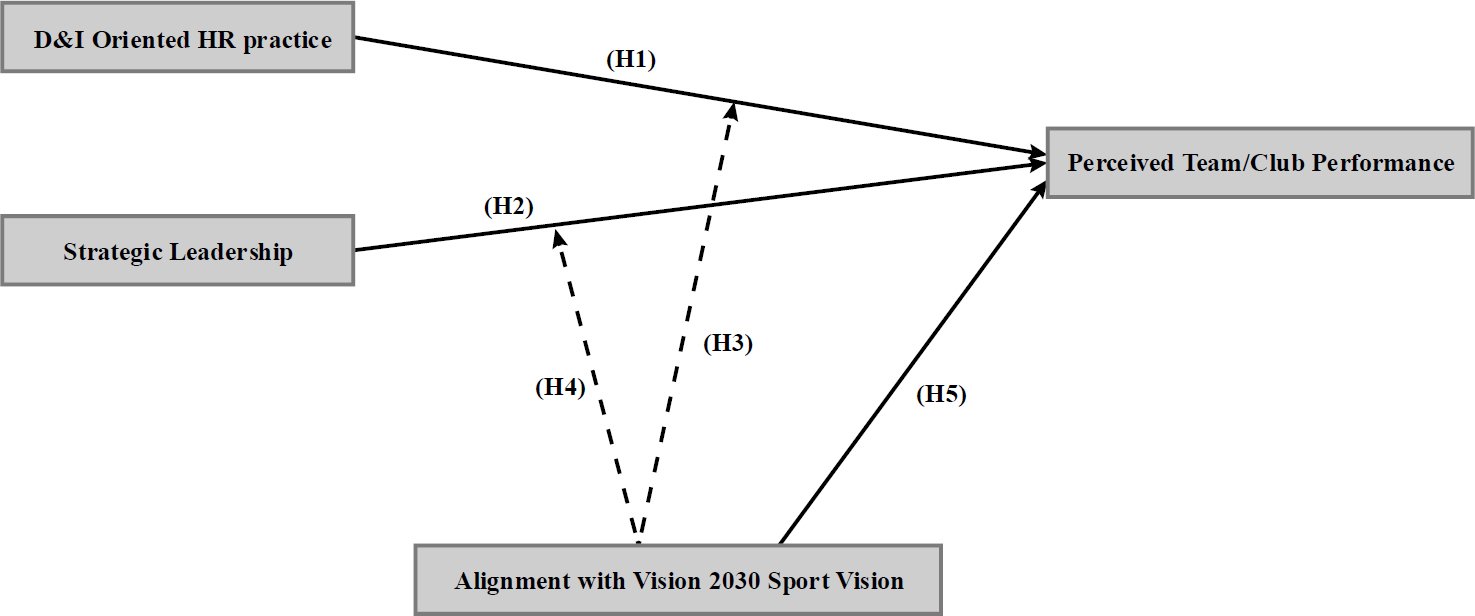
Fig. (1). Conceptual framework.
2.5. Literature Gap
The available literature offers a coherent amount of evidence that D&I-oriented HR practices and strategic leadership have a positive effect on the performance of organisations and teams; however, there are a number of shortcomings.
Although unprecedented national investment is being made under Vision 2030, a range of sports organisations still face uneven organisational capability, imbalanced HR maturity, and leadership issues that can undermine the transfer of national investments into sustainable organisational performance. This means that infrastructure growth alone might not be adequate unless internal organisational means and institutional fit evolve concurrently. Other studies, including (Singh et al., 2024; and Saha et al., 2024), establish that structured D&I systems improve performance; however, the data are limited by the use of HR professionals or secondary firm-level data to understand perceived team-level results, especially in a sports context. Similarly, sport related research (e.g., Clare et al., 2025; Liqiang et al., 2024) supports the relationship between leadership and performance, and the effect is often small or indirect, pointing to a need to take further steps to explain the variations in performance with regard to the concept of leadership. Further, the relationships are largely external circumstance dependent as is now evident. (Kiplagat et al., 2024; and Arora, 2024) indicate that leadership effectiveness is based on contextual governance and environmental alignment. Nevertheless, such studies are mainly set in the context of the public sector or corporations, where they are not applicable to sports organisations that experience national change. In general, the lack of comprehension of the perceived role of national strategic frameworks, such as Saudi Vision 2030, in pre-conditioning the efficacy of D&I-oriented HR practices and strategic leadership regarding perceived team/club performance is clear and prompts the proposed hypotheses to be tested.
3. METHODOLOGY
3.1. Research Design
This research employed a quantitative study design, which can be characterised as a methodological enquiry involving the use of numerical data and statistical methods to study the connections between variables (Taherdoost, 2022). Hypothesis testing and theory validation are two specific areas where quantitative methods are most appropriate because they can be objectively measured and generalised to the findings. This approach was appropriate for the present study, as it aimed to test the relationships between D&I-oriented HR practices, strategic leadership, and perceived team/club performance, as well as the moderating role of perceived organisational alignment with Vision 2030 sports objectives, using statistical modelling.
The organisations engaged included professional and community sports clubs, governing bodies, and sports development organisations within Saudi Arabia. Such organisations are involved in the development of athletes, management of competitions, community involvement programs, and execution of national sports policies. As Vision 2030 has greatly increased public investment and governance reforms in this sector, workers in these organisations are directly exposed to strategic initiatives that facilitate organisational change, making them a suitable group to study HR practices, leadership, and institutional alignment.
3.2. Data Collection Tool
Data was collected using a structured, closed ended questionnaire, created through Google Forms. An online survey was chosen for the research rather than face to face interviews for a number of reasons: firstly, it was effective in terms of speed of completion and secondly, the potential reach was much greater and thirdly, it would allow for the sampling of people that were geographically spread out in the sports industry. In addition, Internet tools eliminate interviewer bias and enable respondents to take the survey at a time of their own choosing. The questionnaire used a 5-point likert scale from 1 (Strongly Disagree) to 5 (Strongly Agree) and included four constructs: D&I oriented HR practices, strategic leadership, perceived team/club performance, perceived organisational alignment with Vision 2030 sports objectives (Appendix A).
The study constructs were measured using items that had been previously tested in the literature to ensure their validity. Inclusive policies and practices were captured in D&I-oriented HR practices based on (Zhao & Ren, 2025b). The Strategic Leadership Scale (SLS) was adapted from (Pisapia, 2006) to include items that focus on strategic leadership, which involve vision and support of leadership. The Perceived Performance in Team Sports Questionnaire (PPTSQ) is a sport-specific questionnaire developed by (Gershgoren et al., 2021) that was used to assess perceived team/club performance. Perceived organisational alignment with Vision 2030 sports objectives was based on the literature on strategic alignment because no standardised scale was available.
Since the research was carried out on staff members of Saudi sports organisations, the questionnaire was designed in English and translated into Arabic using the back-translation technique that is suggested in cross-cultural research. The questionnaire was translated into Arabic by a bilingual scholar with knowledge of management research for the first time Two independent bilingual persons translated the Arabic version into English. All discrepancies between the original and back translation versions were discussed, and it was decided that the versions should be as semantically equivalent and contextually appropriate as possible. A pilot study with 30 sports organisation workers was first undertaken to check the clarity of the items, wording and flow of the questions in the questionnaire. Minimal changes were made to words to enhance readability and the conceptual meaning of constructs did not change. Results of the pilot study were not used in the final analysis. However, formal measurement invariance testing (e.g. MICOM) was not conducted between the Arabic and English versions. Therefore, the study lacks cross-language comparability and cannot confirm that the constructs were measured equivalently across both language versions.
.
Table 1 shows the adaptation process for all the measurement items, including the original source, change in wording, rationale for adaptation, method of translation, and changes after the pilot period. The actual questionnaire used to collect information from all respondents is provided in the Appendix. No items on the questionnaire were changed after data collection was completed.
Table 1. Construct’s item adaptation table.
| Construct | Original Source and Context | Item | Adaptation in the Present Study | Reason for Adaptation | Translation &. Pilot Outcome |
| Diversity &. Inclusion-oriented HR Practices | (Zhao & Ren, 2025b): General organisational HR practices | DIHR1 | Recruitment and promotion practice terminology in the context of Saudi sports organisations. | For the purpose of enhancing the contextual relevance without changing the original HR practice domain. | Back-translated into Arabic. Small changes were made to the wording to make it clearer during the pilot. |
| DIHR2 | References to organisational communication were tailored to diversity and inclusion policy communication in sports organisations. | To make the item “fit” with communication in the sporting context. | No conceptual changes, only language changes as a result of pilot feedback. | ||
| DIHR3 | The language of context was updated for diversity of views in sporting groups and/or clubs. | To document examples of collaborative diversity practices that are relevant to sport organisations. | Pilot tested and some slight readability changes made with no changes to construct meaning. | ||
| Strategic Leadership | (Pisapia, 2006): Educational and organisational leadership | SL1 | Strategic direction wording was adapted for sports teams and organisational objectives. | To make it applicable for sports organisations whilst maintaining the same type of leadership. | Semantic equivalence was verified by back translation. Some changes to the wording to improve understanding. |
| SL2 | Leadership influence was focused on employee contribution in sport organisations. | To demonstrate leadership support in team-based organisational setting. | Only make stylistic changes after pilot testing. | ||
| SL3 | Strategic support was changed to achievement of team goals. | To stay consistent in the level of analysis organisation. | No changes to the concept were made. | ||
| Perceived Team/Club Performance | (Gershgoren et al., 2021): Team Sports Performance | PTP1 | The process of performance assessment was transferred from sports to a team/club level in organisations. | To be comparable to the employee sample as opposed to the athletes. | Semantic equivalence through pilot review and translation. |
| PTP2 | Individual contribution was re-framed as ‘contribution to team/club success’. | To reflect organisational rather than athletic performance. | Some minor wording changes to enhance respondent understanding. | ||
| PTP3 | Overall effectiveness was contextualised at the organisational team/club level. | For consistency with the unit of analysis in the study. | No changes after pilot testing. | ||
| Perceived Organisational Alignment with Vision 2030 Sports Objectives | Strategic alignment literature &. Saudi Vision 2030 documents: Strategic alignment and organisational–environment fit. | POAVSO1 | A new item created to measure perceived alignment of organisational priorities to Vision 2030 sports objectives. | There was no validated Vision 2030 scale available and it was necessary to measure context-specific. | Feedback from piloting has been taken into account and back-translated and refined for clarity. |
| POAVSO2 | New item created to capture consistency between organisational decision making and Vision 2030 objectives. | To implement organisational strategic alignment in the Saudi sports context. | Some minor word changes were made for ease of reading but not to change the meaning. | ||
| POAVSO3 | New item created to gauge employees’ awareness of the contribution the organisation is making to Vision 2030 sports goals. | To measure employees’ perceived alignment of the organisation, not the performance. | Pilot participants suggested that the wording should be simplified (no conceptual change). |
While the constructs are conceptually related, the measurement items have been purposefully operationalised to capture different theoretical domains. D&I-oriented HR practices measured employees’ perceptions of inclusive HR policies, communication, and fairness, while Strategic Leadership measured leadership vision, strategic direction, and managerial support. Perceived Team/Club Performance included the respondents’ assessment of organisational performance outcomes. All items were examined during the adaptation process to reduce conceptual overlap but ensure consistency with the theoretical definition of each construct. Additionally, the empirical results of discriminant validity (HTMT< 0.85) showed that the constructs remained statistically different.
3.3. Population and Recruitment
The target group comprised club staff and administrators associated with different sports organisations. This group was chosen because of its direct participation in implementing HR practices, interacting with leadership, and team performance, and is therefore well positioned to offer informed perceptions of the study variables. Professional networking sites such as LinkedIn and social networking sites such as Facebook, where sports professionals and organisational members are also active, were used as recruitment methods to secure participants. The survey link was sent in invitations through direct messages and to the appropriate groups. However, the use of digital platforms can leave less digitally literate people behind. To address this, the survey was designed to be simple, mobile-ready, and sent out via a number of channels to make it more accessible.
3.4. Sampling Technique and Sample Size
Respondents with experience in sports organisations were selected using purposive sampling. Purposive Sampling is a non-probability sampling technique in which the subjects are selected intentionally based on their characteristics and perhaps their ability to provide an appropriate and informed contribution in the study (Campbell et al., 2020). The criteria used for eligibility were: (1) member must be currently employed in a sports organisation (e.g., club staff, club administrator, management team), (2) at least 1 year of employment within the organisation, and (3) directly or indirectly involved in the organisation’s team, HR practices, or leadership process. With these criteria, the respondents were assured of knowledge and exposure to adequately assess the constructs under study.
The final sample comprised employees from ten sports organisations. The range of respondents per organisation was 15-50 (Mean = 30.0), showing that multiple respondents were recruited from each organisation. However, the unit of analysis remained individual employees, and no aggregation was carried out as responses indicated individual perceptions and not organisational-level measures. However, clustering effects cannot be entirely excluded and must be investigated in future studies using multilevel approaches. Data collection was conducted from June to July 2025. Approximately 400 staff members were invited via organisational networks and staff social media. A total of 323 questionnaires were returned, resulting in a response rate of 80.75. After data screening, 300 valid responses were used for data analysis, as questionnaires with missing values were excluded. To prevent duplicate submissions, a Google form with a one-response setting was used.
G*Power (version 3.1.9.7) was used to determine the minimum sample size and appropriate procedure recommended in social science research. The a priori power analysis was done using three main-effect predictors (D&I-oriented HR practices, Strategic Leadership, and Perceived Organisational Alignment with Vision 2030 Sports Objectives), assuming a medium effect size (f² = .15), α = .05, and statistical power of .80, which resulted in a minimum required sample of 119 respondents. In addition, the complete structural model was tested with two interaction terms (D&I-oriented HR Practices × Perceived Organisational Alignment with Vision 2030 Sports Objectives and Strategic Leadership × Perceived Organisational Alignment with Vision 2030 Sports Objectives). Thus, a sample size of 300 was well above this requirement.
3.5. Data Analysis
Partial Least Squares Structural Equation Modelling (PLS-SEM) was used to analyse the data. As mentioned by (Hair et al., 2021) as cited in (Ghouri, 2023), PLS-SEM can be used to test theories, evaluate models, and validate hypotheses, to explore the complex relationship between the constructs of a theory and the indicators of the constructs of a theory. PLS-SEM was appropriate for this study because it can address a complex model with moderation effects and non-normal data. This analysis consisted of two steps: (1) Measurement Model (reliability and validity) assessment and (2) Structural Model (path coefficients, significance, and moderation effects) assessment. The structural model was estimated using SmartPLS version 4.0. Two-tailed significance testing and bias-corrected confidence intervals were used with 5,000 bootstrap resamples. The moderation effects were computed using a path weighting scheme and product indicator approach.
3.6. Common Method Bias, Non-response Bias, and VIF
This study adopted both procedural and statistical techniques to assess common method bias (CMB). First, Harman’s single-factor test was used, which, according to Rodríguez-Ardura and Meseguer-Artola (2020), tests whether a single factor explains more than 50% of the variance in the data. The results showed that no single factor had more than 50% variance, implying that there was no significant bias. Second, following the full collinearity assessment approach proposed by (Kock, 2015), construct-level variance inflation factors (VIFs) were examined to assess both collinearity and potential common method bias. A VIF less than the conservative value of 3.3 suggests that the model does not exhibit any significant collinearity issues and that there is no likelihood that common method bias issues would compromise the validity of the results. Table 2 reveals that none of the construct-level VIFs were higher than this value, meaning that collinearity could not be an issue and that the likelihood of common method bias influencing the study results was low. The two diagnostics indicated that the results did not indicate a common method bias.
Table 2. Collinearity statistics (VIF).
| – | VIF |
| Perceived Organisational Alignment with Vision 2030 Sports Objectives | 1.791 |
| Diversity and Inclusion Oriented HR Practices | 1.805 |
| Strategic leadership | 1.365 |
To ensure there was no non-response bias, independent-sample t-tests were conducted to compare the first half of the responses (150) with the second half (150) for each construct. The results showed no statistical differences (p > 0.05) suggesting that the results were unlikely to be affected by non-response bias.
3.7. Ethical Considerations
This study was conducted in compliance with internationally accepted ethical principles for conducting research. Participation was voluntary, and the purpose of the study was explained to the respondents. Anonymity and confidentiality were assured, and no personally identifiable information was gathered. Before participation, informed consent was obtained from all respondents. The study was independent and did not require a formal institutional ethics committee review, as it was an anonymous, minimal-risk questionnaire.
4. RESULTS
4.1. Descriptive Analysis
Table 3 presents the demographics of the 300 respondents. The vast majority of them were male (66.0%) and female (30.7%), which is indicative of the gender gap in the sports industry. The majority of the respondents were 25-34 (42.0%), indicating a relatively young workforce. In terms of education, the sample of the population was well educated, with the majority being bachelor’s degree holders (46.0%) and master’s degree holders (22.0%). Regarding positions, the highest percentage was the administrative/operational staff (28.0%), followed by the coaching staff (24.0%), which means that both technical and managerial levels were represented in the sample. The levels of experience were also fairly even, with 6-10 years of experience (28.0%) and 1-3 years of experience (26.0%) being the most frequent, indicating a fair amount of industry exposure.
Table 3. Demographics of respondents.
| Variable | Category | Frequency | Percentage (%) |
| Gender | Male | 198 | 66.0 |
| Female | 92 | 30.7 | |
| Prefer not to say | 10 | 3.3 | |
| Age Group | Below 25 | 48 | 16.0 |
| 25–34 | 126 | 42.0 | |
| 35–44 | 72 | 24.0 | |
| 45–54 | 36 | 12.0 | |
| 55 and above | 18 | 6.0 | |
| Education Level | Secondary | 30 | 10.0 |
| Diploma | 54 | 18.0 | |
| Bachelor’s | 138 | 46.0 | |
| Master’s | 66 | 22.0 | |
| Doctorate | 12 | 4.0 | |
| Job Role | Coaching / Technical Staff | 72 | 24.0 |
| Administrative / Operational Staff | 84 | 28.0 | |
| Supervisory / Team Coordinator | 54 | 18.0 | |
| Managerial | 60 | 20.0 | |
| Senior Management / Executive | 30 | 10.0 | |
| Experience | 1–3 years | 78 | 26.0 |
| 3–5 years | 66 | 22.0 | |
| 6–10 years | 84 | 28.0 | |
| More than 10 years | 72 | 24.0 |
4.2. Measurement Model Analysis
Table 4 presents the results for the measurement models. The reliability of all factor loadings were greater than 0.70 (e.g., DIHR2 = 0.886; PTP2 = 0.932) a good indicator of reliability. The values of Cronbach’s alpha ranged from 0.818 to 0.901 and composite reliability values were greater than 0.80, suggesting satisfactory internal consistency. Furthermore, the convergent validity of the AVE values was higher than 0.50 for both D&I-oriented HR practices and performance.
Table 4. Measurement model.
| Latent Construct | Indicators | Factor Loading | Cronbach’s Alpha | Composite Reliability (rho_a) | Composite Reliability (rho_c) | Average Variance Extracted (AVE) |
| Diversity and Inclusion Oriented HR Practices | DIHR1 | 0.878 | 0.837 | 0.843 | 0.902 | 0.754 |
| DIHR2 | 0.886 | |||||
| DIHR3 | 0.841 | |||||
| Perceived Team Performance | PTP1 | 0.906 | 0.901 | 0.901 | 0.938 | 0.835 |
| PTP2 | 0.932 | |||||
| PTP3 | 0.904 | |||||
| Strategic Leadership | SL1 | 0.823 | 0.818 | 0.827 | 0.892 | 0.734 |
| SL2 | 0.909 | |||||
| SL3 | 0.836 | |||||
| Perceived Organisational Alignment with Vision 2030 Sports Objectives | POAVSO1 | 0.887 | 0.884 | 0.887 | 0.928 | 0.812 |
| POAVSO2 | 0.929 | |||||
| POAVSO3 | 0.887 |
Note: Factor Loadings ≥ 0.70; Cronbach’s alpha ≥ 0.70; CR ≥ 0.70; AVE ≥ 0.50 (Hair et al., 2021; Mia et al., 2022)
4.3. Discriminant Validity Analysis
Table 5 shows the discriminant validity of the heterotrait-monotrait (HTMT) ratios. All values were below the threshold of 0.85 (for example, 0.706 between vision alignment and performance; 0.577 between D&I-oriented HR practices and strategic leadership) which proves that the constructs are differentiated and measure different things.
Table 5. Discriminant validity.
| – | Perceived Organisational Alignment with Vision 2030 Sports Objectives | Diversity and Inclusion Oriented HR Practices | Perceived Team Performance |
| Diversity and Inclusion Oriented HR Practices | 0.704 | – | – |
| Perceived Team Performance | 0.706 | 0.608 | – |
| Strategic leadership | 0.460 | 0.577 | 0.406 |
Note: HTMT threshold < 0.85 (Afthanorhan et al., 2021; Cheung et al., 2023)
4.4. Model Fit
Table 6 presents the model fit indices for both the saturated and estimated models. The SRMR value of 0.057 for both models is below the commonly accepted threshold of 0.08, indicating a good overall model fit. The d_ULS values of 0.257 and 0.256 and the d_G values of 0.186 and 0.185 are very similar across the two models, suggesting consistency between the saturated and estimated specifications. The NFI value of 0.846 indicates a reasonably acceptable fit, although it is slightly below the commonly recommended threshold of 0.90. Overall, the results suggest that the estimated model demonstrates an adequate level of fit to the observed data.
Table 6. Model Fit summary.
| – | Saturated Model | Estimated Model |
| SRMR | 0.057 | 0.057 |
| d_ULS | 0.257 | 0.256 |
| d_G | 0.186 | 0.185 |
| NFI | 0.846 | 0.846 |
4.5. Explanatory Power and Predictive Relevance
The explanatory power and predictive relevance is reported in Table 7. The value of R2 (0.436) was moderate, which means that the model could explain 43.6% of the variance in perceived team performance. The Q2 was 0.400, which indicated that the model was relevant to predicting.
Table 7. R-square showing explanatory power and Q-square presenting predictive relevance.
| – | R-Square | R-Square Adjusted | Q-Square | RMSE | MAE |
| Perceived Team Performance | 0.436 | 0.427 | 0.400 | 0.782 | 0.573 |
Note: R2 = 0.25, 0.5, and 0.75 are weak, moderate, and substantial predictors, respectively; Q2 > 0 indicates predictive relevance (Changalima & Chuwa, 2025).
4.6. Path Coefficient
Table 8 presents the results of the structural model and the hypothesis testing. Two complementary criteria were applied to determine the decisions regarding the hypotheses. Bootstrap p-values (p < 0.05) were first determined for statistical significance. Second, substantive significance was evaluated using Cohen’s effect size (f²), where effects below 0.02 were considered negligible. Therefore, hypotheses were considered well supported only if there was both statistical and practical substantive significance. Relationships that were statistically significant but had negligible effect sizes were considered statistically supported but not substantively supported.
Table 8. Path coefficient.
| Hypothesised Relationship | β | SE | t | p | 95% Bootstrap CI (LL) | 95% Bootstrap CI (UL) | f² | Decision |
| Perceived Organisational Alignment with Vision 2030 Sports Objectives → Perceived Team Performance | 0.471*** | 0.068 | 6.881 | 0.001 | 0.337 | 0.607 | 0.220 | Supported |
| Perceived Organisational Alignment with Vision 2030 Sports Objectives × Diversity and Inclusion-Oriented HR Practices → Perceived Team Performance | -0.016*** | 0.005 | 3.274 | 0.001 | -0.026 | -0.006 | 0.001 | Statistically significant but not substantively supported |
| Perceived Organisational Alignment with Vision 2030 Sports Objectives × Strategic Leadership → Perceived Team Performance | -0.006** | 0.003 | 2.110 | 0.035 | -0.012 | -0.001 | 0.001 | Statistically significant but not substantively supported |
| Diversity and Inclusion-Oriented HR Practices → Perceived Team Performance | 0.209*** | 0.070 | 2.989 | 0.003 | 0.068 | 0.342 | 0.043 | Supported |
| Strategic Leadership → Perceived Team Performance | 0.063 | 0.060 | 1.055 | 0.292 | -0.050 | 0.186 | 0.005 | Not Supported |
Note: β = standardised path coefficient; SE = bootstrap standard error; t = bootstrap t-statistic; p = bootstrap significance level; CI = 95% bias-corrected bootstrap confidence interval; LL = lower limit; UL = upper limit; **p < 0.05; ***p < 0.01.
Regarding H1, that is the existence of a positive relationship between D&I-oriented HR practices and perceived team performance, the findings showed a significant positive relationship between these variables (β = 0.209, p = 0.003 and t = 2.989), but the result was small in size (f2 = 0.043). However, the strategic leadership is not significantly associated with performance (β = 0.063, t = 1.055, p = 0.292), so that the contribution of strategic leadership will be weak (f2 = 0.005) and does not support the hypothesis of H2. The direct effect of perceived alignment with Vision 2030 sports objectives on perceived team performance was significant and strong β = 0.471, p = 0.001, f² = 0.220) which supports H5.
Although both interaction terms were statistically significant (H3: β = -0.016, p = 0.001; H4: β = -0.006, p = 0.035), they had a very small effect size (f2 = 0.001), suggesting that they were statistically significant but negligible in practice. Both interaction terms were statistically significant, but the size of the effect was negligible (f²=.001). This means that the interaction effects are statistically significant but not very meaningful in practice. Thus, the results do not demonstrate meaningful moderation. Perceived Organisational Alignment with Vision 2030 Sports Objectives is better interpreted as a direct organisational predictor of perceived performance than as a substantive boundary condition.
4.7. Conditional Effects
Table 9 shows the conditional effects, where the positive associations of D&I-oriented HR practices and strategic leadership with perceived team performance weaken slightly as perceived organisational alignment with Vision 2030 sports objectives grows. However, the differences between low, medium, and high levels of alignment are extremely small and represent little real difference in the strength of these relationships. This pattern is consistent with negligible interaction effect sizes (f² = 0.001), indicating that there is no meaningful moderating effect of perceived organisational alignment with Vision 2030 sports objectives on the effect of diversity and inclusion-oriented HR practices or strategic leadership on perceived team performance.
Table 9. Conditional direct effects of perceived organisational alignment with vision 2030 sports objectives.
| Perceived Organisational Alignment with Vision 2030 | D&I HR → Performance | Strategic Leadership → Performance |
| Low (−1 SD) | 0.225 | 0.069 |
| Mean | 0.209 | 0.063 |
| High (+1 SD) | 0.193 | 0.057 |
5. DISCUSSION
The research question aimed to understand how internal organisational capabilities or institutional alignment is a better predictor of perceived team performance in Saudi sports organisations working under the transformation agenda of Vision 2030. The results show that the factors have varying levels of influence on perceived performance, with perceived institutional alignment appearing to be a more powerful factor of explanation than the internal organisational capabilities initially hypothesised. Instead of the hypothesised predictors having similar effects, the findings show a pattern of differentiation in the relationships. This trend must be explained by the fact that the data are perceptual, cross-sectional, and non-probability, which means that the subjective assessment of employees is involved, not objective organisational performance. In general, the results indicate the asymmetric incorporation of the theoretical framework, in which the Resource-Based View can be used to justify the minimal contribution of internal resources, and the Contingency Theory can be manifested more through direct contextual impact than meaningful moderation.
H1 is supported, according to which D&I-oriented HR practices are positively and significantly related to perceived performance. The results show a positive association between D- and I-oriented HR practices and perceived performance (β = 0.209, t = 2.989, p = 0.003). This is consistent with earlier research (Singh et al., 2024; Saha et al., 2024), which points out that well-structured and formalised inclusion processes have the potential to enhance collaboration, psychological safety, and decision quality. Nevertheless, the effect size in this study is rather small (f2 = 0.043), which implies that D&I-oriented HR practices are significant, but their effect on perceived team performance is relatively small when considered individually. This is in line with the claim made by (Okatta et al., 2024), who observed that D&I efforts are more likely to have better results when they are backed by adjunctive processes such as leadership commitment and implementation strength. In this regard, the current results support a more moderate understanding of the effects of D&I: it is important, but it does not prevail in performance perception. This can be suggestive in the context of sports team settings, in particular, that inclusion can enhance interpersonal functioning but not necessarily lead to more robust perceptions of competitive success that are frequently determined by the result of matches, the level of skills, and coaching policies outside HR systems.
The findings do not confirm H2, which states that strategic leadership is positively and significantly related to perceived performance (β = 0.063, t = 1.055, p = 0.292). This is contrary to a large portion of the literature on leadership performance (e.g., Clare et al., 2025; Liqiang et al., 2024), which usually show positive correlations. The absence of a strong direct impact in the present study may imply that employees or team members do not directly correlate performance gains with leadership. Leadership can be a background condition that facilitates processes rather than a performance driver. This interpretation aligns with critiques of sports research that have identified that leadership effects may be less salient in high-stakes, result-oriented settings where performance is largely influenced by external competition conditions and athlete competence, and less by management (Tadesse et al., 2024). The small direct effect of strategic leadership implies that its performance impact might not be direct but indirect and process-based, as strongly suggested by earlier literature. The processes of leadership may be reinforced by team cohesion, psychological safety, motivation, or quality of communication, which were not investigated in this study. Future studies should embrace mediation models to include these indirect pathways and provide a more comprehensive picture of the effectiveness of leadership in sports organisations. The use of multistage/longitudinal designs can further elucidate how leadership is translated into performance over time, especially in institutionally aligned contexts.
H3 states that perceived organisational alignment with Vision 2030 sports objectives significantly moderates the relationship between diversity and inclusion (D&I)-oriented HR practices and perceived team/club performance. The interaction term is statistically significant (β = -0.016, p = 0.001), but its effect size is insignificant, which means that there is no substantive moderating effect. Similarly, H4 explains that perceived organisational alignment with Vision 2030 sports objectives plays a significant role in moderating the relationship between strategic leadership and perceived team/club performance. The outcome is statistically significant (β = -0.006, p = 0.035), but the effect is practically non-significant. H3 and H4 attained statistical significance but were not substantively supported because of the negligible size of the interaction effect (f² = 0.001). Hence, there is no practical significance in the interaction as a meaningful moderator, even though it is statistically present. Therefore, H3 and H4 are not supported from a practical perspective. Since the moderation effects had no substantive practical significance, they should not be considered to possess meaningful boundary conditions. Instead, the data show that perceived organisational alignment with Vision 2030 sports objectives is a direct predictor of perceived team performance and not a moderator.
These results offer a weak justification for contingency theory in its classical moderation form, as the statistically significant interaction terms do not have substantial effect sizes. In line with (Kiplagat et al., 2024), performance perceptions seem to be influenced by contextual alignment, which provides legitimacy and institutional guidance. However, the current findings indicate that this influence acts mostly via a direct effect rather than a real interaction process.
Moreover, the negative coefficients should not be understood as a negative impact but as a slight weakening of the relationship between the internal factors (D&I-oriented HR practices and strategic leadership) and perceived performance in the upper levels of alignment. This trend can indicate a possible substitution effect, where high perceived institutional compatibility acts as the primary reference point in assessing performance, and thus lessens the dependence on internal organisational qualities. This has been witnessed in the governance literature, whereby powerful institutional setups can overshadow internal processes (Iqbal et al., 2025).
This study does not negate the RBV but rather introduces an important limitation to the RBV in policy-oriented organisational settings. RBV assumes that valuable internal capabilities create a competitive advantage, but the value of these capabilities can be contingent upon employees’ understanding of the organisational context within which they are set. From this perspective, D&I-oriented HR practices and strategic leadership continue to be strategic tools, with employee perceptions of value contingent on their awareness of the organisation’s strategic priorities. This builds upon the RBV by stating that internal resource effectiveness does not exist in isolation but rather in conjunction with employees’ perception of the organisation’s strategic direction. Therefore, the combination of RBV and Contingency Theory offers a more context-sensitive account of organisational performance, as strategic resources and perceptions of the organisational context both affect performance assessments.
THEORETICAL CONTRIBUTION
This study further clarifies the integration of RBV and Contingency theory by demonstrating that perceived organisational congruence with Vision 2030 is a more direct predictor of perceived team performance than the proposed moderation effects. The current results do not measure institutional dominance or internal organisational capabilities being substituted, but employees feeling more aligned with their organisation report higher perceived team performance. Thus, the study expands RBV-CT integration by pointing to the role of perceived contextual realignment while remaining within the boundaries of employee perception data.
Compared to CT, the research offers low support for the classical moderation-based formulation. Although there are statistically significant interaction effects of perceived organisational alignment with Vision 2030 sports objectives, the small effect sizes suggest that contingency logic is not meaningfully operating in terms of interaction in this case. Instead, alignment can be seen as a pure institutional motivator of perceived performance, which switches the theoretical focus of the moderating concept of fit to context-based dominance.
To this end, this study adds to the theory by developing RBV-CT integration in two ways. First, it points out that the effect of institutional fit can neutralise or redraw the influence of internal resources, as opposed to moderating them. Second, it shows that within state-led transformation environments, performance perceptions are influenced more by employees’ perception of their organisation’s macro-level strategic alignment than by internal capability differentials. This requires refining RBV-CT integration models to incorporate more of the effects of the perceived influence of organisational alignment, especially in cases where national visions are highly influential in the way organisational evaluation criteria are designed.
Another contribution of this study is that it shows that employees’ perception of macro-level institutional alignment can be effective without classical contingency mechanisms such as reward systems. This result indicates that employees’ perceptions of institutional legitimacy can have more explanatory power in highly centralised policy settings than the interaction effects that Contingency Theory conventionally postulates.
CONCLUSION
These results indicate that employees measure organisational success not only by internal HR and leadership practices but also by how much organisational activities are perceived to be in accordance with the national transformation agenda (NTA). Accordingly, the perception of institutional alignment seems to be a more powerful predictor of perceived performance than the moderating mechanism initially proposed.
LIMITATIONS AND FUTURE DIRECTION
This study has the limitation of being cross-sectional in nature; therefore, it is not possible to make any cause-and-effect interpretations or determine how changes occur over time. Non-probability purposive sampling and data gathered via LinkedIn and Facebook also restrict generalisability, since they can omit less digitally active professionals and cause selection bias. In addition, the emphasis on Saudi sports organisations limits extrapolation to other settings. Future studies should implement longitudinal designs to study changes in these relationships, adopt more representative probability sampling methods, and use objective or multi-source performance indicators instead of purely perceptual measures. Future research could also be extended to identify further mediating variables (e.g., team cohesion and psychological safety) or other moderators (organisational culture and available resources) to describe performance relationships more thoroughly.
Moreover, one of the limitations is related to construct operationalisation: Although the scales developed were based on previous studies, there is a possibility that some items that assessed perceived performance and perceived organisational alignment with Vision the 2030 sports objectives are theoretically related. Although the statistical results indicated discriminant validity (HTMT < 0.85), but these measures should be refined in future studies using performance measures that are not theoretically related to HR practices, leadership, and alignment of the institution. This would provide more evidence of construct validity and reduce the chances of shared conceptual variance.
Although validated sports performance measures were used in this study, future researchers should integrate perceptual measures with objective performance indicators, including league rankings, win-loss ratios, financial performance, outcomes of athlete development, and competition success. The combination of subjective and objective measures would provide a fuller picture of organisational performance, reduce the possible common perceptual variance, and enhance the robustness of the empirical results.
POLICY IMPLICATION
Sports authorities must reinforce systems that transform Vision 2030 into operational directives for clubs. This can be achieved through the provision of uniform performance dashboards and KPI models that specifically relate national sports objectives to club objectives. Moreover, HR departments should combine D&I-oriented HR practices with performance monitoring systems to ensure that inclusion works in the performance processes. For example, adding indicators of inclusion (e.g., participation balance, communication fairness, and role clarity) to regular team performance reviews is recommended.
Furthermore, leadership development programs must focus on connecting strategic leadership behaviours to practical team coordination and implementation results, instead of overall motivation. This can be facilitated by scenario-based training and performance feedback systems that are also linked to match preparation, coordination efficiency, and speed of decision-making. Lastly, policy frameworks must focus on alignment audits so that sports clubs are active in linking their internal HR systems to national sports transformation goals. For instance, an annual compliance and alignment audit should be conducted that reviews HR policies, leadership practices, and the operation of the team against Vision 2030 sports targets.
LIST OF ABBREVIATIONS
CT | = | Contingency Theory |
CMB | = | Common Method Bias |
D&I | = | Diversity and Inclusion |
NTA | = | National Transformation Agenda |
PLS-SEM | = | Partial Least Square Structural Equation Modelling |
PPTSQ | = | Perceived Performance in Team Sports Questionnaire |
RBV | = | Resource-Based View |
SLS | = | Strategic Leadership Scale |
VIFs | = | Variance Inflation Factors |
AUTHOR’S CONTRIBUTION
R.H.K. has contributed to the study conceptualization, methodology, data analysis, interpretation of results, and manuscript writing.
ETHICAL APPROVAL & INFORMED CONSENT
This study was conducted in compliance with internationally accepted ethical principles for conducting research. Participation was voluntary, and the purpose of the study was explained to the respondents. Anonymity and confidentiality were assured, and no personally identifiable information was gathered. Before participation, informed consent was obtained from all respondents. The study was independent and did not require a formal institutional ethics committee review, as it was an anonymous, minimal-risk questionnaire.
AVAILABILITY OF DATA AND MATERIALS
The data will be made available on reasonable request by contacting the corresponding author [R.H.K.]
FUNDING
None.
CONFLICT OF INTEREST
The author declares that there is no conflict of interest regarding the publication of this article.
ACKNOWLEDGEMENTS
Declared none.
DECLARATION OF AI
During the preparation of this manuscript, the author used ChatGPT for language editing and refinement purposes. Following the use of this tool, the author carefully reviewed and revised the content where necessary and accept full responsibility for the final published version of the article.
APPENDIX A
Study Title: Effect of Diversity and Inclusion-oriented HR Practices and Strategic Leadership on Perceived Team/Club Performance: Testing Perceived Organisational Alignment with Vision 2030 Sports Objectives as a Moderator
Research Team: Raza Khoso
Introduction
Thank you for considering participation in this research study. I am conducting a study on the relationship between Diversity and Inclusion oriented HR practices, strategic leadership, and Perceived Team/Club Performance, with a particular focus on the moderating role of the Perceived Organisational Alignment with Vision 2030 Sports Objectives. Your participation is valuable and will significantly contribute to the completion of this research.
Purpose of the Study
The aim of this study is to explore how Diversity and Inclusion oriented HR practices and strategic leadership influence Perceived Team/Club Performance, and how the Perceived Organisational Alignment with Vision 2030 Sports Objectives acts as a moderator in this relationship. By participating, you will help us understand the role of diversity, inclusion, and strategic leadership in enhancing team and club performance, as well as how Vision 2030 reforms in sports are influencing these practices within the context of team and club management. Your responses will provide valuable insights into how these factors interact to improve performance in sports teams and clubs in Saudi Arabia.
What will I be asked to do?
You will be asked to complete a questionnaire that will take approximately 5-15 minutes to complete. The questions will focus on your experiences and views regarding Diversity and Inclusion oriented HR practices, strategic leadership, and the impact of the Perceived Organisational Alignment with Vision 2030 Sports Objectives on Perceived Team/Club Performance. Your participation will help us collect essential data to support our research findings.
Confidentiality
Your responses will be kept strictly confidential. The information you provide will only be used for research purposes. No personally identifiable information will be collected, and your participation will remain anonymous.
Voluntary Participation
Participation in this study is entirely voluntary. You can choose not to participate, or withdraw from the study at any time without any consequences. If you decide to withdraw, your responses will be excluded from the final analysis.
Potential Risks
There are no anticipated risks involved in participating in this study. The questions are non-invasive and do not require sensitive personal information. If you feel uncomfortable at any point, you are free to skip any questions or withdraw.
Thank you for taking the time to consider participating in this study. Your involvement is greatly appreciated.
- What is your gender?
- Male
- Female
- Prefer not to say
- What is your age group?
- Below 25
- 25–34
- 35–44
- 45–54
- 55 and above
- What is your highest educational qualification?
- Secondary
- Diploma
- Bachelor’s
- Master’s
- Doctorate
- What best describes your current job role?
- Coaching / Technical Staff
- Administrative / Operational Staff
- Supervisory / Team Coordinator
- Managerial (e.g., Club/Department Manager)
- Senior Management / Executive (e.g., Director, Board Member)
- How many years of total experience do you have in this industry?
- 1–3 years
- 3–5 years
- 6–10 years
- More than 10 years
Variable | Question Statement | Strongly Disagree (1) | Disagree (2) | Neutral (3) | Agree (4) | Strongly Agree (5) |
Diversity & Inclusion oriented HR Practices | 1. The organisation implements fair recruitment and promotion practices | ☐ | ☐ | ☐ | ☐ | ☐ |
2. Diversity and inclusion policies are effectively communicated within the organisation. | ☐ | ☐ | ☐ | ☐ | ☐ | |
3. The company encourages diverse perspectives to improve team performance. | ☐ | ☐ | ☐ | ☐ | ☐ | |
Strategic Leadership | Leaders communicate a clear strategic direction for our team. | ☐ | ☐ | ☐ | ☐ | ☐ |
2. The leadership within the organisation inspires me to contribute to team success. | ☐ | ☐ | ☐ | ☐ | ☐ | |
3. I feel supported by strategic leadership in achieving team goals. | ☐ | ☐ | ☐ | ☐ | ☐ | |
Perceived Organisational Alignment with Vision 2030 Sports Objectives | Our organisation’s strategic priorities are aligned with the objectives of Saudi Vision 2030 for sports. | ☐ | ☐ | ☐ | ☐ | ☐ |
Decisions made in our organisation are consistent with the goals of Vision 2030 Sports Vision. | ☐ | ☐ | ☐ | ☐ | ☐ | |
Employees clearly understand how their work contributes to Vision 2030 sports objectives. | ☐ | ☐ | ☐ | ☐ | ☐ | |
Perceived Team/Club Performance | 1. Consistently meet performance targets set for team or club. | ☐ | ☐ | ☐ | ☐ | ☐ |
2. My performance directly contributes to the overall success of my team or club. | ☐ | ☐ | ☐ | ☐ | ☐ | |
3. Overall, I consider my team to be highly effective in achieving its objectives. | ☐ | ☐ | ☐ | ☐ | ☐ |
REFERENCES
Afthanorhan, A., Ghazali, P. L., & Rashid, N. (2021). Discriminant validity: A comparison of CBSEM and consistent PLS using Fornell & Larcker and HTMT approaches. In Journal of Physics: Conference Series (Vol. 1874, No. 1, p. 012085). IOP Publishing.
https://doi.org/10.1088/1742-6596/1874/1/012085
Alardani, G. (2023). Quality of sports management in Saudi Arabia. International Journal for Quality Research, 17(3), 683-694.
https://doi.org/10.24874/IJQR17.03-04
Anwar, G., & Abdullah, N. N. (2021). The impact of Human resource management practice on organisational performance. International Journal of Engineering, Business and Management (IJEBM), 5(1), 35-47. http://dx.doi.org/10.22161/ijebm.5.1.4
Arbelo, A., Arbelo-Pérez, M. & Pérez-Gómez, P. (2024). Internationalization and individual firm performance: A resource-based view. Eurasian Business Review, 14, 881-915.
https://doi.org/10.1007/s40821-024-00276-5
Arora, A. (2024). Board leadership structure and firm performance: Moderating effects of board independence. Journal of Emerging Market Finance, 23(1), 32-55.
https://doi.org/10.1177/09726527231190690
Arthachinda, P., & Charoensukmongkol, P. (2024). Effect of perceived group inclusion on innovative behaviour and its subsequent impact on team performance: Moderating effects of team characteristics. Management Research Review, 47(9), 1341-1359.
https://doi.org/10.1108/MRR-09-2023-0708
Ashkevari, S. B., & Ghasemi, B. (2023). The impact of strategic leadership on organisational performance with regard to the role of organisational innovation. Journal of Organizational Behaviour Research, 8(2), 40-53.
https://doi.org/10.51847/vSDdNm6S8t
Atta, A. & Zaman, N.U. (2024). The role of leadership in diversity, equity, and inclusion (DEI) in the workplace and its impact on organisational culture: Empirical evidence from Pakistan. Remittances Review, 9(3), 1169-1185. Available from: https://www.researchgate.net/publication/384426564_The_Role_of_Leadership_in_Diversity_Equity_and_Inclusion_DEI_in_the_workplace_and_its_impact_on_organizational_culture_Empirical_Evidence_from_Pakistan
Away, T., & Boudabbous, S. (2025). From diversity to belonging: Reframing inclusive HR practices in MENA region SMEs. Journal of Entrepreneurship and Business Resilience, 8(2), 129-161.
https://doi.org/10.65537/jebr.202582.160
Barney, J. B. (2001). Resource-based theories of competitive advantage: A ten-year retrospective on the resource-based view. Journal of Management, 27(6), 643-650.
https://doi.org/10.1177/014920630102700602
Brovina, F., & Sallaku, D. (2025). Leadership and strategic management in sports: Comparing different leadership approaches and their impact on sports management outcomes. Sports Science and Health, 32(2), 202-216.
https://doi.org/10.7251/SSH2502202B
Campbell, S., Greenwood, M., Prior, S., Shearer, T., Walkem, K., Young, S., … & Walker, K. (2020). Purposive sampling: Complex or simple? Research case examples. Journal of Research in Nursing, 25(8), 652-661.
https://doi.org/10.1177/1744987120927206
Changalima, I. A., & Chuwa, M. P. (2025). Partial least squares structural equation modelling (PLS-SEM) in business research: A simple guide for novice researchers. International Journal of Research in Business and Social Science (2147-4478), 14(9), 497-506.
https://doi.org/10.20525/ijrbs.v14i9.4601
Chaudhry, I. S., Paquibut, R. Y., & Tunio, M. N. (2021). Do workforce diversity, inclusion practices, & organisational characteristics contribute to organisational innovation? Evidence from the U.A.E. Cogent Business & Management, 8(1), 1947549.
https://doi.org/10.1080/23311975.2021.1947549
Cheung, G.W., Cooper-Thomas, H.D., Lau, R.S. & Wang, L.C. (2023). Reporting reliability, convergent and discriminant validity with structural equation modelling: A review and best-practice recommendations. Asia Pacific Journal of Management, 41, 745-783.
https://doi.org/10.1007/s10490-023-09871-y
Clare, C., Hardy, J., Roberts, R., Tod, D., & Benson, A. (2025). Do leaders actually influence sports performance? An integrated systematic review and meta-analyses. Journal of Sport & Exercise Psychology, 47(4), 205–222.
https://doi.org/10.1123/jsep.2024-0312
Csaszar, F. A., & Ostler, J. (2020). A contingency theory of representational complexity in organisations. Organisation Science, 31(5), 1198-1219.
https://doi.org/10.1287/orsc.2019.1346
Doh, P. Y., Kim, M., & Nite, C. (2025). Leveraging the cultural intelligence of sport employees in the globalized sports industry. Sport, Business and Management: An International Journal, 15(1), 43-63.
https://doi.org/10.1108/SBM-04-2024-0042
El-Shaeri, N. (2026). Saudi sports sector could surpass $22bn by 2030, expert says. Arab News PK. Available from: https://www.arabnews.pk/node/2636421/business-economy (Accessed on: 07-08-2026).
Gershgoren, L., Blatt, A., Sela, T. & Tenenbaum, G. (2021). Does the League Table Lie? The Development and Validation of the Perceived Performance in Team Sports Questionnaire (PPTSQ). Frontiers in Psychology, 11, 615018.
https://doi.org/10.3389/fpsyg.2020.615018
Ghouri, A. M. (2023). Quantitative data analysis using PLS-SEM (SmartPLS): Issues and challenges in ethical consideration. Available at SSRN, 4892642.
https://dx.doi.org/10.2139/ssrn.4892642
Hair, J. F., Hult, G. T. M., Ringle, C. M., Sarstedt, M., Danks, N. P., & Ray, S. (2021). An introduction to structural equation modeling. In Partial Least Squares Structural Equation Modelling (PLS-SEM) using R: A Workbook (pp. 1-29). Cham: Springer International Publishing.
https://doi.org/10.1007/978-3-030-80519-7_1
Hao, Y. (2023). A study of strategic leadership approaches in culturally diverse sports teams. Journal of Education, Humanities and Social Sciences, 21, 209–213.
https://doi.org/10.54097/ehss.v21i.13272
Holle, N. (2021). Perceived group cohesion and its relation with individual and team performance in sports. Available from: https://asu-ir.tdl.org/items/f4de2027-cc72-4eef-b018-d3a568038f43
Iqbal, S., Bushra., & Hussain, S. M. (2022). The impacts of leadership style on the team performance in the construction sector of Pakistan. Journal of Development and Social Sciences, 3(3), 727-733.
https://doi.org/10.47205/jdss.2022(3-III)69
Iqbal, T., Mujtaba, G., Shafique, A., & Amjad, A. (2025). Human resource management practices and employee retention: Mediating role of diversity & inclusion and moderating effect of corporate governance. Bulletin of Management Review, 2(2), 573-591. Available from: https://bmrjournal.com/index.php/Journal/article/view/172
Khan, I., Khan, I., Khan, I. U., Suleman, S., & Ali, S. (2024). Board diversity on firm performance from resource-based view perspective: New evidence from Pakistan. International Journal of Productivity and Performance Management, 73(3), 649-675.
https://doi.org/10.1108/IJPPM-01-2022-0055
Kiplagat, G. J., Ngui, T., & Keino, D. (2024). Moderating effect of external environment on the relationship between transformational leadership and performance of commercial state corporations in Kenya. Journal of Strategic Management, 8(3), 19-33.
https://doi.org/10.53819/81018102t5328
Kock, N. (2015). Common method bias in PLS-SEM: A full collinearity assessment approach. International Journal of e-Collaboration (ijec), 11(4), 1-10.
https://doi.org/10.4018/ijec.2015100101
Liqiang, Y., Zang, X., & Dunjie, L. (2024). Transforming youth sports team performance in the Era of digitalization: The Interplay of charismatic leadership, satisfaction, and team engagement drivers. Heliyon, 10(15), e34904, 1-14.
https://doi.org/10.1016/j.heliyon.2024.e34904
Martínez-Moreno, A., Cavas-García, F., & Díaz-Suárez, A. (2021). Leadership style in amateur club sports: A key element in strategic management. Sustainability, 13(2), 730.
https://doi.org/10.3390/su13020730
Mia, M. M., Zayed, N. M., Islam, K. M. A., Nitsenko, V., Matusevych, T., & Mordous, I. (2022). The strategy of factors influencing learning satisfaction explored by first and second-order structural equation modelling (SEM). Inventions, 7(3), 59.
https://doi.org/10.3390/inventions7030059
Alshahrani, S. M. M., & Alqahtani, H. F. S. (2025). Saudi sports management: Challenges, implementation gaps, and future directions. Journal of Information Systems Engineering and Management, 10(52s), 10807.
https://doi.org/10.52783/jisem.v10i52s.10807
Barak, M. E. (2000). The inclusive workplace: An ecosystems approach to diversity management. Social Work, 45(4), 339–353.
https://doi.org/10.1093/sw/45.4.339
Okatta, C. G., Ajayi, F. A., & Olawale, O. (2024). Enhancing organisational performance through diversity and inclusion initiatives: A meta-analysis. International Journal of Applied Research in Social Sciences, 6(4), 734-758.
https://doi.org/10.51594/ijarss.v6i4.1065
Pisapia, J. (2006). Mastering change in a globalizing world: New directions in leadership. The Chinese University of Hong Kong. Education Policy Studies Series. Available from: https://www.academia.edu/download/39129538/06Mastering_Change_in_a_Globalized_World_DistribtuitonCopy.pdf
Rehman, K., Lim, K. B., Yeo, S. F., Ameeq, M., & Asad Ullah, M. (2025). The Synergy of Entrepreneurial Leadership and Team Diversity: Pathways to Entrepreneurial Success in Pakistan’s SMEs. Sustainability, 17(5), 2063.
https://doi.org/10.3390/su17052063
Rodríguez-Ardura, I., & Meseguer-Artola, A. (2020). How to prevent, detect and control common method variance in electronic commerce research. Journal of Theoretical and Applied Electronic Commerce Research, 15(2), i-v.
https://doi.org/10.4067/S0718-18762020000200101
Safari, A., & Saleh, A. S. (2020). Key determinants of SMEs’ export performance: A resource-based view and contingency theory approach using potential mediators. Journal of Business & Industrial Marketing, 35(4), 635-654.
https://doi.org/10.1108/JBIM-11-2018-0324
Saha, R., Kabir, M. N., Hossain, S. A., & Rabby, S. M. (2024). Impact of diversity and inclusion on firm performance: Moderating role of institutional ownership. Journal of Risk and Financial Management, 17(8), 344.
https://doi.org/10.3390/jrfm17080344
Saiyed, S., Hasan, M., Chowdhury, R., Hossain, M. A., Musa, S., & Kumar, V. (2025). Green human resource management practices on the sustainable performance of India’s sports sector. Retos, 67, 946-961.
https://doi.org/10.47197/retos.v67.113288
Saudi Vision 2030. (2025). Saudi Arabia’s Sports Evolution. Available from: https://www.vision2030.gov.sa/en/media/articles/saudi-arabia-s-sports-evolution (Accessed on: 07-08-2026).
Shaha, R., & Bhadauria, P. (2023). Diversity, Inclusion, And Organisational Sustainability: Exploring HR Practices’ Impact on Innovation and Adaptability Through Secondary Research. Available from: https://sdmimd.ac.in/hrconference2023/papers/IHR23105.pdf
Singh, A., Verma, S., Vijeyata, & Jha, C. (2024). Diversity and inclusion strategies in HRM policies of modern – day organisation: An empirical study. Journal of Informatics Education and Research, 4(3). Available from: https://jier.org/index.php/journal/article/view/1400/1178
Tadesse, S. W., Haddera, T. A., & Tessema, A. T. (2024). Transformational leadership on performance of selected Ethiopian sport federations. Pamukkale Journal of Sport Sciences, 15(2).
https://doi.org/10.54141/psbd.1458070
Taherdoost, H. (2022). What are different research approaches? Comprehensive review of qualitative, quantitative, and mixed method research, their applications, types, and limitations. Journal of Management Science & Engineering Research, 5(1), 53-63.
https://doi.org/10.30564/jmser.v5i1.4538
Tipurić, D. (2022). The rise of strategic leadership. In The Enactment of Strategic Leadership: A Critical Perspective (pp. 55-92). Cham: Springer International Publishing.
https://doi.org/10.1007/978-3-031-03799-3_3
Tran, T. V., Lepistö, S., & Järvinen, J. (2021). The relationship between subjectivity in managerial performance evaluation and the three dimensions of justice perception. Journal of Management Control, 32, 369-399.
https://doi.org/10.1007/s00187-021-00319-2
Turi, J. A., Khastoori, S., Sorooshian, S., & Campbell, N. (2022). Diversity impact on organisational performance: Moderating and mediating role of diversity beliefs and leadership expertise. PloS one, 17(7), e0270813.
https://doi.org/10.1371/journal.pone.0270813
Wu, C. H. (2021). On the Moderating Effects of Country Governance on the Relationships between Corporate Governance and Firm Performance. Journal of Risk and Financial Management, 14(3), 140.
https://doi.org/10.3390/jrfm14030140
Zhao, K., Hsieh, W., Faulkner, N., & Smith, L. (2025a). A systematic meta-review of organisational diversity and inclusion interventions and their associated outcomes. Equality, Diversity and Inclusion: An International Journal, 44(9), 53-71.
https://doi.org/10.1108/EDI-02-2024-0085
Zhao, Z., & Ren, J. (2025b). Diverse and inclusive human resource practices and employee creativity: The psychological fit mechanisms and the role of inclusive leadership. Frontiers in psychology, 16, 1679943.
https://doi.org/10.3389/fpsyg.2025.1679943
Licensed
© 2026 Copyright by the Authors.
Licensed as an open access article using a CC BY 4.0 license.
Article Contents Author Danish Rahman1, * Matias Garcia-Constantino1 1School of Computing, Ulster University, Belfast Campus, BT151AP, United Kingdom Article History:
Article Contents Authors Saqib Hussain Hadri1, Muhammad Hassnain1,* , Aqsa Arshed1, Shamaiza Kousar1, Aleeza Yasmeen1, Nuzhat Latif1, Kiran Ijaz1, Maryam
Article Contents Author Amal S. Al Saadi1, * 1Sohar University, Sohar, Oman Article History: Received: 13 June, 2026 Accepted: 09
Article Contents Author Olabode Adeyemi David1, * , Nduka Christiana1, Akazue Ruth Chioma1, Amos Mishael1 1Department of Animal Production,
Article Contents Author Muzmmil Memon1, * 1Department of Computer Science Management, Avila University, Kansas City, Missouri, United States Article History:
Article Contents Author Raza Hussain Khoso1, * 1Henry W. Bloch School of Management, University of Missouri-Kansas City, Missouri, United States