


Article Contents
Article ID: CMT2621101002
Views: 1088Green HRM And Sustainability Orientation in Relation to Carbon-Reduction Performance: The Moderating Role of Perceived Vision 2030 Alignment
 DOI:
DOI:
⬇ Downloads: 27
1Department of Business Administration, Imam Abdul Rahman Bin Faisal University, Dammam, Saudi Arabia
Received: 06 May, 2026
Accepted: 27 June, 2026
Revised: 19 June, 2026
Published: 15 July, 2026
ABSTRACT:
Introduction: This study examined the relationship between green human resource management (GHRM), sustainability orientation, and carbon reduction performance in Saudi-based sustainability-focused firms, with perceived Vision 2030 alignment as a moderator. This study utilises the Natural Resource-Based View (NRBV), Stakeholder Theory, and Institutional Theory to examine the association between internal environmental capabilities, institutional alignment, and carbon outcomes.
Methods: A cross-sectional survey design was used, and 250 valid responses were collected from environmental and operations staff. The data were analysed using partial least squares structural equation modelling (PLS-SEM) to evaluate reliability, validity, direct relationships, and moderation.
Results: A significant positive association between Green HRM and carbon-reduction performance (β = 0.524, p < 0.01) and a significant positive relationship (β = 0.230, p < 0.01) were also observed between sustainability orientation and carbon reduction performance. The moderation effect of perceived Vision 2030 alignment was small but statistically and meaningfully significant on the relationship between GHRM and carbon-reduction performance (β = 0.058, p < 0.01) and between sustainability orientation and carbon-reduction performance (β = 0.032, p < 0.05).
Conclusion: Alignment with national decarbonisation strategies (Vision 2030) in Green HRM practices and the organisation’s vision, decision-making, and operational processes is positively associated with carbon reduction performance.
Keywords: Green HRM, sustainability orientation, vision 2030 alignment, natural resource-based view, carbon-reduction performance.
1. INTRODUCTION
Global issues, such as climate change and increased carbon emissions, have pressured governments and various organisations to embrace sustainable operational practices. Economic diversification and environmental responsibility are major issues for resource-dependent economies. The Kingdom of Saudi Arabia (KSA), one of the largest hydrocarbon economies in the world, is experiencing growing urgency to mitigate carbon emissions and maintain economic growth in the context of its national transformation agenda, Vision 2030 (Al-Barakati, 2024). Thus, achieving organizational-level carbon reduction has become critical to national net-zero commitments.
Empirical evidence indicates that energy use is a major factor contributing to CO2 emissions in Saudi Arabia, which underscores the need to incorporate technological innovation and environmental management practices across sectors ((Alajmi, 2024). National environmental analysis also shows that economic growth and industrial activity continue to place pressure on greenhouse gas (GHG) emissions, especially in power and heat generation systems (Altouma et al., 2024). Such environmental pressures have driven the Saudi government to initiate structural sustainability reforms through Vision 2030 and the Saudi Green Initiative.
Under Vision 2030, Saudi Arabia has committed to reaching net-zero emissions by 2060, aiming to reduce by an estimated 278 million tons of CO2 each year by 2030, doubling renewable energy capacity, and increasing energy efficiency in industries (Islam & Ali, 2024). These policy efforts focus on organizational change, technological advancement, and sustainable workforce engagement as critical tools for facilitating national decarbonisation strategies. The carbon capture project, which can store 9 million metric tons of carbon dioxide annually, in which Aramco, SLB, and Lindse are major shareholders, provides an additional example of how the Kingdom is shifting to a low-carbon economy in line with global climate pledges ((Reuters, 2024).
Although national sustainability policies offer a strategic guide, organizational capabilities and workforce engagement largely determine environmental performance outcomes. Green Human Resource Management (Green HRM) and sustainability orientation have become key internal forces for environmental change in this context. In a recent study on Saudi organisations, it was observed that Green HRM practices contribute significantly to environmental performance by boosting both environmental commitment and innovation behaviour of employees ((Altassan, 2025). However, it also indicates the importance of aligning leadership values to meaningfully incorporate sustainability into their culture. Similarly, a study indicated that sustainability-oriented organizational cultures strengthen sustainable development performance using green engagement and operational innovation processes (Putra et al., 2025).
Theoretical perspectives that support this facet include Stakeholder Theory, Natural Resource-Based View (NRBV), and Institutional Theory. According to (McDougall et al., 2019), the NRBV proposes that firms gain a competitive advantage through environmentally sustainable capabilities. Conversely, (Ribeiro & Gavronski, 2021) pointed out that Stakeholder Theory focuses on the responsibility of an organisation to fulfil the environmental expectations of stakeholders that affect sustainability performance outcomes. Institutional Theory describes the external pressures produced by laws, norms, and expectations of the industry and the formation of organizational behaviour in relation to the adoption of sustainable practices ((Kauppi, 2022).
Although scholarly attention to this topic has increased, the current body of literature focuses mainly on the direct associations between Green HRM practices and sustainability outcomes. The current literature often disregards the institutional and policy processes by which organizational sustainability efforts are translated into concrete carbon-reduction performance. Corporate environmental strategies in transitional economies, such as Saudi Arabia, are highly influenced by national sustainability programs. Nevertheless, there is little empirical evidence on how organizational sustainability orientation and Green HRM practices are associated with national programs such as Vision 2030.
To fill this gap, this study aimed to examine the association between Green Human Resource Management and sustainability orientation with carbon-reduction performance in Saudi Arabian organisations and explore the moderating effects of perceived Vision 2030 alignment. This study makes an empirical contribution by offering organisation-level findings to determine how internal sustainability practices culminate in environmental performance outputs through policy-based mechanisms. In concept, it adds a new dimension to the literature on sustainability management by incorporating human resource practices, strategic sustainability orientation, and national climate policy into a single approach for analysis. Contextually, this research provides insights specific to the KSA and proves the role of Vision 2030 as an institutional driver that aligns organizational behaviour with national net-zero goals in an energy-reliant developing economy.
2. LITERATURE REVIEW
2.1. Key Constructs
Green HRM is defined as the incorporation of environmental sustainability goals into human resource practices, including green recruitment and selection, environmental training and development, sustainability-based performance appraisal, green compensation, and employee involvement in environmental programs (Ahmad et al., 2025). Such practices build ecologically responsible employee behaviour and the ecological competence of the organisation. Green HRM in this study involves green recruitment, environmental training, performance evaluation based on sustainability, and employee participation in carbon-reduction programs.
Sustainability orientation is the strategic dedication of an organisation to incorporate environmental and social responsibility into the corporate vision, decision-making, operational processes, and long-term strategic planning to create sustainable value (de Sena Silva et al., 2025). Highly sustainability-oriented companies align their business objectives, environmental conservation, and stakeholder needs.
Perceived Vision 2030 Alignment is the perception of employees about the degree to which the organisation’s sustainability strategies, policies, and operational practices comply with the environmental and decarbonisation priorities in the Saudi Arabia agenda of Vision 2030. Instead of gauging national policy programs or carbon performance on the macro-level, this construct reflects the perceived organizational alignment, strategic commitment, and compliance orientation to Vision 2030 sustainability goals. Notably, the items are not a direct measure of carbon reduction performance but rather how much organisations are aligning their sustainability strategies and internal practices with the national policy framework of Vision 2030. Therefore, the construct reflects how employees perceive organizational alignment and not the national policy itself.
Carbon-reduction performance is an organizational capacity to reduce GHG emission levels by improving energy efficiency, emission control strategies, resource optimisation, and a low-carbon operational strategy. Although carbon reduction can be measured using audited emission inventories, this study measures it using the perceptual assessment of professionals who have a sound understanding of sustainability and operations and are involved in the evaluation of the environmental activities of organisations. Previous sustainability studies often quantify environmental performance based on employees’ perceptual judgments, where objective data on emissions are lacking because organizational actors have credible knowledge of environmental programs and operational strategies that affect carbon performance (Fangqi et al., 2023; Ibrahim & Mahmood, 2022).
Therefore, the construct represents perceived organizational effectiveness in carrying out emission-reduction programs, energy-efficient operations, and carbon management practices that could help reduce the organisation’s operational carbon footprint.
2.2. Theoretical Framework
The Natural Resource-Based View (NRBV) is a continuation of the Resource-Based View (RBV), which suggests that an organisation can gain a lasting competitive advantage based on environmentally oriented capabilities, including pollution prevention, eco-efficiency, and sustainable resource management (McDougall et al., 2019). According to the NRBV, environmental competencies are integrated into organizational systems, especially human capital and managerial practices, which become strategic resources that are difficult to imitate and valuable, and are the key to their long-term sustainability performance (Legese et al., 2026). In this research, training serves as an internal capability that builds employees’ environmental knowledge and behaviours, thereby helping companies enhance their carbon-reduction performance.
Stakeholder Theory, on the other hand, postulates that the success of organizations is based on their capacity to address the demands of their stakeholders, such as employees, regulators, communities, and society, especially in terms of environmental responsibility and sustainability performance (Freeman, 1984, cited in Mahajan et al., 2023). Stakeholder Theory supports the sustainability orientation construct as it emphasises the external pressure (decarbonisation demands of stakeholders under the Saudi Arabian agenda of Vision 2030) compelling firms to incorporate sustainability in corporate vision and objectives.
To further support this explanation, Institutional Theory sheds light on how organizational behaviour is influenced by formal policy structures. Firms are urged to adhere to national sustainability agendas through institutional pressures such as coercive regulations, normative expectations, and legitimacy-seeking behaviour (DiMaggio & Powell, 1983, cited in (Kauppi, 2022). A recent article applied Institutional Theory and revealed that institutional forces have a strong impact on low-carbon innovation policy in organisations, indicating its usefulness in environmental strategy studies (Yuning et al., 2024). Vision 2030 in the Saudi Arabian context is an institutional mechanism that is policy-based to encourage organisations to correspond their internal strengths and strategic orientations with national climate objectives. A combination of these theories offers a multi-layered account: NRBV shows how Green HRM creates internal environment capabilities; Stakeholder Theory explains why companies form sustainability orientations to match the expectations of stakeholders; and Institutional Theory explains how policy environments like Vision 2030 shape the effectiveness of these capabilities.
In addition to theories, many pioneering empirical studies have provided evidence of the linkages between HR practices and environmental sustainability. In their pioneering study, (Daily & Huang, 2001) stated that the success of environmental management depends on employee participation, leadership support, and environmental training programs. Following their study, (Renwick et al., 2013) developed Green HRM as an approach to strategic sustainability, which includes green recruitment, green training, green performance management, and green rewards. Similarly, (Jackson et al., 2011) conceptualised Green HRM in the context of strategic sustainability, where environmentally focused HR systems enable sustainability transformation.
2.3. Hypotheses Development
It has been observed that sustainability-related business approaches enhance the competitiveness of the Saudi Arabian energy industry, which supports the strategic significance of sustainability management systems (AlKhars et al., 2024). Another study by (Kumar et al., 2025) studied a large state-owned steel manufacturing firm and applied PLS-SEM analysis with the data of 236 workers to explore how Green HRM can impact environmental performance via the proactive behaviour of employees. The researchers concluded that Green HRM significantly and positively impacts environmental performance through employee engagement in environmentally friendly practices, which eventually leads to emission reduction performance. Nevertheless, its results are constrained by a single industry setting and a cross-sectional survey design, thus limiting generalisability to other sectors and national policy settings.
Likewise, (Mishra & Rath, 2024) identified the effects of Green Recruitment and Training (GRT) and Green Performance and Reward (GPR) on environmental performance by surveying employees in the Indian banking sector. Their findings were that such practices improve environmental outcomes in organizations through the intermediary of Organizational Citizenship Behavior for Environment (OCBE). However, the service sector orientation and regional concentration in India restrict the applicability to carbon-intensive industries with more significant pressure for emission reduction.
Continuing the NRBV arguments, (Ahmad et al., 2023) conducted research among 155 academic employees of environmentally ranked institutions, using structural modelling to test the relationship between Green HRM (competence, motivation, and involvement) and environmental performance. The results showed that Green HRM indirectly improves environmental outcomes via employee environmental commitment and the indirect impact of green knowledge sharing. Nevertheless, the university context is a low-emission institutional setting, which forms a theoretical limitation in explaining the performance of direct carbon reduction in industrial organisations.
However, there are also indications of conditional effects. A study based on NRBV within the banking sector and involving 310 employees in the survey indicated that Green HRM did not have a direct positive effect on environmental performance unless moderators such as green corporate social responsibility and innovation processes were included (Niazi et al., 2023). This implies that organizational systems might be expected to encode HR practices into quantifiable emission results. The limitation of this study is that it is sectorial, which makes the direct effect of the environment inconclusive. Collectively, the existing literature shows that Green HRM builds environmental competencies and responsiveness of stakeholders that facilitate sustainability performance; however, there are gaps in how it specifically affects carbon reduction performance outcomes in diverse settings. Thus, H1 is proposed:
H1: Green HRM is positively and significantly associated with carbon reduction performance.
(Agyapong et al., 2023) conducted a survey of 202 Ghanaian manufacturing SMEs based on survey data and structural equation modelling, which explored the impact of environmental orientation on sustainability performance via green supply chain management (GSCM). The study concluded that environmental orientation has a strong positive correlation with environmental performance, which is consistent with the reduction of emissions, but the research revealed that GSCM is a primary means of this relationship. Nevertheless, it is a regionally targeted study focusing on Ghana and manufacturing SMEs, which makes it less directly applicable to different environments and sectors with high carbon-emission rates.
(Zehir & Ozgul, 2020) evaluated the impact of the green innovation functions in a different empirical context by calculating the results of the 315 ISO-certified industrial firms in Turkey on the performance of firms depending on internal and external environmental orientation. The findings show that internal environmental orientation has a direct positive impact on firm performance through innovation, which proves that organizational commitment to sustainability can be translated into performance gains. However, this study did not directly relate to carbon emissions or reduction indicators, and its Turkish industrial sample limits its use in industries with different emission profiles.
Other evidence in support is (Mustapa et al., 2022) in an emerging economy, where PLS-SEM analysis showed that sustainability orientation was a key determinant of sustainable performance outcomes, thus indicating that the firm’s sustainability commitment contributed to improved corporate sustainability outcomes in line with its environmental goals. Nevertheless, the emphasis on micro-enterprises and generalised sustainability performance instead of carbon-specific performance is a methodological shortcoming.
Moreover, (Mah et al., 2023) conducted another study on 219 Malaysian MSMEs in which PLS-SEM was applied to determine the effect of corporate sustainability orientation and environmental practices on firm performance. It was determined that sustainability orientation positively influenced firm performance via environmental practices, proving that strategic environmental commitment positively affects a firm’s sustainability performance. However, it did not segment carbon-specific performance and focused on MSMEs in Malaysia; therefore, it cannot be directly applied to carbon reduction in general terms. Taken together, these studies imply that the organisation sustainability orientation facilitates the improvement of environmental performance, which is conceptually connected to the results of carbon reduction, but the gaps in geographic coverage, industry orientation, and relation with carbon reduction remain. Thus, H2 is proposed:
H2: Sustainability orientation has a positive and significant association with carbon reduction performance.
(Khuntia et al., 2025) studied the integration of a Green HRM policy and the change in employee behaviour in Malaysian organisations and found that structured HRM policies enhance pro-environmental behaviours that affect sustainability outcomes. Despite not being targeted at Saudi Vision 2030, the study mentions that organizational policy frameworks can enhance the correlation between HRM and environmental performance, which means that governance frameworks can play the role of a moderator.
Furthermore, (Liu et al., 2025) relied on panel data of A-share listed companies in China to determine the impact of institutional interventions of green policies on corporate environmental performance. They reported high levels of improvement in firm environmental performance after policy implementation, implying that national policies reinforce the role of internal management practices in emission reductions. Importantly, HRM was not directly measured in this study, but evidence was provided that policy contexts moderate the effects of organizational practice.
(Soussi et al., 2025) examined 188 firm-years of listed firms in Saudi Arabia to test the relationship between sustainable governance and environmental performance. They discovered that the mechanism of sustainability governance, which is informed by the expectations of national policy, has a positive influence on environmental performance. Although the study does not directly test the moderation effect, it depicts how robust sustainability frameworks associated with national policy priorities improve organizational environmental outcomes. Taken together, these studies indicate that policy and strategy frameworks moderate organizational practices regarding sustainability and environmental performance. Even though none of them directly consider the perceived Vision 2030 alignment as a moderator, the evidence shows that national policy settings can enhance the internal HRM agency on environmental outcomes. Thus, H3 is proposed:
H3: Perceived Vision 2030 alignment is a positive and significant moderator between Green HRM and carbon-reduction performance.
(Basali & Alshahrani, 2025) studied ESG disclosure reform under Vision 2030 and the sustainability reporting practices of listed Saudi companies in response to national policy priorities. According to their analysis, disclosure reforms under Vision 2030 impact how firms organise sustainability orientation within the organisation, promoting transparency and accountability. Nevertheless, the research concentrates on financial performance rather than direct carbon reduction indicators, which prevents the generalisation of the research to the areas of environmental performance.
Moreover, ((Altassan, 2025) discussed sustainable and green leadership in Saudi companies, with the possibility of establishing sustainability orientation in organizational practice through strategic leadership and internal systems. However, the study did not directly relate to the carbon reduction performance or moderation effect of the policies. However, its focus on matching internal orientation with external values implies that wider policy frameworks, such as Vision 2030, enhance the operationalisation of sustainability orientation to deliver quantifiable results.
Another study by ((Elfakharani, 2024) focused on the legislative effect of Vision 2030 on multinational corporations in Saudi Arabia, showing that Vision 2030 created regulatory changes that forced firms to modify their compliance and corporate approaches. This implies that organizational responses to sustainability orientation are determined by national policy under Vision 2030, which forms institutional expectations that can moderate orientation-performance associations. Its qualitative method and compliance constrain the quantitative evaluation of Green HRM and carbon reduction performance.
Moreover, (Unnisa et al., 2023) on the CSR and sustainability roles of Aramco in the context of Vision 2030 demonstrated that the corporation addresses CSR principles consistent with the sustainability agenda of Saudi Vision 2030. It encompasses climate, energy transition, and environmental impact. This signifies the influence of national policy priorities on the strategic orientation for environmental responsibility in large corporations and suggests a moderating effect on the connection between sustainability orientation and outcomes (including carbon metrics) via Vision 2030 frameworks. Nevertheless, the single-corporate emphasis does not provide a wider generalisability across industries. Collectively, these studies highlight that the Vision 2030 policy frameworks reinforce and channel organizational sustainability orientation, allowing sustainability commitment to translate into performance results. Thus, H4 is proposed.
H4: Perceived Vision 2030 alignment is a positive and significant moderator of sustainability orientation and carbon-reduction performance.
2.4. Conceptual Framework
The conceptual framework presented in Fig. (1) includes independent variables (IVs) such as Green HRM and sustainability orientation, the dependent variable (DV) is carbon-reduction performance, and perceived Vision 2030 alignment acts as a moderating variable (MV) between IVs and DV.
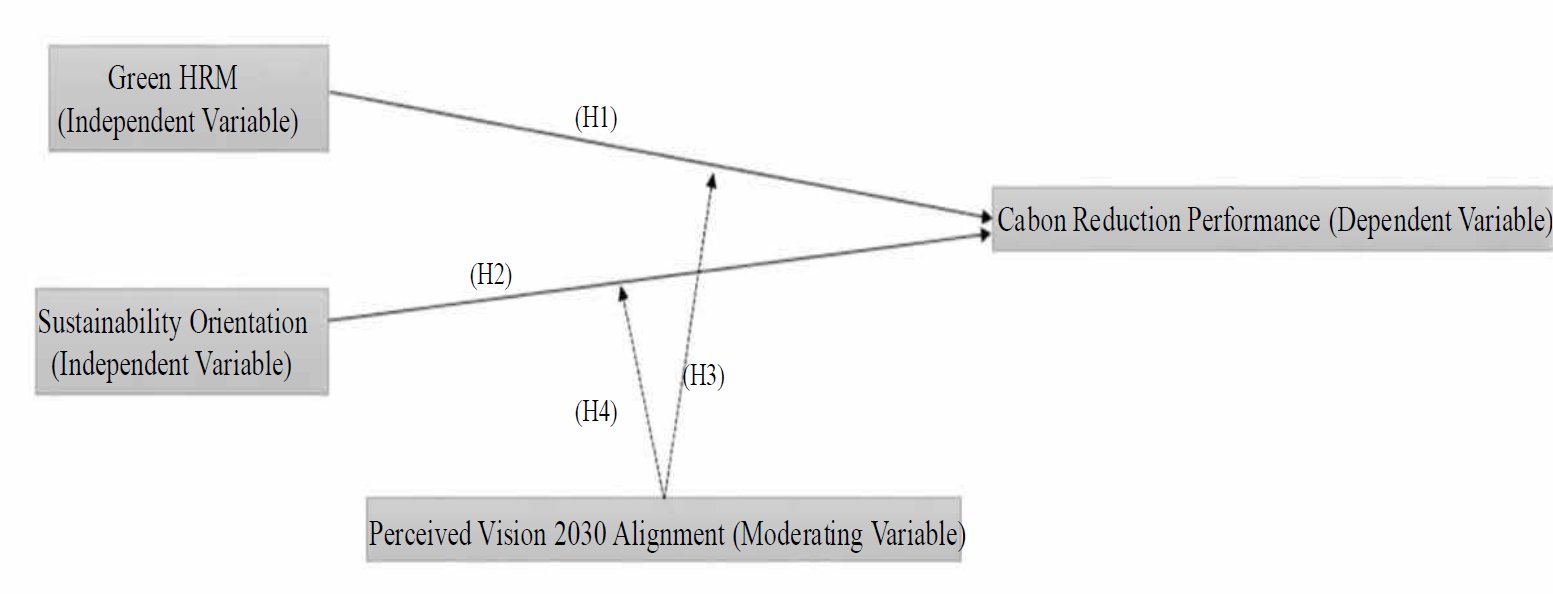
Fig. (1). Conceptual framework.
2.5. Literature Gap
Existing research commonly agrees that Green HRM and sustainability orientation can be used to enhance environmental and organizational performance. Nevertheless, most studies focus mainly on the direct correlations of these internal sustainability capabilities with broad environmental or financial performance indicators but do not investigate how this internal sustainability capabilities can be transferred into certain carbon-reduction outcomes (Altassan, 2025; Putra et al., 2025). Research in the Saudi context draws attention to the fact that corporate sustainability practices and ESG reporting are increasingly consistent with the national agenda of Vision 2030 (Basali & Alshahrani, 2025; Elfakharani, 2024); however, they seldom investigate whether such consistency can enhance the connection between internal sustainability practices and quantifiable environmental results. Equally, the international literature recognises that policy environments affect sustainability initiatives (Khuntia et al., 2025); however, there is little empirical research on how national policy alignment predisposes the relationship between internal sustainability capabilities and carbon-reduction performance. As such, a major gap in knowledge on how organizational sustainability capabilities can be converted to carbon-reduction performance exists under the conditioning effect of the national agenda. The novelty of this study is that it investigated Vision 2030 as a moderator to develop an understanding of the impact of the national agenda on the association between organizational sustainability capabilities and carbon-reduction performance in Saudi Arabian companies.
3. METHODOLOGY
The research design used in this study was a quantitative research design, which is a systematic empirical study involving numerical data to measure the relationships between constructs (Taherdoost, 2022). Quantitative research was appropriate in this study for testing the hypothesised relationships between Green HRM, sustainability orientation, perceived Vision 2030 alignment, and carbon-reduction performance, with moderating effects. The research is explanatory in nature and thus concentrates on the interplay between internal organizational practices and policy frameworks in shaping environmental outcomes and not describing trends.
The target group was the environmental and operations staff employed in sustainability-based businesses in Saudi Arabia. The choice of these participants was based on their direct participation in the implementation of sustainability initiatives. In this study, sustainability-based businesses are defined as organisations with official sustainability programs, environmental management processes, or sustainability functions that are in tandem with national environmental policies, such as Vision 2030. These companies were selected from industries where active environmental management is practiced, such as energy, manufacturing, construction, and service industries. A purposive sampling method was used, which (Obilor, 2023) defined as a form of non-probability sampling that entails the selection of a participant based on specified criteria that are applicable to the study aim. Moreover, the respondents were required to work in an organisation that publicly reports sustainability activities, has environmental management activities, or is in a sector where sustainability and environmental compliance activities are actively taking place.
An online questionnaire on Google Forms was used to collect the data. The invitations were sent through LinkedIn groups related to environmental and sustainability-related practices, namely, ‘Saudi Green Initiative’ and ‘Sustainability Professionals in Saudi Arabia’, which guaranteed the inclusion of professionals who were highly engaged in sustainability projects. Invitations were dispatched to 500 people, with 280 responding (response rate: 56%). The final analysis involved 250 responses that were filtered after a thorough screening of completeness, consistency, and elimination of statistical outliers. This sample size is deemed sufficient since it was sufficient to provide sound and strong results in structural modelling studies.
A G*Power analysis was performed to approximate the minimum number of participants required to reliably identify the proposed moderating effect. (Kang, 2021) claimed that it would require over 100 respondents for a significance level (0.05), statistical power (0.80) (probability of finding an effect that is true) and an effect size at α= 0.05. As the research had already 250 valid responses, the sample size was greater than the heuristic and statistical suggestions, and it increased the reliability of parameter estimates and the validity of the moderation analysis.
The questionnaire was divided into two parts (Appendix A), where the initial section included demographic data: gender, age, education, job position, and work experience. Past studies suggest that education level, professional experience, and other factors may affect sustainability awareness and engagement (El Khatib & Alsereidi, 2025). The second part examined the primary constructs, Green HRM, sustainability orientation, perceived Vision 2030 alignment, and carbon-reduction performance, on a five-point Likert scale (1 = strongly disagree to 5 = strongly agree). The validated scales used in previous research (Jin et al., 2019; Martusewicz et al., 2025; Tang et al., 2018) served as the foundation of items, which were modified to be content valid and contextually appropriate for Saudi organisations.
PLS-SEM was used to analyse the collected data, which (Hair et al., 2021) defined as a variance-based structural modelling method employed in prediction-focused and exploratory theory testing. This is appropriate in cases where the study is aimed at explaining a variance, moderation analysis, and complex latent constructs, as opposed to rigid theory confirmation. PLS-SEM was selected for several reasons. First, the research examines the moderating impact of perceived Vision 2030 alignment, which is better served with predictive modelling methods. Second, the model has several latent variables that are reflected in the indicators. Third, PLS-SEM does not assume a multivariate normal data distribution and works well with non-probability samples. All constructs in this study were defined as reflective measurement models because the indicators were manifestations of the latent variable and were supposed to be correlated.
Furthermore, discriminant validity was estimated using the heterotrait-monotrait ratio (HTMT), which has higher reliability and sensitivity than the traditional Fornell-Larcker criteria used to determine the lack of discriminant validity (Afthanorhan et al., 2021). The measurement model was used prior to testing the structural relationships to determine the reliability and validity of the measurement models. Cronbach’s alpha and composite reliability were used to determine construct reliability, whereas the average variance extracted (AVE) was used to determine convergent validity.
Harman single-factor test was done to measure the common method bias. The initial unrotated factor contributed 34.2% of the total variance, which is less than the 50% that (Howard et al., 2024) recommend, indicating that common method bias is unlikely to have a significant impact on the results. Furthermore, the variance inflation factor (VIF) was considered to identify possible collinearity and bias of the method, with the suggested value ranging between 3 and 5 (Hair et al. 2006, cited in Jeng, 2023). The inner VIFs were all between 1.32 and 2.41, which is far below the recommended value, thus indicating that no serious issues of common method bias existed. Moreover, non-response bias was determined using early and late respondents, and independent sample t-tests showed no statistically significant differences, which implied that there was little non-response bias in the dataset.
The study was conducted in accordance with high ethical standards. The respondents were informed of the purpose of the study, and participation was voluntary and anonymous. Consent was provided electronically, and participants were free to withdraw at any point without penalty. No personally identifiable information was gathered, and the data were kept in a safe place to be used only in an academic sense.
4. RESULTS
4.1. Descriptive Analysis
Table 1 presents descriptive analysis and indicating that the sample mainly comprised male professionals (62%), with the highest age bracket of 25-34 years (43.2%), which implies a youthful workforce. The sample was highly educated, with most respondents having a bachelor’s (43.6%) or master’s degree (40.8%). The roles in the organisation differed, but technical and sustainability specialist jobs were prevalent. The experience was mixed; almost half (48%) of the respondents had 3-10 years of experience, which boosted the validity of the information relating to sustainability practices. There was a sound representation of the energy, industrial, and service industries, and more than three-quarters of the respondents indicated moderate to direct participation in sustainability initiatives, which highlights their informed opinion on environmental management.
Table 1. Descriptive analysis of 250 respondents.
| Demographic Variable | Category | Frequency (n) | Percentage (%) |
| Gender | Male | 155 | 62.0 |
| Female | 92 | 37.0 | |
| Prefer not to say | 3 | 1.00 | |
| Age Group | Below 25 | 38 | 15.2 |
| 25–34 | 108 | 43.2 | |
| 35–44 | 68 | 27.2 | |
| 45–54 | 26 | 10.4 | |
| 55 and above | 10 | 4.00 | |
| Education | Diploma / Technical | 12 | 4.80 |
| Bachelor’s Degree | 109 | 43.6 | |
| Master’s Degree | 102 | 40.8 | |
| Doctorate / PhD | 25 | 10.0 | |
| Other | 2 | 0.80 | |
| Organizational Role | Env. /Sustainability Specialist | 67 | 26.8 |
| Operations / Technical | 82 | 32.8 | |
| Supervisor/Team Leader | 38 | 15.2 | |
| Middle Management | 40 | 16.0 | |
| Senior Management / Executive | 23 | 9.20 | |
| Experience (Years) | Less than 3 | 46 | 18.4 |
| 3–5 | 74 | 29.6 | |
| 6–10 | 63 | 25.2 | |
| 11–15 | 38 | 15.2 | |
| More than 15 | 29 | 11.6 | |
| Industry Sector | Energy / Oil & Gas | 68 | 27.2 |
| Manufacturing / Industrial | 59 | 23.6 | |
| Construction / Infrastructure | 42 | 16.8 | |
| Services | 63 | 25.2 | |
| Other | 18 | 7.20 | |
| Sustainability Involvement | Not directly involved | 21 | 8.40 |
| Occasionally involved | 37 | 14.8 | |
| Moderately involved | 78 | 31.2 | |
| Highly involved | 66 | 26.4 | |
| Directly responsible | 48 | 19.2 |
4.2. Measurement Model Analysis
Table 2 presents the results of the PLS-SEM measurement model. The construct reliability and validity, followed by structural testing, suggested the following thresholds: factor loadings = 0.70, Cronbach’s alpha = 0.70, composite reliability (CR) = 0.70, and average variance extracted (AVE) = 0.50 (Hair et al., 2021; Mia et al., 2022). The factor loadings of all indicators vary between 0.824-0.909, which is above the 0.70 mark of indicator reliability. The values of Cronbach’s alpha (0.918-0.933) and composite reliability (0.939-0.949) exceed the recommended value at 0.70, which means that there is internal consistency. The AVE (0.755-0.788) were much higher than 0.50, indicating satisfactory convergent validity. In general, the constructs were sufficiently reliable and valid, indicating their appropriateness for structural analysis.
Table 2. Measurement model.
| Latent Construct | Indicator | Factors Loading | Cronbach’s Alpha | Composite Reliability | Average Variance Extracted (AVE) |
| Carbon Reduction Performance | CRP1 | 0.856 | 0.933 | 0.949 | 0.788 |
| CRP2 | 0.888 | ||||
| CRP3 | 0.904 | ||||
| CRP4 | 0.906 | ||||
| CRP5 | 0.883 | ||||
| Green HRM | GHRM1 | 0.895 | 0.921 | 0.941 | 0.761 |
| GHRM2 | 0.859 | ||||
| GHRM3 | 0.892 | ||||
| GHRM4 | 0.879 | ||||
| GHRM5 | 0.834 | ||||
| Sustainability Orientation | SO1 | 0.879 | 0.918 | 0.939 | 0.755 |
| SO2 | 0.878 | ||||
| SO3 | 0.906 | ||||
| SO4 | 0.824 | ||||
| SO5 | 0.856 | ||||
| Perceived Vision 2030 Alignment | PVA1 | 0.845 | 0.920 | 0.940 | 0.758 |
| PVA2 | 0.869 | ||||
| PVA3 | 0.909 | ||||
| PVA4 | 0.870 | ||||
| PVA5 | 0.860 |
Note: Factor Loadings ≥ 0.70; Cronbach’s alpha ≥ 0.70; CR ≥ 0.70; AVE ≥ 0.50
4.3. Discriminatory Analysis
Table 3 shows the discriminant validity using the Heterotrait-Monotrait ratio (HTMT), which evaluates the presence of empirical differences between constructs. The recommended standard level is less than 0.90, or more conservatively, 0.85 (Afthanorhan et al., 2021; Cheung et al., 2023). All HTMT values are between 0.392 and 0.842 which is less than 0.85. Although the largest figure (0.842) between Green HRM and Carbon Reduction Performance is close to the threshold, it is still within a reasonable range. These findings confirm that each construct reflects a different concept, and there is no issue of multicollinearity or conceptual overlap. Consequently, an adequate level of discriminant validity was achieved.
Table 3. Discriminant validity through HTMT.
| – | Carbon Reduction Performance | Green HRM | Sustainability Orientation | Perceived Vision 2030 Alignment | Perceived Vision 2030 Alignment x Sustainability Orientation |
| Green HRM | 0.842 | – | – | – | – |
| Sustainability Orientation | 0.776 | 0.770 | – | – | – |
| Perceived Vision 2030 Alignment | 0.767 | 0.783 | 0.768 | – | – |
| Perceived Vision 2030 Alignment x Sustainability Orientation | 0.392 | 0.387 | 0.493 | 0.498 | – |
| Perceived Vision 2030 Alignment x GHRM | 0.423 | 0.407 | 0.518 | 0.524 | 0.840 |
Note: HTMT threshold < 0.85
4.4. Model Explanatory Power and Predictive Relevance
Table 4 provides the coefficient of determination (R2), which measures the model’s explanatory power (Hair et al., 2021). Generally, R2 values of 0.25, 0.5, and 0.75 are termed weak, moderate, and substantial, respectively. The R2 of Carbon Reduction Performance is 0.669 (adjusted R2 = 0.662) which has a moderate to substantial explanatory power. This implies that the predictors explain approximately 66% of the carbon reduction performance. The Q2 value indicates the predictive relevance of the model, which is obtained during the blindfolding process, with values above zero implying sufficient predictive power. The Q2 of 0.652 in this study indicates strong predictor relevance, meaning that the model is effective in predicting carbon-reduction performance in sustainability-oriented organisations. In general, the model has a significant explanatory and predictive strength.
Table 4. Explanatory power and predictive relevance.
| – | R-Square | R-Square Adjusted | Q-Square |
| Carbon Reduction Performance | 0.669 | 0.662 | 0.652 |
4.5. Path Coefficient Analysis
The path coefficient outcomes in Table 5 reveal that the largest positive association with carbon-reduction performance is Green HRM (β = 0.524, p < 0.001), implying that the use of green recruitment, training, and sustainability-based performance systems is positively linked to carbon-reduction performance. A significant positive relationship (β = 0.230, p < 0.003) was also observed between sustainability orientation and carbon reduction performance, implying that organisations that incorporate sustainability into their strategic goals and decision-making tendencies are more effective in achieving the aim of eliminating emissions. Although the moderating coefficients (β = 0.058 and p = 0.032) are small, they are statistically and meaningfully significant. This suggests that perceived Vision 2030 alignment has a small but significant strengthening impact on the connection between organizational sustainability practices and carbon reduction performance. Moreover, the model does not contain any control variables; therefore, the results must be interpreted cautiously.
Table 5. Path coefficient.
| – | Path coefficient | T-statistics | P-values |
| Green HRM -> Carbon Reduction Performance | 0.524*** | 8.482 | 0.001 |
| Sustainability Orientation -> Carbon Reduction Performance | 0.230*** | 2.972 | 0.003 |
| Perceived Vision 2030 alignment -> Carbon Reduction Performance | 0.113*** | 2.630 | 0.007 |
| Perceived Vision 2030 alignment x Green HRM -> Carbon Reduction Performance | 0.058*** | 2.652 | 0.008 |
| Perceived Vision 2030 alignment x Sustainability Orientation -> Carbon Reduction Performance | 0.032** | 2.576 | 0.010 |
Note: Asterisks show significant paths: ** = 0.05 (5%), and *** = 0.01 (1%)
5. DISCUSSION
The study found a positive relationship between Green HRM and carbon reduction performance, confirming H1 (β = 0.524, p < 0.001). This means that sustainability-related HR practices are closely linked to organizational carbon reduction results among Saudi sustainability-oriented companies. Notably, in this case, it indicates an association and not causality because of the cross-sectional design. This result is consistent with previous studies that propose that Green HRM enhances environmental abilities and employee involvement, which are associated with environmental performance (Ahmad et al., 2023; Kumar et al., 2025). With support for H1, it can be suggested that to achieve stronger emission control outcomes, Saudi firms need to embed environmental responsibilities into their day-to-day workplace and employee management practices.
The findings supported H2 as sustainability orientation had a positive and significant association with carbon-reduction performance (β = 0.230, p < 0.003). This indicates that organisations that exhibit greater strategic dedication to environmental responsibility are more likely to focus on carbon reduction efforts in their business operations. Sustainability orientation in Saudi sustainability-oriented firms is associated with a managerial focus on environmental performance, whereby firms can incorporate emissions reduction into larger organizational objectives. Nevertheless, the relatively moderate scale of the connection suggests that strategic sustainability commitment cannot necessarily be transformed into robust carbon reduction results in the absence of well-organised implementation instruments. The results also align with earlier research demonstrating that sustainability orientation is associated with better environmental results through its influence on organizational strategies and decision-making processes, leading to environmental responsibility (Agyapong et al., 2023; Mustapa et al., 2022; Mah et al., 2023). Therefore, organisations should make efforts to reflect their sustainability commitments in their operations so that intentions for the strategic environment can provide measurable improvements in the environmental context.
The greater impact of Green HRM on sustainability orientation can be attributed to the operational characteristics of HR practices that directly influence employees’ behaviour and the implementation of environmental programs (e.g., green recruitment, sustainability-driven performance appraisals, and environmental training). In comparison, sustainability orientation tends to be more indicative of larger-scale strategic purposes or corporate values, long-term environmental ambitions, or organizational vision, which are less directly concerned with the actual performance of operations on a daily basis. This difference underscores the fact that strategic orientation defines the path, but HR-led practices are the real tools that transform these intentions into quantifiable carbon-reduction results. It can be suggested that more benefits can be gained from having sustainability systems that are actionable rather than having mere general commitments to the environment. Thus, Saudi firms need sustainable mechanisms that can be implemented operationally.
The difference in effect size (0.524 and 0.230) also indicates that operationally embedded practices are more likely to generate a stronger measurable environmental result than strategic intents. Green HRM is directly associated with employee competencies, accountability infrastructure, and daily environmental practices that are directly related to carbon management efforts. Sustainability orientation, on the other hand, represents more general organizational values and strategic commitment that might require more implementation mechanisms before being translated into measurable operational results. This can also be indicative of the transitional phase of sustainability implementation in the Saudi Arabian environment under Vision 2030, whereby most companies have yet to translate strategic sustainability commitments into fully institutionalised operational systems.
The findings indicate that Perceived Vision 2030 alignment enhances the relationship between Green HRM and carbon-reduction performance (β = 0.058, p = 0.008), which validates its moderating role and supports H3. This means that HR-related environmental practices are more closely linked to carbon reduction results in circumstances when employees perceive that their organisations are guided by the national decarbonisation agenda in the institutional direction. In the case of Saudi companies, this underlines the need to make internal sustainability practices (green recruitment, hiring, training, and appraisals) consistent with the policy priorities of Vision 2030. These results are consistent with the literature, which proposes that sustainability policies and regulatory frameworks enhance the effectiveness of internal environmental practices by promoting the alignment of managerial systems with institutional expectations (Khuntia et al., 2025; Liu et al., 2025; Soussi et al., 2025). These findings suggest that to achieve strong organizational environmental outcomes, policymakers need to encourage firms to make visible connections between their internal sustainability systems and the Vision 2030 agenda.
The findings support H4 as Perceived Vision 2030 alignment moderates the relationship between sustainability orientation and carbon reduction performance (β = 0.032, p < 0.010). This implies that sustainability-related organizational values are positively associated with carbon reduction results when employees perceive that firms match their environmental priorities with the national decarbonisation course established within the framework of Vision 2030. For organisations, this means that aligning corporate sustainability strategies with national climate priorities can contribute to changing general environmental commitment through more systematic carbon management activities. These results are in line with other prior studies that show that national sustainability agendas and climate policies steer organisations to align internal environmental strategies with overall policy goals, enhancing environmental performance results (Basali & Alshahrani, 2025; Elfakharani, 2024). Importantly, the results of this study are consistent with those of (Altassan, 2025), who conducted a study in the UAE regarding the impact of national visions on sustainability, but differ in the strength of the effect, which may reflect the difference in the degree of maturity of green infrastructure between the two countries. These results imply that when firms align their sustainability approaches with national goals, they may have better organizational coordination and consistent environmental performance improvements.
In this regard, one can find that Vision 2030 may be seen as an institutional setting that is associated with the operationalization of sustainability-oriented approaches by firms. However, the moderating coefficients (0.058 and 0.032) are small, indicating that although policy alignment has a positive influence, other aspects may also moderate the association between internal capabilities and strategic orientation with carbon-reduction performance (organizational culture, resource constraints, or implementation fidelity). This implies that Vision 2030 offers guidance and validity but is not the sole factor defining organizational efficiency.
The institutional and sustainability governance literature implies that relatively small moderation effects are prevalent because policy and institutional variables tend to be associated with organizational outcomes indirectly and not as the driving operational factors. For example, (Gauthier, 2013) institutional sustainability research established that institutional pressures primarily work in interactive and reinforcing ways rather than having significant direct operational impacts. Moreover, research on corporate sustainability governance has demonstrated that the institutional context tends to reinforce already established sustainability systems at an incremental level, not in terms of transforming operational outcomes (Pasamar et al., 2025; Ortiz-de-Mandojana et al., 2016). Thus, the moderation coefficients are relatively small in the context of this study, which is consistent with institutional theory and studies on sustainability governance, where policy alignment tends to strengthen, legitimise, and sustain organizational sustainability capabilities rather than supplanting the internal drivers of operations.
Notably, the results do not merely substantiate the essence of sustainability practices being advantageous; they help to understand that organised HR-based competencies and institutional correspondence seem to be more strongly correlated with the carbon-cutting results than sustainability orientation in general.
THEORETICAL CONTRIBUTION
This study expands on three theoretical approaches, NRBV, Stakeholder Theory, and Institutional Theory, and reveals the interplay of internal capabilities with national policy frameworks in yielding a quantifiable carbon-reduction effect. NRBV conventionally concerns the competitive advantage created by environmentally oriented internal capabilities. This study shows that Green HRM as an internal strategic resource is not only positively associated with carbon reduction performance, but is also more effective in policy-conditioned mechanisms that the NRBV literature lacks. The Stakeholder Theory is extended by demonstrating that sustainability orientation in itself is not enough; the responsiveness of the organisation to environmental demands is only turned into concrete performance when it is systematically coordinated with institutional policy.
Institutional Theory is furthered by recognising perceived Vision 2030 alignment as a moderator to demonstrate the influential effect of coercive and normative pressures on the operational effects of HR and strategic sustainability practices. The synthesis of these perspectives enables this study to bridge a major gap: previous studies have analysed Green HRM, sustainability orientation, or policy alone, but there is little research on how internal environmental capabilities are used in the explicit contexts of decarbonisation at the national level. Overall, the contribution is that the efficacy of internal capabilities depends on policy alignment, which is a new mechanism by which national climate policy influences the mapping of organizational sustainability endeavours to concrete carbon-reduction impacts.
CONCLUSION
The study identified structured Green HRM practices as being strongly associated with carbon reduction performance. The results imply that internal environmental capabilities are also positively associated with carbon outcomes when they are congruent with the Perceived Vision 2030 alignment. Overall, the findings support the significance of capability-based deployment and institutional fit in decarbonisation initiatives at the organizational level under a national policy agenda.
LIMITATIONS AND FUTURE DIRECTION
However, this study has various methodological limitations. The cross-sectional design does not allow for monitoring dynamic changes in sustainability practices over time, and due to this design, causal relationships cannot be drawn; therefore, the results are interpreted as correlational relationships only. Longitudinal analysis may be more useful in investigating changes in policy congruency and its impact on carbon achievements. Second, the use of self-reports by environmental and operations personnel could create common method bias. Future studies should link employees’ perceptions of green HRM practices with actual published data on carbon emissions (such as ESG or annual sustainability reports). Thus, future research should support perceptual measures with objective data.
Third, the generalisability of the research is limited because it targets sustainability-oriented enterprises in Saudi Arabia. Comparative analyses across sectors or other countries with distinct national climate policies would assist in assessing the strength of the identified moderating mechanisms. Moreover, data were collected from five different sectors (Energy, Manufacturing, Services, and Construction), but the study did not investigate whether the relationships differ between these sectors. The results for service or financial firms may differ radically from those of manufacturing or construction companies, which presents an area for future research.
The results can be used by policymakers and organizational leaders working to advance Saudi Arabia’s net-zero goals, according to Vision 2030. First, the high relevance of Green HRM implies that environmental skills must be formally integrated into HR systems. This may be operationalised by asking firms to include sustainability-related criteria in job descriptions, carbon-reduction KPIs in annual performance appraisals, and certified environmental training hours in high-impact jobs. Government bodies should release standardised Green HRM implementation toolkits based on priority areas, including energy, manufacturing, and construction. Second, regulators may enhance the alignment of policies by directly associating ESG or sustainability reporting policies with HR metrics, including the intensity of green training, environmental leadership development, and incentives tied to sustainability in national reporting templates. Lastly, executive training programs structured through industry associations may help translate national carbon targets into departmental action plans that would guarantee that policy objectives are formally integrated into day-to-day operations and decision-making within enterprises.
LIST OF ABBREVIATIONS
AVE | = | Average Variance Extracted |
CR | = | Composite Reliability |
GHG | = | Greenhouse Gas |
GPR | = | Green Performance and Reward |
GRT | = | Green Recruitment and Training |
GSCM | = | Green Supply Chain Management |
GHRM | = | Green Human Resource Management |
HTMT | = | Heterotrait-Monotrait Ratio |
NRBV | = | Natural Resource-Based View |
OCBE | = | Organizational Citizenship Behavior for Environment |
PLS-SEM | = | Partial Least Squares Structural Equation Modeling |
VIF | = | Variance Inflation Factor |
AUTHORS’ CONTRIBUTIONS
M.A.A.A.Q has contributed to the study conceptualization, methodology, data analysis, interpretation of the results, and manuscript writing. B.H.S.A has contributed to the literature review, data collection, formal analysis, and manuscript editing. N.S.A.A has supervised the study, validated the findings, reviewed and revised the manuscript critically for important intellectual content, and approved the final version for publication. All authors read and approved the final manuscript.
ETHICAL APPROVAL & INFORMED CONSENT
The study was conducted in accordance with high ethical standards. The respondents were informed of the purpose of the study, and participation was voluntary and anonymous. Consent was provided electronically, and participants were free to withdraw at any point without penalty. No personally identifiable information was gathered, and the data were kept in a safe place to be used only in an academic sense.
AVAILABILITY OF DATA AND MATERIALS
The data will be made available on reasonable request by contacting the corresponding author [M.A.A.A.Q.].
FUNDING
None.
CONFLICT OF INTEREST
The authors declare that there is no conflict of interest regarding the publication of this article.
ACKNOWLEDGEMENTS
Declared none.
DECLARATION OF AI
The author used ChatGPT solely to improve the language, grammar, and readability of this manuscript. The AI tool was not used to generate, interpret, or analyze research findings, nor to formulate scientific conclusions. Following its use, the authors carefully reviewed, revised, and validated the manuscript and assume full responsibility for the accuracy, integrity, and originality of its content.
APPENDIX A
Study Title: Green HRM and Sustainability Orientation on Carbon-Reduction Performance: Perceived Vision 2030 Alignment as a Moderator
Research Team: Group of Students (Research Team)
Introduction
Thank you for considering participation in this research study. We, a group of students, are conducting a study on the relationship between Green Human Resource Management (HRM) practices, sustainability orientation, and carbon-reduction performance, with a specific focus on the moderating role of perceived Vision 2030 alignment. Your participation is valuable and will significantly contribute to the completion of this research.
Purpose of the Study
The aim of this study is to explore how Green HRM practices and sustainability orientation influence carbon-reduction performance, and how perceived Vision 2030 alignment moderate these relationships. By participating, you will help us gain insights into the role of green HRM and sustainability practices in achieving carbon-reduction targets. Your responses will assist in understanding how alignment with national sustainability objectives can enhance organizational carbon-reduction efforts.
What will I be asked to do?
You will be asked to complete a questionnaire that will take approximately 5-15 minutes to complete. The questions will focus on your experiences and views regarding Green HRM practices, sustainability orientation, and the role of perceived Vision 2030 alignment in supporting carbon-reduction performance. Your participation will help us collect essential data to support our research findings.
Confidentiality
Your responses will be kept strictly confidential. The information you provide will only be used for research purposes. No personally identifiable information will be collected. Your participation will remain anonymous.
Voluntary Participation
Participation in this study is entirely voluntary. You can choose not to participate, or withdraw from the study at any time without any consequences. If you decide to withdraw, your responses will be excluded from the final analysis.
Potential Risks
There are no anticipated risks involved in participating in this study. The questions are non-invasive and do not require sensitive personal information. If you feel uncomfortable at any point, you are free to skip any questions or withdraw.
Section A: Respondent Profile
- Gender
- Male
- Female
- Prefer not to say
- Age Group
- Below 25
- 25–34
- 35–44
- 45–54
- 55 and above
- Highest Educational Qualification
- Diploma / Technical Certification
- Bachelor’s Degree
- Master’s Degree
- Doctorate / PhD
- Other
- Current Organizational Role
- Environmental / Sustainability Specialist
- Operations / Technical Staff
- Supervisor / Team Leader
- Middle Management
- Senior Management / Executive
- Years of Professional Experience
- Less than 3 years
- 3–5 years
- 6–10 years
- 11–15 years
- More than 15 years
- Industry Sector of Your Organization
- Energy / Oil & Gas
- Manufacturing / Industrial
- Construction / Infrastructure
- Services
- Other
- Extent of Involvement in Sustainability Initiatives
- Not directly involved
- Occasionally involved
- Moderately involved
- Highly involved
- Directly responsible for sustainability initiatives
Section 2: Survey Questions
Construct | Indicator | Question Statement | 1 | 2 | 3 | 4 | 5 |
Green Human Resource Management | GHRM1 | Recruitment considers candidates’ environmental awareness. | ☐ | ☐ | ☐ | ☐ | ☐ |
GHRM2 | Employees receive environmental sustainability training. | ☐ | ☐ | ☐ | ☐ | ☐ | |
GHRM3 | Sustainability included in employee performance evaluations. | ☐ | ☐ | ☐ | ☐ | ☐ | |
GHRM4 | Employees participate in organizational environmental programs. | ☐ | ☐ | ☐ | ☐ | ☐ | |
GHRM5 | Employees rewarded for supporting environmental initiatives. | ☐ | ☐ | ☐ | ☐ | ☐ | |
Sustainability Orientation | SO1 | Sustainability integrated into organizational strategic vision. | ☐ | ☐ | ☐ | ☐ | ☐ |
SO2 | Environmental responsibility guides organizational decision making. | ☐ | ☐ | ☐ | ☐ | ☐ | |
SO3 | Management prioritizes sustainability in business operations. | ☐ | ☐ | ☐ | ☐ | ☐ | |
SO4 | Organization balances business goals with environmental protection. | ☐ | ☐ | ☐ | ☐ | ☐ | |
SO5 | Long-term strategies emphasize environmental sustainability. | ☐ | ☐ | ☐ | ☐ | ☐ | |
Perceived Vision 2030 Alignment | PVA1 | Our organization aligns its sustainability strategy with the environmental objectives of Saudi Arabia’s Vision 2030. | ☐ | ☐ | ☐ | ☐ | ☐ |
PVA2 | Our organization considers Vision 2030 priorities when developing environmental and sustainability initiatives. | ☐ | ☐ | ☐ | ☐ | ☐ | |
PVA3 | Employees in this organization are aware of the relevance of Vision 2030 sustainability goals for organizational operations. | ☐ | ☐ | ☐ | ☐ | ☐ | |
PVA4 | Vision 2030 provides a strategic reference point for our organization’s sustainability planning. | ☐ | ☐ | ☐ | ☐ | ☐ | |
PVA5 | Our organization seeks to ensure that its environmental policies are consistent with the sustainability direction of Vision 2030. | ☐ | ☐ | ☐ | ☐ | ☐ | |
Carbon-Reduction Performance | CRP1 | Organization implements programs to reduce carbon emissions. | ☐ | ☐ | ☐ | ☐ | ☐ |
CRP2 | Energy efficiency initiatives lower operational carbon emissions. | ☐ | ☐ | ☐ | ☐ | ☐ | |
CRP3 | Organization monitors and evaluates carbon reduction progress. | ☐ | ☐ | ☐ | ☐ | ☐ | |
CRP4 | Operational processes improved to support low-carbon practices. | ☐ | ☐ | ☐ | ☐ | ☐ | |
CRP5 | Organization achieves progress toward carbon reduction targets. | ☐ | ☐ | ☐ | ☐ | ☐ |
Contact Information
If you have any questions or need more information about the study, please feel free to contact the research team.
Thank you for taking the time to consider participating in this study. Your involvement is greatly appreciated.
REFERENCES
Afthanorhan, A., Ghazali, P. L., & Rashid, N. (2021). Discriminant validity: A comparison of CBSEM and consistent PLS using Fornell & Larcker and HTMT approaches. In Journal of Physics: Conference Series (Vol. 1874, No. 1, p. 012085). IOP Publishing.
https://doi.org/10.1088/1742-6596/1874/1/012085
Agyapong, A., Aidoo, S. O., Acquaah, M., & Akomea, S. (2023). Environmental orientation and sustainability performance; the mediated moderation effects of green supply chain management practices and institutional pressure. Journal of Cleaner Production, 430, 139592.
https://doi.org/10.1016/j.jclepro.2023.139592
Ahmad, F., Hossain, M. B., Mustafa, K., Ejaz, F., Khawaja, K. F., & Dunay, A. (2023). Green HRM practices and knowledge sharing improve environmental performance by raising employee commitment to the environment. Sustainability, 15(6), 5040.
https://doi.org/10.3390/su15065040
Ahmad, S., Javed, U., Sharma, C., & Siddiqui, M. S. (2025). Green human resource management: Analyzing sustainable practices and organizational impact through a Word2Vec approach. Green Technologies and Sustainability, 3(4), 100224.
https://doi.org/10.1016/j.grets.2025.100224
Alajmi, R. G. (2024). Energy consumption and carbon emissions: An empirical study of Saudi Arabia. Sustainability, 16(13), 5496.
https://doi.org/10.3390/su16135496
Al-Barakati, M. (2024). Saudi Arabia’s on the frontline of battle against climate change. Arab News PK. Available from: https://www.arabnews.pk/node/2504751/business-economy (Accessed on: 19 June, 2026).
AlKhars, M., Masoud, M., AlNasser, A., & Alsubaie, M. (2024). Sustainable practices and firm competitiveness: An empirical analysis of the Saudi Arabian energy sector. Discover Sustainability, 5(1), 146.
https://doi.org/10.1007/s43621-024-00347-7
Altassan, M. A. (2025). Sustainable leadership and green HRM: Fostering environmentally responsible organizational cultures. Sustainability, 17(20), 9331.
https://doi.org/10.3390/su17209331
Altouma, A., Bashir, B., Ata, B., Ocwa, A., Alsalman, A., Harsányi, E., & Mohammed, S. (2024). An environmental impact assessment of Saudi Arabia’s vision 2030 for sustainable urban development: A policy perspective on greenhouse gas emissions. Environmental and Sustainability Indicators, 21(1), 100323.
https://doi.org/10.1016/j.indic.2023.100323
Basali, M., & Alshahrani, S. O. (2025). Vision 2030 in action: how ESG disclosure shape financial performance in Saudi Arabia. Management & Sustainability: An Arab Review, 1-20.
https://doi.org/10.1108/MSAR-06-2025-0222
Cheung, G.W., Cooper-Thomas, H.D., Lau, R.S. & Wang, L.C. (2023). Reporting reliability, convergent and discriminant validity with structural equation modeling: A review and best-practice recommendations. Asia Pacific Journal of Management, 41, 745-783.
https://doi.org/10.1007/s10490-023-09871-y
Daily, B. F., & Huang, S. C. (2001). Achieving sustainability through attention to human resource factors in environmental management. International Journal of Operations & Production Management, 21(12), 1539-1552.
https://doi.org/10.1108/01443570110410892
El Khatib, M., & Alsereidi, F. (2025). Bridging knowledge and action: How education advances awareness and business engagement in environmental sustainability. International Journal of Theory of Organization and Practice (IJTOP), 5(1), 95-108.
https://doi.org/10.54489/wkg0rp67
Elfakharani, A. M. (2024). The Legislative Impact of Vision 2030 on Multinational Companies in Saudi Arabia. Journal of Human Security, 20(1), 33-38.
https://doi.org/10.12924/johs2024.20105
Fangqi, D., Irfan, M., & Baloch, Z. (2023). Revolutionizing quality performance through digitization, technology management, and environmental management: a cutting-edge PLS-SEM model analysis with organizational agility as mediator and culture as moderator. Frontiers in Environmental Science, 11, 1169145.
https://doi.org/10.3389/fenvs.2023.1169145
Gauthier, J. (2013). Institutional theory and corporate sustainability: Determinant versus interactive approaches. Organization Management Journal, 10(2), 86–96.
https://doi.org/10.1080/15416518.2013.801741
Hair Jr, J. F., Hult, G. T. M., Ringle, C. M., Sarstedt, M., Danks, N. P., & Ray, S. (2021). An introduction to structural equation modeling. In Partial Least Squares Structural Equation Modeling (PLS-SEM) Using R: A Workbook (pp. 1-29). Cham: Springer International Publishing.
https://doi.org/10.1007/978-3-030-80519-7_1
Howard, M. C., Boudreaux, M., & Oglesby, M. (2024). Can Harman’s single-factor test reliably distinguish between research designs? Not in published management studies. European Journal of Work and Organizational Psychology, 33(1), 1-15.
https://doi.org/10.1080/1359432X.2024.2393462
Ibrahim, M., & Mahmood, R. (2022). Proactive environmental strategy and environmental performance of the manufacturing SMEs of Karachi city in Pakistan: Role of green mindfulness as a DCV. Sustainability, 14(19), 12431.
https://doi.org/10.3390/su141912431
Islam, M.T. & Ali, A. (2024). Sustainable green energy transition in Saudi Arabia: Characterizing policy framework, interrelations and future research directions. Next Energy, 5, 100161.
https://doi.org/10.1016/j.nxener.2024.100161
Jackson, S. E., Renwick, D. W., Jabbour, C. J., & Muller-Camen, M. (2011). State-of-the-art and future directions for green human resource management: Introduction to the special issue. German Journal of Human Resource Management, 25(2), 99-116.
https://doi.org/10.2307/23279428
Jeng, C. C. (2023). Why a variance inflation factor of 10 is not an ideal cutoff for multicollinearity diagnostics. Journal of Education Studies, 57(2), 67-93.
https://doi.org/10.53106/199044282023105702004
Jin, Z., Navare, J., & Lynch, R. (2019). The relationship between innovation culture and innovation outcomes: Exploring the effects of sustainability orientation and firm size. R&D Management, 49(4), 607-623.
https://doi.org/10.1111/radm.12351
Kang, H. (2021). Sample size determination and power analysis using the G*power software. Journal of Educational Evaluation for Health Professions, 18(17).
https://doi.org/10.3352/jeehp.2021.18.17
Kauppi, K. (2022). Chapter 21 Institutional theory. In Handbook of Theories for Purchasing, Supply Chain and Management Research (pp. 320-334). Edward Elgar Publishing.
https://doi.org/10.4337/9781839104503.00025
Khuntia, R., M, H., Deepasari, K., Gupta, Y. C., R, K. (2025). Green HRM practices: From policy to employee behaviour change. Journal of Marketing & Social Research, 2(7), 149-155.
https://doi.org/10.61336/jmsr/25-07-18
Kumar, A., Sethi, S.R. & Sahoo, C.K. (2025). Greening the workforce: Unveiling the role of proactive employee behaviour in enhancing environmental performance. Strategic Business Research, 1(1), 1-12, 100005.
https://doi.org/10.1016/j.sbr.2025.100005
Legese, M. A., Zhou, S., Tiruneh, W. A., & Ying, H. (2026). How green HRM enhances sustainable organizational performance: A capability-building explanation through green innovation and organizational culture. Sustainability, 18(2), 764.
https://doi.org/10.3390/su18020764
Liu, R., Wang, Y., & Liu, C. (2025). Can green policy enhance corporate environmental performance? Evidence from China’s new energy demonstration city policy. Energies, 18(19), 5238.
https://doi.org/10.3390/en18195238
Mah, P. Y., Chuah, F., & Sahar, E. (2023). Corporate sustainability orientation, sustainable development practices, and firm performance of MSMEs in Malaysia. Asian Journal of Business Research, 13(2), 107-127.
https://dx.doi.org/10.14707/ajbr.230152
Mahajan, R., Lim, W. M., Sareen, M., Kumar, S., & Panwar, R. (2023). Stakeholder Theory. Journal of Business Research, 166, 114104.
https://doi.org/10.1016/j.jbusres.2023.114104
Martusewicz, J., Suchorski, K., Chomiak-Orsa, I., Usyk, J., Bednarowicz, Ł., & Łukaszewicz, M. (2025). From Organizational Readiness to Industry 5.0: An EFQM Model Pathway to Net Zero. Energies, 18(11), 2722.
https://doi.org/10.3390/en18112722
McDougall, N., Wagner, B., & MacBryde, J. (2019). An empirical explanation of the natural-resource-based view of the firm. Production Planning & Control, 30(16), 1366-1382.
https://doi.org/10.1080/09537287.2019.1620361
Mia, M. M., Zayed, N. M., Islam, K. M. A., Nitsenko, V., Matusevych, T., & Mordous, I. (2022). The strategy of factors influencing learning satisfaction explored by first and second-order Structural Equation Modeling (SEM). Inventions, 7(3), 59.
https://doi.org/10.3390/inventions7030059
Mishra, S., & Rath, N. (2024). Impact of Green Human Resource Management Practices on Environmental Performance of Indian Banking Sector: An Empirical Study. International Journal of Sustainable Development and Planning, 19(4), 1457–1469.
https://doi.org/10.18280/ijsdp.190423
Niazi, U. I., Nisar, Q. A., Nasir, N., Naz, S., Haider, S., & Khan, W. (2023). Green HRM, green innovation and environmental performance: the role of green transformational leadership and green corporate social responsibility. Environmental Science and Pollution Research, 30, 45353–45368.
https://doi.org/10.1007/s11356-023-25442-6
Wan Mustapa, W. N. B., Hayat, N., Fazal, S. A., Al Mamun, A., Salameh, A. A., & Zainol, N. R. (2022). Modeling the significance of sustainability orientation on the sustainability performance of micro-enterprises in an emerging economy. Frontiers in Psychology, 13, 881086.
https://doi.org/10.3389/fpsyg.2022.881086
Obilor, E. I. (2023). Convenience and purposive sampling techniques: Are they the same. International Journal of Innovative Social & Science Education Research, 11(1), 1-7. https://www.researchgate.net/profile/Esezi-Obilor/publication/398681103_Convenience_and_Purposive_Sampling_Techniques_Are_they_the_Same/links/693fe9e8a1fd01798907e406/Convenience-and-Purposive-Sampling-Techniques-Are-they-the-Same.pdf
Ortiz‐de‐Mandojana, N., Aguilera‐Caracuel, J., & Morales‐Raya, M. (2016). Corporate governance and environmental sustainability: The moderating role of the national institutional context. Corporate Social Responsibility and Environmental Management, 23(3), 150-164.
https://doi.org/10.1002/csr.1367
Pasamar, S., Bornay-Barrachina, M., & Morales-Sánchez, R. (2025). Institutional pressures for sustainability: a triple bottom line approach. European Journal of Management and Business Economics, 34(4), 460-484.
https://doi.org/10.1108/EJMBE-07-2022-0241
Putra, F. M., Lestari, I. A., & bin Zulkifli, A. F. (2025). Sustainability Orientation, Green Innovation Capability, and Competitive Advantage among ASEAN Manufacturing Firms. Journal of Economics and Management, 3(3), 104–113.
https://doi.org/10.70716/ecoma.v3i3.328
Renwick, D. W., Redman, T., & Maguire, S. (2013). Green human resource management: A review and research agenda. International Journal of Management Reviews, 15(1), 1-14.
https://doi.org/10.1111/j.1468-2370.2011.00328.x
Reuters (2024). Aramco, SLB and Linde plan to build carbon capture project. Reuters. Available from: https://www.reuters.com/sustainability/climate-energy/aramco-slb-linde-plan-build-carbon-capture-project-2024-12-04/ (Accessed on: 19 June, 2026).
Ribeiro, R. P., & Gavronski, I. (2021). Sustainable management of human resources and stakeholder theory: A review. Revista de Gestão Social e Ambiental, 15, 1-21.
https://doi.org/10.24857/rgsa.v15.2729
de Sena Silva, N., Gomes, S.C., Filho, E. J. M. A., & Galina, S. V. R. (2025). Sustainability orientation, environmental knowledge integration, and strength of ties: Governance and sustainable performance in regulated agribusiness. Corporate Social Responsibility and Environmental Management, 32(6), 7310–7325.
https://doi.org/10.1002/csr.70080
Soussi, J. C., Aljaaidi, K. S., & Alwadani, N. F. (2025). Sustainable environmental Governance and Corporate Environmental Performance: Empirical Evidence from Saudi Companies. Journal of Risk and Financial Management, 18(11), 616–616.
https://doi.org/10.3390/jrfm18110616
Unnisa, S. T., Kee, D. M. H., Alyafi-AlZahri, R., Alsanie, G., & BinSaeed, R. (2023). Corporate Sustainability and Vision 2030: Exploring ARAMCO’s role in promoting social responsibility for sustainability. Journal of Law and Sustainable Development, 11(12), e1408.
https://doi.org/10.55908/sdgs.v11i12.1408
Taherdoost, H. (2022). What are different research approaches? Comprehensive review of qualitative, quantitative, and mixed method research, their applications, types, and limitations. Journal of Management Science & Engineering Research, 5(1), 53-63.
https://doi.org/10.30564/jmser.v5i1.4538
Tang, G., Chen, Y., Jiang, Y., Paillé, P., & Jia, J. (2018). Green human resource management practices: scale development and validity. Asia Pacific Journal of Human Resources, 56(1), 31-55.
https://doi.org/10.1111/1744-7941.12147
Yuning, M., Taozhen, H., Saleem, N., & Hassan, A. H. (2024). Institutional pressure and low carbon innovation policy: the role of EMS, environmental interpretations and governance heterogeneity. Frontiers in Environmental Science, 12, 1385062.
https://doi.org/10.3389/fenvs.2024.1385062
Zehir, C., & Ozgul, B. (2020). Environmental orientation and firm performance: The mediation mechanism of green innovation. International Journal of Research in Business and Social Science, 9(5), 13-25.
https://doi.org/10.20525/ijrbs.v9i5.883
Licensed
© 2026 Copyright by the Authors.
Licensed as an open access article using a CC BY 4.0 license.
Article Contents Author Eva Troja1, * 1Microbiology Laboratory, Profarma Sh.a Pharmaceutical Company, Tirana, Albania Article History: Received: 16 May, 2026
Article Contents Author Felicia Gabriela Beresescu1, * 1George Emil Palade University of Medicine, Pharmacy, Science and Technology, Targu Mures, Romania
Article Contents Authors Saman Ismail1, * Imran Iqbal2 1Faculty of Management Science, Department of Business Administration, Salim Habib University, Karachi,
Article Contents Author Michael Dolinsky1, * 1Faculty of Mathematics and Technologies of Programming, Francisk Skorina Gomel State University,
Article Contents Author Abdul Ghafoor Memon1, * 1Emaan Institute of Management Sciences, Karachi, Pakistan Article History: Received: 01 April, 2026
Article Contents Authors Zixuan Zhao1, Ju Guo1, * 1School of Management, Chengdu University of Information Technology, Chengdu, China Article History: