











Article Contents
Article ID: CM2601105005
Views: 134Applying Design Thinking for Achieving National Education Policy Objectives through AI-Driven Solutions
 PDF
PDF
⬇ Downloads: 7
1ITM SLS Baroda University, India
Received: 03 September, 2025
Accepted: 07 Feburary, 2026
Revised: 21 January, 2025
Published: 25 March, 2026
Abstract:
The National Education Policy (NEP) 2020 emphasizes personalized, inclusive, and multidisciplinary education in India, with a strong focus on technology integration [1]. While artificial intelligence (AI) offers transformative opportunities to achieve NEP objectives, its implementation faces challenges related to contextual relevance, inclusivity, and scalability. This paper proposes using the Design Thinking (DT) framework as a human-centered methodology to bridge this gap. By mapping NEP objectives with AI-driven solutions across the five stages of Design Thinking—Empathize, Define, Ideate, Prototype, and Test—the study outlines a structured approach to innovation in education. A schematic framework is presented that aligns NEP objectives with AI technologies at each stage, thereby ensuring learner-centricity, teacher empowerment, and evidence-driven policymaking. This approach contributes to both the academic discourse on educational innovation and the practical deployment of AI in education, making it a reference point for future research and policy implementations.
Keywords: Artificial intelligence in education, design thinking, personalized learning, educational technology, human-centered innovation, national education policy.
1. INTRODUCTION
The National Education Policy (NEP) 2020 outlined an ambitious vision to reshape India’s education system, focusing on equity, inclusion, multidisciplinary learning, and technology. Among the many emerging technologies, Artificial Intelligence (AI) stands out as a powerful enabler of these goals. From creating personalized learning paths and delivering multilingual content to using predictive analytics for early interventions and providing teacher support systems, AI has the potential to transform the way education is delivered. Its capacity to analyze vast amounts of data and adapt to diverse learner needs makes it especially valuable in advancing NEP’s vision of equitable, competency-based education supported by continuous assessment.
At the same time, the road to integrating AI into India’s education system is not without obstacles. Gaps in infrastructure between rural and urban areas, limited teacher training, concerns about data privacy, algorithmic bias, and accessibility issues all present significant challenges. Overcoming these requires more than just technology—it calls for an approach that puts human needs first while turning policy ambitions into practical, sustainable solutions.
This is where Design Thinking (DT) becomes essential. Initially developed in fields like innovation and product design, DT is a human-centered methodology built on empathy, problem framing, ideation, prototyping, and iterative testing [2]. In this paper, we introduce a conceptual framework that brings DT and AI together to help meet the mandates of NEP 2020. The framework focuses on making education more personalized and inclusive, strengthening teacher professional development, and supporting evidence-based policymaking—all while keeping ethical, infrastructural, and equity concerns in view.
2. Literature Review
A. NEP and Educational Transformation
The National Education Policy (NEP) 2020 offers a comprehensive roadmap to reshape Indian education by encouraging flexibility, multidisciplinary learning, and deeper use of technology [3-5]. Scholars highlight its promise to broaden access and improve quality, but they also note significant implementation hurdles. Persistent digital divides across regions, insufficient teacher training, and limited funding for technology remain key challenges. Critics further note that while NEP lays out an ambitious digital vision, it often lacks concrete operational strategies and measurable outcomes, raising concerns about its long-term scalability and sustainability in resource-constrained settings.
B. AI in Education
Artificial Intelligence (AI) has emerged as a powerful tool in education, enabling personalized learning experiences, automating repetitive tasks, enhancing student engagement, and supporting data-driven decision-making [6, 14]. Applications such as personalized tutoring systems [7], learning analytics [8, 13], and intelligent content recommendation engines [9] demonstrate AI’s practical impact. Assistive technologies powered by AI are also improving accessibility for learners with disabilities [10]. More recently, innovations such as Generative AI and immersive technologies have begun to reshape how NEP’s vision could unfold in classrooms [11]. However, researchers caution against challenges such as algorithmic bias, data privacy risks, and inequitable outcomes, especially if AI solutions are introduced without proper policy alignment and adaptation to local contexts [12]. These risks underline the importance of developing context-sensitive frameworks and embedding ethical safeguards when leveraging AI for educational transformation.
C. Design Thinking in Educational Innovation
Design Thinking (DT) is increasingly recognized as a valuable methodology for addressing complex educational challenges. By emphasizing empathy, collaboration, creativity, and iterative problem-solving, DT encourages the development of learner-centered solutions [15-17]. In education, it has been applied to both pedagogy and technology integration, fostering 21st-century skills and promoting innovation in teaching and learning [18]. Despite its growing relevance, there remains little research that directly connects DT, AI, and the objectives of NEP 2020. This gap highlights the need for structured frameworks that can translate policy aspirations into AI-enabled practices grounded in human-centered design.
3. Research Gap and Problem Statement
Although AI solutions exist for personalized and adaptive learning, their deployment in India often lacks grounding in NEP’s specific mandates. It fails to address infrastructural and ethical challenges. No empirical or conceptual framework currently integrates NEP objectives with AI technologies through a human-centered methodology such as Design Thinking.
Research Question: How can the Design Thinking framework be applied to develop AI-driven solutions that align with and operationalize the objectives of the National Education Policy 2020 while addressing infrastructural, ethical, and equity challenges unique to the Indian context?
4. Proposed approach: Design Thinking Framework for AI-driven NEP implementation
This study introduces a Design Thinking (DT) framework to guide the use of AI in advancing India’s NEP 2020. At present, it is a conceptual model rather than a tested one; its value lies in providing a foundation for future research and policy pilots. The novelty of this framework is in mapping each DT stage to NEP priorities, while embedding specific challenges and ethical safeguards.
Stage 1 – Empathize: Understanding Stakeholders and Context
Goal: Deeply understand the educational ecosystem and challenges.
Stakeholders: Students, teachers, administrators, policymakers.
Activities: Conduct surveys and interviews to understand learning gaps, access issues and teacher needs; Observe classrooms, online learning platforms, and blended learning environments; Identify differences between urban, rural, and marginalized communities.
AI Role: Sentiment Analysis of student feedback to detect learning difficulties; Analytics to identify under-resourced areas or subjects.
Ethical Considerations: Protect privacy and sensitive student data; Avoid bias in AI models (gender, caste, region).
Stage 2 – Define: Frame the Problem in the NEP Context
Goal: Translate insights into actionable problem statements aligned with NEP objectives.
Problem Statement Examples: How might we personalize learning for students in multilingual classrooms while adhering to NEP’s mother-tongue-first approach? How can AI assist teachers in formative assessment without increasing workload? How can AI bridge gaps in STEM education in under-resourced schools?
AI Role: Identify patterns in learning outcomes and assessment data; Highlight where interventions can be most effective.
Ethical Consideration: Ensure AI recommendations are explainable and transparent; Avoid over-reliance on automation that undermines teacher authority.
Stage 3 – Ideate: Generate AI-enhanced Solutions
Goal: Brainstorm AI applications that advance NEP 2020 mandates
Ideation Techniques: Brainstorming, scenario planning, co-creation workshops with teachers, students and policy-makers.
Potential AI Solutions: Adaptive learning platforms personalized for each student; AI tutors for underserved subjects; Automated grading with feedback for skill-based learning; Career guidance systems leveraging predictive analytics.
Ethical considerations: Inclusivity – Ensure solutions support all socio-economic and linguistic groups; avoid reinforcing existing inequalities in access to technology.
Step 4 – Prototype: Build Low-fidelity AI Solutions
Goal: Develop small-scale, testable AI tools and frameworks.
Example: AI-powered chatbot for homework assistance; predictive model to identify students at risk of dropping out.
AI Role: Implement machine learning models to test personalization and recommendation features.
Ethical Considerations: Minimize data collection to only what’s necessary; Incorporate human oversight in decision-making loops.
Stage 5 – Test: Evaluate Effectiveness and Equity
Goal: Iteratively test AI solutions and refine them.
Evaluation Metrics: Learning outcomes (grades, skills); teacher and student satisfaction; engagement and participation rates.
AI Role: Continuous monitoring and adaptive feedback loops; Identify unintended consequences like bias or overdependence.
Ethical Safeguards: Bias audits on AI algorithms; Transparent reporting to policy-makers and stakeholders; Ensure human-in-the-loop for high stake decisions.
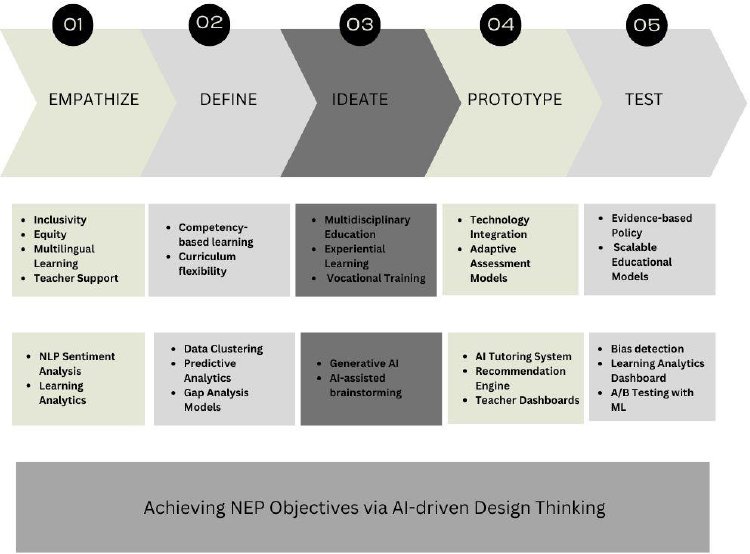
Fig. (1). Design thinking framework for AI-driven NEP implementation.
5. Expected Outcomes and Discussion
The proposed framework is expected to generate outcomes that go beyond conventional AI deployments in education by embedding Design Thinking’s human-centered principles into each stage of AI development and policy alignment. Its unique contribution lies in shifting the focus from technology-first implementation to stakeholder-driven co-creation, which addresses three persistent gaps in the Indian context:
- Contextual Relevance:
- By prioritizing empathy and iterative problem framing, DT ensures that AI tools reflect the realities of diverse Indian classrooms—such as multilingual instruction, uneven infrastructure, and socio-economic diversity—rather than relying on imported “one-size-fits-all” solutions.
- Integrated Challenge Management:
- Unlike most AI-in-education models that treat challenges (g., ethics, infrastructure) as post-implementation concerns, DT incorporates these constraints into the earliest design phases, helping developers and policymakers design for limitations rather than design around them.
- Policy-Linked Innovation:
- Mapping DT stages to specific NEP 2020 mandates (g., continuous formative assessment, multilingual education, National Educational Technology Forum pilots) enables direct traceability between policy objectives and AI design choices—something absent in existing AI or NEP studies.
Through these mechanisms, the framework aspires to create:
- Learner-centric AI systems that adapt to linguistic and cultural diversity.
- Teacher-empowerment tools that reduce administrative workload while preserving pedagogical autonomy.
- Evidence-driven policymaking dashboards that use real-time analytics for equitable resource allocation.
6. Limitations
This study is conceptual and therefore limited in several important ways:
- No empirical validation: The framework has not yet been piloted or evaluated in real classrooms, leaving its practical effectiveness untested.
- Data and ethical assumptions: Although ethical safeguards are proposed, no actual data collection was performed to test privacy or bias mitigation measures.
- Scope of NEP coverage: The framework emphasizes technology-related mandates and does not fully address other NEP goals such as teacher recruitment reforms or early childhood care.
- These limitations underscore the need for cautious interpretation and iterative refinement before policy adoption.
7. Future Work
Future research should focus on context-specific pilot studies that test the framework in diverse educational environments, for example – Rural primary schools: to examine infrastructure constraints and teacher-training needs.; Urban secondary schools: to evaluate scalability and integration with existing digital platforms and Higher-education institutions: to explore AI applications for multidisciplinary, competency-based curricula.
Such pilots should collect longitudinal data on learning outcomes, teacher adoption rates, and cost efficiency, and conduct fairness audits to detect algorithmic bias across socio-economic and linguistic groups. Comparative studies across Indian states with different digital-readiness levels could further reveal how regional policies mediate AI adoption.
In addition, future work should refine ethical guidelines aligned with India’s Digital Personal Data Protection Act (2023) and explore design modifications that accommodate emergent technologies such as generative AI or immersive learning environments.
Author’s Contribution
Madonna Lamin has contributed to data collection, data analysis and interpretation and writing of paper.
FUnding
None.
Conflict of Interest
The authors declare that there is no conflict of interest regarding the publication of this article.
Acknowledgement
Declared none.
References
[1] Government of India, National Education Policy 2020, Ministry of Human Resource Development, 2020.
[2] Brown, Change by Design: How Design Thinking Creates New Alternatives for Business and Society, HarperCollins, 2009.
[3] K. Gupta, Digital Transformation in Indian Education:Role of Computer Science under NEP 2020, International Journal of Contemporary Research in Multidisciplinary, 2025
[4] Sharma and P. Singh, “Policy frameworks and technology integration in Indian education,” Journal of Education Policy Studies, vol. 15, no. 3, pp. 45–60, 2021.
[5] Rathi,”NEP 2020 Revisiting,Reimagining and Revamping Higher Education in India: Vision 2047”, MLAC Journal for Arts, Commerce and Sciences(m-JACS) ISSN:2584-1920,2(3),2-6.
[6] Harry, “Role of AI in Education”, Injuruty: Interdisciplinary Journal and Humanity, Volume 2, Number 3, March 2023 e-ISSN: 2963-4113 and p-ISSN: 2963-3397.
[7] Woolf, Building Intelligent Tutoring Systems, Morgan Kaufmann, 2010.
[8] Ferguson, “Learning analytics: Drivers, developments and challenges,” International Journal of Technology Enhanced Learning, vol. 4, no. 5, pp. 304–317, 2012.
[9] Chen et al., “AI-driven recommendation systems in education,” IEEE Access, vol. 8, pp. 117–125, 2020.
[10] Holmes, I. Tuomi, “State of the art and practice in AI in Education”, European Journal of Education, 2022.
[11] Dutta, NEP 2020 and Generative AI, Immersive Technologies- Transforming Indian Education for Sustainable Future”,GLOBAL GOALS, LOCAL IMPACTS:38.
[12] Holmes, M. Porayska-Pomsta, and R. Sutherland, “Ethics in AI and education,” British Journal of Educational Technology, vol. 52, no. 4, pp. 1500–1516, 2021.
[13] Siemens, Learning Analytics: The emergence of a discipline”. American Behavioral Scientist, 57(10), 1380-1400, 2013.
[14] Prajapati,”Artificial Intelligence and NEP 2020: Shaping India’s Educational Future”,ADHYAPAN (Peer reviewed Multidisciplinary Journal), ISSN-2321-2195, June 2025.
[15] Liedtka, “Why design thinking works,” Harvard Business Review, vol. 96, no. 5, pp. 72–79, 2018.
[16] Oberer, A.Erkollar,” Education 5.0: Using Design Thinking process-An interdisciplinary view”,Journal of Systemics, Cybernetics and Informatics, 22(1), 1-17,2024.
[17] Thoring,R.M. Muller,”Understanding Design Thinking: A process model based on method engineering”, Proceedings of E & PDE 2011, the 13th International Conference of Engineering and Product Design Education, 2011.
[18] R. Kijima, M. Yang-Yoshihara, M.S. Sadao Maekawa,”Using Design Thinking to Cultivate the Next Generation of Female STEM Thinkers”, International Journal of STEM Education,8, Article No. 14, 2021.
Licensed
© 2026 Copyright by the Authors.
Licensed as an open access article using a CC BY 4.0 license.
Article Contents Author Grienggrai Rajchakit1 , Maria Malik1, * 1Department of Mathematics, Faculty of Science, Maejo University, Sansai 50290, Chiang
Article Contents Author Imad Ullah1, * , Mushtaq Ali1 1Riphah Institute of Informatics, Malakand Campus, Riphah International University Islamabad, Pakistan
Article Contents Author Dolly Sharma1, 2 , Rajendran Thomas1, * , Jai N. Vishwakarma2 , Devarshi Bharadwaj1 , Sadhana Ojha1
Article Contents Author Ozair Erfan1, * Ali Reza Atlas2, 1Oral and Maxillofacial Surgery, Stomatology Faculty, Herat University, Herat, Afghanistan 2Stomatology
Article Contents Author Farooq Ahmad Bajwa1, * 1Department of Management, Hainan University, Haikou, China Article History: Received: 13 April, 2026
Article Contents Authors Beenish Nawaz Awan1, * , Imran Iqbal2 1Department of Business Management, SIRM College, University of Salford, Salford,