

Article Contents
The Impact of Sustainable Infrastructure Development and Green Innovation on the Tourism Sector of KSA: The Role of Vision 2030 As An Intervening Variable
 DOI:
DOI:  PDF
PDF
⬇ Downloads: 9
1College of Business Administration, Imam Abdulrahman bin Faisal University, UAE
Received: 15 February, 2025
Accepted: 04 July, 2025
Revised: 27 June, 2025
Published: 15 July 2025
Abstract:
Research Purpose: The study evaluated sustainable infrastructure development and green innovation principles in tourism. It analysed Vision 2030’s position in mediating the relationship between sustainability and tourism and green innovation and tourism in the context of Saudi Arabia.
Research Approach: The research adopts a quantitative approach and collects primary data applying the Partial Least Squares-Structural Equation Modelling (PLS-SEM) technique.
Design and Methods: The research collected primary data from 249 respondents representing the Saudi Arabian tourism sector. The data was collected through a structured survey questionnaire based on a 5-point Likert scale. The respondents were employees of Development Company and Red Sea Global.
Findings: The findings revealed that sustainability integration in tourism is crucial for long-term growth, competitiveness, and environmental protection. The mediation test of the study confirmed that Vision 2030 strongly mediates the relationships between green innovation and tourism, as well as sustainable infrastructure development and tourism. In particular, Vision 2030 serves as a partial mediating variable in strengthening the effect of sustainability on tourism development (β= 0.304; p-value=0.000), as well as the influence of green innovation (e.g., β = 0.299, p = 0.000) on tourism growth. These findings highlight Vision 2030’s central position in fostering sustainable tourism and propelling green innovation in Saudi Arabia.
Originality &. Value: The research contributes to the academic understanding of how national policies like Vision 2030 influence sustainable development in the tourism industry. It offers a comprehensive analysis of green innovation’s role in tourism, an area underexplored in the context of Saudi Arabia. It provides actionable recommendations for industry stakeholders to enhance sustainability in tourism practices.
Research Limitation: This research is solely focused on the geographical region of Saudi Arabia, particularly the tourism sector. The data comes from only two organisations.
Keywords: Sustainable infrastructure, green innovation, vision 2030, united nations SDG 9, Tourism.
1. INTRODUCTION
Tourism is an essential economic growth factor that drives national economic development worldwide (Khan et al., 2020). Under the Vision 2030 initiative, Saudi Arabia has made tourism its principal objective, establishing economic diversification alongside oil revenue reduction (Mir & Kulibi, 2023). Saudi Arabia’s Vision 2030 has greatly promoted sustainable tourism growth. The country welcomed more than 30 million international visitors in 2024, indicating a 9.5% increase from the previous year; thus, underscoring the success of Vision 2030 initiatives in transforming the Kingdom into a prominent tourism destination (Sneieneh, 2025). The trends reflect the successful incorporation of sustainable infrastructure development and green innovation into the Vision 2030 strategy, supporting sustainable development in Saudi Arabia’s tourism industry (Alammash et al., 2021).
Tourism infrastructure development is an integral element of sustainable tourism, encompassing key physical elements like energy networks, transport networks, accommodation amenities, and waste treatment, all designed to minimise environmental degradation (Guendouz & Ouassaf, 2020). In parallel, green innovation encompasses embracing sophisticated technologies and new solutions that have a low carbon footprint while at the same time producing improved social and economic value (Shahzad et al., 2022). The convergence of green innovation and sustainable infrastructure has a synergistic impact, promoting environmental conservation and economic development in Saudi Arabia’s tourism industry (Hilmi et al., 2020). The integration facilitates national sustainability goals and enhances the sector’s competitiveness by appealing to more tourists while promoting sustainable economic growth (Almakaty, 2025).
Vision 2030 is guiding Saudi tourism to become greener and more sustainable. It resulted in over 30 million tourists visiting the country in 2024, 9% more than in 2023 (Almakaty, 2024. Vision 2030 makes this change happen by introducing clear policies and investing billions in important projects such as environmentally friendly roads and alternative energy Arab News, 2024. They encourage green innovation among tourism businesses to reduce environmental damage and help societies become more diverse and richer in economic activities (Syaputra & Prasodjo, 2023). The strategy matches the United Nations Sustainable Development Goal 9 (SDG 9), promoting sustainable infrastructure growth and innovation for long-term success in building the sector (Khan & Iqbal, 2020).
The research is grounded on the United Nations Sustainable Development Goals (SDGs), specifically SDG 8, which seeks to promote sustained and inclusive economic growth, full and productive employment, and decent work for all, and SDG 9, which seeks to build resilient infrastructure, promote inclusive and sustainable industrialisation, and foster innovation (Pauliukevičienė et al., 2025). These objectives are highly pertinent to the Saudi tourism industry, where diversification of the economy and sustainable growth form the core support columns of Vision 2030. The study seeks to analyse how green innovation and sustainable infrastructure development, including major elements connected to SDG 9, are relevant to Vision 2030 in igniting tourism industry growth while upholding SDG 8’s economic growth and employment generation agenda. The research fills a significant gap by examining the application of these SDGs to practical policies and projects that face challenges like balancing environmental conservation with fast-growing tourism expansion and economic diversification. Therefore, the study provides empirical information and actionable suggestions to policymakers and industry players, thus reinforcing Saudi Arabia’s role as a regional and international leader in sustainable tourism development, aligned with Vision 2030 objectives.
2. Literature Review
Sustainable infrastructure and green innovation have been considered as drivers for tourism development by many authors. According to (Ibrahim et al., 2021; and Waheed et al., 2023), sustainable infrastructure increases tourism sector growth by better protecting the environment and making the experience more enjoyable for travellers. Green efforts have been found to lessen the tourism industry’s effect on nature and help the industry stay resilient and competitive. Sustainable infrastructure is fundamental to tourism development, and it is essential to modernise facilities that support the SDGs. According to (Alemahu, 2023; Buryak, 2024; and Neffati & Jbir, 2024), private-sector collaboration is vital since it creates economic growth and community development. (Baloch et al., 2023) pointed out, how developed infrastructure not only enhances tourism experiences by providing reliable and efficient facilities but also contribute to environmental improvement by integration sustainable design and resource management practices. It supports the development of eco-friendly tourism and influences visitor satisfaction with the perseveration of natural resources, thereby promoting long-term sustainability in the sector (Ben Hassen, 2022).
The tourism industry’s ability to reduce environmental impact relies heavily on green innovation, such as suitable energy conservation and effective waste management systems. (Sarwar et al., 2021) showed that using green technology reduces carbon emissions in the tourism industry, which in turn helps the environment. (Maqbool et al., 2024) also supported these results by demonstrating that green innovations improve environmental welfare and increase profits in tourism, as these studies pointed out that eco-friendly technologies help maintain ecological balance as the industry expands. On the other hand, (Awwad & Hamdan, 2023) showed that green innovation is critical in making tourism more sustainable by bringing in eco-friendly systems that limit the damage to nature. (Aransyah et al., 2025) demonstrated that, adopting green innovations enhances the competitiveness of tourism destinations while promoting long-term environmental and economic benefits. The studies emphasised that turning towards green innovation allows tourist destinations to become more competitive and care for the environment and the economy over time.
According to SDG 9 within the United Nations SDGs framework, sustainable development requires infrastructure development and industrialisation (Alasgah & Rizk, 2023). The fulfilment of these objectives demands strategic coordination of economic, social, and environmental elements, and it demands participatory planning and community empowerment, according to (Mohammed, 2024). The Saudi Arabian government uses Vision 2030 as its key framework to develop sustainable tourism, which safeguards cultural heritages, creates economic development, and maintains environmental stability (Abdelkawy & Al Shammre, 2024; Al Anezi, 2021; Aldhobaib, 2025; Alzubair, 2021; and Mason, 2021).
The literature supporting Saudi Arabia’s Vision 2030 illustrates major achievements in developing sustainable tourism through massive investments in eco-friendly development schemes (Aziz & Sarwar, 2023; and Sfakianakis, 2024). Key projects like the Red Sea Project, Diriyah, AlUla, and Amaala are excellent examples of ambitious steps towards cultural conservation balanced with environmental sustainability, which has enhanced Saudi Arabia’s tourism magnetism (Khard, 2024; and Kyriakidis et al., 2024). In addition, the focused development of religious tourism to host 30 million pilgrims by 2030 highlights the government’s economic diversification intentions (Alam et al., 2023; and Alqublan, 2021). Development projects such as the Riyadh Metro and new airports increase accessibility, further promoting tourism development. Adopting eco-concrete technology in projects such as the Red Sea is a notable attempt at reducing the environmental footprint (Hilal, 2020). (Li, 2022) examined the impact of environmental perception on CSR and attitude towards CSR on sustainable tourism, while environmental behaviour was kept as a mediating variable. The case of Chinese tourism firms was chosen, where findings revealed that environmental perception and attitude towards CSR positively impacted sustainable tourism and environmental behaviour. The main focus was on enhancing the environmental infrastructure of tourism destinations to boost sustainable development.
The study by (Mir & Kulibi, 2023; Shili & Panjwani, 2020; and Miniaoui, 2020) highlights vision 2030’s significant investments in tourism infrastructure but also points to challenges in balancing rapid tourism growth with environmental conservation and cultural preservation. (Sfakianakis, 2024), underscores vision 2030’s ambitious framework aimed at economic diversification and sustainable development acknowledging the complexity of implementing these goals effectively. Therefore, the studies successfully outline Vision 2030’s advantage in massive investment and sustainable project implementation; they are more descriptive and fail to engage adequately with the issues and limitations. For example, there is little critical scrutiny of possible clashes between fast-paced tourism growth and long-term conservation efforts, and little analysis of stakeholder involvement and policy enforcement efficacy. This area of weakness perpetuates a knowledge gap in the effective challenges Vision 2030 encounters toward achieving genuinely sustainable tourism growth. Strengthening these areas is crucial to provide more well-rounded strategies that coordinate economic development, cultural heritage, and environmental stewardship in Saudi Arabia’s emerging tourism industry.
2.1. Theoretical Framework
According to the ecological modernisation theory (EMT), modern societies can achieve environmental sustainability through technological innovation, institutional reform, and integrating environmental goals with social and economic development (Aransyah et al., 2025). The theory emphasises that government actions encourage sustainability by directing changes to laws and supporting environmentally friendly technology to avoid harming the environment and the economy. In the study context, the theory explains that the sustainable development goals for infrastructure and green technology can support Saudi Arabia’s ambition for economic diversification, outlined in Vision 2030. It is suggested by the theory that moves toward modern, sustainable technologies could help the Kingdom maintain a clean environment and grow as a tourist destination.
On the other hand, the Triple Bottom Line (TBL) theory shows that focusing on environmental, social, and economic components is important for sustainable development, as noted by EMT (Abbas et al., 2025). This holistic approach promotes economically sustainable, socially accountable, and environmentally friendly tourism development. In tourism, TBL promotes the implementation of green innovations and sustainable infrastructure that not only contribute to economic performance but also enhance community welfare and conserve natural resources (Aransyah et al., 2025) Therefore, TBL presents an overall framework that converges towards the goals of sustainable tourism and maintains well-balanced development in economic, environmental, and social aspects.
H1: Green innovation positively impacts sustainable infrastructure development
As per first hypothesis, the study by (Sarwar et al., 2021) prove that green innovation contributes immensely to energy efficiency, waste management, and environmental design of infrastructure. Similarly, (Maqbool et al., 2024) confirm that technological innovation in tourism infrastructure not only enhances the environmental impact but also enhances operational efficiency, which is consistent with sustainability objectives.
H2: Vision 2030 mediates the relationship between sustainable infrastructure development and the tourism sector in KSA
The second hypothesis (H2) suggests that Vision 2030 acts as a mediator between sustainable infrastructure development and the tourism industry in KSA. It is validated by the findings that Vision 2030 serves as an effective strategic policy guide facilitating the successful implementation of sustainability programs in tourism infrastructure (Aziz & Sarwar, 2023; and Samargandi et al., 2024). In addition, (Abdelkawy & Al Shammre, 2024) claim that, Vision 2030 ensures that sustainable infrastructure projects complement national development agendas, thus driving tourism growth and sectoral competitiveness.
H3: Vision 2030 mediates the relationship between green innovation and tourism in KSA
Vision 2030 makes green innovation feasible to translate into quantifiable growth of the tourism sector by integrating innovation policy within the national development agenda. It promotes the acceptance of green technology and sustainable practices among tourism businesses through incentives, regulation, and public-private partnerships (Elfakharani, 2024). This mediator function enhances the impact of green innovation on tourism competitiveness and sustainability by creating a link with Vision 2030’s macroeconomic and environmental goals, promoting inclusive growth and establishing Saudi Arabia as a global leader in sustainable tourism.
H4: Vision 2030 has a significant and positive impact on the Tourism KSA
Vision 2030 is a strategic national plan that facilitates sustainable tourism development by linking sector growth to overall economic diversification and environmental goals (Almakaty, 2025; and Azad, 2023). With tremendous investments and regulatory changes, Vision 2030 encourages infrastructure upgrading, environmental protection, and innovation incorporation in tourism (Aziz & Sarwar, 2023). Vision 2030 makes Saudi Arabia an internationally competitive destination while combating socio-economic and environmental issues (Jimenez et al., 2023). The initiative’s unambiguous policy guidance improves stakeholders’ coordination and guarantees that tourism development contributes to positive sustainable development objectives (Mustun, 2022; and Alharb, 2023).
2.2. Conceptual Framework
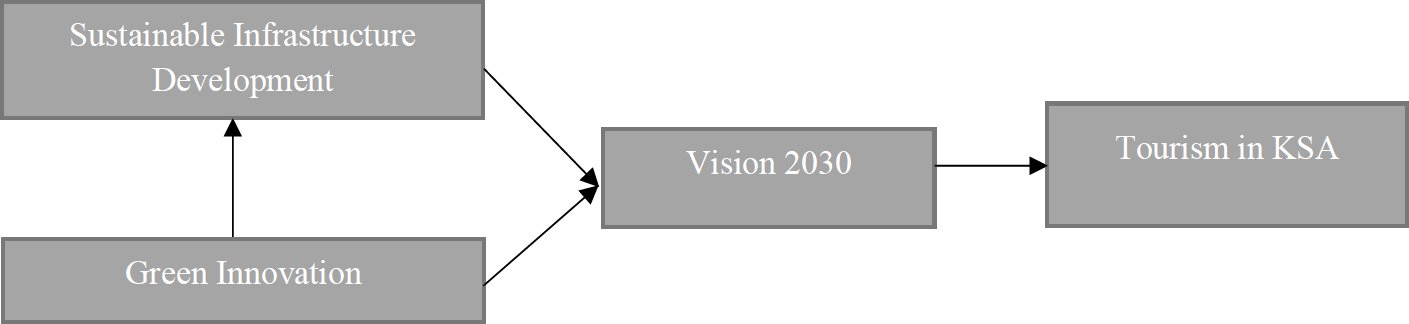
Fig. (1). Conceptual framework.
Source: Author (2025).
3. Methodology
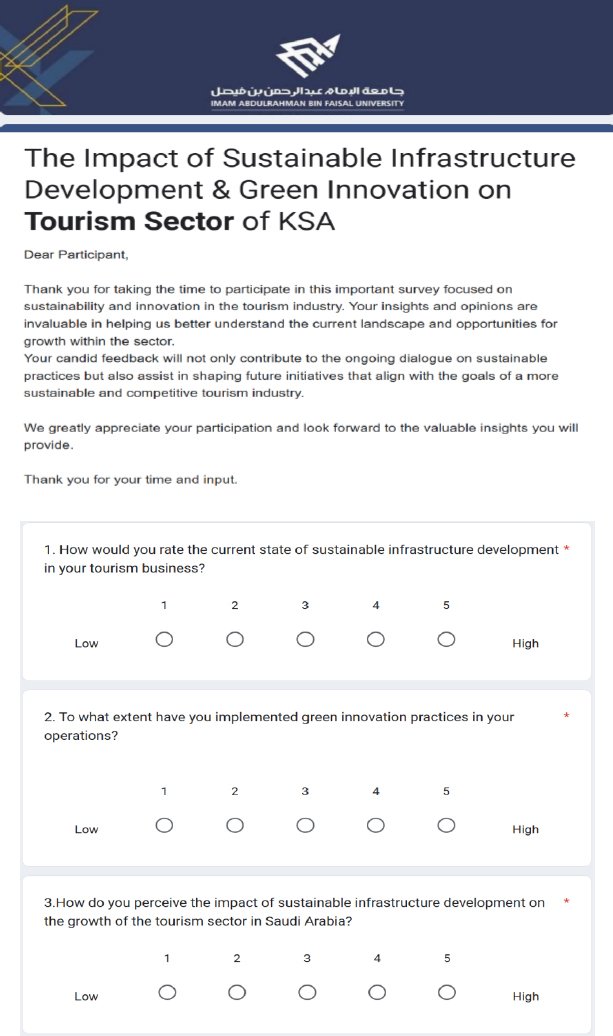
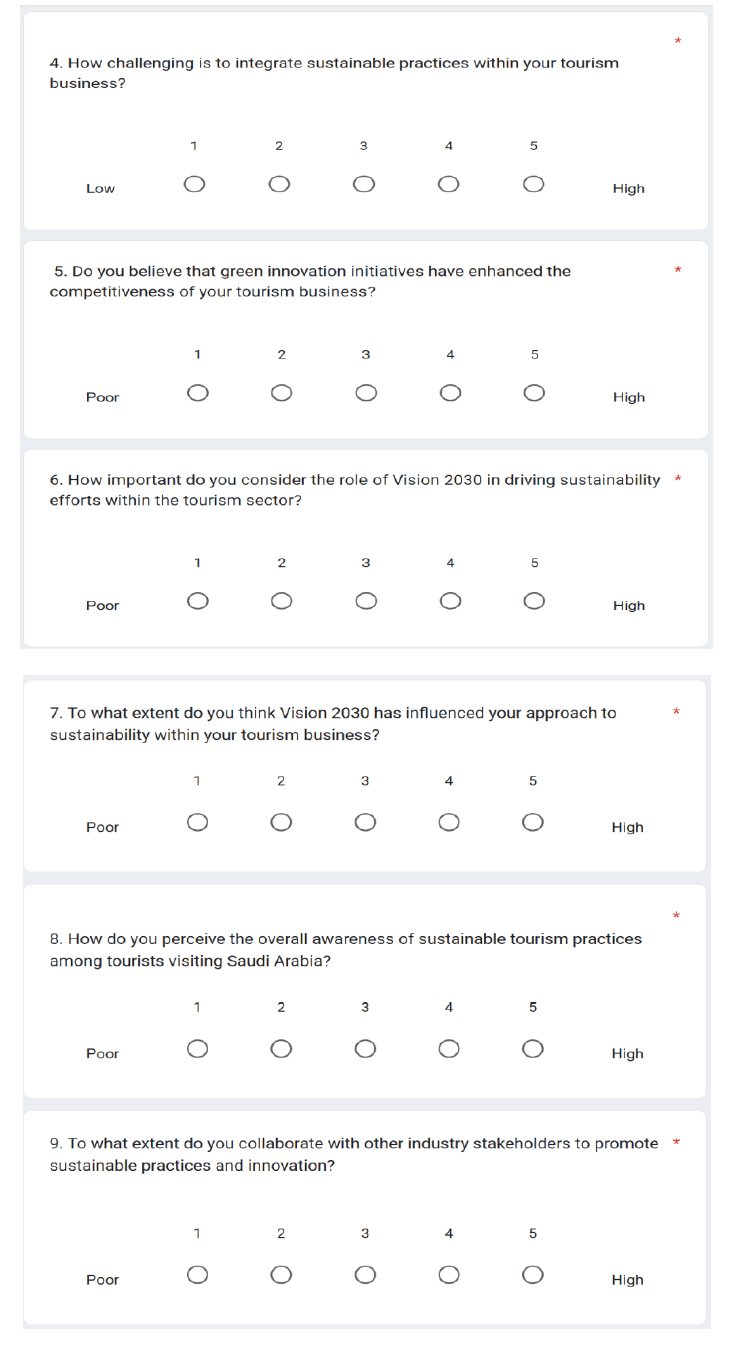
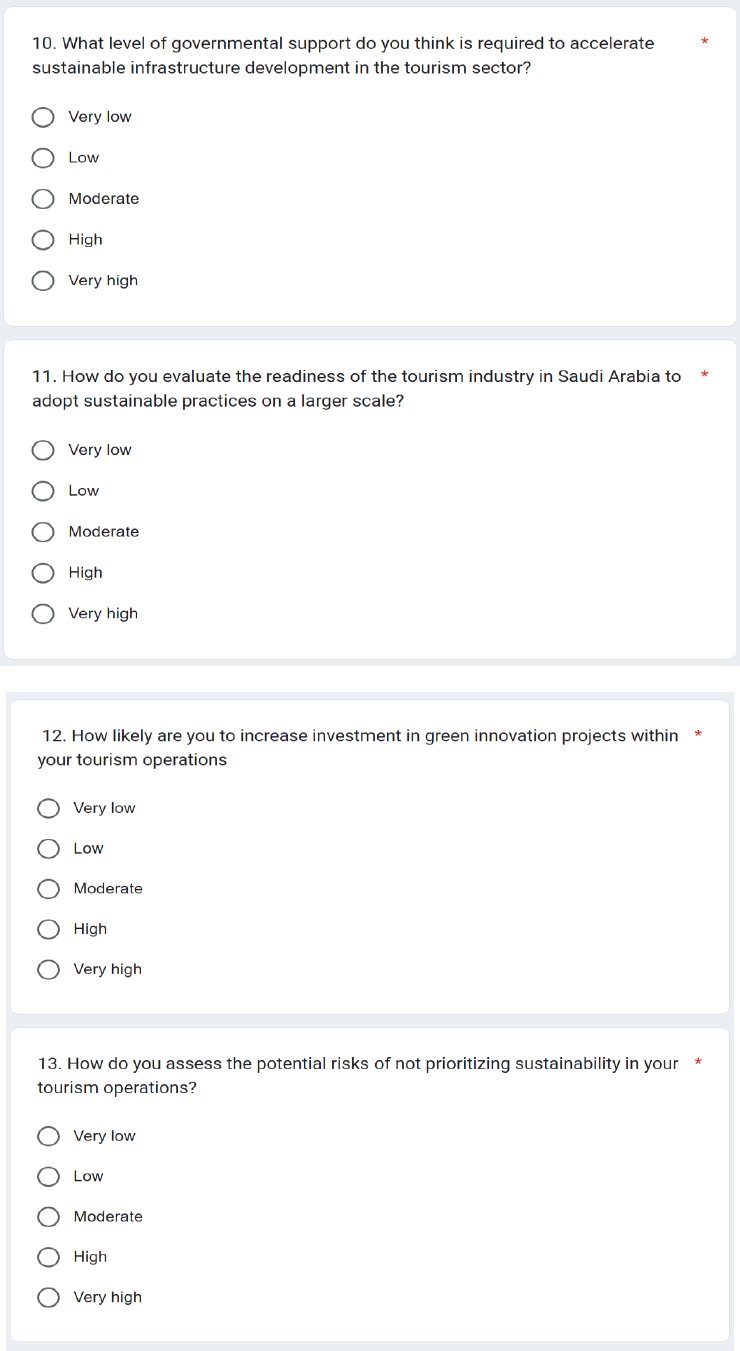
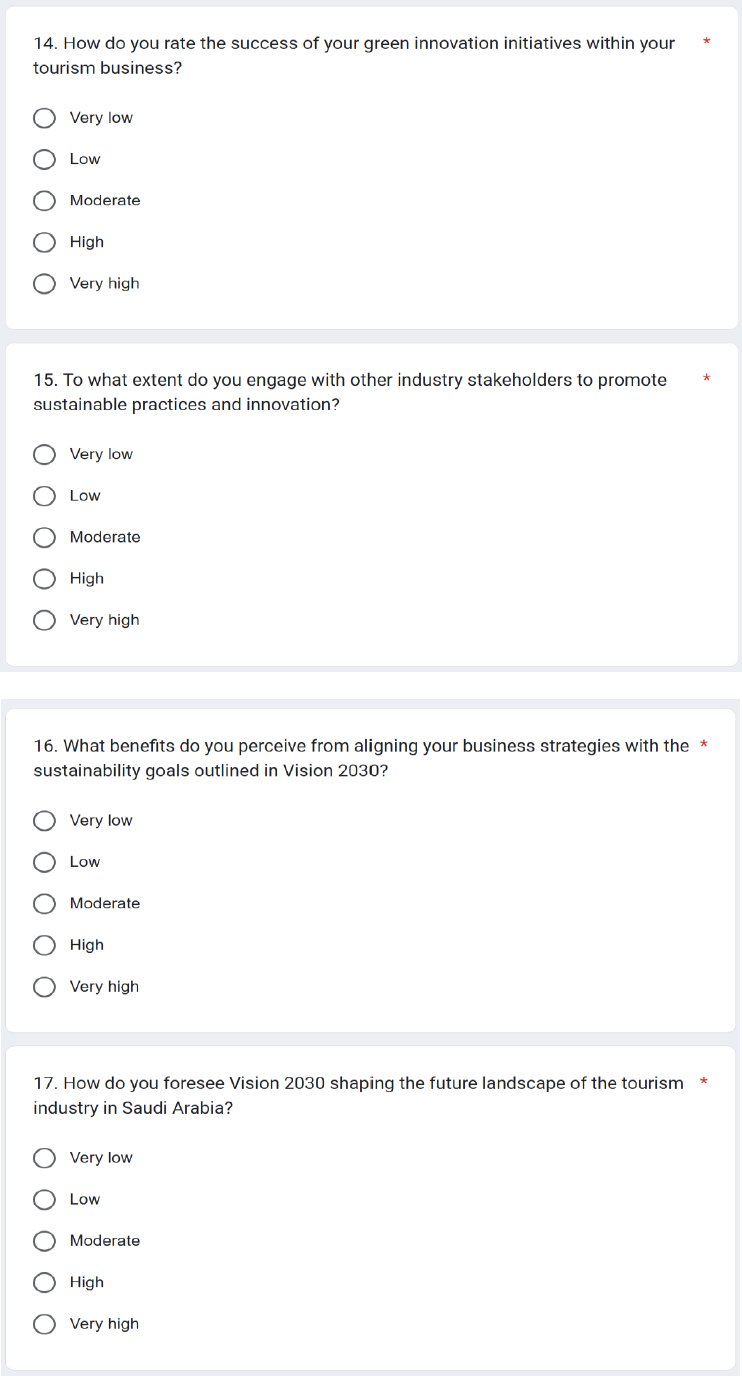
The research follows a quantitative approach to investigate how stakeholders from Saudi Arabia’s tourism industry perceive sustainable practices and how they view the influence of Vision 2030. Quantitative method was chosen for its effectiveness in systematically analysing and measuring perceptions and relationship among variables, allowing for statistical and generalisability of the findings (Duckett, 2021). The research instrument was a self-made questionnaire, which was created after studying many articles and connecting them to the main concepts in the study. The study ensured the questions were well-designed, and experts in academia and industry looked at the questionnaire. The survey questionnaire had two sections; the first asked demographic questions, and the second involved a set of 19 statements that assessed main variables where the 19th statement was an open statement. The responses were noted on a 5-point Likert scale with different anchors like “low to high,” “poor to high,” and “very low to very high” based on the statement. This scale variation in anchors was intended to most appropriately fit each statement and maximize response precision. The survey successfully captured participants’ views on various dimensions pertinent to the study.
The statements were conceptually divided to create unique variables, so that every variable represents exactly one aspect of the study. This makes both the questionnaire more transparent and the construct validity of the measurement better. Table 1 shows the statement numbers; the items of the questionnaire were systematically categorised according to their conceptual significance to create unique variables. This ensured exact measurement of every construct in the study. Sustainable infrastructure development and green innovation were identified as independent variables due to their critical roles in promoting ecological transportation, sustainable accommodation, and renewable energy projects supporting tourism development. However, 3 of them were dropped due to low loadings in the preliminary testing.
Table 1. Variable statement mapping.
| Variable | Statements Number(s) |
| Sustainable Infrastructure Development | S1, S3, S4, S10 |
| Green Innovation | G2, G5, G12, G14, G18 |
| Tourism in KSA | T8, T9, T13, T11, T15 |
| Vision 2030 | V6, V7, V16, V17 |
A total of 249 participants were recruited for the survey from two Saudi semi-governmental organisations, including Diriyah Development Company and Red Sea Global. Diriyah directs its efforts to cultural tourism developments while Red Sea Global focuses on reshaping the nation’s touristic and ecological scenarios. To achieve wide distribution, a survey distribution was made possible through WhatsApp and email. Around 70% of the participants participated in the survey, showing strong engagement from the targeted participants. Missing values were addressed through list-wise deletion to maintain data integrity, as they were minimal. Outliers were identified using standardised residuals and handled by examining their influence on the model, with extreme cases excluded where necessary. To reduce common method bias, the respondents’ anonymity was respected, and different styles of questions were used. Moreover, the Harman test revealed that common method bias did not greatly affect the study results. The test-factor showed common method bias accounted for less than 50% of the variance, indicating it did not significantly affect the study results.
Through purposive sampling, the researcher verified that participants met the experience and knowledge requirements of the Saudi Arabian tourism sector. Potential survey participants needed to demonstrate professional work in tourism development alongside organisational membership to Diriyah Development or Red Sea Global and at least three years of experience within the tourism industry. All the participants lived within Saudi Arabia while directly working on projects associated with Vision 2030’s tourism development.
The research analysis utilised Partial Least Squares Structural Equation Modelling (PLS-SEM) and Microsoft Excel for data processing. The researcher chose PLS-SEM because it is excellent in dealing with complicated associations and can process small datasets (Hair et al., 2019). The research started by examining the measurement model to establish construct validity and reliability before executing the structural model analysis to study variable relationships. Confirmatory Factor Analysis (CFA) parameters were assessed to ensure construct validity and reliability, including factor loadings, composite reliability, and Average Extracted Variance (AVE). Path testing assessed the importance and reliability of the relationships via path coefficients and t-values. The study required PLS-SEM because it matched its explanatory nature and predictive aims instead of hypothesis confirmation. Survey items were used to operationalise “Sustainable Infrastructure Development” and “Green Innovation” before PLS-SEM analysed their effects on sustainable tourism practices and Vision 2030’s impact on these dynamics.
4. Results
4.1. Demographics
As per Table 2, the population analysis of the study’s 249 respondents shows a high percentage of male respondents (60.2%) over females (39.8%), a pattern mirroring the gender balance typical among the Saudi Arabian tourism industry workforce (Alharbi, 2023). In terms of age, most respondents are in the 30–39 years category (38.2%), followed by 20–29 years (28.1%), showing a fair to young and dynamic workforce actively working towards sustainable tourism development (Mir & Kulibi, 2023). The fact that 22.1% belongs to the 40–49 age group and 11.6% belongs to the 50+ age group indicates the presence of mature professionals working for the sector. This demographic spread indicates the presence of both new ideas and experienced knowledge, which is critical for driving innovation and sustainability in terms of Vision 2030 goals.
Table 2. Demographics.
| Demographic Variable | Category | Frequency | Percentage (%) |
| Gender | Male | 150 | 60.2 |
| Female | 99 | 39.8 | |
| Age | 20 – 29 years | 70 | 28.1 |
| 30 – 39 years | 95 | 38.2 | |
| 40 – 49 years | 55 | 22.1 | |
| 50 years and above | 29 | 11.6 | |
| Total Participants | 249 | 100 |
4.2. Measurement Model Using Confirmatory Factor Analysis
As per Table 3, the reliability and convergent validity of the constructs within this research were thoroughly tested using multiple proven metrics. (Brown, 2015) explains that principal component analysis facilitates testing for component structure for discriminant, convergent validity, and reliability. In contrast, Cronbach’s alpha and composite reliability are key measures of internal consistency and reliability of latent constructs. According to (Kline, 2023), Cronbach’s alpha and composite reliability coefficients must be greater than 0.7 to confirm reliability. As per the above table, Cronbach’s alpha values for green innovation (0.768), sustainable infrastructure development (0.718), tourism in KSA (0.887), and Vision 2030 (0.766) demonstrate excellent internal consistency among the items on measurement. On the other hand, composite reliabilities for the above constructs range between 0.830 and 0.918, further verifying the stability and strength of the measurement instrument. These findings maintain that the constructs are accurately measured to ensure consistency in survey items.
Convergent validity was also established by the Average Variance Extracted (AVE), which evaluates the proportion of variance explained by a construct concerning the measurement error (Alqublan, 2021). Table 3 shows factor loadings which exceeded the threshold of 0.6, suggesting that the measurement items are acceptable. All of the constructs were sufficiently reliable and required no changes to their items, adding to the strength of the model used for measuring. (Hair et al., 2017; and Latan et al., 2017) proposed that values of AVE greater than 0.5 reflect good convergent validity. From Table 3, the AVE of green innovation (0.684), sustainable infrastructure development (0.620), tourism in KSA (0.691), and Vision 2030 (0.591) are all greater than 0.5, and this reflects clearly that the variables under observation reflect their underlying constructs well. The above indicators show the measurement model’s robustness, supporting the structural analysis’s validity and accuracy. The validity and reliability conclusions are consistent with general best practices in social sciences research and well establish a basis for interpreting path relationships in the model.
As per Table 4, the discriminant validity of the constructs is evaluated using the Heterotrait-Monotrait (HTMT) ratio, which effectively measures the differences between latent variables and prevents multicollinearity as asserted by (Wong, 2011). According to (Rönkkö & Cho, 2022), HTMT values should be less than 0.85 based on the threshold to ascertain sufficient discriminant validity. Table 4 shows interrelatedness between the study constructs, supporting that each construct is related more strongly to its indicators than to other constructs, hence supporting discriminant validity. These measure of distinctness all below the 0.85 threshold, indicate that although the constructs are connected, they are still empirically separate, affirming the model’s theoretical basis. (Hair et al., 2019; and Henseler et al., 2015). Therefore, the HTMT outcomes confirm the discriminant properties of the measurement model to maintain confidence in the following structural path analyses.
Table 3. Reliability and convergent validity testing.
| Constructs | Indicators | Factor loadings | Cronbach’s Alpha | Composite Reliability | Average Variance Extracted (AVE) |
| Green Innovation | GI1 | 0.771 | 0.768 | 0.866 | 0.684 |
| GI2 | 0.854 | ||||
| GI3 | 0.853 | ||||
| Sustainable Infrastructure Development | Sus1 | 0.790 | 0.718 | 0.830 | 0.620 |
| Sus2 | 0.819 | ||||
| Sus3 | 0.751 | ||||
| Tourism in KSA | To1 | 0.797 | 0.887 | 0.918 | 0.691 |
| To2 | 0.831 | ||||
| To3 | 0.908 | ||||
| To4 | 0.783 | ||||
| To5 | 0.832 | ||||
| Vision 2030 | Vi1 | 0.655 | 0.766 | 0.852 | 0.591 |
| Vi2 | 0.805 | ||||
| Vi3 | 0.769 | ||||
| Vi3 | 0.835 |
Table 4. Discriminant validity.
| Variables | Green innovation | Sustainability | Tourism in KSA |
| Sustainable Infrastructure Development | 0.571 | ||
| Tourism in KSA | 0.579 | 0.443 | |
| Vision 2030 | 0.826 | 0.786 | 0.835 |
Table 5. Path coefficients.
| Variables | Co-Efficients | T Statistics | P Values |
| Green Innovation -> Sustainability | 0.461*** | 10.074 | 0.000 |
| Green Innovation -> Vision 2030 | 0.431*** | 10.289 | 0.000 |
| Sustainability -> Vision 2030 | 0.439*** | 8.594 | 0.000 |
| Vision 2030 -> Tourism in KSA | 0.694*** | 18.755 | 0.000 |
Note: *** indicates significance at 1%, ** indicates significance at 5%, * indicates significance at 10%
4.3. Path Analysis
The path coefficients in Table 5 indicate statistically significant and strong direct correlations between the focal constructs. Green Innovation exerts a significant direct influence on both Sustainability (β = 0.461, p = 0.000) and Vision 2030 (β = 0.431, p = 0.000), suggesting that environmental innovation plays a significant role in both ecological objectives and national development policies. Sustainability also plays an important role in Vision 2030 (β = 0.439, p = 0.000), and Vision 2030 has a strong and direct effect on the Tourism Sector in Saudi Arabia (β = 0.694, p = 0.000), which also points to its mediating role. The above findings indicate that Vision 2030 is a structural enabler via which sustainability and innovation propel tourism growth. As (Hair et al., 2021) explain, these strong direct relationships between variables provide a good basis for testing and justifying mediation analysis in PLS-SEM models.
Table 6 shows the direct indirect effects, which demonstrate that Vision 2030 acts as a mediator of the relationship between Green Innovation and Tourism. The Green Innovation with Sustainability and Vision 2030 path is significant (β = 0.202, p = 0.000), showing that innovation promotes sustainability, which supports Vision 2030 outcomes. In addition, the indirect impact of Green Innovation with Vision 2030 and Tourism (β = 0.299, p = 0.000), and of Sustainability and Vision 2030 and Tourism (β = 0.340, p = 0.000), all indicate partial mediation because the direct relationship between Green Innovation and Tourism is still significant. This is in agreement with (Hair et al., 2019), who clarify that mediation is partial where both the direct and indirect effects are statistically significant. This fact attests that Vision 2030 is a major mechanism by which green innovation and sustainability lead to tangible growth in the tourism industry.
The Table 7 summarise the combined effect of the independent variables on the dependent variable. Green Innovation has a significant impact on Tourism (β = 0.439, p = 0.000), Vision 2030 (β = 0.633, p = 0.000), and Sustainability (β = 0.461, p = 0.000). Sustainability also has a significant impact on Tourism (β = 0.304, p = 0.000) and Vision 2030 (β = 0.439, p = 0.000). These results indicate that despite Vision 2030 playing a mediating role, the existence of large and significant direct effects affirms partial mediation. In this case, (Hair et al., 2021), state that in case both direct and indirect routes are significant, it is an exhibition of partial mediation, noting that despite Vision 2030 being an influential channel of change, Green Innovation and Sustainability also have direct influences on Saudi Arabian tourism outcomes.
Table 6. Specific indirect effects.
| Variables | Coefficients | T Statistics | P Values |
| Green Innovation -> Sustainability -> Vision 2030 | 0.202*** | 6.926 | 0.000 |
| Green Innovation -> Vision 2030 -> Tourism in KSA | 0.299*** | 8.261 | 0.000 |
| Green Innovation -> Sustainability -> Vision 2030 -> Tourism in KSA | 0.140*** | 6.653 | 0.000 |
| Sustainability -> Vision 2030 -> Tourism in KSA | 0.304*** | 8.472 | 0.000 |
Note: *** indicates significance at 1%, ** indicates significance at 5%, * indicates significance at 10%
Table 7. Total effects.
| Variables | Coefficients | T Statistics | P Values |
| Green Innovation -> Sustainability | 0.461*** | 10.074 | 0.000 |
| Green Innovation -> Tourism in KSA | 0.439*** | 11.763 | 0.000 |
| Green Innovation -> Vision 2030 | 0.633*** | 17.435 | 0.000 |
| Sustainability -> Tourism in KSA | 0.304*** | 8.472 | 0.000 |
| Sustainability -> Vision 2030 | 0.439*** | 8.594 | 0.000 |
| Vision 2030 -> Tourism in KSA | 0.694*** | 18.755 | 0.000 |
Note: *** indicates significance at 1%, ** indicates significance at 5%, * indicates significance at 10%
4.4. Model Explanatory Power
As per Table 8, the model’s explanatory power analysis is focused on the R-squared and adjusted R-squared values. As seen in Table 8, the R-squared measures for the Tourism Sector in KSA and Vision 2030 stand at 0.481 and 0.552, respectively, while the adjusted R-squared measures are very similar to these at 0.479 and 0.549. These measures give valuable information regarding the model’s predictive capability and fit. The KSA Tourism variable has a much greater R-squared value of 0.481, which means that the model’s independent variables explain nearly 48.1% of the variance in tourism performance in Saudi Arabia. A robust explanatory power is found in the Vision 2030 construct, with R-squared = 0.552. This shows that more than 55% of the variance of Vision 2030-related results is explained by the model, representing a high model fit and prescribing Vision 2030 as a key and pivotal component of the conceptual framework.
Table 8. Explanatory power.
| Variable | R-Square | R-Square Adjusted |
| Tourism in KSA | 0.481 | 0.479 |
| Vision 2030 | 0.552 | 0.549 |
5. Discussion
The investigation presents significant findings about the connections between green innovations and sustainability elements related to Vision 2030 in Saudi Arabian tourism. The results showed that Vision 2030 was the main regulating factor that successfully connected sustainable tourism initiatives with green innovation activities. The research supports previous literature studies where national strategic plans create favourable conditions for sustainable development in tourism industries (Alsweilem et al., 2024; and Rahman & Al-Borie, 2021).
The study confirms the first hypothesis since the results verify a significant positive link positive relationship between green innovation and sustainable infrastructure development. Green technologies enhance energy efficiency and better environmental design in the tourism industry. Such innovations allow tourism companies to subscribe to sustainable operating models. This aligns with (Sarwar et al., 2021), who highlighted the contribution of eco-innovation towards infrastructure modernisation.
As per second hypothesis, research demonstrates that Vision 2030 guides national policy development and infrastructure modernisation and supports the tourism industry in implementing environment-friendly technologies to foster green innovation which corresponds to the study of (Ben Hassen, 2022). The research demonstrates a strong direct connection between Vision 2030 and sustainable practices because Vision 2030 effectively controls how sustainability integrates with tourism. As reported in this study, research by (Alasgah & Rizk, 2023) demonstrates that sustainable development promotion in the tourism sector strongly depends on well-defined national policies and frameworks.
The results of this study strongly affirm that Saudi Arabia’s Vision 2030 is an important and transformational catalyst in advocating truism and green innovation in the tourism industry ensuring third hypothesis. The measurement model analysis, which has strong reliability and validity statistics, highlights the stability and importance of constructs like Green Innovation, Sustainability, Tourism performance, and Vision 2030. Path analysis identifies that green innovation positively impacts sustainability, which strongly affects achieving Vision 2030 targets and tourism development in the Kingdom. These findings support existing literature and hypothesis, highlighting Vision 2030’s pivotal position as a champion for sustainable tourism growth through creativity in green strategies (Hibatullah & Syauqillah, 2021).
Despite the positive momentum, the research also reveals significant implementation challenges. The major challenges are balancing rapid tourism sector expansion and preserving environmental conservation, efficient management of natural resources and creating frameworks that support sustainable development without affecting the progress. All the above align with issues identified in previous literature, highlighting the challenge of balancing economic growth and environmental conservation in the Saudi case (Miniaoui, 2020; and Shili & Panjwani, 2020). Stakeholder perspectives in this study mirror (Aldhobaib’s, 2025) findings on sustainable tourism’s inherent tensions between growth and conservation. The central place of stakeholder commitment and multi-sector collaboration to ensure the optimal effectiveness of Vision 2030 is also supported by existing studies by (Aliedan, 2022; Alzubair, 2021; and Neffati & Jbir, 2024), which promotes composite strategies to sustainable development.
The research contributes to the scholarly literature by illustrating how Vision 2030 is a policy guideline and a force of change that facilitates green technology and sustainable tourism practices. In agreement with (Alharbi, 2023; and Remsey, 2023), stakeholders confirm Vision 2030’s significant contribution in inspiring tourism operators to embrace sustainability, accompanied by innovation. Empirical data from the present study support recent studies by (Elfakharani, 2024; Azad, 2023; and Alharb, 2023), confirming that national strategic actions supported by vision 2030 significantly influence tourism industry validating fourth hypothesis. The overall positive perception by stakeholders of Vision 2030’s impact is in stark contrast to previous reports of lagging adoption rates by (Mustun, 2022), representing significant advances in adopting international best practices. These results confirm that Vision 2030 is reframing Saudi Arabia’s tourism sector towards a sustainable and innovative direction and pinpointing areas for ongoing improvement and policy development.
Conclusion and Recommendations
The study provides an in-depth examination of green innovation and sustainable infrastructure development in the Saudi Arabian tourism industry, underlining their importance in support of the objectives of Vision 2030. The results clearly show that sustainable actions substantially reinforce the tourism sector by protecting the environment, diversifying the economy, and conserving culture simultaneously. Vision 2030 stands out as a key reference framework that guides strategic development and promotes the convergence of green innovation throughout the industry.
To facilitate sustainable tourism growth and diversification of the Saudi economy, policymakers must prioritise building regulatory frameworks that reconcile fast-growing sector growth and environmental protection. Encouraging more public-private collaboration is needed to effectively adopt green innovation technologies and sustainable infrastructure initiatives. Investment in capacity-building programs that enhance awareness and sustainability-linked skills among tourism operators will also enhance industry resilience. Additionally, there should be continuous monitoring and adaptive management mechanisms to ensure that there is development in accordance with Vision 2030 objectives as well as global requirements for sustainability. A key recommendation for the industrial players in KSA is to increase investment in green innovation and enhancing collaboration with government bodies to implement sustainable infrastructure.
Future studies should consider expanding the scope geographically by incorporating various regions from various parts of Saudi Arabia to enable the generalisability of the findings at the national level. Using mixed methods, e.g., pairing stakeholder interviews with quantitative study, would yield more nuanced findings on the particular barriers and opportunities encountered through the implementation of sustainable tourism. Further, longitudinal research is required to explore the long-term effects of Vision 2030 on different sub-sectors of tourism and to assess the overall effectiveness of green innovation policy over time. Arabic translation of research tools could also enhance data validity and participant responsiveness, thus enhancing the general quality of research findings. Upcoming studies should focus more on in-depth knowledge of policy implementation and stakeholder coordination to drive sustainable tourism development in alignment with Saudi Arabia’s ambitious Vision 2030 plans.
Author’s Contribution
A.A. contributed to the design and implementation of the study. A.A. contributed to the analysis of the results and the writing of the manuscript. A.A. conceived of the original study and supervised the project.
AVAILABILITY OF DATA AND MATERIALS
The data will be made available on reasonable request by contacting the corresponding author [A.A.].
Finding
The people who wrote this article did not receive any financial support from anyone.
Conflict of interest
The authors declare no conflicts of interest.
Appendices
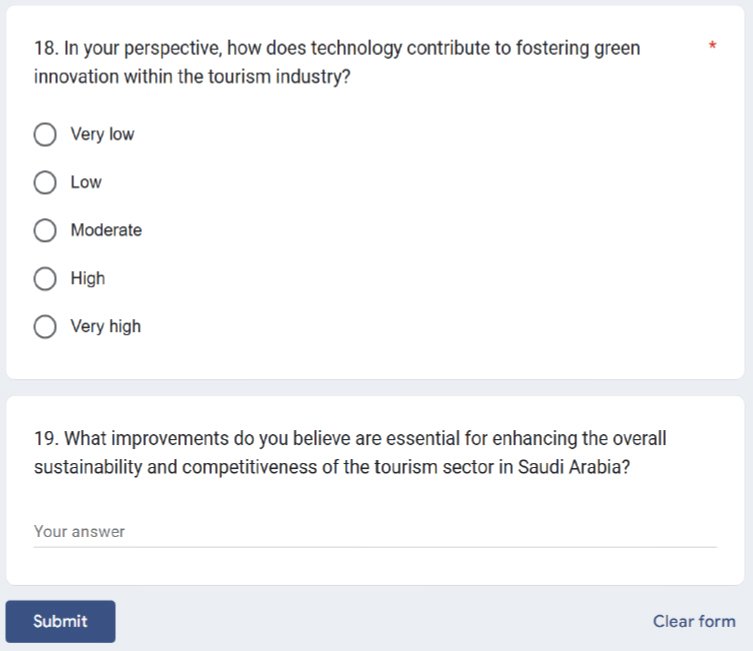
Questionnaire
Section A: Demographic Profiles
- Gender
- Male
- Female
- Age
- 20-29 years
- 30-39 years
- 40-49 years
- 50 years and above
References
Abbas, J., Mamirkulova, G., Al-Sulaiti, I., Al-Sulaiti, K.I. & Dar, I.B., (2025). Mega-infrastructure development, tourism sustainability and quality of life assessment at world heritage sites: catering to COVID-19 challenges. Kybernetes, 54(4), pp.1993-2018. DOI: https://doi.org/10.1108/K-07-2023-1345.
Abdelkawy, N.A. & Al Shammre, A.S., (2024). Fiscal Policy and Economic Resilience: The Impact of Government Consumption Alongside Oil and Non-Oil Revenues on Saudi Arabia’s GDP during Crises (1969–2022). Sustainability, 16(14), pp.1-31. DOI: https://doi.org/10.3390/su16146267.
Al Anezi, F.Y., (2021, June). Saudi vision 2030: sustainable economic development through IoT. In 2021 10th IEEE International Conference on Communication Systems and Network Technologies (CSNT) (pp. 837-841). IEEE. DOI: 10.1109/CSNT51715.2021.9509592.
Alam, F., Alam, S., Asif, M., Hani, U. & Khan, M.N., (2023). An Investigation of Saudi Arabia’s Ambitious Reform Programme with Vision 2030 to Incentivise Investment in the Country’s Non-Oil Industries. Sustainability, 15(6), p.5357. DOI: https://doi.org/10.3390/su15065357.
Alammash, S.A., Guo, P.S. & Vinnikova, A., (2021). Saudi Arabia and the Heart of Islam in Vision 2030: Impact on International Relations. Arab. J. Sci. Publ. (AJSP), 2663, p.5798. Available at: https://www.researchgate.net/profile/Saad-Alammash/publication/352135328_Saudi_Arabia_and_the_Heart_of_Islam_in_Vision_2030_Impact_on_International_Relations_s_Researcher/links/60ba7e4192851cb13d798450/Saudi-Arabia-and-the-Heart-of-Islam-in-Vision-2030-Impact-on-International-Relations-s-Researcher.pdf.
Alasgah, A.A. & Rizk, E.S., (2023). RETRACTED ARTICLE: Empowering Saudi women in the tourism and management sectors according to the Kingdom’s 2030 vision. Journal of Sustainable Finance & Investment, 13(1), pp.16-43. DOI: https://doi.org/10.1080/20430795.2021.1874217.
Aldhobaib, M.A., (2025). The New Era of the Kingdom of Saudi Arabia: Key Highlights and Future Research Agenda on Organizational Strategy. Businesses, 5(1), p.5. DOI: https://doi.org/10.3390/businesses5010005.
Alemahu, A., (2023). Saudi Arabia’s Vision 2030 and Its Regional Implication. International Journal of Public Administration and Management Research, 9(1), pp.79-85. DOI: https://doi.org/10.36758/ijpamr.
Alharbi, M., (2023). Foreign Investment Attracted by Saudi Arabia. Available at SSRN 4357486. DOI: http://dx.doi.org/10.2139/ssrn.4357486.
Aliedan, M., (2022). The geopolitics of international trade in Saudi Arabia: Saudi Vision 2030. Cuadernos de Economía, 45(127), pp.11-19. DOI: https://doi.org/10.32826/cude.v1i127.601.
Almakaty, S., (2025). Tourism Development and Management in Saudi Arabia: Strategic Approaches under Vision 2030. DOI: https://doi.org/10.20944/preprints202501.1464.v1.
Almakaty, S.S., (2024). Saudi Vision 2030 and International Media Coverage and Response: A comparative Study. International Journal of International Relations, Media and Mass Communication Studies, 12(2), pp.55-88. DOI: https://doi.org/10.37745/ijirmmcs.15/vol10n25588.
Alqublan, L.F., (2021). The adoption of technologies in The Kingdom of Saudi Arabia’s Sovereign Wealth Fund in propelling its attainment of Vision 2030 goals. DOI: https://dx.doi.org/10.2139/ssrn.4682383.
Alsweilem, K., Lepech, M., Monk, A. & Rietveld, M., (2024). Saudi Arabia: From The Big Push to The Long Push Building Resilience Beyond Vision 2030. DOI: https://dx.doi.org/10.2139/ssrn.4912451.
Alzubair, A., (2021). The Need for Economic Diversification in the Oil-Dependent Nations of Saudi Arabia, UAE, and Nigeria: Possible Pathways and Outcomes. Available at: https://research.library.fordham.edu/international_senior/68/.
Aransyah, M.F., Hermanto, B., Muftiadi, A. & Oktadiana, H., (2025). Exploring sustainability-oriented innovations in tourism: insights from ecological modernisation, diffusion of innovations, and the triple bottom line. Cogent Social Sciences, 11(1), p.2447396. DOI: https://doi.org/10.1080/23311886.2024.2447396.
Awwad, B.S.A.L. & Hamdan, A.M.M., (2023). Saudi Arabia’s Post-Oil Economic Prospects: Economic Diversification, Entrepreneurship and Women’s Empowerment. Journal of Human Resource and Sustainability Studies, 11(4), pp.903-941. DOI: https://doi.org/10.4236/jhrss.2023.114052.
Azad, S., (2023). Ushering in the Post-Oil Era: A Functional Finance Approach to Development, Diversification and Sustainability in Saudi Arabia. University of Missouri-Kansas City. Available at: https://www.proquest.com/openview/058c45cf500ec7e324cd9d847a85e8b0/1?pq-origsite=gscholar&cbl=18750&diss=y.
Aziz, G. & Sarwar, S., (2023). Revisit the role of governance indicators to achieve sustainable economic growth of Saudi Arabia–pre and post implementation of 2030 Vision. Structural Change and Economic Dynamics, 66, pp.213-227. DOI: https://doi.org/10.1016/j.strueco.2023.04.008.
Baloch, Q.B., Shah, S.N., Iqbal, N., Sheeraz, M., Asadullah, M., Mahar, S. & Khan, A.U., (2023). Impact of tourism development upon environmental sustainability: a suggested framework for sustainable ecotourism. Environmental Science and Pollution Research, 30(3), pp.5917-5930. https://doi.org/10.1007/s11356-022-22496-w.
Ben Hassen, T., (2022). The GCC economies in the wake of COVID-19: toward post-oil sustainable knowledge-based economies? Sustainability, 14(18), p.11251. DOI: https://doi.org/10.3390/su141811251.
Brown, T.A., (2015). Confirmatory factor analysis for applied research. Guilford Publications.
Buryak, A., (2024). Diversification Of the Economy as a driving factor of development on the example of Saudi Arabia. Організаційний комітет, p.95. Available at: https://duan.edu.ua/wp-content/uploads/2024/04/thesis_int_econom_36_conf_vol1.pdf#page=96.
Duckett, L. J. (2021). Quantitative research excellence: Study design and reliable and valid measurement of variables. Journal of Human Lactation, 37(3), 456-463. https://doi.org/10.1177/08903344211019285.
Elfakharani, A.M., (2024). The Legislative Impact of Vision 2030 on Multinational Companies in Saudi Arabia. Journal of Human Security, 20(1), pp.33-38. DOI: https://doi.org/10.12924/johs2024.20105.
Guendouz, A.A. & Ouassaf, S.M., (2020). The economic diversification in Saudi Arabia under the strategic vision 2030. Acad Account Financ Stud J, 24, pp.1-23. Available at: https://d1wqtxts1xzle7.cloudfront.net/103436272/The-Economic-Diversification-in-Saudi-Arabia-Under-the-Strategic-Vision-2030-1528-2635-24-5-589-libre.pdf?1686911127=&response-content-disposition=inline%3B+filename%3DThe_Economic_Diversification_in_Saudi_Ar.pdf&Expires=1748446215&Signature=aMSsZYCCuMPhY754sYrItUKSEWmMNDQW42L0MIDRwYO4iXMxVXj4Q2fjr46X21qfiOEu4xNsHg5YTCtvEPRliHZBXHUjWdxORyL0dGckZw37WBxTxM~ka1oJPDZ55gwb8q14P2MJc0g1bNkk7NLpFc0mdptyFSbQWfWk11QyLw0jcVts4vrAr8-oqZn0DZt7QPCqe9MhKXgQNE8JyL0zeICPYMDurYxeyiPneCm2byfPWo3RBSSO82chvClFlqDxfpVDSqFlpzC6EW5wRc~8pteORGmIAOoNwdzZ5uc4xgkfClH9MJW511MN74V-S7tzav188-VEPonLnTfFyz~Xdg__&Key-Pair-Id=APKAJLOHF5GGSLRBV4ZA.
Hair, Jr, J.F., Hult, G.T.M., Ringle, C.M., Sarstedt, M., Danks, N.P., & Ray, S., (2021). Mediation analysis. Partial least squares structural equation modeling (PLS-SEM) using R: A workbook, pp.139-153. https://library.oapen.org/handle/20.500.12657/51463.
Hair, Jr, J.F., Matthews, L.M., Matthews, R.L. & Sarstedt, M., (2017). PLS-SEM or CB-SEM: updated guidelines on which method to use. International Journal of Multivariate Data Analysis, 1(2), pp.107-123. https://doi.org/10.1504/IJMDA.2017.087624.
Hair, J.F., Astrachan, C.B., Moisescu, O.I., Radomir, L., Sarstedt, M., Vaithilingam, S. & Ringle, C.M., (2021). Executing and interpreting applications of PLS-SEM: Updates for family business researchers. Journal of Family Business Strategy, 12(3), p.100392. https://doi.org/10.1016/j.jfbs.2020.100392.
Hair, J.F., Risher, J.J., Sarstedt, M. & Ringle, C.M., (2019). When to use and how to report the results of PLS-SEM. European Business Review, 31(1), pp.2-24. https://doi.org/10.1108/EBR-11-2018-0203.
Henseler, J., Ringle, C.M. & Sarstedt, M., (2015). A new criterion for assessing discriminant validity in variance-based structural equation modeling. Journal of the academy of marketing science, 43, pp.115-135. https://doi.org/10.1007/s11747-014-0403-8.
Hibatullah, F. & Syauqillah, M., (2021). Saudi Vision 2030 As Political Policy to Maintain Ibn Saud’s Regime. Elementary Education Online, 19(4), pp.3622-3622. DOI: https://doi.org/10.17051/ilkonline.2021.05.736.
Hilal, N., (2020). Tourism in the Gulf Cooperation Council countries as a priority for economic prospects and diversification. Journal of Tourism and Hospitality, 9(451), pp.2167-2269. DOI: https://doi.org/10.35248/2167-0269.20.9.451.
Hilmi, N., Farahmand, S. & Belaid, F., (2020). Why should Saudi Arabia diversify its economy? Economic Development in the Gulf Cooperation Council Countries: From Rentier States to Diversified Economies, pp.89-109. DOI: https://doi.org/10.1007/978-981-15-6058-3_5.
Ibrahim, A.O., Bashir, F.M., Ojobo, H., Dodo, Y.A., Abdulmumin, I. & Christian, O.I., (2021). Opting for enriching Saudi Arabia’s tourism attraction sites towards the realisation of vision 2030. Elementary Education Online, 20(5), pp.4101-4114. DOI: https://doi.org/10.17051/ilkonline.2021.05.450.
Jimenez, E., Ellis, D. & Uyan, B., (2023). Vision 2030 and prospects for network airlines in Saudi Arabia. Transportation Research Procedia, 75, pp.260-269. DOI: 10.1016/j.trpro.2023.12.029.
Khan, M.B. & Iqbal, S., (2020). Vision 2030 and the national transformation program. In Research, Innovation and Entrepreneurship in Saudi Arabia (pp. 146-166). Routledge. Available at: https://www.taylorfrancis.com/chapters/edit/10.4324/9781351040020-7/vision-2030-national-transformation-program-muhammad-babar-khan-sadia-iqbal.
Khan, N., Hassan, A.U., Fahad, S. & Naushad, M., (2020). Factors affecting tourism industry and its impacts on global economy of the world. Available at SSRN 3559353. DOI: https://dx.doi.org/10.2139/ssrn.3559353.
Khard, F., (2024). The Role of the Fintech Industry in Saudi Arabia’s Vision 2030. DOI: http://hdl.handle.net/20.500.14131/1763.
Kline, R.B., (2023). Principles and practice of structural equation modeling. Guilford publications. Available at: https://books.google.com.pk/books?hl=en&lr=&id=t2CvEAAAQBAJ&oi=fnd&pg=PP1&dq=Kline,+R.B.,+2023.+Principles+and+practice+of+structural+equation+modeling.+Gu&ots=sWVHX261jI&sig=00yiBaGpP7EqlR-CS_4dBkzhOqs&redir_esc=y.
Kyriakidis, K., Alabdulla, R.E.A.M., AlQaidi, E.A.S.A. & Kirat, S., (2024). The Rise of the Saudi Arabia Tourism Sector: Competition/Cooperation with the UAE and Security Concerns: A Comparative Study. The Arab World Geographer, 27(1), pp.34-46. DOI: https://doi.org/10.5555/1480-6800-27.1.34.
Latan, H., Noonan, R. and Matthews, L., (2017). Partial least squares path modeling. Partial least squares path modeling: basic concepts, methodological issues and applications. https://doi.org/10.1007/978-3-031-37772-3.
Li, X., (2022). Green innovation behavior toward sustainable tourism development: a dual mediation model. Frontiers in Psychology, 13, p.930973. DOI: https://doi.org/10.3389/fpsyg.2022.930973.
Maqbool, I., Hina, K., Malik, W. & Arslan, M., (2024). Tourism, identity, and Vision 2030: A neonationalist analysis of Red Sea Global’s impact on Saudi Arabia’s future. Migration Letters, 21(S14), pp.257-271. Available at: https://www.researchgate.net/profile/Irfan-Maqbool/publication/384843603_Tourism_Identity_And_Vision_2030_A_Neo-Nationalist_Analysis_Of_Red_Sea_Global’s_Impact_On_Saudi_Arabia’s_Future/links/670985f4ffe5b7281242a8e9/Tourism-Identity-And-Vision-2030-A-Neo-Nationalist-Analysis-Of-Red-Sea-Globals-Impact-On-Saudi-Arabias-Future.pdf.
Mason, R., (2021). The nexus between state-led economic reform programmes, security, and reputation damage in the Kingdom of Saudi Arabia. In Oil and the political economy in the Middle East (pp. 124-144). Manchester University Press. https://doi.org/10.7765/9781526149107.00016.
Miniaoui, H. ed., (2020). Economic development in the gulf cooperation council countries: From rentier states to diversified economies (Vol. 1). Springer Nature. Available at: https://books.google.com.pk/books?hl=en&lr=&id=gEwFEAAAQBAJ&oi=fnd&pg=PR5&dq=Miniaoui,+H.+ed.,+2020.+Economic+development+in+the+gulf+cooperation+council+countries:+From+rentier+states+to+diversified+economies+(VolMiniaoui,+H.+ed.,+2020.+Economic+development+in+the+gulf+cooperation+council+countries:+From+rentier+states+to+diversified+economies+(Vol&ots=aBIN8qY4ai&sig=TfYBNPG7jSjbWTNEsvqlYyIcNPE&redir_esc=y#v=onepage&q&f=false.
Mir, R.N. & Kulibi, T.A., (2023). Tourism as an engine for economic diversification: An exploratory study of Saudi Arabia’s tourism strategy and marketing initiatives. Saudi Journal of Business and Management Studies, 8(8), pp.186-201. DOI: https://doi.org/10.36348/sjbms.2023.v08i08.003.
Mohammed, H.Y.A., (2024). Economic Diversification through Knowledge-Based Industries 2024. Journal of Ecohumanism, 3(8), pp.83-106. DOI: https://doi.org/10.62754/joe.v3i8.4714.
Mustun, Z.K., (2022). Sustainable development, climate change vulnerability, governance and oil rent: The case of Saudi Arabia. Journal of Emerging Economies & Islamic Research, 10(3), pp.35-62. DOI: https://doi.org/10.24191/jeeir.v10i3.19094.
Neffati, M. & Jbir, R., (2024). The impact of digitalisation and economic diversification on economic growth: evidence from Saudi Arabia. Technological and Economic Development of Economy, 30(5), pp.1510-1532. DOI: https://doi.org/10.3846/tede.2024.22105.
Pauliukevičienė, G., Stankevičienė, J. & Binh, D., (2025). Strategic insights: evaluating SDG 4, SDG 8, SDG 9 and SDG 16 in driving sustainable growth in the global FinTech landscape. Review of International Business and Strategy, 35(1), pp.27-46. https://doi.org/10.1108/RIBS-02-2024-0019.
Rahman, R. & Al-Borie, H.M., (2021). Strengthening the Saudi Arabian healthcare system: role of vision 2030. International Journal of Healthcare Management, 14(4), pp.1483-1491. DOI: https://doi.org/10.1080/20479700.2020.1788334.
Remsey, D.N., (2023). The Impact of the Renewable Energy Transition on Rentier Structures: A Case Study of Saudi Arabia since the 2014 Oil Price Plunge. http://hdl.handle.net/20.500.11956/186837.
Rönkkö, M. & Cho, E., (2022). An updated guideline for assessing discriminant validity. Organisational research methods, 25(1), pp.6-14. https://doi.org/10.1177/1094428120968614.
Samargandi, N., Islam, M.M. & Sohag, K., (2024). Towards realising vision 2030: Input demand for renewable energy production in Saudi Arabia. Gondwana Research, 127, pp.47-64. DOI: https://doi.org/10.1016/j.gr.2023.05.019.
Sarwar, S., Streimikiene, D., Waheed, R., Dignah, A. & Mikalauskiene, A., (2021). Does the vision 2030 and value added tax leads to sustainable economic growth: the case of Saudi Arabia? Sustainability, 13(19), p.11090. DOI: https://doi.org/10.3390/su131911090.
Sfakianakis, J. ed., (2024). The Economy of Saudi Arabia in the 21st Century: Prospects and Realities. Oxford University Press. Available at: https://books.google.com/books?hl=en&lr=&id=T00HEQAAQBAJ&oi=fnd&pg=PP1&dq=Sfakianakis,+J.+ed.,+2024.+The+Economy+of+Saudi+Arabia+in+the+21st+Century:+Prospects+and+Realities.+Oxford+University+Press.+&ots=tjDvlIwiJQ&sig=XnOyHaWKj9YoOW51mopGtkfTkmI.
Shahzad, M., Qu, Y., Rehman, S.U. & Zafar, A.U. (2022). Adoption of green innovation technology to accelerate sustainable development among manufacturing industry. Journal of Innovation & Knowledge, [online] 7(4), p.100231. DOI: https://doi.org/10.1016/j.jik.2022.100231.
Shili, N. & Panjwani, K., (2020). Non-oil Revenue Impact on Economic Growth: Empirical Study of Saudi Arabia’s Economy. Business and Economic Research, 10(4), pp.13-25. DOI: https://doi.org/10.5296/ber.v10i4.17587.
Sneieneh, M A, (2025). Tourism to Match Oil as Biggest Contributor to Saudi Arabia’s Economy by 2030, Minister Says’ (Arab News 2020). https://www.arabnews.com/node/2600594/amp (Accessed on: 17 May 2025).
Syaputra, F.F. & Prasodjo, H., (2023). Saudi Arabia’s Efforts in Implementing Saudi Vision 2030. Jurnal Public Policy, 9(1), pp.70-74. DOI: https://doi.org/10.35308/jpp.v9i1.6294.
Waheed, R., Sarwar, S. & Alsaggaf, M.I., (2023). Relevance of energy, green and blue factors to achieve sustainable economic growth: Empirical study of Saudi Arabia. Technological Forecasting and Social Change, 187, p.122184. DOI: https://doi.org/10.1016/j.techfore.2022.122184.
Wong, K.K.K., (2011). Book review: Handbook of partial least squares: Concepts, methods and applications. International Journal of Business Science and Applied Management, 6(2), pp.52-54. https://doi.org/10.69864/ijbsam.6-2.72
Licensed
© 2025 Copyright by the Authors.
Licensed as an open access article using a CC BY 4.0 license.
Article Contents Author Yazeed Alsuhaibany1, * 1College of Business-Al Khobar, Al Yamamah University, Saudi Arabia Article History: Received: 03 September,
Article Contents Author Muhammad Arslan Sarwar1, * Maria Malik2 1Department of Management Sciences, University of Gujrat, Gujrat, Pakistan; 2COMSATS
Article Contents Author Tarig Eltayeb1, * 1College of Business Administration, Imam Abdulrahman Bin Faisal University, Dammam, Saudi Arabia Article History:
Article Contents Author Kuon Keong Lock1, * and Razali Yaakob1 1Faculty of Computer Science and Information Technology, Universiti Putra Malaysia,
Article Contents Author Shabir Ahmad1, * 1College of Business, Al Yamamah University, Al Khobar, Kingdom of Saudi Arabia Article History:
Article Contents Author Ghanima Amin1, Simran1, * 1Department of Biological Sciences, University of Sialkot, Sialkot 51310, Pakistan Article History: Received: