






Article Contents
Relationship of Internet Usage and Sociodemographic Profile of Selected Saudi College Students
 DOI:
DOI:  PDF
PDF
⬇ Downloads: 16
1Jubail Industrial College, Royal Commission of Jubail, Kingdom of Saudi Arabia
Received: 09 April, 2025
Accepted: 20 August, 2025
Revised: 14 August, 2025
Published: 10 September, 2025
Abstract:
Objective: The Internet has been the source of countless opportunities for personal fulfilment, professional development, and value creation. It has become a vital necessity for working, learning, accessing basic services, and keeping in touch. In the last few decades, young adults, mostly students, have remained the most likely to go online. The study examined the relationship between Internet usage and the socio-demographics of selected Saudi college students.
Methodology: It utilised quantitative research, and 356 students from various programs were the respondents of the study. The self-administered survey questionnaire was used as a data-gathering instrument. Descriptive and inferential statistics, including Chi-square and ANOVA, were employed for data analysis.
Findings/Results: Findings had high correlations between sociodemographic factors and internet behaviour usage. Internet use daily and age comprised a p-value of 0.021, indicating that older students used the internet more frequently. Year-level was also significant at a p-value of 0.015, where higher use of the internet was experienced as students progressed in their course of study. In addition, living arrangements were significantly associated with internet access (p = 0.015) and daily use (p = 0.022), suggesting that students who lived in families had more consistent internet access.
Implications: The study implied that promoting healthy internet usage is crucial in educational settings to support academic performance and prevent political overuse issues.
Keywords: Survey questionnaire, sample size, ranking technique, talent management strategies, operational performance, SPSS.
1. INTRODUCTION
The origin of the internet dates back to the 1950s in the United States, when it was initially conceived for military purposes. The Advanced Research Projects Agency (ARPA), created by former U.S. President Dwight D. Eisenhower in 1958, was instrumental in delivering the ARPANET (Advanced Research Projects Agency Network), the forerunner of today’s Internet (Levine, 2019). ARPANET represented a system of communication between research institutions and became the first network that used packet-switching, which became a basic technique that made the evolution of the Internet. The aim of the ARPANET was to help American military technology stay ahead of its enemies (National Science and Media Museum, 2020). Since then, the internet has quickly grown and become a global interconnected network of networks, or the Internet. It became a mechanism for information dissemination and a medium for collaboration and interaction between individuals regardless of geographic location (Internet Society, 2017). As per (Thompson & Thompson, 2025), the total number of individuals who use the internet globally in 2025 is expected to reach 5.56 billion, 67.9% of the total global population, and the number of users grew by 2.5% in 2024. Internet activities and technologies are increasing rapidly, becoming the source of countless opportunities for personal fulfilment, professional development, and value creation. It has become a vital necessity for working, learning, accessing basic services, and keeping in touch. With the growing use of the internet, excessive use of it could interfere with daily activities, which may become a big concern. The higher Internet penetration rate could possibly cause Internet addiction, especially among youngsters. (Cheng & Li, 2014) found that internet addiction around the world is about 6%.
The excessive use of the internet by young adults, especially university students, is becoming a growing concern all over the world (Lozano-Blasco et al., 2022). Even as the use of the internet has numerous benefits, such as access to information, education, and communication, it has also led to an increased level of internet addiction, particularly among adolescents and young adults. The rapid adoption of smartphone usage and access to internet services, especially through government initiatives like the provision of free Wi-Fi hotspots in Saudi Arabia, has pushed individuals towards staying connected almost the entire day. However, excessive use of the internet, especially for non-academic purposes like social networking websites and entertainment, can have negative consequences in the form of a fall in academic performance, withdrawal from social interactions, and psychological distress (Peckham, 2021). With the Kingdom witnessing rapid technological advancement, there is a need to consider how such advancement influences the digital behaviour of Saudi university students. This research aims to fill the gap in the knowledge of the relationship between internet usage and demographics for Saudi students at the university level and provide insights into how excessive use of the internet impacts them academically, socially, and psychologically. There is a great need to research Saudi students because of the high level of technological development in the Kingdom and the specific socio-cultural situation, which can affect the use of the internet and academic outcomes. These aspects will assist in developing effective interventions to support healthier internet interactions with Saudi youth.
This research is timely due to the rapid growth of internet usage and access in Saudi Arabia, particularly among the young population. The position of Saudi Arabia among the top nations in internet speed and 5G technology has significantly heightened the coverage of digital platforms, and young adults (Naar, 2020; Saquib, 2020). In this regard, the relationship between internet usage and young adults’ behaviours is crucial in addressing the potential hazards of excessive internet usage, such as internet addiction. Since college students spend most of their time online, it is important to identify the effect that it has on their academic performance, interpersonal relationships, and psychological well-being. The pressing question is one of identifying the causes of disordered internet use in order to inform policies and interventions that will foster responsible internet use among young adults.
Moreover, the findings of this study would be beneficial to different stakeholders, including policymakers, educators, healthcare professionals, and families. The policymakers in Saudi Arabia can use the findings to initiate and develop digital literacy and awareness education programs to avert internet addiction and promote healthy use of the internet. Educators will be able to better understand the impact of internet usage on students’ academic performance and health and, therefore, come up with interventions that enable students to balance their offline and online activities. Health professionals, and particularly psychologists and counsellors, will benefit from a better understanding of the impacts of internet addiction on young adults so that they can improve their intervention techniques. The findings can be used by families to guide their children toward making choices regarding internet use and its effects. Additionally, the novelty of this research is that it addresses Saudi college students, and there are no extensive studies on them in terms of internet addiction and its impact. While internet addiction studies have been so prosperous across the globe, research examining how internet usage and demographic factors correlate in conservative societies like Saudi Arabia is scarce. In addition, the research will bridge the literature gap in recognising the influence of internet usage on Saudi students’ social and academic lives, giving valuable information for policy and intervention development in a globally digitalised world.
2. LITERATURE REVIEW
According to several studies, sociodemographic status has a relative influence on the use of the Internet (Tirado-Morueta et al., 2017). Scholars have also argued that ‘there is a strong association between age and the so-called digital divide’ and have coined the term age-based digital divide to describe the lack of access, skills, and knowledge that can result in older citizens being ‘information poor’. Several studies have affirmed that internet usage is associated with academic performance. Learners who spent time on the internet for study purposes for less than 1 hour have the lowest GPA, and those who spent more than 3 hours have the highest GPA (Chowdhury et al., 2020; Fatema et al., 2020; Talwar et al., 2018). (Rao et al., 2022) concluded that the internet has become a vital want that has taken a prominent place among the social needs of humans as social beings. Humans become self-reliant only once they gain the aspired likeability, admiration, and approval. Thus, the birth of new levels of needs and inclusion.
According to (Jaffery, 2018), Saudi Arabs spend most of their time online. A report found that the daily average time spent on the Internet by Saudi Arabians is 8 hours and five minutes in 2022 (Global Media Insight, 2022). (Firdos et al., 2022) revealed that most Saudi medical students are used to browsing social networking sites daily, including most of WhatsApp, Facebook, YouTube, and Instagram. Being connected with their loved ones positively influences their well-being, thus significantly affecting their academic performance. (Hamza et al., 2021) confirmed in their study that most students agreed that social networking media have a positive influence on their academic performance. It was also found out that no correlation between social internet addiction and academic performance, as the majority were found to be addicted by the screening, regardless of whether they had high or low CGPAs, which seems to be a matter of time management.
(Nasrullah & Khan, 2019) revealed that students enjoy meeting new friends online using social media rather than meeting in person, and for this reason, they spend a lot of time addicted. (Alkhalaf et al., 2018) found a positive impact of WhatsApp, revealing that the time spent on WhatsApp usage was directly proportional to the symptoms of addiction and weak academic performance.
(Aljabry et al., 2017) discovered that the most common internet application being used by Jazan University students is social media (Facebook), which affects the academic performance of students negatively. Students were found using social media, particularly during classes or lectures, which interfered with their learning. (Alakloby, 2017) established that, as social media technologies are used for communication and incorporated in higher education, they have a significant impact. Twitter usage in higher education has increased in the Arab World, especially in the Kingdom of Saudi Arabia, and has impacted student achievements.
The study by (Alwagait et al., 2014) stated that social media is a popular method for communication among university students in Saudi Arabia. The results highlighted that besides social media use, time management is a factor that affects students’ studies negatively.
Moreover, a number of studies have been conducted to determine the degree of internet use and academic performance; the results have indicated both positive and negative results. As an example, (Tirado-Morueta et al., 2017) discovered that sociodemographic characteristics play an essential role in the control of internet consumption, and it was established that age had a significant effect. Nevertheless, the cross-sectional nature of the study is also its limitation because this study takes only a snapshot of the behaviour of internet use and does not analyse its long-term impacts. On the same line, the concept of age-based digital divide described by (Alshalawi, 2021) states that older citizens encounter more problems on their way to obtaining and efficiently using the internet, which may result in information poverty. Although this piece of research has rich information on the generational gap, it does not give a concrete realisation of the relationship between the digital divide and particular academic results. In addition, the research of (Chowdhury et al., 2020; and Fatema et al., 2020) indicates a positive correlation between time spent online studying and study GPA. However, such studies fail to recognise the intricacy in the way internet usage affects various models of learning, which leaves a gap in the comprehension of this issue, as far as these factors are concerned. Conversely, (Firdos et al., 2022) discovered that overuse of social media has the potential to adversely impact academic performance, and the major constraint was an insufficient analysis of the nature of social media usage among the students. All of these studies emphasise the importance of additional research concerning the impact of internet usage and its purpose and background, with a particular emphasis on social media, on academic performance and social well-being.
2.1. Theoretical Framework
According to Maslow’s Hierarchy of Needs, human motivation is based on the pursuit of different levels of need, such as physiological, safety, social, esteem, and self-actualisation (Huang, 2024). Nowadays, individuals, especially youngsters, are trying to fulfil these needs through the internet. As per (McLeod, 2025), the social need, the third level of Maslow’s hierarchy that relates to human interaction, is the need that most individuals are trying to satisfy through the internet. Personal relationships with friends, family, and lovers play an important role, as do involvement in groups (Cherry, 2022). According to (Yang et al., 2023), social needs, including the desire for communication, connection, and community, are factors driving internet usage. Another need that the internet can gratify is esteem, the fourth level of Maslow’s hierarchy of needs. Esteem needs are related to a person’s need to gain recognition, status, and feel respected. Esteem need is the attention and credit received from others. According to (Wang et al., 2022), interactive applications such as discussion groups, chatrooms, and e-mail were found to fulfil the need for social interaction, including the formation of new relationships and maintaining existing ones. According to (Ruffin, 2022), self-esteem is a realistic respect or favourable impression of oneself, and it is pointed out that self-esteem is deeply correlated with external validation.
Individuals with unsatisfied social and esteem needs found the internet as a platform to gratify these needs. The “Uses and Gratification Theory” asserts that people use media to gratify specific wants and needs (Saeed & Ullah, 2021). As per (Sichach, 2023), uses and gratifications were first introduced in the 1940s to study how people choose to consume various forms of media. The uses and gratifications theory relies on two principles regarding media users. First, it characterises media users as active in their selection of the media they consume, and secondly, people are aware of their reasons for selecting different media options (Daniel, 2024). Uses and gratifications have uncovered several motivations people often have for consuming media. These include force of habit, companionship, relaxation, passing the time, escape, and information (Vinney, 2019).
Individuals turn to the internet to satisfy their unfulfilled needs, but if they are not controlled, it can affect their daily functions and activities. According to (Bai et al., 2022), excessive use of the internet leads to impaired functioning due to preoccupation. (Soegoto & Tjokroadiponto, 2018) argued that internet usage affects both the academic performance and social life of students, and the number of hours spent on the internet affects students’ social life unless the internet is used for learning or academic purposes. (Daniel, 2024) concluded that the use of the internet has a positive impact on the academic performance of students. (Sushma et al., 2014) found that the more time spent with the Internet, the higher the risk of a student becoming addicted to it.
Moreover, the impact of internet usage on academic performance has garnered a lot of attention in the last several years, with inconclusive evidence of its positive and negative impacts. On one side, several studies suggest the potential of internet usage to enhance academic performance by offering easy access to information and facilitating collaboration. (Aljabry et al., 2017) are of the opinion that social media sites can provide beneficial networking for medical students via simple communication and cooperation. Similarly, (Chowdhury et al., 2020) found that internet usage, as influenced by demographic factors such as age, gender, and education, can enhance the ability of students to understand and apply online content efficiently. This would mean that if properly harnessed, the internet can also be utilised as a tool for learning, particularly for those with more years of schooling and those who utilise it for academic purposes. Furthermore, (Alwagait et al., 2014) deduced that internet-based learning resources, such as e-learning sites, possess the capacity to allow students to improve their stock of knowledge and academic achievement.
However, the negative impacts of internet usage cannot be overlooked. Several studies recognise risks in overuse of the internet, particularly social media and recreational browsing, as it leads to academic distraction and addiction. For instance, (Adeyemi, 2019) confirmed that internet addiction, especially when it is a distraction source, can affect students’ focus, leading to poor academic performance. (Alakloby, 2017) also pointed out that excessive use of Twitter among university students led to withdrawal from academic activities, which further intensified their academic issues. The negative consequences of internet addiction are corroborated by (Leite et al., 2024), who observed that internet addiction impacted the academic performance and social involvement of students in a negative manner. These findings are contrary to the expectation that the internet is always beneficial for academic purposes, with an emphasis on the importance of controlled and balanced usage.
2.2. Conceptual Framework
This study aims to determine the relationship between Internet usage and the sociodemographic profile of the selected Saudi College students. The conceptual framework of the study is illustrated in Fig. (1), utilising the “Input-Process-Output” model. The Input-Process-Output (IPO model) transforms the input variables into the outcome or output through the utilisation of processes. The Input variables of the present study are the sociodemographic profile with the following variables: gender, age, course, year-level, living arrangement, accessibility to internet, uses of internet gratifying respondents; academic performance; and level of internet usage. The study will gather data through a survey, utilise the Internet Addiction Test (IAT) diagnostic tool to assess the internet usage level, and conduct statistical treatment and analysis. The IAT determines the level of internet usage, such as normal, mild, moderate, and severe dependence on the internet. The output of the study is the assessed relationship between internet usage and the demographic profile of the respondents.
Moreover, empirical studies have examined the relationship between sociodemographic variables such as age, gender, and education, and internet usage, and the results are useful to this study’s conceptual model. For instance, (Adeyem et al., 2019) found that gender and education level positively affected the internet usage of workers in Malaysia, while age had no effect. This aligns with previous research by (Alkhalaf et al., 2018), who recognised the role of gender, age, and education in determining internet skills and usage levels. As shown in Fig. (1), with the input variables, an appropriate process to gather and assess the internet usage level, and proper statistical analysis, the relationship of internet usage to sociodemographic profile can be identified.
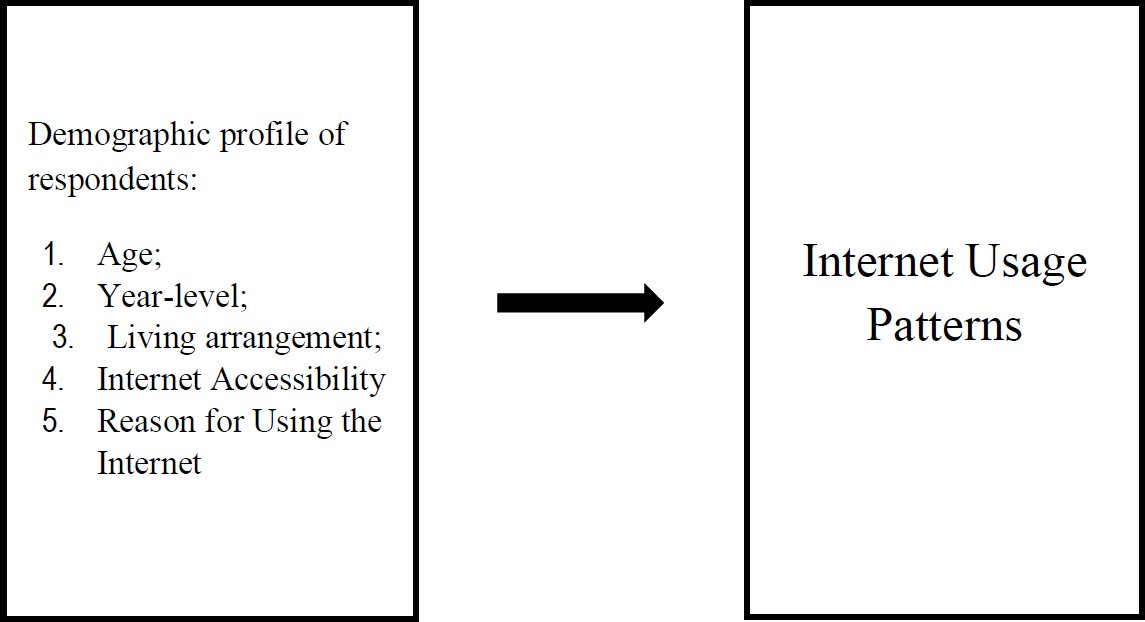
Fig. (1). Paradigm showing the independent variables and dependent variables.
3. METHODOLOGY
The study utilised the primary quantitative method using a descriptive correlational research design. The locale of the study is Jubail Industrial College of the Royal Commission of Jubail in Saudi Arabia. Jubail Industrial College offers associate and bachelor’s degree programs. Convenience sampling was used in the study, as 356 students participated as respondents. According to (Stratton, 2021), convenience sampling was applied as it was convenient and easy to reach the participants in the study since the study was implemented in one particular institution, the Jubail Industrial College. Power analysis was used to calculate the sample size of 356 based on adequate heights (statistical points) to reveal meaningful links between variables. This sample offers a large amount of assurance on the correctness and consistency of the findings. The analysis was conducted with the least chance of Type II errors, and each of the hypotheses could be effectively tested during the study.
A self-administered survey questionnaire was used as the main instrument of data collection. The questionnaire was broken into four sections or questions, which dealt with several issues of Saudi college students’ use of the internet. Part 1 involved sociodemographic questions which included variables like age, course, year-level, living arrangement, accessibility to the internet, average number of hours one used the internet every day, reasons for using the internet, and GPA. The section was designed to give an insight into the background of the participants and their general habits in internet use.
Part 2 assessed the factors influencing internet consumption. Factors like affordability of data, availability of free Wi-Fi and internet connection stability were ranked by the respondents in terms of their significance. Moreover, reasons for using the internet were explored including factors like isolation, boredom, free time and environmental conditions.
Part 3 analysed the difference between the use of the internet before and after the COVID-19 pandemic. It focused on changes in sleeping habit, internet usage duration, peak time usage, login-behaviour and the purposes for internet use.
Part 4 of the survey is based on Young’s Internet Addiction Test (IAT), which uses 20 statements to measure the level of internet addiction (Young, 2011). It included 20 statements as respondents rated their behaviour on a 5-point Likert scale with “Not Applicable” rated as zero and “Always” rated as 5. The measurement is based on the frequency of various internet-related activities such as spending more time online than wanted, abandoning responsibilities, and experiencing negative consequences on personal relationships or academic performance. The total rating determines the level of internet addiction from normal use to extreme dependence.
The study used SPSS (Statistical Package for the Social Sciences) to evaluate the correlations between sociodemographic factors and internet usage behaviours. SPSS was selected due to its effectiveness in handling enormous data and conducting different statistical tests. The analysis used Chi-square and ANOVA to investigate whether meanings relating to categorical variables like age, living arrangements, and year level had any relevance. Chi-square tests determined the existence of significant correlations between those variables and internet usage behaviours, where the p-values represent the strength of these relationships. ANOVA was employed to analyse variance in internet usage across different sociodemographic groups, highlighting significant differences based on year level, internet accessibility, and reasons for internet use.
4. RESULTS AND FINDINGS
4.1. Demographics
As per Table 1, the data of respondents’ age distribution shows that the highest number of respondents fell in the age bracket of 21-23. Superficially, 43.3% were 22 years old and 32% were 23 years old. There were fewer respondents who were 21 years old (19.4%), and the lowest age group of 18 years constituted just 1.1% of the sample. The age distribution shows that the majority of the sample were young, such as university students. This is consistent with the research conducted by (Adeyemi, 2019), which accounted for the impact of internet use on the performance of undergraduates. It has been further reported that the students who had saved age had varied interactions over the internet, which may influence their academic performance. However, the sample size in the age groups of 18 and 19 years is small, but the preponderance of the 21-23 years old age group shows that the university-aged students are the most represented in the sample.
Table 1. Demographics.
| Demographic Variable | Category | Frequency | Percentage (%) |
| Gender | Male | 250 | 70.22 |
| Female | 156 | 43.82 | |
| Age | 18-29 years | 70 | 19.66 |
| 30-39 years | 95 | 26.68 | |
| 40-49 years | 55 | 15.44 | |
| 50 years and above | 29 | 8.146 |
Moreover, there was a larger number of men responding to the survey as compared to women, where there were 250 men, and 156 women. Such gender breakdown portrays normal trends experienced in university Alberta demography where male students tend to comprise a very large proportion. The imbalance in the male gender might imply difference in the pattern and academics behaviour with the intrusion of social and cultural aspects of the genders.
As per Table 2, the data indicate significant trends of internet use among university students, with various factors by year-level residence situation, daily internet users, internet access, and purposes for accessing the internet. By year level, the majority of students were juniors (60.4%), and freshmen constituted 2.8% only. The distribution reflects the expected academic progression, as upper-level students are typically more engaged in academic and extracurricular activities that necessitate high internet usage, aligning with the findings of (Adeyemi, 2019), where the use of the internet was higher in high-level students. Additionally, the table implies that most of the respondents (67.7%) reside with their facilities compared to only 7.3% of students residing with non-relatives or alone. This trend may be influenced my socio-cultural factors such as financial support from facilities, which is consistent with the research by (Alkhalaf et al., 2018), highlighting the key role family support plays in the academic and social lives of students.
Table 2. Highest and lowest percentages for each category of internet usage study.
| Category | Highest | Lowest |
| Year-Level | Junior (60.4%) | Freshman (2.8%) |
| Living Arrangement | Living with family (67.7%) | Independently living alone or with friends (7.3%) |
| Internet Usage Per Day | 3 to 8 Hours (38.8%) | 16 hours and more (11.0%) |
| Accessibility of Internet | Affordable (46.1%) | Free Wi-Fi (12.9%) |
| Reason for Using Internet | Boredom (42.4%) | Others (2.5%) |
In terms of daily internet usage, the majority of students (38.8%) employed the internet for 3 to 8 hours a day, and fewer (11%) employed the internet for 16 or more hours. This shows general moderate use of the internet, likely driven social interaction and leisure activities. This occurs with the findings of (Leite et al., 2024), who believed that moderate use of internet is directly related to the advantage of academic performance, whereas extensive use detracts from academic focus. When considering, internet accessibility, near half of the students (46.1%), reported having subsidised data plans, whereas a lesser percentage (12.9%) utilised free Wi-Fi. This disparity indicates that, economic inequality some students face when it comes to accessing the internet, a finding that mirrors the conclusions of (Bai et al., 2022), as the authors identified that financial considerations play a significant role in internet usage patterns. Similarly, the most common reason for going online due to boredom (42.4%), with other reason including environmental conditions.
4.2. Chi-square
As per Table 3, the Chi-Square tests indicates that there is a significant relationship between various variables of the dynamic interactions between internet usage and patterns and socio-demographic features of university students. The test between age and accessibility and internet has a Chi-Square of 20.713 with a p-value of 0.025. It shows that, the students’ age relates significantly to their access to the internet. The findings indicate that older students may have better access to low-cost or stable internet access than younger students. The result may stem from older students being more independent, potentially living off-campus or in private housing where internet plans are more consistent. This is evidenced by (Khawaldeh, 2019), showing that older individuals, particularly those in tertiary level, tend to experience fewer barriers to access the internet since they can afford and pay for their internet subscription. Additionally, the significant relationship having p-value 0.021 between age and internet usage per day reflects how older students tends to sue the internet on daily basis than younger students. It has been observed that, the use of internet more for studies and for personal purposes, which could be the explanation of the trends (Chowdhury et al., 2020).
Table 3. Adjusted chi-square tests results for variable pairs with significant p-values.
| Variable Pair | Chi-Square Value | Degrees of Freedom (df) | Asymptotic Significance (p-value) |
| Age * Accessibility of Internet | 20.713 | 15 | 0.025 |
| Age * Internet Usage Per Day | 25.124 | 15 | 0.021 |
| Age * Reason for Using Internet | 30.483 | 20 | 0.010 |
| Year-level * Accessibility of Internet | 18.470 | 9 | 0.010 |
| Year-level * Internet Usage Per Day | 20.599 | 9 | 0.015 |
| Year-level * Reason for Using Internet | 20.867 | 12 | 0.004 |
| Living Arrangement * Accessibility of Internet | 12.874 | 6 | 0.015 |
| Living Arrangement * Internet Usage Per Day | 15.121 | 6 | 0.022 |
| Living Arrangement * Reason for Using Internet | 18.018 | 8 | 0.025 |
Moreover, the relationship age and reason for using the internet is also significant statistically significant with a Chi-square value of 30.48 and p-value of 0.10. It shows that, older students use the internet for more activities compared to the younger students. Younger students may be more interested in entertainment and social media, whereas older students likely sue of the internet for learning, studying, research and networking. (Alkhalaf et al., 2018), argued that, students in higher levels engage with more academic contents online, whereas younger students may tend to sue the internet for non-academic purposes. Year-level shows significant relationship with both internet accessibility and usage. With p-values of 0.10 for accessibility and 0.015 for internet usage per day, it shows that as student progress through school years, they experience increased access to and the use of internet. Older students also more at ease with the technology required or successful academic research and have high probability of having internet connections, especially if they live-off capon or in stand-alone living arrangement.
The Chi-Square test shows there is a statistical relationship between living arrangements and internet accessibility with p-value 0.015. Those who live with their families have more reliable and continuous internet connections, most likely due to having frequent access to home broadband subscriptions. Students living alone or in dorms have fewer conveniences, such as slower or interrupted connections, which play a significant factor in their overall internet accessibility. A significant relationship exists between living arrangements and internet use per day with p-value 0.022. Home-staying students access the internet more frequently, likely due to more stable and regular internet connections. Chi-Square test indicates that there is a significant relationship between living arrangements and reason for using internet with p-value 0.025. Students who live with their families are more inclined to use the internet for academic purposes with the benefit of guaranteed non-intermittent access.
4.3. ANOVA
As per Table 4, ANOVA test show that there are significant relationships among all the variables in question and their impact on internet usage. Age is highly impacting with a value of 0.001, which means age contributes significantly to the determination of how students utilise the internet. Younger students have higher social or leisure use of the internet, whereas older students will tend to utilise the internet more for educational and career purposes. This finding reveals the transformations in student usage as they mature throughout their academic life, where the internet is an essential tool for studying and success as the students get older.
Table 4. ANOVA results for the relationship between demographic and internet usage variables.
| Variable | Sum of Squares (Between Groups) | df (Between Groups) | Mean Square | F Value | Sig. Value |
| Age | 0.934 | 5 | 0.187 | 0.563 | 0.001 |
| Year-level | 0.680 | 3 | 0.227 | 0.686 | 0.002 |
| Living Arrangement | 0.362 | 2 | 0.181 | 0.548 | 0.003 |
| Internet Usage Per Day | 0.191 | 3 | 0.064 | 0.192 | 0.004 |
| Accessibility of Internet | 0.691 | 3 | 0.230 | 0.697 | 0.005 |
| Reason for Using Internet | 1.527 | 4 | 0.382 | 1.161 | 0.003 |
The variable Year-level is also revealing a significant effect with p-value = 0.002. This indicates that at different stages of their higher educational life, students exhibit different patterns of internet usage. The freshmen, being green to university life, might mostly utilise the internet for socialisation and seeking entertainment, whereas the seniors, being more oriented towards academic success, largely depend upon the internet for research and academic pursuits. The growing intellectual demands as students’ progress through their years could be the cause of the observed difference in patterns of internet use, highlighting the position of the internet as an essential intellectual tool.
Under Living Arrangement, the p-value of 0.003 shows a considerable effect on patterns of internet use. Students living with families are more likely to have better and consistent access to reliable and fast internet, which may result in higher frequency of academic and social use. Students living in dorms or on their own may be disadvantaged by conditions such as sharing the same internet connection or slower speeds, which can limit their internet use per day. This disparity captures the impact that housing has upon students’ ability to access and utilise the internet, particularly for study. It further captures the frustration faced by students who reside in less stable households, whose sporadic access to the internet hinders effective research and study.
Moreover, the variable Internet Usage Per Day also suggests a significant influence with a p-value of 0.004, which means that the length of time spent on the internet is influenced by more than one factor, including housing and the availability of technology. The students who have the best access to the internet, especially those living with families, spend more time online, using the internet for study purposes as well as entertainment purposes. On the other hand, students with reduced internet availability, e.g., those dwelling in dorms or shared rooms, might have more restricted usage patterns. Accessibility of Internet, p-value = 0.005, also indicates the significant contribution of the access to the internet in determining the frequency and the purpose of usage by the students of the internet. Those who have low-cost and reliable internet plans or reliable Wi-Fi connections are likely to use the internet for academic-related activities, but those with less reliable access may use the internet for entertainment or social uses only.
5. DISCUSSION
The study aimed to examine the relationship between internet usage and the sociodemographic profile of Saudi university students, and the impact of these factors on academic performance, internet addiction and digital behaviour. The findings indicated that the internet usage among the participants is moderate, with significant association between sociodemographic factors and patterns of internet use. These findings are in agreement with previous research by (Adeyemi, 2019; and Leite et al., 2024), which developed that internet use varied significantly across different sociodemographic groups, particularly age, study level and household living situation. For instance, students in later years of study and students living with their families had a higher number of internet applications, which were primary for educational an occupational purpose. This aligns with the work by (Alkhalaf et al., 2018), which showed how internet use and family support are instrumental in determining academic success. Moreover, younger students in lower academic years tended to use the internet more for social interaction and entertainment, a pattern that shifted as students advanced through their academic careers using the internet for educational purposes such as research and academic networking (Chowdhury et al., 2020; Lozano-Blasco et al., 2022).
A key finding of the study is the negative relationship between excessive internet usages for non-academic purposes and academic performances. This is proved by studies conducted (Aljabry et al., 2017; and Bai et al., 2022) confirming that, time spent on social media and recreational activities deprives the students of their concentration, leading to poor academic performance. On the other hand, (Alakloby, 2017) also discovered similar findings, where students’ academic activities were significantly interrupted by the utilisation of social media such as Twitter and Facebook, this provides evidence for the assertion that while the internet can be effective study tool, overuse for other purposes than learning brings negative impacts on academic performance (Elbilgahy et al., 2021). Consequently, the study results also showed that moderate and purposeful internet use for academic and social purposes has a positive impact on academic work. It aligns determining that controlled usage of internet, particularly for research and studies can enhance the academic skill of students. Similarly, (Fatema et al., 2020) also backed the findings mentioning that, the key to academic success lies in how students effectively utilise the internet, emphasising the significance of purposeful online engagement for educational achievement.
Furthermore, the study explored the relationship between sociodemographic factors, such as living arrangements and internet accessibility and internet usage patterns. It found that, students living with their families have more stable internet access, which most likely was responsible for their high levels of internet use for academic and social purposes. This aligns with (Nasrullah & Khan, 2019) indicating that students with greater ease of access to facilities such as stable internet, tend to sue the intent for academic work. However, (Wang et al., 2022) argued that, students living in in dormitories or off-campus accommodations had challenges accessing the internet which affects their ability to utilise for academic work, and overall performance. (Khawaldeh, 2019) also reported that students with independent living situations as compared to off-campus, are most likely to have better experience greater challenges to consistent internet availability, potentially impacting academic performance.
The obtained results in the context of Saudi students correspond to the individual socio-cultural and technological environment where the latter study. The family support system allows students in Saudi Arabia, especially in higher academic years, to have stable internet connection that they can apply more intensely to education and work-related matters. This corresponds to the study of (Alkhalaf et al., 2018) that family support is an important factor in developing academic success. Additionally, high penetration of 5G internet and availability of Wi-Fi hotspots in Saudi Arabia are some of the rapid changes in its technology, which allow students to engage in academic activities especially in research and learning. Nevertheless, younger respondents, who tend to recreational use, also report difficulties with time management, which might lead to a shift in the internet use towards academic activities as they age, as reported in other works, such as (Chowdhury et al., 2020).
CONCLUSION AND RECOMMENDATIONS
The study concluded that, internet usage among Saudi college students is moderately high and that sociodemographic factors such as age, year-level, and resident status are important in determining internet usage patterns. Students that are older and studying at higher academic levels were found to have more significant and noticeable internet activity. More stable access to internet, especially by students, who would live with families, was linked with increased and effective usage. However, the study limited to single institution Jubail Industrial College, and therefore restricts the generalisability of findings to other areas and institutions of Saudi Arabia. The research does not elaborate on the qualitative elements of the internet usage behaviour among the students which does not provide many hints on the motivation in its causes. It also omitted the faculty or parental view which could have been used to enhance the analysis. The study recommends to expand the research to multiple institutions across different regions of Saudi Arabia using random sampling as it will enhance the generalisability and representativeness of the findings.
Moreover, the study provides a platform to explore on how association among internet usage, academic achievement and sociodemographic variables is evolving in conservative societies like Saudi Arabia. Future researchers are encouraged to expand the sample population in different institutions and areas to improve generalisability. Longitudinal and mixed-method design can be used by future scholars to examine casualty and the internalised psychological drivers behind internet use. Researchers may also incorporate new media trends including AI-driven platforms and short-term internet videos into their models to couture latest usage patterns. Studies can include mediating factors such as digital literacy, parental monitoring and mental health that may provide deeper insights.
AUTHOR’S CONTRIBUTIONS
G.M.T. has contributed to conceptualization, idea generation, problem statement, methodology, results analysis, results interpretation.
AVAILABILITY OF DATA AND MATERIALS
The data will be made available on reasonable request by contacting the corresponding author [G.M.T.].
FINDING
None.
CONFLICT OF INTEREST
The authors declare no conflicts of interest.
ACKNOWLEDGEMENTS
Declared None.
REFERENCES
Adeyemi, S. (2019). Impact of Internet usage on undergraduates’ academic performance in South West, Nigeria. KIU Journal of Social Sciences, 5(4), 327-335. Available from: https://ijhumas.com/ojs/index.php/niujoss/article/view/716.
Alakloby, S. (2017). The effect of using twitter in an achievement and development trends toward it at the College of Education students at Shaqra University. British Journal of Education, 5(5), 53-59. Available from: https://www.eajournals.org/wp-content/uploads/The-effect-of-using-Twitter-in-achievement-and-development-trends-toward-it-at-the-College-of-Education-students-at-Shaqra-University.pdf.
Aljabry, A., Jaafari, M., Salawi, M., Majrabi, M., Hazzazi, N., Khormi, A., Daghriri, M., Alfaqih, A., Al-harobi, M., & Alqahtani, M. (2017). Effect of social media network on social relations and academic achievement among medical students. The Egyptian Journal of Hospital Medicine, 69(7), 2910-2917 DOI: Https://doi.org/10.12816/0042591.
Alkhalaf, A., Tekian, A., & Park, Y. S. (2018) The impact of WhatsApp use on academic achievement among Saudi medical students. Medical Teacher, 40, 10-14. https://doi.org/10.1080/0142159X.2018.1464652.
Alshalawi, A. (2021). Social media usage intensity and academic performance among undergraduate students in Saudi Arabia. Contemporary Education Technology, 14(2), 11711. https://doi.org/10.30935/cedtech/11711.
Alwagait, E., Shahzad, B., & Alim, S. (2014). Impact of social media usage on students academic performance in Saudi Arabia. Computers in Human Behavior, 51(Part B), 1092-1097. http://dx.doi.org/10.1016/j.chb.2014.09.028.
Bai, W., Cai, H., Wu, S., et. al. (2022). Internet addiction and its association with quality of life in patients with major depressive disorder: a network perspective. Translational Psychiatry, 12(138), 1-7. https://doi.org/10.1038/s41398-022-01893-2.
Cheng, C. & Li, A. (2014). Internet addiction prevalence and quality of (real) life: A meta-analysis of 31 nations across seven world regions. Cyberpsychology, Behavior, and Social Networking, 17(12), 317. https://doi.org/10.1089/cyber.2014.0317.
Cherry, K. (2022). Maslow’s Hierarchy of Needs. Available from: https://www.verywellmind.com/what-is-maslows-hierarchy-of-needs-4136760#:~:text=Abraham%20Maslow%20first%20introduced%20the,to%20other%2C%20more%20advanced%20needs.
Chowdhury, N., Debnath, P., & Bhowmik, D. (2020). How does internet usage influence the academic performance of university students? A case of MBSTU. IOSR Journal of Research & Method in Education (IOSR-JRME), 1093, 15-24. Available from: https://d1wqtxts1xzle7.cloudfront.net/63603347/C100302152420200611-4690-1m7017w-libre.pdf?1591936465=&response-content-disposition=inline%3B+filename%3DHow_Does_Internet_Usage_Influence_the_Ac.pdf&Expires=1753119739&Signature=ccwHKgfuDlQAeIq0GbmqFSNFgLX9v3lIXScUTm5NrIq83GaQEpQ7ViyK5mhwXMiiFcuVd4C599deJ8wZdmDaWWxymXaGH0Lk5-128geI59Vyi-zhRkChBjhadychOKMXRw55p1w0ApBcVmcZtqWBFDe74kukyZhaOL2Z2AzzRexF2DdMoET8N8-cpREYSBAI~mrkljMS1toZuHZVgUfBIxQAsNGTzG3P~~pJTO2bZ0mW0wtpetBgPyY-PNe8zqXJGwt-7P1OHz4fSGyDA8pxnt8s4r3vrf1S8eomYh-oiufcVo19fYiF3rTNaPzRBC-U2KYRwNYfRmJl07r~xkzsrA__&Key-Pair-Id=APKAJLOHF5GGSLRBV4ZA.
Daniel, O. B. (2024). Use and gratification of news consumption on social media among thomas adewumi university students. Available from: https://tau.edu.ng/assets/oer/projects/8_use-and-gratification-of-news-consumption-on-social-media-among-thomas-adewumi-university-students_Project_File.pdf.
Elbilgahy, A., Sweelam, R., Eltaib, F., Bayomy, H., & Elwasefy, S. (2021). Effects of electronic devices and internet addiction on sleep and academic performance among female egyptian and saudi nursing students: a comparative study. SAGE Open Nursing, 7, 1- https://doi.org/10.1177/2377960821105561412.
Fatema, K, Nasreen, S., Parvez, M. S., & Rahman, M. A. (2020). Impact of Using the Internet on Students: A Sociological Analysis at Bangabandhu Sheikh Mujibur Rahman Science and Technology University, Gopalganj, Bangladesh. Open Journal of Social Sciences, 8, 71-83. https://doi.org/10.4236/jss.2020.812007.
Firdos, S., Amanullah, M., & Yusoff, M. (2022). understanding the role of motives and preferences of social networking sites with mental health and academic performance among medical students Al Ahsa, Saudi Arabia. Middle East Journal of Rehabilitating Health Students, 9(2), 1-8. https://doi.org/10.5812/mejrh-118030.
Global Media Insight, (2022). Saudi Arabia social media statistics 2022. Available from: https://www.globalmediainsight.com/blog/saudi-arabia-social-media-statistics/.
Hamza, S., Abdalla, Y., Alkabashi, T., Mustafa, A., Muhmmed, K., & Hussain, N. (2021). The effects of internet addiction on the academic performance of medical students at omdurman islamic university: an online cross-sectional study. Research Square, 1, 1-16. DOI: https://doi.org/10.21203/rs.3.rs-154768/v1.
Huang, W. (2024). An exploration of needs within maslow’s hierarchy of motivation. Advances in Social Behavior Research, 14, 41-44. https://doi.org/10.54254/2753-7102/2024.19284.
Internet Society, (2017). Brief History of the Internet. Available from: https://www.internetsociety.org/resources/doc/2017/brief-history-internet/.
Jaffery, R. (2018). Is Saudi Arabia Addicted to Social Media? The Culture Trip. Available from: https://theculturetrip.com/middle-east/articles/is-saudi-arabia-addicted-to-social-media/.
Khawaldeh, S. (2019). Internet use and its impact on academic achievements and social competence among the students of the philadelphia university: a comparative study according to gender, college, and educational level. An-Najah University Journal of Research, 33(8), 1392-1412. https://doi.org/10.35552/0247-033-008-006.
Leite, Â. M. T., Azevedo, Â. S., & Rodrigues, A. (2024). Influence of sociodemographic and social variables on the relationship between formal years of education and time spent on the internet. Societies, 14(7), 114. https://doi.org/10.3390/soc14070114.
Levine, Y., (2019). Surveillance valley: The secret military history of the Internet. Icon Books. Available from: https://books.google.com.qa/books?hl=en&lr=&id=Rph5DwAAQBAJ&oi=fnd&pg=PP8&dq=The+Advanced+Research+Projects+Agency+(ARPA)+created+by+former+U.S.+President+Dwight+D.+Eisenhower+in+1958+was+instrumental+in+delivering+the+ARPANET+(Advanced+Research+Projects+Agency+Network),+the+forerunner+Internet+version+of+today.&ots=0Pt3YhnjeJ&sig=BLPFi8wOrt2_uiUkL1-yQkR9IRk&redir_esc=y.
Lozano-Blasco, R., Robres, A. Q., & Sánchez, A. S. (2022). Internet addiction in young adults: A meta-analysis and systematic review. Computers in Human Behavior, 130, 107201.https://doi.org/10.1016/j.chb.2022.107201.
McLeod, S. (2025). Maslow’s Hierarchy of Needs. ResearchGate, 1-30. https://doi.org/10.5281/zenodo.15240897.
Naar, I. (2020). Saudi Arabia ranks 4th globally in 5G technology, 10th in internet speed. AlArabiya News. Available from: https://english.alarabiya.net/business/technology/2020/05/10/Saudi-Arabia-ranks-4th-globally-in-5G-technology-10th-in-internet-speed#:~:text=Saudi%20Arabia%20is%20now%20ranked%20fourth%20globally%20in,to%20the%20Kingdom%E2%80%99s%20Ministry%20of%20Communications%20and%20technology.
Nasrullah, S. & Khan, F. R. (2019). Examining the impact of social media on the academic performance of Saudi students – case study: Prince Sattam Bin Abdul Aziz University. Humanities & Social Sciences Reviews, 7(5), 851-861. https://doi.org/10.18510/hssr.2019.75111.
National Science and Media Museum, (2020). A short history of the internet | National Science and Media Museum. [online] Available from: https://www.scienceandmediamuseum.org.uk/objects-and-stories/short-history-internet.
Peckham, A. (2021). What is addiction? Medical News Today. Available from: https://www.medicalnewstoday.com/articles/323465.
Rao, D., Huggahalli, M., & David, A. (2022). refined model of maslow’s needs theory in internet era. Organization and Human Capital Development (ORCADEV), 1(1), 1-12.
Ruffin, B. (2022). Why You Shouldn’t Base Your Self-Esteem On Grades. Center for Communication. Available from: https://www.centerforcommunication.org/community-voices/why-you-shouldnt-base-your-self-esteem-on-grades.
Saeed, M., & Ullah, R. (2021). Exploring news media usage among university students to fulfil needs: Uses & gratification perspective. Human Nature Journal of Social Sciences, 2(2), 29-41. https://doi.org/10.71016/hnjss/mpw60z75.
Saquib, J. (2020). Internet addiction among Saudi Arabian youth. International Journal of Health Sciences, 14(2), 1-2. Available from: https://pmc.ncbi.nlm.nih.gov/articles/PMC7069663.
Sichach, M. (2023). Uses and Gratifications Theory-Background, History and Limitations. History and Limitations (November 17, 2023). Available from: https://papers.ssrn.com/sol3/papers.cfm?abstract_id=4729248.
Soegoto, E. & Tjokroadiponto, S. (2018). Effect of Internet on Student’s Academic Performance and Social Life. IOP Conf. Series: Materials Science and Engineering, 407(2018), 012176. https://doi.org/10.1088/1757-899X/407/1/012176.
Stratton, S. J. (2021). Population research: convenience sampling strategies. Prehospital and disaster Medicine, 36(4), 373-374. https://doi.org/10.1017/S1049023X21000649.
Sushma, M., Peter D., Natalya G., Gregory L., & Donald C. (2014). The impact of internet addiction on university students and its effect on subsequent academic success: a survey based study. Issues in Information Systems, 15(1), 344-352. Available from: http://iacis.org/iis/2014/67iis2014344-352.pdf.
Talwar, P., Sabil, S., Mustaffa, M. S., Othman, M. K., Hian, C. C., Aman, S., & Talwar, P. (2018). Reconnoitering the Influence of Socio-demographic Factors on Internet Addiction. Online Journal of Health and Allied Sciences, 17(1), 1–6. Available from: https://www.ojhas.org/issue65/2018-1-8.html.
Thompson, A. & Thompson, A. (2025). Digital 2025: The essential guide to the global state of digital – We Are Social Australia. Available from: https://wearesocial.com/au/blog/2025/02/digital-2025-the-essential-guide-to-the-global-state-of-digital/#:~:text=A%20total%20of%205.56%20billion,at%20the%20start%20of%202025.
Tirado-Morueta, R., Mendoza-Zambrano, D.M., Aguaded-Gómez, J.I., & Marín-Gutiérrez, I. (2017). Empirical study of a sequence of access to internet use in Ecuador. Telematics Inf, 34(4), 171–183. https://doi.org/10.1016/j.tele.2016.12.012.
Vinney, C. (2019). What Is Uses and Gratifications Theory? Definition and Examples. Thought Co. Available from: https://www.thoughtco.com/uses-and-gratifications-theory-4628333#:~:text=Uses%20and%20gratifications%20theory%20asserts,control%20over%20their%20media%20consumption.
Wang, Q., Camacho, I., Jing, S., & Goel, A. K. (2022). Understanding the design space of AI-mediated social interaction in online learning: challenges and opportunities. Proceedings of the ACM on Human-Computer Interaction, 6(CSCW1), 1-26. https://doi.org/10.1145/3512977.
Yang, Y., Yu, X., Zhang, Z., & Gan, L. (2023). Integrating technology acceptance model with Maslow’s hierarchy needs theory to investigate smart homes adoption. IEEE Access, 11, 80726-80740. DOI: https://doi.org/10.1109/access.2023.3300724.
Young, K.S. (2011). CBT-IA: The first treatment model for Internet addiction. Journal of Cognitive Psychotherapy, 25(4), 304. DOI: https://doi.org/10.1891/0889-8391.25.4.304.
Licensed
© 2025 Copyright by the Authors.
Licensed as an open access article using a CC BY 4.0 license.
Article Contents Author Yazeed Alsuhaibany1, * 1College of Business-Al Khobar, Al Yamamah University, Saudi Arabia Article History: Received: 03 September,
Article Contents Author Muhammad Arslan Sarwar1, * Maria Malik2 1Department of Management Sciences, University of Gujrat, Gujrat, Pakistan; 2COMSATS
Article Contents Author Tarig Eltayeb1, * 1College of Business Administration, Imam Abdulrahman Bin Faisal University, Dammam, Saudi Arabia Article History:
Article Contents Author Kuon Keong Lock1, * and Razali Yaakob1 1Faculty of Computer Science and Information Technology, Universiti Putra Malaysia,
Article Contents Author Shabir Ahmad1, * 1College of Business, Al Yamamah University, Al Khobar, Kingdom of Saudi Arabia Article History:
Article Contents Author Ghanima Amin1, Simran1, * 1Department of Biological Sciences, University of Sialkot, Sialkot 51310, Pakistan Article History: Received: