












Article Contents
Moderating Effect of Leadership Styles on the Relationship Between Employee Engagement and Performance Excellence in the Telecom Sector of Abu Dhabi
 DOI:
DOI:  PDF
PDF
⬇ Downloads: 12
1Department of Business Administration, Swiss Business School, Zurich, Switzerland
Received: 25 April, 2025
Accepted: 14 July, 2025
Revised: 04 July, 2025
Published: 21 July 2025
Abstract:
Aim: The following article investigated how employee engagement impacts performance excellence within Abu Dhabi’s telecom sector and the moderating role of leadership styles.
Method/Design: Quantitative research was conducted to analyse how employee engagement affects performance excellence within the telecom sector of Abu Dhabi. The data collection process involved administering a survey to 385 individuals from the telecom sector. The survey included employee engagement, leadership styles (transformational, transactional, and laissez-faire), and performance excellence. The research data collection approach included various roles across the telecom sector to secure diverse responses from the representative sample. Structural Equation Modelling (SEM) was used to analyse the data using the SmartPLS software.
Findings: Research showed employee engagement positively and significantly impacts performance excellence [B = 0.398, p-value = 0.00]. Transformational leadership had a marginal positive effect on this relationship, although the findings were significant [B=0.118, p-value=0.061]. The moderating role of transactional leadership is indicated to be insignificant [B= 0.073, p-value= 0.229]. Laissez-faire leadership had a negative moderating effect [B= -0.097, p-value= 0.074], which is statistically significant at the 10% level, suggesting it weakens the relationship between engagement and performance excellence.
Originality/Novelty: This study is novel in its analysis of how transformational, transactional, and laissez-faire leadership styles moderate the relationship between employee engagement and performance excellence in the Abu Dhabi telecom sector. By examining these moderating effects, it contributes new insights to the literature and offers practical implications for improving employee performance through effective leadership strategies in the industry.
Keywords: Employee engagement, performance excellence, leadership styles, transformational leadership, transactional leadership, laissez-faire leadership, telecom sector, structural equation modelling.
1. INTRODUCTION
Performance excellence is essential to sustaining the industry’s high growth rate and competitiveness in the international market. High performance is about providing better customer service, developing innovation, maintaining operational effectiveness, and evolving quickly into new technology (Nimngam et al., 2025). The UAE’s telecommunications operators, for example, Etisalat and Du, have expended significant investment in infrastructure and digitalisation to address growing consumer demands for speedy, dependable, and advanced communication services (Zarrouk, 2023). Yet, despite these improvements, numerous challenges hinder performance excellence.
Some of the principal challenges are high market competition, which compels businesses to innovate continually while controlling. Rapid technological change necessitates ongoing investment in new technology and upskilling the workforce, which tends to stretch resources. Customer expectations are also changing fast, expecting bespoke services and unfaulty experiences, which pressure current operating models. Employee engagement and retention also present problems; keeping a motivated team is necessary but challenging in the face of high job pressure and stress. Additionally, regulatory adherence and cybersecurity issues increase complexity of operations (Nimngam et al., 2025). Resolution of these issues necessitates connected strategies of human capital growth, quick innovation, and strong customer-driven approaches to ensure performance excellence in the fast-changing UAE telecommunication industry.
Employee engagement is important in promoting motivation towards performance excellence in organisations. It is defined within motivational and organisational behaviour theories as employees’ emotional and cognitive investment in their work and organisation. The Job Demands-Resources (JD-R) model developed by (Bakker & Demerouti, 2007), for instance, illuminates how engagement arises when there is a balance between job demands and resources available, leading to motivation, well-being, and productivity. Involving employees manifests greater attention, creativity, and voluntary effort, enhancing performance outcomes (Koroglu & Ozmen, 2022). Social Exchange Theory also clarifies that mutual supportive relationships between organisations and workers promote trust and loyalty, increasing engagement and performance (Meira & Hancer, 2021). Self-Determination Theory also highlights autonomy, competence, and relatedness as the bases of intrinsic motivation, which brings about engagement and long-term excellence (McAnally & Hagger, 2024). By synthesizing these theoretical frames, employee engagement is seen as a vital mechanism for converting organisational support, empowerment, and culture into greater individual and collective performance and ultimately sustainable competitive advantage and operational excellence.
The study carried out by (Thanh & Quang, 2022) explained about transformational, transactional and laissez-faire leadership styles. The study stated that transformational leadership enhances employee engagement by motivating and inspiring employees through vision, support, and empowerment, building creativity and solid organisational commitment. Besides, transactional leadership enhances clarity and performance through formal rewards and punishments, with task accomplishment and responsibility, which can boost short-term productivity and engagement. On the other hand, Laissez-faire leadership provides employees with freedom and autonomy, inspiring innovation and self-management, but at risk of less direction. Each style affects engagement in a different way: transformational leadership leads to intrinsic motivation and long-term excellence; transactional leadership sustains performance through clear expectations; and laissez-faire can empower but disengage if there is not sufficient support. A balance of these styles maximizes engagement and performance results.
This research aims to explore the role of leadership styles in moderating the relationship between employee engagement and performance excellence within the Abu Dhabi telecom industry. In particular, it explores how transformational, transactional, and laissez-faire leadership styles shape the direction and power of this association. The dynamics of these interactions are important for organisations that seek to maximize employees’ motivation and attain superior levels of performance in a competitive and fast-changing business environment. The importance of this research resides in its theoretical and practical contributions through filling knowledge gaps on leadership’s moderating function within the telecom setting. It provides understanding of which leadership approaches best complement the favourable performance impact of employee engagement. The findings assist telecom managers and HR professionals tailor leadership development and engagement strategies, fostering a high-performance culture that supports innovation, productivity, and sustainable competitive advantage in Abu Dhabi’s dynamic telecom industry.
The research consists of following objectives:
- To investigate the relationship between employee engagement and performance excellence in the telecom sector of Abu Dhabi.
- To analyse how leadership styles moderate the relationship between employee engagement and performance excellence in the Abu Dhabi telecom sector.
- To provide insights into the leadership strategies that can optimise employee engagement and performance in the telecom sector of Abu Dhabi.
2. Literature Review
Employee engagement has been one of the most highlighted topics in the field of research especially because of its strong association with performance excellence (Rathee & Sharma, 2020). Performance excellence means persistently gaining outstanding results by improving processes, resources, and employee potential. Performance excellence incorporates ongoing improvement, innovation, and alignment with organisational objectives to produce superior-quality products or services, raise customer satisfaction, and sustain a competitive edge in the market (Turner, 2020). According to (Yadav et al., 2022), employee engagement is the process through which individuals in organisations develop work-related identity attachments by integrating emotional, cognitive, and physical connections to their workplace responsibilities. Staff members display enhanced productivity, creativity, and allegiance when engaged at work because it leads to better organisational results. Job engagement have indicated the significant and positive impact on the employee productivity levels (He et al., 2021). Strong relationships between teams create better performance excellence by allowing employees to enhance their skills and exchange important information about organisational goals. Organisations benefit significantly from employee engagement, particularly in terms of enhanced performance outcomes. Engaged employees are more motivated, productive, and committed, leading to improved efficiency, higher-quality work, and greater overall organisational success. Organisations gained substantial performance benefits from knowledge-sharing activities. Knowledge sharing proved to partially interpret the relationship between employee engagement and organisational performance (Ahmed et al., 2020). Research on the leadership effect on employee engagement-performance relations remains sparse especially as it pertains to the telecom sector in Abu Dhabi.
Studies conducted by (Al-Dmour et al., 2018; Jayaraman & Sowmiya, 2022; and Yousif & Hasaballah, 2020) among others, established the relationship between employee engagement and performance excellence. (Al-Dmour et al., 2018) conducted a systematic literature review and highlighted the crucial role of work engagement on the employee performance. It has found mixed results from the studies mostly highlighting a positive relationship. (Jayaraman & Sowmiya, 2022) evaluated the impact of employee engagement on work performance among employees of manufacturing organisations in Dindjgul district. It highlighted the positive impact of employee engagement on performance excellence. Furthermore, (Yousif & Hasaballah, 2020) evaluated the study in the banking sector of Saudi Arabia. It has also revealed the positive impact between the variables.
The existing research on leadership styles and their influence on employee engagement and performance excellence is limited, particularly in the context of the telecom sector. This gap underscores the need for further investigation, specifically focusing on the telecom industry to understand how different leadership styles, such as transformational and transactional leadership, influence the relationship between employee engagement and performance excellence in this dynamic and competitive sector. Employees engaged through transformational leadership reach beyond their limits due to the motivational approach that enhances their performance (Chua & Ayoko, 2021). Transactional leadership achieves short-term performance results by using rewards and punishments to connect employee goals with organisational objectives but its ability to maintain long-term engagement is restricted (Dong, 2023). However, despite their established relevance, there is a need for deeper analysis of how these leadership styles moderate the relationship between employee engagement and performance, particularly in sectors like telecom, where rapid technological and market changes demand continuous innovation and high employee performance. Under transformational leadership people achieve achievements which surpass their initial targets and needs (Nsom et al., 2019). Through salary raises and promotions leaders use transactional leadership to drive subordinates’ motivation thus establishing transactional relationships with their teams (Wuryaningrat et al., 2024). Laissez-faire leadership presents itself as a management approach that keeps leaders from directly overseeing employees or issuing frequent directives about organisational decisions. Such leadership style mistakenly creates the appearance of total leader absence though it enables staff members complete self-sufficiency for their work tasks and independent decision-making authority (Ali & Ullah, 2023).
In past, many researchers such as (Baig et al., 2021; Dastane, 2020; and Al Marshoudi et al., 2023) have explored the moderating role of leadership styles in the relationship between employee engagement and performance and found significant moderation. Recently published research by (Sandhu & Al Naqbi., 2023) examined leadership and performance in various sectors throughout the UAE but failed to study the telecom sector in Abu Dhabi.
The leadership style as a moderator of the employee engagement-performance excellence relationship is based on various organisational theories. Transformational leadership, drawing on transformational leadership theory, facilitates this relationship by motivating and inspiring employees and inculcating intrinsic engagement that enhances performance. It promotes trust, shared vision, and empowerment, amplifying the positive impact of engagement on performance excellence. Transactional leadership, based on expectancy theory, moderates this relationship by setting clear goals, rewards, and responsibility, which can reinforce the connection between engagement and task accomplishment, particularly in formal settings (Koroglu & Ozmen, 2022). On the other hand, laissez-faire leadership can degrade this relationship because of a lack of guidance and support, which may limit employee motivation and performance. Social Exchange Theory articulates that effective leadership forms reciprocal relationships, which promote engagement and thus performance (Thanh & Quang, 2022). Thus, leadership style influences the manner in which motivated employees convert their motivation into great performance, reinforcing or eroding this critical organisational connection.
2.1. Hypotheses Development
- H1: Employee engagement positively affects performance excellence in the telecom sector of Abu Dhabi.
Kahn’s Engagement Theory forms the foundation for this hypothesis because it explains employee engagement results from their mental and physical relationships to their work tasks. Engaged employees put more energy along with creativity and effort toward their work duties so performance levels improve according to Kahn’s theory (Yadav et al., 2022). Furthermore, (Saks et al., 2022) investigated the relationship between employee engagement and work performance elaborating positive relationship. Kahn’s argument demonstrates that workers can achieve performance excellence alongside creativity when experiencing positive connections with leaders within favourable work environments. (Palumbo, 2021) study further supports the notion that employee engagement plays a central role in driving innovation, which in turn leads to high performance.
- H2: Transformational leadership positively moderates the relationship between employee engagement and performance excellence in the telecom sector of Abu Dhabi.
This hypothesis supports Bass’s Transformational Leadership Theory which demonstrates how transformational leaders can inspire employees to go beyond expectations. A transformational leader builds an atmosphere yet generates trust and intrinsic motivation with employee empowerment. The involvement of workers under transformational leadership leads to elevated performance results (Park et al., 2022). Transformational leadership functions like a performance amplifier because it enhances the link between employee engagement and output delivery. (Lai et al., 2020) confirmed that the engagement levels of employees rise when leaders follow transformational practises leading to superior performance. Transformational leadership provides a force that upgrades employee engagement and simultaneously improves workplace performance excellence.
- H3: Transactional leadership negatively moderates the relationship between employee engagement and performance excellence in the telecom sector of Abu Dhabi.
According to Burns’ Transactional Leadership Theory employees can achieve desired behaviour patterns through organised systems of rewards along with systemised punishments. The effective achievement of rapid performance goals through transactional leadership does not automatically lead to lasting employee commitment or enduring superior performance (Başar et al., 2021). (Suhendra, 2021) further noted that leaders who operate in a transactional manner stay mostly dedicated to keeping current organisational conditions intact instead of developing employee motivation and commitment. The use of external rewards under transactional leadership damages intrinsic motivation and decreases employee work effort so it diminishes the performance benefits associated with engagement. The hypothesis claims transactional leadership creates negative effects on the employee engagement and performance excellence relationship because it restricts engagement’s ability to maintain long-term high performance.
- H4: Laissez-faire leadership negatively moderates the relationship between employee engagement and performance excellence in the telecom sector of Abu Dhabi.
The Laissez-Faire Leadership Theory suggests that when leaders do not step in or guide employees it creates an environment marked by confusion and disengagement which leads their employees to lack direction. The passive leadership behaviour of laissez-faire leaders negates employee motivation and commitment because of its unchecked nature. The theory supports the research hypothesis which demonstrates that laissez-faire leadership produces negative effects on employee engagement and performance excellence relationships. Employees demonstrate lower motivation and feel unsupported when leaders do not offer required direction or support therefore leading to decreased performance levels (Chiu et al., 2021). (Donkor & Zhou, 2020) confirm that when leaders exhibit minimal interference in staff affairs it results in decreased motivation as well as weak organisational commitment thereby affecting performance excellence. The implementation of laissez-faire leadership diminishes all possible beneficial effects that come from employee engagement.
Studies presented in this paper provide support for an investigation of how telecommunications leaders in Abu Dhabi advance employee engagement combined with performance excellence improvement. The obtained results will deliver essential knowledge to refine leadership techniques in the sector combined with actionable information for boosting organisational performance. Fig. (1) below represents the conceptual model of the study based on the above hypothesis.
2.2. Conceptual Framework
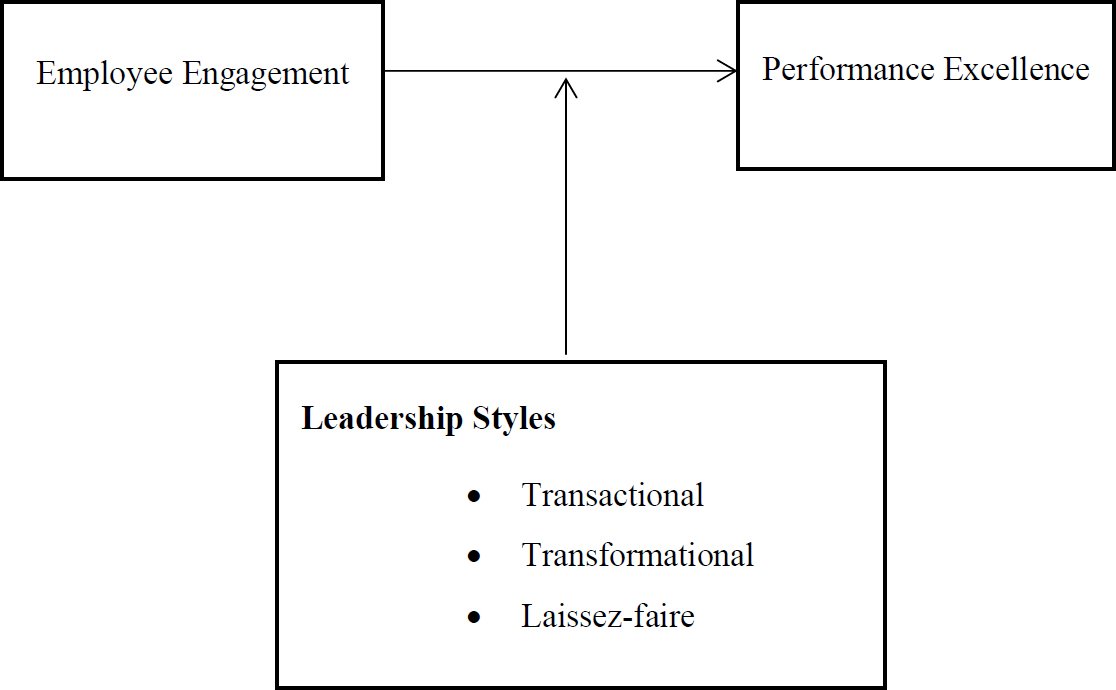
Fig. (1). Conceptual framework.
3. Research Methodology
In this study, survey questionnaires are used as the primary data collection method. Surveys represent the optimal research method to collect data from various telecom employees throughout Abu Dhabi. The research devised a structured questionnaire to measure employee engagement, leadership styles, and performance excellence in a telecom firm. The survey commenced with demographic information seeking gender, age, designation, department, and years of employment to characterize respondents. The second part gauged employee engagement by ascertaining emotional and cognitive engagement in work on a 5-point Likert scale. The third part measured views on styles of leadership—transformational, transactional, and laissez-faire—on the basis of employees’ experience of managerial action towards motivation and direction, also on a 5-point scale. The last part measured performance excellence through employee self-reporting on individual, team, and organisational performance, measuring agreement with job success, teamwork, and outcomes statements using the same Likert scale. This systematic method allowed for holistic understanding of the interaction among engagement, leadership, and performance.
A small sample of staff members from an analogous company participated in a preliminary assessment to validate and improve the clarification of the research instrument. The questionnaire was modified through pilot test results to enhance both question quality as well as survey precision. Cronbach’s Alpha measures were used to assess instrument reliability and each section reported sufficient reliability results. All questionnaire sections demonstrate high reliability according to their Cronbach’s Alpha values which exceed 0.7 thus making the instrument suitable for measuring its intended constructs.
The questionnaire was expert-reviewed to ensure its correct representation of employee engagement, leadership practices, and performance excellence constructs, determining content validity. It was pilot-tested as well to verify reliability and validity in its measurement of crucial organisational factors. The complete questionnaire, outlined in the Appendix, employs easy-to-understand Likert-scale statements (1–5) within sections on engagement, leadership, and performance for specific participant answers.
The research makes use of purposive sampling to gather data from telecom sector participants who possess specific industry experience. This sampling method is beneficial for selecting participants who are most likely to provide insightful data about the specific context of telecom sector job roles (Robinson, 2024). By focusing on employees from different corporate roles within the sector, the study ensures that the sample is aligned with the research objectives, capturing key perspectives relevant to the topic at hand. The sample size of 384 employees was chosen to ensure sufficient statistical power for detecting meaningful relationships between the variables under investigation. The choice of sample size was based on statistical power analysis, which was conducted using G*Power software. The calculation for the required sample size took into account the expected effect size, significance level (α = 0.05), and desired power (0.80) (Kang, 2021). Specifically, the formula used in G*Power for sample size determination was:
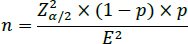
Where:
- n = sample size
- Zα/2 = Z value for the chosen confidence level (typically 1.96 for 95% confidence)
- p = estimated proportion (here assumed as 0.5 for maximum variability)
- E = margin of error (desired precision)

= 384
A total of 600 individuals were contacted, and 450 responses were initially received having response rate of 75%. However, after data cleaning, 65 responses were omitted due to invalid or incomplete data. These omissions occurred for several reasons:
- Outliers: Responses with extreme values were identified using Z-scores, with data points having a Z-score above or below 3.29 being considered outliers and subsequently removed.
- Inconsistent responses: Respondents who answered inconsistently (e.g., straight-lining, where they selected the same response for all questions) were removed.
- Incomplete responses: Responses missing a significant amount of key data (e.g., more than 10% of the questions were unanswered) were also omitted.
This resulted in a final, clean sample of 385 valid responses. To minimise response bias, the survey was conducted anonymously, ensuring that respondents could freely express their views without fear of identification. Additionally, reverse-coded items were included in the questionnaire to reduce social desirability bias and ensure that participants were paying attention to the questions. Reverse coding was applied to some leadership and engagement questions, where a high score on a particular item indicated a low level of agreement (e.g., “I feel disconnected from my work” would be reverse-coded to reflect a lower engagement level). The reverse-coded items were specifically discussed and mentioned in the questionnaire to avoid confusion. For example, if the question asked “I often feel detached from my job,” a high score would reflect low engagement, while a low score would indicate higher engagement.
To further address potential common method variance (CMV), Harman’s single-factor test was performed. This test involves examining the unrotated factor solution to check if one factor explains the majority of the variance. A significant issue with CMV would be suggested if a single factor accounted for more than 50% of the variance (Zhonglin, 2020). The results from this analysis confirmed that CMV was not a concern in this study.
Multiple imputation as a method handled missing data points in the study. Multiple imputation techniques were chosen as it offers a strong approach to handle missing data through multiple plausible dataset creation before generating combined results. The researchers applied imputation through demographic and related variable responses including age along with gender. This study contained only less than 5% missing data which meets the criteria for imputation purposes. Statistical power remained intact and informative data loss was prevented after researchers employed the imputed data in analysis (Mayfield et al., 2009).
According to (Mascha & Vetter, 2018), a larger sample size enhances the precision level of findings therefore improving both the reliability and generalisability of the results and reducing possible biases and errors. The targeted sample size creates the right equilibrium between operational feasibility and statistical worth which leads to research results that effectively represent the telecom segment of the study. Online surveys were sent to corporate employees across different positions of the Abu Dhabi telecom sector to collect the data. The research team employed organisational email addresses to contact participants who received their first invitation for the study then received additional reminder emails to achieve broad survey participation. Participants accessed the survey through an online tool which guaranteed their confidentiality and anonymity during the entire process. A reference to the survey platform was embedded in the email message which specified that the collected information would remain dedicated to research activities alone. The research instrument contained a user-centric design to enable respondents to access and complete the questionnaire when it was suitable for them.
SmartPLS software was used to conduct PLS-SEM (partial least squares- structural equation modelling) data analysis using its ability to evaluate multiple variable interdependencies within a single framework (Hair et al., 2019). The SEM technique has explored the effects of leadership styles on employee engagement and performance excellence relationships. The analysis has evaluated each leadership style through interaction terms within SEM. A reliability analysis, using Cronbach’s alpha and composite reliability tests, has evaluated the consistent measurement of constructs. The validity of the constructs were testing using factor loadings above 0.7, reliability was tested using composite reliability greater than 0.7, and convergent validity was tested using AVE exceeding 0.5 (Kline et al., 2012). Discriminant validity was conducted by using HTMT ratio to ensure that constructs are distinct from each other and the acceptable threshold is below 0.85 (Baharum et al., 2023). Finally, path analysis has been conducted to examine the direct and moderating relationships, providing insights into how leadership styles impact the engagement-performance relationship.
4. Results and analysis
4.1. Demographic Profile
Characteristics of 385 participants are reflected in the demographic profile Table 1. There is a higher proportion of male participants (57.14%) than female participants (38.96%). The majority of participants have an undergraduate degree (38.96%), full time job (64.94%) and 1 – 3 years’ experience in telecom industry (25.97%). The table is available insights on job positions, education or work locations.
4.2. Measurement Model Using Confirmatory Factor Analysis (CFA)
Several tests evaluated the measurement model reliability and validity through Cronbach’s alpha, Composite Reliability and Average Variance Extracted (AVE). Tests of internal consistency and reliability showed acceptable results according to the obtained values for each indicator.
The research relies on the Table 2 which elaborates the measurement model using confirmatory factor analysis including factor loadings, composite reliability, Cronbach’s alpha and AVE for convergent validity. The measures for Employee Engagement (0.862–0.901) demonstrate high strength while internal consistency (Cronbach’s Alpha = 0.851) and Composite Reliability (0.851) indicate good reliability. The Average Variance Extracted value of 0.771 surpasses the necessary minimum threshold of 0.5 to support good convergent validity.
| Demographic Category | Frequency (n) | Percentage (%) | |
| Gender | Male | 221 | 57.14% |
| Female | 150 | 38.96% | |
| Other | 10 | 2.60% | |
| Prefer not to answer | 5 | 1.30% | |
| Age Range | 18-24 | 61 | 15.58% |
| 25-34 | 120 | 31.17% | |
| 35-44 | 90 | 23.38% | |
| 45-54 | 70 | 18.18% | |
| 55+ | 35 | 9.09% | |
| Job Title/Position | Customer Support Representative | 41 | 10.38% |
| Sales Executive | 50 | 12.98% | |
| Marketing Specialist | 45 | 11.69% | |
| Network Engineer | 30 | 7.79% | |
| Product Manager | 40 | 10.38% | |
| Project Manager | 35 | 9.09% | |
| IT Specialist | 25 | 6.49% | |
| Operations Manager | 30 | 7.79% | |
| HR Manager | 20 | 5.19% | |
| Executive (e.g., CEO, CFO) | 40 | 10.38% | |
| Other (Please specify) | 20 | 5.19% | |
| Department | Customer Service | 51 | 12.98% |
| Sales and Marketing | 60 | 15.58% | |
| Network Engineering | 40 | 10.38% | |
| Product Development | 30 | 7.79% | |
| IT/Technology | 45 | 11.69% | |
| Operations | 40 | 10.38% | |
| Human Resources | 35 | 9.09% | |
| Finance | 30 | 7.79% | |
| Executive Management | 25 | 6.49% | |
| Other (Please specify) | 25 | 6.49% | |
| Length of Employment in the Company | Less than 1 year | 51 | 12.98% |
| 1-3 years | 100 | 25.97% | |
| 4-6 years | 80 | 20.78% | |
| 7-10 years | 70 | 18.18% | |
| More than 10 years | 85 | 22.08% | |
| Highest Level of Education | High School | 61 | 15.58% |
| Undergraduate Degree | 150 | 38.96% | |
| Postgraduate Degree | 130 | 33.77% | |
| Doctorate | 25 | 6.49% | |
| Other (Please specify) | 20 | 5.19% | |
| Employment Status | Full-time | 251 | 64.94% |
| Part-time | 50 | 12.98% | |
| Temporary | 30 | 7.79% | |
| Contractual | 55 | 14.29% | |
| Work Location | Head Office | 151 | 38.96% |
| Regional Office | 100 | 25.97% | |
| Field/Remote | 80 | 20.78% | |
| Other (Please specify) | 55 | 14.29% | |
| Years of Experience in the Telecom Industry | Less than 1 year | 50 | 12.98% |
| 1-3 years | 80 | 20.78% | |
| 4-6 years | 90 | 23.38% | |
| 7-10 years | 85 | 22.08% | |
| More than 10 years | 80 | 20.78% |
Performance Excellence has the highest factor loading (0.901) among its dimensions and a range from 0.785 to 0.901. The good internal consistency of the research is demonstrated through both Cronbach’s Alpha (0.811) and Composite Reliability (0.828). The construct validity evidence comes from an AVE value of 0.726.
Transactional Leadership gathers data points between 0.887 and 0.925 to show excellent internal consistency (Cronbach’s Alpha = 0.901) and Composite Reliability (0.904). The AVE of 0.835 supports strong convergent validity.
Transformational Leadership displays measurements between 0.883 to 0.930 and it proves solid internal consistency (Cronbach’s Alpha = 0.883) and Composite Reliability (0.883). The AVE value of 0.811 indicates strong superior convergent validity.
The factor loadings of Laissez-Faire Leadership fall within the range of 0.898 to 0.933 while showing both Cronbach’s Alpha (0.894) and Composite Reliability (0.896) that indicate very good internal consistency. The measurement of 0.826 represents superior convergent validity in the research. Fig. (2) provides the visual representation of the measurement model of the study.
| Latent Variables | Indicators | Factor Loadings | Cronbach’s Alpha | Composite Reliability | Average Variance Extracted (AVE) |
| Employee Engagement | EE1 | 0.871 | 0.851 | 0.851 | 0.771 |
| EE2 | 0.901 | ||||
| EE3 | 0.862 | ||||
| Performance Excellence | PE1 | 0.785 | 0.811 | 0.828 | 0.726 |
| PE2 | 0.901 | ||||
| PE3 | 0.867 | ||||
| Transactional Leadership | TL1 | 0.887 | 0.901 | 0.904 | 0.835 |
| TL2 | 0.925 | ||||
| TL3 | 0.889 | ||||
| Transformational Leadership | TransL1 | 0.914 | 0.883 | 0.883 | 0.811 |
| TransL2 | 0.930 | ||||
| TransL3 | 0.896 | ||||
| Laissez-Faire Leadership | LL1 | 0.898 | 0.894 | 0.896 | 0.826 |
| LL2 | 0.933 | ||||
| LL3 | 0.896 |
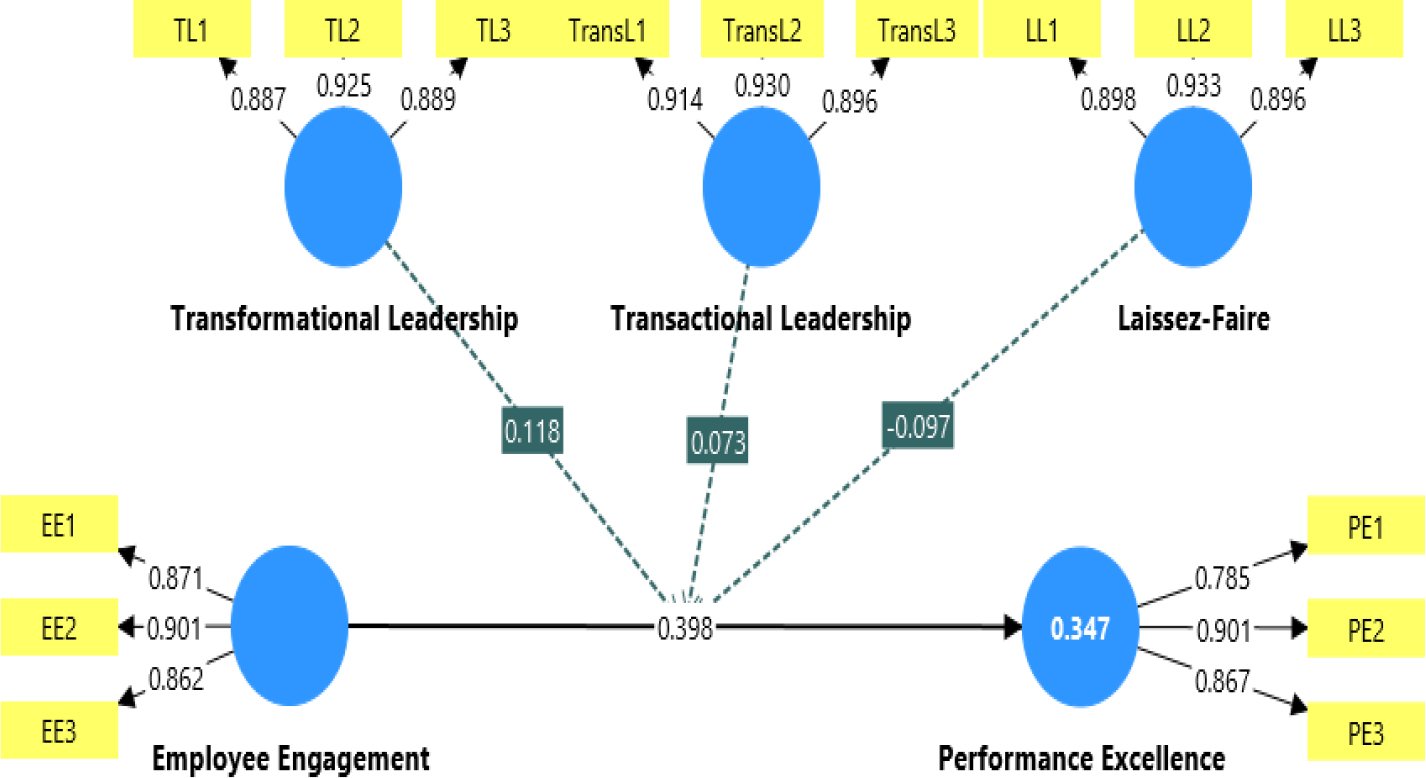
Fig. (2). Measurement model using CFA (showing factor loading, Path Coefficient and R-Squared).
4.3. Discriminant Validity
Discriminant validity evaluates how separate one construct remains from other elements within the model framework. A validity test protects distinct constructs from overlapping or showing high correlations with other measured variables in the model. Discriminant validity assessment can be done through the use of Heterotrait-Monotrait Ratio (HTMT) that analyses relationships between latent variables (Rönkkö & Cho, 2022).
The Table 3 presents the Discriminant Validity using the Heterotrait-Monotrait Ratio (HTMT), which shows distinction of the latent variables and their interactions. It reveals that the HTMT values between Employee Engagement and Performance Excellence (0.620), and between Employee Engagement and Transformational Leadership (0.718), are the strongest, indicating that these constructs are well-distinguished from others. On the other hand, the interaction of Laissez-Faire x Employee Engagement shows the weakest correlations, suggesting minimal overlap with other variables. These HTMT values demonstrate the discriminant validity of the constructs in the study, confirming their separateness.
Table 3. Discriminant validity.
| Employee Engagement | Laissez-Faire | Performance Excellence | Transactional Leadership | |
| Laissez-Faire | 0.276 | |||
| Performance Excellence | 0.620 | 0.343 | ||
| Transactional Leadership | 0.614 | 0.477 | 0.467 | |
| Transformational Leadership | 0.718 | 0.495 | 0.550 | 0.733 |
4.4. Path Analysis
The path analysis results indicate that Employee Engagement and Transformational Leadership have significant positive effects on Performance Excellence, while Laissez-Faire Leadership and Transactional Leadership show minimal or no significant impact. The moderating effect of Transformational Leadership on the engagement-performance relationship is marginally significant, suggesting a small positive influence (see Table 4).
Table 4. Structural model.
| Path Coefficients | T Statistics | P Values | |
| Employee Engagement -> Performance Excellence | 0.398*** | 6.408 | 0.000 |
| Laissez-Faire -> Performance Excellence | 0.036 | 0.539 | 0.590 |
| Laissez-Faire x Employee Engagement -> Performance Excellence | -0.097* | 1.787 | 0.074 |
| Transactional Leadership -> Performance Excellence | 0.104 | 1.495 | 0.135 |
| Transactional Leadership x Employee Engagement -> Performance Excellence | 0.073 | 1.203 | 0.229 |
| Transformational Leadership -> Performance Excellence | 0.204** | 2.490 | 0.013 |
| Transformational Leadership x Employee Engagement -> Performance Excellence | 0.118* | 1.873 | 0.061 |
Note: *: Significance at 10%; **: Significance at 5%; ***: Significance at 1%
Table 4 presents the results of the path analysis, showing the path coefficients, T statistics, and P values for the relationships between variables. The path from Employee Engagement to Performance Excellence has a strong and statistically significant effect (β = 0.398; p < 0.001), indicating that higher employee engagement is associated with better performance outcomes. The path from Transformational Leadership to Performance Excellence also shows a positive and significant impact (β = 0.204; p = 0.013), suggesting that transformational leadership contributes to improved performance.
In contrast, the Laissez-Faire path to Performance Excellence (β = 0.036; p = 0.590) and the moderating role of Laissez-Faire on Employee Engagement -> Performance Excellence (β = -0.097; p = 0.074) are both significant at 10%, indicating that laissez-faire leadership has little to no effect on performance, either directly or through employee engagement. Similarly, Transactional Leadership to Performance Excellence (β = 0.104; p = 0.135) and the moderating role of Transactional Leadership on Employee Engagement -> Performance Excellence (β = 0.073; p = 0.229) are also insignificant, suggesting minimal influence of transactional leadership on performance outcomes. Lastly, the moderating role of Transformational Leadership on Employee Engagement -> Performance Excellence (β = 0.118; p = 0.061) is close to being significant at 10%, with a p-value just above the common threshold of 0.05, indicating a marginal moderating effect of transformational leadership on the employee engagement-performance excellence relationship. The structural model is presented in Fig. (3). below.
The value of R-Squared is 0.347 which shows that 34.7% of the variation in performance excellence is explained through employee engagement and leadership styles.
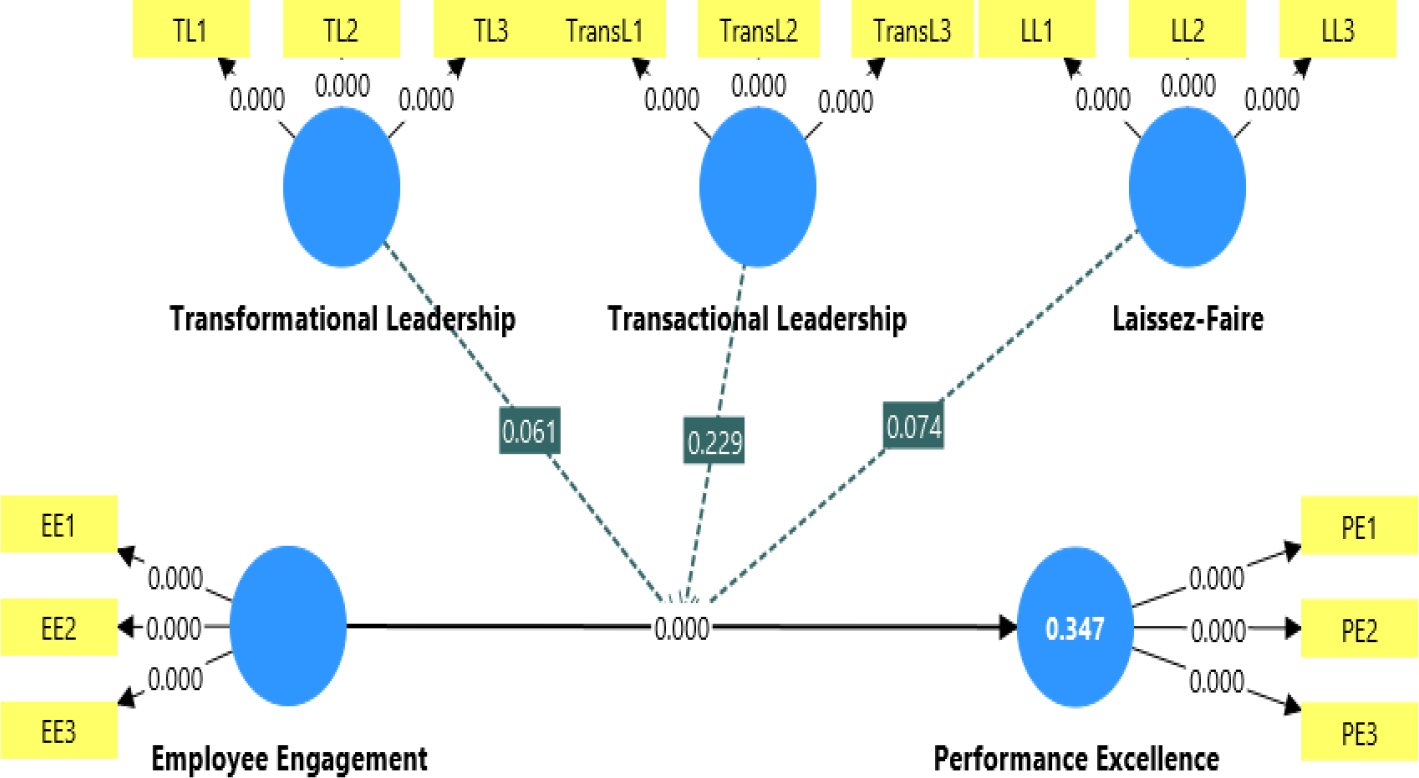
Fig. (3). Measurement model with path coefficients, T-statistics, and R-squared values.
5. Discussion and Hypothesis Assessment
This study aimed to investigate the relationship between employee engagement and performance excellence within the Abu Dhabi telecom sector, as well as to analyse how different leadership styles moderate this relationship. The research objectives were designed to fill gaps in the existing literature, specifically in relation to the telecom sector, and to provide actionable insights on optimal leadership strategies for improving employee engagement and performance outcomes. Below is a discussion that ties the findings of this study to the stated objectives and compares them with past studies.
The first objective was addressed through the strong positive relationship between employee engagement and performance excellence, with a path coefficient of 0.398. This confirms that higher engagement leads to better performance outcomes, which is consistent with the theoretical framework laid out by (Yadav et al., 2022) and supported by studies such as (He et al., 2021). Unlike past studies that have explored the engagement-performance relationship across various sectors (Ahmed et al., 2020) specifically focuses on the Abu Dhabi telecom sector. The study offers useful insights regarding employee engagement dynamics because it concentrates on a specific industry sector that operates in a technology-dominated environment.
The evaluation examined how three distinct leadership styles interact with the employee engagement-performance connexion. Transformational leadership creates a positive impact on this relationship yet demonstrates a moderate power level according to the path coefficient measurement of 0.118. The research indicates that transactional leadership produces a minimal positive effect (0.073) but laissez-faire leadership generates a clear negative impact (path coefficient -0.097) on the relationship. The study demonstrates fresh understanding of leadership-determination relationships within telecom industries because these findings showcase the behaviour effects on worker engagement in this highly competitive market sector. Past research, including studies by (Al Marshoudi et al., 2023; and Decuypere & Schaufeli, 2021) has extensively examined transformational leadership’s role in enhancing engagement and performance, particularly in creative and innovative sectors. Few studies exist which analyse how transactional and laissez-faire leadership styles impact long-term employee engagement because these leadership styles lead to different outcomes. This research contributes to improved knowledge of understudied leadership strategies that operate in the telecom industry.
The research also investigated actual leadership techniques to maximise both staff engagement and performance standards in the telecommunications industry of Abu Dhabi. The research established transformational leadership as the essential approach to achieve superior performance outcomes because of how this style inspires employees to exceed expectations. Performance shows a moderate positive connection with transactional leadership but reduces when employees experience laissez-faire leadership. It is supported with the study of (Yousif & Hasaballah, 2020; and Jayaraman & Sowmiya, 2022), that have discussed the positive effects of transformational leadership on performance. Table 5 reflects the summary of the hypotheses.
Table 5. Hypotheses summary.
| S.No. | Developed and Tested Hypotheses | Status |
| 1 | Employee engagement positively affects performance excellence in the telecom sector of Abu Dhabi. | Accepted |
| 2 | Transformational leadership positively moderates the relationship between employee engagement and performance excellence in the telecom sector of Abu Dhabi. | Accepted |
| 3 | Transactional leadership negatively moderates the relationship between employee engagement and performance excellence in the telecom sector of Abu Dhabi. | Rejected |
| 4 | Laissez-faire leadership negatively moderates the relationship between employee engagement and performance excellence in the telecom sector of Abu Dhabi. | Accepted |
This research has important practical implications for human resource management and leadership in the telecom industry of Abu Dhabi. The high positive correlation between employee engagement and excellence in performance highlights the relevance of cultivating a highly engaged staff to achieve better organisational results. Transformational leadership is identified as the most effective style, reiterating the necessity for leaders to inspire, motivate, and empower staff to surpass performance expectations. Telecom companies ought to invest in leadership training programs that foster transformational traits, like expression of vision and one-to-one support. Though transactional leadership has a limited positive influence, it can complement transformational practice through the sustenance of structure and accountability. Yet, the negative effect of laissez-faire leadership warns against the dangers of poor guidance, such that unstructured leadership might destroy commitment and performance. These findings lead telecom operators to focus on active, participative leadership styles that fuse inspiration with direct guidance, thereby increasing employee commitment, innovation, and organisational competitiveness in a rapidly changing marketplace.
Conclusion
This research identifies the pivotal influence of employee engagement and leadership on improving performance excellence in the Abu Dhabi telecom industry. The results indicate that employee engagement to some extent positively affects performance, and transformational leadership most effectively enhances this by motivating and actively engaging employees. Transactional leadership provides limited value, mostly for goal-specific purposes, while laissez-faire leadership also negatively affects motivation and performance. Telecom companies need to focus on transformational and action-oriented leadership styles to promote enduring employee commitment and innovation. Further, creating a caring organisational culture and ongoing professional growth are also key to aligning engagement with performance objectives. Continued measurement of employee engagement and performance facilitates improved strategic alignment. Investment in adaptive learning initiatives allows leaders and employees to navigate the increasingly dynamic telecom landscape. Through the integration of effective leadership, robust culture, and continuous development, Abu Dhabi telecom operators can attain sustainable success, innovation, and better organisational results.
The practical implications of this study highlight the importance for Abu Dhabi telecom organisations to implement transformational leadership to enhance employee engagement and performance excellence. Leaders need to actively energize and steer employees, creating supportive cultures that promote innovation and commitment. Transactional leadership can be supplementary by having clear goals and accountability, but laissez-faire leadership should be avoided because it has adverse effects. Organisations need to invest in ongoing leadership development and employee training initiatives to keep pace with the rapidly evolving telecom landscape. Biannual engagement surveys will ensure workforce efforts are aligned with business goals, ultimately leading to productivity, innovation, and competitive success.
Future implications
Subsequent researchers can build on this research by examining other leadership styles, e.g., participative or servant leadership, to identify their moderating influences on employee engagement and performance. Broadening the study across different industries outside telecommunications will enhance generalisability and industry-specific knowledge. Comparative analysis across industries or regions will highlight context differences in leadership performance. The integration of quantitative with qualitative methods, including interviews or focus groups, would yield richer explanations of observed relationships and underlying employee experience. These additions would allow for a better-rounded understanding of how leadership affects engagement and performance in various organisational contexts.
Author’s Contribution
The entire work including conceptualization, methodology, analysis, software work, writing, and editing/proofreading before final submission was done by F.A.
Ethical Approval for Human Participants
Not Applicable.
AVAILABILITY OF DATA AND MATERIALS
The data will be made available on reasonable request by contacting the corresponding author [F.A.].
Funding
Not Applicable.
Conflict of Interest
The authors declare that there is no conflict of interest regarding the publication of this article.
Acknowledgements
Declared None.
APPENDIX: Questionnaire
Section 1: Demographics
Please provide the following demographic information:
- Gender
- Male
- Female
- Other
- Prefer not to answer
- Age Range
- 18-24
- 25-34
- 35-44
- 45-54
- 55+
- Job Title/Position
- Customer Support Representative
- Sales Executive
- Marketing Specialist
- Network Engineer
- Product Manager
- Project Manager
- IT Specialist
- Operations Manager
- HR Manager
- Executive (e.g., CEO, CFO)
- Other (Please specify)
- Department
- Customer Service
- Sales and Marketing
- Network Engineering
- Product Development
- IT/Technology
- Operations
- Human Resources
- Finance
- Executive Management
- Other (Please specify)
- Length of Employment in the Company
- Less than 1 year
- 1-3 years
- 4-6 years
- 7-10 years
- More than 10 years
- Highest Level of Education
- High School
- Undergraduate Degree
- Postgraduate Degree
- Doctorate
- Other (Please specify)
- Employment Status
- Full-time
- Part-time
- Temporary
- Contractual
- Work Location
- Head Office
- Regional Office
- Field/Remote
- Other (Please specify)
- Years of Experience in the Telecom Industry
- Less than 1 year
- 1-3 years
- 4-6 years
- 7-10 years
- More than 10 years
Section 2: Employee Engagement
Please indicate your level of agreement with the following statements using a scale from 1 (strongly disagree) to 5 (strongly agree):
- I feel emotionally connected to my work.
- Strongly Disagree
- Disagree
- Neutral
- Agree
- Strongly agree
- I am motivated to go above and beyond my job responsibilities.
- Strongly Disagree
- Disagree
- Neutral
- Agree
- Strongly agree
- I believe my work has a significant impact on the success of the organisation.
- Strongly Disagree
- Disagree
- Neutral
- Agree
- Strongly agree
Section 3: Leadership Practices
Please indicate your level of agreement with the following statements about leadership in your workplace using a scale from 1 (strongly disagree) to 5 (strongly agree):
Transformational Leadership
- My supervisor encourages me to think creatively and solve problems on my own.
- Strongly Disagree
- Disagree
- Neutral
- Agree
- Strongly agree
- My supervisor inspires me to achieve high performance.
- Strongly Disagree
- Disagree
- Neutral
- Agree
- Strongly agree
- My supervisor motivates me by creating a vision for the future.
- Strongly Disagree
- Disagree
- Neutral
- Agree
- Strongly agree
Transactional Leadership
- My supervisor recognises my achievements and provides rewards based on my performance.
- Strongly Disagree
- Disagree
- Neutral
- Agree
- Strongly agree
- My supervisor enforces rules strictly and expects compliance.
- Strongly Disagree
- Disagree
- Neutral
- Agree
- Strongly agree
- My supervisor tends to use a system of rewards and punishments to manage performance.
- Strongly Disagree
- Disagree
- Neutral
- Agree
- Strongly agree
Laissez-Faire Leadership
- My supervisor avoids making decisions and leaves employees to work independently.
- Strongly Disagree
- Disagree
- Neutral
- Agree
- Strongly agree
- My supervisor takes a hands-off approach and allows employees to manage their own work.
- Strongly Disagree
- Disagree
- Neutral
- Agree
- Strongly agree
- My supervisor does not provide sufficient guidance when issues arise.
- Strongly Disagree
- Disagree
- Neutral
- Agree
- Strongly agree
Section 4: Performance Excellence
Please indicate your level of agreement with the following statements using a scale from 1 (strongly disagree) to 5 (strongly agree):
- I believe my individual job performance is consistently high.
- Strongly Disagree
- Disagree
- Neutral
- Agree
- Strongly agree
- My team works collaboratively to achieve high performance.
- Strongly Disagree
- Disagree
- Neutral
- Agree
- Strongly agree
- The organisation provides sufficient resources and support for employees to perform excellently.
- Strongly Disagree
- Disagree
- Neutral
- Agree
- Strongly agree
References
Ahmed, T., Khan, M. S., Thitivesa, D., Siraphatthada, Y., & Phumdara, T. (2020). Impact of employees engagement and knowledge sharing on organizational performance: Study of HR challenges in COVID-19 pandemic. Human Systems Management, 39(4), 589–601. https://doi.org/10.3233/HSM-201052.
Al-Dmour, R., Yassine, O., & Masa’deh, R. (2018). A review of literature on the associations among employee empowerment, work engagement and employee performance. Modern Applied Science, 12(11), 313–329. https://doi.org/10.5539/mas.v12n11p313.
Al Marshoudi, F. B., Jamaluddin, Z., & Al Balushi, F. I. (2023). Transformational leadership mediates the relationship between employee engagement and performance in production media. International Journal of Management, 1(2). https://doi.org/10.56868/ijmt.v1i2.25.
Ali, M., & Ullah, M. S. (2023). Role of laissez-faire leadership in talent management: Evidence from the pharmaceutical industry of Bangladesh. Heliyon, 9(6). https://doi.org/10.1016/j.heliyon.2023.e17234.
Baharum, H., Ismail, A., Awang, Z., McKenna, L., Ibrahim, R., Mohamed, Z., & Hassan, N. H. (2023). The study adapted instruments based on Confirmatory Factor Analysis (CFA) to validate measurement models of latent constructs. International Journal of Environmental Research and Public Health, 20(4), 2860. https://doi.org/10.3390/ijerph20042860.
Baig, S. A., Iqbal, S., Abrar, M., Baig, I. A., Amjad, F., Zia-ur-Rehman, M., & Awan, M. U. (2021). Impact of leadership styles on employees’ performance with moderating role of positive psychological capital. Total Quality Management & Business Excellence, 32(9–10), 1085–1105. https://doi.org/10.1080/14783363.2019.1665011.
Bakker, A. B., & Demerouti, E. (2007). The Job Demands‐Resources model: State of the art. Journal of Managerial Psychology, 22(3), 309–328. https://doi.org/10.1108/02683940710733115.
Başar, U., Yalçıntaş, M., & İyigün, N. Ö. (2021). A conceptual study on the theoretical framework of transformational and transactional leadership models. Business & Management Studies: An International Journal, 9(4), 1708. https://doi.org/10.15295/bmij.v9i4.1897.
Chiu, C. Y., Nahrgang, J. D., Bartram, A., Wang, J., & Tesluk, P. E. (2021). Leading the team, but feeling dissatisfied: Investigating informal leaders’ energetic activation and work satisfaction and the supporting role of formal leadership. Journal of Organizational Behavior, 42(4), 527-550. https://doi.org/10.1002/job.2511.
Chua, J., & Ayoko, O. B. (2021). Employees’ self-determined motivation, transformational leadership and work engagement. Journal of Management & Organization, 27(3), 523-543. https://doi.org/10.1017/jmo.2018.74.
Dastane, D. O. (2020). Impact of leadership styles on employee performance: A moderating role of gender. Australian Journal of Business and Management Research, 5(12), 27–52. https://papers.ssrn.com/sol3/papers.cfm?abstract_id=3732731.
Decuypere, A., & Schaufeli, W. (2021). Exploring the Leadership–Engagement Nexus: A Moderated Meta-Analysis and Review of Explaining Mechanisms. In International Journal of Environmental Research and Public Health (Vol. 18, Issue 16). https://doi.org/10.3390/ijerph18168592.
Dong, B. (2023). A systematic review of the transactional leadership literature and future outlook. Academic Journal of Management and Social Sciences, 2(3), 21–25. https://pdfs.semanticscholar.org/8158/5768e874415ebf8b69fee2520929c0e283cb.pdf.
Donkor, F., & Zhou, D. (2020). Organisational commitment influences on the relationship between transactional and laissez-faire leadership styles and employee performance in the Ghanaian public service environment. Journal of Psychology in Africa, 30(1), 30–36. https://doi.org/10.1080/14330237.2020.1712808.
Hair, J. F., Risher, J. J., Sarstedt, M., & Ringle, C. M. (2019). When to use and how to report the results of PLS-SEM. European Business Review, 31(1), 2–24. https://doi.org/10.1108/EBR-11-2018-0203.
He, J., Morrison, A. M., & Zhang, H. (2021). How high-performance HR practices and LMX affect employee engagement and creativity in hospitality. Journal of Hospitality & Tourism Research, 45(8), 1360–1382. https://doi.org/10.1177/1096348021996800.
Jayaraman, S., & Sowmiya, K. (2022). A Study on Impact of Employee Engagement on Work Force Excellence. MS Ramaiah Management Review ISSN (Print)-0975-7988, 13(02). https://doi.org/10.52184/msrmr.v13i02.141.
Kang, H. (2021). Sample size determination and power analysis using the G* Power software. Journal of Educational Evaluation for Health Professions, 18. https://doi.org/10.3352/jeehp.2021.18.17.
Kline, E., Wilson, C., Ereshefsky, S., Tsuji, T., Schiffman, J., Pitts, S., & Reeves, G. (2012). Convergent and discriminant validity of attenuated psychosis screening tools. Schizophrenia Research, 134(1), 49–53. https://doi.org/10.1016/j.schres.2011.10.001.
Koroglu, Ş., & Ozmen, O. (2022). The mediating effect of work engagement on innovative work behavior and the role of psychological well-being in the job demands–resources (JD-R) model. Asia-Pacific Journal of Business Administration, 14(1), 124–144. https://doi.org/10.1108/APJBA-09-2020-0326.
Lai, F.-Y., Tang, H.-C., Lu, S.-C., Lee, Y.-C., & Lin, C.-C. (2020). Transformational leadership and job performance: The mediating role of work engagement. Sage Open, 10(1), 2158244019899085. https://doi.org/10.1177/2158244019899085.
Mascha, E. J., & Vetter, T. R. (2018). Significance, errors, power, and sample size: The blocking and tackling of statistics. Anesthesia & Analgesia, 126(2), 691–698. https://doi.org/10.1213/ANE.0000000000002741.
Mayfield, C., Neville, J., & Prabhakar, S. (2009). A statistical method for integrated data cleaning and imputation. https://docs.lib.purdue.edu/cstech/1723.
McAnally, K., & Hagger, M. S. (2024). Self-determination theory and workplace outcomes: A conceptual review and future research directions. Behavioral Sciences, 14(6), 428. https://doi.org/10.3390/bs14060428.
Meira, J. V. de S., & Hancer, M. (2021). Using the social exchange theory to explore the employee-organization relationship in the hospitality industry. International Journal of Contemporary Hospitality Management, 33(2), 670–692. https://doi.org/10.1108/IJCHM-06-2020-0538.
Nimngam, C., Rojanapanich, A., & Lei, S. (2025). Factors Affecting Work Performance Based on the Education Criteria for Performance Excellence (EdPEx) of Personnel at the Faculty of Management Science, Suan Sunandha Rajabhat University. International Academic Multidisciplinary Research Conference (Icbtsmadrid) 2025, 236–242. http://icbtsproceeding.ssru.ac.th/index.php/ICBTSMADRID2025/article/view/1588/1558.
Nsom, N. K., Teih, M. M., & Sundjo, F. (2019). The effects of transactional and transformational leadership on personnel conduct. International Journal of Research–Granthaalayah, 7(6), 155–164. https://doi.org/10.5281/zenodo.3266231.
Palumbo, R. (2021). Engaging to innovate: An investigation into the implications of engagement at work on innovative behaviors in healthcare organizations. Journal of Health Organization and Management, 35(8), 1025–1045. https://doi.org/10.1108/JHOM-02-2021-0072.
Park, J., Han, S. J., Kim, J., & Kim, W. (2022). Structural relationships among transformational leadership, affective organizational commitment, and job performance: the mediating role of employee engagement. European Journal of Training and Development, 46(9), 920-936. https://doi.org/10.1108/EJTD-10-2020-0149.
Rathee, R., & Sharma, M. V. (2020). Journey of engagement: From personal engagement to employee engagement. A conceptual review. International Journal of Advanced Science and Technology, 29(3), 10622–10638. https://www.researchgate.net/profile/Rupa-Rathee/publication/351138902_Journey_of_Engagement_From_Personal_Engagement_to_Employee_Engagement/links/608bc543458515d315e6f449/Journey-of-Engagement-From-Personal-Engagement-to-Employee-Engagement.pdf.
Robinson, R. S. (2024). Purposive sampling. In Encyclopedia of quality of life and well-being research (pp. 5645–5647). Springer. https://doi.org/10.1007/978-3-031-17299-1_2337.
Rönkkö, M., & Cho, E. (2022). An updated guideline for assessing discriminant validity. Organizational research methods, 25(1), 6-14. https://doi.org/10.1177/1094428120968614.
Saks, A. M., Gruman, J. A., & Zhang, Q. (2022). Organization engagement: a review and comparison to job engagement. Journal of Organizational Effectiveness: People and Performance, 9(1), 20-49. https://doi.org/10.1108/JOEPP-12-2020-0253.
Sandhu, M. A., & Al Naqbi, A. (2023). Leadership behavior and innovation performance in the UAE’s telecom and ICT industries. Benchmarking: An International Journal, 30(5), 1695–1712. https://doi.org/10.1177/1094428120968614.
Suhendra, R. (2021). Role of transactional leadership in influencing motivation, employee engagement, and intention to stay. KnE Social Sciences, 194-210. https://doi.org/10.18502/kss.v5i5.8809.
Thanh, N. H., & Quang, N. V. (2022). Transformational, transactional, laissez-faire leadership styles and employee engagement: Evidence from Vietnam’s public sector. Sage Open, 12(2), 21582440221094606. https://doi.org/10.1177/21582440221094606.
Turner, P. (2020). Employee Engagement in Contemporary Organizations Maintaining High Productivity and Sustained Competitiveness. Palgrave Macmillan. https://link.springer.com/content/pdf/10.1007/978-3-030-36387-1.pdf.
Wuryaningrat, N. F., Hidayat, N., & Kumajas, M. L. (2024). The Impact of transformational and transactional leadership on employee performance. Klabat Journal of Management, 5(2), 103–113. https://doi.org/10.60090/kjm.v5i2.1116.103-113.
Yadav, A., Pandita, D., & Singh, S. (2022). Work-life integration, job contentment, employee engagement and its impact on organizational effectiveness: a systematic literature review. Industrial and Commercial Training, 54(3), 509-527. https://doi.org/10.1108/ICT-12-2021-0083.
Yousif, A. M. S., & Hasaballah, A. H. A. (2020). Assessing the effect of organizational cultural values and employees engagement on performance excellence. International Journal of Management, 11(4). https://papers.ssrn.com/sol3/papers.cfm?abstract_id=3600700.
Zarrouk, J. (2023). Digitalization and the UAE Economy: A New Driver of Sustainable Development. https://erf.org.eg/app/uploads/2023/08/1693330582_958_1456421_1651.pdf.
Zhonglin, D. T. W. (2020). Statistical approaches for testing common method bias: Problems and suggestions. Journal of Psychological Science, 43(1), 215. https://jps.ecnu.edu.cn/EN/.
Licensed
© 2025 Copyright by the Authors.
Licensed as an open access article using a CC BY 4.0 license.
Article Contents Author Yazeed Alsuhaibany1, * 1College of Business-Al Khobar, Al Yamamah University, Saudi Arabia Article History: Received: 03 September,
Article Contents Author Muhammad Arslan Sarwar1, * Maria Malik2 1Department of Management Sciences, University of Gujrat, Gujrat, Pakistan; 2COMSATS
Article Contents Author Tarig Eltayeb1, * 1College of Business Administration, Imam Abdulrahman Bin Faisal University, Dammam, Saudi Arabia Article History:
Article Contents Author Kuon Keong Lock1, * and Razali Yaakob1 1Faculty of Computer Science and Information Technology, Universiti Putra Malaysia,
Article Contents Author Shabir Ahmad1, * 1College of Business, Al Yamamah University, Al Khobar, Kingdom of Saudi Arabia Article History:
Article Contents Author Ghanima Amin1, Simran1, * 1Department of Biological Sciences, University of Sialkot, Sialkot 51310, Pakistan Article History: Received: