





Article Contents
Impact of Leadership Style, Employee Motivation, and Organisational Culture on Employee Productivity in the Technology UK
 DOI:
DOI:  PDF
PDF
⬇ Downloads: 7
1Department of Business Management, University of Staffordshire, England, UK
Received: 26 March, 2025
Accepted: 17 June, 2025
Revised: 13 June, 2025
Published: 02 July, 2025
Abstract:
Background: Employee productivity is paramount in sustaining a competitive edge in the rapidly evolving and fast-paced UK technology industry. Leadership style, employee motivation, and organisational culture have been recognised as determinants of productivity, although their simultaneous impact is less examined in this industry.
Aim: The study explored the impact of leadership style, employee motivation, and organisational culture on employee productivity in the UK technology industry.
Methods: A quantitative study design was used, and 337 employees from different UK technology firms completed a structured questionnaire. Using a five-point Likert scale, the questionnaire captured leadership style, motivation, organisational culture, and productivity. Data were examined using Partial Least Squares Structural Equation Modelling (PLS-SEM) with confirmatory factor analysis and path analysis to verify the hypothesised relations.
Findings: The results indicate that organisational culture has the strongest and most positive influence on employee productivity (β = 0.487, p < 0.001). The leadership style likewise shows a statistically significant positive impact on employee productivity (β = 0.205, p = 0.003). Employee motivation, however, suggests a positive but statistically insignificant influence (β = 0.071, p = 0.261). These findings suggest that although leadership style and organisational culture are the main drivers of productivity for the UK technology industry, employee motivation’s direct influence is less pronounced in this context.
Implications: The findings indicate that British technology companies must develop a healthy organisational culture and transformational leadership to improve productivity. Employee motivation Although critical, employee motivation could operate indirectly through these variables. The research provides practicable recommendations for managers and policymakers looking to maximise human capital and create sustainable productivity growth in technologically rapid environments.
Keywords: Leadership style, employee motivation, organisational culture, employee productivity, UK technology sector.
1. INTRODUCTION
In today’s business environment, leadership style, employee motivation, and organisational culture have increasingly been recognised as key drivers of employee productivity (Jerab & Mabrouk, 2023). The technology industry is a high-speed, constantly changing environment that demands continuous and optimal workforce performance. Therefore, it is imperative to understand the dynamics of the relationships between leadership style, employee motivation, and organisational culture to assist businesses in their bid to stay competitive. According to (Kongkaew & Nuangjamnong, 2023), work satisfaction, leadership style, training programs, and company culture are all key aspects influencing employee performance. It has been argued that, effective leadership encourages and inspires employees, leading to higher production and performance (Shiyanbade et al., 2024). Employees work more effectively when they are given the right training to succeed in their work. Moreover, a strong organisational culture allows employees to participate and achieve better productivity. (Oladimeji et al., 2023). The quality and amount of output given by a workforce is often connected to how satisfied employees are with their jobs.
Organisations in the UK technology industry face challenges affecting employee productivity, for example, increased advancements in technology, high competition and the constant need for continuous development (Belitski et al., 2023). Organisations in this rapid economy must devote resources to technology and focus on the development of their people. In such case, effective leadership behaviour becomes critical in promoting innovation while inspiring staff to get involved at work (Abdul-Azeez et al., 2024). A workplace culture that supports inclusion, originality and respect among workers suits their ability to perform well. (Bogale & Debela, 2024). Effective leadership, motivation and culture are important in generating high productivity in the tech sector.
The UK tech sector faces significance challenges that affects employee producivty and organisational performance. Per (Spowage et al., 2024), an important issue is that the speed of technological development and new immigration policies have led to the shortage of skilled experts. The quick change to hybrid and remote jobs has added new challenges when it comes to team engagement, communication and collaboration (Nagori & Lawton, 2025). These changes pressure leadership modes and company culture to adjust and facilitate workforce productivity. Furthermore, increased competition and rapid innovation call for ongoing employee motivation and loyalty. These urgent challenges justify this study because knowledge of the relationship between leadership, motivation, and culture is necessary to maintain productivity in this challenging sector. This study thus fills a timely and topical gap in the context of the UK tech sector.
Despite widespread research on leadership style, employee motivation, and organisational culture individually and separately, there is a significant knowledge gap in understanding how they affect employee productivity, particularly in the UK technology sector. In addition, although research has recognised the significance of leadership and motivation in driving productivity, few have directly shed light on the UK technology sector, where change is faster, and employee expectations are continually evolving (Rukmana, 2020). As the industry experiences increased competition worldwide, organisations must constantly evolve to incorporate emerging technologies like artificial intelligence, automation, and data analytics, which require highly skilled, motivated, and dynamic employees. Also, shifting employee aspirations around purposeful work, belongingness, and work-life harmony requires leadership and cultural strategies that encourage engagement and retention. The increasing prominence of hybrid and remote work arrangements further complicates conventional management structures, such that effective leadership and a robust organisational culture are essential to preserving productivity. Increasing focus on sustainable business practices puts new demands on companies to connect their organisational values with employee drivers. Tackling such urgent challenges, this research offers key insights for UK technology companies seeking to boost productivity and innovation through optimising leadership, motivation, and culture in an ever more complex and dynamic world.
The research holds significance as it provides vital knowledge to organisations in the technology industry, which rely heavily on innovation, productivity, and creativity to remain competitive. By understanding the relationship between leadership, motivation, and culture, organisations can create better management strategies, adapt their leadership styles, and promote a working environment that achieves optimum employee productivity. The study will benefit academic researchers by expanding the literature on organisational behaviour and employee productivity, especially within the fast-changing technology industry. The study’s findings aim to fill the knowledge gaps by offering a detailed insight into the dynamics between leadership, motivation, and culture in shaping worker performance.
The study’s novelty lies in its focus on the specific context of the UK tech sector, which faces many challenges, including high competition and demand for continuous learning. Based on a report by Tech UK in 2025, the industry is also confronted with major challenges, such as high energy prices and business tax, which affect its growth potential (TechUK, 2025). Moreover, a survey also pointed out that more than half of UK business leaders confirmed that their companies have no formal AI strategy, creating an imbalance in productivity levels among AI users and non-users (Milmo, 2025). Therefore, this research is necessary for both scholarly theory and real-world application. In addition, through a holistic process of analysing leadership, motivation, and culture, the study will offer innovative insights into how organisations can bring these factors together to achieve a culture of productivity and innovation. Ultimately, companies, policymakers, and research academics will gain from the practical recommendations and conclusions drawn from this research, allowing them to create more productive and innovative work environments within the UK technology industry.
2. Literature Review
Leadership style determines employee productivity by affecting motivation, engagement, and general work behaviour. As per (Alshehri, 2024), transformational leadership, exemplified by vision, inspiration, and individualised support, has been extensively recognised in driving productivity. It has been argued that transformational leaders motivate employees by creating a powerful vision and instilling a sense of purpose, thus challenging them to perform beyond what is expected in everyday activities (Syarifuddin, 2023). Transactional leadership grounded on formal rewards and penalties is more about maintaining developed performance levels rather than inspiring exceptional effort (Tinise, 2022). Although effective for ordinary tasks and compliance, (Al-Baidhani & Alsaqqaf, 2022) argued that transactional leadership may limit creativity and lower intrinsic motivation, constraining productivity growth. Open communication, participative decision-making, and empowerment by leaders create a positive climate in which workers feel appreciated and encouraged to contribute significantly (Ahn & Bessiere, 2022). Such environments facilitate problem-solving, information sharing, and flexibility, contributing to efficiency and output. Additionally, (Prayudi et al., 2024) stated that ethical and compassionate leadership fosters trust and commitment, decreasing turnover and absenteeism and thus maintaining stability in productivity. As per (Sunarni et al., 2023), leaders who adapt their approach to meet situational requirements as well as the needs of their employees are optimally suited to maximise performance and overall productivity.
Employee motivation is a key determinant of productivity since it directly influences the effort, commitment, and perseverance employees invest in their work (Uka & Prendi, 2021). (Ahmad, 2021) found that motivation drives the internal willingness of employees to accomplish goals, perform their work, and make significant contributions to organisational achievement. (Aljumah, 2023) further discussed that it functions through intrinsic and extrinsic mechanisms, as personal satisfaction, a sense of duty, and the satisfaction derived from work create intrinsic motivation, while external rewards like pay, bonuses, promotions, and praise drive extrinsic motivation. Employees exhibit increased attention, creativity, and tenacity, increasing productivity when motivated. (Neuber et al., 2022) revealed that the absence of motivation tends to result in disengagement, absenteeism, and reduced quality of work, drastically lowering organisational performance. It is critical that organisations need to determine and resolve the complex factors that affect motivation in order to realise their employees’ full potential successfully. Moreover, (Karsim et al., 2023) found that the organisational context in which employees work influences impedes motivation. Organisational practices that promote autonomy, recognition, growth opportunities, and meaning significantly boost intrinsic motivation and productivity (Imran et al., 2025). As per (Uka & Prendi, 2021), when employees feel that their contribution is valued and that they have an opportunity to learn skills and professionally develop, their effort and dedication thus increase productivity.
Recent empirical evidence spotlights leadership style and organisational culture’s crucial roles in improving employees’ productivity in the UK technology industry. Organisational culture emerged as the most significant and positive effect, echoing previous work by (Page et al., 2019), which stressed that a culture of care and trust enhances employee engagement and performance rates. This validates the conclusions of (Nzuva & Mwende-Kimanzi, 2022), as the authors contended that organisational culture influences employee attitudes and b, behaviours and productivity. Leadership style was also highly significant in impacting productivity, supporting (Alshehri, 2024), who established that transformational leadership encourages employees to perform beyond expectations. Just like organisational culture, (Ali & Yin, 2024) also pointed out that leadership styles are responsible for open communication and empowerment, which, in turn, greatly impacts workforce performance. Conversely, employee motivation had a positive but statistically non-significant direct relationship with productivity, aligning with (Ahmad, 2021), who suggested that motivation’s effect might be indirect or mediated by organisational factors.
Organisational culture significantly influences employee productivity by establishing the shared values, beliefs, and behavioural norms that determine how staff interact, collaborate, and approach their work (Nzuva & Mwende-Kimanzi, 2022). (Pougajendy et al., 2024) discovered that when employees feel aligned with the organisation’s culture, they develop a stronger sense of belonging and commitment, which drives higher motivation and discretionary effort. Such cultures may stifle communication, inhibit innovation, and foster resistance to change, detracting from employee performance. (Monyai et al., 2024) stated that organisational culture dictates the tone of workplace conduct and greatly influences how well employees collaborate to meet strategic goals. It demonstrates the perception of leadership stole and the way motivational strategies are put into action, helping them either help or constraining their influence. If a company creates recognition, learning and collaboration-focused cultures, employees tend to feel better at their jobs and are more productive (Celestin et al., 2024). For instance, (Radu, 2023) argued that organisations open to transparent communication and encourage employees develops an adaptable workforce that responds positively and actively towards problems. Moreover, positive culture assists in talent attraction and retention as they create an appealing and healthy work environment (Page et al., 2019). (Rasool et al., 2021) discovered that toxic cultures result in high turnover and low employee engagement, which degrades productivity.
The Expectancy Theory of Motivation, formulated by Victor Vroom, is a strong paradigm for grasping how worker motivation determines productivity (Misroame, 2023). The theory explains that the motivation of an individual to work depends on the anticipated rewards from their activity and the importance they assign to these rewards. The theory has three key elements including expectancy, instrumentality, and valence whereas expectancy is the perception that harder work results in improved performance; instrumentality is the perceived relationship between performance and receiving a desired reward; and valence is the value or priority the person assigns to that reward (Lee, 2019). As per the theory, employees are encouraged to invest their effort when they be certain that this will lead to effective performance, the phenomenon will be rewarded, and the compensation is meaningful to them as individuals (Kandel et al., 2025). In terms of application, the Expectancy Theory proposes that organisations can make employees work more productively by explicitly connecting effort with consequences on performance and ensuring that the benefits being provided are valued and desirable.
2.1. Conceptual Framework
Fig. (1) depicts the relationships among employee motivation, leadership style, organisational culture, and their combined effect on employee productivity. Employee motivation is the intrinsic and extrinsic driver of employees’ effort and commitment towards organisational objectives. Leadership style is how leaders motivate, inspire, and direct employees, influencing workplace behaviours and performance (Al-Baidhani & Alsaqqaf, 2022). Organisational culture captures the common values, norms, and practices that establish the social context of the work environment. These three independent variables are posited to directly and indirectly impact employee productivity, and the dependent variable captures the employees’ effectiveness and efficiency in accomplishing organisational goals.
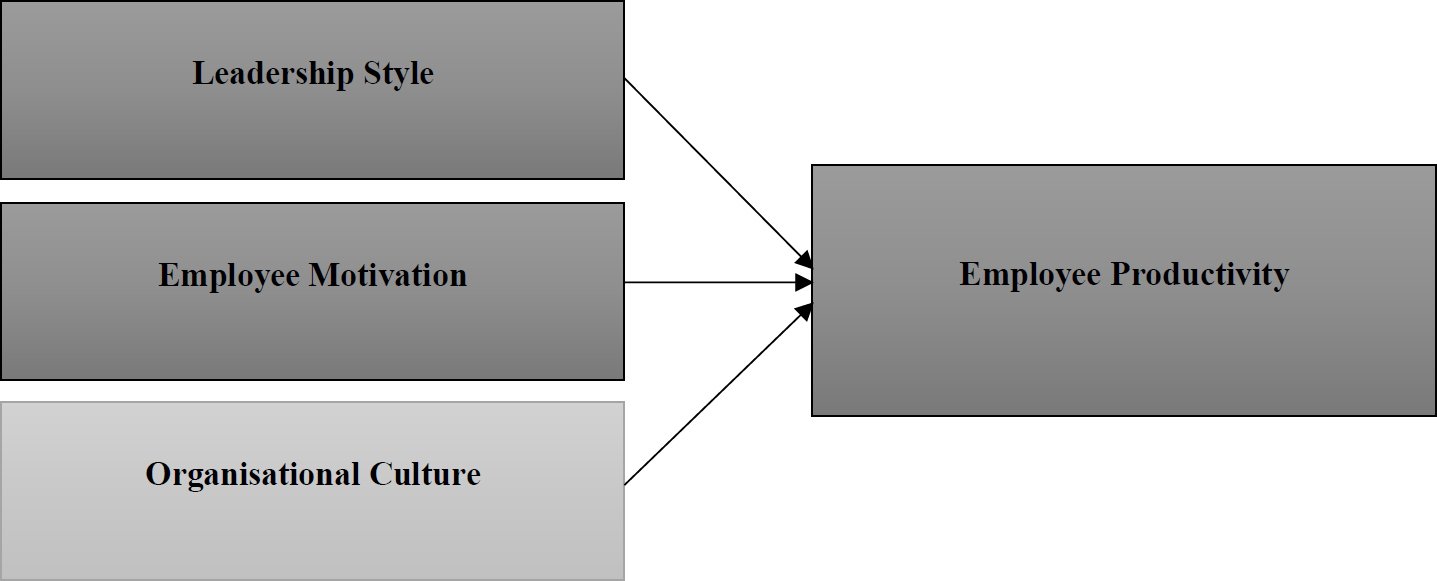
Fig. (1). Conceptual framework.
H1: The leadership style positively and significantly affects workplace productivity.
(Alshehri, 2024) showed that transformational leadership, marked by vision, inspiration, and individualised consideration, greatly boosts employee productivity. (Alshehri, 2024) further documented how transformational leaders inspire employees by articulating a compelling vision and building trust, collaboration, and empowerment, which spur improved performance levels.
H2: Employee motivation has a positive but insignificant impact on employee productivity.
(Ahmad, 2021) highlighted that worker motivation is a crucial productivity driver, demonstrating that employees with motivation exert more effort, commitment, and persistence. (Ahmad, 2021) further revealed that intrinsic and extrinsic motivation drivers, including personal satisfaction and rewards, explicitly affect the amount of energy invested in work by employees, hence enhancing performance.
H3: Organisational culture contributes positively and significantly to employee productivity.
(Page et al., 2019) explained that a healthy organisational culture often makes employees more productive with the help of trust, respect and a place to belong. According to the study, encouraging work cultures with open talk, joint efforts and ongoing learning increases employees’ engagement and the amount of effort they freely give.
3. Methods
The study utilised quantitative methods in the study to investigate the impact of leadership style, employee motivation and organisational culture on employee productivity in the UK tech sector. The rationale for opting quantitative research it its ability in delivering objective measurements and rigorous statistical analysis of how these factors affect each other (Taguchi, 2018). As the focus of the study is understanding how organisational culture, employee motivation and style of leadership affect employees, using quantitative data methods makes it possible to study and generalise the information for the whole population. The study by (Jones et al., 2019), argued that, quantitative methods assist in reducing any subjectivity and ensures the testing of hypotheses using appripriate statistical methods.
The data was collected through a structured questionnaire, meticulously designed to obtain in-depth and quantifiable information about employees’ impressions and experiences of leadership, motivation, organisational culture, and productivity in the UK technology industry. questionnaire wa developed on five-point Likert scale from “Strongly Agree” to “Strongly Disagree” to score the degree of agreement or disagreement. The scale gave the respondents a convenient means of expressing their views and enabling the researcher to measure differences in attitudes and behaviours precisely. The questionnaire comprises four sections: the independent variables, such as organisational culture, employee motivation, and leadership style and the dependent variable, such as employee productivity, enabling a specific and systematic data collection. The sample size in the study was 337 respondents, and the most frequent statistical formula employed in quantitative research was employed to calculate the sample size. The formula accounts for factors like the number of employees in the UK technology sector to calculate that the sample would accurately represent the greater population.
In addition, the process included selecting a confidence level of 95% which represents high confidence in the outcome, with a 5% margin of error which is allowable deviation from the true population parameteres. Due to this, the researcher determine the number of people needed for reliable and general findings. With this sample size, the findings are considered statistically appropriate for applying to the whole study population. The study utilised purposive and convenient sampling techniques to recruite participants employed in the UK technology sector and receive proper exposure to company culture, leaders and motivation Purposive sampling guarantees that proper respondents only are ensured to have fulfilled defend inclusion criteria, i.e., job title, length of experience, and organisational process participation are selected, thereby enhancing data appropriateness and quality (Mweshi & Sakyi, 2020). Convenience sampling method is used to help with data collection and to make sure there is diversity among the participants (Zickar & Keith, 2023).
Partial Least Squares Structural Equation Modelling (PLS-SEM) is the method used for data analysis suitable for appropriate analysis examining relationships between latent factors in social science research. The first step in analysis is performing Confirmatory Factor Analysis (CFA) to check the model’s reliability, and to assess the effectiveness among items. To ensure construct validity, analysed critical indicators included item factor loadings, composite reliabiltiy measures and average variance extracted (AVE). After the measurement model is confirmed, the structural model is examined to understand whether employee motivation, organisational culture, leadership style and employee productivity have the expected relationships shown by the hypotheses. At this stage, path coefficient analysis helps identify the effects’ strength and the direction they take. Additionally, a reliable and valid sample was achieved because the study used careful data screening methods. An analysis of the response was performed to help ensure more people took part and less biased data was collected. When the data was collected, any missing values were discovered and handled through suitable imputations so that the analysis would not be affected. By using a trustworthy and clean sample, we were able to show more clearly that relationships between motivation, leadership, culture and productivity had an impact on each other.
4. Results and Analysis
4.1. Demographics
According to Table 1, there are more males (62.3%) than females (37.7%) in the 337 participants. Women hold 35.6% of the positions and other gender identities together are under 2%. As per (Hing et al., 2023), the data suggests that males have higher probability to be hired in the UK tech sector as they form a greater part of the industry workforce. The proportionately lower percentage of females indicates persistent gender imbalances in the sector.
Table 1. Gender.
| Gender | Frequency | Percentage (%) |
| Male | 210 | 62.3 |
| Female | 120 | 35.6 |
| Other | 5 | 1.5 |
| Not Specified | 2 | 0.6 |
| Total | 337 | 100 |
As per Table 2, the age breakdown of the 337 respondents demonstrates that the most predominant category is the 26-35 years category, which comprises 38.6% of the population. The age bracket 8-25 years category at 28.2%. as these two younger age categories collectively form an overwhelming majority (66.8%), underscoring the young age profile of the technology workforce. The 36-45 years cohort holds 20.8%, followed by older workers in the 46-55 and over 55 associates at 8.9% and 3.5%, respectively. As (Higginbotham, 2024) found, the UK tech sector is dominated by early and mid-career workers showing signs of long-term success.
Table 2. Age.
| Age Group | Frequency | Percentage (%) |
| 18 – 25 | 95 | 28.2 |
| 26 – 35 | 130 | 38.6 |
| 36 – 45 | 70 | 20.8 |
| 46 – 55 | 30 | 8.9 |
| Above 55 | 12 | 3.5 |
| Total | 337 | 100 |
4.2. Measurement Model Using Confirmatory Factor Analysis
As per Table 3, the research utilised Confirmatory Factor Analysis (CFA) to estimate the reliability and convergent validity of the measurement model, which is an essential step in validating the constructs being researched. It has been argued that, CFA effectively helps confirm that observed variables meet the requirements of the underlying latent constructs (Cheung et al., 2024). Cronbach’s alpha and composite reliability were both used to measure the unity of constructs and a value of 0.7 or higher is considered acceptable according to guidelines (Haji-Othman & Yusuff, 2022). According to Table 3, it shows that all the constructs exceed the established threshold, ensuring the quality of the measurement model. Leadership Styles, Employee Motivation, Organisational Culture and Employee Productivity show Cronbach’s alpha values of 0.838, 0.831, 0.890 and 0.902 respectively and composite reliability of 0.842, 0.839, 0.892 and 0.902, respectively. The analyses high iternal consostency in all latent variables which increases the confidence in the validity of the measurement tools.
Table 3. Reliability and convergent validity testing.
| Constructs | Indicators | Factor Loadings | Cronbach’s Alpha | Composite Reliability | Average Variance Extracted (AVE) |
| Leadership styles | LS1 | 0.876 | 0.838 | 0.842 | 0.755 |
| LS2 | 0.890 | ||||
| LS3 | 0.840 | ||||
| Employee motivation | EM1 | 0.827 | 0.831 | 0.839 | 0.748 |
| EM2 | 0.913 | ||||
| EM3 | 0.853 | ||||
| Organisational culture | OC1 | 0.894 | 0.890 | 0.892 | 0.820 |
| OC2 | 0.932 | ||||
| OC3 | 0.891 | ||||
| Employee productivity | EP1 | 0.908 | 0.902 | 0.902 | 0.737 |
| EP2 | 0.931 | ||||
| EP3 | 0.904 |
Individual factor loadings for each indicator were looked at to determine the degree to which they contribute to their constructs. (Cheung et al., 2024) studied factor loadings greater than 0.6 as worthwhile and a good indication of high construct representation. Table 3 displays factor loadings ranging from 0.840 to 0.890 for Leadership Styles, 0.827 to 0.913 for Employee Motivation, 0.891 to 0.932 for Organisational Culture, and 0.904 to 0.931 for Employee Productivity, confirming that all items meaningfully contribute to their constructs. In addition, the Average Variance Extracted (AVE) measures for all the constructs are above the 0.7 benchmark, standing at 0.755 for Leadership Styles, 0.748 for Employee Motivation, 0.820 for Organisational Culture, and 0.737 for Employee Productivity. These AVE measures all denote a high degree of convergent validity, as they show that the latent constructs account for much of the variance in their respective observed indicators. Therefore, the findings validate that the measurement model is valid and reliable and is a good foundation for further structural analysis in this study.
As per Table 4, the study employed the Heterotrait-Monotrait (HTMT) ratio to examine the discriminant validity of the involved constructs rigorously, an essential step to establish that every latent variable captures a distinct factor of the research model (Ab Hamid et al., 2017). HTMT score less than 0.85 is the standard signalling valid discriminant validity, ensuring that constructs are not interrelated and multicollinearity is properly addressed (Cheung et al., 2024). The findings in Table 4 illustrate that all HTMT relatedness between employee motivation, employee productivity, leadership style, and organisational culture is below this critical value. For instance, the relatedness between employee motivation and productivity is 0.443, indicating a moderate yet distinctive relationship. The HTMT ratio between leadership style and employee productivity is 0.620, and its relatedness with employee motivation is 0.595. These values support the theoretical assumption that though these constructs interrelate, they maintain conceptual distinctness, thus affirming the structural validity of the measurement model.
Table 4. Discriminant validity.
| Constructs | Employee Motivation | Employee Performance | Leadership Style |
| Employee Productivity | 0.443 | ||
| Leadership Style | 0.595 | 0.620 | |
| Organisation Culture | 0.509 | 0.719 | 0.714 |
Moreover, the table’s findings indicate that organisational culture strongly relates to employee productivity (0.719) and leadership style (0.714). However, these are still below the threshold, reaffirming that these highly interconnected constructs measure distinct phenomena. Organisational culture and employee motivation have a more moderate relatedness of 0.509, asserting construct distinctiveness. This interrelatedness pattern indicates an interdependence of variables with no sacrifice in discriminant validity. The findings confirm that each construct accounts uniquely for employee productivity, leadership relationships, motivation, and influence within the organisational context. Therefore, HTMT provides strong evidence for the measurement model’s validity and reliability, reinforcing the research design’s strength and allowing for certain interpretations of follow-up path analyses. This validation is essential to ensure that the hypothesised relationships assessed through the structural model rest upon empirically discriminant and theoretically coherent constructs.
4.3. Path Analysis
Table 5 shows the structural model testing conducted to test the expected relationships between the independent variables (employee motivation, leadership style, and organisational culture) and the dependent variable (employee productivity). Bootstrapping methods were used in the analysis to assess the strength and significance of these path coefficients, which were in line with methodological prescriptions (Kock, 2018). As shown in Table 5, the estimated path coefficient from employee motivation to employee productivity was 0.071, with a t-statistic of 1.125 and an associated p-value of 0.261. These findings show that the direct effect of employee motivation on employee productivity is positive but statistically insignificant in the sample studied, implying that motivation may not be a strong predictor of productivity in this situation. The asterisks beside the coefficients represent statistical significance at the 0.01 level (p < 0.01), indicating strong evidence that the relationship is not coincidental. In Table 5, Leadership Style and Organisational Culture both have strongly significant positive impacts on Employee Productivity, but Employee Motivation is not significant and contains no asterisks. This convention enables easy spotting of which paths in the model have significant impacts.
Table 5. Structural model.
| Constructs | Coefficient | T Statistics | P values |
| Employee Motivation -> Employee Productivity | 0.071 | 1.125 | 0.261 |
| Leadership Style -> Employee Productivity | 0.205*** | 3.015 | 0.003 |
| Organisation Culture -> Productivity | 0.487*** | 7.755 | 0.000 |
Conversely, the path coefficient for Leadership Style concerning Employee Productivity is significantly stronger at 0.205, with the support of a t-statistic of 3.015 and an extremely significant p-value of 0.003. The statistically significant relationship substantiates that Leadership Style has a significant and positive influence on Employee Productivity, highlighting the key position that sound leadership has in maximising workforce performance. In addition, Organisational Culture has the highest significant impact on Employee Productivity with a path coefficient of 0.487, a remarkable t-statistic of 7.755, and a p-value below 0.001. This indicates how critical it is to develop a good organisational culture as a strategic catalyst for productivity within the workplace. The findings highlight that although employee motivation might have a weak direct influence on employees individually, leadership style and organisational culture play major roles in driving employee productivity. The large coefficients and high statistical significance for the latter two factors highlight their pivotal role as levers to improve organisational performance.
4.4. Model Explanatory Power
As per Table 6, the R-square value reflects the percentage of variance in the dependent variable explained by the independent variables in a regression equation. In this research, the value of R-square as 0.452 measures that about 45.2% of the variance in employee productivity is explained by the combined impact of leadership style, employee motivation, and organisational culture. It has been argued that an R-square value greater than 0.3 is acceptable in social science studies, reflecting that the model is useful in explaining the phenomenon studied (Ozili, 2023). Although the model accounts for almost half of the variance in employees’ productivity, the other 54.8% can be explained by factors outside the model.
Table 6. Predictive relevance and quality assessment.
| Variable | R-Square | R-Square Adjusted |
| Employee Productivity | 0.452 | 0.449 |
5. Discussion
The study’s primary aim was to examine the impact of leadership style, employee motivation, and organisational culture on employee productivity in the UK technology industry. The research findings demonstrated that organisational culture positively affected productivity, followed by leadership style. In contrast, employee motivation had a positive but statistically non-significant direct effect. The findings were achieved through rigorous quantitative data analysis that leadership style and organisational culture greatly improve employee productivity, although employee motivation had only a small, insignificant effect. These findings highlight these variables’ intricate interdependency and varied inputs into workplace performance. In this case, the third hypothesis and recent study validated that organisational culture’s key role confirms earlier research highlighting culture as a main driver for productivity (Nzuva & Mwende-Kimanzi, 2022; Page et al., 2019). (Pougajendy et al., 2024) discovered that a positive organisational culture promotes respect, trust, and safety, facilitating employees to perform at their best, initiate actions, and go above minimum expectations. The strong association between productivity and culture indicates that fostering productive, innovative, and friendly workplaces is essential to organisations that want to maintain a competitive edge, particularly in rapidly changing industries like technology.
Leadership style impacts impacts employees’ productivity, as shown by the high path coefficient and the first hypothesis, confirming that leadership is a primary determinant of employee performance (Ali & Yin, 2024; Alsheri, 2024). Transformational leadership, for instance, encourages employees by inspiring vision and personalised attention, building trust and collaboration that allow employees to perform at their best (Syarifuddin, 2023). This research’s evidence supports that effective leadership provides a favourable organisational climate that empowers employees, promotes open communication, and facilitates innovation (Ahn & Bessiere, 2022). However, the relatively lower effect in contrast to organisational culture implies that leadership effectiveness can be moderated by the cultural context in which it exists (Sunarni et al., 2023). The synergy between leadership and culture underscores leadership strategies tailoring to organisational values to achieve maximum productivity, an indication of the complexity attributed to the multifaceted influence of leadership on motivation and performance (Prayudi et al., 2024).
In the third hypothesis, although employee motivation had a positive but statistically non-significant direct influence on productivity, this does not deny its vital role. A study by (Uka & Prendi, 2021) validated this finding, as motivation affects the intensity and duration of employee effort, which are key for performance. A lack of statistical significance in this research could indicate the indirect effect motivation has through organisational culture and leadership mechanisms or the possibilities of nuances in measurement. Prior studies highlight that motivation is brought about by intrinsic and extrinsic motivators, including job satisfaction, feedback, and personal growth, which interplay with cultural and leadership factors to shape productivity (Ahmad, 2021; Ali & Anwar, 2021). Additionally, organisational practices that promote autonomy and opportunities for growth increase intrinsic motivation and indirectly contribute to productivity (Imran et al., 2025). Thus, motivation can be considered an integral, if mediated, variable that sustains employee productivity by reinforcing commitment and involvement in the organisational setting.
Table 7. Hypotheses table.
| Hypotheses No. | Hypotheses Statement | Result |
| H1 | Leadership style positively and significantly impacts employee productivity in the UK technology sector. | Accepted |
| H2 | Employee motivation positively and significantly impacts employee productivity in the UK technology sector. | Rejected |
| H3 | Organisational culture positively and significantly impacts employee productivity in the UK technology sector. | Accepted |
Conclusion
The study concluded that organisational culture and leadership style are critical in determining employee performance, with culture contributing most heavily. These results underline the need for organisations to foster positive, inclusive and creative cultures that keep employees motivated and help them work together. When organisations recognise how these factors work together, they can implement plans that improve their productivity and build strong, flexible places to work for long-term success.
Having a bigger sample of UK technology companies might have increased the strength and usefulness of the conclusions. The study did not include any mediating variables such as employee engagement and job satisfaction that maye have revealed in-depth insights on how leadership style, motivation and corporate culture influence productivity. By introducing mediators, indirect effects could have been better understood and the overall findings could have supported. Future research may take this study forward by incorporating mediating variables to clarify employee productivity dynamics in the technology industry. For instance, investigating the contribution of technological innovation adoption, work-life balance programs, or employee well-being may provide a better understanding of productivity drivers. Longitudinal analysis would be ideal to track the impact of changes in leadership patterns and organisational culture over time on productivity outcomes, especially considering how quickly the UK tech sector is changing. In addition, comparative studies between various geographic locations or industry sectors might uncover contextual variations, increasing the overall generalizability of findings. Qualitative approaches, including interviews or case studies, might be used in addition to quantitative findings to explore greater insight into employee experiences and perceptions of leadership and culture driving their productivity level. By following these studies, future academics will enhance the scholarly literature and offer practical knowledge to aid in the ongoing refinement of workforce productivity in dynamic technological environments.
It is recommended that UK tech companies emphasise developing a robust organisational culture and embracing transformational leadership approaches to increase worker productivity. Moreover, even though employee motivation exhibits less direct influence, including motivational practices in leadership and cultural models can indirectly increase workforce performance. A commitment to ongoing learning and shared communication will also sustain productivity in this rapidly evolving industry.
Author’s Contribution
K.S. contributed to the design and implementation of the study. K.S. contributed to the analysis of the results and the writing of the manuscript.
AVAILABILITY OF DATA AND MATERIALS
The data will be made available on reasonable request by contacting the corresponding author [K.S.].
Finding
The people who wrote this article did not receive any financial support from anyone.
Conflict of interest
The authors declare no conflicts of interest.
ACKNOWLEDGEMENTS
Declared None.
Appendices
Questionnaire
Please specify your age:
18-25
25-35
35-45
45-55
More than 55 years
Please specify your Gender:
Male
Female
Other
Not feeling comfortable to specify
Based on your knowledge and experience, select any one of the options given below each of the following statements.
| Strongly Agree | Agree | Neutral | Disagree | Strongly Disagree |
Leadership Style |
|
|
|
|
|
I feel that my leader clearly communicates a compelling vision that motivates me to perform better. |
|
|
|
|
|
My leader provides me with personalised support and feedback to help me improve my work. |
|
|
|
|
|
The leadership style in my organisation encourages collaboration and open communication among employees. |
|
|
|
|
|
Employee Motivation |
|
|
|
|
|
I feel motivated to put in extra effort beyond my usual duties to help my organisation succeed. |
|
|
|
|
|
I am satisfied with the rewards and recognition I receive for my work. |
|
|
|
|
|
My work gives me a sense of personal accomplishment and satisfaction. |
|
|
|
|
|
Organisational Culture |
|
|
|
|
|
The organisational culture promotes respect, trust, and mutual support among employees. |
|
|
|
|
|
I feel comfortable expressing my ideas and opinions at work without fear of negative consequences. |
|
|
|
|
|
The culture of my organisation encourages continuous learning and professional growth. |
|
|
|
|
|
Employee Productivity |
|
|
|
|
|
I consistently meet or exceed the performance expectations set for my role. |
|
|
|
|
|
I am able to complete my work efficiently without compromising quality. |
|
|
|
|
|
I actively contribute to achieving the goals of my team and organisation. |
|
|
|
|
|
References
Ab Hamid, M. R., Sami, W., & Sidek, M. M. (2017). Discriminant validity assessment: Use of Fornell & Larcker criterion versus HTMT criterion. Journal of Physics: Conference Series, 890(1), 012163. https://doi.org/10.1088/1742-6596/890/1/012163.
Abdul-Azeez, O., Ihechere, A. O., & Idemudia, C. (2024). Transformational leadership in SMEs: Driving innovation, employee engagement, and business success. World Journal of Advanced Research and Reviews, 22(3), 1894–1905. DOI: https://doi.org/10.30574/wjarr.2024.22.3.1888.
Ahmad, S. (2021). Motivation and performance: A psychological process. International Journal of Business and Management Research, 9(2), 104–112. https://doi.org/10.37391/IJBMR.090201.
Ahn, Y., & Bessiere, J. (2022). The role of participative leadership in empowerment and resident participation. Sustainability, 14(18), 11223. https://doi.org/10.3390/su141811223.
Al-Baidhani, A., & Alsaqqaf, A. (2022). The Impact of Leadership on Employees’ Productivity and the Mediation Role of Motivation. Leadership & Organizational Behavior eJournal, 13 (21). http://dx.doi.org/10.2139/ssrn.4275791.
Ali, B. J., & Anwar, G. (2021). An empirical study of employees’ motivation and its influence job satisfaction. International Journal of Engineering, Business and Management, 5(2), 21–30. https://doi.org/10.22161/ijebm.5.2.3.
Ali, S. A., & Yin, W. (2024). Working environment and employee performance in Chinese service firms: An analysis of hotels and tourism companies. Pioneer Journal of Business and Management, 2(1), 1-8.
Aljumah, A. (2023). The impact of extrinsic and intrinsic motivation on job satisfaction: The mediating role of transactional leadership. Cogent Business & Management, 10(3), 2270813. https://doi.org/10.1080/23311975.2023.2270813.
Alshehri, A. A. M. (2024). Theoretical Foundations of Transformational Leadership in Modern Organisations. 44(2), 60–69. https://doi.org/10.24297/ijmit.v10i5.623.
Belitski, M., Stettler, T., Wales, W., & Martin, J. (2023). Speed and scaling: An investigation of accelerated firm growth. Journal of Management Studies, 60(3), 639–687. https://doi.org/10.1111/joms.12869.
Celestin, M., Vasuki, M., Sujatha, S., & Kumar, A. D. (2024). Enhancing Employee Satisfaction and Engagement to Boost Productivity: The Role of Leadership, Culture, and Recognition Programs. International Journal of Computational Research and Development, 9(2), 67–74. https://doi.org/10.5281/zenodo.13871930.
Cheung, G. W., Cooper-Thomas, H. D., Lau, R. S., & Wang, L. C. (2024). Reporting reliability, convergent and discriminant validity with structural equation modeling: A review and best-practice recommendations. Asia Pacific Journal of Management, 41(2), 745–783. https://doi.org/10.1007/s10490-023-09871-y.
Haji-Othman, Y., & Yusuff, M. S. S. (2022). Assessing reliability and validity of attitude construct using partial least squares structural equation modeling. Int J Acad Res Bus Soc Sci, 12(5), 378–385. https://doi.org/10.6007/IJARBSS/v12-i5/13289.
Higginbotham, D. (2024). Diversity in the tech industry. Available from: https://www.prospects.ac.uk/jobs-and-work-experience/job-sectors/information-technology/diversity-in-the-tech-industry (Accessed on: 02 Dec 2024).
Hing, L. S. S., Sakr, N., Sorenson, J. B., Stamarski, C. S., Caniera, K., & Colaco, C. (2023). Gender inequities in the workplace: A holistic review of organisational processes and practices. Human Resource Management Review, 33(3), 100968. https://doi.org/10.1016/j.hrmr.2023.100968.
Imran, U. D., Ghazwan, M. F., & Firmansyah, F. (2025). The Effect of Recognition and Appreciation on Employee Motivation and Performance. Economics and Digital Business Review, 6(1), 1–18. https://doi.org/10.37531/ecotal.v6i1.1890.
Jerab, D., & Mabrouk, T. (2023). The role of leadership in changing organisational culture. Available at: SSRN 4574324. http://dx.doi.org/10.2139/ssrn.4574324.
Jones, K. R., Gwynn, E. P., & Teeter, A. (2019). Quantitative or qualitative: Selecting the right methodological approach for credible evidence. Journal of Human Sciences and Extension, 7(2), 5. https://doi.org/10.54718/KUET2761.
Kandel, M., Timilsina, J., & Budhathoki, D. K. (2025). Unlocking Employee Potential: Effectiveness of Incentive Practices in Nepalese Banks through Expectancy Theory. Interdisciplinary Journal of Management and Social Sciences, 6(1), 143–159. https://doi.org/10.3126/ijmss.v6i1.75400.
Karsim, K., Susilowati, E., Setiawan, W. B., Syafii, M., & Rijal, S. (2023). Nurturing Job Satisfaction: Social Interactions and Work Environment via Empowering Motivation. Jurnal Informatika Ekonomi Bisnis, 5(3), 772–778. https://doi.org/10.37034/infeb.v5i3.645.
Kock, N. (2018). Should bootstrapping be used in pls-sem? Toward stable p-value calculation methods. Journal of Applied Structural Equation Modeling, 2(1), 1–12. https://doi.org/10.47263/JASEM.2(1)02.
Kongkaew, W. W., & Nuangjamnong, C. (2023). A study of the effect of leadership style towards organisational culture on job satisfaction and employee performance in Bangkok. Journal of Interdisciplinary Research (ISSN: 2408-1906), 8(2), 21–34.
Lee, H.-W. (2019). Moderators of the motivational effects of performance management: A comprehensive exploration based on expectancy theory. Public Personnel Management, 48(1), 27–55. https://doi.org/10.1177/0091026018783003.
Milmo, D. (2025). Some British firms ‘stuck in neutral’ over AI, says Microsoft UK boss. The Guardian. Available from: https://www.theguardian.com/technology/2025/mar/05/uk-firms-ai-microsoft-uk-boss (Accessed on: 5 Mar 2025).
Misroame, J. K. (2023). Exploring site operatives’ motivation in the construction industry in Ghana the relevance of expectancy theory of motivation [PhD Thesis]. University of Education Winneba.
Monyai, D. P., Mitonga-Monga, J., & Makhubele, B. W. (2024). Organisational culture and its influence on employees’ attitude towards organisational change in a developing country setting. International Journal of Research in Business and Social Science, 13(9), 11–21. https://doi.org/10.20525/ijrbs.v13i9.3769.
Mweshi, G. K., & Sakyi, K. (2020). Application of sampling methods for the research design. Archives of Business Review, 8(11), 180–193. https://doi.org/10.14738/abr.811.9042.
Nagori, R., & Lawton, N. R. (2025). The design of hybrid work for improved employee engagement and well-beingwell-being: Perspectives for HRD practice. International Journal of Human Resource Development Practice Policy & Research, 8(2), 83–99. https://doi.org/10.2478/ijhrd-2024-0010.
Neuber, L., Englitz, C., Schulte, N., Forthmann, B., & Holling, H. (2022). How work engagement relates to performance and absenteeism: A meta-analysis. European Journal of Work and Organizational Psychology, 31(2), 292–315. https://doi.org/10.1080/1359432X.2021.1953989.
Nzuva, S. M., & Mwende-Kimanzi, P. (2022). The Impact of Organisational Culture on Employees’ Productivity: A Comprehensive Systematic Review. European Journal of Business and Management, http://dx.doi.org/10.7176/EJBM/14-4-05.
Oladimeji, K. A., Abdul-kareem, A. K., & Ishola, A. A. (2023). Talent Management, Organizational Culture and Employee Productivity: The Moderating Effect of Employee Involvement. Journal of HRM, 26(1). 43-56. https://doi.org/10.46287/DPKF9953.
Ozili, P. K. (2023). The acceptable R-square in empirical modelling for social science research. In Social research methodology and publishing results: A guide to non-native English speakers (pp. 134–143). IGI global. http://dx.doi.org/10.2139/ssrn.4128165.
Page, L., Boysen, S., & Arya, T. (2019). Creating a culture that thrives. Organization Development Review, 51(1), 28–35.
Pougajendy, S., Mathiazhagan, A., & Karunamurthy, A. (2024). The Role of Organisational Culture in Driving Employee Engagement: Insights and Implications. Quing: International Journal of Multidisciplinary Scientific Research and Development, 3(3), 26–32. https://doi.org/10.54368/qijmsrd.3.3.0009.
Prayudi, A., Badewin, B., Machdie, M., & Arifansyah, A. (2024). The Role of Ethical Leadership, Corporate Culture, Employee Empowerment, and Organizational Commitment on Employee Productivity: Case Study of State Owned Enterprise Employee. International Journal of Business, Law, and Education, 5(2), 2663–2674. https://doi.org/10.56442/ijble.v5i2.929.
Radu, C. (2023). Fostering a positive workplace culture: Impacts on performance and agility. In Human resource management-an update. IntechOpen., https://doi.org/10.5772/intechopen.1003259.
Rasool, S. F., Wang, M., Tang, M., Saeed, A., & Iqbal, J. (2021). How toxic workplace environment affects the employee engagement: The mediating role of organisational support and employee well-beingwell-being. International Journal of Environmental Research and Public Health, 18(5), 2294. https://doi.org/10.3390/ijerph18052294.
Rukmana, I. J. (2020). The Influence of Leadership and Motivation on Employee Performance. Almana: Jurnal Manajemen Dan Bisnis, 4(2), 190–196. https://doi.org/10.2991/aebmr.k.210121.019.
Shiyanbade, B. W., Obembe, M. P., Esan-Atanda, R., Adegoke, S. K., & Adenopo, K. B., (2024). Rebranding Local Government Administration and Constitutional Responsibility in Nigeria. Journal of Harbin Engineering University, 45(3), 16–21.
Spowage, M., Milne, K., & O’Neill, L. (2024). Skills for Today and Tomorrow. Publishers: UK Commission for Employment and Skills, ISBN: 978-1-906597-42-9.
Sunarni, S., Purnomo, E. P., Yuliza, M., & Yanuar, I. E. S. (2023). The Influence Of Sıtuatıonal Leadershıp Style On Employee Performance Through Job Satısfactıon. Asian Journal of Management, Entrepreneurship and Social Science, 3(04), 694–712. https://doi.org/10.46799/ijssr.v3i6.393.
Syarifuddin, S. (2023). Can transformative leadership, work discipline, and work motivation improve employee performance? Advances: Jurnal Ekonomi & Bisnis, 1(3), 158–170. https://doi.org/10.60079/ajeb.v1i3.100.
Bogale, A., & Debela, K. L. (2024). Organisational culture: A systematic review. Cogent Business & Management, 11(1), 2340129. https://doi.org/10.1080/23311975.2024.2340129.
Taguchi, N. (2018). Description and explanation of pragmatic development: Quantitative, qualitative, and mixed methods research. System, 75, 23–32. https://doi.org/10.1016/j.system.2018.03.010.
TechUK. (2025). TechUK and Public First Poll: The State of UK Tech in 2025. Available from: https://www.techuk.org/resource/techuk-and-public-first-poll-the-state-of-uk-tech-in-2025.html (Accessed on: 10 Mar 2025).
Tinise, A. (2022). Impact of transactional leadership style on the performance of a project-based carpentry organisation in the Western [PhD Thesis]. Cape Peninsula University of Technology.
Uka, A., & Prendi, A. (2021). Motivation as an indicator of performance and productivity from the perspective of employees. Management & Marketing, 16(3), 268–285. https://doi.org/10.2478/mmcks-2021-0016.
Zickar, M. J., & Keith, M. G. (2023). Innovations in sampling: Improving the appropriateness and quality of samples in organisational research. Annual Review of Organizational Psychology and Organizational Behavior, 10(1), 315–337. https://doi.org/10.1146/annurev-orgpsych-120920-052946.
Licensed
© 2025 Copyright by the Authors.
Licensed as an open access article using a CC BY 4.0 license.
Article Contents Author Yazeed Alsuhaibany1, * 1College of Business-Al Khobar, Al Yamamah University, Saudi Arabia Article History: Received: 03 September,
Article Contents Author Muhammad Arslan Sarwar1, * Maria Malik2 1Department of Management Sciences, University of Gujrat, Gujrat, Pakistan; 2COMSATS
Article Contents Author Tarig Eltayeb1, * 1College of Business Administration, Imam Abdulrahman Bin Faisal University, Dammam, Saudi Arabia Article History:
Article Contents Author Kuon Keong Lock1, * and Razali Yaakob1 1Faculty of Computer Science and Information Technology, Universiti Putra Malaysia,
Article Contents Author Shabir Ahmad1, * 1College of Business, Al Yamamah University, Al Khobar, Kingdom of Saudi Arabia Article History:
Article Contents Author Ghanima Amin1, Simran1, * 1Department of Biological Sciences, University of Sialkot, Sialkot 51310, Pakistan Article History: Received: