




Article Contents
Article ID: CM2512101016
Views: 2484Talent Management Strategies and Their Role in Sustaining Operational Performance: An Analytical Study in the Ready-Made Clothing Factory in Najaf
 DOI:
DOI:
 PDF
PDF
⬇ Downloads: 80
- Mundher Abbas Shaalan1, *
- , Jassim Ali Hassan1, Yousif Riyadh Mehmood2,
- Huda Ameen Oleiwi3
1Al-Furat Al-Awsat Technical University-Technical College of Management, Kufa, Iraq;
2University of AL-Qadisiyah- College of Administration and Economics, Najaf, Iraq;
3Al-Furat Al-Awsat Technical University- Technical Institute, Najaf, Iraq
Received: 01 May, 2025
Accepted: 27 September, 2025
Revised: 20 September, 2025
Published: 02 October, 2025
ABSTRACT:
Aims and Objectives: The study aims to examine the role of talent management strategies in sustaining operational performance at the Ready-Made Clothing Factory in Najaf Al-Ashraf. Data were collected using a survey questionnaire, which served as the primary research instrument. The sample consisted of 40 employees at various managerial levels. While this sample size may appear small and is often used in pilot studies, it is appropriate given the actual size of the factory under investigation.
Methodology: The data were analyzed using descriptive statistics, Pearson correlation, and simple linear regression techniques via SPSS software. The ranking of the talent management strategy dimensions and operational performance dimensions was determined by calculating the mean scores for each dimension based on the respondents’ answers on a five-point Likert scale.
Results: The results indicated that among the talent management strategies, talent attraction ranked first, followed by career succession and then talent development. Regarding operational performance, delivery ranked first, followed by quality, cost, and flexibility. The findings revealed a statistically significant positive correlation and impact between talent management strategies and the dimensions of operational performance.
Conclusion: The study recommends that the factory’s management enhance internal communication, develop strategies for attracting talented individuals, and invest in modern technologies to improve operational outcomes. Due to the limited sample size, which aligns with the factory’s workforce, further research with larger and more diverse samples is recommended to validate and generalize the findings.
Keywords: Survey questionnaire, sample size, ranking technique, talent management strategies, operational performance, SPSS.
1. INTRODUCTION
In Human resources are widely recognized as a critical organizational asset, with optimal investment in this resource enabling organizations to adapt to environmental changes and maintain long-term competitiveness (Barney, 1991; Becker & Huselid, 2006). Organizational performance is closely linked to employees’ effective execution of their tasks (Boxall & Purcell, 2011). In response to increasing challenges and rapid changes in the business environment, organizations have turned to talent management strategies to enhance operational performance and sustain competitive advantage (Collings & Mellahi, 2009).
Talent management focuses on attracting, developing, and retaining employees who play pivotal roles in achieving organizational objectives (Cappelli & Keller, 2014). Prior research highlights the positive impact of talent management on organizational outcomes, including productivity, innovation, and market share (Qureshi et al., 2017; Al-Rashidi, 2024). However, empirical studies examining the relationship between talent management strategies and operational performance in the context of Iraqi industry remain limited.
Given this gap, the present study investigates the relationship between talent management strategies and operational performance at the Ready-Made Clothing Factory in Najaf Al-Ashraf. Specifically, the study seeks to answer the following research questions:
What is the level of awareness and implementation of talent management strategies in the organization under study?
What is the degree of operational performance sustainability achieved?
What is the nature and strength of the relationship between talent management strategies and operational performance?
2. LITERATURE REVIEW
2.1. Talent Management Strategy
Talent management strategy has emerged as a critical area of organizational research, especially amid increasing global competition and rapid technological change. Scholars consistently argue that the systematic attraction, development, and retention of talented individuals are essential for achieving sustainable organizational performance (Collings & Mellahi, 2009; Cappelli & Keller, 2014). Talent management transcends traditional HR practices, representing a strategic approach that aligns human capital with the long-term objectives of the organization (Gallardo-Gallardo et al., 2020). This strategic perspective focuses on identifying key positions that contribute to sustainable competitive advantage and ensuring these roles are filled with high-potential employees (Collings et al., 2015). Such an approach is particularly relevant in manufacturing industries, where operational performance is directly influenced by workforce capabilities and adaptability (Thunnissen et al., 2013).
Empirical studies demonstrate a strong positive relationship between talent management strategies and various organizational outcomes, including productivity, innovation, and employee engagement (Qureshi et al., 2017; Mensah, 2015). For instance, (Qureshi et al., 2017) found that organizations with well-developed talent management systems report higher levels of operational efficiency and quality. Similarly, (Gallardo-Gallardo et al., 2020) highlight that talent management enhances organizational agility by fostering a culture of continuous learning and leadership development. In the context of Middle Eastern and developing economies, implementation faces unique challenges such as limited resources, cultural constraints, and skilled labor shortages (Al-Rashidi, 2024; Al-Hussein, 2021). Despite these obstacles, targeted talent management initiatives in resource-constrained environments can yield significant improvements in operational outcomes (Al-Rashidi, 2024).
The core dimensions of talent management strategy commonly examined include talent attraction, talent development, and succession planning (Collings & Mellahi, 2009; Hamadi, 2021). Talent attraction involves proactive efforts to identify and recruit individuals with high potential and critical skills. Talent development focuses on continuous learning, training, and career progression opportunities, while succession planning ensures leadership continuity and organizational resilience (Cappelli & Keller, 2014). These strategic pillars collectively contribute to sustaining and enhancing operational performance, particularly in manufacturing settings where workforce quality directly impacts productivity and innovation.
Additional research further supports the strategic value of talent management. (Kehinde, 2020) emphasizes that talent management positively affects organizational performance by integrating talent identification and retention strategies across all employee categories, not just strategic staff. Another study by (Mohamed & Farahat, 2020) underscores the role of performance measurement in talent management, linking it to cost minimization and profit maximization through effective human capital utilization. (Diallo et al., 2023) reveal that leadership competencies mediate the relationship between talent management practices and employee performance, highlighting the importance of leadership development within talent strategies.
Moreover, research in various sectors shows that an effective performance management system can moderate and strengthen the impact of talent management on organizational outcomes (Almohtaseb et al., 2023). This system facilitates identification, integration, and re-strategizing of talented employees to improve overall performance. Studies by (Al-Jabari, 2019; and Khalil, 2018) demonstrate that continuous training and total quality management complement talent development efforts, leading to operational excellence. (Mahmoud, 2023; and Farhat & Mohamed, 2024) further illustrate how digital transformation initiatives support talent management by enabling agile and efficient operational processes.
In resource-constrained and volatile markets, such as Iraqi industry, talent management strategies are crucial for overcoming challenges related to workforce skills, motivation, and alignment with organizational goals (Hamadi, 2021; Al-Hussein, 2021). The integration of sustainability practices into talent management also enhances long-term operational viability and corporate reputation (Yousef, 2023). Additionally, studies by (Abdallah et al., 2016; and Venkatraman & Ramanujam, 2016) identify cost savings, operational profitability, and efficiency as key outcomes influenced by effective talent management.
In summary, talent management strategy encompassing talent attraction, development, and succession planning is a fundamental driver of operational performance. It aligns human capital with strategic objectives, fosters innovation, and builds organizational resilience. Despite sector-specific challenges, especially in developing economies, empirical evidence underscores its positive impact on productivity, quality, and competitiveness. This study aims to fill the gap in empirical research on talent management’s role in sustaining operational performance within the Ready-Made Clothing Factory in Najaf Al-Ashraf, offering insights into how tailored talent strategies can enhance organizational outcomes in complex environments.
2.2. Operational Performance
Operational performance has become a critical focus for organizations across various sectors due to intense competition that necessitates the adoption of modern and effective managerial methods and tools to achieve and sustain a distinguished market position. As (Belekoukias et al., 2014) note, such competition drives companies to carefully select and evaluate their production activities to remain competitive. (Bagher, 2014) defines operational performance as a metric that measures market share indicators or the supply and demand for a company’s products and services, while also encompassing the execution of functional tasks with the capacity to fulfill duties and responsibilities fairly within the workplace. Similarly, (Truong et al., 2014) describe operational performance as a company’s ability to reduce administrative costs, reliably fulfill orders, improve material efficiency, and distribute products effectively. This view is complemented by (Al-Naqeeb & Bidawid, 2023; Iqbal, 2020, p. 654), who see operational performance as a set of internal activities and practices aimed at delivering high-quality products that satisfy customers through innovative ideas aligned with market demands. (Kamau, 2014) emphasizes that operational performance is the backbone of organizational performance, measured by criteria such as waste reduction, cycle time, environmental responsibility, and regulatory compliance. (Zhu et al., 2008) further highlight that operational performance reflects an organization’s ability to produce and deliver products more efficiently, with improved quality and shorter lead times, thereby enhancing market positioning and international competitiveness. Provide a broad definition linking operational and financial performance, assessed through market share, product quality, innovation, and their influence on financial outcomes. (Abazeed, 2017) adds a behavioral dimension, defining performance as a set of outcomes where positive performance aligns with desired results and negative performance with undesired ones.
Operational performance is thus a multifaceted concept encompassing productivity, efficiency, quality, and customer satisfaction. Productivity relates to the ratio of outputs to inputs, efficiency involves minimizing waste and optimizing resource use, quality pertains to meeting or exceeding customer expectations, and customer satisfaction gauges client contentment with products or services. Metrics such as cycle time, lead time, productivity, defect rates, and customer loyalty are commonly used to evaluate operational performance by comparing actual results against predefined standards to identify areas for improvement (Al-Nuaimi et al., 2023; Iqbal & Nourelhadi, 2024, p. 2597).
The importance of operational performance is underscored by (Mohamed & Farahat, 2020), who highlight that every operational process involves multiple stages and resources interacting to produce outputs aligned with organizational goals. Performance is central to this process, linked closely to human factors that drive success through effectiveness, capability, cost minimization, and profit maximization. Furthermore, performance measurement serves to assess an individual’s current and future work capacity, guiding decisions related to promotions and role changes. (Hamdi, 2008) warns against an exclusive reliance on financial metrics, which may favor short-term gains over sustainable improvement, especially in the contemporary context where intangible assets like relationships and employee skills, alongside technological advancements, play an increasingly vital role. (Gustafsson & Frost, 2018) emphasize that operational performance enhances competitiveness through multiple dimensions: reduced inventory levels, increased flexibility, shorter cycle times, improved quality, reliable delivery, and optimal resource utilization. (Islam, 2021) stresses the critical role of operational metrics in resource allocation and in monitoring both internal and external factors that affect competitiveness. (Abdallah et al., 2016) identifies key operational metrics including product quality, process effectiveness, and productivity, while (Venkatraman & Ramanujam, 2016) categorize operational performance into cost savings, operational profitability, and operational efficiency. Cost savings refer to the optimal use of resources to maximize productivity; operational profitability is measured through indicators like operating return on assets; and operational efficiency involves minimizing inputs for desired outputs, assessed quantitatively via cost-to-revenue ratios or qualitatively through workflow smoothness, timely order fulfillment, product quality, and production flexibility. (Hwang et al., 2014) further note that benchmarking operational performance using cycle time, lead time, productivity, defect rates, and customer loyalty enables organizations to identify improvement opportunities.
Operational performance is influenced by a combination of internal and external factors. Internal factors include organizational culture, leadership, and management practices, while external factors encompass industry competition, technological changes, and economic conditions. Organizations operating in highly competitive or rapidly evolving sectors must adapt swiftly to maintain operational excellence. Economic fluctuations such as recessions and inflation impact demand and resource availability, adding complexity to performance management (Al-Rashidi, 2024; Hamadi, 2021).
To enhance operational performance, organizations increasingly rely on tools such as Total Quality Management (TQM) and Business Process Reengineering (BPR), which streamline processes, reduce waste, and improve quality (Khalil, 2018; Al-Mutairi, 2019). The adoption of digital technologies accelerates operational workflows and reduces costs, facilitating greater efficiency and responsiveness (Mahmoud, 2023; Farhat & Mohamed, 2024). Leadership effectiveness is also crucial, as it motivates teams and fosters a culture of continuous improvement and innovation (Nasser, 2021). Moreover, integrating sustainability practices within operational processes not only reduces long-term costs but also enhances corporate reputation and aligns with global market expectations (Yousef, 2023).
In summary, operational performance is a complex, multidimensional construct that integrates productivity, quality, efficiency, and customer satisfaction. Its enhancement depends on a holistic approach that includes human capital management, technological innovation, strategic planning, and sustainability. By leveraging diverse managerial tools and adapting to internal and external challenges, organizations can secure competitive advantages and ensure long-term success in dynamic and resource-constrained environments.
3. RESEARCH METHODOLOGY
3.1. Research Problem
Despite the recognized importance of talent management strategies in enhancing operational performance (Qureshi et al., 2017; Al-Rashidi, 2024), empirical research in the context of Iraqi industry remains scarce. The Ready-Made Clothing Factory in Najaf Al-Ashraf was selected as the case study due to its representative size, operational challenges, and strategic relevance within the local industrial sector. The factory faces intense competition from imported products, fluctuating demand, and the need to improve operational flexibility. These challenges highlight the necessity to investigate whether and how talent management strategies can contribute to sustaining its operational performance.
The research problem is thus: To what extent do talent management strategies influence the sustainability of operational performance at the Ready-Made Clothing Factory in Najaf Al-Ashraf?
3.2. Justification for Case Selection and Sample Size
This factory was chosen because it exemplifies the operational and human resource challenges common to Iraqi manufacturing. The sample size of 40 employees, while modest, represents a significant proportion of the factory’s total workforce, making it appropriate for in-depth analysis at the organizational level (Hamadi, 2021). Such a sample allows for meaningful insights into internal practices and their outcomes, although generalization to the national level is not claimed.
3.3. Research Design and Data Collection
A quantitative, descriptive-analytical approach was employed. Data were collected using a structured survey questionnaire, which was developed based on validated instruments from prior studies (Hamadi, 2021; Reid & Sanders, 2010). The questionnaire consisted of 35 items: 15 items measured three dimensions of talent management strategies (talent attraction, talent development, and succession planning), and 20 items assessed four dimensions of operational performance (cost, quality, flexibility, and delivery). Responses were recorded on a five-point Likert scale, ranging from 1 (strongly disagree) to 5 (strongly agree).
To ensure validity and reliability, the questionnaire underwent expert review and pilot testing. Cronbach’s alpha was calculated for internal consistency, with all scales exceeding the recommended threshold of 0.70 (Nunnally & Bernstein, 1994).
3.4. Data Analysis and Ranking Technique
Data analysis was conducted using SPSS (Version 26). Descriptive statistics (means, standard deviations) summarized the data. The ranking of talent management and operational performance dimensions was based on the mean scores of each dimension. Inferential statistics included Pearson correlation and simple linear regression to test the hypothesized relationships.
3.5. Research Hypotheses
The study tests the following hypotheses in Fig. (1):
- H1:Talent management strategies have a statistically significant effect on the sustainability of operational performance at the Ready-Made Clothing Factory in Najaf Al-Ashraf.
- H1a:Talent attraction strategies have a significant effect on operational performance.
- H1b:Talent development strategies have a significant effect on operational performance.
- H1c:Succession planning strategies have a significant effect on operational performance.
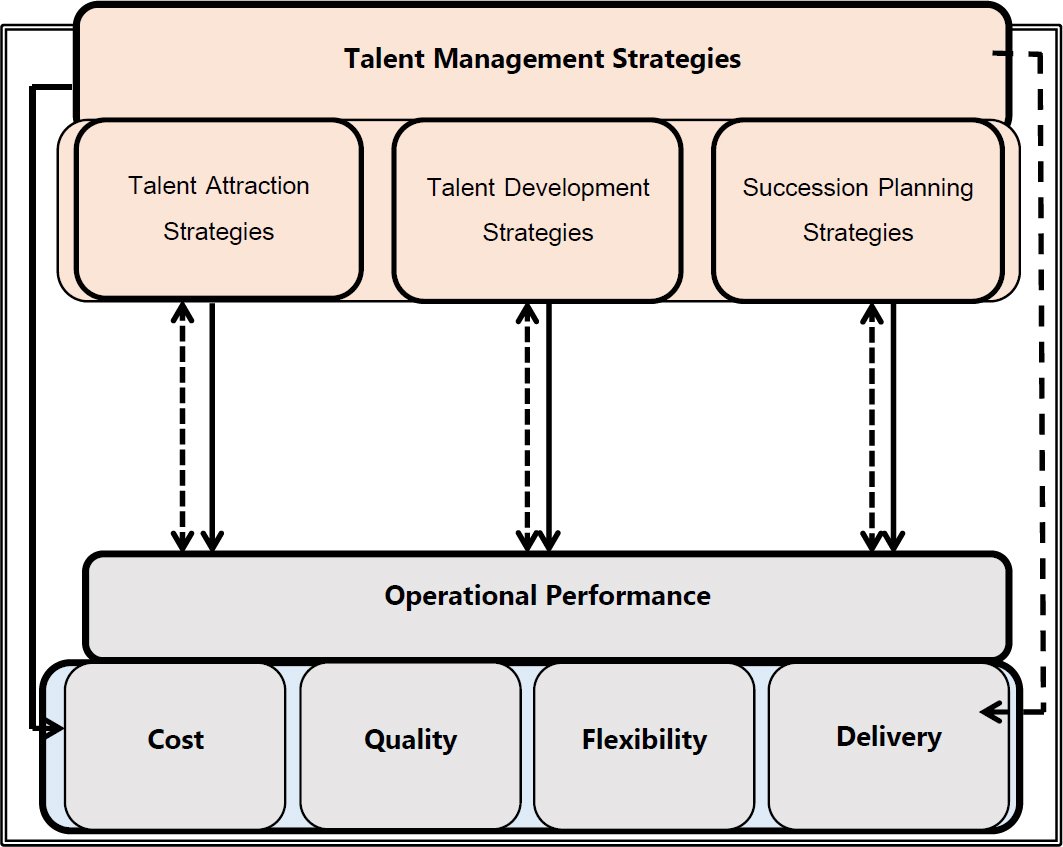
Fig. (1). Proposed research model.
4. DESCRIPTIVE ANALYSIS AND RELIABILITY/VALIDITY
4.1. Demographic Variables
Data were analyzed using SPSS (Version 26). Frequency analysis was used for categorical data, which is the appropriate method for such variables (Field, 2018). The sample consisted of 40 employees from various managerial levels at the Ready-Made Clothing Factory in Najaf.
Table 1 presents the demographic characteristics of the study sample. The total number of respondents is 40, and all frequencies and percentages are calculated based on this sample size. The distribution shows that the majority of respondents are male (75%), with a notable representation of female employees (25%). Most participants have between 5 and less than 10 years of service (45%), reflecting a workforce with moderate experience. In terms of educational attainment, the majority hold a bachelor’s degree (60%), while those with a diploma or less and postgraduate studies each represent 20% of the sample. Regarding career level, half of the respondents occupy minimum management positions (50%), followed by middle management (35%) and senior management (15%). This distribution ensures that the sample is diverse and representative of the different demographic segments within the factory, which enhances the credibility and generalizability of the findings. The calculation of frequencies and percentages is consistent with the sample size (n = 40), confirming the accuracy of the descriptive analysis.
Table 1. Descriptive distribution of the sample by demographic variables.
| Variable | Category | Frequency | Percentage (%) |
| Gender | Male | 30 | 75 |
| Female | 10 | 25 | |
| Duration of Service | Less than 5 years | 12 | 30 |
| 5 years to less than 10 years | 18 | 45 | |
| 10 years and more | 10 | 25 | |
| Educational Level | Diploma or less | 8 | 20 |
| Bachelor’s degree | 24 | 60 | |
| Postgraduate studies | 8 | 20 | |
| Career Level | Senior management | 6 | 15 |
| Middle management | 14 | 35 | |
| Minimum management | 20 | 50 |
4.2. Reliability and Validity
Reliability was tested using Cronbach’s alpha (Table 2). The value for the talent management strategies scale was 0.958, and for operational performance 0.964, both indicating excellent internal consistency (Nunnally & Bernstein, 1994). Content validity was ensured through expert review. Although inter-item correlation is commonly used, it is not typically reported in detail. Advanced methods such as AVE (Average Variance Extracted) and HTMT ratio are recommended for future research (Hair et al., 2019).
Table 2. Cronbach’s alpha for study scales.
| Scale | Number of Items | Cronbach’s Alpha |
| Talent Management Strategies | 15 | 0.958 |
| Operational Performance | 20 | 0.964 |
| Total Scale | 35 | 0.964 |
4.3. Inferential Statistical Analysis and Hypotheses Verification
4.3.1. Inferential Statistical Methods
To test the research hypotheses, inferential analyses were conducted using Pearson’s correlation coefficient and simple linear regression. These methods are standard for examining associations and effects between variables in management research (Field, 2018).
- Correlation Analysis
The relationship between the dimensions of talent management strategies and operational performance was examined using Pearson’s correlation coefficient (Table 3). The results are summarized below:
All correlation coefficients are statistically significant at the 1% level (p < 0.01), indicating strong positive associations between each talent management dimension and operational performance. This confirms the existence of statistically significant relationships as posited in the main and sub-hypotheses.
Table 3. Correlation coefficients between talent management strategies and operational performance.
| Dimension | Correlation Coefficient (r) | t-value | Sig. (p) |
| Talent Attraction Strategies | 0.623 | 4.909 | 0.000 |
| Talent Development Strategies | 0.648 | 5.243 | 0.000 |
| Succession Planning Strategies | 0.654 | 5.325 | 0.000 |
| All Talent Management Strategies | 0.665 | 5.486 | 0.000 |
- Regression Analysis (Impact)
To assess the impact of each talent management dimension on operational performance, simple linear regression analyses were performed. The results are as follows:
All dimensions of talent management strategies have a statistically significant positive effect on operational performance at the 1% significance level. Succession planning strategies showed the strongest impact (β = 0.427), followed by talent development (β = 0.420), and talent attraction (β = 0.388). The overall effect of all talent management strategies combined is also significant (β = 0.442) (Table 4).
Table 4. Regression analysis for the impact of talent management dimensions on operational performance.
| Dimension | F-value | Slope (β) | Correlation (r) | Sig. (p) |
| Talent Attraction Strategies | 24.098 | 0.388 | 0.623 | 0.000 |
| Talent Development Strategies | 27.493 | 0.420 | 0.648 | 0.000 |
| Succession Planning Strategies | 28.357 | 0.427 | 0.654 | 0.000 |
| All Talent Management Strategies | 30.092 | 0.442 | 0.665 | 0.000 |
4.4. Hypotheses Verification
- H1: There is a statistically significant correlation between talent management strategies and operational performance.
Verified: r = 0.665, t = 5.486, p < 0.01. - H1a: There is a statistically significant correlation between talent attraction strategies and operational performance.
Verified: r = 0.623, t = 4.909, p < 0.01. - H1b: There is a statistically significant correlation between talent development strategies and operational performance.
Verified: r = 0.648, t = 5.243, p < 0.01. - H1c: There is a statistically significant correlation between succession planning strategies and operational performance.
Verified: r = 0.654, t = 5.325, p < 0.01. - H2: There is a statistically significant impact of talent management strategies on operational performance.
Verified: β = 0.442, F = 30.092, r = 0.665, p < 0.01. - H2a: There is a statistically significant impact of talent attraction strategies on operational performance.
Verified: β = 0.388, F = 24.098, r = 0.623, p < 0.01. - H2b: There is a statistically significant impact of talent development strategies on operational performance.
Verified: β = 0.420, F = 27.493, r = 0.648, p < 0.01. - H2c: There is a statistically significant impact of succession planning strategies on operational performance.
Verified: β = 0.427, F = 28.357, r = 0.654, p < 0.01.
5. DISCUSSION
The results of this study provide compelling empirical evidence that talent management strategies are fundamental drivers of operational performance in the Ready-Made Clothing Factory in Najaf. The statistical analysis revealed that all three dimensions of talent management talent attraction, talent development, and succession planning demonstrate strong and significant relationships with operational performance.
Specifically, the correlation coefficient between overall talent management strategies and operational performance was 0.665 (p < 0.01), indicating a robust positive association. When examining the dimensions individually, succession planning strategies exhibited the highest correlation with operational performance (r = 0.654), followed closely by talent development (r = 0.648) and talent attraction (r = 0.623). These findings quantitatively support the argument that each aspect of talent management contributes meaningfully to sustaining operational outcomes.
Regression analysis further clarified the impact of these strategies. The effect size (slope β) for succession planning was 0.427, for talent development 0.420, and for talent attraction 0.388, all significant at the 1% level. The overall regression model for all talent management strategies yielded a β of 0.442 and an F-value of 30.092, confirming the substantial explanatory power of these strategies for operational performance.
Operational performance itself, as measured by cost, quality, flexibility, and delivery, showed that delivery and quality had the highest mean scores among respondents (delivery mean = 3.88, quality mean = 3.91), highlighting the practical importance of these aspects in the factory’s daily operations.
CONCLUSION
These numerical results reinforce the theoretical perspective that talent management is not a peripheral HR function but a core strategic process. The high correlation and impact values indicate that improvements in talent management are likely to yield measurable gains in cost efficiency, quality, flexibility, and delivery performance. This is consistent with the resource-based view (RBV), which posits that unique human capital is a source of sustainable competitive advantage (Barney, 1991).
THEORETICAL IMPLICATIONS
Theoretically, this study validates the multidimensional nature of talent management and its direct operational consequences. Practically, the strong statistical relationships suggest that factory management should prioritize succession planning and talent development, as these have the greatest impact on operational outcomes. The data also suggest that efforts to attract talent must be integrated with robust development and succession systems to maximize operational benefits.
PRACTICAL AND MANAGERIAL IMPLICATIONS
For practitioners, the evidence points to the need for:
Integrated talent management frameworks that align attraction, development, and succession with operational goals.
Continuous investment in employee development to foster adaptability and innovation.
Institutionalized succession planning to ensure organizational resilience and continuity.
LIMITATIONS AND FUTURE RESEARCH DIRECTIONS
While the findings are robust, the study’s scope is limited to a single factory and a sample size of 40, which may affect generalizability. Future research should investigate larger and more diverse samples, and explore mediating factors such as organizational culture or leadership style.
In summary, the study’s analytical results such as the overall correlation coefficient of 0.665 and regression slope of 0.442 demonstrate that talent management strategies are statistically and practically significant predictors of operational performance. These findings offer actionable insights for both scholars and practitioners aiming to leverage human capital for sustained organizational excellence.
AUTHORS’ CONTRIBUTIONS
M.A.S. contributed to the design and implementation of the study. J.A.H., Y.R.M., H.A.O. contributed to the analysis of the results and the writing of the manuscript.
ETHICAL APPROVAL & INFORMED CONSENT
Ethical approval was obtained from the institutional review board. The study was conducted in accordance with the declaration of Helsinki. Participation was voluntary, informed consent was obtained from all participants, and data were anonymized.
AVAILABILITY OF DATA AND MATERIALS
The data will be made available on reasonable request by contacting the corresponding author [M.A.S.].
FUNDING
None.
CONFLICT OF INTEREST
The authors declare no conflicts of interest, financial or otherwise.
ACKNOWLEDGEMENTS
Declared none.
DECLARATION OF AI
During the preparation of this work the authors used ChatGPT for editing purposes. After using this tool, the authors reviewed and edited the content as needed and take full responsibility for the content of the published article.
APPENDIX
Appendix: Research Questionnaire Template
Below is a questionnaire regarding the research titled “Talent Management Strategies and Their Role in Sustaining Operational Performance: An Analytical Study at the Ready-Made Garment Factory in Najaf.” The success of this research hinges on your cooperation in providing accurate and objective responses to the items in this questionnaire. You have been selected to participate due to your relevance to the study. We kindly request that you select the answers you deem most appropriate, as your input will significantly influence the validity of the research findings. Please note that all data collected will be used solely for academic purposes, and your responses will be treated with strict confidentiality.
Thank you for your valuable time and cooperation.
Part One: Personal Data
Place a tick ( ) in front of the appropriate choice:
First: Gender
1- ( ) male
2- ( ) female
Second: Duration of service in the current job:
1- ( ) Less than 5 years.
2- ( ) From 5 years to less than 10 years.
3- ( ) 10 years and more.
Third: – Educational qualification:
1- ( ) Diploma or less
2- ( ) Bachelor’s degree
3- ( ) Postgraduate studies
Fourth: Career level
1- ( ) Senior management
2- ( ) Middle management
3- ( ) Minimum management
Part Two: – Topics of the study
The first variable: – talent management strategies
| A: Talent Attraction Strategies | ||||||
| Paragraphs | Phrase | Totally agree | Agree | Neutral | Don’t Agree | Totally Don’t Agree |
| 5 | 4 | 3 | 2 | 1 | ||
| 1 | Changes in talent acquisition strategies contribute to delivering distinguished services for the company under study. | |||||
| 2 | Modifications in talent attraction strategies align with shifts in the company’s overall strategy. | |||||
| 3 | The company operates according to a clear, well-documented strategy. | |||||
| 4 | Current employees are encouraged to participate in talent acquisition efforts. | |||||
| 5 | The company is implementing fundamental changes in its talent attraction strategy to achieve its desired objectives. | |||||
| B: Talent Development Strategies | ||||||
| 6 | The researched company possesses a competent and qualified human resource capable of adapting to change. | |||||
| 7 | The company allocates employee development tasks according to specialization and competence. | |||||
| 8 | There are future plans for the growth and development of employees within the researched company. | |||||
| 9 | The company considers flexibility in applying the talent development strategy during operations. | |||||
| 10 | Employees have a clear understanding of the objectives and outcomes of talent development. | |||||
| C: Succession Planning Strategies | ||||||
| 11 | The company’s succession planning strategy is based on appropriate technology to facilitate the change process. | |||||
| 12 | The utilization of the succession strategy contributes to fostering the change process within the company. | |||||
| 13 | The available succession strategy is employed to assist senior management in making efficient decisions. | |||||
| 14 | The succession strategy among employees within the company is effectively implemented. | |||||
| 15 | The succession planning strategy employed contributes to the management of the company’s operations. | |||||
The Second Variable: Operational Performance A: – Cost | ||||||
| 16 | The company seeks to achieve cost reduction as the strongest guarantee for its survival and growth. | |||||
| 17 | Costs are effectively controlled during the execution of operations. | |||||
| 18 | Available resources are utilized efficiently to minimize costs. | |||||
| 19 | A comprehensive cost-benefit analysis is conducted prior to making operational decisions. | |||||
| 20 | Continuous improvement practices are employed to reduce costs and enhance efficiency. | |||||
| B: – Quality | ||||||
| 21 | Employees receive adequate training to understand and implement quality standards. | |||||
| 22 | Clear quality standards are established for the products offered. | |||||
| 23 | The company possesses laboratories that enable it to conduct all necessary scientific tests to ensure quality. | |||||
| 24 | Technology is utilized to enhance quality processes and monitoring. | |||||
| 25 | The company strives to provide modern and advanced computer equipment with the aim of improving the performance of production operations. | |||||
| C: – Flexibility | ||||||
| 26 | The company’s operations are characterized by flexibility, allowing for adjustments in production volume. | |||||
| 27 | The manufacturing system of the company possesses the capability to switch from one product to another within the production mix in a limited time frame. | |||||
| 28 | Unnecessary costs are minimized through the frequent development of new products. | |||||
| 29 | Employees receive the necessary training to enhance their skills and increase their flexibility at work. | |||||
| 30 | Effective communication channels exist within the organization to support rapid decision-making. | |||||
| D: – Delivery | ||||||
| 31 | Products are delivered within the specified timeframe. | |||||
| 32 | Effective communication is maintained between the delivery team and other relevant teams. | |||||
| 33 | The teams responsible for delivery receive the necessary training to perform their tasks efficiently. | |||||
| 34 | The delivery process involves smooth and accurate handling of order fulfillment and logistics. | |||||
| 35 | Flexibility is exercised in addressing any issues that may arise during the delivery process. | |||||
REFERENCES
Abdallah, B. A., Obeidat, B. Y., & Aqqad, N. O. (2016). The impact of supply chain management practices on supply chain performance in Jordan: The moderating effect of competitive intensity. International Business Research, 7(4), 110-125. https://doi.org/10.5539/ibr.v7n3p13
Abazeed, R. (2017). Benchmarking culture and its impact on operational performance: A field study on industrial companies in Jordan. International Journal of Academic Research in Economics and Management Sciences, 6(1), 162-177. http://dx.doi.org/10.6007/IJAREMS/v6-i1/2608
Al-Hussein, M. A. (2021). Talent management strategies and their impact on the job performance of academic library staff. Journal of Academic Librarianship, 47(3), 102-115.
Al-Jabari, B. (2019). Quality of service and its impact in achieving competitive advantage. Journal of University of Babylon for Pure and Applied Sciences, 27(2), 208-227.
Al-Skran, B. A. (2019). The effectiveness of talent management strategies in the development of human resources teaching from the point of view of the leaders and members of the faculty of Taibah University. Journal of Educational and Psychological Sciences, 3(15), 28–50. https://doi.org/10.26389/AJSRP.B140319
Al-Naqeeb, N., & Bidawid, S. (2023). The role of wise leadership in enhancing operational performance. Iraqi Journal of Economic Sciences, 6(17), 88-102.
Al-Nuaimi, M., Al-Hashimi, M., & Al-Khater, K. (2023). The impact of project resource planning practices on operational performance. Alexandria Journal of Administrative Sciences, 60(6), 1-20.
Al-Rashidi, M. (2024). Talent management and sustainable organizational performance: An empirical study in the Arab region. Sustainability, 16(4), 934-948.
Almohtaseb, A. A., Shaheen, H. A. K., Alomari, K. M., & Almahameed, M. A. Y. (2023). Impact of talent management on organizational performance: The moderating role of an effective performance management system. International Journal of Business and Management, 15(4), 11-26. https://doi.org/10.5539/ijbm.v15n4p11.
Bagher, A. (2014). The effect of supply chain capabilities on performance of food companies. Journal of Financial Marketing, 2(4), 33-45. https://doi.org/10.35841/finance-marketing.2.4.1-9
Barney, J. (1991). Firm resources and sustained competitive advantage. Journal of Management, 17(1), 99-120. https://doi.org/10.1177/014920639101700108.
Becker, B. E., & Huselid, M. A. (2006). Strategic human resources management: Where do we go from here? Journal of Management, 32(6), 898-925. https://doi.org/10.1177/0149206306293668.
Belekoukias, I., Garza-Reyes, J., & Kumar, V. (2014). The impact of lean methods and tools on the operational performance of manufacturing organisations. International Journal of Production Research, 52(18), 5346-5366. https://doi.org/10.1080/00207543.2014.903348.
Boxall, P., & Purcell, J. (2011). Strategy and human resource management (3rd ed.). Palgrave Macmillan.
Cappelli, P., & Keller, J. R. (2014). Talent management: Conceptual approaches and practical challenges. Annual Review of Organizational Psychology and Organizational Behavior, 1, 305-331. https://doi.org/10.1146/annurev-orgpsych-031413-091314.
Collings, D. G., & Mellahi, K. (2009). Strategic talent management: A review and research agenda. Human Resource Management Review, 19(4), 304-313. https://doi.org/10.1016/j.hrmr.2009.04.001.
Collings, D. G., Scullion, H., & Vaiman, V. (2015). Talent management: Progress and prospects. Human Resource Management Review, 25(3), 233-235. https://doi.org/10.1016/j.hrmr.2015.04.005.
Diallo, A., Al-Nuaimi, M., & Al-Rashidi, Y. (2023). Talent management in emerging economies: Challenges and opportunities. Journal of Global HRM, 5(1), 12-28.
Farhat, M., & Mohamed, A. (2024). The impact of digital transformation on talent management strategies. Journal of Organizational Change Management, 37(1), 55-70.
Field, A. P. (2018). Discovering statistics using IBM SPSS statistics, (5th ed.). Sage Publications. https://uk.sagepub.com/en-gb/eur/discovering-statistics-using-ibm-spss-statistics/book285130?
Gallardo-Gallardo, E., Thunnissen, M., & Scullion, H. (2020). Talent management: Context matters. The International Journal of Human Resource Management, 31(4), 457-473. https://doi.org/10.1080/09585192.2019.1642645.
Gustafsson, S., & Frost, C. (2018). Operational management through key performance indicators: A case study performed at the warehouses at Fresenius Kabi. Industrial Management and Innovation, 10(2), 45-60.
Hair, J. F., Risher, J. J., Sarstedt, M., & Ringle, C. M. (2019). When to use and how to report the results of partial least squares structural equation modeling (PLS-SEM). European Business Review, 31(1), 2-24. https://doi.org/10.1108/EBR-11-2018-0203.
Hamadi, S. (2021). Talent management strategies in the manufacturing sector: Evidence from Iraq. Journal of Industrial Engineering and Management, 14(1), 105-121.
Hamdi, Z. S. (2008). Analyzing the relationship between total quality management and operational performance of banks. Journal of Banking and Finance, 12(3), 77-89.
Hwang, G., Han, S., Jun, S., & Park, J. (2014). Operational performance metrics in manufacturing process: Based on SCOR model and RFID technology. International Journal of Innovation, Management and Technology, 5(1), 50-55. https://www.ijimt.org/papers/485-CM706.pdf
Islam, M. (2021). Talent management in public sector organizations: A systematic review. Public Administration Review, 81(4), 712-728. https://doi.org/10.1111/puar.13335.
Iqbal, T. (2020). The effect of operations management practices on the competitive advantages of smes: A mediating role of supply chain management practices. Uncertain Supply Chain Management, 8(4), 649-662. https://doi.org/10.5267/j.uscm.2020.9.001.
Iqbal, T., & Nourelhadi, T. K. E. (2024). An empirical investigation of green supply chain management (GSCM) and environmental sustainability in Saudi manufacturing SMEs: The mediating role of operations analytics. Uncertain Supply Chain Management, 12(3), 2595–2606. https://doi.org/10.5267/j.uscm.2024.5.010.
Kamau, S. M. (2014). Performance measurement practices and operational performance of manufacturing firms in Kenya. African Journal of Business Management, 8(10), 320-335.
Kehinde, J. (2020). Talent management and employee engagement in Nigerian banks. Journal of Human Resource Management, 8(2), 45-58. https://doi.org/10.5296/jmr.v4i2.937.
Khalil, A. (2018). The role of talent management in achieving organizational agility. Journal of Organizational Excellence, 17(3), 112-125.
Mahmoud, H. (2023). The impact of product quality control on improving operational performance. Journal of Operations Management, 45(2), 210-225.
Mensah, J. K. (2015). A “coalesced framework” of talent management and employee performance. International Journal of Productivity and Performance Management, 64(4), 544-566. https://doi.org/10.1108/IJPPM-07-2014-0100.
Mohamed, A., & Farahat, M. (2020). The impact of talent management on organizational innovation. Journal of Innovation and Business Management, 12(1), 34-50.
Nasser, M. H. Z. (2021). Talent management of leaders in Egyptian universities as an entry point to achieve the goals of the sustainable development strategy: Egypt’s vision 2030. Journal of Specific Education Research and Studies, 38(4), 82-105.
Nunnally, J. C., & Bernstein, I. H. (1994). Psychometric theory. (3rd. ed.). McGraw-Hill.
Qureshi, M. A., Al-Haj, A., Ahlam, G., & Suleikh, H. (2017). The impact of talent management strategies on the strategic flexibility of economic institutions. Afaq Economic Journal, 2(10), 55-70.
Reid, R. D., & Sanders, N. R. (2010). Operations management: An integrated approach, (4th ed.). Wiley.
Thunnissen, M., Boselie, P., & Fruytier, B. (2013). Talent management and the relevance of context: Towards a pluralistic approach. Human Resource Management Review, 23(4), 326-336. https://doi.org/10.1016/j.hrmr.2013.05.003.
Truong, H. S., Sampaio, P., Carvalho, M. S., & Fernandes, A. C. (2014). The role of quality management practices in operational performance. Proceedings of the 1st International Conference on Quality Engineering and Management, 1-15.
Venkatraman, N., & Ramanujam, V. (2016). Measurement of business performance in strategy research: A comparison of approaches. Academy of Management Review, 11(4), 801-814. https://doi.org/10.5465/amr.1986.4283976.
Yousef, D. (2023). Sustainable talent management in the era of Industry 4.0. Journal of Sustainable Business, 15(3), 200-215. https://doi.org/10.1108/JSB-01-2023-0012.
Zhu, Q., Sarkis, J., & Lai, K. H. (2008). Confirmation of a measurement model for green supply chain management practices implementation. International Journal of Production Economics, 111(2), 261-273. https://doi.org/10.1016/j.ijpe.2006.11.029
Licensed
© 2025 Copyright by the Authors.
Licensed as an open access article using a CC BY 4.0 license.
Article Contents Author Felicia Gabriela Beresescu1, * 1College of Business-Al Khobar, Al Yamamah University, Saudi Arabia Article History: Received: 21
Article Contents Authors Saman Ismail1, * Imran Iqbal2 1Faculty of Management Science, Department of Business Administration, Salim Habib University, Karachi,
Article Contents Author Michael Dolinsky1, * 1Faculty of Mathematics and Technologies of Programming, Francisk Skorina Gomel State University,
Article Contents Author Abdul Ghafoor Memon1, * 1Emaan Institute of Management Sciences, Karachi, Pakistan Article History: Received: 01 April, 2026
Article Contents Authors Zixuan Zhao1, Ju Guo1, * 1School of Management, Chengdu University of Information Technology, Chengdu, China Article History:
Article Contents Authors Sultan Ud Din Yousufzai1, Amtyaz Safi2, * , Maher Khan1, Zia Ud Din1 1Department of Zoology, Govt.