










Article Contents
Article ID: CM2501112003
Views: 1049The Mediating Role of Transactional Leadership Between Last-Mile Delivery Practices and Sustained Change Implementation: A Case Study of the UK Retail Market
 DOI:
DOI:
 PDF
PDF
⬇ Downloads: 45
Aftab, F. (2025). The mediating role of transactional leadership between last-mile delivery practices and sustained change implementation: A case study of the UK retail market. Majestic Global Trends in Marketing & Supply Chain Management, 1, 1–12, Article ID: CM2501112003. https://doi.org/10.65080/mgtmscm.v1i1.1
Aftab, Faisal. 2025. “The mediating role of transactional leadership between last-mile delivery practices and sustained change implementation: A case study of the UK retail market.” Majestic Global Trends in Marketing & Supply Chain Management 1: 1–12, Article ID: CM2501112003. https://doi.org/10.65080/mgtmscm.v1i1.1
Aftab, F., 2025. The mediating role of transactional leadership between last-mile delivery practices and sustained change implementation: A case study of the UK retail market. Majestic Global Trends in Marketing & Supply Chain Management, 1, pp.1–12, Article ID: CM2501112003. Available at: https://doi.org/10.65080/mgtmscm.v1i1.1
Aftab F. The mediating role of transactional leadership between last-mile delivery practices and sustained change implementation: A case study of the UK retail market. Maj Glob Trends Mark Supply Chain Manag. 2025 Sep 23;1:1–12, Article ID: CM2501112003. doi:10.65080/mgtmscm.v1i1.1
1College of Business Administration, Imam Abdulrahman Bin Faisal University, Dammam, Saudi Arabia
Received: 10 June, 2025
Accepted: 14 July, 2025
Revised: 12 July, 2025
Published: 23 September, 2025
ABSTRACT:
Introduction: The following study examined the mediating role of transactional leadership on the link between last-mile delivery practices and the sustained change implementation within the UK retail sector.
Methods: Employing a quantitative approach, responses were collected from 385 supply chain managers and tested through Partial Least Squares Structural Equation Modelling (PLS-SEM).
Results: The findings indicated that last-mile delivery behaviours significantly contribute to the effective implementation of enduring change (β = 0.250, p-value < 0.001), where transactional leadership acts as a partial mediator (β = 0.22, p-value < 0.001). The findings highlighted that while transactional leadership enhances operational consistency with rewards and explicit goals, this is not sufficient to drive change in the long term. The study focused on adaptive leadership models coupled with transactional ones to address dynamic market needs and technological advancements.
Conclusion: The present research added to the literature on supply chain management by examining the central role of leadership in balancing efficiency, customer satisfaction, and sustainability in last-mile delivery and offers practical insights for retail companies aiming for long-term operational change in a competitive marketplace.
Keywords: Transactional leadership, last mile delivery, supply chain management, structural equation modelling (SEM), SmartPLS, operational efficiency, sustainability, change implementation, leadership styles.
1. INTRODUCTION
The global challenge of climate change threatens the world’s economies and ecosystems. Therefore, in the ever-changing field of supply chain management, last-mile delivery is particularly significant because of its great influence on customer satisfaction and operational effectiveness. For example, the international grocery delivery market had a size of $643.90 billion in 2023 and is expected to expand to an estimated $1,347 billion by 2029, showing that demand for timely and effective delivery services is rising (Statista, 2025). The significance of transactional leadership in rallying complex delivery networks cannot be overstated. Transactional leadership is bureaucratic and entails the application of rewards and punishments in which leaders track the schedules and timelines for the provision of services and other operating plans (Swan, 2023). Such a leadership style is best applied when a business is faced with conditions of pressure in which precision and responsibility are paramount to success.
(Vrhovac et al., 2024) believed that the degree of effectiveness in relation to the topic of last-mile delivery is directly proportional to customer loyalty. Additionally, his study showed that 25 per cent of customers will be inclined to remain loyal to those brands that have an on-time delivery system. The link indicates that it is necessary to handle the last mile properly in order to achieve a competitive advantage. Furthermore, artificial intelligence route optimisation and real-time tracking technologies are more and more used to enhance delivery accuracy and reduce overheads, demonstrating the determinant position of this segment within supply chain management (Issaoui et al., 2022; Kaul & Khurana, 2022). Growing environmental concern among consumers has prompted businesses to embrace green practices, such as the use of electric vehicles and optimising delivery routes (Ghosh, 2020; Vishnuram & Alagarsamy, 2024; Zosu et al., 2024). The transition, however, serves not only environmental needs but also aligns with consumer expectations, making deliveries more environmentally friendly and bespoke for the customer.
The United Kingdom is a relevant context to explore the responsibility of transactional leadership in last-mile delivery due to its well-established but environmentally limited retail industry. The British retail industry is one of the most established industries in Europe, with online commerce accounting for approximately 27% of total retail sales as of 2023. The increasing consumer need for swift, secure, and environmentally friendly deliveries is driving retailers to shift to more advanced last-mile strategies. Further, the stringent environmental regulations and net-zero carbon targets of the UK government by 2050 place extra pressure on retail organisations to transform in a sustainable way (Welch et al., 2021). This unique blend of regulatory requirements, technological transformation, and shifting consumer need makes the UK fertile ground in which to grow an analysis of leadership style, and transactional leadership in particular, as an influence on operational uniformity and sustainable transformation within last-mile delivery. And with rising city density and advanced delivery networks, there are unique challenges for UK retailers to meet efficiency with environmental goals. Concentrating on the UK, this research can offer contextually unique but universally applicable information that enables businesses to exert greater control over delivery networks as part of broader environmental strategies. The findings will assist UK businesses in optimizing leadership practice and stimulating effective long-term change in last-mile logistics.
The primary research gap in this study lies in the limited exploration of how transactional leadership specifically mediates the relationship between last-mile delivery practices and the implementation of sustained change within the UK retail market. The current research has been conducted on the last mile delivery logistic practices; however, the knowledge remains limited as the studies such as (Chen et al., 2025; and Heikkinen, 2024) elaborated the last mile delivery in sustainability practices and demand for supporting last mile operations. However, the studies have not specifically discussed how last mile delivery and sustained change implementation can be mediated through transactional leadership. Hence, this study contributes to the current literature by elaborating how transactional leadership can mediate on the relationship between last mile delivery and sustained change implementation.
2. LITERATURE REVIEW
2.1. Last Mile Delivery Practices
Last-mile delivery practices are rapidly evolving to meet the escalating demands of modern consumers and technological advancements (Andrei et al., 2024; Nagadeepa et al., 2024; Pourmohammadreza et al., 2025). The landscape in 2024 is defined by several major trends that are changing the effectiveness and flexibility of such delivery models. One notable trend is the use of integrated real-time smart tracking and optimised routes by artificial intelligence (Mohsen, 2024; Sodiya et al., 2024). Some of these technologies optimise the accuracy and efficiency of delivery by anticipating delay occurrences, thereby minimising delivery and operational expenses (Oteri et al., 2023). The use of real-time tracking, therefore, enhances business visibility and provides customers with constant updates, thereby improving customer satisfaction and credibility (Alonge et al., 2023; Olayinka, 2021).
Moreover, micro-fulfilment centres are witnessing a rising trend in the overall distribution network changes. They are established near customers, especially potential customers, and are particularly prevalent in urban areas (Gani et al., 2023; Karaoulanis, 2024). These centres help to clearly and quickly meet customers’ orders, and in many cases, fulfil them on the same day or even within several hours (Paché, 2024). It also facilitates a fast delivery process without incurring significant transportation expenses and is an environmentally friendly method (Comi & Savchenko, 2021). Moreover, the increased concern regarding the effectiveness of last-mile delivery is also impacted by sustainability concerns (Ignat & Chankov, 2020). Companies are procuring electric vehicles, while delivery and transportation routes are being strategically set to minimise their negative environmental impact (Ghosh, 2020). However, it has received mixed attention from the literature. According to (Paché, 2024), it is fuelled by customer pressure on firms to become environmentally conscious and the global movement towards reduced emissions of greenhouse gases. However, (Zosu et al., 2024) indicated that another upcoming innovation is the application of self-conveyance devices, such as drones and self-driving vehicles, which will ease downstream operations, including last-mile delivery, as they are cheaper and tend to convey consignments faster than having handlers in congested areas or any other region. These trends indicate that the future of last-mile delivery is not only one characterised by greater speed and efficiency, but also by increased customer orientation and eco-friendliness (Jagoda et al., 2023). Thus, the future competitiveness of last-mile delivery hinges not only on adopting these technologies but also on critically evaluating their practical integration and long-term viability within the evolving retail and e-commerce sectors.
2.2. Transactional Leadership
Transactional leadership remains a significant approach within modern organisational management, particularly valued for its clear structuring and goal-oriented focus. This leadership style is a notable feature of managing teams through incentives, which motivate team members to deliver on set objectives (Ansari et al., 2024; Jaqua & Jaqua, 2021). In this case, the primary process in action is goal setting and direction that includes structured feedback as indicated by the research of (Chowhan et al., 2024; and Skopak & Hadzaihmetovic, 2022). According to (Ansari et al., 2024; and Nurlina, 2022), transactional leadership is most effective in enhancing operational efficiency. It still tends to provide a high level of schedule certainty and a significant amount of control necessary in precise and repetitive contexts, such as production lines and other manufacturing companies (Khairy et al., 2023).
Furthermore, transactional leadership can be easily applied when there is a need to make decisions quickly, as time is not on the side of the workers. It is typically observed in situations where a crisis or specific tasks require faster completion than usual (Alkhawlani et al., 2021). In such contexts, therefore, the quasi-autocratic approach of transactional leadership is particularly suitable for promoting concerted action towards achieving specific and short-term objectives (Jacobsen et al., 2022). Quasi-autocratic transactional leadership style refers to a style of leadership that is marked by the reliance of its style on control, strict rules, and attaining outcomes through the application of rewards and punishment. It entails hierarchical obedience and control with a focus on obtaining precision and accountability within formal operating environments (Akande et al., 2024; Bamson & Ololube, 2018). However, transactional leadership has its weaknesses as well, primarily where there is a need for innovativeness and forward planning for the consequences thereof. As will become evident, a focus on concrete, goal-based performance can sometimes be detrimental to innovation or stifle members’ willingness to take risks and be innovative (Prabhu & Srivastava, 2023; Young et al., 2021). Hence, it is helpful for organisations to balance transactional leadership with other forms that foster innovation and flexibility in leadership.
2.3. Last Mile Delivery, Sustained Change Implementation and Transactional Leadership
The integration of last-mile delivery practices with sustained change implementation through leadership, particularly transactional leadership, is a critical area of focus in current supply chain management research. The study by (Kiba-Janiak et al., 2021), evaluated last-mile delivery in the E-commerce market. It has been indicated that last-mile delivery and organisational change have a significant relationship. The study has effectively linked last mile delivery with organisational change, providing practical insights. However, it lacked exploring leadership roles particularly transactional leadership in facilitating this change. Tha path goal theory explains the role of transactional leadership by focusing on how leaders clarify tasks, set goals and use rewards or penalties to motivate employees. In last mile derlivery, this structured aprpoach supports organisational change by ensuring consistent performance, meeting tight schedules and aligning delivery practices with changing operational goals (Aslam & Li, 2025). However, (Khairy et al., 2023) identified the problem of effective last-mile delivery and stated that a lack of effective management of the last-mile delivery can be addressed by using transactional leadership, which establishes goals and rewards to match them. This is especially useful in organisational settings that involve much coordination, and factors that determine business operations are likely to change frequently. The study effectively linked transactional leadership to improved coordination in dynamic settings. However, they overlook its specific mediating effect between last mile delivery and oraganisation change. It implied that when leaders apply transactional tactics, including clear-cut goals and incentives, last-mile delivery operations improve, delivering better and more frequent service, which results in high levels of customer satisfaction.
However, the study by (Khairy et al., 2023) indicated that the application of transactional leadership, particularly when managing last-mile delivery, must also take caution in its shortcomings. The concern with a short-term perspective and tangible benefits could hinder long-term decision-making and creativity, which are essential for responding to shifts in consumer preferences and new technologies. Therefore, in this way, it can have an impact on the change management. For this purpose, this leadership style may require complementing it with other, more revolutionary methods to cultivate a culture of change and growth that is more responsive to market challenges and trends. Additionally, increased growth in e-commerce leads to higher challenges in last-mile delivery, necessitating leadership skills to effectively manage the situation (Andrei et al., 2024). By adopting data analysis to support decision-making and implementing the application of technology, such as AI for route optimisation and real-time tracking, under transactional leadership, the organisation can integrate these delivery systems and make them more effective, meeting the needs of modern operations. The study commendably focused on technology and data driven decision making in last mile delivery under transactional leadership but lacks empirical validation and fail to elaborate on the long-term organisation change outcomes. Although, path goal theory effectively elaborates that transactional leadership styles play a significant role in the relationship between last mile delivery and organisation change, it lacks empirical insights.
H1: Last-mile delivery practices have a significant and positive impact on the implementation of sustained change.
H2: Transactional leadership mediates the relationship between last-mile delivery practices and the implementation of sustained change.
2.4. Research Gap
The major research gap in this research exists in the minimal investigation of how transactional leadership particularly acts as a mediator between last-mile delivery practices and the adoption of long-lasting change in the UK retail market. The present study has been carried out on last mile delivery logistic practices, but the understanding is still limited since the studies have been conducted by authors like (Chen et al., 2025; and Heikkinen, 2024) that described the last mile delivery in sustainability practices and the need for facilitating last mile operations. Yet, the studies have not mentioned how the last mile delivery and implementation of sustained change can be mediated by transactional leadership explicitly. A key theoretical gap exists in the limited application of leadership theories, particularly path-goal theory, to explain how transactional leadership mediates between last mile delivery and organisation change in the retail market.
2.5. Conceptual Framework
The conceptual framework for this study explores the mediating role of transactional leadership in enhancing the efficacy of last-mile delivery practices in impacting sustained change implementation as shown in Fig. (1). Transactional Leadership (TL) serves as a mediator, Last Mile Delivery Practices (LMDP) is an independent variable, and Sustained Change Implementation (SCI) is a dependent outcome.
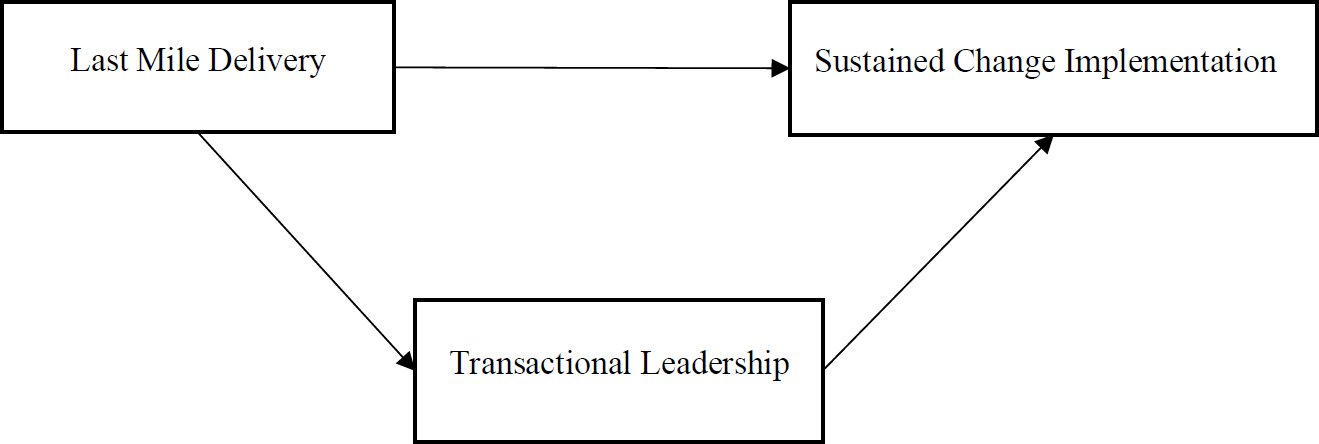
Fig. (1). Conceptual framework.
3. METHODS
This research employs a quantitative approach to systematically examine the interrelationships between transactional leadership, last-mile delivery operations, and the implementation of long-term change. Quantitative methods enable the collection of numeric data through standardised surveys for supply chain managers and logistics professionals in the UK retail industry. This enables statistical analysis to objectively quantify variables and verify hypotheses about the impact of leadership and operational performance. The use of quantitative research is warranted due to its capability to yield generalisable findings, detect meaningful patterns, and determine causality, which are critical to evidence-based decision-making and strategic change in complex delivery networks.
The research employs primary data collection via a systematic questionnaire survey administered to supply chain managers and logistics staff in the UK retail industry. This approach facilitates the collection of first-hand data pertinent to the research variables (Bougie & Sekaran, 2019), such as transactional leadership perceptions, last-mile delivery practices, and sustained change implementation. The instrument used to measure these constructs are provided in the Appendix A. The questionnaire technique ensures standardised data collection, which aids reliability and comparability across the respondents. Furthermore, it enables effective data collection from a geographically diverse sample, allowing the study to incorporate current industry insights and create empirical evidence that is representative of genuine operational environments.
The data collection tool is a well-developed questionnaire with tested scales to assess prominent constructs: transactional leadership, last-mile delivery efficiency, and sustained change implementation as attached in Appendix A. Transactional leadership items are drawn from proven leadership measurement instruments, with emphasis on reinforcement, goal setting, and reward. Last-mile delivery practices are evaluated through key metrics related to operational strategy, technology utilisation, and environmental sustainability. The change implementation scale gauges the level of organisational continuous improvement and adaptability.
The sample size of this study was computed using the Cochran sample size formula as shown below. The sample size as per this formula is 384.
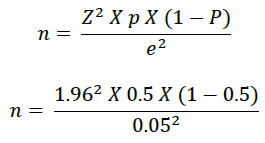
n = 384
The survey was distributed to around 500 supply chain and logistics managers to reach the desired sample size. This included UK retail store managers comprising local and international stores in different regions. These managers were contacted through LinkedIn or personal referrals. 390 responses were received out of 500 obtaining a response rate of 78%. Furthermore, the data was treated for the missing values. Hence, the final sample for this study was reached at 385 managers operating within the UK’s retail sector. This sample number is selected to provide a fair representation across various retail organisations and delivery environments, enabling meaningful statistical analysis (Hair et al., 2017). Managers are selected because they have direct contact with managing the last-mile delivery operations and changing operational processes, making them crucial informants. The sample size of 385 is adequate for meeting the generalizability and precision thresholds recommended by sampling theory for quantitative research, thereby ensuring the validity of the study’s findings and enabling strong inference concerning the effect of leadership on delivery performance and lasting change.
However, the lower response rate in this study and the use of purposive sampling exposes the study to the non-response bias that needs to be addressed properly. This study has used statistical difference between early and late respondents to address the issue of non-response bias since late respondents are similar in characteristics to the non-respondents (Gaia et al., 2024). The comparison between first thirty and last thirty respondents using the independent sample t-test. The results highlighted that the constructs like LMDP (P-value > 0.1), SCI (P-value > 0.1) and TL (P-value > 0.1) show statistically insignificant different between early and late respondents. Hence, there is no issue of response bias here.
The common method bias was also a matter of concern in this study when using similar method to measure both dependent and independent variable. The bias is detected and addressed using Harman’s single factor test, where exploratory factor analysis (EFA) is conducted to extract only a single factor and total variance explained for that single factor that falls below 50% indicates that there is no issue of common method bias (Saxena et al., 2024). EFA has revealed that total variance extracted for single factor is 44% and hence common method bias is not an issue in this study.
Table 1 reflects the demographic details of the participants. It shows that most participants were male (54.5%) and aged 25-34 (28.6%). The majority of them had an undergraduate degree (39%) and 1-3 years of employment (26%). It indicates a relatively young, educated workforce with early to mid-career professional experience, suitable for workforce related analysis.
Table 1. Demographic profile.
| Category | Frequency (n) | Percentage (%) | |
| Gender | Male | 210 | 54.50% |
| Female | 175 | 45.50% | |
| Age | 18–24 | 60 | 15.60% |
| 25–34 | 110 | 28.60% | |
| 35–44 | 95 | 24.70% | |
| 45–54 | 70 | 18.20% | |
| 55+ | 50 | 13.00% | |
| Length of Employment | Less than 1 year | 40 | 10.40% |
| 1–3 years | 100 | 26.00% | |
| 4–6 years | 95 | 24.70% | |
| 7–10 years | 80 | 20.80% | |
| More than 10 years | 70 | 18.20% | |
| Education Level | High School | 45 | 11.70% |
| Undergraduate Degree | 150 | 39.00% | |
| Postgraduate Degree | 120 | 31.20% | |
| Doctorate | 50 | 13.00% | |
| Other | 20 | 5.20% |
The research utilises Partial Least Squares Structural Equation Modelling (PLS-SEM) to examine intricate associations among transactional leadership, last-mile delivery practices, and the implementation of sustained change. PLS-SEM is ideal for exploratory and predictive studies with multiple latent constructs and small to medium-sized sample sizes. The evaluation proceeds in two general phases: the measurement model evaluation, which assesses construct reliability, validity, and loadings of indicators; and the structural model evaluation, which examines path coefficients, significance levels, and explained variance (R²) for hypothesised relationships (Ringle et al., 2015). The procedure enables the concurrent assessment of measurement quality and structural relations, providing a comprehensive understanding of the model’s predictive power.
4. RESULTS
The results, as shown in Table 2, present the reliability and validity analyses. Cronbach’s alpha and composite reliability have a threshold of 0.7 (Ringle et al., 2015). Table 2 shows that the latent variables have higher internal consistency, confirming reliability, since all variables have a Cronbach’s alpha of greater than 0.7. The composite reliability of each variable is also depicted as being above 0.7, which confirms the reliability of the constructs. Hence, it confirms that each construct has reliable measurement items.
Table 2. Measurement model using confirmatory factor analysis (CFA).
| Latent Variable | Observed Variable | Factor Loadings | Cronbach’s Alpha | Composite Reliability | AVE |
| Last mile delivery practices | LMDP1 | 0.783 | 0.811 | 0.830 | 0.726 |
| LMDP2 | 0.900 | ||||
| LMDP3 | 0.869 | ||||
| Sustained Change Implementation | SCI1 | 0.890 | 0.883 | 0.884 | 0.811 |
| SCI2 | 0.929 | ||||
| SCI3 | 0.882 | ||||
| Transactional leadership | TL1 | 0.906 | 0.901 | 0.901 | 0.835 |
| TL2 | 0.930 | ||||
| TL3 | 0.905 |
Furthermore, the validity of the indicators of the constructs has been evaluated using factor loadings. Factor loadings have a threshold value of greater than 0.6 to ensure the validity of the factor. Table 2 indicates that the factor loading of each indicator is above 0.6, indicating that no indicators need to be dropped and confirming the validity of the measurement items. Additionally, the research has determined convergent validity using the Average Variance Extracted (AVE), with a threshold of 0.5 (Hair et al., 2017). The results presented in Table 2 show that AVE values are above 0.5, indicating that the data contain convergent validity.
The discriminant validity has been confirmed using the HTMT ratio as shown in Table 3. It has been elaborated that the HTMT ratio has to be below 0.85 (Hair et al., 2017). The table above shows that the value of each variable is below 0.85, indicating that the data have not violated the assumption of discriminant validity.
Table 3. Discriminant validity.
| Last-Mile Delivery Practices | Sustained Change Implementation | |
| Sustained Change Implementation | 0.549 | |
| Transactional leadership | 0.467 | 0.733 |
The results shown in Table 4 indicate significant direct effects of last-mile delivery practices on the implementation of sustained change (β = 0.250, p < 0.001) and transactional leadership (β = 0.400, p < 0.001), as well as a substantial direct effect of transactional leadership on sustained change implementation (β = 0.554, p < 0.001). The specific indirect effect of last mile delivery on sustained change implementation through transactional leadership is significant (β = 0.222, p < 0.001), reflecting mediation. Since both direct and indirect effects are significant, this indicates partial mediation, where transactional leadership partially mediates the relationship between last-mile delivery practices and sustained change implementation.
Table 4. Structural model.
| Coefficient | T Statistics | P Values | |
| Direct Effect | |||
| Last mile delivery practices -> Sustained Change Implementation | 0.250*** | 5.271 | 0.000 |
| Last mile delivery practices -> Transactional leadership | 0.400*** | 7.238 | 0.000 |
| Transactional leadership -> Sustained Change Implementation | 0.554*** | 12.371 | 0.000 |
| Specific Indirect Effect | |||
| Last mile delivery practices -> Transactional leadership -> Sustained Change Implementation | 0.222*** | 6.657 | 0.000 |
| Total Effect | |||
| Last mile delivery practices -> Sustained Change Implementation | 0.472*** | 9.963 | 0.000 |
| Last mile delivery practices -> Transactional leadership | 0.400*** | 7.238 | 0.000 |
| Transactional leadership -> Sustained Change Implementation | 0.554*** | 12.371 | 0.000 |
Note: *: indicates significance at 10%, **: indicates significance at 5%, ***: indicates significance at 1%
Table 5 represents the explanatory power of the model. The value of R-Square for sustained change implementation is 0.481 or 48.1%. It shows that 48.1% of the variation in the sustained change implementation is explained by the last mile delivery. Transactional leadership has the R-Squared value of 0.160 or 16%, showing 16% predictive quality of last mile delivery for transactional Leadership.
Table 5. Model predictive quality.
| R-Square | R-Square Adjusted | |
| Sustained Change Implementation | 0.481 | 0.478 |
| Transactional leadership | 0.160 | 0.158 |
5. DISCUSSION
The study aims to investigate the mediating role of transactional leadership in the relationship between last-mile delivery and the implementation of sustained change. It shows that last-mile delivery has a significant impact on the implementation of sustained change. Furthermore, it shows partial mediation of transactional leadership between last mile delivery and sustained change implementation. The hypotheses summary is also present in Table 6. The findings align with those of (Jacobsen et al., 2022), underscoring the crucial role of leadership in achieving operational success. The mediating role of transactional leadership (TL) is supported by (Dong, 2023), emphasising TL’s efficiency in structured environments. Hence, this study’s findings on transactional leadership’s effectiveness in structured US environments reflect similar applicability in the UK, where hierarchical organisational structures are also common. It supports the relevance of TL as a mediating factor in British context, reinforcing its potential to increase performance in comparably structured work cultures. However, limitations in unstructured settings resonate with critiques by (Young et al., 2021) that has conducted meta analysis to reveal crucial impact of transactional leadership. However, the meta-analysis had different countries outcomes and when specifying results for the UK, it becomes important to consider the difference of culture that makes this leadership style effective in the UK as compared to other countries. (Swan, 2023) further support the notion that transactional leadership can be expressed through key attributes, such as well-defined instructions and incentives for achieving specific performance levels when conducted the study in the Saudi Arabia. Hence, it suggests that these principles can also be effectively applied in the UK, reflecting that structured leadership styles may transcend cultural contexts for driving goal-oriented performance in diverse organisation settings.
Table 6. Hypotheses assessment.
| Hypotheses | Decision |
| H1: Last-mile delivery practices have a significant and positive impact on the implementation of sustained change. | Accepted |
| H2: Transactional leadership mediates the relationship between last-mile delivery practices and the implementation of sustained change. | Accepted |
The results of this research have major practical implications for the management of retail supply chains and leadership strategies. Establishing that last-mile delivery has a considerable impact on the implementation of sustained change, supports retailers’ inherent need to continually improve their delivery operations to ensure competitiveness and customer satisfaction in the UK retail market. The partial mediation by transactional leadership implies that although effective leadership, characterised by clear instructions and reward schemes, boosts operational consistency, it is not sufficient to drive long-term change completely. Thus, organisations in the UK can utilise transactional leadership to instil order and accountability, especially in dynamic and complex last-mile delivery landscapes, while also implementing complementary leadership styles that encourage innovation and adaptability. This study has not only practical implication for the UK retail market but also the organisations operating globally. It specifies that the organisation globally must adapt to the sustainable changes in the organisation and transactional leadership is very effective in controlling these aspects.
CONCLUSION
This research has demonstrated how last-mile delivery practices contribute to the implementation of sustained change within the UK retailing industry. The research identifies transactional leadership as a partial mediator in this link, reinforcing that though effective goal-setting, methodical incentives, and monitoring increase operational reliability, these are inadequate to implement holistic and lasting change. This highlights the need for retail organisations to harmonise transactional leadership with more adaptive and creative leadership styles in order to effectively respond to changing market needs and technological developments. The study’s findings align with current literature, and it is indeed true that transactional leadership proves to be most effective in organised and predictable settings, but may have limitations in dynamic, unstructured ones where adaptability and creativity are essential.
In conclusion, this study adds to supply chain management literature by shedding light on the subtle role of transactional leadership in linking operational effectiveness with long-term organisational transformation. Practitioners are urged to implement a hybrid leadership style that overlays the discipline of transactional practices with the adaptability of transformational leadership to maximise last-mile delivery performance and facilitate enduring change in a competitive retail environment.
POLICY IMPLICATION
The policy applications of this research are most applicable for retail organisations, supply chain managers, and policymakers who need to optimise last-mile delivery while driving sustainable organisational change. First, firms can develop leadership development policies that encourage a hybrid leadership style that incorporates transactional leadership’s structured style with transformational leadership’s flexibility. This will allow them to maintain consistent performance but drive innovation and flexibility in changing delivery conditions. Secondly, policy frameworks should promote investment in training programs that prepare managers with both operational and strategic leadership skills. Governmental agencies and industry regulators can also pursue incentivising companies that embrace leadership-focussed technological integrations, including AI-based route optimisation and real-time tracking, attuned to environmental and efficiency objectives. Finally, performance measures need to be reconfigured to include leadership impact on change implementation, rather than just delivery efficiency. These policies will underpin the UK retail industry to attain operational excellence and sustainable change in the face of changing consumer aspirations and environmental obligations.
LIMITATION & FUTURE DIRECTION
The research has certain limitations which can be used in future studies to build on this research further. The study is limited in its focus on only transactional leadership style. Future studies should explore the integration of transactional leadership with transformational and adaptive leadership to understand how hybrid approaches may enhance deep-rooted change in last-mile delivery operations. Furthermore, the study is conducted using cross-sectional design. However, longitudinal studies are also recommended to investigate the long-term effects of leadership on delivery performance and organisational flexibility in the context of fast-paced technological innovations, such as AI and driverless vehicles. Examining the influence of contextual factors, such as organisational culture and market volatility, would yield deeper understanding of leadership effectiveness. Broadening the scope beyond the UK retail sector to additional sectors and geographic regions would also enhance generalisability of findings and reveal sector-specific leadership dynamics.
LIST OF ABBREVIATIONS
| AMLF | = | Adaptive Machine Learning Framework |
| LMDP | = | Last Mile Delivery Practices |
| SCI | = | Sustained Change Implementation |
| SEM | = | Structural Equation Modelling |
| TL | = | Transactional Leadership |
AUTHOR’S CONTRIBUTION
F.A has contributed to conceptualization, idea generation, problem statement, methodology, results analysis, results interpretation.
ETHICAL APPROVAL & INFORMED CONSENT
All procedures were carried out in accordance with institutional research ethics committee guidelines and informed consent was obtained from all participants.
AVAILABILITY OF DATA AND MATERIALS
The data will be made available on reasonable request by contacting the corresponding author [F.A.].
FUNDING
None.
CONFLICT OF INTEREST
The author declares that there is no conflict of interest regarding the publication of this article.
ACKNOWLEDGEMENTS
Declared none.
DECLARATION OF AI
During the preparation of this work the author used ChatGPT for editing purposes. After using this tool, the author reviewed and edited the content as needed and take full responsibility for the content of the published article.
APPENDIX A: QUESTIONNAIRE
Section A: Demographics
- Gender
- Male
- Female
- Age
- 18-24
- 25-34
- 35-44
- 45-54
- 55+
- Length of Employment
- Less than 1 year
- 1-3 years
- 4-6 years
- 7-10 years
- More than 10 years
- Education Level
- High School
- Undergraduate Degree
- Postgraduate Degree
- Doctorate
- Other
Section B: Last Mile delivery
Rate the following statements based on the scale as follows;
SD = Strongly Disagree, D= Disagree, N = Neutral, A= Agree, SA= Strongly Agree
| SD | D | N | A | SA | |
| Our organisation uses advanced technologies, such as AI-based route optimisation, to improve last-mile delivery efficiency. | |||||
| We prioritise minimising delivery times to enhance customer satisfaction in our last-mile operations. | |||||
| Sustainability considerations, such as using electric vehicles or eco-friendly routes, are integrated into our last-mile delivery processes. |
Section C: Sustained Change Implementation
SD = Strongly Disagree, D= Disagree, N = Neutral, A= Agree, SA= Strongly Agree
| SD | D | N | A | SA | |
| Our organisation consistently implements long-term operational changes to improve delivery performance. | |||||
| Our organisation consistently implements long-term operational changes to improve delivery performance. | |||||
| The organisation actively monitors and adjusts delivery practices to ensure continuous improvement. |
Section D: Transactional Leadership
SD = Strongly Disagree, D= Disagree, N = Neutral, A= Agree, SA= Strongly Agree
| SD | D | N | A | SA | |
| Leaders in our organisation set clear goals and expectations for last-mile delivery teams. | |||||
| Performance rewards and penalties are used to motivate employees to meet delivery targets. | |||||
| Leadership closely monitors delivery schedules and holds employees accountable for meeting deadlines. |
REFERENCES
Akande, A., Coker, D. C., & Pinto, J. F. (2024). The constructs of leadership and politics: theory to praxis. In Leadership and Politics: New Perspectives in Business, Government and Society (pp. 1-35). Cham: Springer Nature Switzerland. https://doi.org/10.1007/978-3-031-56415-4_1.
Alkhawlani, M. A. S., Bohari, A. M., & Shamsuddin, J. (2021). The moderating effect of crisis experiences on the relationship between transformational leadership, decision-making styles and crisis management in Yemen organisations. International Journal of Business Continuity and Risk Management, 11(2-3), 156-171. https://doi.org/10.1504/IJBCRM.2021.116277.
Alonge, E. O., Eyo-Udo, N. L., Ubanadu, B. C., Daraojimba, A. I., Balogun, E. D., & Ogunsola, K. O. (2023). Real-time data analytics for enhancing supply chain efficiency. Journal of Supply Chain Management and Analytics, 10(1), 49-60. https://doi.org/10.54660/.IJMRGE.2021.2.1.759-771.
Andrei, N., Scarlat, C., & Ioanid, A. (2024). Transforming E-commerce logistics: sustainable practices through autonomous maritime and last-mile transportation solutions. Logistics, 8(3), 71. https://doi.org/10.1016/j.plas.2024.100136.
Ansari, M. S. A., Abouraia, M., El Morsy, R., & Thumiki, V. R. R. (2024). Influence of transformational and transactional leadership on agile project success. Project Leadership and Society, 5, 100136. https://doi.org/10.1016/j.plas.2024.100136.
Aslam, M. A., & Li, Z. (2025). A way of optimization of last-mile logistics operations. a knowledge-driven literature review. Journal of the Knowledge Economy, 1-34. https://doi.org/10.1007/s13132-025-02680-2.
Bamson, E. F., & Ololube, N. P. (2018). Effective leadership style as correlate of staff performance in universities in Rivers State. International Journal of Scientific Research in Education, 11(4), 756-782. Available from: https://www.ijsre.com.ng/assets/vol.%2C-11%284%29-bamson—ololube.pdf.
Bougie, R., & Sekaran, U. (2019). Research methods for business: A skill building approach. John Wiley & Sons. Available from: https://books.google.com.pk/books?id=ikI6EAAAQBAJ&redir_esc=y.
Chen, K., Su, H.C., Linderman, K. & Li, W., (2025). Last‐minute coordination: Adapting to demand to support last‐mile operations. Journal of Operations Management, 71(2), pp.176-194. https://doi.org/10.1002/joom.1297.
Chowhan, J., Mann, S., & Budworth, M. H. (2024). Feedback, training, goal-setting, planning and performance: understanding the pathway to improved organizational outcomes. International Journal of Manpower, 45(9), 1797-1815. https://doi.org/10.1108/IJM-12-2023-0737.
Comi, A., & Savchenko, L. (2021). Last-mile delivering: Analysis of environment-friendly transport. Sustainable Cities and Society, 74, 103213. https://doi.org/10.1016/j.scs.2021.103213.
Dong, B. (2023). A systematic review of the transactional leadership literature and future outlook. Academic Journal of Management and Social Sciences, 2(3), 21-25. Available from: https://pdfs.semanticscholar.org/8158/5768e874415ebf8b69fee2520929c0e283cb.pdf.
Gaia, A., Brown, M., Adali, T., Fleetwood, S., & Lai, C. (2024). Response burden and survey participation: experimental evidence on the effect of interview length on non-response conversion. Available from: https://discovery.ucl.ac.uk/id/eprint/10205063/.
Gani, M. O., Faroque, A. R., Manzoor, F., Shimanto, R. A., Mashfee, A. S., & Sabit, A. A. (2023). Delivery revolution through micro-fulfillment: A case study on Chaldal. com. SAGE Publications: SAGE Business Cases Originals. https://doi.org/10.4135/9781529611755.
Ghosh, A. (2020). Possibilities and challenges for the inclusion of the electric vehicle (EV) to reduce the carbon footprint in the transport sector: A review. Energies, 13(10), 2602. https://doi.org/10.3390/en13102602.
Hair, J., Hollingsworth, C. L., Randolph, A. B., & Chong, A. Y. L. (2017). An updated and expanded assessment of PLS-SEM in information systems research. Industrial management & data systems, 117(3), 442-458. https://doi.org/10.1108/IMDS-04-2016-0130.
Heikkinen, H., (2024). Exploring how retail and logistics service provider managers make sense of sustainability in last mile delivery. International Journal of Physical Distribution & Logistics Management, 54(2), pp.139-162. https://doi.org/10.1108/IJPDLM-02-2023-0073.
Ignat, B., & Chankov, S. (2020). Do e-commerce customers change their preferred last-mile delivery based on its sustainability impact? The International Journal of Logistics Management, 31(3), 521-548. https://doi.org/10.1108/IJLM-11-2019-0305.
Issaoui, Y., Khiat, A., Haricha, K., Bahnasse, A., & Ouajji, H. (2022). An advanced system to enhance and optimize delivery operations in a smart logistics environment. IEEE Access, 10, 6175-6193. https://doi.org/10.1109/ACCESS.2022.3141311.
Jacobsen, C. B., Andersen, L. B., Bøllingtoft, A., & Eriksen, T. L. M. (2022). Can leadership training improve organizational effectiveness? Evidence from a randomized field experiment on transformational and transactional leadership. Public Administration Review, 82(1), 117-131. https://doi.org/10.1111/puar.13356.
Jagoda, A., Kolakowski, T., Marcinkowski, J., Cheba, K., & Hajdas, M. (2023). E-customer preferences on sustainable last mile deliveries in the e-commerce market: A cross-generational perspective. Equilibrium. Quarterly Journal of Economics and Economic Policy, 18(3), 853-882. Available from: https://www.ceeol.com/search/article-detail?id=1192327.
Jaqua, E., & Jaqua, T. (2021). Transactional leadership. American Journal of Biomedical Science and Research, 14(5), 399-400. https://doi.org/10.34297/AJBSR.2021.14.002021.
Karaoulanis, A. (2024). The role of micro fulfilment centers in alleviating, in a sustainable way, the urban last mile logistics problem: a systematic literature review. Sustainability, 16(20), 8774. https://doi.org/10.3390/su16208774.
Kaul, D., & Khurana, R. (2022). AI-driven optimization models for e-commerce supply chain operations: Demand prediction, inventory management, and delivery time reduction with cost efficiency considerations. International Journal of Social Analytics, 7(12), 59-77. Available from: https://norislab.com/index.php/ijsa/article/view/104.
Khairy, H. A., Baquero, A., & Al-Romeedy, B. S. (2023). The effect of transactional leadership on organizational agility in tourism and hospitality businesses: The mediating roles of Organizational Trust and Ambidexterity. Sustainability, 15(19), 14337. https://doi.org/10.3390/su151914337.
Kiba-Janiak, M., Marcinkowski, J., Jagoda, A., & Skowrońska, A. (2021). Sustainable last mile delivery on e-commerce market in cities from the perspective of various stakeholders. Literature review. Sustainable Cities and Society, 71, 102984. https://doi.org/10.1016/j.scs.2021.102984.
Mohsen, B. M. (2024). Ai-driven optimization of urban logistics in smart cities: Integrating autonomous vehicles and iot for efficient delivery systems. Sustainability, 16(24), 11265. https://doi.org/10.3390/su162411265.
Nagadeepa, C., Dyczek, B., Mishra, A. K., Valerii, B., Oleksandr, O., & Sokoliuk, K. (2024). Last-Mile Delivery Innovations: The future of e-commerce logistics. In Technology-Driven Business Innovation: Unleashing the Digital Advantage, (pp. 283-296). Cham: Springer Nature Switzerland. https://doi.org/10.1007/978-3-031-51997-0_24.
Nurlina, N. (2022). Examining linkage between transactional leadership, organizational culture, commitment and compensation on work satisfaction and performance. Golden Ratio of Human Resource Management, 2(2), 108-122. https://doi.org/10.52970/grhrm.v2i2.182.
Olayinka, O. H. (2021). Big data integration and real-time analytics for enhancing operational efficiency and market responsiveness. International Journal Science Research Archive, 4(1), 280-96. https://doi.org/10.30574/ijsra.2021.4.1.0179.
Oteri, O. J., Onukwulu, E. C., Igwe, A. N., Ewim, C. P. M., Ibeh, A. I., & Sobowale, A. (2023). Cost optimization in logistics product management: strategies for operational efficiency and profitability. International Journal of Business and Management. Forthcoming. https://doi.org/10.54660/.IJMRGE.2023.4.1-852-860.
Paché, G. (2024). The ongoing transformation of urban logistics: implications of the battle over lead times. In Symposium on Logistics (p. 352).
Pourmohammadreza, N., Akbari Jokar, M. R., & Van Woensel, T. (2025). Last-mile logistics with alternative delivery locations: A systematic literature review. Results in Engineering, 25, 104085. https://doi.org/10.1016/j.rineng.2025.104085.
Prabhu, M., & Srivastava, A. K. (2023). Leadership and supply chain management: a systematic literature review. Journal of Modelling in Management, 18(2), 524-548. https://doi.org/10.1108/JM2-03-2021-0079.
Ringle, C., Da Silva, D., & Bido, D. (2015). Structural equation modeling with the SmartPLS. Brazilian Journal Of Marketing, 13(2). Available from: https://papers.ssrn.com/sol3/papers.cfm?abstract_id=2676422.
Saxena, M., Bagga, T., Gupta, S., & Kaushik, N. (2024). Exploring common method variance in analytics research in the Indian context: A comparative study with known techniques. FIIB Business Review, 13(5), 553-569. https://doi.org/10.1177/23197145221099098.
Skopak, A., & Hadzaihmetovic, N. (2022). The impact of transformational and transactional leadership style on employee job satisfaction. International Journal of Business and Administrative Studies, 8(3), 113. https://dx.doi.org/10.20469/ijbas.8.10001-3.
Sodiya, E. O., Umoga, U. J., Amoo, O. O., & Atadoga, A. (2024). AI-driven warehouse automation: A comprehensive review of systems. GSC Advanced Research and Reviews, 18(2), 272-282. https://doi.org/10.30574/gscarr.2024.18.2.0063.
Statista. (2025). Statista Market Forecast. Available from: https://www.statista.com/outlook/emo/online-food-delivery/grocery-delivery/worldwide.
Swan, W. (2023). Transactional Leadership. In Global Encyclopedia of Public Administration, Public Policy, and Governance (pp. 12834-12837). Cham: Springer International Publishing. https://doi.org/10.1007/978-3-030-66252-3_1893.
Vishnuram, P., & Alagarsamy, S. (2024). Grid integration for electric vehicles: A realistic strategy for environmentally friendly mobility and renewable power. World Electric Vehicle Journal, 15(2), 70. https://doi.org/10.3390/wevj15020070.
Vrhovac, V., Dakić, D., Milisavljević, S., Ćelić, Đ., Stefanović, D., & Janković, M. (2024). The factors influencing user satisfaction in last-mile delivery: the structural equation modeling approach. Mathematics, 12(12), 1857. https://doi.org/10.3390/math12121857.
Welch, D., Swaffield, J., & Evans, D. (2021). Who’s responsible for food waste? Consumers, retailers and the food waste discourse coalition in the United Kingdom. Journal of Consumer Culture, 21(2), 236-256. https://doi.org/10.1177/1469540518773801.
Young, H. R., Glerum, D. R., Joseph, D. L., & McCord, M. A. (2021). A meta-analysis of transactional leadership and follower performance: Double-edged effects of LMX and empowerment. Journal of management, 47(5), 1255-1280. https://doi.org/10.1177/0149206320908646.
Zosu, S., Amaghionyeodiwe, C., Oyetunji, E., & Yussouf, A. (2024). Last-Mile Delivery Optimization: Balancing Cost Efficiency and Environmental Sustainability. International Journal, 12(11). https://doi.org/10.30534/ijeter/2024/0112112024.
Licensed
© 2025 Copyright by the Authors.
Licensed as an open access article using a CC BY 4.0 license.
Article Contents Author Felicia Gabriela Beresescu1, * 1College of Business-Al Khobar, Al Yamamah University, Saudi Arabia Article History: Received: 21
Article Contents Authors Saman Ismail1, * Imran Iqbal2 1Faculty of Management Science, Department of Business Administration, Salim Habib University, Karachi,
Article Contents Author Michael Dolinsky1, * 1Faculty of Mathematics and Technologies of Programming, Francisk Skorina Gomel State University,
Article Contents Author Abdul Ghafoor Memon1, * 1Emaan Institute of Management Sciences, Karachi, Pakistan Article History: Received: 01 April, 2026
Article Contents Authors Zixuan Zhao1, Ju Guo1, * 1School of Management, Chengdu University of Information Technology, Chengdu, China Article History:
Article Contents Authors Sultan Ud Din Yousufzai1, Amtyaz Safi2, * , Maher Khan1, Zia Ud Din1 1Department of Zoology, Govt.