










Article Contents
Article ID: CM2511101007
Views: 1202The Influence of Machine Learning on Consumer Decision-Making Patterns in Germany: The Mediating Role of AI Recommendation Systems for Achieving Sales and Customer Satisfaction
 DOI:
10.65080/c0nevs55
DOI:
10.65080/c0nevs55
 PDF
PDF
⬇ Downloads: 103
Ali, H. (2025). The influence of machine learning on consumer decision-making patterns in Germany: The mediating role of AI recommendation systems for achieving sales and customer satisfaction. Advances Journal of Business Management and Social Sciences, 1(1), 1–11. https://doi.org/10.65080/c0nevs55
Ali, Hassan. 2025. “The Influence of Machine Learning on Consumer Decision-Making Patterns in Germany: The Mediating Role of AI Recommendation Systems for Achieving Sales and Customer Satisfaction.” Advances Journal of Business Management and Social Sciences 1 (1): 1–11. https://doi.org/10.65080/c0nevs55
Ali, H., 2025. The influence of machine learning on consumer decision-making patterns in Germany: The mediating role of AI recommendation systems for achieving sales and customer satisfaction. Advances Journal of Business Management and Social Sciences, 1(1), pp.1–11. Available at: https://doi.org/10.65080/c0nevs55
Ali H. The influence of machine learning on consumer decision-making patterns in Germany: The mediating role of AI recommendation systems for achieving sales and customer satisfaction. Adv J Buss Manag Soc Sci. 2025 Feb 7;1(1):1–11. doi:10.65080/c0nevs55.
1Department of Business Administration, Imam Abdulrahman Bin Faisal University, Dammam, Saudi Arabia
Received: 29 October, 2024
Accepted: 20 January, 2025
Revised: 17 January, 2025
Published: 07 February, 2025
ABSTRACT:
Introduction: Consumer behaviour in global markets has been affected by the rapid evolution of machine learning (ML) and artificial intelligence (AI). The research aimed to evaluate the impact of ML on consumer decision-making, along with the mediating role of the AI recommendation system, using the case of Germany. Germany was a good case study because of its stringent duty to protect privacy and sizeable tech-savvy consumer base.
Methods: A quantitative, cross-sectional design was used with 385 German consumers surveyed through a structured Likert scale questionnaire. The data was analyzed using the PLS-SEM and SmartPLS.
Results: The findings indicated that ML (B = 0.250, p-value = 0.00) significantly and positively impacts consumer decision making. It also indicated that the AI recommendation system (B = 0.222, p-value = 0.000) partially mediates the relationship between ML and consumer decision making.
Conclusion: This research provides practical guidance for companies, focusing on a transparent, user-centric AI system that empowers rather than controls consumers. In contexts like Germany, success relies on cultural alignment, trust, and user autonomy, not just advanced technology, elaborating the need to tailor AI design and deployment strategies to specific consumer environments.
Keywords: Machine learning, consumer decision-making patterns, AI recommendation systems, customer trust, SEM, AI technologies.
1. INTRODUCTION
Artificial intelligence (AI) has brought a massive change in the retail landscape in recent years, specifically in tech-advanced countries such as Germany. Since consumers highly demand digital platforms for shopping, AI recommendation systems have become essential for businesses aiming to capture and retain consumer attention (Rodrigues, 2021). Such systems use complex algorithms to analyse consumer behaviour and give them personalised product suggestions, which can influence purchasing decisions in a significant way. Germany has strict customer protection laws and strong privacy standards (Habil et al., 2023; Chabane et al., 2022). This makes it a unique context to understand how an AI recommendation system mediates the relationship between Machine learning (ML) and consumer decision-making patterns. Though AI recommendation systems have many benefits, including personalization, efficiency, increased engagement, and customer satisfaction (Babatunde et al., 2024; Pereira et al., 2022), there are significant challenges in the present understanding of impacts on consumer decision-making including privacy concerns, trust deficit, algorithmic bias, and sustainability limitations (Zhang & Xiong, 2024). Regarding Germany, a lack of evidence is found on the customers’ perception of AI-driven recommendations, mainly regarding trust, safety, and personalization.
Over the last few years, ML has dramatically altered consumer decision-making patterns, especially in technology-savvy economies such as Germany. Being a world champion of digital innovation and data safeguarding, Germany showcases a distinctive environment where personalization fueled by AI crosses paths with robust consumer rights (Abrardi et al., 2022; Mishra & Varshney, 2024). ML algorithms are becoming more widely employed by retailers, e-commerce sites, and online marketers to sort through massive amounts of behavioural data, like browsing history, likes and dislikes, and buying habits, to provide hyper-personalized product suggestions, pricing, and content (Bhaskaran & Marappan, 2023). Such personalisation increased customer engagement and impacted purchasing decisions by anticipating needs before they become consciously aware (Misra et al., 2024). However, embracing ML in German markets requires walking a delicate line between innovation and privacy under the control of stringent data laws such as the General Data Protection Regulation (GDPR). Consequently, German consumers are both enthusiasts and critics of machine learning, and this is a situation that mirrors a delicate dance between trust, convenience, and control over decision-making.
Although there is a high body of knowledge on personalization and predictive analytics (Lee et al., 2021; Chen & Zheng, 2024; Singh et al., 2024), little is known about how trust affecting it, deriving from privacy concerns and transparency, affects the degrees of adoption and value perception of these technologies in the consumer decision-making process, especially within highly regulated markets such as Germany. It is crucial to carry out this research in Germany because it has high-level digital infrastructure, effective data privacy policies, and increasing AI-dependent consumer technologies (Misra et al., 2024). As machine learning-based and AI-based recommendation systems increasingly determine consumer purchases, it becomes essential to know how they affect behaviour in a market like Germany, where consumers are privacy-oriented and technology-enabled (Bhaskaran & Marappan, 2023). This research assists in revealing how AI recommendations act as mediators of consumer decision-making, providing insights into whether such technologies improve or influence choices. The study will benefit companies by providing guidelines on ethically optimising AI systems for increased customer interaction. Consumers will become more aware of how data drives their decisions, enabling them to make informed choices. Policymakers can apply the results to fortify policies safeguarding consumer autonomy and enabling innovation. Researchers and technology creators will similarly be advantaged by increased insight into human-AI interaction in an actual environment. Finally, this research encourages responsible utilization of AI in Germany’s consumer market.
2. LITERATURE REVIEW
2.1. Empirical Review
Consumer decision-making is a complicated process affected by many factors, including personal liking, social influences, and situational factors (Pappalardo et al., 2024; Wong et al., 2023). (Heins, 2023) conducted the study in Germany and revealed that customers display distinctive decision-making styles characterized into three types. Machine learning influences the consumer decision-making process by enabling people to recognize their needs, evaluate the alternatives, and make a choice based on recommendations that they are given, based on their profile. These technologies can alter purchase behaviour and promote loyalty by streamlining information search, raising confidence in decisions, and improving trust and satisfaction (Kim et al., 2021; Vashishth et al., 2024). (Alizadeh et al., 2023) conducted the study in Iran. They indicated that ML contributes to predictive analytics in which ML models can forecast trends depending on historical data, which can help businesses anticipate consumer needs, impacting their decision-making patterns. ML uses personalization to look at what consumers are doing on the website and their preferences, and then it can deliver more relevant recommendations and improve the purchase experience. It can tailor the recommendations and enhance their shopping experiences. Considering the given information, the hypothesis could be;
H1: Machine learning affects consumer decision-making patterns in Germany.
AI recommendation systems significantly leverage ML to influence consumer behaviour (Zhang et al., 2021). Moreover, they work on principles like collaborative filtering, hybrid approaches, and content-based filtering. Specifications in this regard include personalized recommendations. This system analyses user data, such as browsing history or old purchases, to suggest products matching customer preferences. Another is Real-Time Adaptation, which helps the AI system adjust the recommendations in real time based on the new data inputs and ensures significance and appropriateness (Meng, 2024; Gkikas & Theodoridis, 2021). Furthermore, through enhanced user experience, perfect recommendation systems can streamline decision-making and reduce consumers’ time and effort searching for products.
AI recommendation systems mediate the relationship between machine learning and consumer decision-making in many ways (Beyari & Garamoun, 2022; De Mauro et al., 2022). One of the significant roles is to reduce information overload. While filtering extensive product selections with the presentation of custom-made options, the recommendation systems ease the decision fatigue. Moreover, AI recommendation systems enhance customer engagement. The personalized suggestions increase user interaction, conversion rates, and consumer loyalty (Iyelolu et al., 2024). Another trait of this system is to ensure higher trust and customer satisfaction. Enhanced recommendations increase trust in the brand since the customers feel appreciated and valued, which relates to higher satisfaction. Thus, the hypothesis in this regard is;
H2: AI recommendation systems play a mediating role in consumer decision-making patterns in Germany.
2.2. Theoretical Framework
The Theory of Planned Behaviour postulates that customer behaviour is driven by intentions that are affected by attitudes, perceived behavioural control, and subjective norms (Ajzen, 2020). Considering AI recommendation systems, consumers’ attitudes toward AI recommendations impact the likelihood of engaging with technology. Moreover, positive experiences with perceived benefits, such as personalized suggestions, significantly lead toward durable attitudes. Moreover, the views of peers and social influences help shape perceptions about AI systems, mainly regarding trust and acceptance, as a part of subjective norms (Conner, 2020). Lastly, in the context of perceived behavioural control, when the customers feel that they possess control over the data and can easily choose out of the recommendations, they are more inclined to the factor of trust and utilize such systems (Lazim et al., 2020). If the customers get AI-generated recommendations that conflict with their recognized inclinations or values, such as environmental concerns, they might face dissonance. The theory relates to post-purchase behaviour, as consumers evaluate the level of satisfaction and trust in the AI system when they purchase (Haritha & Mohan, 2022). That significantly leads to adjustments in the imminent behaviour depending on their experiences.
The Technology Acceptance Model infers that the perceived ease of use and usefulness significantly affect users’ decisions to adopt the technology (Davis et al., 2024). This study considers perceived usefulness when customers who think AI recommendations enhance the shopping experience are likely to use them. At the same time, perceived ease of use means a user-friendly edge and direct recommendation process, which leads to higher acceptance and reliance on such systems (Musa et al., 2024). All these theories help explain customers’ shopping experiences in Germany using AI, which is both positive and negative. The conceptual framework, as depicted in Fig. (1), is considered to study the impact of the variables on one another, with the role of mediating variables as well.
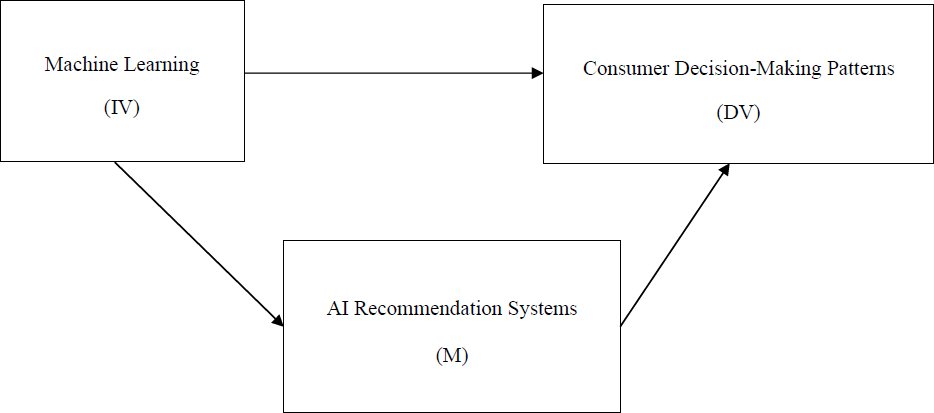
Fig. (1). Conceptual Framework.
3. METHODS
3.1. Research Design, Data Collection, and Sampling
The study used a cross-sectional research design to survey consumers in Germany to determine the impact of ML on decision-making patterns, along with the mediating role of the AI recommendation system. It is an exploratory study in which a cross-sectional research design has helped in enhancing the efficacy of data collection while analyzing the procedures (Hunziker & Blankenagel, 2024; Wang & Cheng, 2020). It even assists in terms of understanding the nature of the examined relationships and the significant factors that affect consumer decision-making in Germany. The study has used a quantitative research approach to generate empirical evidence regarding the influence of machine learning on consumer decision-making patterns in Germany. Close-ended questions were constructed to obtain information regarding the research factors (Appendix A). The measurement used in developing this questionnaire was the Likert Scale of measurement, which includes 5 points, starting from strongly disagree as 1 and strongly agree as 5. The scale was selected to ask the participants about detailed insights and related experience with ML and AI recommendation systems and how it has transformed their decision-making.
The data collection was conducted using an online survey strategy. The target audience was consumers in the German market. The convenience sampling method was used, and 385 participants were approached. All the participants were briefed about the purpose of this research and the exact usefulness of their contributions. After explaining their right to claim confidentiality and receiving the information, the participants agreed to participate in the study and signed the consent form. This was a credible way to start data collection, ensuring the importance of trust and ethical conduct.
3.2. Biases
Using a questionnaire survey with purposive sampling introduces certain biases in the research, which need to be addressed. The most important bias in such a scenario is selection bias, where some respondents who might provide sufficient results may be ignored due to the selection process. However, (Abobakr et al., 2024) indicated that selecting participants across different backgrounds and platforms ensures bias-free sampling. Hence, this research has used participants from different consumer groups in the German market, which involves both retail and clothing brands, to ensure the diversity of the participants. Furthermore, the participants were also approached using different platforms such as LinkedIn, Facebook groups, Instagram, personal contacts, and by visiting stores personally. It ensured that the respondents’ participation was bias-free and accurately represented.
The standard method bias is also important to address in such studies. Here, the same method is used for measuring the independent and dependent variables. Variables can be detected using Harman’s single-factor test, where exploratory factor analysis (EFA) is tested on the entire scale, extracting a single factor. The total variance extracted for the first factor has to be below 50%, reflecting that standard method bias is not the issue in this study (Kock et al., 2021). Since this study’s constructs provided total variance extracted for the first factor below 45%, the standard method bias was not an issue with this study. The research also addressed non-response bias by indicating the difference between early and late respondents. The late respondents are similar in characteristics to the non-respondents as per (Malik et al., 2024); hence, the insignificant difference in their responses reflects that non-response bias does not exist. The early respondents (n1 = 30) and late respondents (n2 = 30) show insignificant differences for the constructs such as ML (P-value >0.1), AI recommendation system (P-value >0.1), and consumer decision making (P-value >0.1). Hence, non-response bias is not an issue in this study.
3.3. Data Analysis
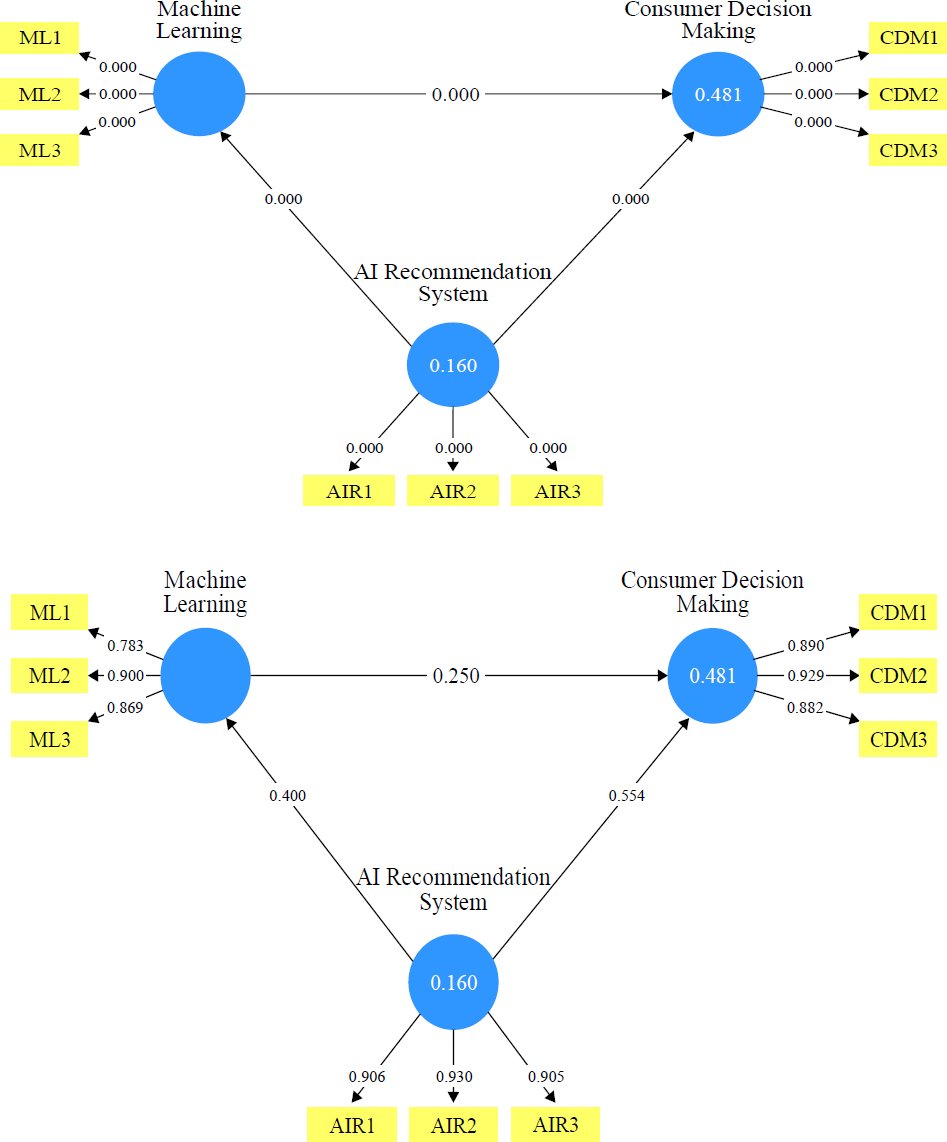
Structural Equation Modelling (SEM) based on SmartPLS was undertaken to validate the relationship between the constructs, including the measurement and the structural models (Santoso et al., 2023) (Appendix B). Reliability and validity of the measurement model were determined by outer loadings (over 0.7), Cronbach’s Alpha and Composite Reliability (CR) (over 0.7), and using Average Variance Extracted (AVE) (over 0.5) to determine convergent validity. The HTMT ratio assessed the discriminant validity, with a value below 0.85. The strength and direction of the relationships were analyzed using path coefficients, and the model’s explanatory power was analyzed using R-squared values (Chen et al., 2020).
4. ANALYSIS
4.1. Demographic Profile
Table 1 shows the demographic profile of the respondents. Most respondents (35%) belong to the 26–30 age group, followed by 31–35 (28%), while only 4% are over 45. Males overwhelm the sample at 75%, and females hold 25%. Education-wise, most (55%) have undergraduate qualifications, 30% are postgraduates, and 10% are under “Others”; a mere 5% possess higher education qualifications. This also points towards a young, male-dominated group with moderate to high levels of education. The density at the 26–35 age group suggests a probable early-to-mid-career demographic profile.
| Demographic Category | Category | Frequency | Percentage |
|---|---|---|---|
| Age | Up to 25 | 39 | 10% |
| 26-30 | 135 | 35% | |
| 31-35 | 108 | 28% | |
| 35-40 | 58 | 15% | |
| 40-45 | 31 | 8% | |
| Above 45 | 15 | 4% | |
| Gender | Male | 289 | 75% |
| Female | 96 | 25% | |
| Education | Higher Education | 19 | 5% |
| Undergraduate | 212 | 55% | |
| Postgraduate | 116 | 30% | |
| Others | 39 | 10% |
4.2. Measurement Model Using CFA
Table 2 shows the measurement model using CFA to confirm the reliability and validity of the construct and indicators. Factor loadings are used to evaluate the validity of the constructs, where a value above 0.6 is considered valid in measuring the construct (Hair et al., 2017). Since the factor loadings for all indicators are above 0.6, there is no need to drop any indicator, and the measurement model is valid. Furthermore, the reliability of the constructs is evaluated using Cronbach’s alpha and composite reliability, where a value above 0.7 is considered reliable (Ringle et al., 2015). Since the values of all constructs are above 0.7, it confirms that the constructs are reliable.
Furthermore, AVE values indicate the convergent validity with the value above 0.5 (Hair et al., 2017). The constructs in Table 2 show values above 0.5, confirming the convergent validity. Hence, the measurement model confirms that the indicators and constructs are reliable and valid.
| Latent Construct | Indicators | Factor Loadings | Cronbach's Alpha | Composite Reliability | Average Variance Extracted (AVE) |
|---|---|---|---|---|---|
| AI Recommendation System | AIR1 | 0.906 | 0.901 | 0.901 | 0.835 |
| AIR2 | 0.930 | ||||
| AIR3 | 0.905 | ||||
| Consumer Decision Making | CDM1 | 0.890 | 0.883 | 0.884 | 0.811 |
| CDM2 | 0.929 | ||||
| CDM3 | 0.882 | ||||
| Machine Learning | ML1 | 0.783 | 0.811 | 0.830 | 0.726 |
| ML2 | 0.900 | ||||
| ML3 | 0.869 |
Table 3 shows the discriminant validity of the constructs. It shows that the constructs are distinctively unrelated, and no indicator of one construct loads onto the indicators of other variables. A value below 0.85 shows discriminant validity (Hair et al., 2017). The value of AI recommendation and Consumer decision making (0.733), AI recommendation and Machine Learning (0.467), and consumer decision making and machine learning (0.55) shows that the constructs are distinctively unrelated to each other. Hence, there is no issue of discriminant validity.
| AI Recommendation System | Consumer Decision Making | |
|---|---|---|
| Consumer Decision Making | 0.733 | |
| Machine Learning | 0.467 | 0.550 |
4.3. Structural Model
Table 4 shows the path analysis to confirm the hypothesis of the study. It shows that ML (B = 0.250, p-value = 0.00) significantly and positively impacts consumer decision making. The direct effect also shows that the AI recommendation system (B = 0.554, p-value = 0.000) significantly and positively impacts consumer decision making. Furthermore, ML (B = 0.400, p-value = 0.000) significantly and positively impacts the AI recommendation system. The indirect effect also shows that ML (B = 0.222, p-value = 0.00) significantly and positively impacts consumer decision making. The specific indirect effect shows that the AI recommendation system (B = 0.222, p-value = 0.000) significantly and positively mediates ML and consumer decision making. These results confirm that the AI recommendation system partially mediates the relationship between ML and consumer decision making. It indicates the complexity of the model and indicates that other factors can indirectly impact the relationship between ML and consumer decision making, such as cultural impact, technology literacy, or technological readiness among consumers, which can impact their relationship. Hence, these factors also need to be taken into account.
| Direct Effect | |||
| Path Coefficient | T Statistics | P Values | |
|---|---|---|---|
| AI Recommendation system → Consumer Decision Making | 0.554*** | 12.371 | 0.000 |
| Machine Learning → AI Recommendation system | 0.400*** | 7.238 | 0.000 |
| Machine Learning → Consumer Decision Making | 0.250** | 5.271 | 0.000 |
| Total Indirect Effect | |||
| Machine Learning → Consumer Decision Making | 0.222*** | 6.657 | 0.000 |
| Specific Indirect Effect | |||
| Machine Learning → AI Recommendation system → Consumer Decision Making | 0.222*** | 6.657 | 0.000 |
Note: ***showing significance at 1%
4.4. Model Explanatory Power
Table 5 shows the model’s explanatory power. The AI recommendation system’s R-Square is 0.160, or 16%, showing that 16% of the variation in the AI recommendation system can be explained through ML. Consumer decision-making’s R-Square is 0.481, or 48%, showing that 48% of the variation in Consumer decision-making can be explained through ML and the AI recommendation system.
| R-Square | R-Square Adjusted | |
|---|---|---|
| AI Recommendation System | 0.160 | 0.158 |
| Consumer Decision Making | 0.481 | 0.478 |
5. DISCUSSION
The results of the current study validate that ML plays a strong and positive role in influencing consumer decision-making (B = 0.250, p = 0.000), confirming H1 Table 6, consistent with earlier work by (Alizadeh et al., 2023; and Pappalardo et al., 2024). These works highlighted ML’s capability to ease need recognition, alternative evaluation, and knowledge-based purchase decisions through delivering data-driven and personalized recommendations. The findings further validate (Zhang et al., 2021) conclusions, which posited that ML improves consumers’ trust and satisfaction through simplifying information processing and minimizing cognitive load when making decisions.
TAM and TPB also affirm these findings. From a TPB view, ML increases perceived behavioural control since consumers are offered affordable, personalized choices. At the same time, TAM accounts for adopting ML-facilitated systems based on perceived usefulness and ease of use (Haritha & Mohan, 2022). In the case of Germany, the important role played by ML can be attributed to the nation’s strong technological readiness, digital level of infrastructure, and data literacy among consumers. The German focus on openness in AI practices and respect for data privacy could also translate to more consumer confidence, and thus more willingness to use ML-based systems.
| S. No. | Hypotheses | Results |
|---|---|---|
| 1 | Machine learning has a significant impact on consumer decision-making. | Accepted |
| 2 | AI recommendation systems positively mediate the relationship between machine learning and consumer decision-making. | Partially Accepted |
The research finds a partial mediation impact of AI recommendation systems in the relationship between ML and consumer decision-making (B = 0.222, p = 0.000), confirming H2 Table 6, reflecting significant variation from numerous previous works indicating complete mediation. (Alizadeh et al., 2023) and (Beyari & Garamoun’s, 2022) research highlighted that AI recommendation systems pass entirely the impact of ML to consumer behaviour, primarily because ML’s impact was viewed as indirect, functioning mainly through individualized and AI-based interfaces. However, in the German case, ML directly impacts consumer decision-making (B = 0.250, p = 0.000) in addition to the indirect effect through AI recommendation systems. This partial mediation implies that German consumers can interact with ML outputs independently, independent of the AI recommendations. One reasonable hypothesis is that Germany’s highly developed digital infrastructure and high data literacy enable consumers to understand ML-driven information critically and make choices without depending entirely on AI interfaces. Culturally, German consumers have been described as highly needing certainty and evidence-based decision-making. This can cause them to utilize AI recommendation systems as a tool for support, not as a standalone decision-making device.
Additionally, Germany’s focus on data control and privacy under GDPR promotes a culture where consumers are more reserved and independent in their digital actions. They may believe in ML-driven platforms but desire to maintain final decision-making power. This subtlety accounts for the partial mediation; ML shapes direct and indirect decisions, describing a more participatory and critically active digital consumer base in Germany, distinct from observed patterns elsewhere.
CONCLUSION AND RECOMMENDATION
The purpose of this research is to evaluate the impact of ML on consumer decision-making and the mediating role of AI recommendation systems. This research finds that ML significantly influences consumer decision-making, both directly and indirectly through AI recommendation systems, showing a partial mediation effect. This research points out that German customers tend to interact directly with ML-based insights, given a context where high digital literacy, strong data privacy conventions, and cultural autonomy preference shape technology use.
Drawing on these conclusions, several practical recommendations follow. Firstly, businesses need to increase transparency in their AI systems by explicitly detailing how recommendations are produced, something that can enhance consumer confidence. Secondly, platforms need to facilitate consumer autonomy through options to personalize or override AI suggestions, which German consumers desire regarding control. Finally, investments in digital education programs can enable users to use ML technologies more confidently. Finally, AI systems must be culturally tailored to German consumer values for better relevance, acceptance, and effectiveness in decision-making.
CONTRIBUTION OF THE STUDY
This research advances scholarly understanding and real-world application by providing a sophisticated insight into how ML impacts consumers’ decisions and an AI recommendation system as a mediator, especially in the German market. The work builds on previous research by uncovering that AI recommendation systems partially mediate between ML and decision-making. This emphasizes the need to account for cultural and contextual variables, including digital literacy and awareness of data privacy, which influence technology adoption and usage trends. From a business point of view, the research offers actionable guidance to companies and marketers. It prioritizes user-friendly, transparent AI systems that enable consumers to dominate them. The results imply that in countries such as Germany, success is not solely based on cutting-edge technology but also cultural fit, trust, user control, and cultural alignment. Therefore, the research guides AI system design and action plans for effective deployment in various consumer contexts.
POLICY IMPLICATIONS
This research has significant policy implications, specifically encouraging responsible and consumer-oriented use of AI and machine learning technologies. The policymakers should work on establishing guidelines that require transparency in AI recommendation systems, so users know how decisions are made. As with the partial mediation discovered in the German setting, policies would also prioritize user control, data sovereignty, and informed consent. Secondly, digital literacy programs can be further supported to enable consumers to interact critically with AI technologies. Regulatory regimes such as GDPR should remain an enforced reality and be extended to guarantee ethical use of AI, promoting innovation and consumer confidence in digital ecosystems.
LIMITATIONS AND FUTURE DIRECTIONS
This research has some limitations. First, it is conducted in the German context only, which might restrict the generalisability of the results to other regional or cultural environments in which digital trust, technological readiness, and consumer behaviour could be different. Moreover, it only views AI recommendation systems as mediators and might not consider other relevant variables like cultural values, privacy issues, or user interface design.
For future research, cross-cultural comparisons could yield more in-depth insights into the extent to which ML and AI systems influence consumer decision-making processes worldwide. More exploration of other potential mediators and moderators, such as user trust, platform usability, and psychological characteristics, would strengthen the model. Longitudinal designs would also be able to measure shifts over time in consumer attitudes as AI technologies change. Scaling up beyond Germany would ensure testing the robustness and generalisability of the findings in larger, more heterogeneous environments.
LIST OF ABBREVIATIONS
ML | = | Machine Learning |
AI | = | Artificial Intelligence |
SEM | = | Structural Equation Modeling |
CR | = | Composite Reliability |
AVE | = | Average Variance Extracted |
TAM | = | Technology Acceptance Model |
TPB | = | Theory of Planned Behaviour |
AUTHOR'S CONTRIBUTION
H.A. has contributed to conceptualization, idea generation, problem statement, methodology, results analysis, results interpretation.
ETHICAL APPROVAL & INFORMED CONSENT
All the participants were briefed about the purpose of this research and the exact usefulness of their contributions. After explaining their right to claim confidentiality and receiving the information, the participants agreed to participate in the study and signed the consent form. This was a credible way to start data collection, ensuring the importance of trust and ethical conduct.
AVAILABILITY OF DATA AND MATERIALS
The data will be made available on reasonable request by contacting the corresponding author [H.A].
FUNDING
None.
CONFLICT OF INTEREST
The author declares that there is no conflict of interest regarding the publication of this article.
ACKNOWLEGDEMENTS
Declared none.
DECLARATION OF AI
During the preparation of this work the author used ChatGPT for editing purposes. After using this tool, the author reviewed and edited the content as needed and take full responsibility for the content of the published article.
APPENDIX A
Survey Questionnaire
| S. No. | Questions | Strongly Disagree | Disagree | Neutral | Agree | Strongly Agree |
|---|---|---|---|---|---|---|
| ML | 1 | 2 | 3 | 4 | 5 | |
| 1 | ML tailors the recommendations, and enhance the shopping experience of the customers. | |||||
| 2 | ML ensures to get positive feedback after providing satisfied services to the customers | |||||
| 3 | ML ensures personalized recommendations which lead to increases in sales | |||||
| AIR | 1 | 2 | 3 | 4 | 5 | |
| 4 | AIR offers personalized suggestions to the customers | |||||
| 5 | AIR ensures trust and satisfaction which attracts customers | |||||
| 6 | User experience is enhanced through reduced time by AIR | |||||
| CDM | 1 | 2 | 3 | 4 | 5 | |
| 7 | German customers give priority to the information and logic instead of the emotional aspects | |||||
| 8 | Brand loyalty matters a lot in consumer decision making | |||||
| 9 | Consumers prefer sustainability in their purchasing decisions | |||||
APPENDIX B
REFERENCES
Abobakr, M. A., Abdel-Kader, M., & F. Elbayoumi, A. F. (2024). An experimental investigation of the impact of sustainable ERP systems implementation on sustainability performance. Journal of Financial Reporting and Accounting. https://doi.org/10.1108/JFRA-04-2023-0207
Abrardi, L., Cambini, C., & Rondi, L. (2022). Artificial intelligence, firms and consumer behavior: A survey. Journal of Economic Surveys, 36(4), 969-991. https://doi.org/10.1111/joes.12455
Ajzen, I., (2020). The theory of planned behaviour: Frequently asked questions. Human behaviour and emerging technologies, 2(4), pp. 314–324. https://publons.com/publon/10.1002/hbe2.195
Alizadeh, H., Kashani, H. N., Filshoor, M. J. & Khameneh, A. P., (2023). Evaluation of consumer behaviour prediction based on artificial intelligence in marketing. Tehran, Khatam University. https://www.researchgate.net/publication/375596970_Evaluation_of_consumer_behavior_prediction_based_on_artificial_intelligence_in_marketing
Babatunde, S., Odejide, O., Edunjobi, T. & Ogundipe, D., (2024). The role of AI in marketing personalization: A theoretical exploration of consumer engagement strategies. International Journal of Management & Entrepreneurship Research, 6(3), p. 93. DOI:10.51594/ijmer.v6i3.964
Beyari, H. & Garamoun, H., (2022). The effect of artificial intelligence on end-user online purchasing decisions: Toward an integrated conceptual framework. Sustainability, 14(15), p. 9637. https://doi.org/10.3390/su14159637
Bhaskaran, S., & Marappan, R. (2023). Enhanced personalized recommendation system for machine learning public datasets: generalized modeling, simulation, significant results and analysis. International Journal of Information Technology, 15(3), 1583-1595. https://doi.org/10.1007/s41870-023-01165-2
Chabane, N., Bouaoune, A., Tighilt, R., Abdar, M., Boc, A., Lord, E., & Makarenkov, V. (2022). Intelligent personalized shopping recommendation using clustering and supervised machine learning algorithms. Plos One, 17(12), e0278364. https://doi.org/10.1371/journal.pone.0278364
Chen, C., & Zheng, Y. (2024). When consumers need more interpretability of artificial intelligence (AI) recommendations? The effect of decision-making domains. Behaviour & Information Technology, 43(14), 3481-3489. https://doi.org/10.1080/0144929X.2023.2279658
Chen, J., Bai, L., Luo, H. & Yu, D., (2020). Correlation and path analysis of quantitative traits of pearl oyster Pinctada fucata at two different ages. Journal of Southern Agriculture 51(10), 2557-2564. DOI: 10.3969/j.issn.2095-1191.2020.10.029
Conner, M., (2020). Theory of planned behavior.. In: G. E. R. C. Tenenbaum, ed. Handbook of sport psychology. New Jersey: Wiley, pp. 1-18. https://doi.org/10.1002/9781119568124.ch1
Davis, F., Granić, A. & Marangunić, N., (2024). The technology acceptance model: 30 years of TAM. 1st ed. New York City: Springer International Publishing AG, 117. https://books.google.com.pk/books/about/The_Technology_Acceptance_Model.html?id=L2X8EAAAQBAJ&redir_esc=y
De Mauro, A., Sestino, A., & Bacconi, A. (2022). Machine learning and artificial intelligence use in marketing: a general taxonomy. Italian Journal of Marketing, 2022(4), 439-457. https://doi.org/10.1007/s43039-022-00057-w
Gkikas, D. C., & Theodoridis, P. K. (2021). AI in consumer behavior. In Advances in Artificial Intelligence-based Technologies: Selected Papers in Honour of Professor Nikolaos G. Bourbakis—Vol. 1, (pp. 147-176). Cham: Springer International Publishing. https://doi.org/10.1007/978-3-030-80571-5_10
Habil, S., El-Deeb, S. & El-Bassiouny, N., (2023). AI-based recommendation systems: the ultimate solution for market prediction and targeting. In: The Palgrave handbook of interactive marketing. s.l.:Cham: Springer International Publishing., pp. 683-704. DOI:10.1007/978-3-031-14961-0_30
Hair, J., Hollingsworth, C. L., Randolph, A. B., & Chong, A. Y. L. (2017). An updated and expanded assessment of PLS-SEM in information systems research. Industrial Management & Data Systems, 117(3), 442-458. https://doi.org/10.1108/IMDS-04-2016-0130
Haritha, S. & Mohan, B., (2022). Cognitive Dissonance in Online Shopping in an Emerging E-tailing Market. Transnational Marketing Journal, 10(3), pp. 719-737. DOI: https://doi.org/10.33182/tmj.v10i3.2176
Heins, C., (2023). New Concepts for Efficient Consumer Response in Retail Influenced by Emerging Technologies and Innovations, Friedrichshafen: Zeppelin University. DOI:10.48586/zu/11553
Hunziker, S. & Blankenagel, M., (2024). Cross-sectional research design. In: Research Design in Business and Management: A Practical Guide for Students and Researchers. s.l.:Wiesbaden: Springer Fachmedien Wiesbaden., pp. 187-199. DOI:10.1007/978-3-658-42739-9_10
Iyelolu, T., Agu, E., Idemudia, C. & Ijomah, T., (2024). Leveraging artificial intelligence for personalized marketing campaigns to improve conversion rates. International Journal of Engineering Research and Development, 20(8), pp. 253-270. https://www.researchgate.net/publication/383847844_Leveraging_Artificial_Intelligence_for_Personalized_Marketing_Campaigns_to_Improve_Conversion_Rates
Kim, J., Giroux, M., & Lee, J. C. (2021). When do you trust AI? The effect of number presentation detail on consumer trust and acceptance of AI recommendations. Psychology & Marketing, 38(7), 1140-1155. https://doi.org/10.1002/mar.21498
Kock, F., Berbekova, A., & Assaf, A. G. (2021). Understanding and managing the threat of common method bias: Detection, prevention and control. Tourism management, 86, 104330. https://doi.org/10.1016/j.tourman.2021.104330
Lazim, N. A. M., Sulaiman, Z., Zakuan, N., Mas’od, A., Chin, T. A., & Awang, S. R. (2020). Measuring post-purchase regret and impulse buying in online shopping experience from cognitive dissonance theory perspective. In 2020 6th International Conference on Information Management (ICIM), (pp. 7-13). IEEE. DOI:10.1109/ICIM49319.2020.244662
Lee, M., Kwon, W., & Back, K. J. (2021). Artificial intelligence for hospitality big data analytics: developing a prediction model of restaurant review helpfulness for customer decision-making. International Journal of Contemporary Hospitality Management, 33(6), 2117-2136. https://doi.org/10.1108/IJCHM-06-2020-0587
Malik, M., Andargoli, A., Clavijo, R. C., & Mikalef, P. (2024). A relational view of how social capital contributes to effective digital transformation outcomes. The Journal of Strategic Information Systems, 33(2), 101837. https://doi.org/10.1016/j.jsis.2024.101837
Meng, X., (2024). Cross-domain information fusion and personalized recommendation in artificial intelligence recommendation system based on mathematical matrix decomposition. Scientific Reports, 14(1), 7816. https://doi.org/10.1038/s41598-024-57240-6
Mishra, D. R., & Varshney, D. (2024). Consumer protection frameworks by enhancing market fairness, accountability and transparency (FAT) for ethical consumer decision-making: Integrating circular economy principles and digital transformation in global consumer markets. Asian Journal of Education and Social Studies, 50(7), 10-9734. https://doi.org/10.9734/ajess/2024/v50i71494
Misra, R. R., Kapoor, S., & Sanjeev, M. A. (2024). The impact of personalization algorithms on consumer engagement and purchase behaviour in AI-enhanced virtual shopping assistants. https://doi.org/10.21203/rs.3.rs-3970797/v1
Musa, H., Fatmawati, I., Nuryakin, N. & Suyanto, M., (2024). Marketing research trends using technology acceptance model (TAM): A comprehensive review of researches (2002–2022). Cogent business & management, 11(1), p. 2329375. https://doi.org/10.1080/23311975.2024.2329375
Pappalardo, L., Ferragina, E., Citraro, S., Cornacchia, G., Nanni, M., Rossetti, G., & Pedreschi, D. (2024). A survey on the impact of AI-based recommenders on human behaviours: methodologies, outcomes and future directions. arXiv preprint arXiv:2407.01630. https://doi.org/10.48550/arXiv.2407.01630
Pereira, A. M., Moura, J. A. B., Costa, E. D. B., Vieira, T., Landim, A. R., Bazaki, E., & Wanick, V. (2022). Customer models for artificial intelligence-based decision support in fashion online retail supply chains. Decision Support Systems, 158, 113795. https://doi.org/10.1016/j.dss.2022.113795
Ringle, C., Da Silva, D., & Bido, D. (2015). Structural equation modeling with the SmartPLS. Brazilian Journal of Marketing, 13(2). https://ssrn.com/abstract=2676422
Rodrigues, J., (2021). Understanding the Impact of Personalized Recommendations on Customer Satisfaction, Likelihood to Recommend and Repurchase Intentions, s.l.: Master’s thesis, Universidade Catolica Portuguesa (Portugal. https://repositorio.ucp.pt/handle/10400.14/35410
Santoso, N., Sunarjo, R. & Fadli, I., (2023). Analyzing the Factors Influencing the Success of Business Incubation Programs: A SmartPLS Approach. ADI Journal on Recent Innovation, 5(1), pp. 60-71. DOI: https://doi.org/10.34306/ajri.v5i1.985
Singh, B., Kaunert, C., & Vig, K. (2024). Reinventing Influence of Artificial Intelligence (AI) on digital consumer lensing transforming consumer recommendation model: exploring stimulus artificial intelligence on consumer shopping decisions. In AI Impacts in Digital Consumer Behavior, (pp. 141-169). IGI Global. DOI: 10.4018/979-8-3693-1918-5.ch006
Vashishth, T. K., Sharma, K. K., Kumar, B., Chaudhary, S., & Panwar, R. (2024). Enhancing customer experience through AI-enabled content personalization in e-commerce marketing. Advances in digital marketing in the era of artificial intelligence, 7-32. DOI: 10.1201/9781003450443-2
Wang, X. & Cheng, Z., (2020). Cross-sectional studies: strengths, weaknesses, and recommendations. Chest, 158(1), pp. S65-S71. DOI: 10.1016/j.chest.2020.03.012
Wong, I. A., Lian, Q. L., & Sun, D. (2023). Autonomous travel decision-making: An early glimpse into ChatGPT and generative AI. Journal of Hospitality and Tourism Management, 56, 253-263. https://doi.org/10.1016/j.jhtm.2023.06.022
Zhang, Q. & Xiong, Y., (2024). Harnessing AI potential in E-Commerce: improving user engagement and sales through deep learning-based product recommendations. Current Psychology, 43(38), pp. 30379-30401. DOI:10.1007/s12144-024-06649-3
Zhang, Q., Lu, J. & Jin, Y., (2021). Artificial intelligence in recommender systems. Complex & Intelligent Systems, 7(1), pp. 439-457. https://doi.org/10.1007/s40747-020-00212-w
Licensed
© 2025 Copyright by the Authors.
Licensed as an open access article using a CC BY 4.0 license.
Article Contents Author Felicia Gabriela Beresescu1, * 1College of Business-Al Khobar, Al Yamamah University, Saudi Arabia Article History: Received: 21
Article Contents Authors Saman Ismail1, * Imran Iqbal2 1Faculty of Management Science, Department of Business Administration, Salim Habib University, Karachi,
Article Contents Author Michael Dolinsky1, * 1Faculty of Mathematics and Technologies of Programming, Francisk Skorina Gomel State University,
Article Contents Author Abdul Ghafoor Memon1, * 1Emaan Institute of Management Sciences, Karachi, Pakistan Article History: Received: 01 April, 2026
Article Contents Authors Zixuan Zhao1, Ju Guo1, * 1School of Management, Chengdu University of Information Technology, Chengdu, China Article History:
Article Contents Authors Sultan Ud Din Yousufzai1, Amtyaz Safi2, * , Maher Khan1, Zia Ud Din1 1Department of Zoology, Govt.