



Article Contents
Article ID: CM2511101004
Views: 965Assessing the Role of Vertical Farming in Managing the Net-Zero Supply Chain in Aerofarms: The Mediating Role of Supply Partner Collaboration
 DOI:
10.65080/hzvrh624
DOI:
10.65080/hzvrh624
 PDF
PDF
⬇ Downloads: 43
Eltayeb, T. K., & Mahmood, C. K. (2025). Assessing the role of vertical farming in managing the net-zero supply chain in Aerofarms: The mediating role of supply partner collaboration. Advances Journal of Business Management and Social Sciences, 1(1), 1–10. https://doi.org/10.65080/hzvrh624
Eltayeb, Tarig Khidir., Mahmood, Chaudhary Kashif. 2025. “Assessing the Role of Vertical Farming in Managing the Net-Zero Supply Chain in Aerofarms: The Mediating Role of Supply Partner Collaboration.” Advances Journal of Business Management and Social Sciences 1 (1): 1–10. https://doi.org/10.65080/hzvrh624
Eltayeb, T.K. and Mahmood, C. K., 2025. Assessing the role of vertical farming in managing the net-zero supply chain in Aerofarms: The mediating role of supply partner collaboration. Advances Journal of Business Management and Social Sciences, 1(1), pp.1–10. Available at: https://doi.org/10.65080/hzvrh624
Eltayeb TK, Mahmood CK. Assessing the role of vertical farming in managing the net-zero supply chain in Aerofarms: The mediating role of supply partner collaboration. Adv J Buss Manag Soc Sci. 2025 Feb 7;1(1):1–10. doi:10.65080/hzvrh624
- Tarig Khidir Eltayeb1, *
- and Chaudhary Kashif Mehmood1
1Department of Business Administration, Imam Abdulrahman Bin Faisal University, Dammam, Saudi Arabia
Received: 22 October, 2024
Accepted: 25 January, 2025
Revised: 23 January, 2025
Published: 07 February, 2025
Abstract:
Introduction: The research evaluated the vertical farming practices and its contribution towards having a net zero supply chain management in terms of supply partner collaboration as a mediating factor.
Methods: Among the commercial vertical farming companies, aerofarms was chosen as the case study. Data were captured from 385 participants using a quantitative research design, analysed using SMARTPLS.
Results: The results suggest that Vertical farming (B = 0.189, p-value = 0.002), have a significant and positive impact on net-zero supply chain management. Sustainable resource management (B = 0.200, p-value = 0.000) have a significant and positive impact on net zero supply chain. The mediating effect of supplier partner distribution (B = 0.101, p-value = 0.001) is significant and positive on the relationship between vertical farming and net-zero supply chain management. Furthermore, supplier partner distribution (B = 0.265, p-value = 0.000) have a significant and positive mediating effect on the relationship between supplier resource management and net-zero supply chain management which further implied the partial mediation.
Conclusion: The results show that vertical farming can reduce the carbon emissions and improve the supply chain efficiency only when supply partner collaborations are promoted. Insights from these applications also contribute to the increasing literature surrounding sustainable agricultural practices and provide actionable strategies for organisations looking to achieve its net zero goals.
Keywords: Vertical farming, supplier collaboration, supply chain, expenditures, net-zero carbon emissions, aerofarms.
1. Introduction
In the current era, role of technology in agriculture practices is expected to improve the production since it is able to address the supply and demand gap for agriculture produce (Balasundram et al., 2023; Brower-Toland et al., 2024; Raj et al., 2021). It is essential to implement new crop production methods since it is able to bridge the global requirements and also mitigate their current problems (Rasanjali et al., 2021; Xing & Wang, 2024). Reiterating on the current issues; it includes environmental pollution and the subsequent soil degradation. Vertical farming is considered to be an effective method that is used for reducing environmental degradation and also balancing food requirements (Lubna et al., 2022; Naskali et al., 2022).
Vertical farming has been leveraged by Aerofarms by scaling commercial indoor farming operations and conducting extensive agricultural research and development with industry collaborations (Gee, 2022). In addition, Aerofarms used vertical farming to make food more available and incorporated sixth-generation farming technologies. Pioneering in over 550 varieties of greens using sensing technologies such as AgX in UAE to conceputalise next generation crops through phenotyping and speed breeding. AgX in the UAE uses cutting-edge sensing technologies to drive agricultural innovation, specifically phenotyping and speed breeding. With insights from over 550 greens varieties, AgX enables the growth of next-generation crops adapted to arid environments, improving food security through exact data-driven recommendations and optimised growing parameters (Zarras et al., 2024).
Vertical farming is considered to be an alternative method to produce more crops by utilising less resources (Beacham et al., 2019; Kalantari et al., 2018). This is important as it integrates the building structure with farming and aids the food supply chain with relative ease (Akintuyi, 2024). Building structure refers to the hierarchy present that is initiated from the producer to the end consumer. One way to use this method of farming is to integrate it into building structures which is part of streamlining the food supply chain and reducing environmental sustainability through the reduction of the carbon footprint significantly (Mir et al., 2022).
Furthermore, vertical farming helps in producing high yield in year-round, in a pesticide and fertilizer free manner, promoting the environment (Avgoustaki & Xydis, 2020; Benke & Tomkins, 2017). This is coupled without the use of pesticides and fertilizers as well that helps in contributing to the environment. Vertical farming also uses 70% less water and thus protects the environmental from the financial and logistics expenditure due to minimising its transportation as well and supply partner collaboration has not been seriously studied via empirical work mediating Aerofarms’ efforts toward sustainability (Mir et al., 2022).
Considering the background; its problem has been identified and it is claimed that the modern agricultural industry has been facing significant pressure to adopt and implement sustainable practices (Zaręba et al., 2021). It is being proposed to address the issues emerging from climate change and also to achieve net-zero emissions. One of the main issues includes the necessity for companies to reduce their carbon footprints by adopting net-zero practices primarily through their supply chains (Xu et al., 2023; Baumont de Oliveira et al., 2022). This is however, limited through high resource consumption and inefficiencies in its distribution chain.
However, despite the growing literature, limited literature exists that conducted specific research on Aerofarms context (Akintuyi, 2024). It is also lacking in the consensus regarding its supplier base collaboration. There is also a lack of empirical research that can assess the mediating role of supply partner collaboration in completing its sustainability goals as well. For this purpose, the research’s aim is to assess the role of vertical farming in managing net-zero supply chain with supply partner collaboration as the mediating role. Its objectives include 1) to evaluate the impact of vertical farming on the net-zero supply chain management at Aerofarms. 2) to assess the role of supply partner collaboration in achieving net-zero goal and 3) to investigate the supply partner collaboration’s mediating role between the vertical farming and its net-zero supply chain management.
Carrying out this research in the UAE is extremely important because of the arid climate of the region, lack of water, and extensive dependence on food imports, all of which together present essential challenges to food security and sustainable agriculture (Alkhaldi et al., 2023). The UAE has demonstrated firm national support for food systems innovation through programs such as the National Food Security Strategy 2051, so it is a good place to investigate the transformative implications of vertical farming (Degefa, 2022). With path-breaking projects like AgX and Aerofarms already up and running in the country, the UAE offers a functional and technologically sophisticated environment to explore how vertical farming can be brought into supply chains with net-zero ambitions (Zarras et al., 2024).
This study is also timely, considering the UAE’s increasing emphasis on climate action, particularly following hosting COP28, which highlighted the need for sustainable food systems. As global warming increases and pressures on conventional farming worsen, learning how vertical farming helps address the environmental pressures and how it can heighten cooperation between supply chains is essential. By assessing the mediating effect of supply partner cooperation, the research not only enriches scholarly discourse but also provides actionable advice to policymakers, agri-tech companies, and green activists. The research could assist in scaling vertical farming solutions in desert areas worldwide to encourage resilience, lower carbon emissions, and guarantee long-term food security.
2. Literature Review
The empirical analysis of recent research indicates that vertical farming (VF) can play a major role in attaining net-zero supply chain ambitions, mainly under renewable energy inputs, but also indicates some challenges and limitations. (Baumont de Oliveira et al., 2022) employed a carbon life cycle analysis (LCA) method to contrast emissions from conventional field-based agriculture and hydrogen-powered vertical farming. They discovered that vertical farms produced 3.79–4.45 kg CO₂e/kg of lettuce, whereas conventional imports varied from 1.14–5.05 kg CO₂e/kg, taking deforestation impacts into consideration. Powered by tidal energy, VF emissions reduced to 1.57 kg CO₂e/kg. Results demonstrate that VF, integrated with renewable energy, has the potential to surpass conventional agriculture in terms of carbon efficiency, thereby enabling a net-zero supply chain. However, the limitation is single-crop focus and the lack of supply chain integration. The research gap is the narrow study of supplier collaboration and logistics in carbon accounting.
(Gargaro et al., 2024) carried out a cradle-to-customer LCA based on actual data from a UK commercial VF. The study demonstrated that renewable energy can lower VF emissions considerably, bringing them to levels comparable or even lower than conventional methods. Results indicate that renewable-powered VF is in line with net-zero targets. Strengths are the utilsation of primary data and thorough environmental profiling. Weaknesses include limited range of products and failure to evaluate collaborative supply chain dynamics.
(Sandison et al., 2023) applied LCA to various electricity mix scenarios in Scotland. The VF lettuce carbon footprint fell from 1.49 to 0.33 kg CO₂e/kg with 100% renewable energy, rendering it competitive with field-grown counterparts. Observations reaffirm VF’s potential for net-zero when driven on sustainable energy. Gap in research is lack of supply chain emissions and efficiency evaluations. Vidergar, (Perc & Lukman, 2021) employed comparative LCA and cost analysis in a Mediterranean city. VF in residential construction demonstrated lower emissions and water consumption, validating VF’s contribution to net-zero urban agriculture. Weaknesses include dependence on simulated data and regional specificity.
(Stanghellini & Katzin, 2024) offered a critical analysis, contending VF can be energy-hungry, usually higher than emissions of field-based farming unless being driven by renewable sources. Results contradict general presumption about VF’s sustainability, with focus on energy source as a variable in achieving net-zero alignment. Together, the research affirms that VF is capable of enabling net-zero supply chains, but only through renewable energy, efficient use of resources, and more studies on collaboration among suppliers and scalability. Based on the review, following hypothesis can be formed;
H1: Vertical farming practices has a significant impact on the net-zero supply chain management in the UAE agriculture sector
The research empirically brings out the central contribution of sustainable resource management in fulfilling net-zero supply chain (NZSC) ambitions, more specifically through the convergence of digital technologies, lean-green strategies, and circular economy. (Yadav et al., 2023) employed a resource-based view (RBV) and VRIO framework in investigating whether digital technologies, when blended with lean and green, can help manufacturing companies pursue SDGs through NZE. The research formulated four innovation-led scenarios on radical vs. incremental change. Results indicate that high-level integration of digital, lean, and green technologies significantly speeds NZSC transformation. Limitations are conceptual in approach with a lack of empirical verification. The research gap exists in the absence of real-life case applications across industries.
(Bag, 2024) applied variance-based structural equation modelling (SEM) using SME data from South Africa’s paper and chemical industries. Findings indicated that intangible (organisational culture, learning, and training of employees) resources played a stronger role in NZSC adoption than tangible. Findings highlight the paramount role of sustainability culture and knowledge management. Strengths are sound statistical analysis and applicability to SMEs. The study is constrained to certain industries and geographic locations with low generalisability.
(Mishra et al., 2023) performed a systematic literature review of 79 articles in the years 2009–2021 and found a significant correlation between digitalisation, circular economy practices, and resource optimisation with NZSC objectives. The analysis abstracted core theoretical, methodological, and contextual knowledge. The limitations were that it had no empirical testing and regional specificity.
(Alsofiani, 2024) formulated a conceptual model of the construction sector with PRISMA-based literature review. The research focused on enablers and performance indicators of integrating net-zero ambitions into supply chain assessment. The findings validate carbon accounting, life cycle thinking, and digitalisation are crucial for achieving sustainable resource alignment. Yet, there is a lack of real-time confirmation and industry-wide data. Together, these studies show that sustainable resource management, specifically through digital innovation and organisational culture, is an important driver in achieving net-zero-aligned supply chains. Therefore, it can be hypothesised that;
H2: Sustainable resource management has a significant impact on the net-zero supply chain management in the UAE agriculture sector
The mediating effect of supplier partner collaboration between the NZSC and VF can be adequately explained through the RBV and Stakeholder Theory. VF being a novel form of agriculture is dependent on highly controlled inputs like LED lights, nutrient solutions, and climate control systems. These inputs tend to be procured through specialists and thus a collaboration is a prerequisite (Sharma et al., 2024). To RBV, companies gain a competitive edge through the utilisation of valuable, rare, inimitable, and organised (VRIO) resources (Singh et al., 2023). For VF, cooperation with supply partners enables companies to access the latest technologies, renewable sources of energy, and environmentally friendly materials that play a central role in emission cuts and minimisation of environmental footprints. Such cooperation integrates external capabilities into combined resources that benefit NZSC goals directly (Bag, 2024). Stakeholder Theory also endorses this connection by highlighting the significance of involving all concerned actors in sustainability objectives. Supplier collaboration ensures transparency, collaborative innovation, and common sustainability measures, which are important for monitoring carbon footprints, maximising energy usage, and reducing waste along the supply chain (Feng et al., 2024). Therefore, supplier partner collaboration functions as a mediating mechanism that converts VF’s potential into real environmental gains, facilitating the achievement of net-zero objectives through enhanced coordination, exchange of knowledge, and sustainable procurement practices.
H3: Supplier partner collaboration mediates the relationship between vertical farming practices and net-zero supply chain management in the UAE agriculture sector
The mediating function of supplier partner collaboration in the relationship between sustainable resource management and NZSC can be interpreted through the Practice-Based View (PBV) and Relational View Theory. PBV stresses organisational practices, efficient use of resources, culture of sustainability, and knowledge sharing, as the drivers of performance results. SRM consists of practices such as maximising energy, water, and material use, which are critical to cutting carbon emissions. These practices, though, might not be fully beneficial unless part of a larger supply chain network of partners (Bag, 2024). The Relational View Theory argues that relationships between organisations are sources of competitive advantage through collective investment, trust, and cooperative capabilities (Zhu et al., 2022). Collaboration with supplier partners allows companies to jointly develop green solutions, coordinate on emission reduction goals, and make procurement sustainable. Such coordination ensures improved carbon footprint monitoring, improves the sustainability of life cycles, and enhances transparency of the supply chain (Hämäläinen, 2024). Therefore, supplier collaboration serves as an intermediary by bridging the gap between SRM practices and quantifiable NZSC outcomes. In the absence of collaboration, SRM initiatives could be isolated and less impactful. With high levels of supplier engagement, companies can apply circular practices, embrace cleaner technologies, and work together to achieve net-zero targets, increasing the broader sustainability impact along the supply chain. Hence, it can be hypothesised that;
H4: Supplier partner collaboration mediates the relationship between sustainable resource management and net-zero supply chain management in the UAE agriculture sector
2.1. Conceptual Framework
Fig. (1) presents the conceptual framework which highlights the impact of vertical farming practices on the net zero supply chain which is supported from the study of (Alsofiani, 2024; and Gargaro et al., 2024). Furthermore, it also highlights the impact of sustainable resource management on the net zero supply chain which is supported from the research of (Bag, 2024). The framework also supports the mediating role of supplier partners collaboration supported from RBV, and stakeholder theory (Feng et al., 2024).
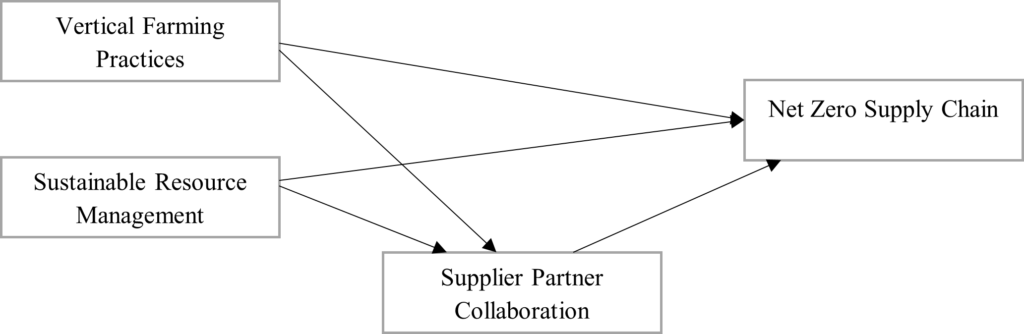
Fig. (1). Conceptual framework.
2.2. Literature Gap
Even with increased interest in sustainable agriculture and net-zero supply chains, few empirical studies directly address the contribution of VF to the attainment of NZSC results in practical contexts such as Aerofarms. Current research such as (Baumont de Oliveira et al., 2022; Gargaro et al., 2024; Sandison et al., 2023) mostly addresses LCA of VF with a focus on carbon output and energy usage. Yet, such environmental evaluations tend to miss organisational and relational enablers of sustainability, including supply partner collaboration. While other studies such as (Bag, 2024; and Yadav et al., 2023) emphasise the role of sustainable management of resources and the role of intangible resources and digital technologies in driving net-zero shifts, these findings’ integration into VF-based supply chains is rare. Also, the mediating effect of supplier collaboration between VF practices and NZSC goals remains to be empirically examined. This research bridges this essential research gap by integrating environmental and relational perspectives to examine VF’s efficacy in facilitating NZSC in Aerofarms.
3. Methodology
The study used a quantitative research method, which implies the empirical investigation of the role of VF in managing NZSC along with the mediation of supply partner collaboration. The study has collected the data using survey questionnaire based on 5-point Likert scale (Appendix A) distributed to the stakeholders associated with the VF in Aerofarms. The stakeholders included supply chain managers, farm operators, and logistic partners. Their selection was important due to their direct roles to implement sustainable practices, optimising resource use, and managing supply chain flows. The engagement of these participants ensures well-rounded understanding on how VF contributes to net zero goals and the mediation of supply partner collaboration. Their perspectives are important to evaluate the effectiveness of integration, coordination and innovation to attain sustainable supply chain at Aerofarms. The sampling was done using purposive sampling technique and hence the sample was considered by approaching participants that can help in addressing the research objectives.
The questionnaire survey (Appendix A) was distributed to approximately 600 participants out of which 403 participants filled the survey. Hence, the response rate of 67% was obtained. However, the data was further cleaned for the missing values where 11 values were removed, hence providing data for 392 sample. The data was further checked for the outliers based on the Z-score method as explained by (Yaro et al., 2023). The value of Z>3 was considered as outliers. 7 values were detected as outliers and hence were removed, providing final sample of 385 participants which were considered for further analysis.
However, the lower response rate (67%) and use of purposive sampling leads to non-response bias which needs to be addressed. The non-response bias was addressed in this study by analysing the statistical difference between the early and late respondents. The late respondents are indicated to be similar attributes to the non-respondents. Hence, this method is identified to be most effective in the study of (Gaia et al., 2024). Hence, this study has evaluated the statistical difference between early respondents (n1 = 30) and late respondents (n2 = 30) using the independent sample t-test. The results highlighted that the constructs such as VF (P-value > 0.1), NZSC (P-value > 0.1) and supply partner collaboration (P-value > 0.1) have statistically insignificant different between the early and late respondents. Hence, it is identified that the data is free from the non-response bias.
Furthermore, the common method bias is also one of the concerns when using similar method to measure both dependent and independent variable (Bozionelos & Simmering, 2022). The common method bias is detected and addressed using Harman’s single factor test, where exploratory factor analysis (EFA) is conducted to extract only a single factor and the total variance explained for that single factor that falls below 50% indicates that common method bias is not an issue with this study (Saxena et al., 2024). EFA conducted for this study items revealed total variance extracted for single factor to be less than 40%. It indicates that the issue of common method bias was not an issue in this study.
The data was then analysed using the PLS-SEM technique using SmartPLS. PLS-SEM involves two different stages which involve confirmatory factor analysis (CFA) for measurement model and path analysis for structural model. CFA involve factor loadings (FL), Cronbach alpha (CA), Composite Reliability (CR), Average Variance Extracted (AVE) and discriminant validity to measure the reliability and validity (Memon et al., 2021). Furthermore, the analysis involved structural model using path analysis to evaluate the hypotheses of the study.
4. RESULTS AND ANALYSIS
Table 1 shows the demographic characteristics of the survey respondents. Most respondents were male (79%), with females taking up 21%. The largest group of participants was between 31–35 years old (39%), followed by 26–30 years old (27%), showing a mostly young to mid-career population. Education-wise, most had postgraduate degrees (39%), followed by undergraduates (31%). Also, 27% held diplomas or certifications, and a smaller segment (3%) had doctoral-level credentials. This allocation indicates that the sample is fairly well educated and professionally qualified and so is capable of offering knowledgeable feedback on vertical farming and supply chain sustainability.
| Demographic Category | Category | Frequency | Percentage |
|---|---|---|---|
| Gender | Male | 304 | 79% |
| Female | 81 | 21% | |
| Age | Up to 25 | 54 | 14% |
| 26-30 | 104 | 27% | |
| 31-35 | 150 | 39% | |
| 36-40 | 58 | 15% | |
| 40+ | 19 | 5% | |
| Education | Undergraduate | 119 | 31% |
| Post-Graduate | 150 | 39% | |
| Doctoral | 12 | 3% | |
| Diploma/Certification | 104 | 27% |
Table 2 represents the measurement model to confirm the validity and reliability of the indicators and constructs. FL indicates the validity of indicators in measuring the constructs. The value of FL above 0.6 indicates the validity of the items (Hair et al., 2019). FL value above 0.6 for all the indicators as shown in Table 2 reflects that the items are valid and hence no indicator is required to be dropped. Furthermore, CA and CR are used to evaluate the reliability and internal consistency of the constructs. The value of CA and CR needs to be above 0.7 to confirm the reliability of the constructs (Chan & Lay, 2018). Table 2 shows that CA and CR for all constructs are above 0.7 and hence indicates that the constructs are reliable. Furthermore, AVE is used to evaluate the convergent validity. The value of above 0.5 shows that the constructs have convergent validity (Hair et al., 2019). The value of AVE for each construct is above 0.5, showing convergent validity of the constructs.
| Latent Constructs | Indicators | FL | CA | CR | AVE |
|---|---|---|---|---|---|
| Net zero supply chain management | NZSCM1 | 0.906 | 0.901 | 0.902 | 0.835 |
| NZSCM2 | 0.929 | ||||
| NZSCM3 | 0.907 | ||||
| Supplier Partner Collaboration | SPC1 | 0.895 | 0.883 | 0.888 | 0.811 |
| SPC2 | 0.930 | ||||
| SPC3 | 0.875 | ||||
| Sustainable Resource Management | SRM1 | 0.783 | 0.811 | 0.830 | 0.726 |
| SRM2 | 0.899 | ||||
| SRM3 | 0.869 | ||||
| Vertical Framing Practice | VFP1 | 0.879 | 0.851 | 0.853 | 0.771 |
| VFP2 | 0.902 | ||||
| VFP3 | 0.852 |
Table 3 shows discriminant validity. The discriminant validity indicates that the constructs are distinctively unrelated to each other and indicators of one construct do not measure another construct. The value must be below 0.85 (Rönkkö & Cho, 2022). The values for each construct in Table 3 is below 0.85 and hence confirms discriminant validity.
| Net Zero Supply Chain Management | Supplier Partner Collaboration | Sustainable Resource Management | |
|---|---|---|---|
| Supplier Partner Collaboration | 0.733 | ||
| Sustainable Resource Management | 0.467 | 0.550 | |
| Vertical Framing Practice | 0.614 | 0.718 | 0.620 |
Table 4 below shows the structural model. It shows that VF (B = 0.189, p-value = 0.002), have a significant and positive impact on NZSCM. Sustainable resource management (B = 0.200, p-value = 0.000) have a significant and positive impact on NZSCM. The indirect effect also shows that VF (B = 0.265, p-value = 0.000) have a significant and positive impact on NZSCM. Sustainable resource management (B = 0.101, p-value = 0.001) have a significant and positive impact on NZSCM. The mediating effect of supplier partner distribution (B = 0.101, p-value = 0.001) is significant and positive on the relationship between VF and NZSCM. Furthermore, supplier partner distribution (B= 0.265, p-value = 0.000) have a significant and positive mediating effect on the relationship between supplier resource management and NZSCM. It also shows that the mediation is partial for both variables and hence there is complexity in the relationship of these variables and hence there are other factors as well that needs to be incorporated to evaluate the full impact.
| Direct Effect | Path Coefficient | T Statistics | P Values |
|---|---|---|---|
| Supplier Partner Collaboration → Net zero supply chain management | 0.507*** | 8.759 | 0.000 |
| Sustainable Resource Management → Net zero supply chain management | 0.063 | 1.092 | 0.275 |
| Sustainable Resource Management → Supplier Partner Collaboration | 0.200*** | 3.664 | 0.000 |
| Vertical Framing Practice → Net zero supply chain management | 0.189** | 3.051 | 0.002 |
| Vertical Framing Practice → Supplier Partner Collaboration | 0.522*** | 10.638 | 0.000 |
| Specific Indirect Effect | |||
| Sustainable Resource Management → Supplier Partner Collaboration → Net zero supply chain management | 0.101** | 3.418 | 0.001 |
| Vertical Framing Practice → Supplier Partner Collaboration → Net zero supply chain management | 0.265*** | 6.347 | 0.000 |
Note: *** indicates significance at 1%, ** indicates significance at 5%, * indicates significance at 10%
Table 5 shows model explanatory power. NZSCM has the R-Square value of 0.459 or 45.9% showing that VF and sustainable resource management explains 45.9% variations in NZSCM. Supplier partner collaboration has R-Square value of 0.421 or 42.1% showing that VF and sustainable resource management explains 42.1% of the variation in NZSCM.
| R-Square | R-Square Adjusted | |
|---|---|---|
| Net zero supply chain management | 0.459 | 0.455 |
| Supplier Partner Collaboration | 0.421 | 0.418 |
5. Discussion
In accordance with the hypotheses proposed in this study, all have been accepted except for H2. The structural model results validate that VF practices and sustainable resource management positively impact attaining net-zero supply chain management (NZSCM) with the latter one having an indirect but positive effect through collaboration between supplier partners acting as a key mediating variable. In particular, VF has both direct and indirect effects through collaboration with suppliers that are stronger, pointing to the fact that partnerships complement the effectiveness of VF practices in environmental footprint reduction. Likewise, although SRM has a non-significant direct relationship with NZSCM, its indirect effect through collaboration is, indicating that collaboration is critical for bringing SRM practices to tangible sustainability impacts. The potential reasons behind an insignificant direct impact indicates lack of external integration and this may have been internally focused in the case of Aerofarms. Another reason could be complex structure of across the supply chain and UAE’s market which is still in the process to become mature in this context which the study of (Zarras et al., 2024) also acknowledged.
These findings are in line with previous literature. (Baumont de Oliveira et al., 2022; and Sandison et al., 2023) mentioned VF’s potential to reduce carbon when supplemented with renewable energy but pointed out that there was no supply chain integration. The present research bridges this gap by laying stress on the mediation role of partnership with suppliers. (Bag, 2024; and Alsofiani, 2024) also laid stress on organisational collaboration and culture in facilitating SRM for net-zero aspirations.
In the UAE setting, these findings are especially relevant. The UAE’s agriculture industry is subject to challenges of climate extremity, water deficiency, and import reliance, making VF a strategic innovation towards food security and carbon efficiency (Zarras et al., 2024). Yet, in view of its technologically driven nature, VF depends on high-tech suppliers in lighting, climate systems, and nutrient delivery. Therefore, collaboration is not merely important for operational excellence but also for aligning with sustainability. The partial mediation noted indicates that although supplier collaboration is central, additional contextual drivers such as government regulation, digital infrastructure, and policy incentives also likely play roles, necessitating broader systemic integration for maximum effect.
The research indicates that UAE policymakers must focus on enhancing supplier collaboration frameworks in the agricultural sector, especially for VF initiatives. Policies must encourage sustainable procurement, digitalisation, and knowledge-sharing platforms between supply chain partners. Education and promotion of renewable energy adoption by VF and training initiatives for sustainable practices can maximise net-zero performance. Regulatory frameworks must also encourage open carbon accounting and circular supply chain models. Public-private partnerships can enable innovation and scalability. These initiatives will not only support the UAE’s food security and sustainability objectives but also position the agricultural sector in line with national net-zero targets and international climate obligations.
Conclusion and Implications
This research concludes that VF and sustainable resource management make important contributions to NZSCM in the UAE, with supplier partner collaboration playing a key mediating role. Empirical results affirm that although VF exerts direct and indirect positive influences on NZSCM, sustainable resource management contributes only through supplier collaboration. This further emphasises the key importance of coordinated partnerships in connecting sustainable practices to tangible environmental impacts.
According to these results, organisational investment in well-developed supplier networks emphasising innovation, sustainability, and resource efficiency is suggested. Policymakers are encouraged to facilitate collaborative structures, encourage the introduction of renewable energy to VF, and offer incentives for sustainable supply chain practices. Future research could examine other mediators such as regulatory assistance and digital infrastructure to reflect the complete complexity of NZSCM in the UAE agricultural setting to ensure long-term environmental and economic sustainability.
LIMITATIONS AND FUTURE DIRECTION
This research has a number of limitations. To begin with, the study is restricted to data gathered from stakeholders that relate to Aerofarms in the UAE, which could limit the applicability of the findings to other locations or VF designs. Second, the research is mostly centred on certain crops and practices, which restricts its use to a broader set of agricultural commodities. The cross-sectional data also limit the determination of long-term sustainability implications or temporal changes.
Future research must involve longitudinal studies that could capture dynamic change and assess long-term impacts of collaboration and sustainability practices. Comparative studies among regions, crops, and farming systems would offer broader insights. An investigation of the role of regulatory, digital, and financial enablers could further deepen the understanding of NZSCM.
Policy Implications
The study conclusions carry valuable policy implications for the UAE agriculture and sustainability policies. Policymakers ought to craft focused frameworks supporting VF as a food security and environmental solution. A focus should be placed on encouraging VF operators and supply chain actors to collaborate through grants, tax relief, and public-private partnerships. This cooperation improves access to renewable energy technology, sustainable inputs, and best practices critical in the attainment of NZSCM. Policies need to incentivise investment in digital networks and resource-saving systems to maximise water, energy, and nutrient use. Policy instruments guiding carbon accounting, circular economy behaviours, and disclose-report mechanisms can further bring agricultural operations into conformity with national net-zero ambitions. In addition, incorporating sustainability education and capacity-building programs for stakeholders will create an environment of innovation and environmental stewardship. The foregoing policies in aggregate will facilitate a strong, scalable, and climate-resilient agri-food system in the UAE.
List of abbreviations
AVE | = | Average Variance Extracted |
CA | = | Cronbach Alpha |
CFA | = | Confirmatory Factor Analysis |
CR | = | Composite Reliability |
EFA | = | Exploratory Factor Analysis |
FL | = | Factor Loadings |
PBV | = | Practice-Based View |
NZSCM | = | Net-Zero Supply Chain Management |
SEM | = | Structural Equation Modelling |
AUTHORS' CONTRIBUTIONS
T.K.E. has contributed to study concept and design, data collection and data analysis. C.K.M. has contributed in writing the paper and results interpretation.
ETHICAL APPROVAL & INFORMED CONSENT
All procedures were carried out in accordance with institutional research ethics committee guidelines and Declaration of Helsinki. Informed consent was obtained from all participants. To ensure participant protection, all data were fully anonymized at the point of collection, and no personal or identifiable data was recorded.
Availability Of Data and Materials
The data will be made available on reasonable request by contacting the corresponding author [T.K.E.].
Funding
None.
Conflict Of Interest
The authors declare that there is no conflict of interest regarding the publication of this article.
Acknowledgements
Declared none.
DECLARATION OF AI
During the preparation of this work the authors used ChatGPT for editing purposes. After using this tool, the authors reviewed and edited the content as needed and take full responsibility for the content of the published article.
APPENDIX A: SURVEY QUESTIONNAIRE
1) Gender
- Male
- Female
- Up to 25
- 26-30
- 31-35
- 36-40
- 40+
- Undergraduate
- Postgraduate
- Doctoral
- Certification/Diploma
| Strongly Agree | Agree | Neutral | Disagree | Strongly Disagree | |
|---|---|---|---|---|---|
| Vertical Farming Practices (IV) | |||||
| Vertical farming can increase crop production | |||||
| There is a positive impact on the environment and the agriculture | |||||
| Aerofarms is effective in utilising its resources for vertical farming practices | |||||
| Sustainable resource management (IV) | |||||
| Aerofarms is implementing energy efficient practices for agriculture | |||||
| Sustainable nutrient management is being promoted and used in vertical farming | |||||
| Overall carbon footprint has been reduced through vertical farming | |||||
| Supplier partner collaboration (MV) | |||||
| Positive and strong association exists between Aerofarms and its supplier base | |||||
| Information and knowledge gap is not present with Aero Farm’s supplier base | |||||
| Collaborations are implemented in Aero Farm for its vertical farming practices | |||||
| Net-zero supply chain management (DV) | |||||
| Vertical farming is used to achieve through net-zero supply chain goals | |||||
| Supply chain practices are used to contribute towards reducing its carbon emissions | |||||
| Aerofarms is able to implemented environmentally conscious measures to improve sustainability in its supply chain |
References
Akintuyi, O. (2024). Vertical farming in urban environments: a review of architectural integration and food security. Open Access Research Journal of Biology and Pharmacy, 10(2), 114-126. DOI: 10.53022/oarjbp.2024.10.2.0017.
Alkhaldi, M., Moonesar, I. A., Issa, S. T., Ghach, W., Okasha, A., Albada, M., & Takshe, A. A. (2023). Analysis of the United Arab Emirates’ contribution to the sustainable development goals with a focus on global health and climate change. International Journal of Health Governance, 28(4), 357-367. https://doi.org/10.1108/IJHG-04-2023-0040.
Alsofiani, M. A. (2024). Digitalization in infrastructure construction projects: A PRISMA-based review of benefits and obstacles. arXiv preprint arXiv:2405.16875. https://doi.org/10.48550/arXiv.2405.16875
Avgoustaki, D. D., & Xydis, G. (2020). Indoor vertical farming in the urban nexus context: Business growth and resource savings. Sustainability, 12(5), 1965. DOI: 10.3390/su12051965.
Bag, S. (2024). From resources to sustainability: a practice-based view of net zero economy implementation in small and medium business-to-business firms. Benchmarking: An International Journal, 31(6), 1876-1894. https://doi.org/10.1108/BIJ-01-2023-0056.
Balasundram, S. K., Shamshiri, R. R., Sridhara, S., & Rizan, N. (2023). The role of digital agriculture in mitigating climate change and ensuring food security: an overview. Sustainability, 15(6), 5325. https://doi.org/10.3390/su15065325.
Baumont de Oliveira, F., Bannon, S., Evans, L., Anderson, L., Myers, P., & Thomas, J. M. (2022). Pathways to net-zero farming: A carbon footprint comparison of vertical versus traditional agriculture. International Horticultural Congres. DOI: 10.17660/ActaHortic.2023.1369.15.
Beacham, A. M., Vickers, L. H., & Monaghan, J. M. (2019). Vertical farming: a summary of approaches to growing skywards. The Journal of Horticultural Science and Biotechnology, 94(3), 277-283. DOI: 10.1080/14620316.2019.1574214.
Benke, K. &. Tomkins, B., (2017). Future food-production systems: vertical farming and controlled-environment agriculture. Sustainability: Science, Practice and Policy, 13(1), 13-26. DOI: 10.1080/15487733.2017.1394054.
Bozionelos, N., & Simmering, M. J. (2022). Methodological threat or myth? Evaluating the current state of evidence on common method variance in human resource management research. Human Resource Management Journal, 32(1), 194-215. https://doi.org/10.1111/1748-8583.12398.
Brower-Toland, B., Stevens, J. L., Ralston, L., Kosola, K., & Slewinski, T. L. (2024). A crucial role for technology in sustainable agriculture. ACS Agricultural Science & Technology, 4(3), 283-291. https://doi.org/10.1021/acsagscitech.3c00426.
Chan, S. H., & Lay, Y. F. (2018). Examining the reliability and validity of research instruments using partial least squares structural equation modeling (PLS-SEM). Journal of Baltic Science Education, 17(2), 239-251. https://www.ceeol.com/search/article-detail?id=966981.
Degefa, B. (2022). Food security in the UAE. In Facets of Security in the United Arab Emirates (pp. 88-98). Routledge. DOI: 10.4324/9781003025566-12.
Feng, Y., Gao, G., Wang, P., & Zhang, Z. (2024). Integrating stakeholder value network with strategic issue management for multi-stakeholder needs and requirements analysis of vertical farming systems. Agricultural Systems, 221, 104133. https://doi.org/10.1016/j.agsy.2024.104133.
Gaia, A., Brown, M., Adali, T., Fleetwood, S., & Lai, C. (2024). Response burden and survey participation: experimental evidence on the effect of interview length on non-response conversion. https://discovery.ucl.ac.uk/id/eprint/10205063/.
Gargaro, M., Hastings, A., Murphy, R. J., & Harris, Z. M. (2024). A cradle-to-customer life cycle assessment case study of UK vertical farming. Journal of cleaner production, 470, 143324. https://doi.org/10.1016/j.jclepro.2024.143324.
Gee, E. (2022). Vertical Farming Identity Statement. Available from AeroFarms: https://www.aerofarms.com/vertical-farming-identity-statement.
Hair, J. F., Risher, J. J., Sarstedt, M., & Ringle, C. M. (2019). When to use and how to report the results of PLS-SEM. European Business Review, 31(1), 2-24. https://doi.org/10.1108/EBR-11-2018-0203.
Hämäläinen, V. (2024). Supplier commitment for a long-term sustainable development: Gaining competitive advantage together with a sustainable supply chain. Osuva Open Science, 1-6. https://urn.fi/URN:NBN:fi-fe2024091773445.
Kalantari, F., Tahir, O. M., Joni, R. A., & Fatemi, E. (2018). Opportunities and challenges in sustainability of vertical farming: A review. Journal of Landscape Ecology, 11(1), 35-60, DOI:10.1515/jlecol-2017-0016.
Lubna, F. A., Lewus, D. C., Shelford, T. J., & Both, A. J. (2022). What you may not realize about vertical farming. Horticulturae, 8(4), 322. https://doi.org/10.3390/horticulturae8040322.
Memon, M. A., Ramayah, T., Cheah, J. H., Ting, H., Chuah, F., & Cham, T. H. (2021). PLS-SEM statistical programs: a review. Journal of Applied Structural Equation Modeling, 5(1), 1-14. DOI: 10.47263/JASEM.5(1)06.
Mir, M. S., Naikoo, N. B., Kanth, R. H., Bahar, F. A., Bhat, M. A., Nazir, A., & Ahngar, T. A. (2022). Vertical farming: The future of agriculture: A review. The Pharma Innovation Journal, 11(2), 1175-1195. https://www.researchgate.net/profile/Zakir-Amin/publication/358749034_Vertical_farming_The_future_of_agriculture_A_review/links/6213b0604be28e145ca7aab5/Vertical-farming-The-future-of-agriculture-A-review.pdf.
Mishra, R., Singh, R., & Govindan, K. (2023). Net-zero economy research in the field of supply chain management: a systematic literature review and future research agenda. The International Journal of Logistics Management, 34(5), 1352-1397. https://doi.org/10.1108/IJLM-01-2022-0016.
Naskali, A. T., Pinarer, O., & Tolga, A. C. (2022). Vertical farming: under climate change effect. Environment and Climate-Smart Food Production. Springer, Cham. 259-284. DOI: https://doi.org/10.1007/978-3-030-71571-7_8.
Perc, V.P.M., & Lukman, R.K. (2021). “A survey of the life cycle assessment of food supply chains.” Journal of Cleaner Production , 286, 125506. https://doi.org/10.1016/j.jclepro.2020.125506
Raj, M., Gupta, S., Chamola, V., Elhence, A., Garg, T., Atiquzzaman, M., & Niyato, D. (2021). A survey on the role of Internet of Things for adopting and promoting Agriculture 4.0. Journal of Network and Computer Applications, 187, 103107. https://doi.org/10.1016/j.jnca.2021.103107.
Rasanjali, W. M. C., Wimalachandra, R. D. M. K. K., Sivashankar, P., & Malkanthi, S. H. P. (2021). Impact of agricultural training on farmers’ technological knowledge and crop production in Bandarawela agricultural zone. Applied Economics & Business, 5(1), 37-50. DOI: 10.4038/aeb.v5i1.27
Rönkkö, M., & Cho, E. (2022). An updated guideline for assessing discriminant validity. Organizational Research Methods, 25(1), 6-14. https://doi.org/10.1177/1094428120968614.
Sandison, F., Yeluripati, J., & Stewart, D. (2023). Does green vertical farming offer a sustainable alternative to conventional methods of production? A case study from Scotland. Food and Energy Security, 12(2), e438. https://doi.org/10.1002/fes3.438.
Saxena, M., Bagga, T., Gupta, S., & Kaushik, N. (2024). Exploring common method variance in analytics research in the Indian context: A comparative study with known techniques. FIIB Business Review, 13(5), 553-569. https://doi.org/10.1177/23197145221099098.
Sharma, S., Singh, R. K., Mishra, R., & Subramanian, N. (2024). Developing climate neutrality among supply chain members in metal and mining industry: natural resource-based view perspective. The International Journal of Logistics Management, 35(3), 804-832. https://doi.org/10.1108/IJLM-03-2023-0108.
Singh, J., Pandey, K. K., Kumar, A., Naz, F., & Luthra, S. (2023). Drivers, barriers and practices of net zero economy: An exploratory knowledge-based supply chain multi-stakeholder perspective framework. Operations Management Research, 16(3), 1059-1090. https://doi.org/10.1007/s12063-022-00255-x.
Stanghellini, C., & Katzin, D. (2024). The dark side of lighting: a critical analysis of vertical farms’ environmental impact. Journal of Cleaner Production, 458, 142359. https://doi.org/10.1016/j.jclepro.2024.142359.
Xing, Y., & Wang, X. (2024). Precision agriculture and water conservation strategies for sustainable crop production in arid regions. Plants, 13(22), 3184. https://doi.org/10.3390/plants13223184.
Xu, D., Abbas, S., Rafique, K., & Ali, N. (2023). The race to net-zero emissions: can green technological innovation and environmental regulation be the potential pathway to net-zero emissions? Technology in Society. 75, 102364. DOI: https://doi.org/10.1016/j.techsoc.2023.102364.
Yadav, S., Samadhiya, A., Kumar, A., Majumdar, A., Garza-Reyes, J. A., & Luthra, S. (2023). Achieving the sustainable development goals through net zero emissions: Innovation-driven strategies for transitioning from incremental to radical lean, green and digital technologies. Resources, Conservation and Recycling, 197, 107094. https://doi.org/10.1016/j.resconrec.2023.107094.
Yaro, A. S., Maly, F., & Prazak, P. (2023). Outlier detection in time-series receive signal strength observation using Z-score method with S n scale estimator for indoor localization. Applied Sciences, 13(6), 3900. https://doi.org/10.3390/app13063900.
Zaręba, A., Krzemińska, A., & Kozik, R. (2021). Urban vertical farming as an example of nature-based solutions supporting a healthy society living in the urban environment. Resources, 10(11), 109. DOI:10.3390/resources10110109.
Zarras, I., Mastrogeorgiou, A., Machairas, K., Koutsoukis, K., & Papadopoulos, E. (2024). Vinymap: a Vineyard Inspection and 3D Reconstruction Framework for Agricultural Robots. In 2024 IEEE/RSJ International Conference on Intelligent Robots and Systems (IROS) (pp. 1812-1817). IEEE. DOI: 10.1109/IROS58592.2024.10801409.
Zhu, Q., Kouhizadeh, M., & Sarkis, J. (2022). Formalising product deletion across the supply chain: blockchain technology as a relational governance mechanism. International Journal of Production Research, 60(1), 92-110. https://doi.org/10.1080/00207543.2021.1987552
Licensed
© 2025 Copyright by the Authors.
Licensed as an open access article using a CC BY 4.0 license.
Article Contents Author Felicia Gabriela Beresescu1, * 1College of Business-Al Khobar, Al Yamamah University, Saudi Arabia Article History:
Article Contents Authors Saman Ismail1, * Imran Iqbal2 1Faculty of Management Science, Department of Business Administration, Salim Habib University, Karachi,
Article Contents Author Michael Dolinsky1, * 1Faculty of Mathematics and Technologies of Programming, Francisk Skorina Gomel State University,
Article Contents Author Abdul Ghafoor Memon1, * 1Emaan Institute of Management Sciences, Karachi, Pakistan Article History: Received: 01 April, 2026
Article Contents Authors Zixuan Zhao1, Ju Guo1, * 1School of Management, Chengdu University of Information Technology, Chengdu, China Article History:
Article Contents Authors Sultan Ud Din Yousufzai1, Amtyaz Safi2, * , Maher Khan1, Zia Ud Din1 1Department of Zoology, Govt.