












Article Contents
Article ID: CM2501112006
Views: 10501The Impact of AI-Powered Personalisation on Consumer Trust and Purchase Intention: A Cross-Cultural Comparative Study of Gen Z Consumers in the United Kingdom and Pakistan
 DOI:
DOI:
 PDF
PDF
⬇ Downloads: 304
Sarwar, M.S., & Malik, M. (2025). The impact of AI-powered personalisation on consumer trust and purchase intention: A cross-cultural comparative study of gen Z consumers in the United Kingdom and Pakistan. Majestic Global Trends in Marketing & Supply Chain Management, 1, 1–14. https://doi.org/10.65080/mgtmscm.v1i1.4
Sarwar, Muhammad Arslan., and Malik Maria. 2025. “The impact of AI-powered personalisation on consumer trust and purchase intention: A cross-cultural comparative study of gen Z consumers in the United Kingdom and Pakistan.” Majestic Global Trends in Marketing & Supply Chain Management 1: 1–14. https://doi.org/10.65080/mgtmscm.v1i1.4
Sarwar, M.S. and Malik, M., 2025. The impact of AI-powered personalisation on consumer trust and purchase intention: A cross-cultural comparative study of gen Z consumers in the United Kingdom and Pakistan. Majestic Global Trends in Marketing & Supply Chain Management, 1, pp.1–14. Available at: https://doi.org/10.65080/mgtmscm.v1i1.4
Sarwar MS, Malik M. The impact of AI-powered personalisation on consumer trust and purchase intention: A cross-cultural comparative study of gen Z consumers in the United Kingdom and Pakistan. Maj Glob Trends Mark Supply Chain Manag. 2025 Dec 26;1:1–14. doi:10.65080/mgtmscm.v1i1.4
1Department of Management Sciences, University of Gujrat, Gujrat, Pakistan;
2Department of Statistics, COMSATS University Islamabad, Islamabad, Pakistan
Received: 23 September, 2025
Accepted: 24 December, 2025
Revised: 24 December, 2025
Published: 26 December, 2025
ABSTRACT:
Introduction: Artificial Intelligence (AI) has revolutionised e-commerce and digital marketing by allowing personalised consumer experiences, significantly enhancing engagement and satisfaction. The study investigated the impact of AI-powered preconisation on consumer trust and purchase intention among Gen Z consumers in the UK and Pakistan.
Methodology: Data was gathered through a survey of 376 Gen-Z consumers in both countries. The survey quantified AI-based personalisation, consumer trust, and purchase intention by using a 5-point Likert scale. Partial Least Squares Structural Equation Modelling (PLS-SEM) was adopted to evaluate the relationships and path coefficients using the data.
Results: The findings revealed that AI-based personalisation strongly affects consumer trust (β = 0.497, p = 0.000) and purchase intention (β = 0.693, p = 0.000). The study did not establish any moderating effect of country of origin on these relationships (p > 0.05). The results showed that AI personalisation influences the behaviour of consumers, irrespective of cultures, especially Gen Z consumers who are digitally literate.
Conclusion: The insights of the results support the necessity to incorporate AI in online advertising to enhance consumer trust and loyalty, and determine the ethical applications of AI to privacy issues.
Keywords: AI-powered personalisation, consumer trust, purchase intention, Gen Z, cross-cultural, comparative study.
1. INTRODUCTION
Artificial intelligence (AI) has disrupted the digital world, particularly within the e-commerce and marketing fields, but with AI-supported personalisation, it is possible to meet unique consumer demands (Ingriana & Rolando, 2025; Vashishth et al., 2024). (Wolniak & Grebski, 2023) argue that machine learning models and predictive models, as well as data analytics tools, enable businesses to deliver personalised experiences and recommendations and dynamic presented content which can appeal to consumer groups. AI-Powered Personalisation is the use of artificial intelligent technologies to process consumer data, consumer preferences, and consumer behaviour patterns to provide personalized content, product suggestions, and marketing messages in real time. (Thirupathi et al., 2024) stated that AI personalisation revolution drives customer engagement, satisfaction, and loyalty building a more appealing shopping experience. The use of AI in marketing has permitted brands to anticipate customer attitudes and tastes with astounding precision, which has boosted an extent of tailoring that could not have been achieved previously (Sarin, 2025). An AI-powered global e-commerce market has been estimated to reach $8.65 billion by 2025 and is projected to rise to $22.6 billion by 2032, with an estimated Compounding Annual Rate of Growth (CAGR) of 14.6% (Bholane, 2025). It is due to the rise of machine learning, data analytics, and consumer behaviour model results allowing firms to offer enhanced custom shopping experiences to consumers, boosting customer engagement and satisfaction.
Moreover, AI-driven personalised digital advertising has received an enormous boost, particularly within the e-commerce sector, where businesses are becoming the slaves of capturing attention of their consumers in a crowded and competitive market place (Agarwal, 2024; Ziakis & Vlachopoulou, 2023). AI technologies allow advertisers to develop optimal message delivery, fully immerse users in their experiences, and ultimately trigger purchase intentions (Gao et al., 2023). Nevertheless, AI-based personalisation impacts on purchasing intention and consumer trust are significant to future academic research. According to (Sipos, 2025), AI allows companies to better satisfy customers and introduces concerns about privacy, data protection, and biases in algorithms used by consumers in their trust of AI-driven systems. (Lăzăroiu et al., 2020) states that, trust is an essential purchase intention factor in an online environment as customers may appeal to platforms and make more purchases when they know that their data will not be manipulated. Gen Z is the most digitally connected and tech-savvy generations, and it is a valuable population segment to understand how personalisation enabled by AI works.
The personalised e-commerce and marketing through AI has altered the way businesses are engaged to consumers (Bhardwaj et al., 2024; Edberg, 2025). However, the effect of AI-driven personalisation, consumer trust, and intention to purchase is underrepresented, especially in various cultures. Although (Aldboush & Ferdous, 2023) found that AI can help improve customer experience through personalised recommendations, privacy, data security, and algorithmic biases issues have been described, and they might affect trust. Trust in consumer behaviour is important because it directly influences purchase intention in digital settings. The study attempts to fill the knowledge niche of cultural moderation of the relationship linking AI-driven personalisation, trust, and purchase intention towards the Gen Z consumer segment in two different cultural contexts, the United Kingdom and Pakistan. The context of the United Kingdom as an advanced technological society is juxtaposed with the emerging Pakistani digital marketplace, providing a rare opportunity to investigate how the differences in apparent cultural dimensions of trust and purchase intention are influenced through the lens of AI-led personalisation efforts. Therefore, the study aims to examine the impact of AI-powered personalisation on consumer trust and purchase intention among Gen Z consumers in the UK and Pakistan. It analyses the relationship between AI-driven personalisation and consumer trust across cultural contexts. It further examines how consumer trust in AI-powered personalisation impacts their purchase intention among Gen Z consumers in the UK and Pakistan.
The relevance of this study is that it can augment knowledge about how personalisation through AI influences consumer behaviour in different cultures, particularly the Gen Z consumer. This consumer group is highly impactful when it comes to shaping the future of e-commerce, and their attitudes toward personalisation can be very enlightening for business owners aiming to enhance customer interaction. By contrasting the United Kingdom and Pakistan, this study addresses the worldwide and cross-cultural scope of digital marketing strategies crucial for multinational brands to excel in overseas markets. Moreover, the research outcome will highlight how trust plays a role in digital channels and add practical implications for companies competing to build consumer loyalty as the market becomes increasingly AI-driven. This study is particularly timely in 2025 due to the accelerated adoption of AI solutions across worldwide e-commerce and the ongoing digitalisation of customer trends. The AI industry has seen extremely rapid development over the past couple of years, and business entities worldwide are trying to adopt AI-based personalisation techniques to become competitive (Achumie et al., 2022). With Gen Z being an emerging and powerful consumer group, it is important to examine their reaction to these technologies, particularly in a year where e-commerce and digital marketing are projected to become even more central to business success.
The results of this research inform practical use and academic understanding and offer prescriptive guidance for businesses wishing to optimise their AI-driven marketing strategies. The study contributes substantially to various settings. Theoretically, it adds to the knowledge of the effect of AI-assisted personalisation on trust and intention to purchase, especially in the online environment. Empirically, it will provide significant cross-cultural data comparing the UK and Pakistan, adding to the global digital marketing literature, thus emphasising the difference in culture in customer behaviour. In practice, this work offers a viable plan that businesses can use to balance personal experiences and trust-building efforts to engage and retain customers. This study proposes the ethical creation and responsible use of AI in marketing, whereby the personalisation of the AI must meet consumer confidence and privacy considerations.
2. LITERATURE REVIEW
2.1. Theoretical Framework
Fig. (1) Technology Acceptance Model (TAM) explains the effect of AI based Personalisation on consumer trust and purchase intention, especially when there are cross-cultural variations. The model is an information system that explains how to encourage users to accept and utilise new technology. Within the concept of AI-driven personalisation, TAM can be modified to describe the response of Gen Z consumers in the United Kingdom and Pakistan to personalised marketing. (Winarto & Wisesa, 2024) prove that effectiveness in improving user experience directly determine perceived usefulness, which overall increases purchase intentions. Similarly, (Jayasingh et al., 2025) also mention the role of the credibility of AI influencers in facilitating trust and adoption, similar to what TAM covers regarding perceived usefulness and perceptions of low effort. Country of origin as a moderator factor also has a place in TAM since country interviewers have different views and perceptions on trust and relevance and privacy issues, as explained by (Nugraha et al., 2024).
Moreover, The Unified Theory of Acceptance and Use of Technology 2 (UTAUT2) is utilised as it builds on the foundation of the first TAM by adding more aspects to it, including hedonic motivation, price value and habit. These are essential in explaining how the consumers especially the Gen Z interact with AI-based personalized experiences in e-commerce. As per (Guo & Zhang, 2024) The UTAUT2 deals with emotional and habitual elements of technology acceptance in addition to perceived usefulness and ease of use, which are specifically pertinent in case of personalised shopping experience (Thirupathi et al., 2024). An example is hedonic motivation, which explains why an individual may enjoy receiving personalised AI recommendations affecting the intended behavior to purchase it. In addition, price value and habit are also significant in comprehending how consumers remain to use AI Personalisation as a result of its perceived value and convenience (Vashishth et al., 2024).
As far as cross-cultural differences are concerned, it is crucial to associate the differences between countries with the cultural values in terms of such frameworks as Hofstede cultural dimensions. According to (Jan et al., 2024), the framework by Hofstede provides an understanding of why cultural variables, including individualism and collectivism and uncertainty avoidance, affect consumer behaviour and trust in AI systems. In the present research, cultural differences between the UK and Pakistan may be analysed based on the dimensions offered by Hofstede, as it allowing for a profound insight into the role that AI Personalisation plays in fostering trust and purchase intention in the cultural backgrounds of both countries (Sipos, 2025). This strategy helps in conducting more detailed research on the impact of AI Personalisation on consumer behavior in the world market.
2.2. Hypotheses Development
The existing body of literature on AI-enabled personalisation demonstrates important insights into its influence on consumer confidence and consumer behaviours. (Nath, 2025) demonstrates that personalisation awareness and privacy concerns based on AI favorably affect consumer trust and purchase in India, where satisfaction with personalised experiences does not directly cause a purchase. (OHiggins & Fatorachian, 2025) emphasise that transparency and ethical AI governance are critical factors to cultivate trust, and while personalised experiences can increase engagement, the issue of privacy is one of the factors that continues to pose challenges to the personal care industry in the UK and Ireland. Similarly, (Matta, 2025) reveals that the effectiveness of marketing due to AI-powered personalisation increases consumer/customer engagement, but highlights the drop in world trust in AI from 54% of all people in 2024 to 62% percent in 2019, which shows that Gen Z consumers tend to be more sceptical about it. According to the research by (Falah & Alghaswyneh, 2025), AI Personalisation and consumer engagement are positively linked, and the importance of such aspects as data privacy and transparency is essential to the ethical aspects of TAM, which revolves around perceived usefulness and trust. On the same note, (Teepapal, 2024) demonstrates that trust and perceived usefulness play the medating role but privacy issues give rise to the effectiveness of AI Personalisation in social media, indicating that TAM is limited on its efficacy in meeting privacy and ethical issues. The results indicate that although TAM describes the effect of general acceptance, it should be extended to include such ethical aspects to describe the full extent of consumer interaction with AI Personalisation. Although such studies provide valuable insights, they lack the reassurance in cases when consumer trust is not consistent in varying settings and especially miss out on the effectiveness of cultural factors as a norm-moderating variable and the investigation of behavioural changes over a long period. The following hypothesis is proposed based on the above analysis:
H1: AI-powered personalisation positively impacts consumer trust.
The current body of literature shows key insights about the impact of AI-driven personalisation on the purchase intention of Gen Z customers. (Bunea et al., 2024) demonstrated that the perceived usefulness and ease-of-use mediated exposure to AI, usage, and knowledge in influencing the purchase intentions of Gen Z based on the Technology Acceptance Model (TAM). Their study is, however, a cross-sectional study that limits their capacity to understand long-term effects. (Clark, 2025) went further to look at the use of AI-powered adverts, where it was revealed that the effectiveness of AI on the trust and attitudes of Gen Z is hugely influential in their buying behaviour. However, the research fails to take into consideration the varieties of AI applications, e.g., personalised advertisements and recommendations. This is confirmed by (Chandrakumar, 2024), who emphasises that customised experiences enhance customer satisfaction and buying intentions, but she does not go further in exploring the psychological factors beyond satisfaction, which include cognitive biases. (Sharma et al., 2025) concluded that personalisation and trust had a positive effect on the purchase intention, and perceived intrusiveness acted as a negative mediator. This presents a new factor between them, but their brief attention on intrusiveness does not acknowledge the possibility of privacy concerns. (Mohamed & Unsalan, 2025) addressed the issues of brand loyalty and repurchase intentions and observed the indirect effects of brand image on brand loyalty based on AI marketing. Following hypothesis is proposed based on the above analysis.
H2: AI-powered personalisation positively influences purchase intention among Gen Z consumers in the United Kingdom and Pakistan.
Studies on AI-based personalisation and connection with consumer trust and country of origin present key insights. (An & Ngo, 2025) examine the potential of perceived relevance, trust, and usefulness towards AI-based personalised advertising in Vietnam and confirm that trust is acquired by perceived value as opposed to just personalisation. The research is, however, limited by failing to consider cross-country differences in consumer trust; thus, it cannot be applied in different endeavours. (Theocharis et al., 2025a) focus on the influence of the location-based variables on Gen Z’s online purchase behaviour of new technology goods, with an emphasis on the role that domestic or foreign e-stores play in affecting consumer choice. Insightful as it is, the study does not factor in the possible interaction between personalisation powered by artificial intelligence and consumer trust in various cultural settings. (Zungu et al., 2025) address the importance of self-service based on AI in banking, addressing customer experience and trust, but does not reflect on the moderating variables such as geographic location or socio-economic status which may affect trust in AI in various countries. (Venugopal & Prakash 2025) addresses the effects of digital marketing on consumer behaviour in the dairy products sector however, it ignores the aspect of AI personalisation as one of the most influential forces that determine the determination of trust and repurchase. TAM (Technology Acceptance Model) is mostly based on perceptions of the usefulness and ease of use, yet it does not consider external factors like culture and socio-economic factors that can play a significant role in consumer trust in the use of AI systems. In order to fully determine the varied factors that affect consumer behavior, TAM will be better off integrating the following contextual factors since they play a significant role in the cross-cultural aspects of AI adoption. Though the issue of branding influence on Gen Z desire to buy technological products is examined in (Theocharis et al., 2025b), the study lacks the use of AI-based personalisation as a factor that mediates the relationship between brand image and consumer trust.
H3: Country of origin moderates the relationship between AI-powered personalisation and consumer trust among Gen Z consumers.
Literature on the moderating influence of country of origin on AI-powered personalisation and the intention to purchase has some important findings to offer, but also features certain limitations. A study by (Winarto & Wisesa, 2024) investigates AI influences on the purchase intentions of Gen Z in Indonesia, with a particular emphasis on the improvement of hedonic value brought by personalised interaction with AI and the rising popularity of sustainability. The research study is also restricted because the authors consider only one of these markets and do not investigate the cross-cultural differences in consumer behaviour. (Jayasingh et al., 2025; and Nugraha et al., 2024) emphasise the role of such factors as the credibility of the AI influencer and country image, but they do not take into account the factor of cultural differences, which play a crucial role in consumer behavior. The cultural values that could affect consumer trust in AI Personalisation and purchase intentions are individualism versus collectivism or power distance according to Hofstede cultural dimensions (2001). This implies that TAM might not be adequate as it fails to deal with such cultural factors. (Guo & Zhang, 2024) underline the importance of TAM in the prediction of a purchase intention in a digital setting, and Hofstede framework (Jan et al., 2024) helps to raise awareness of the fact that technology acceptance depends on the national culture, and a more culturally specific model is required to explain AI adoption in various regions. A study by (Phuong & Dat, 2017) examines the effects of country-of-origin on consumer purchase intentions in Vietnam, with no inclusion or addition of AI as a moderating element, which restricts its use in the digital era.
H4: Country of origin moderates the relationship between AI-powered personalisation and purchase intention among Gen Z consumers.
2.3. Conceptual Framework
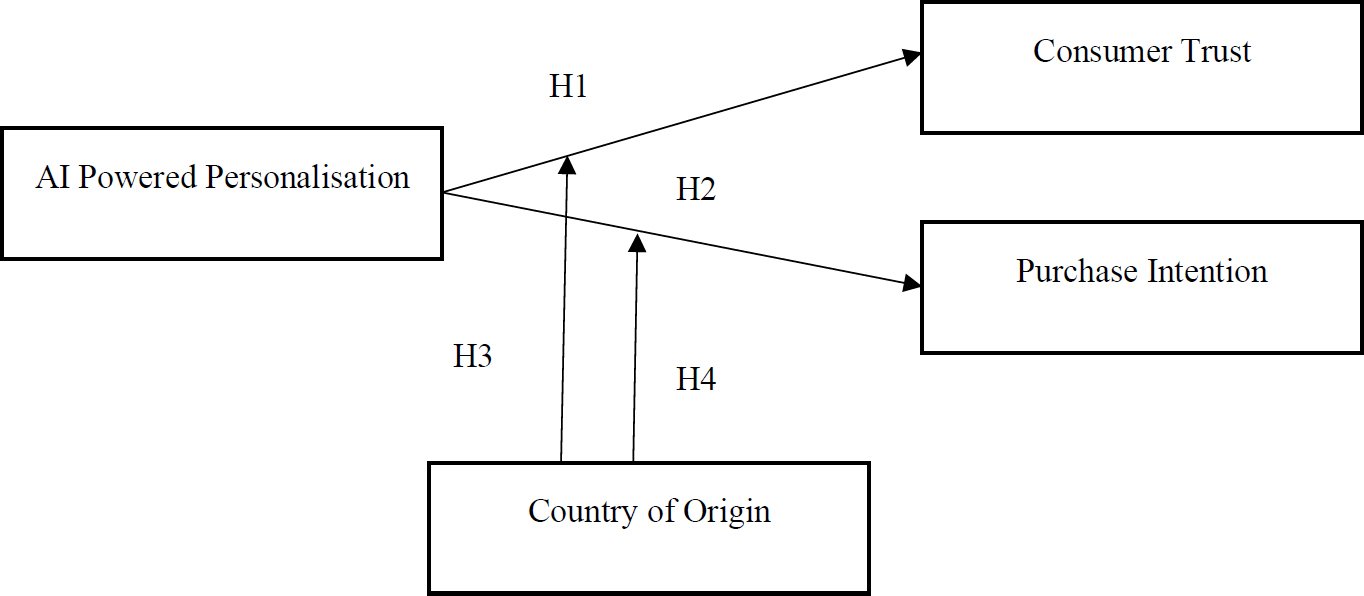
Fig. (1). Conceptual framework.
3. METHODOLOGY
3.1. Data Collection and Sample Size
The study uses a quantitative research method and survey-based approach to investigate the impact of AI-driven personalisation on consumer purchase intention and trust among Gen Z consumers in the UK and Pakistan. The data was collected in the form of the online survey that was sent to the respondents using multiple online platforms, including WhatsApp, email, and social media. These media were chosen to be inclusive to as many people as possible in the urban boundaries and rural boundaries of the United Kingdom and Pakistan so that the sample is diversified across various geographical locations. The survey were conducted within four weeks and this time was enough to give the respondents time to go through the questionnaire at their convenience Appendix A. The voluntary aspect of the participation was highlighted in the introduction of the survey and all the participants were also given clear guidelines on completing the survey. In addition, the participants were also made aware that they were free to participate in the study since this was completely voluntary and they were able to pull out of the study at any time without being reprimanded on the same.
The survey was made in a number of response formats such as reverse-scored items to guarantee the trustworthiness of the information to overcome response bias. Furthermore, the privacy of the respondents was assured by ensuring that the respondents were anonymous so that their privacy would be ensured and their confidentiality would be preserved during the research. The sample of the respondents was selected on the basis of purposive sampling; the method was quite suitable to the nature of the study since it was necessary to make sure that participants possessed appropriate knowledge and experience in the domain of the AI-based personalisation and online shopping. This sampling approach contributed to a greater validity of the sample as it was narrowed down to people who were conversant with the nature of the study based on consumer behavior in the digital context (Campbell et al., 2020).
3.2. Data Analysis
Data was analysed with the SmartPLS software, which utilises PLS-SEM, which is suitable in small samples and the measurement of complex relationships between latent constructs (Hair et al., 2019; Becker et al., 2023). However, to adequately measure the variations between the UK and Pakistan, Multigroup Analysis (MGA) concerning PLS-SEM is to be applied in measuring cultural variance, as mentioned in the title of the study. The argument of a balanced urban vs rural sample is not proved and the procedure fails to adequately deal with the Common Method Bias (CMV) that must be dealt with because of methods such as Harman single factor test. Constructs of measurement (AI-PP1 and CT1) are not described, operationalised, and referenced appropriately. Also, the Country-of-Origin variable must be explained as a dummy variable, latent variable or a categorical variable before it can be included in the model.
4. RESULTS
4.1. Demographics
The demographic data of the 376 participants indicates that there is a balanced performance of the nation and gender. 62.5% (235) of the respondents showed a key skew towards male participants Table 1. The sample size of 18-25-year-olds was 100%, which connected with the focus of the current research on the Gen Z consumers. On the other hand, country representation recorded a balanced representation with the UK and Pakistan representing half of the entire sample 50%. This even distribution allows a comparative study of the influence of the AI-powered personalisation on consumer trust and intention to buy in different cultural settings. The findings give a concise idea of the participant profile of the study, as diversity between genders and geography is established, and one particular target population was Gen Z.
Table 1. Demographics.
| Demographic Variable | Category | Frequency | Percentage (%) |
| Gender | Male | 235 | 62.5 |
| Female | 141 | 37.5 | |
| Country | United Kingdom | 188 | 50.0 |
| Pakistan | 188 | 50.0 | |
| Total Participants | 376 | 100 |
4.2. Measurement Model using Confirmatory Factor Analysis
Cronbach’s alpha and composite reliability are critical for assessing the internal consistency of the constructs, as they indicate how consistently the items measure the underlying construct. According to (Haji-Othman & Yusuff, 2022; Cheung et al., 2024), a Cronbach alpha and composite reliability value of more than 0.7 indicate sufficient reliability, and the values provided in the table surpass those figures.
The table below shows Cronbach Alpha, Composite Reliability (CR) and Average Variance Extracted (AVE) demonstrating the validity and reliability of the constructs in the Pakistani sample. Table 2 depicts that AI-Powered Personalisation has a high Cronbach’s Alpha of 0.868 and Composite Reliability of 0.871 and this is a strong indicator of high internal consistency and reliability. The value of AVE of AI-Powered Personalisation is 0.791, much above the acceptable level of 0.50, and this implies excellent convergent validity. In the case of Consumer Trust, the Cronbach Alpha is 0.839 and Composite Reliability is 0.871 which is satisfactory reliability. The AVE of Consumer Trust is 0.754 which is acceptable convergent validity. Likewise, Purchase Intention demonstrates Cronbach Alpha of 0.873 and Composites Reliability of 0.884 as additional evidence of the reliability of the construct. The AVE value of Purchase Intention is 0.797 and this implies that the construct satisfies the qualities of convergence validity. These findings suggest that the AI-Powered Personalisation, Consumer Trust, and Purchase Intention constructs have high reliability and valid measure in the Pakistani setting.
Table 2. Construct validity and reliability (Pakistan).
| Latent Constructs | Indicators | Factor Loadings | Cronbach’s Alpha | Composite Reliability | Average Variance Extracted (AVE) |
| AI-Powered Personalisation | AI-PP1 | 0.895 | 0.868 | 0.871 | 0.791 |
| AI-PP2 | 0.914 | ||||
| AI-PP3 | 0.858 | ||||
| Consumer Trust | CT1 | 0.811 | 0.839 | 0.871 | 0.754 |
| CT2 | 0.906 | ||||
| CT3 | 0.885 | ||||
| Purchase Intention | PI1 | 0.893 | 0.873 | 0.884 | 0.797 |
| PI2 | 0.938 | ||||
| PI3 | 0.845 |
Table 3 shows data for the United Kingdom as all constructs show good internal consistency as indicated by the Cronbach’s Alpha. In particular, the Cronbach’s Alpha of AI-Powered Personalisation is 0.830 and its Composite Reliability is also 0.830, which indicates good reliability. The AVE of this construct is 0.746 which in itself supports sufficient convergent validity. Similarly, Consumer Trust has Cronbach Alpha of 0.784 and Composite Reliability of 0.794 which both depict the strong reliability of the construct. The AVE of Consumer Trust equals 0.700 and this also meets the requirement of convergent validity. The Cronbach’s Alpha of 0.893 and Composite Reliability of 0.907 of Purchase Intention in the UK are high reliability factors. The AVE of Purchase Intention is 0.823 which is over the minimum requirement of the convergent validity. These results indicate that the constructs are clear and reflect reliable constant measurement as relates to the UK sample.
Table 3. Construct validity and reliability (United Kingdom).
| Latent Constructs | Indicators | Factor Loadings | Cronbach’s Alpha | Composite Reliability | Average Variance Extracted (AVE) |
| AI-Powered Personalisation | AI-PP1 | 0.895 | 0.830 | 0.830 | 0.746 |
| AI-PP2 | 0.914 | ||||
| AI-PP3 | 0.858 | ||||
| Consumer Trust | CT1 | 0.811 | 0.784 | 0.794 | 0.700 |
| CT2 | 0.906 | ||||
| CT3 | 0.885 | ||||
| Purchase Intention | PI1 | 0.893 | 0.893 | 0.907 | 0.823 |
| PI2 | 0.938 | ||||
| PI3 | 0.845 |
Table 4 shows the findings of the combination of the data of both the UK and Pakistan samples, the Cronbach Alpha of the AI-Powered Personalisation construct is 0.852 and the Composite Reliability is 0.853, indicating a high internal consistency in both regions. The AVE of AI-Powered Personalisation is 0.772 that is below the required convergent validity level. In the case of Consumer Trust, Cronbach Alpha scores are 0.815 and Composite Reliability = 0.834 which represent great reliability. Consumer Trust AVE stands at 0.729, which means that convergent validity is satisfactory. Purchase Intention has a Cronbach Alpha of 0.881 and Composite Reliability of 0.895 which are both signs of great reliability. The AVE of Purchase Intention is 0.808 which proves convergent validity. The general findings reveal that the constructs employed in measuring AI-Powered Personalisation, Consumer Trust and Purchase Intention are reliable and valid which assists the validity of the measurement model in both UK and Pakistan cultural settings.
Table 4. Construct validity and reliability (Overall).
| Latent Constructs | Indicators | Factor Loadings | Cronbach’s Alpha | Composite Reliability | Average Variance Extracted (AVE) |
| AI-Powered Personalisation | AI-PP1 | 0.895 | 0.852 | 0.853 | 0.772 |
| AI-PP2 | 0.914 | ||||
| AI-PP3 | 0.858 | ||||
| Consumer Trust | CT1 | 0.811 | 0.815 | 0.834 | 0.729 |
| CT2 | 0.906 | ||||
| CT3 | 0.885 | ||||
| Purchase Intention | PI1 | 0.893 | 0.881 | 0.895 | 0.808 |
| PI2 | 0.938 | ||||
| PI3 | 0.845 |
As noted in Table 5, the construct discriminant validity in the study was examined employing Heterotrait- Monotrait (HTMT) ratio as one of the most important measures pertaining to confirming that the constructs are empirically disparate and no multicollinearity exists between them (Rasoolimanesh, 2022). (Rönkkö & Cho, 2022) have proposed that the values of HTMT estimate should be less than 0.85 to establish acceptable discrimination validity, and these values in Table 5 are comfortably below this value. An example is that the relationship between AI-Powered Personalisation and consumer trust is 0.635 that is a moderate relationship but not above 0.85 justifying distinctiveness of these two constructs. The relationship between AI-Powered Personalisation and Purchase Intention (0.722) and between Consumer Trust and Purchase Intention (0.569) supporting that the constructs do not overlap excessively.
Table 5. Discriminant validity.
| HTMT | |
| AI Powered Personalisation <-> Purchase Intention | 0.722 |
| AI Powered Personalisation <-> Consumer Trust | 0.635 |
| Purchase Intention <-> Consumer Trust | 0.569 |
Path coefficient shows interesting connections among the constructs of the study. AI-Powered Personalisation has a statistically significant and strong positive impact on Consumer Trust (β = 0.497, p = 0.000) and Purchase Intention (β = 0.693, p = 0.000). These findings show that the more people are exposed to AI-powered, personalised material, the greater the consumer trust and the desire to buy. The 0.000 p-values for both associations affirm strong statistical significance, pointing out the influential role of AI personalisation in consumer confidence building and purchasing inclination. As (Chinnaraju, 2025) contend, such significant and high path coefficients form a solid rationale for testing and justifying mediation analysis in PLS-SEM models. These findings suggest that AI-based personalisation is a strong driver that has direct impacts on trust and on buying intention and thus represents a key strategic element for companies that want to optimise customer engagement and sales.
On the other hand, Country of Origin relationships are weaker in their contribution to consumer trust and purchase intention. The path coefficients from Country of Origin to Consumer Trust (β = 0.143, p = 0.083) and Country of Origin to Purchase Intention (β = 0.057, p = 0.451) are both weak and not statistically significant, with p-values higher than the cut-off value of 0.05. This would suggest that Country of Origin has little or no direct effect on consumer trust or buying behaviour within this study. Furthermore, the moderating effect of Country-of-Origin x AI-Powered Personalisation on Consumer Trust (β = 0.072, p = 0.446) and Purchase Intention (β = -0.101, p = 0.277) is not statistically significant either, confirming the notion that Country of Origin does not exert any statistically significant moderating effect on the effect of AI Personalisation on the aforementioned outcomes.
4.3. MICOM
Table 6 presents the analysis of measurement invariance between the groups using MICOM analysis. In the case of AI-Powered Personalisation, Step 2 has a permutation p-value of 0.707, which is the Partial measurement invariance, and the Full Measurement Invariance is not attained because the variance difference p-value of 0.037 is not significant. In the case of Consumer Trust step 2, the permutation p-value is 0.413, meaning that there is partial invariance, Full Measurement Invariance occurs, because the difference in variance p-value of 0.306 indicates that there is no significant difference between the groups. Equally, in the case of Purchase Intention, the permutation p-value of 0.787 in Step 2 implies Partial Measurement Invariance and Full Measurement Invariance is also established with a p-value of 0.787. The implication of these results is that Consumer Trust and Purchase Intention have measurement invariance across the groups but AI-Powered Personalisation does not have full invariance implying that there are slight changes within the groups.
Table 6. MICOM.
| Construct | Step 2: C = 1 | 5.00% | Permutation p-value | Partial Measurement Invariance | Step 3a: Mean Difference | 95% Confidence Interval | Permutation p-value | Step 3b: Variance Difference | Permutation p-value | Full Measurement Invariance |
| AI Powered Personalisation | 1 | 0.999 | 0.707 | YES | 0.091 | (-0.182, 0.188) | 0.348 | -0.301 | 0.037 | NO |
| Consumer Trust | 1 | 0.995 | 0.413 | YES | -0.094 | (-0.203, 0.192) | 0.342 | -0.144 | 0.306 | YES |
| Purchase Intention | 1 | 0.998 | 0.787 | YES | 0.002 | (-0.190, 0.196) | 0.987 | -0.047 | 0.787 | YES |
4.4. Path Analysis
Table 7 shows the results of the Pakistani sample show that AI-Powered Personalisation affected Consumer Trust significantly (β = 0.592, p = 0.000). This implies that artificial intelligence-based personalisation has a positive effect on consumer confidence in Pakistan. On the same note, the effect of AI-Powered Personalisation on Purchase Intention displays a significant level of importance with a coefficient of 0.624 with a significant p value of 0.000, which indicates that AI personalisation is a strong predictor of purchase intention. Both the relationships have statistically significant effects whose p-values are much lower than the p-value of 0.05 indicating the importance of AI in influencing the development of trust and purchase behaviour in the Pakistani market.
Table 7. Structural model (Pakistan).
| Coefficients | T-statistics | P-values | |
| AI Powered Personalisation -> Consumer Trust | 0.592 | 11.166 | 0.000 |
| AI Powered Personalisation -> Purchase Intention | 0.624 | 13.498 | 0.000 |
Table 8 illustrates the path coefficients in the United Kingdom indicate that AI-Powered Personalisation positively influences Consumer Trust (β = 0.475, p = 0.000), but not as strongly as it is the case in Pakistan. The impact of AI-Powered Personalisation on Purchase Intention in UK is stronger (β = 0.646, p = 0.000) which implies its powerful impact on influencing purchase behaviour. The p-values in the two relationships are less than 0.05, which means that AI personalisation is not a substantial predictor of consumer trust and purchase intention in the UK. These results support the notion that personalised experiences driven by AI play a very important role in consumer behaviour in the UK market.
Table 8. Structural model (United Kingdom).
| Coefficients | T-statistics | P-values | |
| AI Powered Personalisation -> Consumer Trust | 0.475 | 8.552 | 0.000 |
| AI Powered Personalisation -> Purchase Intention | 0.646 | 15.528 | 0.000 |
In the process of combining the data in both the UK and Pakistan, the aggregate path coefficients show the pervasive impact of AI-Powered Personalisation in Table 9. In the case of Consumer Trust, (β = 0.535, p = 0.000) which means significant positive effect. Likewise, AI-Powered Personalisation has the positive effect on the Purchase Intention, (β = 0.632, p = 0.000), which confirms that it has a strong influence in the two regions. These results imply that the role of AI-based personalisation as a critical factor in building trust and purchase intention is highly significant in both cultural settings, and the correlations are significantly important. The findings support the universal effect of AI personalisation on consumer behaviour.
Table 9. Structural model (Overall).
| Coefficients | T-statistics | P-values | |
| AI Powered Personalisation -> Consumer Trust | 0.535 | 13.517 | 0.000 |
| AI Powered Personalisation -> Purchase Intention | 0.632 | 19.304 | 0.000 |
Table 10 reflects PLS-MGA results. It shows that cross-country differences for both relationships. AI-powered personalisation shows negative impact on consumer trust and weak positive impact on purchase intention. The significant Welch-Satterthwaite test affirms that these effects differ meaningfully between the groups. The analysis shows that country of origin moderates the effect of AI-powered personalisation. Specifically, strength and significance of its influence on consumer trust and purchase intention differ across groups, reflecting that the relationship is moderated by the country of origin.
Table 10. PLS-MGA.
| PLS-MGA | Welch-Satterthwaite | ||||
| Relationship | Beta | P-value | T-value | P-value | Decision |
| AI Powered Personalisation → Consumer Trust | -0.117 | 0.037 | 9.531 | 0.027 | Supported |
| AI Powered Personalisation → Purchase Intention | 0.022 | 0.062 | 9.358 | 0.021 | Supported |
4.5. Model Explanatory Power
Table 11 shows the values of the R-squared indicating the explanatory power of the model concerning each dependent variable. In the case of Consumer Trust, the R-squared value is 0.286, which indicates that the model predicts 28.6% of the variance in consumer trust given the constructs incorporated. The R-squared value of Purchase Intention is 0.400 (see Table under Section Model estimation). This signifies that the model explains 40% of the variation in the purchase intention. These R-squared values indicate that although the model delivers valuable information, there is still a significant proportion of variance left uncovered, which suggests the existence of other factors that the model does not capture and may affect the results.
Table 11. Predictive relevance and quality assessment.
| R-Square | R-Square Adjusted | |
| Consumer Trust | 0.286 | 0.285 |
| Purchase Intention | 0.400 | 0.398 |
5. DISCUSSION
The study examined the impact of AI-powered preconisation on consumer trust and purchase intention among Gen Z consumers in the UK and Pakistan. The results of the study support the hypotheses suggested concerning the effect of AI-based personalisation on consumer trust and purchase intention, in this case, with Gen Z consumers in the United Kingdom and Pakistan. The overall model and both UK and Pakistan samples supported hypothesis H1, which stated that AI-powered personalisation has a positive effect on consumer trust. This is in line with the literature that highlights the great importance of AI-driven personalisation in breeding customer satisfaction and engagement (Thirupathi et al., 2024; Wolniak & Grebski, 2023), which reveals that personalised experiences create more trust. Besides, the predictive capabilities of AI in determining consumer behavior with accuracy have brought about new opportunities to consumer loyalty and product relevance (Sarin, 2025). This is in line with Technology Acceptance Model (TAM) where a positive perception of usefulness and ease of use go a long way to increase consumer trust and purchase intentions (Vashishth et al., 2024). Additionally, H2 postulated a positive effect of AI personalisation on purchase intention was also substantiated, with the strong path coefficients. These findings are aligned with the literature that has demonstrated the importance of AI-mediated personalisation in the process of making the purchasing choice in the online setting (Agarwal, 2024; Ziakis & Vlachopoulou, 2023).
Regarding the cross-cultural comparison, the study demonstrates that there are no significant variations between the influence of AI personalisation on consumer trust and purchase intention in the United Kingdom and Pakistan. This is in line with the developing range of research which argues that Gen Z consumers, due to the combination of global digital connectivity, also hold similar views toward AI-powered personalisation, irrespective of cultural context (Nayak et al., 2025). The results are contrary to the existing literature that highlighted the moderate nature of Country of Origin in determining consumer trust and buyer behavior (Gallery, 2024; Nugraha et al., 2024). Although the cultural dimensions differ greatly, which are presented by (Hofstede et al., 2021), such differences include individualism vs. collectivism, indicating that AI-based personalisation crosses over the cultural boundaries, especially among digital-sophisticated Gen Z consumers. It is consistent with the findings of (Guo & Zhang, 2024) who suggest that AI personalisation is appealing to younger, tech-focused consumers everywhere. Consequently, this paper assists in the argument that AI personalisation is a worldly-popular phenomenon and can be combusted and equalized to different cultural backgrounds to achieve consumer interaction.
Moreover, the study showed challenges with regard to privacy and ethical use of AI, which were observed to have an effect on consumer confidence. Many of these issues were also mentioned in the literature (Sipos, 2025; Lăzăroiu et al., 2020), and they were essential to comprehend how consumer trust in AI can be built or lost. The findings support the conclusions made by (Jayasingh et al., 2025), who highlighted the significance of transparency and ethical AI governance when establishing trust. One of the factors that affected the purchase intention was the privacy concerns where the consumers tend to trust the AI systems that will not compromise the security of their data or misuse of the personal information. This creates serious consequences in companies that will tap into AI-powered personalisation: ethical AI schemes and data privacy guidelines should become the central focus of the companies that do not want to lose consumer trust and loyalty, especially in the markets that are more suspicious of AI-driven data misuse.
Moreover, H3 and H4 were not supported in this study as far as the moderating role of the Country of Origin is concerned. H3 indicated that cultural aspect of Country of Origin is not a factor in the context of AI-driven personalisation to determine consumer trust. The results did not support the H4, which hypothesized that Country of Origin mediates the relationship between AI-powered personalisation and purchase intention. This result is against the previous research which highlighted the likely role of country image on consumer attitude, especially the trust in electronic platforms (Nugraha et al., 2024). One of the possible explanations of this difference is that the impact of AI personalisation is so influential that it suppresses the factors of culture and geography. This observation is in line with the Gen Z being global, where though their cultures may vary, they all have common digital behaviors and preferences, hence more vulnerable to the personalized experience offered by AI across markets. Therefore, the research confirms the idea that AI personalisation is not limited by cultural contexts and country of origin, especially when it comes to consumer trust and intention to buy.
The findings of this study are especially relevant to those who sell to Gen Z. As this generation goes on to define the next generation in the e-commerce environment, the online marketing strategies should be adapted towards the most effective way of accessing the power of AI. Through individualised experiences, companies can help achieve and build long-term brand loyalty by facilitating engagement. This research work also highlights the ethical AI controls and information privacy, which are increasingly becoming significant to the consumers to the technologically advanced consumers. The study’s findings may encourage policymakers and AI engineers to emphasise transparency and fairness in AI applications, so AI systems receive equitable and ethical deployment in the marketing environment. As personalisation becomes stronger with AI, businesses that lead in ethics and trust will be better placed to compete in the digital economy.
CONCLUSIONS
The study demonstrated that AI-based personalisation has a strong effect on consumer trust and purchase intention among Gen Z shoppers in the United Kingdom and Pakistan. The findings lean towards the key presence of AI-based personalisation, particularly among digitally engaged shoppers who rank experiences as top preferences. While the country of origin did not mediate these effects, privacy concerns and ethical concerns surrounding AI are paramount in shaping consumer purchasing intention. The results hold important implications for firms wishing to expand consumer engagement and build lasting trust with AI-driven initiatives.
LIMITATIONS
The study was based on a survey questionnaire and only looked at Gen Z consumers. It may potentially restrict the generalizability of findings across age groups or demographic groups that might respond differently to AI-powered personalisation. Additionally, although the sample size was adequate, it might not represent the universe of global consumers, especially from less digitally evolved regions.
POLICY RECOMMENDATIONS
The study demands for more robust data privacy policies to protect consumers against potential abuse of their personal information by AI systems. The UK and Pakistani governments are required to make AI-powered marketing approaches transparent through the imposition of clear disclosure of how consumer information is collected and used. Policies should also promote ethical use of AI, including data protection measures and openness in AI algorithms, to build consumer trust in such emerging technologies.
FUTURE IMPLICATIONS
Long-term effects of AI personalisation on consumer behaviour and how purchase intent and trust develop over time might be explored in follow-up studies, as this will add innovative insights into the lasting impact of AI on consumer decisions and trust. The psychological aspects of consumer responses to AI, such as cognitive bias, would also be worthy of study by academics, as would other cultural settings, to further understand cross-cultural differences. Further research could investigate how various AI tools, as well as targeted advertising, influence consumer interaction and loyalty across various market segments.
LIST OF ABBREVIATIONS
| AI | = | Artificial Intelligence |
| AVE | = | Average Variance Extracted |
| CAGR | = | Compounding Annual Rate of Growth |
| CMV | = | Common Method Bias |
| MGA | = | Multigroup Analysis |
| TAM | = | Technology Acceptance Model |
AUTHORS’ CONTRIBUTIONS
M.A.S. has contributed to conceptualization, idea generation, problem statement, methodology, results analysis, results interpretation.
ETHICAL APPROVAL & INFORMED CONSENT
The participants were also made aware that they were free to participate in the study since this was completely voluntary and they were able to pull out of the study at any time without being reprimanded on the same.
AVAILABILITY OF DATA AND MATERIAL
The data will be made available on reasonable request by contacting the corresponding author [M.A.S.].
FUNDING
None.
CONFLICT OF INTEREST
The authors declare that there is no conflict of interest regarding the publication of this article.
ACKNOWLEDGEMENTS
Declared none.
DECLARATION OF AI
During the preparation of this work the authors used ChatGPT for editing purposes. After using this tool, the authors reviewed and edited the content as needed and take full responsibility for the content of the published article.
APPENDIX A
Section A: Demographic Profiles
- Gender
- Male
- Female
- Age
- 18-24 years
- Country
- United Kingdom
- Pakistan
Section B: AI-Powered Personalisation
Rate the following based on the 5-point scale as below.
1 = Strongly Disagree, 2 = Disagree, 3 = Neutral, 4 = Agree, 5 = Strongly Agree
| 1 | 2 | 3 | 4 | 5 | |
| I often encounter personalized content (recommendations, advertisements) when shopping online. | |||||
| Personalized shopping experiences (based on my preferences) improve my overall online shopping experience. | |||||
| I trust the recommendations made by AI-powered systems during my online shopping. |
Section C: Consumer Trust
Rate the following based on the 5-point scale as below.
1 = Strongly Disagree, 2 = Disagree, 3 = Neutral, 4 = Agree, 5 = Strongly Agree
| 1 | 2 | 3 | 4 | 5 | |
| I trust online platforms that use AI to personalize my shopping experience. | |||||
| I believe AI systems are transparent in how they use my data for Personalisation. | |||||
| I am confident that my data is safe when used by AI systems for personalized marketing. |
Section D: Purchase Intention
Rate the following based on the 5-point scale as below.
1 = Strongly Disagree, 2 = Disagree, 3 = Neutral, 4 = Agree, 5 = Strongly Agree
| 1 | 2 | 3 | 4 | 5 | |
| I am more likely to purchase a product after receiving AI-powered personalized recommendations. | |||||
| Personalized ads based on my preferences increase my intention to buy a product. | |||||
| If an e-commerce platform offers personalized experiences, I am more likely to make a purchase from them. |
REFERENCES
Achumie, G. O., Oyegbade, I. K., Igwe, A. N., Ofodile, O. C., & Azubuike, C. (2022). AI-driven predictive analytics model for strategic business development and market growth in competitive industries. International Journal of Social Science Exceptional Research, 1(1), 13-25. https://doi.org/10.54660/IJSSER.2022.1.1.13-25
Agarwal, N. (2024). Conceptual Framework for E-commerce Success: Consumer Behaviour and AI-Enhanced Digital Marketing. Mosaic Of Ideas: Multidisciplinary Reflections, 241.
Aldboush, H. H., & Ferdous, M. (2023). Building trust in fintech: an analysis of ethical and privacy considerations in the intersection of big data, AI, and customer trust. International Journal of Financial Studies, 11(3), 90. https://doi.org/10.3390/ijfs11030090
An, G.K. & Ngo, T.T.A. (2025). AI-powered personalized advertising and purchase intention in Vietnam’s digital landscape: The role of trust, relevance, and usefulness. Journal of Open Innovation: Technology, Market, and Complexity, 11(3), p.100580. https://doi.org/10.1016/j.joitmc.2025.100580.
Becker, J. M., Cheah, J. H., Gholamzade, R., Ringle, C. M., & Sarstedt, M. (2023). PLS-SEM’s most wanted guidance. International Journal of Contemporary Hospitality Management, 35(1), 321-346. https://doi.org/10.1108/IJCHM-04-2022-0474
Bhardwaj, S., Sharma, N., Goel, M., Sharma, K., & Verma, V. (2024). Enhancing customer targeting in e-commerce and digital marketing through AI-driven Personalisation strategies. Advances in Digital Marketing in the Era of Artificial Intelligence, 41-60. Available from: https://www.taylorfrancis.com/chapters/edit/10.1201/9781003450443-4/enhancing-customer-targeting-commerce-digital-marketing-ai-driven-Personalisation-strategies-suyash-bhardwaj-nirmesh-sharma-mausmi-goel-vandana-kirti-sharma-vineeta-verma
Bholane, K. P. (2025). Artificial Intelligence Driven Personal ization and Its Adoption in E-Commerce. Available from: https://www.researchgate.net/profile/Kishor-Bholane/publication/388989134_Artificial_Intelligence_Driven_Personalisation_and_Its_Adoption_in_E-Commerce/links/67af12ce645ef274a4805a0e/Artificial-Intelligence-Driven-Personalisation-and-Its-Adoption-in-E-Commerce.pdf
Bunea, O. I., Corboș, R. A., Mișu, S. I., Triculescu, M., & Trifu, A. (2024). The next-generation shopper: a study of generation-Z perceptions of AI in online shopping. Journal of Theoretical and Applied Electronic Commerce Research, 19(4), 2605-2629. https://doi.org/10.3390/jtaer19040125
Campbell, S., Greenwood, M., Prior, S., Shearer, T., Walkem, K., Young, S., … & Walker, K. (2020). Purposive sampling: complex or simple? Research case examples. Journal of research in Nursing, 25(8), 652-661. https://doi.org/10.1177/1744987120927206.
Chandrakumar, H. (2024). The Use of AI-Driven Personalisation for Enhancing the Customer Experience for Gen-Z. Open Journal of Business and Management, 12(6), 4472-4481. https://doi.org/10.4236/ojbm.2024.126225
Cheung, G. W., Cooper-Thomas, H. D., Lau, R. S., & Wang, L. C. (2024). Reporting reliability, convergent and discriminant validity with structural equation modeling: A review and best-practice recommendations. Asia Pacific Journal of Management, 41(2), 745-783. https://doi.org/10.1007/s10490-023-09871-y
Chinnaraju, A. (2025). Partial Least Squares Structural Equation Modeling (PLS-SEM) In The AI Era: Innovative Methodological Guide and Framework for Business Research. http://dx.doi.org/10.2139/ssrn.5225441
Clark, T. M. (2025). Effectiveness of AI-Powered Advertising on Generation Z’s Trust, Attitude, and Purchasing Behavior (Master’s thesis, University of Oklahoma–Graduate College). Available from: https://www.proquest.com/openview/f631617c710554c6f79f1ce1766b612d/1?pq-origsite=gscholar&cbl=18750&diss=y
Edberg, A. (2025). AI-Driven Personalisation and Customer Loyalty in Swedish E-Commerce-Exploring the Effectiveness of AI as a Strategic CRM Practice. Available from: https://hdl.handle.net/2077/89143
Falah, O. and Alghaswyneh, M. (2025). Exploring the Impact of AI-Driven Personalisation on Consumer Engagement in Digital Marketing Management. Management Poland, 29(1). https://doi.org/10.58691/man/200968
Gallery, C. (2024). Marketing to the hyper-connected consumer. In Fashion Business and Digital Transformation (pp. 143-177). Routledge. Available from: https://www.taylorfrancis.com/chapters/edit/10.4324/9781003364559-10/marketing-hyper-connected-consumer-charlene-gallery
Gao, B., Wang, Y., Xie, H., Hu, Y., & Hu, Y. (2023). Artificial intelligence in advertising: advancements, challenges, and ethical considerations in targeting, Personalisation, content creation, and ad optimization. Sage Open, 13(4), 21582440231210759. https://doi.org/10.1177/21582440231210759
Guo, C., & Zhang, X. (2024). The impact of AR online shopping experience on customer purchase intention: An empirical study based on the TAM model. PloS one, 19(8), e0309468. https://doi.org/10.1371/journal.pone.0309468
Hair, J. F., Risher, J. J., Sarstedt, M., & Ringle, C. M. (2019). When to use and how to report the results of PLS-SEM. European business review, 31(1), 2-24. https://doi.org/10.1108/EBR-11-2018-0203
Haji-Othman, Y., & Yusuff, M. S. S. (2022). Assessing reliability and validity of attitude construct using partial least squares structural equation modeling. Int J Acad Res Bus Soc Sci, 12(5), 378-385. https://doi.org/10.6007/IJARBSS/v12-i5/13289
Hofstede, G. J., Frantz, C., Hoey, J., Scholz, G., & Schröder, T. (2021). Artificial sociality manifesto. Review of Artificial Societies and Social Simulation. Available from: https://rofasss.org/2021/04/08/artsocmanif/
Ingriana, A., & Rolando, B. (2025). Revolutioning E-Commerce: Investigating The Effectiveness of AI-Driven Personalisation in Influencing Consumer Purchasing Behavior. Jurnal Ilmiah Manajemen Dan Kewirausahaan (JUMANAGE), 4(1), 549-565. https://doi.org/10.33998/jumanage.2025.4.1.2040
Jan, J., Alshare, K. A., & Lane, P. L. (2024). Hofstede’s culural dimensions in technology acceptance models: a meta-analysis. Universal Access in the Information Society, 23(2), 717-741. https://doi.org/10.1007/s10209-022-00930-7
Jayasingh, S., Sivakumar, A., & Vanathaiyan, A. A. (2025). Artificial Intelligence Influencers’ Credibility Effect on Consumer Engagement and Purchase Intention. Journal of Theoretical and Applied Electronic Commerce Research, 20(1), 17. https://doi.org/10.3390/jtaer20010017
Lăzăroiu, G., Neguriţă, O., Grecu, I., Grecu, G., & Mitran, P. C. (2020). Consumers’ decision-making process on social commerce platforms: Online trust, perceived risk, and purchase intentions. Frontiers in Psychology, 11, 890. https://doi.org/10.3389/fpsyg.2020.00890
Matta, S. (2025). The Impact of AI-Driven Personalisation on Consumer Trust and Marketing Effectiveness. International Journal of Research and Analysis in Commerce and Management, 4(4), pp.18–18. Available from: https://www.iarj.in/index.php/ijracm/article/view/444 (Accessed 16 Aug. 2025).
Mohamed, Z. A., & Ünsalan, M. (2025). Does AI marketing efforts affect brand loyalty of Gen Z consumers? Mediating role of brand image and brand experience. Cogent Business & Management, 12(1), 2542428. https://doi.org/10.1080/23311975.2025.2542428
Nath, S. (2025). AI-Driven Personalisation: Impact on Consumer Trust and Purchase Behaviour. International Journal of Research Publication and Reviews, 6(1). Available from: https://ijrpr.com/uploads/V6ISSUE1/IJRPR38190.pdf.
Nayak, K., Rajai, R., Bhatt, V., & Aggarwal, M. (2025). Revisiting tomorrow: Gen Z’s innovation-driven destination loyalty through diffusion of innovation and information processing theories. Tourism Recreation Research, 1-17. https://doi.org/10.1080/02508281.2025.2503996
Nugraha, A. K. N. A., Krista, C. E., & Huruta, A. D. (2024). The effect of country image, brand image, and warranty knowledge on car purchase intentions: a comparison of use situations. Cogent Business & Management, 11(1), 2332498. https://doi.org/10.1080/23311975.2024.2332498
O’Higgins, B., & Fatorachian, H. (2025). Consumer trust in artificial intelligence in the UK and Ireland’s personal care and cosmetics sector. Cogent Business & Management, 12(1), 2469765. https://doi.org/10.1080/23311975.2025.2469765
Phuong, N. N. D., & Dat, N. T. (2017). The effect of country-of-origin on customer purchase intention: A study of functional products in Vietnam. The Journal of Asian Finance, Economics and Business, 4(3), 75-83. https://doi.org/10.13106/jafeb.2017.vol4.no3.75
Rasoolimanesh, S. M. (2022). Discriminant validity assessment in PLS-SEM: A comprehensive composite-based approach. Data Analysis Perspectives Journal, 3(2), 1-8. Available from: https://scriptwarp.com/dapj/2022_DAPJ_3_2/Rasoolimanesh_2022_DAPJ_3_2_DiscriminantValidity.pdf
Rönkkö, M., & Cho, E. (2022). An updated guideline for assessing discriminant validity. Organizational Research Methods, 25(1), 6-14. https://doi.org/10.1177/1094428120968614
Sarin, A. B. (2025). The Evolution of Consumer Behavior and the Role of Artificial Intelligence in Shaping It: AI in Marketing. In Decoding Consumer Behavior Using the Insight Equation and AI Marketing (pp. 21-40). IGI Global Scientific Publishing. Available from: https://www.irma-international.org/chapter/the-evolution-of-consumer-behavior-and-the-role-of-artificial-intelligence-in-shaping-it/373436/
Sharma, S. K., Mehta, S., Manu, T. U., Puranik, A. M., & Singh, R. K. (2025). The Impact of AI-Powered Recommendations on Online Purchase Decisions: A Consumer Perspective. Advances in Consumer Research, 2(4), 1542-1552. Available from: https://www.researchgate.net/profile/Suryakant-Sharma/publication/393716001_The_Impact_of_AI-Powered_Recommendations_on_Online_Purchase_Decisions_A_Consumer_Perspective/links/6876c59fae516743559d1b19/The-Impact-of-AI-Powered-Recommendations-on-Online-Purchase-Decisions-A-Consumer-Perspective.pdf
Sipos, D. (2025). The Effects of AI-Powered Personalisation on Consumer Trust, Satisfaction, and Purchase Intent. European Journal of Applied Science, Engineering and Technology, 3(2), 14-24. Available from: https://zenodo.org/records/14962799
Teepapal, T (2024). AI-Driven Personalisation: Unraveling Consumer Perceptions in Social Media Engagement. Computers in Human Behavior, pp.108549–108549. https://doi.org/10.1016/j.chb.2024.108549.
Theocharis, D., Tsekouropoulos, G., Hoxha, G., & Simeli, I. (2025a). Location-Based Moderation in Digital Marketing and E-Commerce: Understanding Gen Z’s Online Buying Behavior for Emerging Tech Products. Journal of Theoretical and Applied Electronic Commerce Research, 20(3), 161. https://doi.org/10.3390/jtaer20030161
Theocharis. D, Tsekouropoulos. G, & Chatzigeorgiou, C (2025b). Branding for Gen Z: Consumer Behavior and Newly Launched Technological Products. Journal of Agricultural Informatics, 16(1). Available from: https://www.scilit.com/publications/646fbb135c96f641850c14dad45d265c
Thirupathi, L., Sunkara, S. H., Boodala, I. R., & Vempati, V. S. (2024). Personalisation and Customization Strategies with AI in Service Marketing. In Integrating AI-Driven Technologies into Service Marketing (pp. 499-524). IGI Global. https://doi.org/10.4018/979-8-3693-7122-0.ch024
Vashishth, T. K., Sharma, K. K., Kumar, B., Chaudhary, S., & Panwar, R. (2024). Enhancing customer experience through AI-enabled content Personalisation in e-commerce marketing. Advances in Digital Marketing in The Era of Artificial Intelligence, 7-32. https://doi.org/10.1201/9781003450443-2
Venugopal B., & Prakash, K.C.S. (2025). Impact of Digital Marketing on Consumer buying Behavior in the Dairy Industry. Academy of Marketing Studies Journal, 29(4), pp.1–182. Available from: https://www.abacademies.org/articles/impact-of-digital-marketing-on-consumer-buying-behavior-in-the-dairy-industry-17525.html (Accessed 22 Dec. 2025).
Winarto. L, & Wisesa. A (2024). Analyzing the Impact of Artificial Intelligence and Sustainability on Gen Z Consumer Purchase Intentions: A Case Study of L’Oréal Cosmetics Indonesia. European Journal of Business Management and Research, 9(5), pp.16–30. https://doi.org/10.24018/ejbmr.2024.9.5.2241.
Wolniak, R., & Grebski, W. (2023). The Application of Business Analytics in Personalized Customer Experience. Scientific Papers of Silesian University of Technology. Organization & Management/Zeszyty Naukowe Politechniki Slaskiej. Seria Organizacji i Zarzadzanie, (182). Available from: https://managementpapers.polsl.pl/wp-content/uploads/2023/12/182-Wolniak-Grebski-2.pdf
Ziakis, C., & Vlachopoulou, M. (2023). Artificial intelligence in digital marketing: Insights from a comprehensive review. Information, 14(12), 664. https://doi.org/10.3390/info14120664
Zungu, N. P., Amegbe, H., Hanu, C., & Asamoah, E. S. (2025). AI-driven self-service for enhanced customer experience outcomes in the banking sector. Cogent Business & Management, 12(1), 2450295. https://doi.org/10.1080/23311975.2025.2450295
Licensed
© 2025 Copyright by the Authors.
Licensed as an open access article using a CC BY 4.0 license.
Article Contents Authors Saman Ismail1, * Imran Iqbal2 1Faculty of Management Science, Department of Business Administration, Salim Habib University, Karachi,
Article Contents Author Michael Dolinsky1, * 1Faculty of Mathematics and Technologies of Programming, Francisk Skorina Gomel State University,
Article Contents Author Abdul Ghafoor Memon1, * 1Emaan Institute of Management Sciences, Karachi, Pakistan Article History: Received: 01 April, 2026
Article Contents Authors Zixuan Zhao1, Ju Guo1, * 1School of Management, Chengdu University of Information Technology, Chengdu, China Article History:
Article Contents Authors Sultan Ud Din Yousufzai1, Amtyaz Safi2, * , Maher Khan1, Zia Ud Din1 1Department of Zoology, Govt.
Article Contents Author Nasir Uddin Khan1, * 1Department of Emaan Institute of Management Sciences, Karachi, Pakistan Article History: Received: 16